This is an original 1972 AMC AMX Pierre Cardin, it’s a car that’s been forgotten by almost everyone, but it represents a fascinating time when European fashion houses were adding a dash of style to American production cars.
Gucci, Cartier, and Givenchy all also got in on the action, taking sizable payments to work their magic on a series of American luxury cars like the Continental Mark IV and Mark V, Cadillac Seville, and of course, the Pierre Cardin AMC AMX as well as the AMC Javelin.
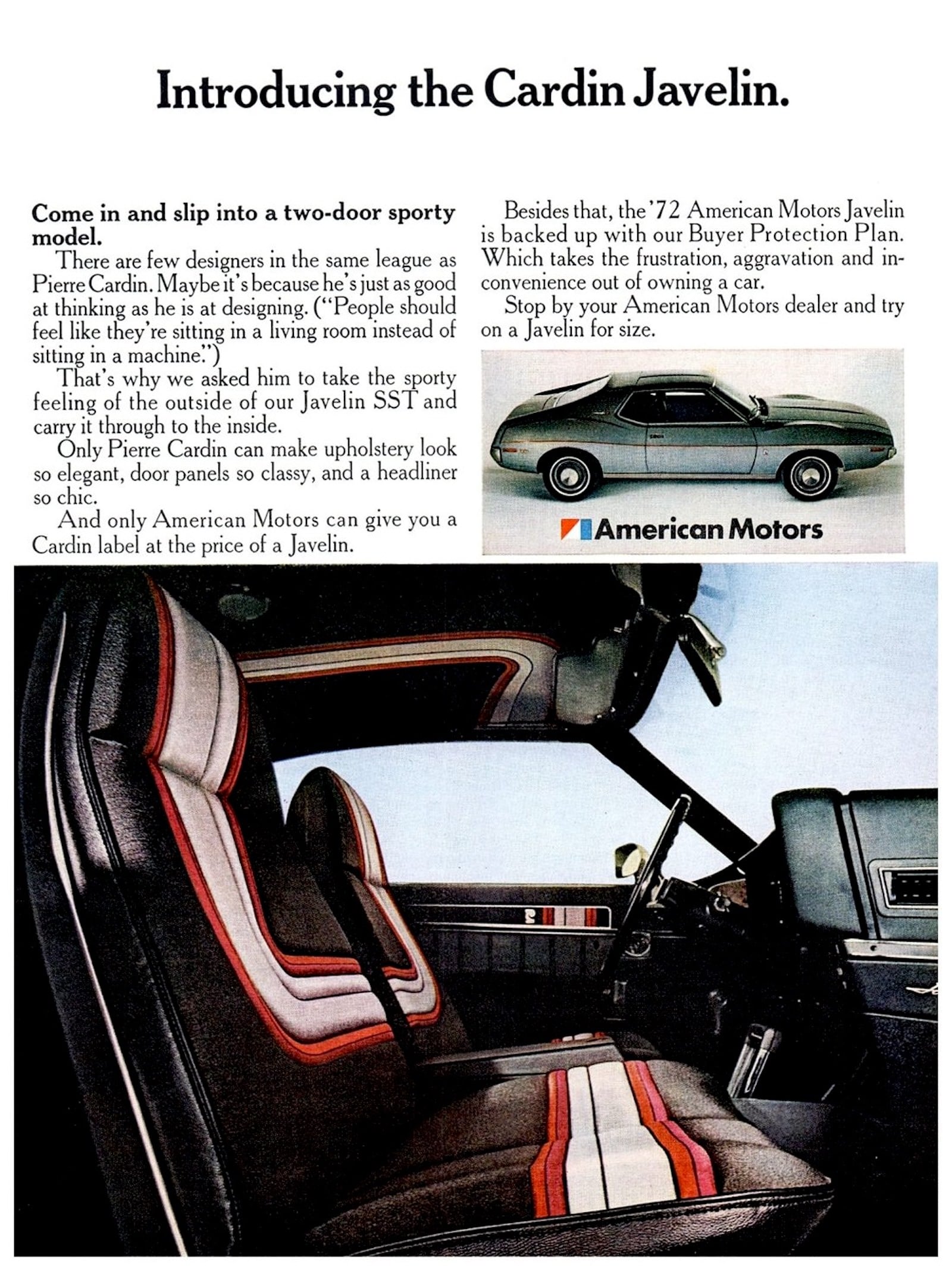
 A Pierre Cardin version of the AMX was also made with a reworked interior, it reached showrooms in March of 1972 as an $84.95 USD option on the Javelin SST – they had black trim with pleated stripes in silver, white, red and plum running across the seats, up the doors and over the headliner. Image courtesy of AMC.
History Speedrun: The AMC AMX
American Motors built 19,134 two-seat AMXs over three model years, it essentially made the AMX by taking twelve inches out of the Javelin. The company had neither the money nor the time to develop a new sports car from scratch, so it took the pony car it was already tooled up to build, tossed out the rear seat, shrunk the wheelbase, and put the result on sale in early 1968 at $3,245 USD. By way of a comparison, a Corvette coupe cost $4,663 USD.
AMC: A Company Running Out Of Road
American Motors Corporation (AMC) lost $12.6 million USD in 1966 as its US auto sales fell 20%, to 272,000 cars, and it held under 4% of the market. Robert B. Evans, a businessman known for buying into ailing companies, arrived and pushed for a two-seater based on the coming 1968 Javelin model.
The idea for a car like this from AMC was older – the company’s advanced styling studio under Charles Mashigan had been working on a two-seat concept called the AMX, for American Motors eXperimental, since back in 1965. A fiberglass version toured the 1966 auto show circuit with a fold-out “Ramble Seat” in the decklid. AMC weighed building the production car in fiberglass but rejected it, plastic bodies suited low-volume cars, and Kenosha already knew how to stamp steel.
Shortening the Javelin gave the AMX a 97 inch wheelbase, one inch under a Corvette’s, and an overall length of 177 inches. Front fenders, doors, bumpers and most of the cabin were Javelin parts. An elongated sail panel stretched the roofline, and it had a hood pressing with twin power bulges to add a little visual pizzazz.
Ford’s two-seat Thunderbird had grown a back seat for 1958, which left the Corvette as the only mass-produced American two-seater until AMC turned up. Not including low-volume specials like the Shelby Cobra or the early Shelby GT350s, among others.
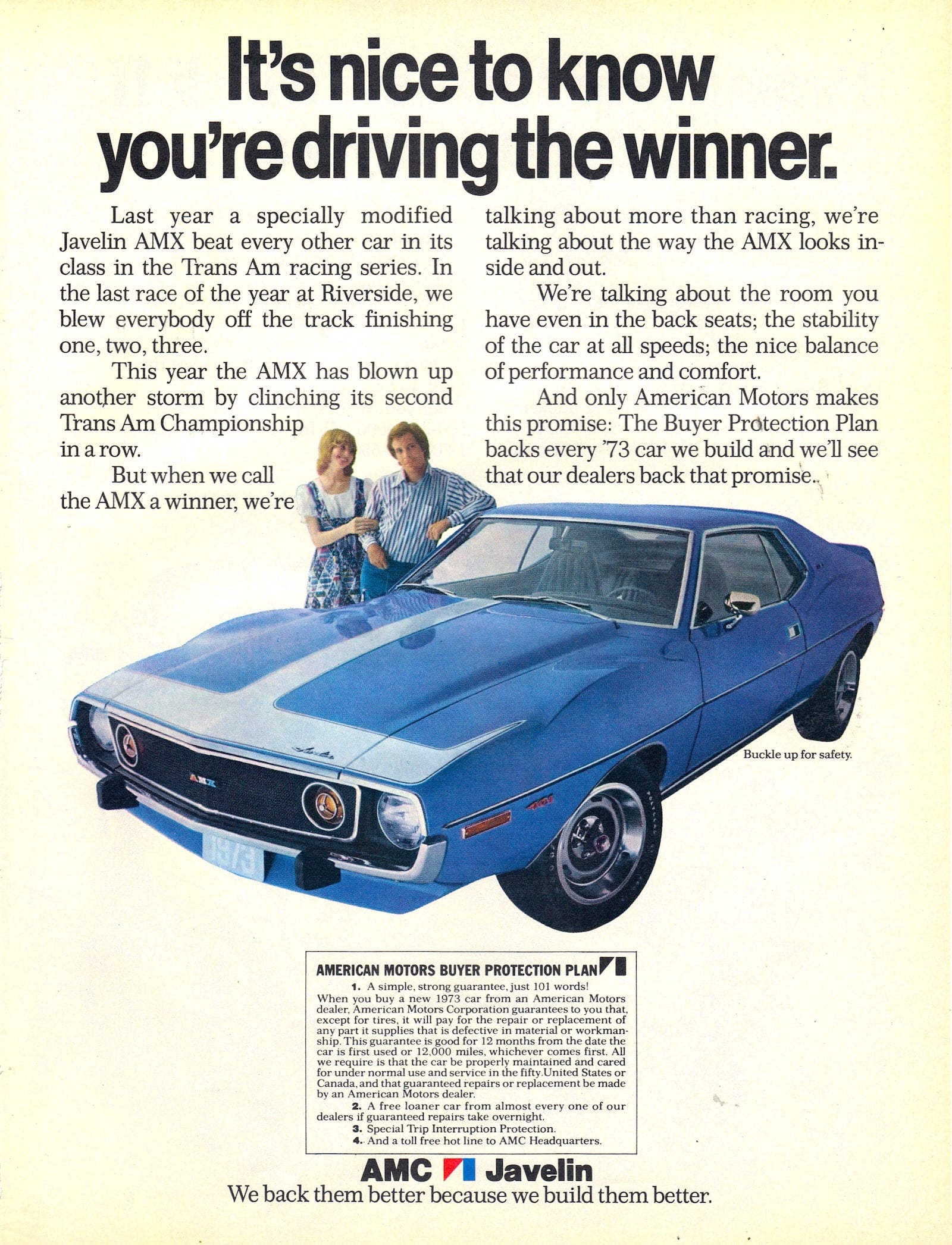
AMC dropped the short-wheelbase car after 1970 and turned AMX into a performance package on the four-seat Javelin from 1971 to 1974. Image courtesy of AMC.
AMC AMX: The Engines
Every regular-production AMX had a V8 with a single four-barrel carburetor, no six was ever offered. The standard 290 V8 made 225 bhp, the optional 343 made 280 bhp, and the 390 made 315 bhp with 425 lb ft of torque, all gross SAE figures.
The three shared external block dimensions, but the 390 used a forged steel crankshaft and connecting rods, where the smaller engines used cast units, plus it had larger rod bearings. A Borg-Warner T-10 4-speed was standard, a 3-speed Shift-Command automatic was optional.
For improved, sports car-like handling the AMX was fitted with heavy-duty springs, a chonky front sway bar, E70x14 tires and a pair of torque links acting as traction bars against rear axle hop. The 390 was what most buyers wanted – 4,399 of the 6,725 cars built for 1968 had one sitting under the hood.
Breedlove And The Need For A Reputation
Before the AMX reached showrooms, AMC Performance Manager Carl Chakmakian recruited land speed record holder Craig Breedlove, who took two prepared cars to Goodyear’s Texas proving ground. One had its 290 V8 bored to 304 cubic inches, the other its 390 to 397 cubic inches.
Sharing the driving with his wife Lee as well as Ron Dykes, Breedlove set no less than 106 speed and endurance records. AMC introduced the car to the press at Daytona in early-1968 and to its dealers at nine Playboy Clubs. Group vice president Vic Raviolo, previously responsible for the Lincolns that raced in the Carrera Panamericana, called it “the Walter Mitty Ferrari.”
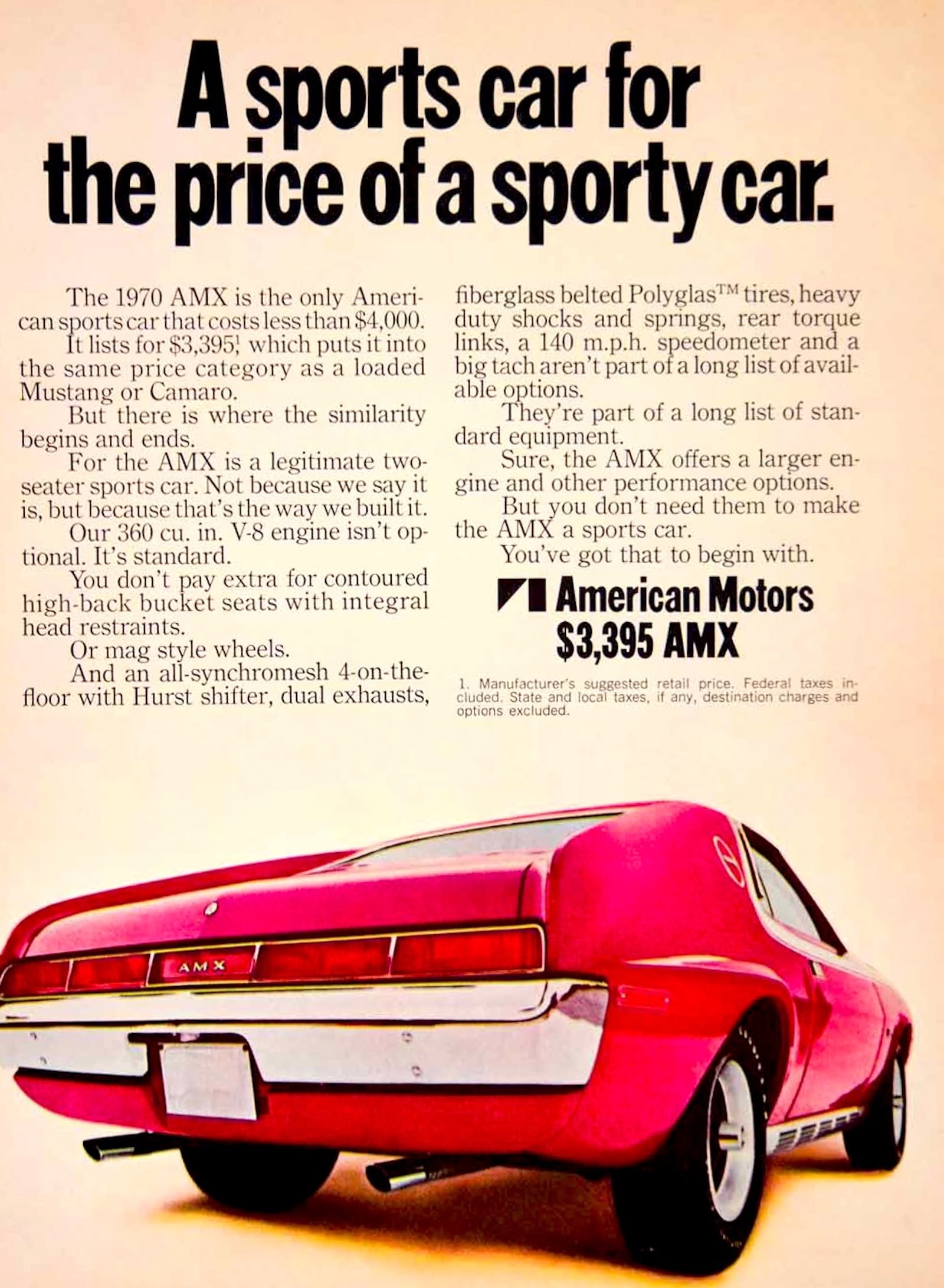
The press were largely impressed with the AMX, Tom McCahill wrote in Mechanix Illustrated that the AMX was “the hottest thing to ever come out of Wisconsin.” Car and Driver ran a 390 to 60 mph in 6.6 seconds and through the quarter mile in 14.8 at 95 mph. Image courtesy of AMC.
The press were largely impressed, Tom McCahill wrote in Mechanix Illustrated that the AMX was “the hottest thing to ever come out of Wisconsin.” Car and Driver ran a 390 to 60 mph in 6.6 seconds and through the quarter mile in 14.8 at 95 mph. Road & Track was a little cooler in their review, calling the steering “slow and numb,” criticizing the proportions behind the A-pillar, and noting the 4-speed’s ratios sat too close together for an engine that had done all it could by 5,000 rpm.
AMC AMX: The Variants
For 1969, AMC offered a $34 “Big Bad” paint option in blue, orange, or green, with bumpers painted to match. Southern California dealers offered a California 500 Special in Big Bad Green with side pipes and brass hood plaques, the number built is estimated at 32, though no official figure exists that we could find.
The most serious performance-oriented variant was the Super Stock AMX. AMC sent 52 cars to Hurst Performance (NHRA homologation required 50) where the 390s received twin Holley four-barrels on an Edelbrock cross-ram intake, 12.3:1 compression, Crane-worked heads and Doug’s headers.
AMC rated them at 340 bhp but the NHRA factored them at 405 bhp and later raised that up to 420 bhp. They sold for $5,994 with no factory warranty and ran the quarter in the low 11s and, at best, the 10s. They were very quick.
For 1970 the car was reworked pretty comprehensively, a new 360 cubic inch V8 replaced both smaller engines with 290 bhp, 65 more than the old base 290, and the 390 gained new heads, pushing output up to 325 bhp. The trunnion-type front suspension of the first two years gave way to ball joints, a change that gave them a clear improvement in handling.
The hood blisters became functional ram-air intakes with the Go Package, the nose and tail were restyled around a full-width grille and lamps, and overall length grew about two inches. It was also the rarest year, with just 4,116 cars made.
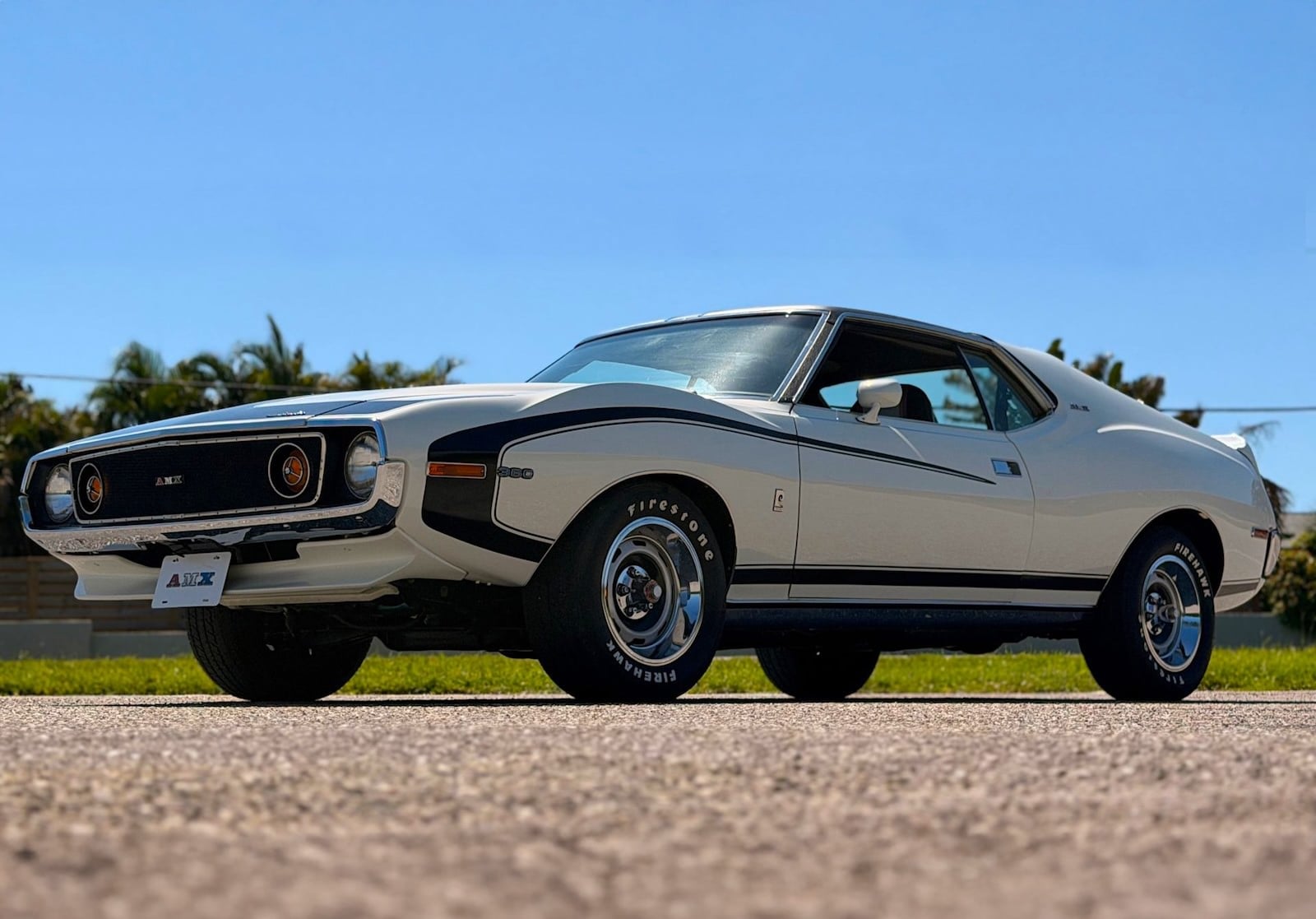
This is an original 1972 AMC AMX Pierre Cardin, it’s a car that’s been forgotten by almost everyone, but it represents a fascinating time when European fashion houses were adding a dash of style to American production cars.
Interestingly, Australia got exactly 24 of them – Australian Motor Industries assembled them as right-hand-drive 1969 cars at Port Melbourne between mid-1969 and mid-1970, all badged as the Rambler AMX, and every one with the 343 V8 and the automatic gearbox, in a choice of White, Safety Wattle Yellow, or Signal Red.
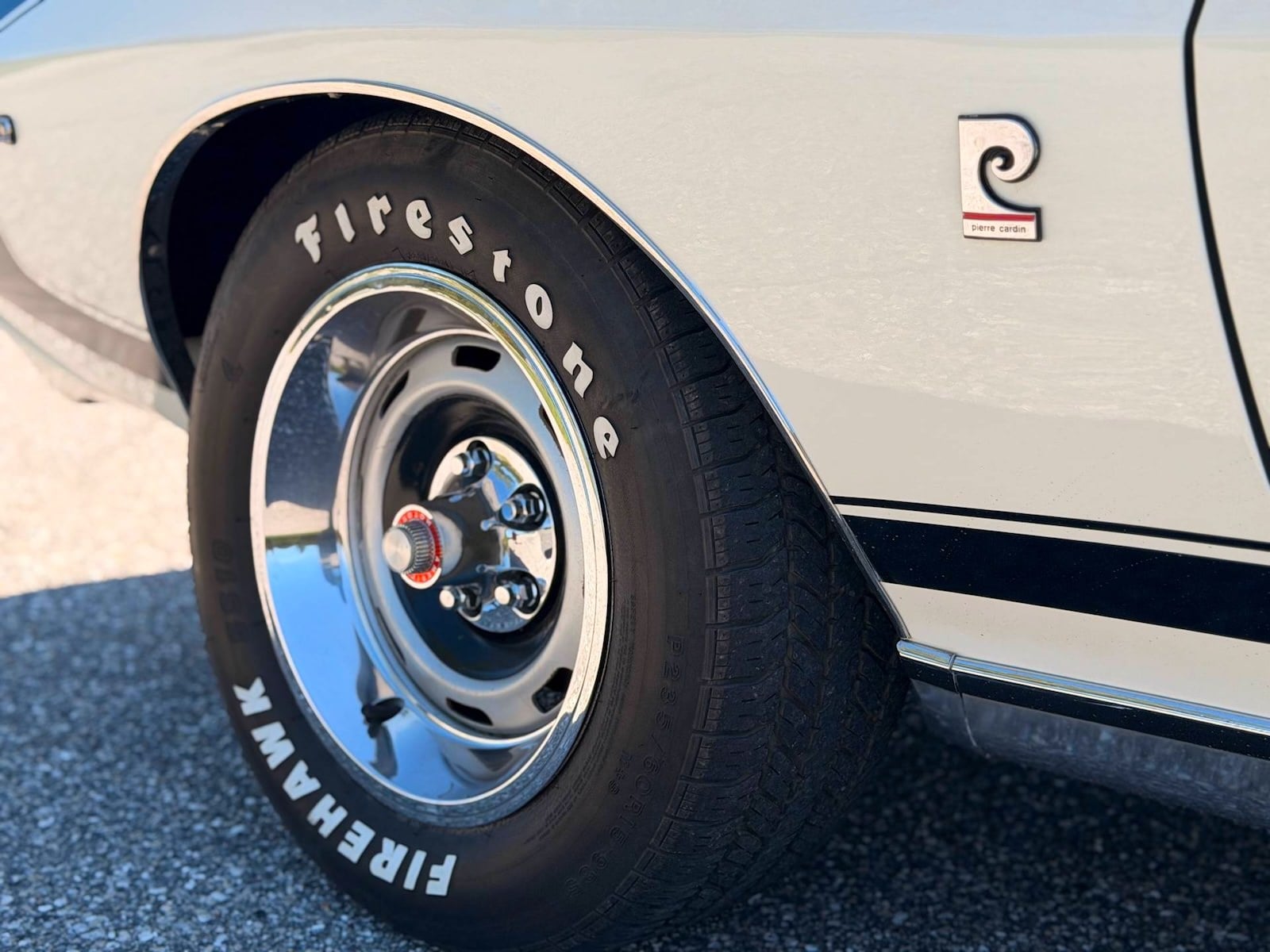
The Pierre Cardin AMC AMX
A Pierre Cardin version of the AMX was also made, but it arrived after the two-seater had disappeared from production. AMC dropped the short-wheelbase car after 1970 and turned AMX into a performance package on the four-seat Javelin from 1971 to 1974.
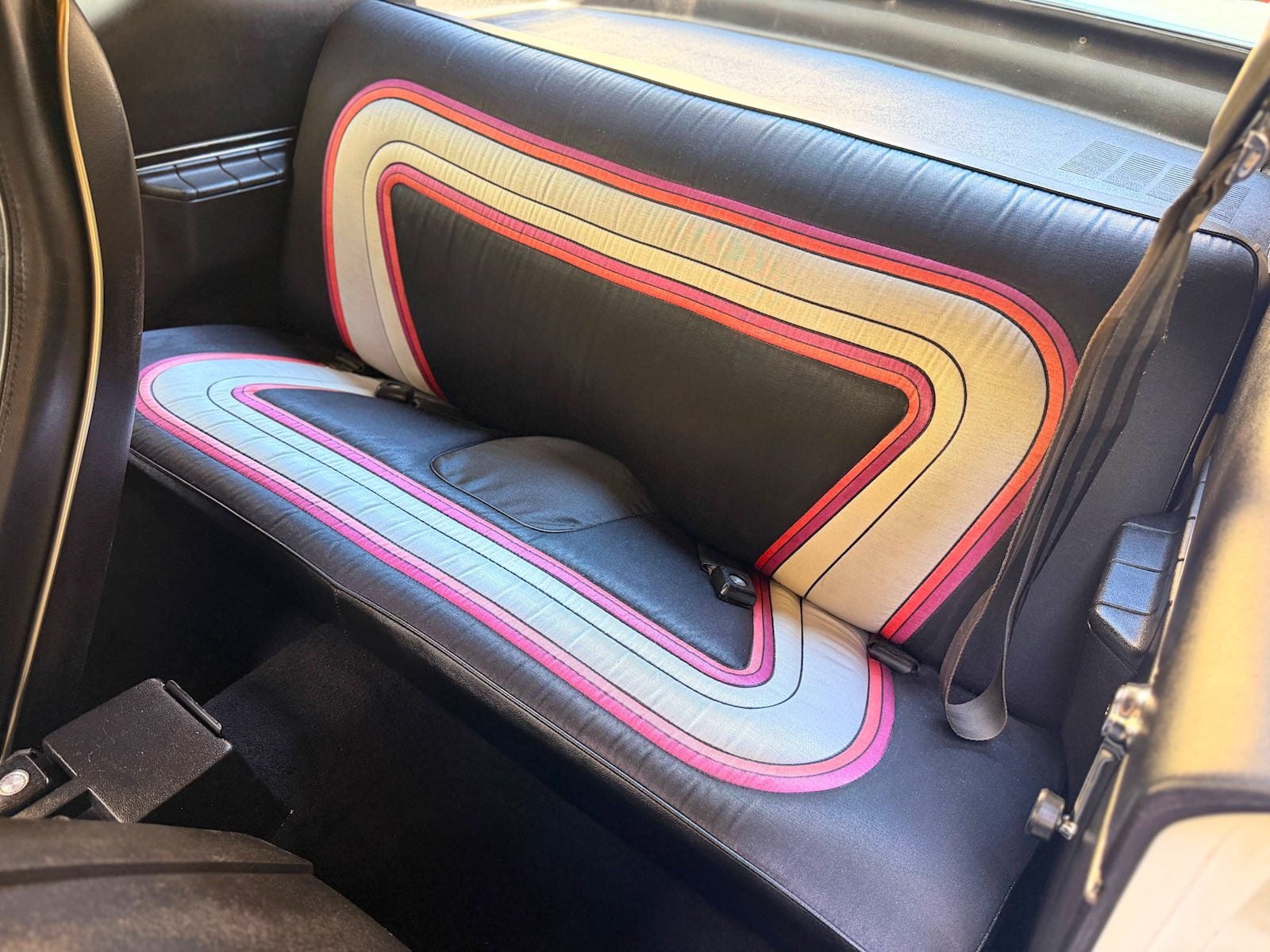
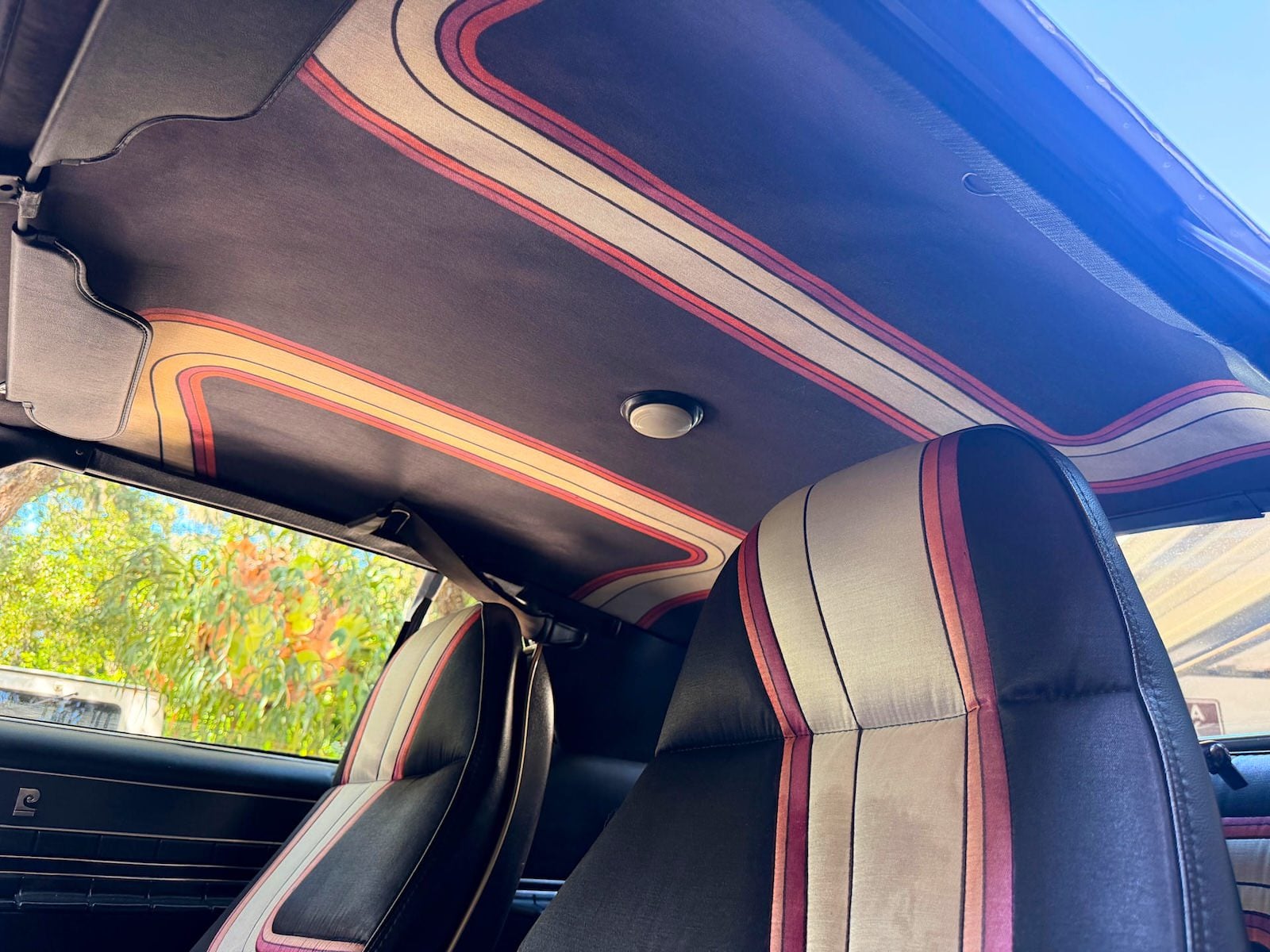
Cardin reworked the interior of the AMX, and it reached showrooms in March of 1972 as an $84.95 USD option on the Javelin SST – they had black trim with pleated stripes in silver, white, red and plum running across the seats, up the doors and over the headliner.
AMC ran a few more of these fashion tie-ups, including a Gucci Hornet Sportabout and an Oleg Cassini Matador.
The End Of The Line
Dick Teague didn’t want to let the two-seater go. He built a 1971 AMX concept on a 1968 mule, failed to get it approved, and used it as his own daily driver. The badge carried on without the missing back seat, appearing on the Hornet in 1977, the Concord in 1978, and the Spirit for 1979 and 1980.
The AMC AMX Pierre Cardin Shown Here
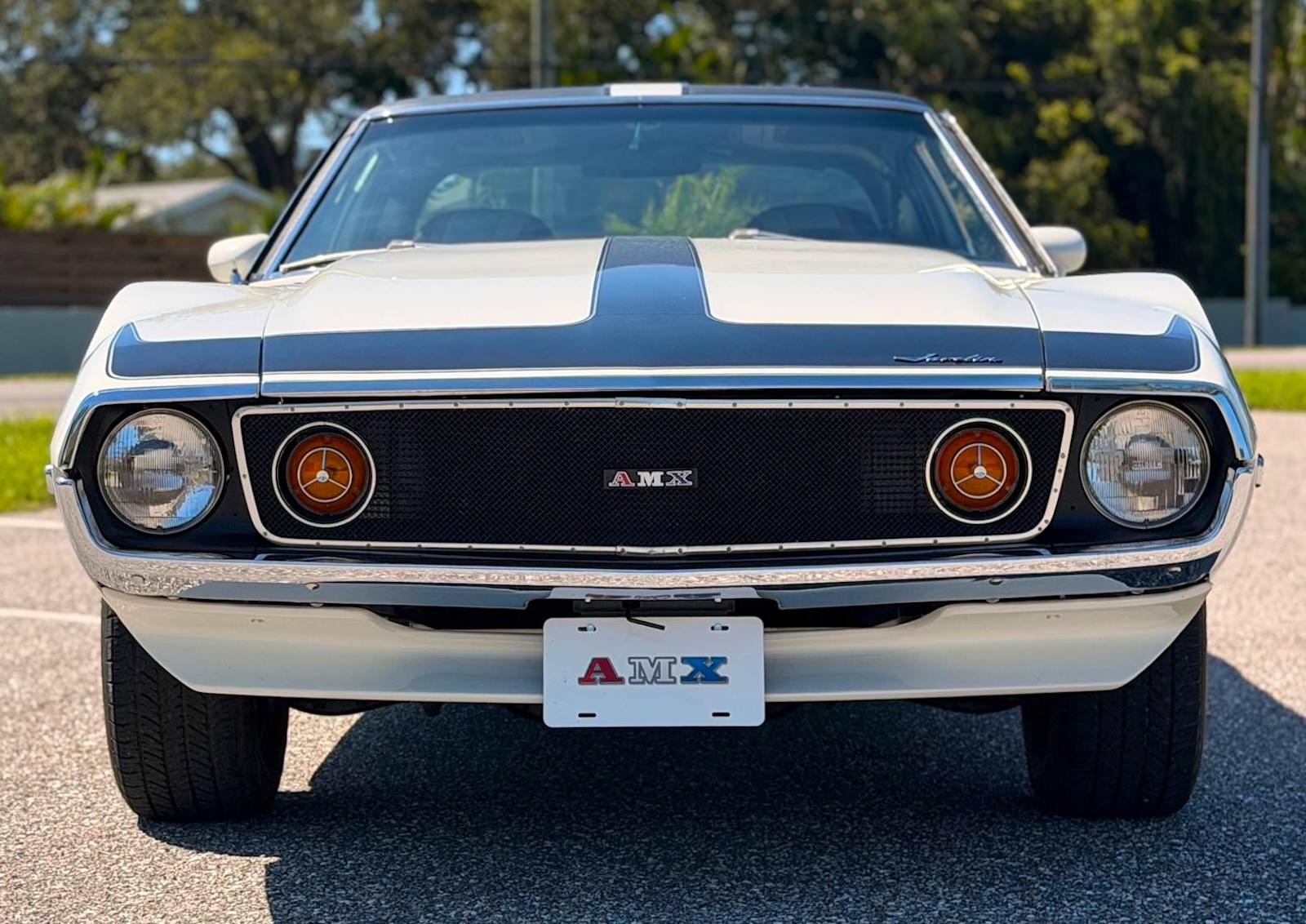
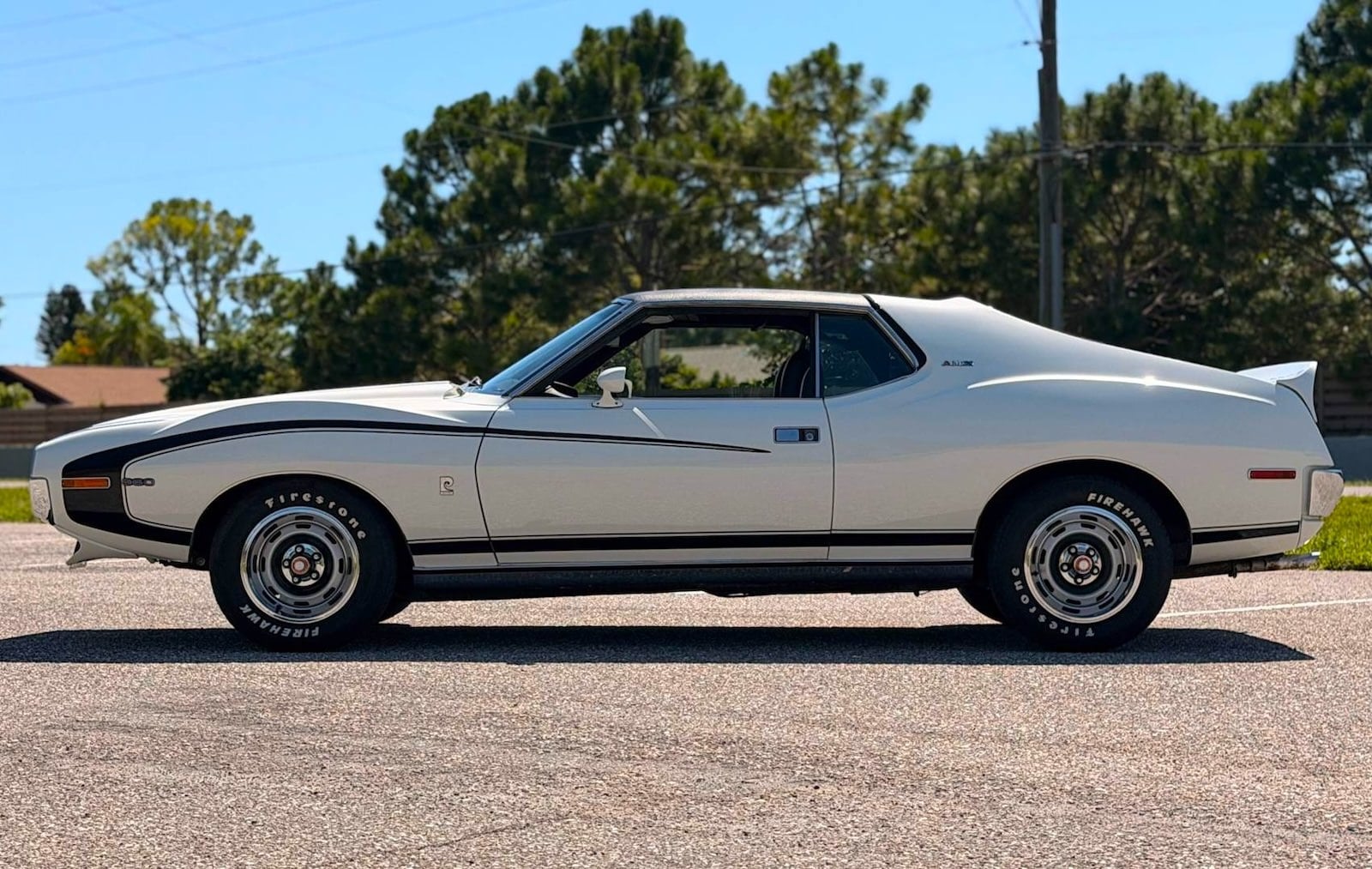
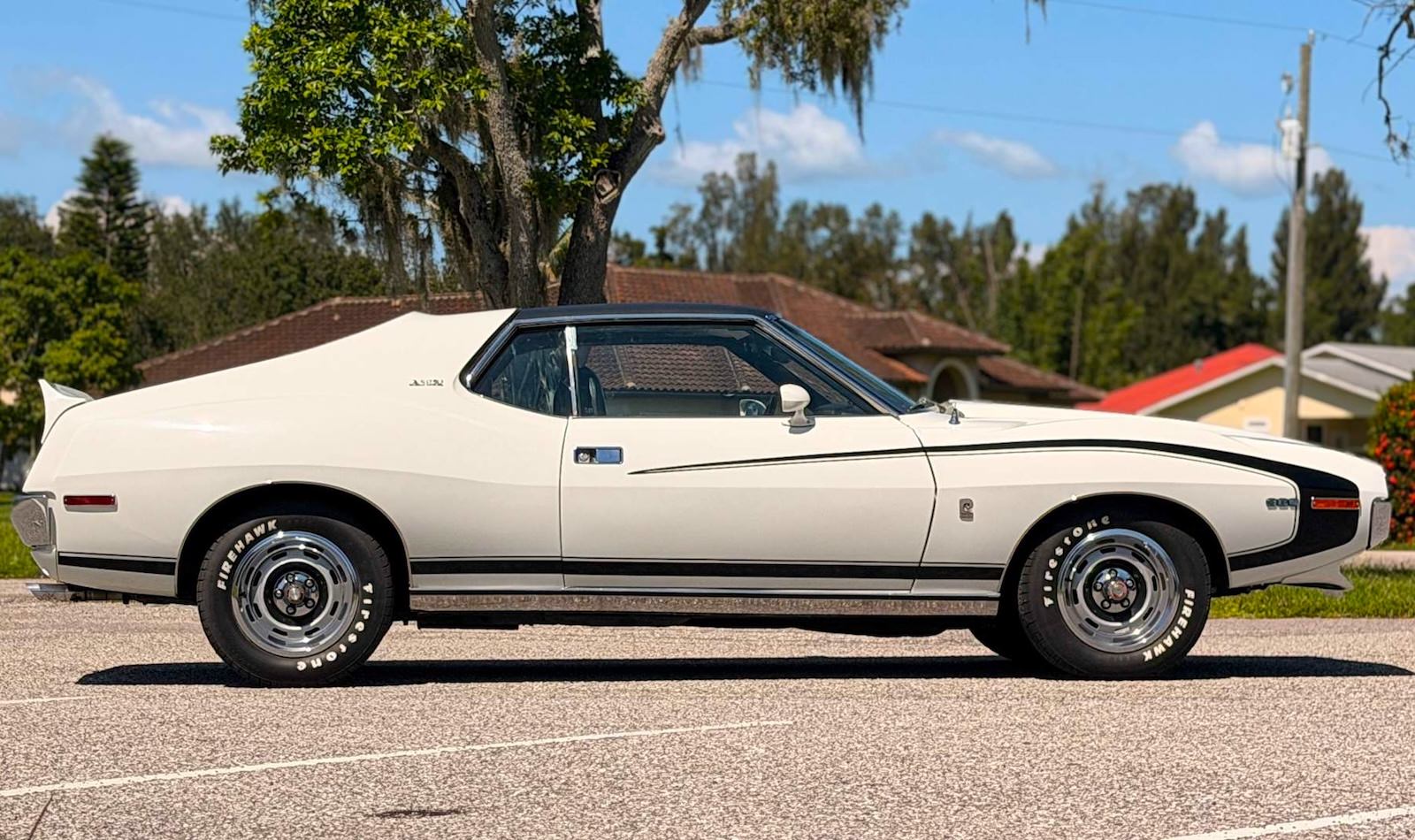
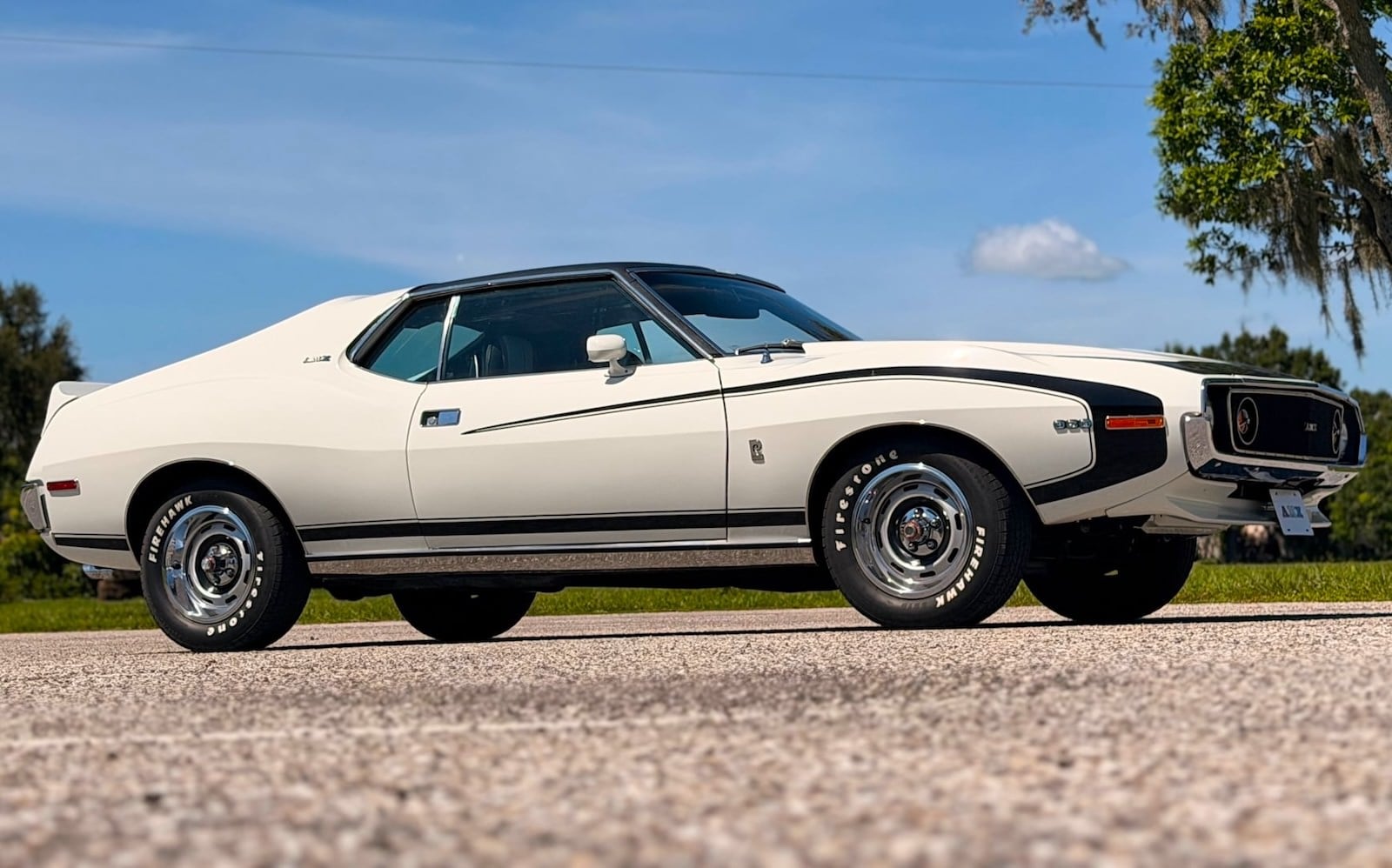
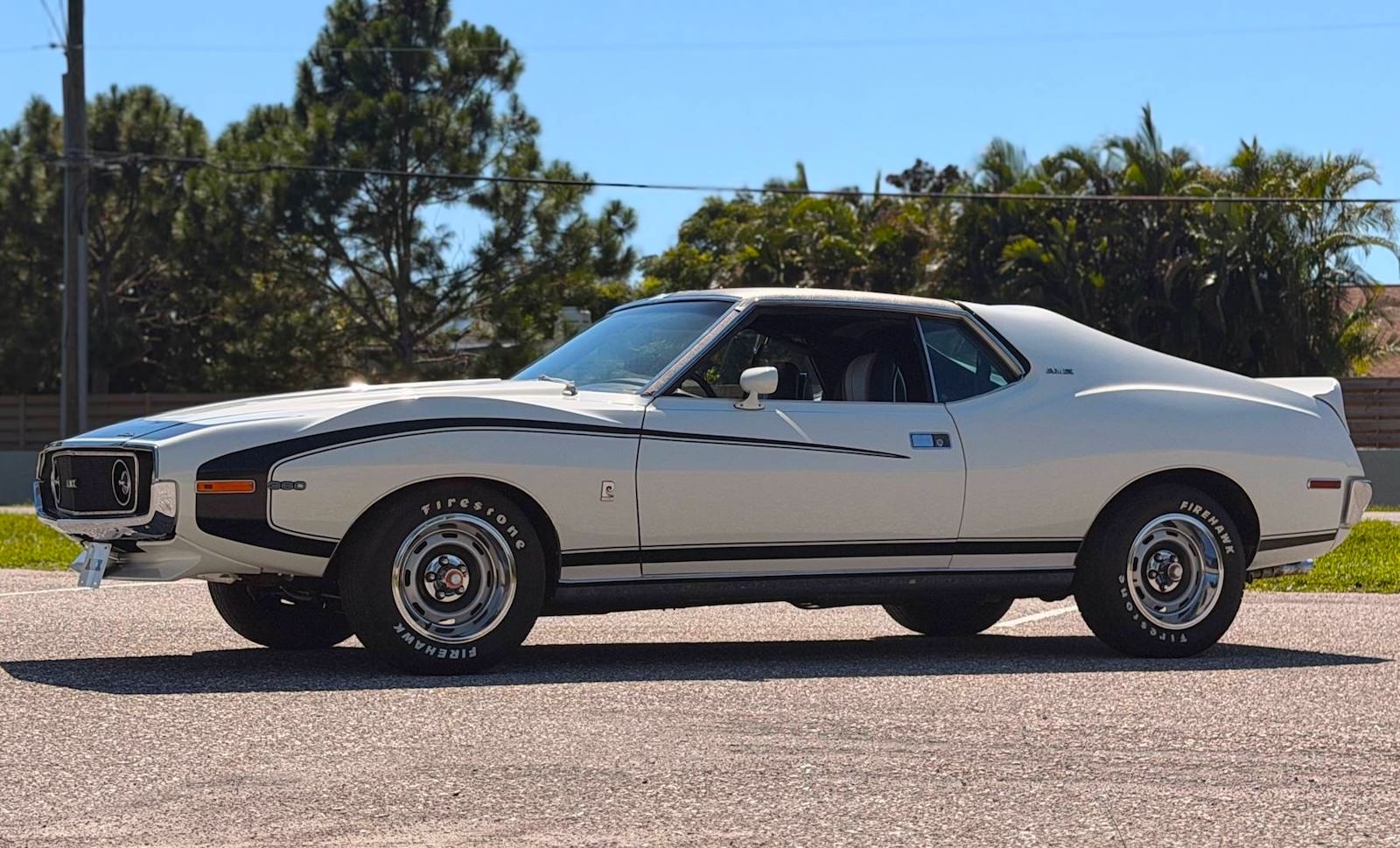
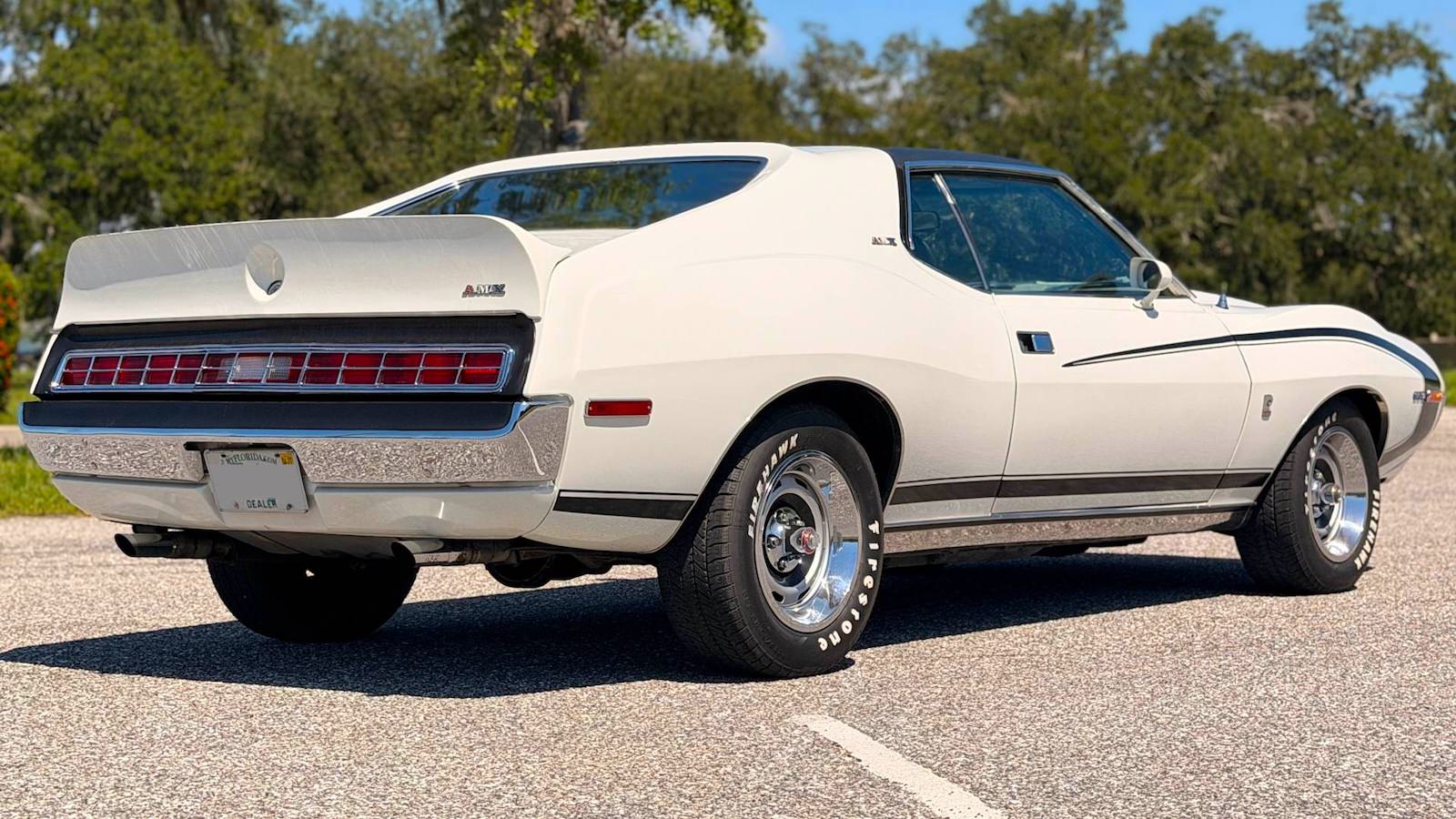
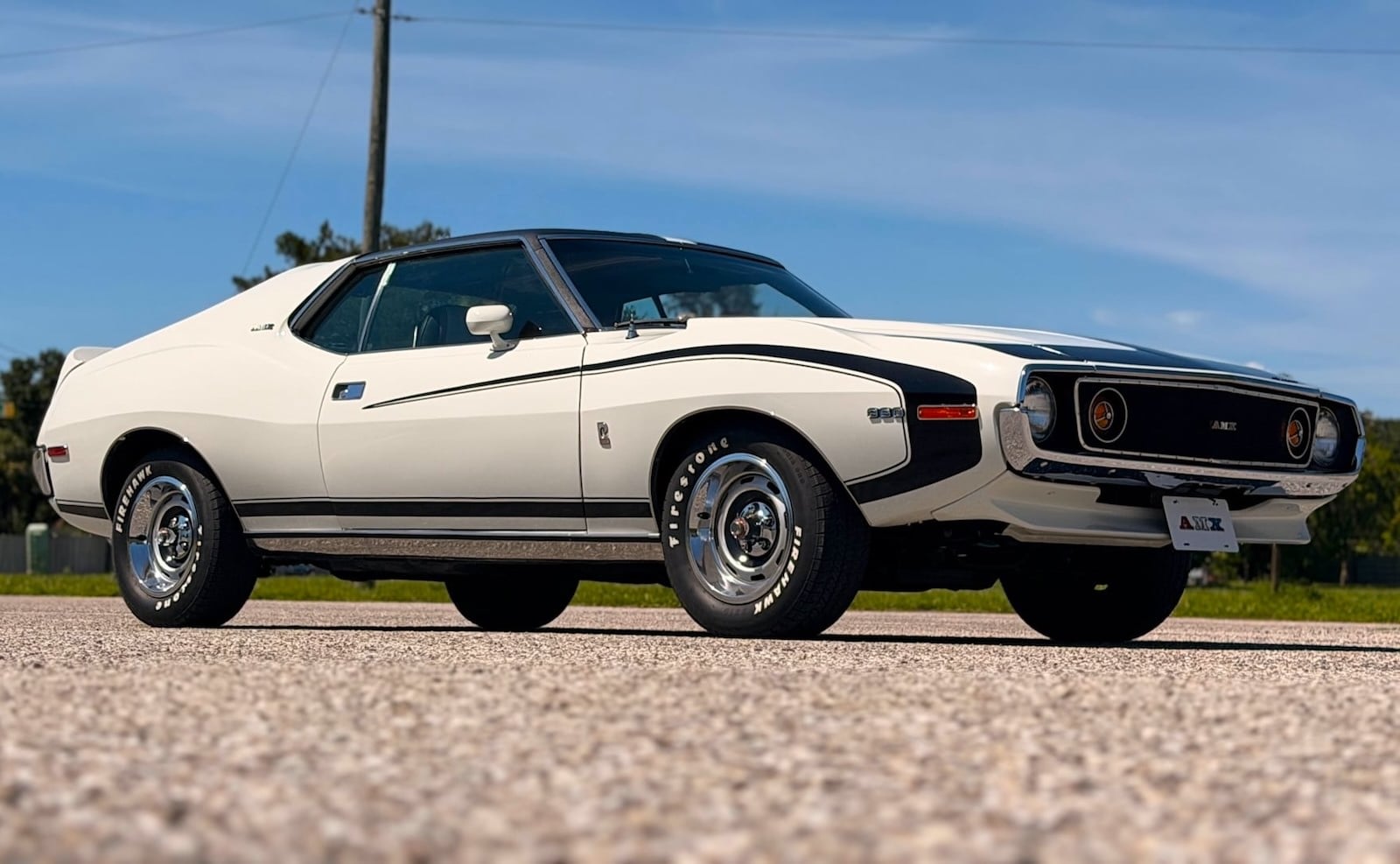
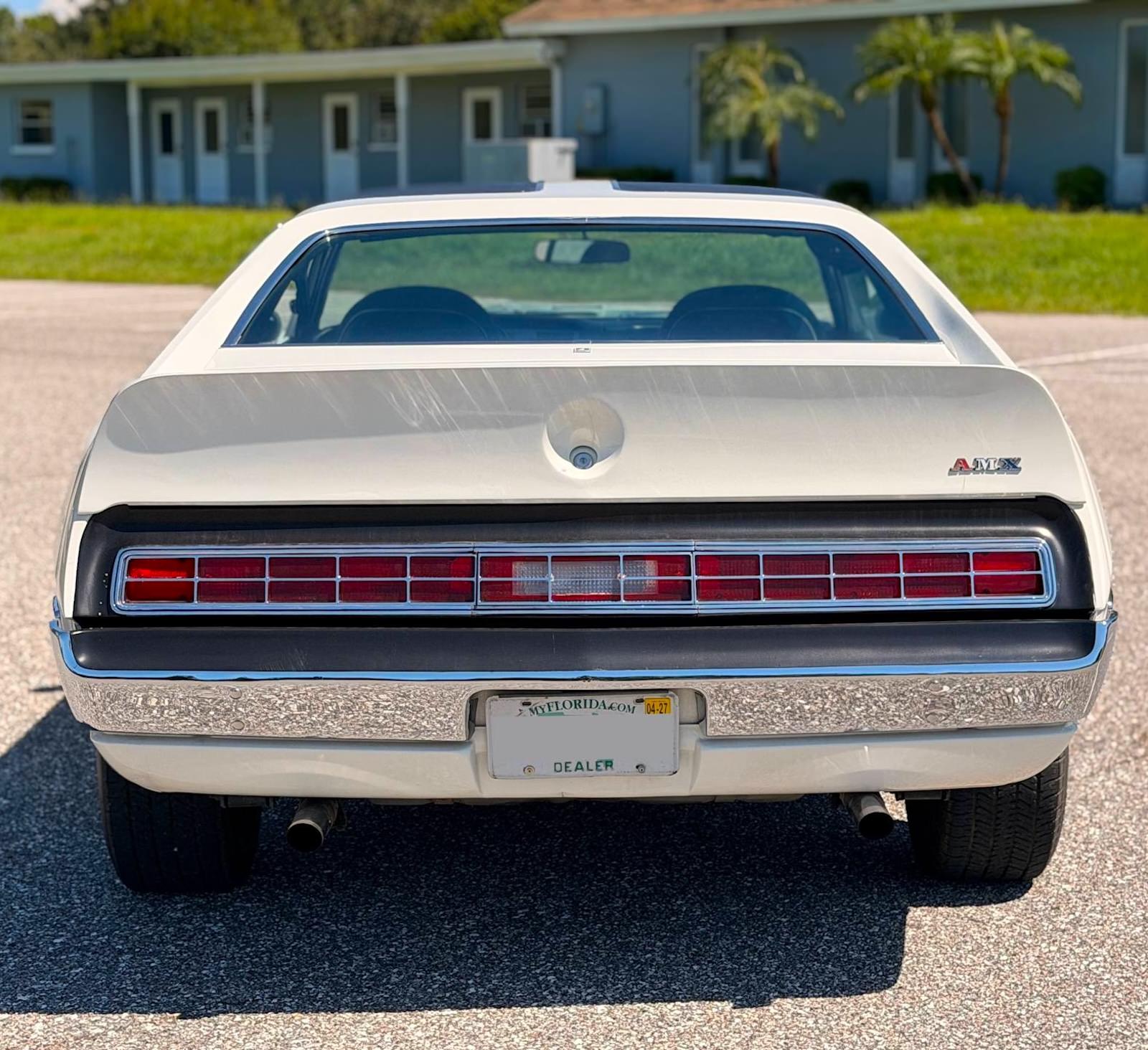
This is an original 1972 AMC AMX Pierre Cardin, it’s one of the 1,276 Pierre Cardin examples that were made, and it’s not known how many have survived to the modern day – but it’s likely vastly fewer than 1,000.
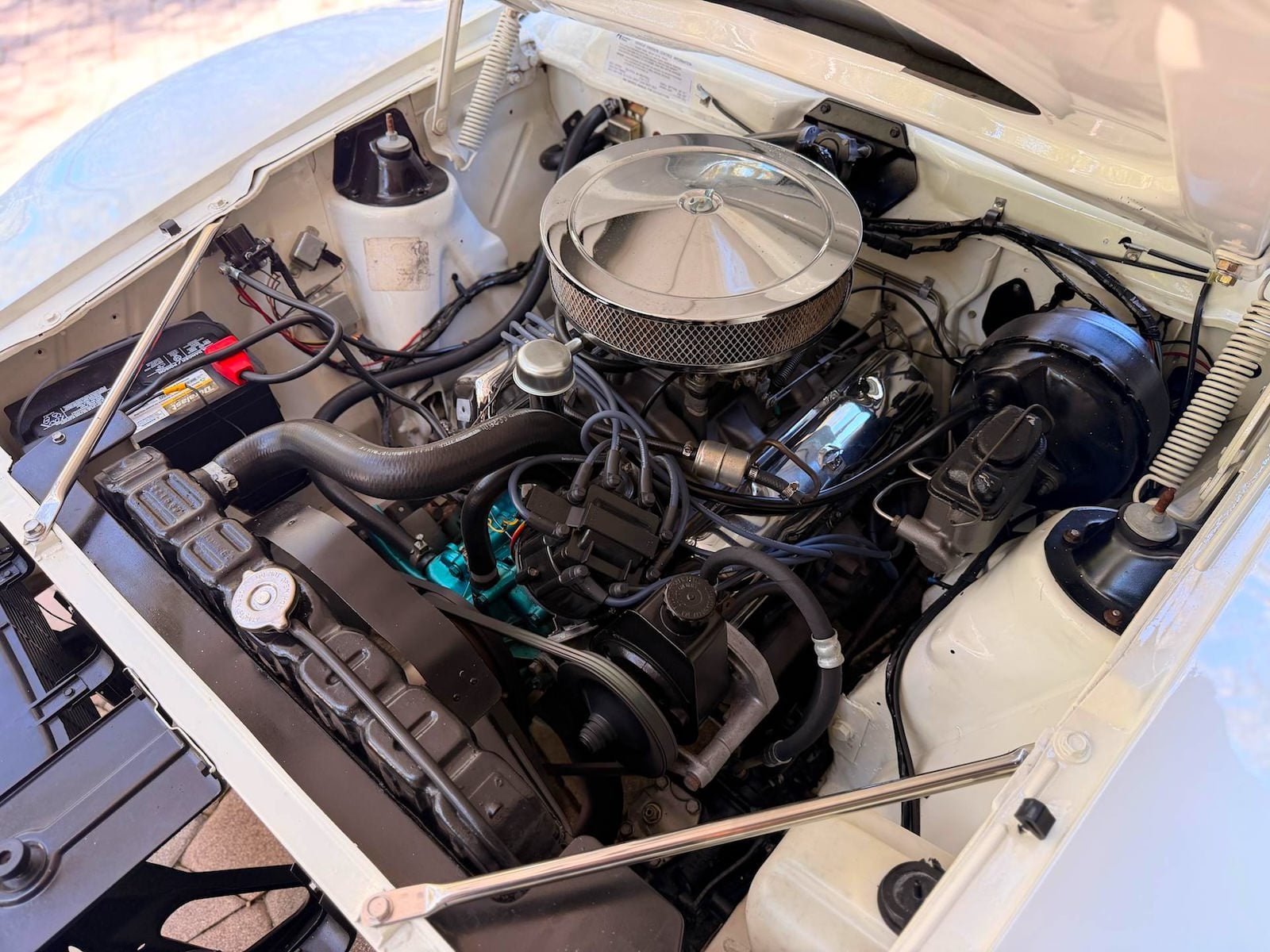
This car is finished in white with black stripe details, and it rides on steel wheels with chrome dress up rings, and Firestone Firehawk tires on all four corners. Power is provided by a 360 cubic inch AMC V8 and sent back through an automatic transmission to the rear wheels.
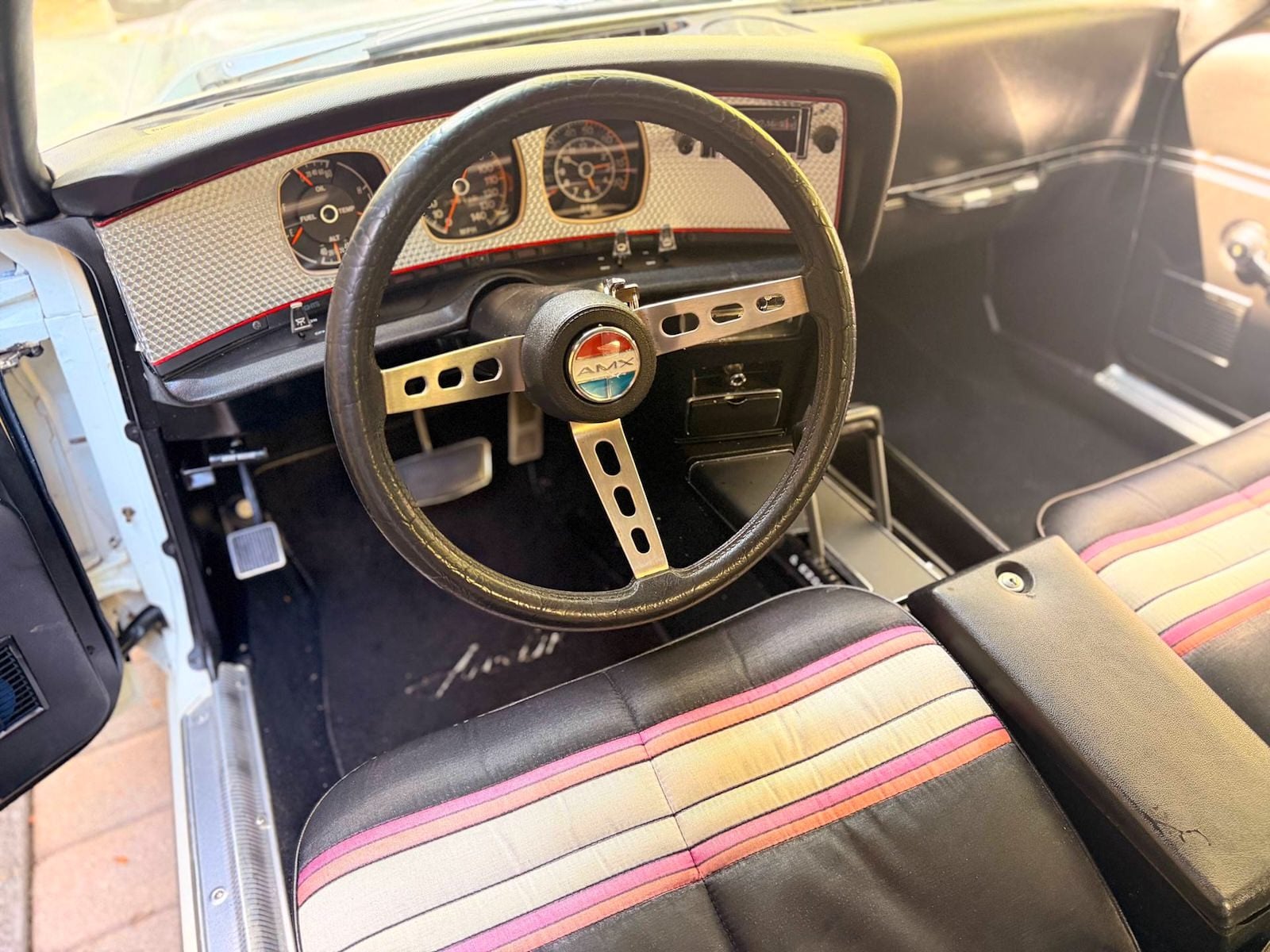
Inside you’ll find two front bucket seats and a rear bench, the upholstery is black with white stripes that have pink edging.
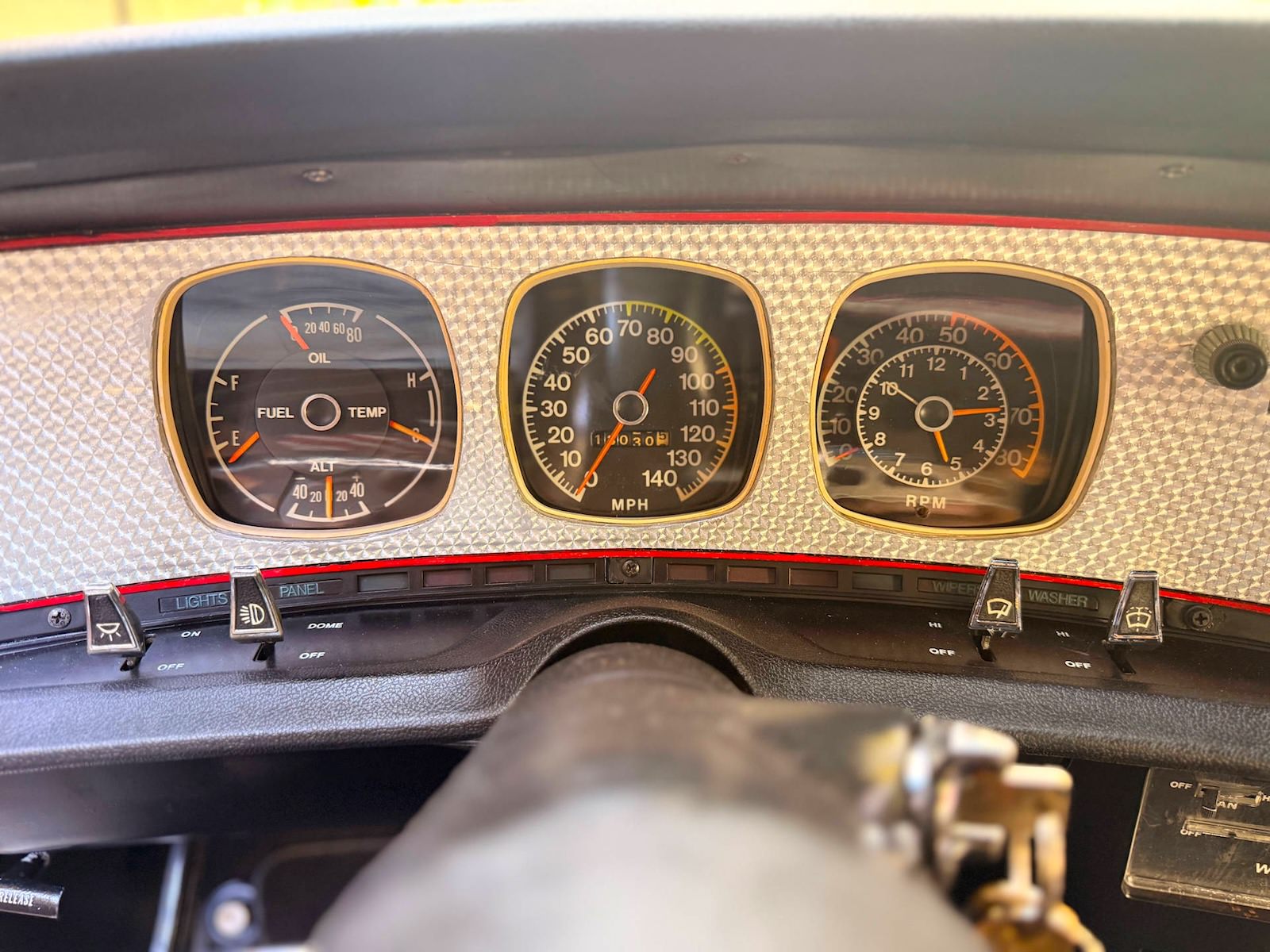
It has a dual exhaust, a factory tachometer, power steering, front disc brakes, and of course, an interior designed by Pierre Cardin. Inside you’ll find two front bucket seats and a rear bench, the upholstery is black with white stripes that have pink edging.
It’s now due to roll across the auction block with Mecum in late-September and you can visit the listing here if you’d like to read more about it or register to bid.
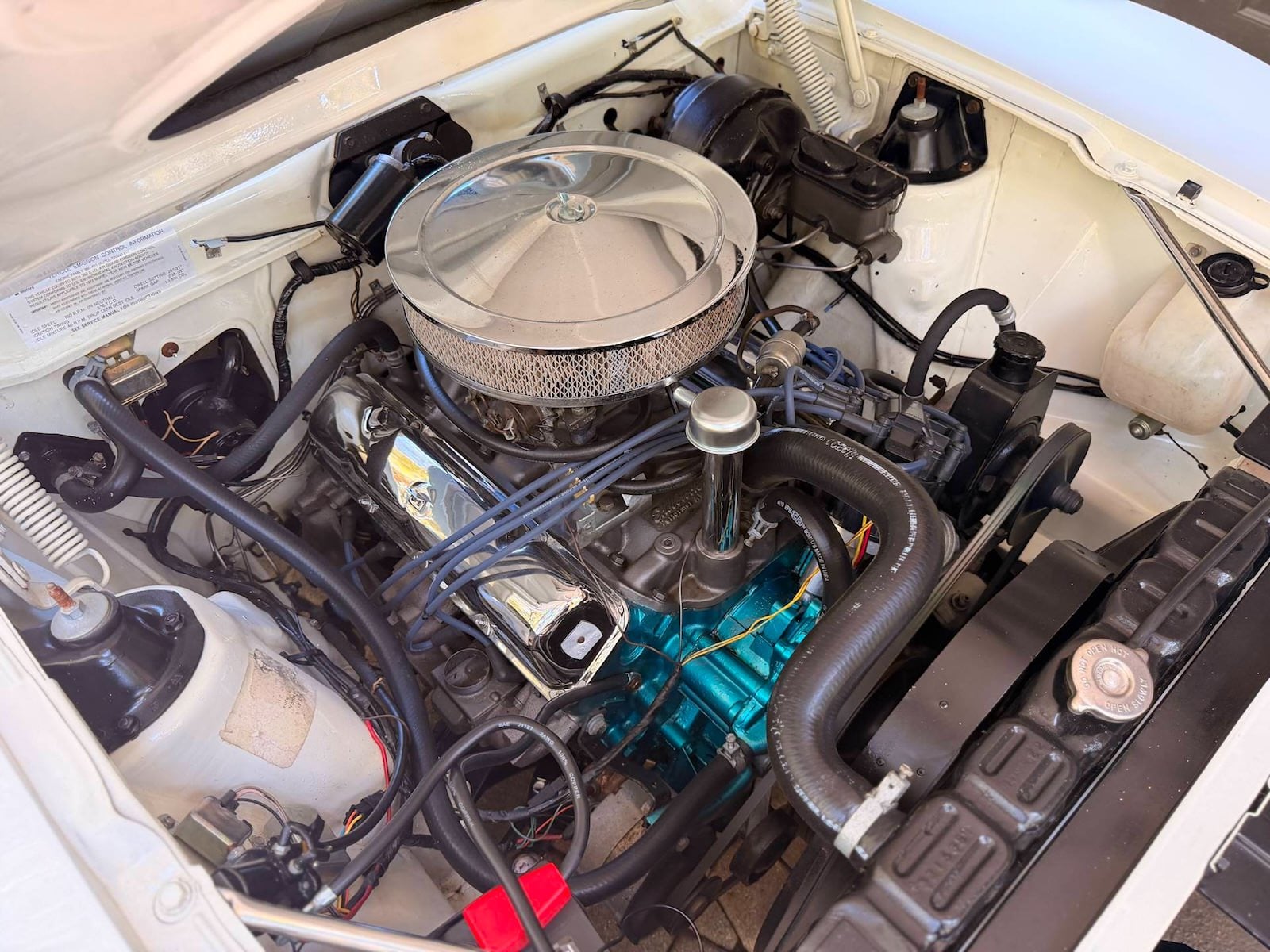
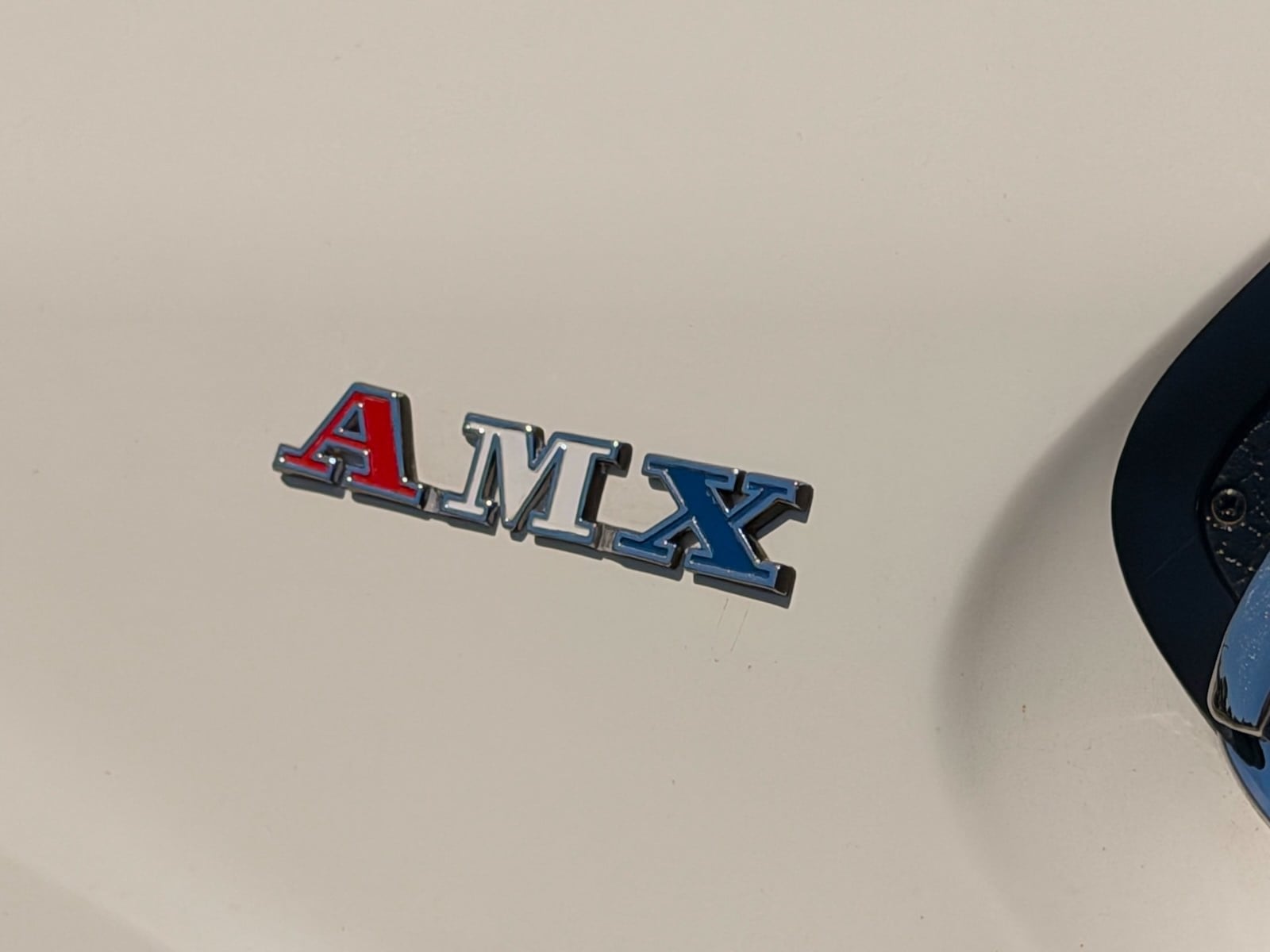
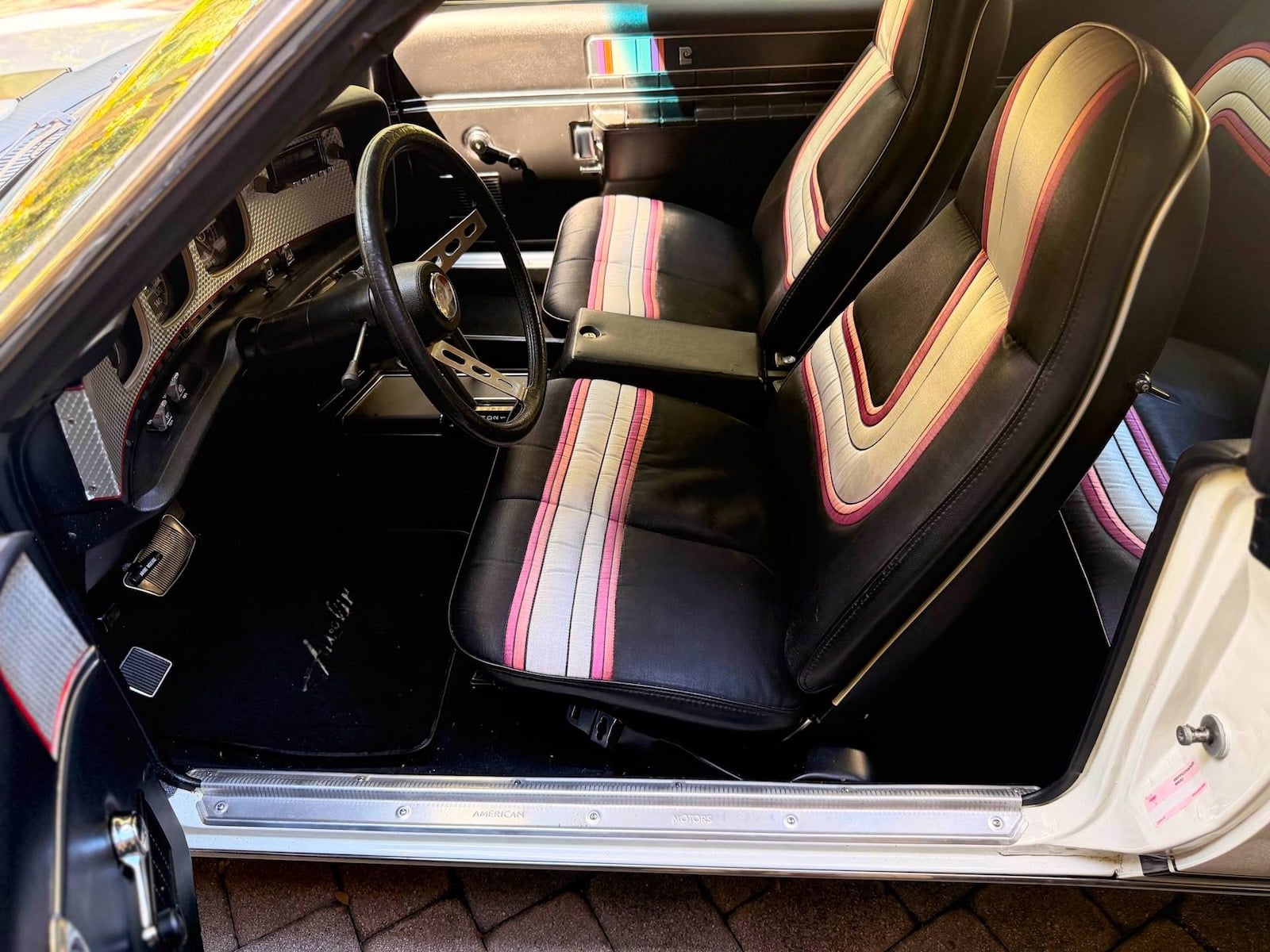
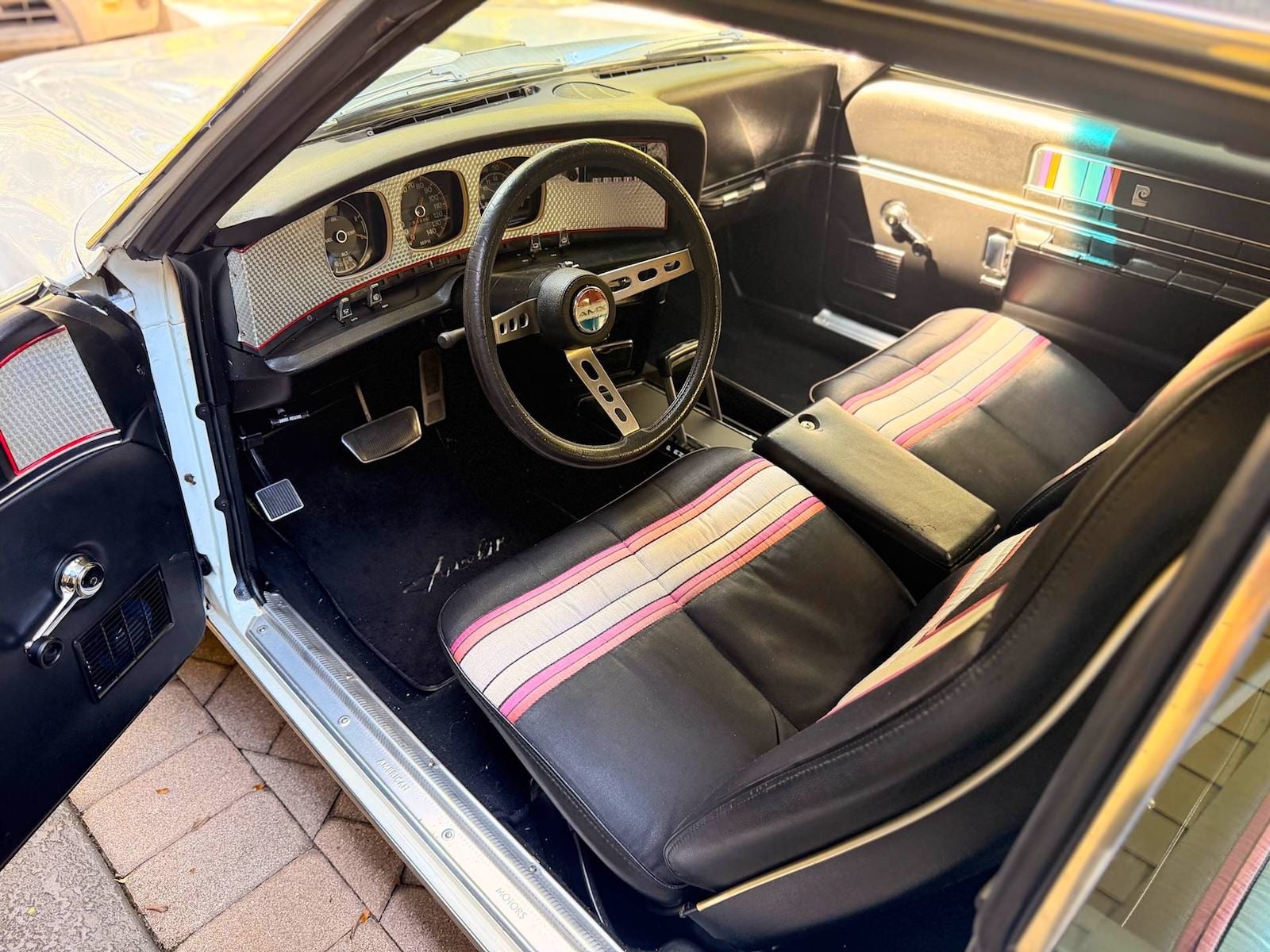
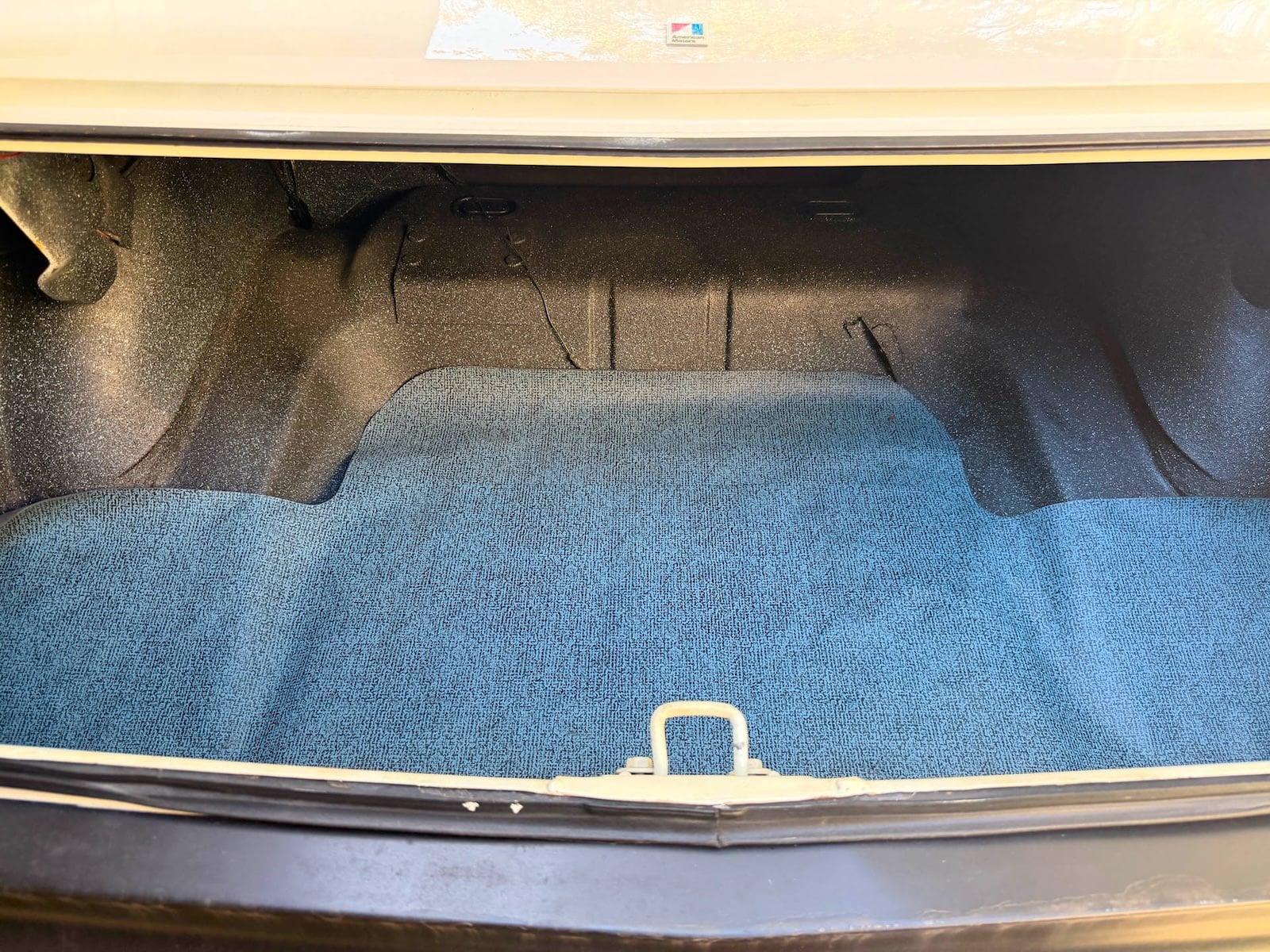
Images courtesy of Mecum

Articles that Ben Branch has written have been covered on CNN, Popular Mechanics, Smithsonian Magazine, Road & Track Magazine, the official Pinterest blog, the official eBay Motors blog, BuzzFeed, Autoweek Magazine, Wired Magazine, Autoblog, Gear Patrol, Jalopnik, The Verge, and many more.
Silodrome was founded by Ben back in 2010, in the years since the site has grown to become a world leader in the alternative and vintage motoring sector, with well over a million monthly readers from around the world and many hundreds of thousands of followers on social media.