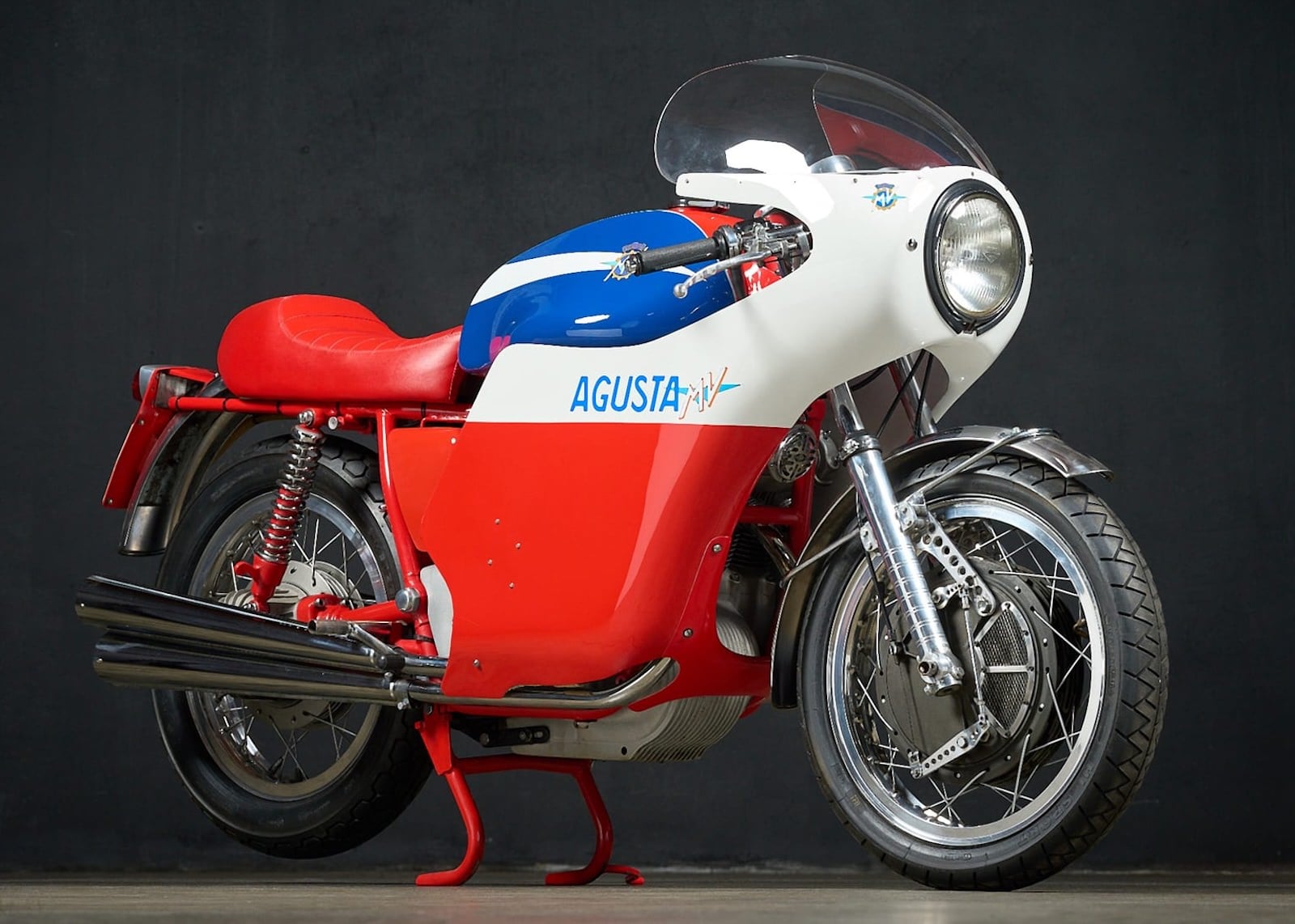
This is a rare, original 1971 MV Agusta 750S. It’s one of the first 56 that were made that year, and for many vintage motorcycle enthusiasts, this is a true bucket list classic that few will ever get the chance to own.
Long before the Japanese manufacturers came along and made transverse four-cylinder motorcycles affordable to the masses, they were the stuff of grand prix racing legend – and most of them came from Italian manufacturers like Gilera and MV Agusta.
Fast Facts: A 1971 MV Agusta 750S
- The MV Agusta 750S emerged from the Italian manufacturer’s Grand Prix racing heritage. Introduced in 1970, it followed the commercially unsuccessful 600cc four-cylinder tourer. Count Domenico Agusta reluctantly approved the sporting model but insisted on keeping the shaft drive. Only 9 were built in 1970, followed by 56 examples in 1971.
- The 750S featured a 743cc DOHC inline-four producing 66 bhp, with gear-driven camshafts, four Dell’Orto carburetors, a 5-speed transmission, and enclosed shaft drive. Its tubular steel frame carried Ceriani front forks, Sebac rear shocks, Borrani alloy rims, and a four-leading-shoe front drum brake. It weighed approximately 235 kgs dry.
- Despite MV Agusta’s claimed 140 mph top speed, road tests of the time recorded 112 to 114 mph. Giacomo Agostini raced a specially prepared 750S at the 1972 Imola 200, briefly leading before retiring. Later versions received upgraded engines and disc brakes, and the model was eventually succeeded by the 750S America in 1975.
- The 1971 MV Agusta 750S featured here is an early-production example authenticated by motorcycle historian Ian Falloon. Finished in red, white, and blue, it retains its distinctive four-cylinder engine and features a GP-style fairing, red leather seat, and approximately 21,000 kilometers indicated. It’s offered in Oregon with documentation and memorabilia, but without a title.
History Speedrun: The MV Agusta 750S
In 1949 Count Domenico Agusta persuaded engineer Piero Remor to leave Gilera, where he had designed the 500cc four-cylinder engine used in Gilera’s Grand Prix bikes, and join his own company – motorcycle manufacturer MV Agusta. Remor’s first MV Agusta four-cylinder bike raced in 1950, its engine was virtually identical to his earlier Gilera design. To set it apart (and perhaps to avoid legal trouble) the MV had a shaft drive and torsion bar suspension.
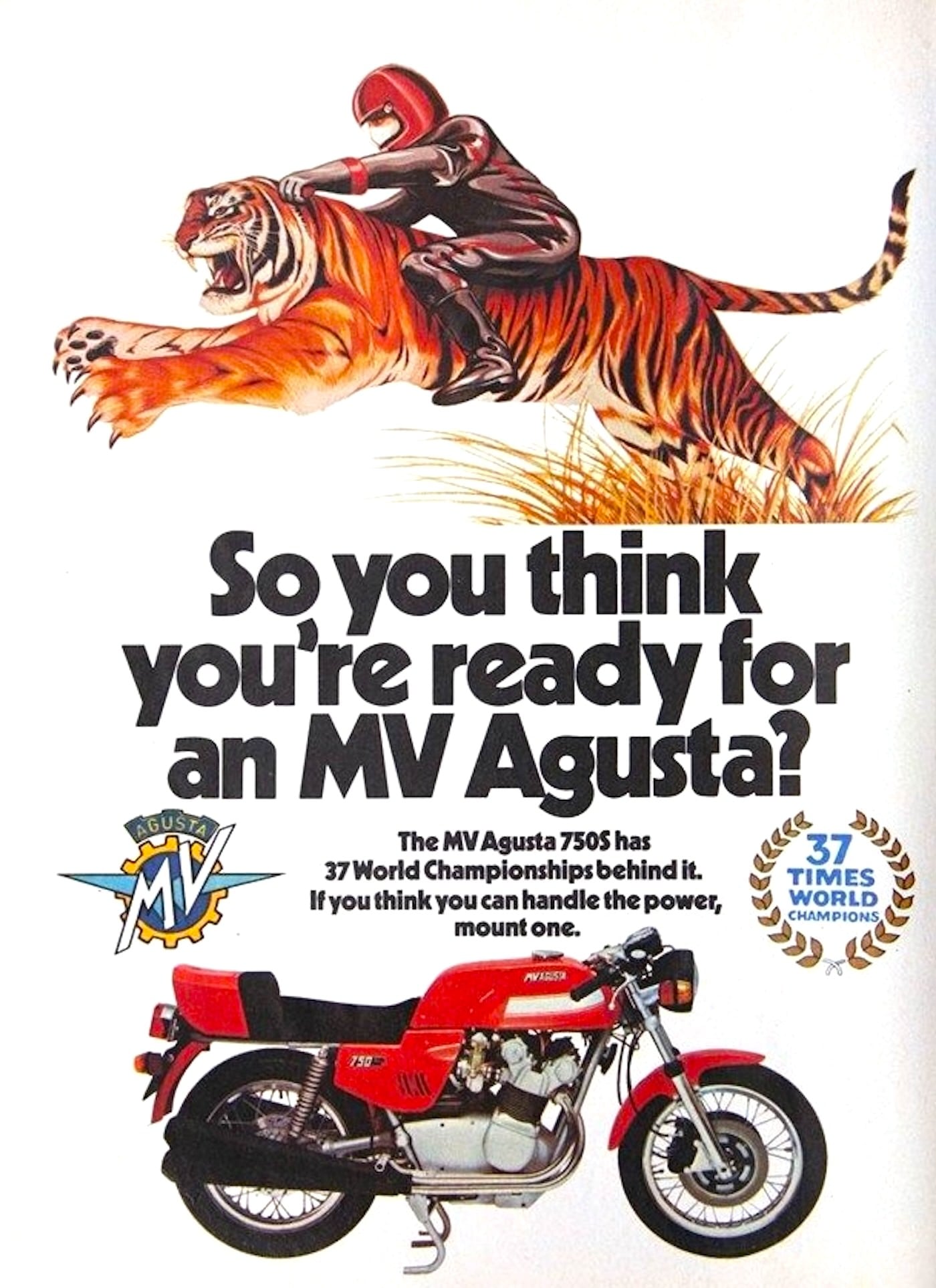
 For many vintage motorcycle enthusiasts, the MV Agusta 750 is a true bucket list classic that few will ever get the chance to own. Image courtesy of MV Agusta.
A road-going prototype with the same features, the R19 Turismo, was shown at the end of 1950, less than a year after the racer’s debut, but it never reached production. 15 years passed before another four-cylinder MV Agusta road bike appeared at the Milan Show in late 1965 – a 600cc (actually 592cc) tourer with shaft drive at the back, a rectangular car headlight up front, and unusually for the time, cable-operated Campagnolo disc brakes.
The Count wanted a 600cc tourer because the odd displacement (above 500cc) and the shaft made it hard for a privateer to turn one into a 500cc racer and run it against his own factory team. The bikes were exceedingly expensive, complex, and lacked the sporting prowess MV Agusta fans really wanted. As a result, not many were sold, just 135 of them between 1967 and 1972.
Slow sales and immense pressure from dealers led the Count to agree, rather reluctantly, to a “proper” sporting version, on condition that the shaft drive rear end stayed. A 750S prototype, built from a 600, was shown at Milan in late-1969 with clip-on handlebars, rear-set footrests, a humped seat, and red, white, and blue paint.
MV claimed 65 bhp and 225 km/h (140 mph), and priced it at 1,950,000 lire (about $3,100 USD or $28,500 USD in 2026 dollars). It cost almost three times as much as the similarly-four-cylinder-powered Honda CB750.
Just nine of them were built in 1970, and in Italy, the early bikes were sold only to people known to the Count. He died of a heart attack on February the 2nd, 1971, his brother Corrado took over, and 56 more were completed that year, all but two of them between August and December.
The MV Agusta 750S Engine + Chassis
The engine used in the 750S was the earlier 600’s with the bore taken from 58mm to 65mm, giving 750cc (actually 743cc) on the same 56mm stroke. Its layout came from that earlier 1950s Grand Prix four. A train of straight-cut gears between the middle cylinders drove the twin overhead camshafts, and the pressed-together crankshaft ran in ball and roller bearings, with one-piece connecting rods on needle rollers.
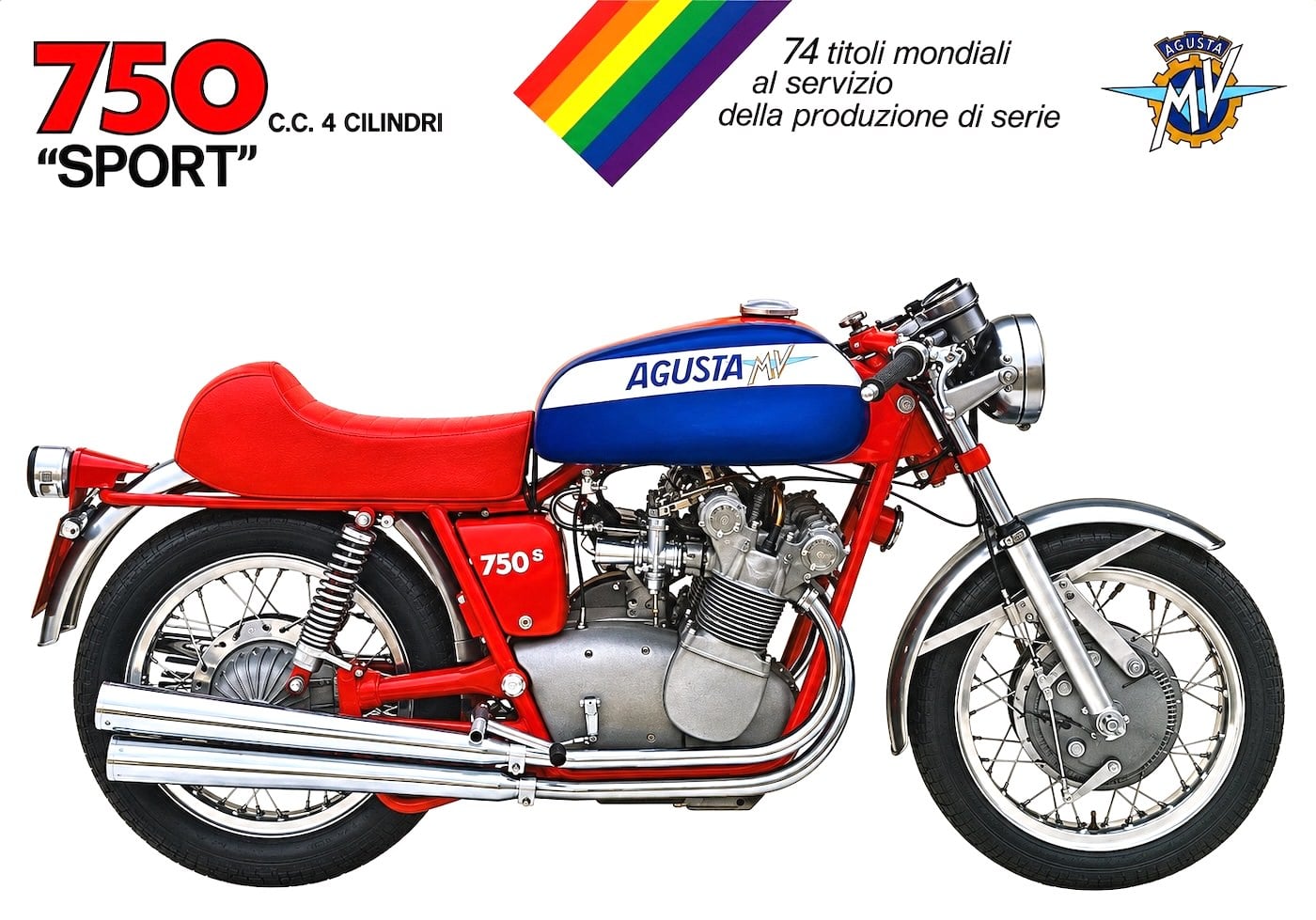
Drive on the 750S went through a gear primary, a wet multi-plate clutch, and a 5-speed gearbox with a right-foot shift, then to a shaft enclosed in the right side of the swingarm. Image courtesy of MV Agusta.
The crankshaft sat in its own carrier casting, which bolted into the sand-cast crankcase, a racing practice that suited an engine made in such small numbers but which would have been prohibitive on a motorcycle with larger production numbers. Each one was assembled individually from selected parts.
Four 24mm Dell’Orto carburetors replaced the 600’s two, and they breathed through open bellmouths with no air filters. A Bosch starter-generator sat under the engine, driven by two V-belts. Output was 66 bhp at 8,000 rpm.
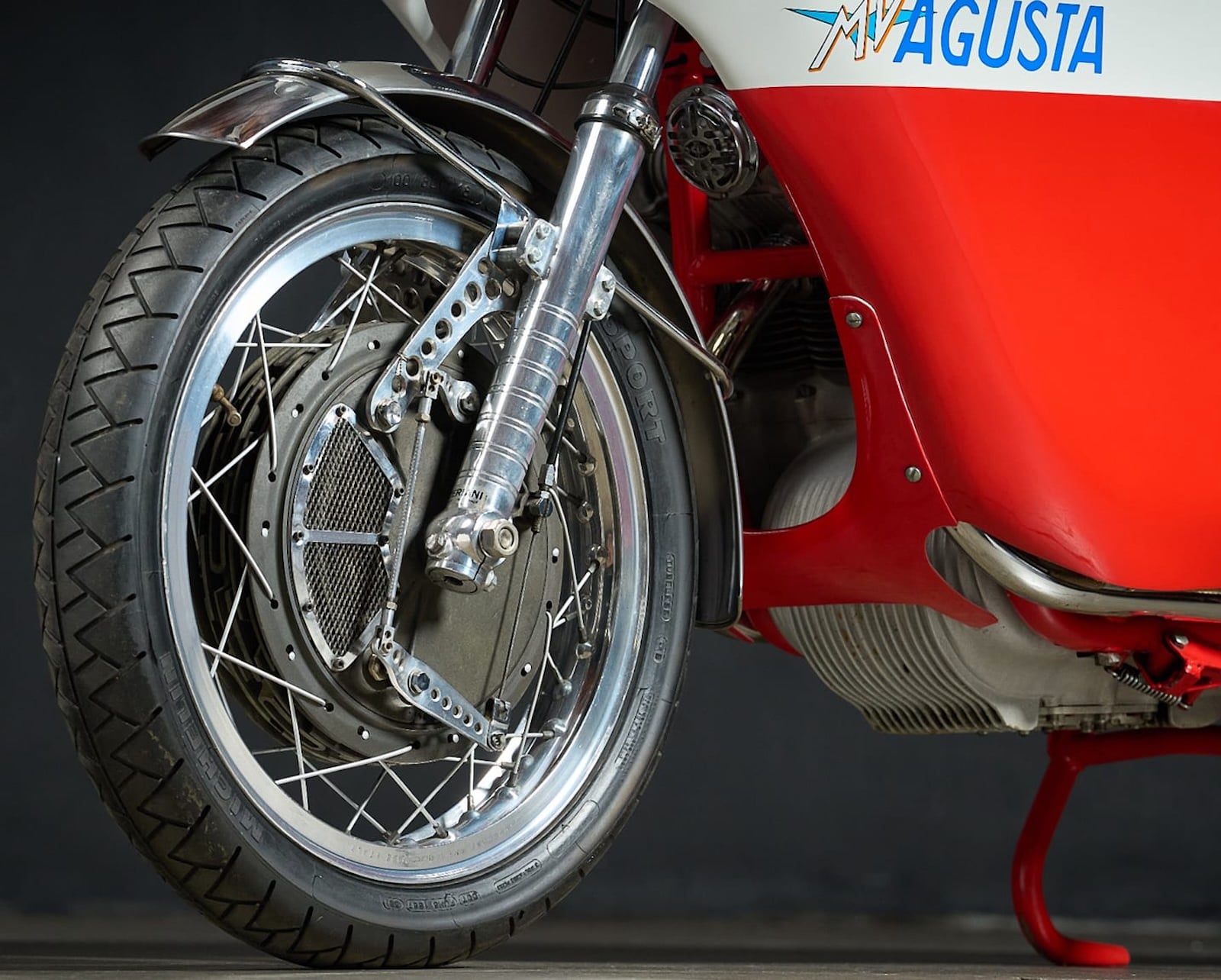
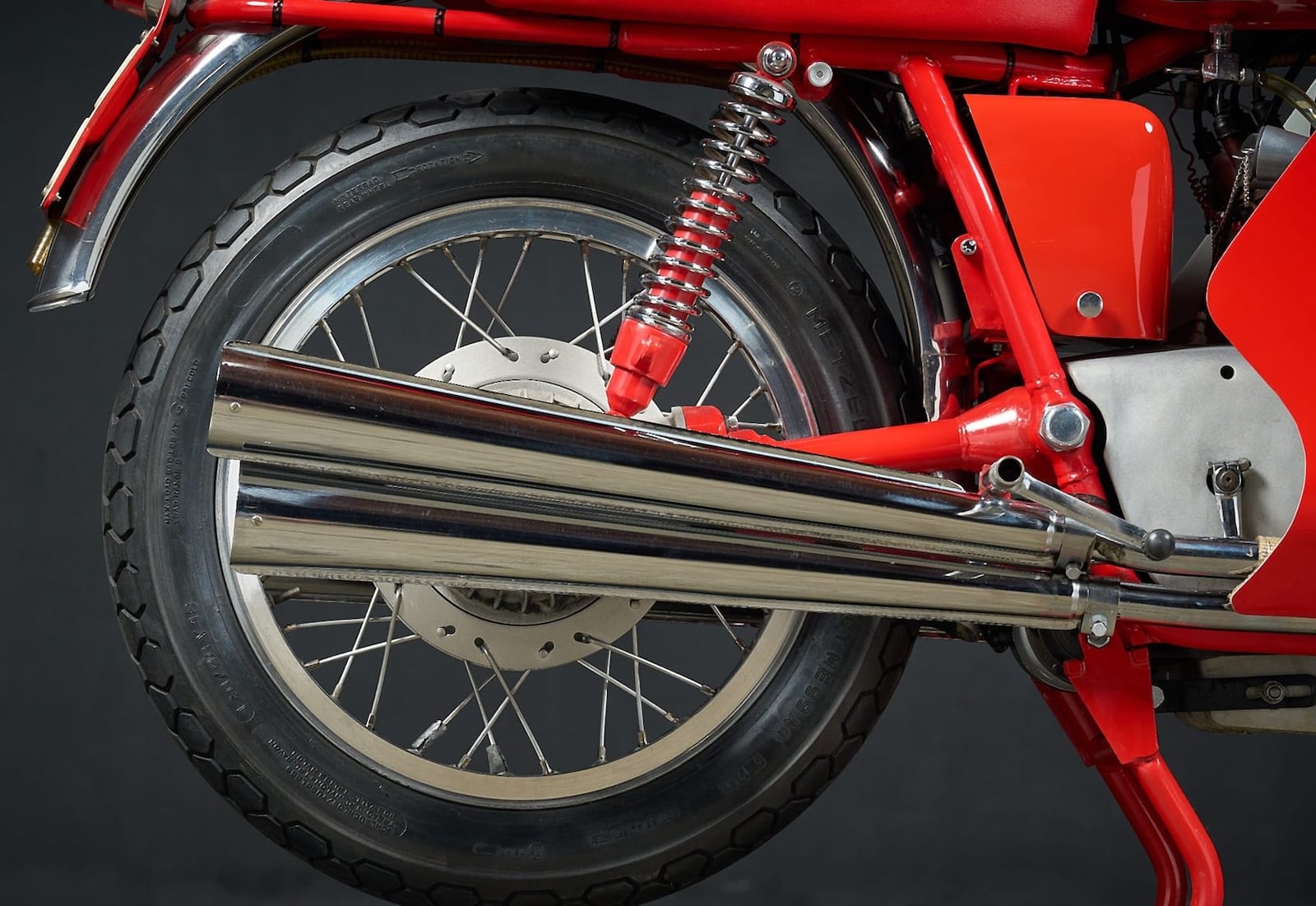
Drive went through a gear primary, a wet multi-plate clutch, and a 5-speed gearbox with a right-foot shift, then to a shaft enclosed in the right side of the swingarm. The tubular steel double-cradle frame followed the 600’s design and was painted red. It had a 35mm Ceriani fork up front, twin Sebac shocks in the back, and 18 inch Borrani aluminum rims.
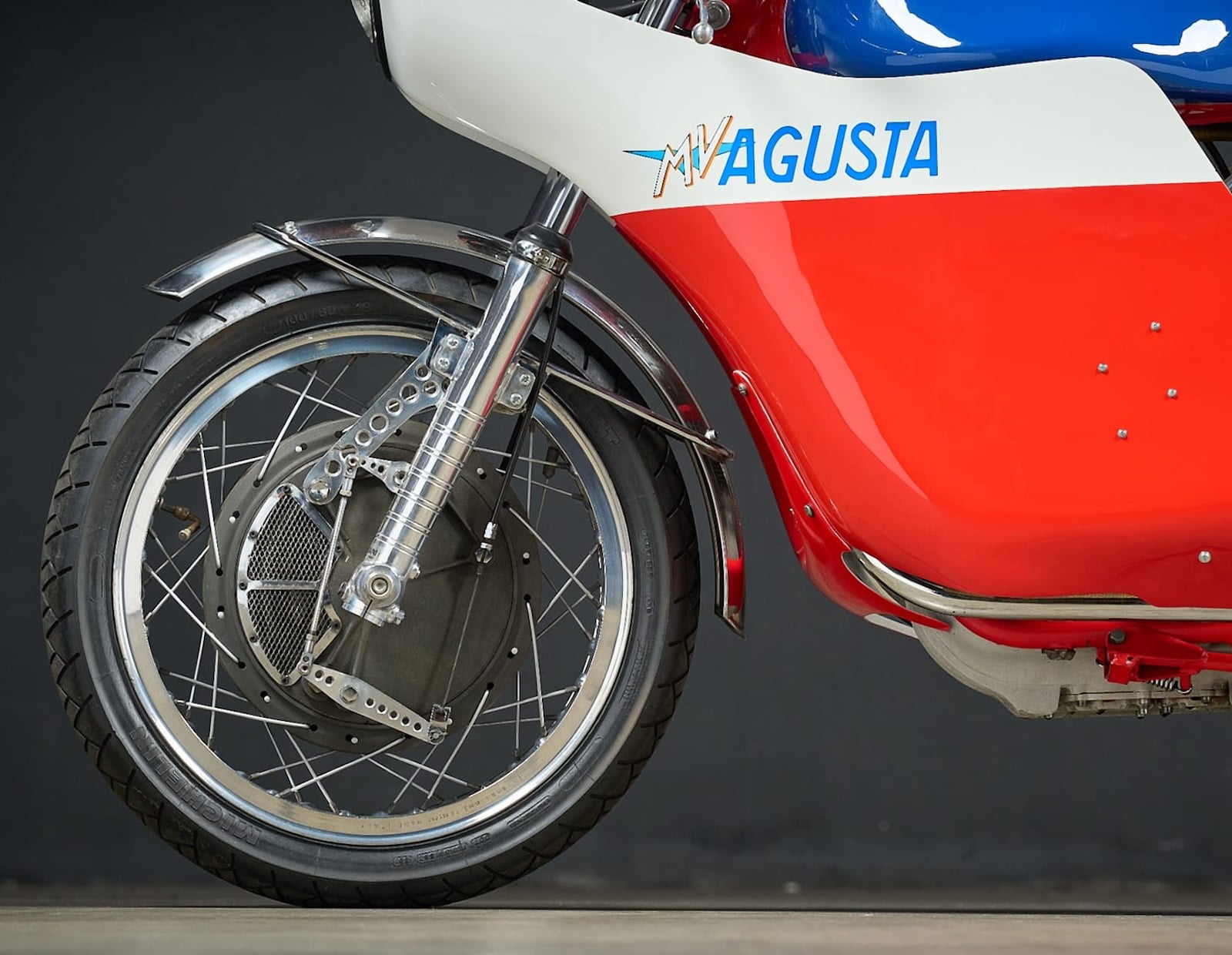
A 230mm Grimeca double-sided front drum with four leading shoes replaced the 600’s discs, and the rear had a 200mm single-leading-shoe drum. The dry weight was 235 kgs (518 lbs), comparable to other four-cylinder bikes of the time.
On The Road + At Imola
An American test conducted by Cycle World magazine in 1971 recorded 114 mph and a 14.5 second quarter mile, well short of the official figures from MV, and the reviewer faulted the fading brakes, the underdamped rear shocks, and the missing air filters. A privately owned bike tested in Britain by Motor Cycle magazine in 1973 managed a two-way average of 112 mph.
The factory raced the 750S at the first Imola 200 on April the 23rd, 1972. Racing chief Arturo Magni prepared Formula 750 machines for Giacomo Agostini and Alberto Pagani, with engines reported at 85 bhp. Pagani injured his arm in practice and didn’t start. Agostini, still on shaft drive, led the first three laps in front of 70,000 spectators before the Ducatis of Bruno Spaggiari and Paul Smart went past.
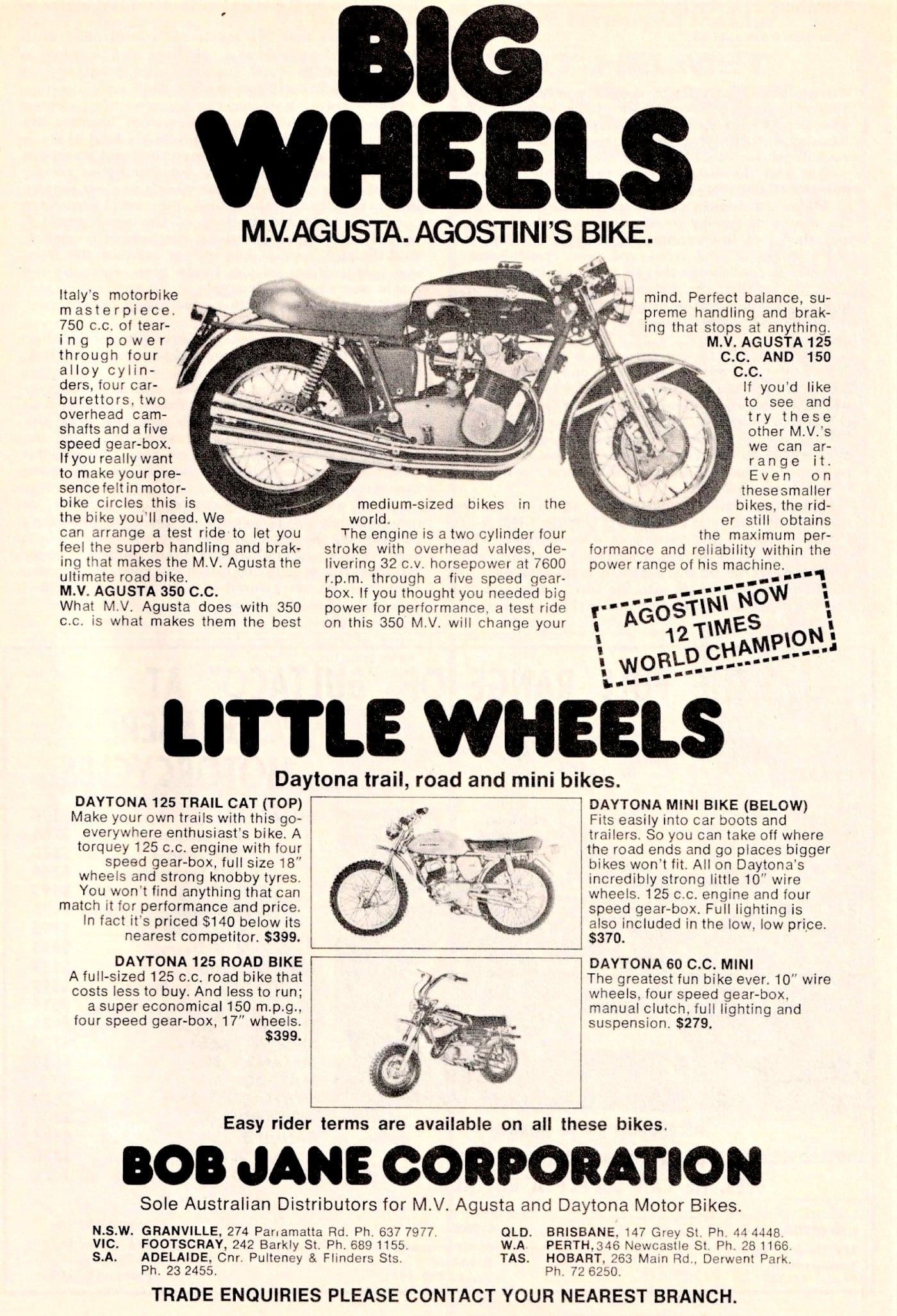
The factory raced the 750S at the first Imola 200 on April the 23rd, 1972. Racing chief Arturo Magni prepared Formula 750 machines for Giacomo Agostini and Alberto Pagani, with engines reported at 85 bhp. Image courtesy of Bob Jane.
Agostini coasted into the pits with a dead engine on lap 42 of 64, and Smart won. “It is our very first experience in this kind of racing,” Magni said. In Australia, Sydney dealer Brian Clarkson retired from the Castrol Six Hour that October with clutch trouble, then finished sixth at Bathurst in 1973. Magni later sold chain-drive conversions to owners who wanted to race.
Later 750S Changes + Production Figures
Late in 1973, MV fitted higher-lift camshafts, larger valves, and 27mm square-slide Dell’Orto carburetors, and replaced the front drum with twin Scarab discs. Power rose to 69 bhp at 8,500 rpm, and a British test by Motor Cycle magazine in June of 1974 measured a mean top speed of 122.68 mph and a 14.15 second quarter mile.
A touring MV Agusta 750 GT went into production in 1972. A faired SS was shown beside it at the 1971 Milan Show but it never made it into production, and the location of the prototype is now unknown – though many have searched for it.
In 1975, the 750S gave way to the 750S America, developed at the urging of US importer Chris Garville and dealer Jim Cotherman. It had a 67mm bore for 790cc, 75 bhp, and a $6,000 USD price tag – $37,640 USD in 2026 dollars. The 850 Monza of 1977 was the last production MV four from the era.
The 1971 MV Agusta 750S Shown Here
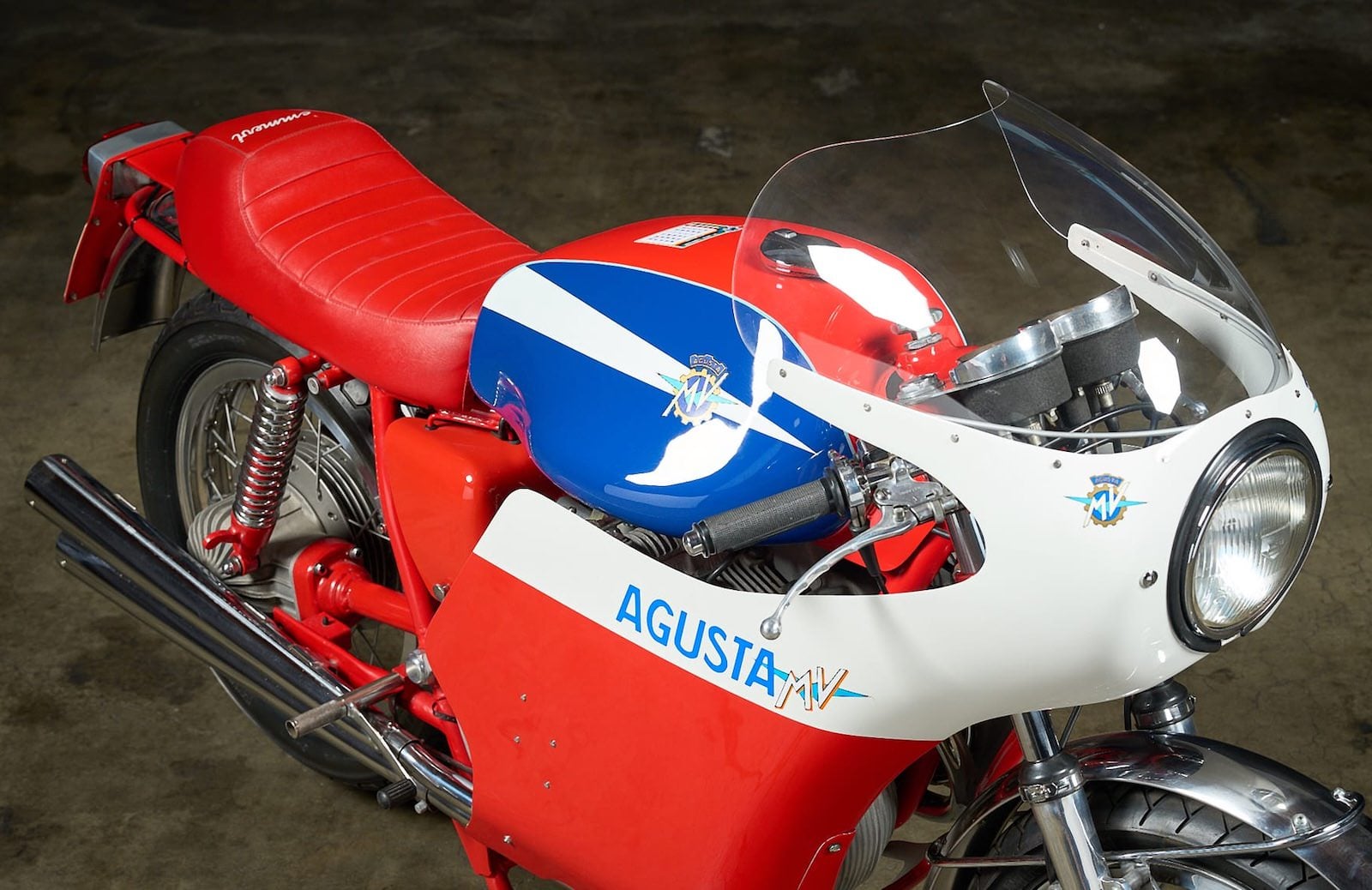
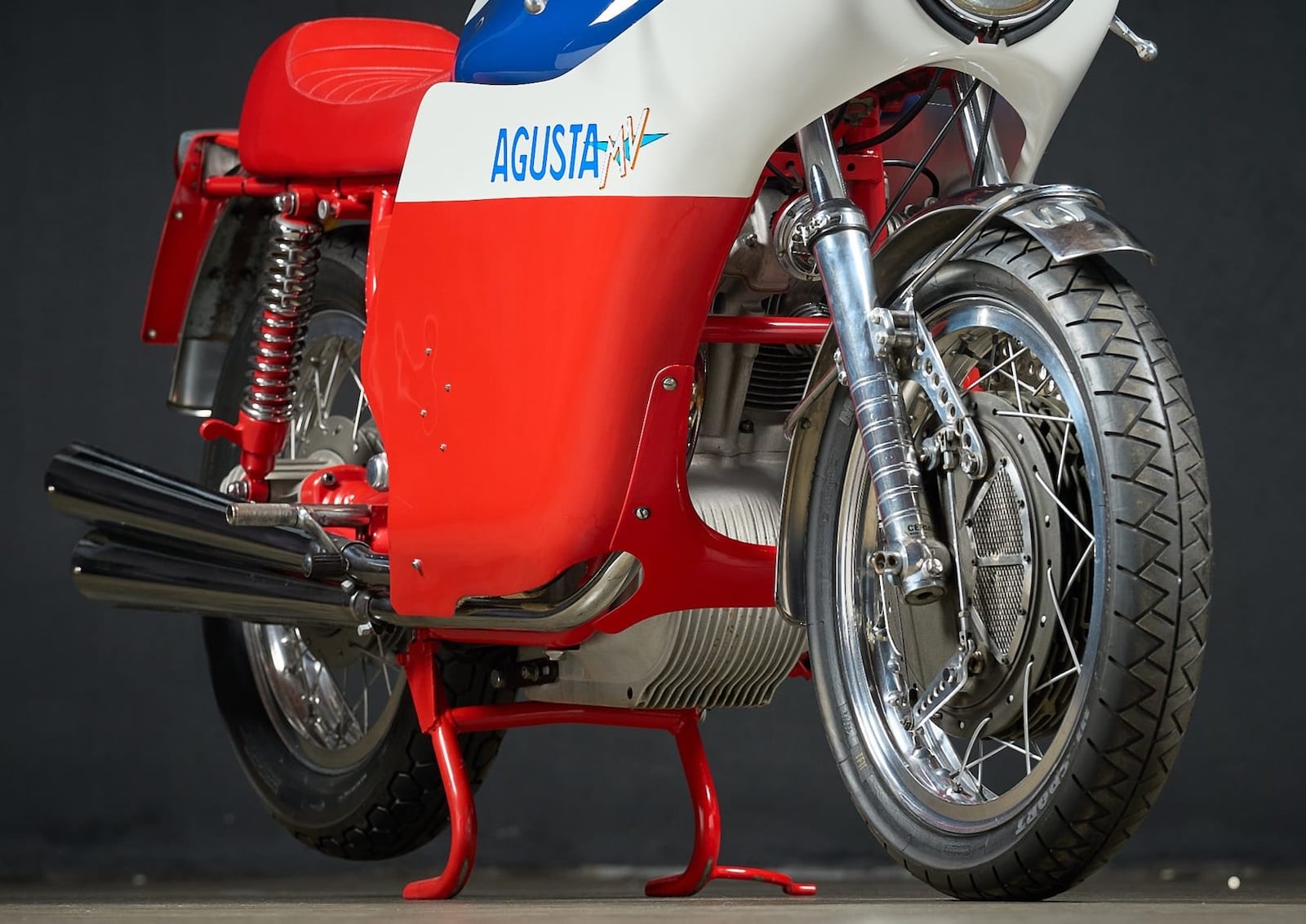
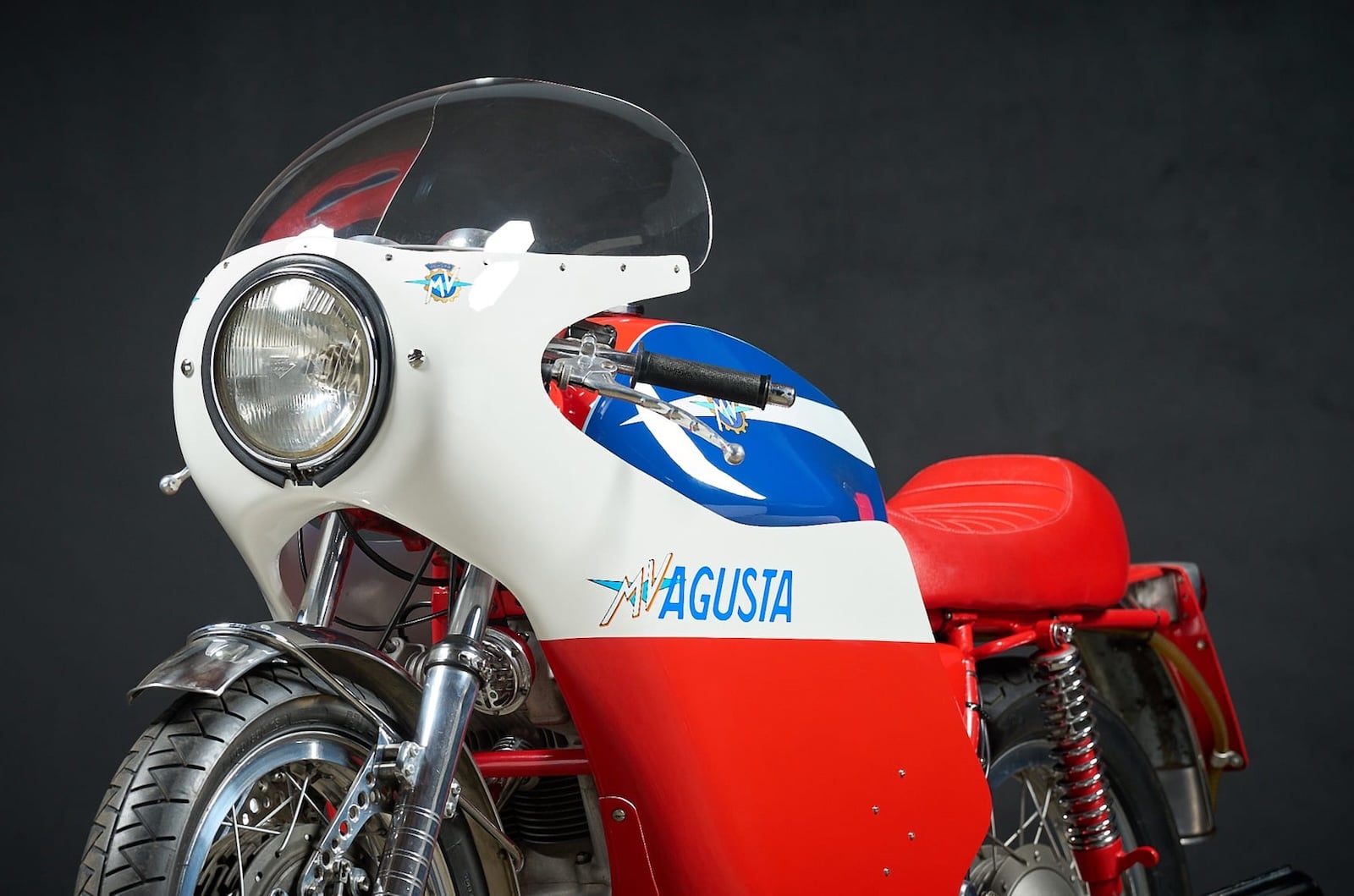
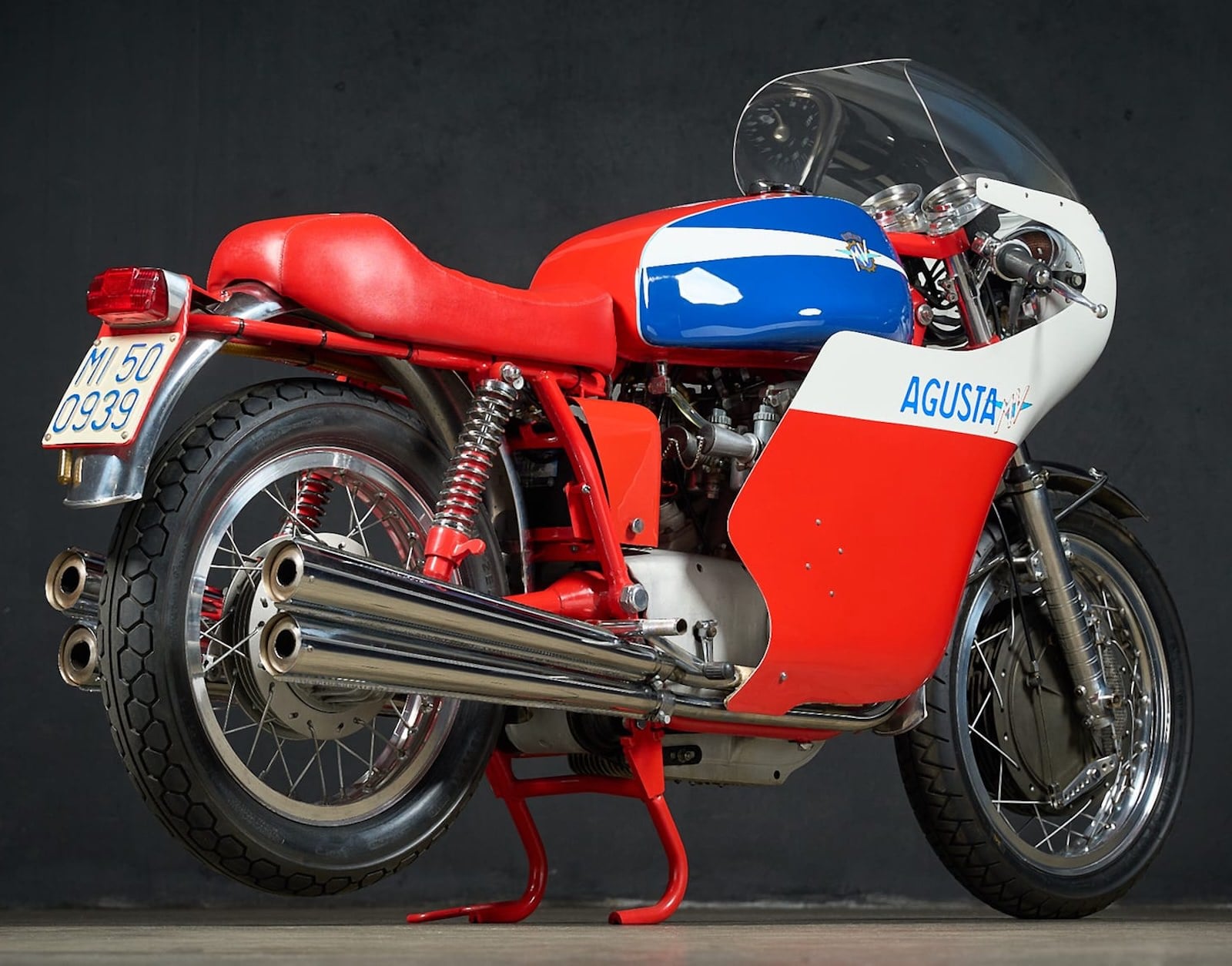
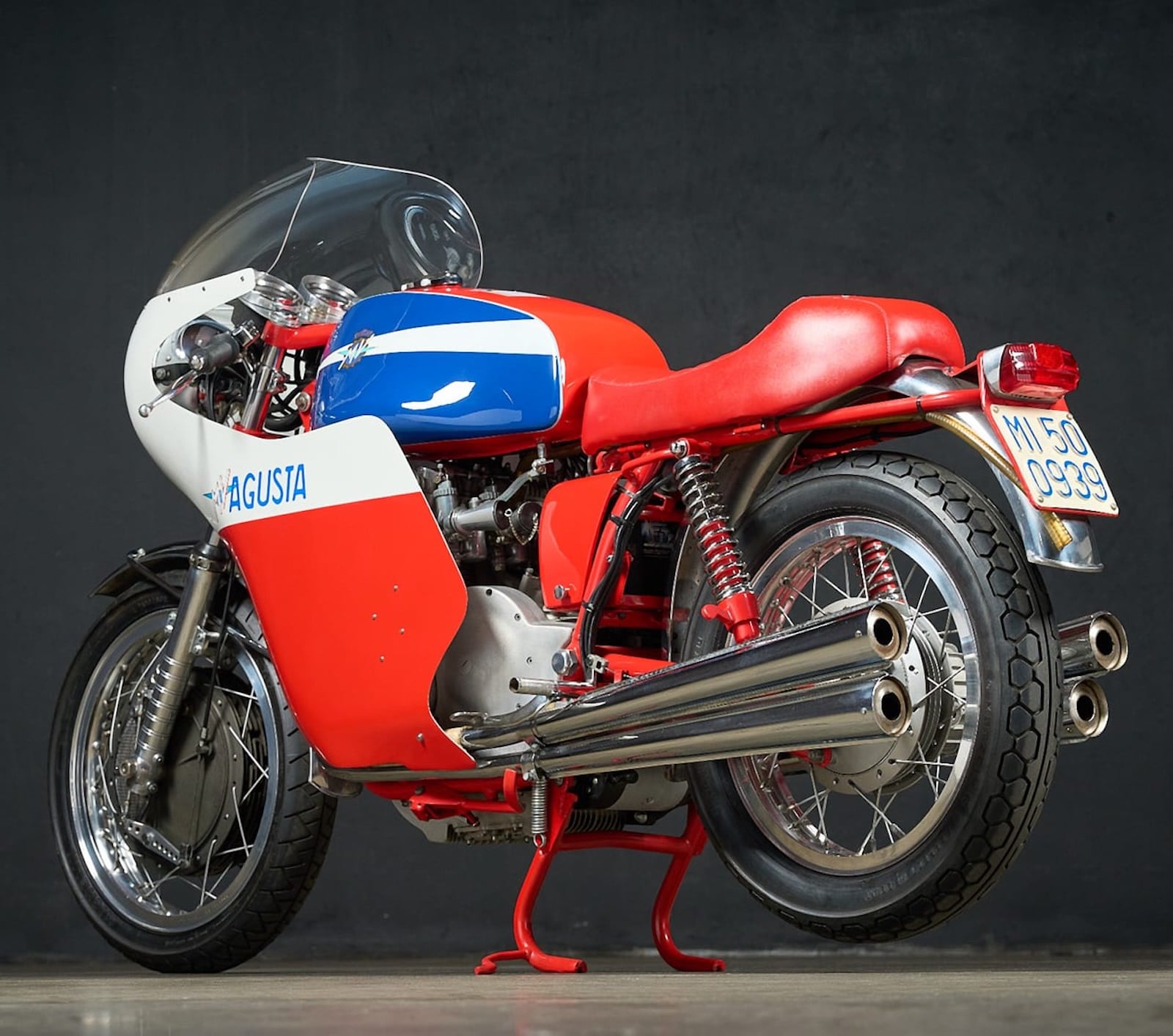
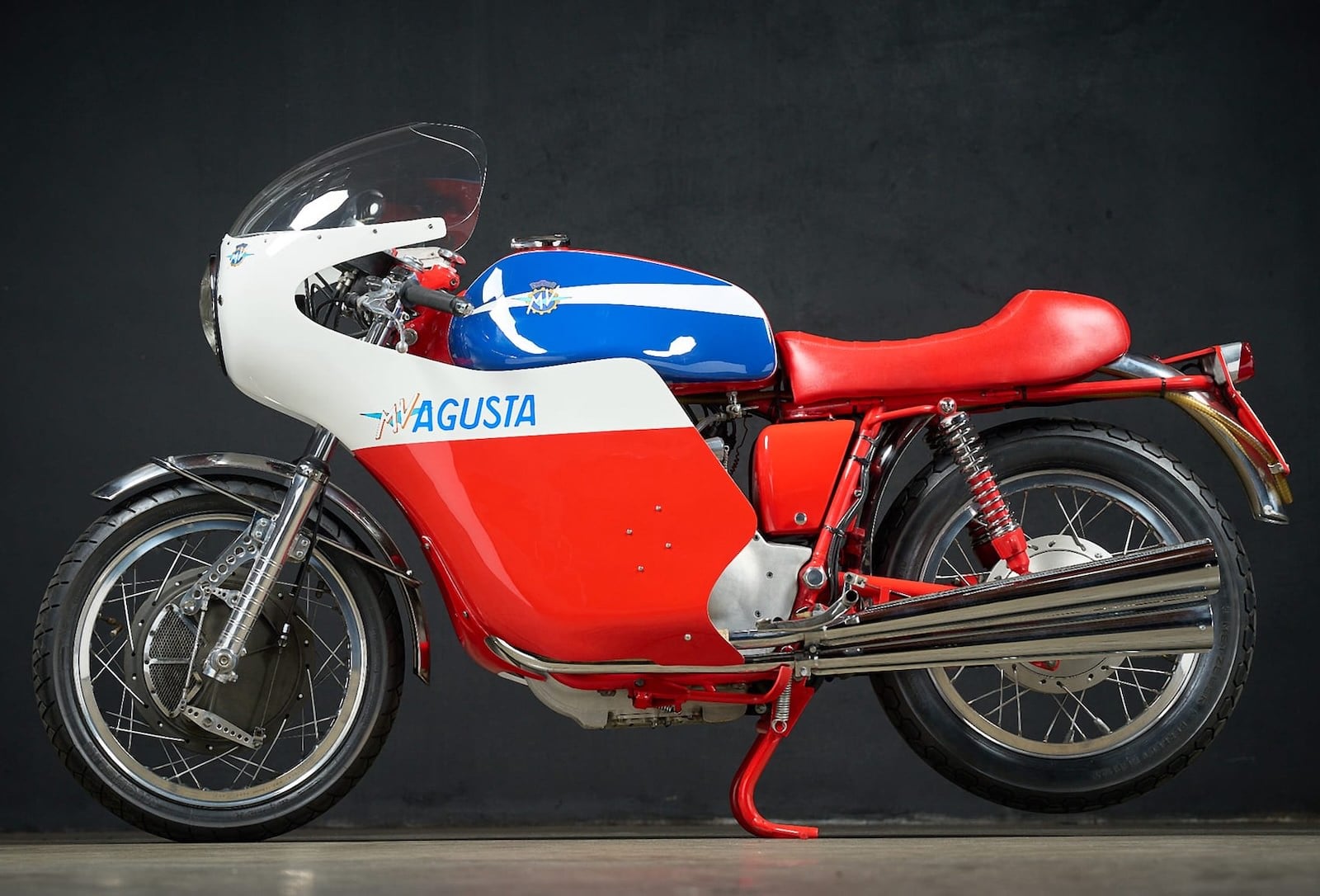
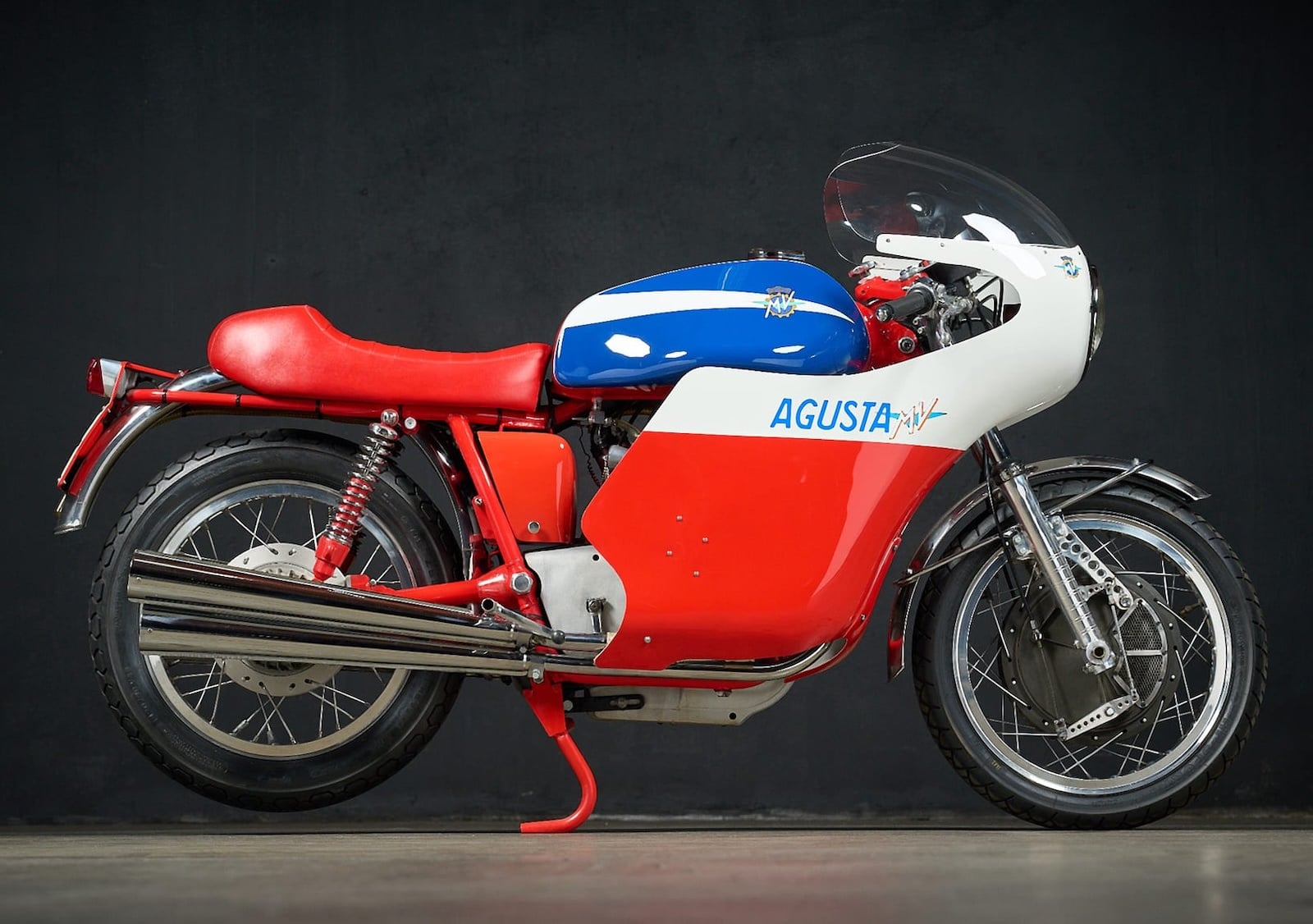
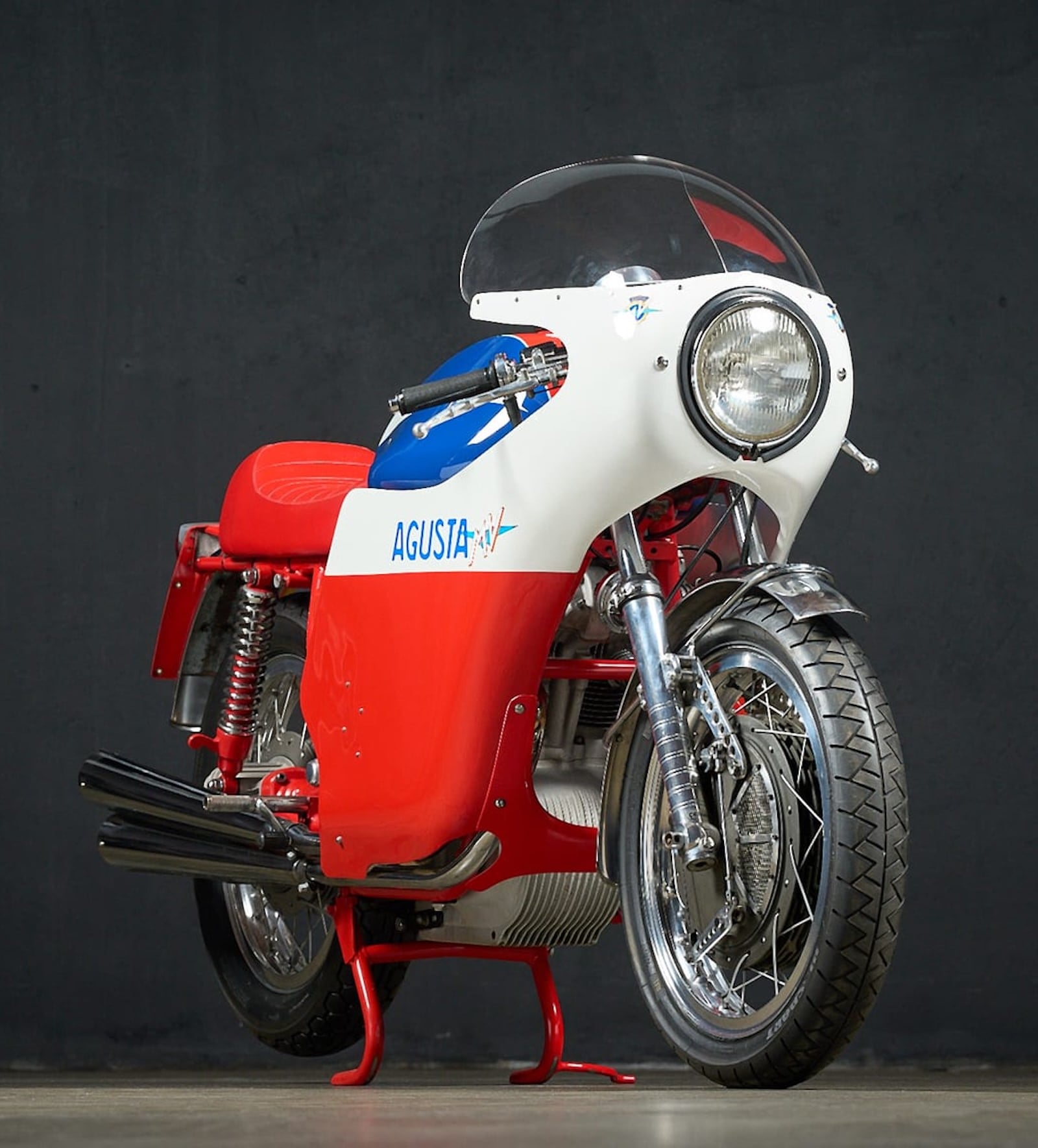
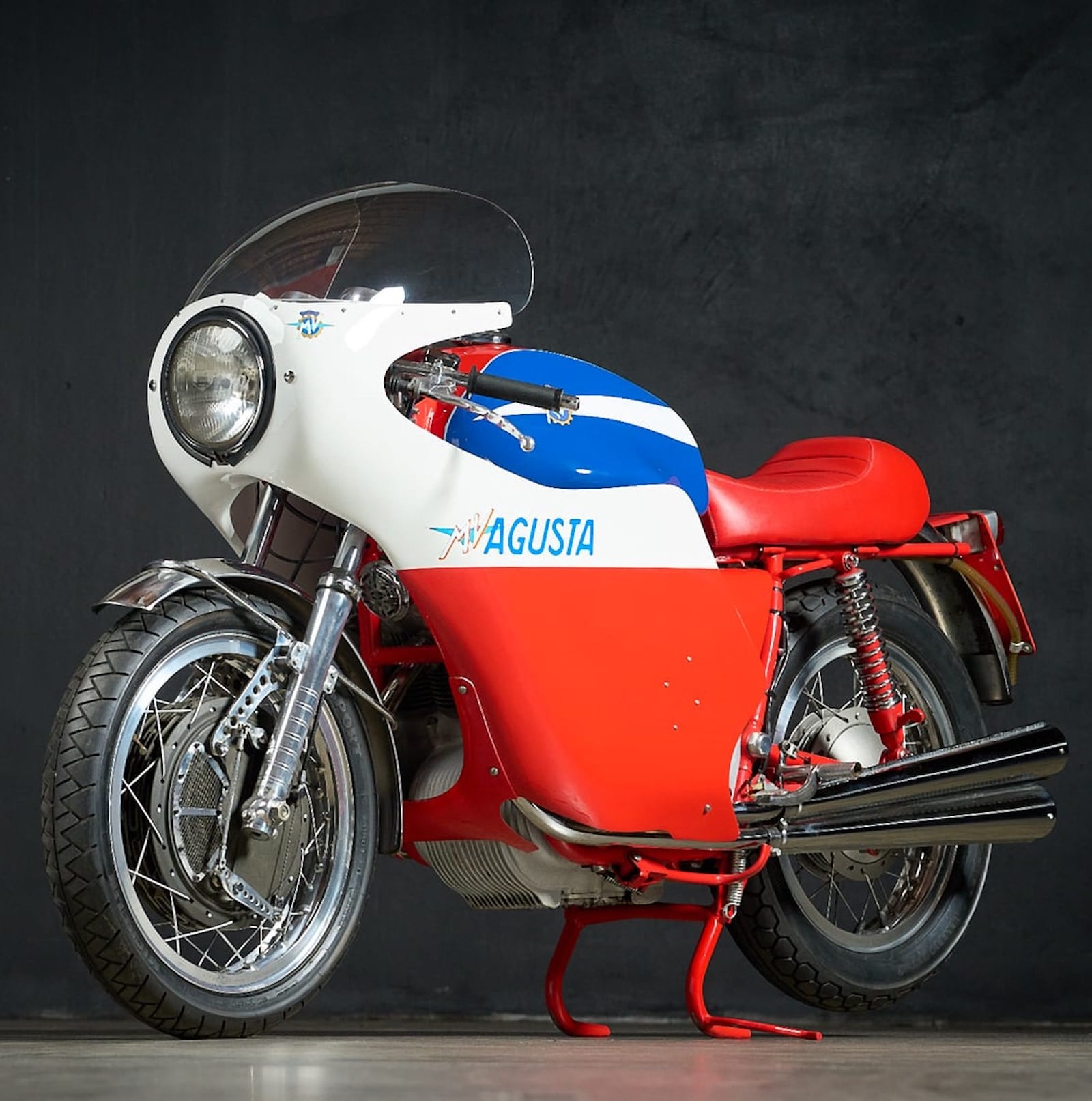
This 1971 MV Agusta 750S is a first-series example finished in the marque’s distinctive red, white, and blue racing livery. It’s reportedly one of just 56 examples made for the 1971 model year, and it’s been inspected and documented by motorcycle historian and author Ian Falloon. The motorcycle was bought by its current owner in 2020.
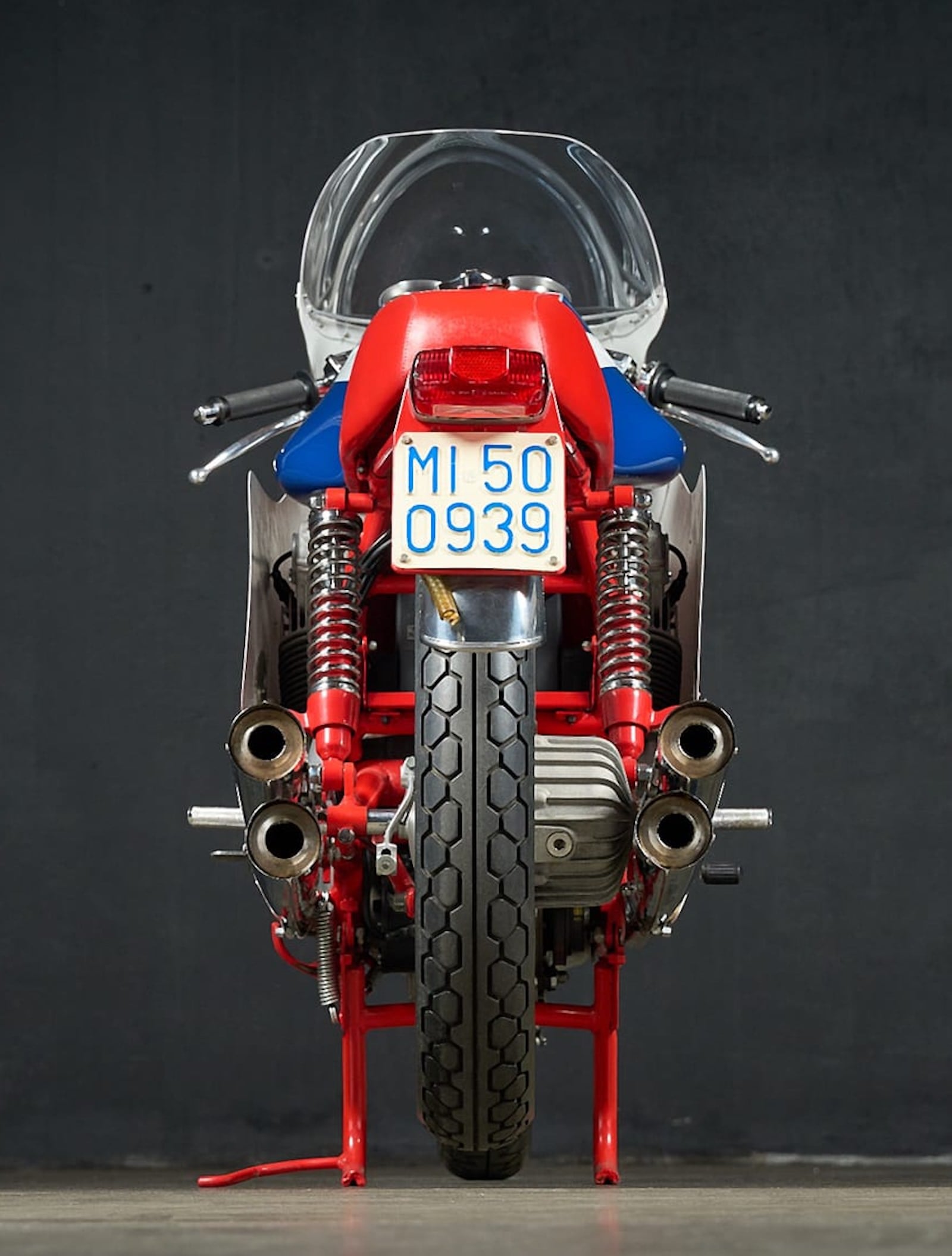
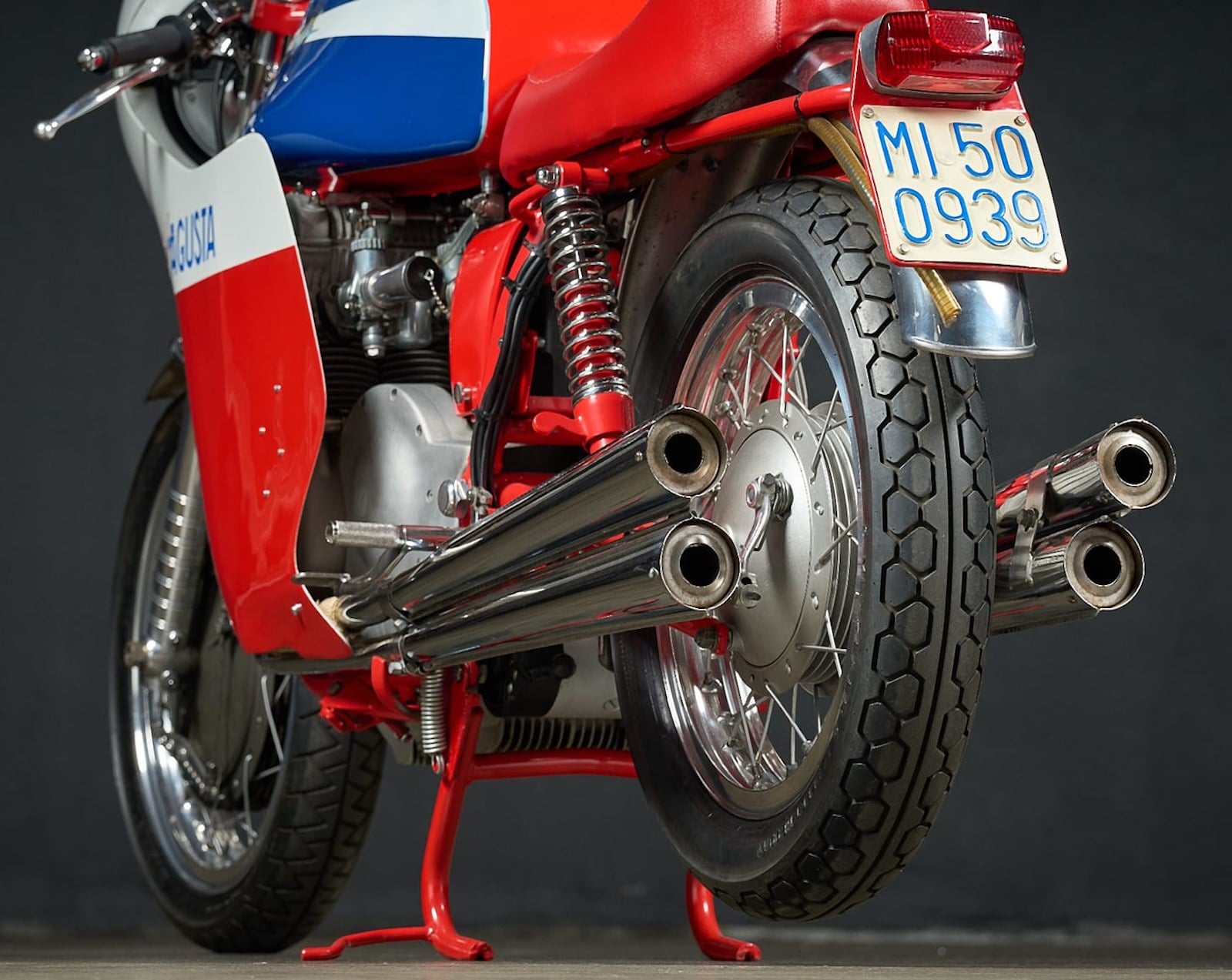
As you would expect, power comes from a 743cc double overhead camshaft inline-four, factory rated at 66 bhp. The engine is sandcast, with individual aluminum cylinders, gear-driven camshafts, four 24mm Dell’Orto UB-series carburetors, and a chrome four-into-four exhaust system. Power is delivered to the rear wheel through a wet multi-plate clutch, a 5-speed transmission, and a shaft drive.
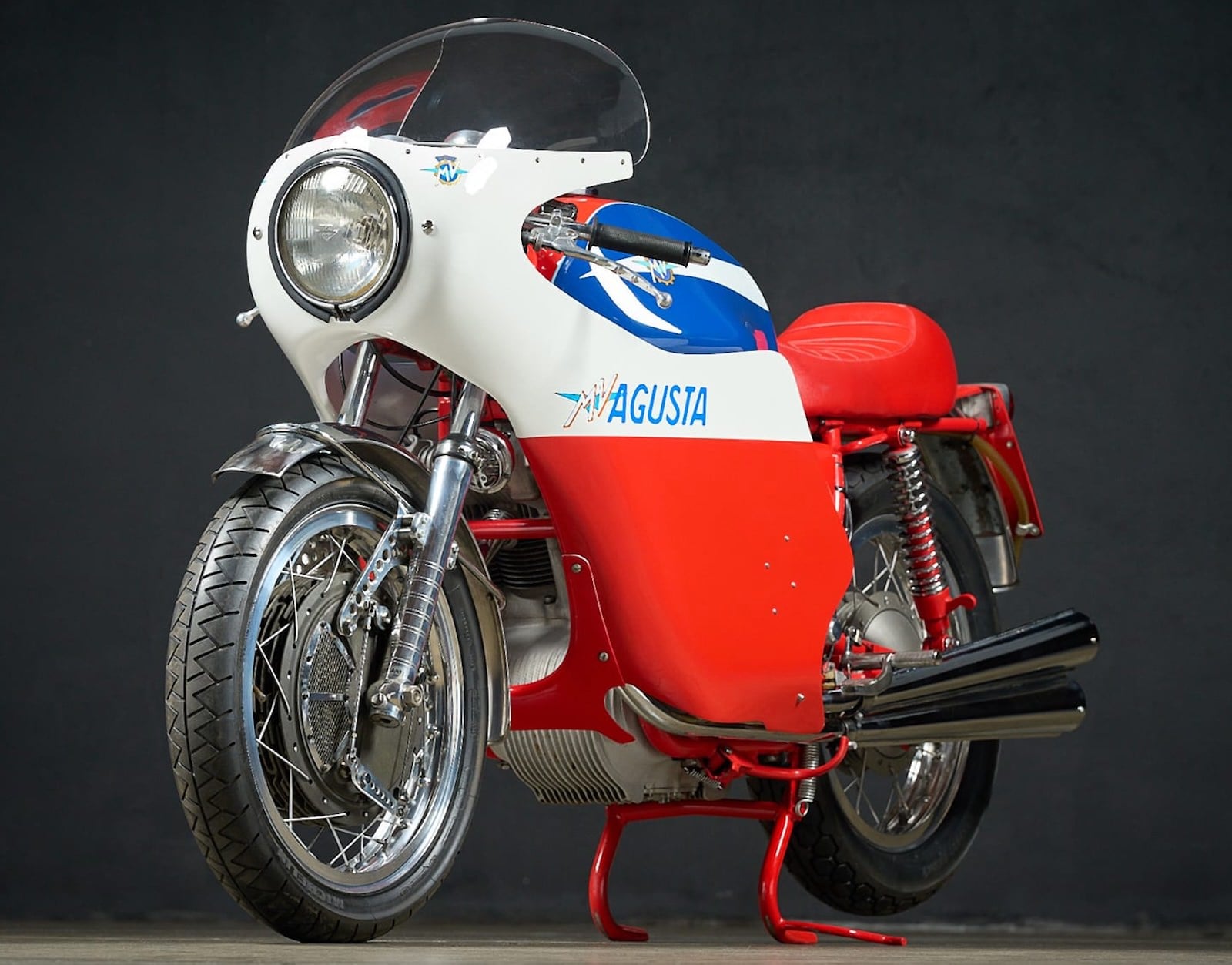
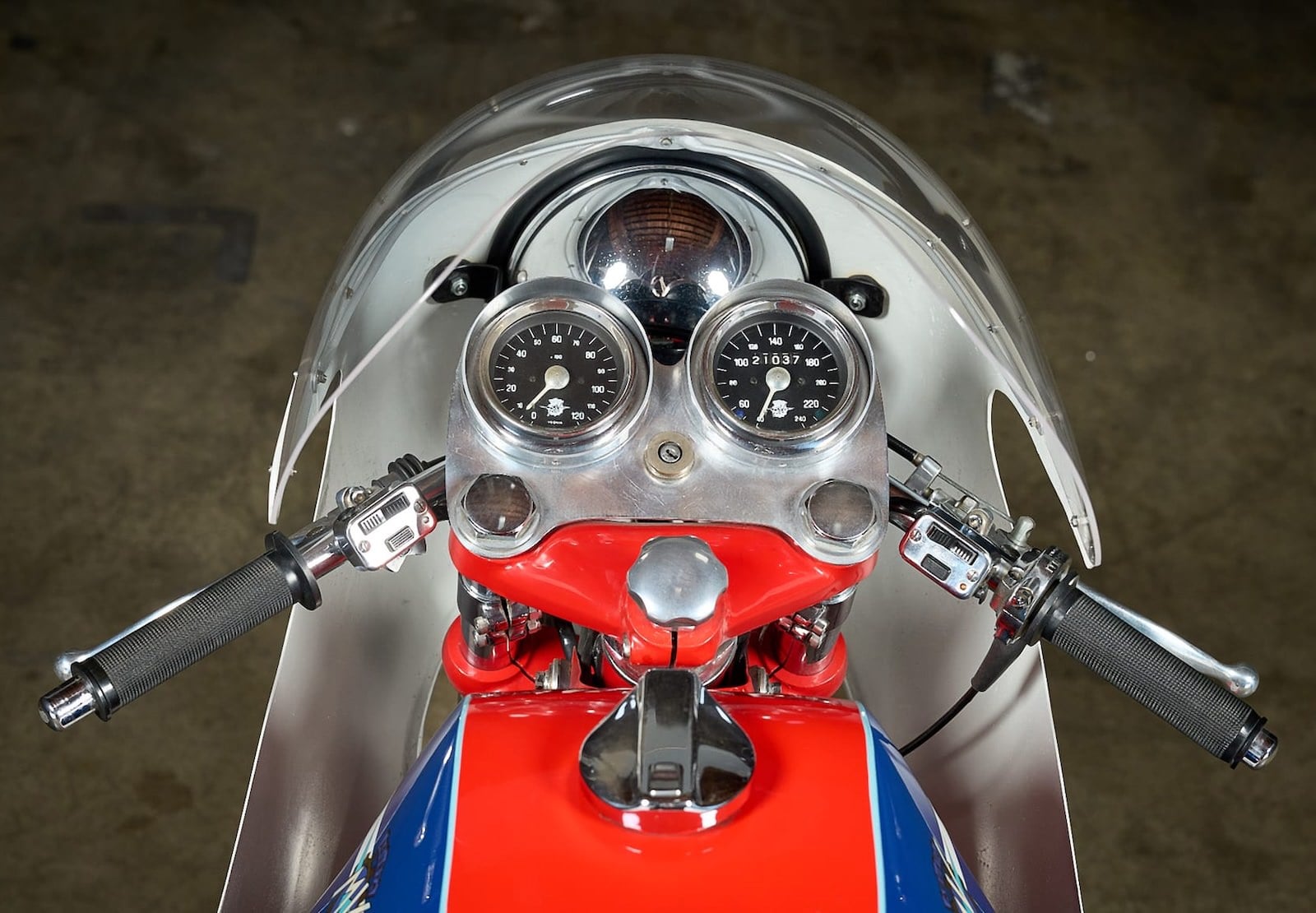
This 1971 MV Agusta 750S is a first-series example finished in the marque’s distinctive red, white, and blue racing livery. It’s reportedly one of just 56 examples made for the 1971 model year, and it’s been inspected and documented by motorcycle historian and author Ian Falloon. The motorcycle was bought by its current owner in 2020.
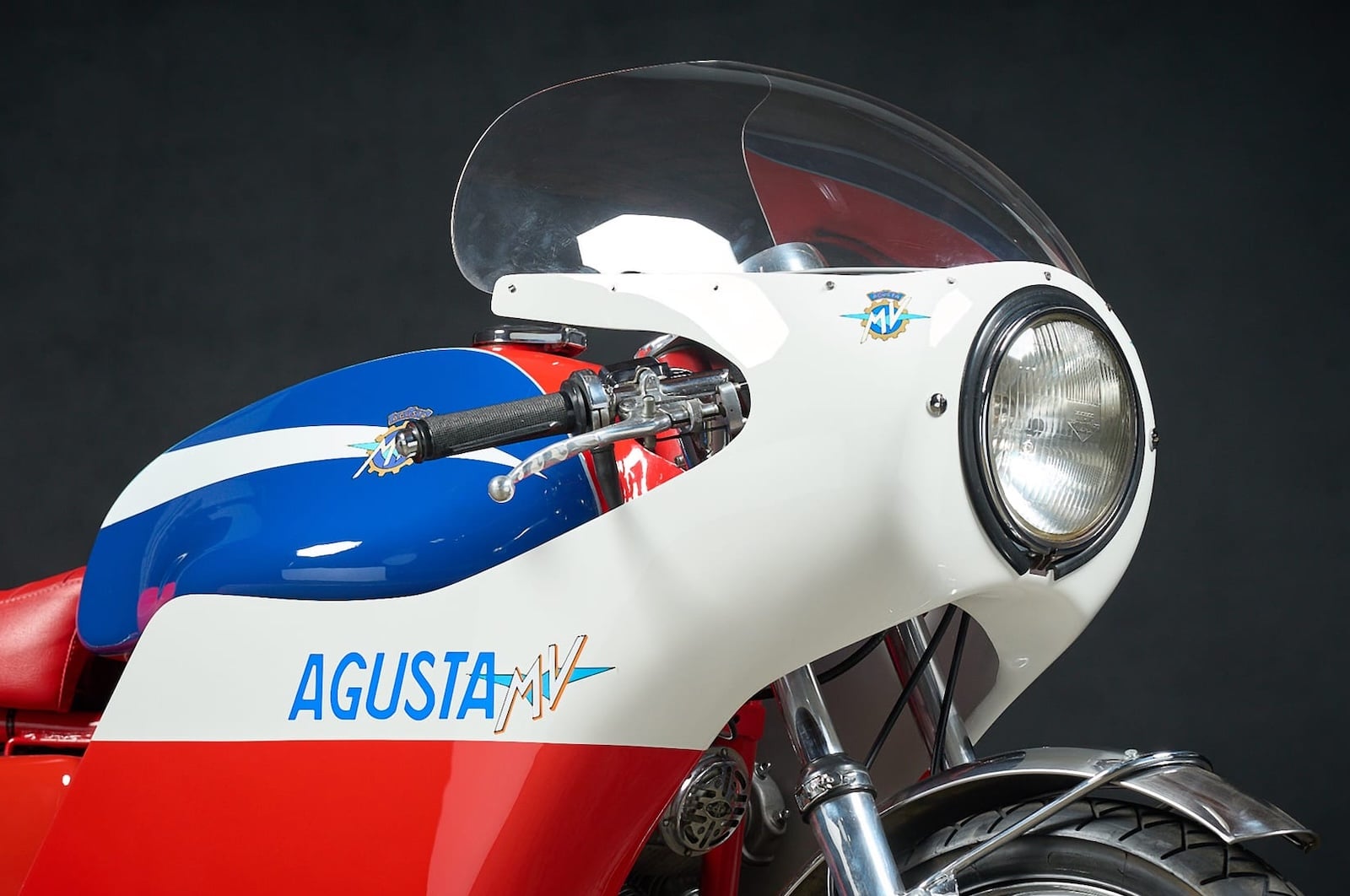
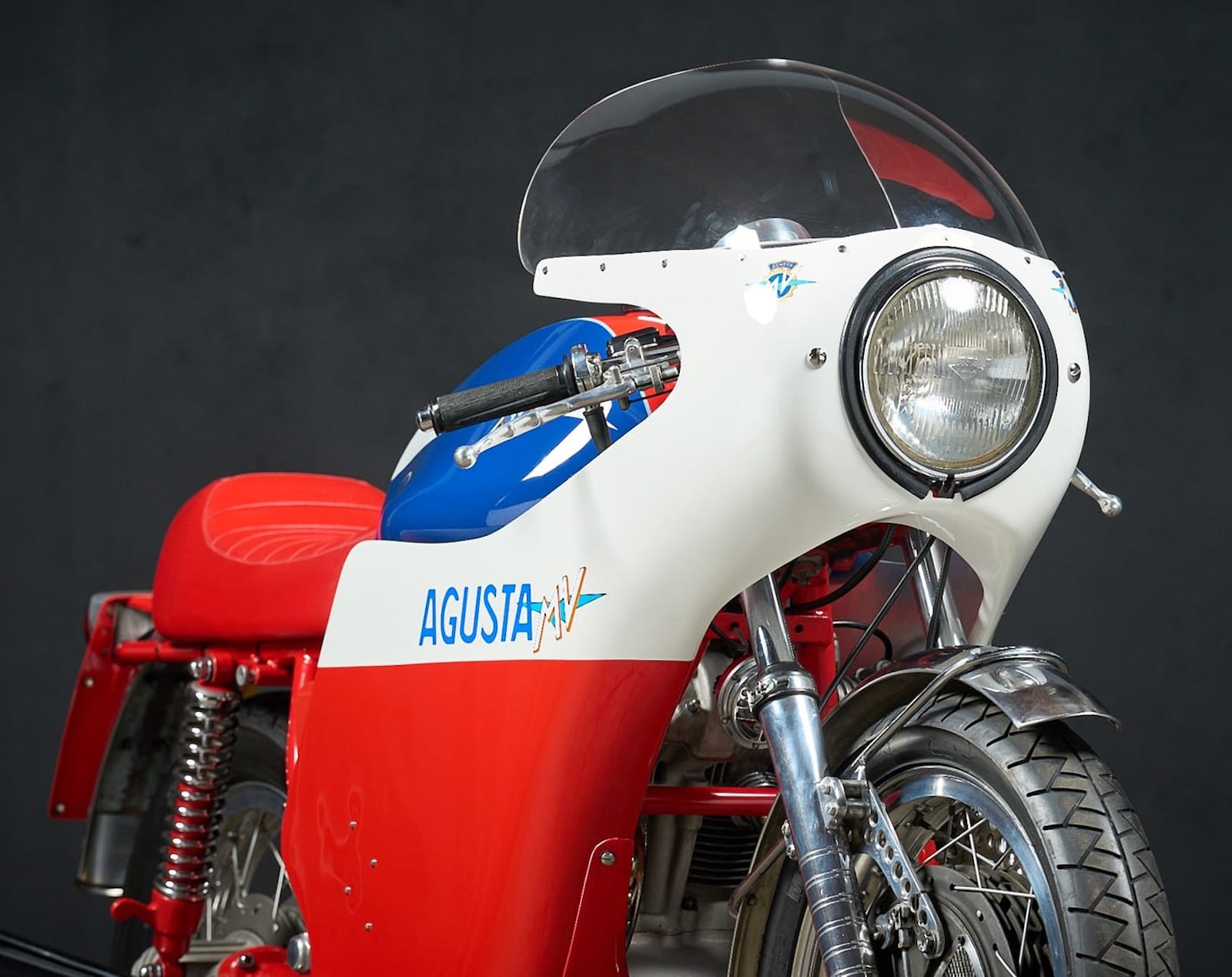
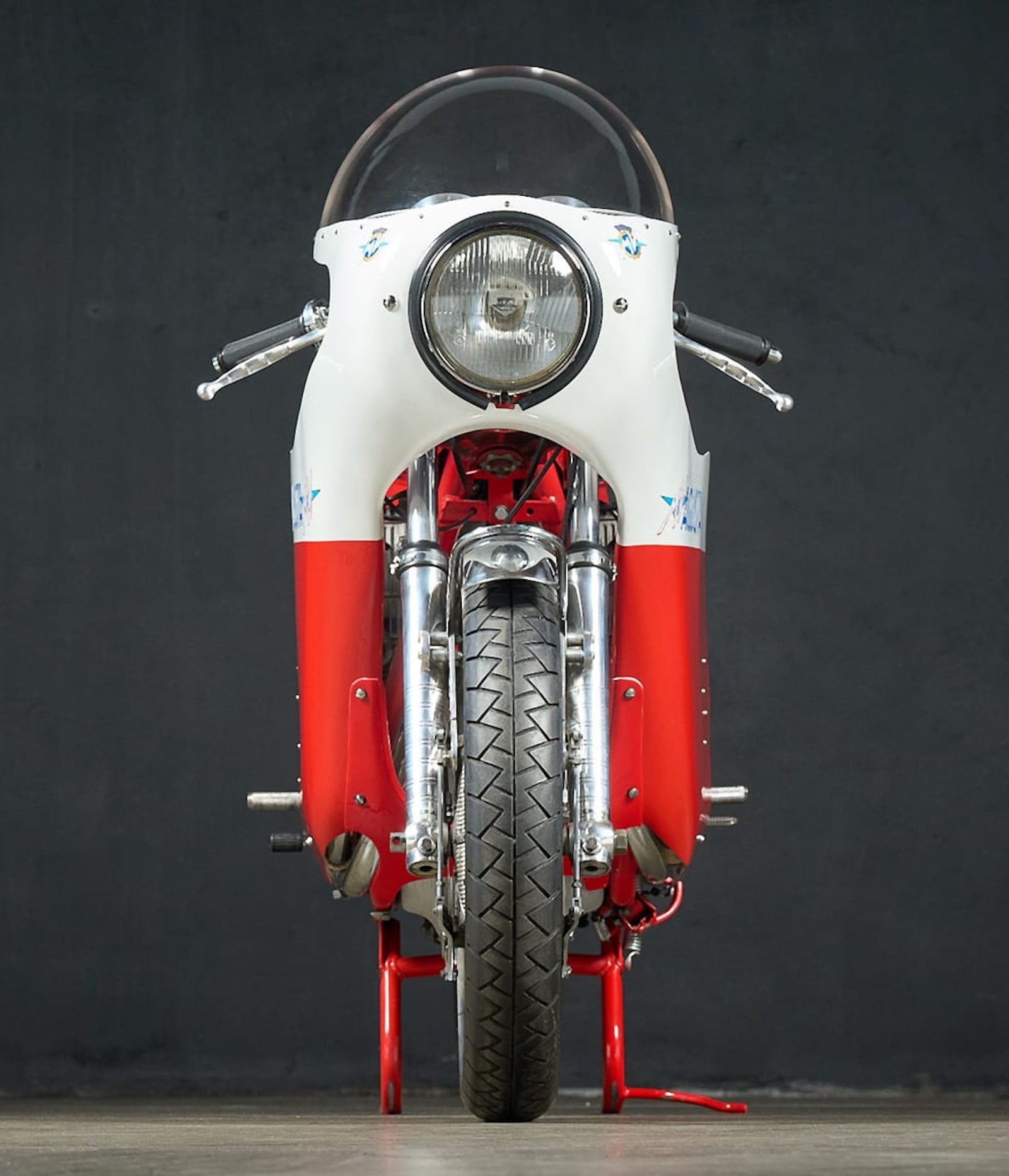
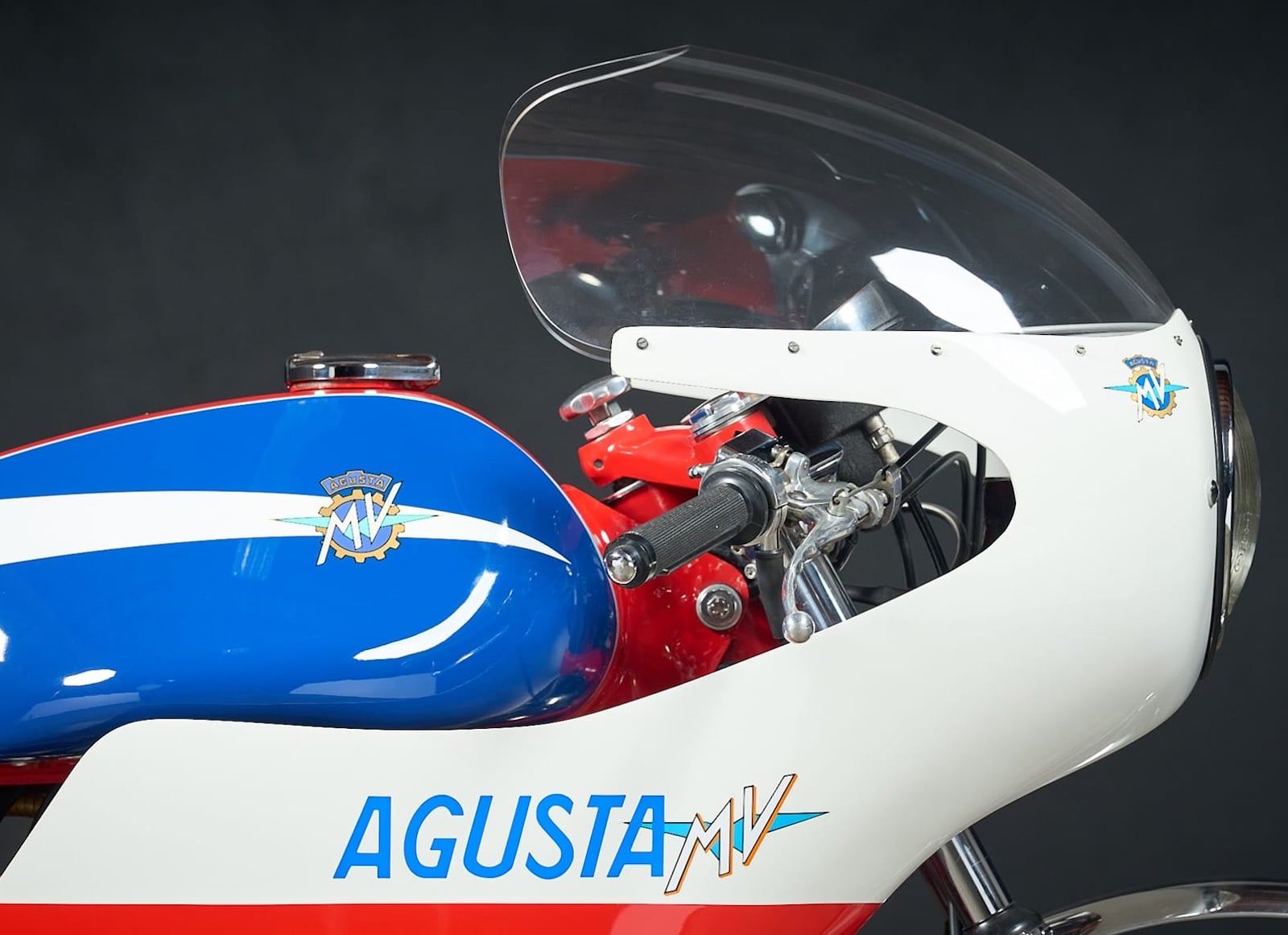
The bike is fitted with an optional GP-style full fairing, a clear windscreen, a 6.3 gallon fuel tank bearing a 37 star emblem commemorating MV Agusta’s world championships, and a distinctive red leather bump seat with white lettering. It also has clip-on handlebars, Tommaselli controls, rear-set foot pegs, a friction steering damper, and Veglia instrumentation. The five-digit odometer currently displays ~21,000 kilometers (~13,000 miles).
This 750S is offered by Avant-Garde Collection in Oregon with Ian Falloon’s hardcover authentication report, spare tires, and memorabilia. It’s being sold on a bill of sale without a title or registration, although the selling dealer has stated that they will assist the buyer with the titling process. If you’d like to read more about it or register to bid you can visit the listing here.
Images courtesy of MV Agusta + Bring a Trailer

Articles that Ben Branch has written have been covered on CNN, Popular Mechanics, Smithsonian Magazine, Road & Track Magazine, the official Pinterest blog, the official eBay Motors blog, BuzzFeed, Autoweek Magazine, Wired Magazine, Autoblog, Gear Patrol, Jalopnik, The Verge, and many more.
Silodrome was founded by Ben back in 2010, in the years since the site has grown to become a world leader in the alternative and vintage motoring sector, with well over a million monthly readers from around the world and many hundreds of thousands of followers on social media.