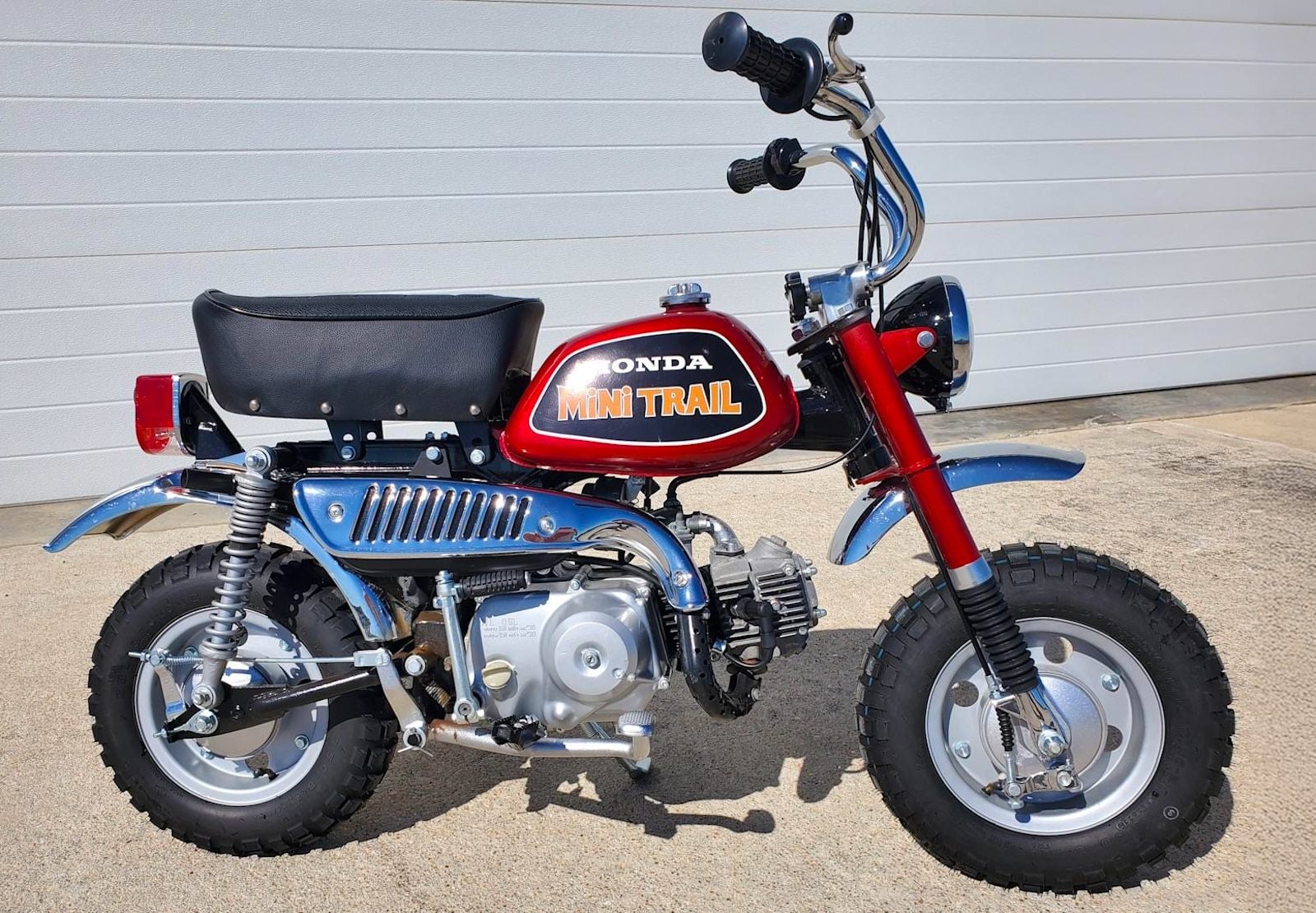
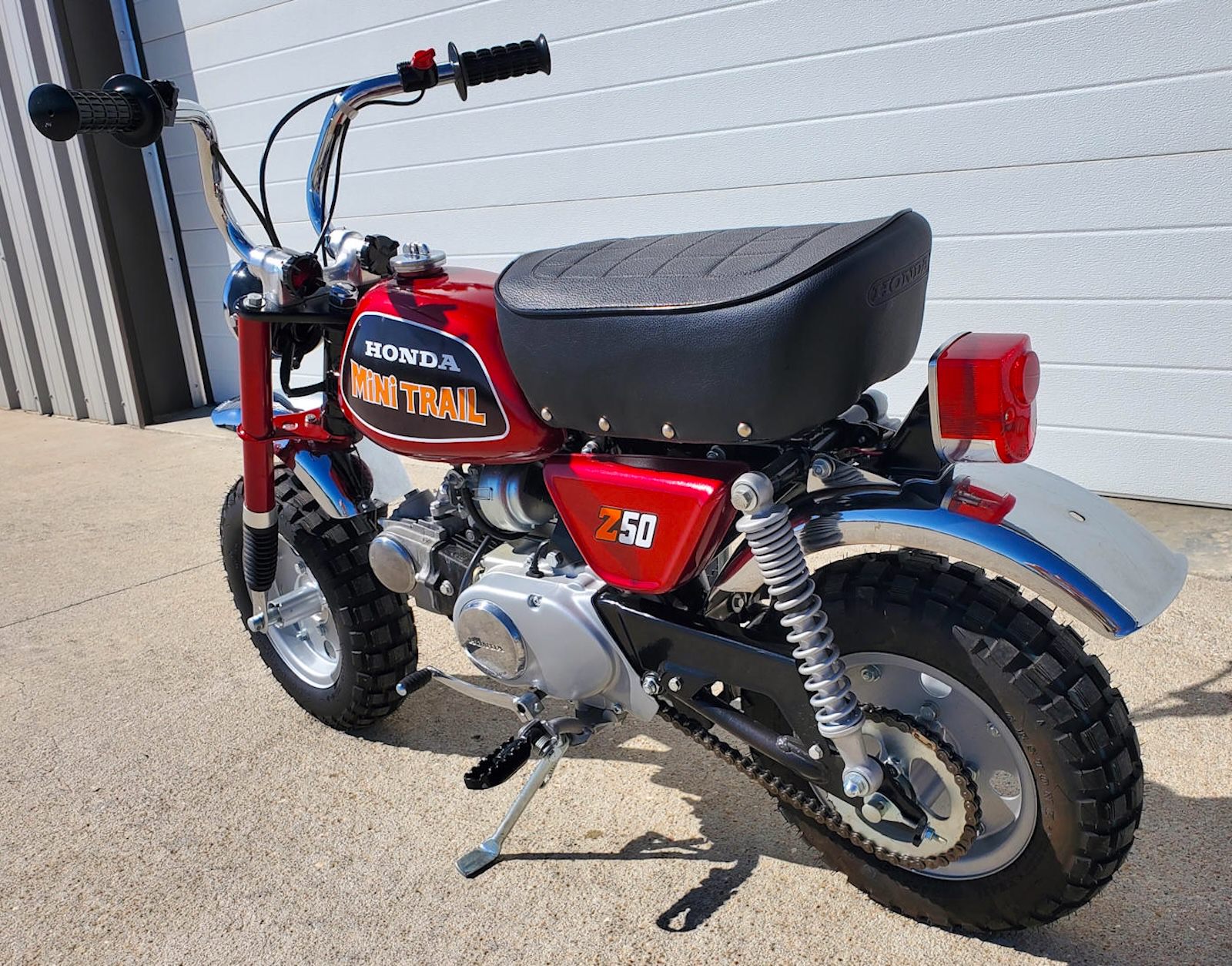
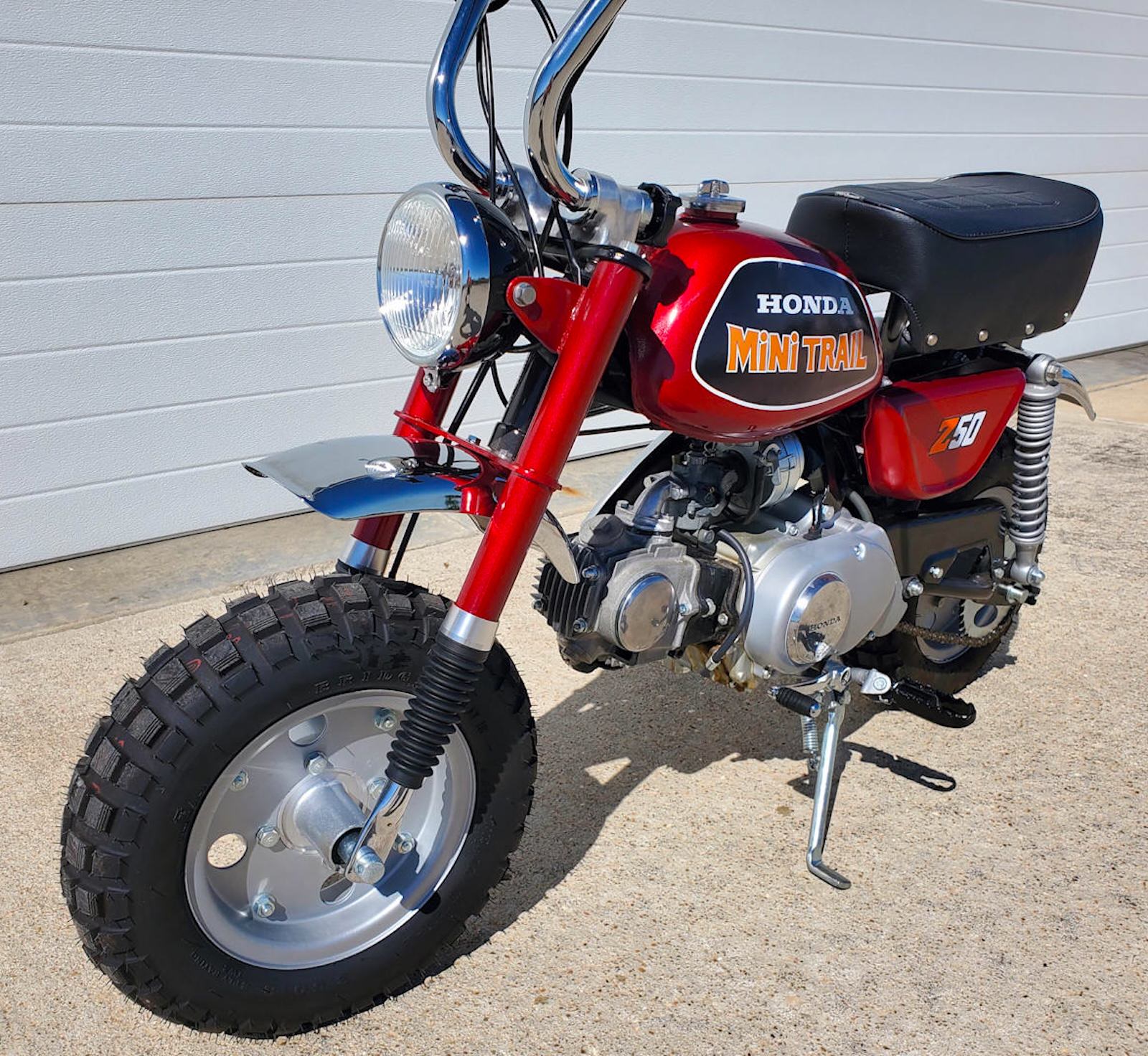
This is a 1972 Honda Z50A Mini Trail that benefits from a recent restoration, the rebuild process was undertaken carefully to preserve and refurb as many original parts as possible.
Original 1970s Z50s Monkey Bikes like this have become hugely collectible in recent years, as many of those who grew up riding them buy them either for the sake of nostalgia, or so that their own kids (and grandkids) can learn to ride on them as well.
Fast Facts: A 1972 Honda Z50A
- Honda’s Monkey Bike story began in 1961 with the Z100, a miniature motorcycle developed for visitors to its amusement parks in Japan. Powered by a 49cc engine with a 3-speed gearbox and automatic clutch, it proved popular enough to inspire the road-legal CZ100 in 1964, followed by the Japanese-market Z50M in 1967.
- The Honda Z50A evolved through the late 1960s and 1970s, it was given 8-inch wheels, front suspension, lighting, and eventually rear suspension with twin shock absorbers in 1972. In America, it was marketed as the Mini Trail, becoming a popular recreational motorcycle for children and adults riding around campgrounds, beaches, and trails.
- The Mini Trail helped transform America’s minibike market, offering a proper motorcycle engine, three gears, an automatic clutch, and established dealer support. It also introduced countless young riders to motorcycling, including future motocross champion Jeff Ward. The Z50A remained in production through 1978, before being succeeded by the off-road-focused Z50R in 1979.
- The 1972 Honda Z50A shown here has recently undergone a comprehensive frame-off restoration, finished in Ruby Red and black. Its original 49cc four-stroke single-cylinder engine remains paired with the factory 3-speed semi-automatic transmission. Many original Honda parts were carefully refurbed and retained, preserving its factory-style appearance. The motorcycle is scheduled for auction with Mecum in December.
History Speedrun: The Honda Z50A
The Honda Z50A Mini Trail had actually started life as a fairground ride in Japan, long before it became a two-wheeled zeitgeist of life in 1970s America. In October of 1961, Honda opened two motoring-themed amusement parks, Tama Tech in the Tokyo suburbs and Ikoma Tech in Nara Prefecture, and built a miniature motorcycle called the Z100 for visitors to ride.
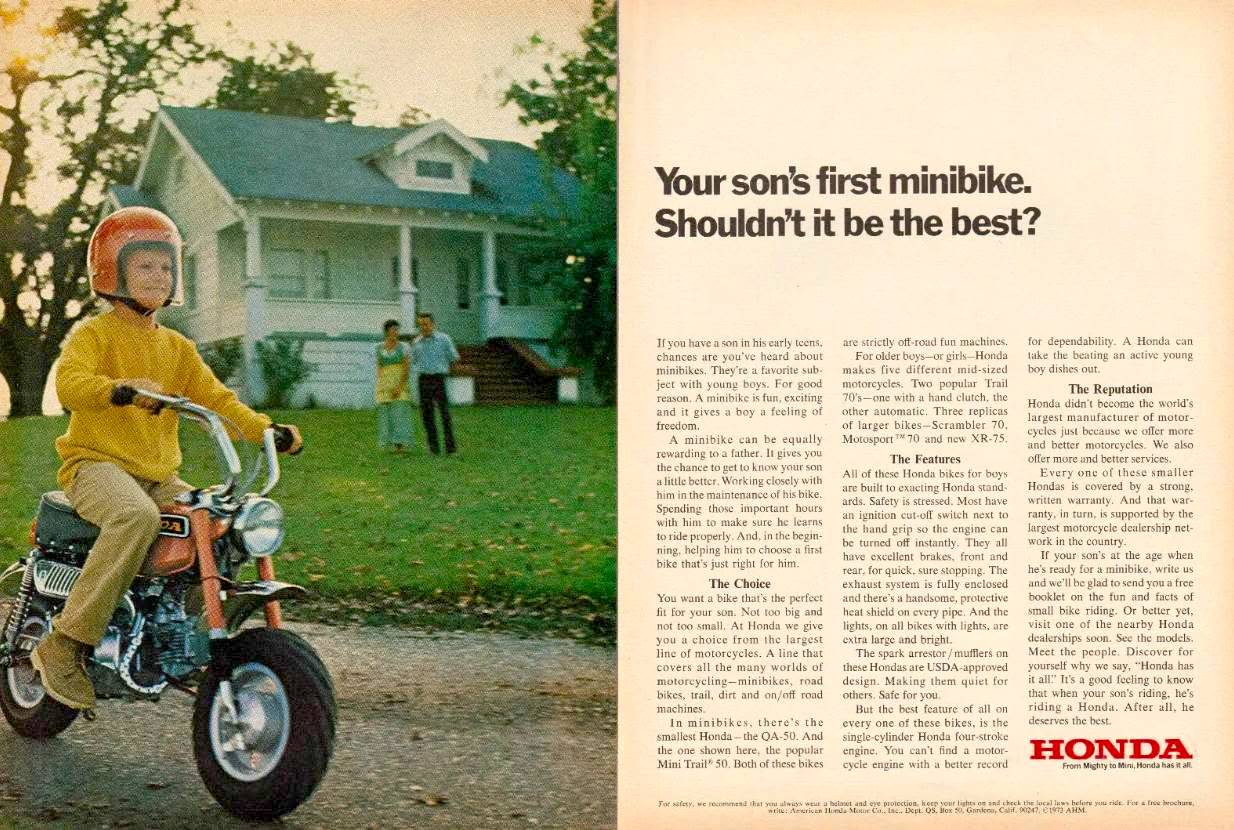
 The Honda Z50A Mini Trail had actually started life as a fairground ride in Japan, long before it became a two-wheeled zeitgeist of life in 1970s America. Image courtesy of Honda.
The little Z100 sat on 5-inch tires and used the Super Cub’s 49cc overhead-valve single, a 3-speed gearbox and an automatic centrifugal clutch. Honda had no plans to sell it, they just wanted a fun and easy fairground ride for people who had never thrown a leg over a motorcycle before. It was quickly nicknamed the “monkey bike” because of how adults looked when riding them (particularly when viewed from the back) with their knees up and arms out, due to the small size of the Z100.
Honda’s no-public-sales plans changed after the Z100 appeared at the Frankfurt and London Motor Shows in late 1962, where they were very warmly received by show attendees – Honda shipped 20 of them to its European operation that December for evaluation.
Long story short, the Europeans loved it, and a road-legal export model soon followed, the Honda CZ100, with a stiffer frame to carry adults and a fuel tank borrowed from the pre-existing Honda Sports Cub. Production began in 1964 on a small assembly line in a corner of the Suzuka factory, where five workers built 20 bikes a day. Around 2,500 were made in three years, exported mainly to France and Germany.
The first of these monkey bikes that sold in Japan was the 1967 Honda Z50M. It switched to the Super Cub’s overhead-cam engine, added lights for the road, and had a seat and handlebars that folded so the bike could ride in a car trunk. Honda didn’t yet build a car with a trunk big enough to take one, but that arrived two years later with the introduction of the Honda 1300 in 1969.
The Honda Z50A Debuts
Honda’s Japanese Z50A of 1969 moved up to 8-inch wheels and added front suspension, a 6-volt battery and turn signals. It also put both brake controls on the handlebars, an easier option than the earlier foot-operated rear brake for new riders. The American version, the 1968-model K0 sold as the Honda Mini Trail, had no lights at all and was meant for trails, campgrounds, and beaches.
The 1969 K1 model gained lights for road registration, and in 1972 the K3 replaced the rigid tail with a swingarm and twin shocks to relieve stress on the frame (and rider). That layout lasted until the Z50A was retired after the 1978 model year. Its larger sibling, the Honda CT70 Trail, had joined it in 1969, and had become a cult classic in its own right.
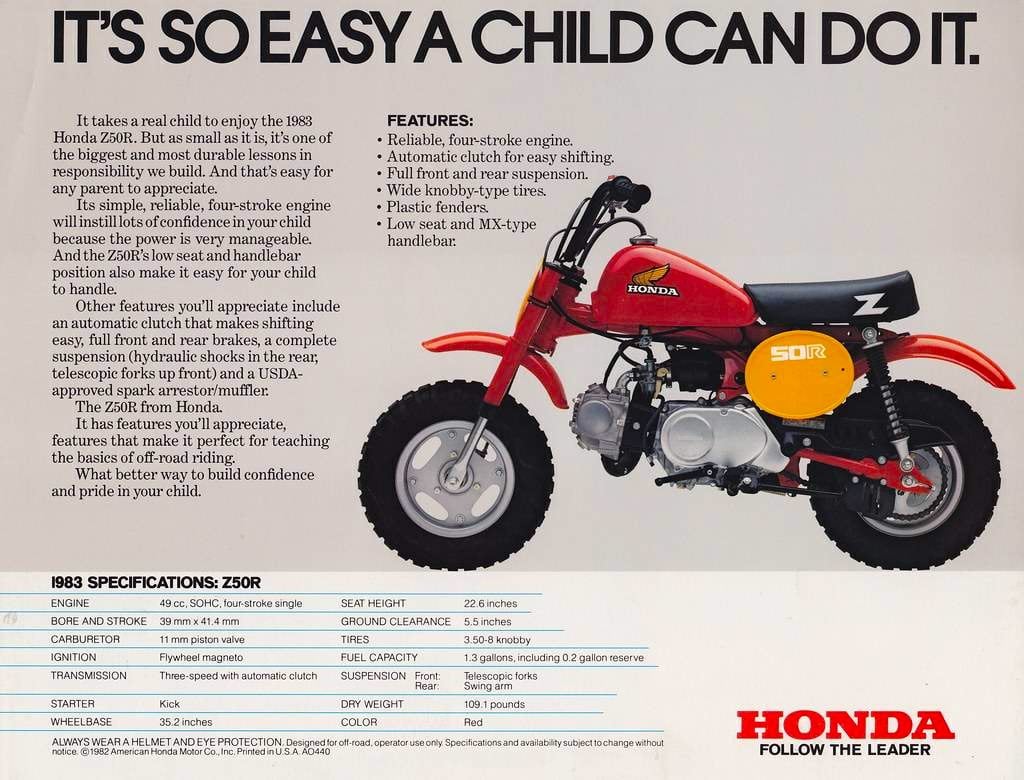
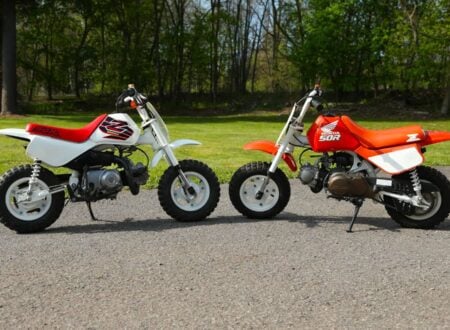
The Z50R replaced the Z50A for 1979, it was an off-road model aimed at young riders who wanted a minibike for the track, and it stayed in production until 1999. The XR50R took over in 2000 and became the CRF50F in 2004, a model Honda still builds today. Image courtesy of Honda.
The Mini Trail In America
The Honda Mini Trail landed smack bang in the middle of an American minibike craze. At its peak more than 150 companies were building minibikes, most of them with lawn-mower engines, sold through hardware shops, farm-equipment dealers, and even suburban department stores.
The Honda offered three gears, an automatic clutch, front suspension and a motorcycle dealer for parts and servicing. By 1974 the number of minibike makers had fallen to just 10. Tom Drzewiecki, a Wisconsin collector with more than 60 of the older machines, describes the Honda’s arrival as “pretty much the end” for the local American manufacturers.
The child performing a long wheelie on a Mini Trail in the opening minutes of the 1971 documentary On Any Sunday, filmed at Saddleback Park, was Jeff Ward. He went on to win AMA Supercross and Motocross championships in the 1980s. He was just one of many kids who got their start riding little Hondas, before graduating to the big bikes and making a name for themselves.
The Successors To The Z50A
The Z50R replaced the Z50A for 1979, it was an off-road model aimed at young riders who wanted a minibike for the track, and it stayed in production until 1999. The XR50R took over in 2000 and became the CRF50F in 2004, a model Honda still builds today.
The 1972 Honda Z50A Shown Here
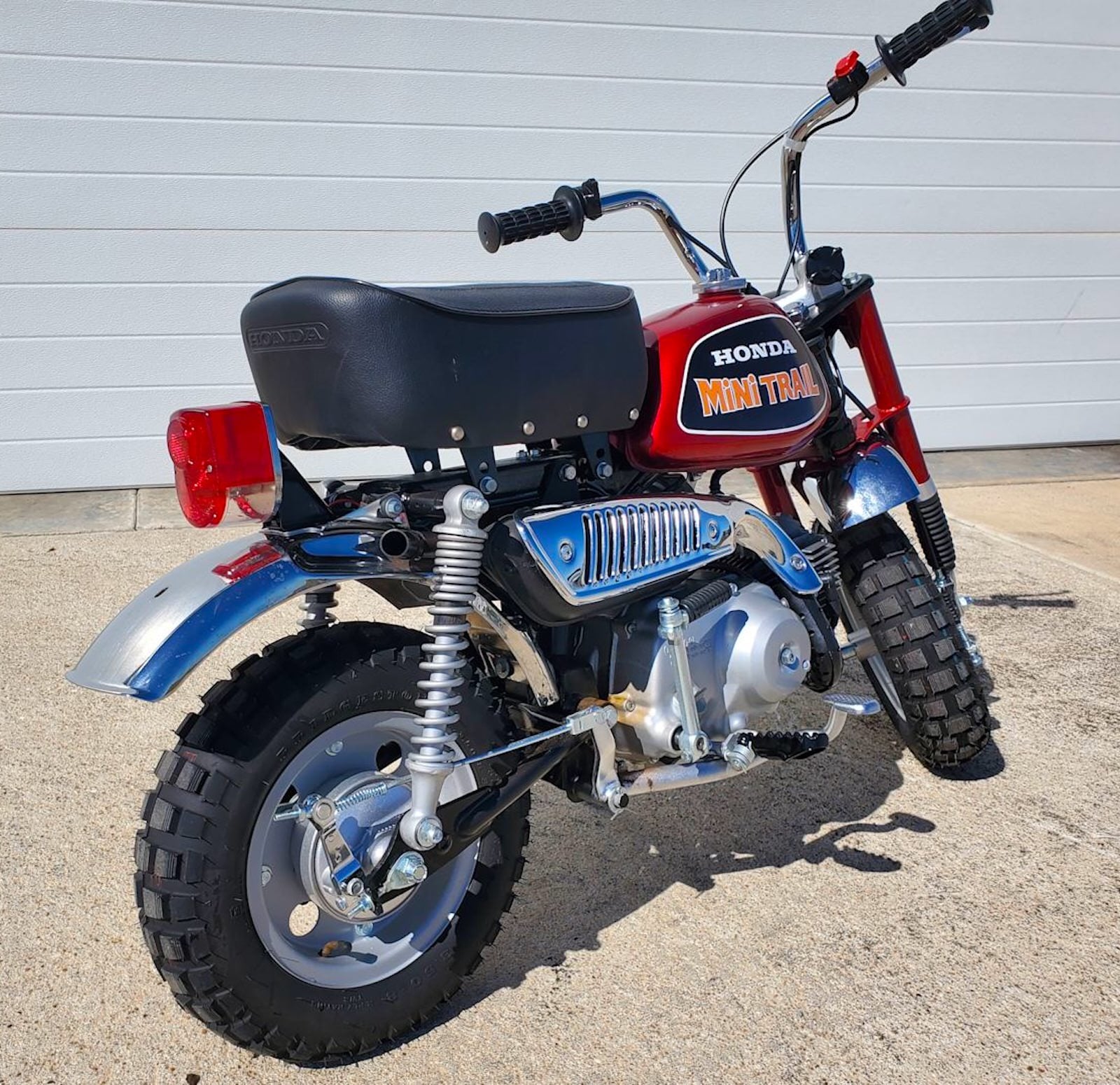
This is an original 1972 Honda Z50A, it’s recently undergone a comprehensive frame-off restoration and it’s finished in Ruby Red and black paint. As you would expect, power comes from its original Honda 49cc four-stroke single-cylinder engine, paired with a factory 3-speed semi-automatic transmission.
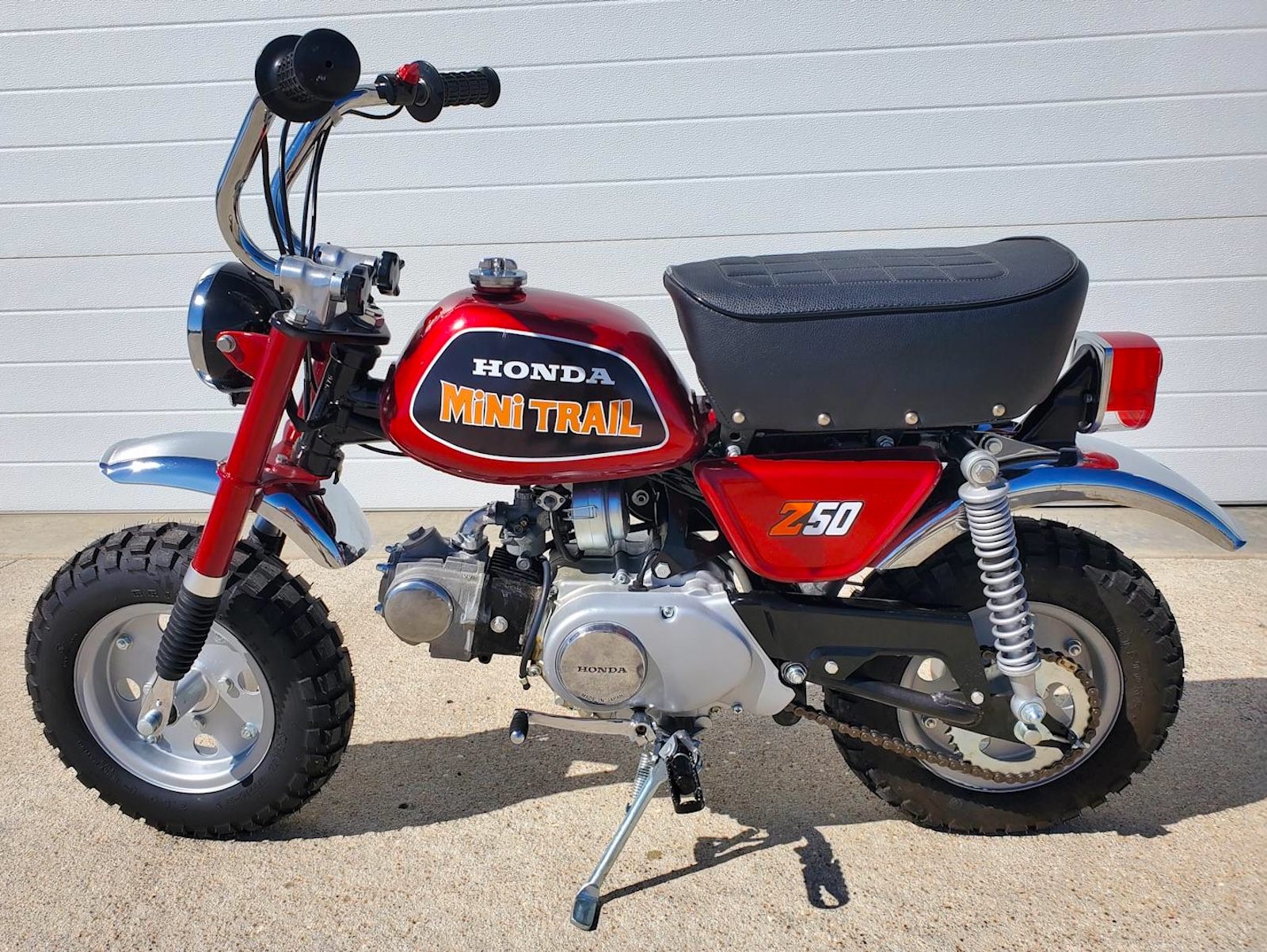
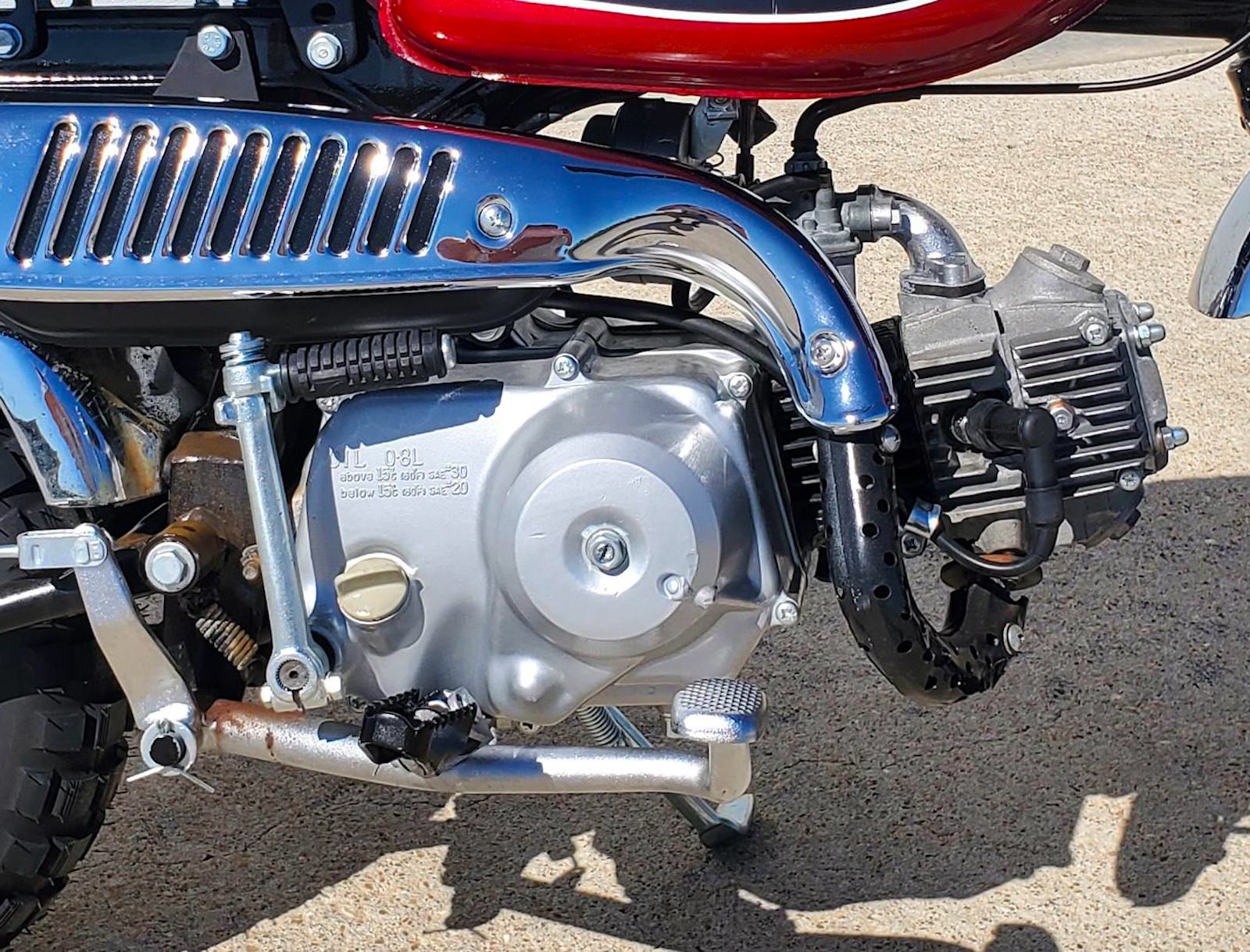
This is an original 1972 Honda Z50A, it’s recently undergone a comprehensive frame-off restoration and it’s finished in Ruby Red and black paint. As you would expect, power comes from its original Honda 49cc four-stroke single-cylinder engine, paired with a factory 3-speed semi-automatic transmission.
The rebuild included refurbishing and keeping many of the bike’s original factory Honda parts. The restoration was carefully sympathetic to keep the classic factory-style appearance, with a major emphasis on preserving original components rather than replacing them with off-the-shelf modern alternatives.
It’s now due to roll across the auction block with Mecum in early December, and you can visit the listing here if you’d like to read more or register to bid.
Images courtesy of Mecum + Honda

Articles that Ben Branch has written have been covered on CNN, Popular Mechanics, Smithsonian Magazine, Road & Track Magazine, the official Pinterest blog, the official eBay Motors blog, BuzzFeed, Autoweek Magazine, Wired Magazine, Autoblog, Gear Patrol, Jalopnik, The Verge, and many more.
Silodrome was founded by Ben back in 2010, in the years since the site has grown to become a world leader in the alternative and vintage motoring sector, with well over a million monthly readers from around the world and many hundreds of thousands of followers on social media.