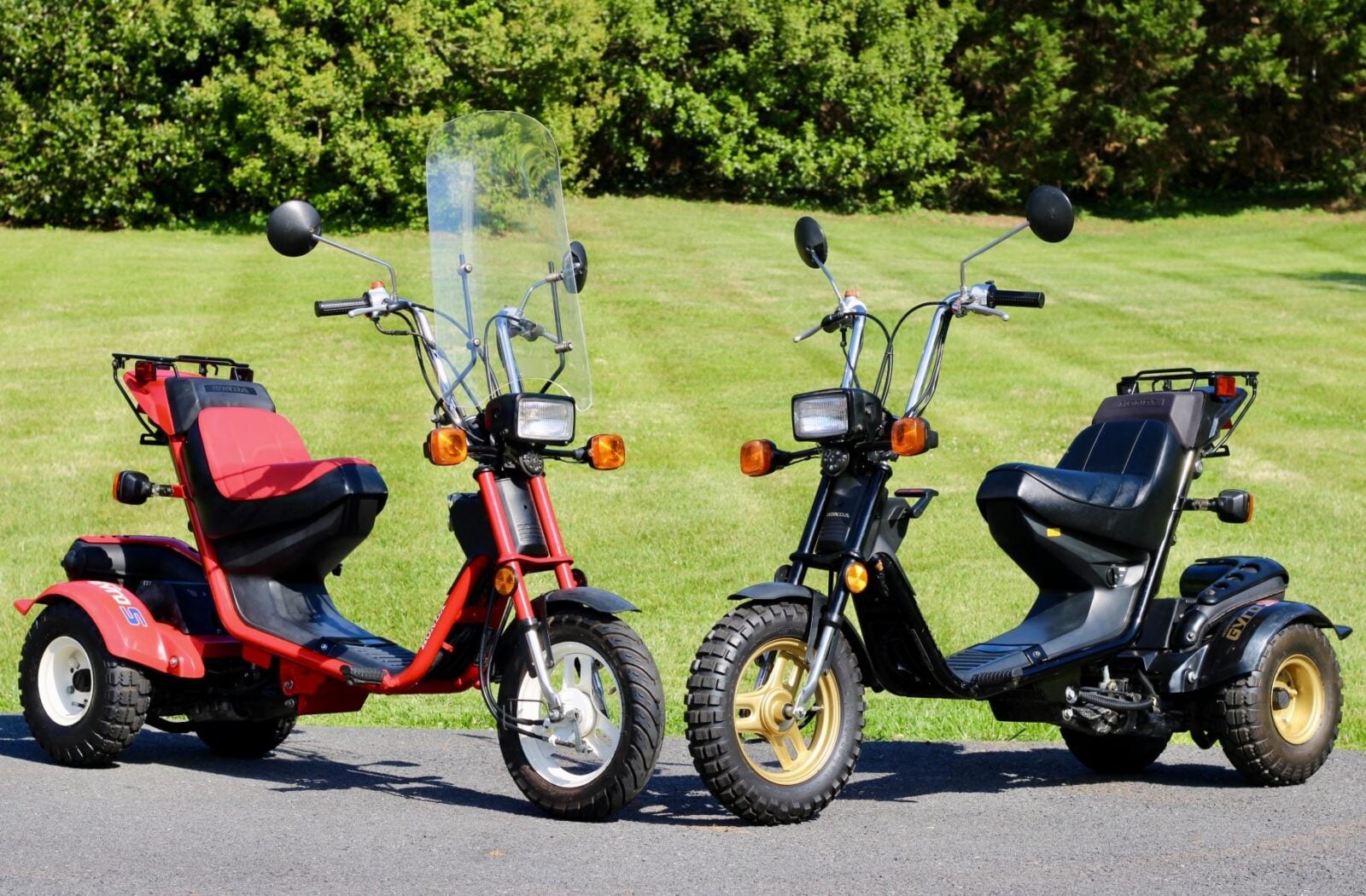
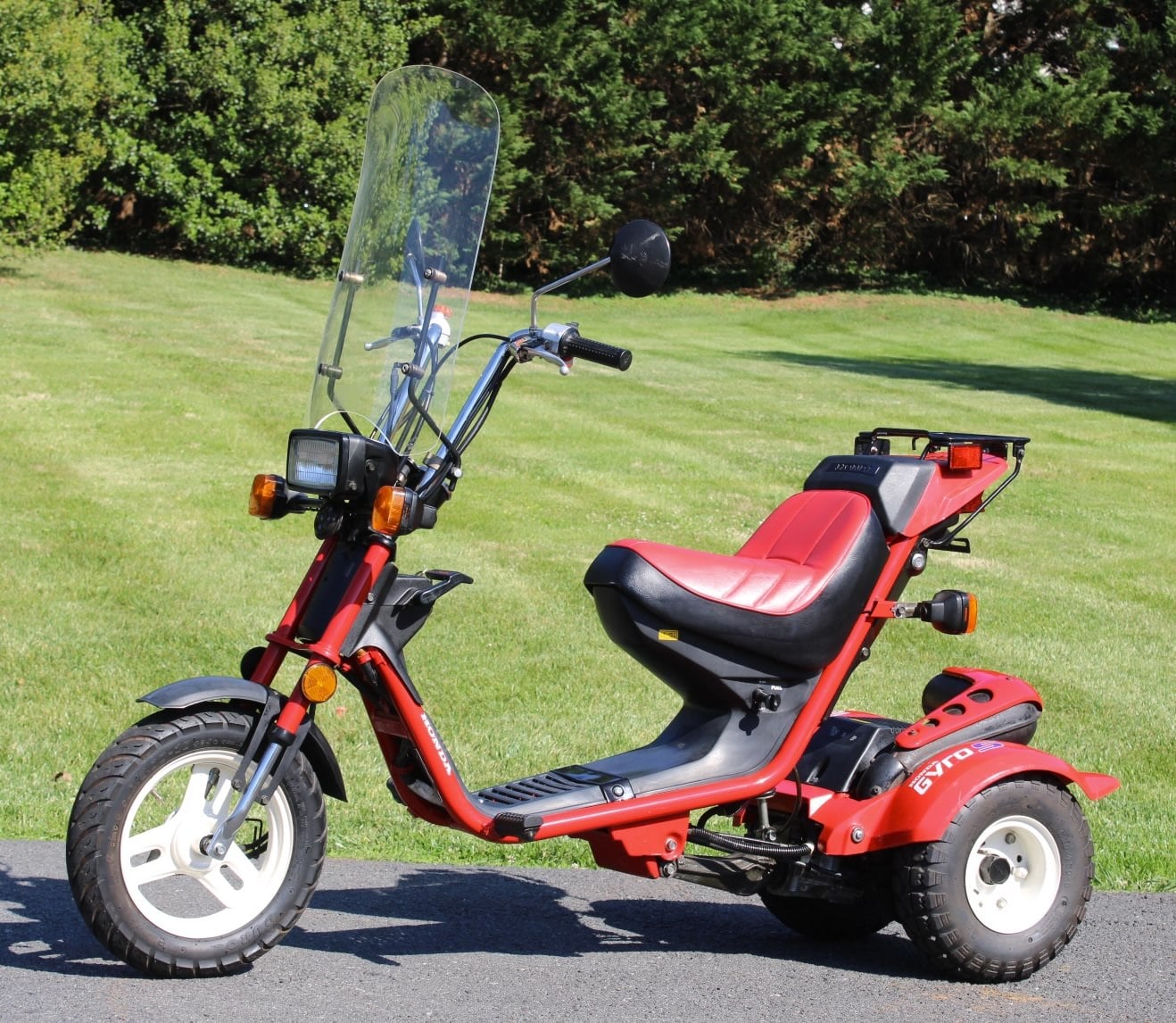
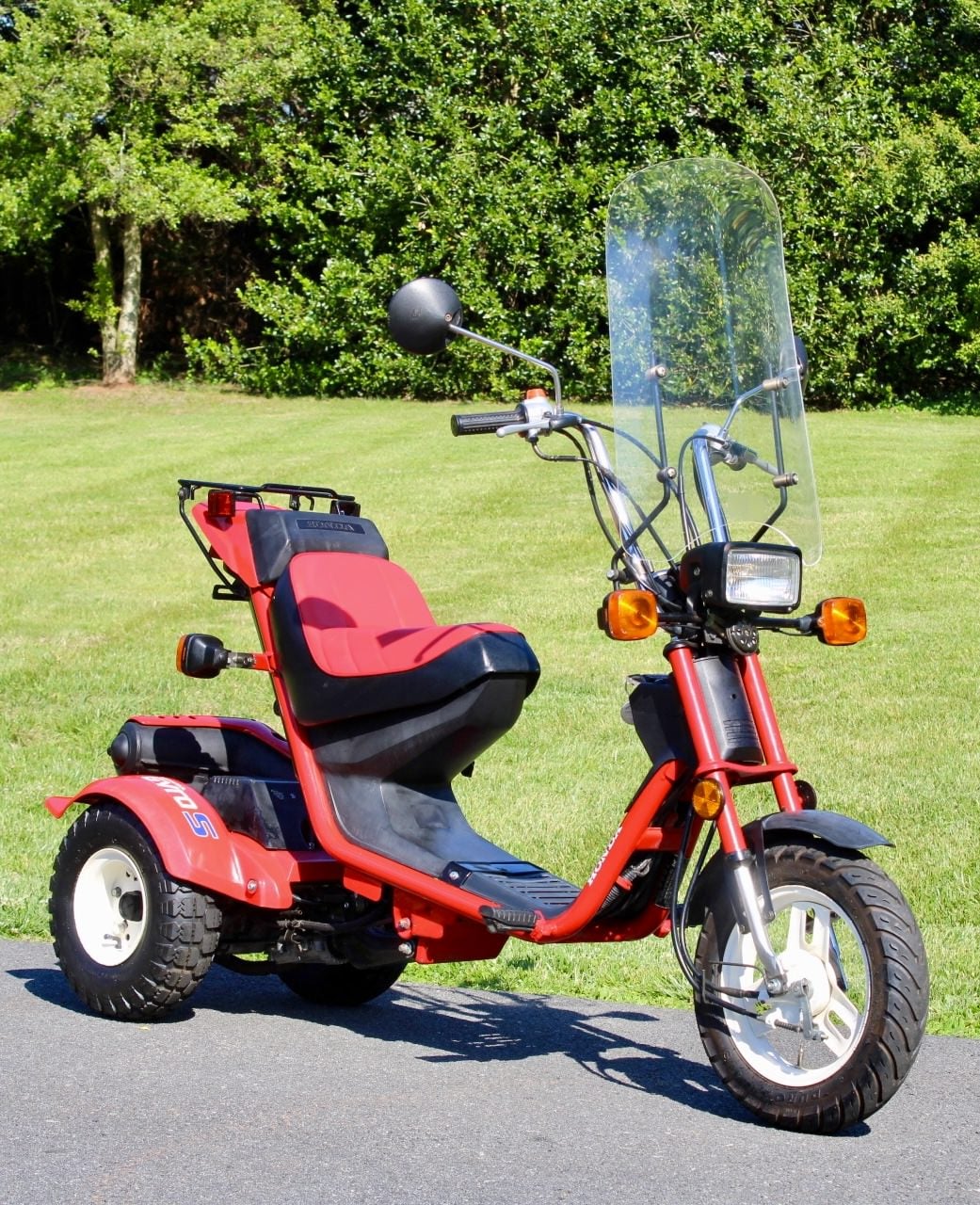
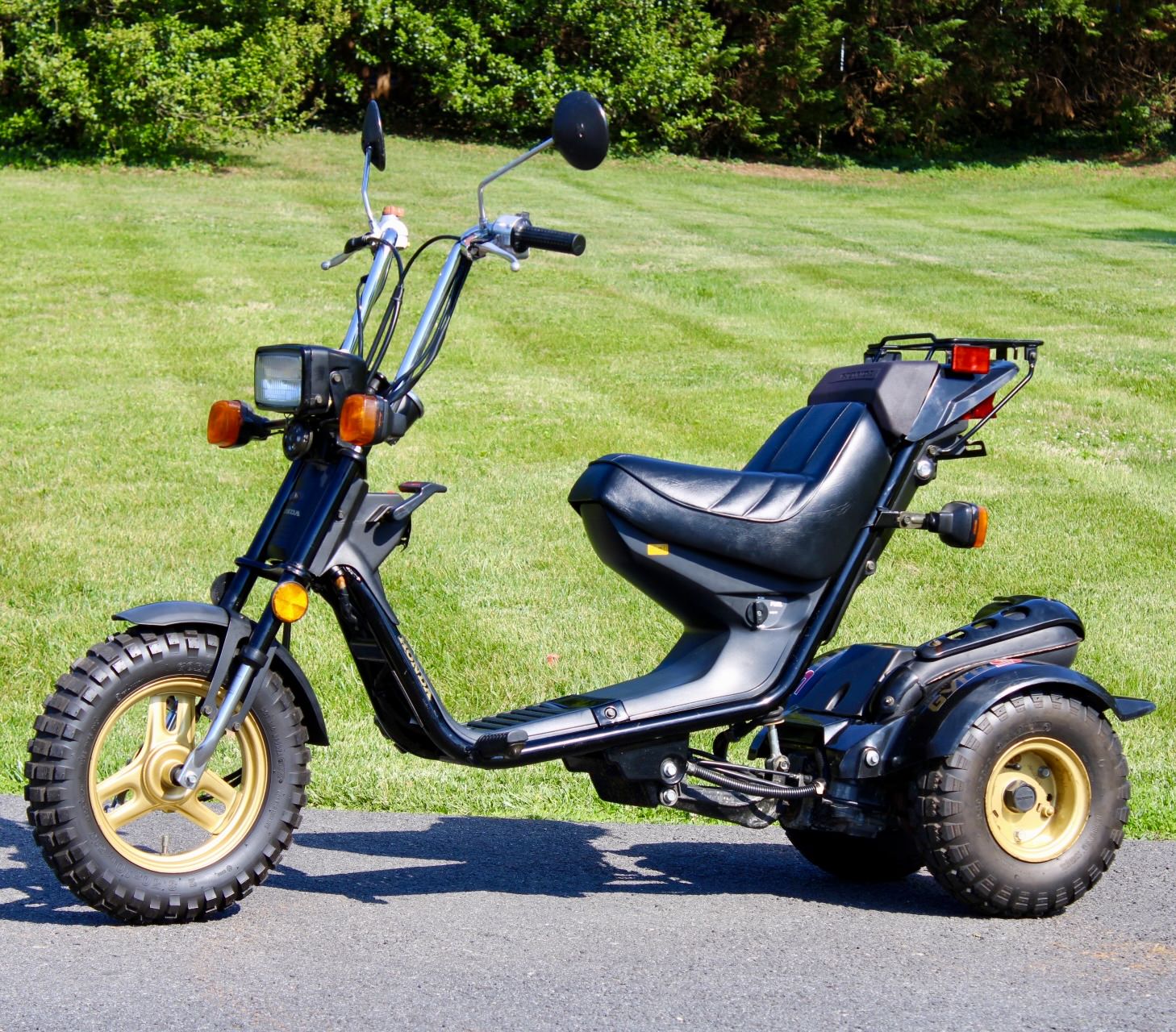
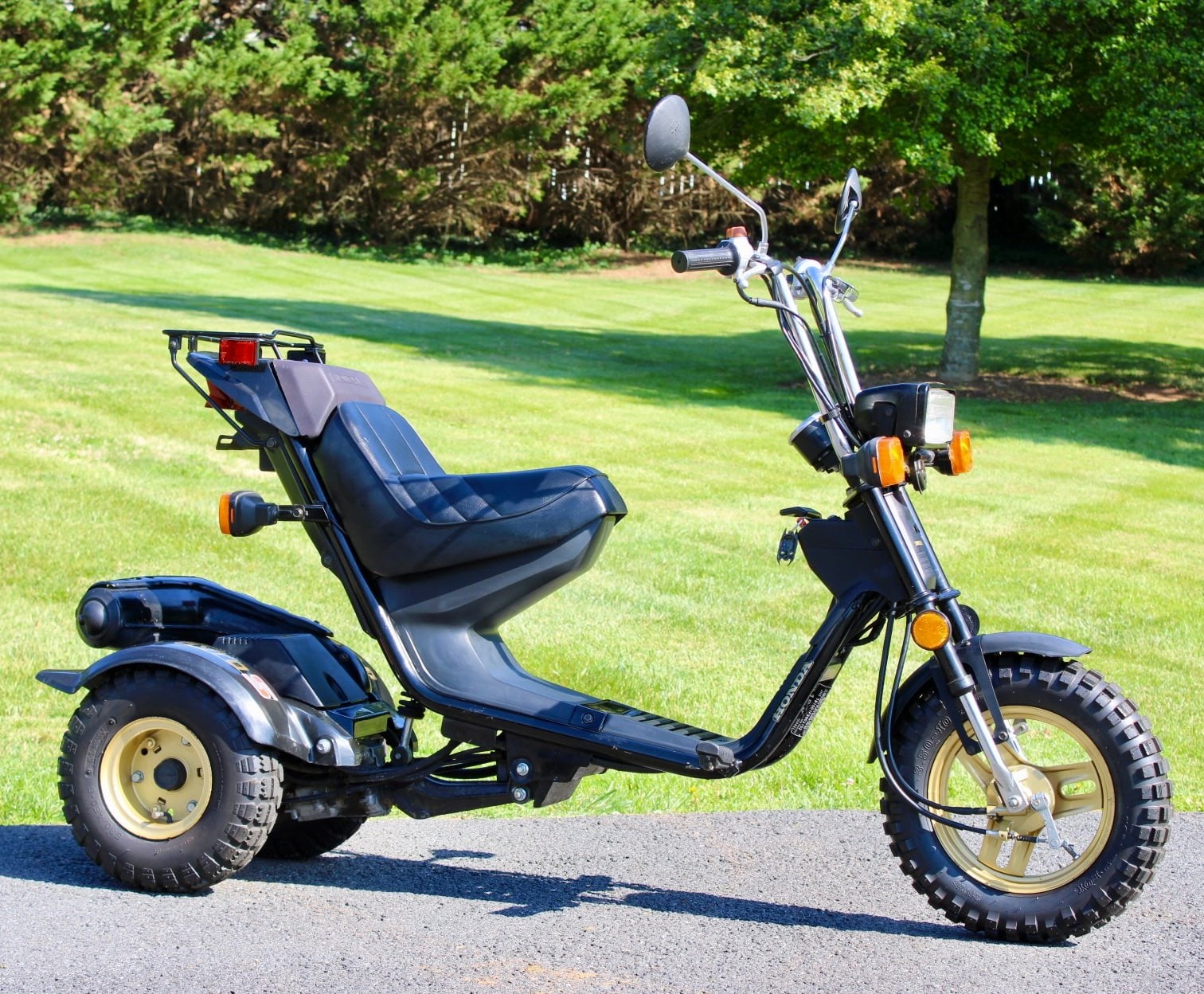
This is a pair of Honda Gyro S scooters from 1985 and 1986. The Gyro S was an unusual three-wheeled scooter design with a fascinating history, but it never quite caught on in the way that Honda had hoped.
The laidback riding style, almost reminiscent of a chopper, and the retro styling, have made the Gyro S a bit of a cult classic today – and due to their rarity many people have never seen one in person.
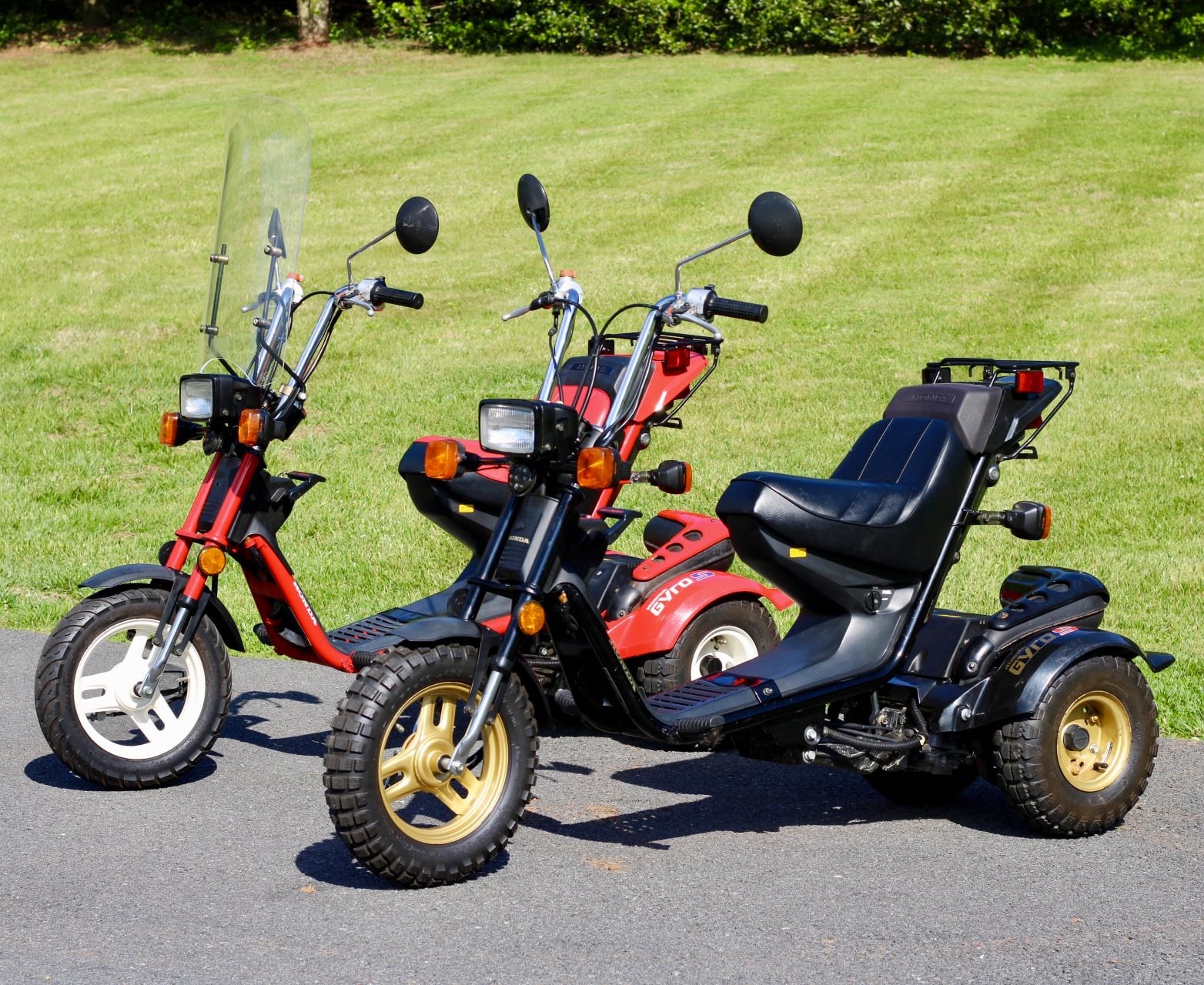
 This is a pair of Honda Gyro S scooters from 1985 and 1986. The Gyro S was an unusual three-wheeled scooter design with a fascinating history, but it never quite caught on in the way that Honda had hoped.
History Speedrun: The Honda Gyro S
Very few small scooters have a backstory quite as unlikely as the Honda Gyro. The little three-wheeled tilters that you can still see darting around side streets in many Japanese cities (often loaded down with pizza boxes or packages) trace their lineage back not to Honda’s R&D division but to a small engineering firm in suburban Surrey, England. Sitting right in the middle of the family tree is the Gyro S, a two-year-only oddity that’s now one of the rarer Hondas to ever wear US plates.
A Failed BSA And A Second Life At Honda
The tilting linkage at the center of every Gyro, a system that lets the main body and front wheel lean into a corner while the rear pod containing the engine and two driven wheels stays flat to the road, was developed and patented by George Wallis of G.L. Wallis & Son in Surbiton back in 1966.
The design first found a production home on the BSA Ariel 3 of 1970, a moped-class three-wheeler that’s often named among the British motorcycle industry’s top ten all-time commercial disasters. Honda saw something in the concept that BSA didn’t, licensed it, and quietly began developing its own interpretation of the design.
That Japanese interpretation first publicly surfaced in November of 1981 as the Honda Stream, a small two-stroke personal scooter that was the first of seven tilting three-wheelers Honda would build using the Wallis linkage.
The Stream was followed by the Joy, Just, and Road Fox, all aimed at personal recreational use, and all relatively short-lived. The cargo-oriented Gyro launched in October of 1982, and unlike its sister models, it caught on.
Honda still builds Gyros in Japan today, and “GYRO” itself is a Honda-issued backronym, with the letters standing for Great, Yours, Recreational, and Original – a phrase that doesn’t really work in any meaningful way, but as we all know, corporations do love an awkward acronym.
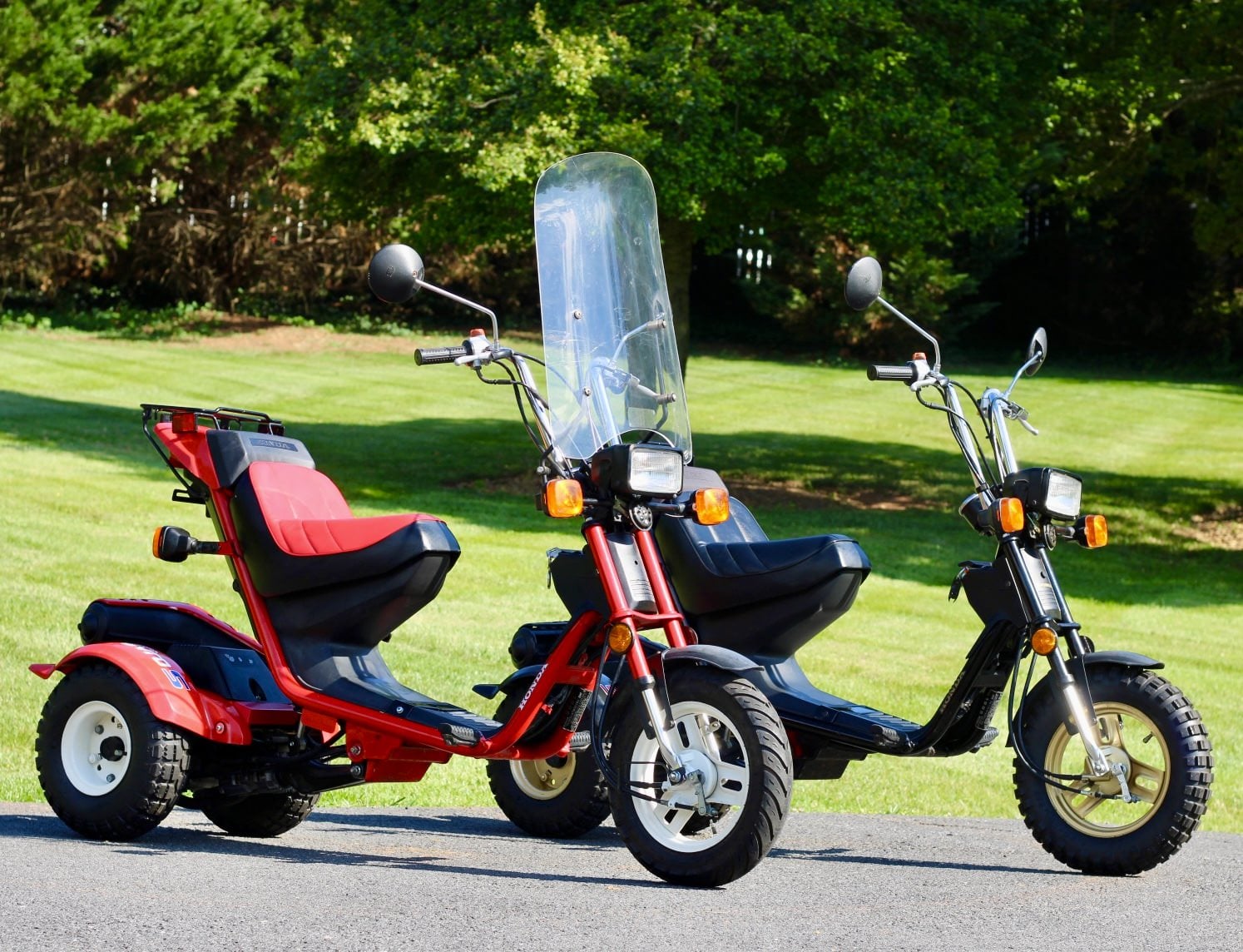
The laidback riding style, almost reminiscent of a chopper, and the retro styling, have made the Gyro S a bit of a cult classic today – and due to their rarity many people have never seen one in person.
The Gyro (Briefly) Comes To America
The Gyro arrived in North America in 1984 as the NN50, which had been sold in Japan as the Just. It was a narrow-track machine that shared its front half with the Honda Spree, finished in either blue or red, and offered with an optional front basket. Sales were modest to say the least. For 1985, Honda dropped the NN50 from the US catalog and replaced it with the TG50 (this model that had been sold in Japan as the Road Fox) which it rebadged the Gyro S. This is where things started to get interesting.
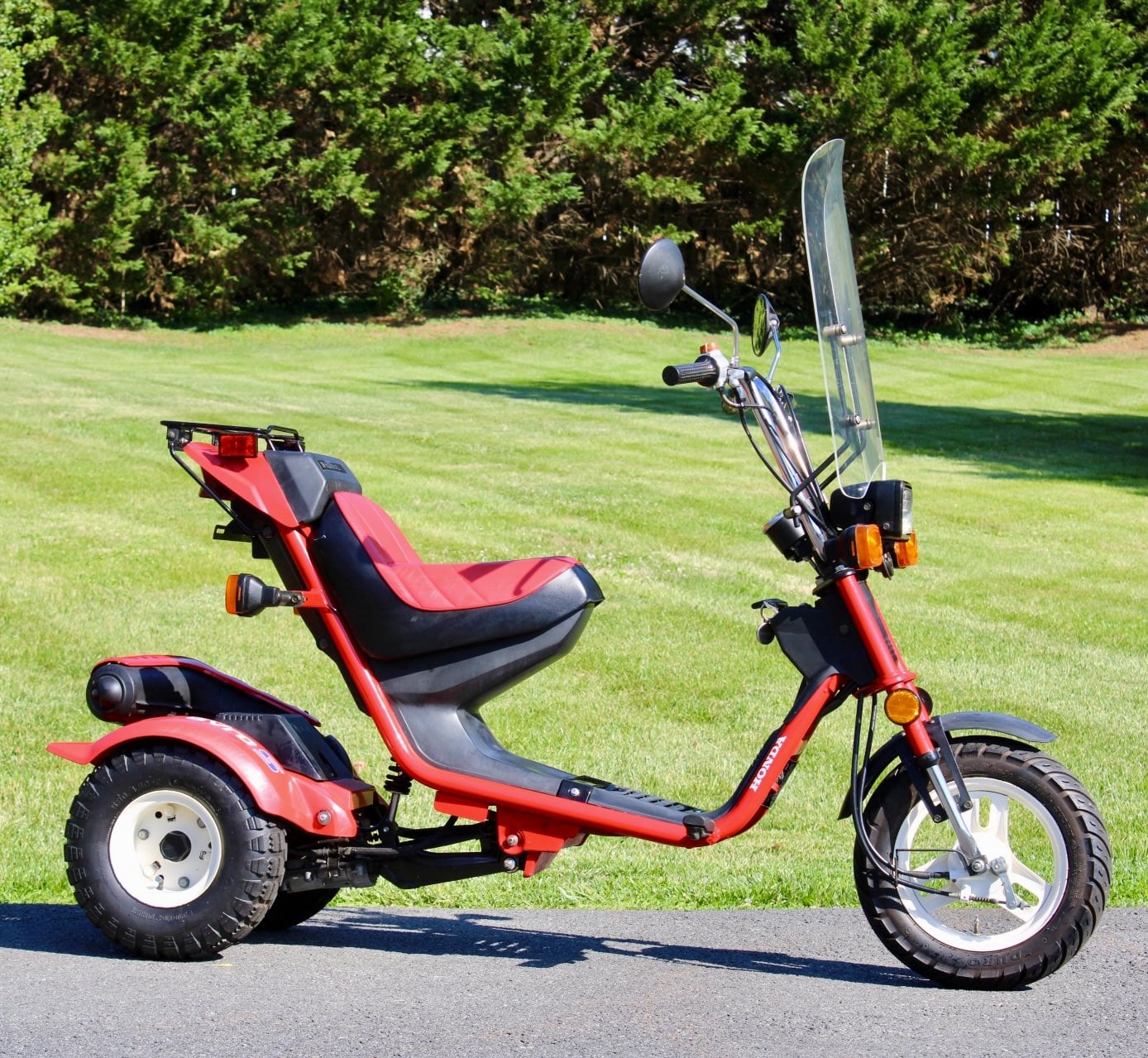
The Gyro S was a wider-track, lower-slung machine with an exposed tubular frame and a laid-back, almost chopper-like riding position. It looked nothing like a delivery scooter and very little like anything else in Honda’s American showrooms at the time.
It was sold only in black for the 1985 model year and only in red for 1986, and US importation of the Gyro family ended after that final year. Canada had it for one year only, in 1984. Due to its (arguably) much cooler looks, the Gyro S has become a bit of an unexpected cult classic, helped along by the model’s relative rarity.
The Gyro S was powered by Honda’s TB08E, this was a 49cc air-cooled two-stroke single with oil injection. Output was nothing to write home about, somewhere in the 3.7 to 4.0 bhp range depending on your source, and top speed was capped at around 30 mph to keep the Gyro S compliant with US moped regulations.
Curb weight was approximately 140 lbs. Honda’s Japanese-market Road Fox release quoted fuel consumption of 72 km/L at a steady 30 km/h test speed – a controlled Japanese test figure that works out to roughly 169 mpg US, indicative of just how frugal the little two-stroke could be under ideal conditions.
Power went to both rear wheels through an automatic transmission and a limited-slip differential, with a one-touch parking brake to keep the whole machine upright at rest. The main body could lean as much as 40º relative to the rear pod, which made the Gyro S handle far more like a conventional scooter than its tricycle layout would suggest.
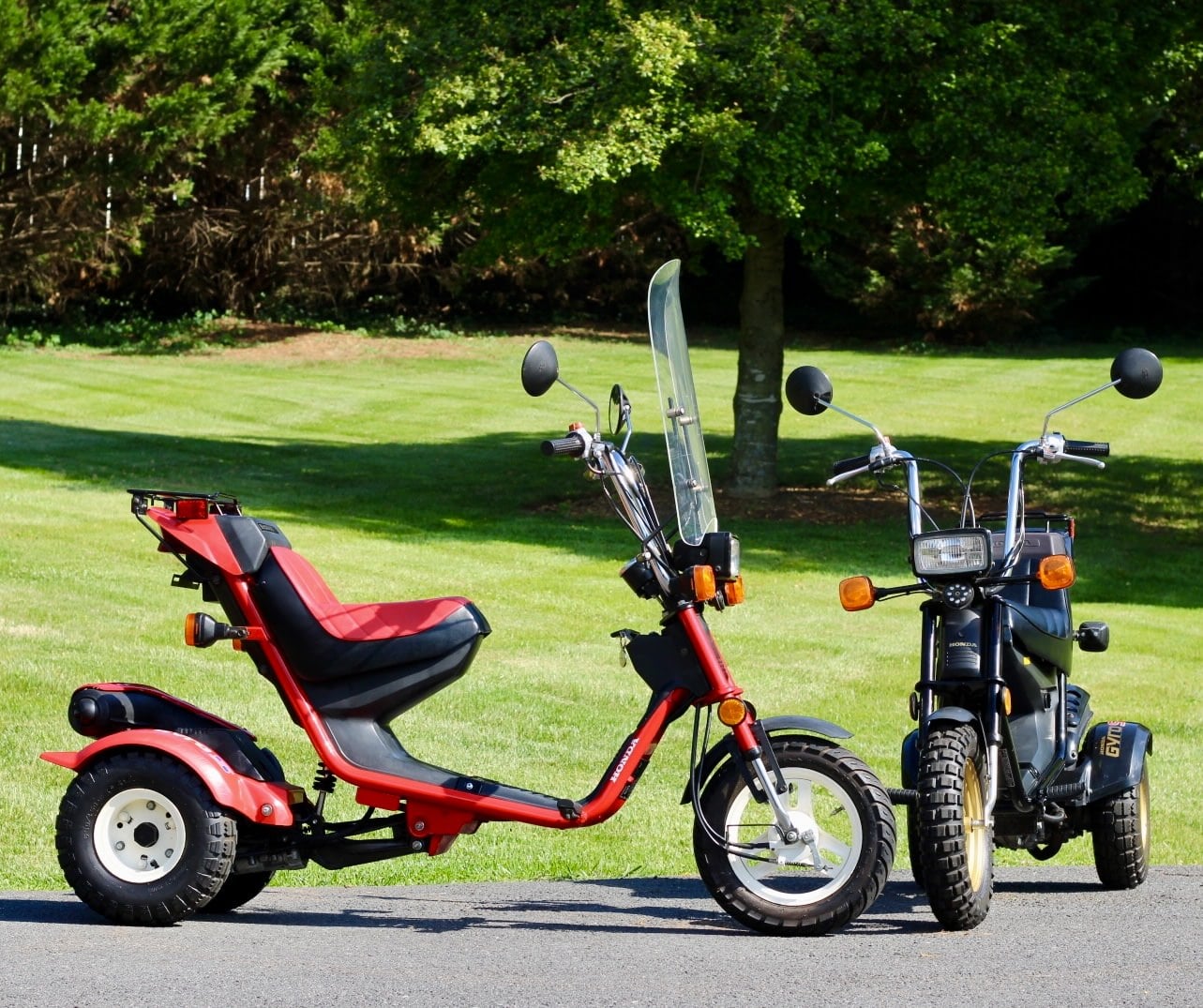
This pair of Honda Gyro S scooters, consisting of a black 1985 model and a red 1986 model, was bought by the seller in 2024. Since their acquisition, work has included new tires on both machines, replacement of one petcock lever and one battery cover, and a carburetor cleaning on both bikes in May of 2026 in preparation for sale.
The TB08E engine was essentially unique to the Gyro lineup, which is why aftermarket support has always been thin. Honda kept the two-stroke in production in Japan until March of 2008, when the Gyro X and Gyro Canopy were finally updated to a water-cooled four-stroke single while keeping the 50cc displacement bracket that keeps the scooter classified as a moped in its home market.
The Two Honda Gyro S Scooters Shown Here
This pair of Honda Gyro S scooters, consisting of a black 1985 model and a red 1986 model, was bought by the seller in 2024. Since their acquisition, work has included new tires on both machines, replacement of one petcock lever and one battery cover, and a carburetor cleaning on both bikes in May of 2026 in preparation for sale.
Each scooter wears matching frame and bodywork in its respective color, with shared equipment that includes a solo seat, luggage rack, street lighting, rubber footpegs, body-color fenders, parking brake, and chrome handlebars with dual mirrors.
The red 1986 bike is also fitted with a removable, tall, clear windshield. The 10-inch front and 6-inch rear steel wheels are finished in white on one bike and gold on the other, wearing tires that were replaced in 2024.
Suspension consists of an inverted front fork along with a monoshock and linkage system that allows the front portion of each scooter to lean into turns while the rear wheels remain perpendicular to the road. Drum brakes are fitted at both ends.
Handlebar controls include switches for the electric starter, horn, and lights, with Nippon Seiki 35-mph speedometers sitting beneath indicator lights for high beams and turn signals. A keyed ignition and parking lock lever reside below each speedometer. One odometer shows 2,200 miles and the other 4,200 miles, and the seller has put approximately 20 miles on each bike since acquiring them.
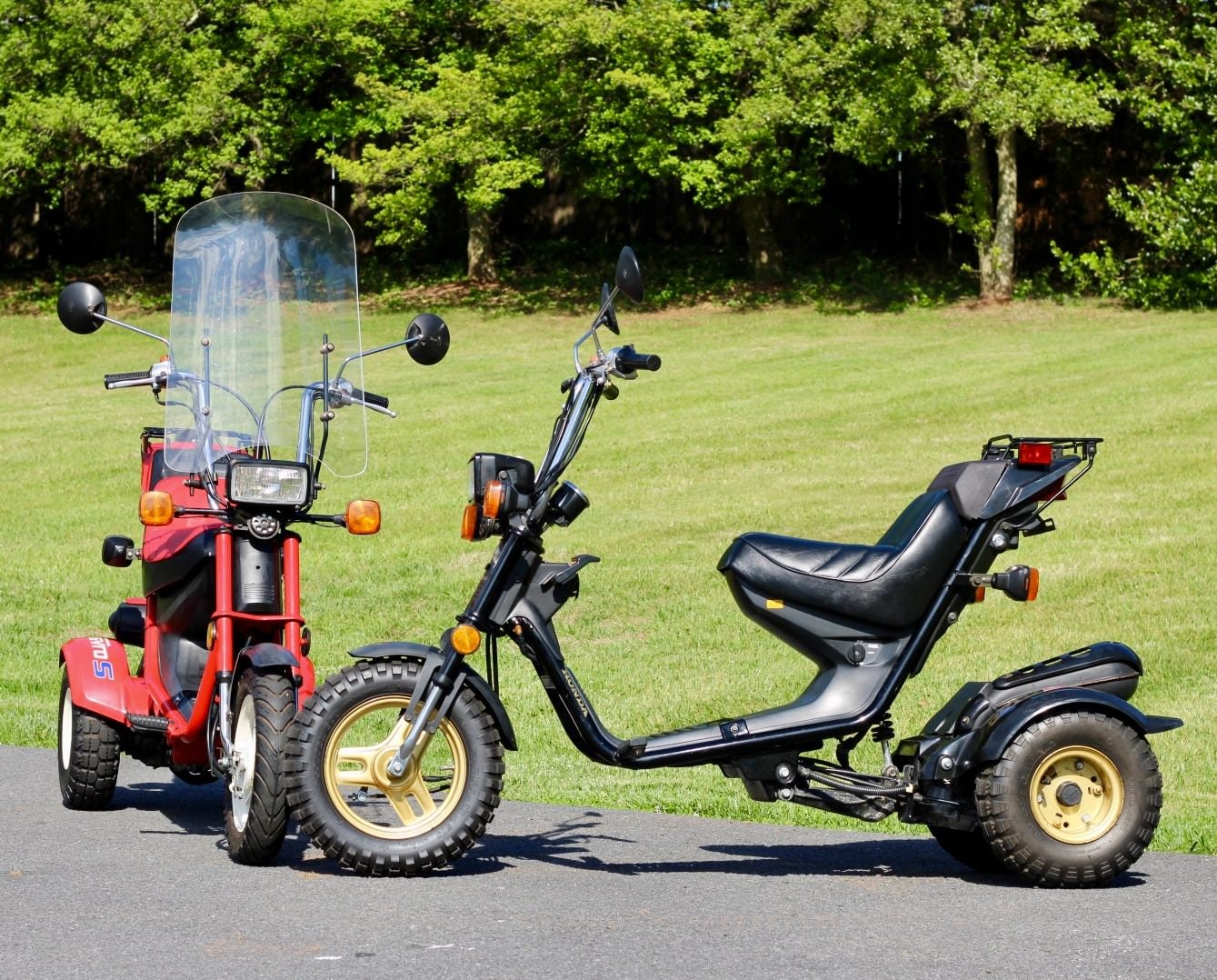
Each scooter wears matching frame and bodywork in its respective color, with shared equipment that includes a solo seat, luggage rack, street lighting, rubber footpegs, body-color fenders, parking brake, and chrome handlebars with dual mirrors.
Power on both machines comes from an air-cooled 49cc two-stroke single fitted with an electric starter and an expansion-chamber exhaust with heat shields, routed to the rear wheels through a two-speed automatic transmission.
They’re now being offered for sale as a pair out of Culpeper, Virginia at no reserve with Virginia titles in the seller’s name. if you’d like to read more or register to bid you can visit the listing here.
Images courtesy of Bring a Trailer

Articles that Ben Branch has written have been covered on CNN, Popular Mechanics, Smithsonian Magazine, Road & Track Magazine, the official Pinterest blog, the official eBay Motors blog, BuzzFeed, Autoweek Magazine, Wired Magazine, Autoblog, Gear Patrol, Jalopnik, The Verge, and many more.
Silodrome was founded by Ben back in 2010, in the years since the site has grown to become a world leader in the alternative and vintage motoring sector, with well over a million monthly readers from around the world and many hundreds of thousands of followers on social media.