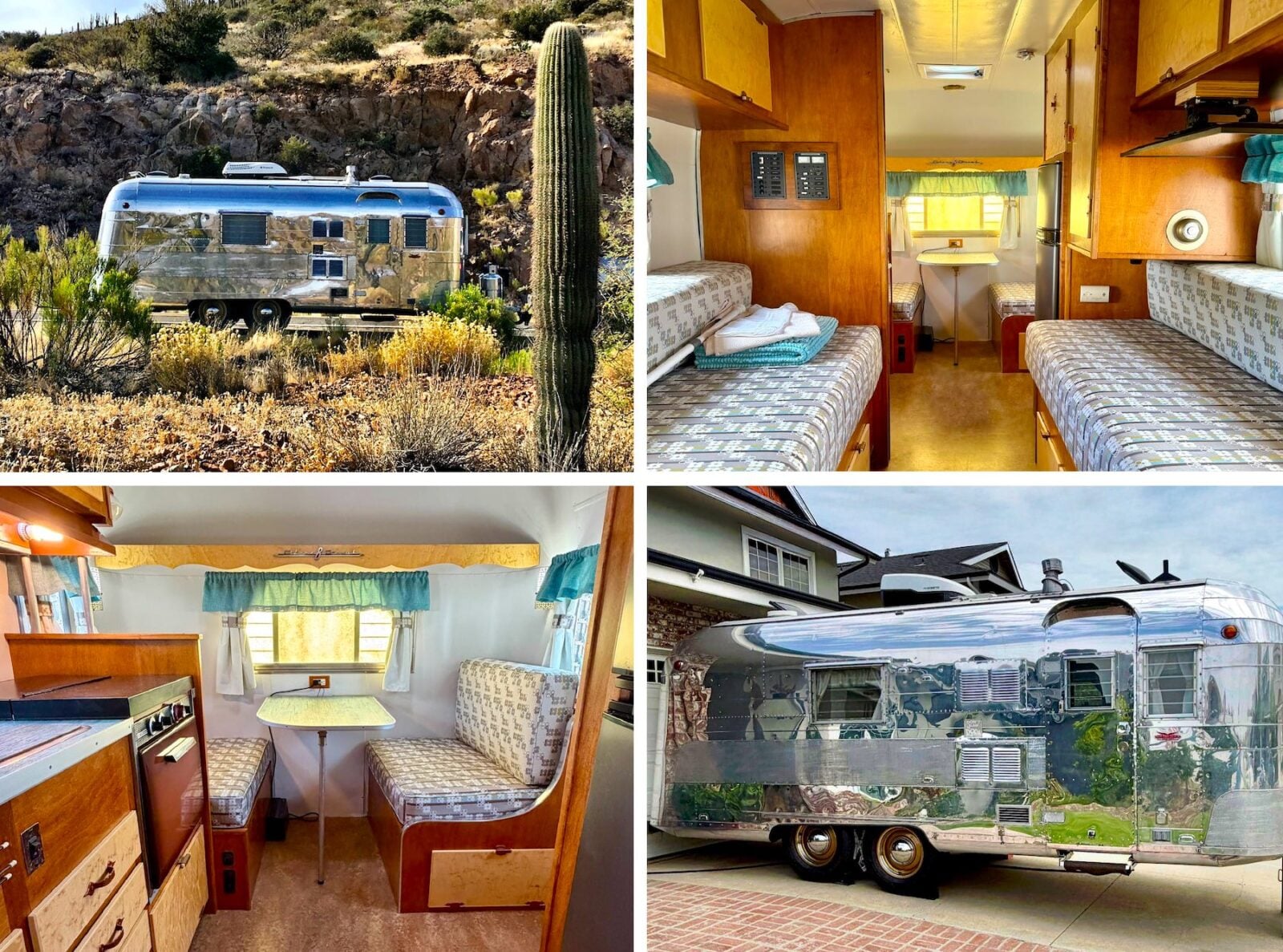
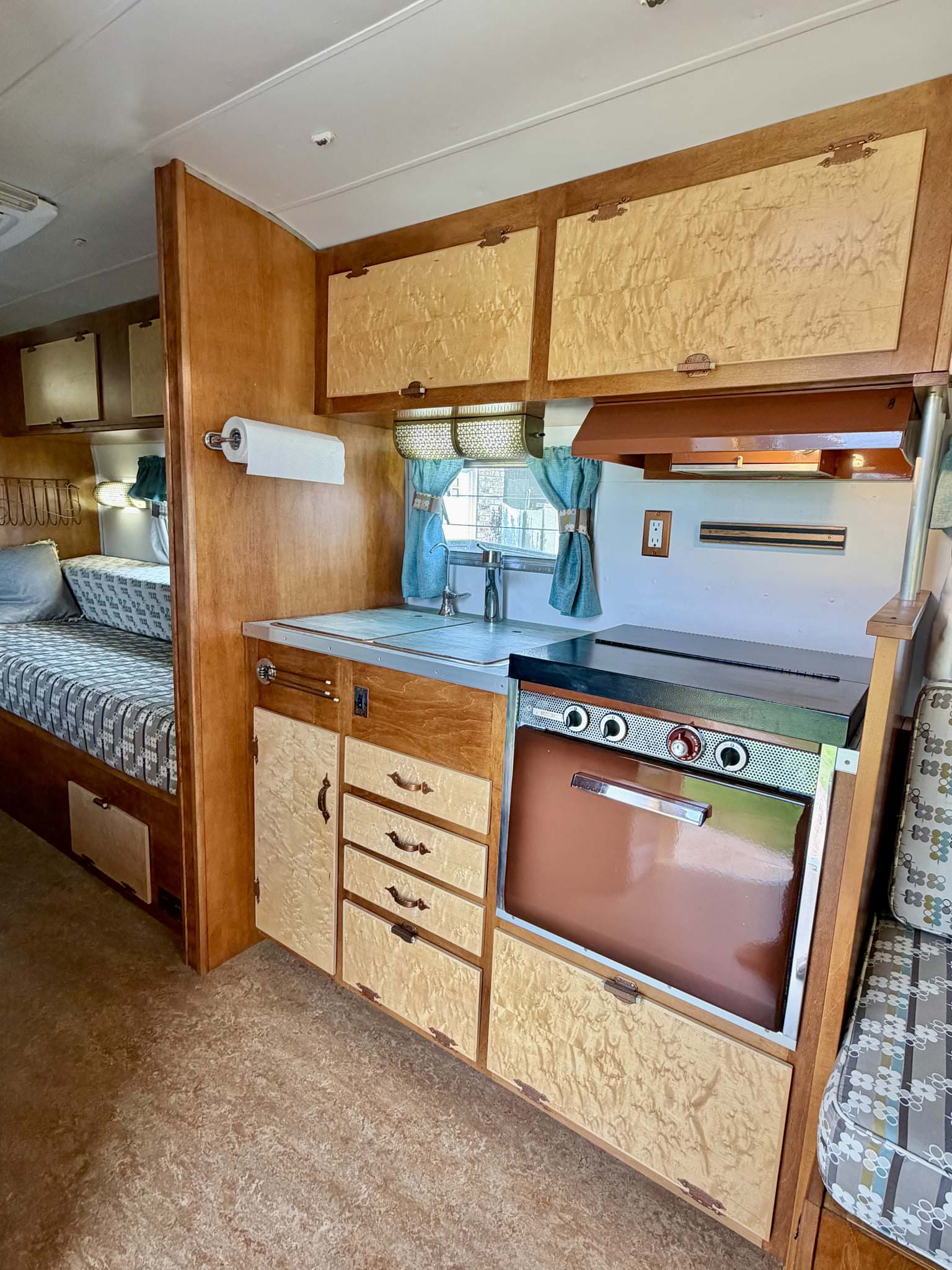
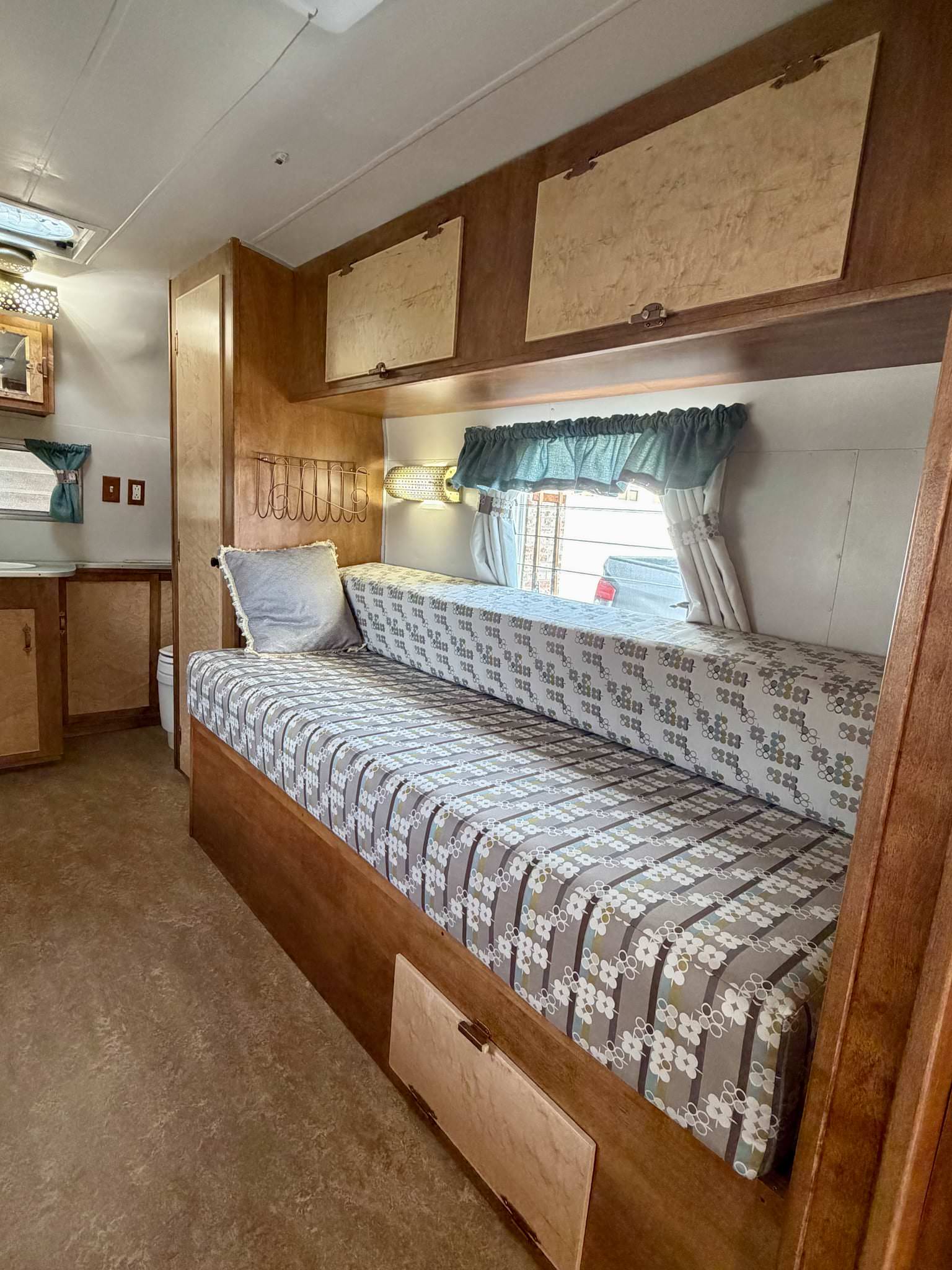
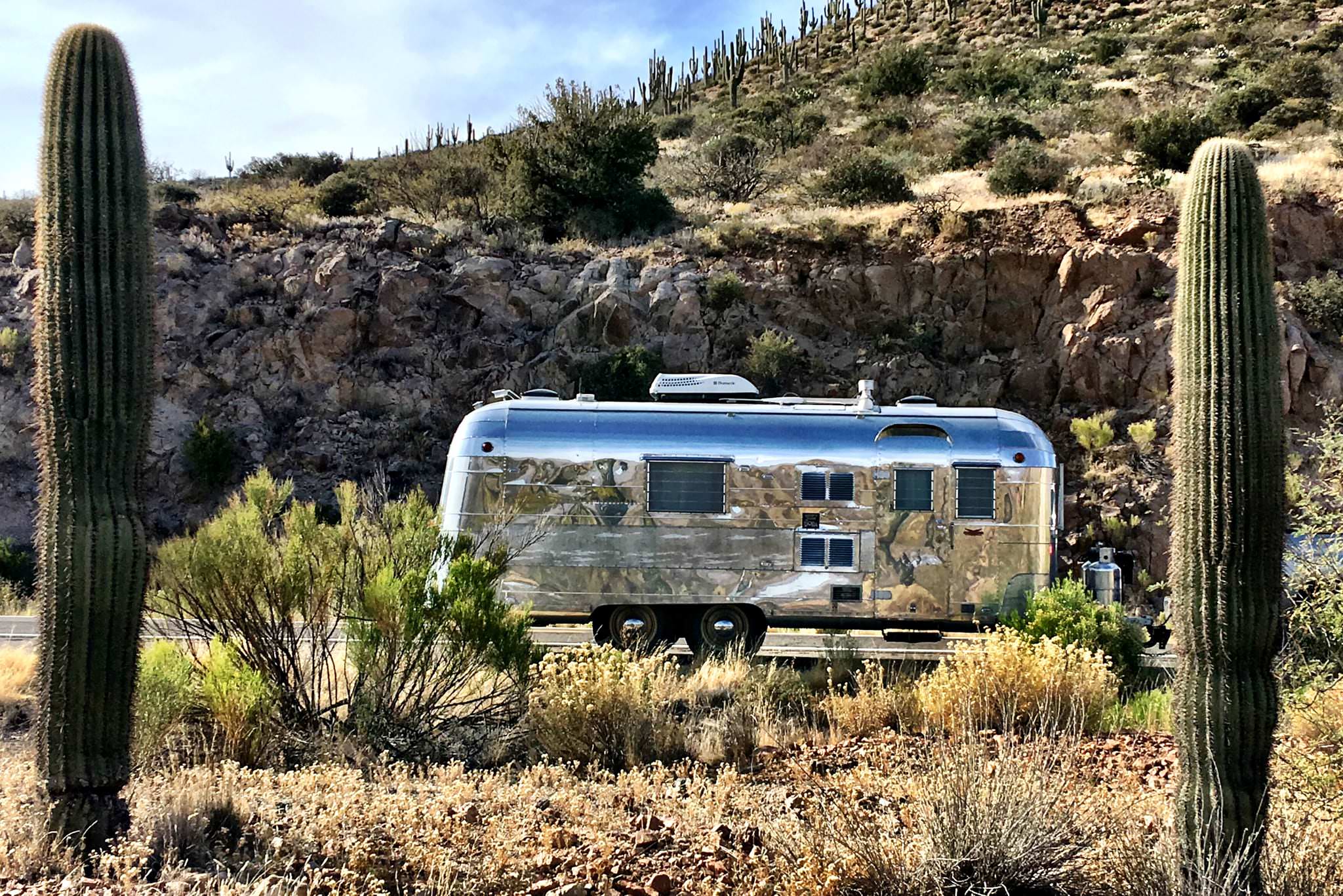
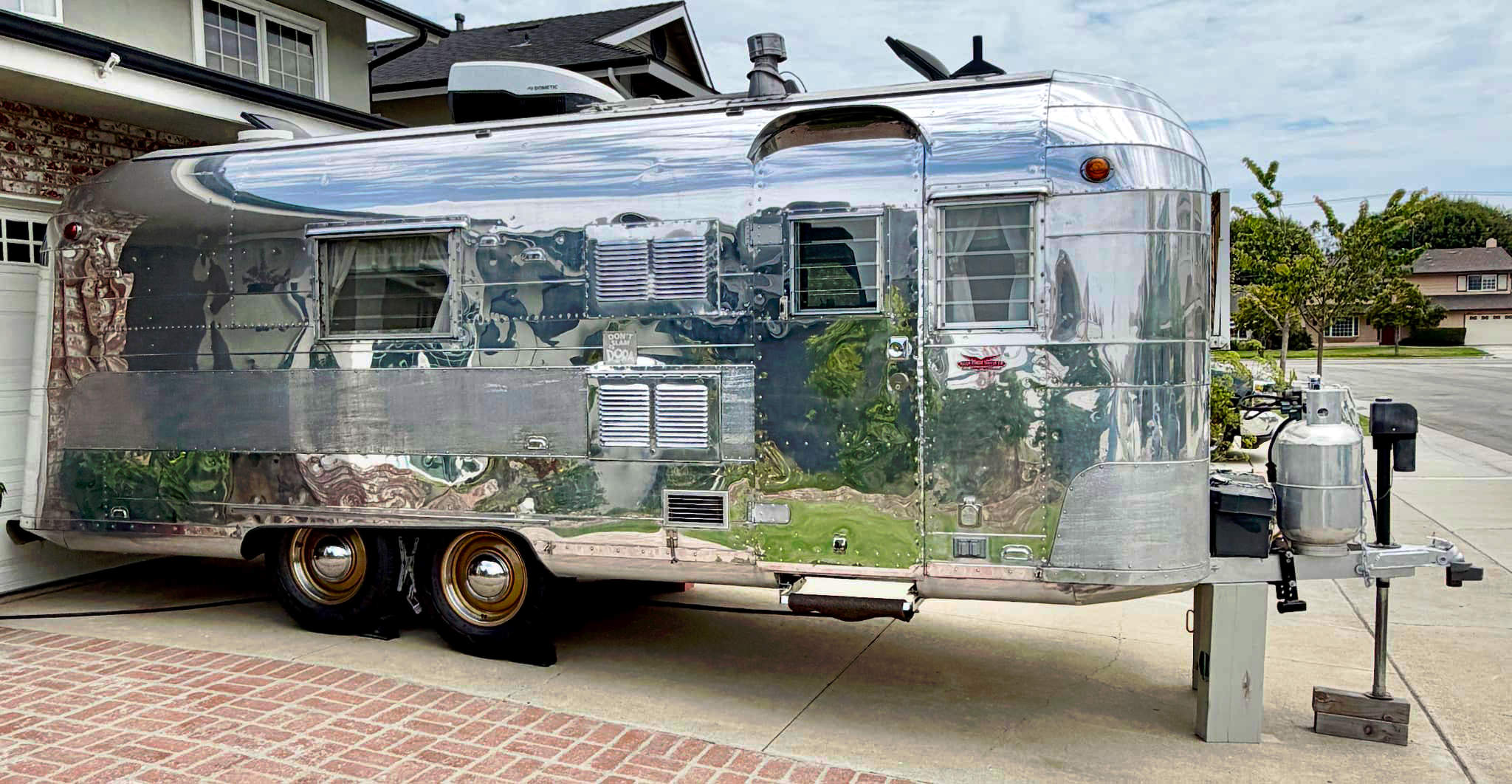
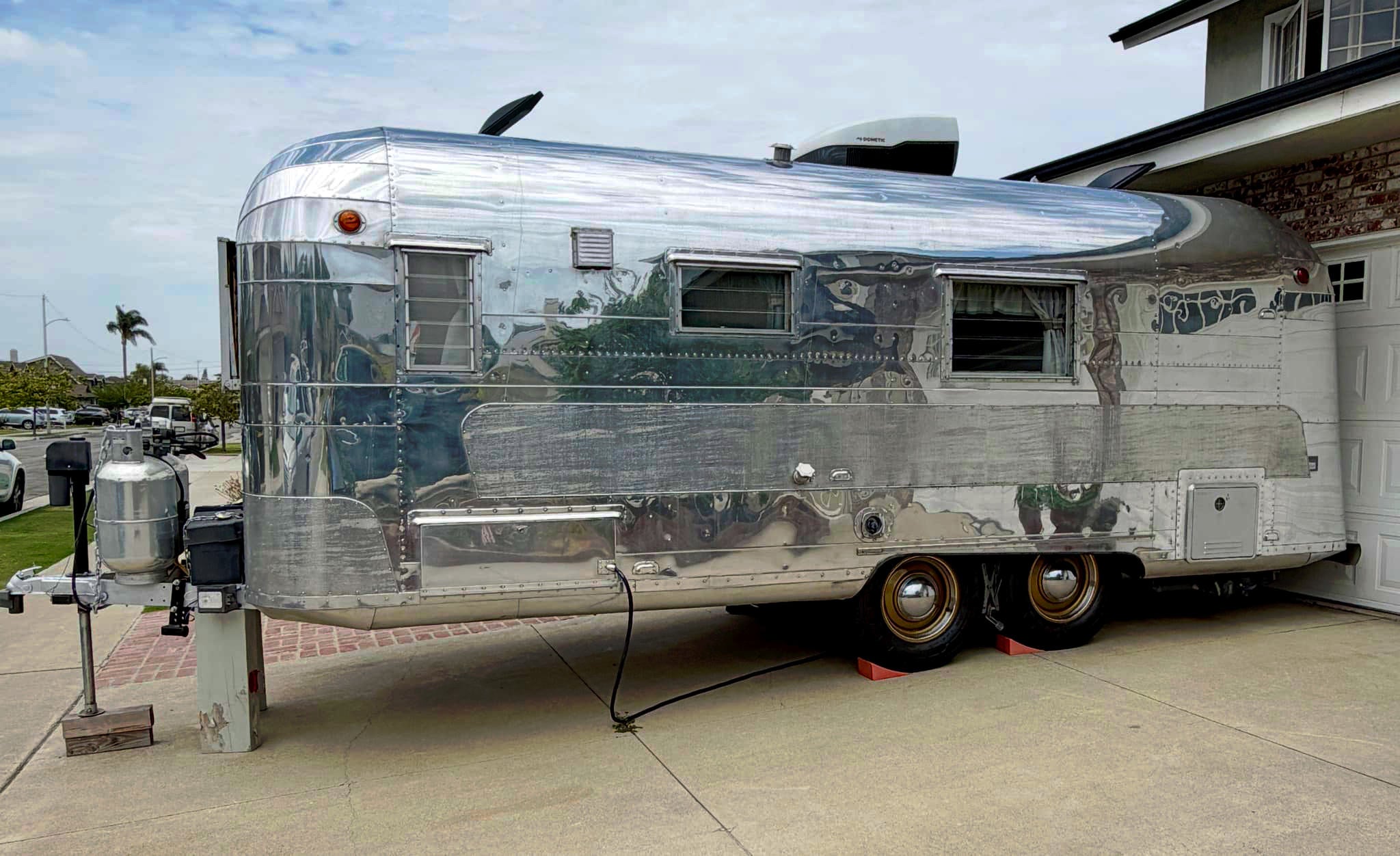
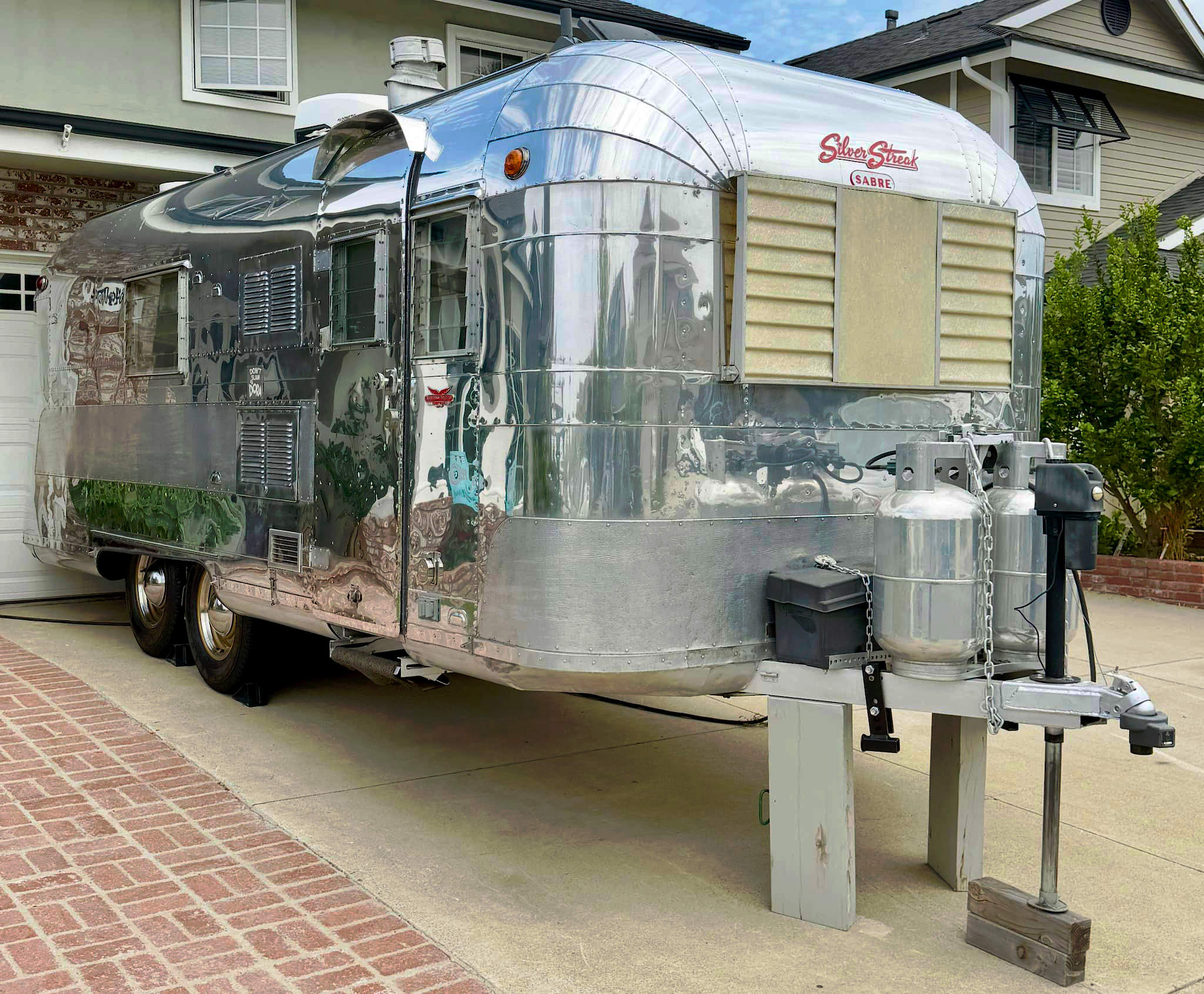
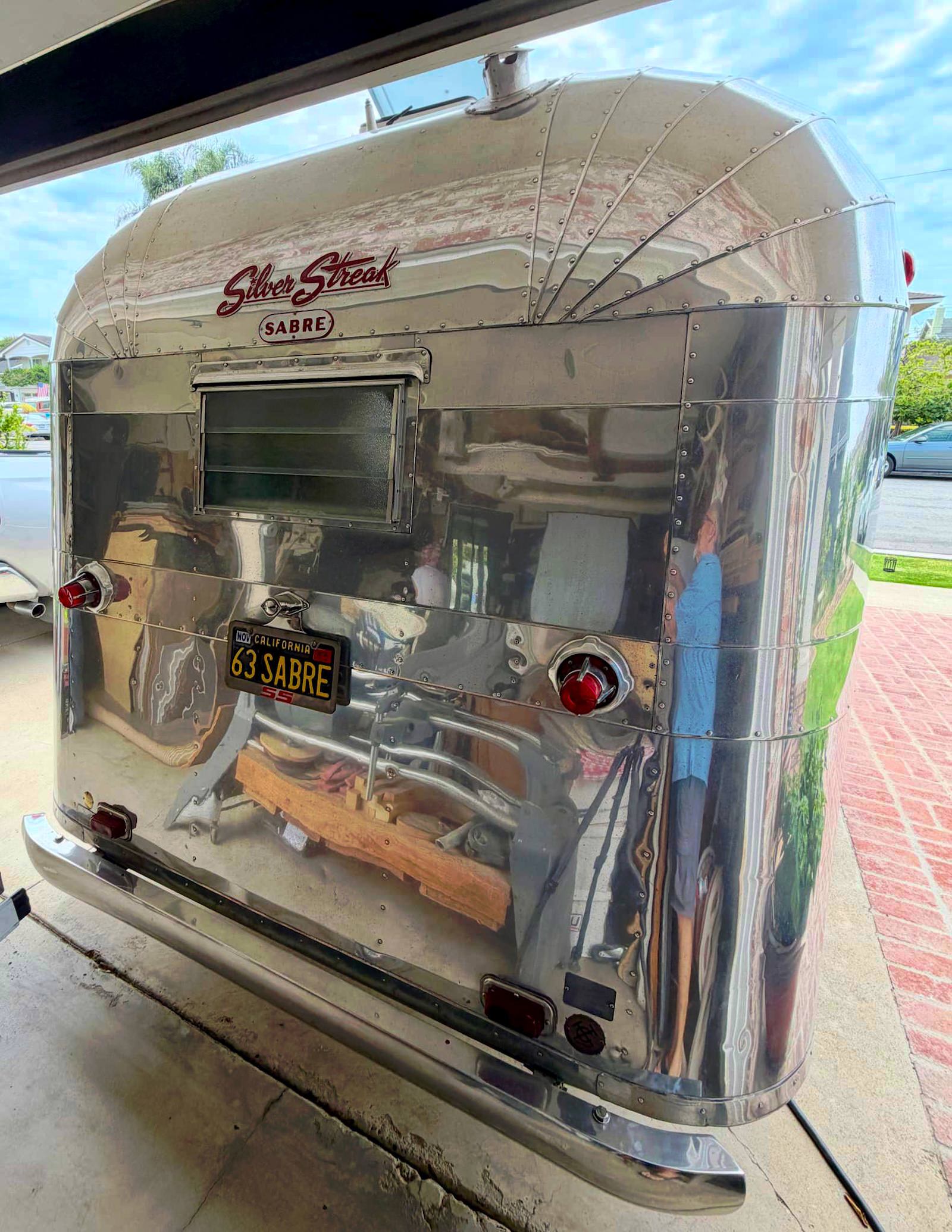
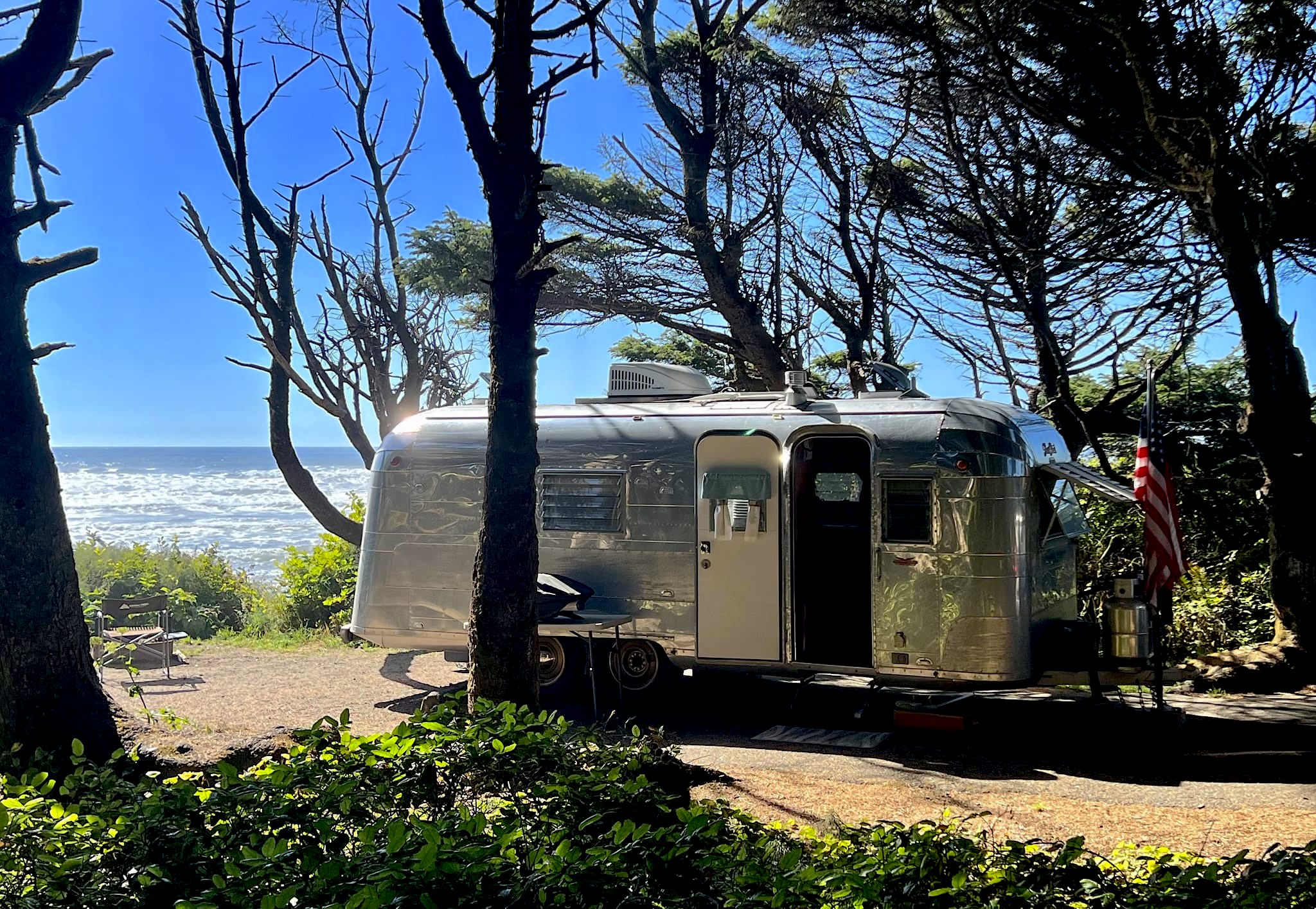
This is a 1963 Silver Streak Sabre travel trailer that benefits from a comprehensive interior renovation – the inside was stripped and painted, the wood cabinetry was given new veneers, and the electrical systems were modernized.
Although they’re often mistaken for Airstreams, Silver Streaks have a character all their own and a dedicated national owners club. The history of the company is fascinating, so we’ve included a speedrun below for those who may never have heard of the company.
History Speedrun: The Silver Streak Trailer Company
The Silver Streak Trailer Company has a fascinating history, even among the wild west world of mid-century American travel trailer manufacturers. The company was in business for almost 50 years, from 1949 into the mid-1990s, and it developed a reputation as a small, fiercely independent California trailer company that never built more than six trailers a week. It earned a good name among enthusiasts as a builder of homes-on-wheels that were (arguably) better in construction than those of its far more famous rival, Airstream.
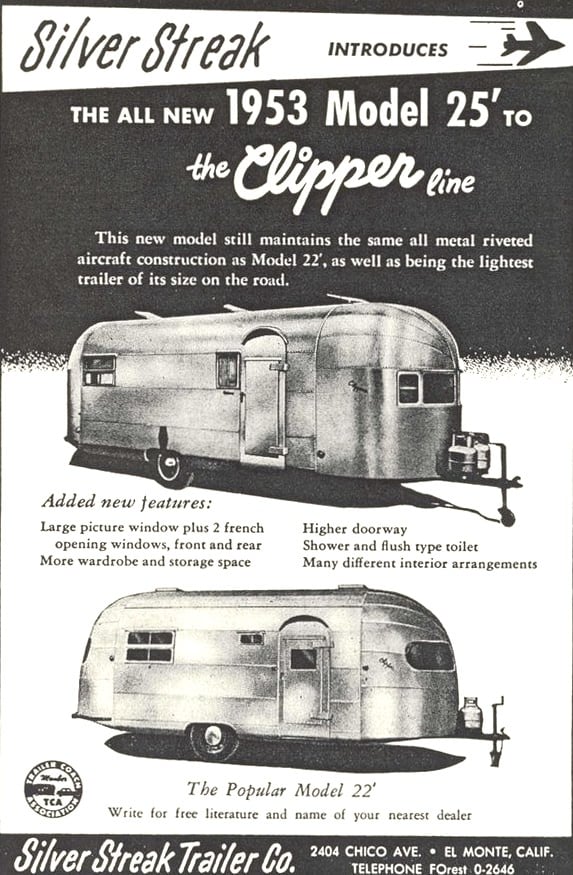
 The Silver Streak Trailer Company has a fascinating history, even among the wild west world of mid-century American travel trailer manufacturers. Image courtesy of the Silver Streak Trailer Company.
Silver Streak’s story doesn’t actually begin with Silver Streak, but with Wally Byam, the man who founded Airstream in 1931 and introduced the Airstream Clipper model in 1936. After Airstream shut down in 1941 as the war effort consumed aluminum supplies, Byam went to work for aircraft manufacturer Lockheed.
By mid-to-late 1945 he had joined the Curtis Wright Company (a trailer coach manufacturer named after its founder, Curtis Wright, not the Curtiss-Wright Aircraft Corporation) and in late 1946 he designed the Curtis Wright Clipper, an evolution of his pre-WWII Airstream design. Byam left Curtis Wright in early 1947 to restart Airstream, but the Clipper he had designed continued in production without him.
The Curtis Wright Company closed its doors in April of 1949, but this wasn’t to be the end of the Clipper, three of its former employees stepped in to keep the ball rolling. Kenneth “Kenny” Neptune, Frank Polito, and James Victor “Pat” Patterson acquired the rights to produce the Clipper model (and possibly some of the tooling needed to build it).
Patterson was also Curtis Wright’s son-in-law, married to the founder’s daughter Marjorie. The three partners formed the Silver Streak Trailer Company and set up shop in El Monte, California (originally at 1166 Chico Street) just five miles from the old Curtis Wright factory, employing many of the same workers. Their first trailers were essentially identical to the Curtis Wright Clippers they had been building before, right down to the Plexiglas front and rear windows.
This gave Silver Streak a direct design pedigree back through Curtis Wright to Byam’s prewar Airstream work – a pedigree that set the company’s engineering DNA off in a good direction from the start. Although I’m sure Byam wasn’t too happy about it.
The Clipper would always be the model most closely linked with Silver Streak’s origins, it was offered in 18, 20, and 22 foot lengths – the front and rear Plexiglas windows were reshaped in 1950, and by late 1953 glass windows that could actually be opened became an option.
The Clipper had all-aluminum construction with stamped, heat-treated transverse ribs, Warner electric brakes, fiberglass insulation in the walls and ceiling, and dual-pane side windows – all details consistent with the aircraft-influenced engineering philosophy that had defined every Silver Streak that left the production line.
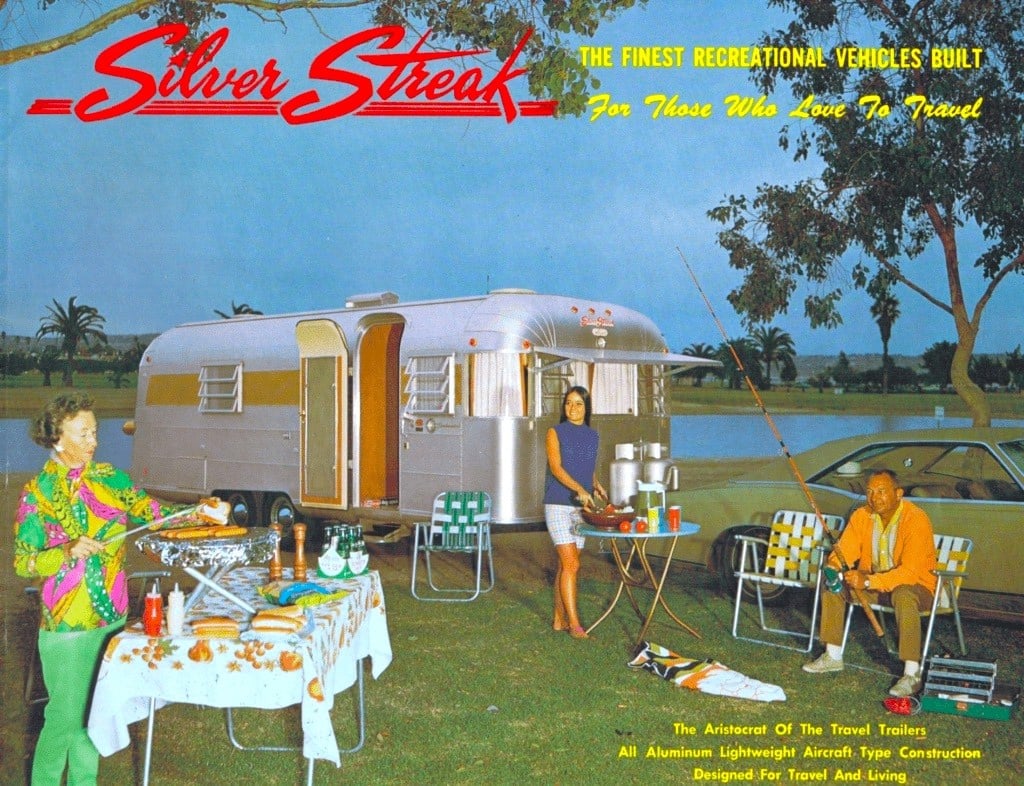
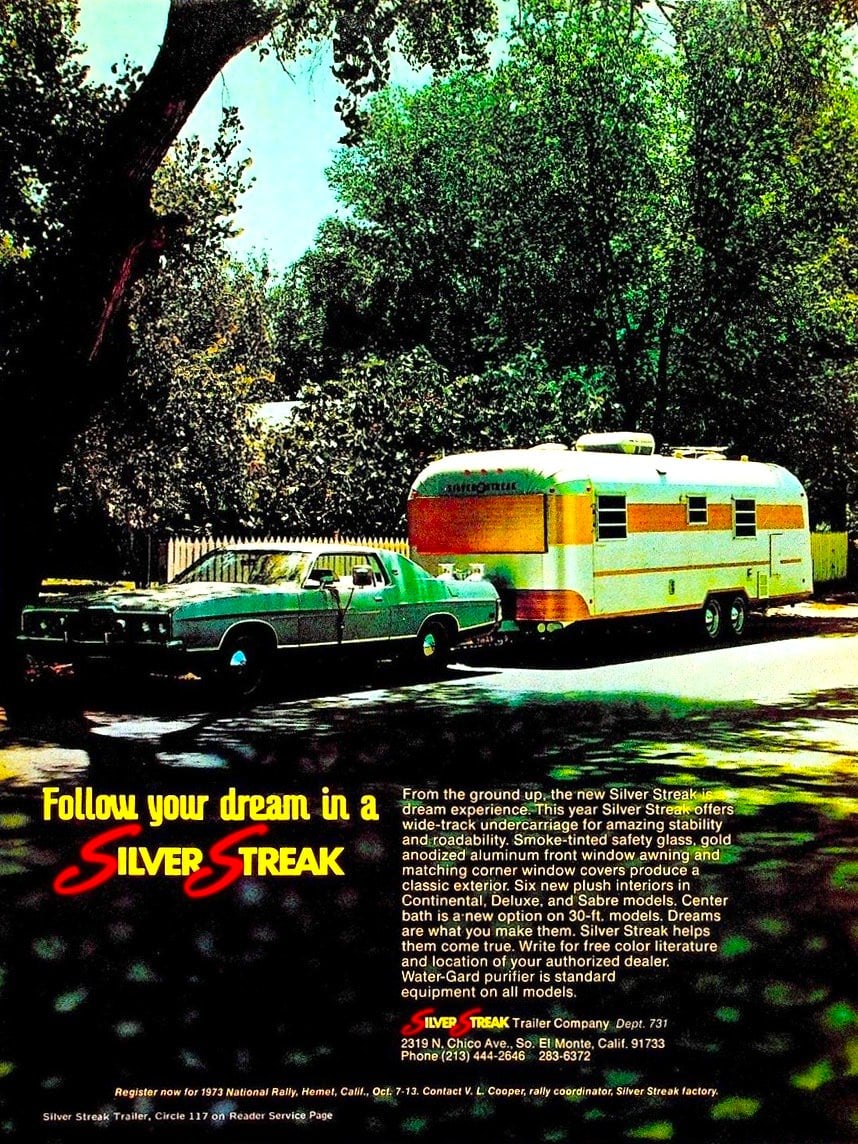
Interestingly, Andy Kaufman owned a Silver Streak and he used it as his set trailer while filming the TV series “Taxi.” Jim Carrey later used the same trailer when filming “Man on the Moon,” and it features in the documentary “Jim & Andy” heavily. Image courtesy of the Silver Streak Trailer Company.
Over the decades that followed the company expanded its range in a big way, the Rocket appeared in a 27 foot version in 1956 (and later as a 28 footer), the Luxury Liner arrived in 1957 at 31 feet long. Additional new models included the smaller Sabre (offered at 17, 19, and 23 feet), the Jet at 19 feet, the Prince at 18 feet from 1969, the Atlas at 26 feet and its Continental Atlas variant from 1968, and the range-topping Continental Supreme at 28 and 34 feet.
A number of models were also offered in upmarket “Continental” variants during the late 1960s and 1970s – the name was possibly a reference to the Lincoln Continental luxury cars that were in production at the time.
What helped to really set Silver Streak apart from its (many) competitors was its fundamentally different construction approach. Unlike Airstream’s method, the Silver Streak’s aluminum skin was built directly onto the trailer frame, with all internal structures and appliances then placed within the shell through the entry door.
Enthusiasts have long argued this produced a structurally stronger trailer with a more substantial frame, and it meant that fittings and appliances (like ovens and hot water heaters) inside the trailer could fit through the door when it needed to be replaced.
Interestingly, Andy Kaufman owned a Silver Streak and he used it as his set trailer while filming the TV series Taxi. Jim Carrey later used the same trailer when filming Man on the Moon, and it features in the documentary Jim & Andy heavily.
In 1957, Neptune and Polito bought out Patterson, who went on to co-found the Streamline Trailer Manufacturing Company with fellow Curtis Wright alumnus Harry Lovett. Neptune and Polito continued running the operation, and in 1978 they hired Rolf Zuschlag away from Airstream to serve as the new general manager.
When the El Monte factory land was sold in 1986, Zuschlag bought the patterns and all machinery from the two founders and eventually relocated production to Chino, California.
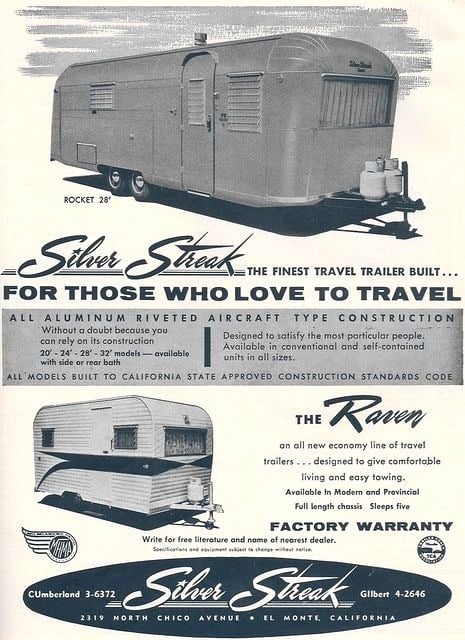
What helped to really set Silver Streak apart from its (many) competitors was its fundamentally different construction approach. Unlike Airstream’s method, the Silver Streak’s aluminum skin was built directly onto the trailer frame, with all internal structures and appliances then placed within the shell through the entry door. Image courtesy of the Silver Streak Trailer Company.
After the relocation, the Sterling models underwent a significant evolution. According to Kyle Morrison, who served as production supervisor during this time and whose firsthand account is preserved in the Tourists archive here, the new Sterling incorporated fully welded skeleton structures and 3M super-tape skin bonding in place of the earlier all-riveted construction.
Morrison later claimed that some of these features were copied by Airstream and its Argosy subsidiary. The Chino facility also produced a number of specialty builds, including units for government and police use, ambulances, fifth wheels, and even a one-off 44 foot unit.
Today, surviving Silver Streaks are considered collector pieces and they’re hugely desirable, campers from a small California manufacturer that spent close to 50 years quietly building some of the best travel trailers in America.
The 1963 Silver Streak Sabre Shown Here
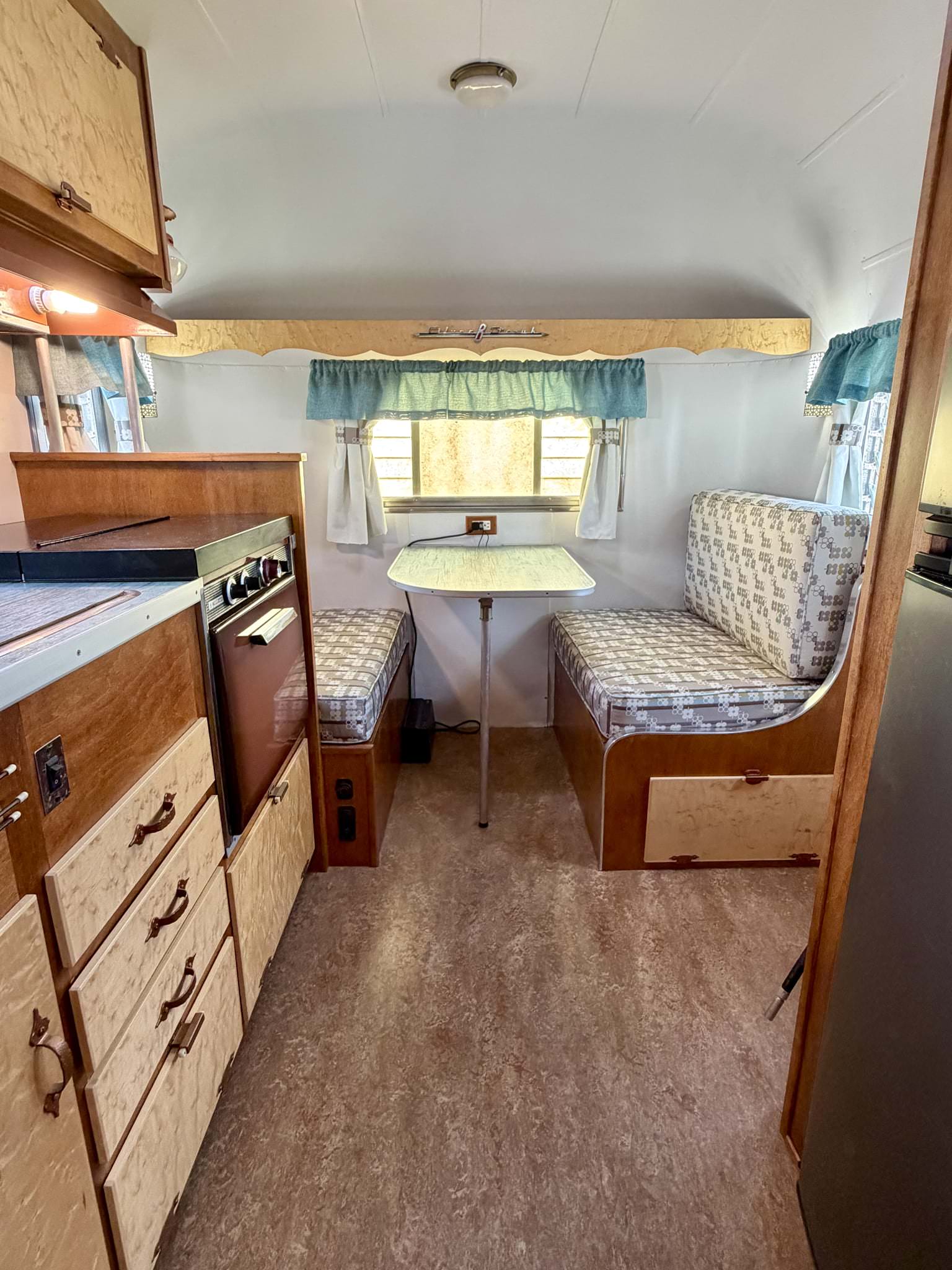
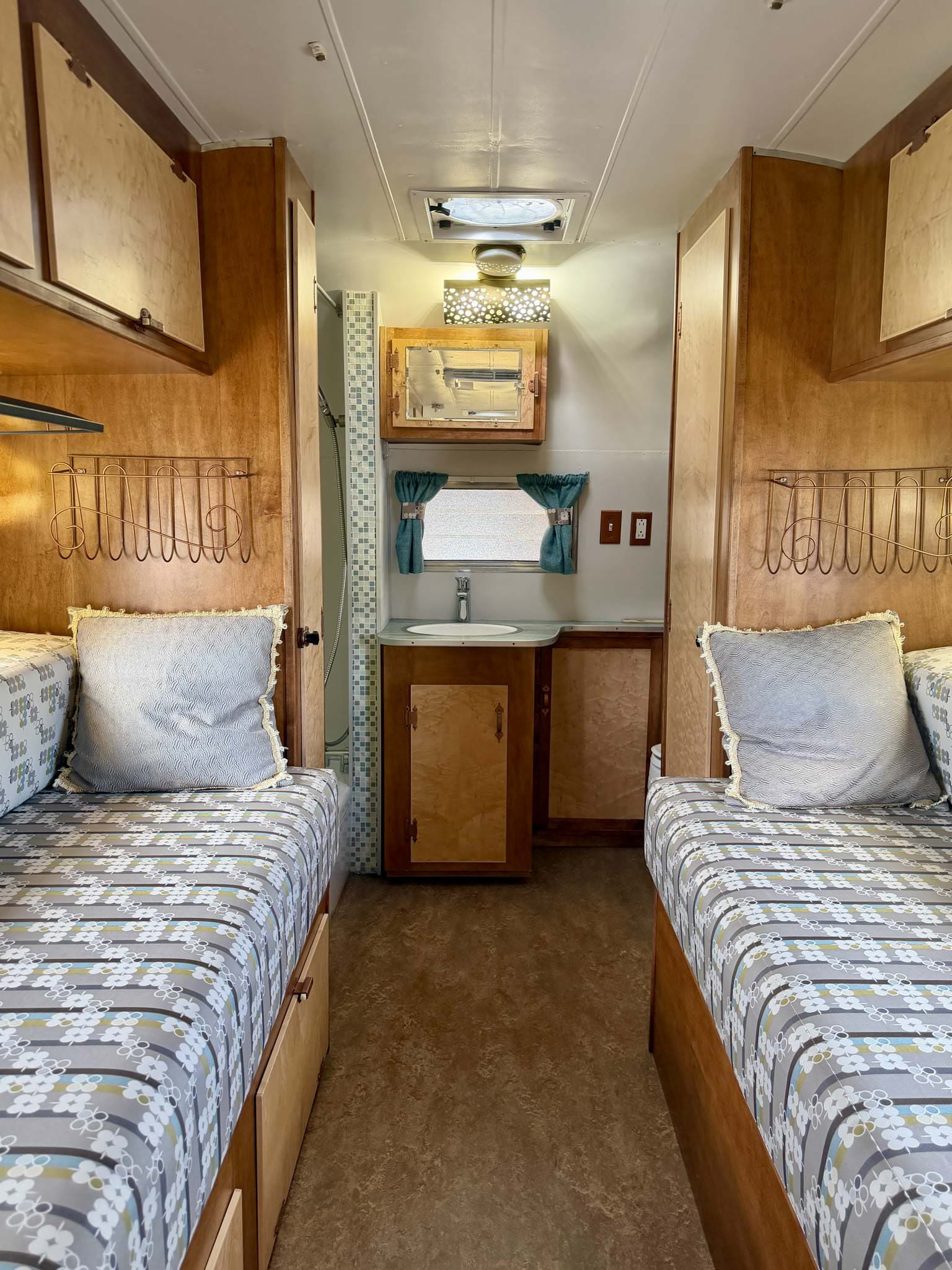
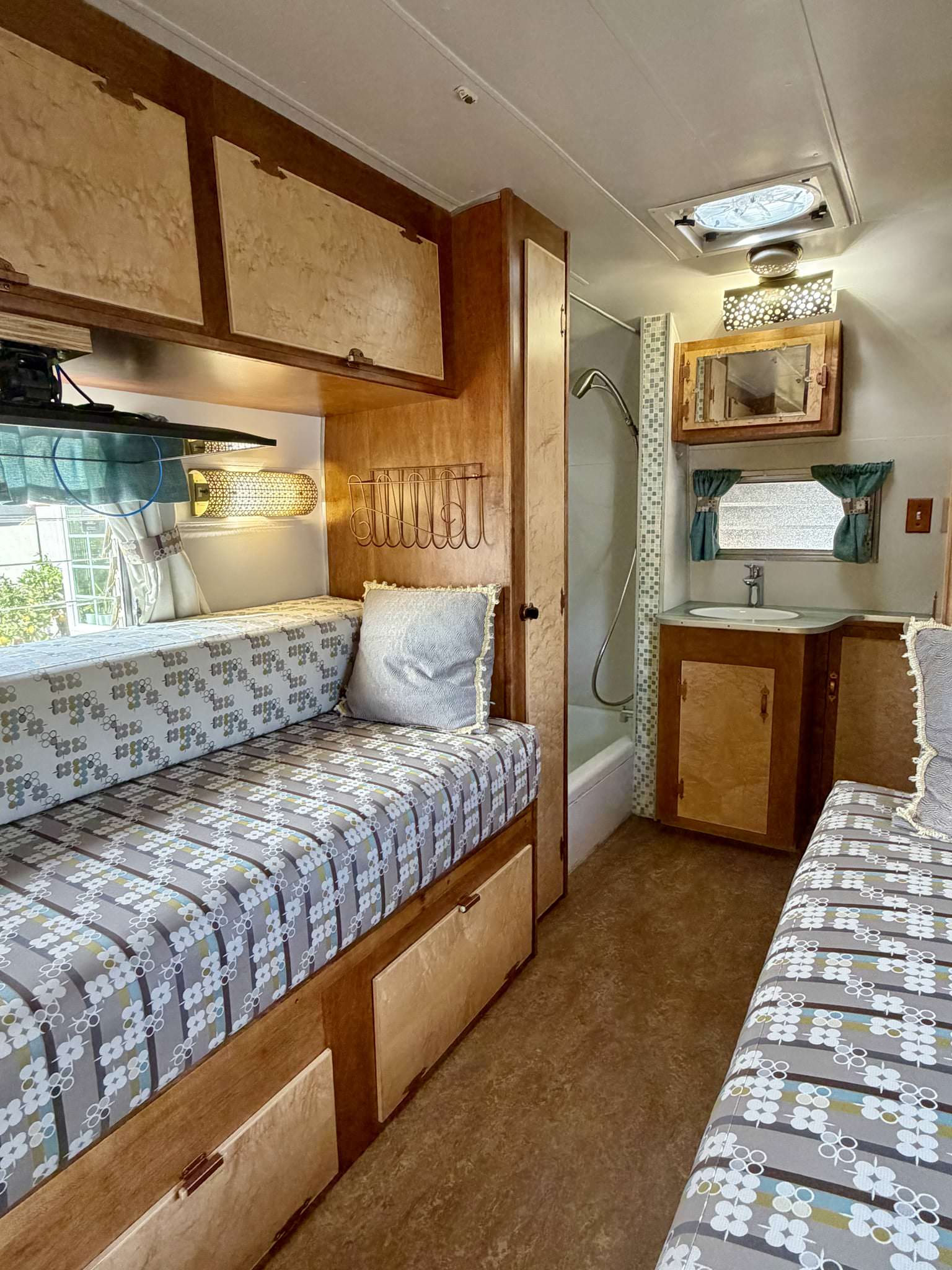
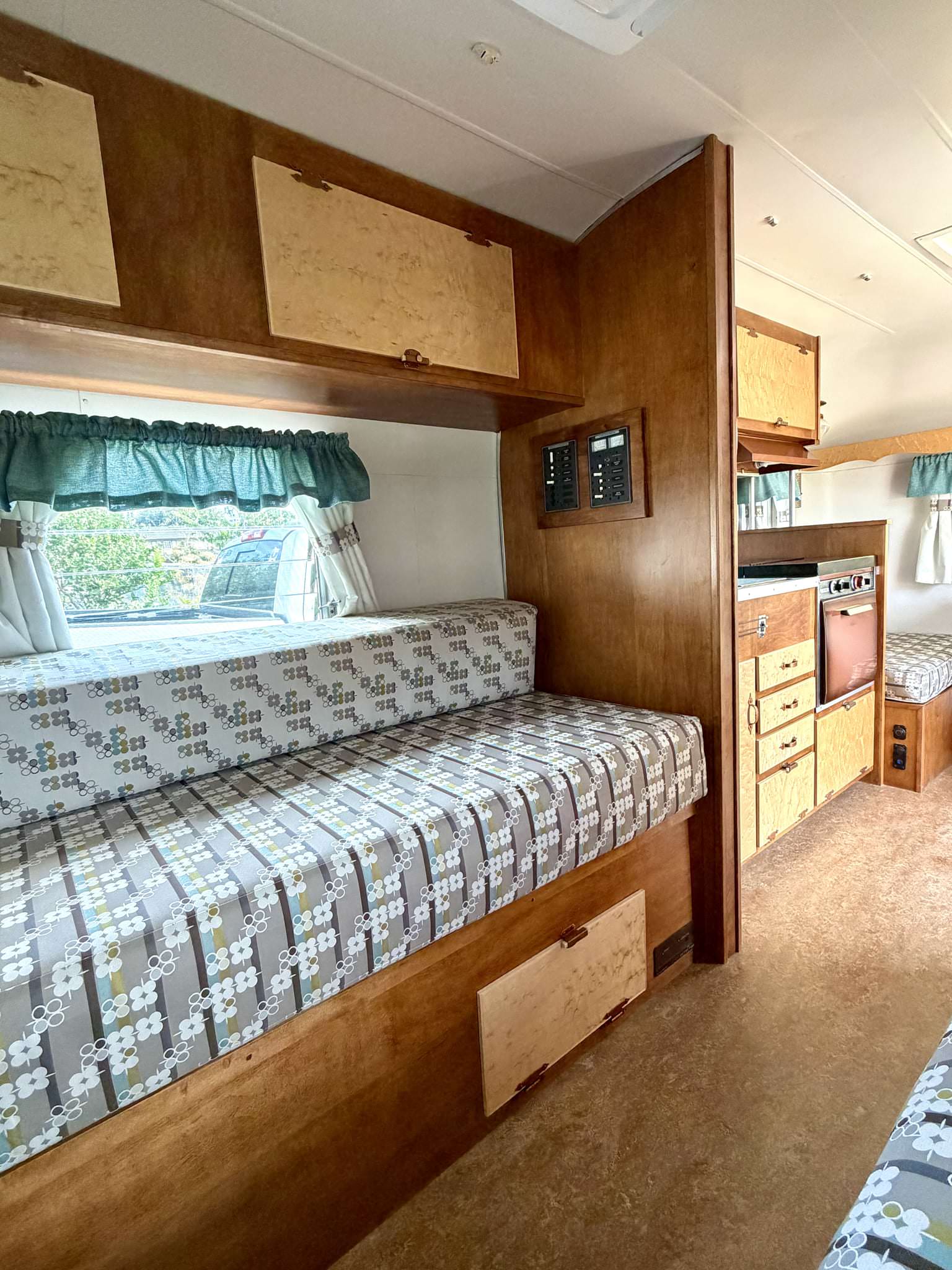
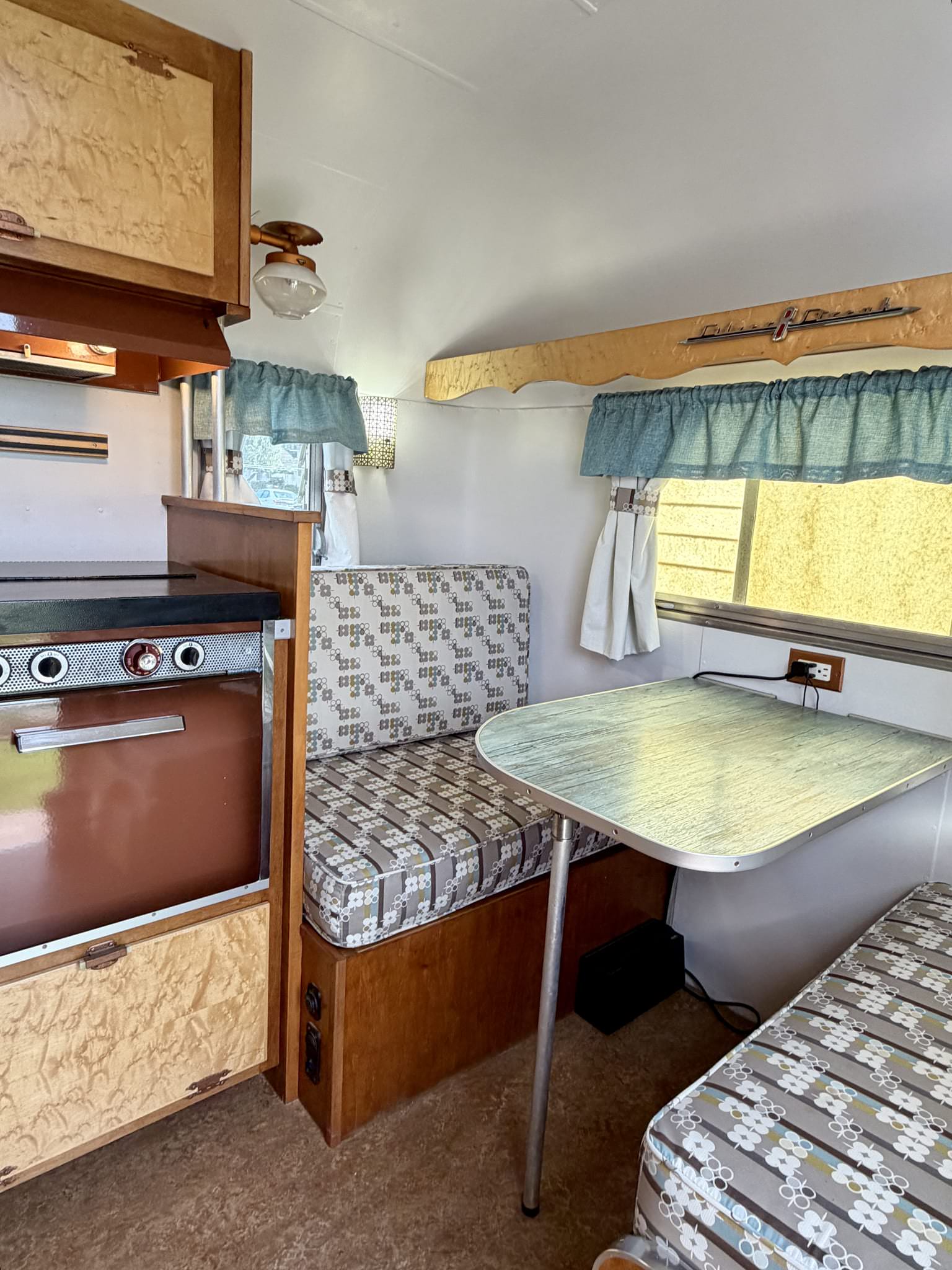
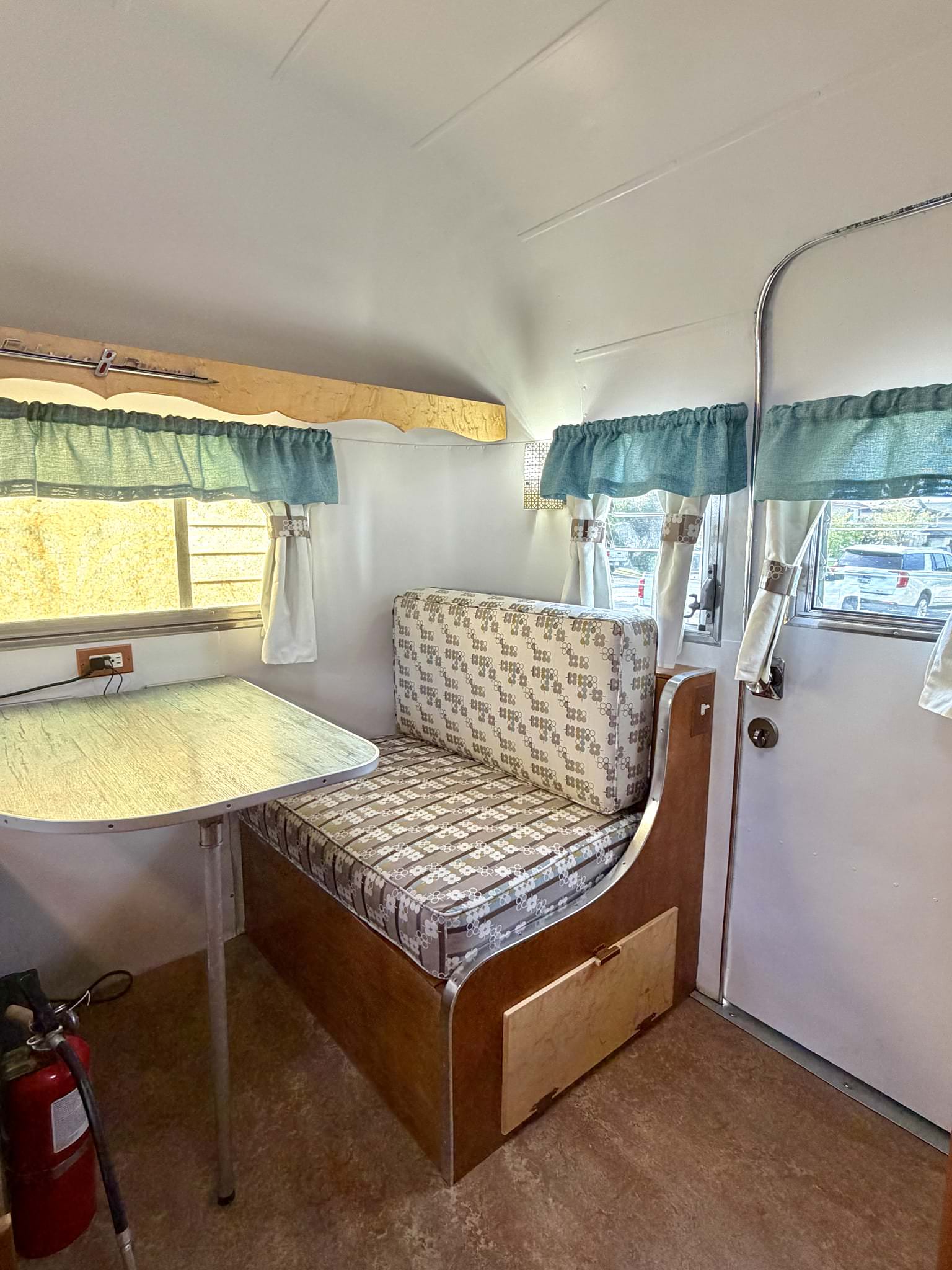
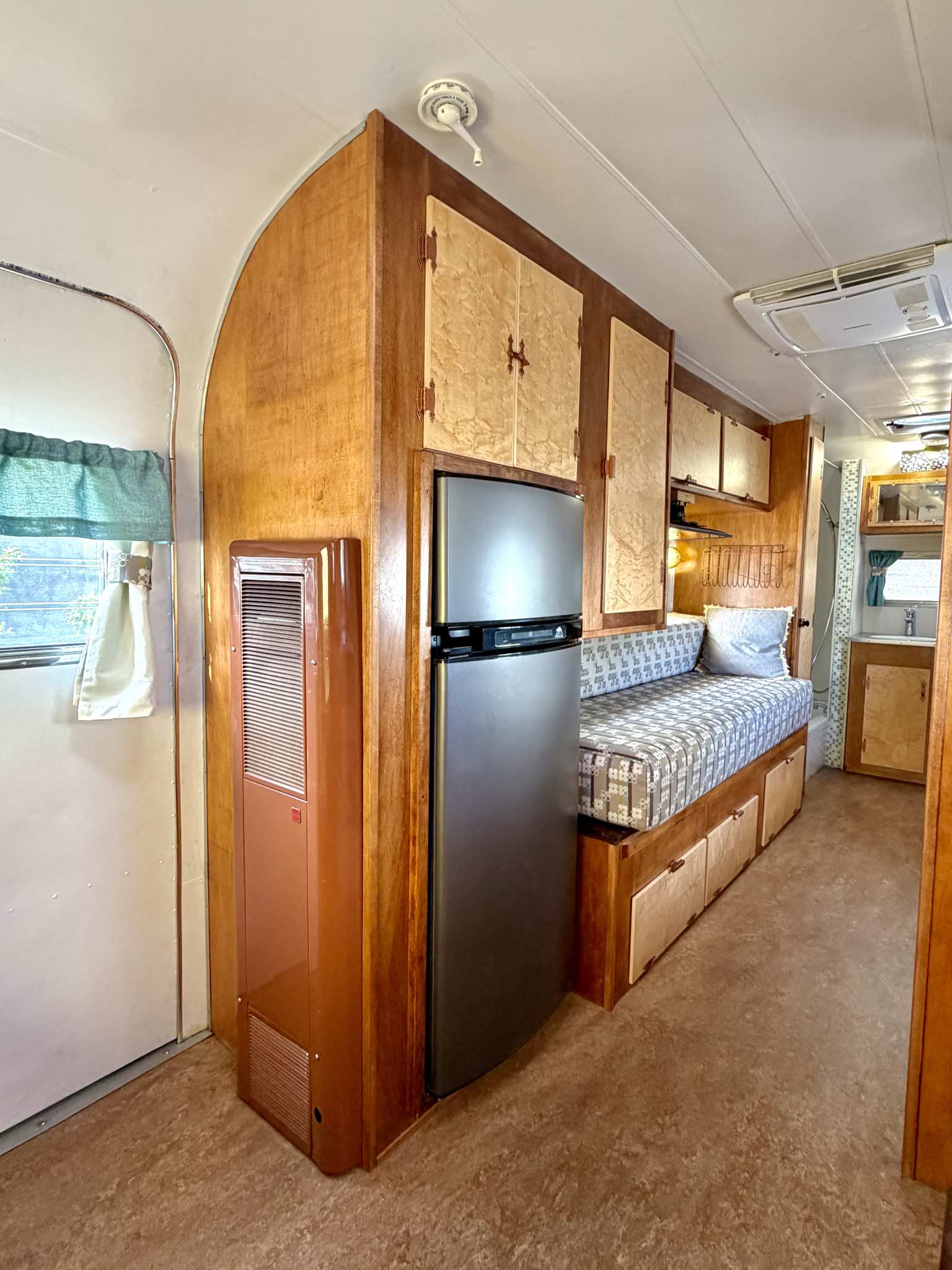
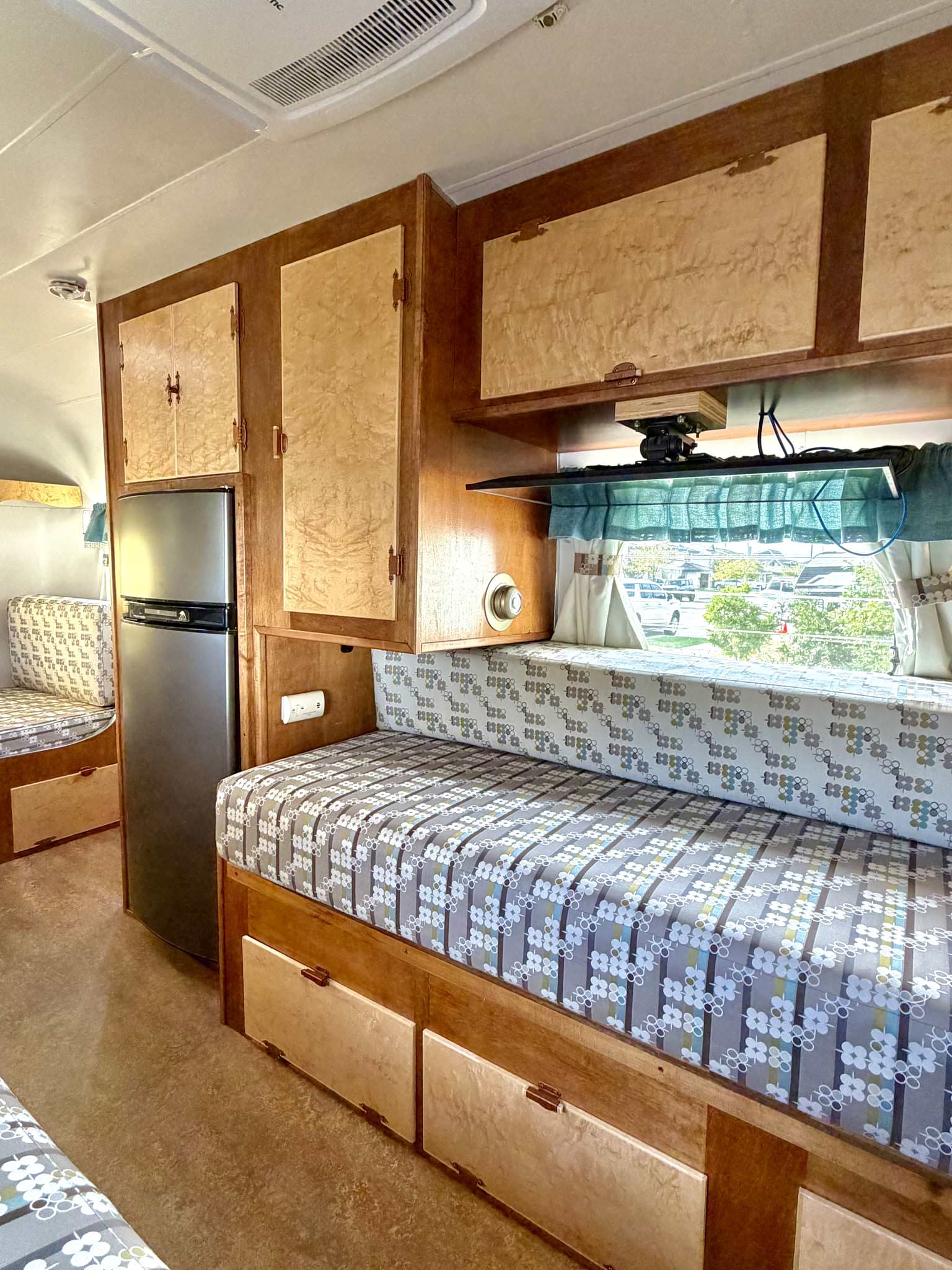
This is a 1963 Silver Streak Sabre, a 22 foot tandem-axle travel trailer that’s been extensively refurbished since the seller bought it in 2015. The polished aluminum exterior remains largely traditional in appearance, thankfully, while the interior was stripped, repainted in white, and fitted with rebuilt cabinetry using new veneers.
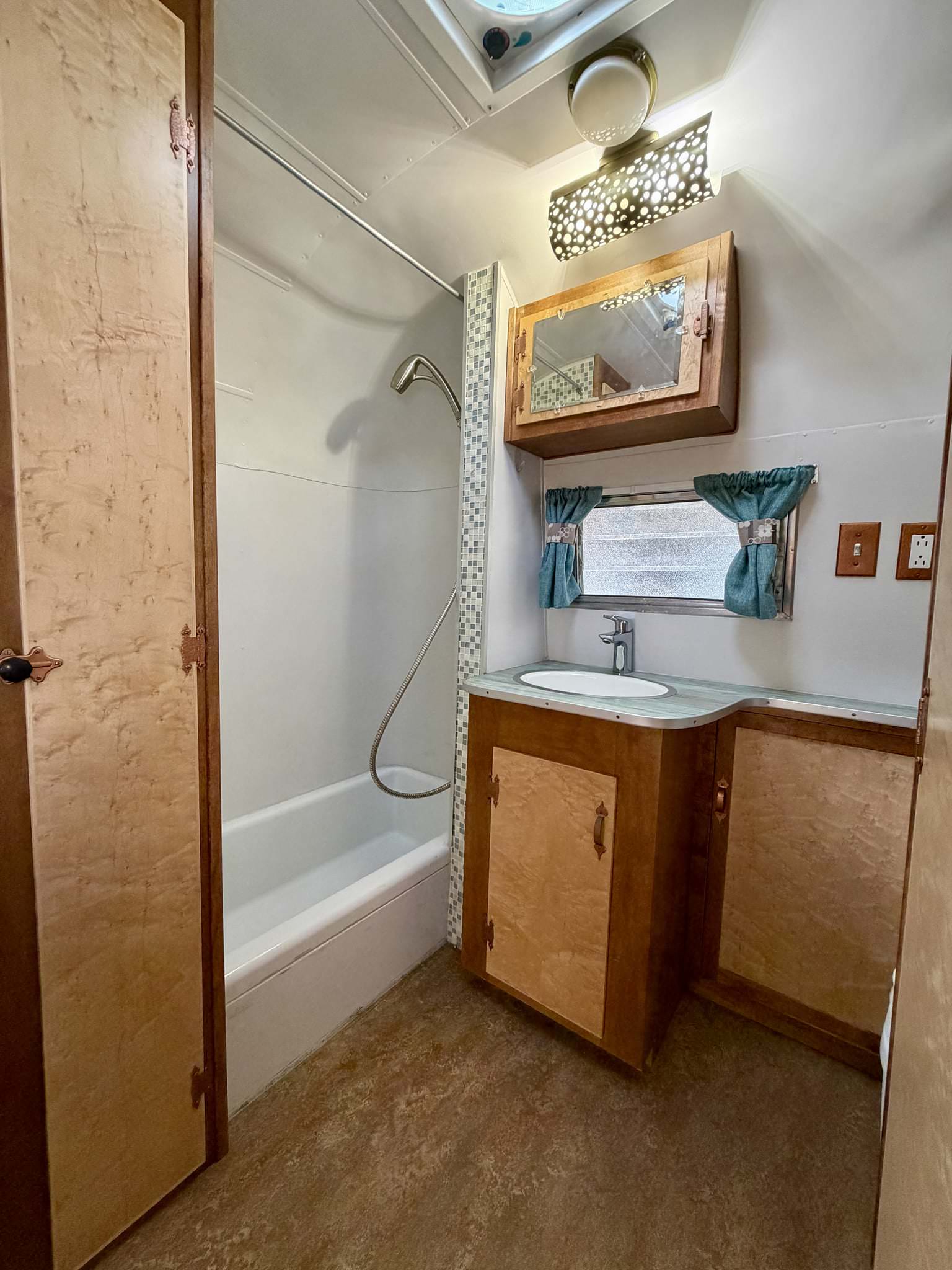
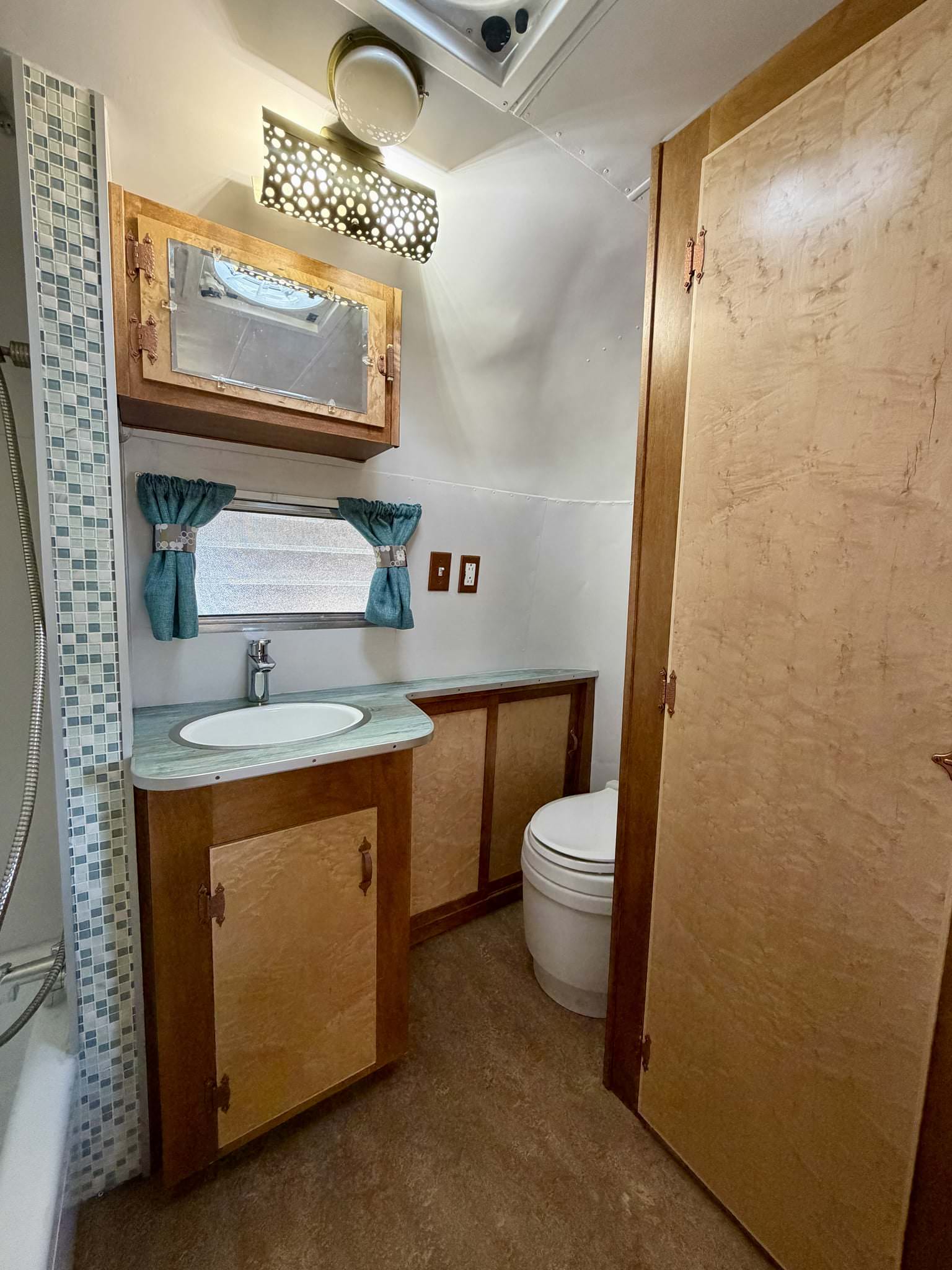
The layout includes a forward lounge with fold-out sofa beds offering sleeping space, a dinette, kitchenette, storage, air conditioning, and a bathroom with a combined shower and tub.
The kitchenette has a refrigerator/freezer, two-bay sink, a propane stove and oven, a microwave, and Marmoleum flooring. The bathroom has a vanity and Laveo cartridge toilet. More recent equipment includes Starlink WiFi, a Peplink router and antenna, GPS tracking, a propane water heater, a retractable entry step, and additional electrical outlets.
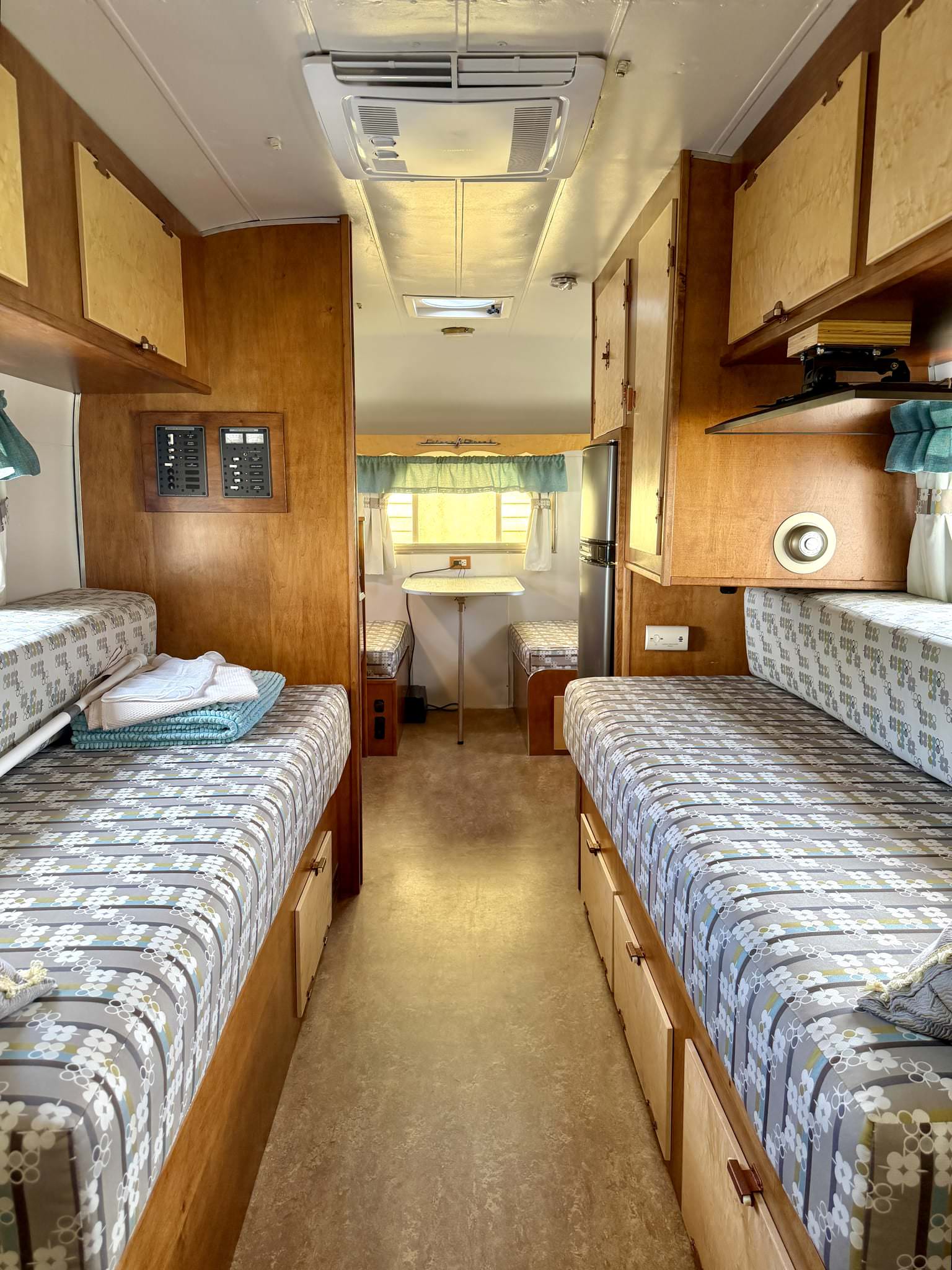
This is a 1963 Silver Streak Sabre travel trailer that benefits from a comprehensive interior renovation – the inside was stripped and painted, the wood cabinetry was given new veneers, and the electrical systems were modernized.
It rides on 16 inch steel wheels with chrome covers and it’s equipped with electric drum brakes. It’s worth noting that the belly pan of this trailer is said to have been damaged in 2016 – fortunately it wasn’t the end of the road for it though – it was repaired and refurbished, giving it a second lease on life. It does mean that it now carries a “salvaged” California title however.
It’s now being offered for sale out of Huntington Beach, California and you can visit the listing here if you’d like to read more about it or register to bid.
Images courtesy of Bring a Trailer + The Silver Streak Trailer Company.

Articles that Ben Branch has written have been covered on CNN, Popular Mechanics, Smithsonian Magazine, Road & Track Magazine, the official Pinterest blog, the official eBay Motors blog, BuzzFeed, Autoweek Magazine, Wired Magazine, Autoblog, Gear Patrol, Jalopnik, The Verge, and many more.
Silodrome was founded by Ben back in 2010, in the years since the site has grown to become a world leader in the alternative and vintage motoring sector, with well over a million monthly readers from around the world and many hundreds of thousands of followers on social media.