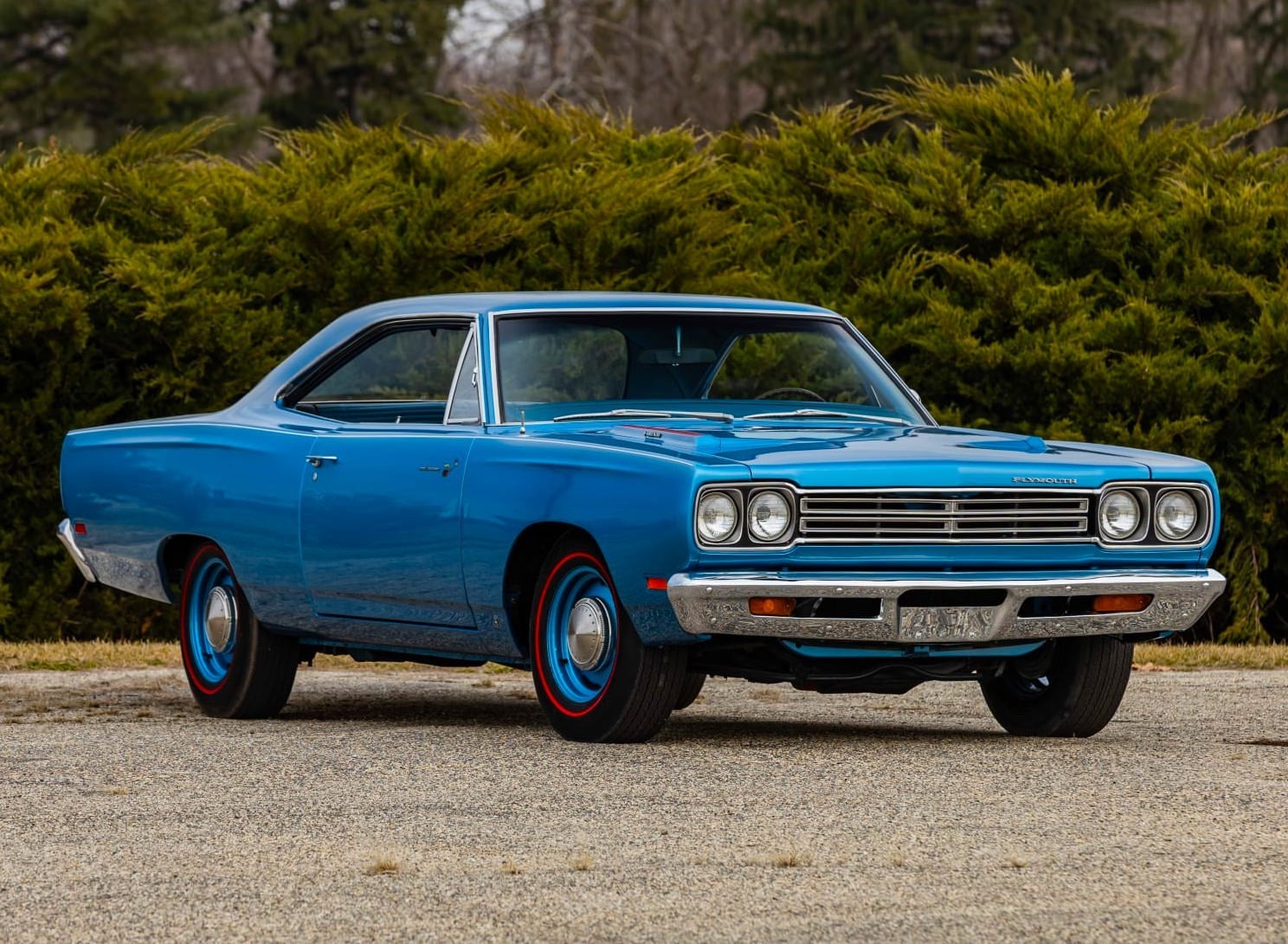
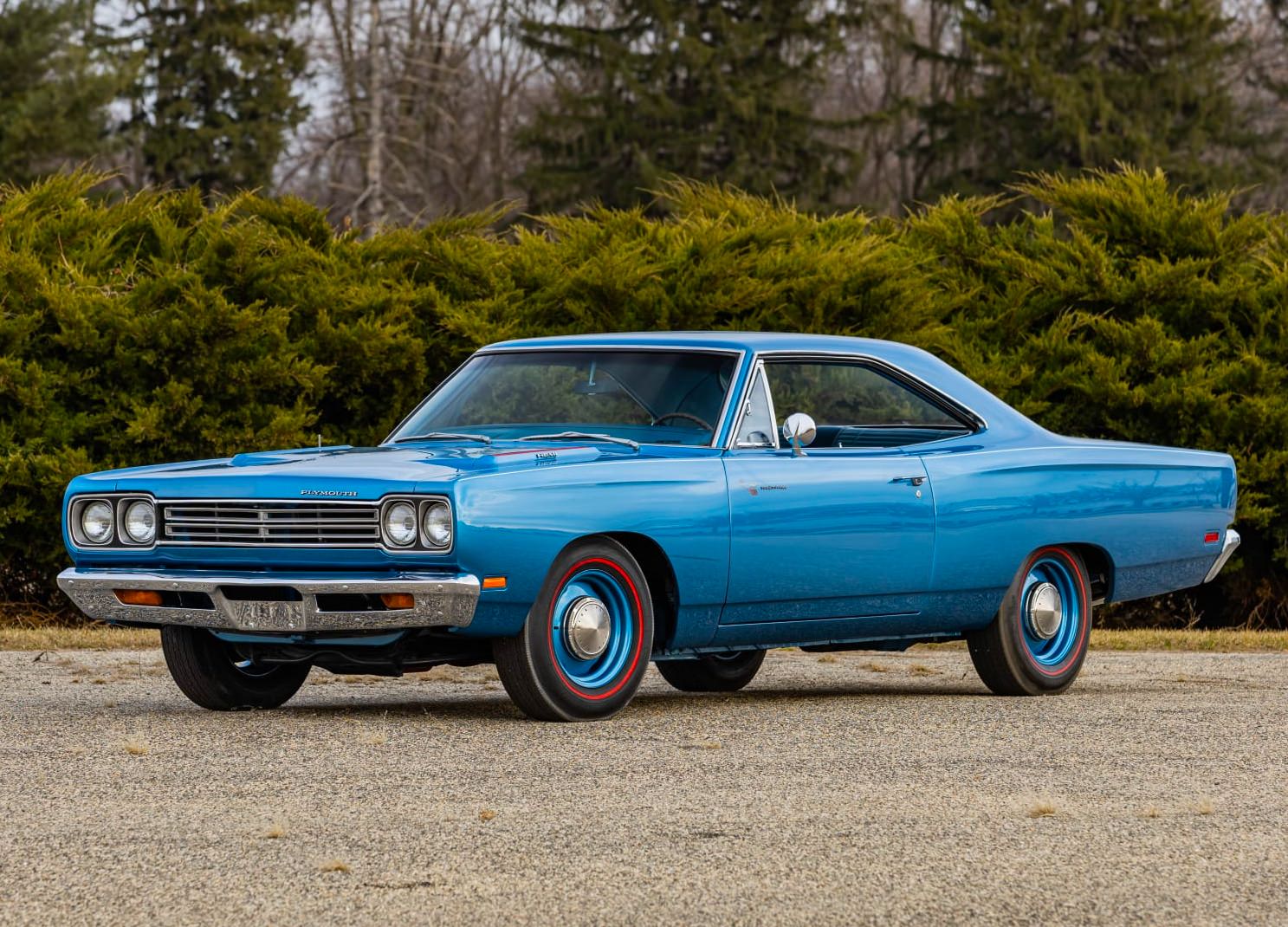
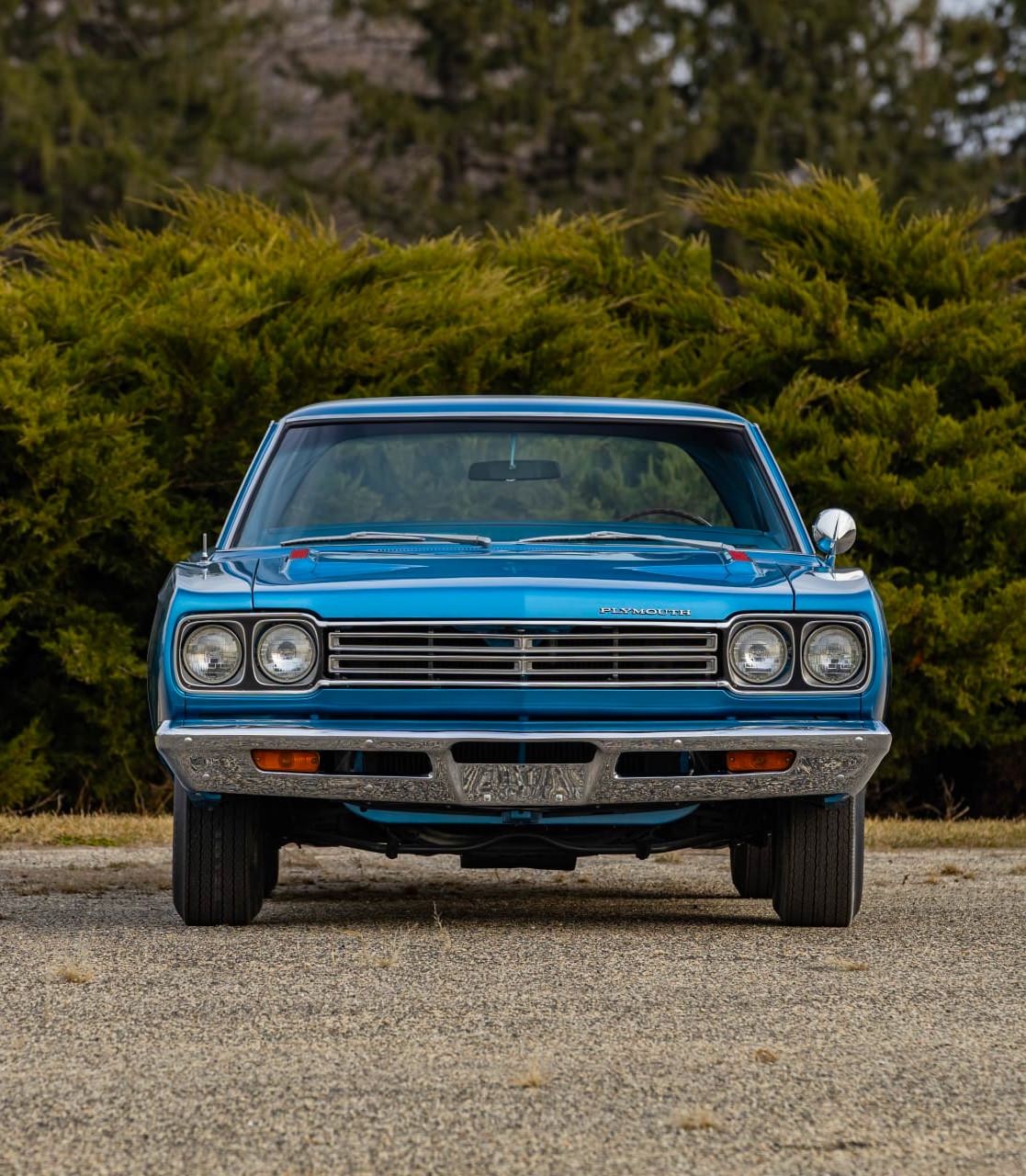
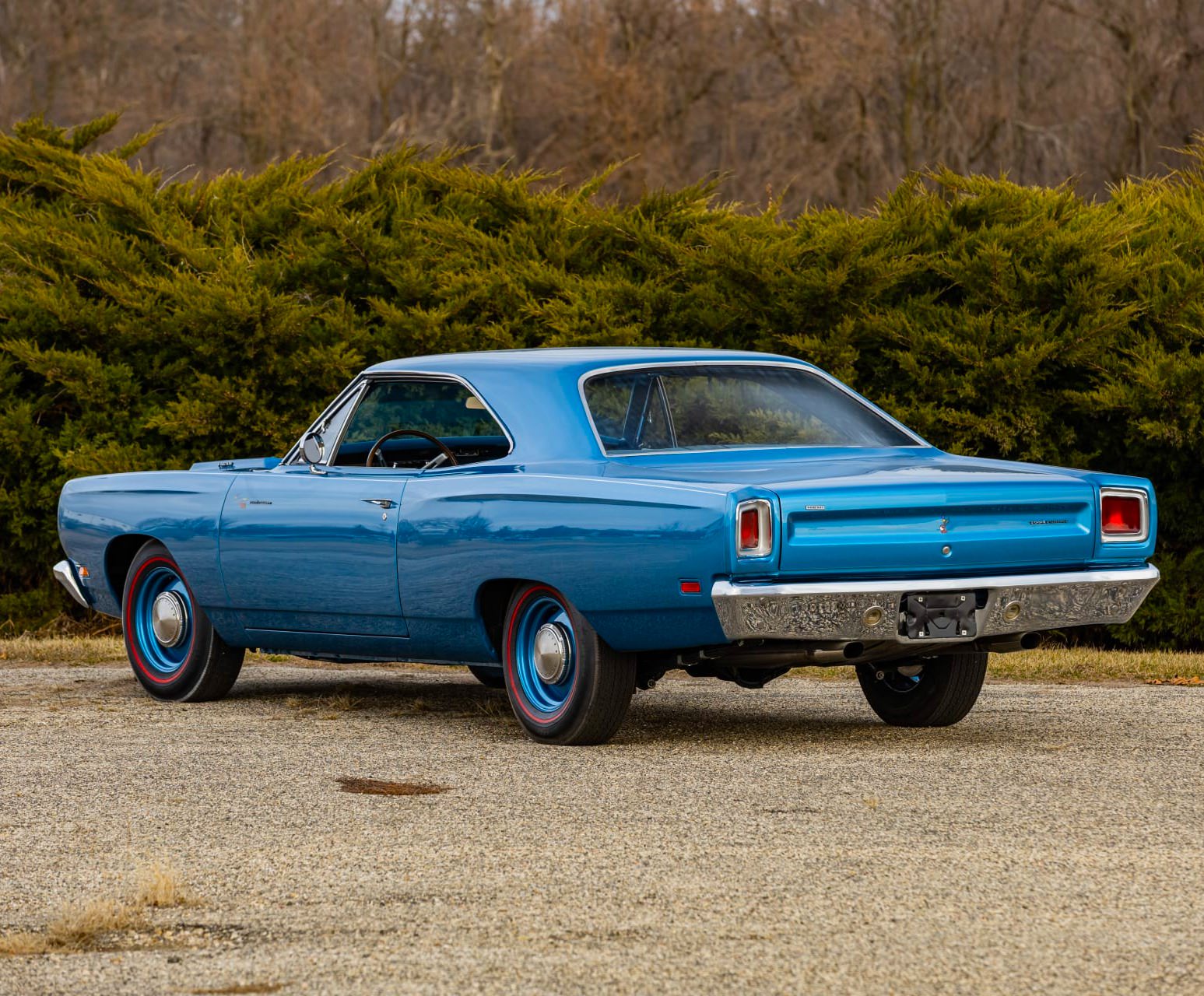
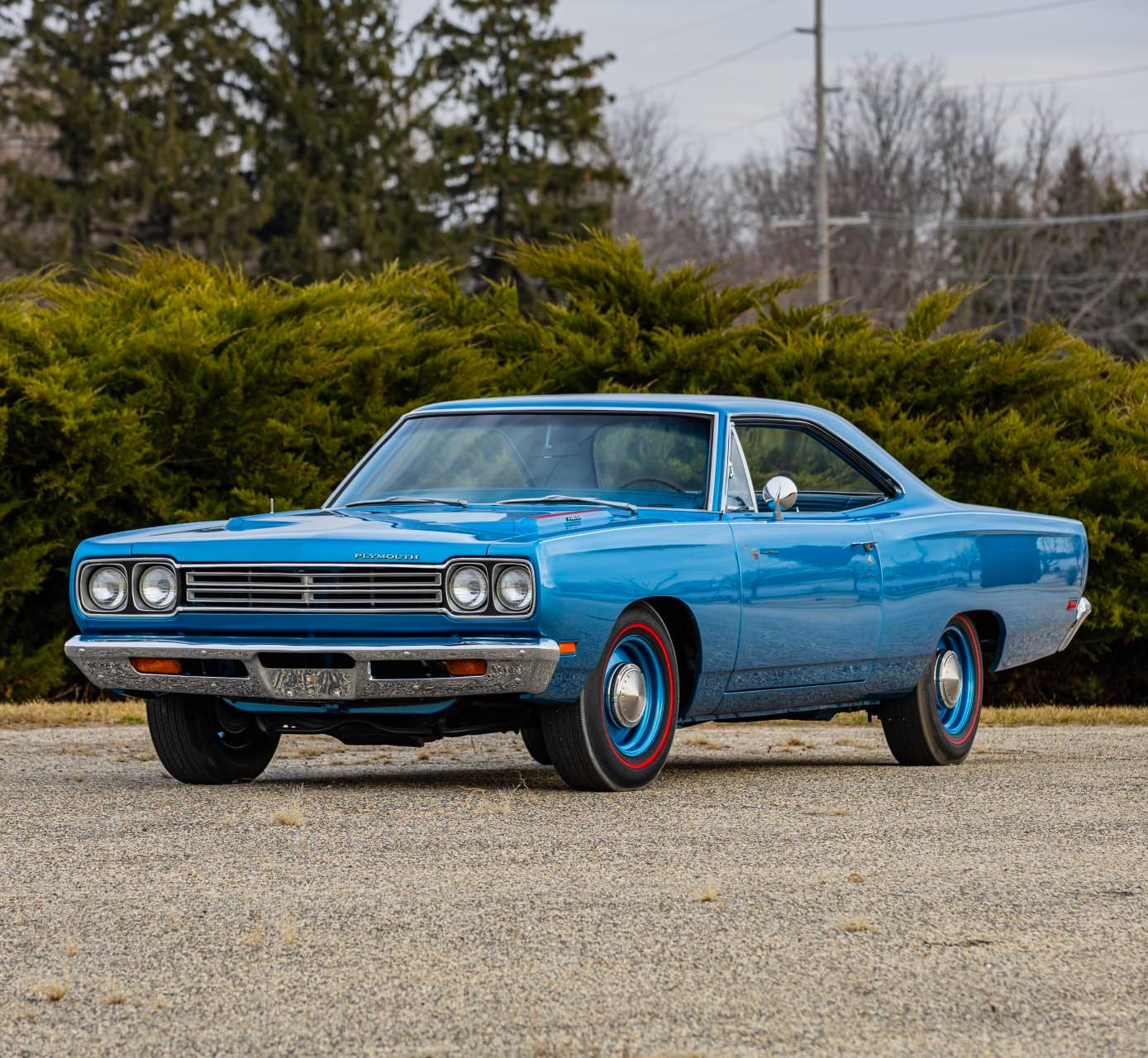
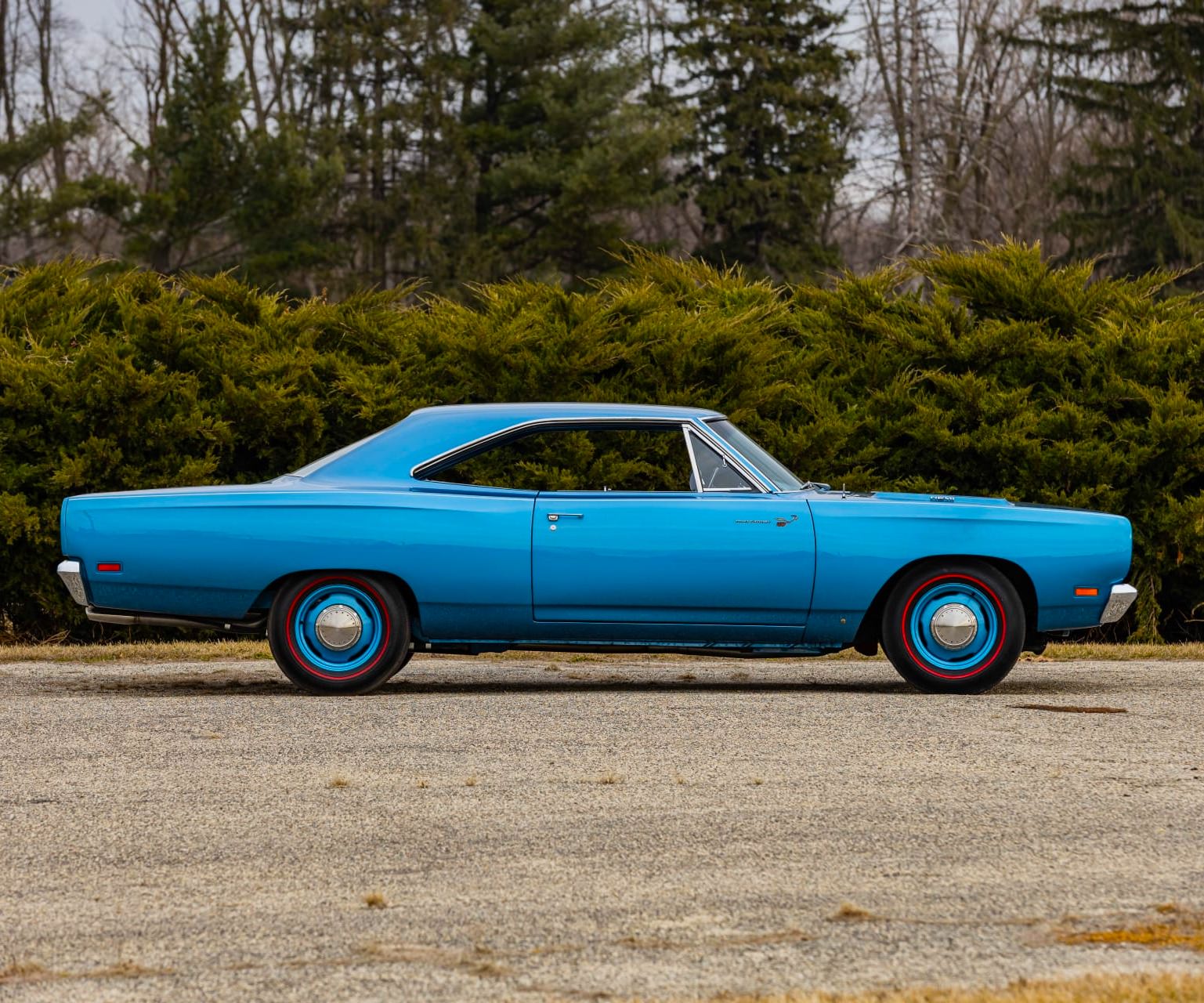
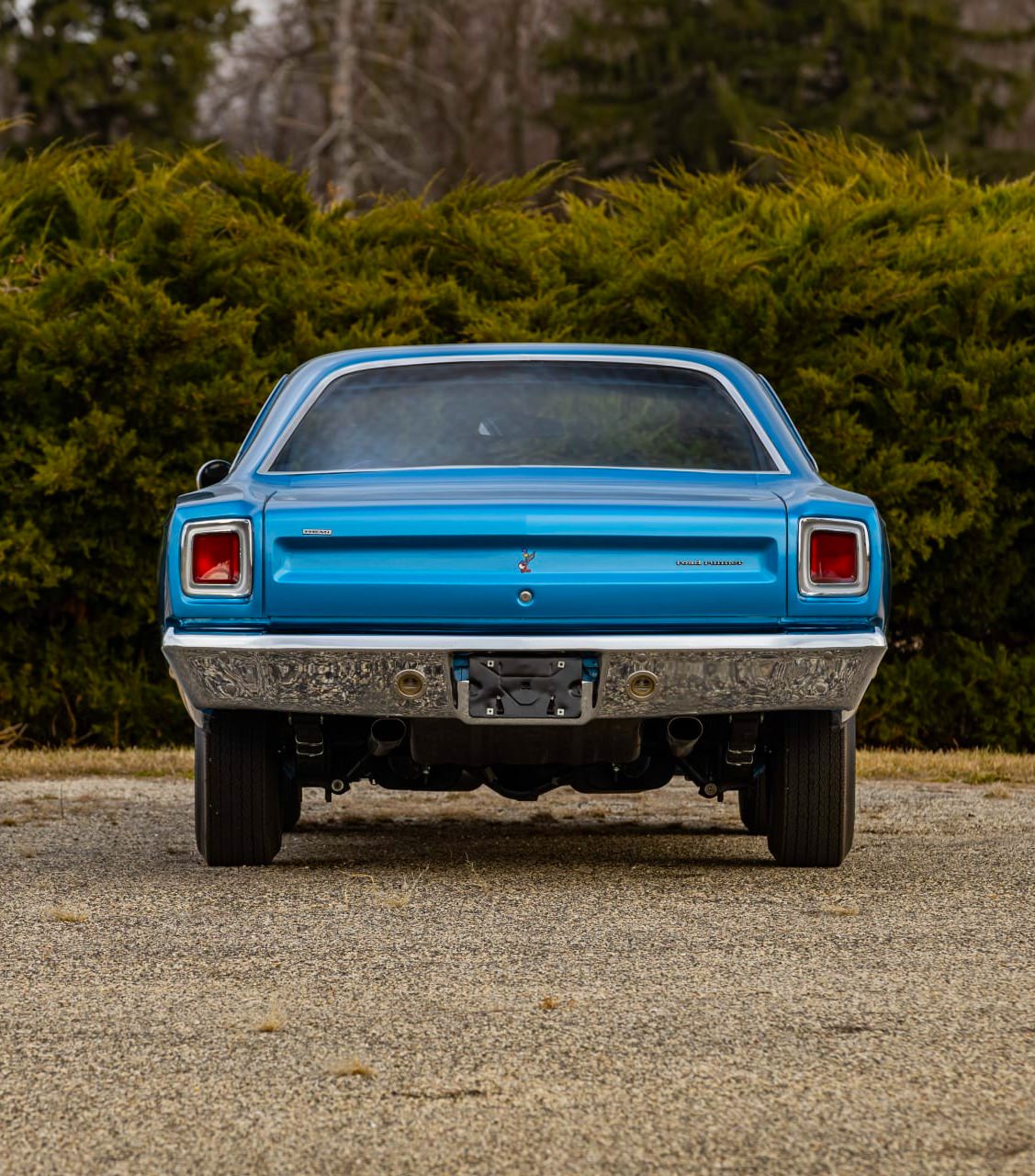
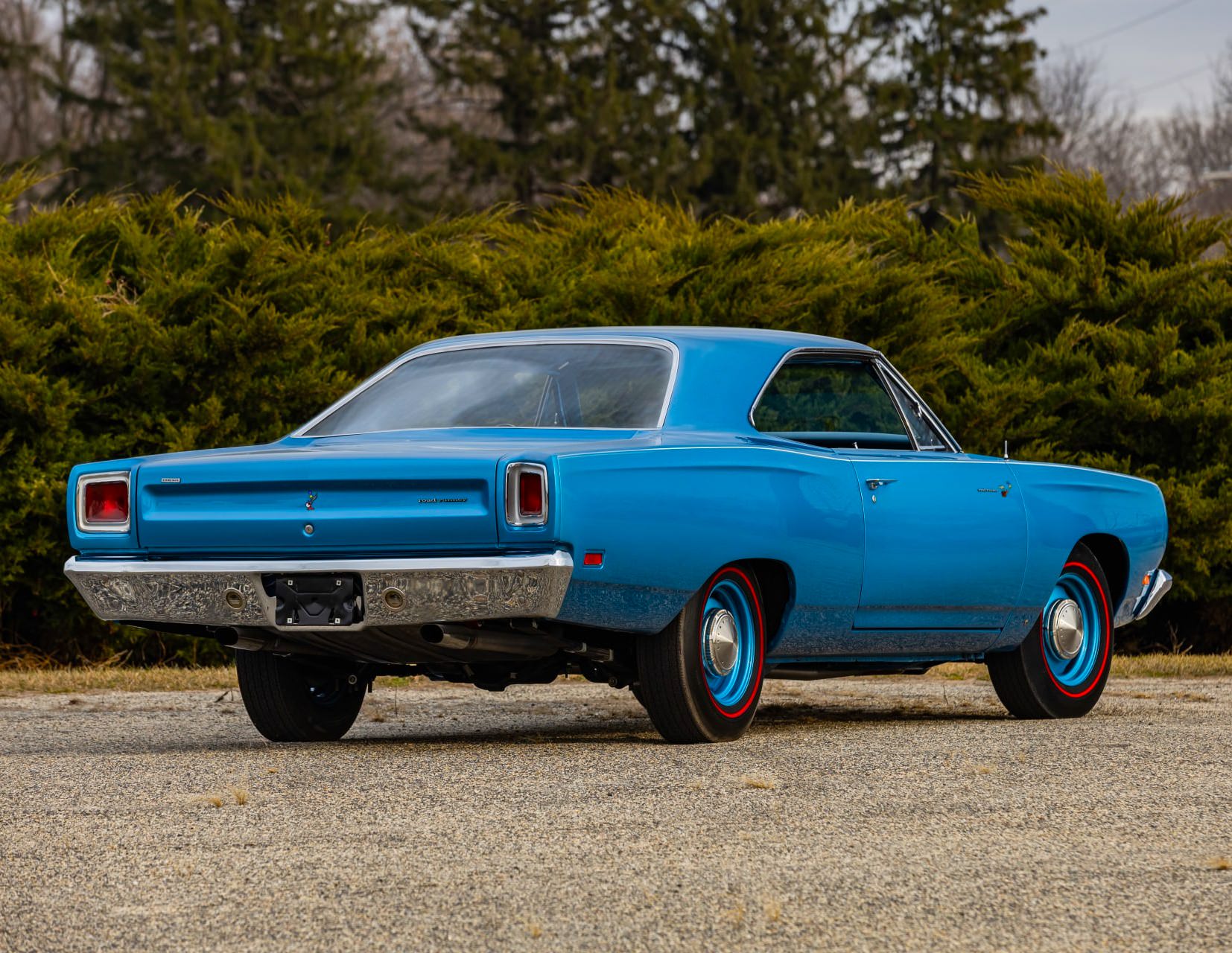
This is an original 1969 Plymouth Road Runner that came from the factory with the hugely desirable 426 Hemi V8, as well as the 4-speed manual transmission, and a Super Track Pak rear end.
This car now benefits from a nut and bolt rotisserie restoration, but importantly it retains the original matching-numbers drivetrain, as well as the factory-correct paint and other options. It’s being offered for sale with a copy of original window sticker, a copy of broadcast sheet, and the original fender tag.
Fast Facts: The 1969 Plymouth Hemi Road Runner
- Plymouth created the Road Runner for 1968 as a stripped-back, lower-cost muscle car aimed at younger buyers who were being priced out of more luxurious rivals. Gordon Cherry proposed the name, Warner Bros. licensed the cartoon branding, and the car’s cheeky image helped make it one of the era’s biggest showroom successes.
- The standard Road Runner used a specially prepared 383 cubic inch V8 with 335 bhp and 425 lb ft, paired with a heavy-duty 4-speed manual or optional TorqueFlite automatic. Buyers wanting maximum performance could order the 426 Hemi, bringing 425 bhp, 490 lb ft, dual four-barrel carburetors, and mandatory driveline upgrades.
- For 1969, the Road Runner received styling revisions, a new convertible body style, the A12 440 Six Barrel option, and the N96 Air Grabber hood. Production surged to more than 81,000 domestic units, with just 787 Hemi-powered examples built, making those cars among the rarest and most sought-after first-generation Road Runners.
- The specific car is a 1969 Hemi Road Runner built at Lynch Road, equipped with the 426 Hemi, A833 4-speed, A34 Super Track Pak, and Air Grabber hood. It retains its matching-numbers drivetrain, factory-correct B5 Blue paint, original documentation, and has been restored with its original sheet metal.
History Speedrun: The Plymouth Road Runner
By 1968 the muscle car market had begun to drift away from its roots. Cars like the Pontiac GTO and Plymouth’s own GTX had become increasingly loaded with luxury features and were also plenty more expensive to match, pricing out the younger buyers who had made the segment so popular in the first place. Plymouth’s answer was the Road Runner, a stripped-down, no-frills B-body Belvedere built around one core idea – maximum performance for minimum money.
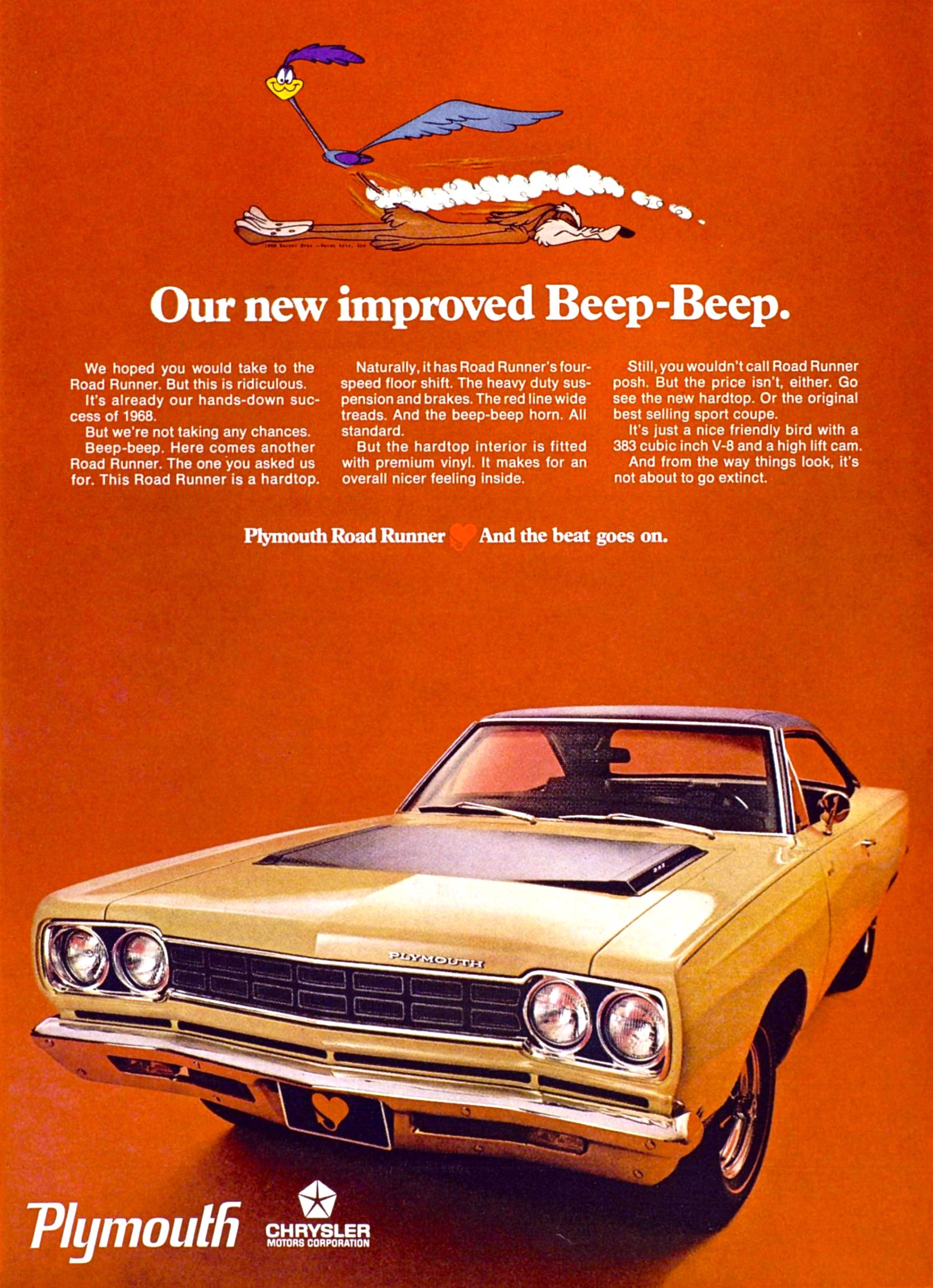
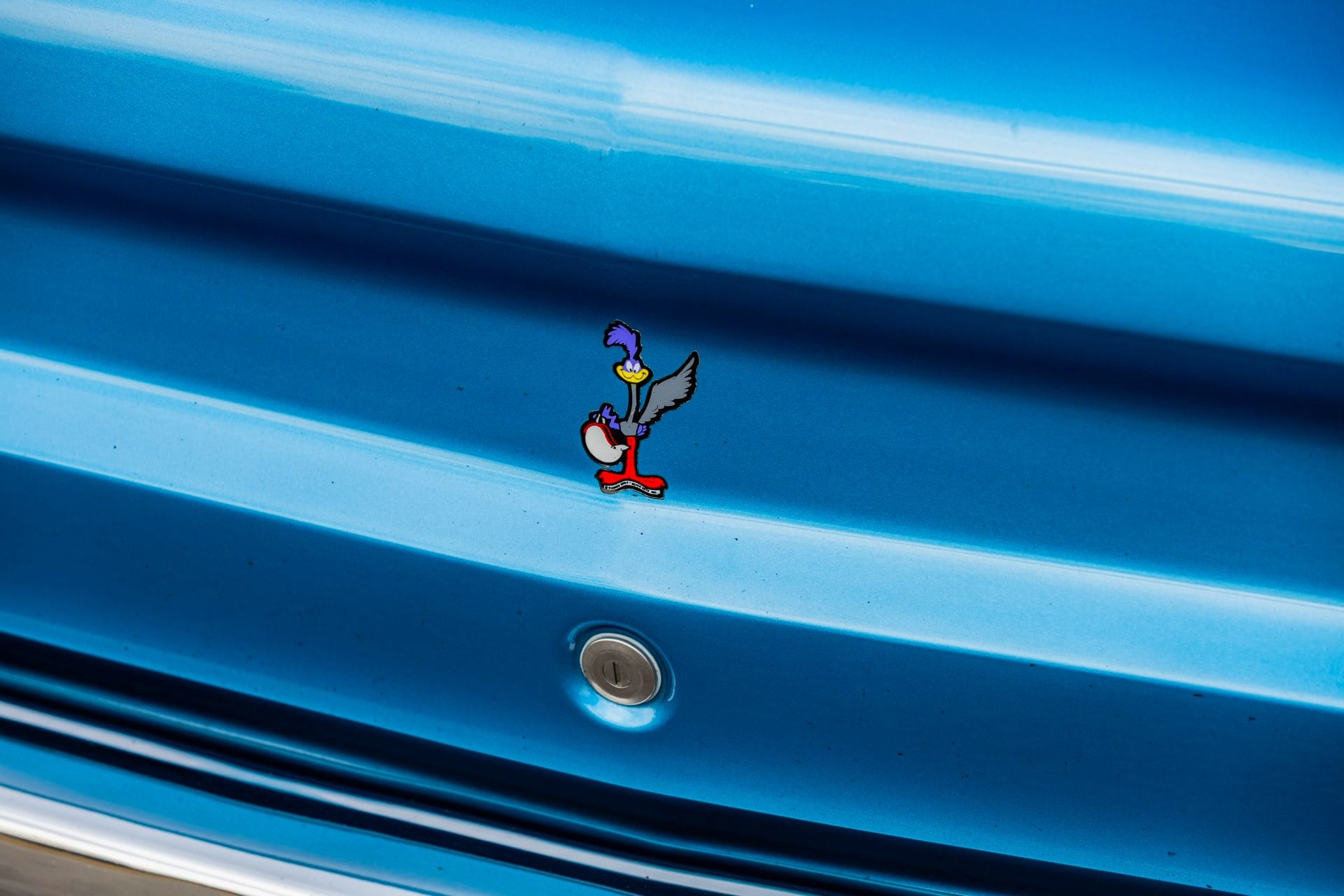
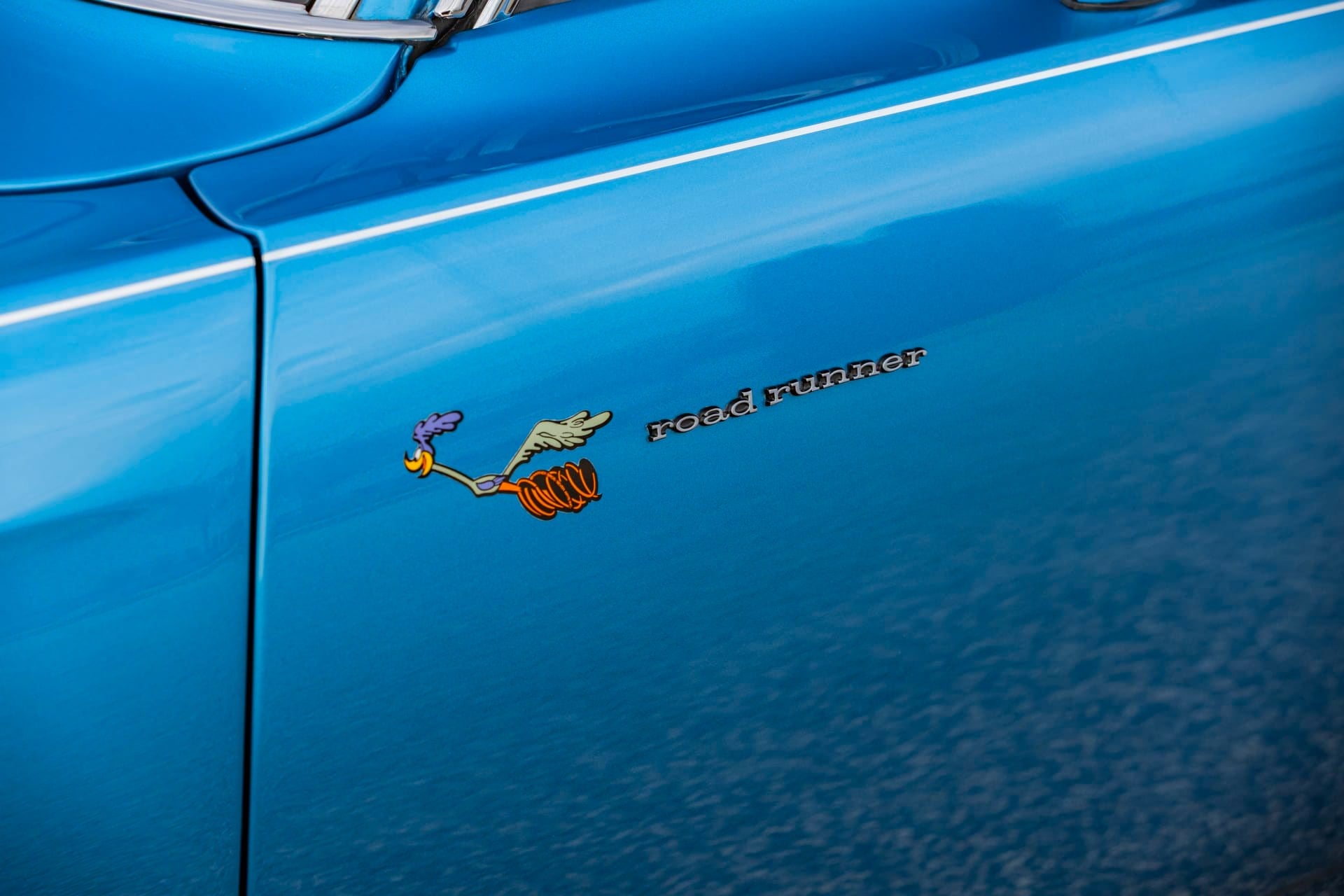
 Product planner Gordon Cherry came up with the name after watching Road Runner cartoons with his children, and his boss Jack Smith negotiated with Warner Brothers for the rights to use the Road Runner character’s name and likeness, including a horn that mimicked the cartoon bird’s now famous call. Image courtesy of Chrysler.
Product planner Gordon Cherry came up with the name after watching Road Runner cartoons with his children, and his boss Jack Smith negotiated with Warner Brothers for the rights to use the Road Runner character’s name and likeness, including a horn that mimicked the cartoon bird’s now famous call. The licensing deal reportedly cost Plymouth around $50,000 USD, the equivalent to almost half a million dollars in 2026 money.
The resulting marketing campaign, featuring colorful illustrations of the cartoon characters alongside the car, was a PR masterstroke that gave Plymouth a memorable pop culture identity at a time when personality counted for everything in the showroom.
Plymouth Road Runner: Specifications
The formula that underpinned the car was simple. Plymouth took the lightest, cheapest Belvedere body (a pillared two-door coupe) and fitted it with a specially prepared 383 cubic inch V8 as standard. This engine borrowed its cylinder heads, camshaft, intake manifold, and windage tray from the larger 440 Super Commando, producing 335 bhp at 5,200 rpm and 425 lb ft of torque with a four-barrel Carter carburetor.
A strengthened 4-speed manual transmission was standard, with the 3-speed TorqueFlite automatic as an option. The interior was deliberately spartan with just a vinyl bench seat, rubber floor mats instead of carpet, and very few options beyond power steering, an AM radio, and front disc brakes.
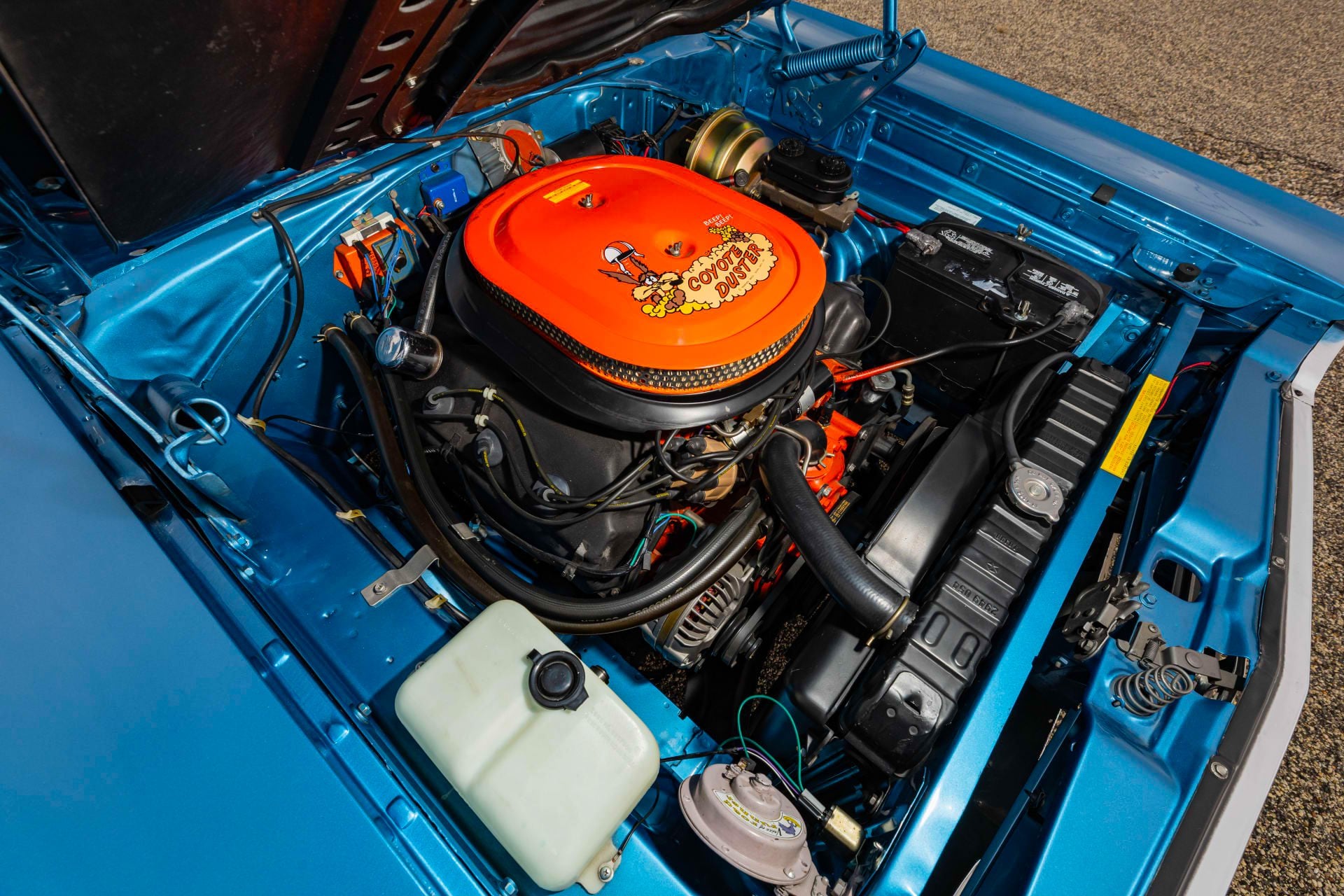
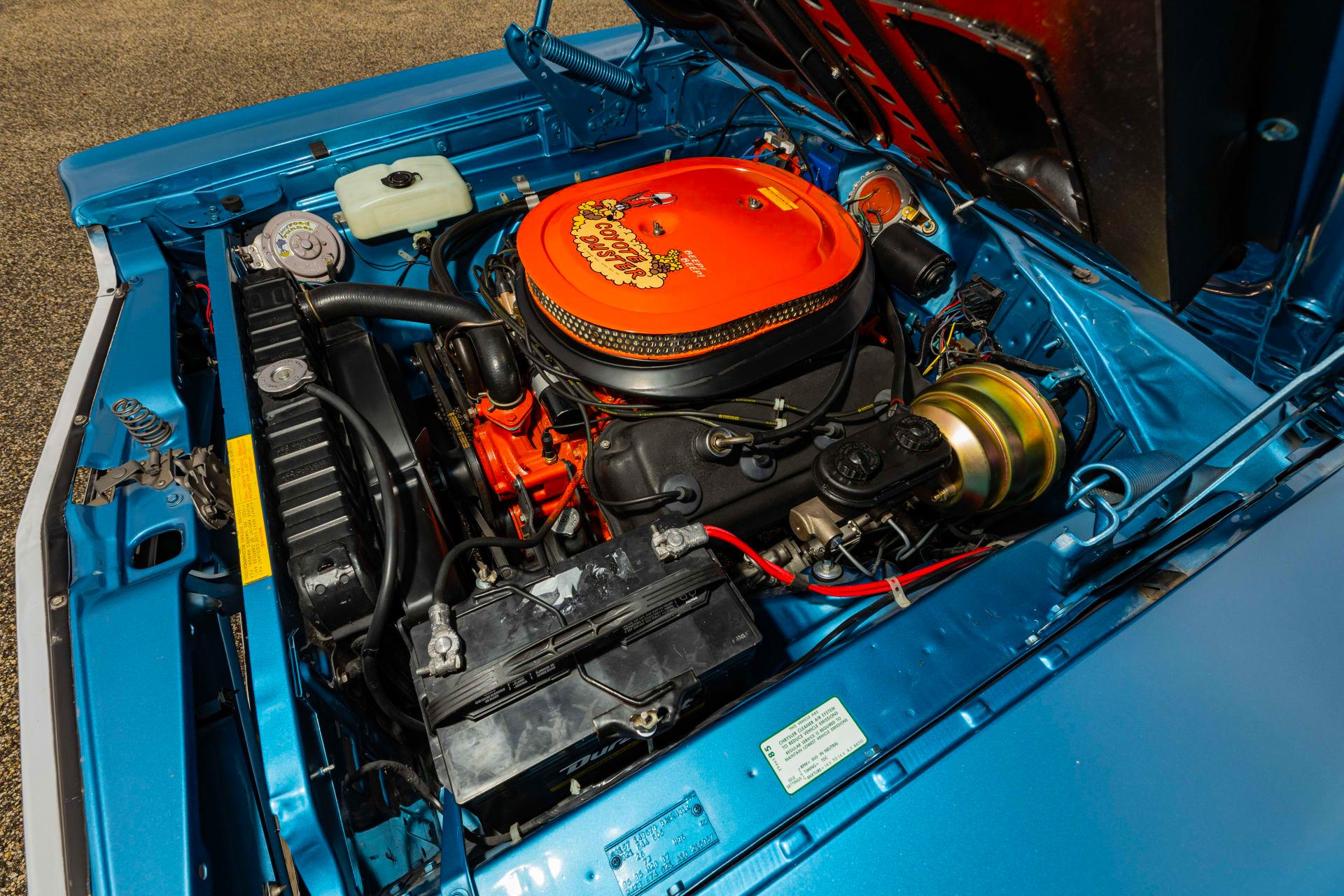
For buyers with deeper pockets, Plymouth offered the 426 cubic inch Hemi V8 as the sole engine option above the 383. Fed by dual Carter AFB four-barrel carburetors, the Hemi produced 425 bhp at 5,000 rpm and 490 lb ft of torque at 4,000 rpm, with a compression ratio of 10.2:1. In 1968, the Hemi option added $714 to the base price ($6,700+ USD today) and came with mandatory upgrades including a Dana 60 Sure-Grip rear axle.
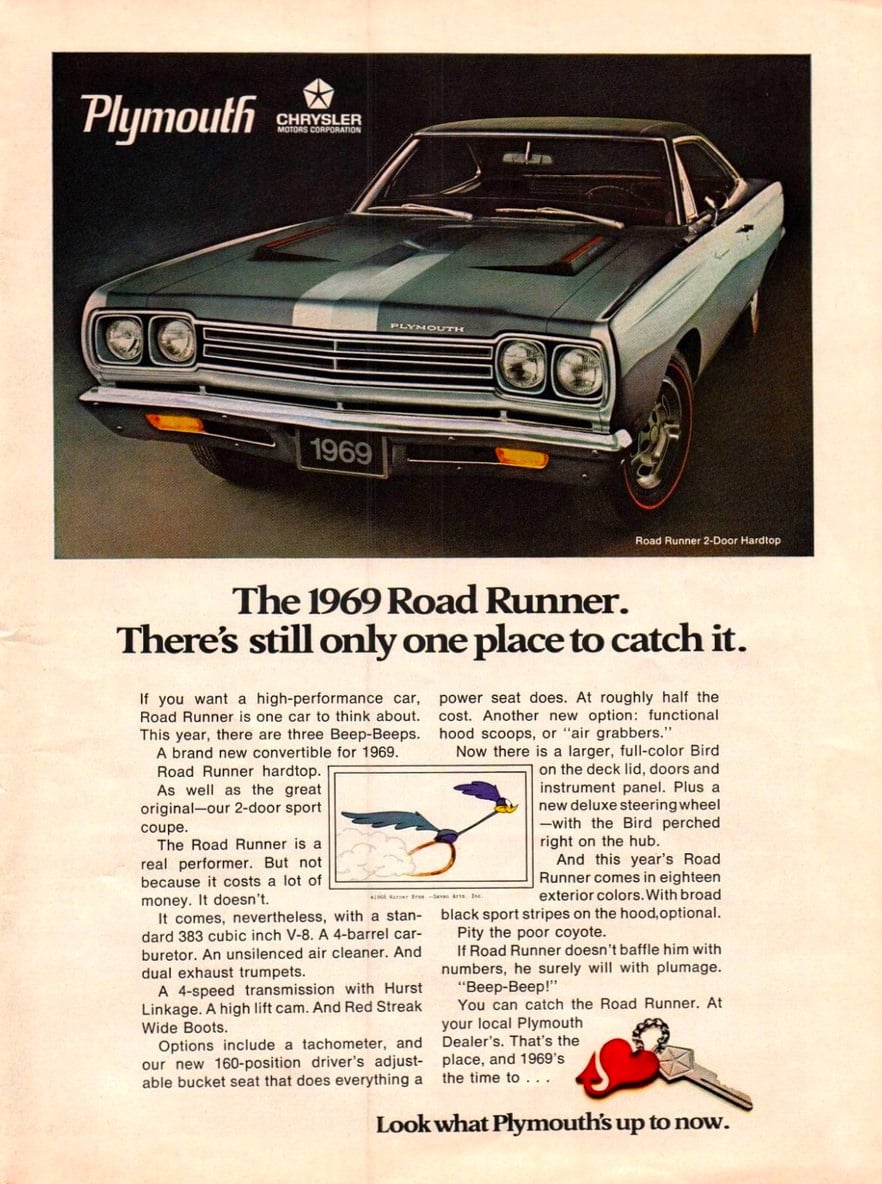
Plymouth took the lightest, cheapest Belvedere body (a pillared two-door coupe) and fitted it with a specially prepared 383 cubic inch V8 as standard. This engine borrowed its cylinder heads, camshaft, intake manifold, and windage tray from the larger 440 Super Commando, producing 335 bhp at 5,200 rpm and 425 lb ft of torque with a four-barrel Carter carburetor. Image courtesy of Chrysler.
Plymouth expected to sell around 20,000 Road Runners in 1968, though actual sales hit approximately 45,000, placing the model third among muscle cars behind only the GTO and Chevrolet’s SS396 Chevelle. Dodge wasted no time creating its own version, the Super Bee, as a mid-1968 offering built on the same B-body platform with similar mechanicals.
The 1969 Model Debuts
The 1969 model year cars were the Road Runner’s peak – it received some minor styling updates including revised taillights, a new grille, and updated decals, while a convertible body style joined the lineup for the first time.
The Hemi option price also rose to $813.45 for 1969 ($7,600+ USD). More significantly though, the mid-year introduction of the A12 440 Six Barrel V8 option, with three Holley two-barrel carburetors on an Edelbrock aluminum intake manifold atop the 440 cubic inch V8, producing 390 bhp and 490 lb ft of torque, gave buyers a third powertrain choice that slotted in neatly between the 383 and the Hemi.
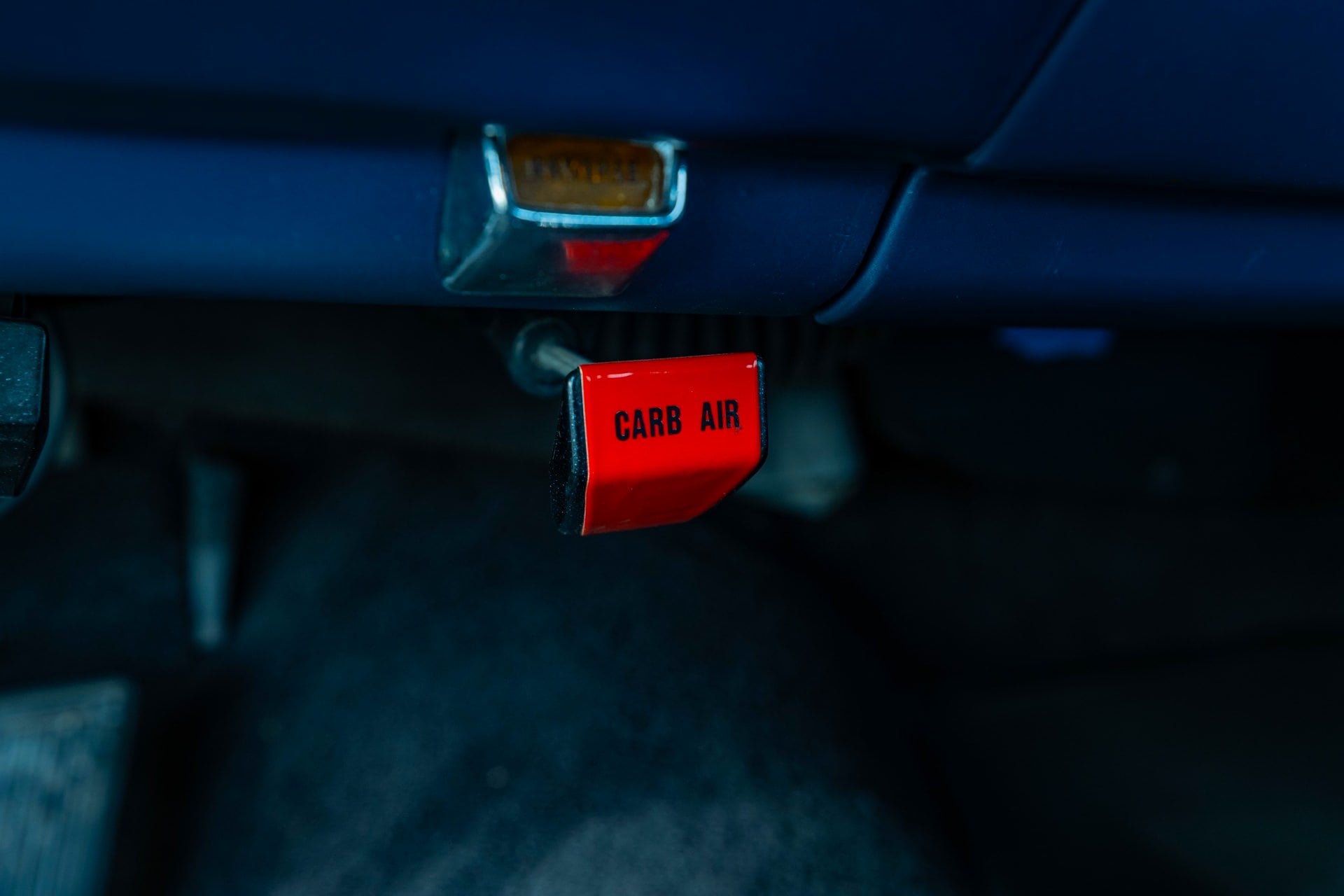
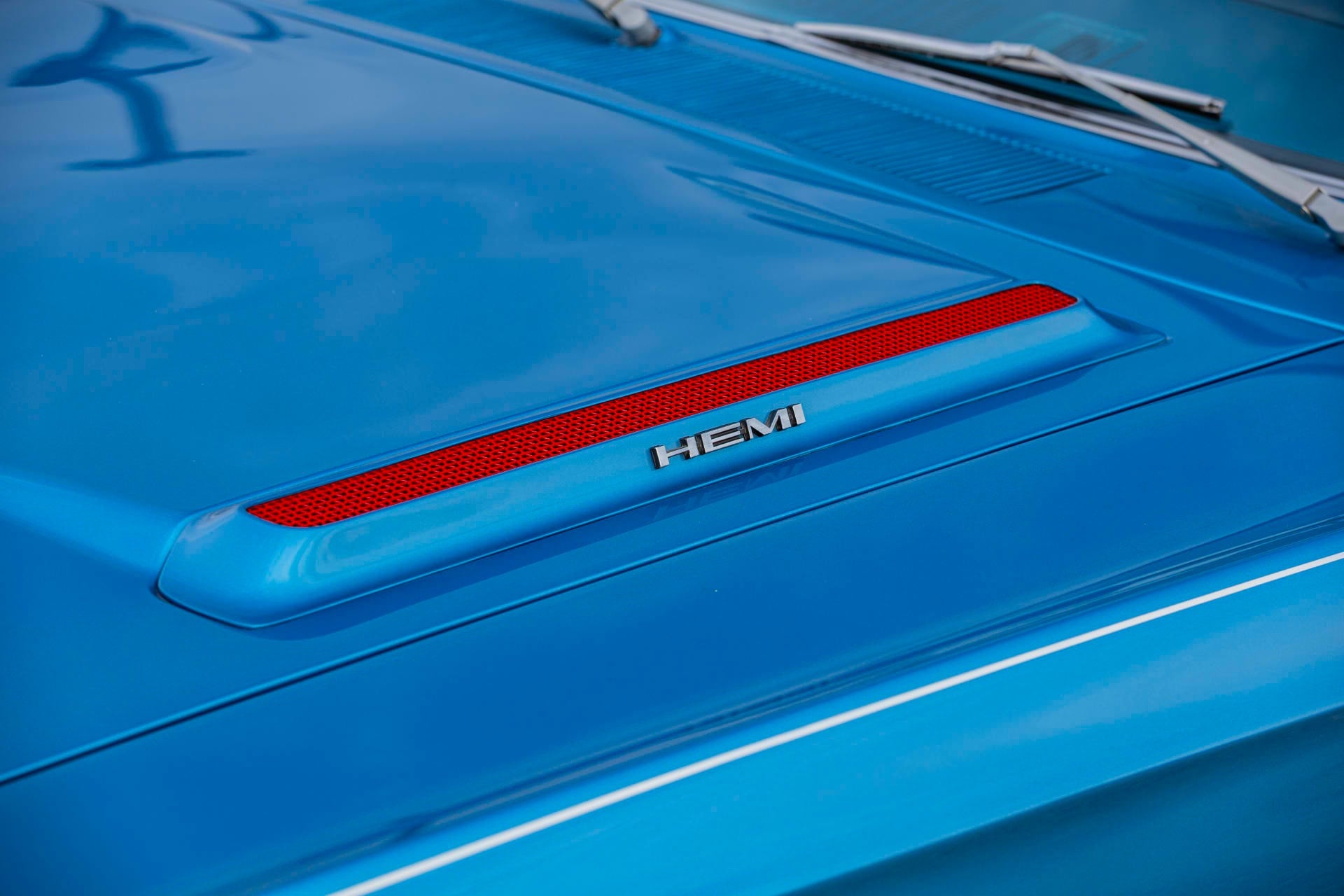
The N96 Air Grabber hood option was introduced for 1969, it consisted of a fiberglass air duct assembly bolted to the underside of the hood with twin rectangular upward-facing vents fitted with Rallye Red screens, controlled by a dash-mounted lever labeled “Carb Air.” On Hemi-equipped cars, the Air Grabber was standard.
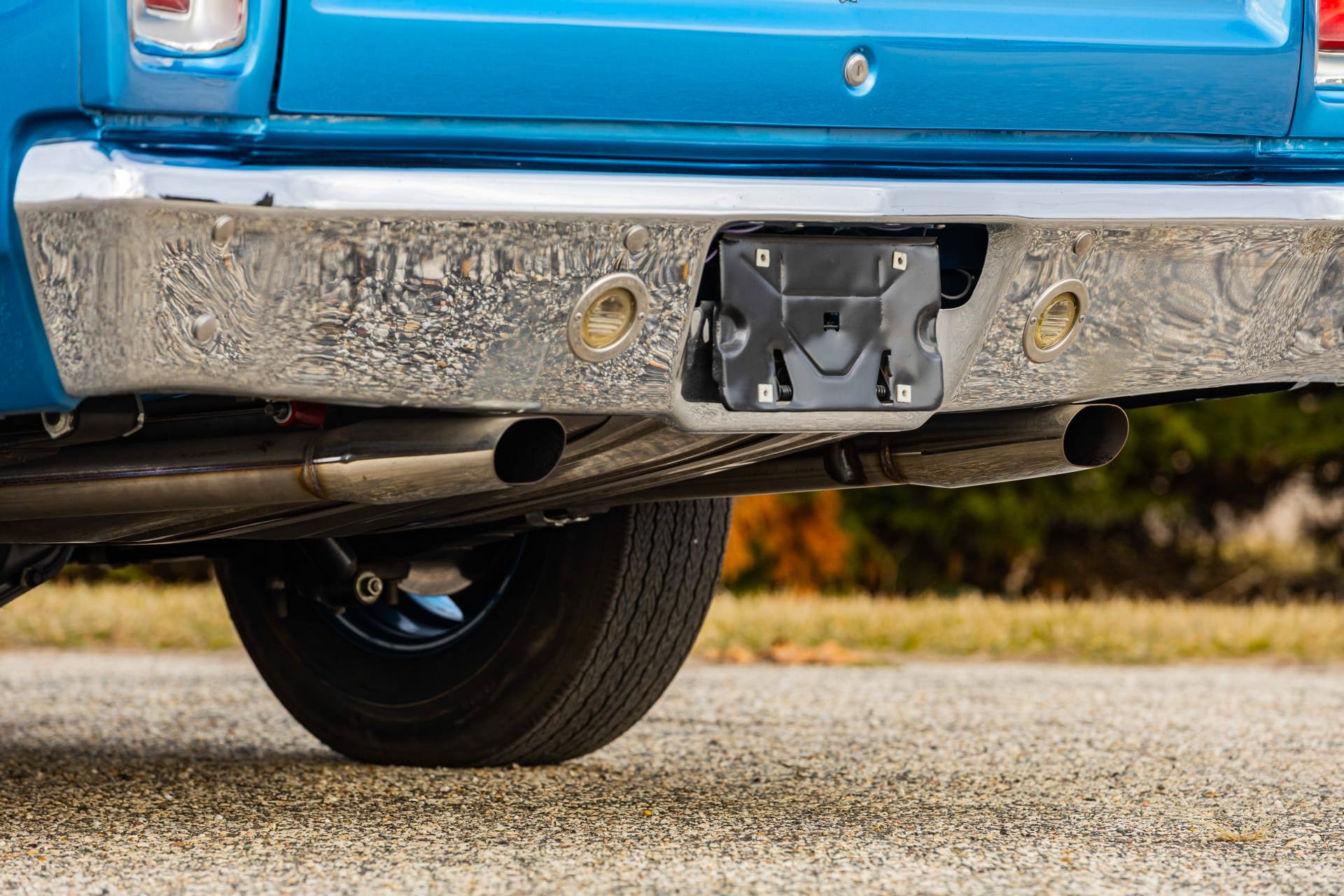
Buyers seeking the ultimate in mechanical preparedness could option the Super Track Pak (code A34), which bundled a Dana 60 Sure-Grip rear end with 4.10 gears, heavy-duty cooling, and power front disc brakes. A separate Track Pak option (code A33) was also available with 3.54 gearing. Period road tests confirmed the Hemi Road Runner’s devastating straight-line performance – Motor Trend recorded a best quarter-mile pass of 13.56 seconds at 105.38 mph with a TorqueFlite-equipped car running 4.10 gears, while Car and Driver managed 13.54 seconds at 105.14 mph.
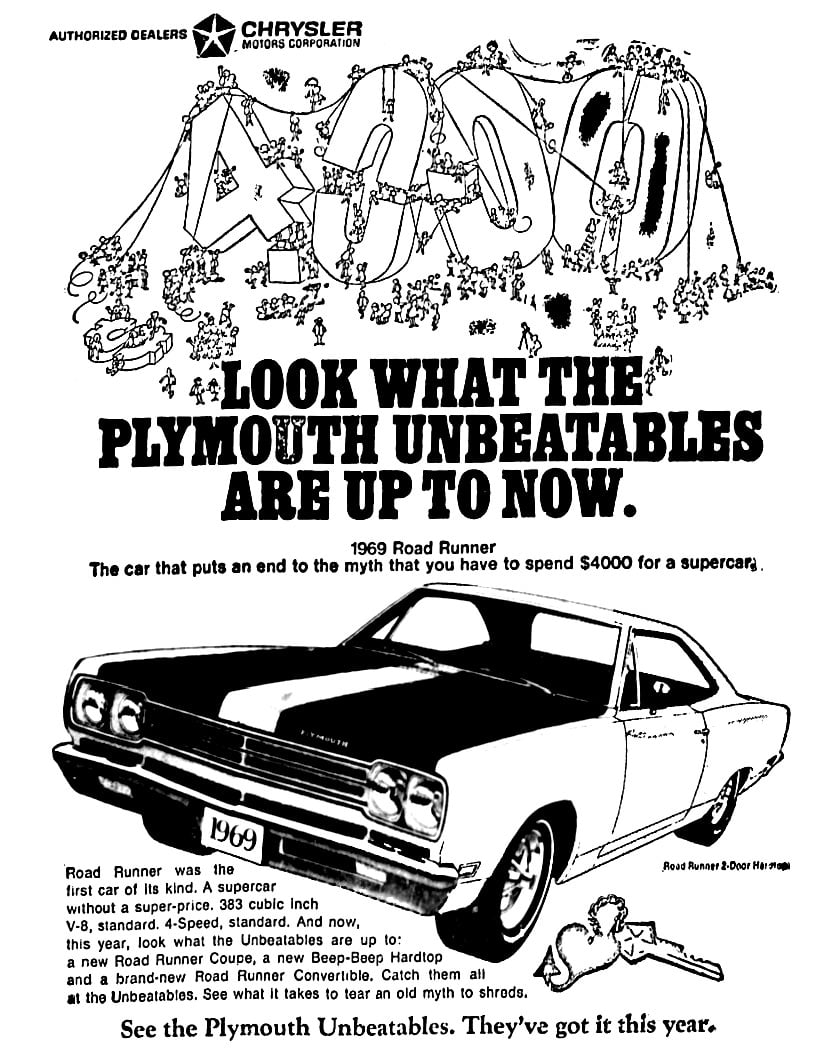
Plymouth expected to sell around 20,000 Road Runners in 1968, though actual sales hit approximately 45,000, placing the model third among muscle cars behind only the GTO and Chevrolet’s SS396 Chevelle. Dodge wasted no time creating its own version, the Super Bee, as a mid-1968 offering built on the same B-body platform with similar mechanicals. Image courtesy of Chrysler.
The Road Runner was named Motor Trend’s Car of the Year for 1969, and domestic production reached 81,125 units with an additional 3,295 delivered to Canada and other export markets. Of the 1969 total, only 787 received the Hemi V8, broken down to approximately 421 hardtops, 356 coupes, and just 10 convertibles.
The model’s main competitors remained the Pontiac GTO and the Chevrolet Chevelle SS, though Dodge’s own Super Bee also competed for the same buyers within the Chrysler family. The Super Bee sold 27,800 units in 1969, a decent number, but far short of the Road Runner’s tally.
The Road Runner Goes Racing
Richard Petty had campaigned a Road Runner-bodied Plymouth carrying his signature number 43 in the 1968 season, but dissatisfaction with Plymouth’s competitiveness during the 1969 aero wars led Petty Engineering to request Dodge Charger 500s and Daytonas from Chrysler management.
When they were told they were “a Plymouth team,” the Pettys signed with Ford and won 10 races that season. To bring Petty back into the fold and meet NASCAR’s homologation requirements, Plymouth developed the Superbird for 1970, this was essentially its own version of the Dodge Charger Daytona, built on the Road Runner platform.
With its aerodynamic nose cone and towering rear wing, the Superbird was one of the most dramatic-looking cars ever to roll off an American production line. NASCAR’s 1970 rules required manufacturers to build either 1,000 cars or one for every two US dealers, whichever was greater. For Plymouth, that worked out to roughly 1,920 cars, and production is commonly cited as 1,935 for the US market.
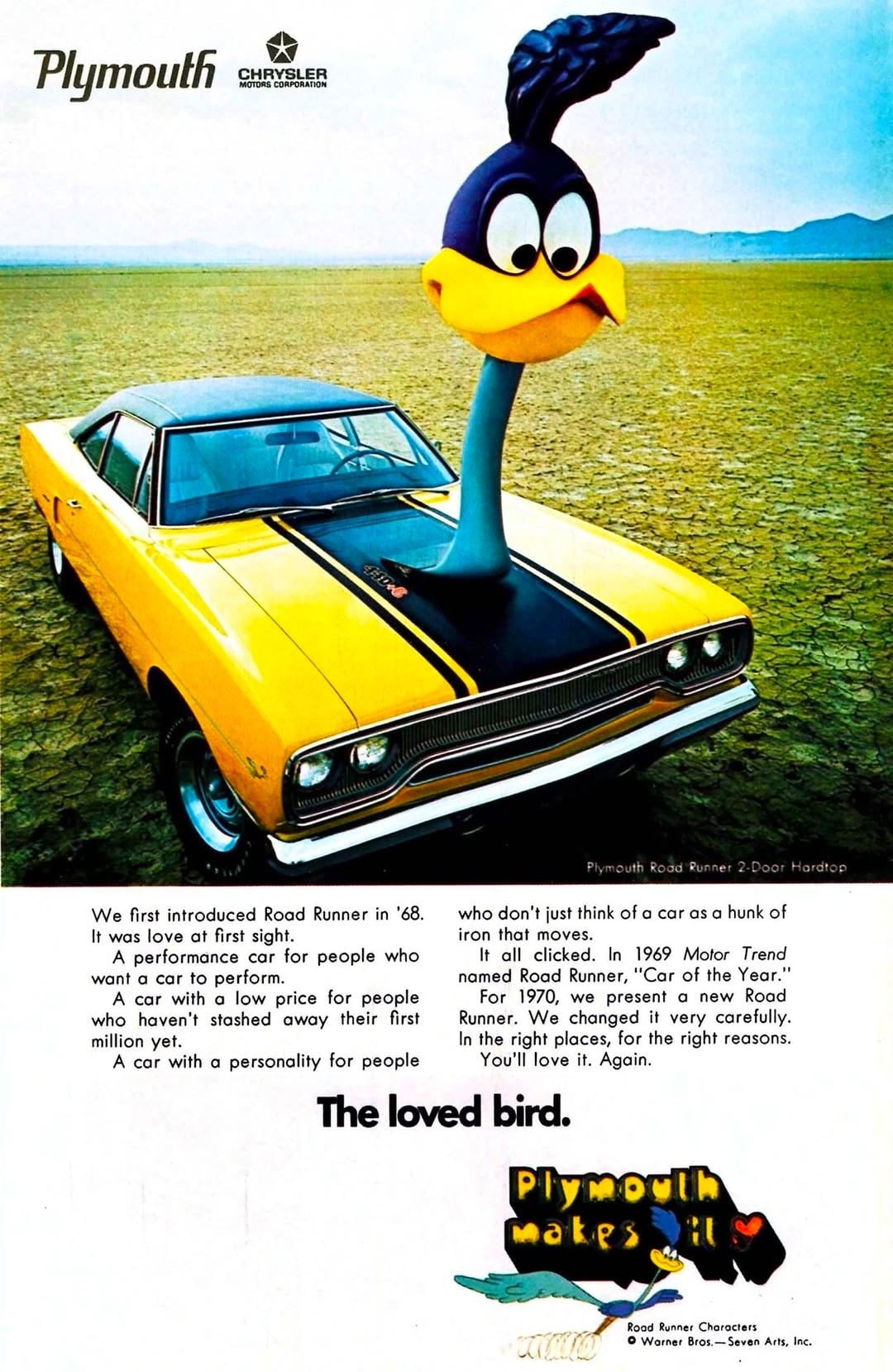
The Road Runner was named Motor Trend’s Car of the Year for 1969, and domestic production reached 81,125 units with an additional 3,295 delivered to Canada and other export markets. Image courtesy of Chrysler.
Petty returned to Plymouth for 1970, driving the Superbird, and went on to win the NASCAR Grand National championship in 1971 in a Road Runner, notably the last stock car to win a NASCAR championship using a production-based body and engine.
The Beginning Of The End
By 1970 it was clear that the muscle car market was shifting. Insurance companies had begun levying steep surcharges on high-performance cars, and Plymouth’s own Duster 340 was drawing budget-conscious buyers toward a cheaper, lighter platform, with much more manageable insurance premiums.
Road Runner sales dropped by more than half to around 41,000 cars, and only three Hemi convertibles were built for the domestic market. A second-gen Road Runner arrived for 1971 on a restyled “fuselage” body with a shorter wheelbase, and while the 440 Six Pack and 426 Hemi remained available that final year, the writing was on the wall.
Through the mid-1970s the Road Runner name migrated to increasingly mundane surroundings, for 1975 it moved to the restyled B-body now badged as the Plymouth Fury, and then in 1976 it became a trim and graphics package on the compact Volaré before being retired after 1980.
The first-gen Road Runner, particularly the 1968 to 1969 Hemi-equipped cars, remain among the most coveted and valuable American muscle cars on the market today. What began as a low-budget experiment offering affordable speed and a fun cartoon character mascot evolved into one of the greatest Plymouths ever made.
The 1969 Plymouth Hemi Road Runner Shown Here
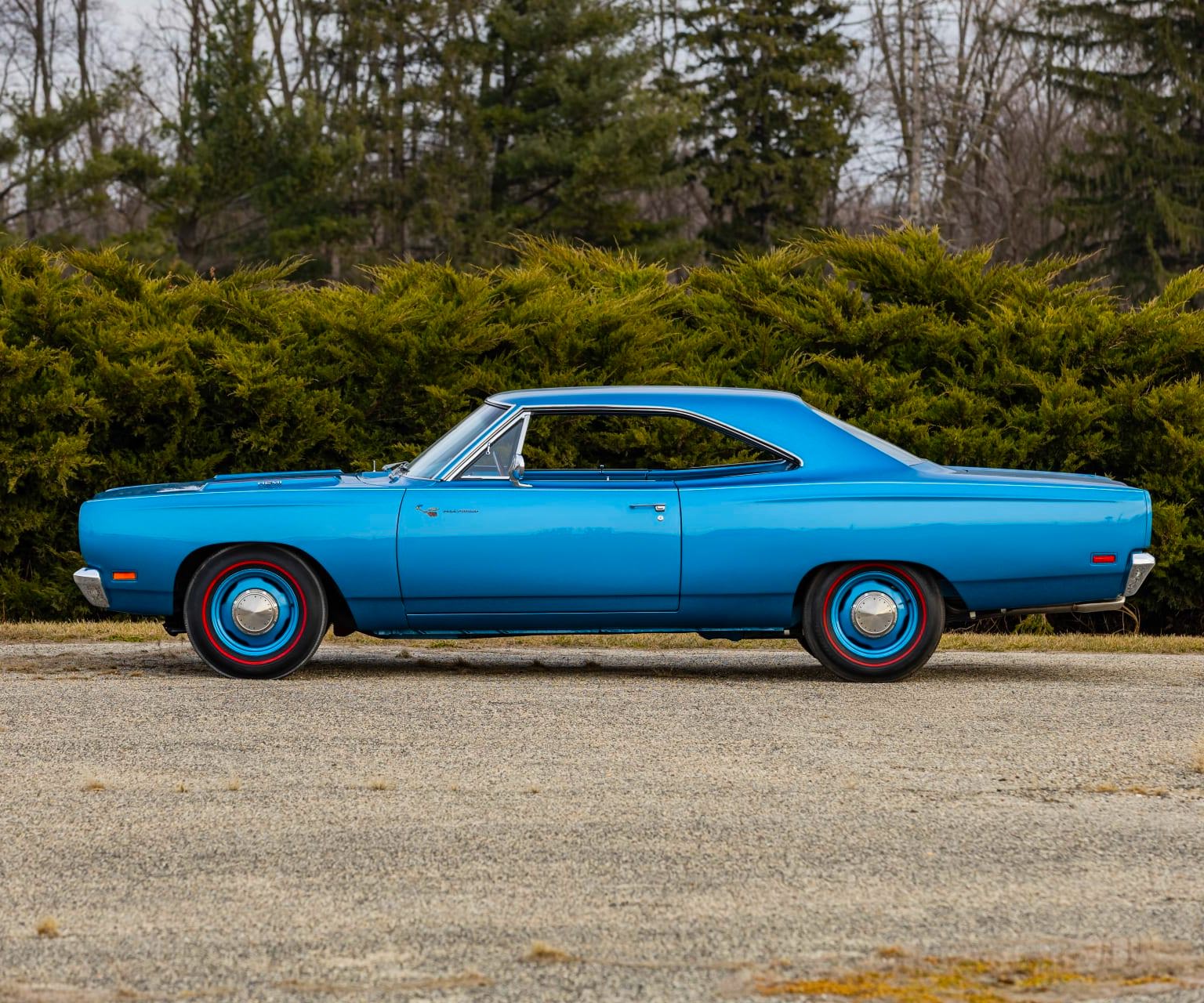
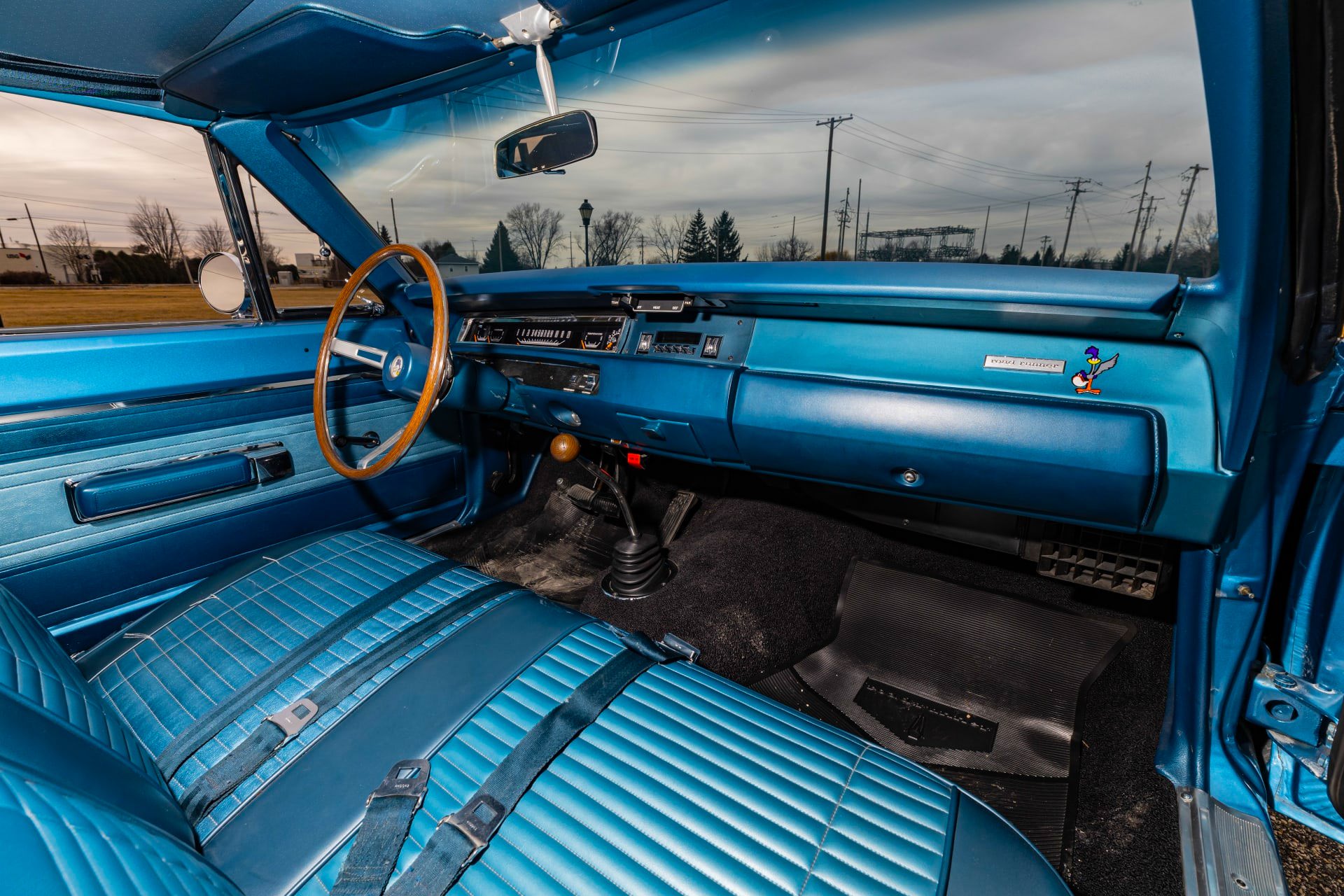
The 1969 Plymouth Hemi Road Runner shown here is one of just 68 examples built at Chrysler’s Lynch Road assembly plant in Michigan, it’s sequenced as the 9th car in that build run. It left the factory equipped with the full-house 426 cubic inch Hemi V8 rated at 425 bhp, backed by an A833 4-speed manual transmission and the desirable A34 Super Track Pak rear end.
This was a combination that bundled the Dana 60 Sure-Grip differential with 4.10 gears, heavy-duty cooling, and power front disc brakes. The car also came with the N96 Air Grabber hood, which was standard equipment on Hemi-equipped Road Runners.
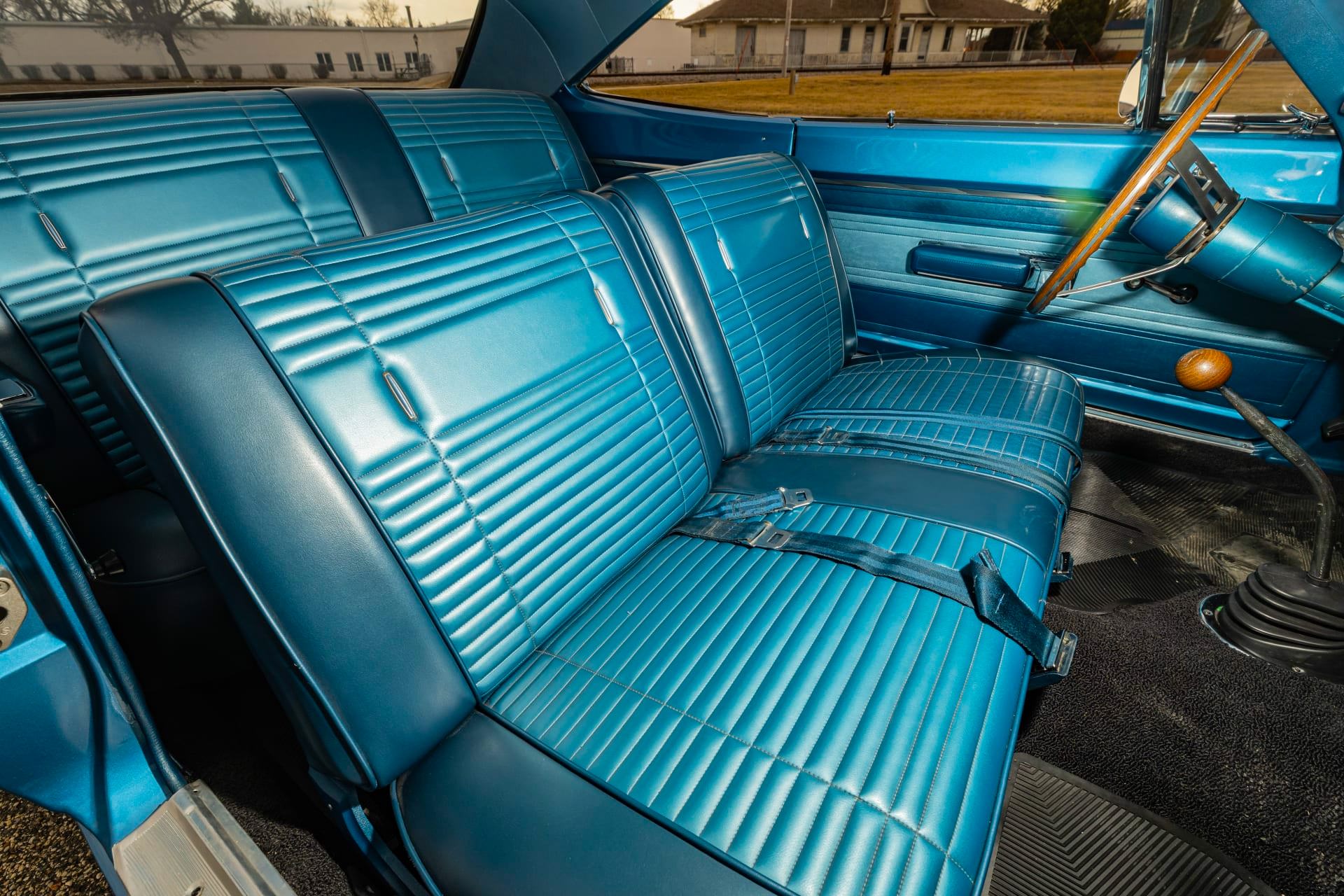
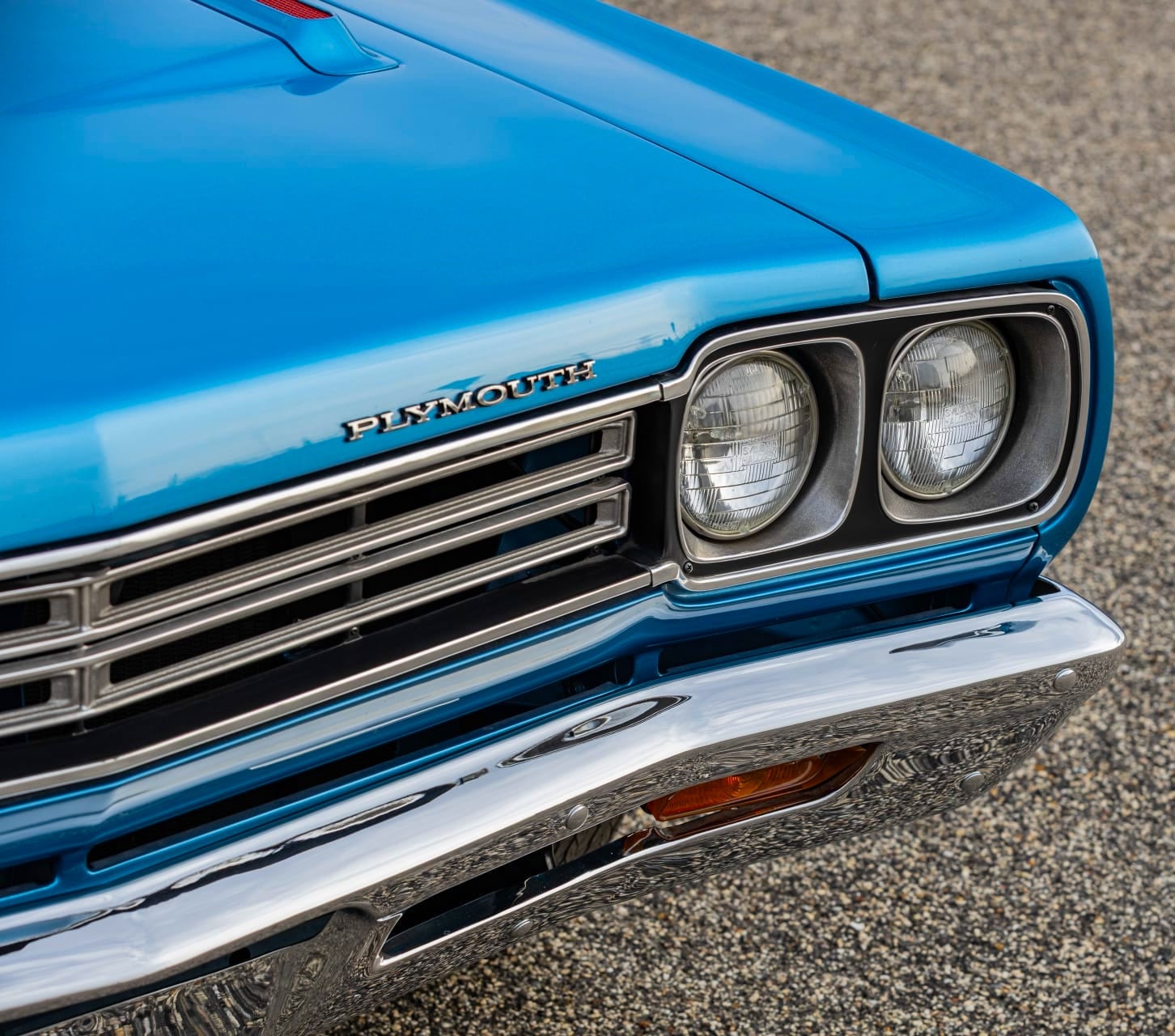
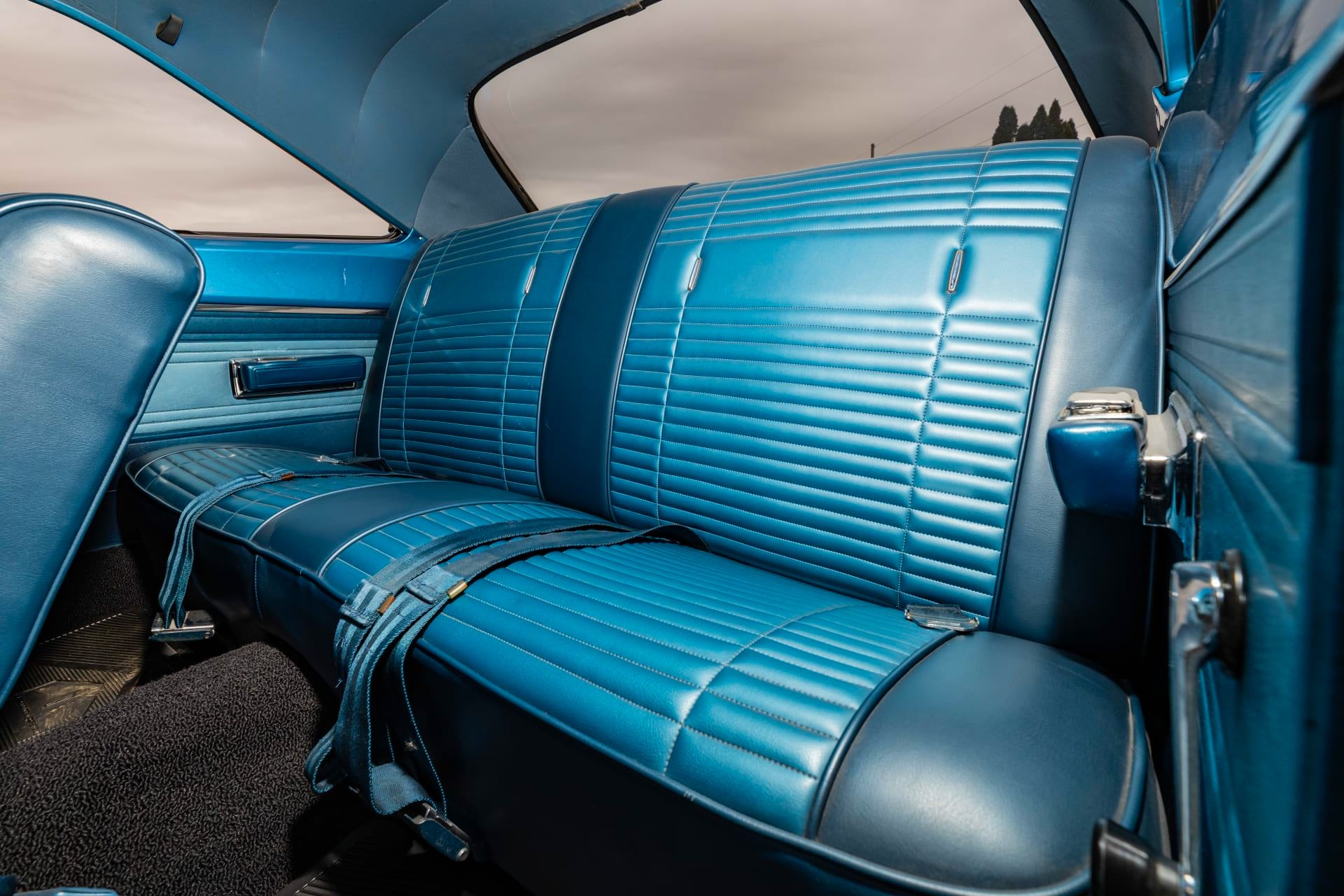
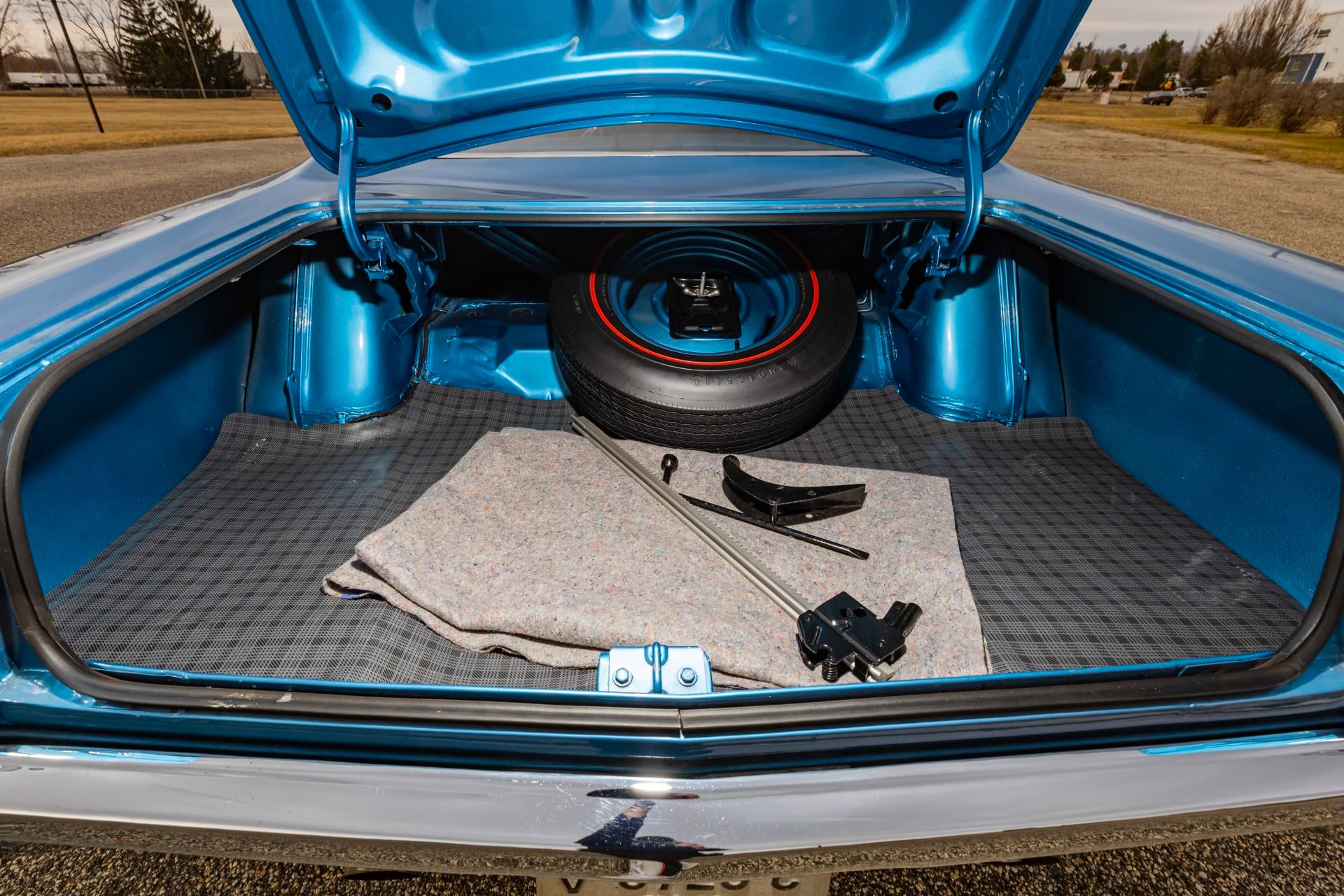
The car keeps its original matching-numbers drivetrain and wears factory-correct B5 Blue Metallic paint over a Blue interior. It has undergone a comprehensive nut-and-bolt rotisserie restoration using the original sheet metal, with the process fully documented in photographs. The result is a car that presents in sympathetically restored condition while keeping the all-important authenticity of its factory-original body panels, mechanicals, and specification.
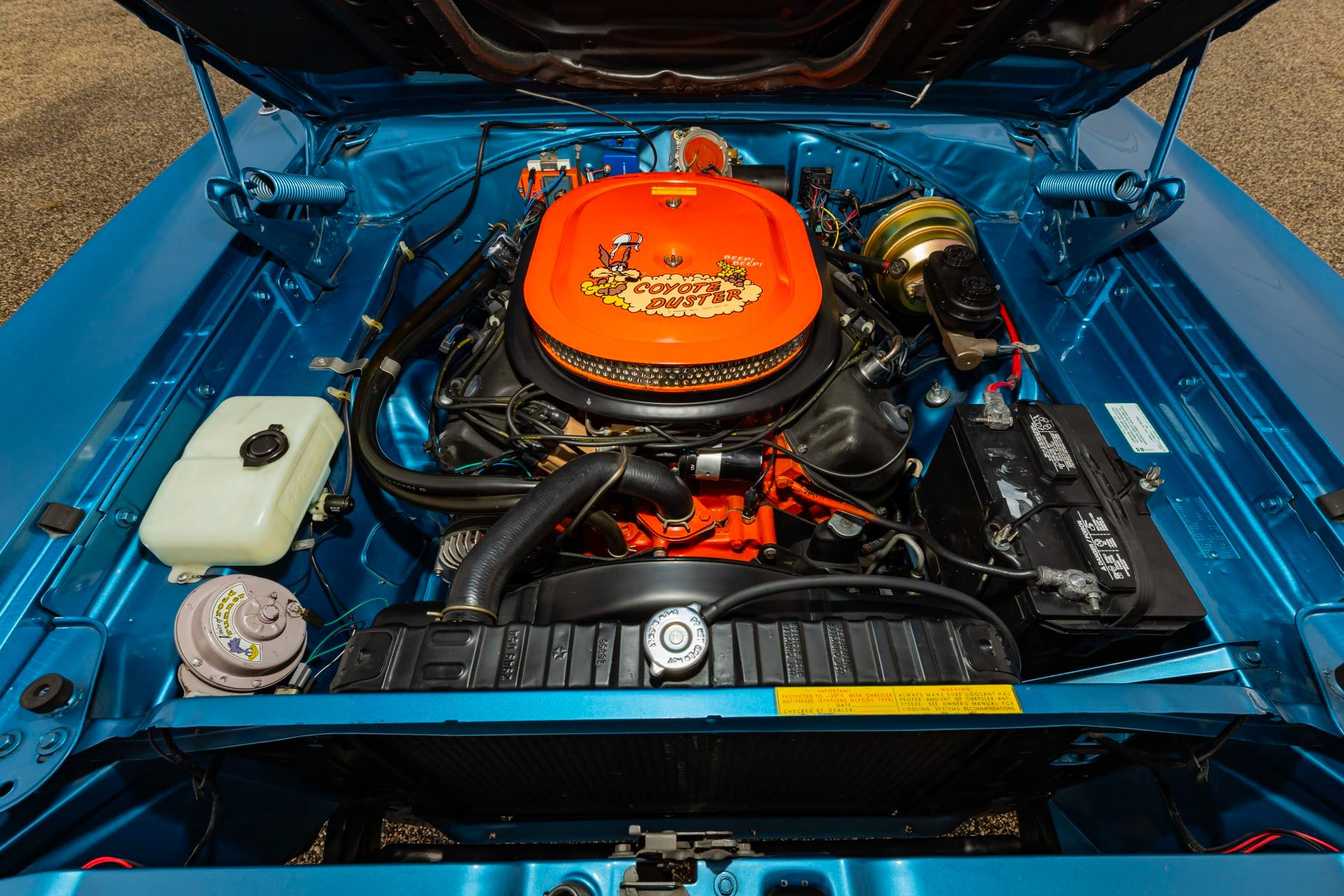
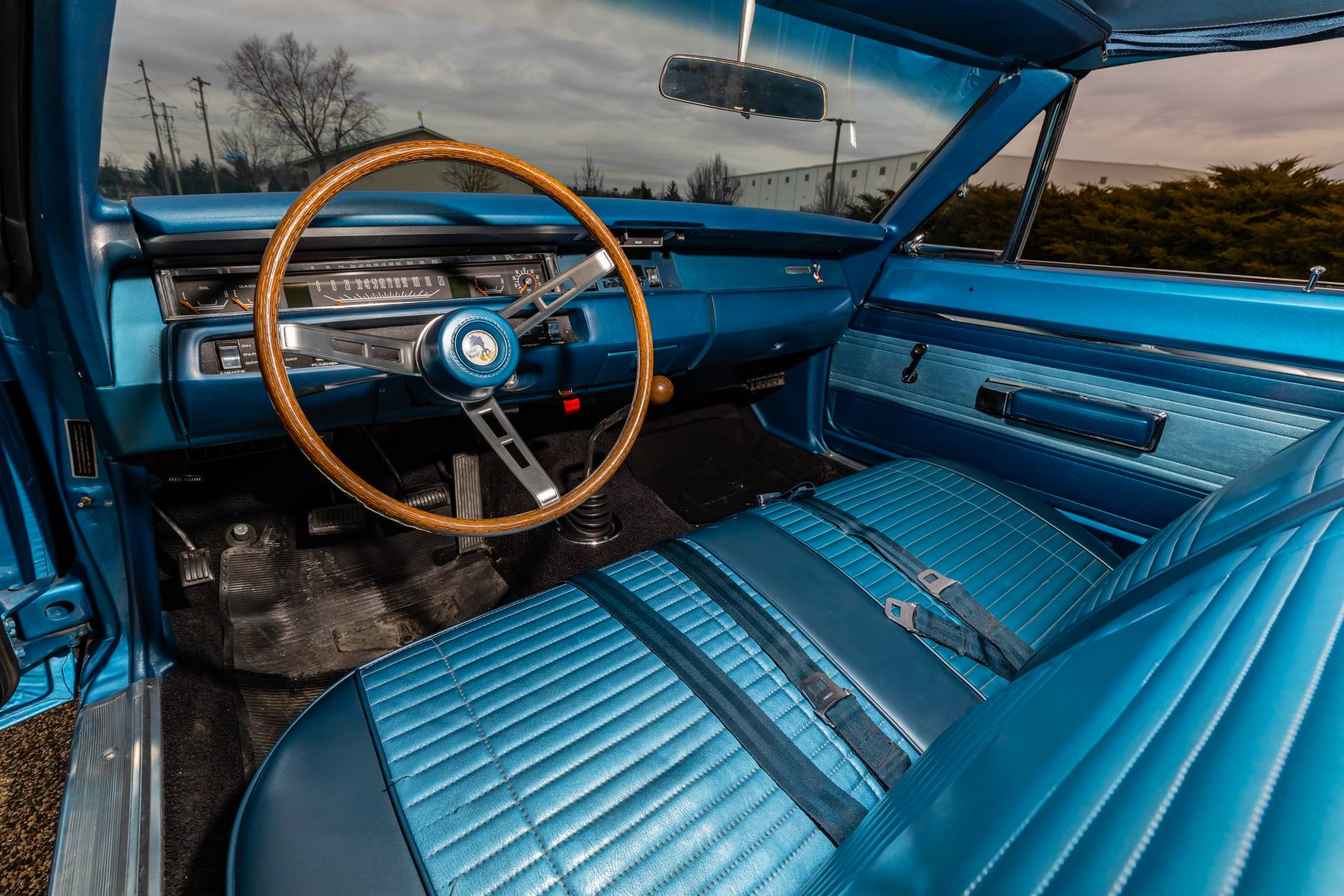
This is an original 1969 Plymouth Road Runner that came from the factory with the hugely desirable 426 Hemi V8, as well as the 4-speed manual transmission, and a Super Track Pak rear end.
It comes with a Chrysler Registry report, a copy of the original window sticker, a copy of the broadcast sheet, a copy of the original MSO (Manufacturer’s Statement of Origin), and the original fender tag.
It’s now due to roll across the auction block with Mecum in May if you’d like to read more about it or register to bid you can visit the listing here.
Images courtesy of Mecum

Articles that Ben Branch has written have been covered on CNN, Popular Mechanics, Smithsonian Magazine, Road & Track Magazine, the official Pinterest blog, the official eBay Motors blog, BuzzFeed, Autoweek Magazine, Wired Magazine, Autoblog, Gear Patrol, Jalopnik, The Verge, and many more.
Silodrome was founded by Ben back in 2010, in the years since the site has grown to become a world leader in the alternative and vintage motoring sector, with well over a million monthly readers from around the world and many hundreds of thousands of followers on social media.