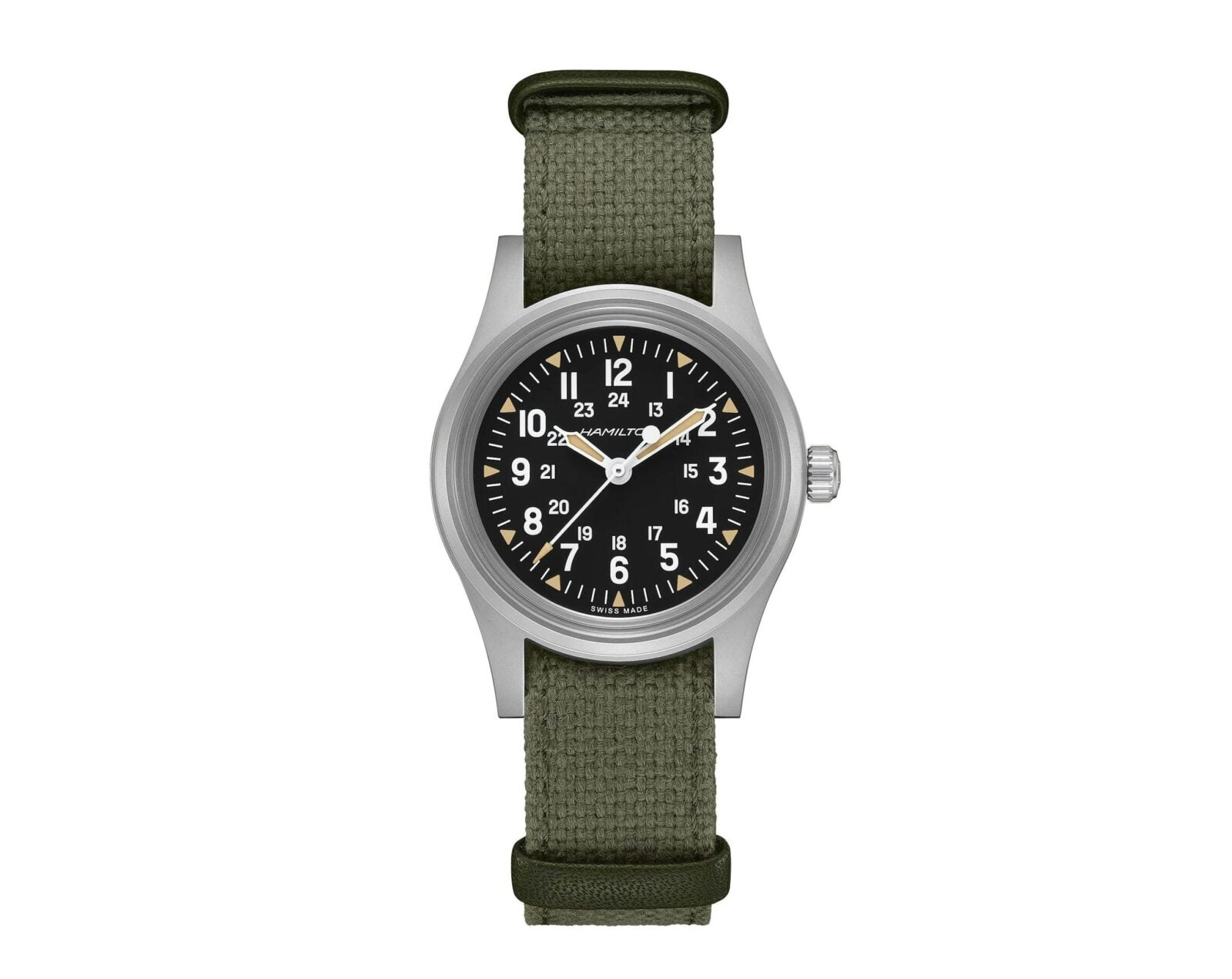
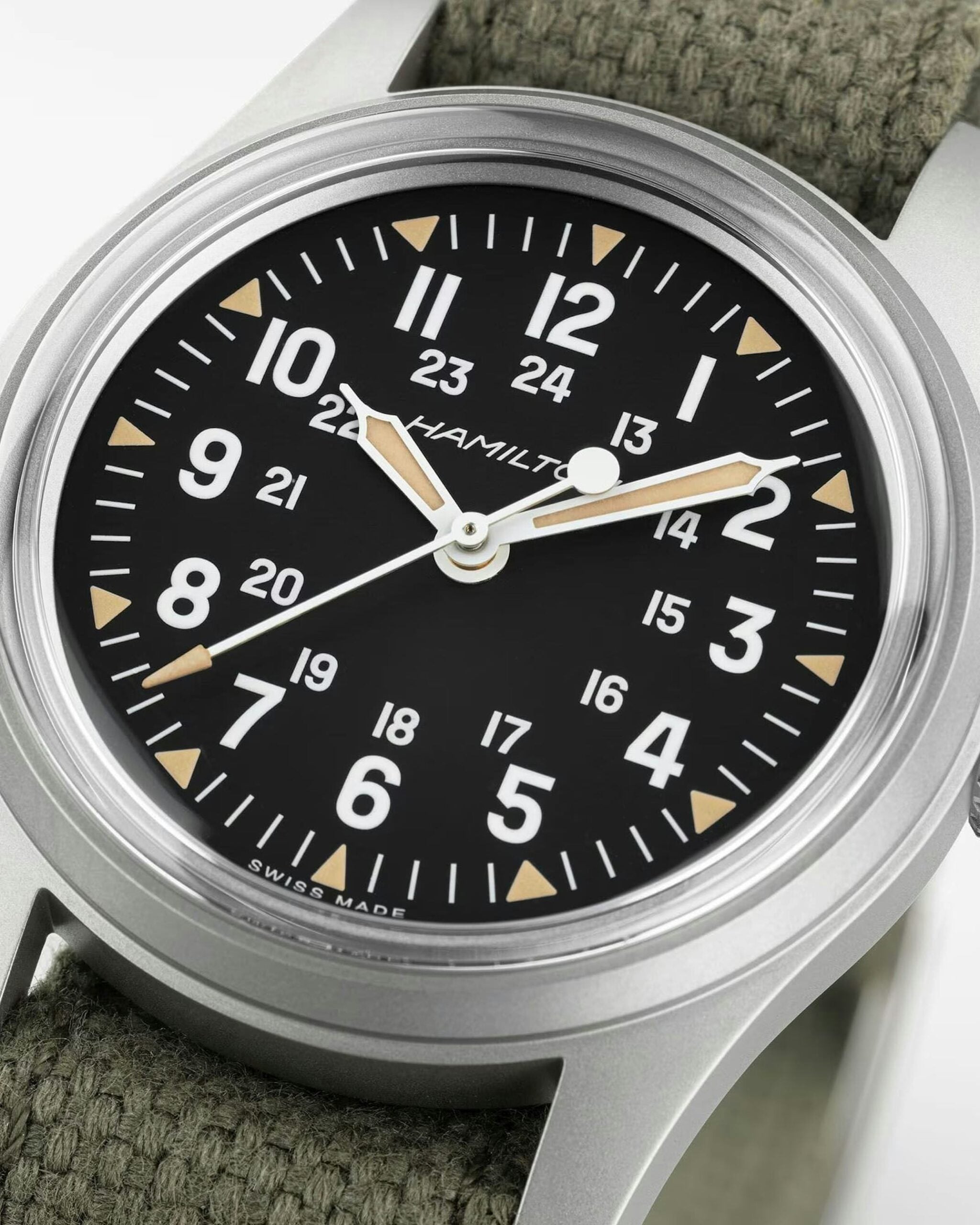
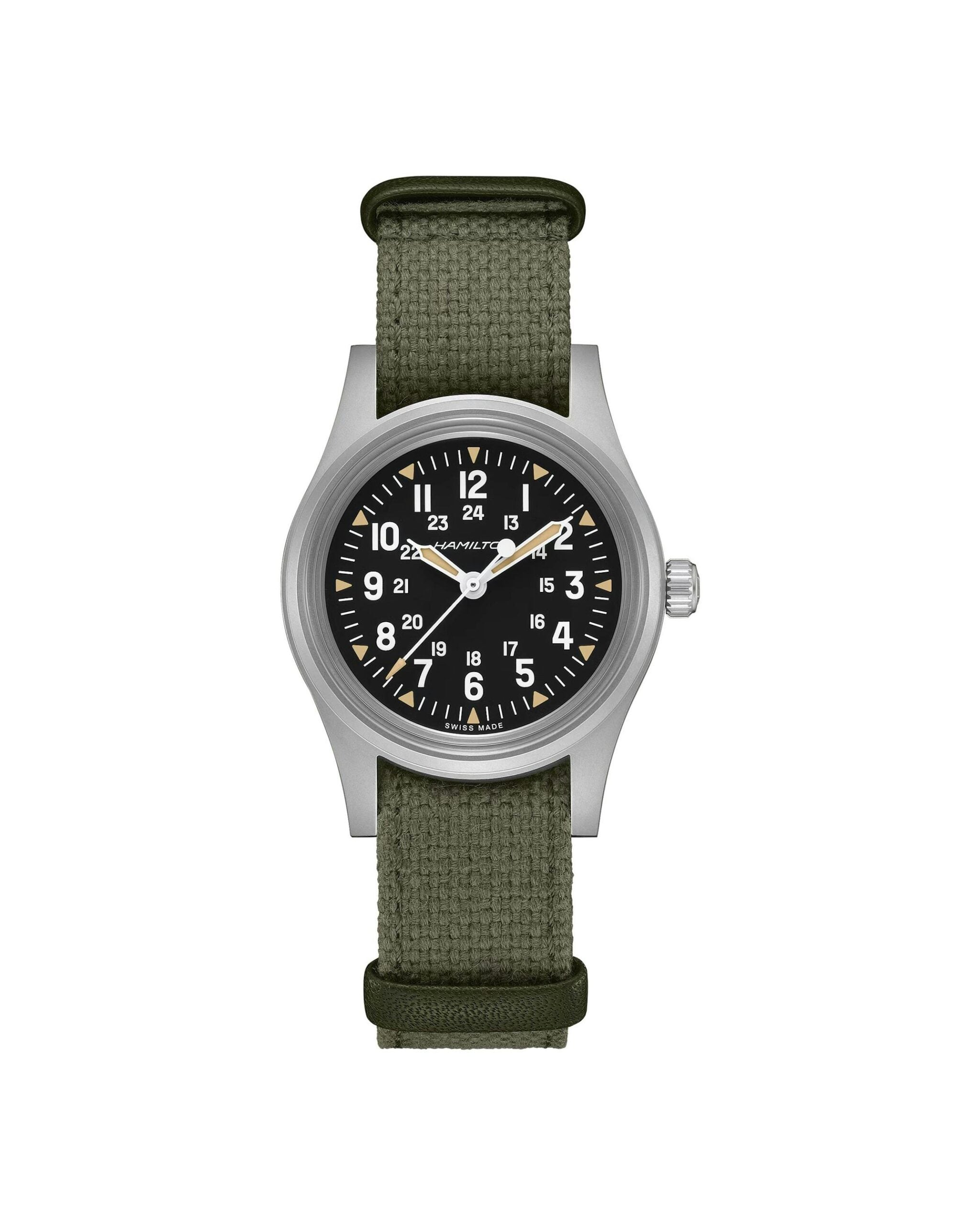
This is the Hamilton Khaki Field Watch, it’s powered by the H-50 mechanical movement with a Nivachron™ balance spring, it has up to an 80 hour power reserve, it’s water resistant down to 328 ft (100 meters), and it has a hard-wearing stainless steel case.
The Khaki Field Watch is a reissue of the legendary Vietnam War-era MIL-W-46374 specification watches. It uses an updated Swiss mechanical movement but keeps the same look and functionality of the originals – making it the perfect summer adventure watch.
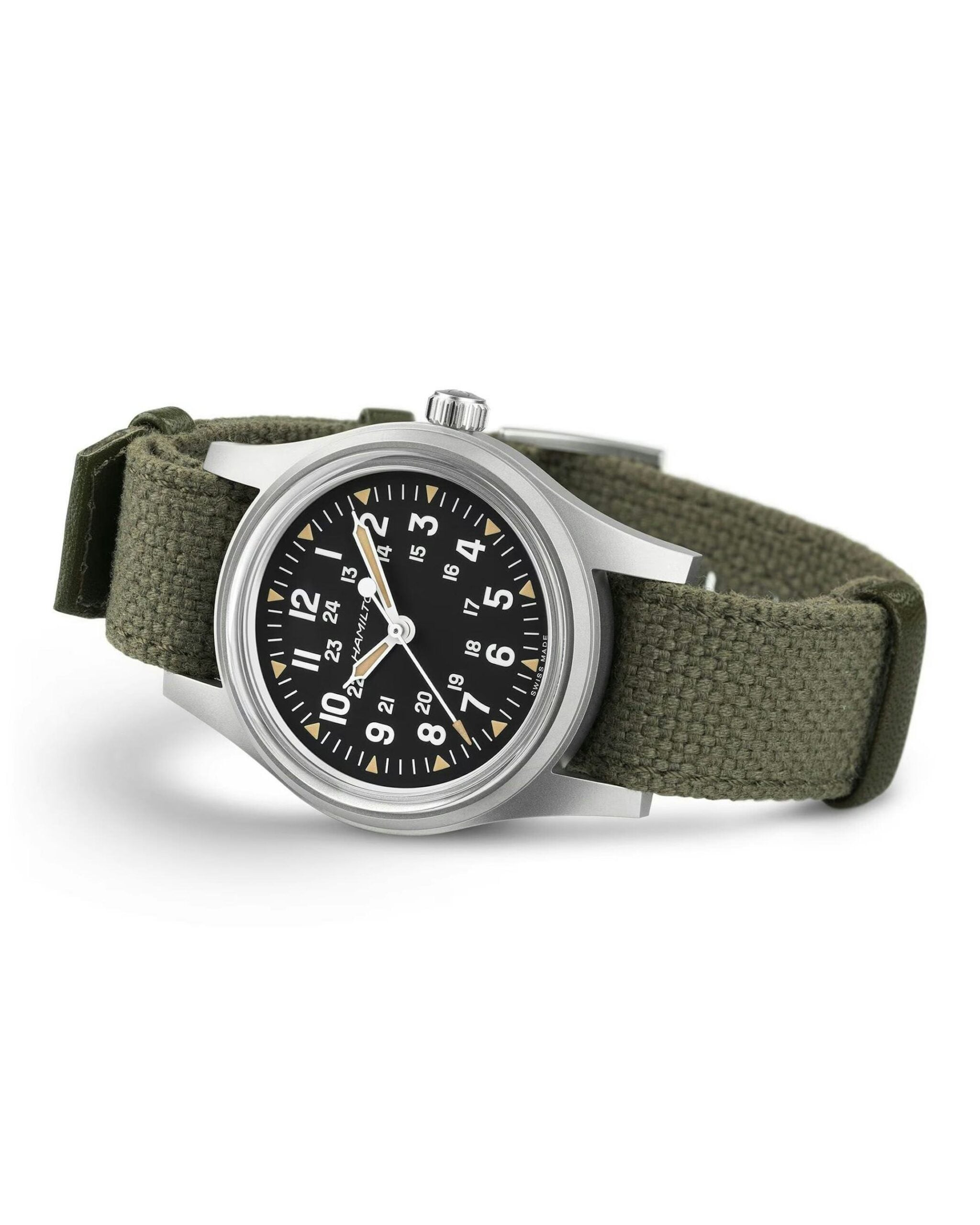
 This is the Hamilton Khaki Field Watch, it’s powered by the H-50 mechanical movement with a Nivachron™ balance spring, up to an 80 hour power reserve, it’s water resistant down to 328 ft (100 meters), and it has a hard-wearing stainless steel case.
History Speedrun: The Hamilton Watch Company
The Hamilton Watch Company was founded in late 1892 in Lancaster, Pennsylvania – it was actually formed from the merger of two bankrupt watchmakers – the Keystone Standard Watch Company of Lancaster and the Aurora Watch Company of Illinois.
Stockholders originally intended to call the new firm the Columbian Watch Company, but that name was already trademarked. As a result, they chose Hamilton, in honor of Andrew Hamilton, the Scottish-born Philadelphia attorney whose family had originally owned the land on which the factory was built.
Hamilton produced its first in-house movement in 1893 to power their 18 size, 17 jewel pocket watch. They quickly established themselves in a single category – reliable, high-grade railroad pocket watches.
The “Broadway Limited” and subsequent grades were marketed as the “Watch of Railroad Accuracy,” and amazingly, by the early 20th century Hamilton held more than 56% of the American railroad watch market. Railroad companies bought up almost all of the company’s output during the time – accurate pocket watches were the backbone of railroad logistics at the time.
Demand due to the First World War pushed Hamilton into wristwatches, they were far more practical for soldiers than pocket watches, and by the 1920s the company was making wristwatches for civilians alongside its railroad timepieces.
The fast-growing aviation industry soon saw Hamilton watches being used on the first U.S. Airmail service between Washington, Philadelphia, and New York, on Admiral Richard E. Byrd’s 1926 North Pole flight and later Antarctic expedition, and by the scheduled operations of TWA, Eastern, United, and Northwest.
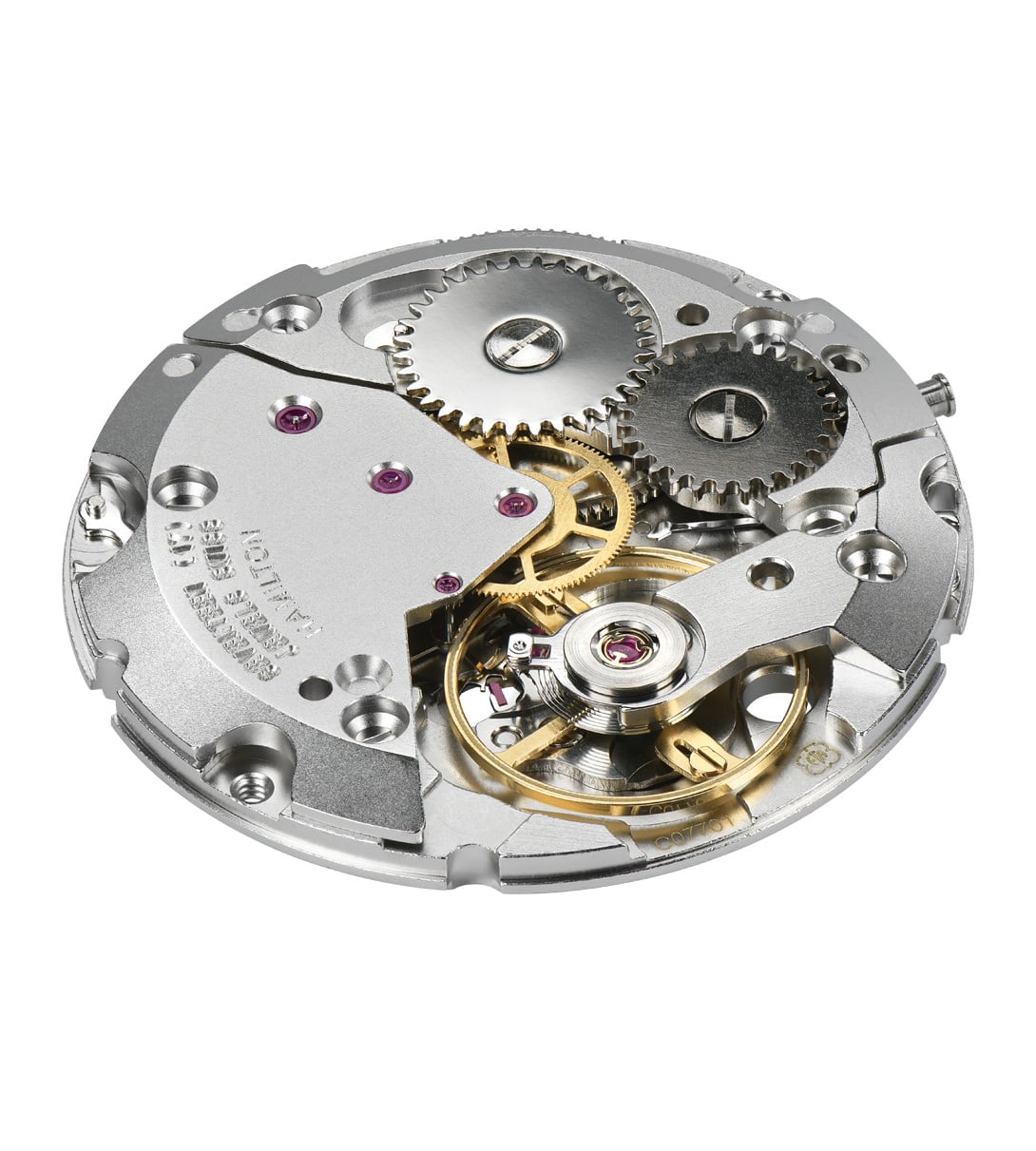
The watch is powered by the H-50 caliber, it’s an improved version of an earlier Swiss movement with the balance slowed from 28,800 vph to 21,600 vph and a lengthened mainspring, now offering an 80 hour power reserve.
Hamilton’s most memorable work (perhaps arguably) came during the Second World War. In 1942 the company stopped all civilian production, and between 1942 and 1945 it turned out over a million timepieces for the U.S. Armed Forces.
The most important of these was the Model 21 marine chronometer, which was developed in anticipation of the wartime cut-off of European chronometer supply. The Naval Observatory began soliciting American watchmakers in 1939, Hamilton and Elgin undertook the project, but only Hamilton met the Navy’s accuracy requirements.
The Model 21 kept time to within half a second per day, well inside the Navy’s 1.55 second requirement, and Hamilton built over 10,900 of them for the Navy, Army, and for the Merchant Marine.
Postwar, Hamilton’s most significant project was the Electric 500, this was the world’s first battery-powered wristwatch movement, launched in January of 1957. It replaced the mainspring with an electromagnetically driven balance, and Hamilton offered it in several styles.
The next milestone was the Pulsar, developed jointly with Electro/Data of Garland, Texas, and commercially released on April the 4th, 1972. It was the world’s first digital wristwatch, using an LED display and a quartz-regulated time base, and it sold for $2,100 in gold – that was $150 more than a gold Rolex at the time of launch.
In 2003 the company consolidated its headquarters and production at Biel/Bienne, Switzerland as part of the Swatch Group, where it remains today.
The Hamilton Khaki Field Mechanical Watch
The Hamilton Khaki Field Mechanical is a hand-wound field watch based on the U.S. military watches that Hamilton produced under the MIL-W-46374 specification from the mid-1960s into the 1980s. It was first introduced in late 2017 in a Japan-only run, then released globally in 2018, it’s since become one of the most widely recommended sub-$1,000 USD Swiss mechanical watches in the world.
The Khaki Field Mechanical has a 36mm matte stainless steel case, 9.5 mm thick, with drilled 20 mm lugs, a sapphire crystal, and 100 meters of water resistance (328 ft or 10 bar). it has cream-toned Super-LumiNova lume in place of the original tritium.
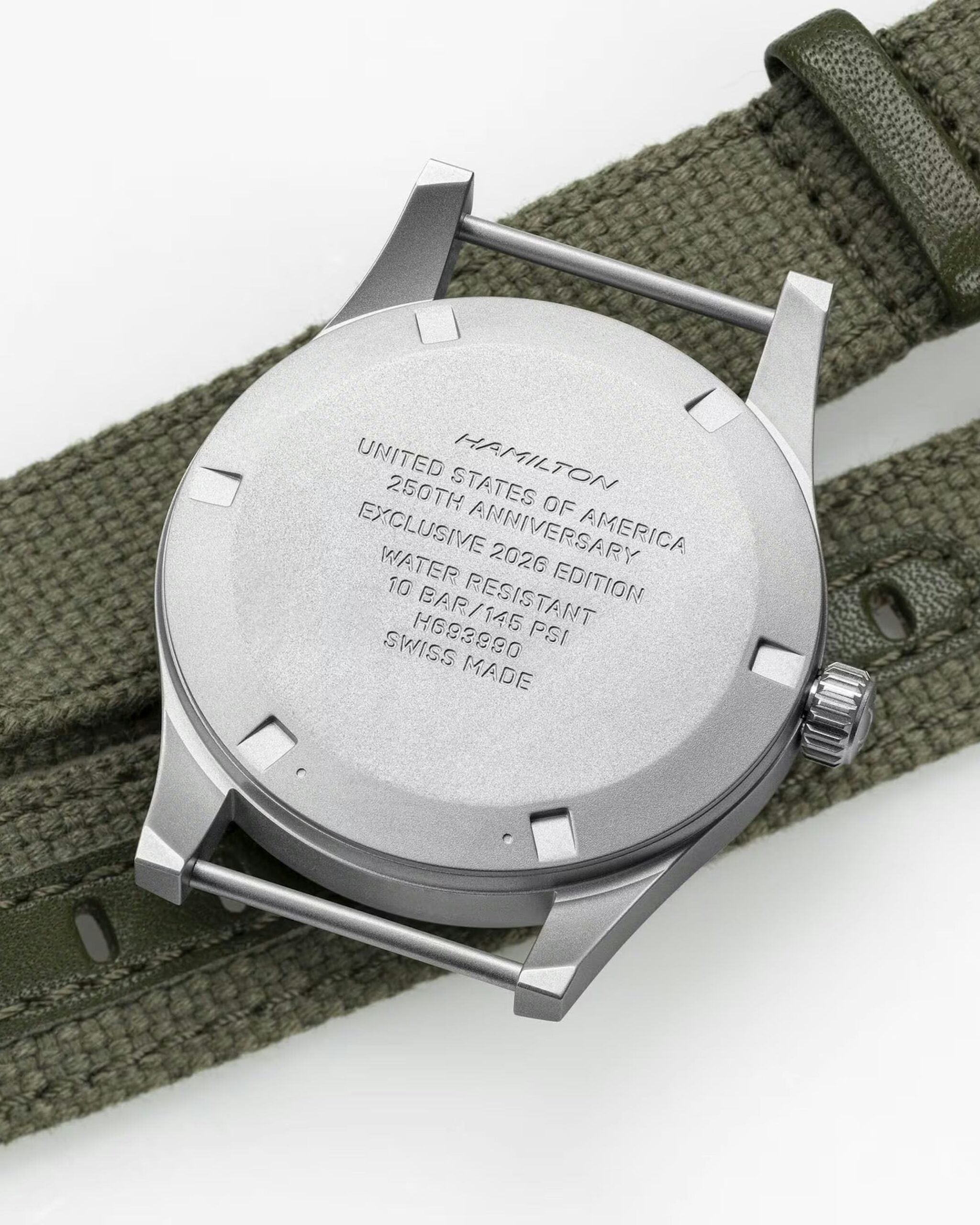
The Hamilton Khaki Field Mechanical is a hand-wound field watch based on the U.S. military watches that Hamilton produced under the MIL-W-46374 specification from the mid-1960s into the 1980s.
The watch is powered by the H-50 caliber, it’s an improved version of an earlier Swiss movement with the balance slowed from 28,800 vph to 21,600 vph and a lengthened mainspring, now offering an 80 hour power reserve.
The Khaki Field Mechanical is now being offered for sale on Huckberry here with free U.S. shipping and free U.S. returns, and deliveries are due to begin on the 9th of July.

Images courtesy of Huckberry

Articles that Ben Branch has written have been covered on CNN, Popular Mechanics, Smithsonian Magazine, Road & Track Magazine, the official Pinterest blog, the official eBay Motors blog, BuzzFeed, Autoweek Magazine, Wired Magazine, Autoblog, Gear Patrol, Jalopnik, The Verge, and many more.
Silodrome was founded by Ben back in 2010, in the years since the site has grown to become a world leader in the alternative and vintage motoring sector, with well over a million monthly readers from around the world and many hundreds of thousands of followers on social media.