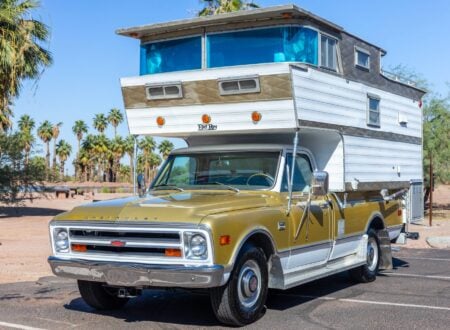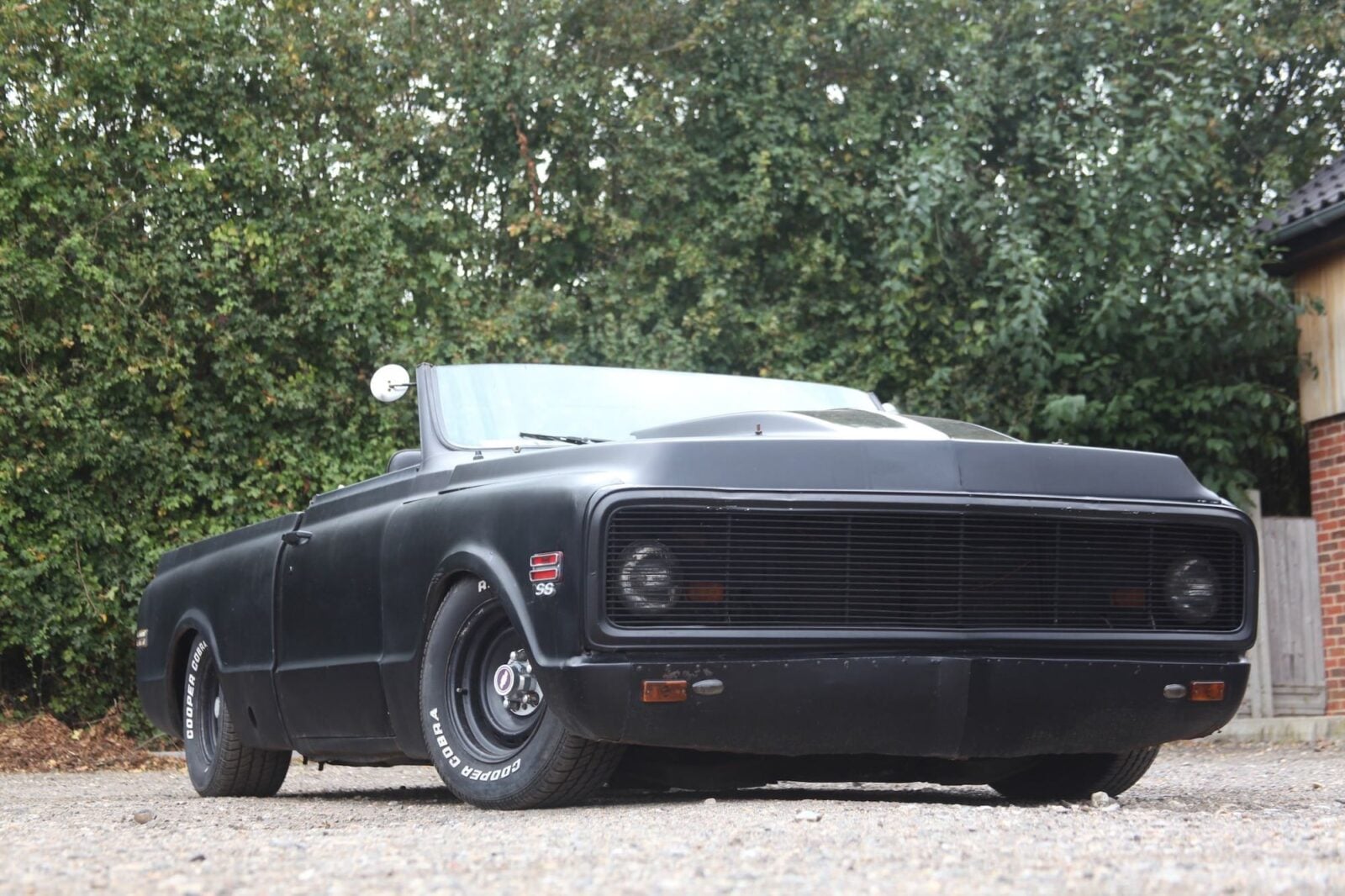
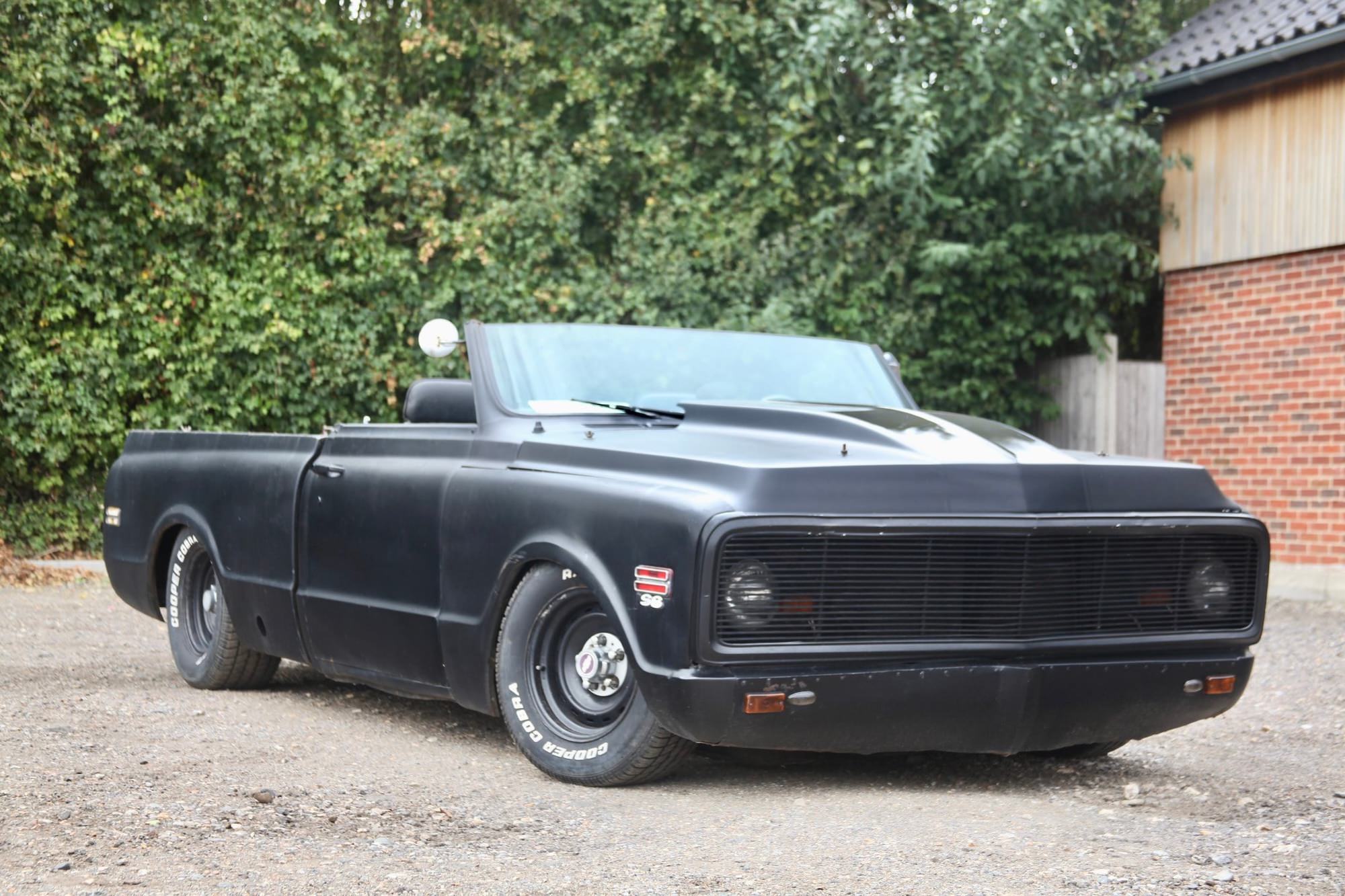
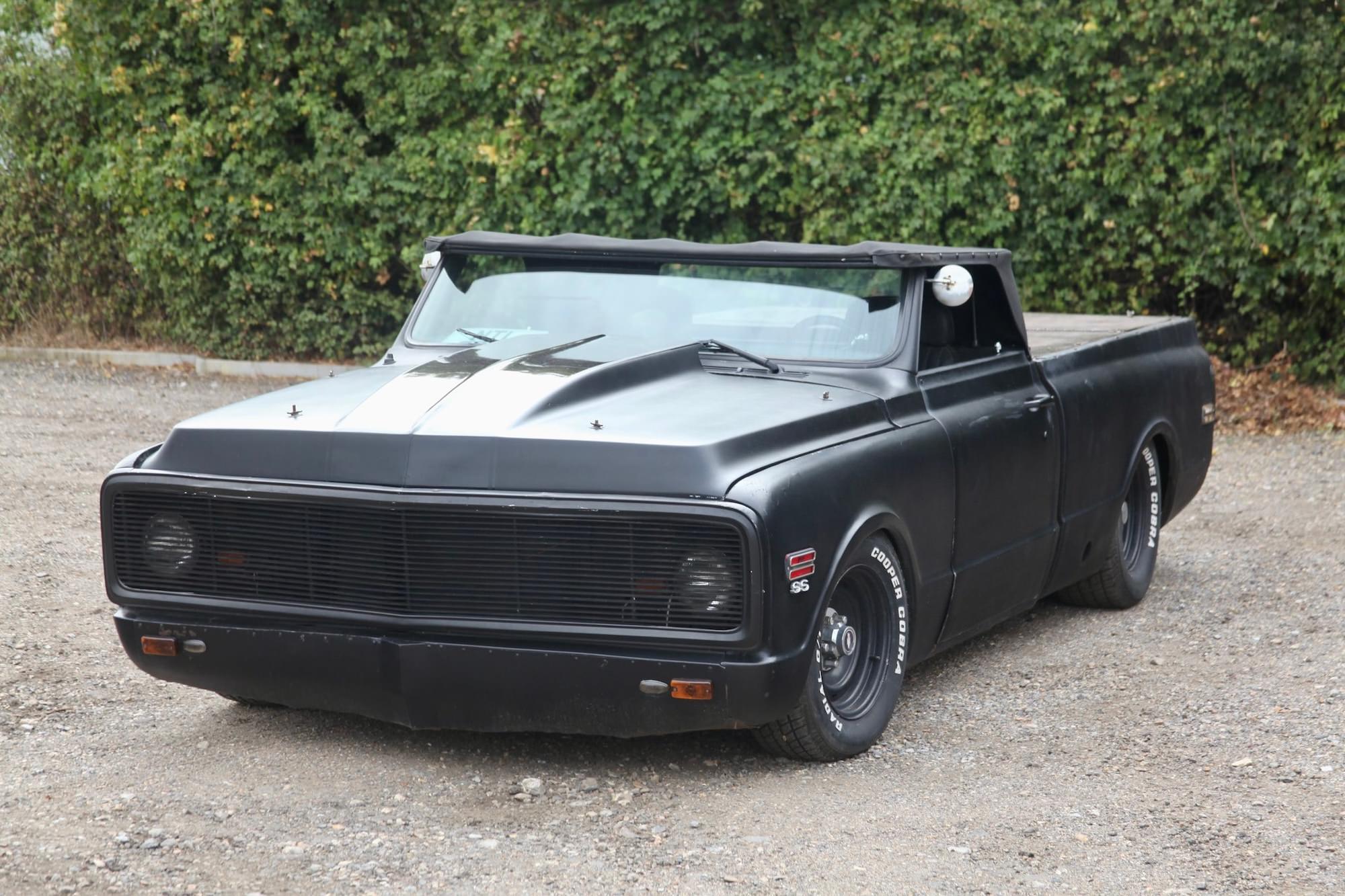
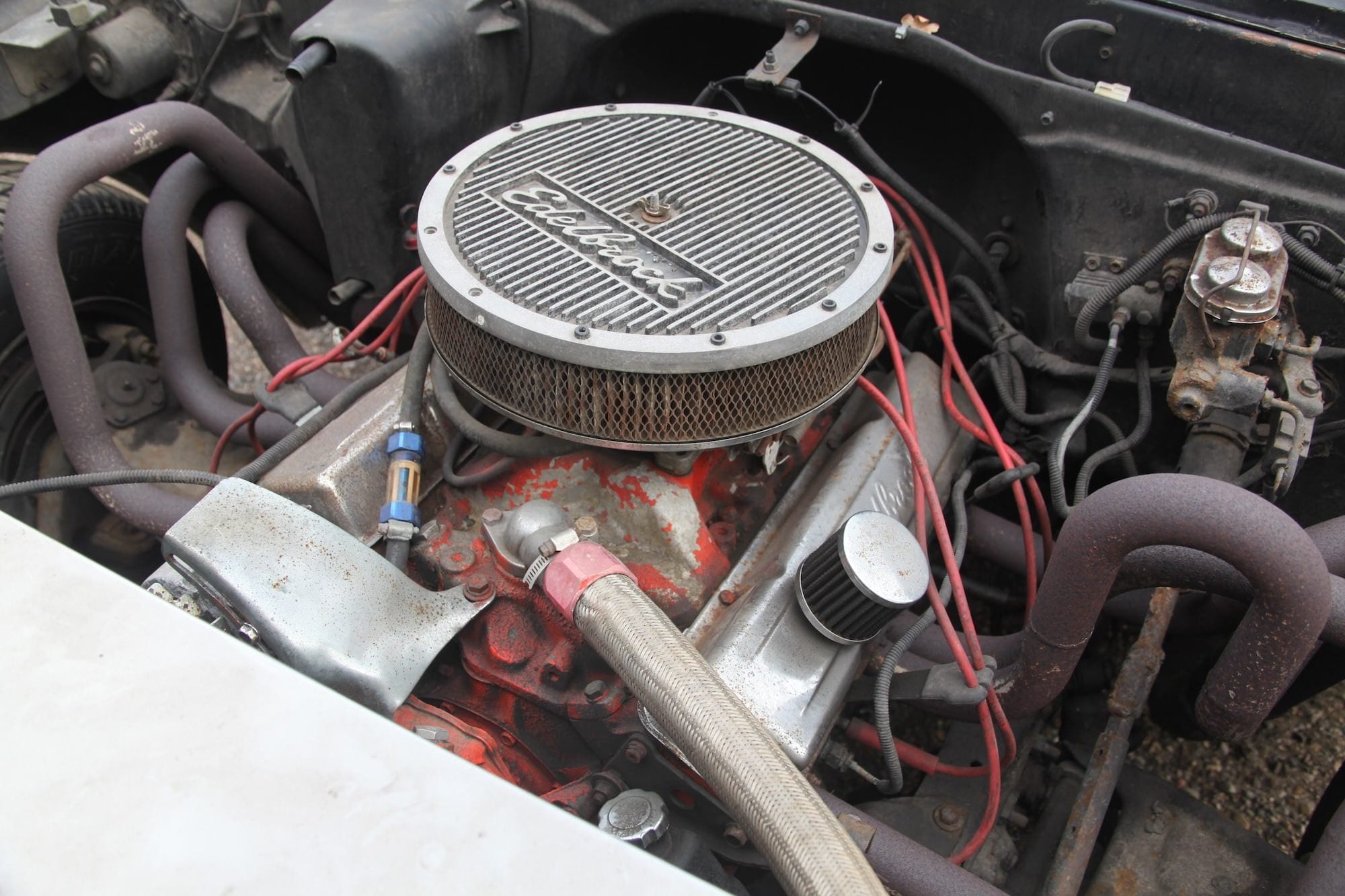
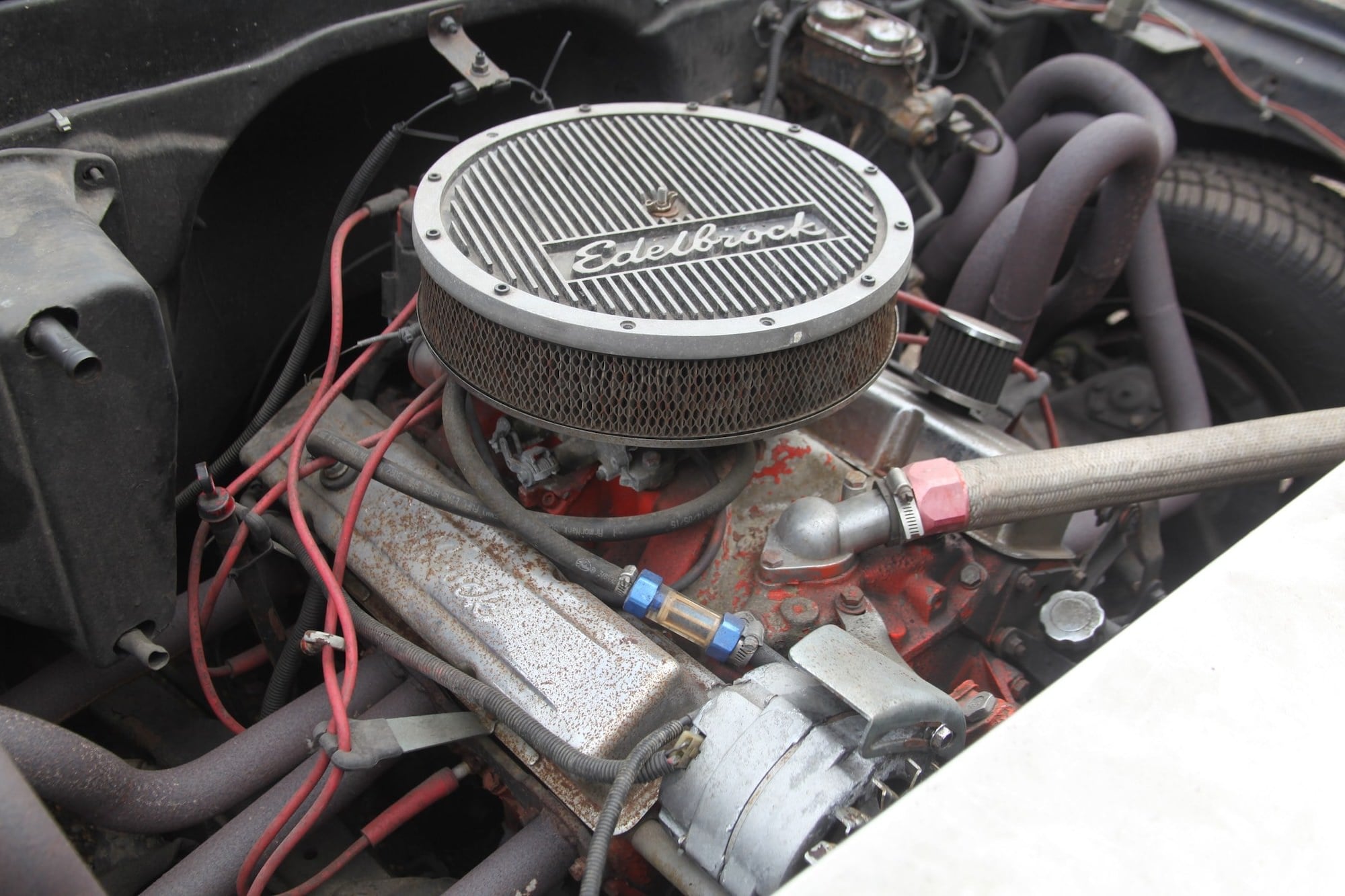
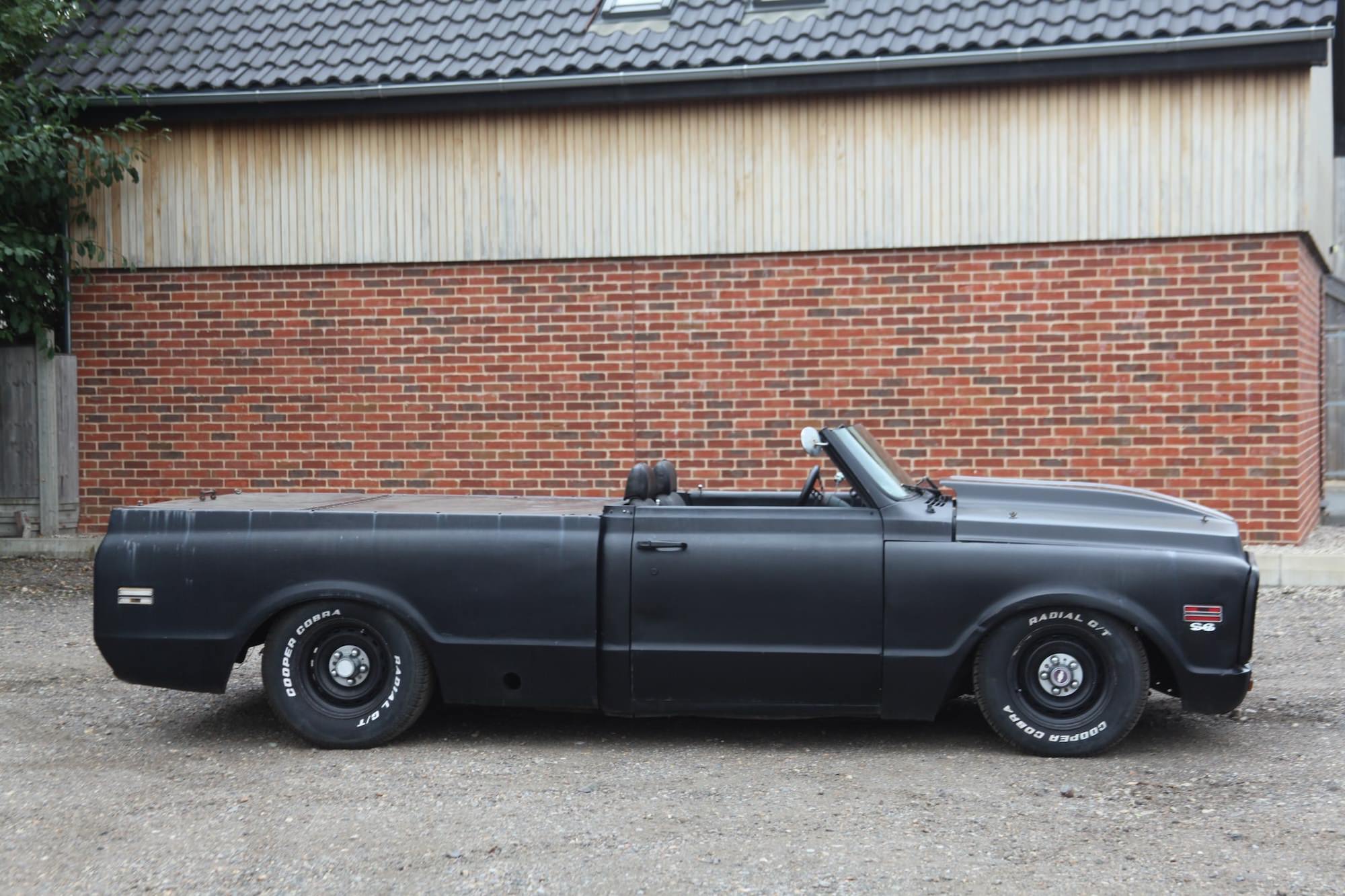
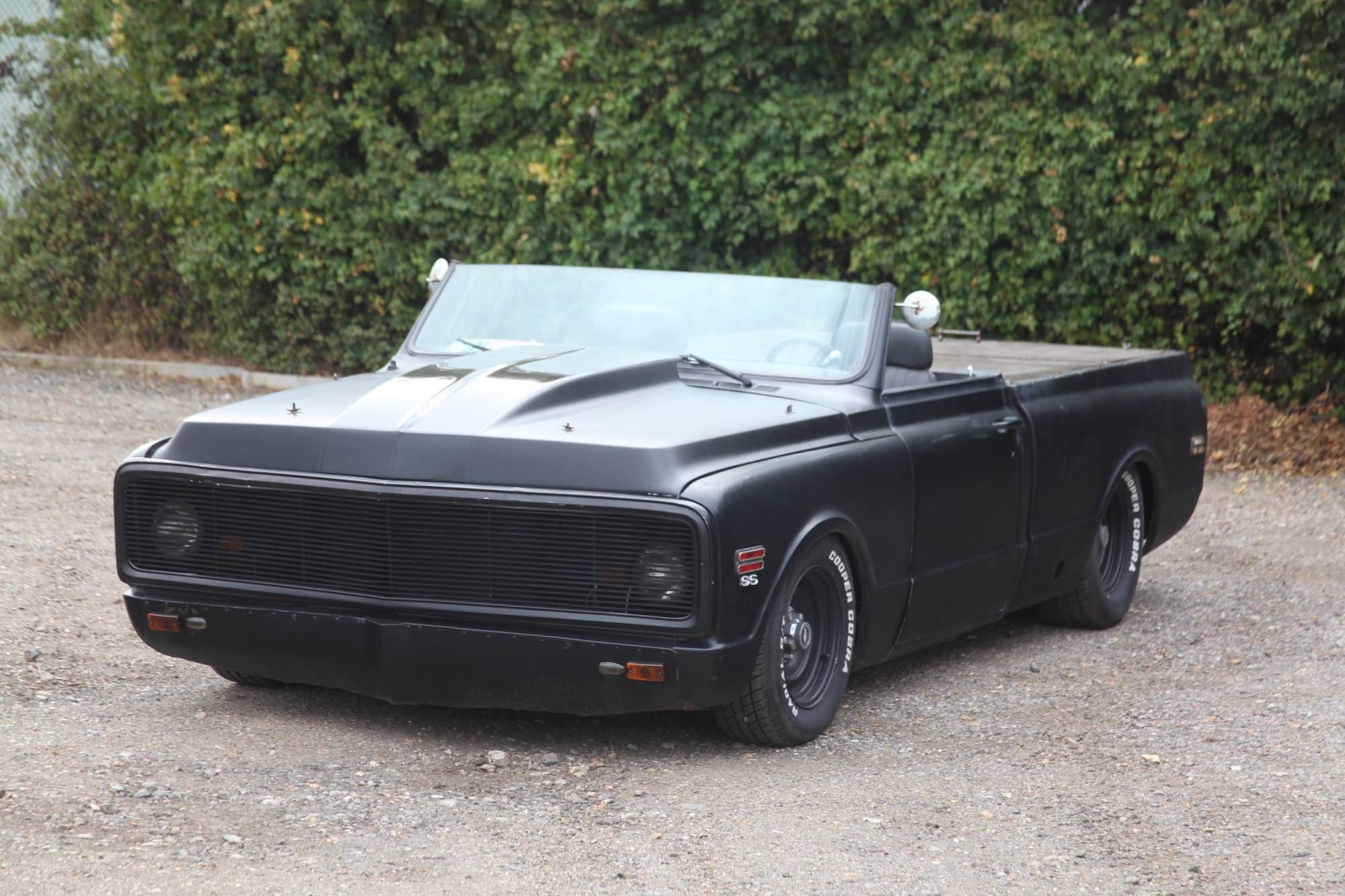
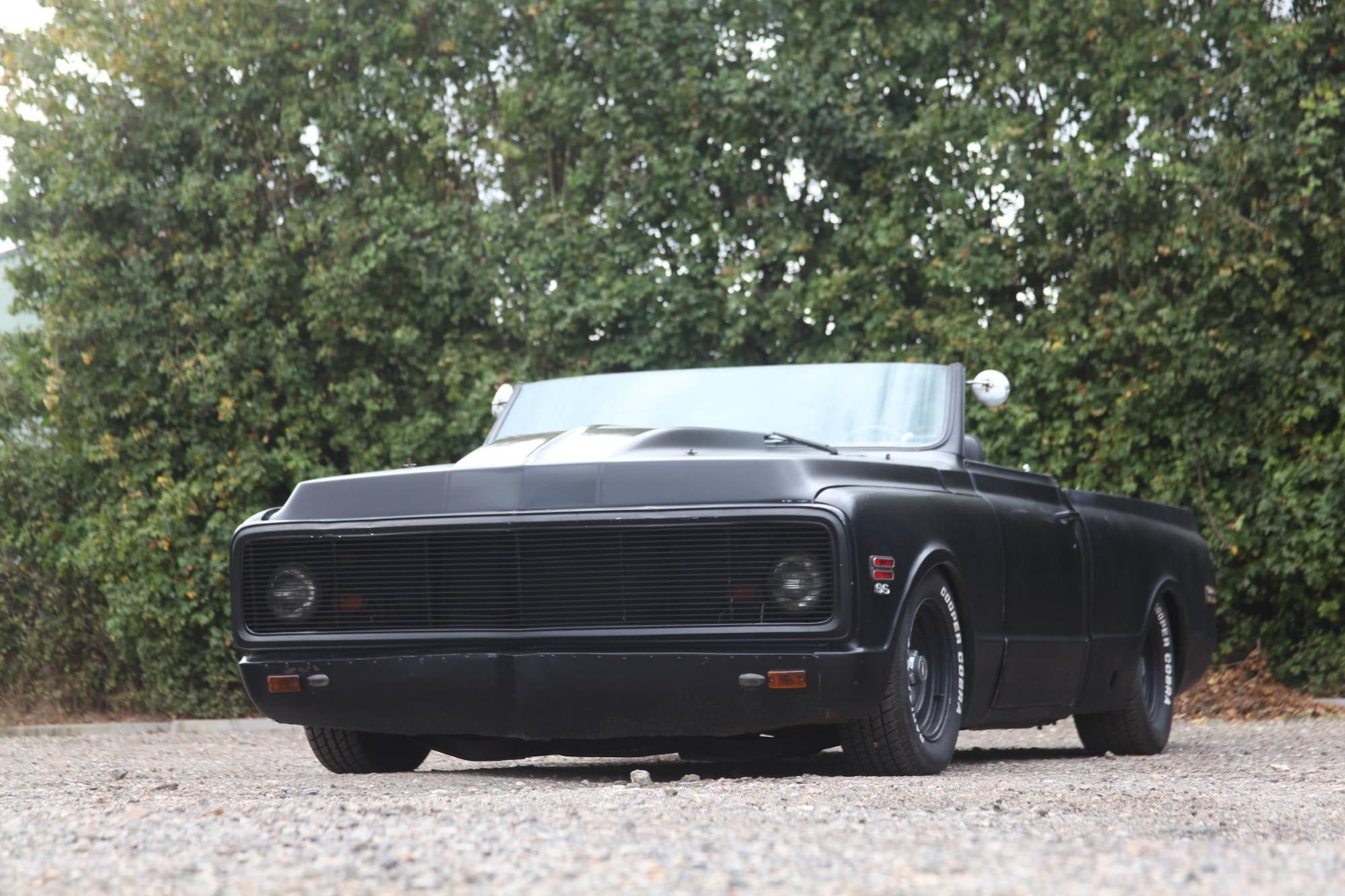
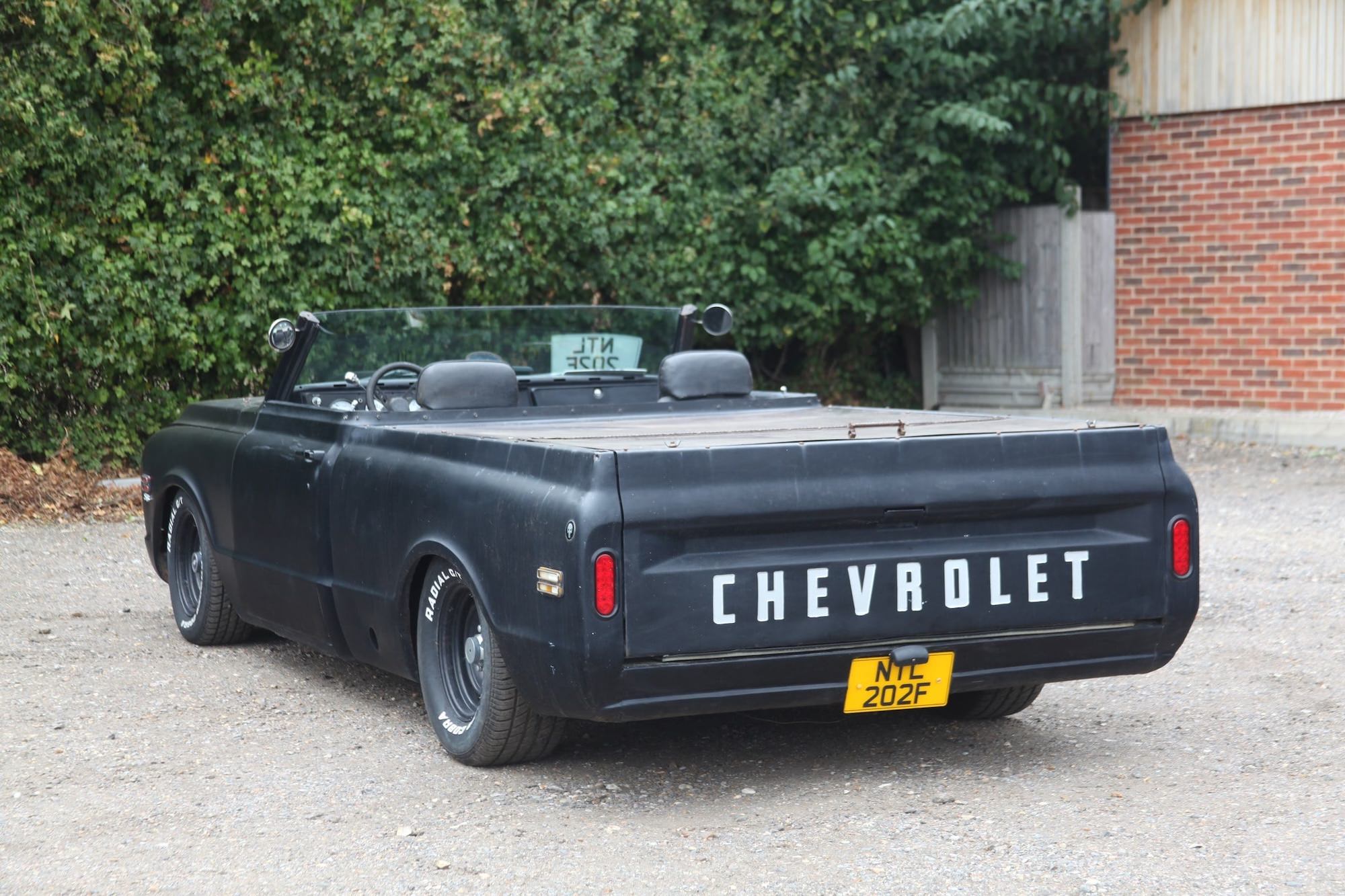
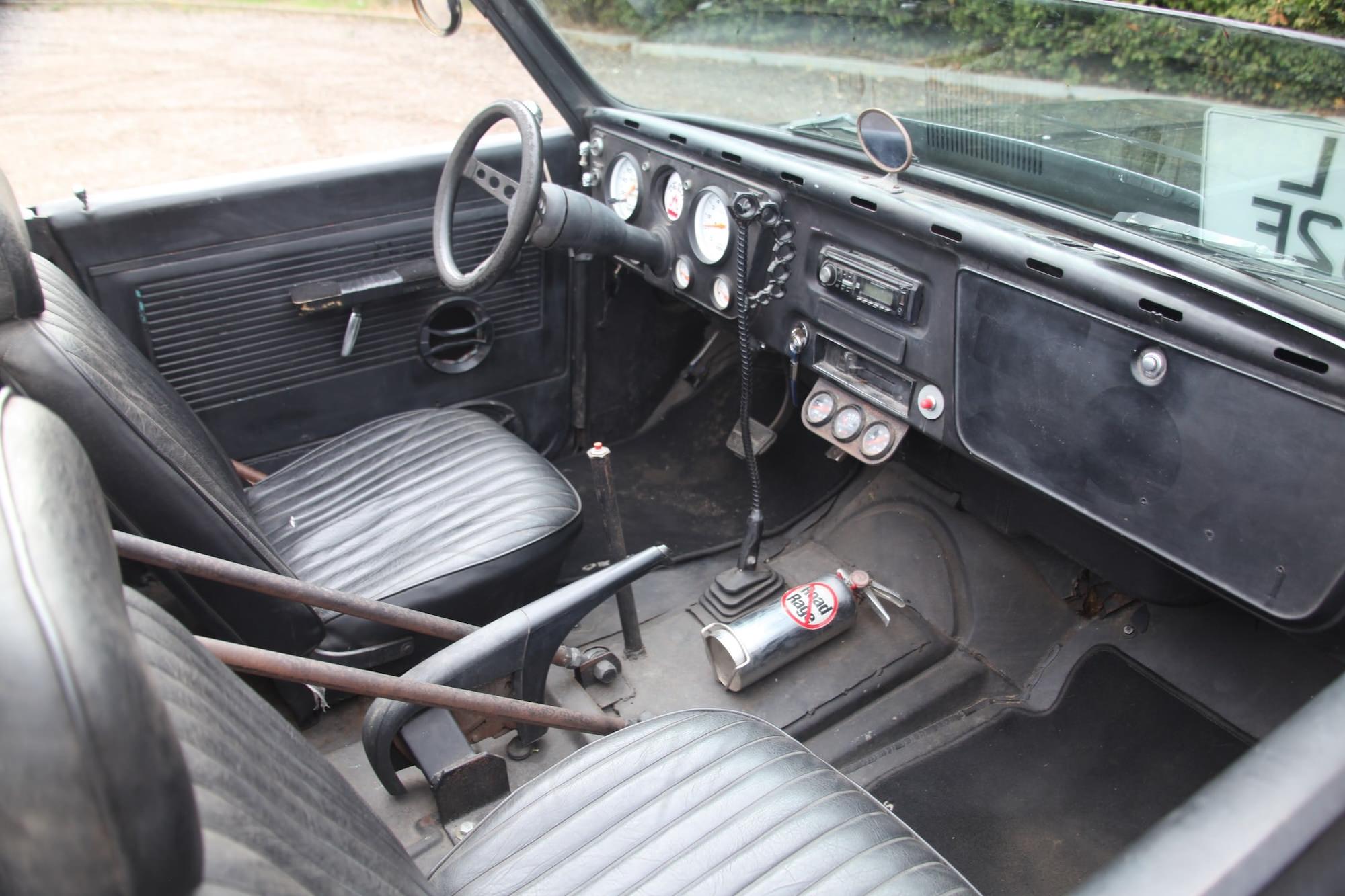
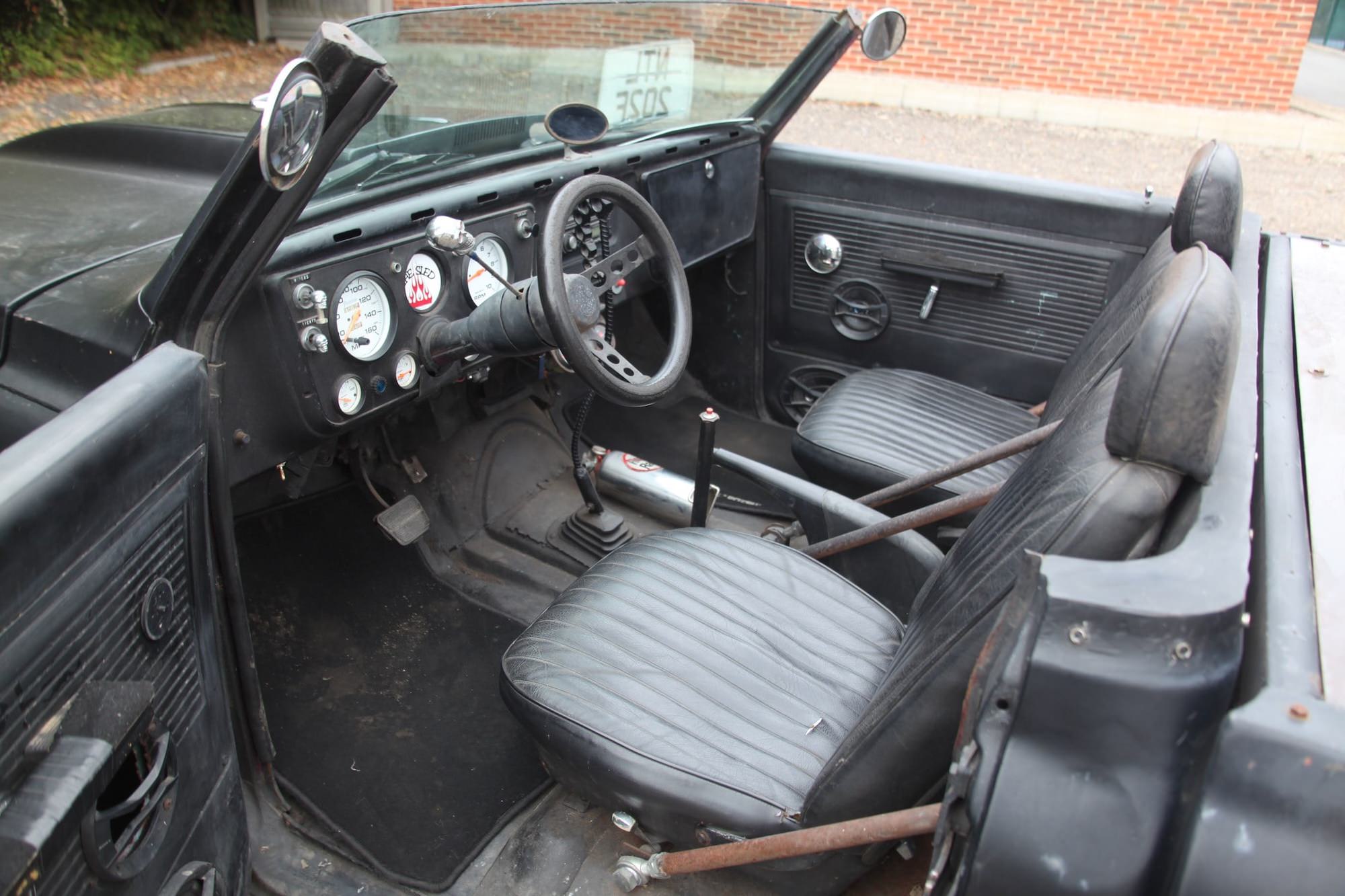
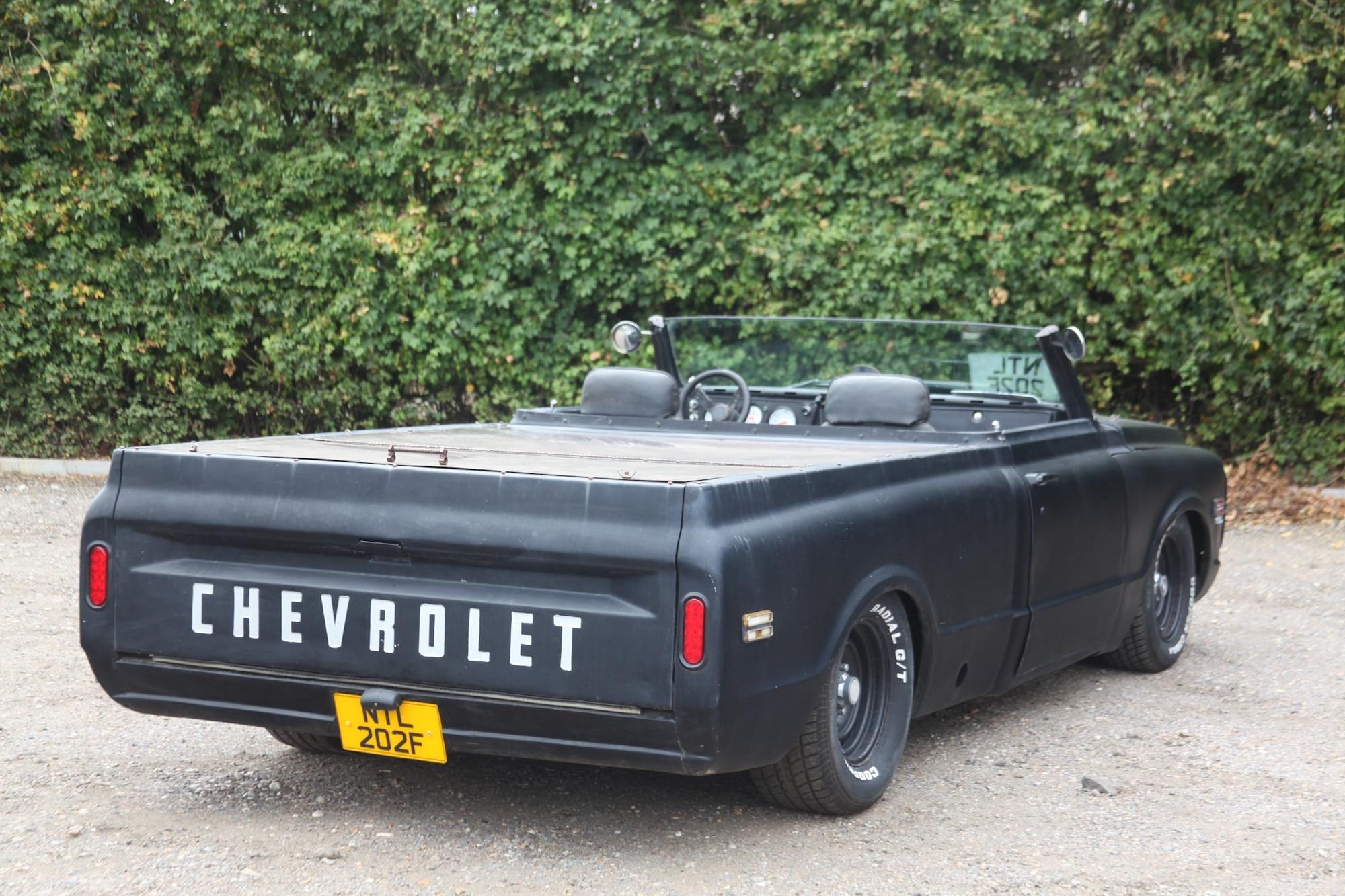
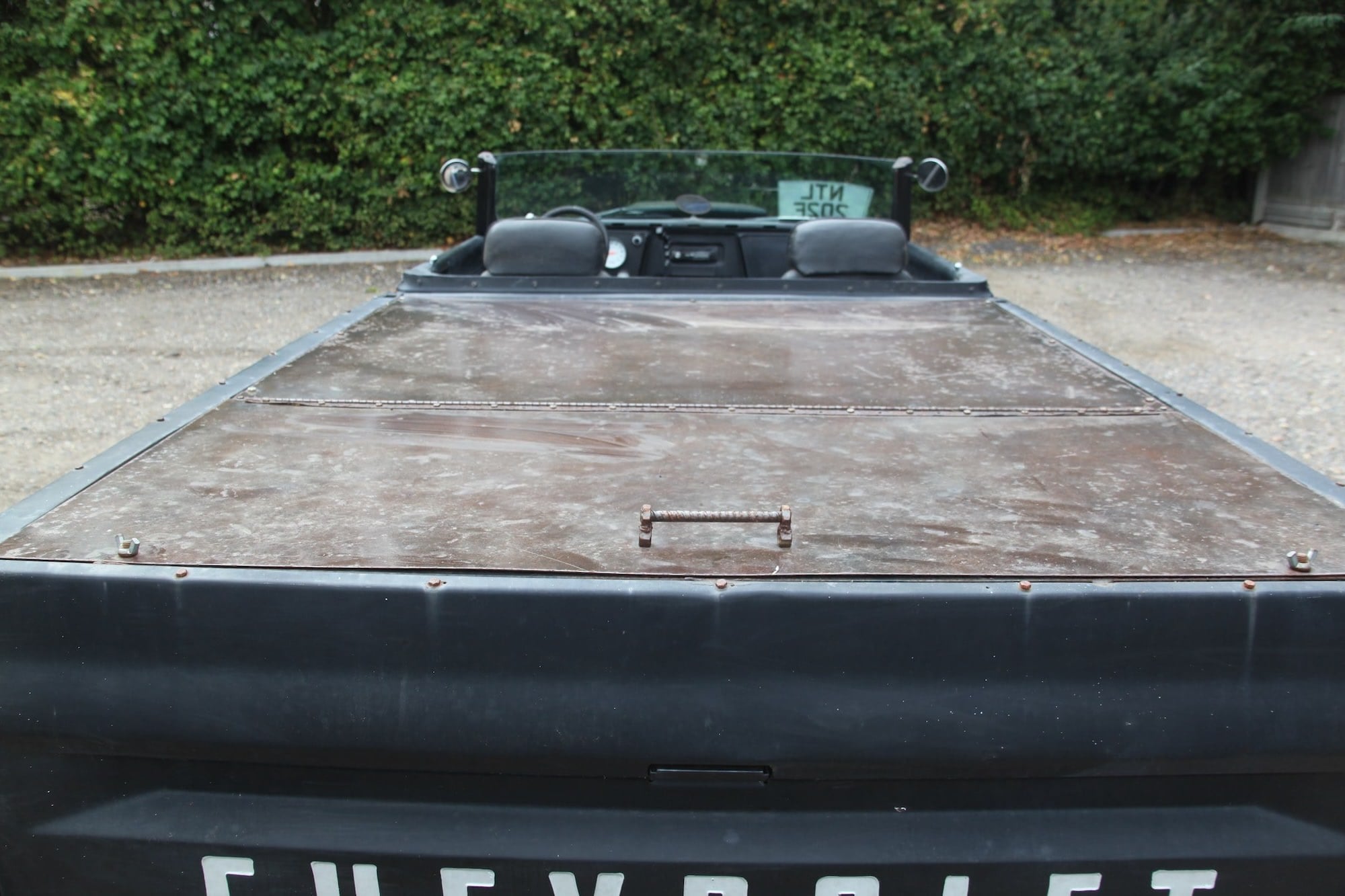
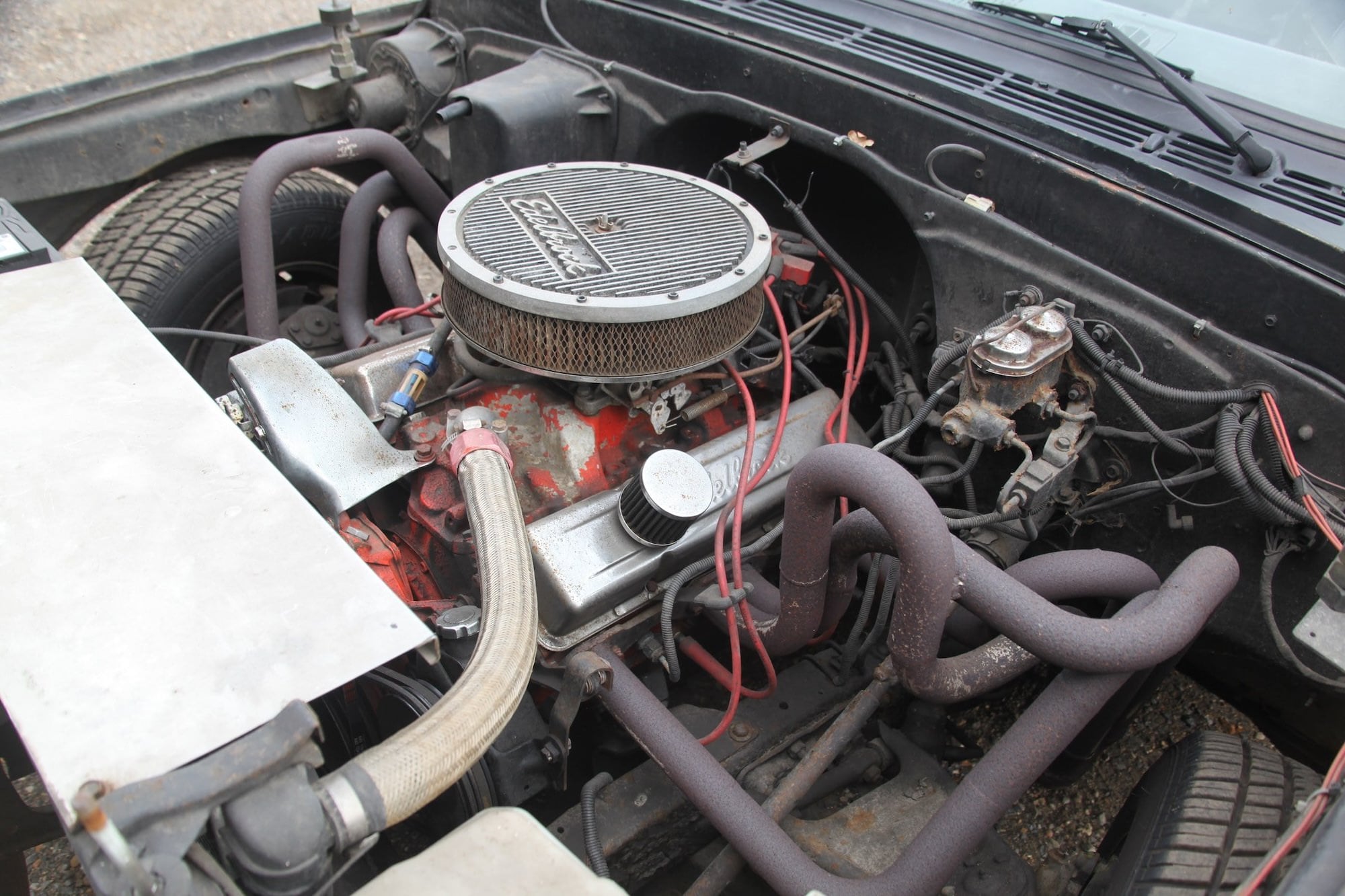
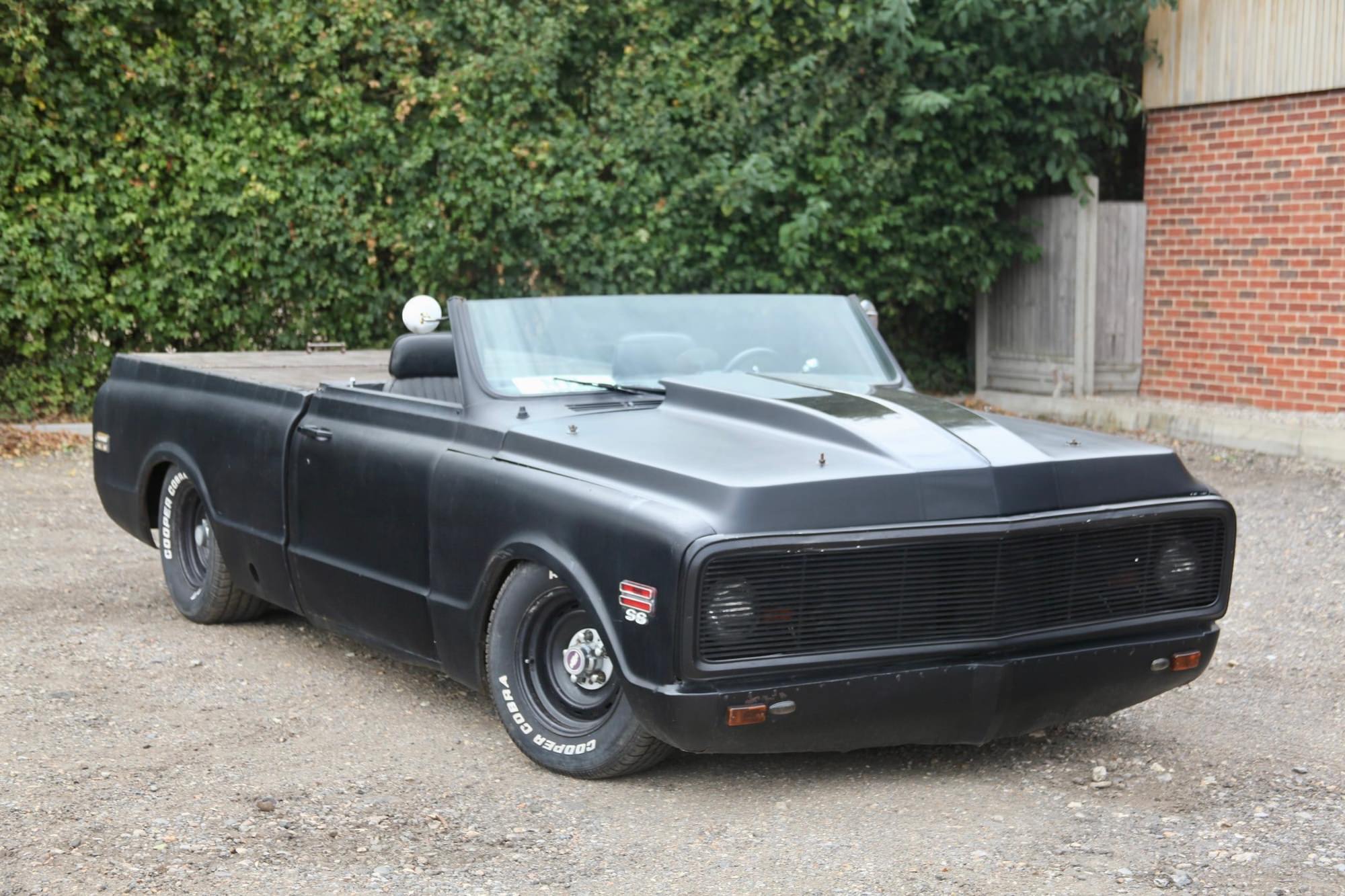
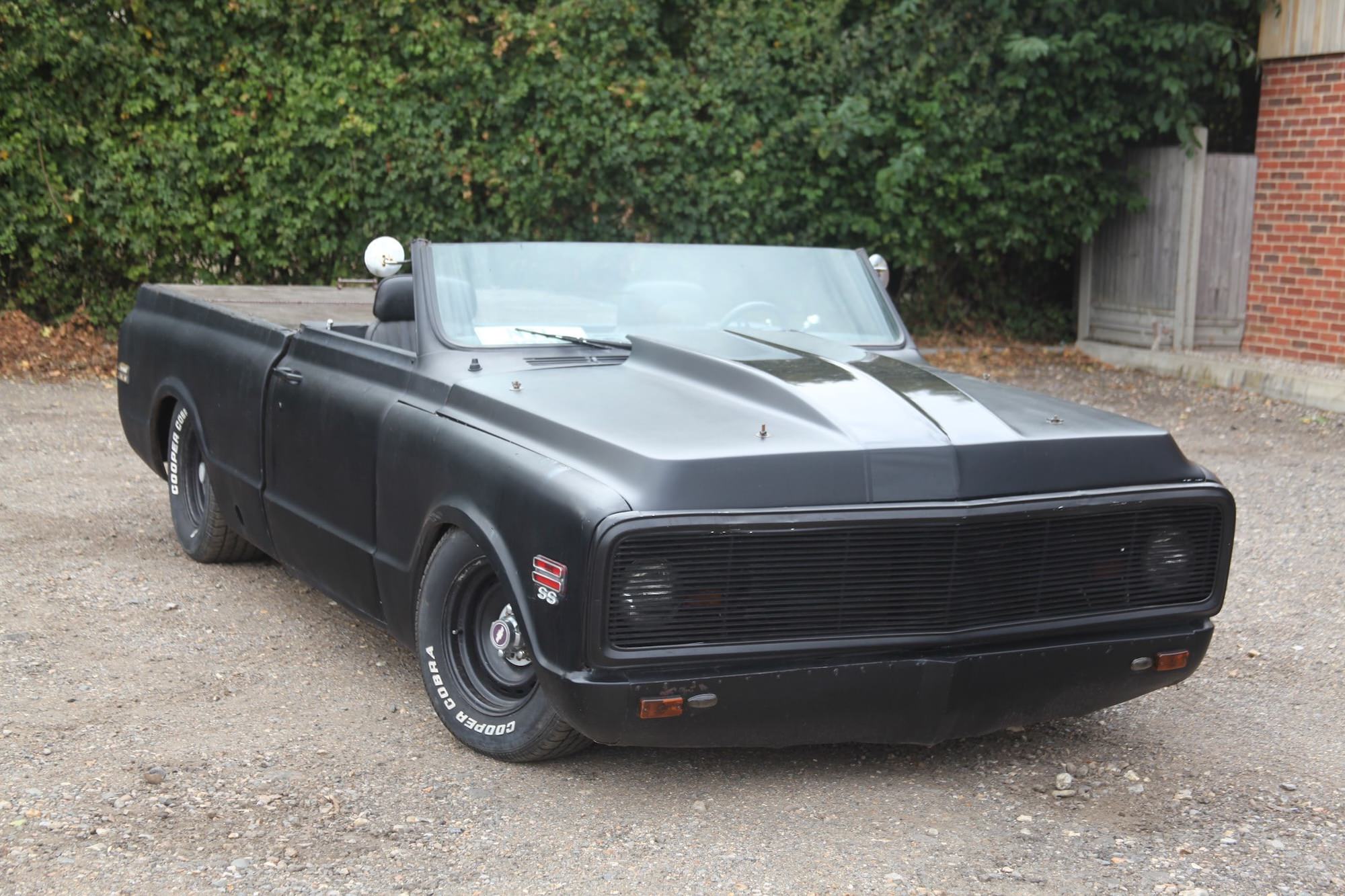
This is a 1968 Chevrolet C10 that’s been turned into a rat rod-style custom, now with a folding convertible roof, and power provided by a 7.2 liter V8 that’s said to be a little on the loud side.
This truck started life as a standard short bed C10 from 1968, it was modified more recently, with the roof cut down, a folding top fitted, the suspension was lowered, new wheels and tires fitted, and a number of other modifications to achieve a rat rod look.
Fast Facts: A 1968 Chevrolet C10 Rat Rod
- Chevrolet introduced the C/K truck line for 1960, with C denoting two-wheel drive and K four-wheel drive. Early C10s used independent front suspension and coil-sprung rear trailing arms, giving them more car-like road manners than earlier pickups. The second-generation Action Line trucks arrived for 1967 with updated styling and more engine choices.
- The 1968 C10 gained a 307 cubic inch V8 and an optional 396 cubic inch big-block rated at 310 bhp. Chevrolet added the 350 small-block for 1969, while front disc brakes became standard on light-duty trucks in 1971. The Action Line generation became one of Chevrolet’s biggest pickup sales successes.
- Chevrolet’s third-generation Rounded Line trucks arrived for 1973 and became widely known as the “Square Body.” They brought longer wheelbases, revised suspension, new crew-cab options, and engines reaching 454 cubic inches. The C10 name continued through 1986 before the trucks were redesignated R10 and V10 for 1987.
- The 1968 C10 shown here has been transformed into a rat rod-style lowrider with its roof removed, a folding top fitted, lowered suspension, and a 7.2 liter V8 paired with a 4-speed automatic. Imported to Britain and bought in 2019, it has reportedly covered only 200 to 300 miles since.
History Speedrun: The Chevrolet C10
Chevrolet used the C10 designation for a remarkably long 27 model years, from 1960 right the way through to 1986, on the two-wheel-drive half-ton in a range of trucks that also included the four-wheel-drive K10, the three-quarter-ton C20 and K20, and the one-ton C30. For 1987 the outgoing trucks were renamed R10 and V10, and for 1988 the replacement arrived as the C1500.
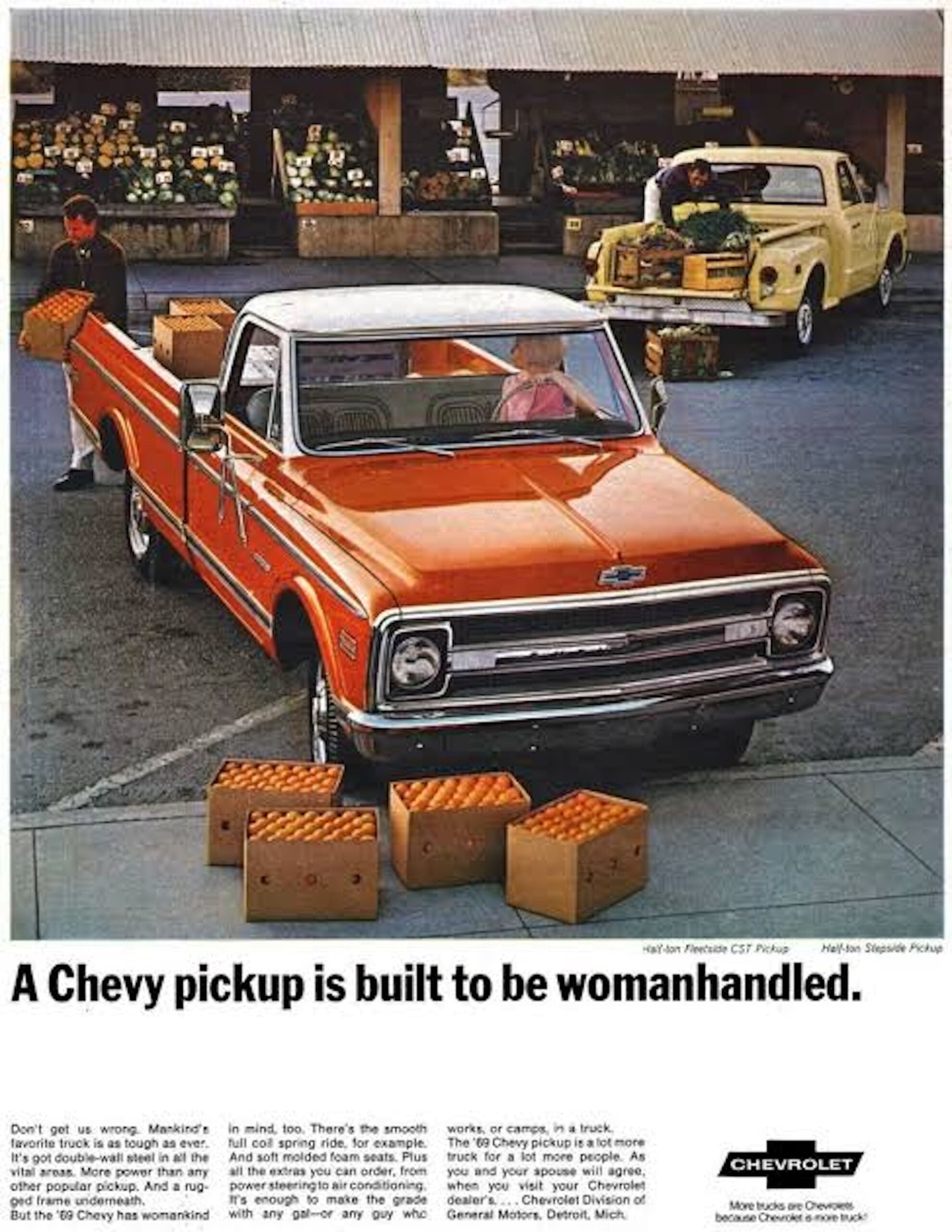
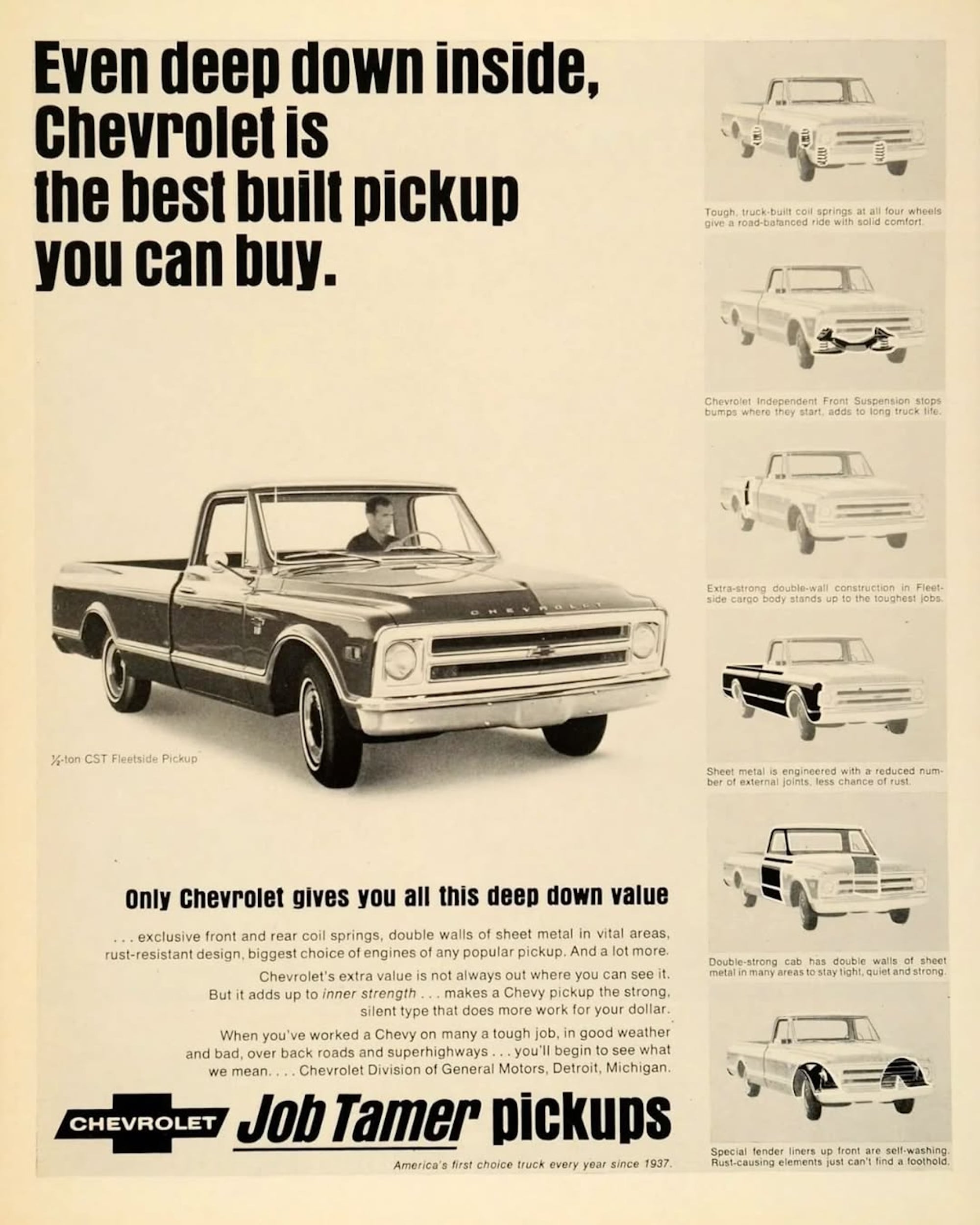
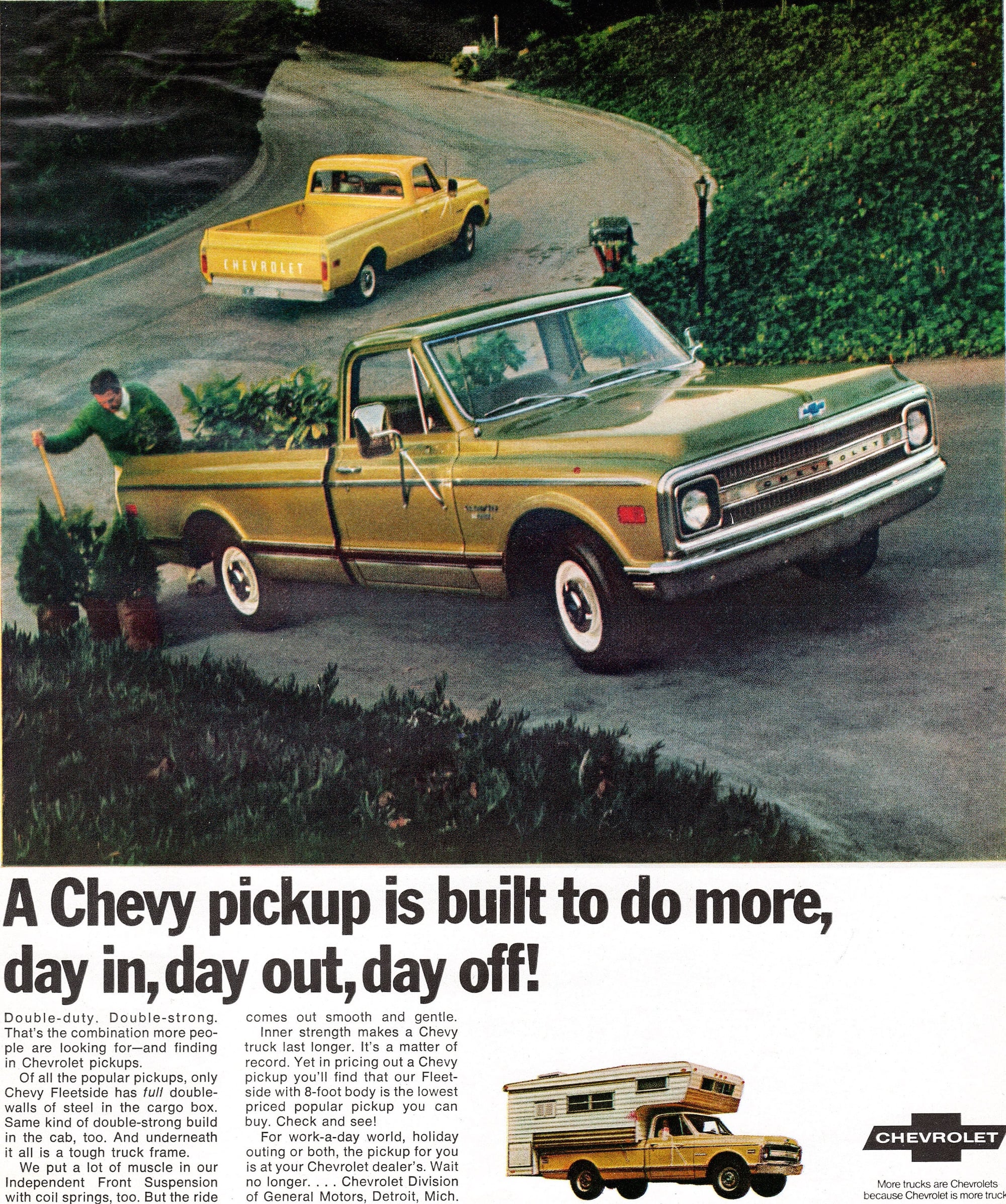
 The second generation trucks, which GM named the Action Line, put a new body over chassis designs that largely carried over the drop-center frame architecture of 1960 and the coil-sprung suspension layout of 1963. Image courtesy of General Motors.
Before The C/K Series Trucks
Two truck families came before the C/K series, the Advance Design pickups of 1947 to 1955 introduced the five-bar horizontal grille that Chevrolet’s design still points to as the start of the brand’s truck identity. The Task Force series that replaced them in 1955 brought a wraparound windshield and, midyear, the Cameo Carrier.
Underneath the Task Force trucks you’d find a ladder frame, solid front and rear axles, and leaf springs at both ends. Four-wheel drive came from NAPCO’s Powr-Pak hardware, first as an aftermarket conversion and, by the late 1950s, as an option that could be ordered through the factory and driven right off the dealer showroom floor on delivery day.
The C/K Series Arrive
The 1960 C/K series trucks were new from the frame up, and the model codes were new with them – C meant a conventional rear-wheel-drive truck and K meant four-wheel drive. The 10, 20, and 30 denominations stood for half, three-quarter, and one-ton ratings.
On the C10 and C20 the frame dipped between the axles and carried an X-brace, the front suspension used torsion bars on short and long control arms, and the rear axle sat on two long trailing arms with coil springs. The cab was seven inches lower and five inches wider than on the 1959 trucks, helping to lower the center of gravity and improve handling a little.
The engines on offer were a 235 cubic inch (3.9 liter) straight-six rated at 135 bhp and a 283 cubic inch (4.6 liter) V8 at 160 bhp, on wheelbases of 115, 127, and 133 inches. The K10 and K20 got none of the drop-center, X-braced chassis business – they used a new (but more conventional) ladder frame and leaf-sprung solid axles front and back, though 1960 was the first year the four-wheel-drive hardware was GM’s own design rather than a NAPCO kit.
The 1960 C/K series trucks were new from the frame up, and the model codes were new with them – C meant a conventional rear-wheel-drive truck and K meant four-wheel drive. The 10, 20 and 30 denominations stood for half, three-quarter, and one-ton ratings. Image courtesy of General Motors.
The torsion bars lasted three model years, then in 1963 Chevrolet replaced them with coil springs on the same control-arm layout, they also dropped the X-brace, and introduced two more six-cylinder engine options, a 230 cubic inch (3.8 liter) unit with 140 bhp and a 292 cubic inch (4.8 liter) offering 165 bhp, the 283 was retuned to produce a slightly improved 175 bhp.
That coil-sprung front end stayed under Chevrolet’s two-wheel-drive pickups through to 1987, albeit with some design updates over the production run. A one-piece windshield replaced the wraparound in 1964, factory air conditioning arrived in 1965, and the 220 bhp 327 cubic inch (5.4 liter) V8, at first limited to the C20 and C30, reached the C10 in 1966.
1967 to 1972 – The Action Line Arrives
The second generation trucks, which GM named the Action Line, put a new body over chassis designs that largely carried over the drop-center frame architecture of 1960 and the coil-sprung suspension layout of 1963. Wheelbases were 115 inches with the six-and-a-half-foot bed and 127 with the eight-foot bed. The 250 cubic inch (4.1 liter) six, rated at 155 bhp, was now the base engine, the 292 continued to be offered, and the 283 and 327 V8s carried over.
For 1968 a 307 cubic inch (5.0 liter) V8 replaced the 283 and a 396 cubic inch (6.5 liter) big-block rated at 310 bhp and 400 lb ft of torque joined the list – it was later enlarged to 402 cubic inches (6.6 liters) and sold as the 400. The 350 cubic inch (5.7 liter) small-block replaced the 327 for 1969 with 255 bhp – it became by far the most popular engine choice.
Front disc brakes became standard on the light-duty trucks in 1971, more out of necessity than anything else as four wheel drums weren’t really up to the task of handling the gross weight of the trucks, let alone the ones fitted with the larger V8s.
The C20 got a Longhorn version on a 133 inch wheelbase with a bed six inches longer for 1968, and the K5 Blazer of 1969 was built on a shortened C/K chassis. Half-ton production for the six years ended at more than 2,000,000 units, with 1969 the peak at more than 400,000 for the year – easily making it one of the best-selling pickup trucks in the country.
GM named the 1973 truck the Rounded Line for its curved side glass and rounded windshield corners. Buyers called it the “Square Body,” and the name stuck like glue. Most people today can’t tell you what the Rounded Line means, but know exactly what a Chevy Square Body is. Image courtesy of General Motors.
1973 to 1987 – The Rounded Line Debuts
GM named the 1973 truck the Rounded Line for its curved side glass and rounded windshield corners. Buyers called it the “Square Body,” and the name stuck like glue. Most people today can’t tell you what the Rounded Line means, but know exactly what a Chevy Square Body is.
The wheelbases grew to 117.5 and 131.5 inches, the body was wind-tunnel tested (a first for a GM pickup), leaf springs replaced the rear coils on the two-wheel-drive trucks, and the fuel tank moved from behind the seat to outside the frame rails. The C20 and C30 could be ordered as Chevrolet’s first factory crew cabs, and the C30 with dual rear wheels became what Chevrolet describes as the first crew-cab dually on the market. Engines, now rated net rather than gross, ran from a 100 bhp 250 six to a 454 cubic inch (7.4 liter) V8 at 240 bhp, the latter of which was new to the pickup line.
For 1975 Chevrolet fitted catalytic converters to trucks rated under 6,001 lbs gross vehicle weight and created the F44 heavy-duty half-ton, sold as the Big 10, with ratings above 6,000 lbs, a 6,050 lb version sat just over the threshold and did without a converter. The Silverado trim name appeared the same year above Custom Deluxe, Scottsdale, and Cheyenne. A 350 cubic inch (5.7 liter) Oldsmobile diesel V8 rated at 120 bhp and 220 lb ft was offered in the half-ton from 1978, and a 6.2 liter diesel replaced it in 1982.
Square headlights appeared on Silverado-trim trucks for 1980, and the redesigned 1981 front end carried them across the range, weight was also cut up to 300 lbs. A 4.3 liter V6 replaced the 250 six for 1985, throttle-body fuel injection arrived across the gasoline engines for 1987, the final year, when the trucks were rebadged R10 and V10 to make room for the successor. Ford’s F-Series overtook Chevrolet in truck sales during this generation’s run.
The 1968 Chevrolet C10 Rat Rod “Convertible” Shown Here
This one-off Chevrolet C10 custom has been extensively reworked into a rat-rod-style lowrider, most notably with the roof chopped to create an open-top pickup truck. It’s also gained considerable online attention, appearing in a YouTube video that has accumulated more than 16 million views, though the listing doesn’t link to this video or mention which channel it was on.
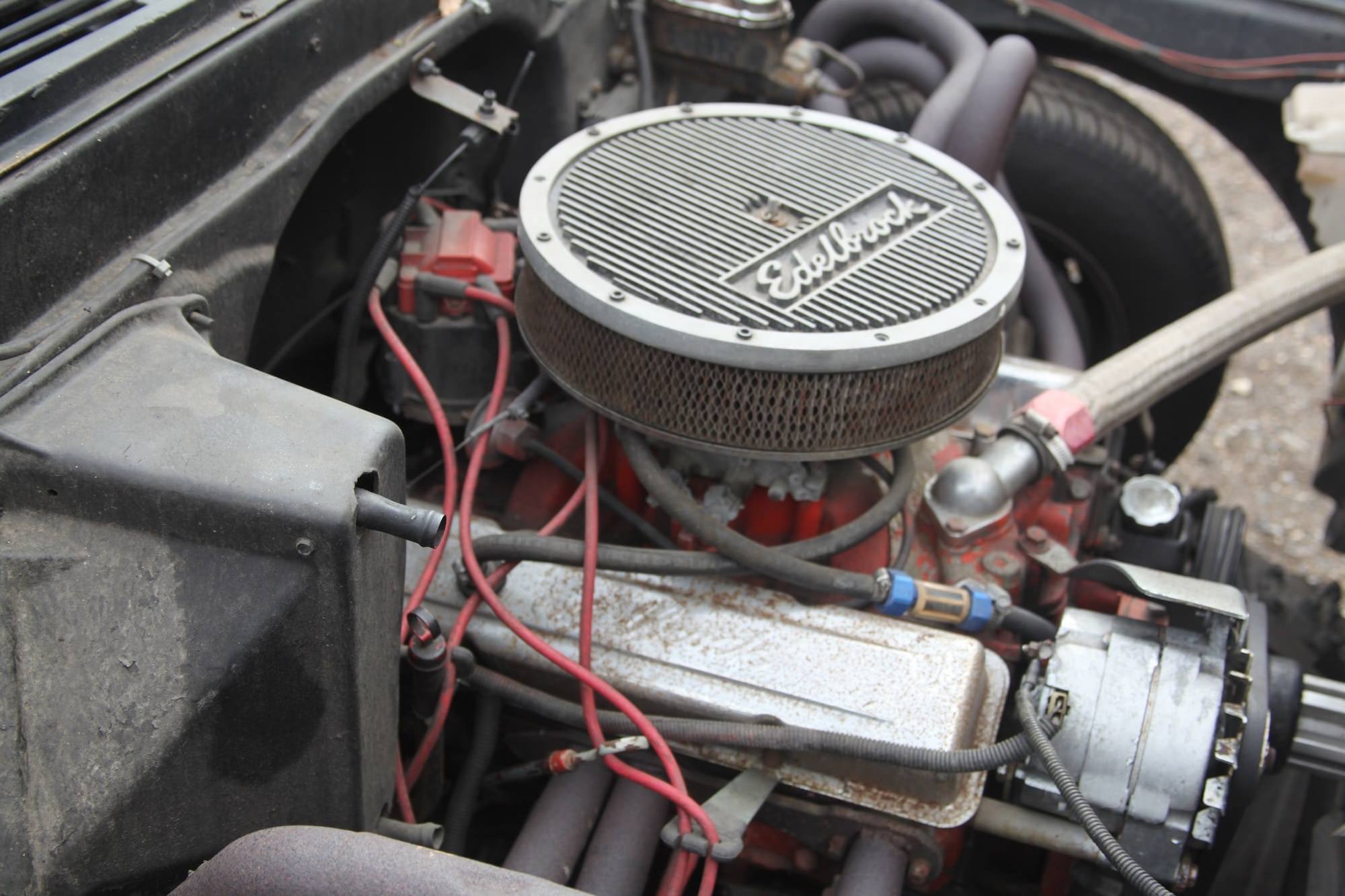
Power now comes from a 7.2 liter V8 paired with a 4-speed automatic transmission, the engine is legal but still loud and throaty, though arguably that’s exactly what you would want from a big block American V8.
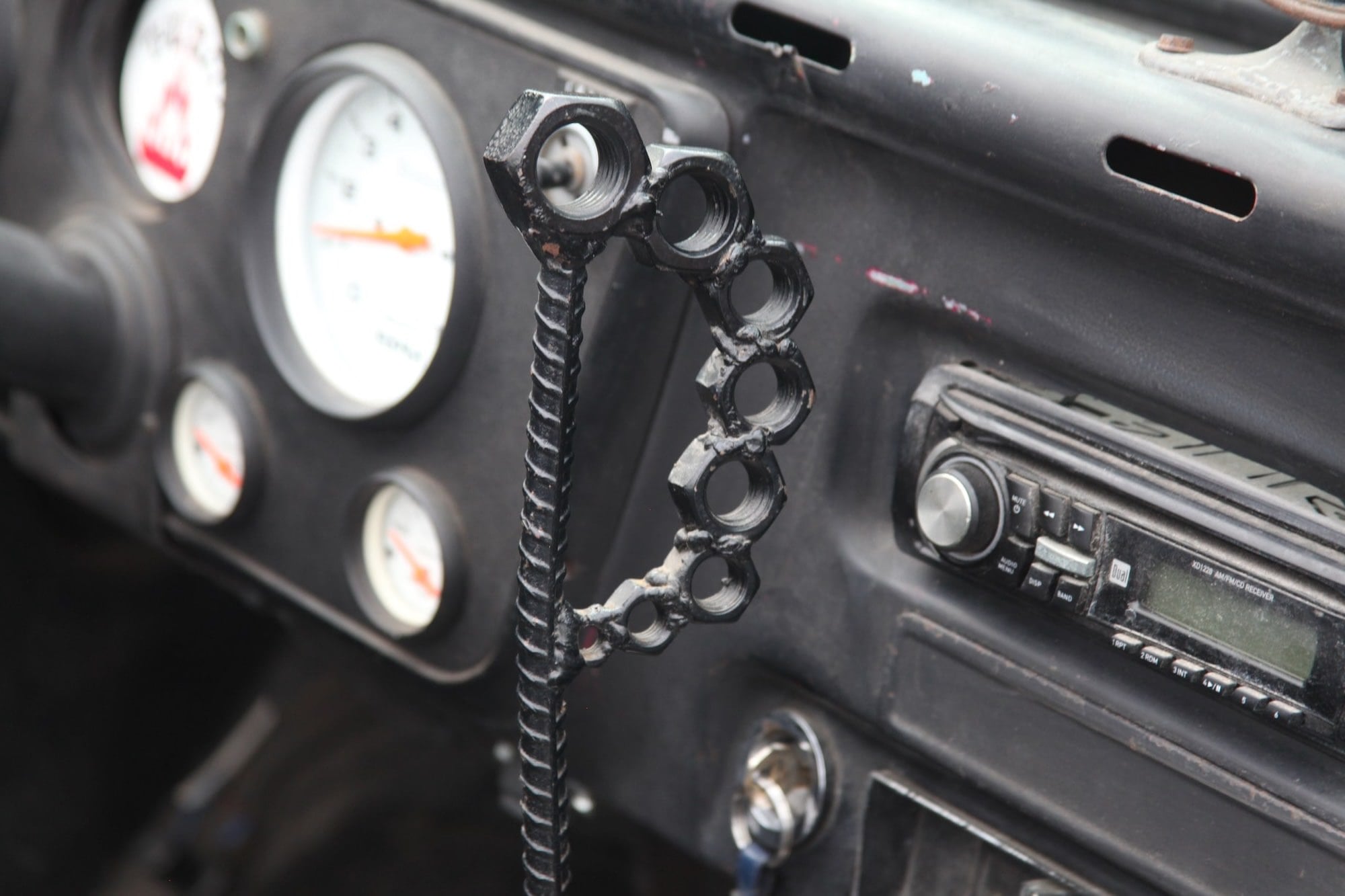
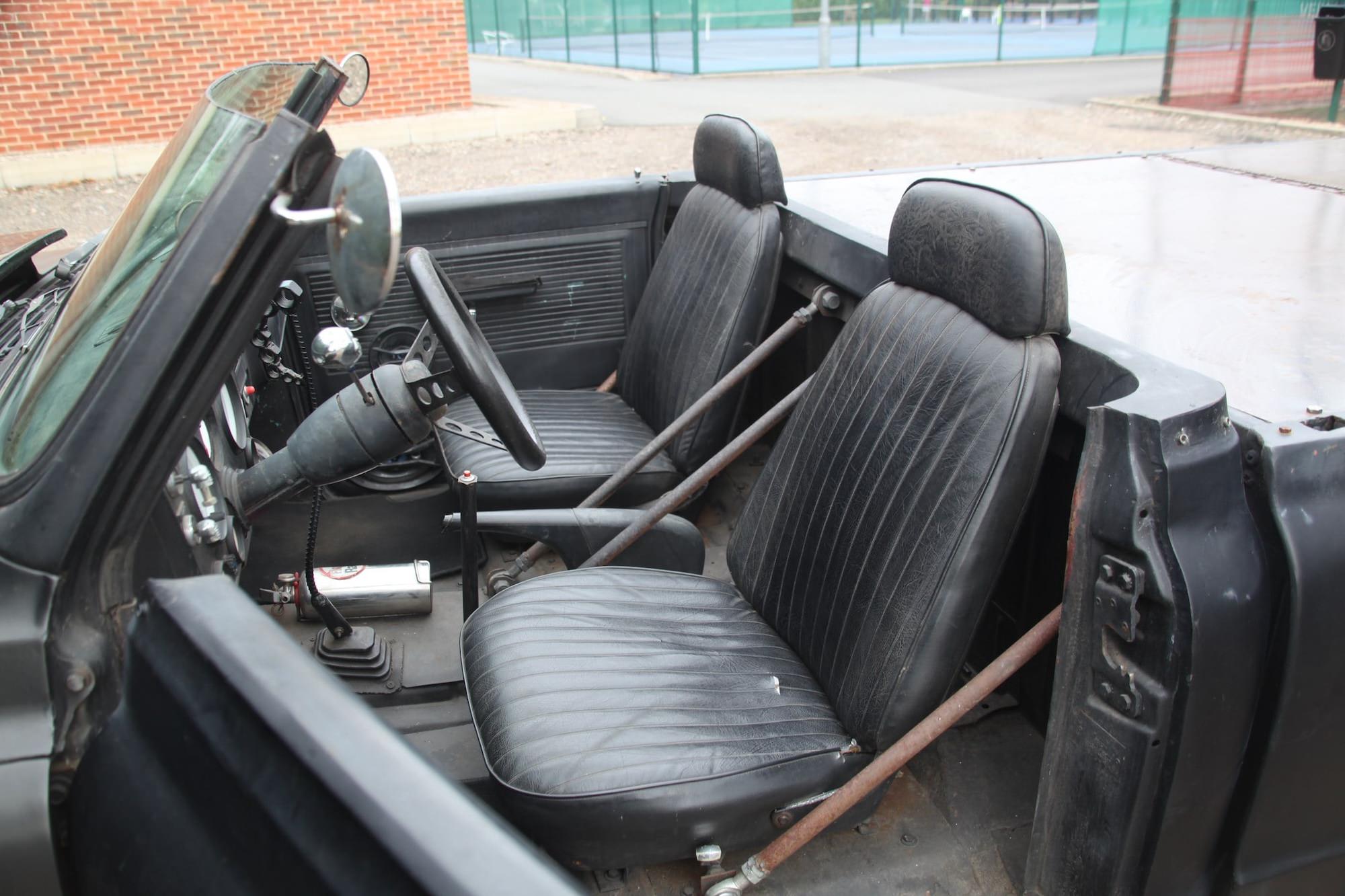
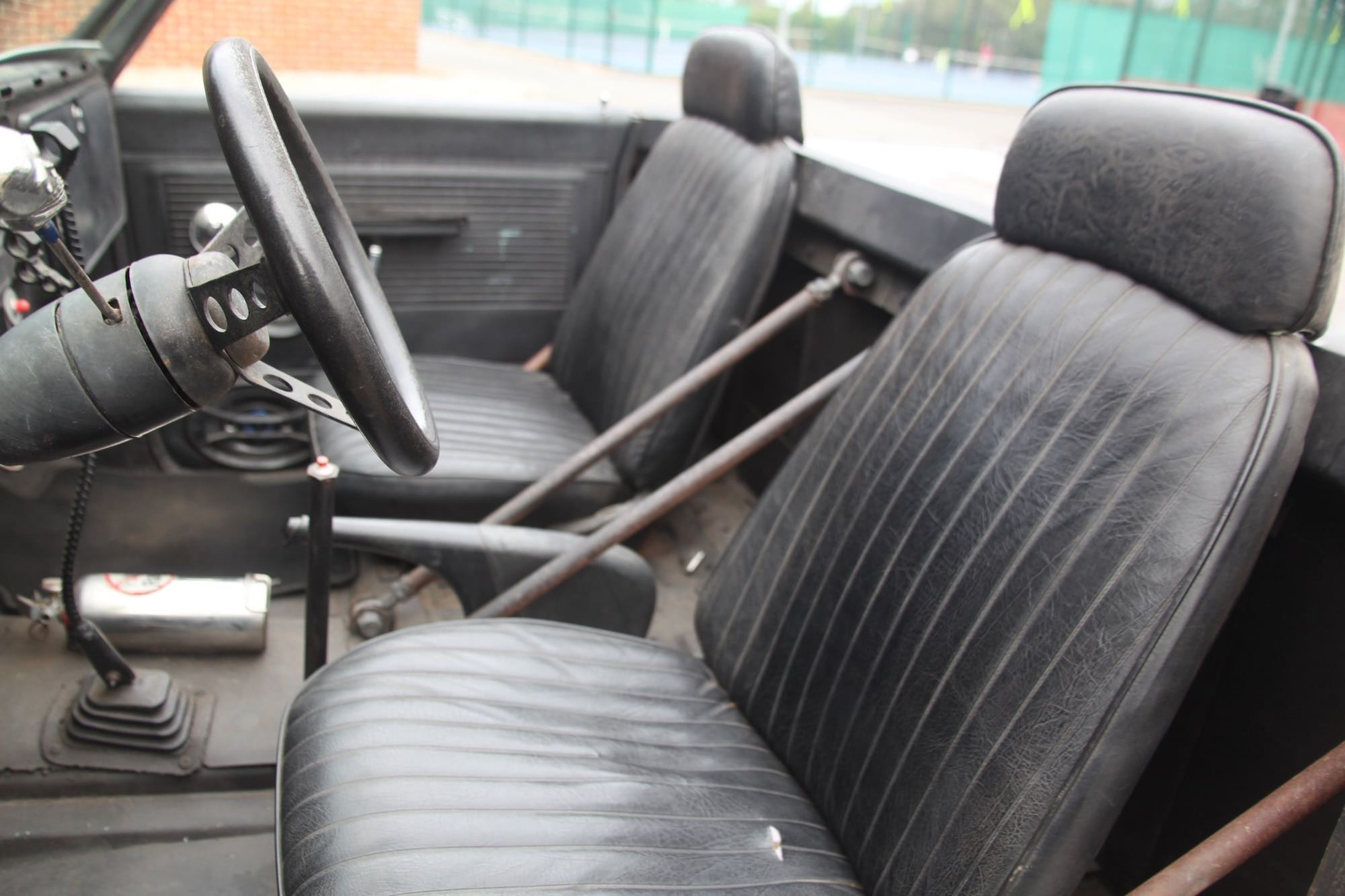
The build has been kept deliberately raw rather than highly finished, and the seller describes the truck as loud but surprisingly driveable. Its odometer is inoperative, so the true mileage is unknown.
This truck came to the UK from the United States and was bought by the current owner in 2019. It was subsequently prepared for British road use, with fog lights, windscreen wipers, and a handbrake added. Rear springs were also fitted to raise the ride height a little for UK roads, while the fan belt has been replaced following wear.
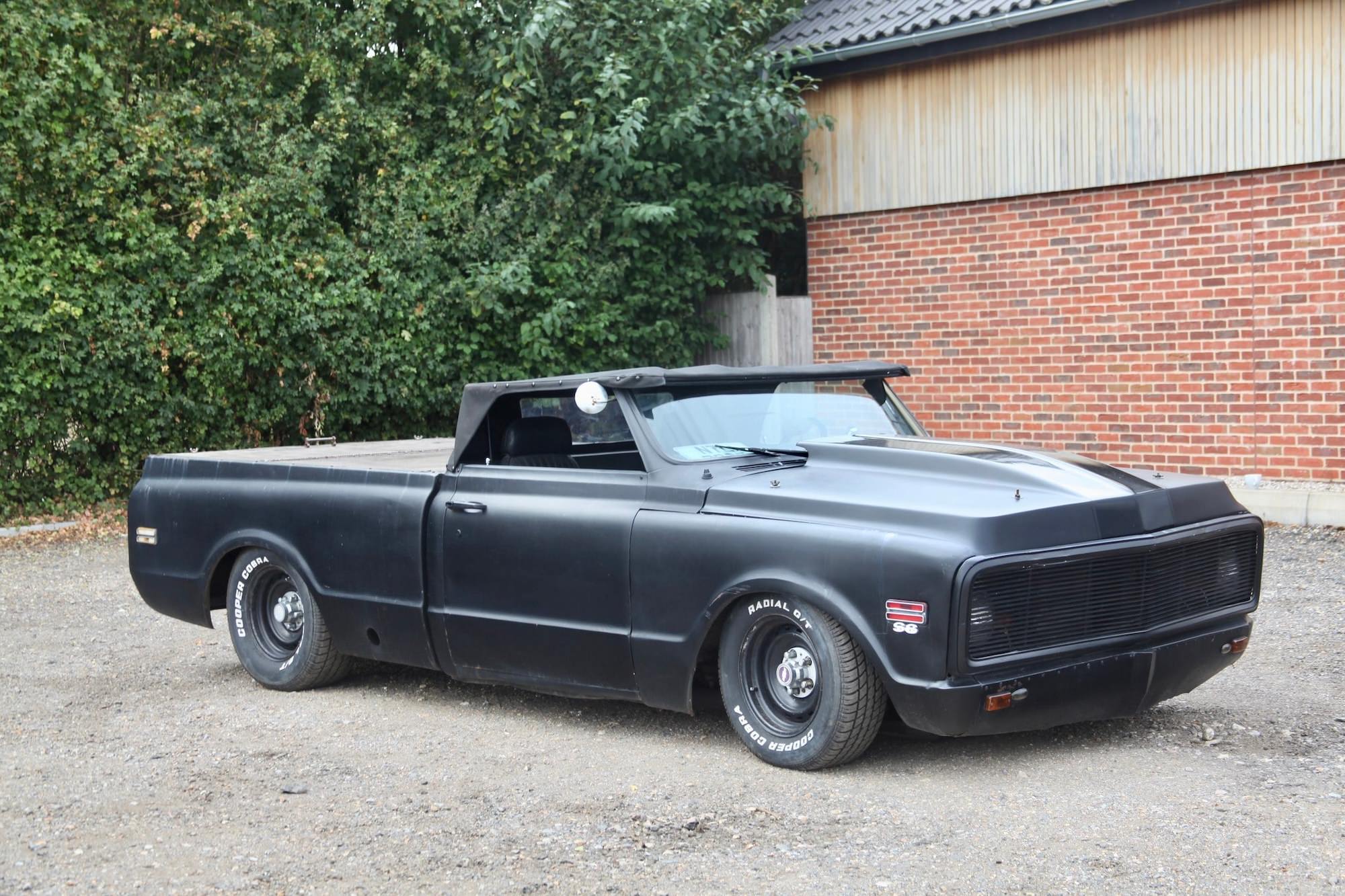
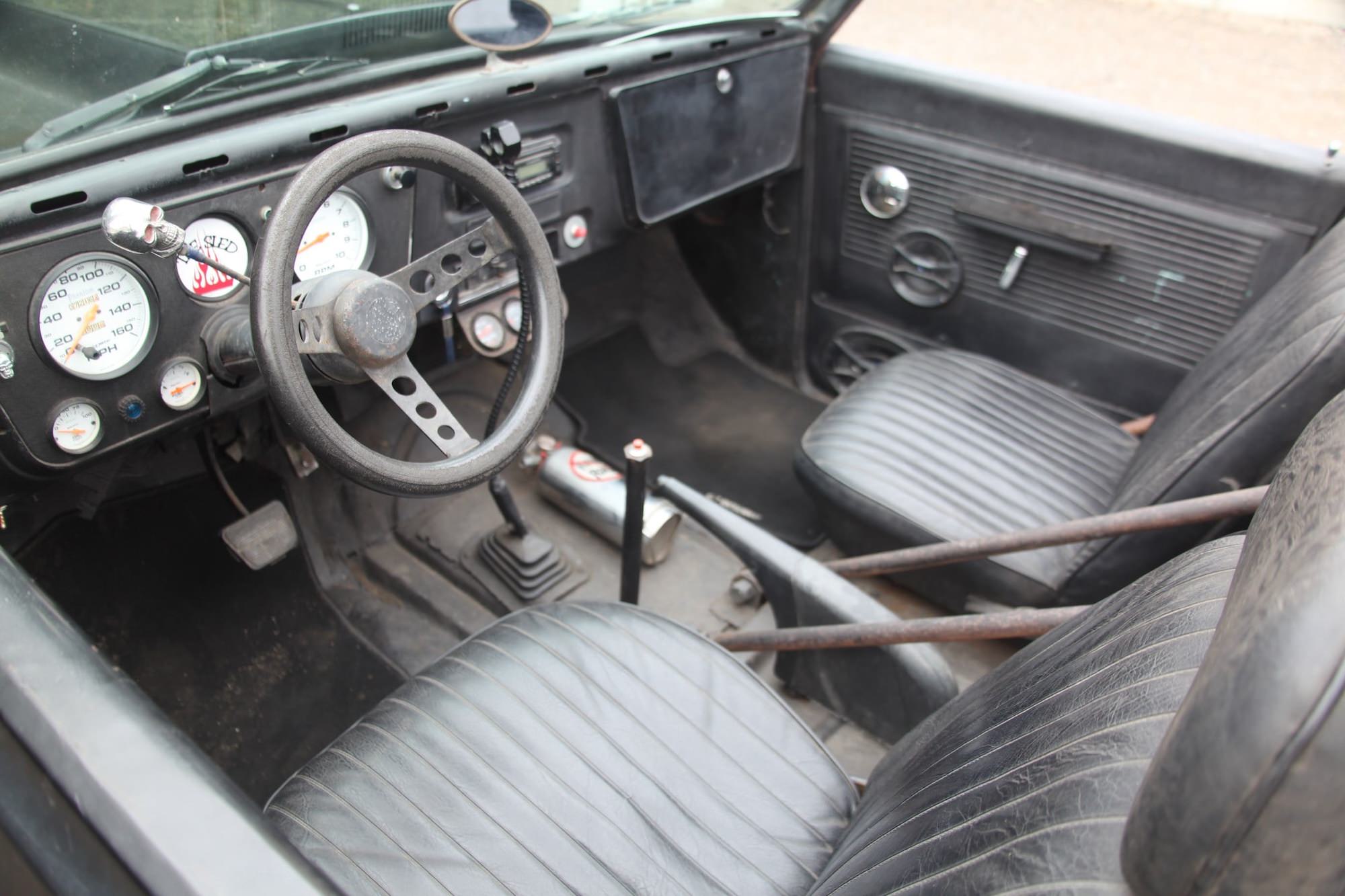
This is a 1968 Chevrolet C10 that’s been turned into a rat rod-style custom, now with a folding convertible roof, and power provided by a 7.2 liter V8 that’s said to be a little on the loud side.
The seller reports that the chassis remains solid and that the truck has covered only an estimated 200 to 300 miles during roughly 7 years of current ownership, most of which has been spent in dry storage.
It’s now being offered for sale out of Norfolk in the United Kingdom and you can visit the listing here on Car & Classic if you’d like to read more about it or register to bid.
Images courtesy of Car & Classic

Articles that Ben Branch has written have been covered on CNN, Popular Mechanics, Smithsonian Magazine, Road & Track Magazine, the official Pinterest blog, the official eBay Motors blog, BuzzFeed, Autoweek Magazine, Wired Magazine, Autoblog, Gear Patrol, Jalopnik, The Verge, and many more.
Silodrome was founded by Ben back in 2010, in the years since the site has grown to become a world leader in the alternative and vintage motoring sector, with well over a million monthly readers from around the world and many hundreds of thousands of followers on social media.