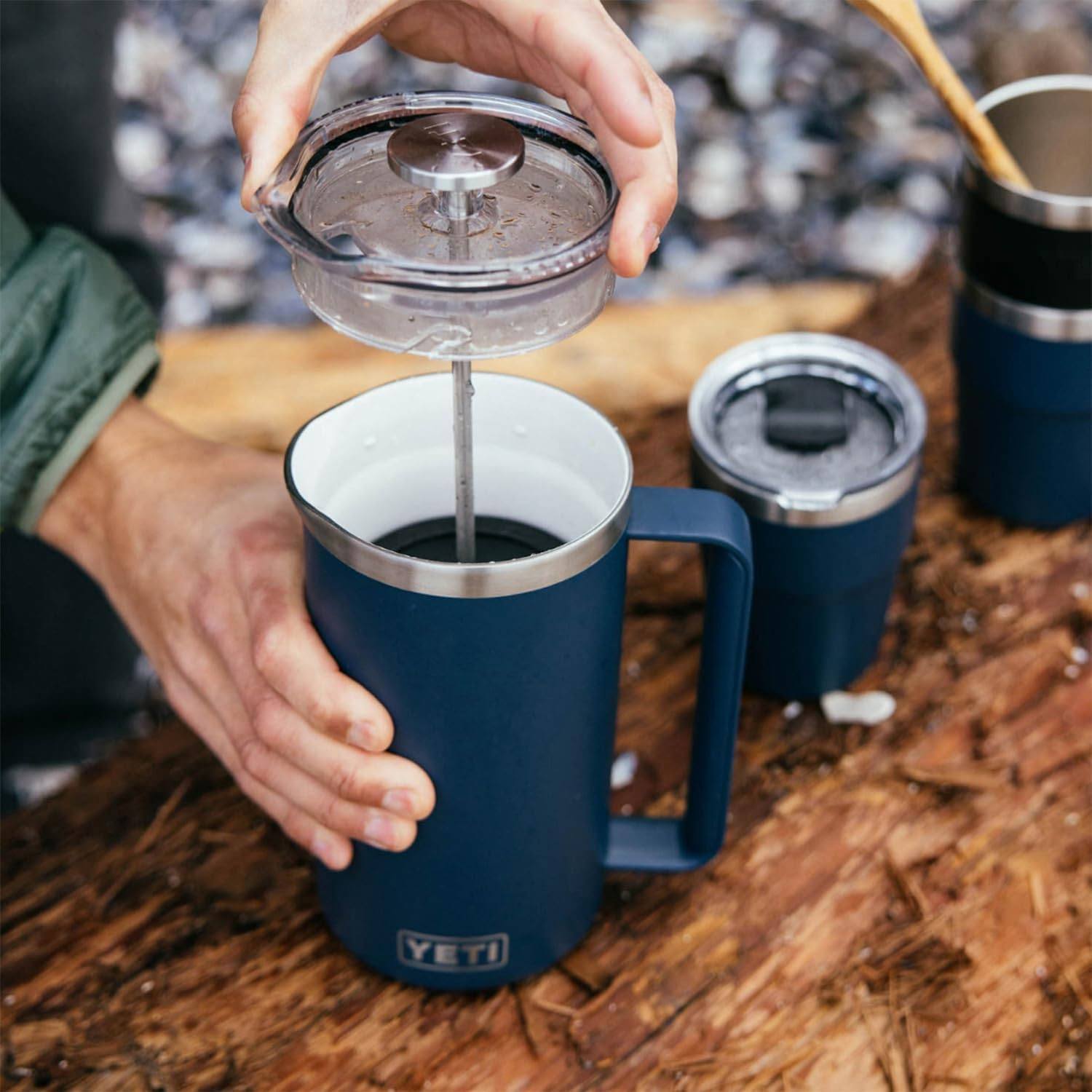
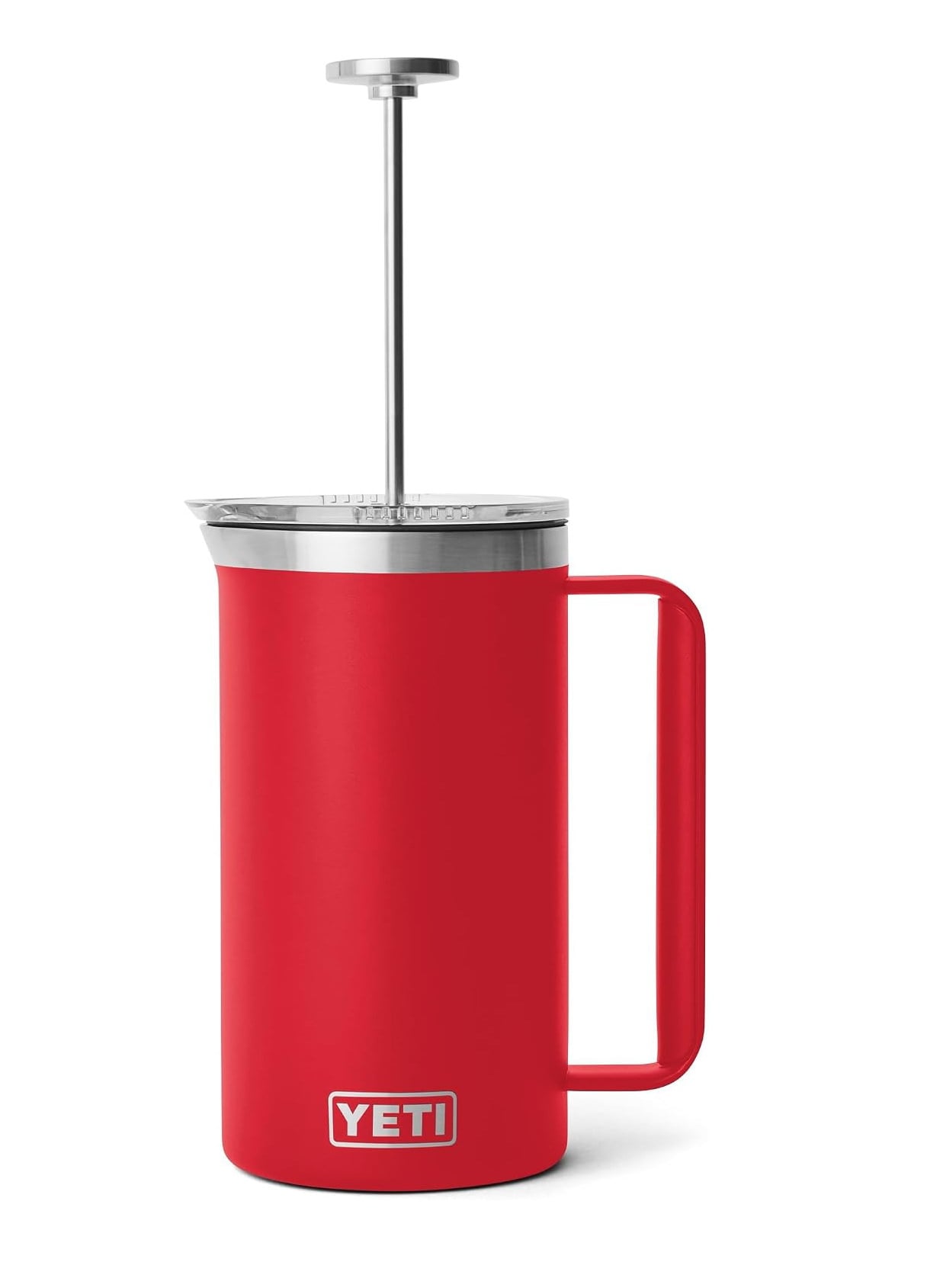
This is the YETI Rambler French Press, each one is made from double-walled vacuum-insulated 18/8 stainless steel, and importantly, the design has no glass parts at all, making it well-suited for a life of adventure.
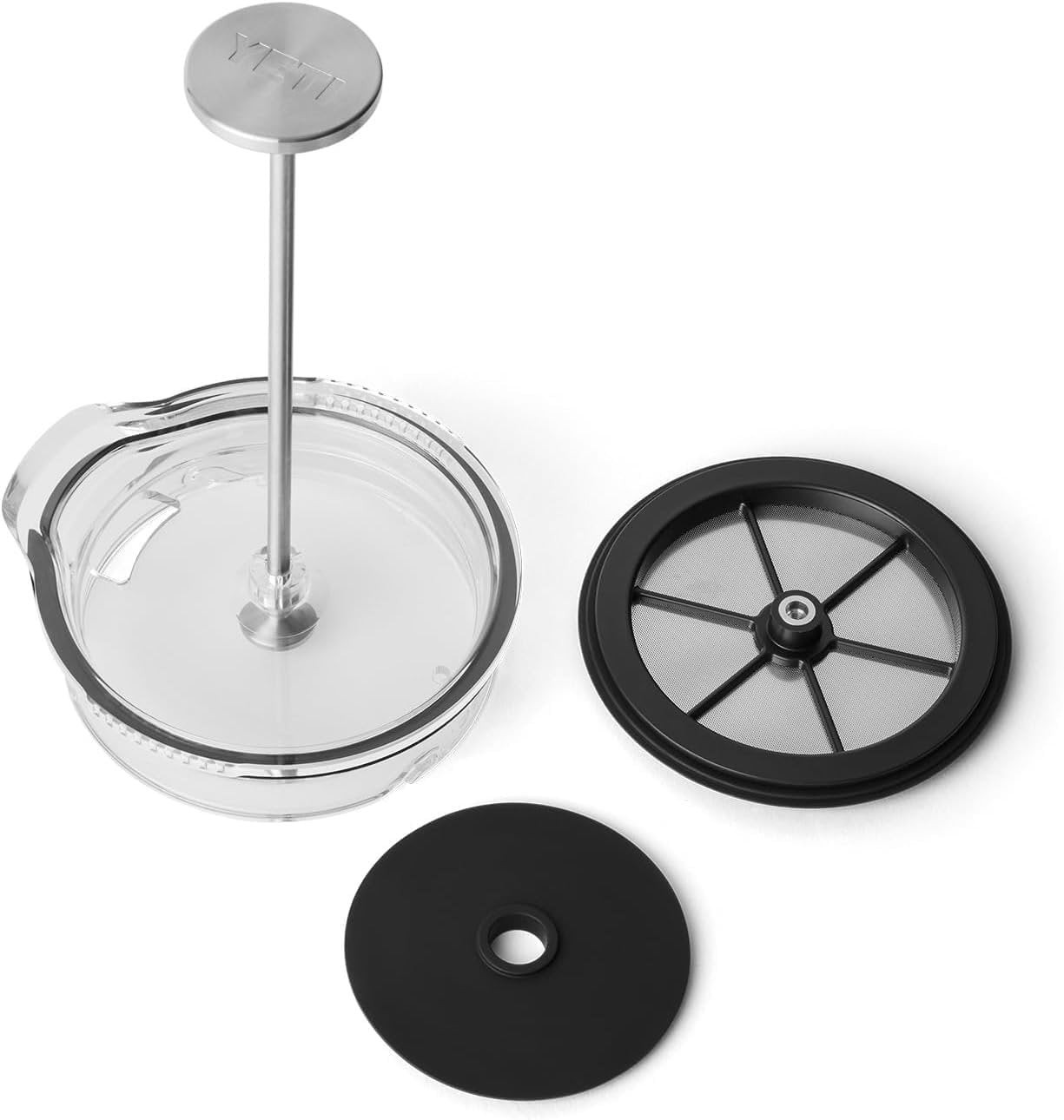
The Rambler was designed to both work as a French press and keep your coffee hot in between cups, and so it has a GroundsControl Filter, which essentially locks out the brewing process once the plunger is depressed and turned – meaning your coffee won’t get over-extracted.
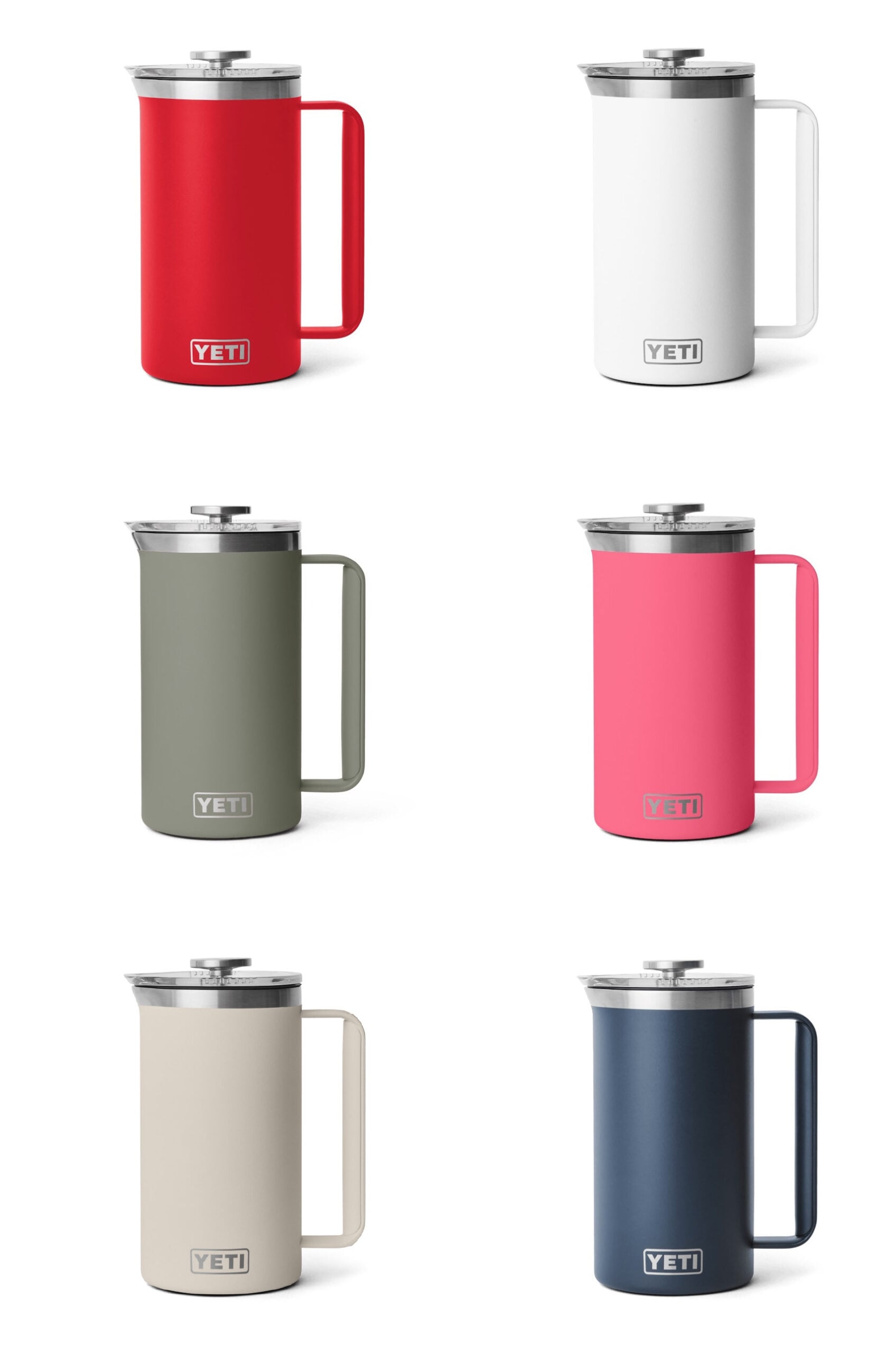
 The Rambler comes with YETI’s 5-year warranty, and it comes in eight colorways.
History Speedrun: The French Press
The earliest known patent for a plunger-style coffee pot was filed in France back in 1852. The parts that make a modern French press work, a filter on a rod and a circular spring that seals it against the side of the vessel, came from a series of Milanese patents filed between 1928 and 1934.
The 1852 patent was filed by Henri-Otto Mayer and Jacques-Victor Delforge, but interestingly, there’s no evidence that their device was ever produced commercially or sold at all. An early commercial success followed decades later in 1913, when Louis Forest’s Caféolette patented a silver-plated brass press meant for brewing coffee in milk. Perhaps an early stab at making a cappuccino.
The modern-day coffee plunger mechanism really starts with Ugo Paolini of Milan, in April of 1928 he filed an Italian application for a pot with a filter disc on a rod, held at any height by a coiled spring. Paolini assigned the rights in equal halves to Attilio Calimani and Giulio Moneta, and the British patent was published under their names as his assignees – Calimani is the name that coffee plunger manufacturer Bodum still attaches to the design today.
In 1934 Bruno Cassol filed the Italian patent that laid out the arrangement still used now – he fixed a helical spring around the filter’s edge and covered it with the filter gauze, so the spring pressed the mesh tightly against the walls to prevent leakage of coffee grounds into the filtered top layer of coffee.
By the mid-1930s Melior-branded plunger pots were on sale in France and Britain. After WWII came Faliero Bondanini, whose patent (first filed in Switzerland in 1955) split the filter’s rim into flexible tongues to absorb irregularities in a glass or porcelain pot. He started production at Société des Anciens Etablissements Martin, a French company that also made clarinets – Martin sold its press from the mid-1950s until 1991, most famously as the “Chambord.”
Bodum introduced its first French press, the “Bistro,” in 1974. Bodum bought Martin outright in 1991, and the company has now sold well over 100 million French presses since the mid-1970s.
The YETI Rambler French Press
The YETI Rambler French Press was released a couple of years ago in two key sizes – 34 oz and 64 oz (1 liter and 1.89 liters). Each is made from double-walled vacuum-insulated 18/8 stainless steel, designed to handle the rough and tumble of life on the trail, and the interior has a DuraSip ceramic lining, which is said to give a smoother pour and easier cleaning.
For the sake of ruggedness, there is no glass used at all anywhere in the design, it measures in at 6.2 inches wide by 8.2 inches tall, and it has an elongated handle and a non-slip foot.
Each comes with a GroundsControl Filter, this means that once plunged, it separates the grounds from the brewed coffee and stops extraction, so the coffee can sit in the insulated vessel between pours without over-extracting. Meaning you can relax and enjoy your coffee at your own pace. This filter is carried inside the twist-to-lock lid – the clear plastic section turns to engage small detents inside the vessel.
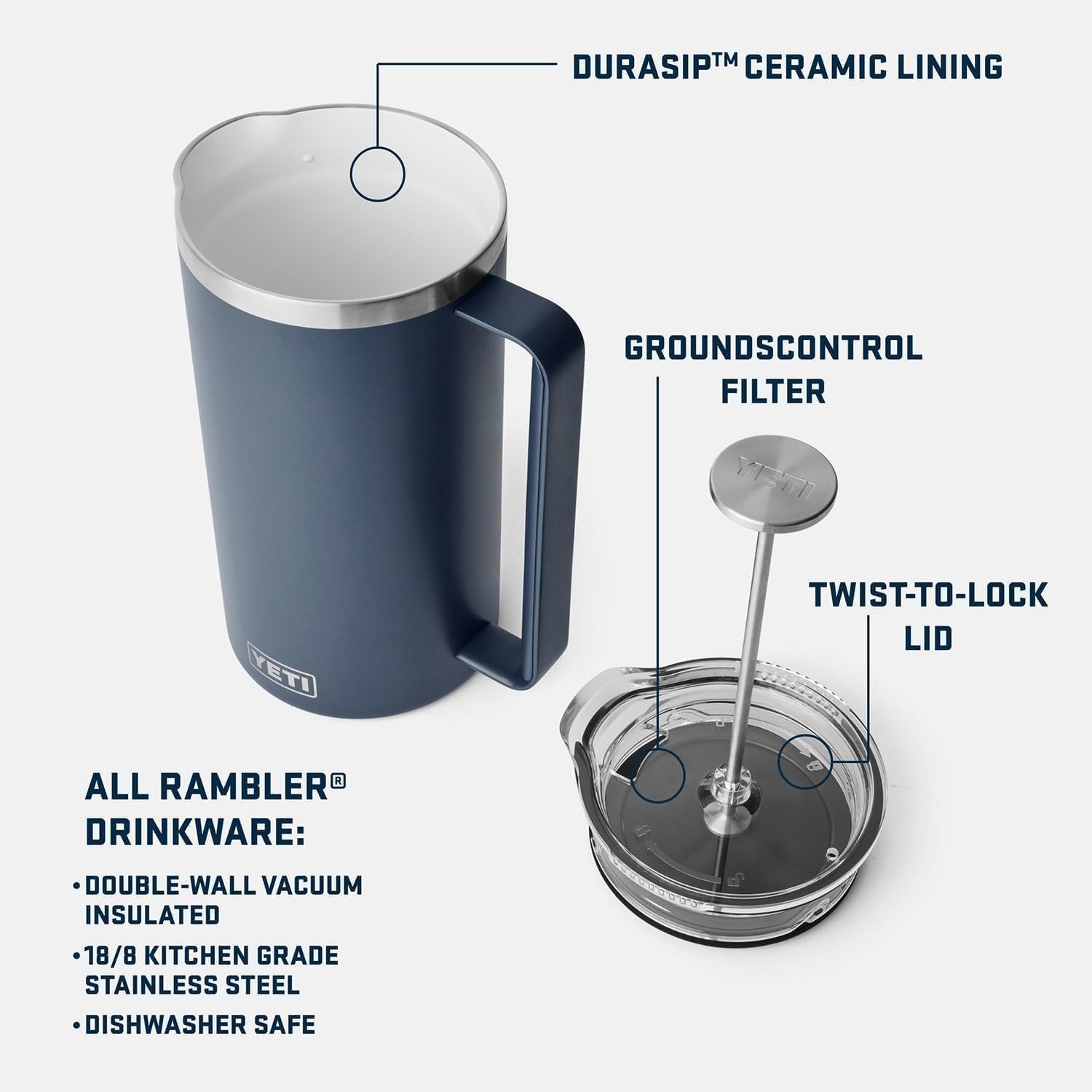
The YETI Rambler French Press was released a couple of years ago in two key sizes – 34 oz and 64 oz (1 liter and 1.89 liters).
All parts of the Rambler are dishwasher safe, for easy cleaning, and it can also be used to brew tea if that’s your preferred tipple when out in the wilderness. YETI recommends coarsely ground coffee and water at 200°F, and warns against forcing the plunger down, as fine grounds can clog the filter and build enough pressure to eject hot liquid. This is a lesson some of us have learned the hard way in the past.
The YETI Rambler is now available to buy from the official YETI Amazon store here, each one comes with YETI’s 5-year warranty, and it comes in eight colorways.

Images courtesy of YETI

Articles that Ben Branch has written have been covered on CNN, Popular Mechanics, Smithsonian Magazine, Road & Track Magazine, the official Pinterest blog, the official eBay Motors blog, BuzzFeed, Autoweek Magazine, Wired Magazine, Autoblog, Gear Patrol, Jalopnik, The Verge, and many more.
Silodrome was founded by Ben back in 2010, in the years since the site has grown to become a world leader in the alternative and vintage motoring sector, with well over a million monthly readers from around the world and many hundreds of thousands of followers on social media.