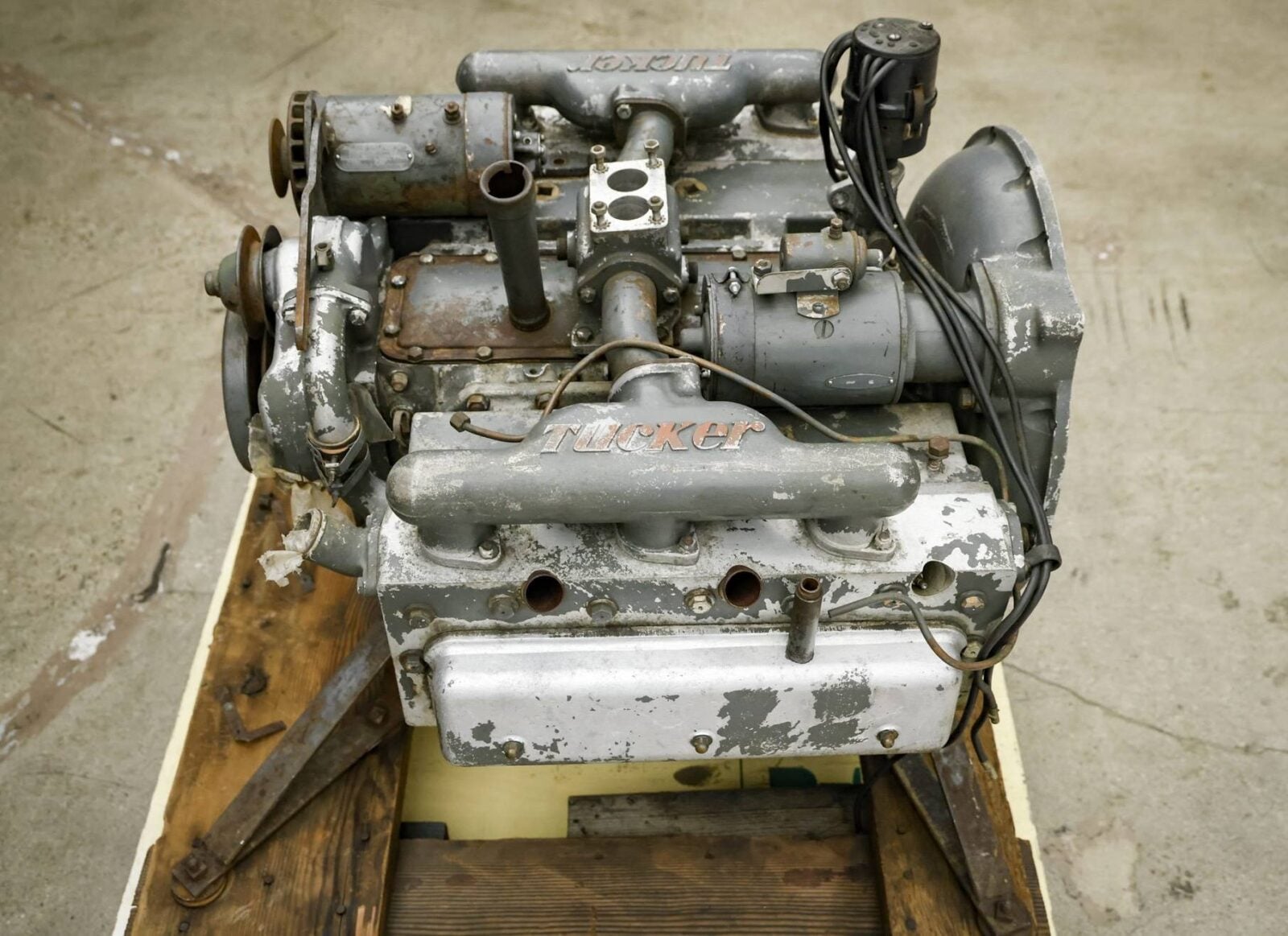
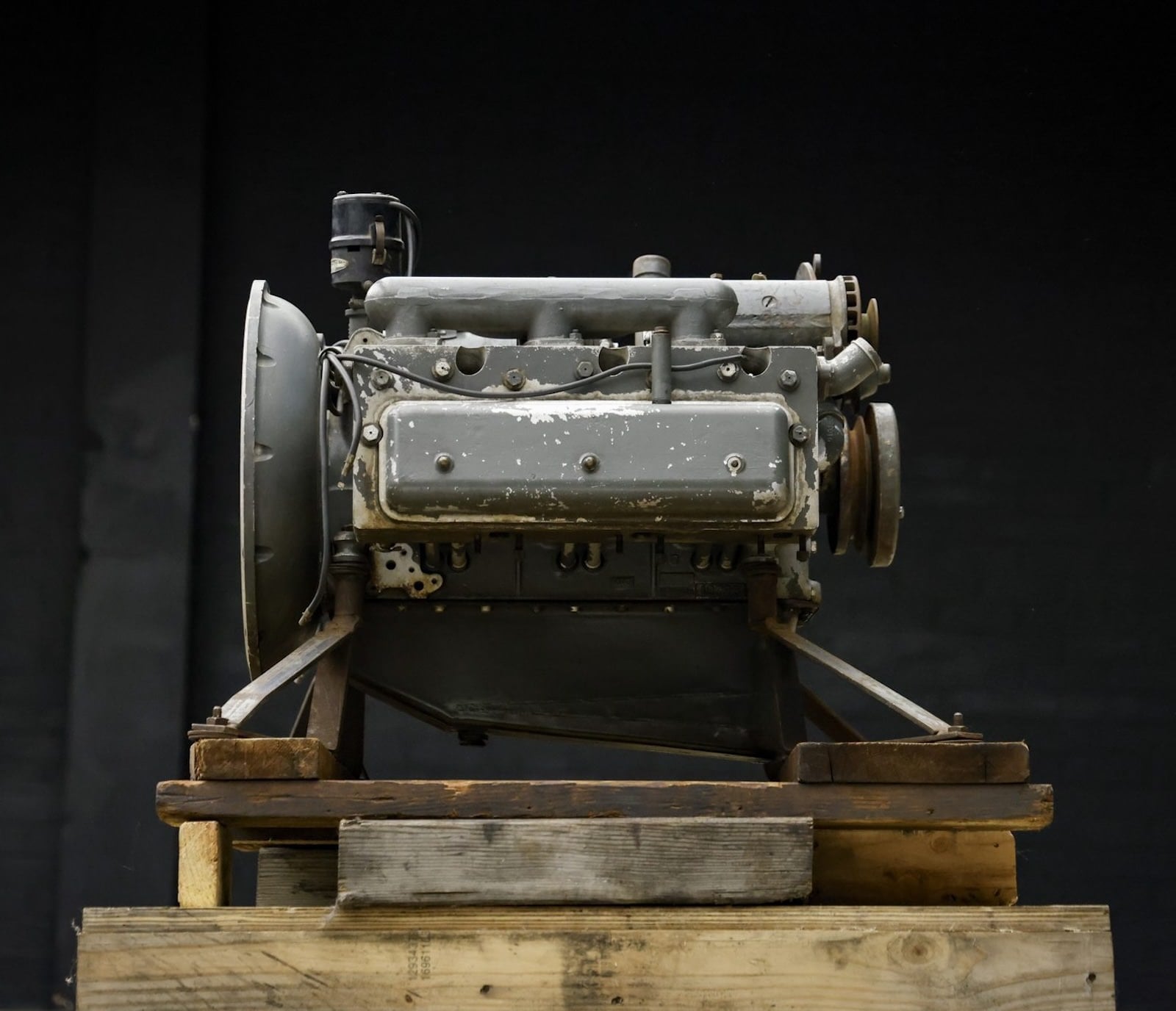
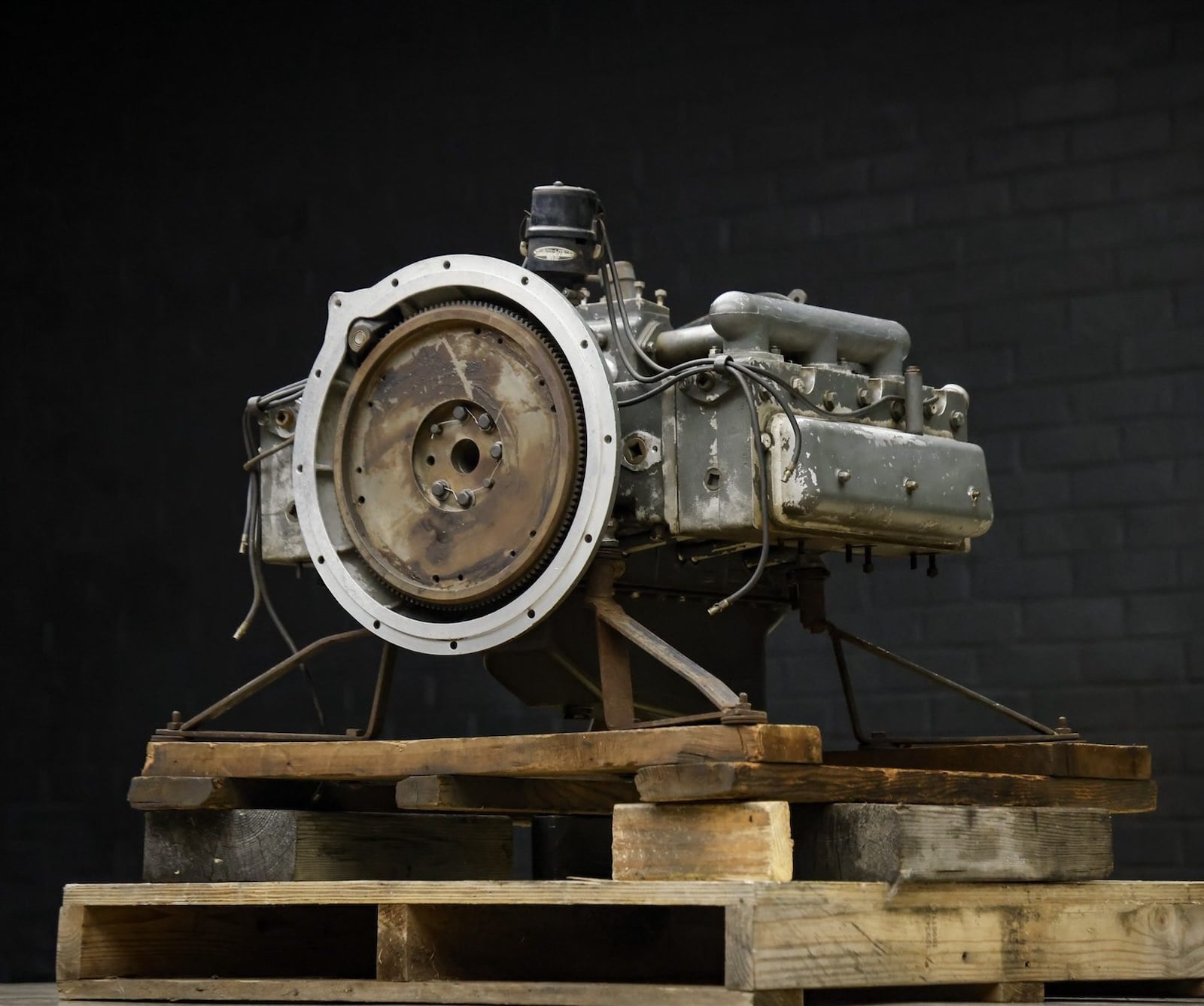
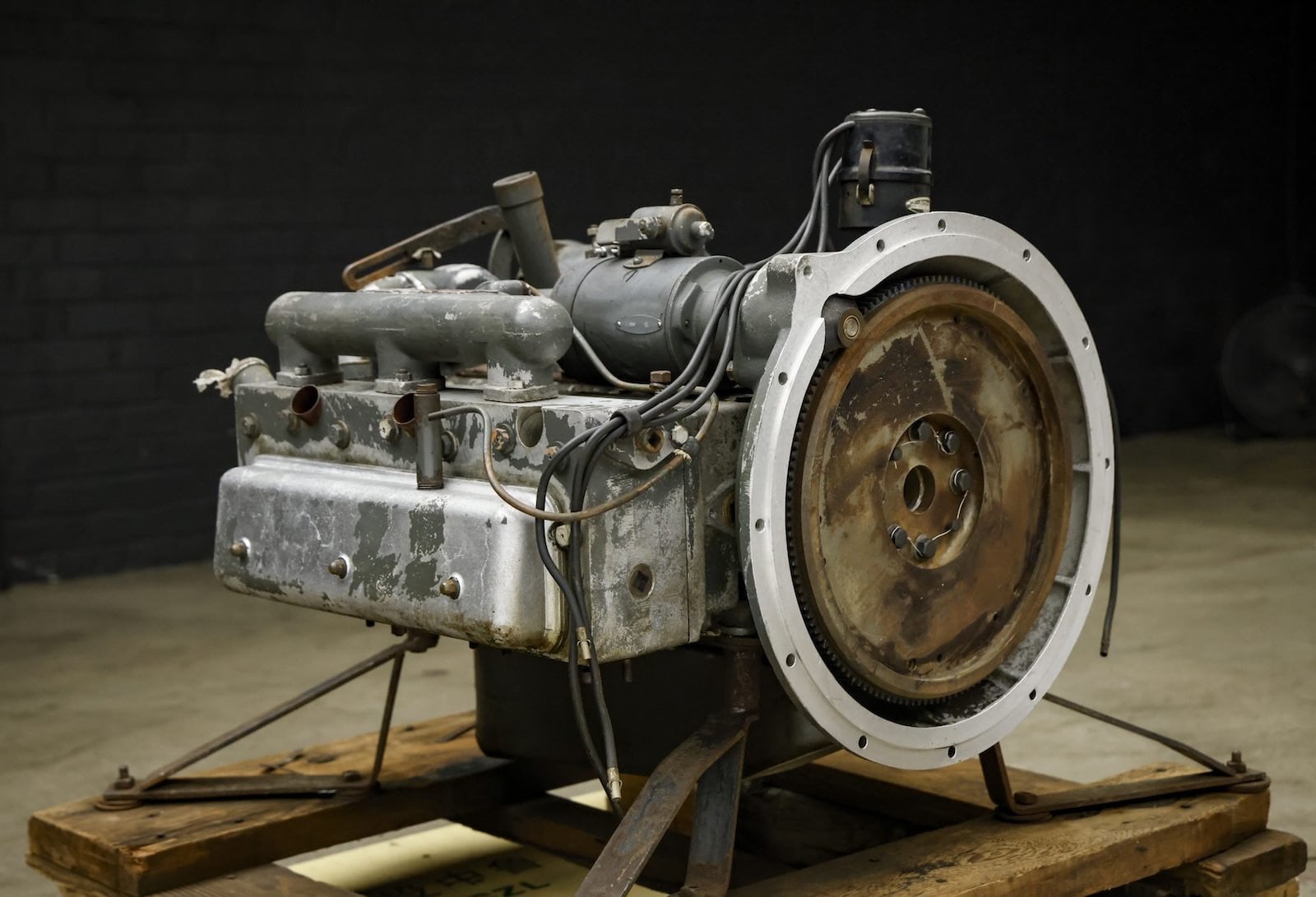
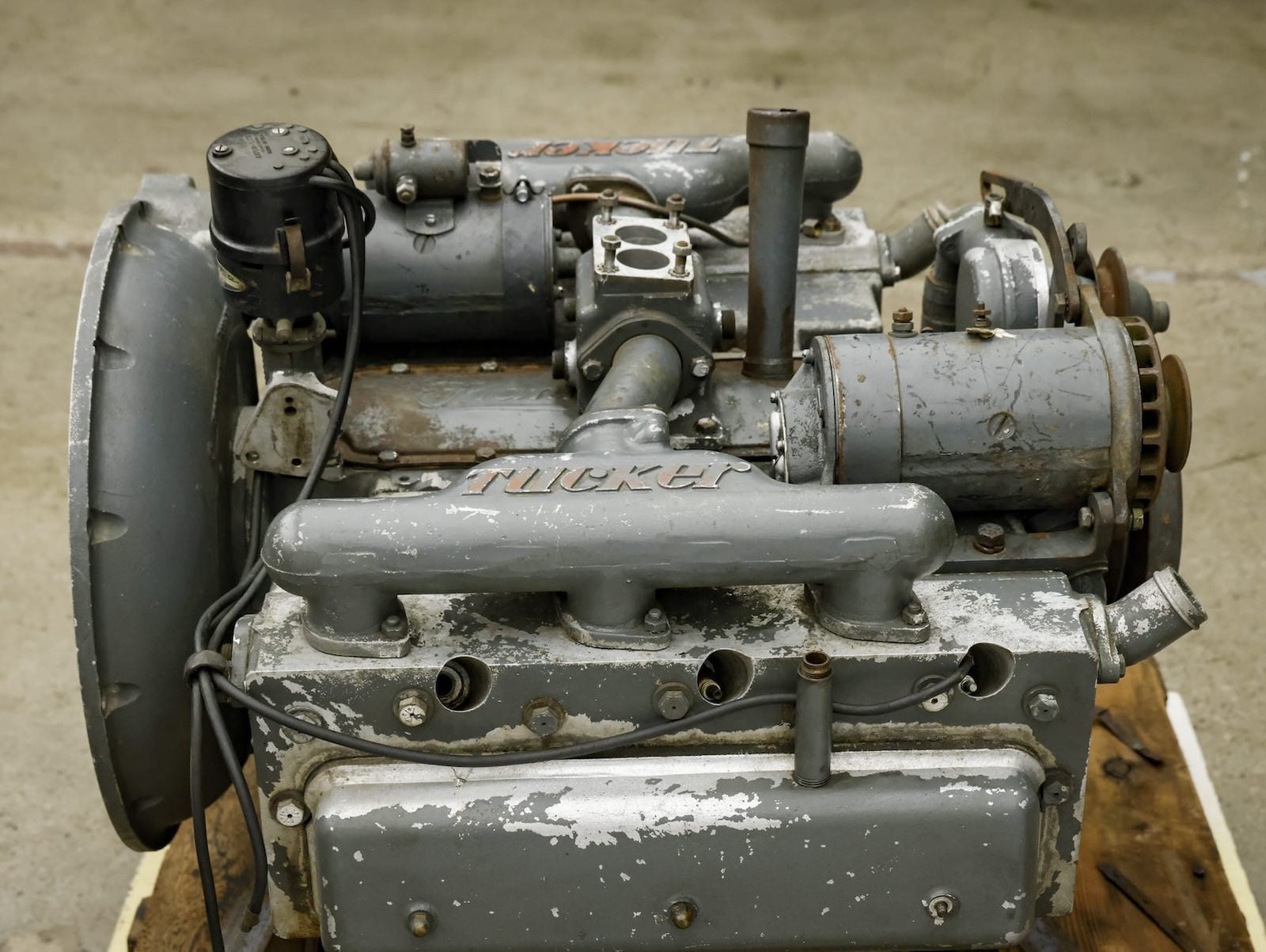
This is an incredibly unusual find, it’s a Tucker 48 335 cubic inch (5.5 liter) flat-six crate engine that was reportedly built for use in a Tucker, but for whatever reason it was never installed and now remains in unused condition, still on its factory pallet.
It seems likely that this is the last unused Tucker engine of its kind, or certainly one of the last. Original Tucker 48s now sell for well over a million USD, and they’re among the most famous (and collectible) American cars of the immediate post-WWII period.
Fast Facts: A Tucker 48 Flat-Six Crate Engine
- Preston Tucker originally planned to power his revolutionary Tucker 48 with a 589 cubic inch (9.7 liter) flat-six with hydraulic valve actuation, fuel injection, and twin torque converters. Developed by engineer Ben Parsons, the ambitious engine suffered significant mechanical problems and was abandoned following a troubled prototype debut in mid-1947.
- Tucker then adopted the Franklin 335 cubic inch (5.5 liter) flat-six aircraft engine, originally developed for helicopter use. Engineers converted it from air-cooling to liquid-cooling, modified its ignition and valve timing, and adapted it for automotive use. The resulting Tucker 335 produced a claimed 166 bhp and 372 lb ft of torque.
- The Tucker 48 reportedly achieved 0 to 60 mph in approximately 10 seconds, with journalist Tom McCahill recording a top speed of at least 105 mph. Tucker purchased the Franklin engine manufacturer in March of 1948, but the automaker collapsed in 1949 after assembling just 51 cars, including the original prototype.
- The engine offered for sale is numbered 33594 and was reportedly never installed in a Tucker 48. Preserved for decades in a private collection, it still has its original Franklin and Tucker castings, intake manifolds, distributor, generator, starter, and water pump. It remains unrestored, mounted on a wooden pallet, and its internal condition is unknown.
History Speedrun: The Tucker 48 Engine
Preston Tucker, based in Ypsilanti, Michigan at the time, began planning his all-new car design in 1944, with engineer Ben Parsons and former General Motors stylist George Lawson. Parsons’s job was the engine – a large displacement flat-six mounted in the tail of the car, turning slowly and driving the rear wheels through fluid couplings in place of a gearbox. When the Tucker Torpedo was announced in December of 1945, just three or four months after the end of WWII, it was promised with 150 bhp and a top speed of 130 mph. Quite the turn of speed for the era.
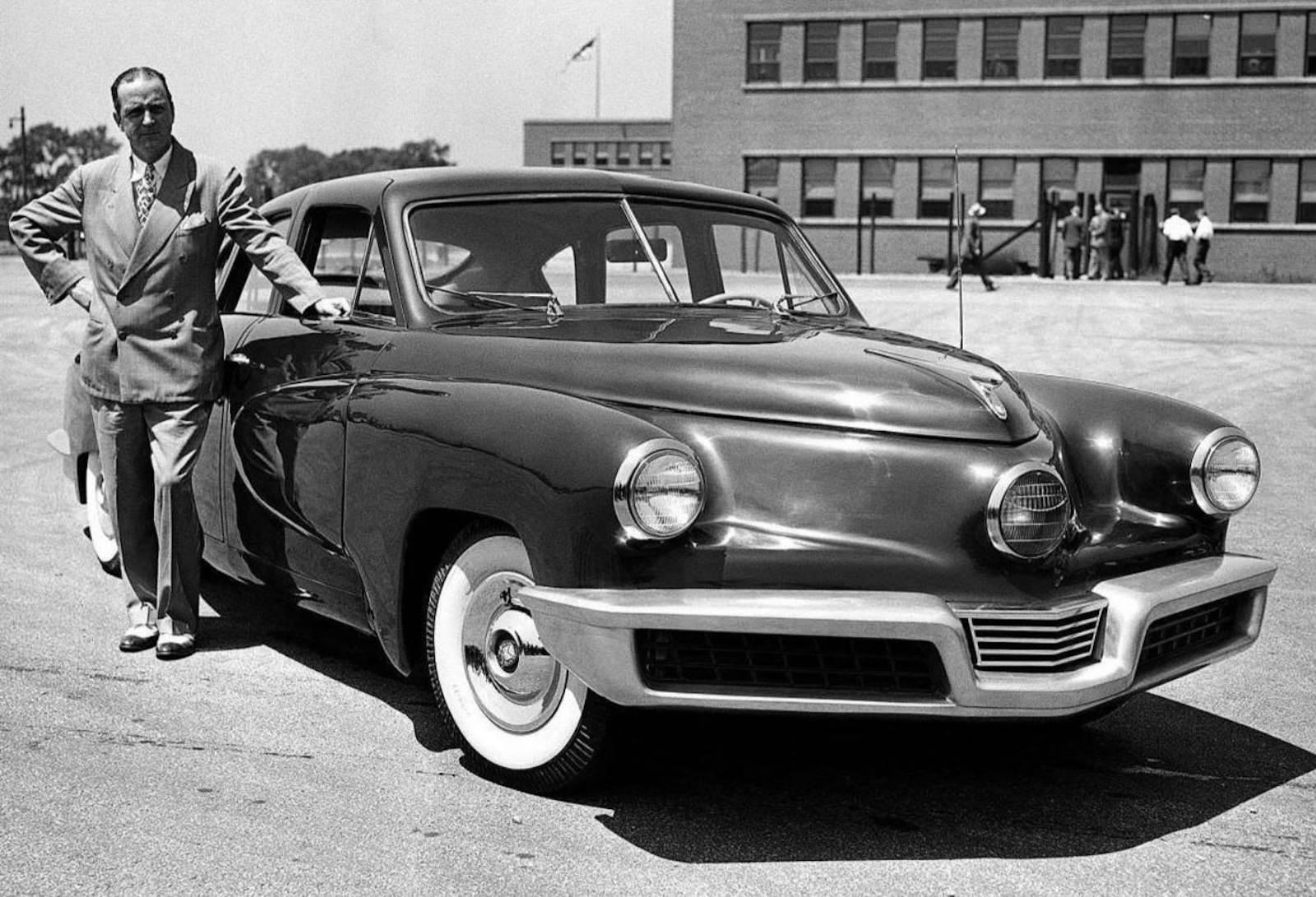
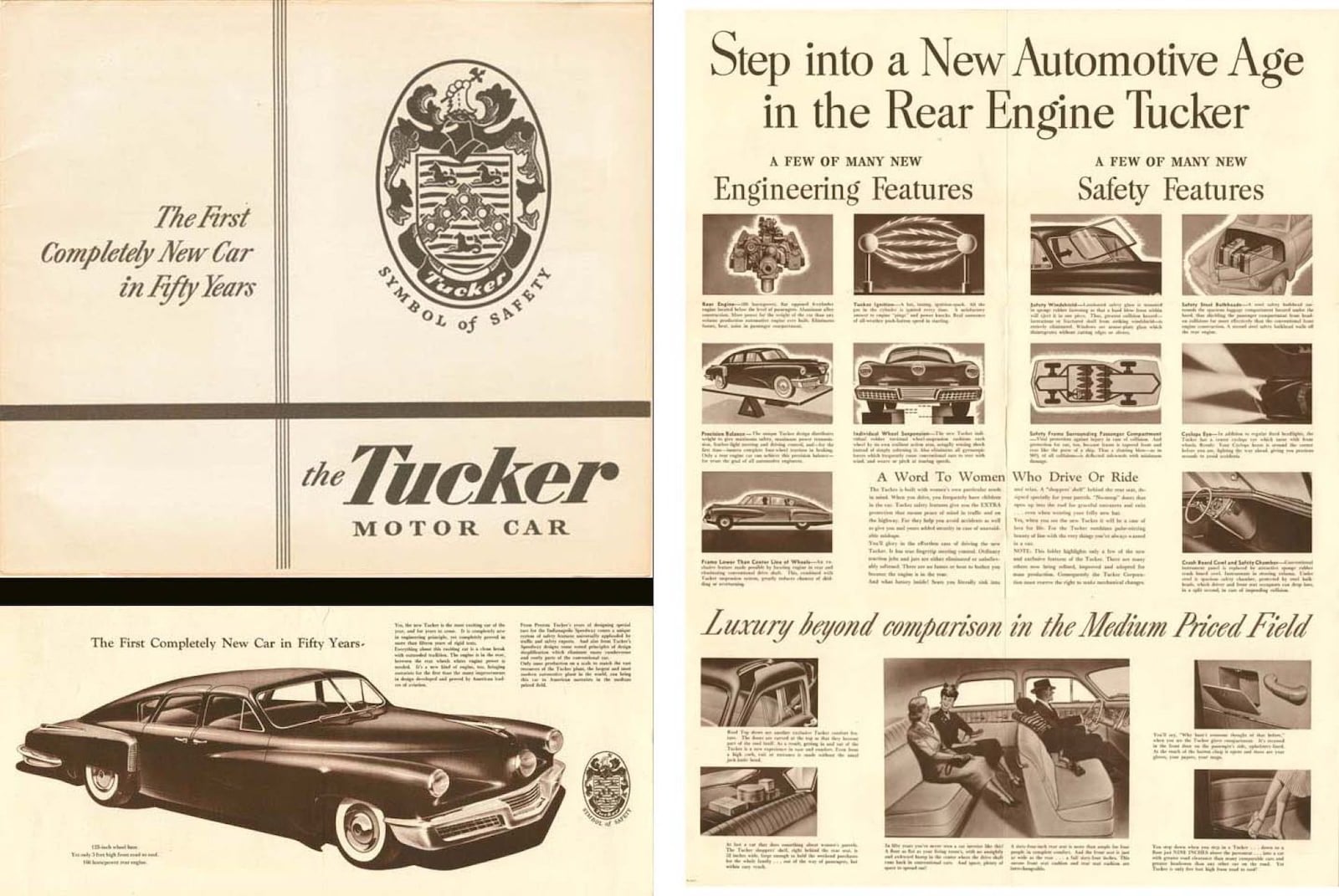
 In the top image we see Preston Tucker himself, standing proudly beside his most famous creation – the Tucker 48. Image courtesy of the Tucker Archives.
The Doomed A-589 Engine
The engine that ended up in the back of the Tucker was called the A-589, but very little about it was conventional then or now. It was an aluminum flat-six with a 5 inch bore and a 5 inch stroke, giving 589 cubic inches (9.7 liters). The cylinder heads were cast in one piece with the cylinders, so there were no head gaskets to fail. There was no camshaft in the usual sense either – a mechanical pump supplied the oil pressure that opened each overhead valve, and springs closed it. Parsons designed his own fuel injection system for it, and it had a 24 volt electrical system.
The power rating was 150 bhp with a hefty 450 lb ft of torque at just 1,800 rpm, from a 6:1 compression ratio. The engine sat transversely between the rear wheels with a hydraulic torque converter on each end of the crankshaft and no transmission at all. To save money, Parsons’s team designed it around the machine tools left behind in Tucker’s Chicago factory, a wartime Dodge plant that had built B-29 engines.
Sadly, the engine concept they had come up with didn’t work, at least not in the time they had available. At the prototype’s unveiling in Chicago on June the 19th, 1947, in front of several thousand guests, the engineers couldn’t get the fuel injection set up and hastily converted the engine to run on carburetors.
They couldn’t time the hydraulic valve gear properly either, so it ran badly and would barely idle – they had a band play loudly over the noise. The batteries needed for the 24-volt system added to the weight that broke the car’s aluminum suspension arms just a few hours before the reveal. The fluid drive also gave trouble in reverse, which is where the long-lived rumor that Tuckers couldn’t back up came from – initially it had been true more or less.
Only a handful of A-589 engines were built, by 1948 the design and its fluid drive had been abandoned. Prototype engines still survive, as well as the factory test chassis in the Cammack Tucker Gallery at the AACA Museum in Hershey, Pennsylvania.
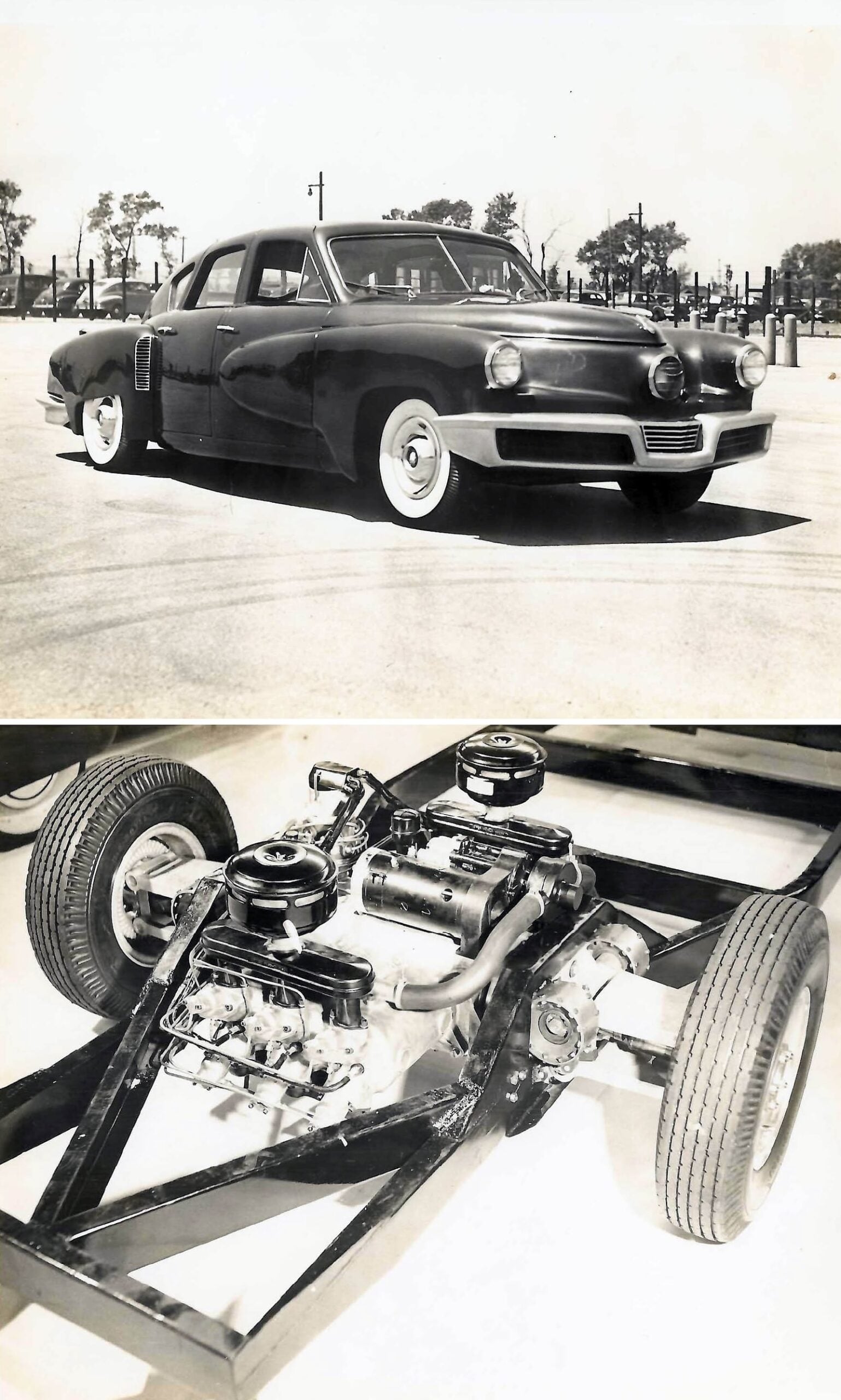
In the lower image here you can see the original Tucker A-589 engine. It was a marvel of engineering but suffered from insufficient development time and resources – it would ultimately be replaced by the Tucker 335 engine. Image courtesy of the Tucker Archives.
The Franklin Helicopter Engine
The replacement engine came from Aircooled Motors of Syracuse, New York, a company set up by former Franklin engineers Carl Doman and Edward Marks after the Franklin Car Company had failed in the 1930s – it still sold its engines under the Franklin name.
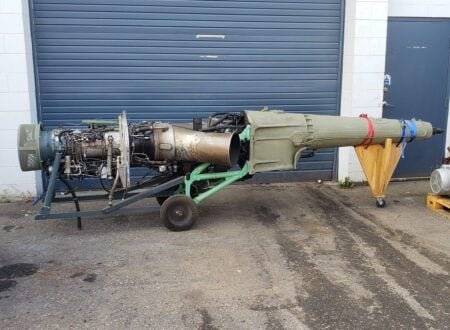
The engine that Tucker chose was the 6V4-178, it was an air-cooled 335 cubic inch (5.5 liter) flat-six with a 4.5 inch bore and a 3.5 inch stroke, type certificated in March of 1946 and rated at 178 bhp at 3,000 rpm. It was built to stand vertically in a helicopter, and it powered the early Bell 47.
A helicopter engine spends its life at relatively steady load and at a steady speed. Franklin’s operating manual said an engine run past 3,600 rpm had to be removed from service for a full overhaul. Making it behave like a car engine, where it would be used up and down its rev range, fell to Tucker engineers Eddie Offutt and Dan Leabu, with help from Preston Tucker Jr – they did it in just 55 days.
The air-cooled finned cylinder barrels were discarded for new aluminum castings, each containing three cylinders and water passages, topped by three-cylinder heads, and the timing cover was reworked to contain a belt-driven water pump. The engine was converted from air-cooling to liquid-cooling to make it better suited to automobile use, but it added significantly to the amount of work the men had to do.
A coil and Autolite distributor replaced the aircraft magneto, and a two-barrel Stromberg AAV-26 downdraft carburetor went onto an intake warmed by engine coolant. The Franklin’s valve gear layout carried over, with a gear-driven camshaft, pushrods, and hydraulic tappets, and the camshaft was changed for better idling characteristics. The compression ratio was now 7:1, and the electrical system ran at 6-volts. This new version of the engine was named the Tucker 335.
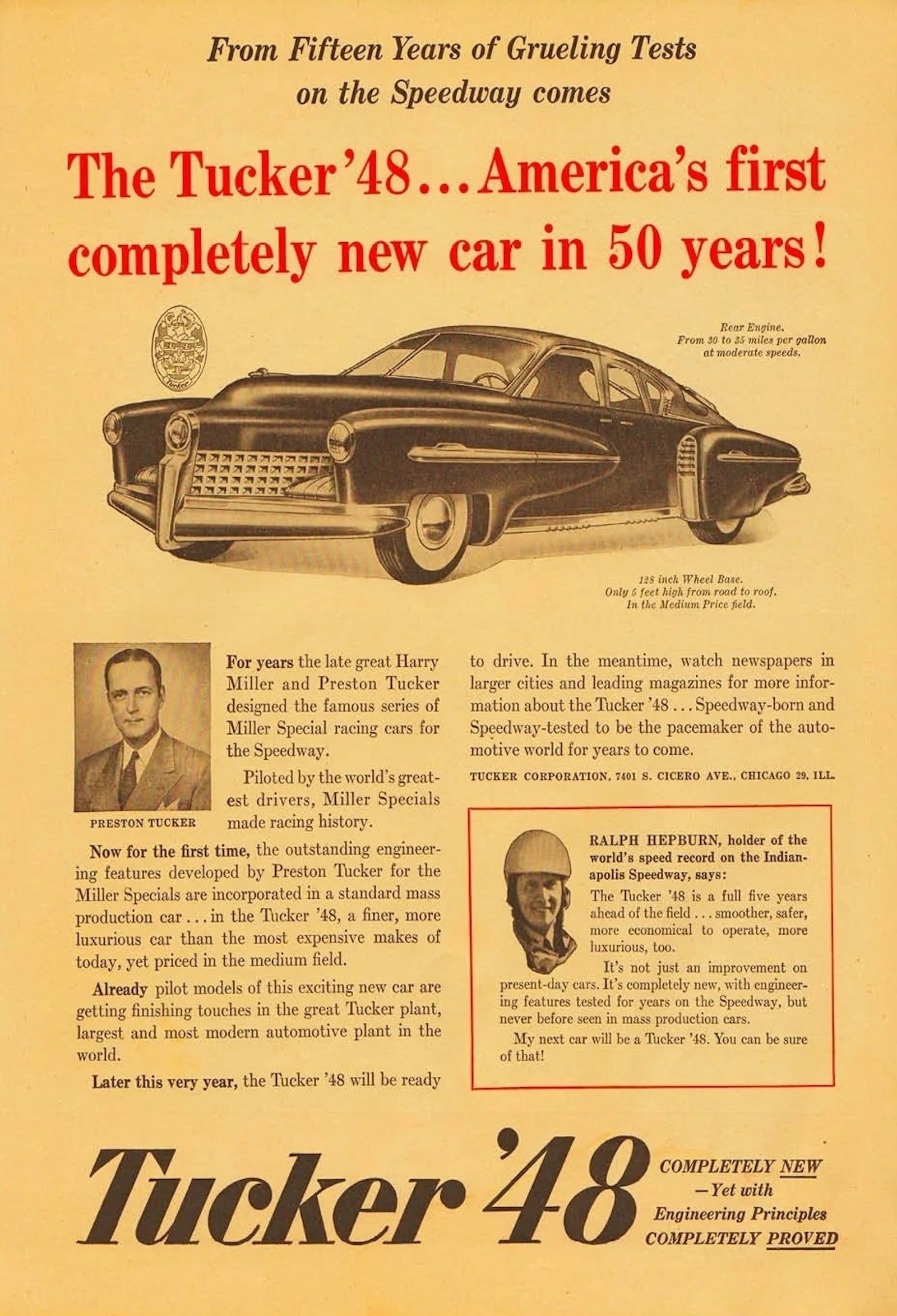
The Tucker 48 was almost inarguably the most interesting, unusual, and exciting American car that appeared in the immediate post-WWII period – a time when people were clamoring for new car designs and not just rehashed vehicles from before the war. Image courtesy of the Tucker Archives.
The Tucker 335 Output + Performance
Tucker claimed 166 bhp and 372 lb ft of torque for the newly created Tucker 335, versus the helicopter engine’s 178 bhp. The twin torque converters went the way of the A-589, in their place the cars used 4-speed preselector transaxles, either reconditioned units from prewar front-wheel drive Cords, or Tucker’s own version of the design, the Y-1. Warren Rice also developed an automatic, the Tuckermatic, before production stopped.
Tom McCahill, the first writer to test drive a Tucker 48, drove one for a report published in August of 1948. He timed 0 to 60 mph at 10 seconds and saw a 105 mph top speed on a public road, with the car still accelerating when a truck got in the way. Motoring journalism was evidently a little more exciting back then.
Tucker Buys Franklin
In March of 1948, 11 days after the first production car was shown to shareholders, Tucker announced it had bought Aircooled Motors from Republic Aviation for $1,800,000 USD (about $25.2 million in 2026 dollars). The factory had earned $398,000 USD (about $6.0 million USD in 2026) the year before, and Tucker said the car engine program wouldn’t cut into its aircraft engine output.
The story of the end of Tucker has been told many times and in many different ways so we won’t rehash it here, ultimately, federal bankruptcy trustees took over the Tucker Corporation on March the 3rd, 1949. 51 cars were assembled in all, the prototype included, and auction records show that 13 of them were sold without transmissions in place.
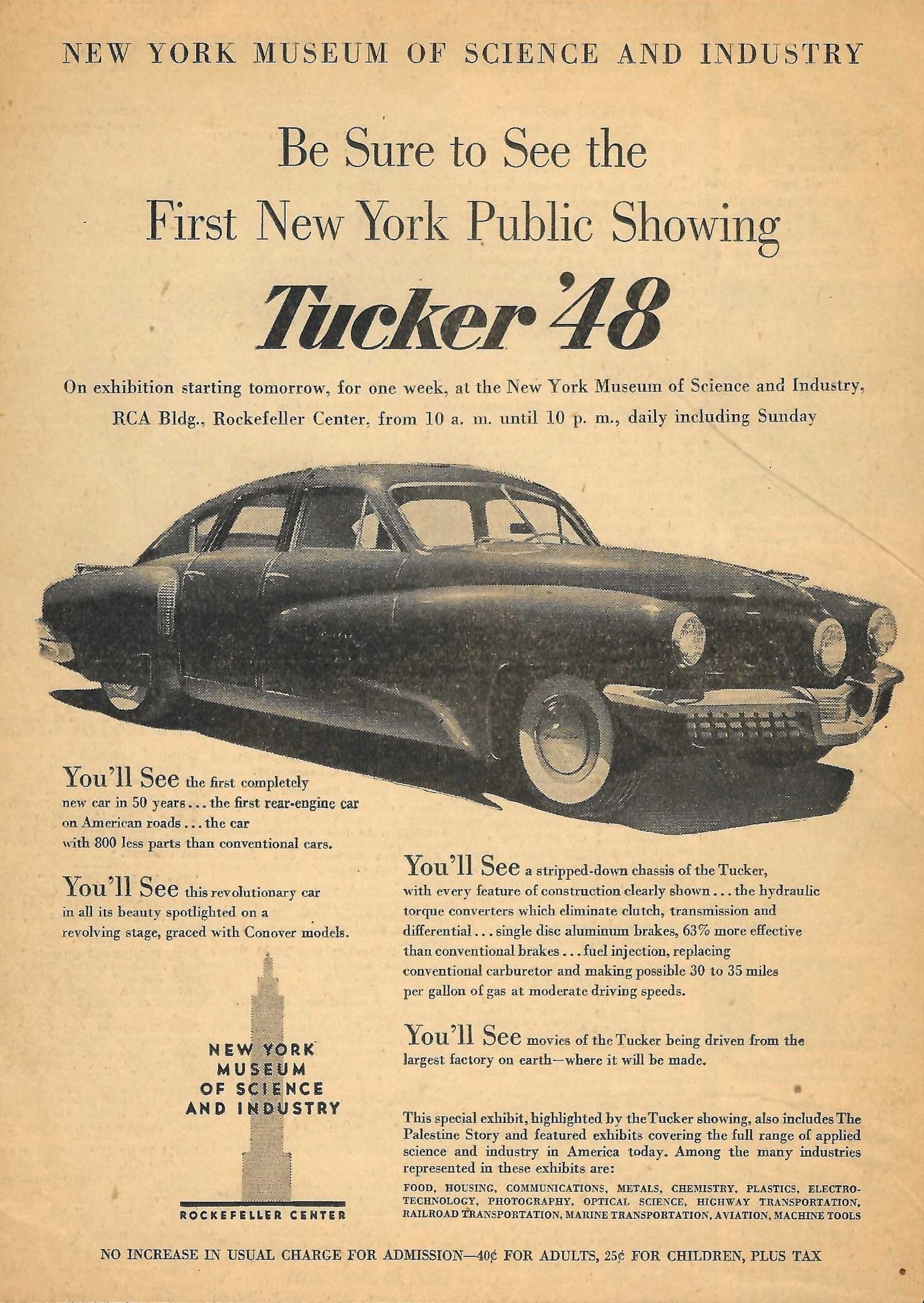
The production version of the Tucker 48 got the Tucker 335 engine, it was good for 166 bhp and 372 lb ft of torque – highly-respectable numbers for the time. Image courtesy of the Tucker Archives.
Interestingly, Aircooled Motors outlasted the Tucker. The company remained with the Tucker family and kept busy through the 1950s, largely with helicopter engines, until it was sold in 1961 to Aero Industries, which renamed it the Franklin Engine Company. The designs went to Poland in 1975, where Franklin engines remained in production until 2002.
The Tucker 48 Flat-Six Crate Engine Shown Here
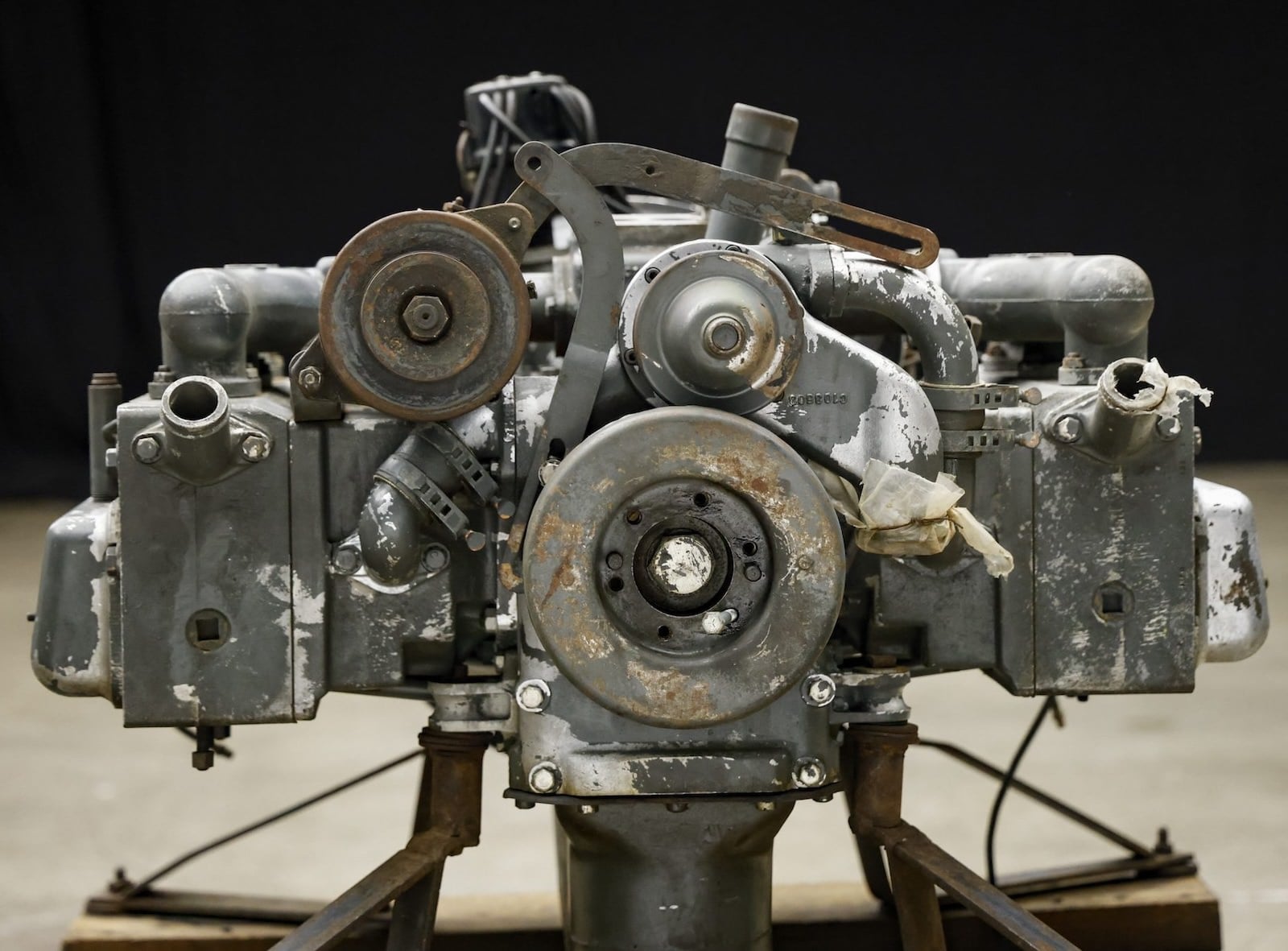
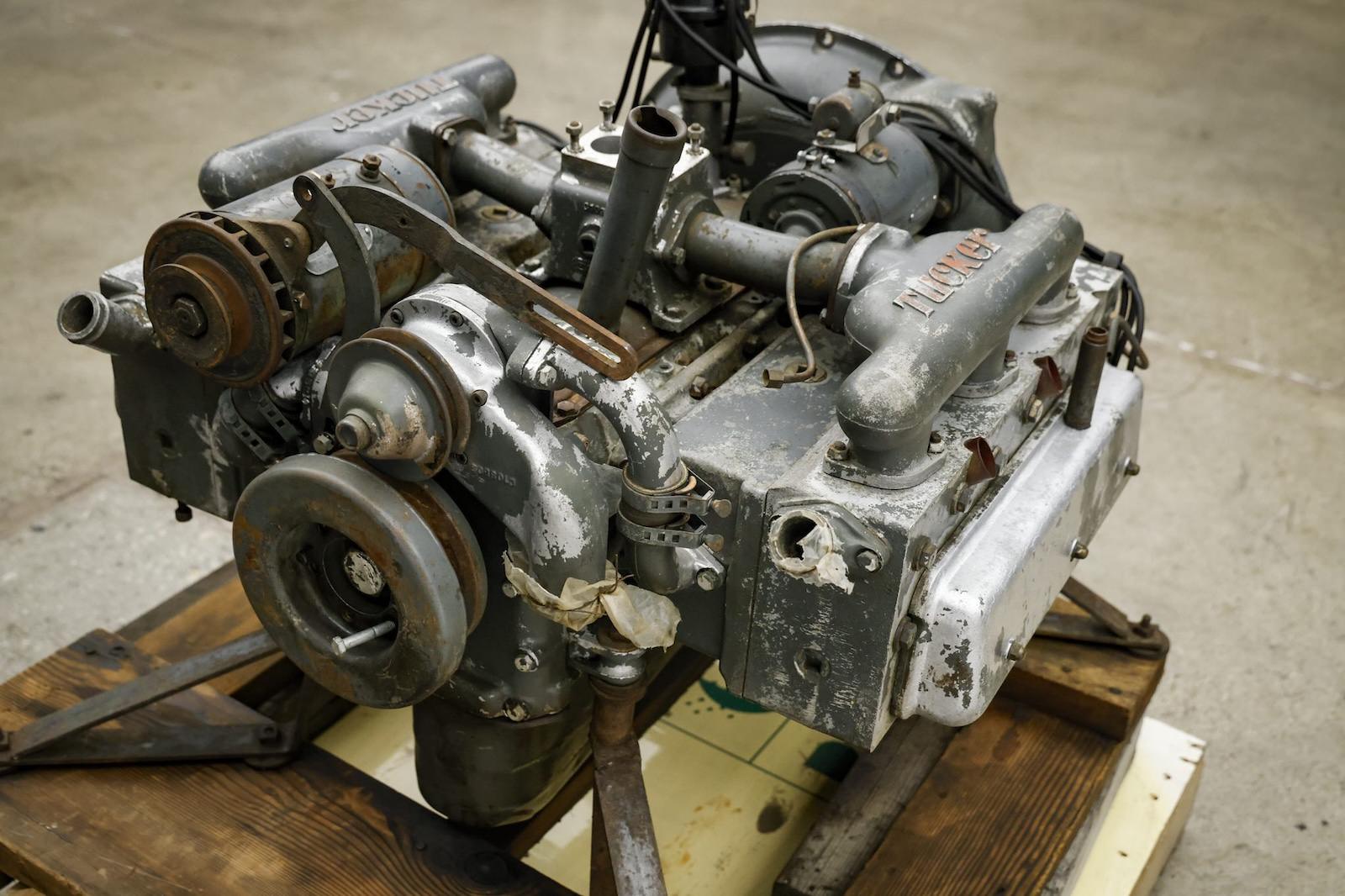
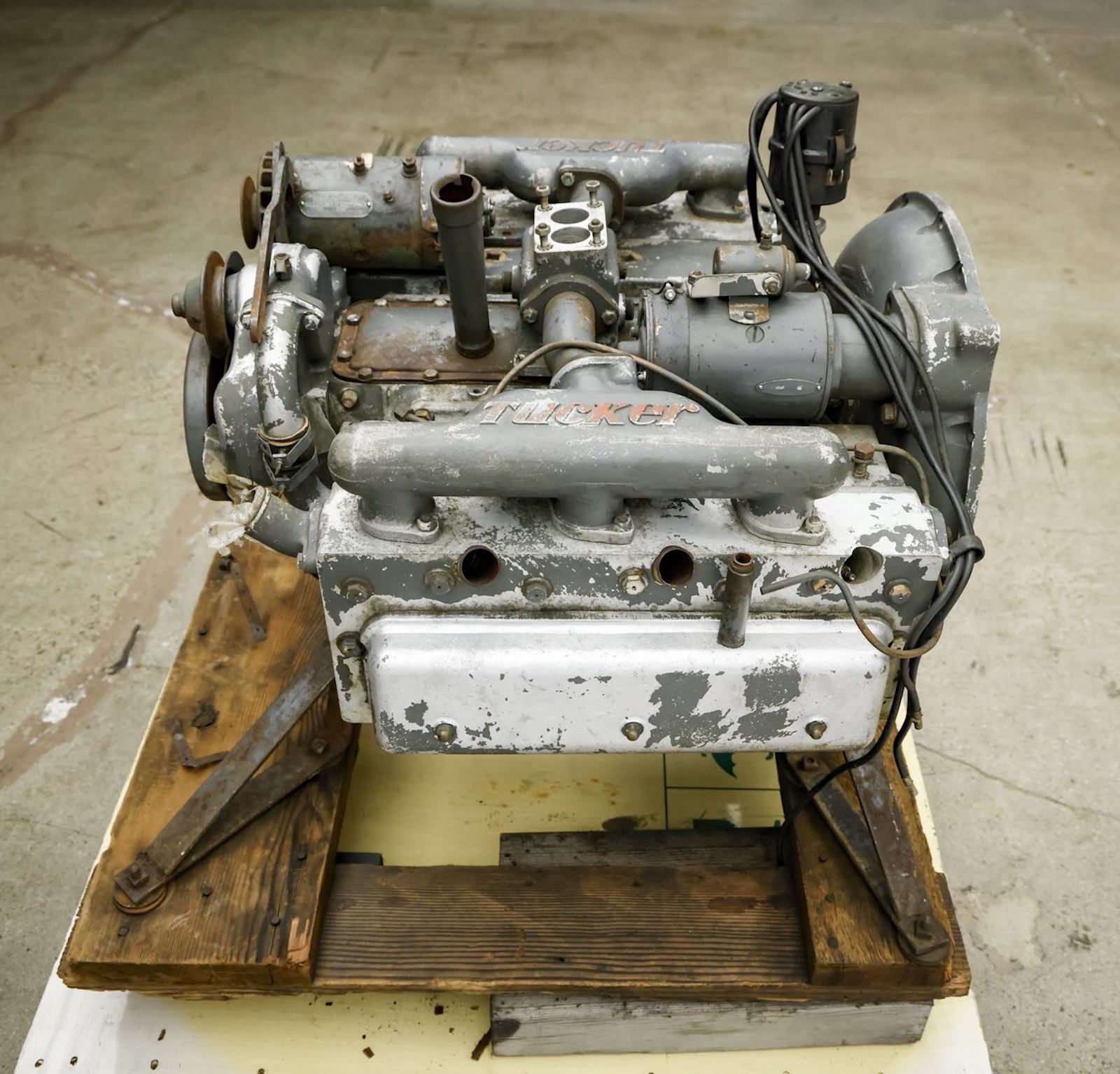
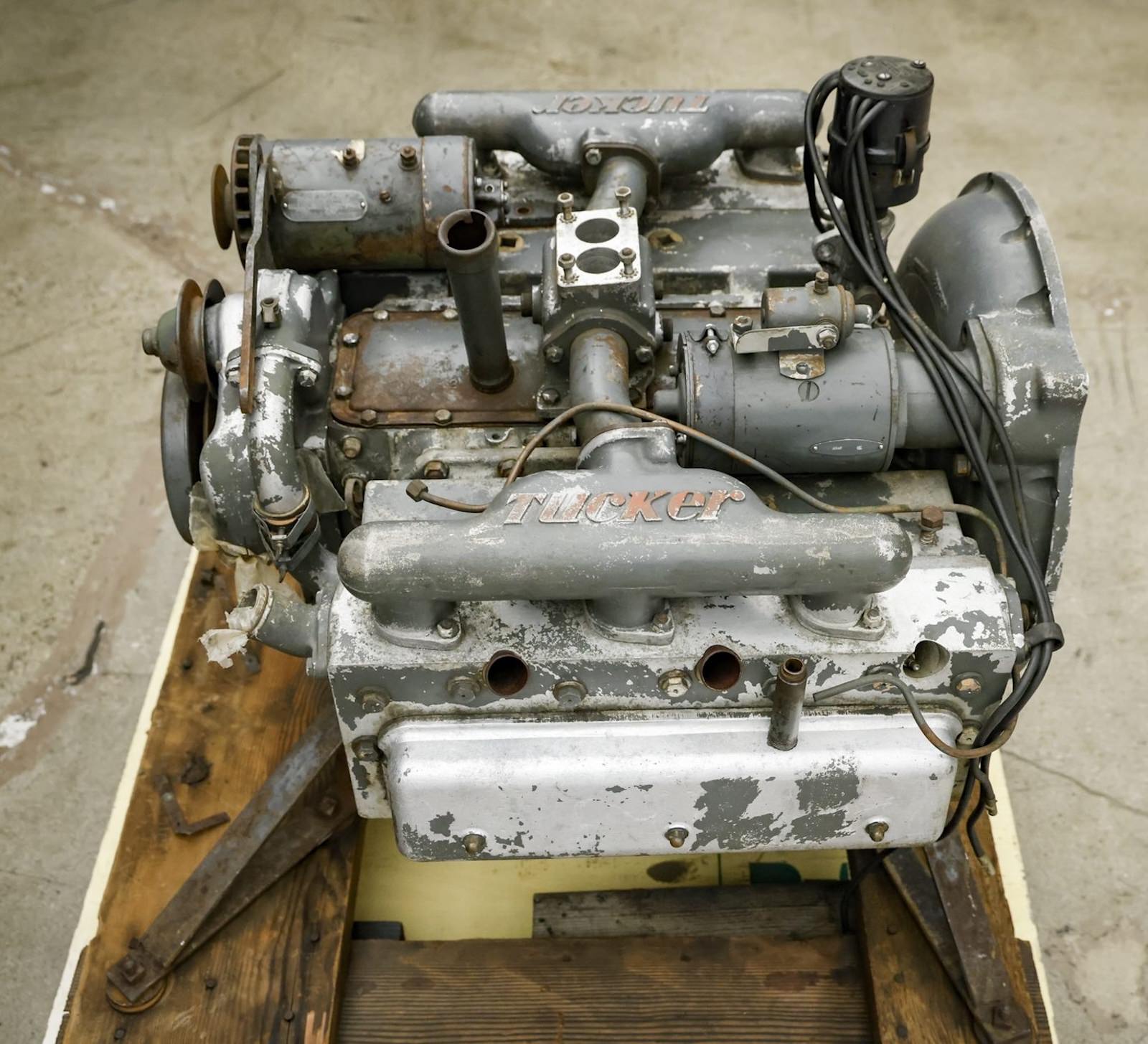
This is an original 334 cubic inch (5.5 liter) Tucker flat-six engine, reportedly manufactured for installation in a Tucker 48 automobile but never actually fitted to a vehicle. According to the owner, the engine has spent many years in a private collection, being carefully preserved in original, non-restored condition.
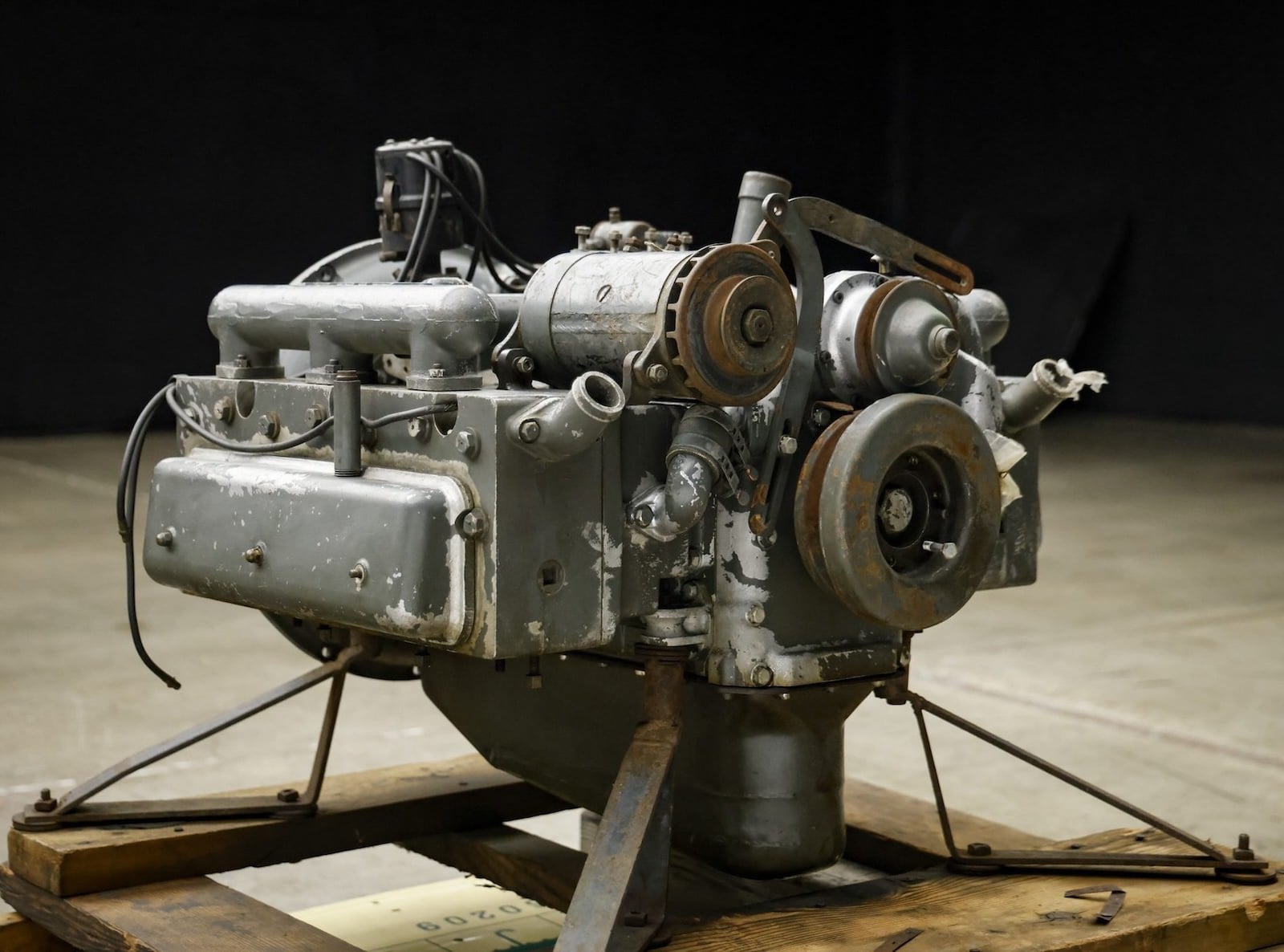
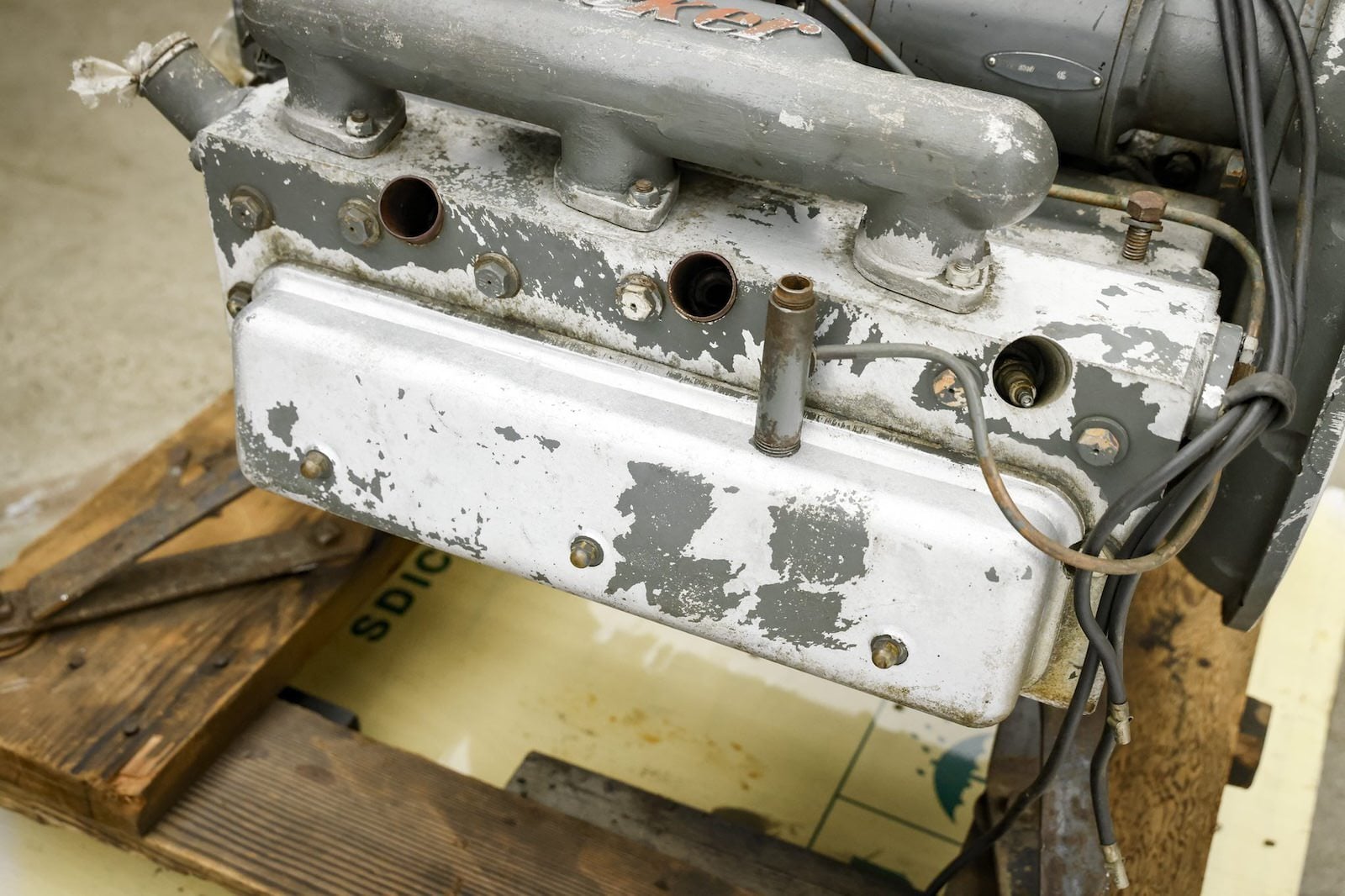
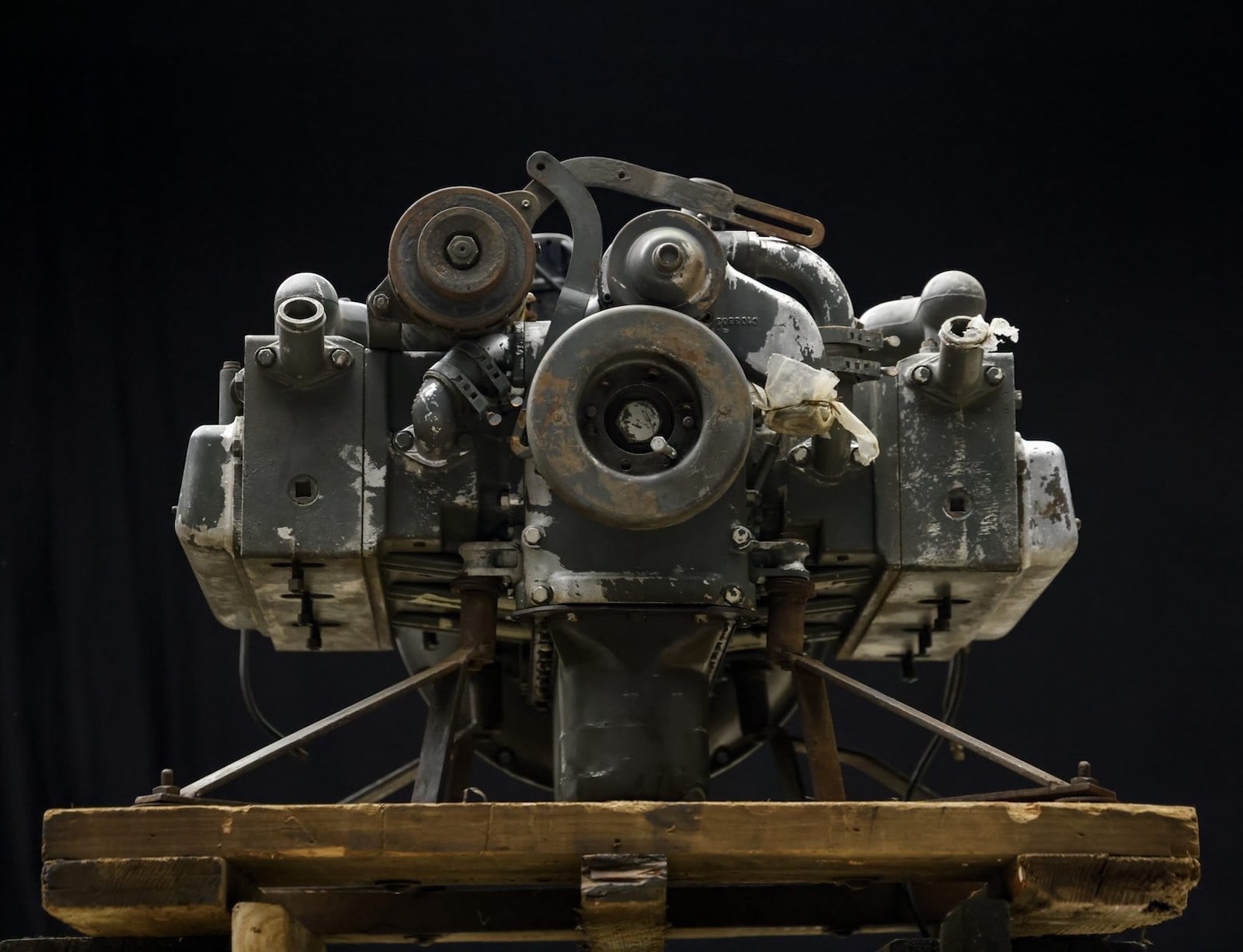
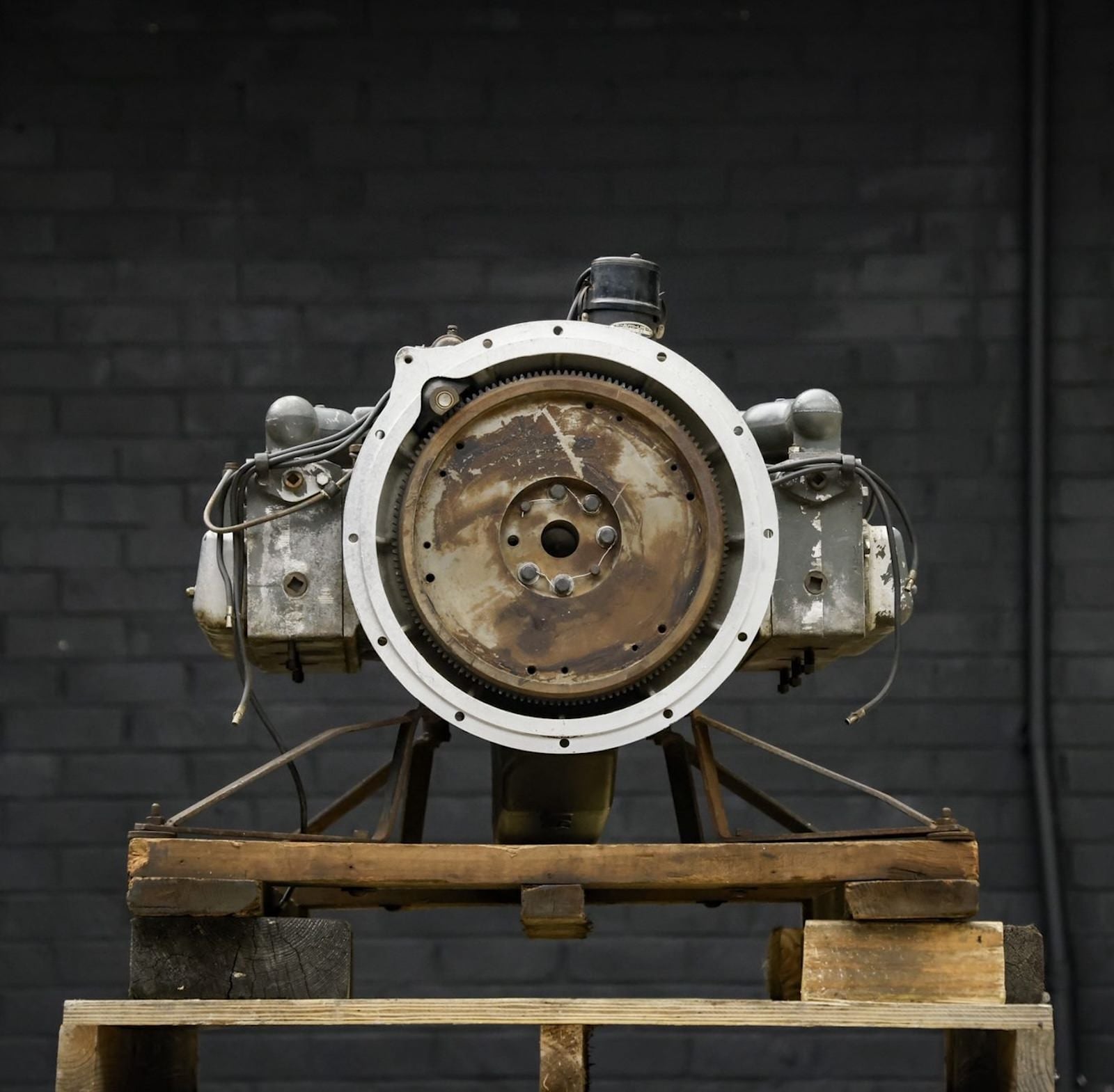
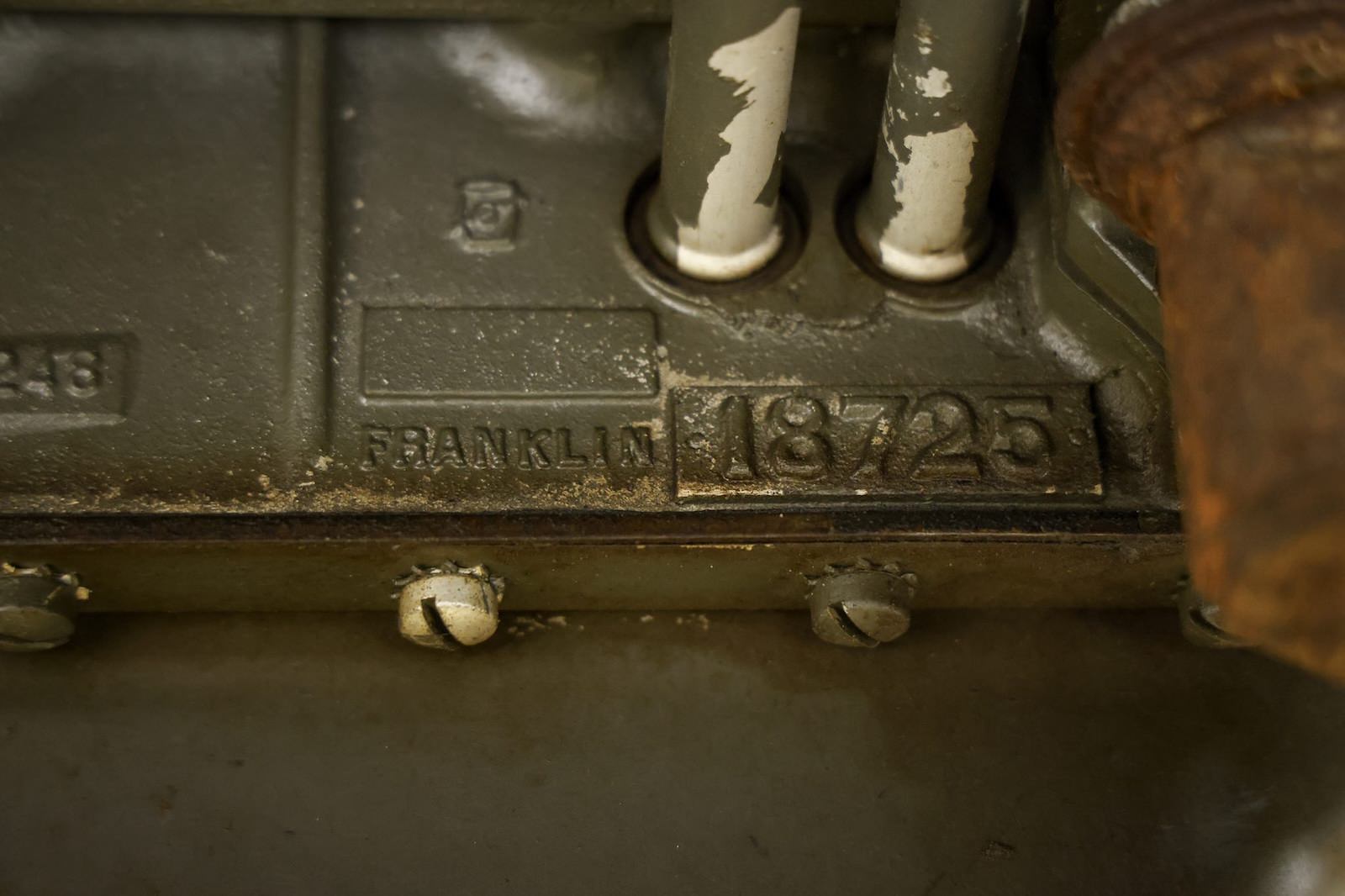
This flat-six has the engine number 33594, it’s based on the Franklin O-335 aircraft engine as they all were, and you can still see some Franklin branding on the engine on some of the original castings. It has a Franklin-marked central case cover and Tucker-branded intake manifolds, along with its flywheel, starter, Auto-Lite distributor, generator, water pump, and crankshaft pulley.
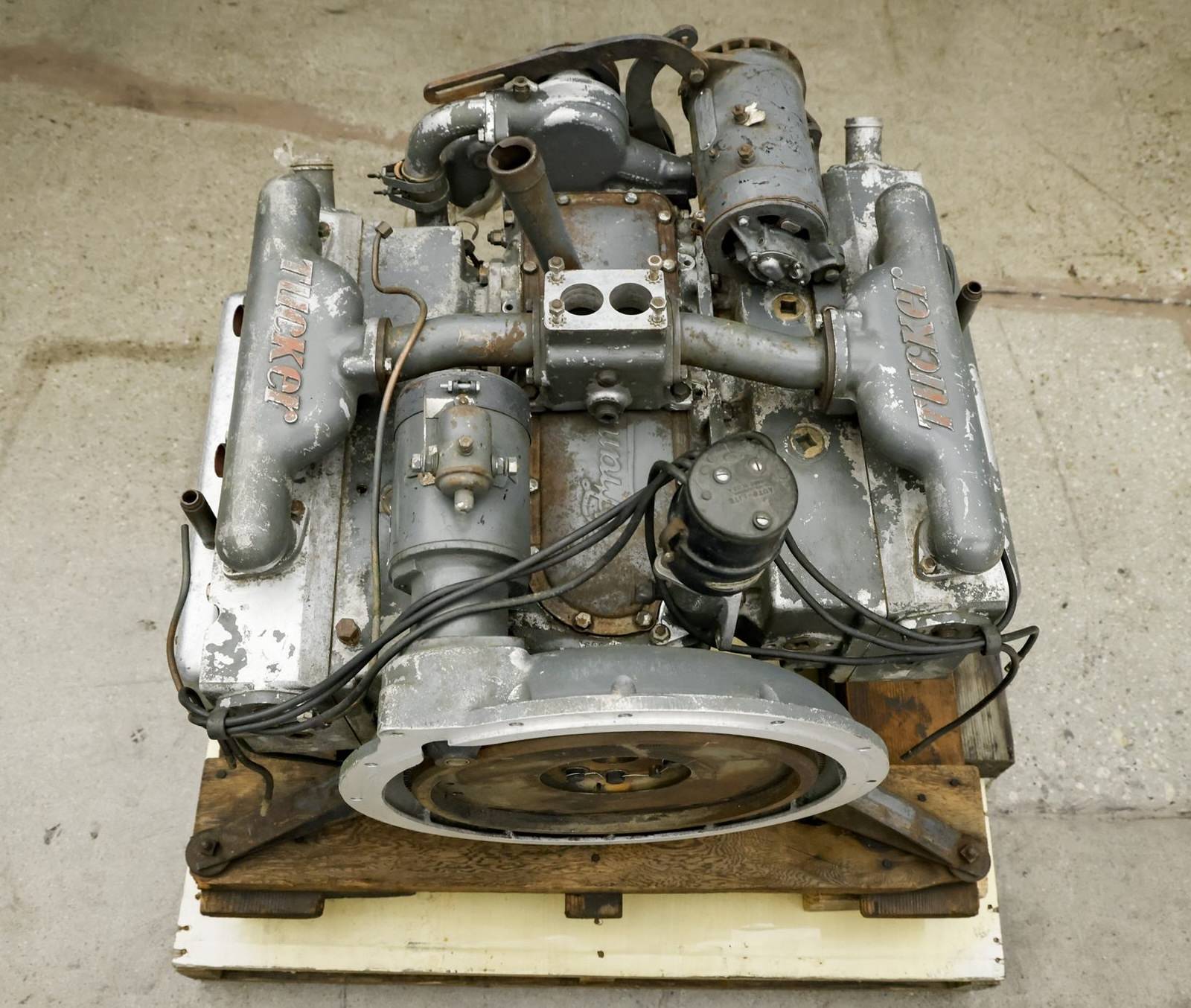
This is an original 334 cubic inch (5.5 liter) Tucker flat-six engine, reportedly manufactured for installation in a Tucker 48 automobile but never actually fitted to a vehicle. According to the owner, the engine has spent many years in a private collection, being carefully preserved in original, non-restored condition.
The engine is finished in worn gray paint and is mounted on a wooden pallet using steel brackets. Some flywheel bolts are missing, and remnants of plastic remain around several coolant passages. It’s not currently operational, and its internal mechanical condition is unknown. Realistically this would ideally be bought by a collector who wants to preserve it as is, or perhaps by a Tucker 48 owner who needs a new engine.
It’s now being offered for sale by the selling dealer out of California, with additional photographs documenting its identification number, casting marks, and surviving parts. If you’d like to read more or register to bid, you can visit the listing here.
Images courtesy of Bring a Trailer

Articles that Ben Branch has written have been covered on CNN, Popular Mechanics, Smithsonian Magazine, Road & Track Magazine, the official Pinterest blog, the official eBay Motors blog, BuzzFeed, Autoweek Magazine, Wired Magazine, Autoblog, Gear Patrol, Jalopnik, The Verge, and many more.
Silodrome was founded by Ben back in 2010, in the years since the site has grown to become a world leader in the alternative and vintage motoring sector, with well over a million monthly readers from around the world and many hundreds of thousands of followers on social media.