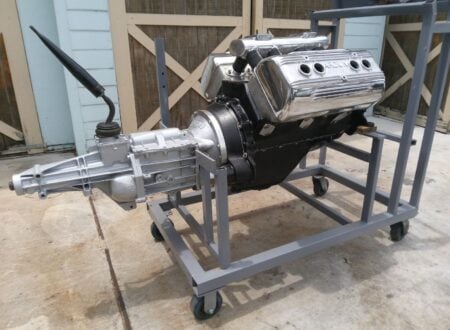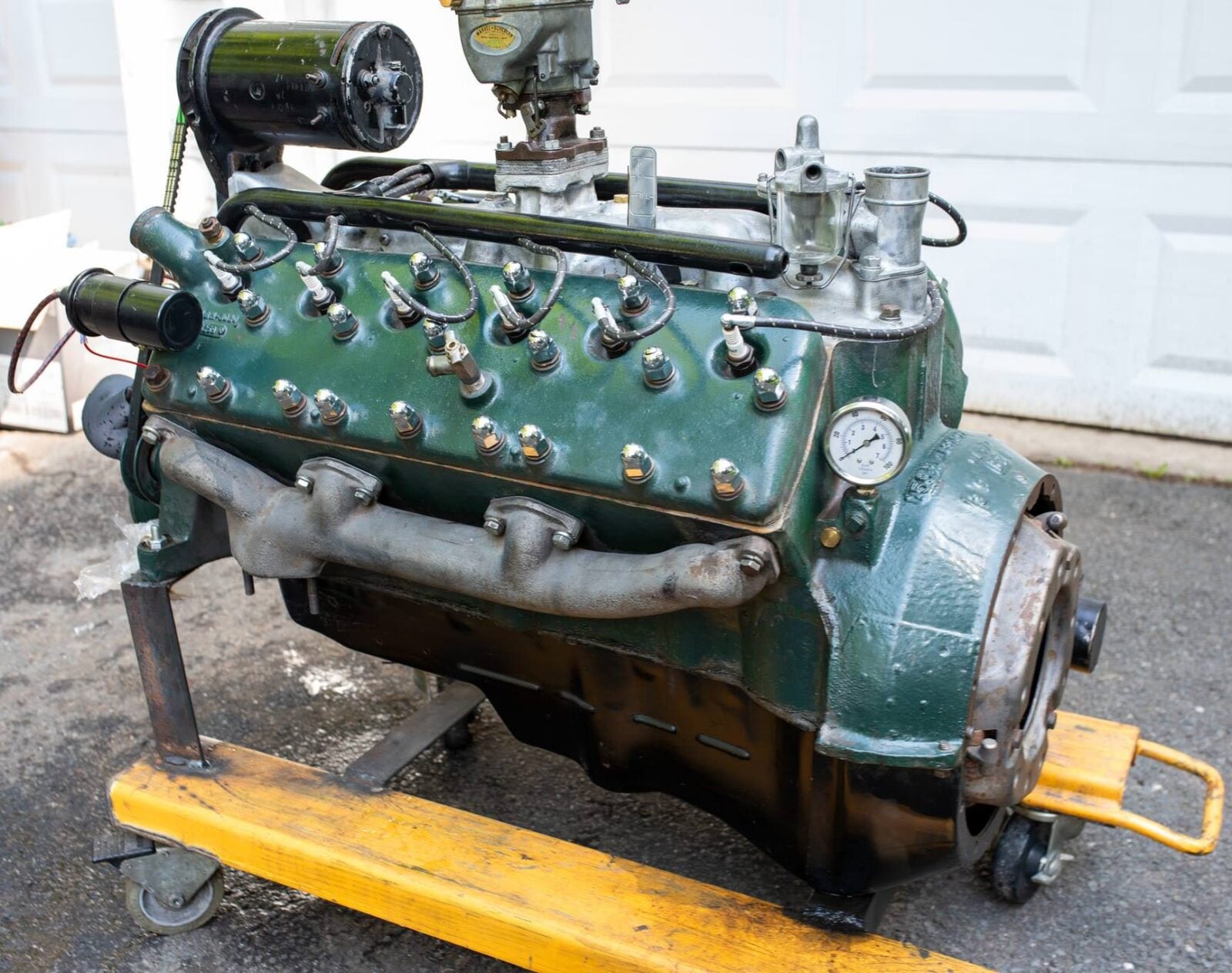
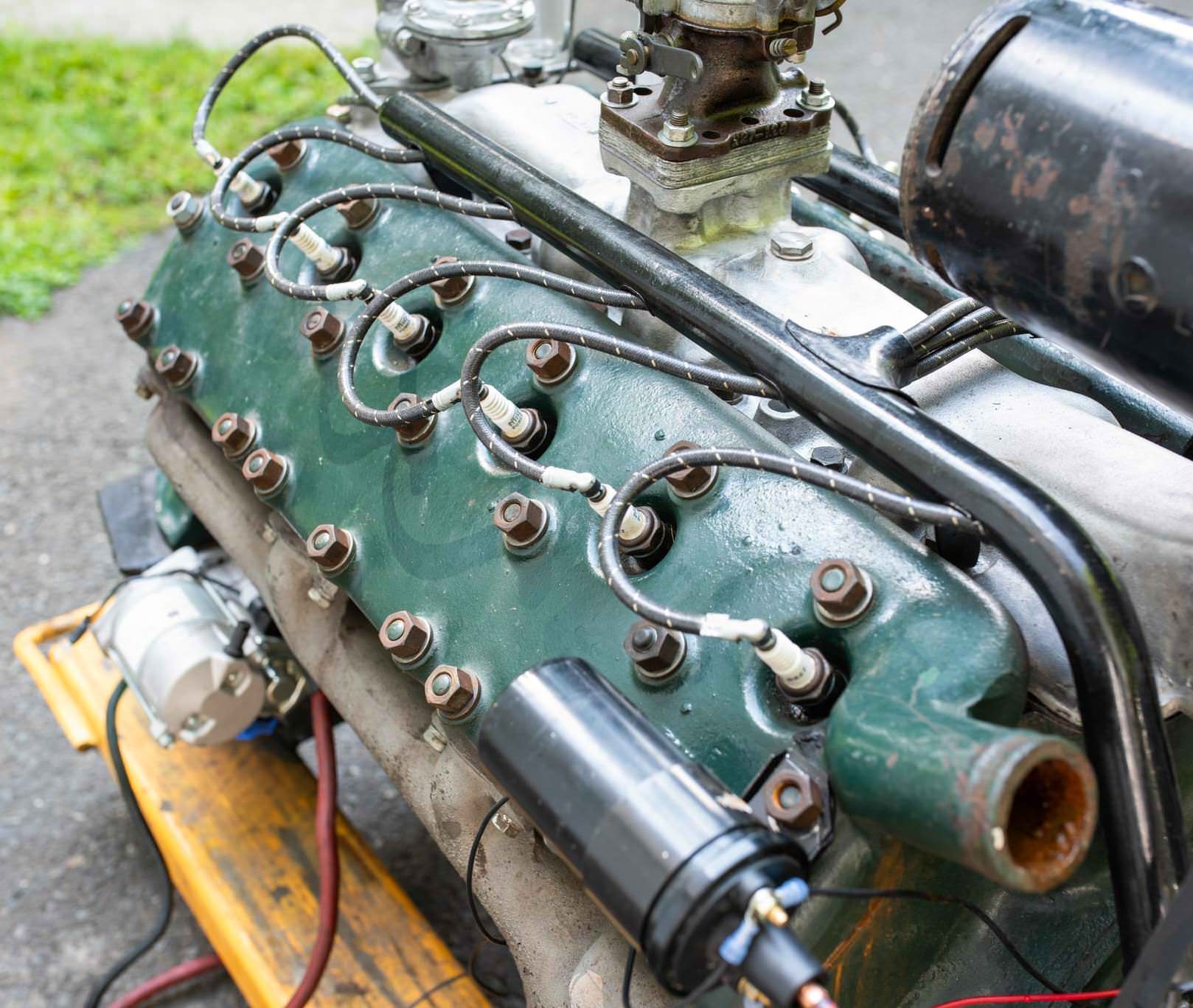
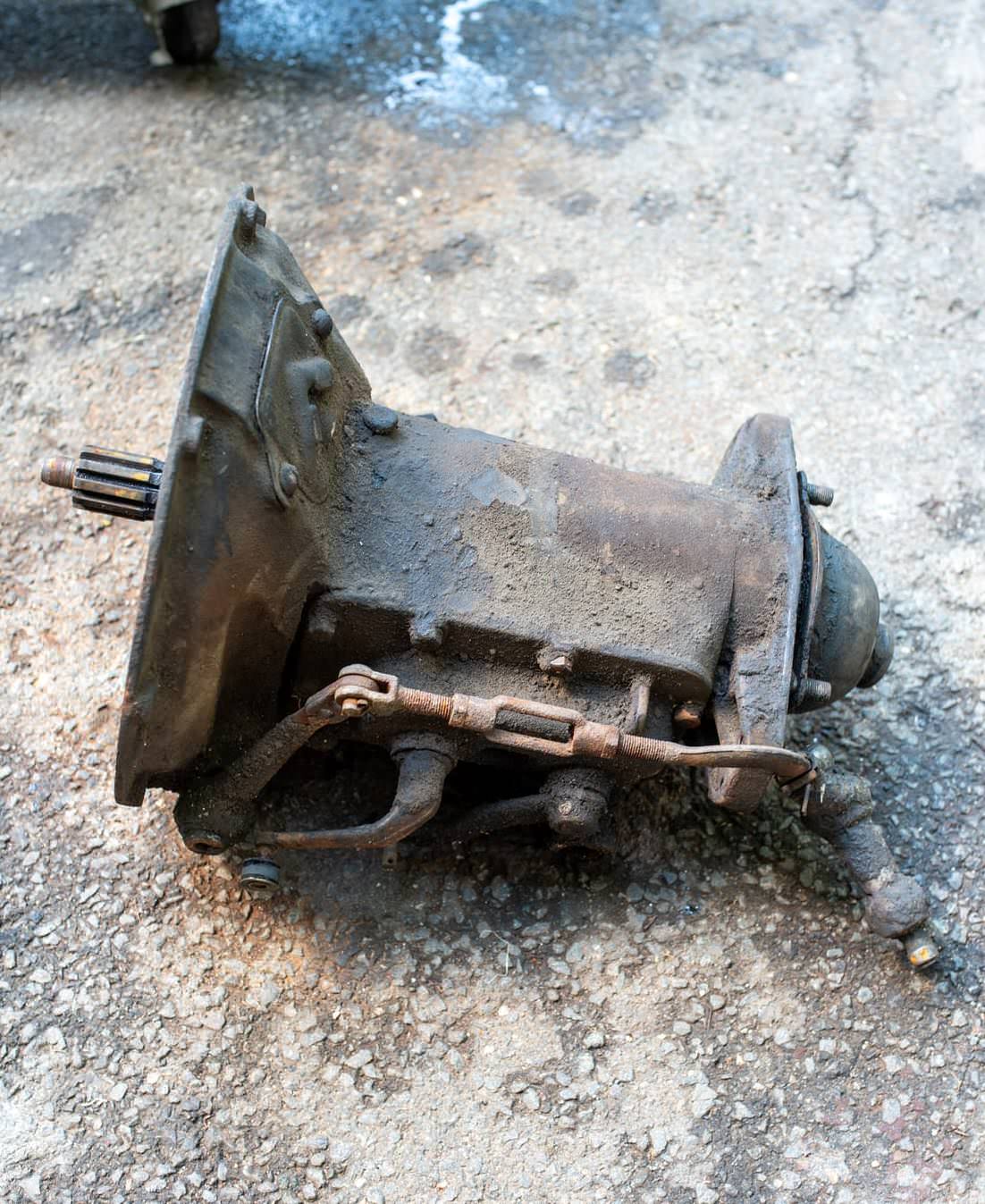
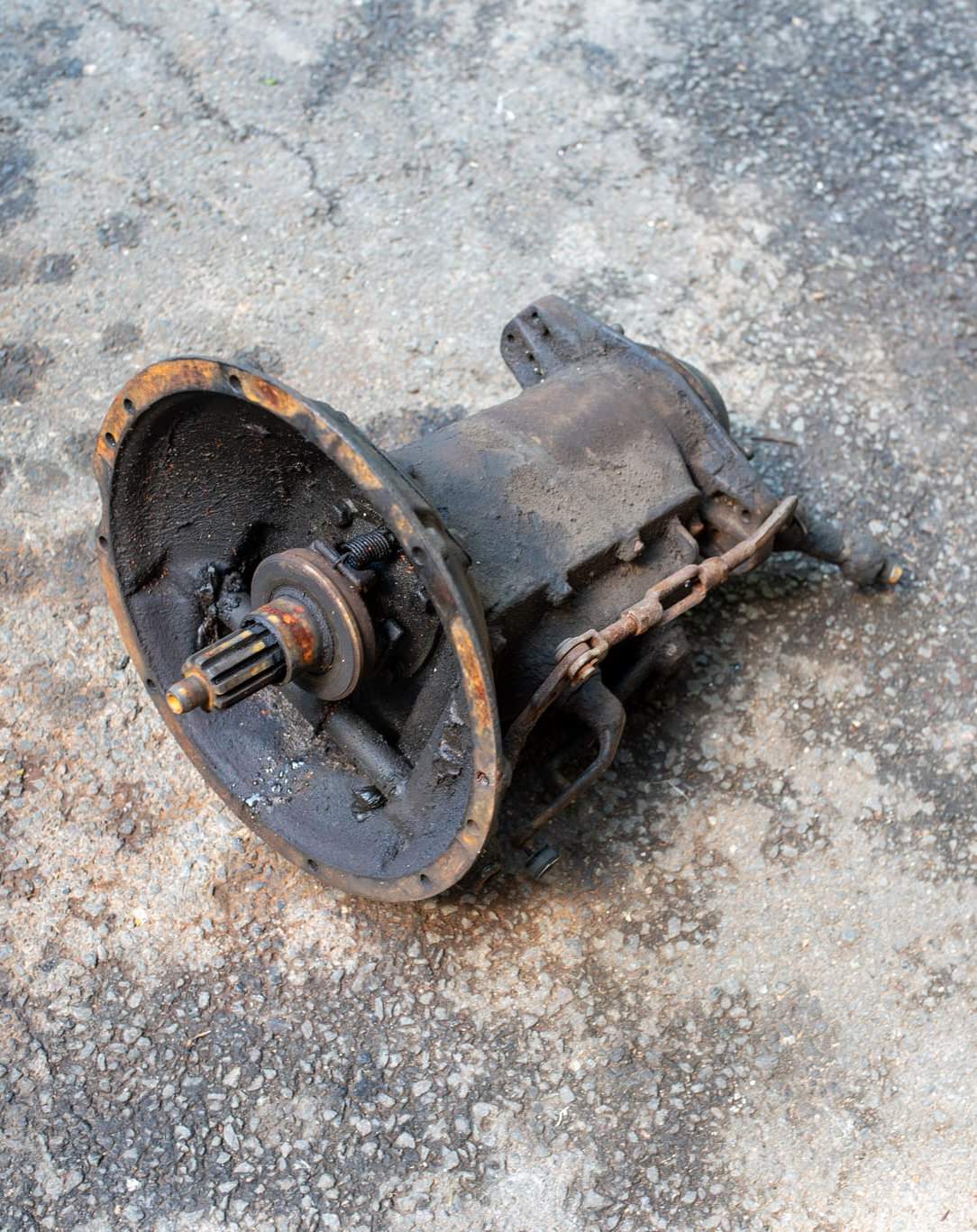
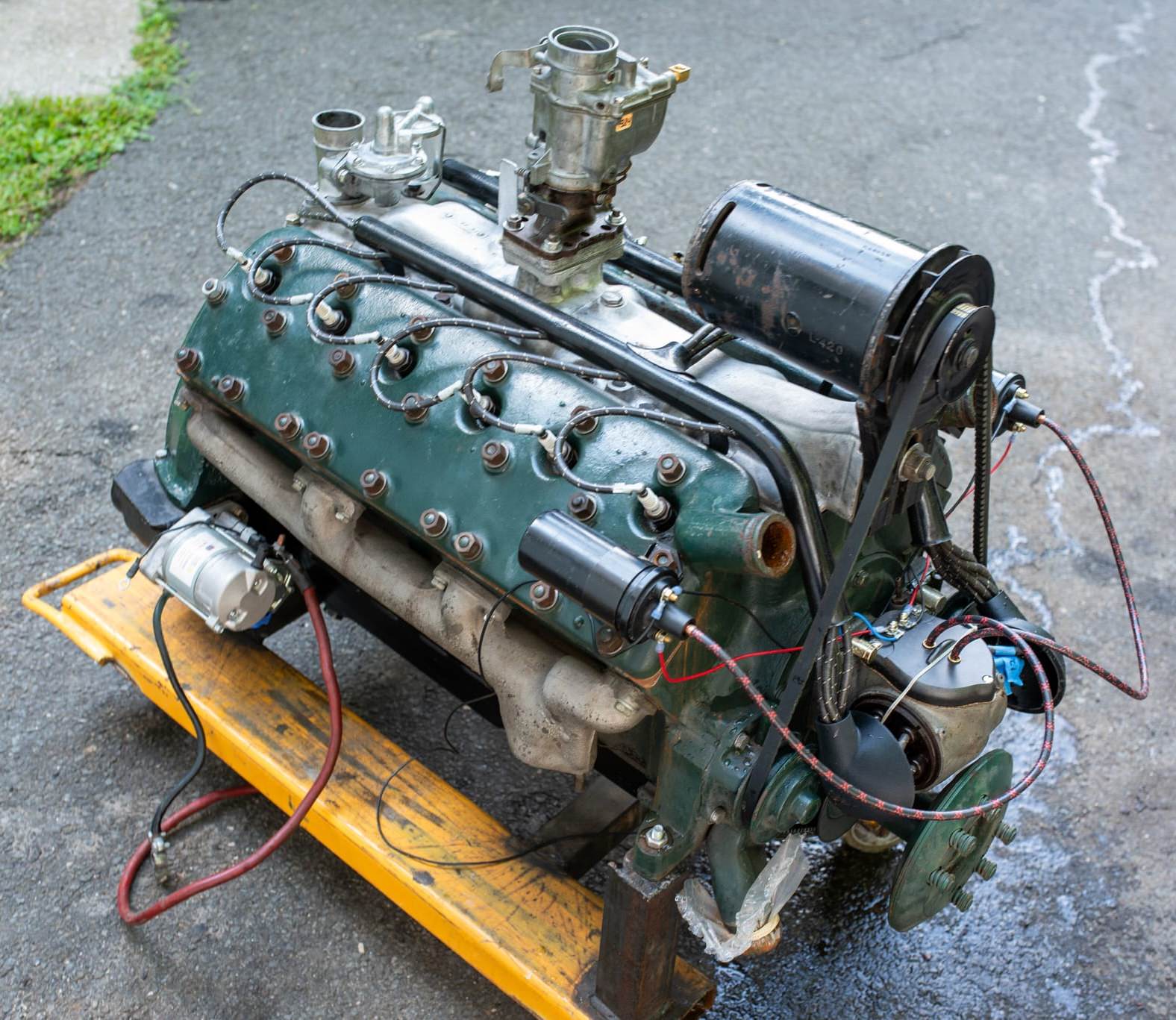
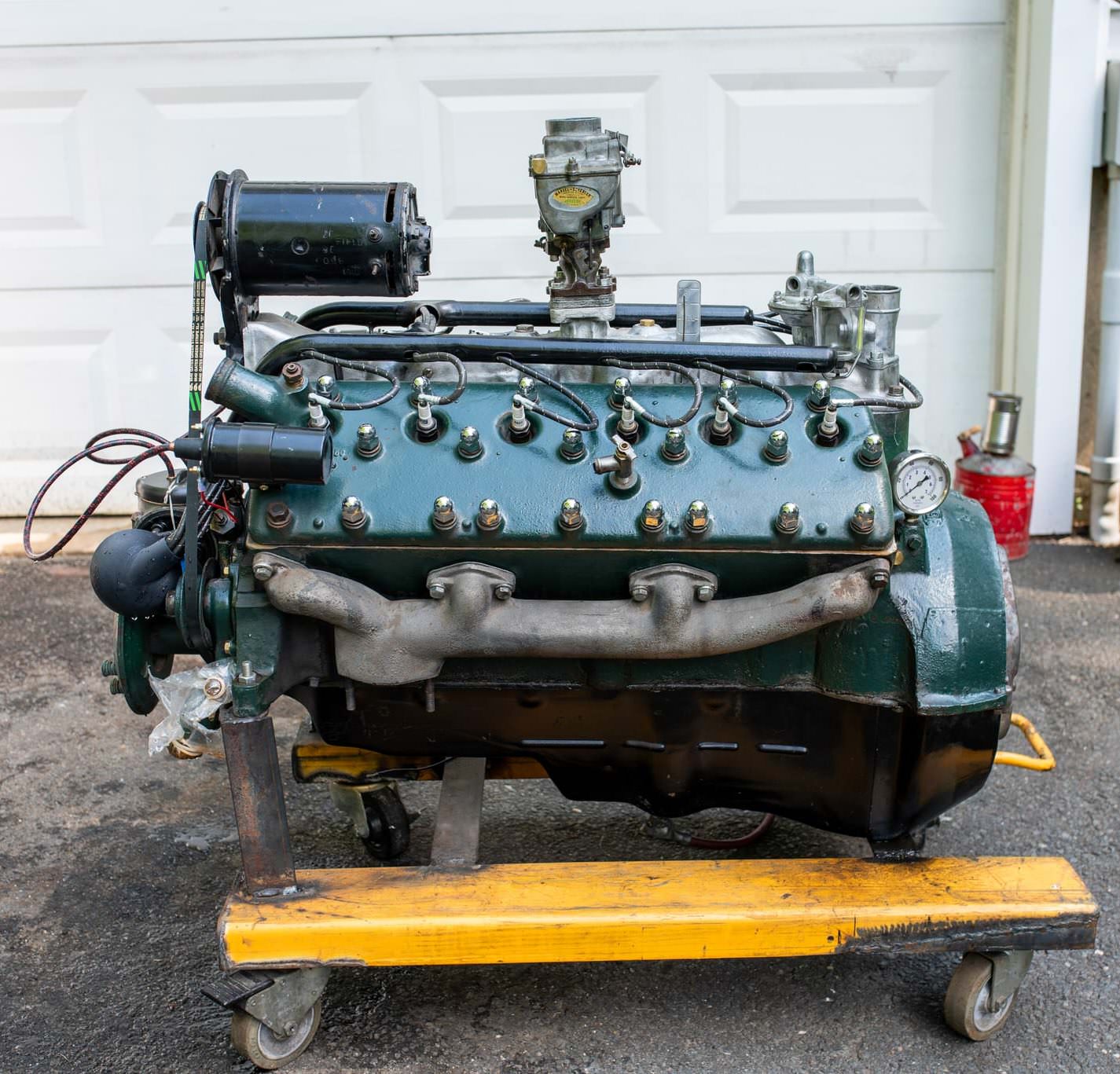
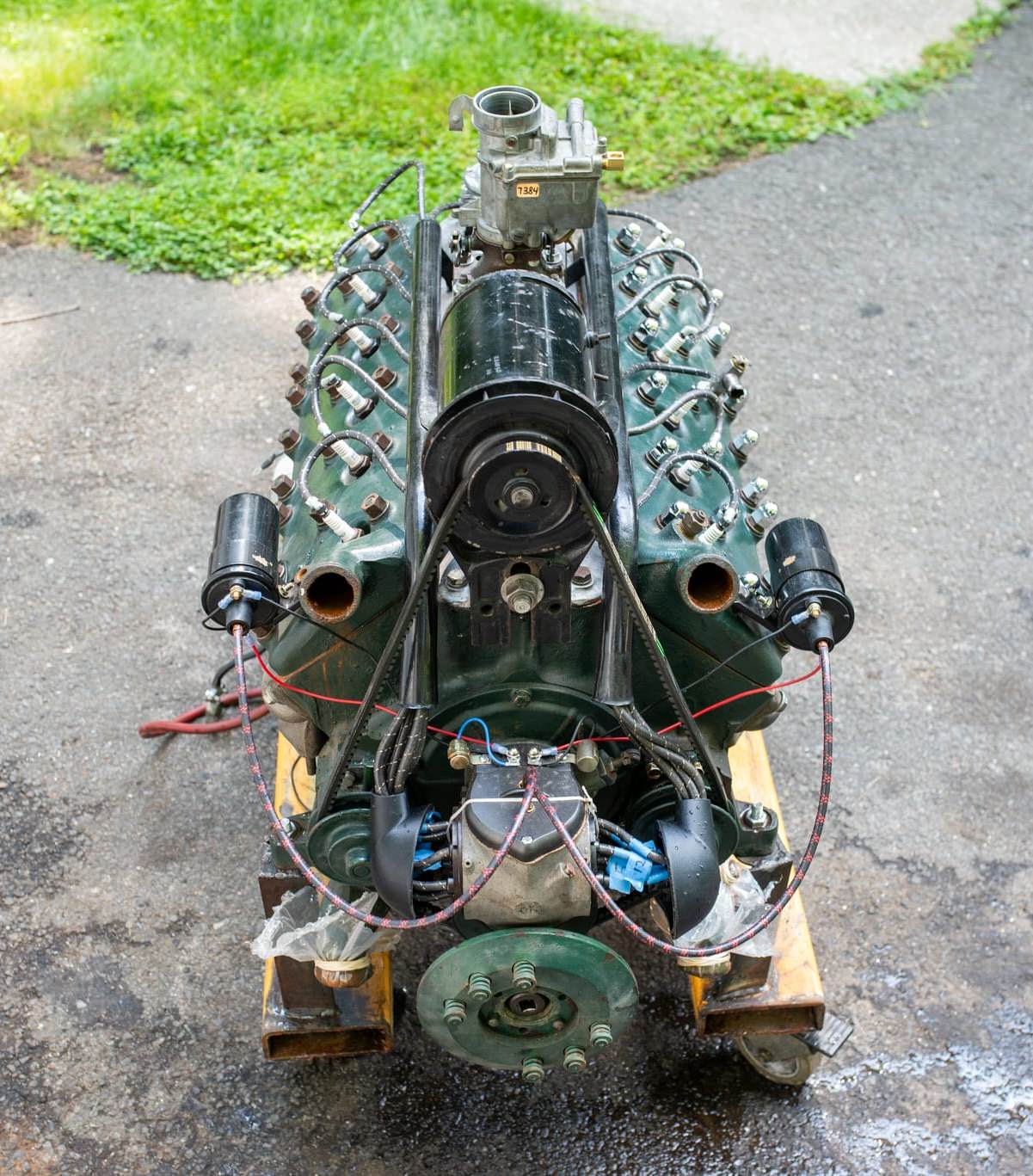
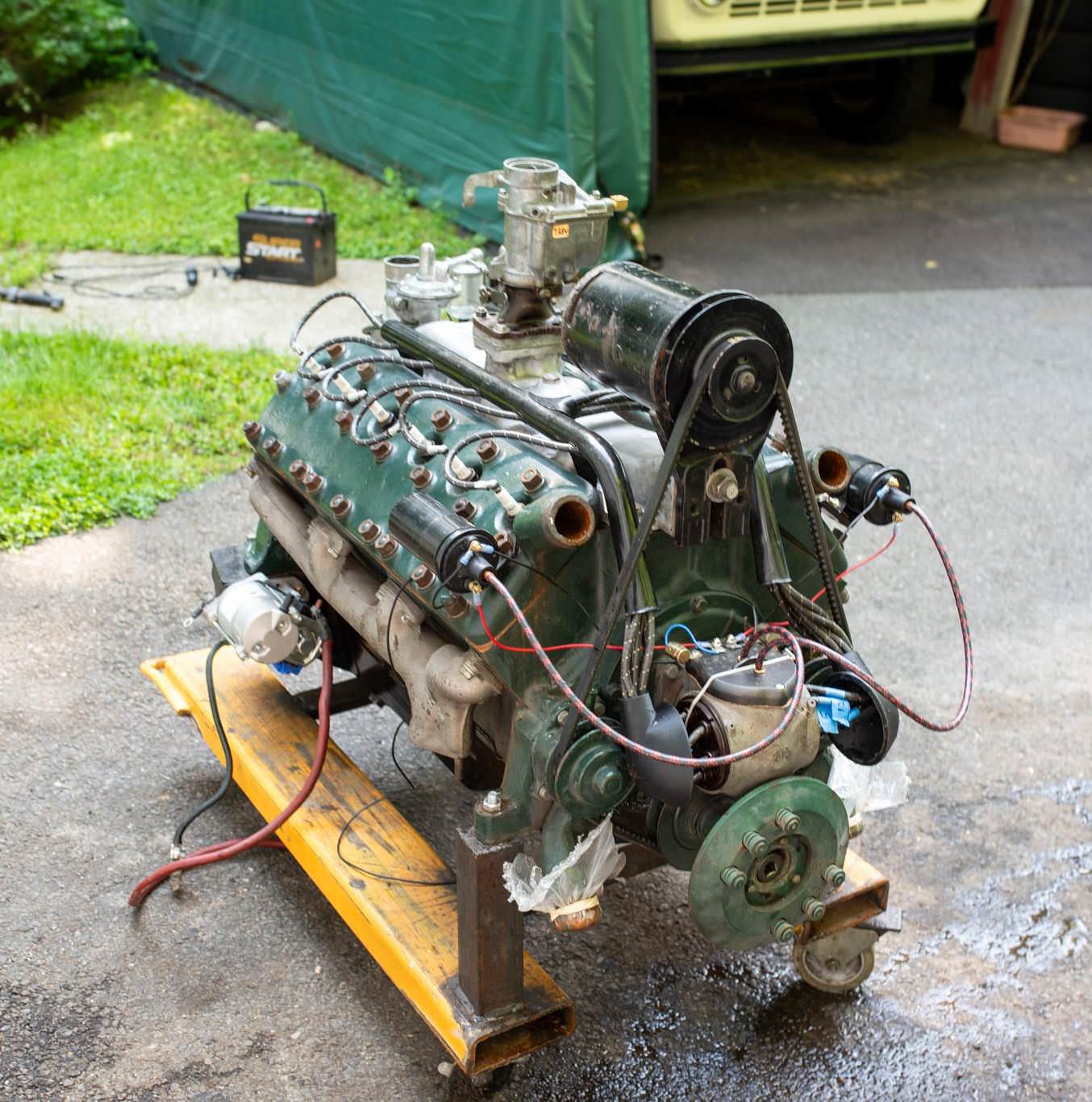
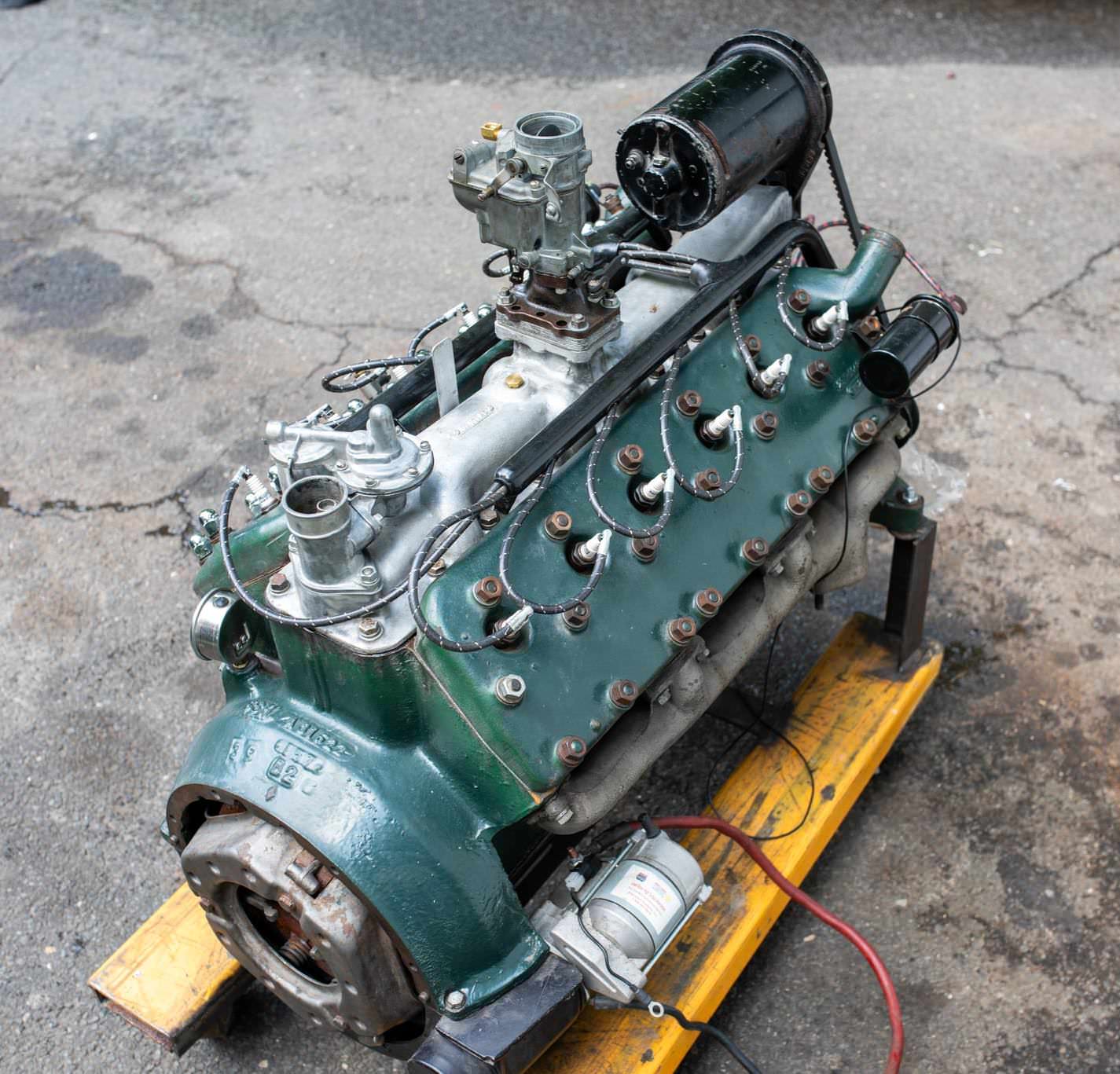
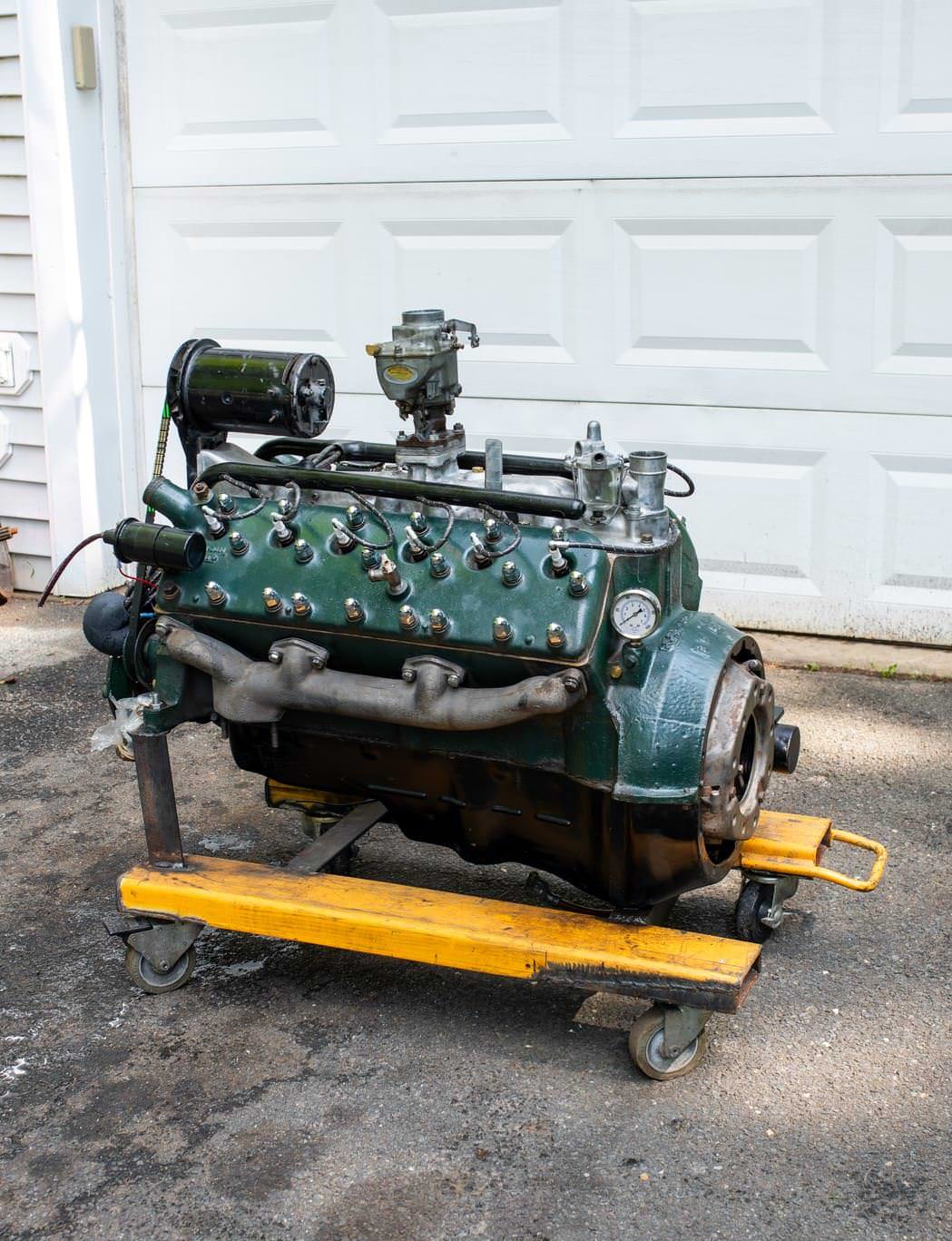
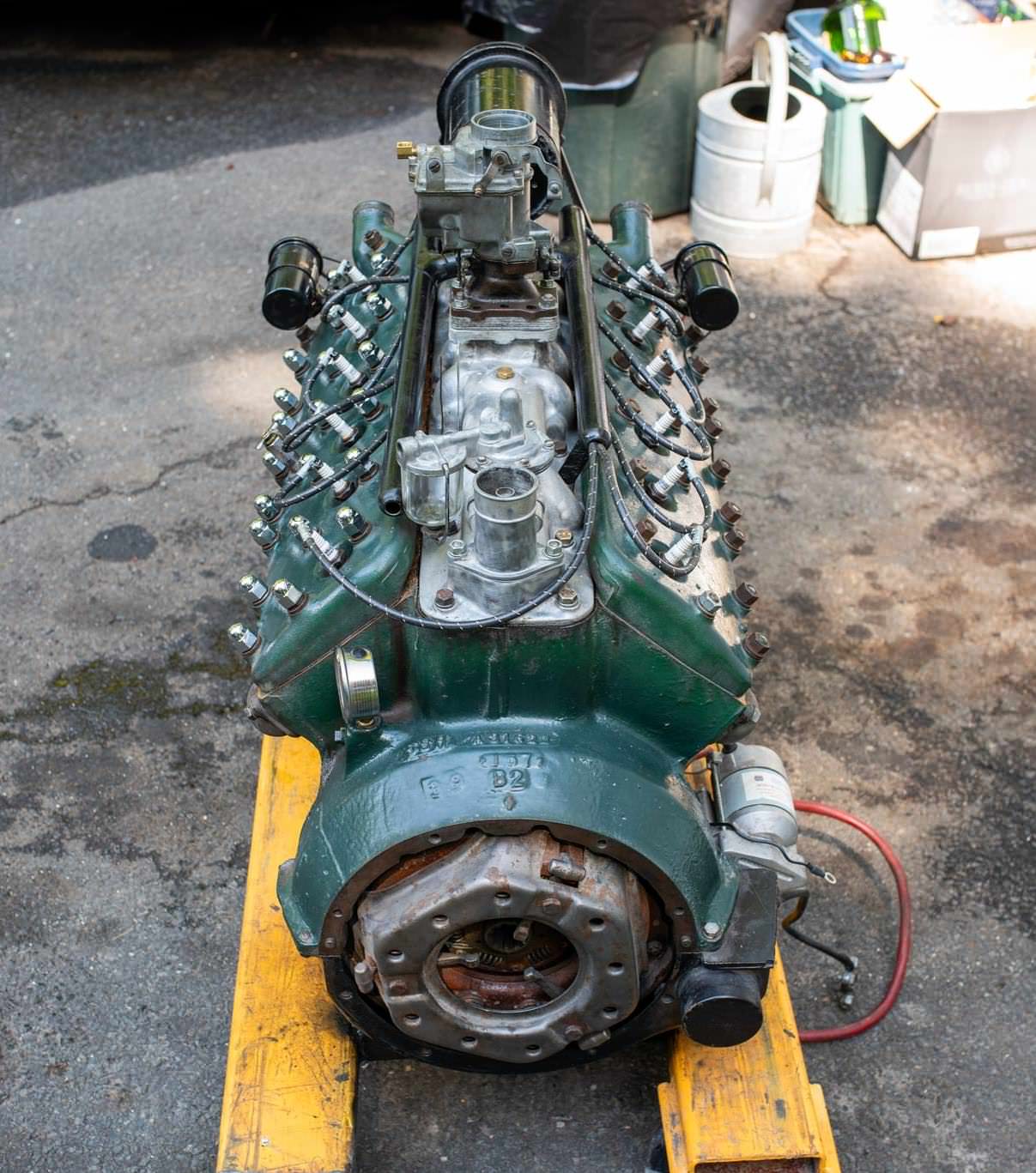
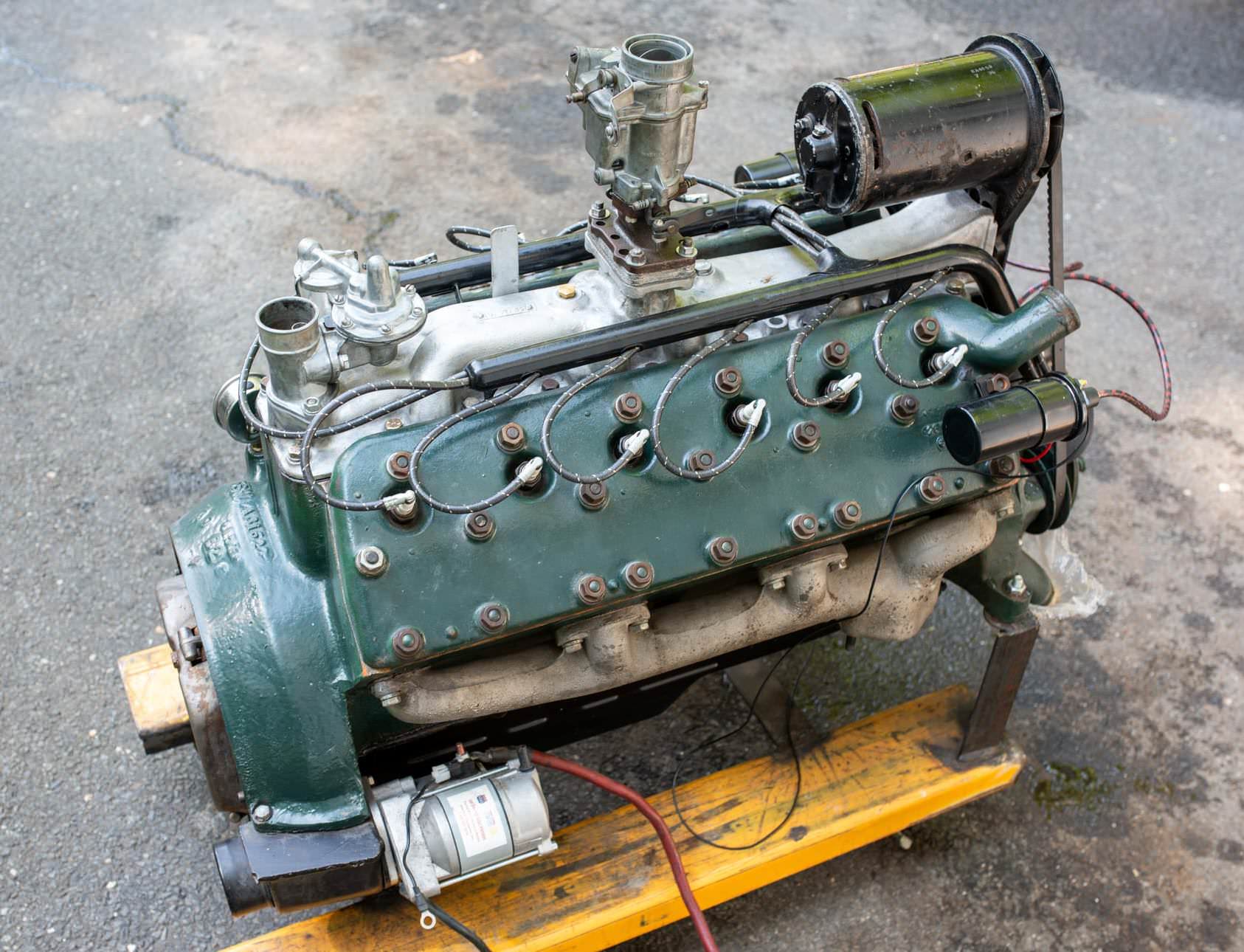
This is a 292 cubic inch (4.8 liter) Lincoln V12 engine, it comes with a correct 3-speed manual transmission and it came from a 1946-1948 model.
It would make an ideal backup or replacement unit, or the beginnings of a fantastic V12 hot rod build if the buyer so decides.
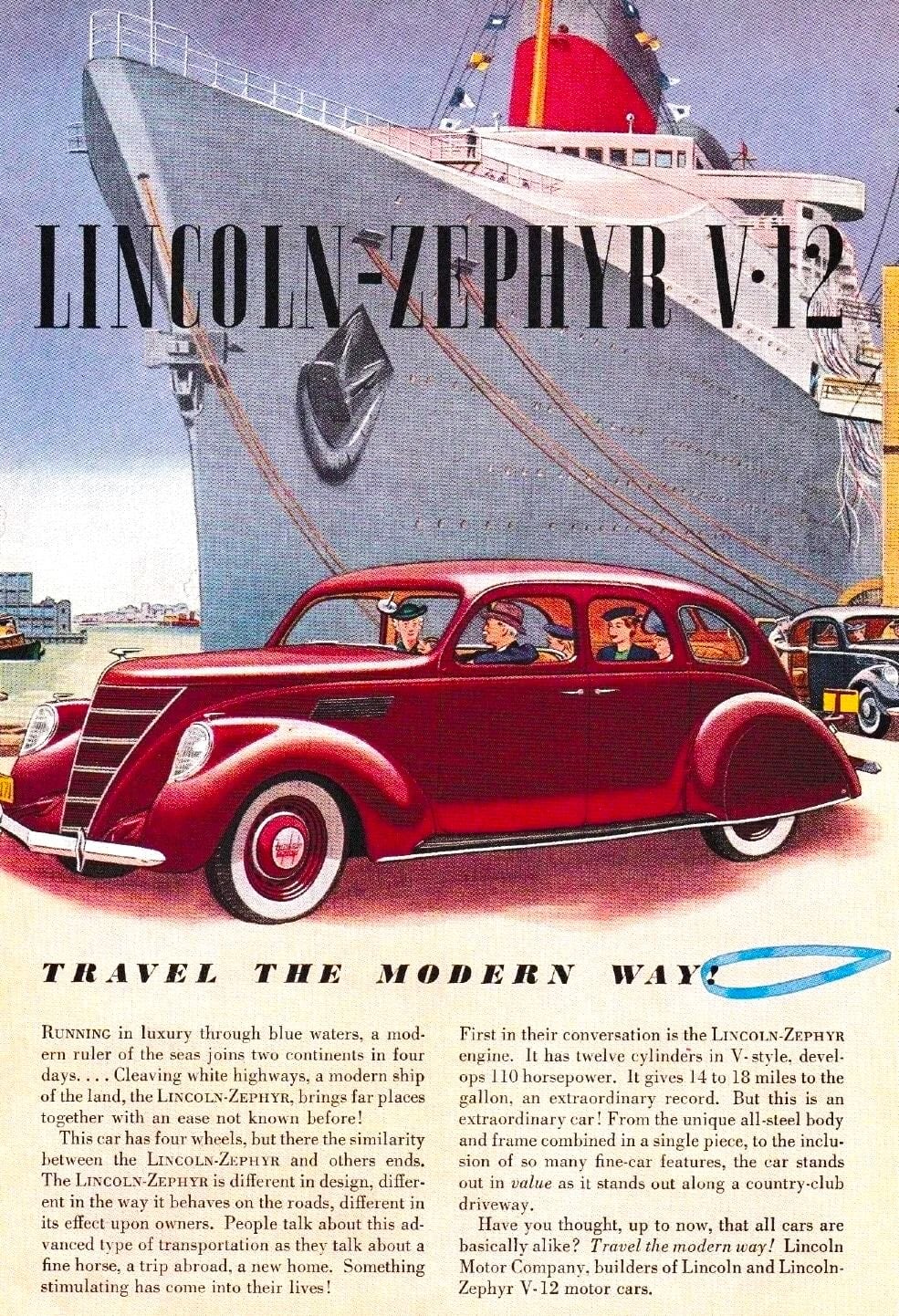
 The Lincoln-Zephyr launched on November the 2nd, 1935, at $1,275 for the two-door and $1,320 for the four-door. The cheapest Model K cost more than three times as much. Image courtesy of The Ford Motor Co.
History Speedrun: The Lincoln V12 Engine
It’s often forgotten today, but the Lincoln Motor Company’s first ever product was a V12 engine, and it never went into a car. Henry Leland founded the firm in 1917 specifically to build Liberty L-12 aircraft engines, after General Motors chief Billy Durant, a pacifist, refused to let Cadillac take the contract.
Leland quit as a result, started again from nothing, and named the new company after the first man he had ever voted for as president. Lincoln assembled 6,500 Liberty engines, making it one of the program’s largest producers. The Liberty itself was a 45º, 1,649 cubic inch V12 rated at 400 bhp, it had been sketched out in just a matter of days by Packard’s Jesse Vincent and Hall-Scott’s Elbert Hall.
Fifteen years later, and a decade into Ford ownership, Lincoln put a V12 into an automobile for the first time. Over the following sixteen years it built three different twelve-cylinder engines that shared a cylinder count, but almost nothing else.
The Great Cylinder Wars
Cadillac started the Cylinder War when they launched a sixteen-cylinder luxury production car in early-1930, and followed it later the same year with a 135 bhp V12 as a 1931 model-year car. The V12 undercut the V16 by $2,000 in every body style and immediately outsold it by 5,733 to 363 in that first model year alone.
The rest of the luxury field scrambled to catch up, Marmon built 390 Sixteens between 1931 and 1933. Packard revived the Twin Six name for 1932 with a 67º L-head twelve. Pierce-Arrow introduced its own V12 the same year.
Auburn priced a Lycoming-built twelve under $1,000 and moved roughly 2,250 across three seasons. Franklin managed about 212 before going bankrupt. Lincoln, whose K-series still ran a developed version of the Leland-era V8, was conspicuously short of cylinders.
The Lincoln KB V12
For 1932 Lincoln split the K-series in two. The KA carried on with the 385 cubic inch V8 at 125 bhp on a 136-inch wheelbase. The KB got a new engine on 145 inches – it was a 447.9 cubic inch L-head V12 with a 65º bank angle, separately cast blocks, seven main bearings, mechanical lifters and a Stromberg downdraft two-barrel, rated at 150 bhp at 3,400 rpm and 292 lb ft at 1,200 rpm.
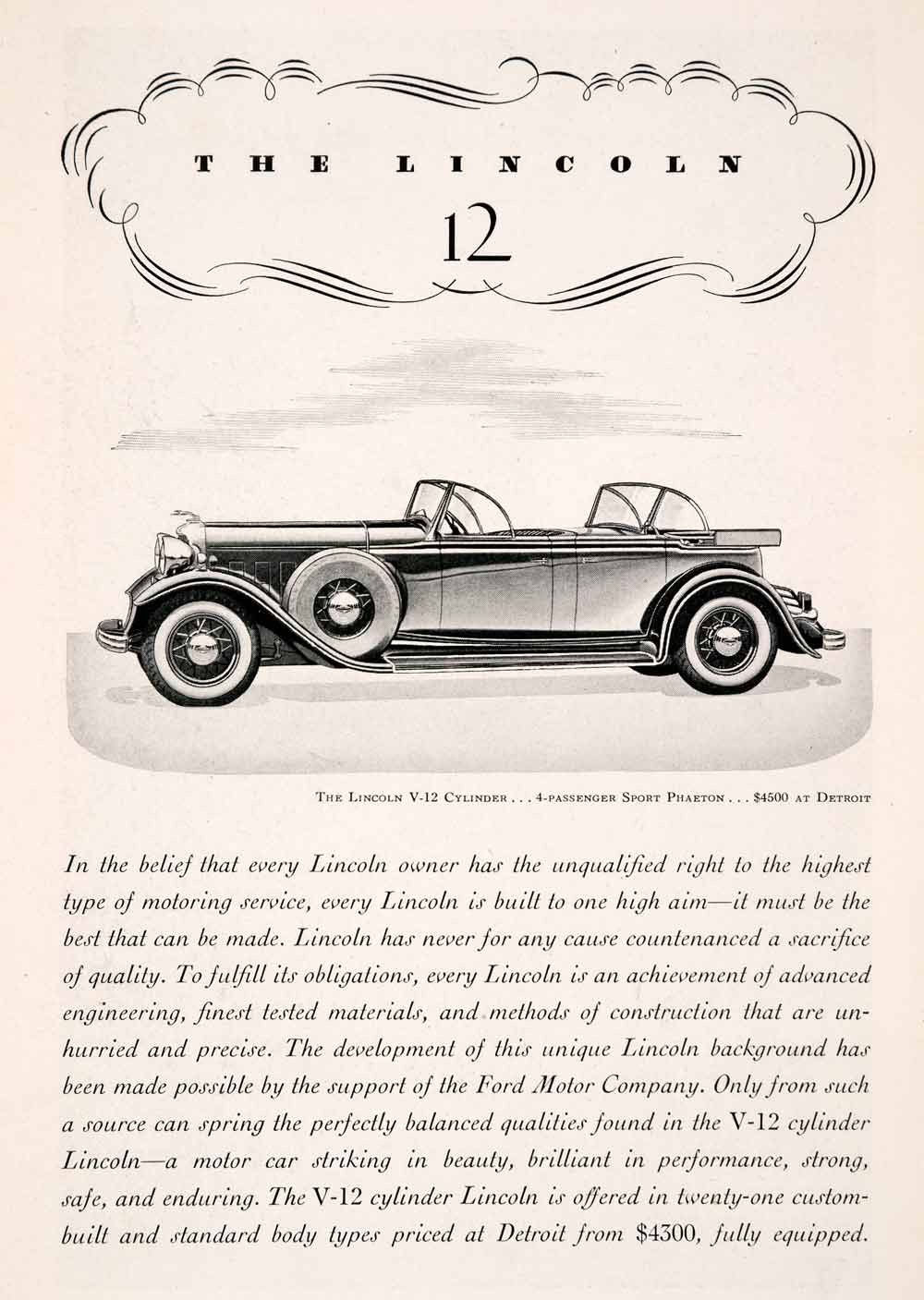
The Lincoln KB got a new engine on 145 inches – it was a 447.9 cubic inch L-head V12 with a 65º bank angle, separately cast blocks, seven main bearings, mechanical lifters and a Stromberg downdraft two-barrel, rated at 150 bhp at 3,400 rpm and 292 lb ft at 1,200 rpm. Image courtesy of The Ford Motor Co.
Chief engineer Frank Johnson developed it at Edsel Ford’s direction – Johnson had earlier worked alongside the Lelands at Cadillac before Lincoln existed, and the KB shows it.
The most distinctive feature of the KB V12 was its connecting rods – they had a fork-and-blade layout, where one rod’s forked big end straddles its opposite number on a shared crankpin, which puts opposing cylinders directly across from one another instead of staggered along the crank.
The result is a shorter, stiffer crankshaft and a remarkably compact engine for 448 cubic inches. The KB was the last Lincoln engine built this way.
Sadly, it was also ruinous to manufacture – KB prices ran from $4,305 to $7,205 in 1932, with nine factory bodies and fourteen catalogued customs from Murphy, Brunn, Dietrich, Judkins, Willoughby and Waterhouse. Lincoln built 1,515 for 1932 and 533 for 1933, then killed it.
The finest engine the company ever made in the Classic Era lasted just two model years. It had been undone not by its own remarkable engineering, but by the ongoing Great Depression which had made luxury automobiles unaffordable to most, and undesirable to those who could afford them – as it drew unwanted attention.
Two Cheaper Twelves
The replacement strategy for the KB was already well underway. For 1933 the KA model dropped its V8 for a new 381.7 cubic inch V12 making 125 bhp at 3,400 rpm, with four main bearings and conventional side-by-side rods. Every Lincoln was now a twelve-banger.
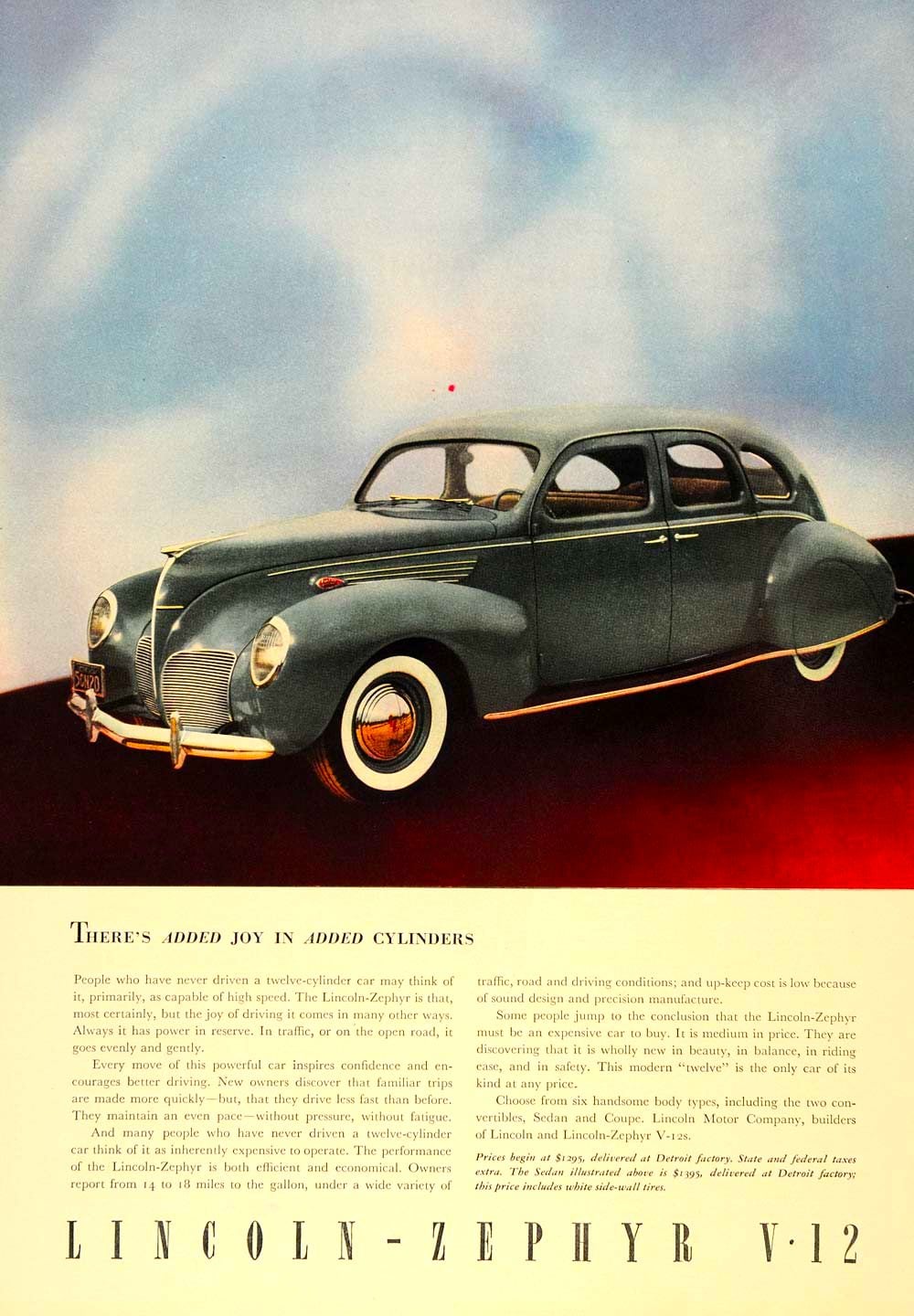
The Zephyr’s performance was excellent by the standards of the pre-WWII automotive world, Britain’s The Motor recorded 90 mph at Brooklands and 62 mph in middle gear, with 0 to 60 mph in 14 seconds and 16 to 18 mpg. Image courtesy of The Ford Motor Co.
For 1934 that engine was bored and stroked to 414 cubic inches and 150 bhp, matching the output of the larger, heavier, far more expensive KB unit, which was dropped outright. From 1935 the KA and KB labels disappeared and everything was simply a Model K. The 414 would run to the end.
Model K production was 1,411 in 1935, 1,534 in 1936, 977 in 1937, 416 in 1938 and 133 in 1939. Only 25 buyers took the LeBaron convertible roadster body across its entire 1937 to 1939 run. Production stopped after the 1939 model year, with leftovers titled as 1940 cars and the last one delivered on January the 24th, 1940.
The most consequential 414 went to Washington – Franklin Roosevelt’s “Sunshine Special” was a 1939 Model K limousine bodied by Brunn & Company of Buffalo and leased from Ford, The Henry Ford Museum now describes it as the first car built expressly for presidential use.
After Pearl Harbor it returned to the factory for armor plating, as well as bullet-resistant glass and tires. The finished car weighed 9,300 lbs, which left 150 bhp with a great deal of work to do. Remarkably, it stayed in service until 1950.
A V12 For $1,275
While the Model K was dying, Lincoln’s survival was being engineered at a body supplier. Briggs Manufacturing, one of Detroit’s largest body manufacturers, employed a Dutch designer named John Tjaarda, whose “Sterkenburg” studies proposed a streamlined, semi-unitized car with a rear engine.
Edsel Ford liked the package but distrusted the engine location. A full-size mockup went on public display in Chicago, where roughly four in five visitors approved of the styling according to the polling that was done, and about half objected to the rear engine.
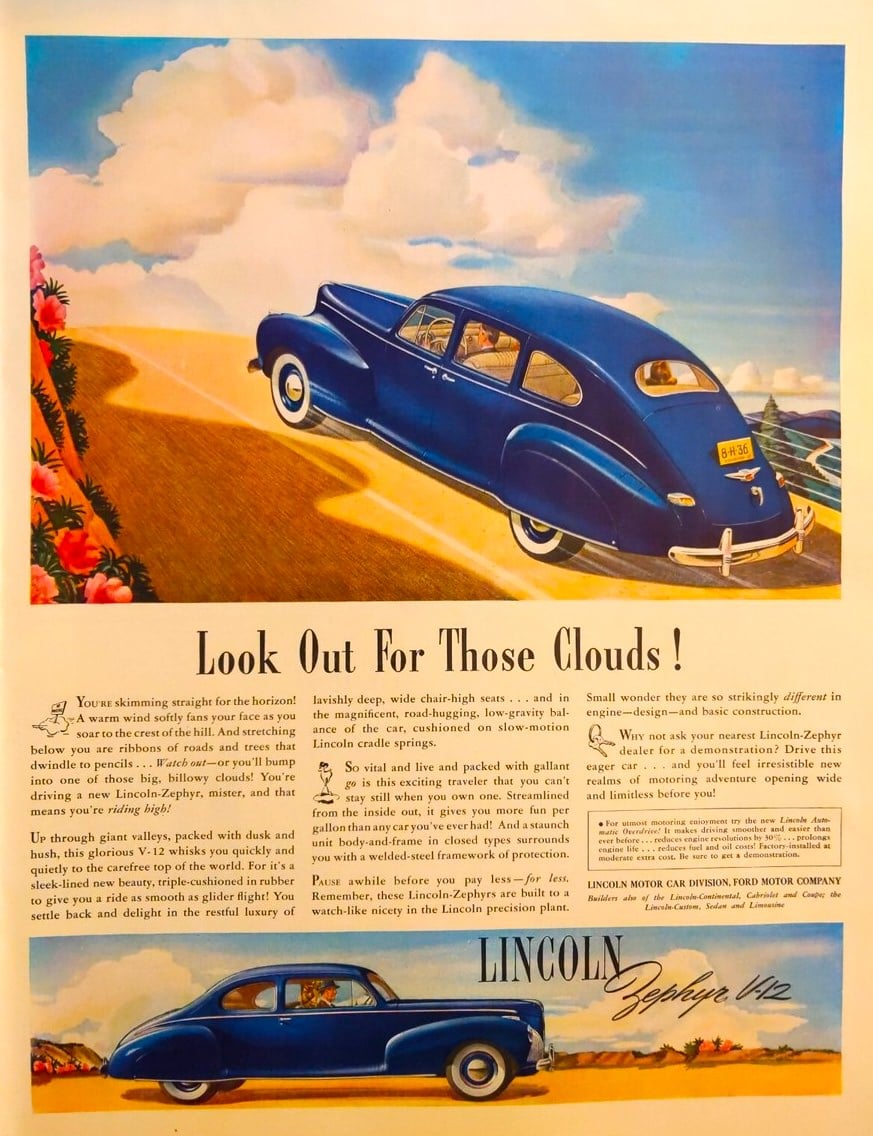
Lincoln sold 14,994 Zephyrs in the 1936 model year out of a company total of 16,528, against 1,434 cars the year before, and the marque climbed from 22nd to 18th in industry production rankings – its first appearance in the top twenty. The 1937 sales total came close to 30,000. Image courtesy of The Ford Motor Co.
The car was to have used a heavily modified Ford Flathead V8 with an aluminum block to match its aluminum heads, targeting 100 gross horsepower. Prototype engines managed 80 to 85. Edsel canceled the project and told Frank Johnson to build a V12 instead.
What Johnson developed, known internally as the HV-12 or Model H, was nothing like his earlier KB. It was a 75º L-head twelve with a one-piece cast iron block, a 2.75-inch bore and the flathead V8’s 3.75-inch stroke, giving 267 cubic inches.
Compression was 6.7:1, higher than any other Ford or Lincoln engine of the time, and output was 110 bhp at 3,900 rpm. Aluminum heads, cast-steel pistons, twin water pumps, a front-mounted dual-coil distributor driven straight off the camshaft nose, and exhaust passages routed through the block’s water jackets were all reminiscent of Ford’s hard-learned lessons with earlier engine designs – largely the Flathead V8.
This new engine was neither an adaptation of the big Lincoln twelves nor one and a half Ford V8s, though it sat closer to the latter and shared some parts. The 75º angle gave uneven firing intervals, which Lincoln accepted in exchange for a narrower engine and a lower hood.
The Lincoln-Zephyr launched on November the 2nd, 1935, at $1,275 for the two-door and $1,320 for the four-door. The cheapest Model K cost more than three times as much. Lincoln sold 14,994 Zephyrs in the 1936 model year out of a company total of 16,528, against 1,434 cars the year before, and the marque climbed from 22nd to 18th in industry production rankings – its first appearance in the top twenty. The 1937 sales total came close to 30,000.
The car’s performance was excellent by the standards of the pre-WWII automotive world, Britain’s The Motor recorded 90 mph at Brooklands and 62 mph in middle gear, with 0 to 60 mph in 14 seconds and 16 to 18 mpg. Its editors reckoned that for main-road work “a very comfortable speed is 75 mph where conditions permit.” This was far faster than most of the roads of the time were safe for.
The Engine’s Famous Issues
The V12’s reputation for reliability was another matter – cooling was marginal, oil circulation was poor, and crankcase ventilation was bad enough that the oil turned to sludge in regular stop-start driving.
There was no dipstick, so owners could not easily inspect the oil without draining it. Hydraulic lifters arrived for 1938 to quiet the valvetrain, and cast iron heads and oiling revisions followed in 1942, but the engine never shook the reputation it had developed.
The Last American (Production) Twelve
The bore grew twice, for 1940 it went to 2.875 inches, giving 292 cubic inches and 120 bhp. For 1942 it went to 2.9375 inches and 305 cubic inches, rated at 130 bhp. That last displacement increase was beyond the foundry’s real-world precision. The cylinder walls came out perilously thin, some vanished entirely during casting and scrapped the block, bore wear in service was severe, and reboring at overhaul was impossible.
The 305 ran for about a month of 1942 production and returned briefly in early 1946, that postwar version running 7.2:1 compression and a twin-choke two-barrel carburetor, before Lincoln reverted to the 292. The final 1948 specification was 125 bhp at 3,600 rpm and 220 lb ft.
The Zephyr name was dropped after 1942, postwar cars were sold simply as Lincolns. Total Model H production was somewhere in the region of 200,000 units between 1936 and 1948, which puts Lincoln’s flawed, inexpensive, and hot-running twelve in a different category entirely from its rivals.
For 1949 Lincoln fitted a 337 cubic inch L-head V8 borrowed from the Ford truck line. No full-line American manufacturer has offered a V12 in a production car since. The nearest thing to an exception is a footnote – Vector Aeromotive built 14 production M12s in Florida between 1996 and 1999, powered by the Lamborghini Diablo’s V12.
The Lincoln V12 Engine Shown Here
This is a Lincoln 292 flathead V12 that is now being sold with a matching 3-speed manual transmission, from a 1946 to 1948 Lincoln.
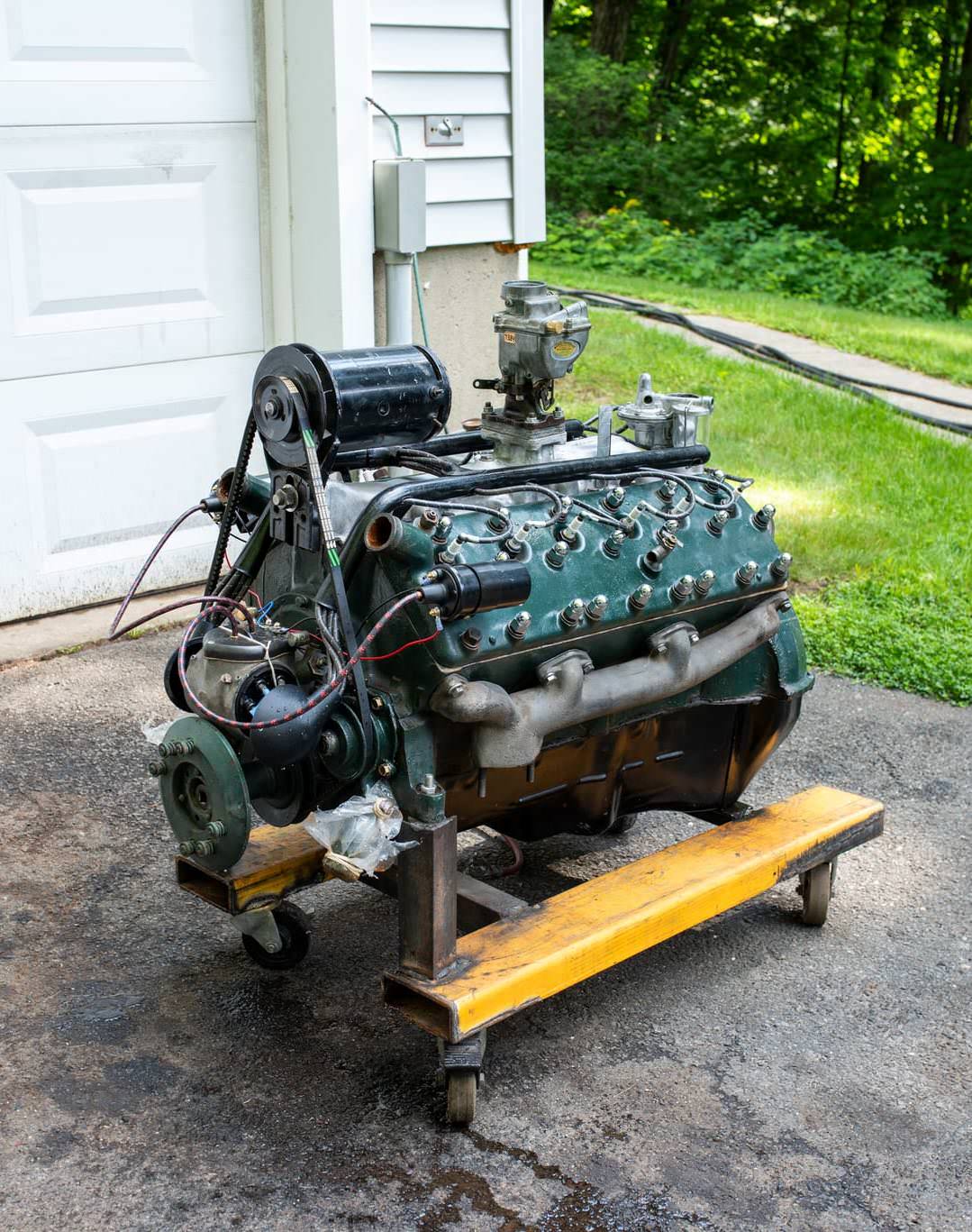
This is a 292 cubic inch Lincoln V12 engine, it comes with a correct 3-speed manual transmission and it came from a 1946-1948 model.
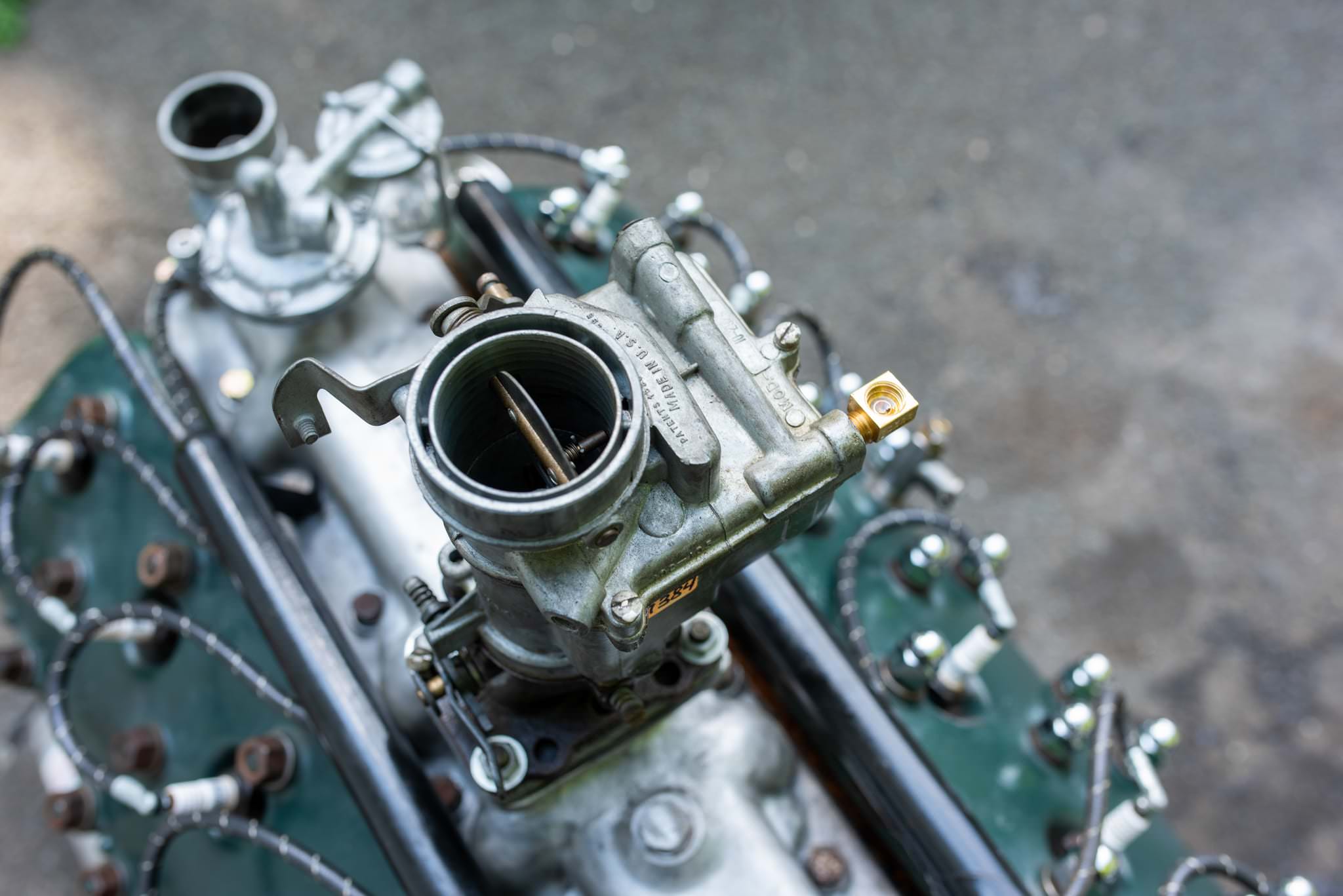
Recent recommissioning work covered the fuel pump, which was rebuilt with an ethanol-resistant diaphragm and valves, the left water pump was also rebuilt, and the carburetor was cleaned and adjusted. Three stuck valves were freed, both sets of distributor points were re-gapped, and a replacement 12V starter was fitted. The engine currently runs a dual-coil 12V distributor, with the original 6V unit included in the sale.
The engine and transmission is now being offered for sale as a pair out of Newtown, Connecticut. If you’d like to read more about it or register to bid you can visit the listing here.
Images courtesy of Bring a Trailer + The Ford Motor Co.

Articles that Ben Branch has written have been covered on CNN, Popular Mechanics, Smithsonian Magazine, Road & Track Magazine, the official Pinterest blog, the official eBay Motors blog, BuzzFeed, Autoweek Magazine, Wired Magazine, Autoblog, Gear Patrol, Jalopnik, The Verge, and many more.
Silodrome was founded by Ben back in 2010, in the years since the site has grown to become a world leader in the alternative and vintage motoring sector, with well over a million monthly readers from around the world and many hundreds of thousands of followers on social media.