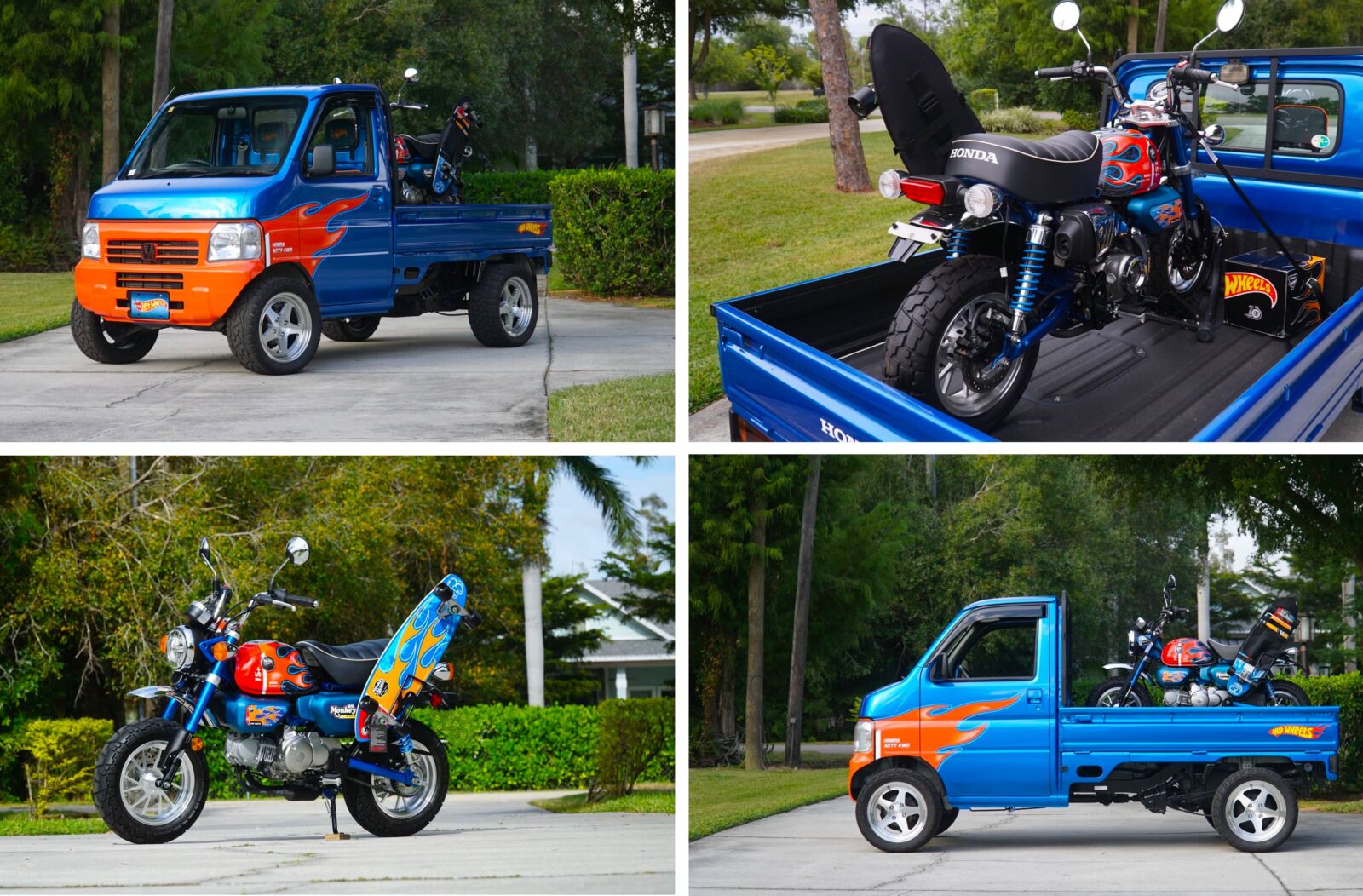
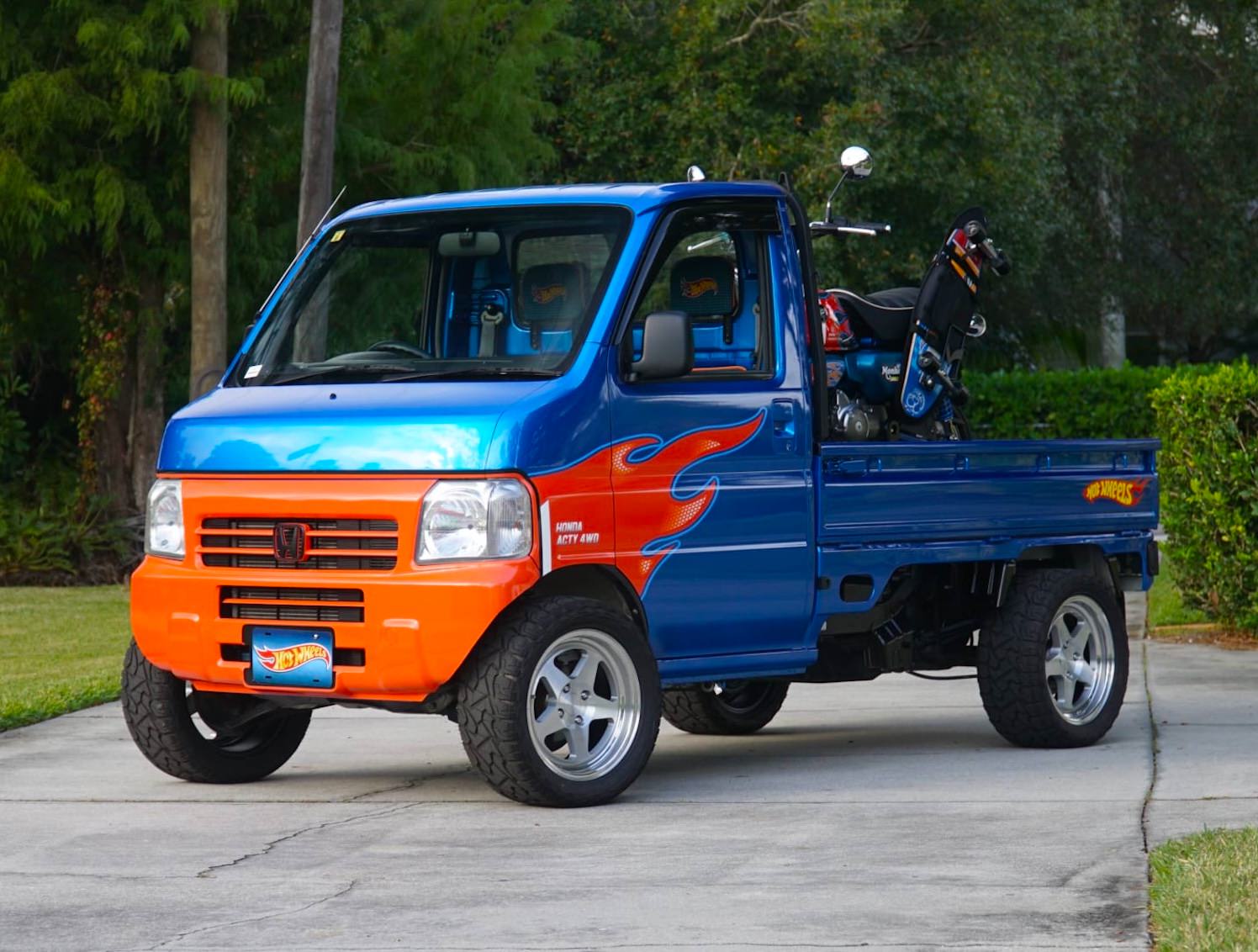
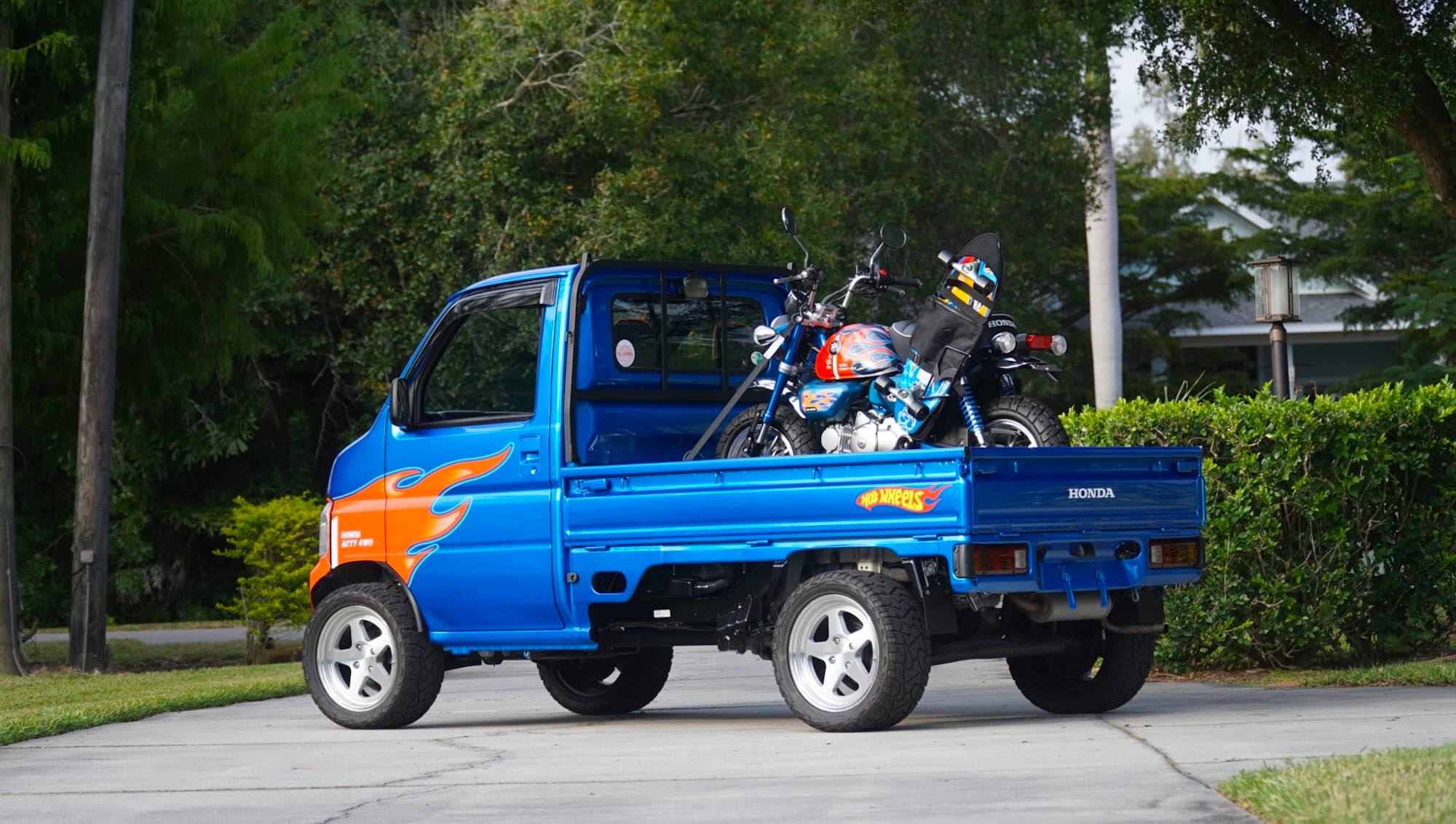
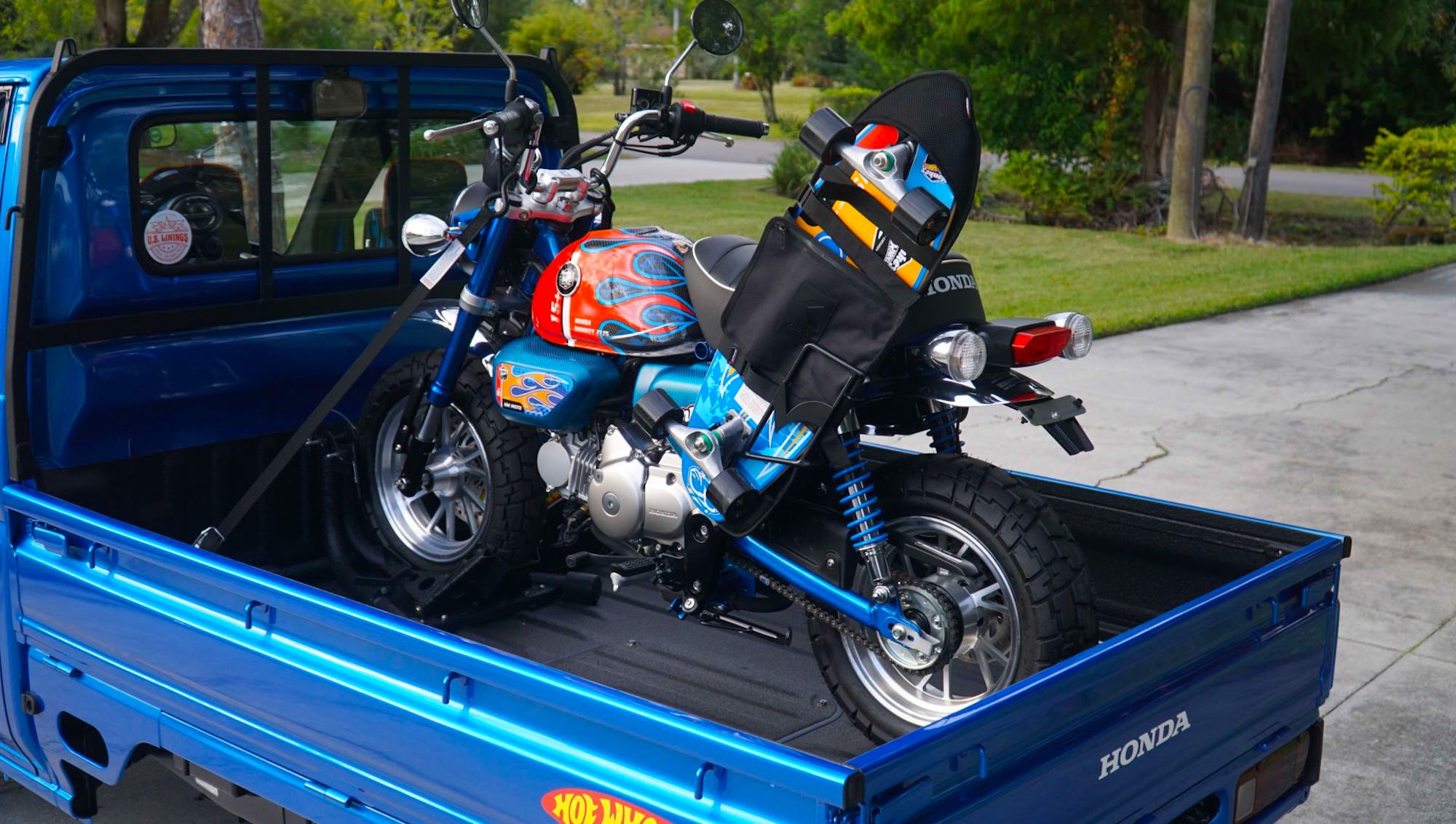
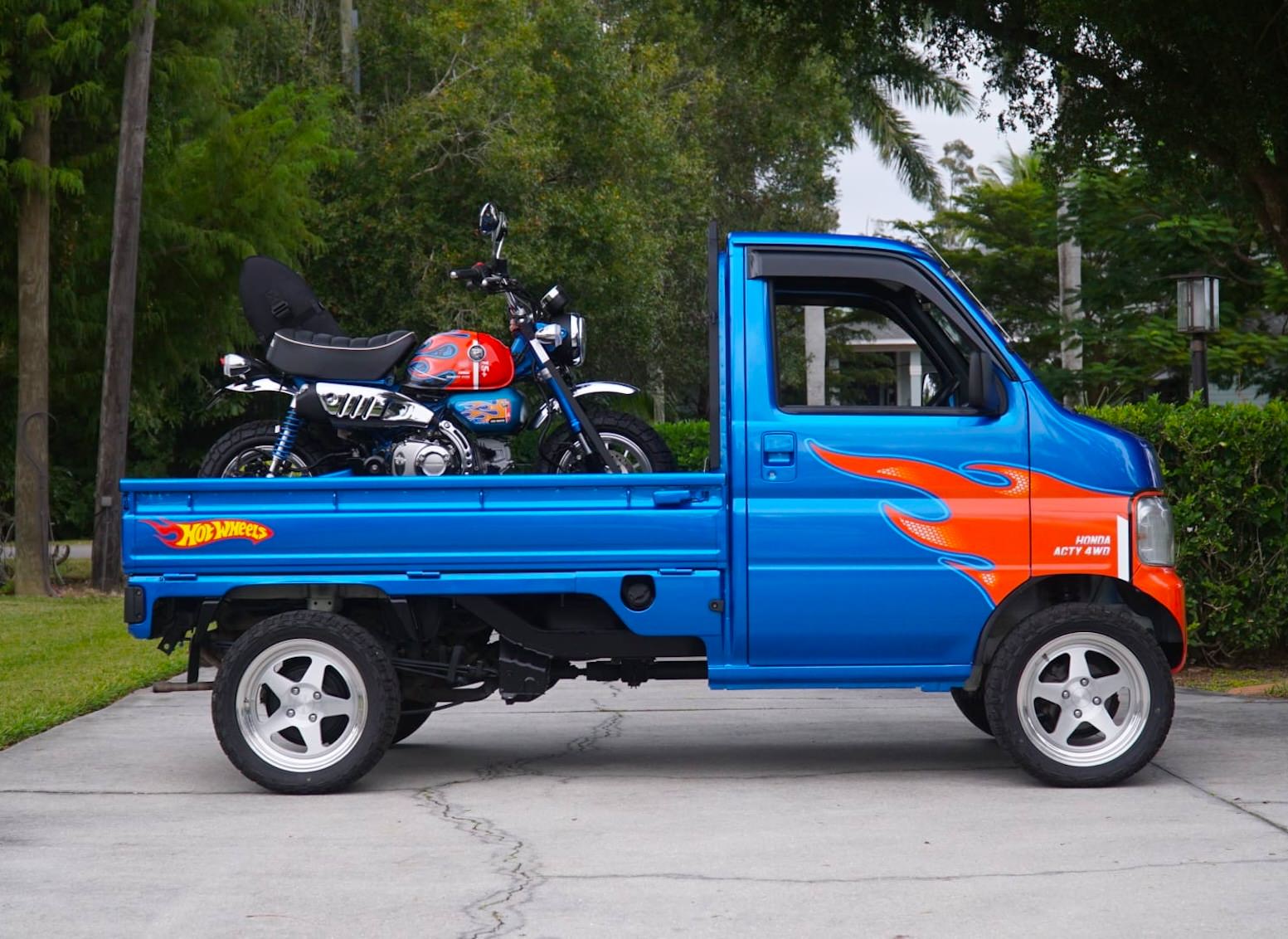
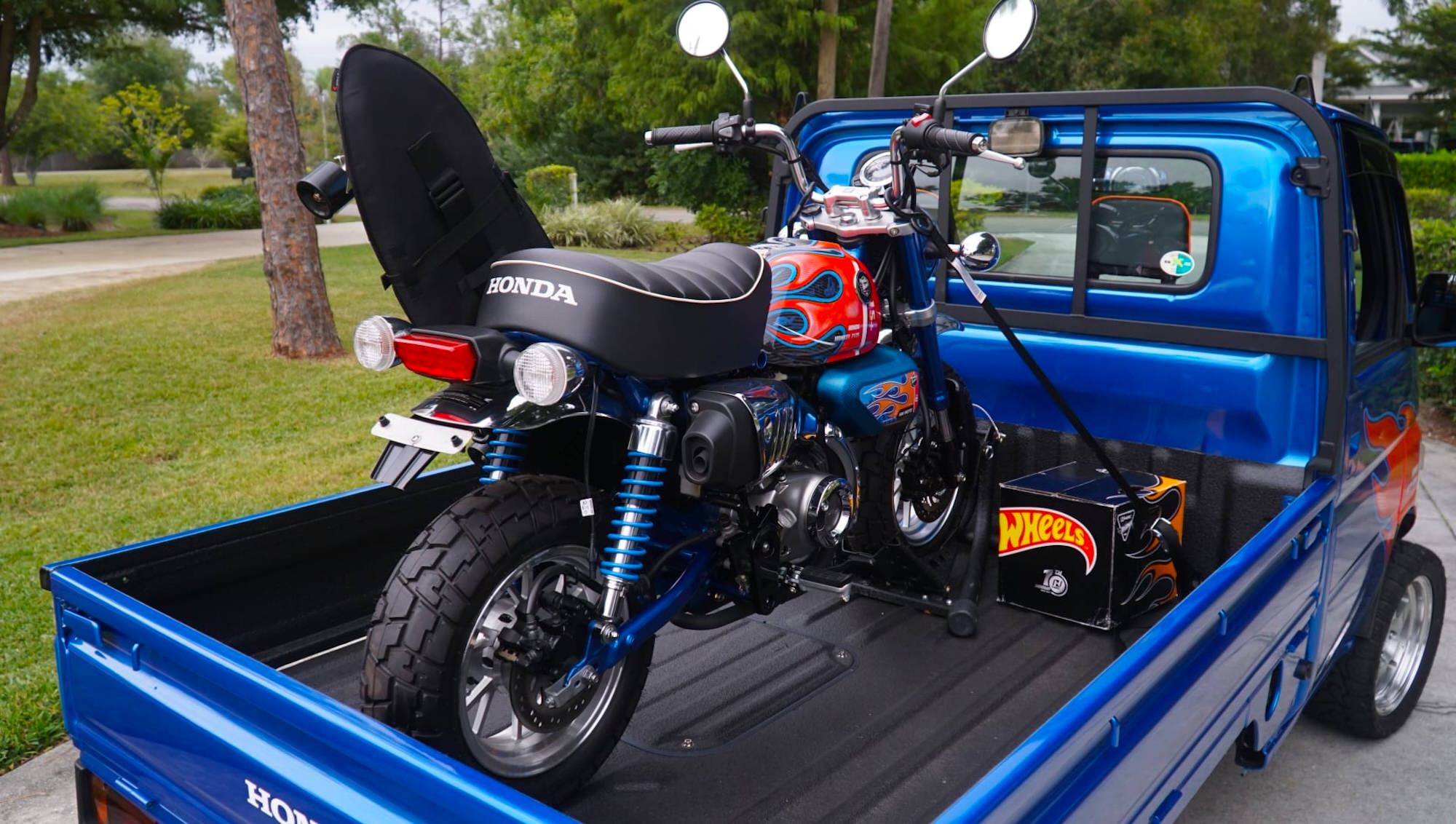
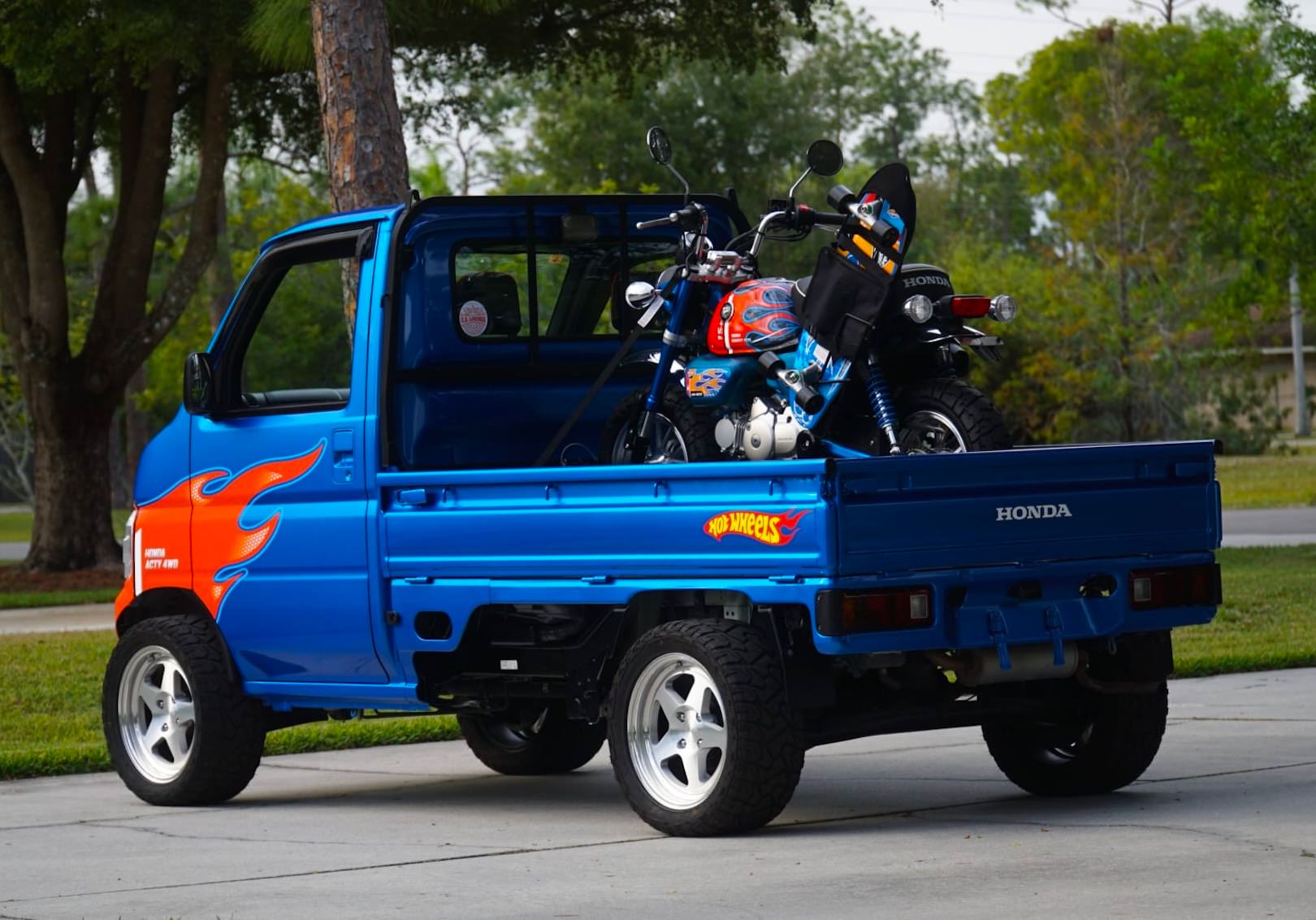
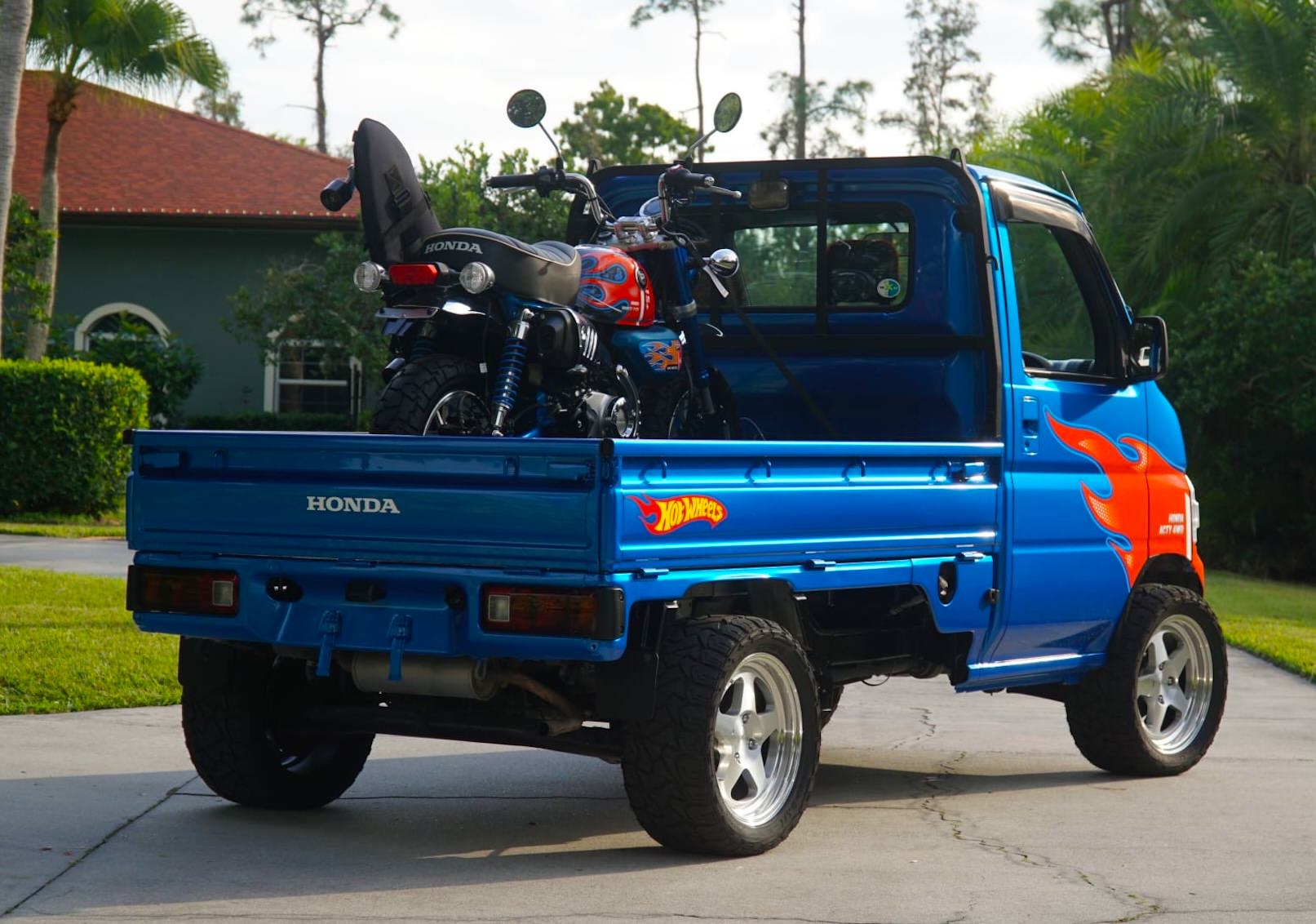
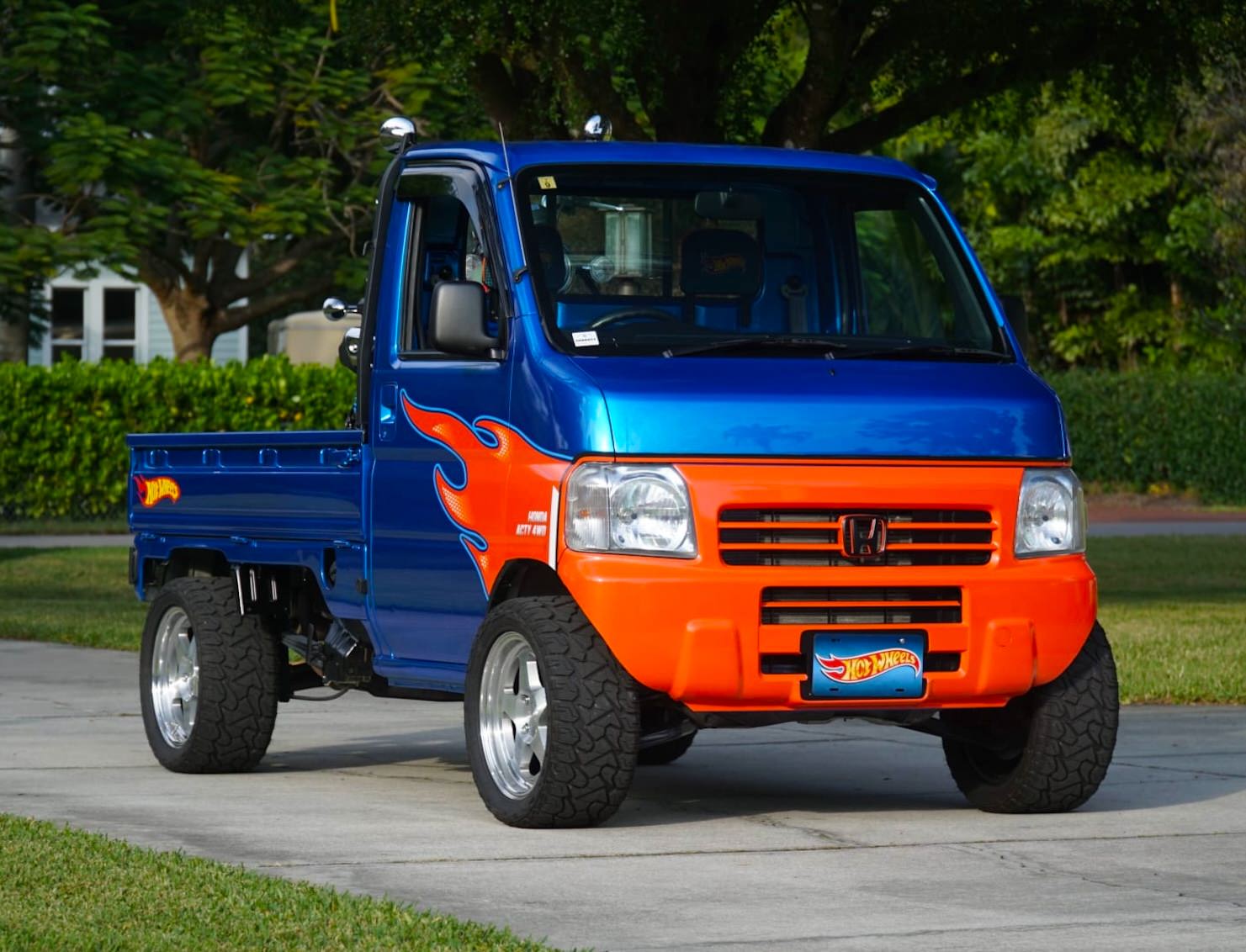
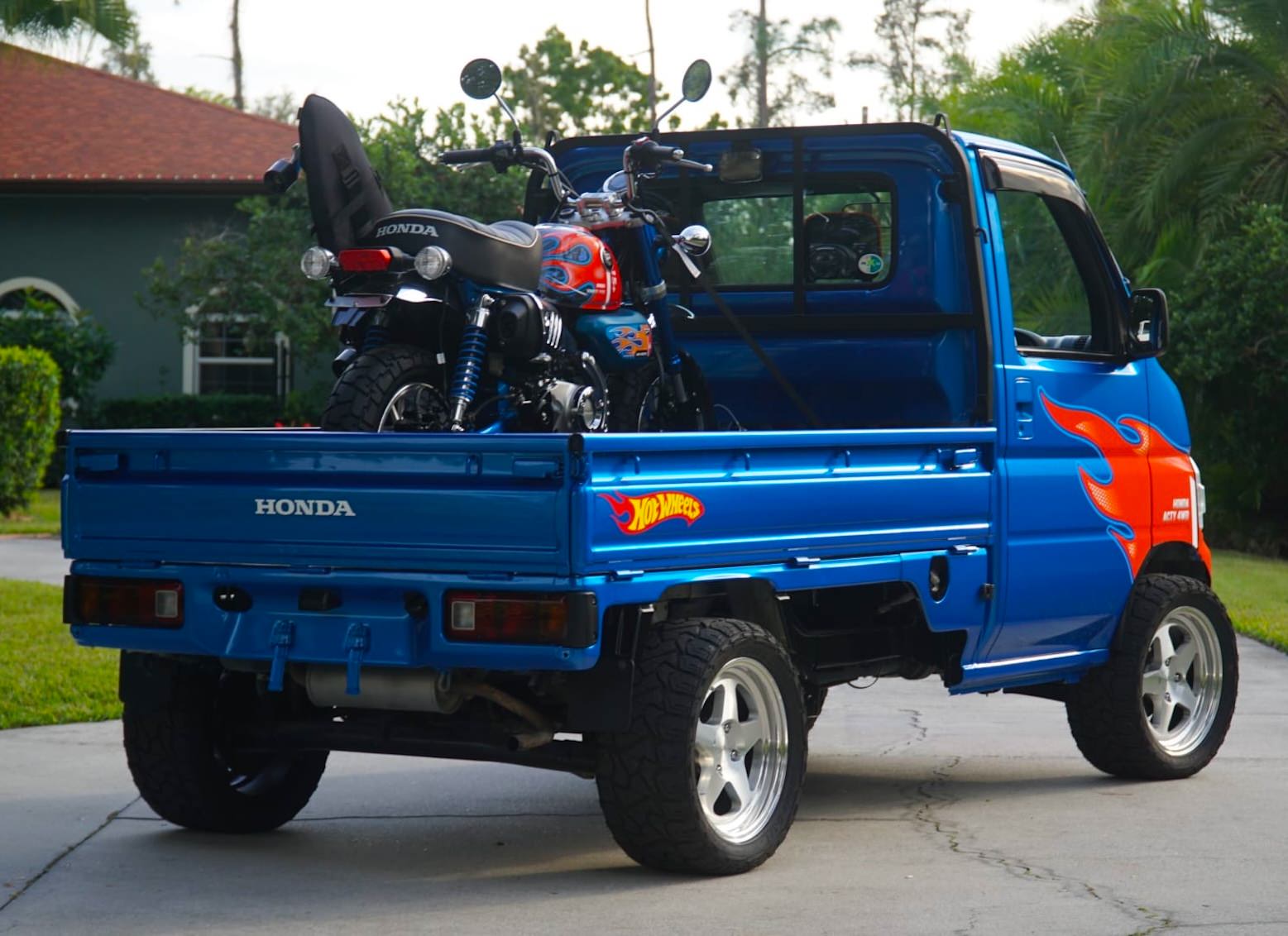
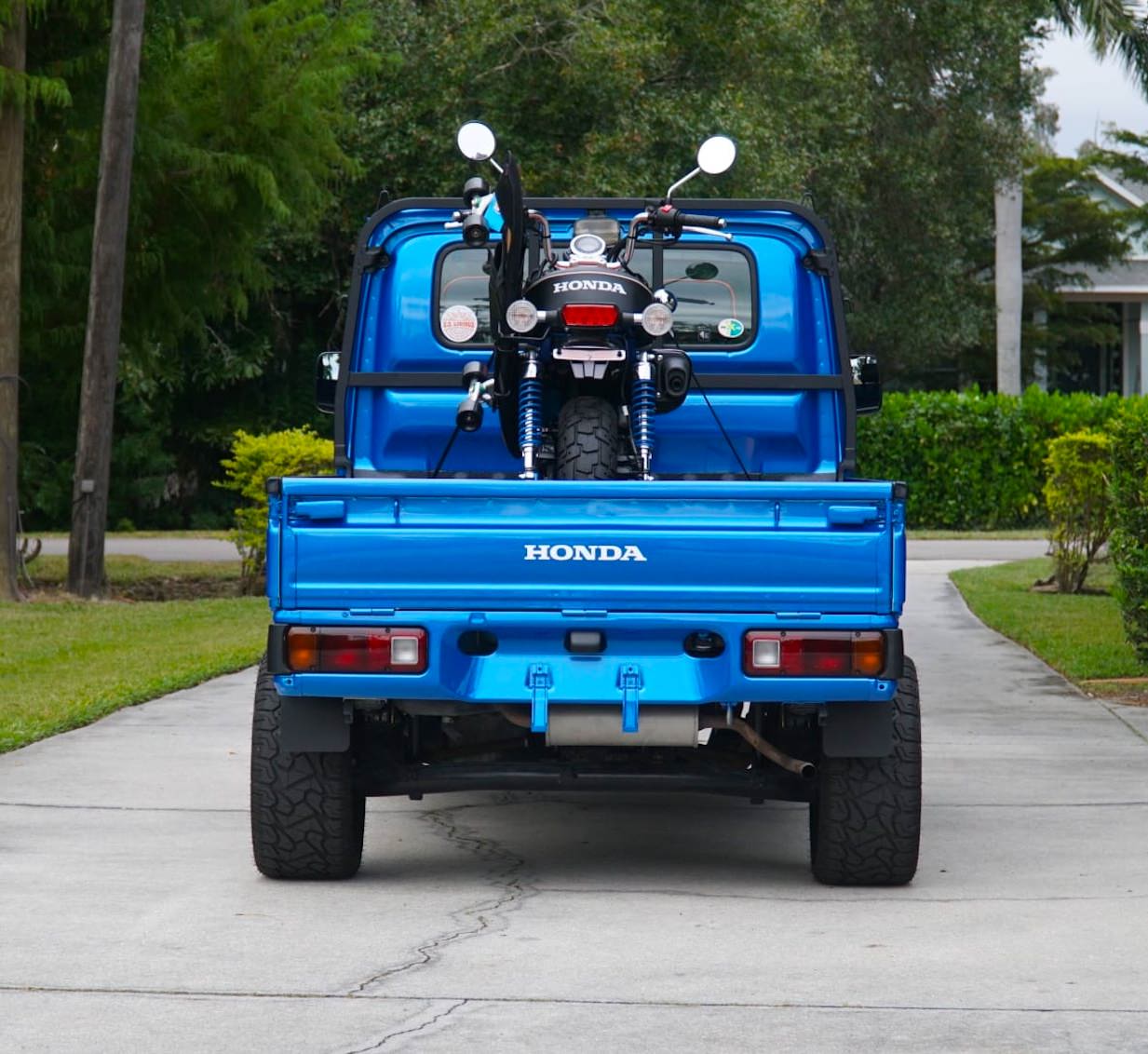
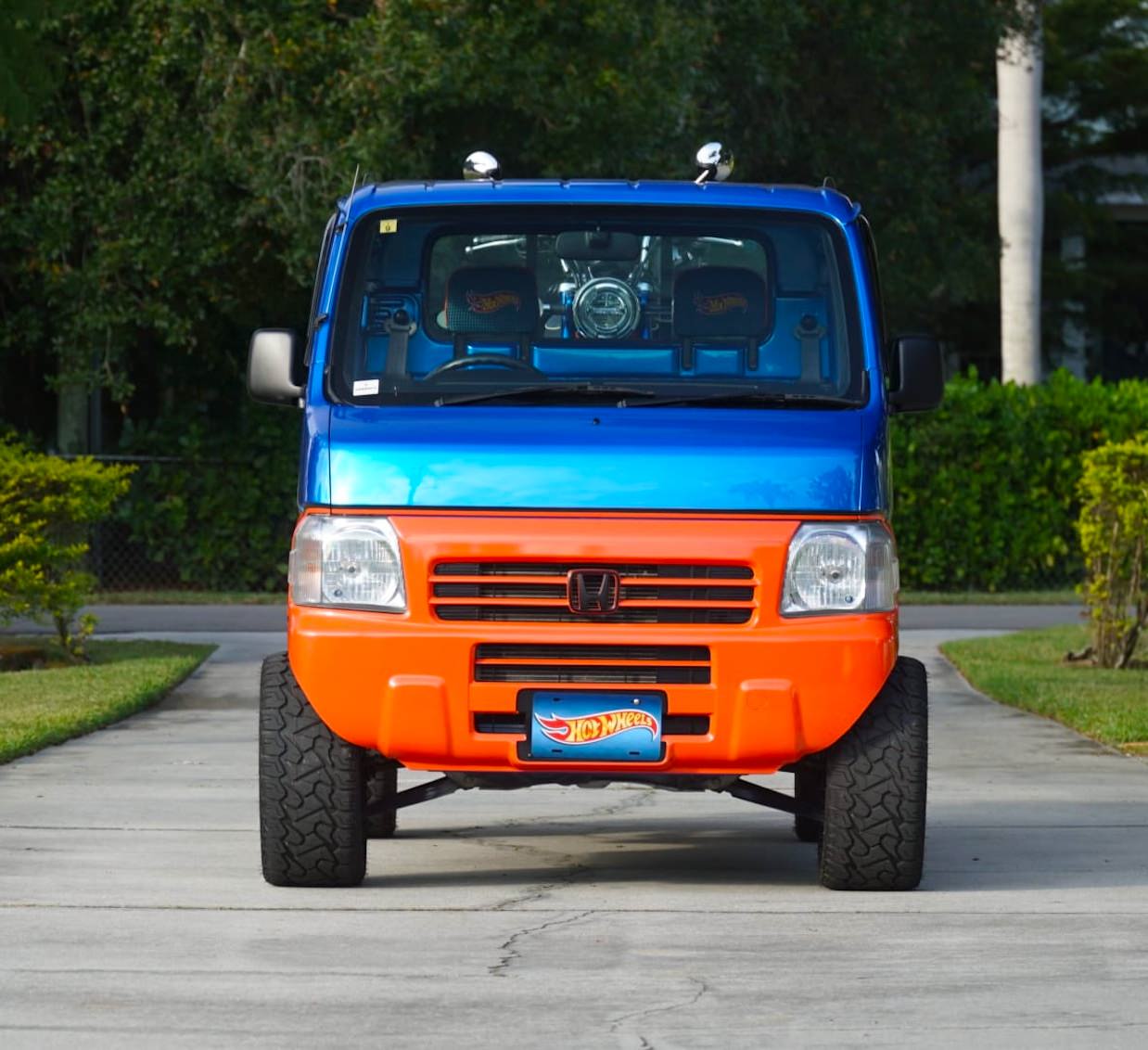
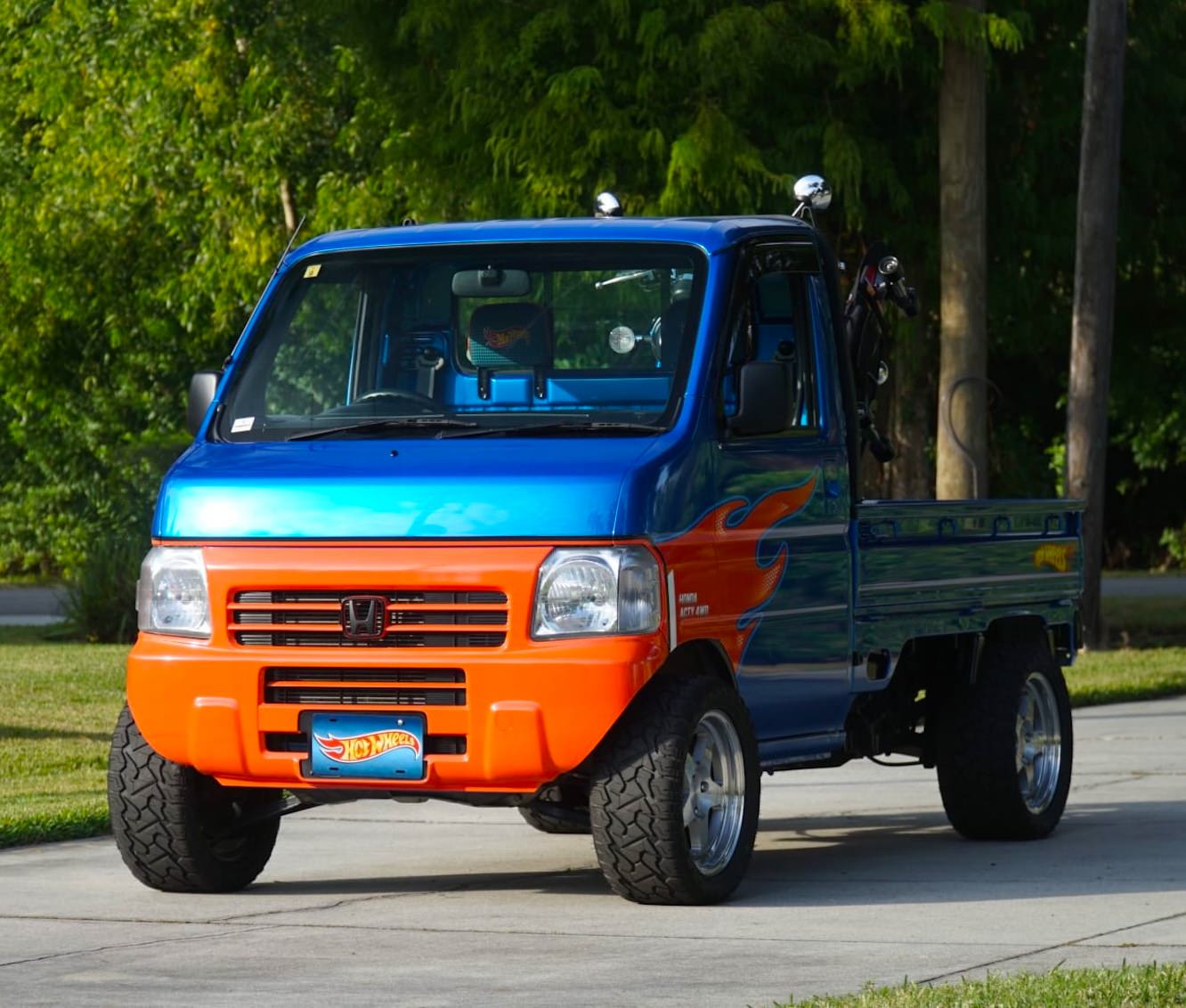
This is a 4×4 Honda ACTY that is now being sold as a package deal with a 2021 Honda Monkey minibike. Both the ACTY and the minibike have been given the full Hot Wheels treatment, including flame decals, Hot Wheels decals, custom embroidery, and more.
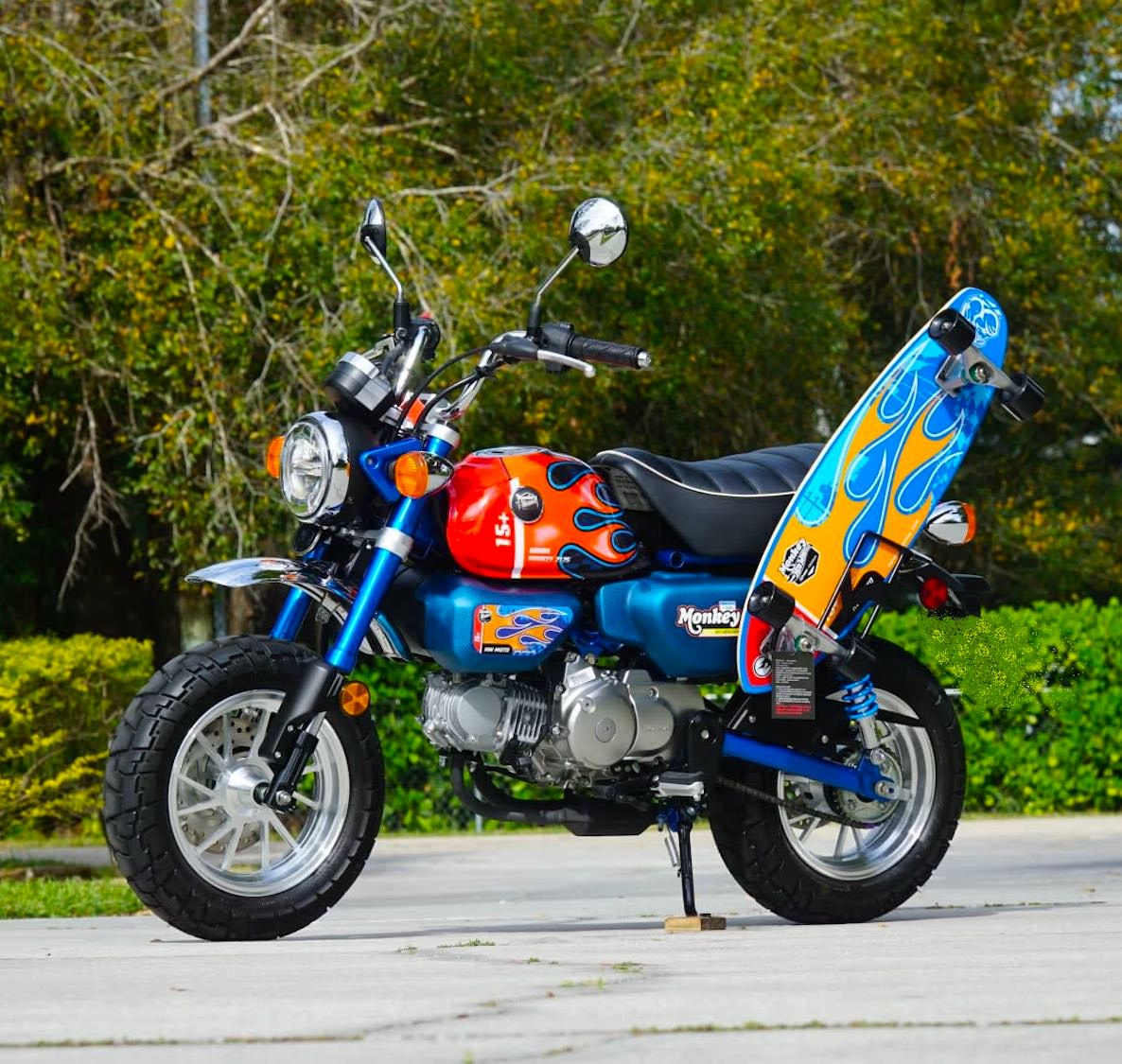
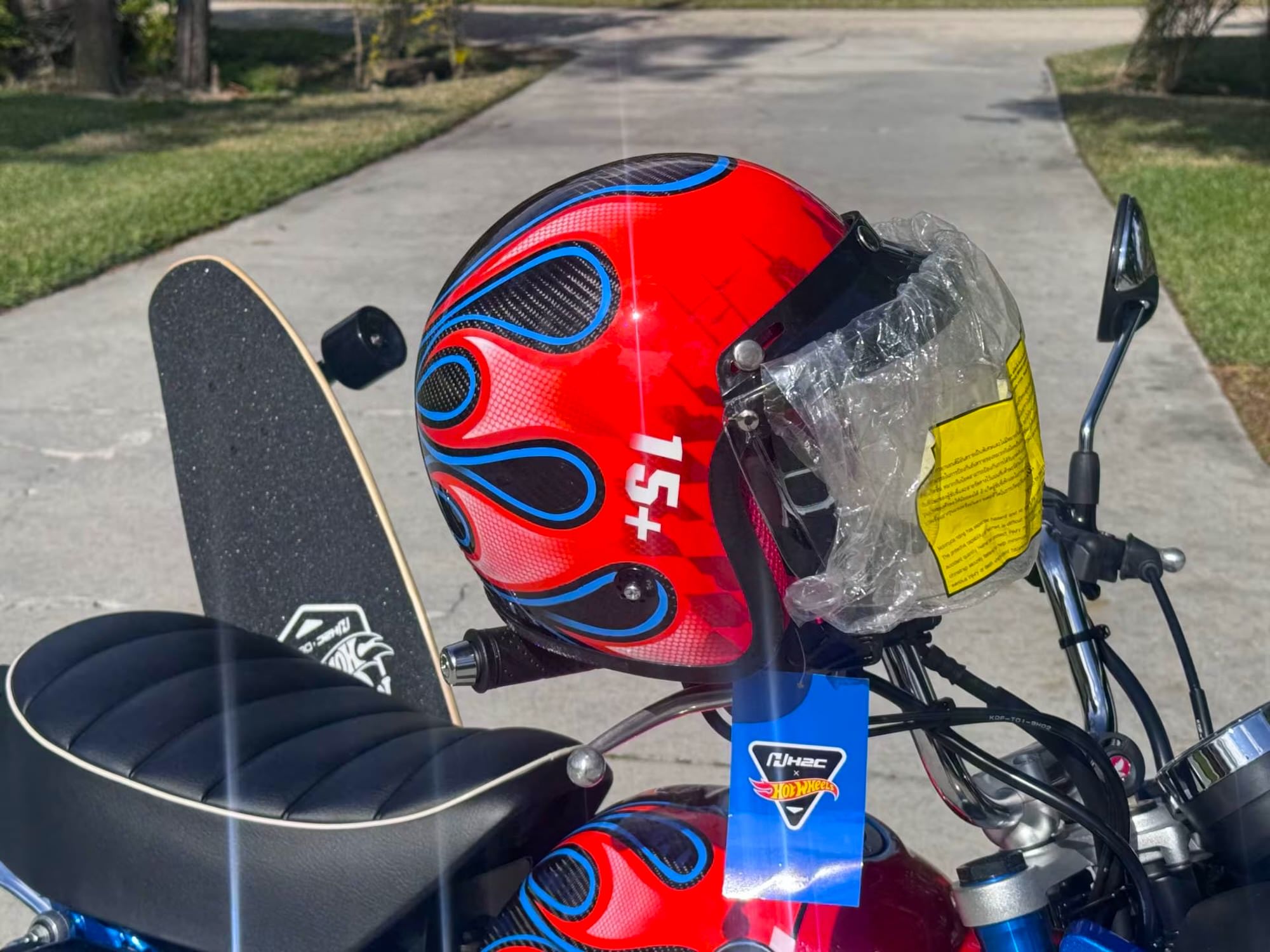
Other items included in this sale, besides the ACTY and Monkey minibike, include a matching skateboard and a matching open-face helmet – the skateboard is carried in a holder fitted to the side of the bike. Both vehicles and the other accessories are being offered as a single lot at the upcoming Mecum auction in Kissimmee, Florida.
Fast Facts: The Honda ACTY 4×4
- This is a customized 1999 Honda Acty 4WD that’s being sold as a package with a 2021 Honda Monkey minibike, both finished in a coordinated Hot Wheels theme. The treatment includes flame graphics, Hot Wheels decals, and matching interior embroidery.
- The lot also includes a flame-matched skateboard and an open-face helmet. The skateboard is mounted in a side carrier on the Monkey, and all items are offered together as a single, styled collection.
- The Honda Acty line debuted in 1977 as a clean-sheet kei truck designed for Japan’s strict size and engine regulations. Its mid-engine layout, focus on durability, and low operating costs made it popular with farmers, tradespeople, and urban delivery users across Japan.
- The Acty shown here belongs to the third generation introduced in 1999, known for its 660cc fuel-injected engine, Real Time 4WD option, and multiple design improvements over earlier models. Production ran for roughly a decade, and these later Actys have since become cult favorites with import buyers and enthusiasts.
History Speedrun: The Honda ACTY
When the Honda Acty made its debut in 1977, it landed at a crucial moment for Japan’s kei class commercial vehicles. Kei class regulations offer major tax incentives for vehicles under a certain size, weight, and engine displacement. This class had tightened its criteria earlier in the decade, forcing manufacturers to rethink packaging, payload, and fuel efficiency within strict dimensional and displacement limits.
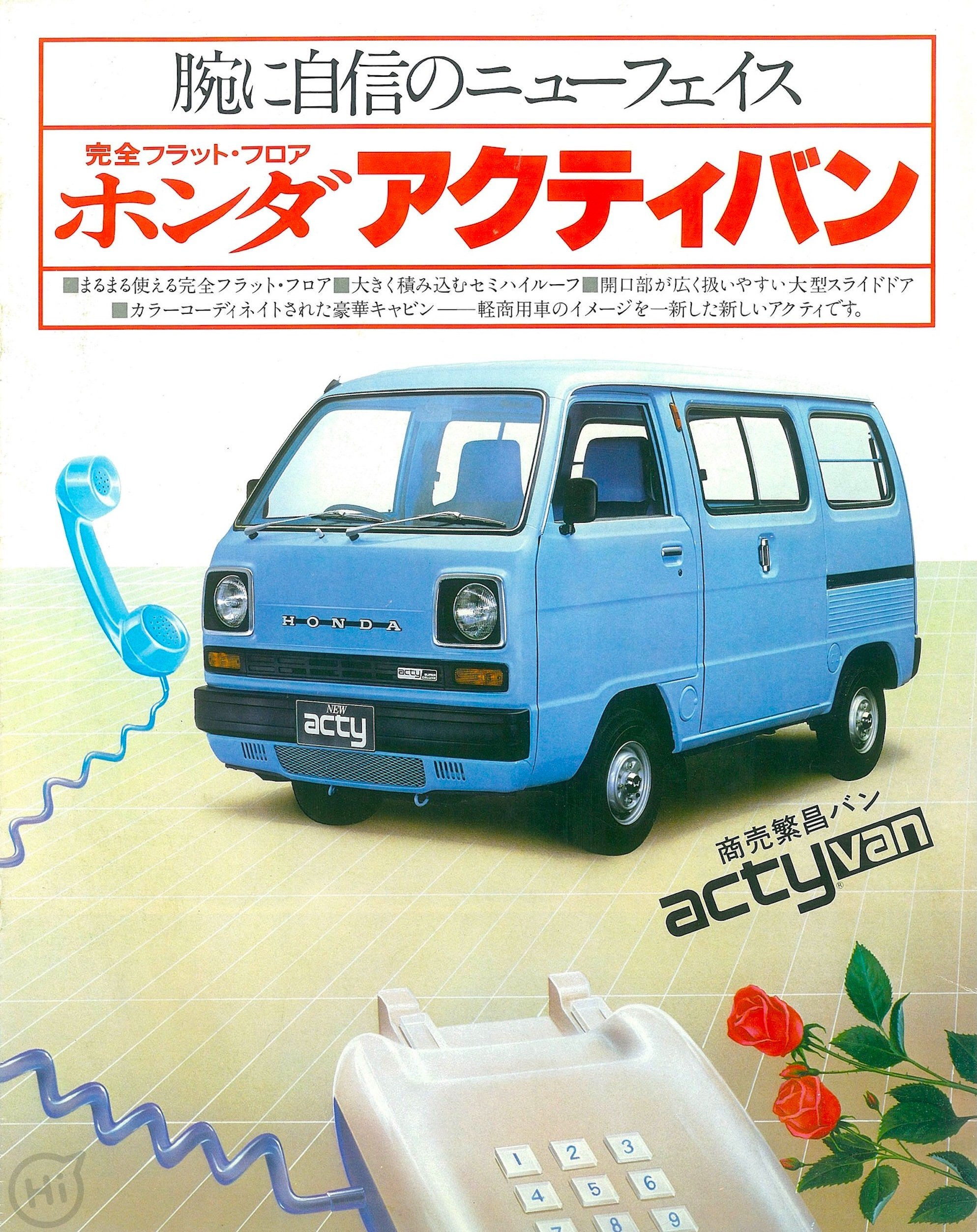
 The Acty was a clean-slate response to the growing need for compact, reliable, and easy-to-maintain utility vehicles that could serve farmers, tradespeople, urban delivery workers, and small businesses across Japan’s increasingly congested cities and small village roads. Image courtesy of Honda.
The Acty was a clean-slate response to the growing need for compact, reliable, and easy-to-maintain utility vehicles that could serve farmers, tradespeople, urban delivery workers, and small businesses across Japan’s increasingly congested cities and small village roads.
The first-generation Acty, internally known as the TN-ACTY, was launched as a cab-over kei truck with a mid-mounted, water-cooled two-cylinder engine driving the rear wheels. That layout gave it excellent weight distribution and a decently sized flat load bed relative to its size, while keeping the mechanicals accessible for maintenance work.
Power output was modest, as regulations dictated, but the emphasis was always on reliability, ease of use, and low operating costs. Even at this early stage, Honda engineers developed the Acty with car-like engineering and design principles rather than treating it like a disposable tool that would only last a few years before being replaced.
The second generation Acty arrived in 1988 alongside a major revision of Japan’s kei standards, bringing improvements in safety, emissions, and drivability. Honda expanded the Acty line to include both truck and van derivatives – urban delivery and service roles had become just as important as agricultural use. Independent front suspension and an improved drivetrain helped keep the Acty competitive as rivals from Suzuki and Daihatsu improved their own kei offerings.
In 1990 Honda updated the Acty range again to comply with additional new kei regulations, introducing a revised Acty and Acty Street series powered by a 660cc water-cooled three-cylinder engine evolved from the earlier 550cc unit through increased bore and stroke.
These models were focused on cleaner emissions, improved fuel efficiency, and better overall refinement, while keeping the basic packaging and working-vehicle priorities that had always defined the Acty line. This period represented an evolutionary step rather than a full generational change, but it helped set the technical direction for what would follow at the end of the decade.
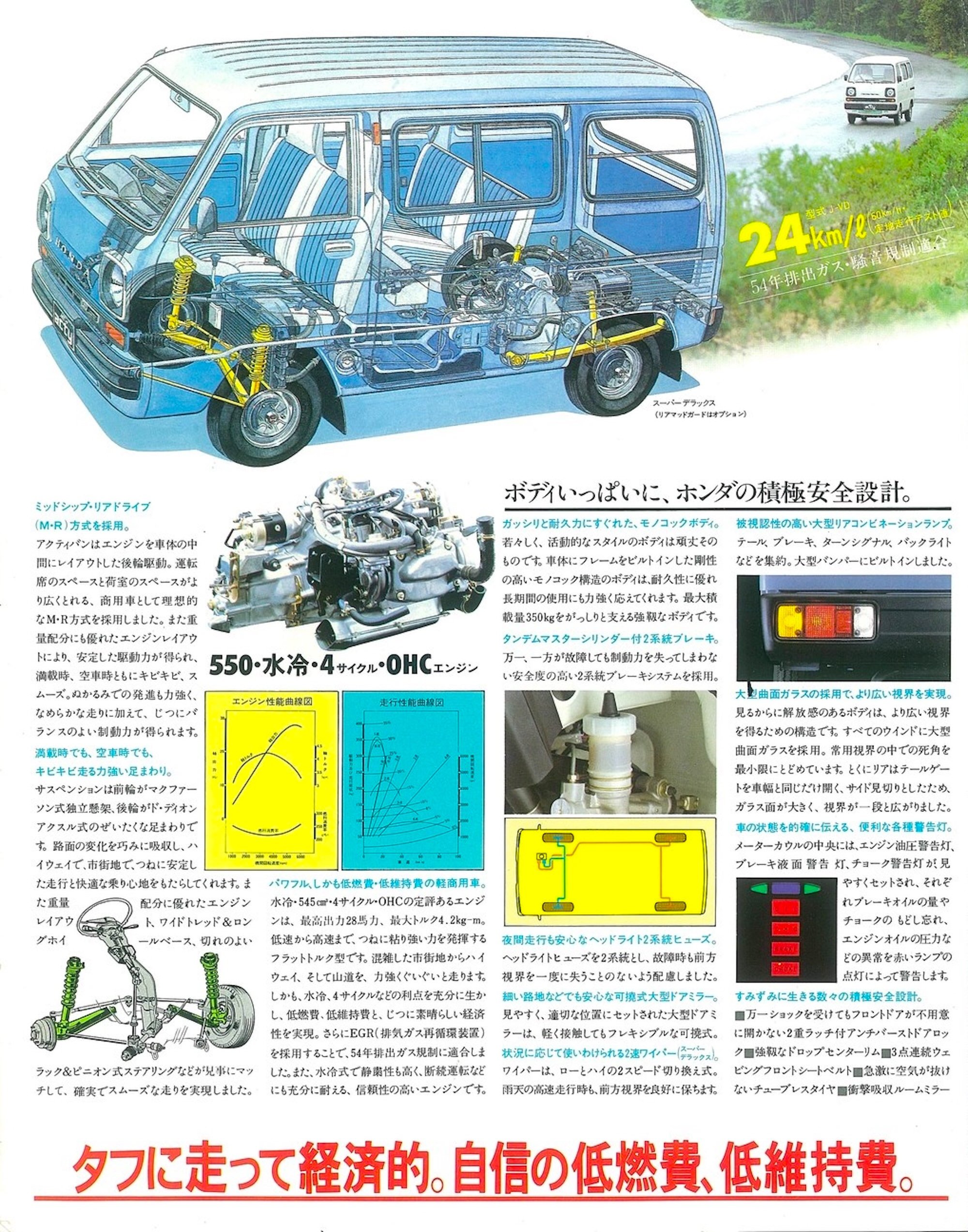
The first-generation Acty, internally known as the TN-ACTY, was launched as a cab-over kei truck with a mid-mounted, water-cooled two-cylinder engine driving the rear wheels. That layout gave it excellent weight distribution and a decently sized flat load bed relative to its size, while keeping the mechanicals accessible for maintenance work. Image courtesy of Honda.
That next major model iteration arrived in May of 1999 with the third-generation Acty, a comprehensive redesign that represents the high-water mark of the original Acty concept. Internally identified by the HA6 and HA7 truck series and the HH5 and HH6 van series, this generation combined the lessons of earlier models with late-1990s engineering standards, resulting in a kei work vehicle that felt unusually well-engineered.
The 1999 Acty was powered by Honda’s 660cc “Hyper 12-valve” PGM-FI engine. In standard naturally-aspirated form it produced 46 bhp at 5,500 rpm, with torque tuned deliberately for low-speed usability rather than any sort of high-rpm output. The engine was paired with either a 5-speed manual transmission or, in some applications, a 3-speed automatic. Rear-wheel drive was standard, while Honda’s Real Time 4WD system was available on selected truck and van variants, automatically varying torque distribution in response to driving conditions.
The 1999 redesign adopted a semi-bonneted layout to meet updated impact safety requirements, while keeping the mid-engine drivetrain placement and maximizing usable load space in the rear within kei class limits. The truck versions offered remarkable versatility for their diminutive size, with drop-side beds and an array of factory special-purpose derivatives. These included dump trucks, refrigerated vans, and the Acty Lifter, which used an electric-hydraulic mechanism to raise and lower cargo.
The van variants helped to further broaden the third-gen Acty’s appeal, with fully enclosed bodies, sliding side doors, and configurable rear seating or cargo layouts, the Acty Van became a staple for delivery fleets, municipal services, and small retailers. Higher-trim versions added modest comfort features, but the focus always remained on toughness, easy cleaning, and mechanical simplicity.
Production of the 1999-era Acty continued for a decade with only minor revisions, incremental updates addressed emissions compliance and safety requirements, but the core mechanical package remained largely unchanged until the full model change of the Acty Truck in late 2009.
Today, the 1999-on Acty occupies a special place among kei class enthusiasts and import buyers outside Japan. Its compact dimensions, mechanical simplicity, and surprising usability have made it popular in regions where kei vehicles are now legal under niche regulations.
The 4WD version in particular has gained a cult following in the United States and further afield, where it’s become a darling of automotive YouTubers and quirky off-road enthusiasts alike.
The Honda ACTY 4×4 + Honda Monkey Bike Shown Here
The two-vehicle package deal you see here consists of a 1999 Honda ACTY 4WD and a 2021 Honda Monkey minibike. It also comes with a matching skateboard and motorcycle helmet, all finished in the same Hot Wheels-style flame livery.
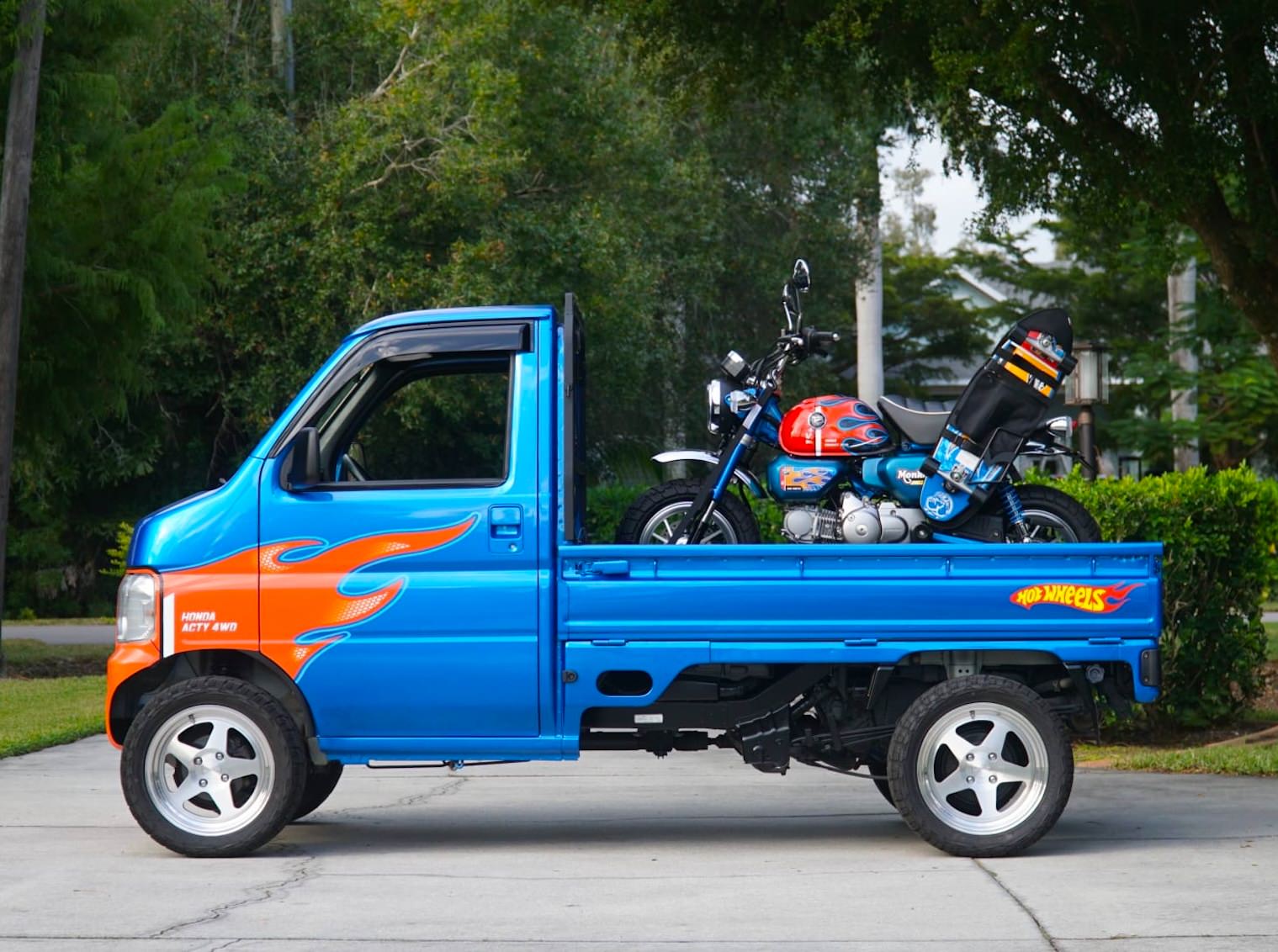
This is a 4×4 Honda ACTY that is now being sold as a package deal with a 2021 Honda Monkey minibike. Both the ACTY and the minibike have been given the full Hot Wheels treatment, including flame decals, Hot Wheels decals, custom embroidery, and more.
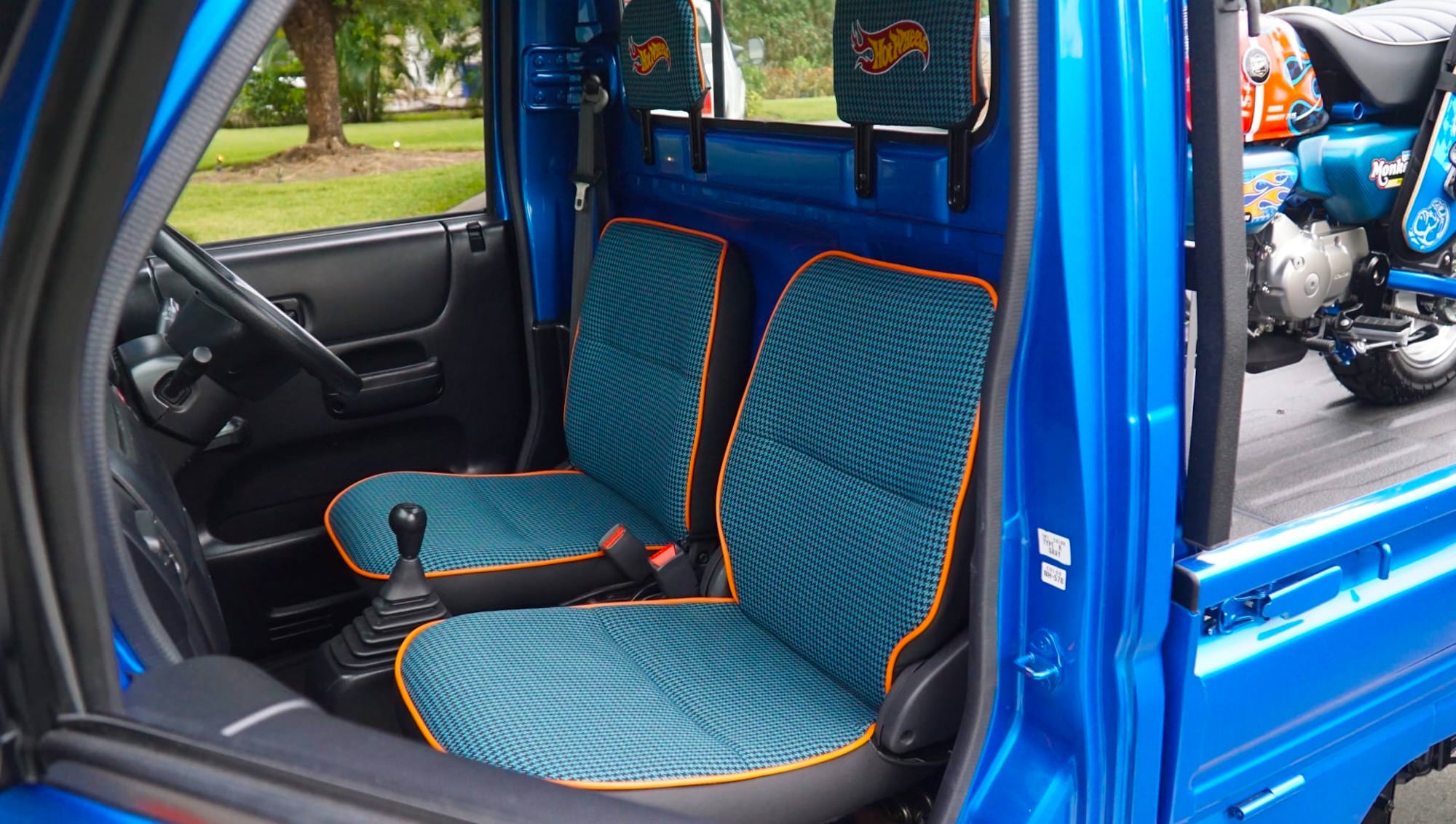
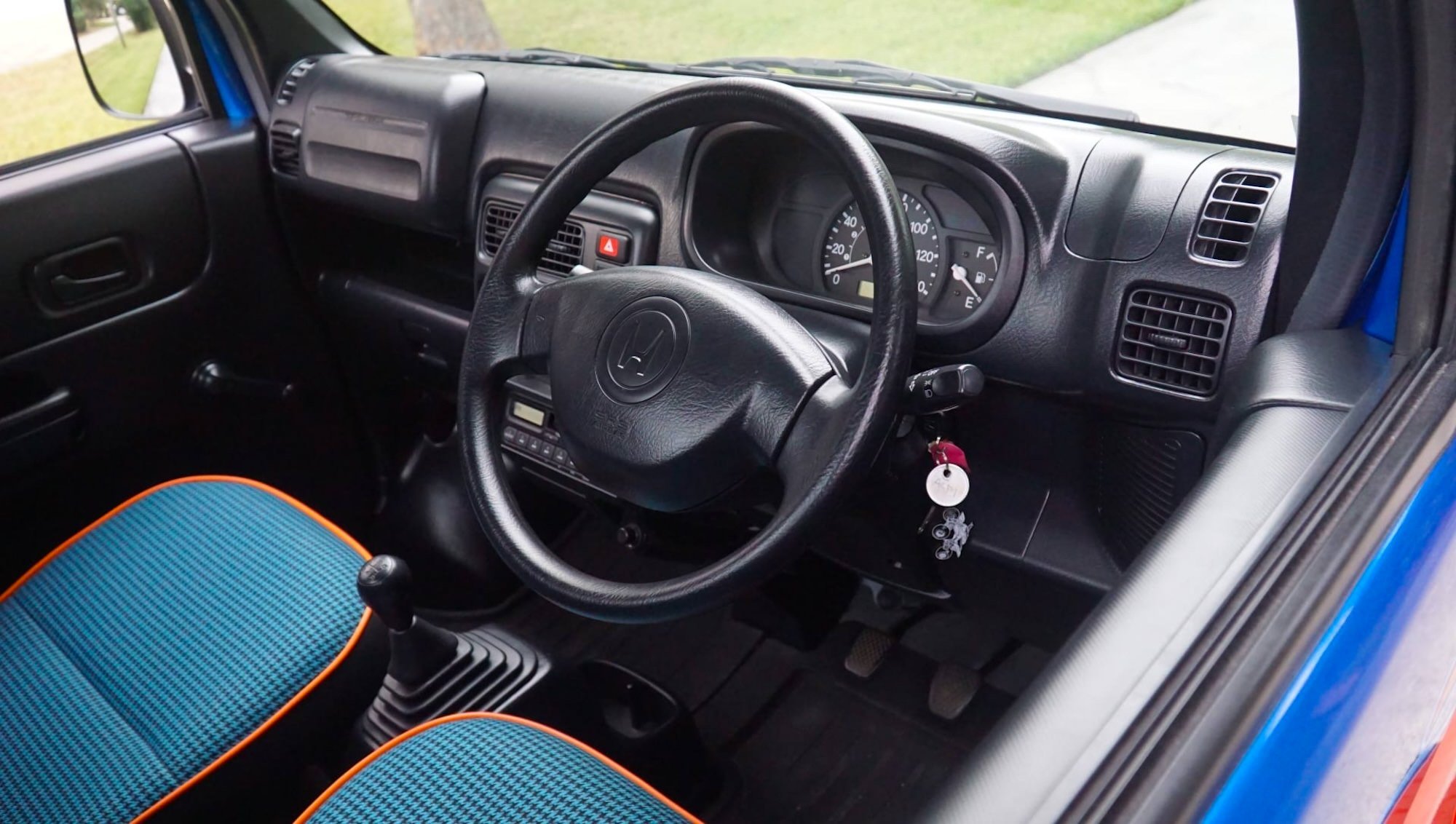
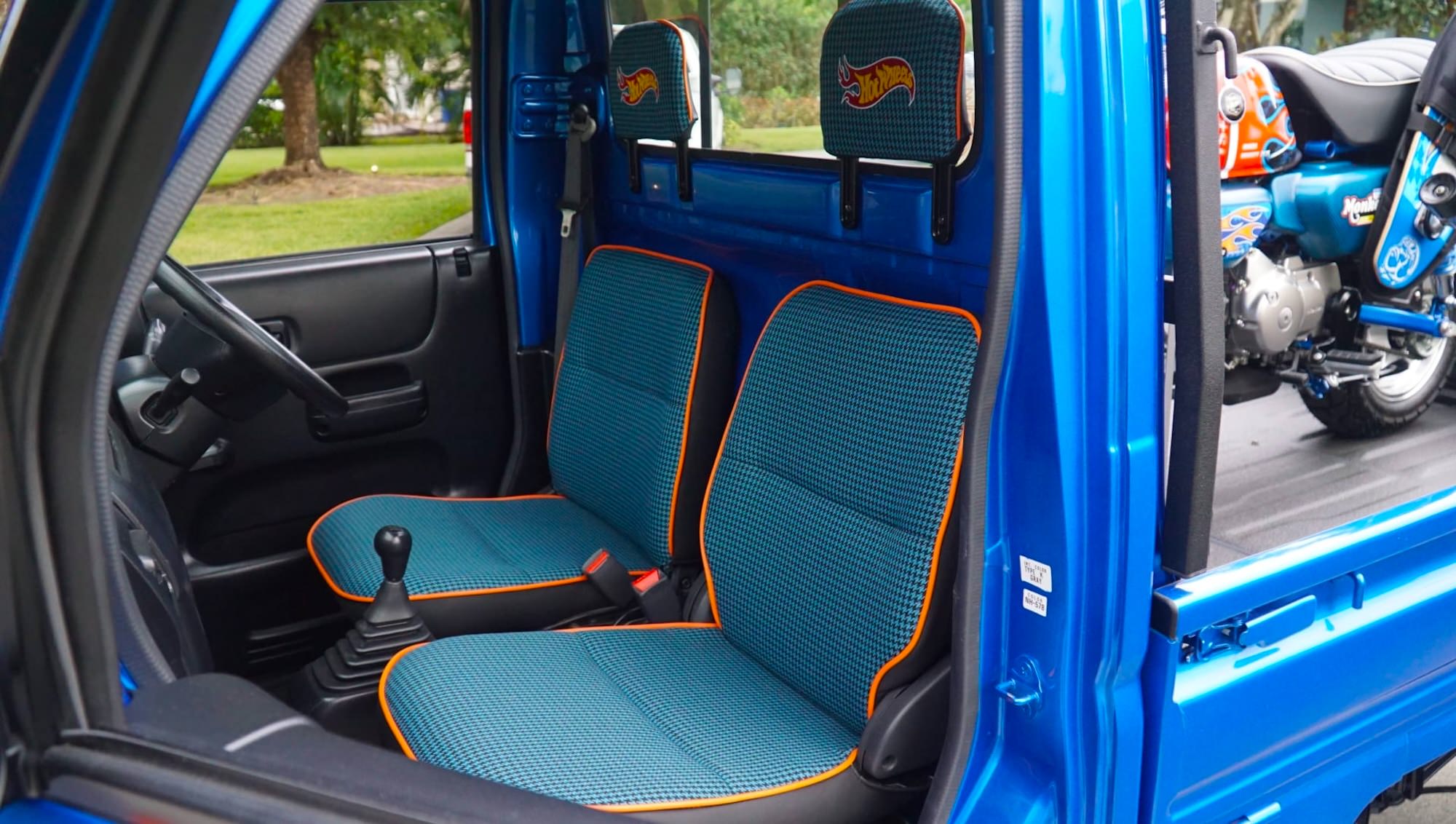
The ACTY is finished in blue with red an d orange flames down the sides, and inside you’ll find a matching blue and orange interior with the Hot Wheels logo embroidered into the headrests. The Monkey Bike rides in the cargo tray, and it’s also finished in blue with flames down the sides of the fuel tank.
The two vehicles and accessories are now due to be auctioned by Mecum as a single lot in Kissimmee, Florida on the 16th of January. If you’d like to read more or register to bid you can visit the listing here.
Images courtesy of Mecum

Articles that Ben Branch has written have been covered on CNN, Popular Mechanics, Smithsonian Magazine, Road & Track Magazine, the official Pinterest blog, the official eBay Motors blog, BuzzFeed, Autoweek Magazine, Wired Magazine, Autoblog, Gear Patrol, Jalopnik, The Verge, and many more.
Silodrome was founded by Ben back in 2010, in the years since the site has grown to become a world leader in the alternative and vintage motoring sector, with well over a million monthly readers from around the world and many hundreds of thousands of followers on social media.