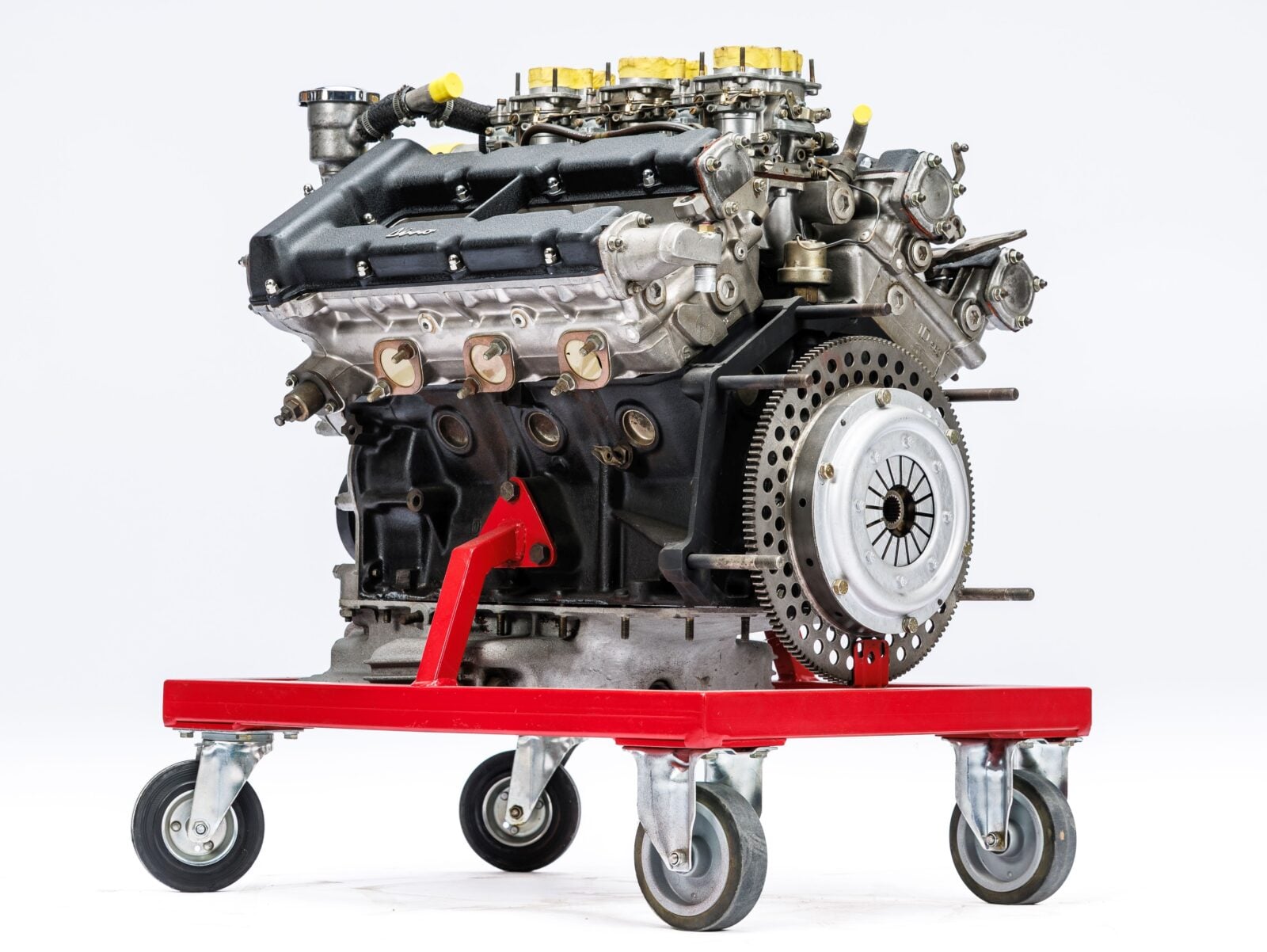
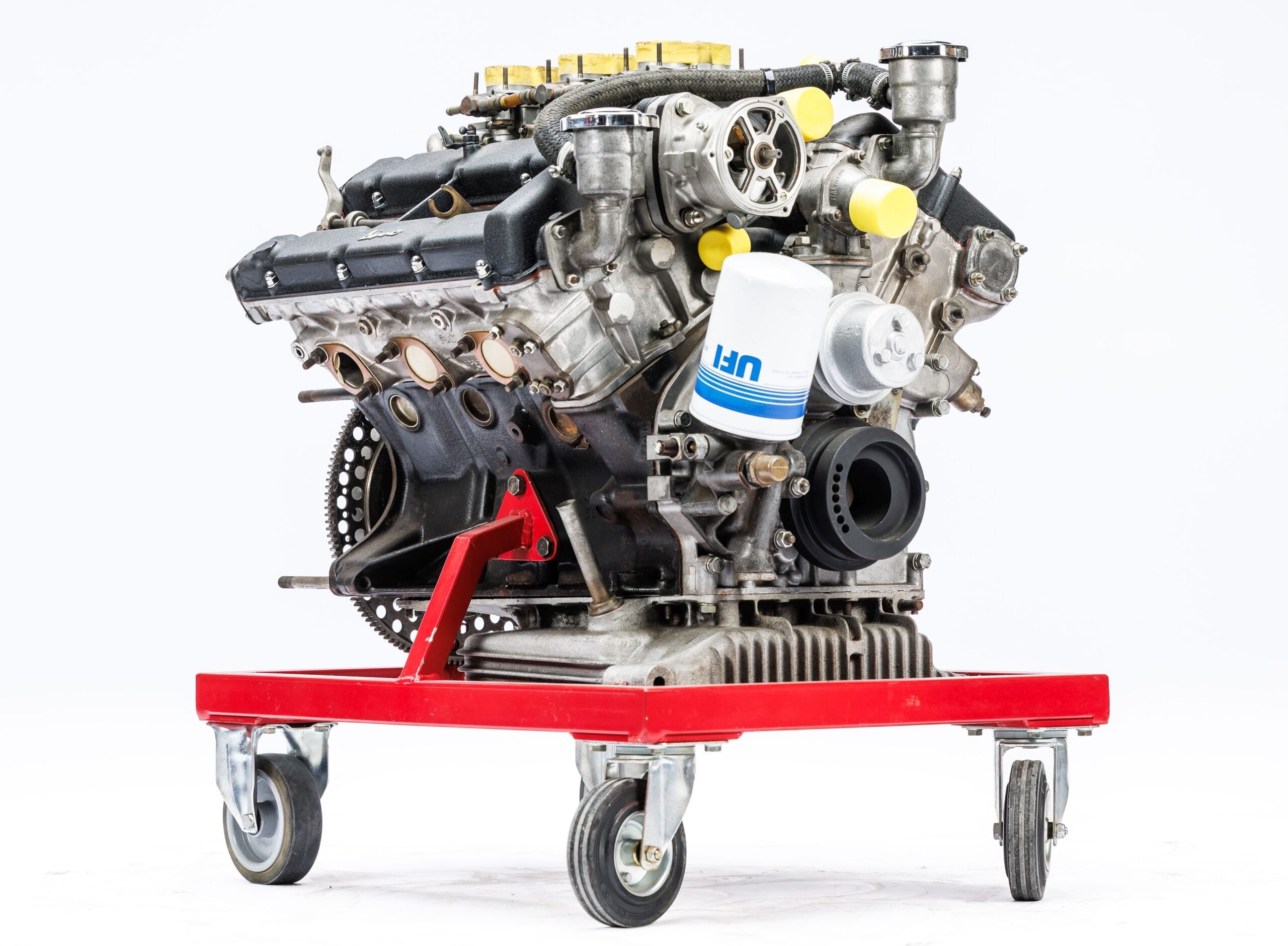
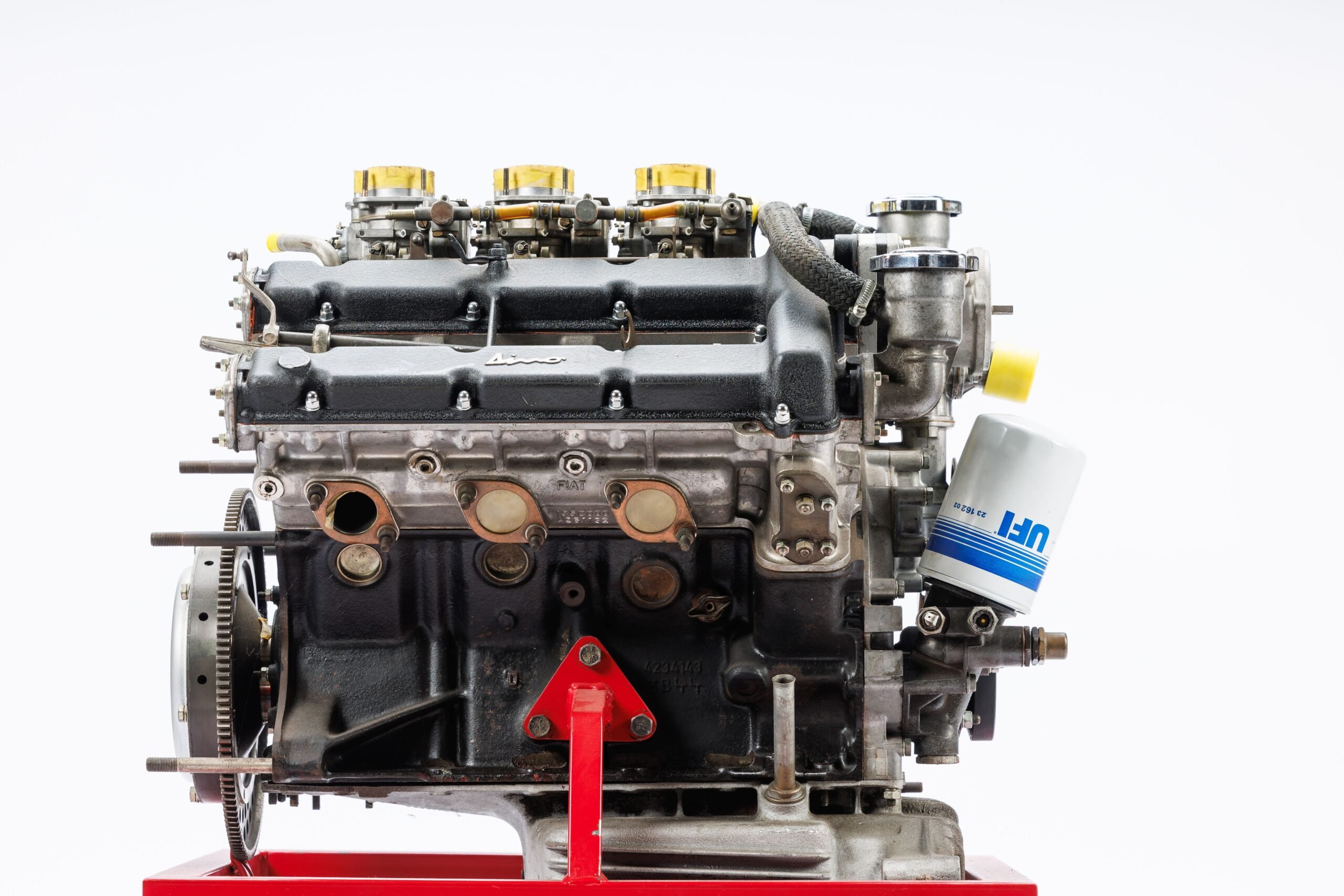
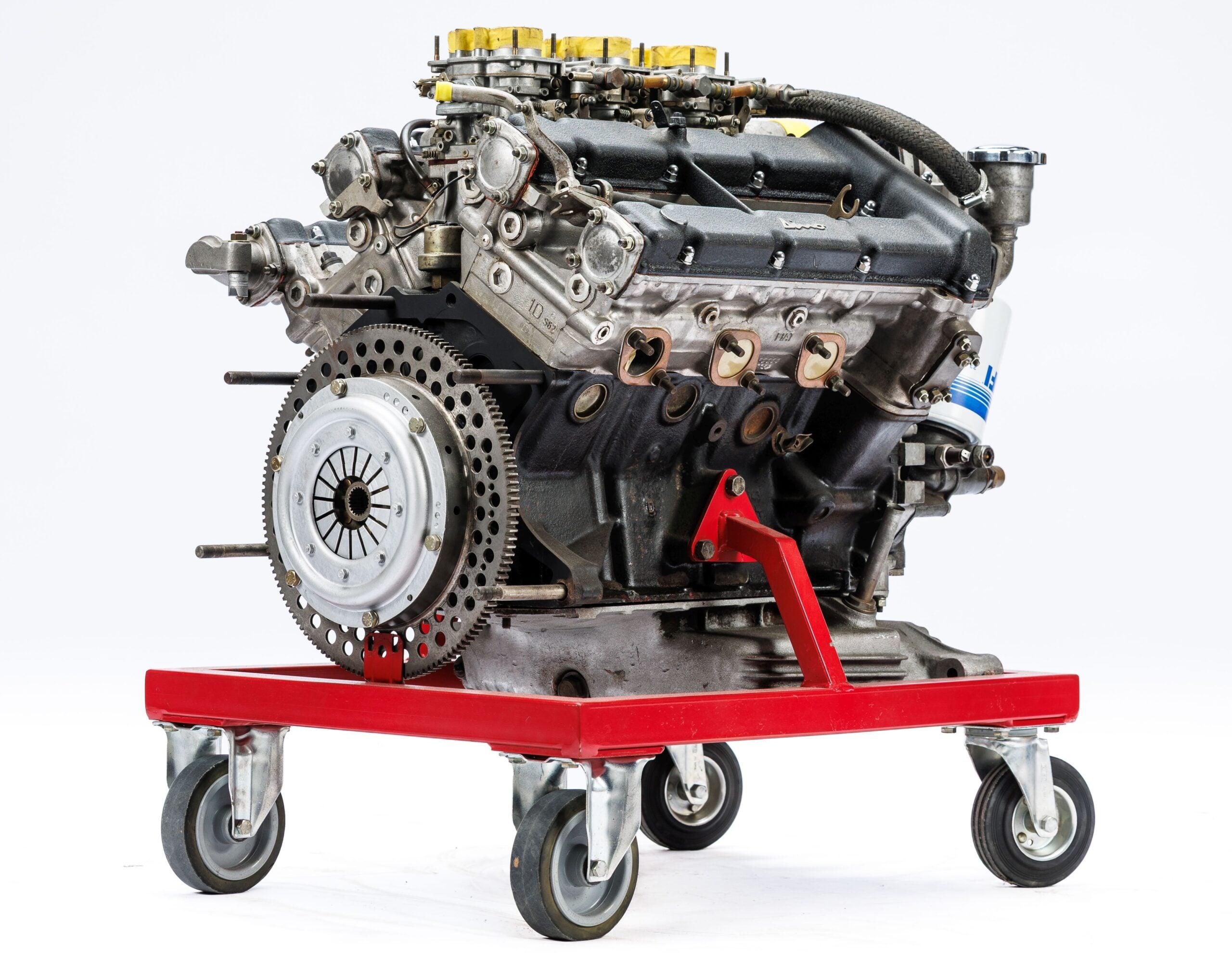
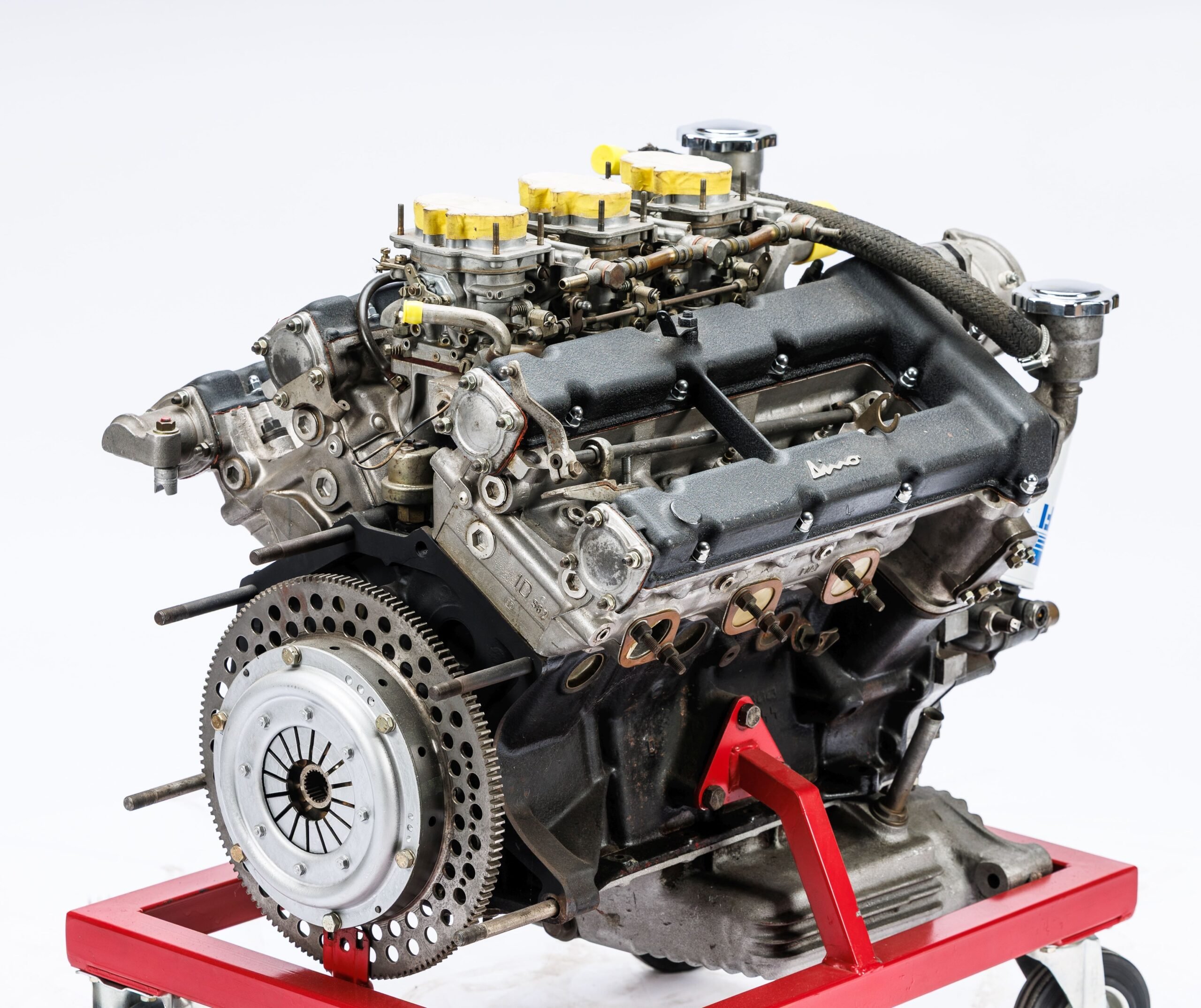
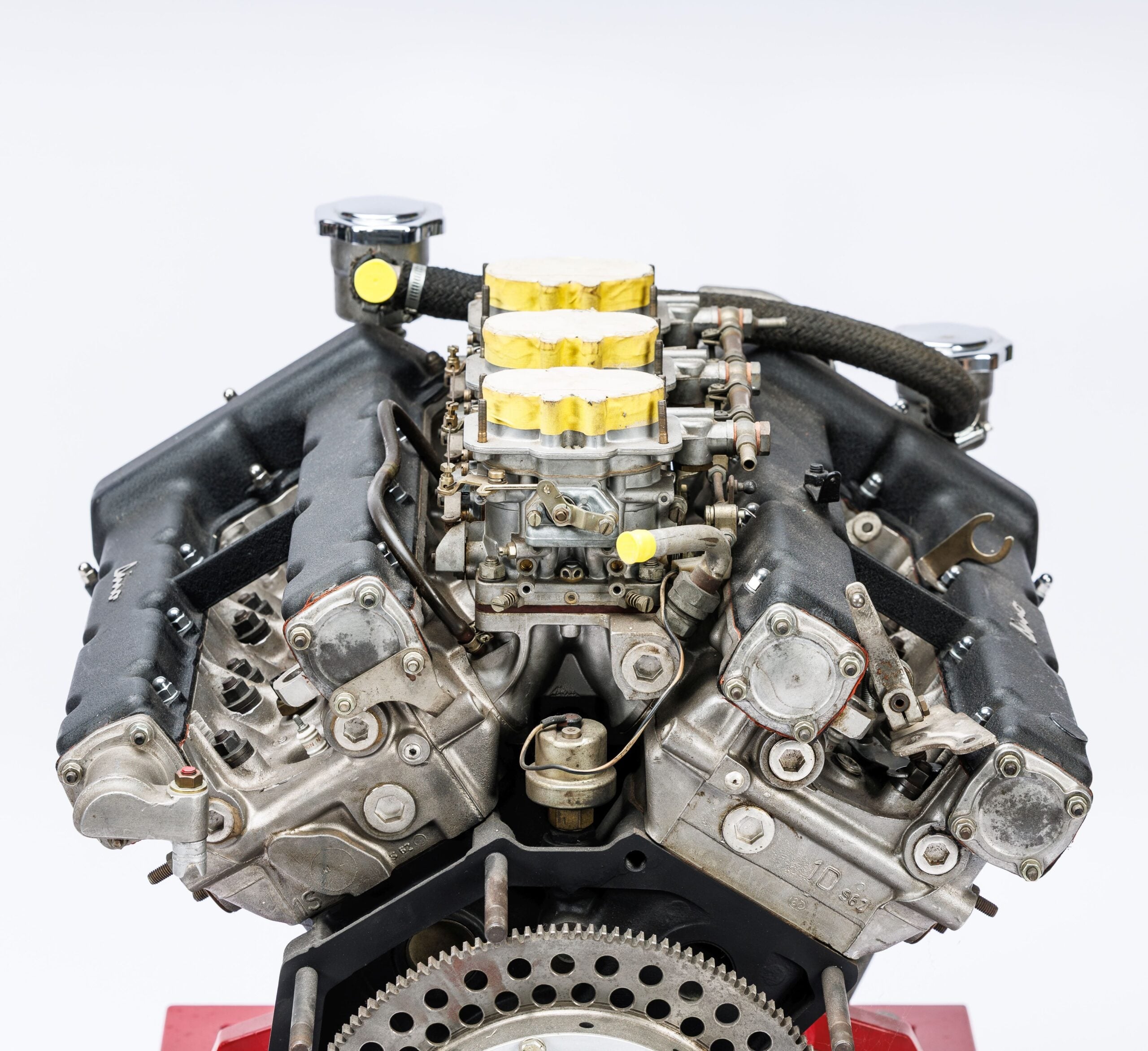
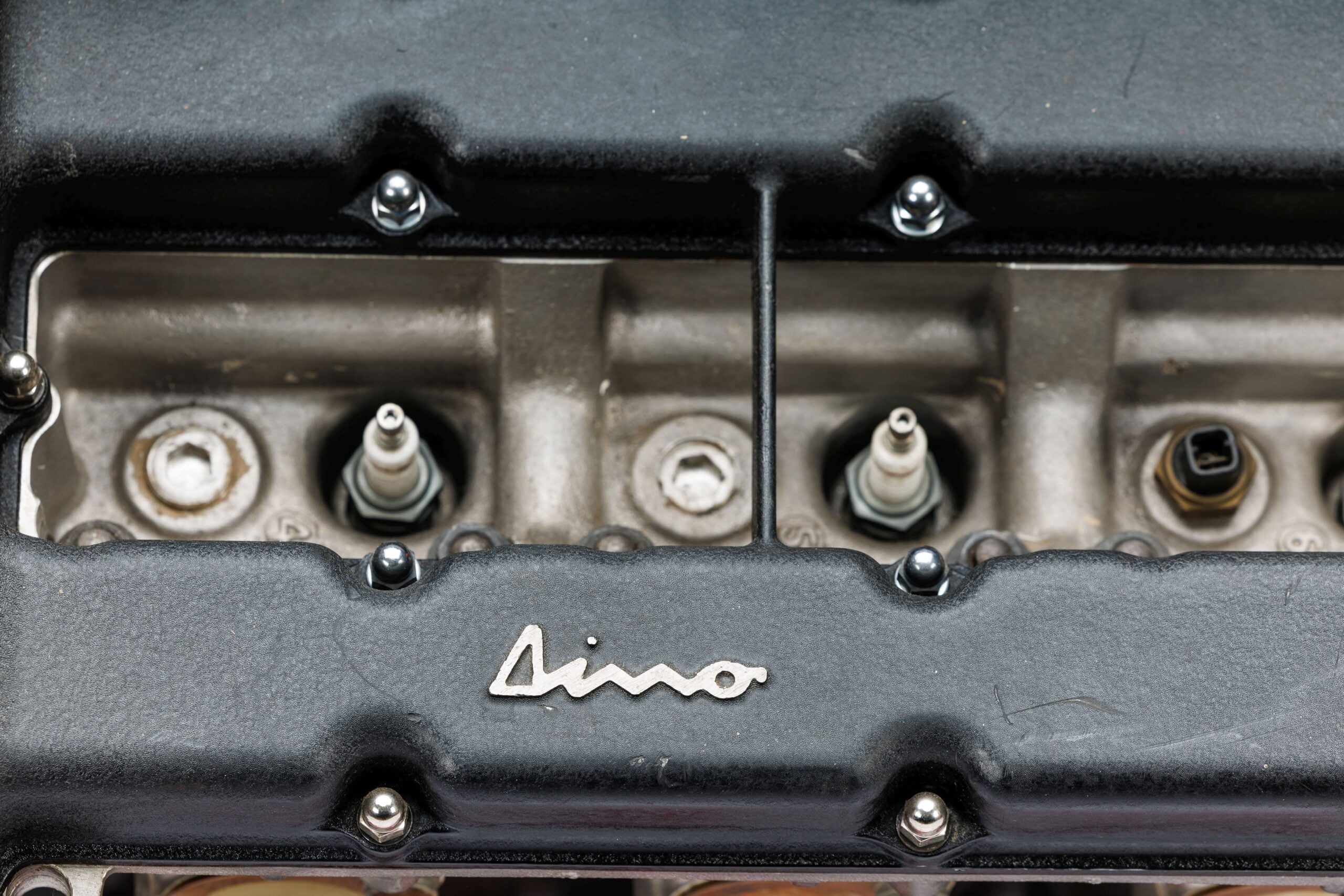
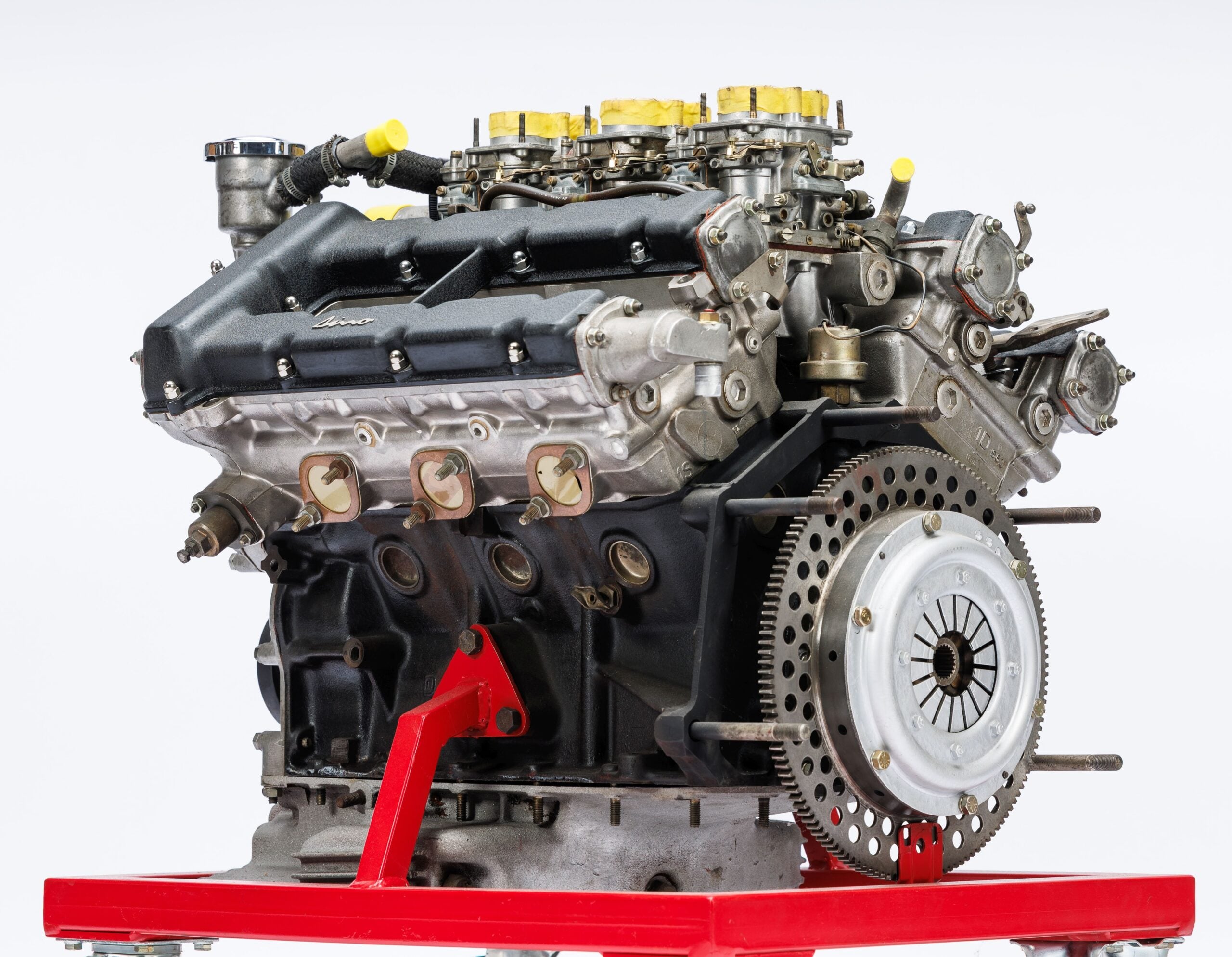
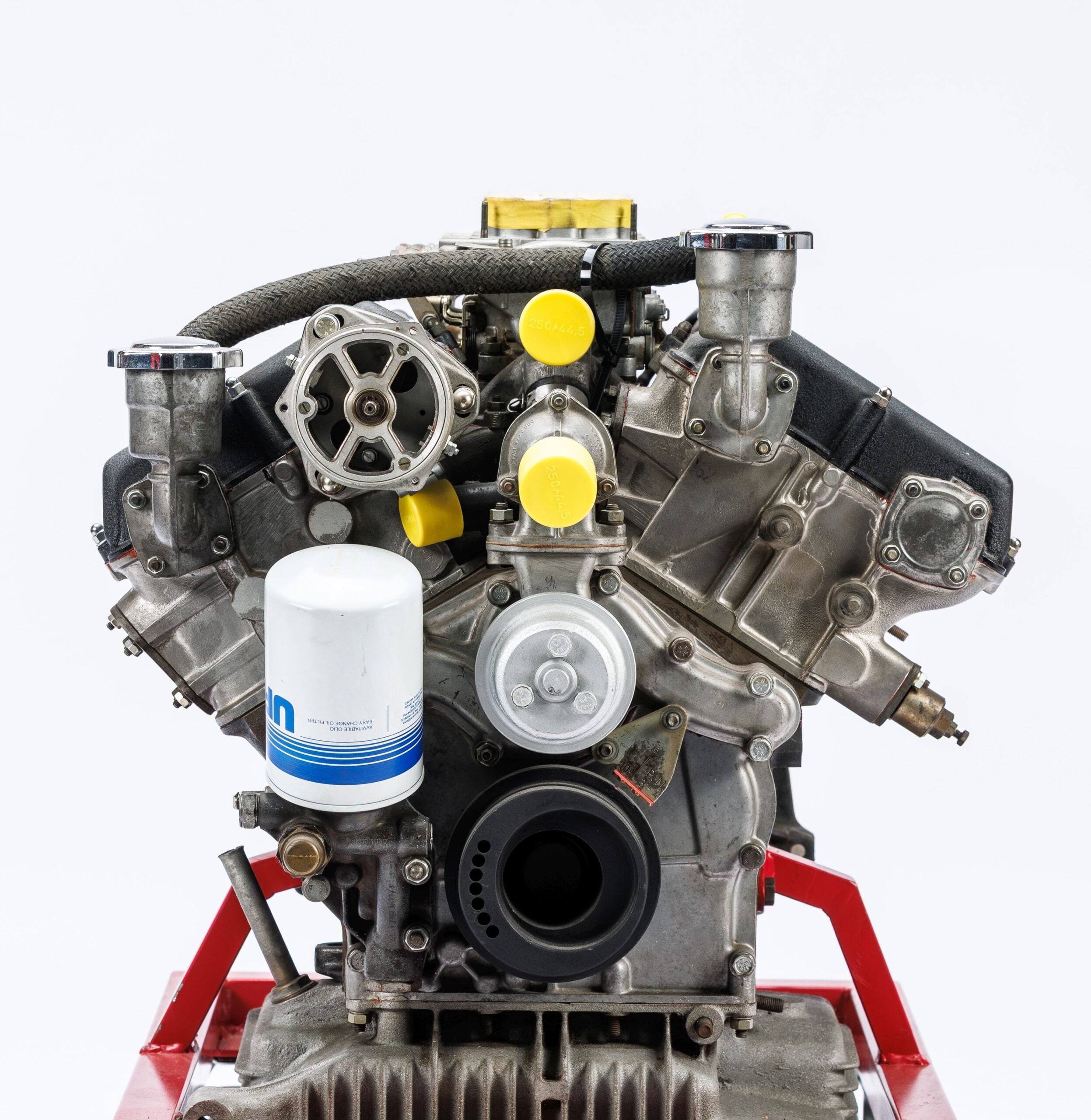
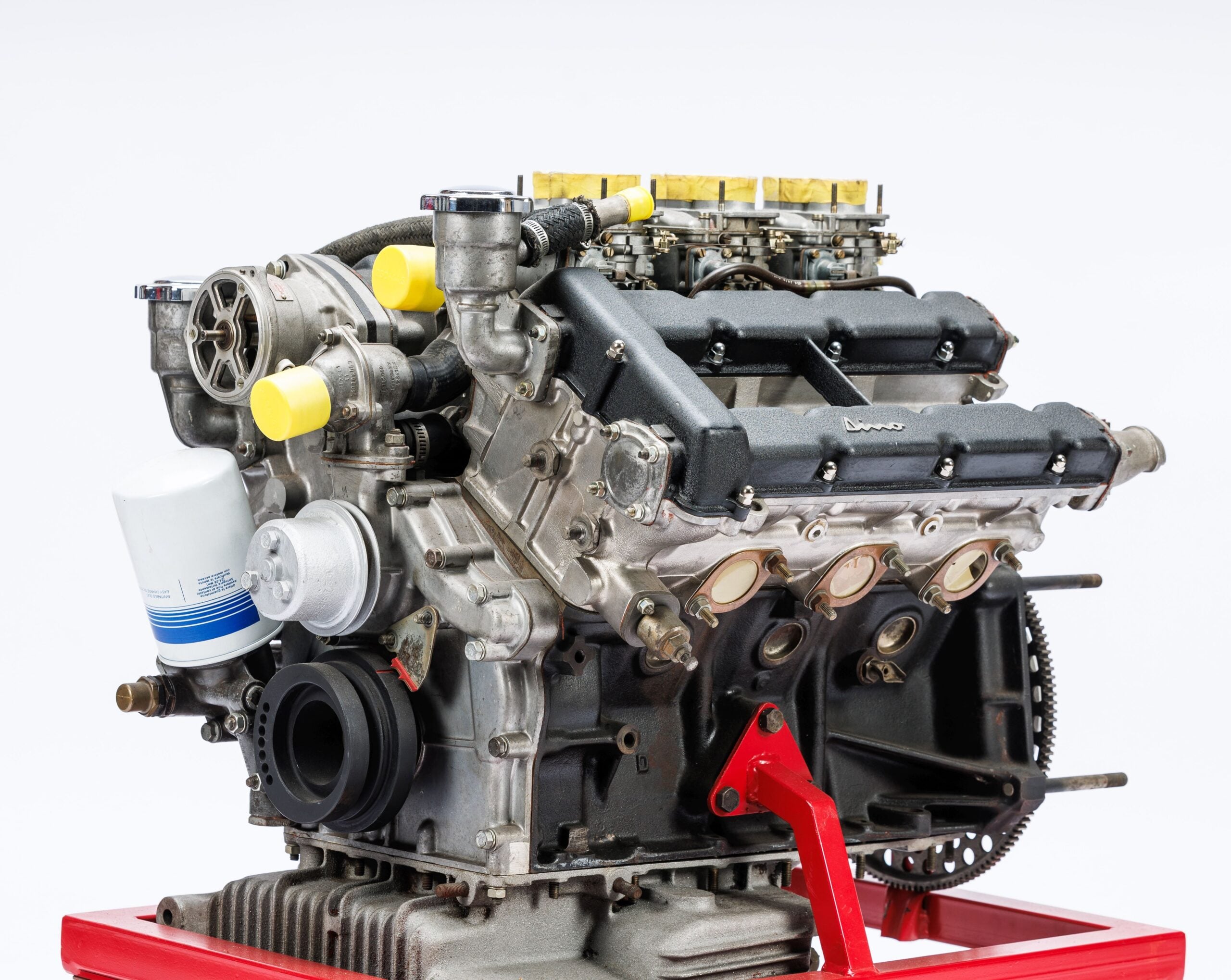
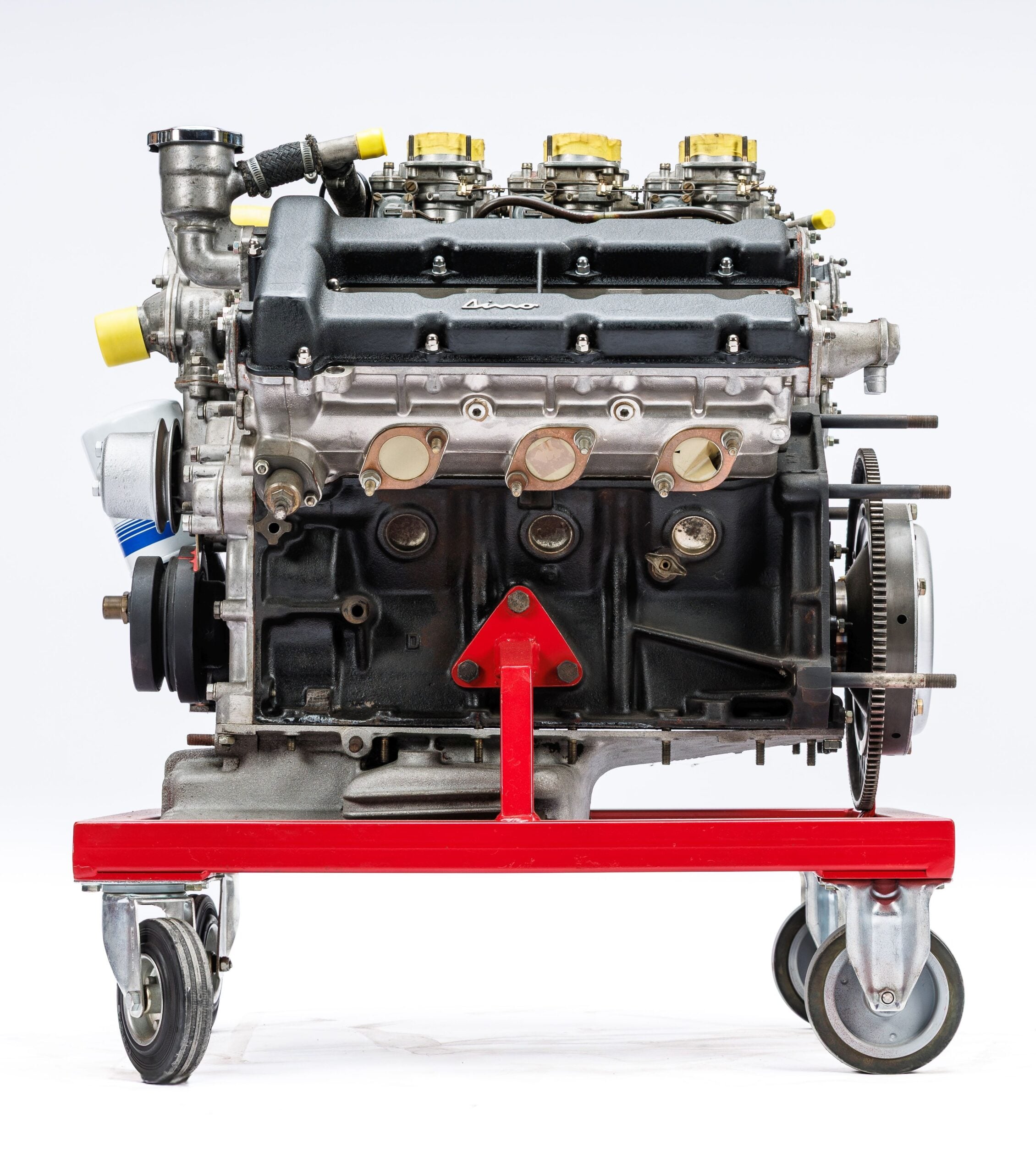
This is a Dino 246 engine, a Ferrari-designed 2.4 liter 65º V6 with double overhead cams, triple Weber 40DCNF13 carburetors, and an iron block with lightweight aluminum alloy heads.
Versions of this engine were fitted to both the Ferrari Dino 246 and to the Fiat Dino 2400, with the Ferrari-version producing a reported 192 bhp and 166 lb ft of torque. A version of this engine would power the all-conquering Lancia Stratos HF that would win the World Rally Championship in 1974, 1975, and 1976.
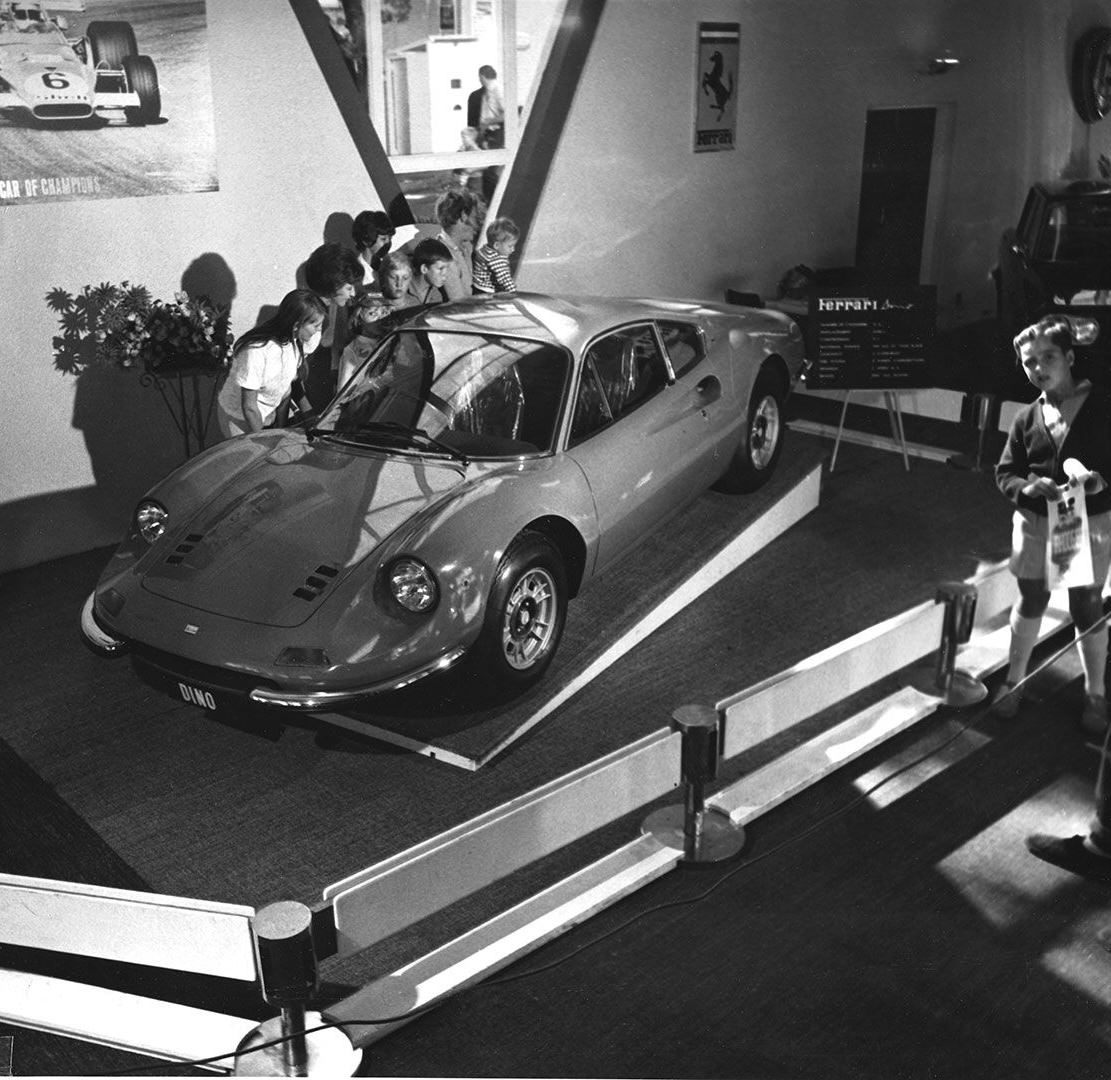
 The Ferrari Dino 246 GT debuted in 1969 with a series of updates over its predecessor, and a revised Dino V6 now with a displacement of 2.4 liters and an iron block paired with alloy heads. The Dino 246 came in both GT (hardtop) and GTS (targa) variants and it was built between 1969 and 1974 in vast numbers by Ferrari standards, with 3,569 produced versus the 152 examples of the earlier Dino 206 GT. Image courtesy of Ferrari.
History Speedrun: The Dino 246 Engine
Known at Ferrari by its internal codename Tipo 135 CS, the Dino 246 V6 engine was a direct evolution of the earlier Tipo 135B engine, a V6 unit with a displacement of 2.0 liters that as directly derived from the Ferrari Formula 2 racing program.
The Dino name came from Enzo Ferrari’s son, Alfredo “Dino” Ferrari, who was a promising young Italian automotive engineer that tragically died of Duchenne muscular dystrophy at the age of just 24. Alfredo had worked directly on the design of early versions of the Dino V6 that would power Ferrari’s F2 cars in the 1950s and beyond.
When Enzo needed a name for a line of road-going Ferraris that would exist on a separate plane to the main Ferrari production cars, he chose the name Dino out of respect for his son. These Ferrari Dinos were developed from the outset to be a more affordable model series to compete with successful sports cars like the Porsche 911.
It’s worth noting, before I start getting emails from anoraks, that initially the Dino cars were not officially named Ferrari Dinos, not at first anyway. The name was just simply Dino and there was no Ferrari badging on them, for a time they weren’t even welcome in many Ferrari clubs, though this has now exceedingly rare.
The first production Dino to official get the Ferrari name was the Ferrari Dino 308 GT4, the last of the line, and a popular V8-powered 2+2 with classic 1970s-wedge styling by Marcello Gandini at Bertone.
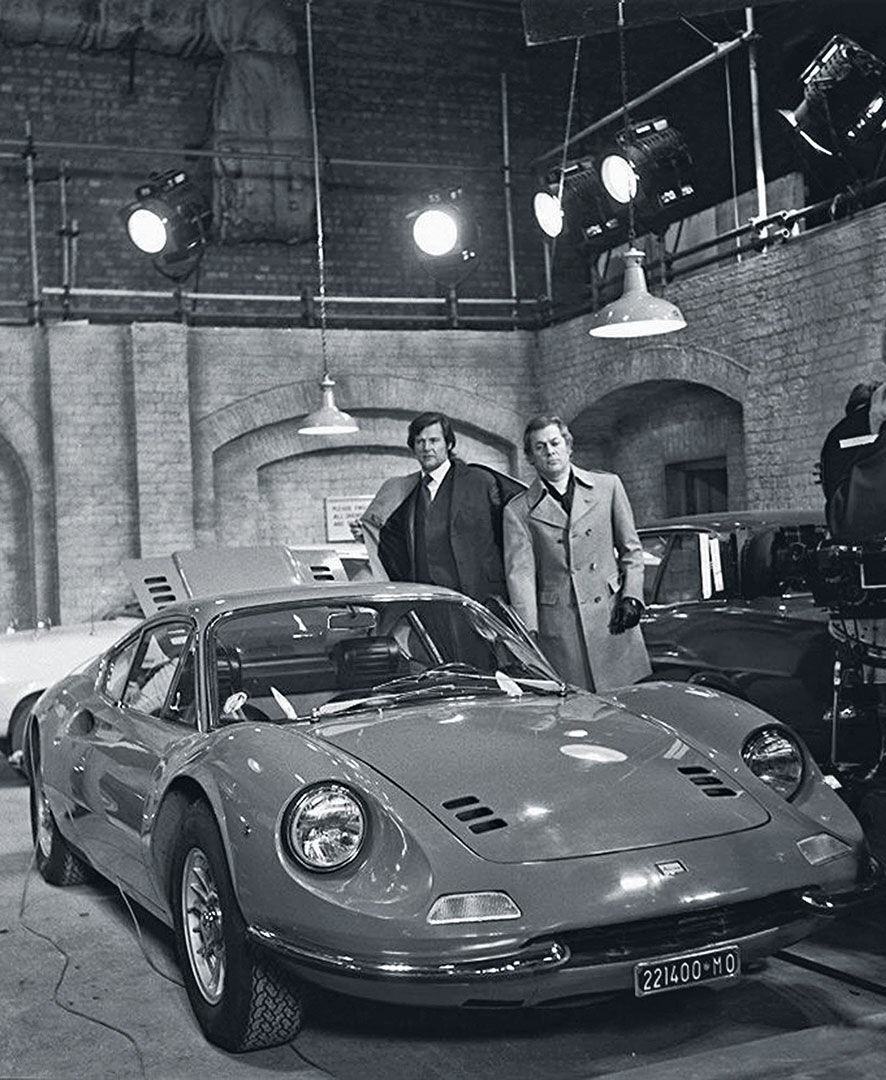
The engine that powered the 246 GT and GTS was the Tipo 135 CS, a 65º V6 with double overhead cams, two valves per cylinder, and a displacement of 2,419.20cc – just a smidge over 2.4 liters. Power was rated by Ferrari as 192 bhp at 7,600 rpm and 166 lb ft of torque at 5,500 rpm. Image courtesy of Ferrari.
When the road-going Dino 206 GT debuted at the Turin Motor Show in October of 1966 it was powered by a 2.0 liter all-alloy version of the Ferrari-designed Dino V6. Fiat famously came to an agreement with Ferrari to produce the engines and to fit them to their own Dinos, the Fiat Dino Spider and Coupe, in order to help Ferrari homologate the engine for racing and provide Fiat with a halo model as a bonus.
The Ferrari Dino 246 GT debuted in 1969 with a series of updates over its predecessor, and a revised Dino V6 now with a displacement of 2.4 liters and an iron block paired with alloy heads. The Dino 246 came in both GT (hardtop) and GTS (targa) variants and it was built between 1969 and 1974 in vast numbers by Ferrari standards, with 3,569 produced versus the 152 examples of the earlier Dino 206 GT.
The engine that powered the 246 GT and GTS was the Tipo 135 CS, a 65º V6 with double overhead cams, two valves per cylinder, and a displacement of 2,419.20cc – just a smidge over 2.4 liters. Power was rated by Ferrari as 192 bhp at 7,600 rpm and 166 lb ft of torque at 5,500 rpm.
The Tipo 135 CS V6 soon developed a reputation for good reliability and above average performance, with the Dino 246 GT just slightly besting the period-Porsche 911S in most major performance metrics offering slightly more horsepower and torque, a 0 – 60 mph time of 6.8 seconds versus 7.3 for the German, and a top speed of 146 mph versus 143 mph.
The Dino 246 Engine Shown Here
The engine you see here is simply listed as a Dino 246 engine, and the listing notes that it’s fitted with triple Weber 40DCNF13 carburetors and it comes on a red wheeled base for easy movement.
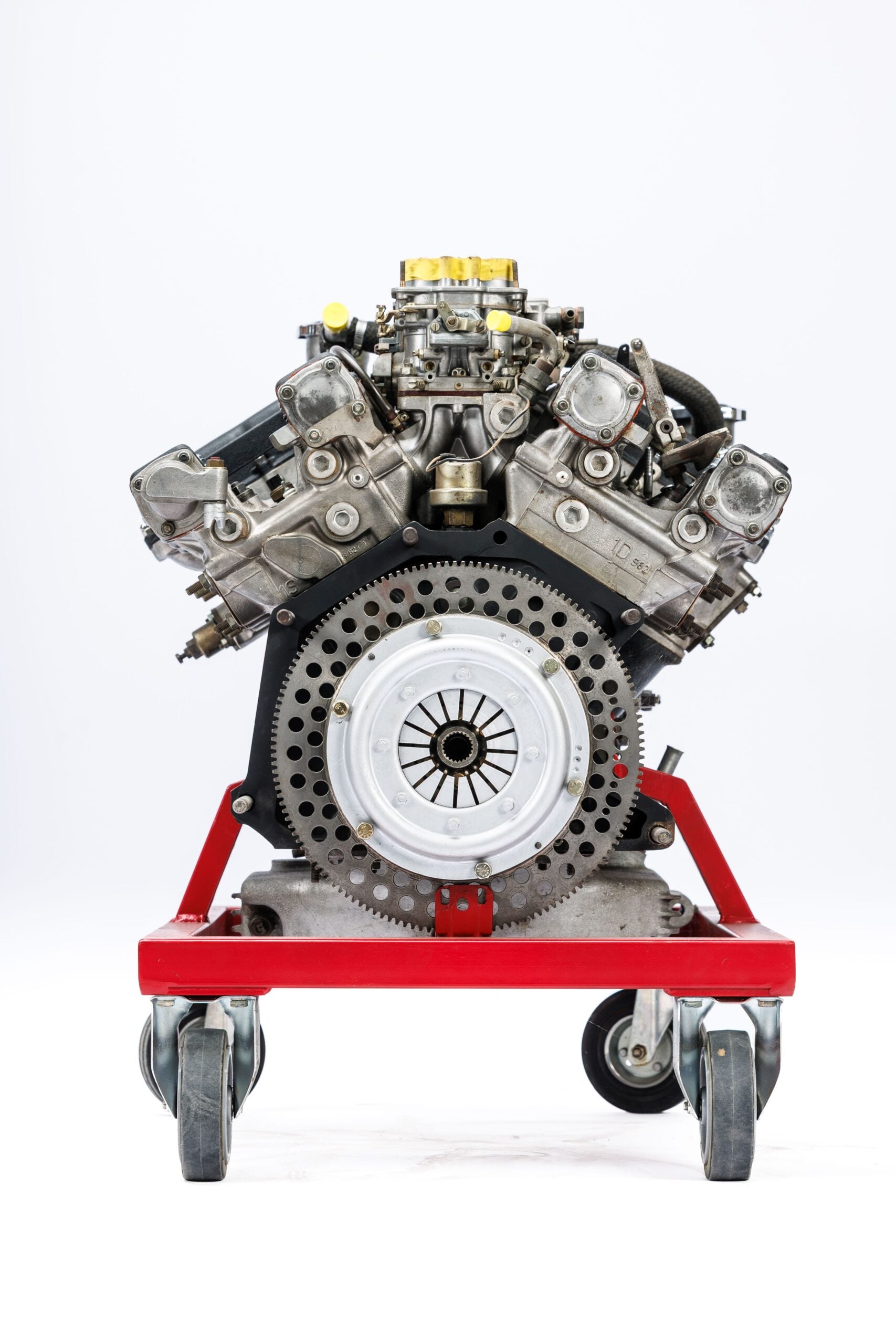
This is a Dino 246 engine, a Ferrari-designed 2.4 liter 65º V6 with double overhead cams, triple Weber 40DCNF13 carburetors, and an iron block with lightweight alloy heads.
There is very little other information about the engine, it’s part of the Fritz Neuser Collection that’s being auctioned by Artcurial in mid-March, along with a number of historically significant custom Ferraris, and a slew of other cars and Ferrari engines.
If you’d like to read more about this engine or register to bid you can visit the listing here, it has a price guide of €10,000 – €20,000, which works out to approximately $11,795 – $23,591 USD.
Images courtesy of © Peter Singhof / Artcurial + Ferrari

Articles that Ben Branch has written have been covered on CNN, Popular Mechanics, Smithsonian Magazine, Road & Track Magazine, the official Pinterest blog, the official eBay Motors blog, BuzzFeed, Autoweek Magazine, Wired Magazine, Autoblog, Gear Patrol, Jalopnik, The Verge, and many more.
Silodrome was founded by Ben back in 2010, in the years since the site has grown to become a world leader in the alternative and vintage motoring sector, with well over a million monthly readers from around the world and many hundreds of thousands of followers on social media.