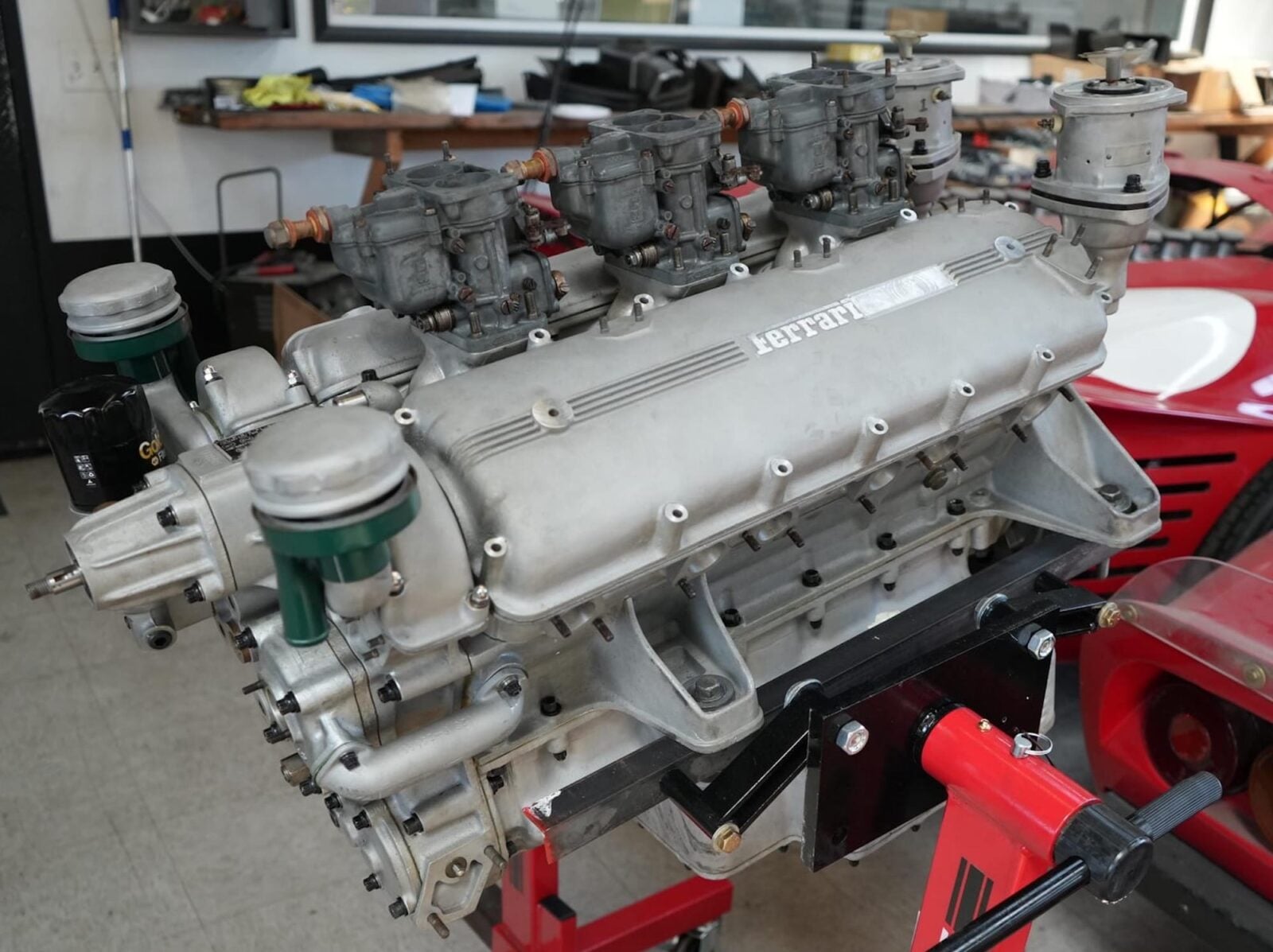
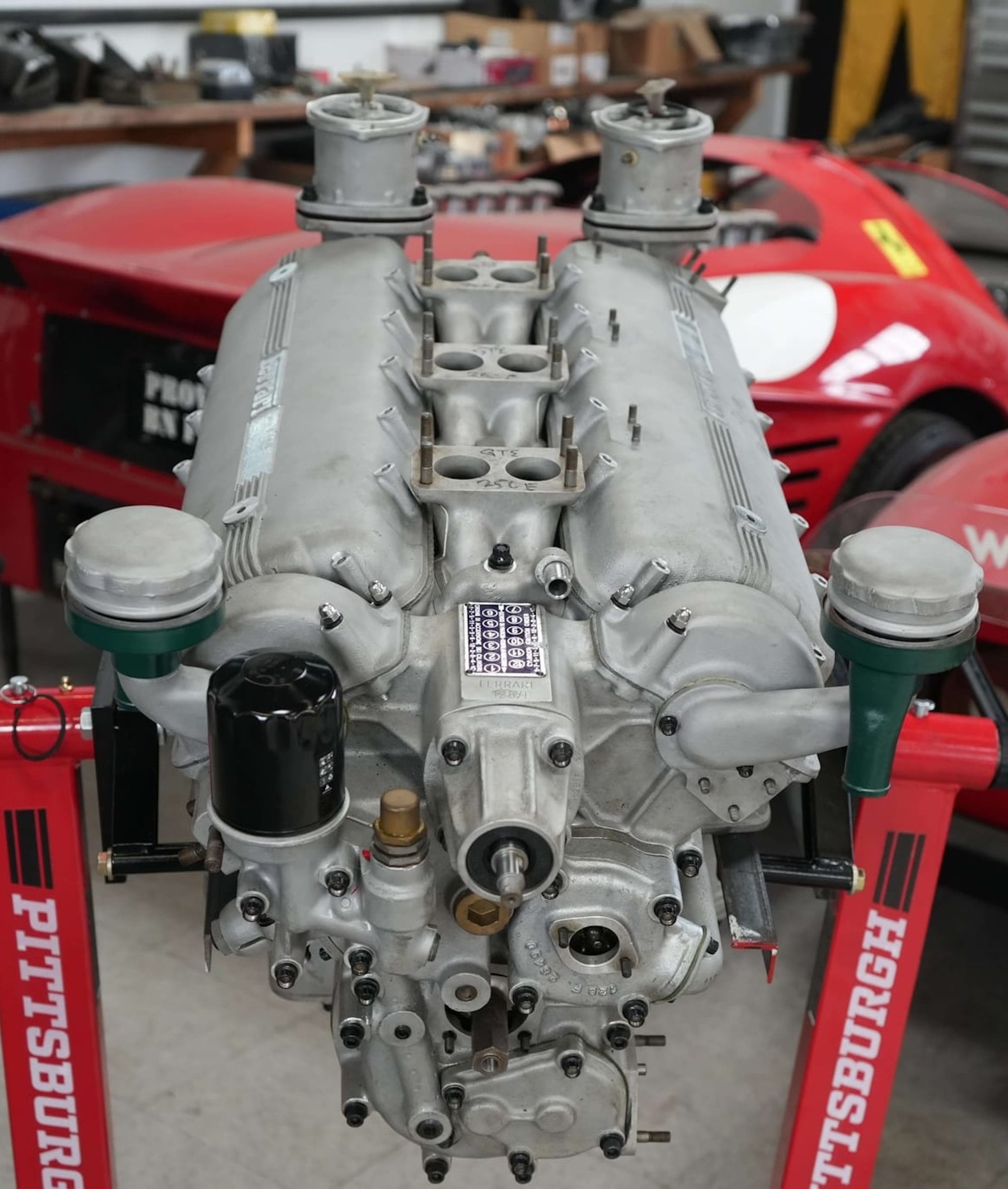
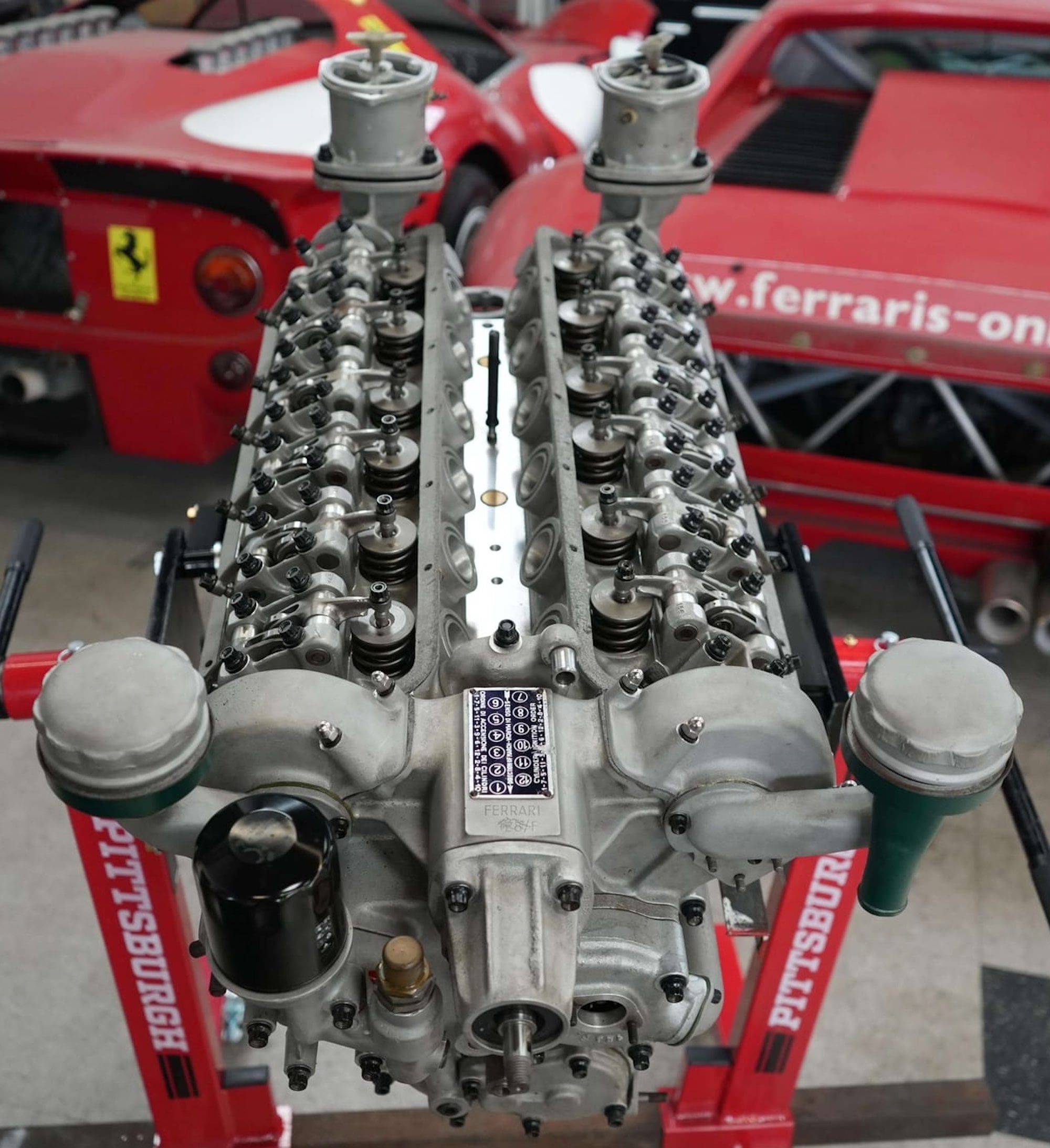
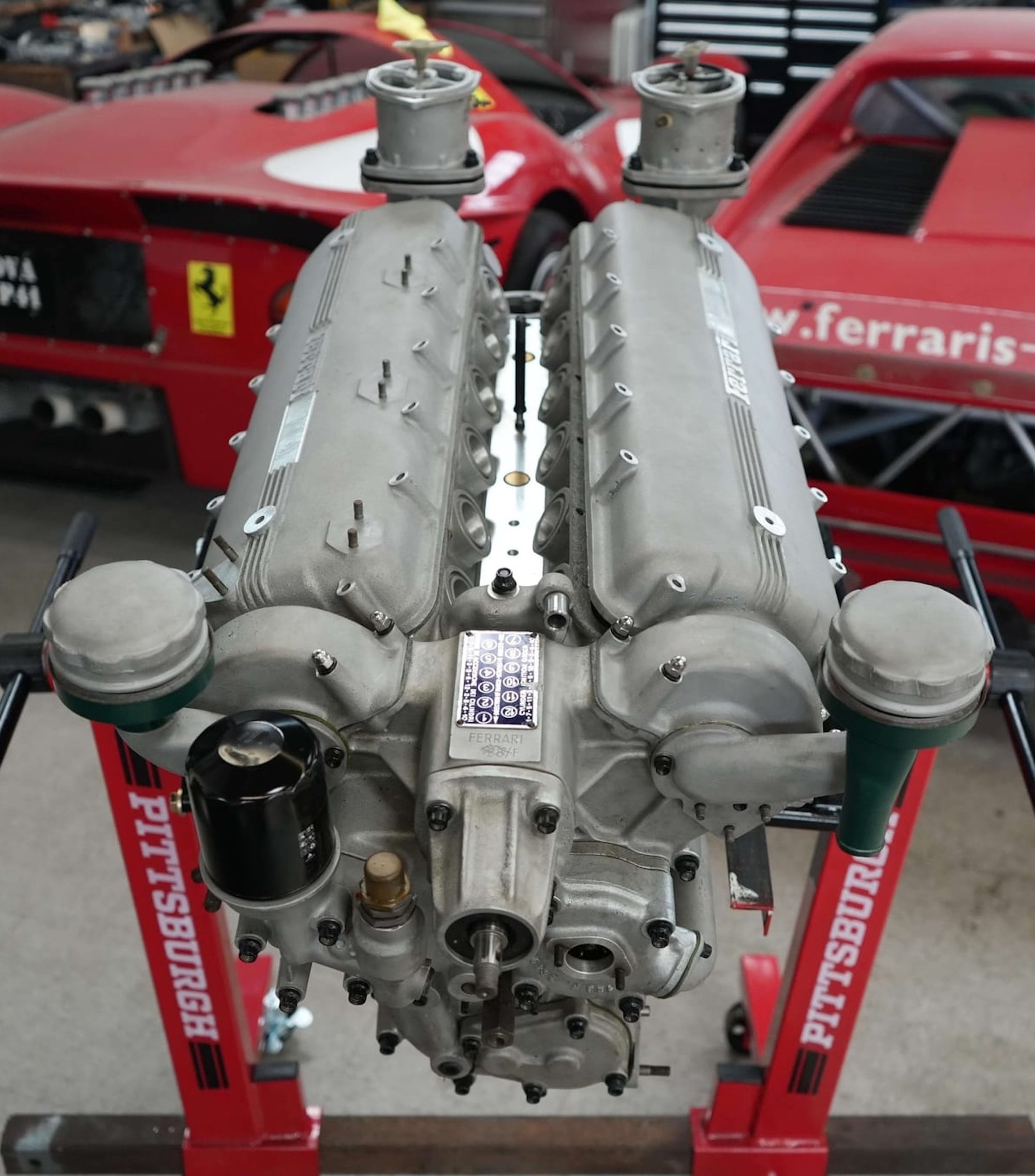
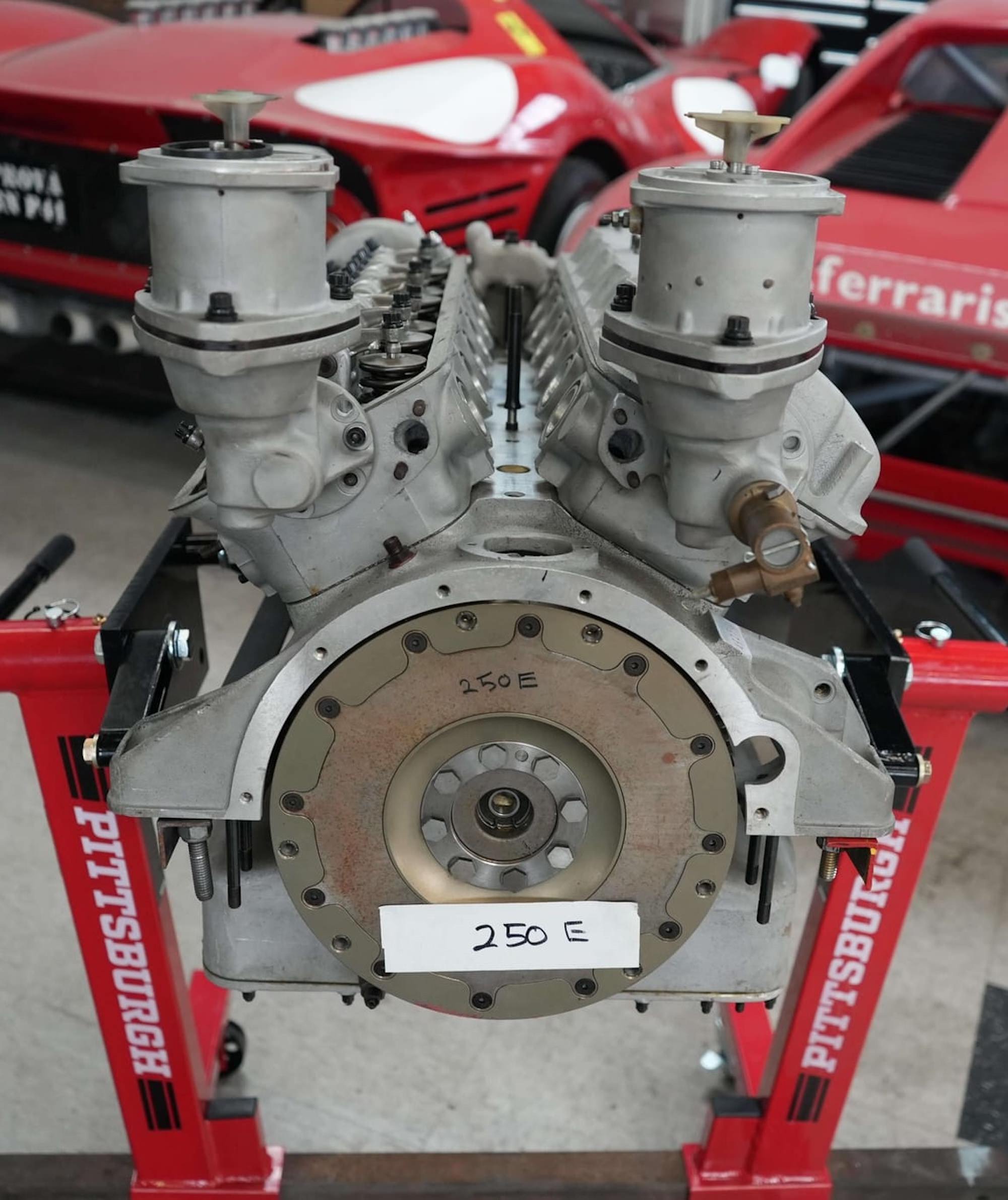
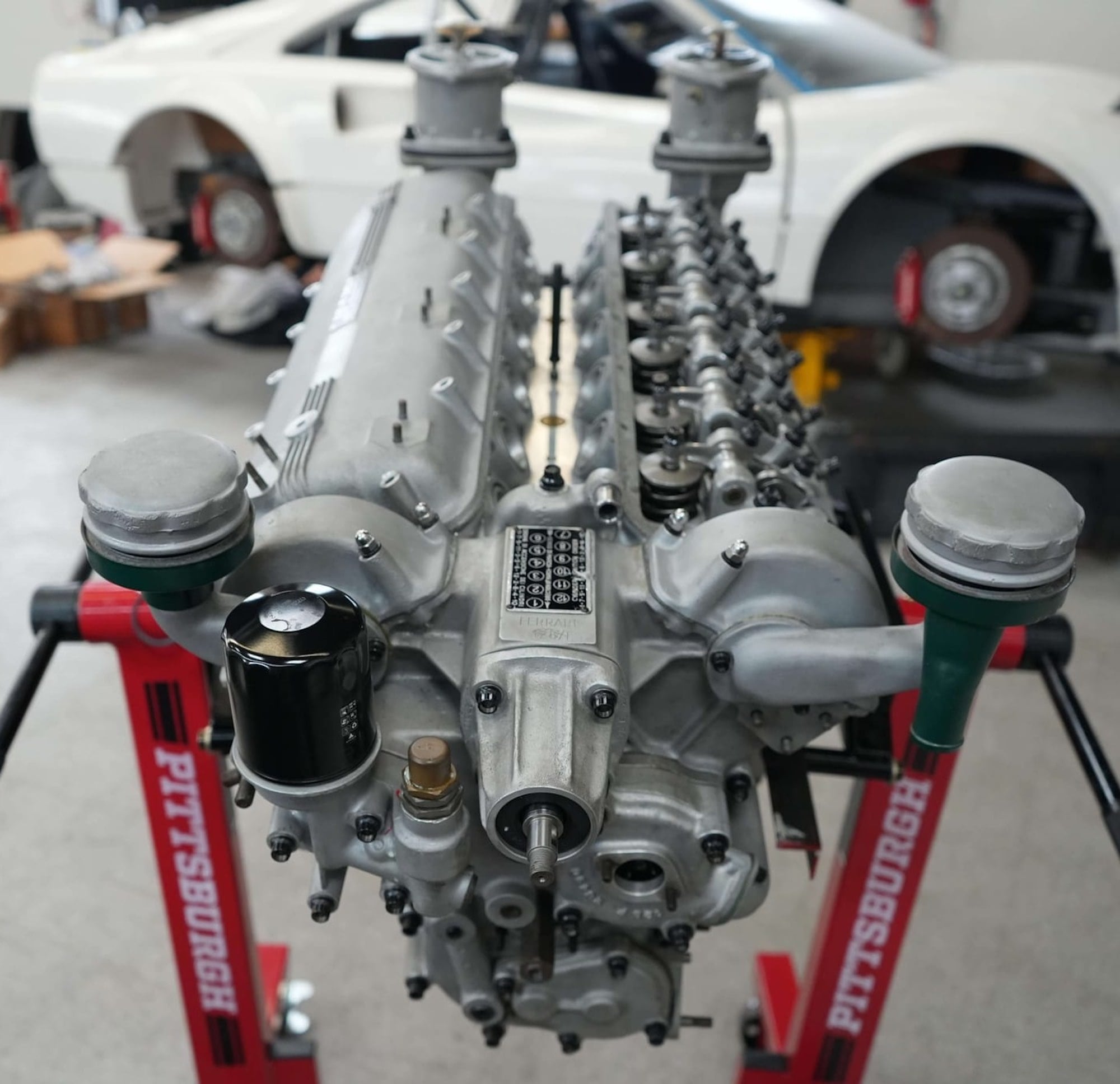
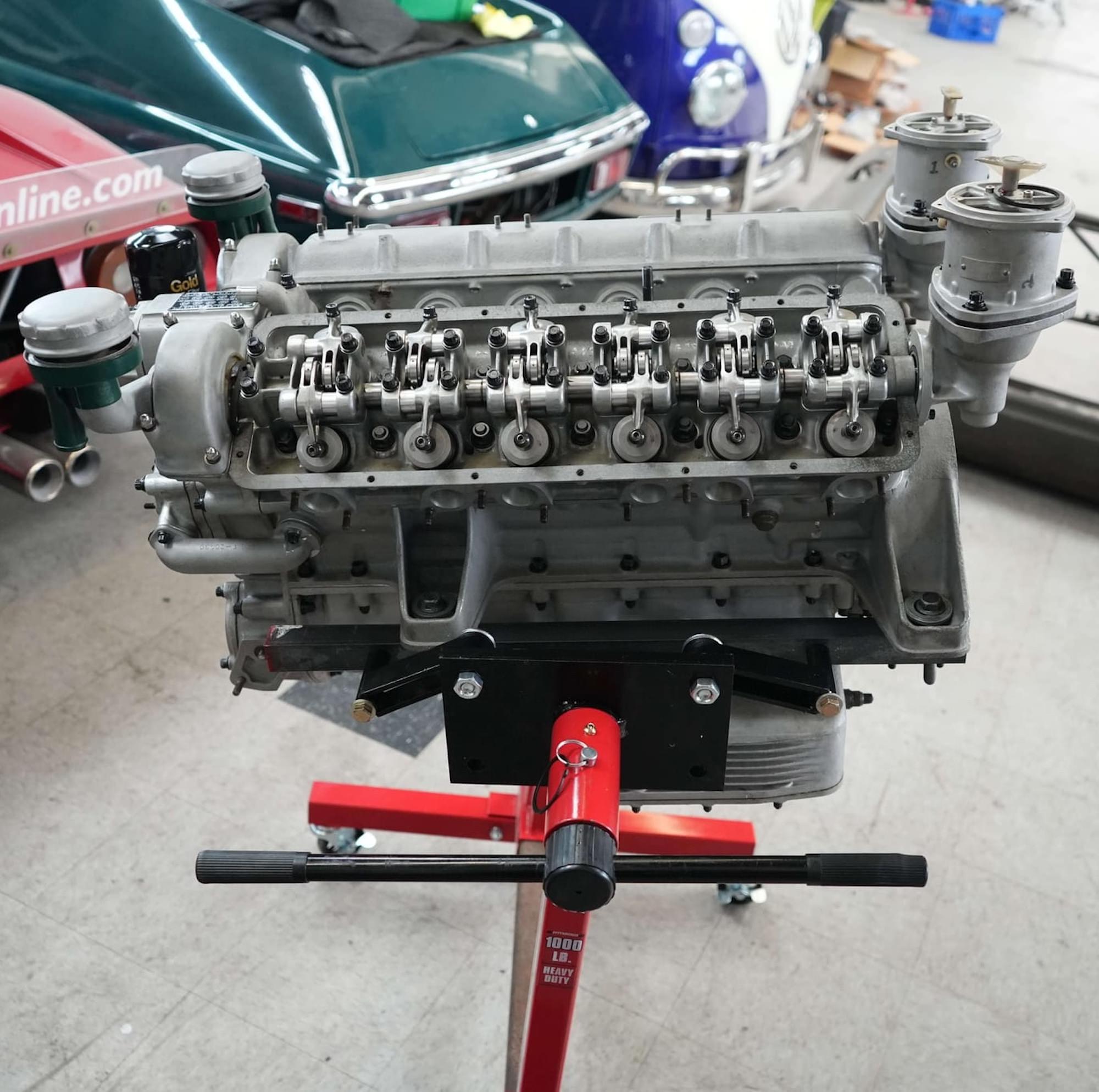
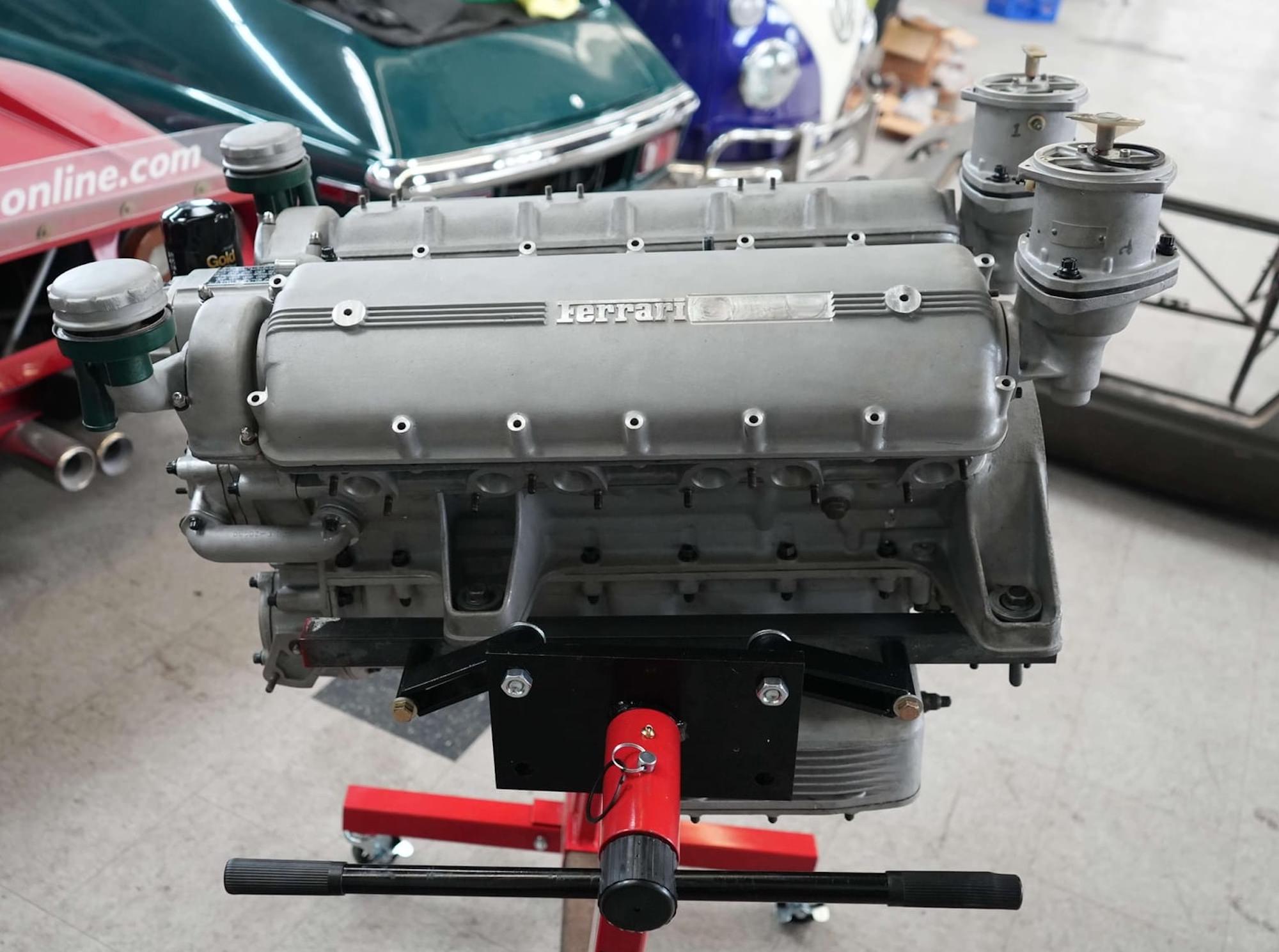
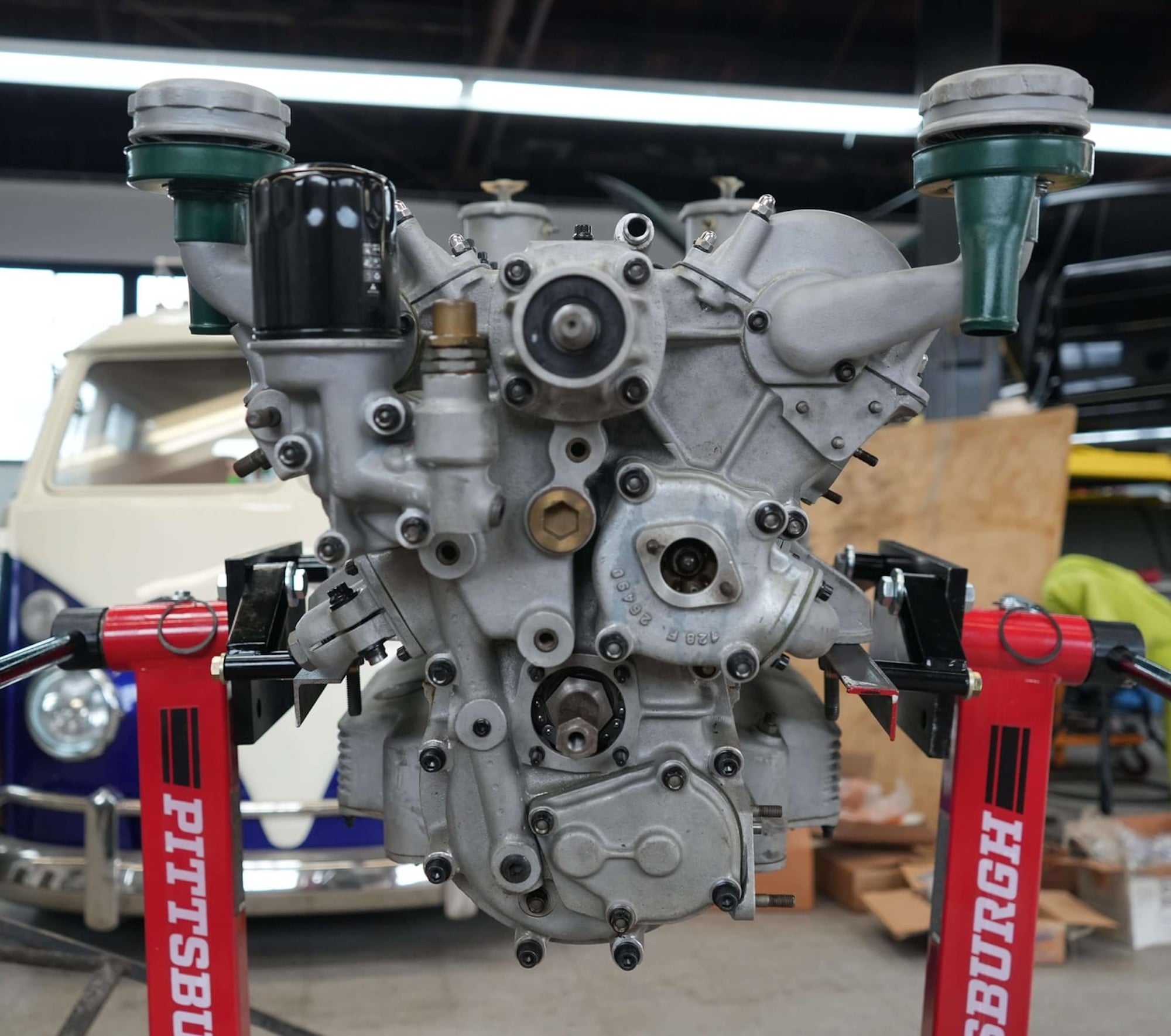
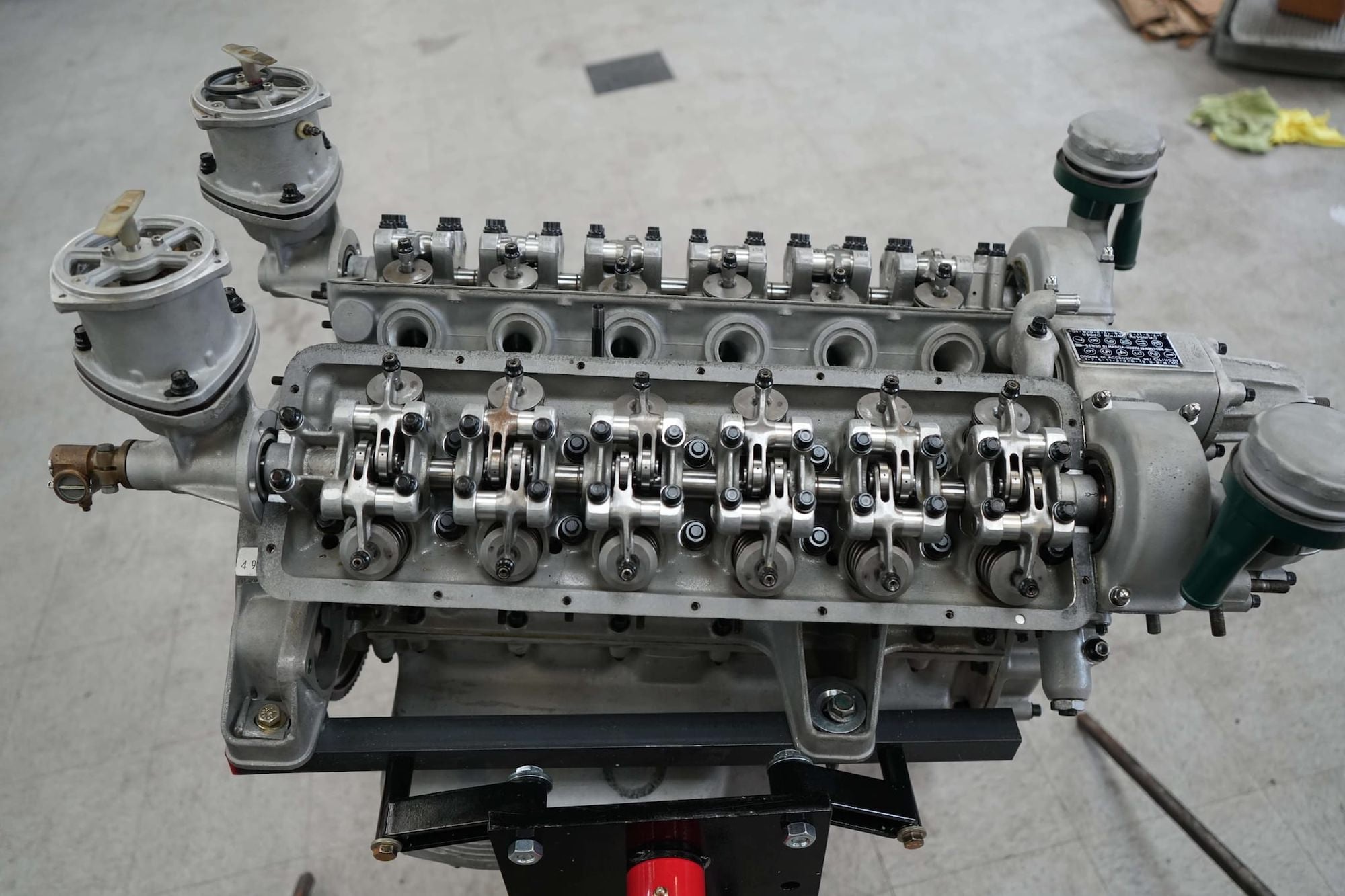
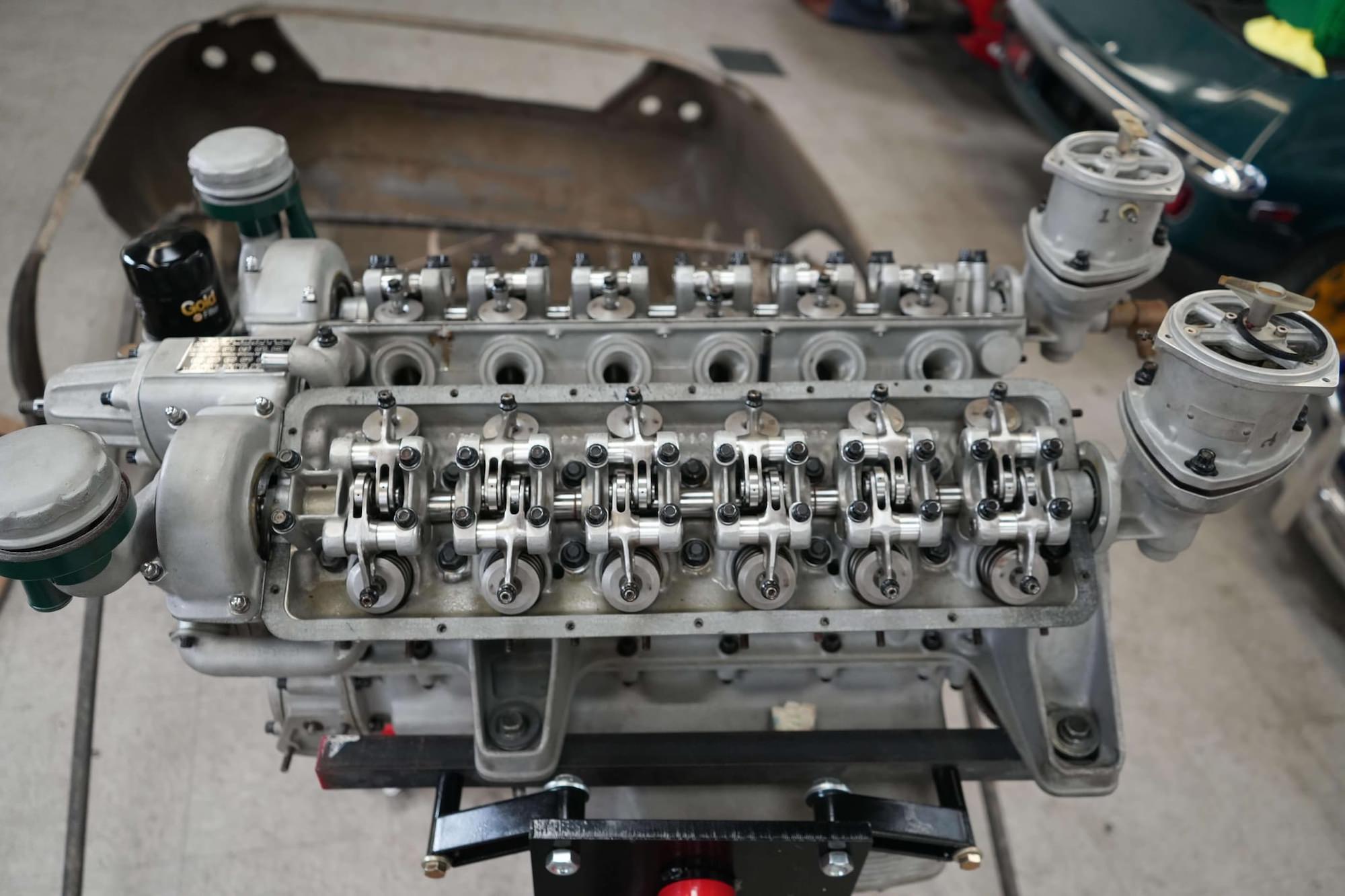
This is a Colombo V12 engine that originally came out of a 1963 Ferrari 250 GTE. It’s now been rebuilt by Richard “Dick” DeBiasse of Dark Horse Motors into a “hot rod” specification, boosting both horsepower and torque over the original.
The Colombo V12 is one of the most famous engine designs of the 20th century, if not of all time, it powered many of Ferrari’s most iconic cars, and it gave the marque a slew of major wins in the 24 Hours of Le Mans, the Mille Miglia, the Targa Florio, the Carrera Panamericana, the 12 Hours of Sebring, the Nürburgring 1000 km, and countless others.
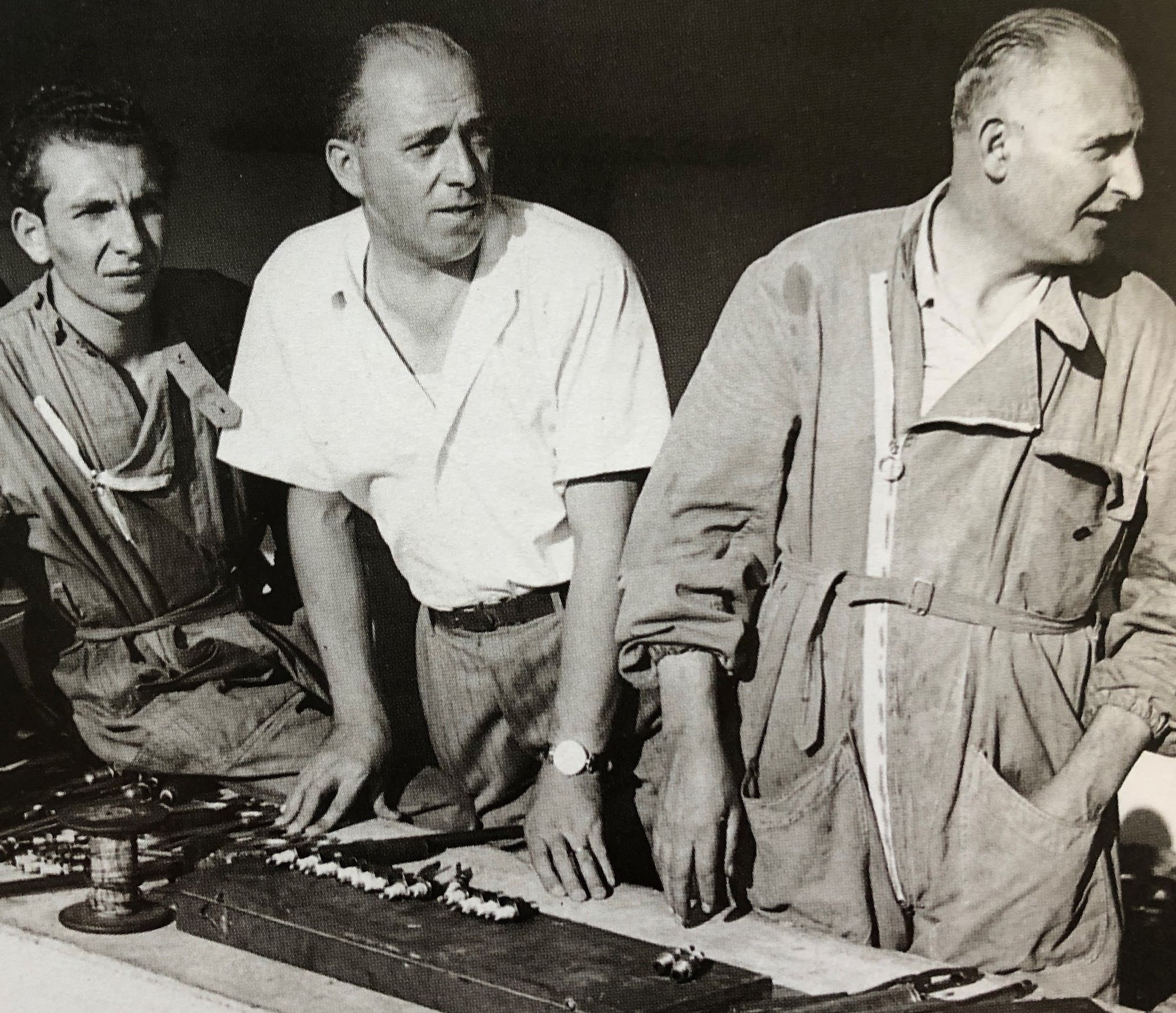
 This is Gioacchino Colombo (center) with with two Ferrari mechanics in 1949 at the Monza Circuit. Image provided by Ferrari.
History Speedrun: The Ferrari Colombo V12 Engine
The first car to carry the Ferrari name had a V12 with a swept-capacity of just 1.5 liters, each cylinder displaced a tiny 125cc. Legendary Italian engineer Gioacchino Colombo designed it, Enzo Ferrari took it on its first road trial in March of 1947, and although no one knew it at the time, a 4.9 liter descendant was still going into the Ferrari 412 when that car went out of production in 1989 – a remarkable 42 years later.
A New V12 Begins To Take Shape
The idea behind the engine that would become known as the Colombo V12 took shape in mid-1945, when Ferrari met Gioacchino Colombo at Maranello in Italy. Colombo had designed the supercharged engine for the Alfa Romeo 158 in 1937, while Enzo Ferrari was still running Alfa’s racing team.
Enzo now wanted to get back to racing – before WWII, supercharged voiturettes, the class below Grand Prix racing, had been limited to 1.5 liters. That limit was being carried into the new Formula 1 rules, where such engines would run against unsupercharged 4.5 liter cars.
When Colombo was later asked why he built a V12, he listed Maserati’s four, the British six-cylinder ERA and Alfa Romeo’s eight, then said: “In my view, you should be building a 12 cylinder!” Enzo, who had long admired V12s, agreed on the spot. Others around Modena thought the plan absurd, and the pistons, critics said, would be the size of thimbles.
Colombo drew up a 60º V12 with an aluminum block and heads, a 55 mm bore and 52.5 mm stroke gave 1.5 liters (1,497cc to be exact), and a single chain-driven camshaft on each bank worked two valves per cylinder. He closed the valves with hairpin springs, an idea he credited to common motorcycle practice at the time.
He deliberately spaced the bores 90 mm apart, which left ample room to enlarge them later. It’s worth noting that Ferrari credits engineers Giuseppe Busso and Luigi Bazzi with contributions to the design, but the lion’s share was done by Colombo. With triple Weber carburetors, the first version made 116 bhp at 6,800 rpm. The car it powered, the Ferrari 125 S, which took its name from the displacement of one cylinder – 125cc.
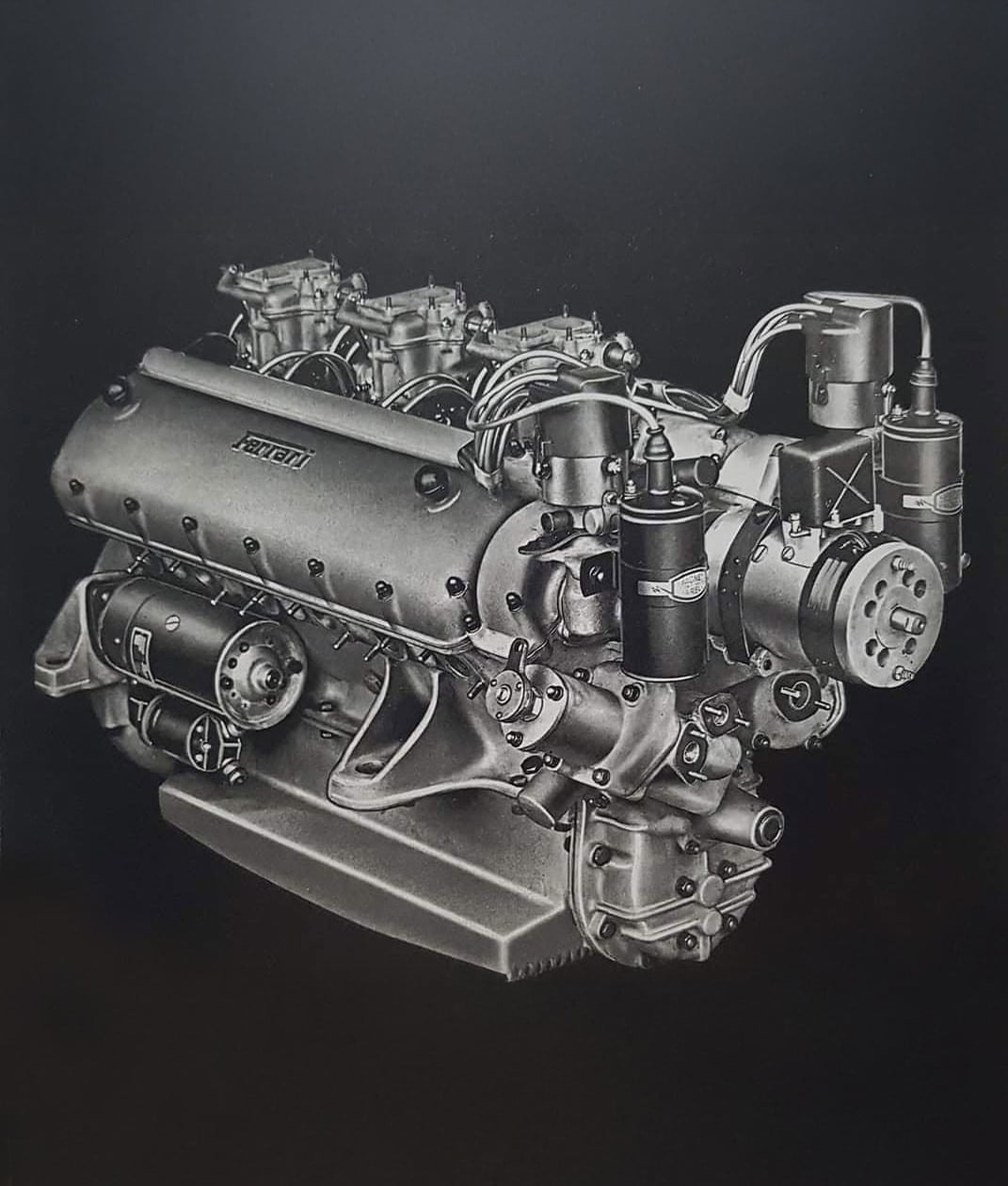
When Colombo was later asked why he built a V12, he listed Maserati’s four, the British six-cylinder ERA and Alfa Romeo’s eight, then said: “In my view, you should be building a 12 cylinder!” Enzo, who had long admired V12s, agreed on the spot. Image provided by Ferrari.
The Colombo V12 Goes Racing
Franco Cortese led the 125 S’s first race, at Piacenza, Italy on May the 11th, 1947, until his fuel pump failed that is. Enzo Ferrari called it “a promising failure.” Two weeks later Cortese won on Rome’s Caracalla circuit, and the V12 cars won a total of six races that season. Cortese later said the engine revved so freely that he had to drive with one eye on the tachometer.
When it was enlarged to 2.0 liters, the Colombo powered the Ferrari 166 to Mille Miglia wins in 1948 and 1949. At the 24 Hours of Le Mans in 1949, on Ferrari’s first appearance there, Luigi Chinetti and Lord Selsdon won in a 166 MM. Chinetti, in a move of remarkable endurance, personally drove for more than 22 of the 24 hours.
The Colombo V12 had been designed with a supercharger in mind, and a supercharged version went into Ferrari’s first single-seater, the 125 GPC – Giuseppe Farina promptly gave it its first win at the 1948 Circuito del Garda. Renamed the 125 F1, it went on to eight victories. For Formula 1, Ferrari then switched to Aurelio Lampredi’s larger unsupercharged V12, and Colombo returned to work at Alfa Romeo. His engine stayed at Ferrari, powering the sports and road cars.
Olivier Gendebien and Phil Hill won the 24 Hours of Le Mans in a 3.0 liter 250 Testa Rossa in 1958. Only 3 of the 10 Testa Rossas entered that year reached the finish, but the model won there again in 1960 and 1961. The 250 GTO, with 36 examples built with the 3.0 liter engine, won the over 2.0 liter division of the International Championship for GT Manufacturers in 1962, 1963, and 1964.
The Ferrari 250 P was the first Ferrari sports racer with its V12 mounted behind the driver. It used a Testa Rossa-type 3.0 liter Colombo V12 and won Le Mans in 1963 with Ludovico Scarfiotti and Lorenzo Bandini taking turns at the controls. In 1965 Chinetti’s North American Racing Team entered a year-old Ferrari 250 LM powered by a 3.3 liter version of the engine, and Masten Gregory and Jochen Rindt won with it – its differential broke just after the finish. That was the last of six consecutive Le Mans wins for Ferrari, and the marque’s last overall win there until 2023.
From 1.5 to 4.9 Liters
The Ferrari 125 S, 166, 195, and 212 kept a 58.8 mm stroke and grew through larger bores to 1.5, 2.0, 2.3, and 2.6 liters. The 3.0 liter 250, with a 73 mm bore, followed them in 1952. The 250 Testa Rossa moved the spark plugs to the outer side of the heads, it also gave every cylinder its own intake port, where the original design had three per bank. The road-going 250 GT SWB adopted both changes.
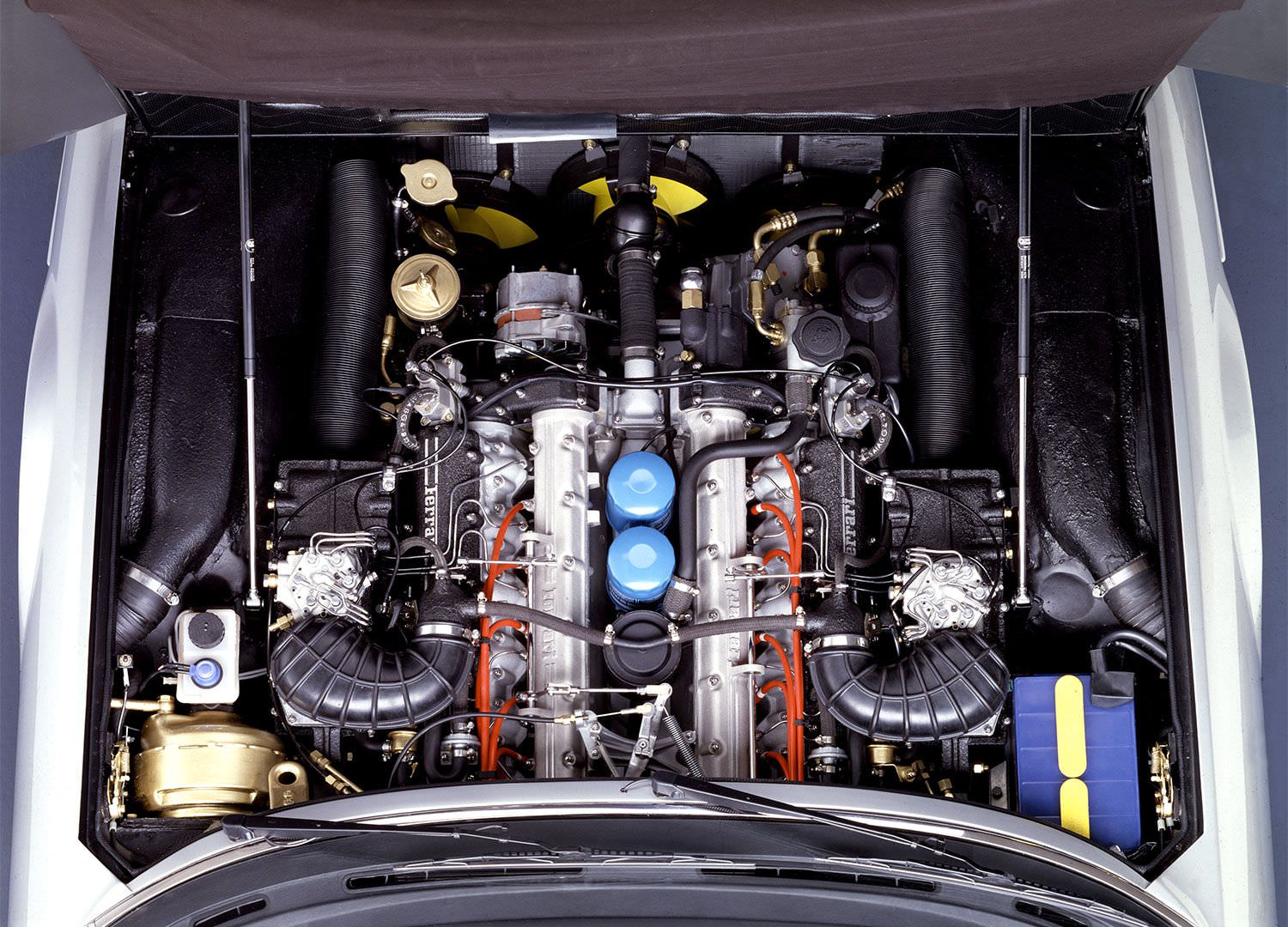
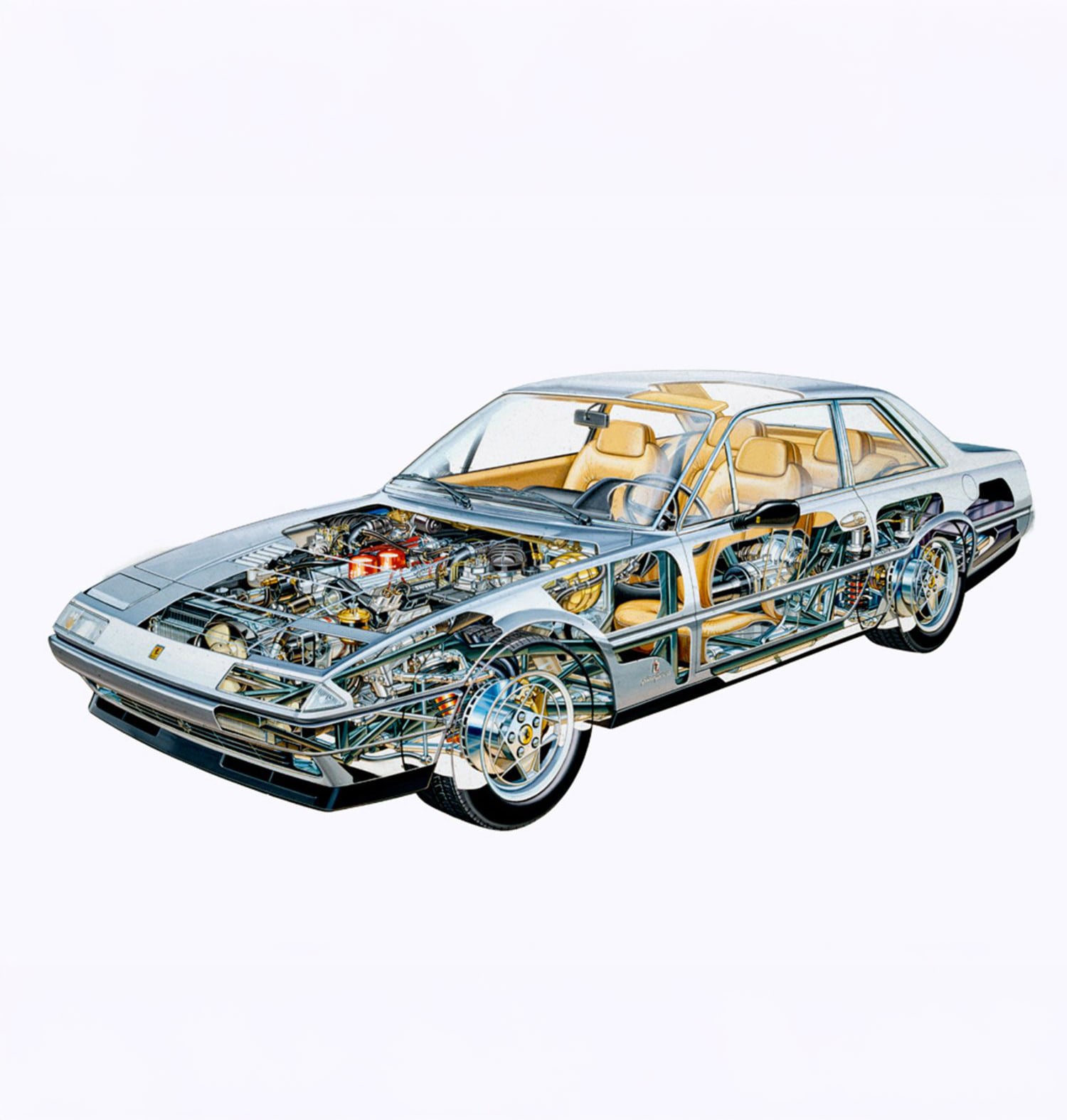
The Ferrari 412, shown at Geneva in 1985, took the bore to 82 mm for 4.9 liters (4,943 cc) and about 335 bhp. The Ferrari 412 stayed in production until 1989, exactly one year after the death of both Gioacchino Colombo and Enzo Ferrari, who both died in 1988. Their most enduring engine had outlived them both. Images provided by Ferrari.
By 1964 the Ferrari 330 series used the Tipo 209 Colombo engine, whose slightly longer block spread the bore centers to 94 mm. Twin overhead camshafts per bank arrived on the road-going Colombo V12 with the 275 GTB/4. The 365 GTB/4 Daytona of 1968 used a 4.4 liter, four-cam version with dry-sump lubrication.
The 400 of 1976 lengthened the stroke to 78 mm for 4.8 liters, and the 400i replaced the carburetors with Bosch K-Jetronic fuel injection in 1979. The 412, shown at Geneva in 1985, took the bore to 82 mm for 4.9 liters (4,943 cc) and about 335 bhp. The Ferrari 412 stayed in production until 1989, exactly one year after the death of both Gioacchino Colombo and Enzo Ferrari, who both died in 1988. Their most enduring engine had outlived them both.
The Ferrari Colombo V12 Engine Shown Here
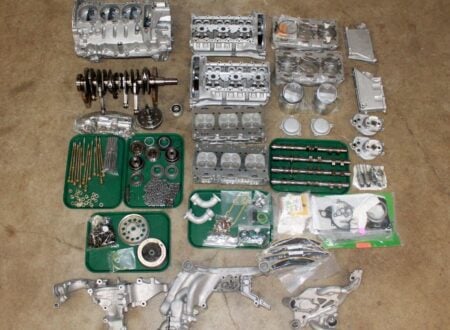
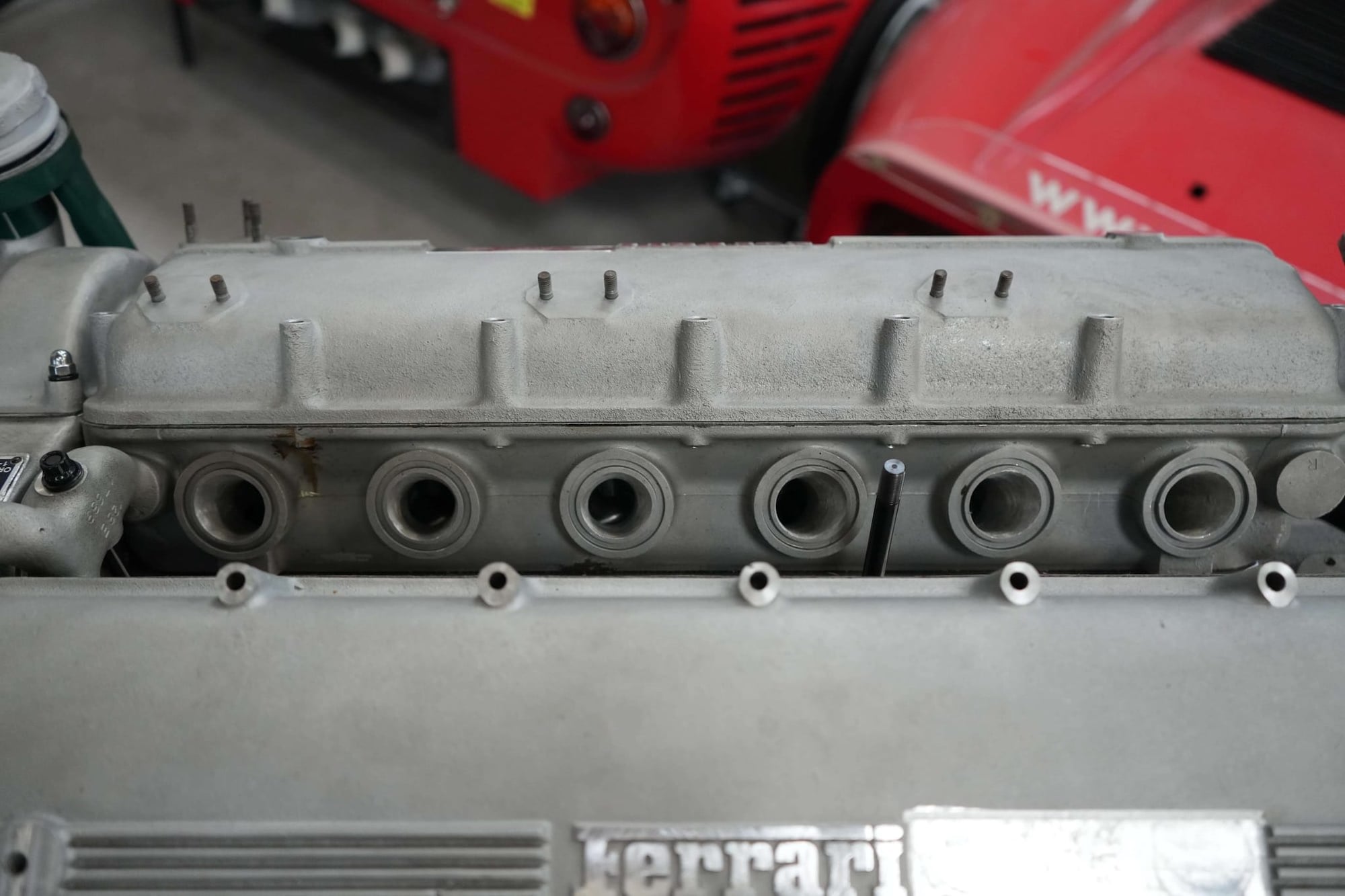
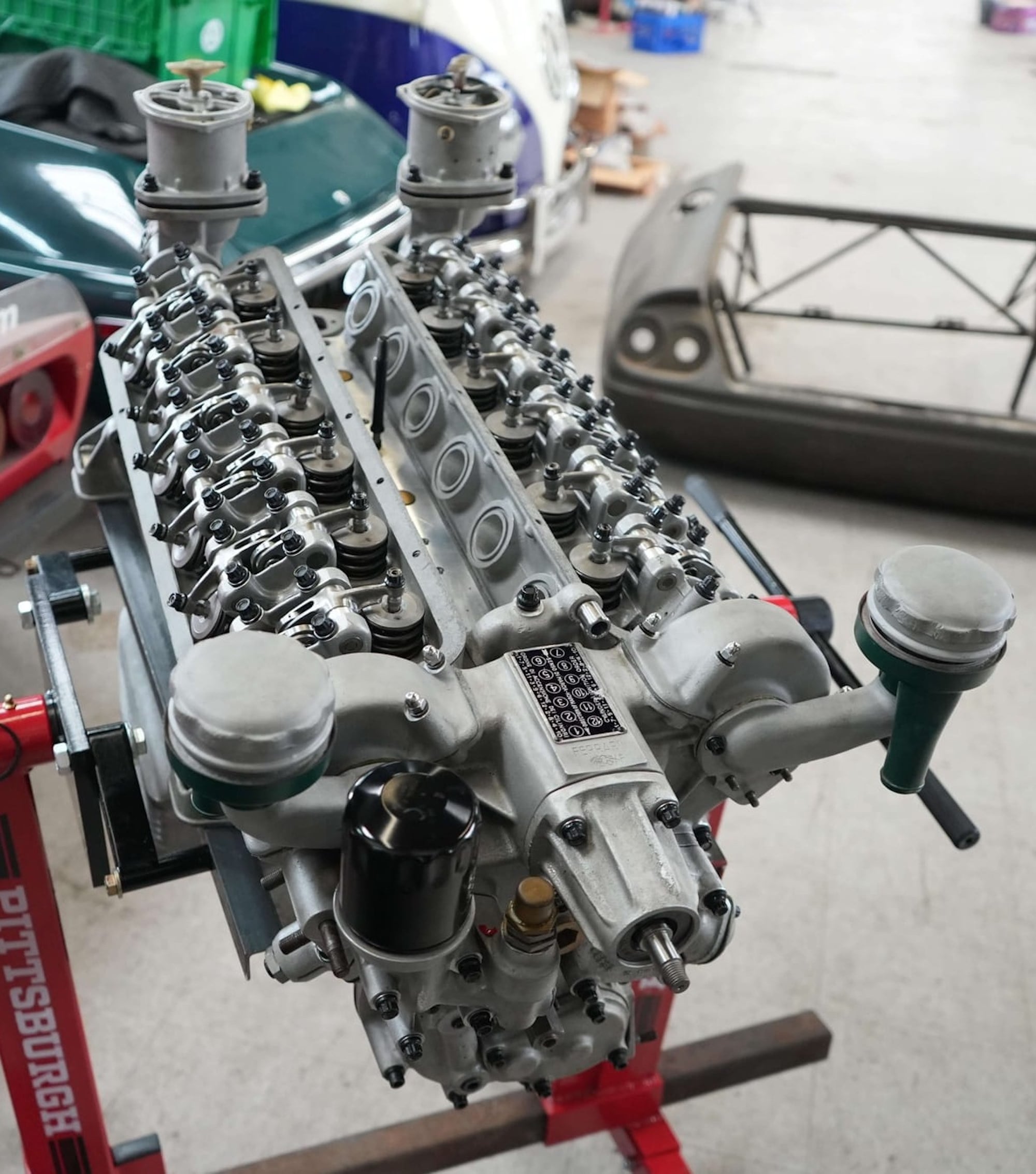
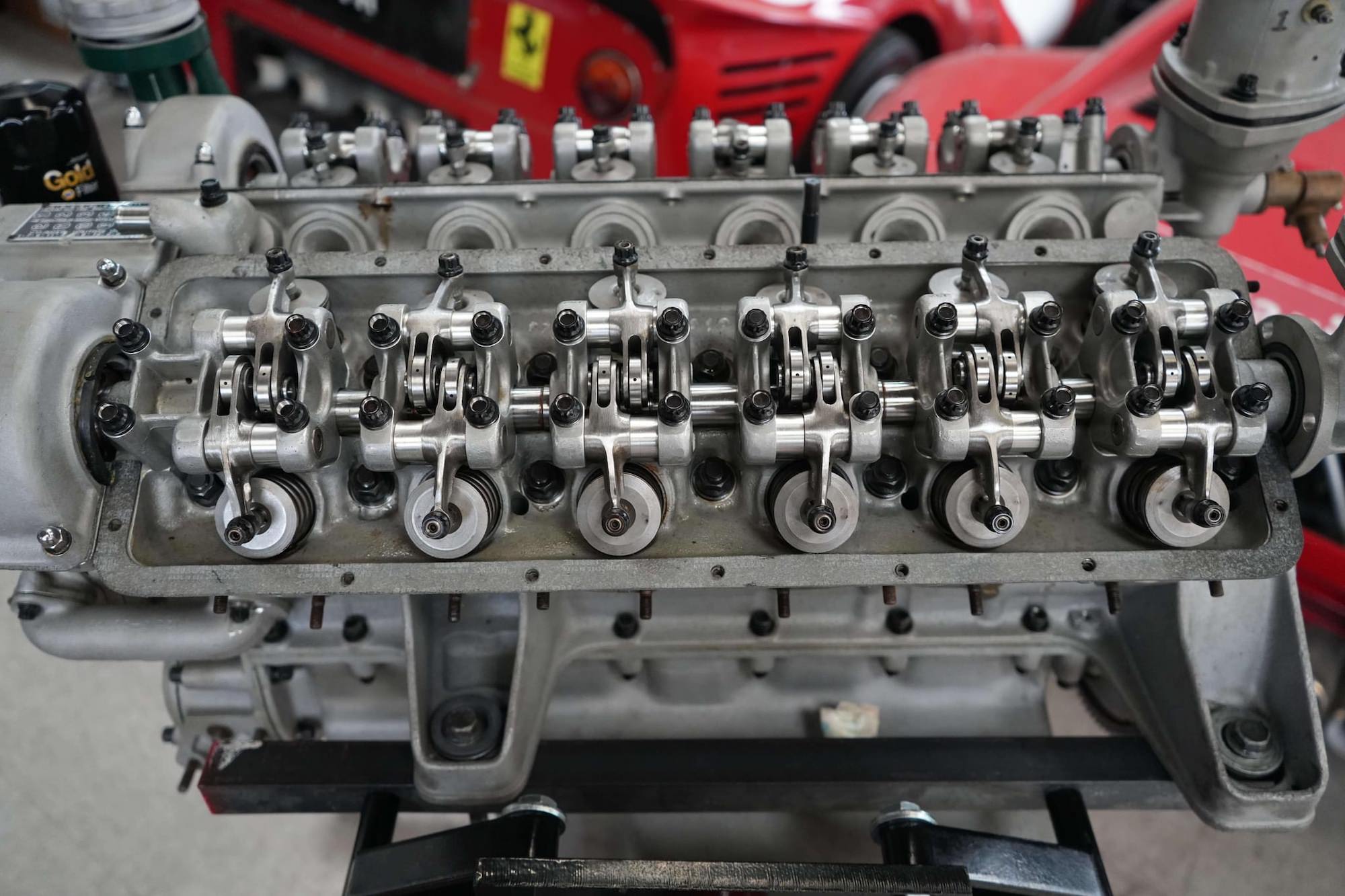
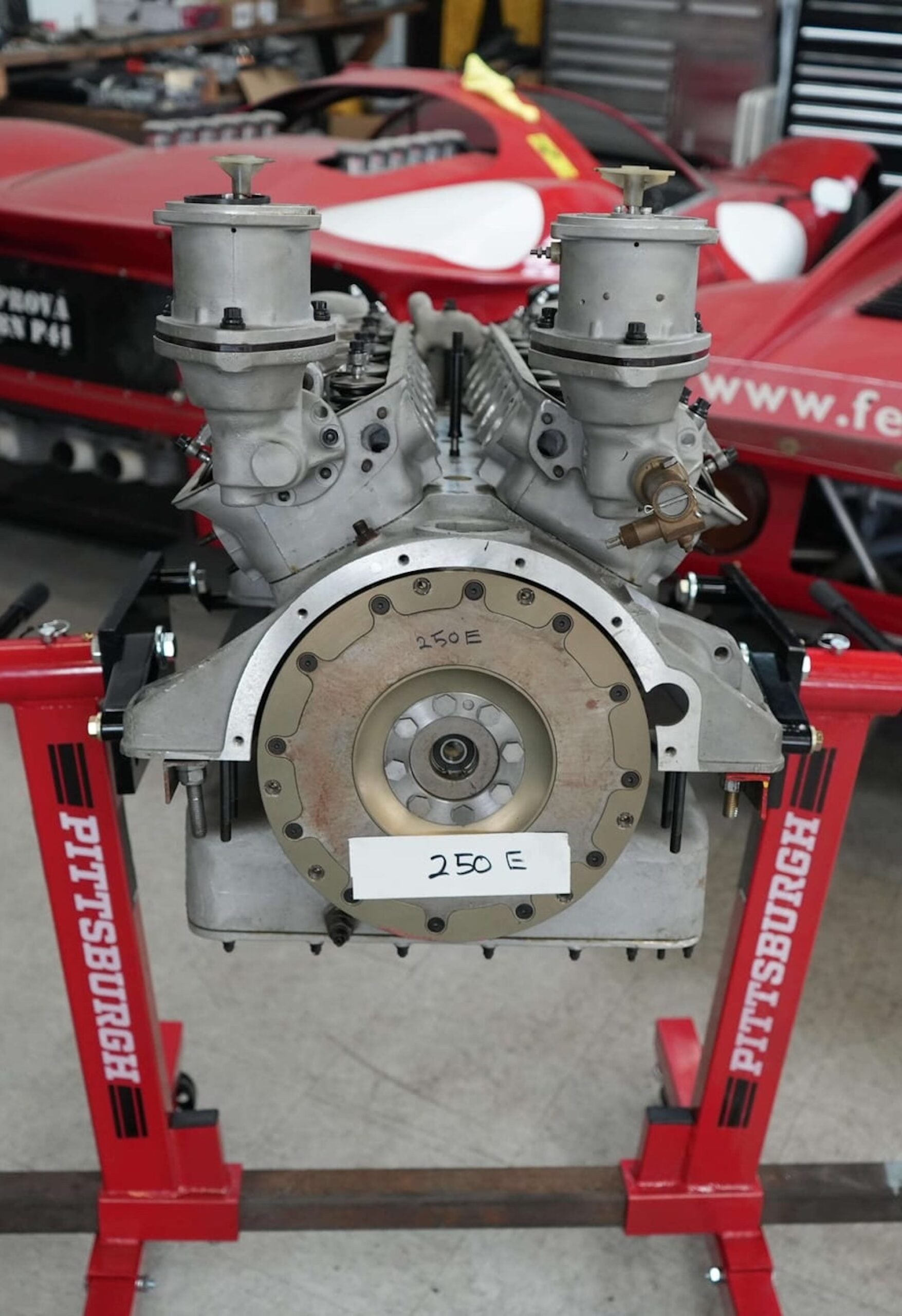
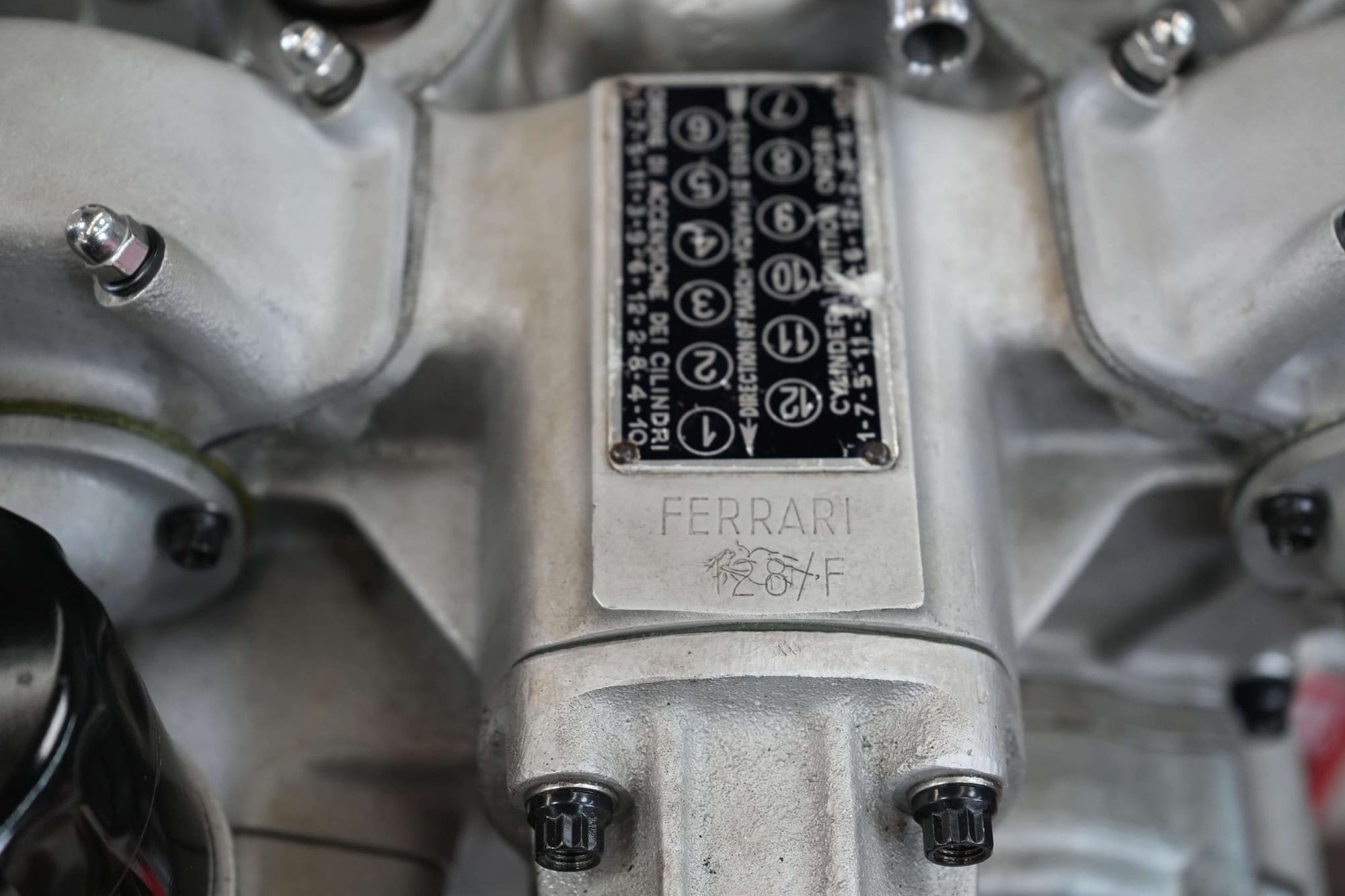
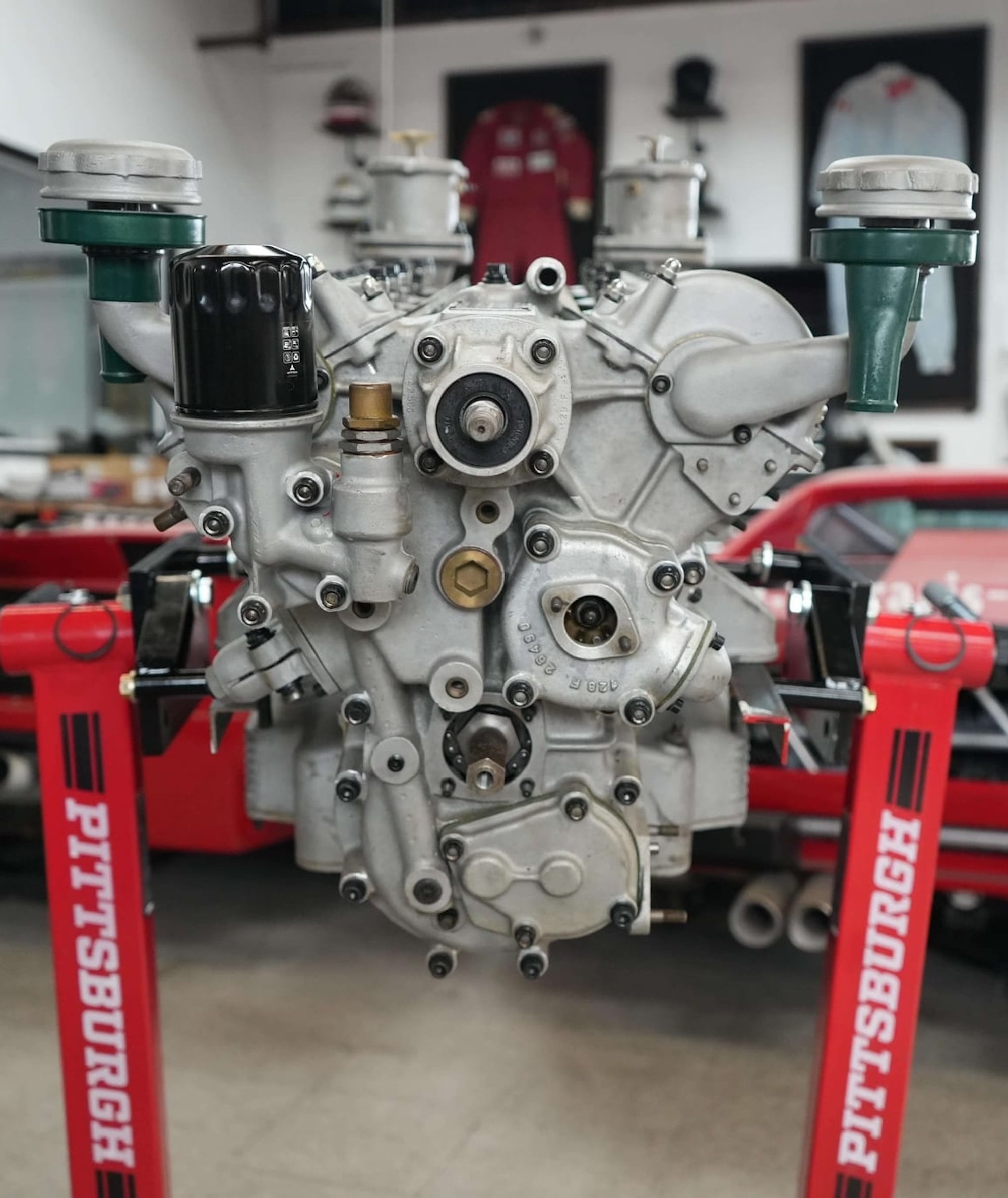
This Ferrari Colombo V12 engine was removed from a 1963 Ferrari 250 GTE and it’s since been rebuilt as a higher-performance “hot rod” version of the original 3.0 liter unit. The work was carried out by Richard “Dick” DeBiasse of Dark Horse Motors, and the seller says that it was the last of five modified 250 GTE engines he built. It’s described as a 0-time engine and has reportedly not been fired up since the rebuild.
In standard 250 GTE form, the Colombo V12 had a displacement of 2,953cc from a 73mm bore and 58.8mm stroke, with an aluminum block and cylinder heads, hemispherical combustion chambers, and a factory rating of 240 bhp at 7,000 rpm.
Ferrari progressively revised the 250 GTE engine through its three production series, enlarging the valves and ports and moving to later pressure-cast cylinder heads. The later engines benefited from 36mm intake and 34mm exhaust valves, along with revised exhaust-port and header designs intended to improve gas flow right across the rev range.
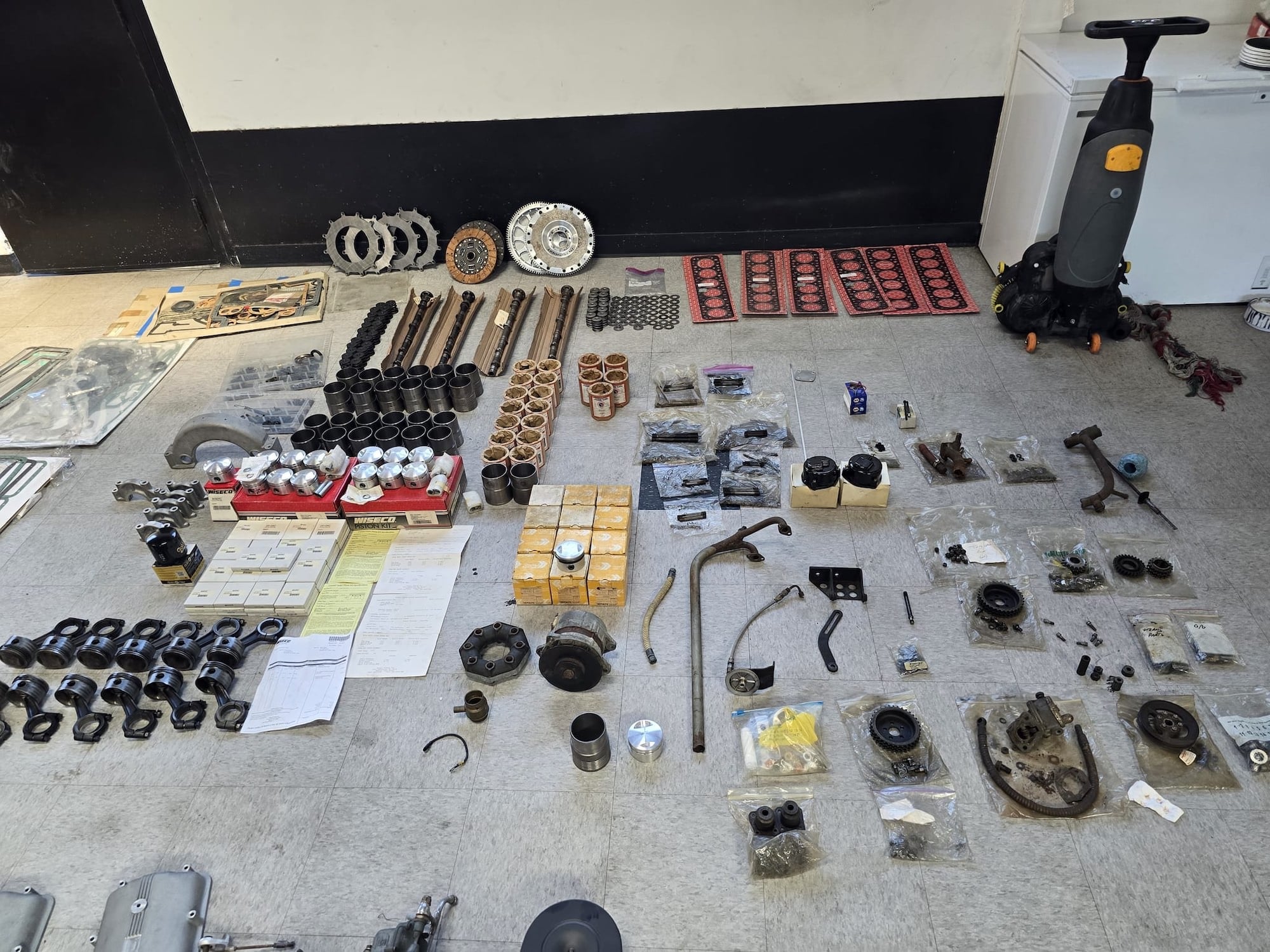
As noted above, this engine had been hot rodded, it’s cylinders were bored to 74.4mm, increasing displacement to 3,068cc, and it was fitted with Wiseco pistons and pins, four-bolt main-bearing caps, and connecting rods that were machined and trued.
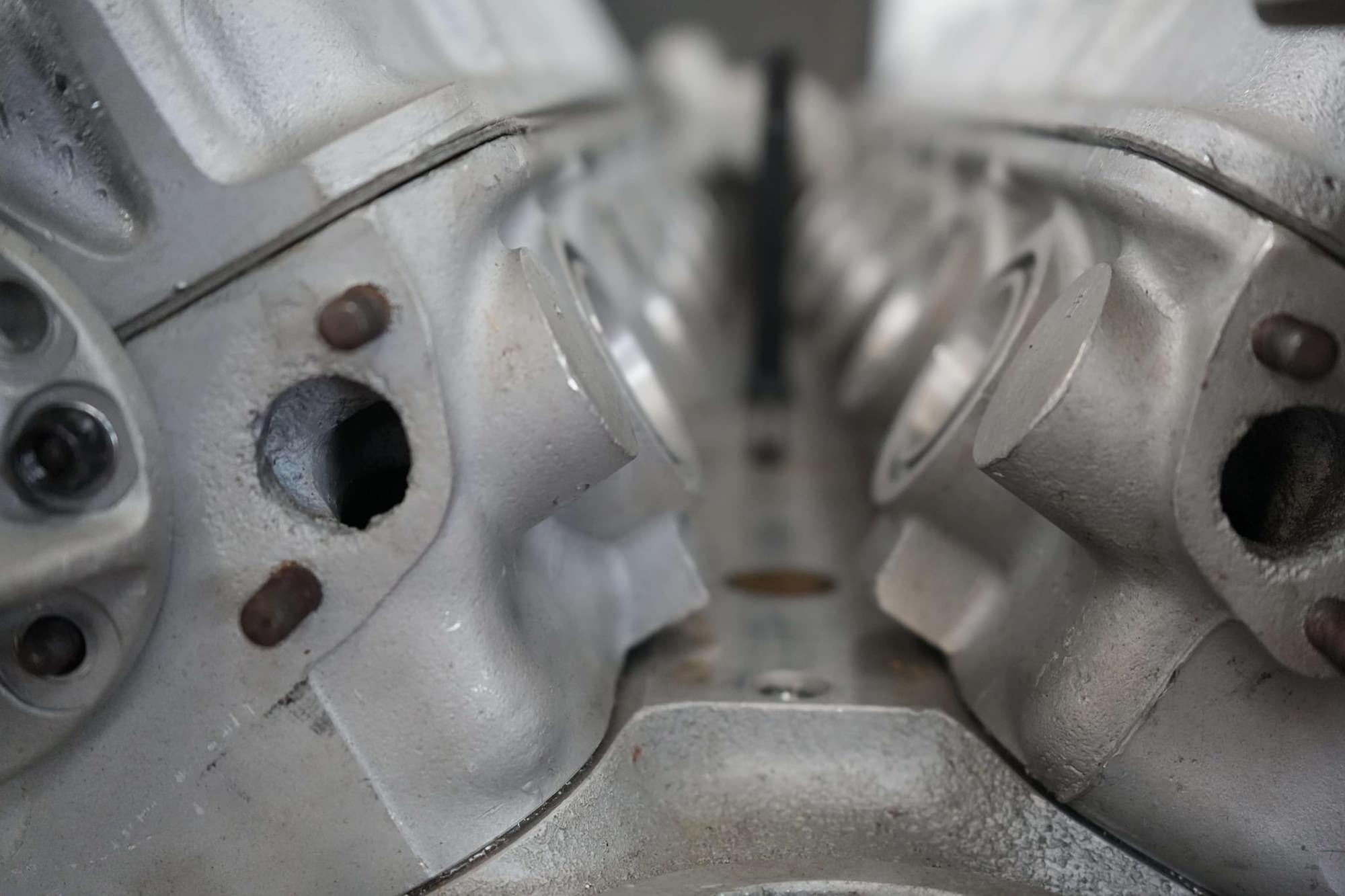
The cylinder heads were ported and polished, the valvetrain received oversized intake and exhaust valves, new exhaust guides and seats, rocker-arm bushings, adjuster screws, and Crane camshafts with a 208° duration.
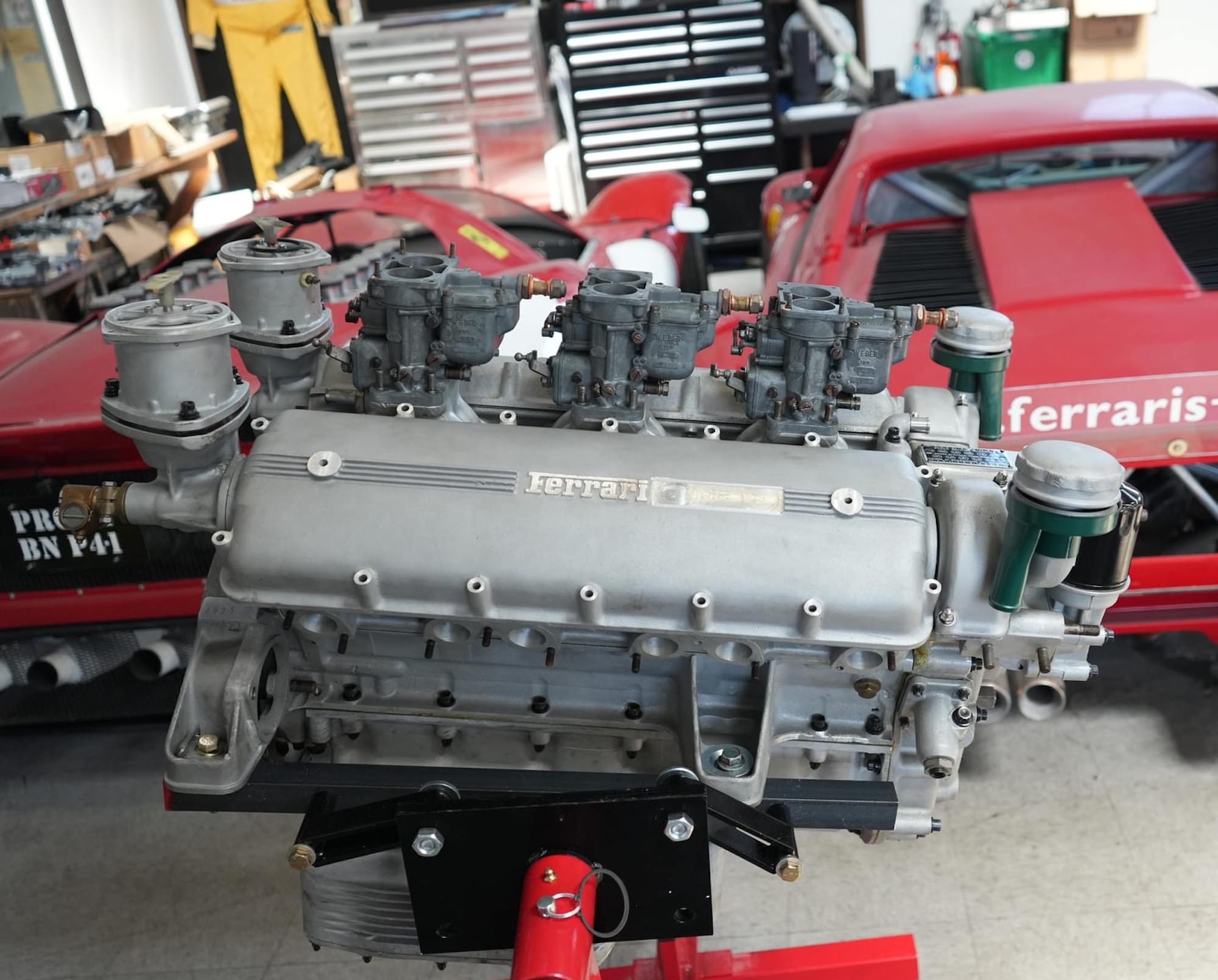
This Ferrari Colombo V12 engine was removed from a 1963 Ferrari 250 GTE and it’s since been rebuilt as a higher-performance “hot rod” version of the original 3.0 liter unit. The work was carried out by Richard “Dick” DeBiasse of Dark Horse Motors, and the seller says that it was the last of five modified 250 GTE engines he built.
Induction is through three Weber 36 DCS carburetors, while the ignition distributors were rebuilt and fitted with replacement Magneti Marelli caps. A lightweight alloy-and-steel flywheel and Ferrari-branded cam covers complete the build.
It’s now being offered for sale out of Costa Mesa, California with a large cache or various spare parts. You can visit the listing here if you’d like to read more about it or place a bid.
Images provided by Ferrari + Bring a Trailer
Articles that Ben Branch has written have been covered on CNN, Popular Mechanics, Smithsonian Magazine, Road & Track Magazine, the official Pinterest blog, the official eBay Motors blog, BuzzFeed, Autoweek Magazine, Wired Magazine, Autoblog, Gear Patrol, Jalopnik, The Verge, and many more.
Silodrome was founded by Ben back in 2010, in the years since the site has grown to become a world leader in the alternative and vintage motoring sector, with well over a million monthly readers from around the world and many hundreds of thousands of followers on social media.