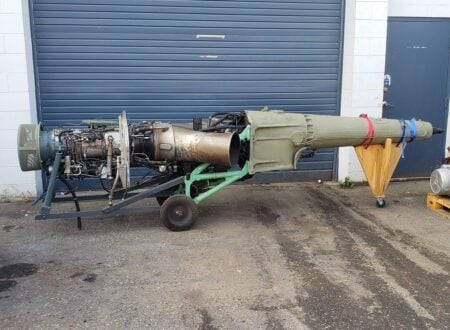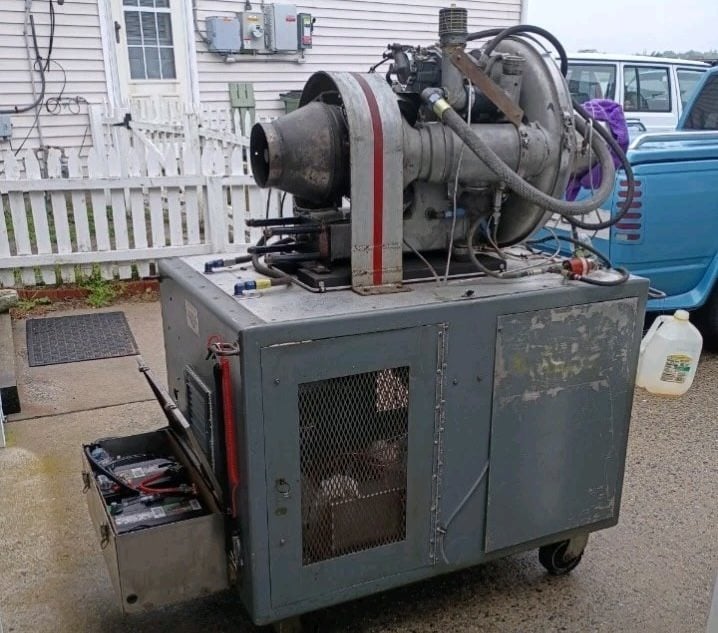
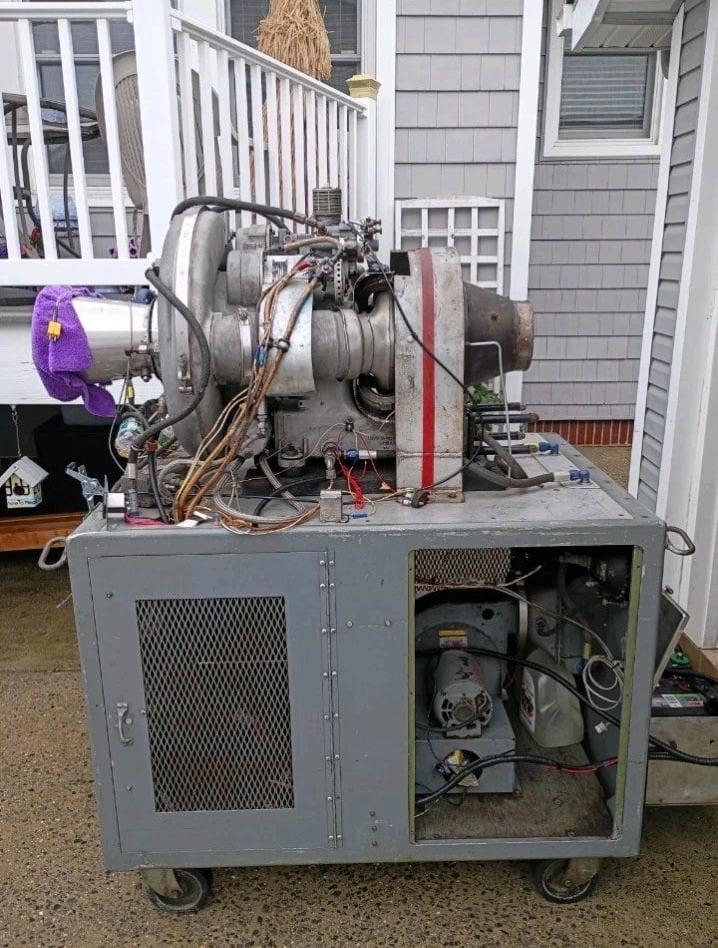
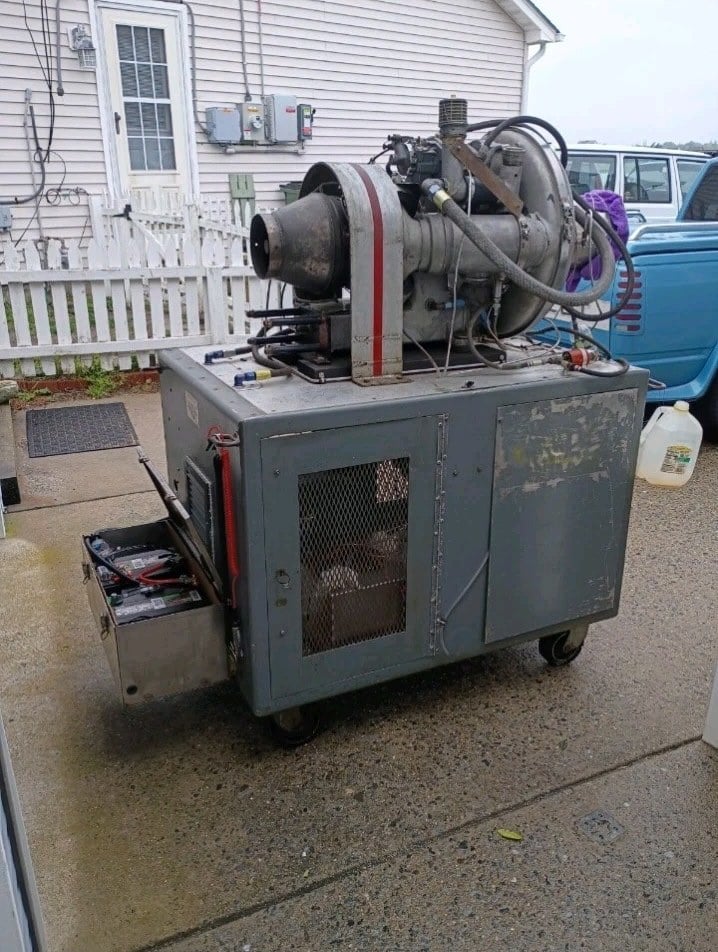
This is a Boeing T50 turbine jet engine that’s reportedly in fully-functional condition, it’s fitted to a run stand allowing it to be fire up and operated, and to monitor the engine’s vital statistics while it’s running.
The Boeing T50 is a fascinating history with a number of historic firsts under its belt, thousands of them were made, and they powered everything from drones and helicopters to a custom Cessna Bird Dog.
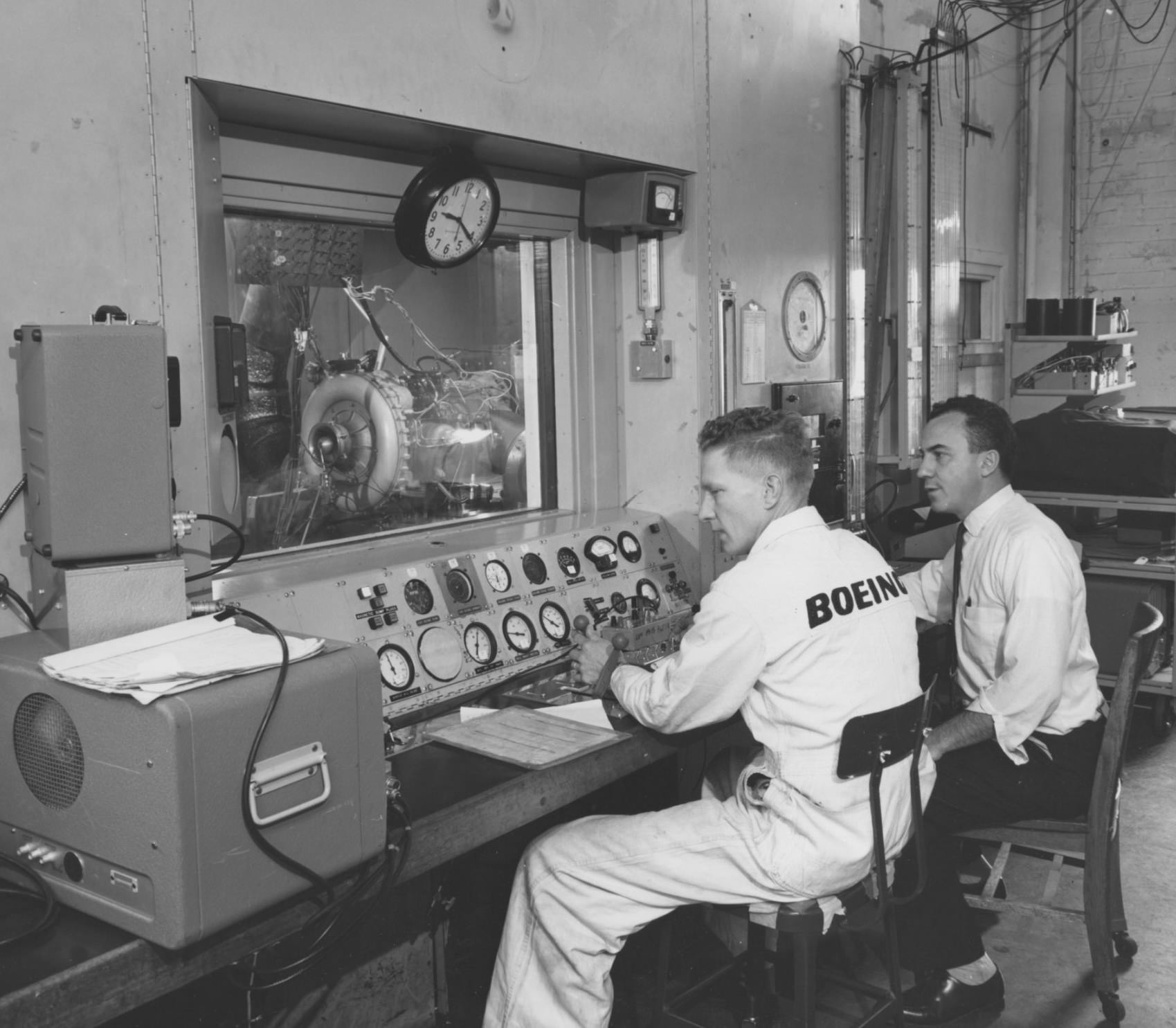
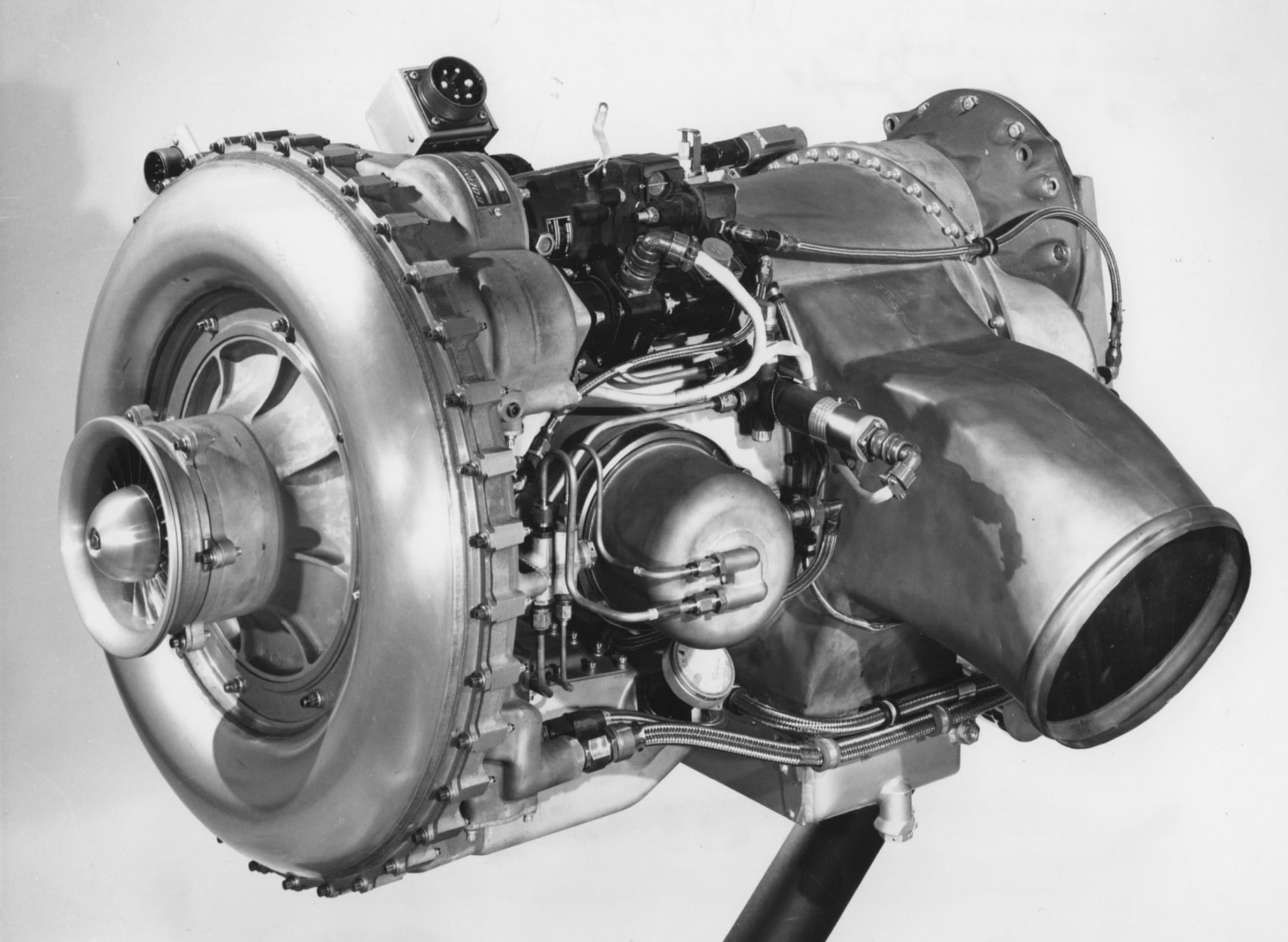
 Here we see the Model 502 (known to the military as the T50) being tested by Bowing engineers during its development. Image courtesy of Boeing.
History Speedrun: Boeing T50 Turbine Jet Engine
It isn’t widely known today, but Boeing used to built aircraft engines as well as complete aircraft – in 1949 its Seattle turbine operation developed the Model 502 (known to the military as the T50) a small turboshaft that powered a run of incredible aviation firsts over the tumultuous decade that followed.
The T50 really began as research project rather than planned product – to better understand the coming age of jet propulsion for its own large aircraft programs, Boeing built two small experimental engines in the mid-1940s. The first was the Model 500, a turbojet that ran in 1947, made 150 lbs of thrust and weighing in at 85 lbs.
Sadly for Boeing, nobody really wanted it. Engineers then added a free power turbine and a reduction gearbox to the same gas generator, producing the Model 502, which ran later that year at 120 shp. The Navy’s Bureau of Ships, hunting for a compact powerplant for naval vessels, gave it the military designation T50 that same year.
Boeing delivered six 160 shp T50s to the Navy in 1949, and the first production order followed in 1950, covering engines for minesweeper generators. It was a humble beginning, but bigger things were set to follow.
The engine’s architecture stayed relatively simple for the next 20 years – it had a single-stage centrifugal compressor fed two combustion chambers, one axial turbine drove the compressor, and a second, mechanically independent turbine turned the output shaft through reduction gearing.
In its most common form, the 502-10VC or T50-BO-8A, the engine measured in at a relatively compact 40 inches long and 24 inches in diameter, weighed 334 lbs, and produced 300 shp with the power turbine at 28,380 rpm and the output shaft geared down to 6,000 rpm. Pressure ratio was 4.77:1, and the -8A’s specified fuels were JP-4 and JP-5, though other engines in the 502 family ran on everything from gasoline to diesel.
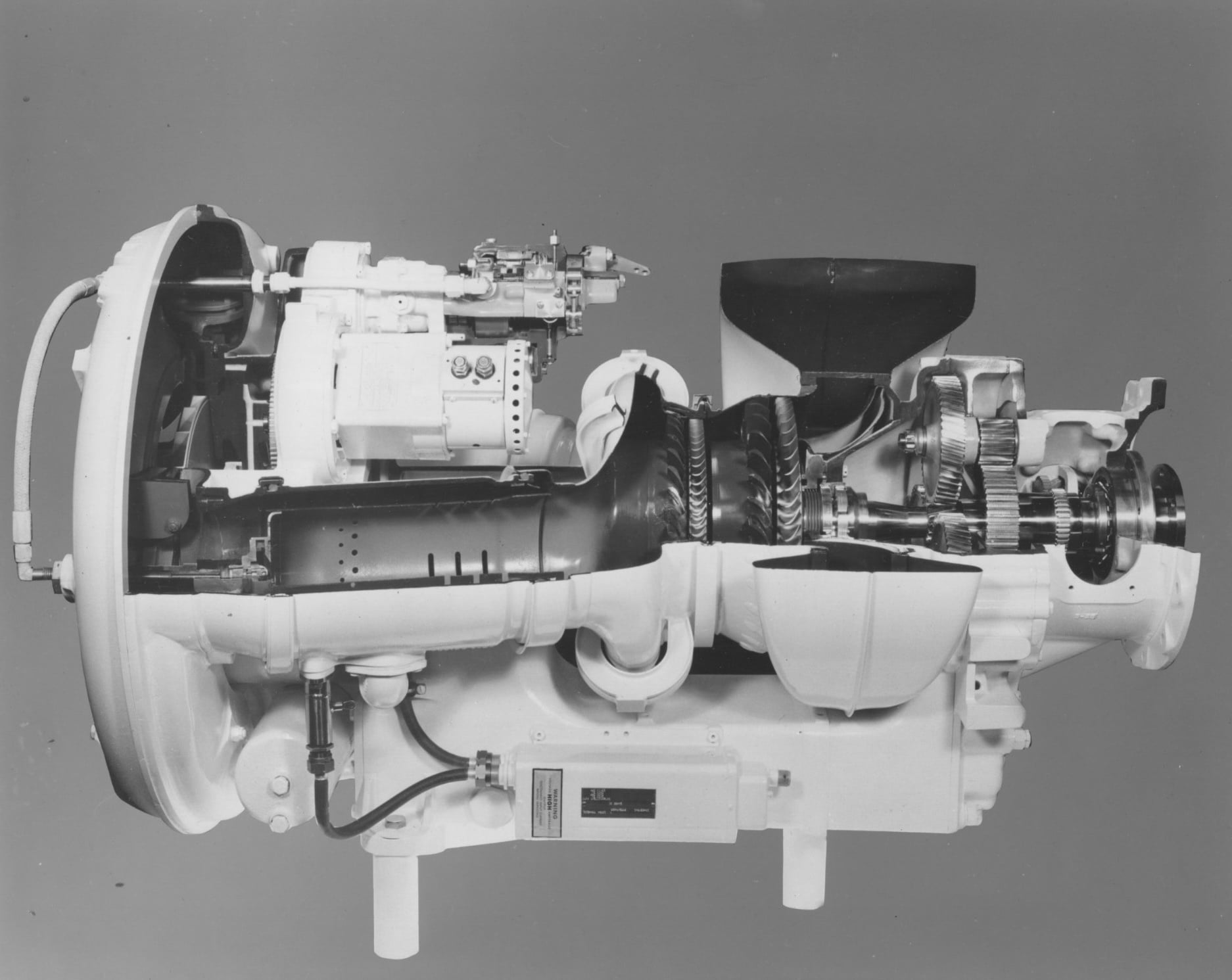
It isn’t widely known today, but Boeing used to built aircraft engines as well as complete aircraft – in 1949 its Seattle turbine operation developed the Model 502 (known to the military as the T50) a small turboshaft that powered a run of incredible aviation firsts over the tumultuous decade that followed. Image courtesy of Boeing.
On December the 11th, 1951, Kaman pulled the 220 bhp Lycoming piston engine out of a K-225 and fitted a Boeing 502-2E rated at 175 shp continuous. It made less power but weighed less than half as much, and that flight is recorded as the first in which a gas turbine drove a helicopter rotor through a mechanical transmission. A huge historic first for Boeing.
A French Sud-Ouest Ariel III had flown on turbine power eight months earlier, but its engine fed a compressor supplying rotor-tip jets rather than driving the rotor directly, that would prove to be an evolutionary dead end. In late-1952 a 210 shp XT50-BO-1 turboprop went into a Cessna XL-19B Bird Dog, the first turboprop light airplane, and the following July it set a light-plane altitude record of 37,063 feet. An astonishing altitude for such a small aircraft.
Interestingly, engine’s largest use case was in unmanned aircraft – early drones. Gyrodyne had been working since 1958 on turning its Rotorcycle into a drone that could carry a torpedo off a destroyer deck, a technology that was well ahead of its time.
In the summer of 1959 the Navy’s Ships Characteristics Board ruled that gasoline engines were a fire hazard aboard ship, which ended further purchases of the piston-engined DSN-1 and DSN-2 and pushed the program toward turbine power.
The result was the DSN-3, it first flew unmanned in early-1962. That September the Department of Defense imposed a unified aircraft designation system across the services, and the DSN-1, DSN-2 and DSN-3 became the QH-50A, QH-50B and QH-50C. Production QH-50Cs used the 502-10VC, rated at 300 shp military and 270 shp normal. The QH-50D that followed took the Model 550, a lighter redesign with an axial stage ahead of the centrifugal impeller, rated at 365 shp as the T50-BO-12. Roughly 750 DASH airframes were built through 1969.
Boeing tried hard to sell the 502 for use on the ground as well – Kenworth put a 175 shp example in a semi-tractor in 1950. It returned about 1 mpg against roughly 5 for a diesel, and that obviously sank it. The fire service did a little better though, across 1960 and 1961 American LaFrance built three turbine rigs on its 900-series chassis, a pumper for San Francisco, a tractor-drawn aerial for Seattle and a second pumper for Mount Vernon, Virginia, and all three went into service.
All three eventually lost their turbines too, for a mixture of operational and maintenance reasons. Continental sixes went into the San Francisco and Mount Vernon pumpers, and a 323 bhp Hall-Scott into the Seattle aerial in late-1962.
Model 502 production ended in 1965 after roughly 1,500 engines. The turbine division had lost money for 17 consecutive years by then, and with the 747 program looming Boeing announced its exit in early-1966. Caterpillar took over development and support that December. The last T50-BO-12 was completed in April of 1968. By Boeing’s own count the division had built 2,461 engines across all its turbine models, and set a few historic firsts.
The Boeing T50 Turbine Shown Here
The engine you see here is an original Boeing T50 that’s fitted to a run stand, allowing it to be operated and for its key metrics to me monitored as it’s run. Rigs like this have been used for training aviation mechanics, and for testing engines before they go into service.
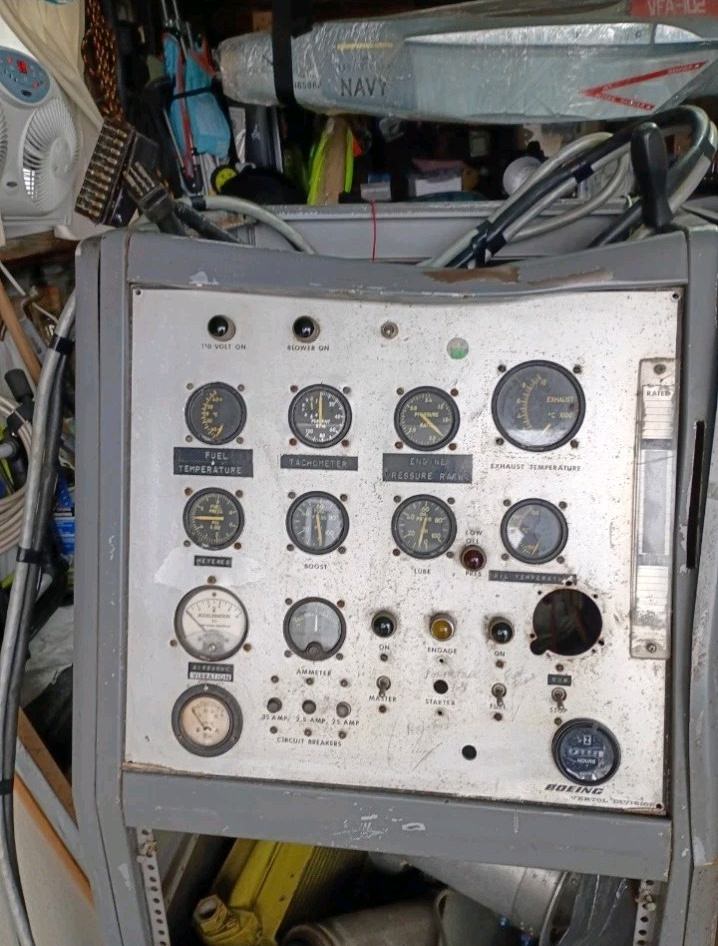
This is a Boeing T50 turbine jet engine that’s in fully-functional condition, it’s fitted to a run stand allowing it to be fire up and operated, and to monitor the engine’s vital statistics while it’s running.
The history of this engine isn’t offered in the listing, we don’t know what year it is or what specific variant, but the seller may be able to provide this information if you enquire.
It’s now being offered for sale in functioning condition on the run stand out of Pleasantville, New Jersey on eBay, and you can visit the listing here if you’d like to read more about it or place a bid.
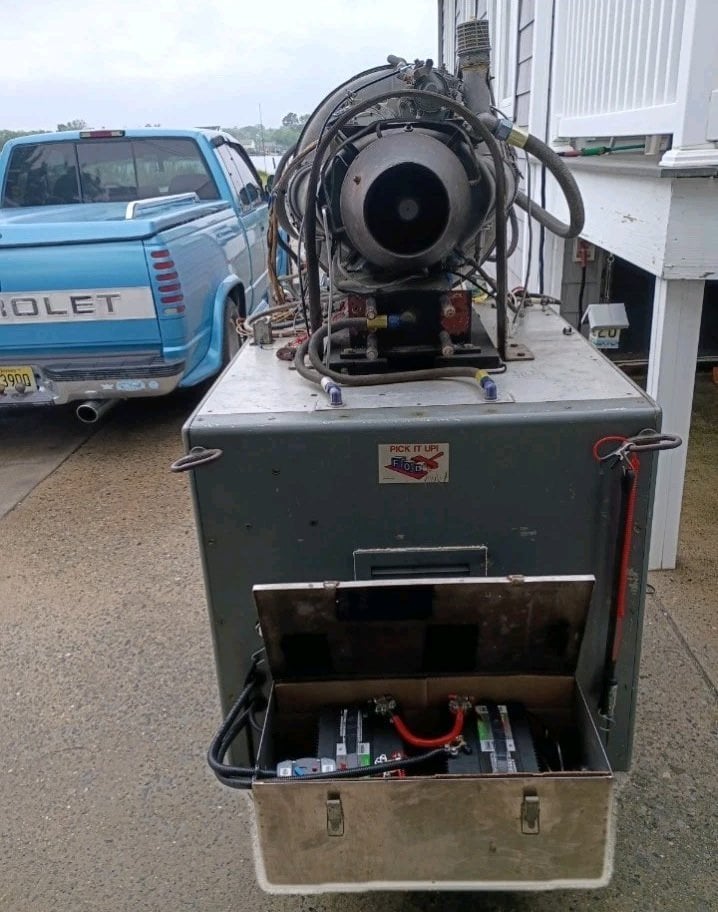
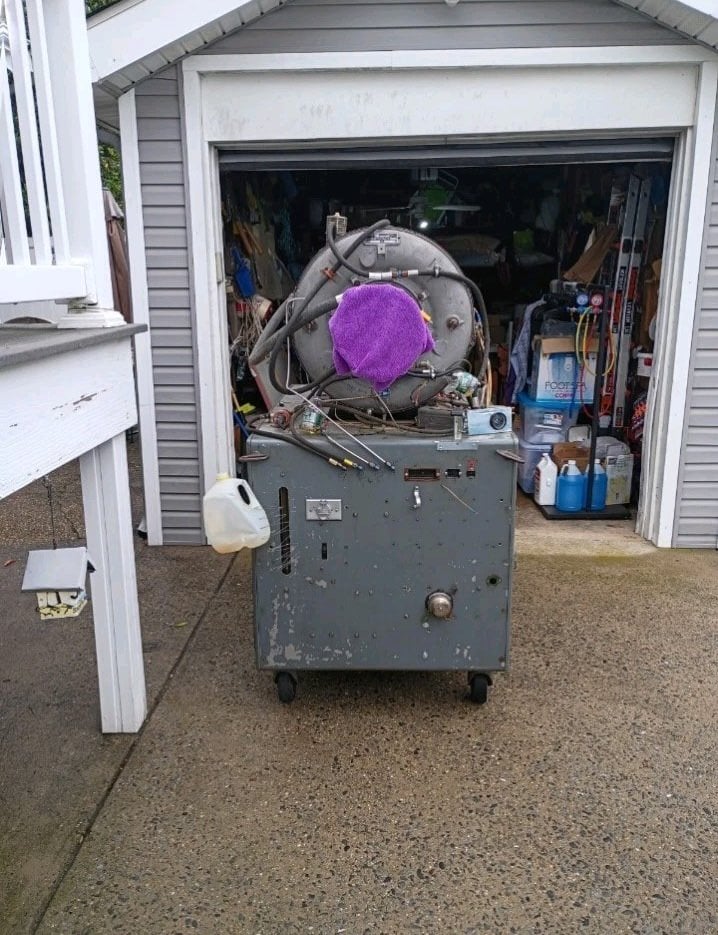
Images courtesy of Chanel 81

Articles that Ben Branch has written have been covered on CNN, Popular Mechanics, Smithsonian Magazine, Road & Track Magazine, the official Pinterest blog, the official eBay Motors blog, BuzzFeed, Autoweek Magazine, Wired Magazine, Autoblog, Gear Patrol, Jalopnik, The Verge, and many more.
Silodrome was founded by Ben back in 2010, in the years since the site has grown to become a world leader in the alternative and vintage motoring sector, with well over a million monthly readers from around the world and many hundreds of thousands of followers on social media.