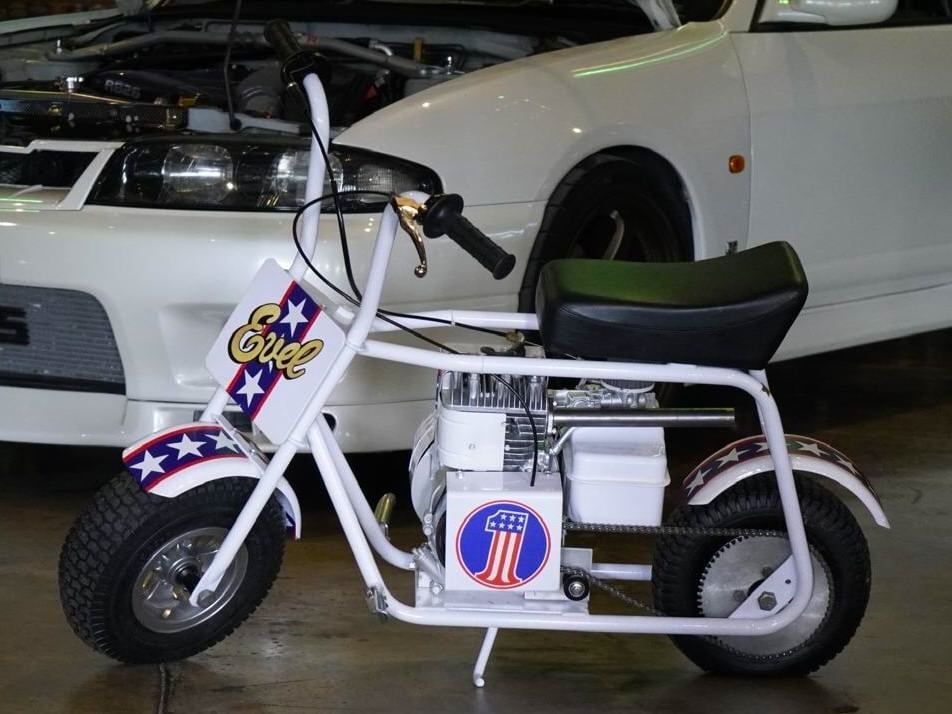
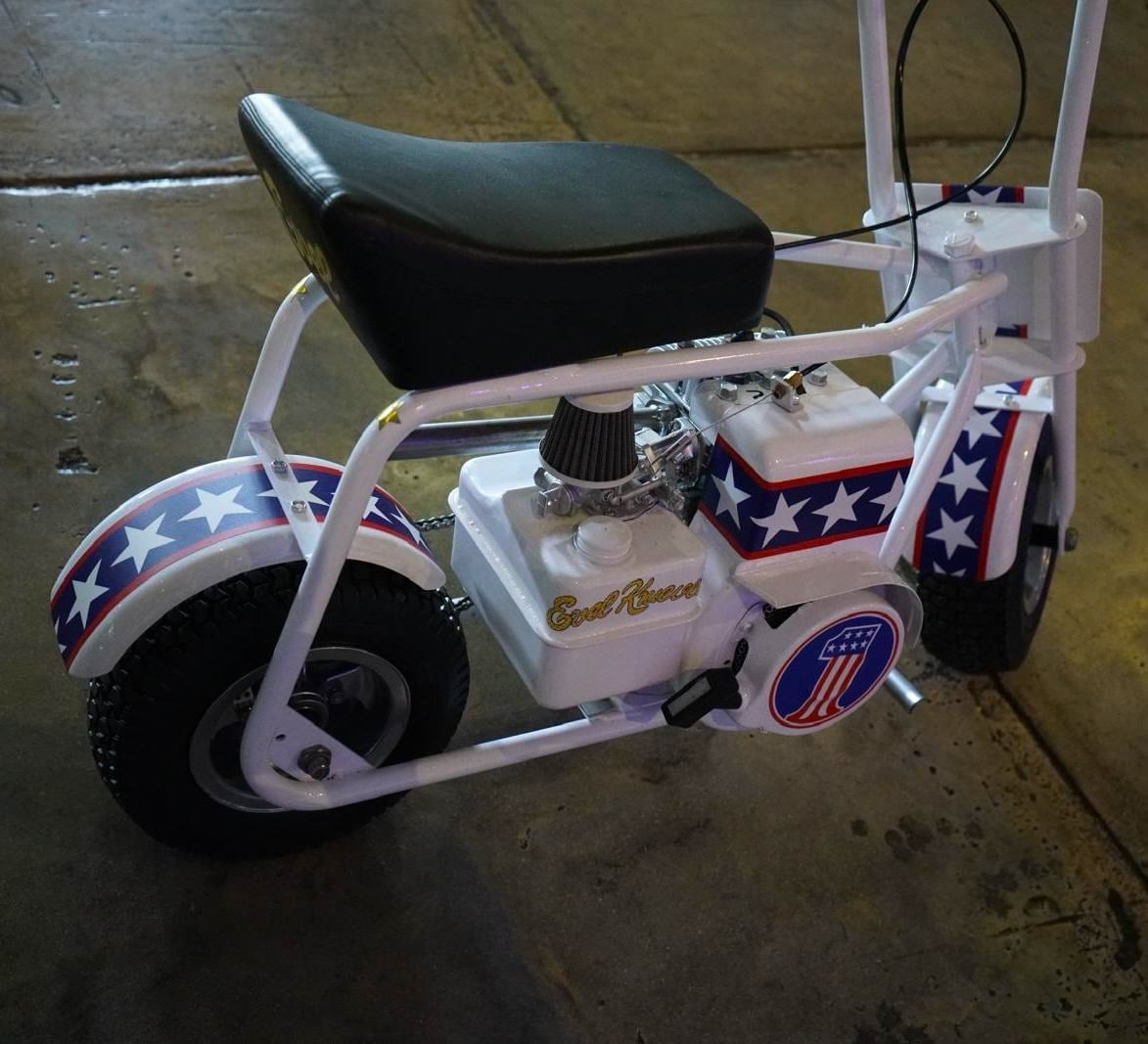
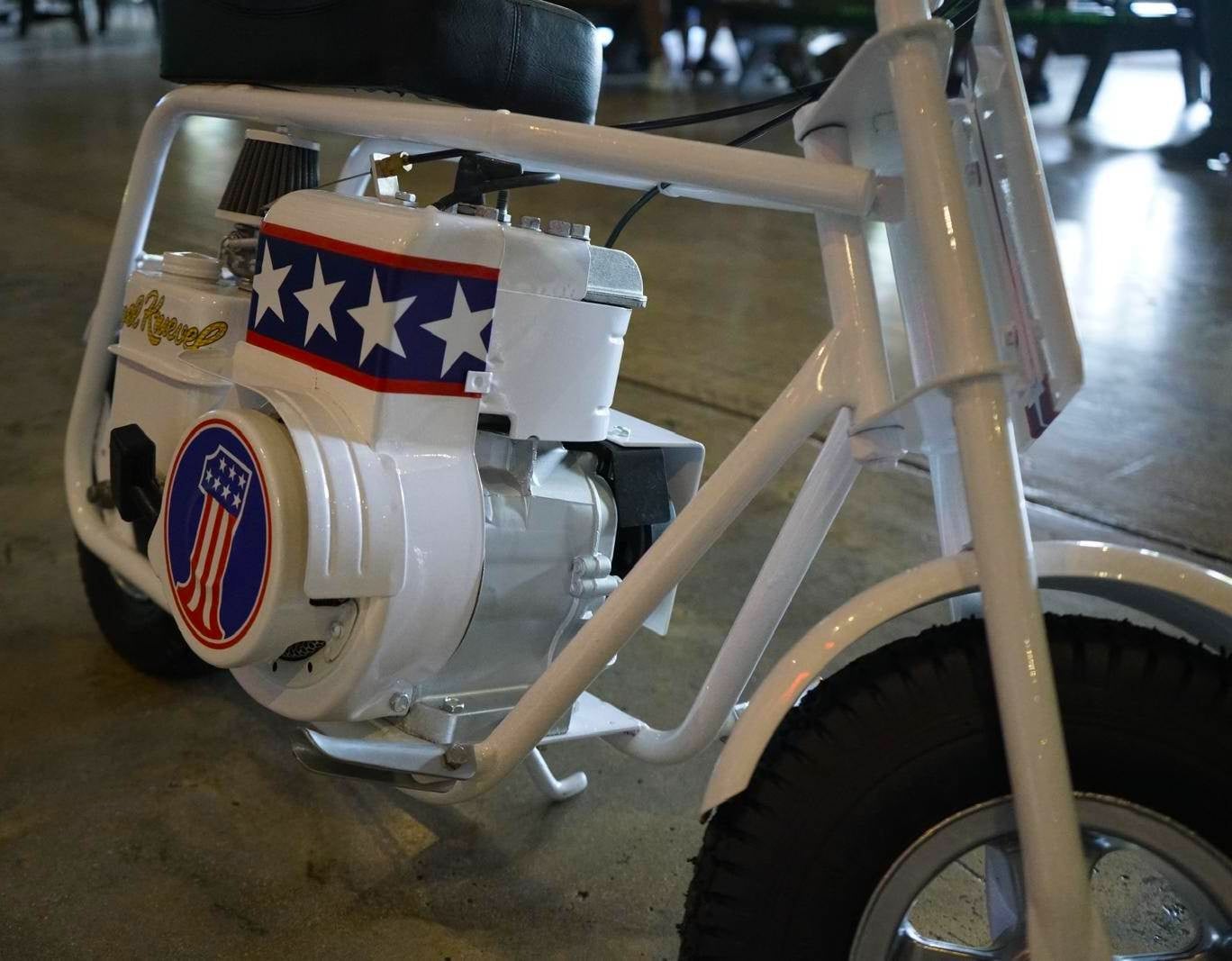
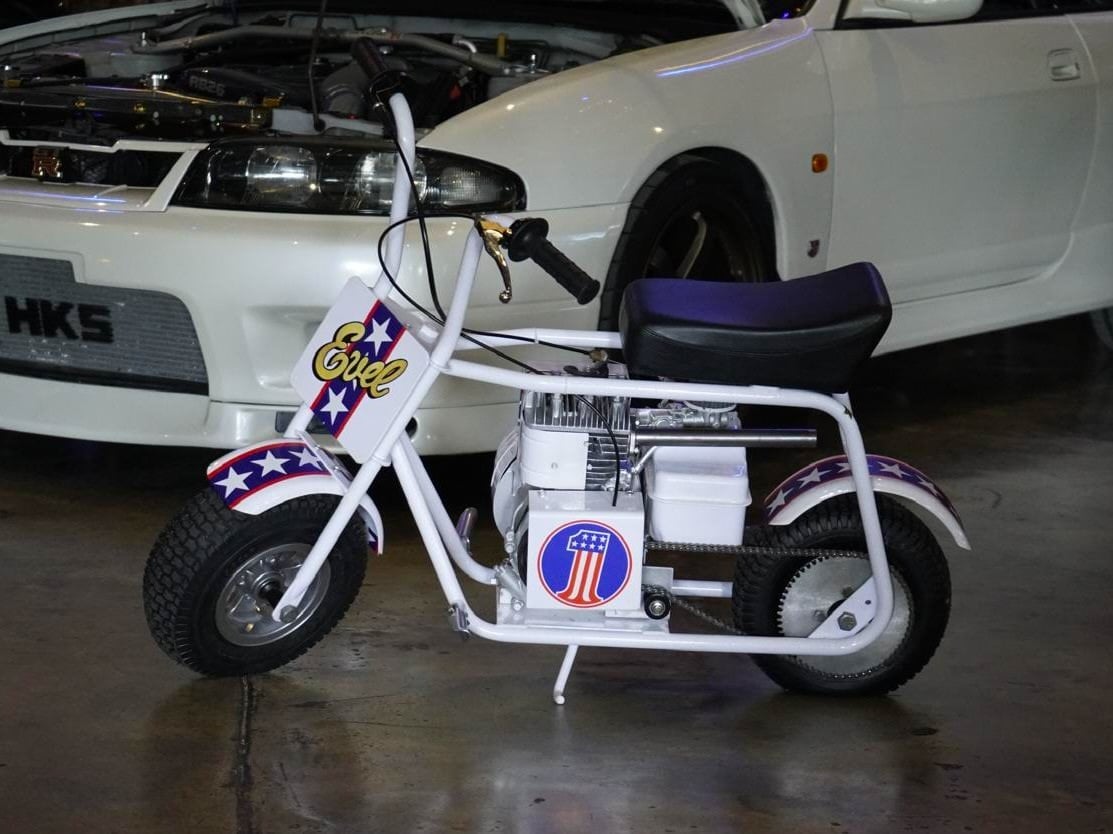
This is a vintage Ruttman minibike that’s been given a full period-correct Evel Knievel livery. It’s doubtful you’d be able to jump it over the Caesars Palace fountains in Las Vegas however, as its Briggs and Stratton engine is only capable of 5 bhp. You could still try though.
American companies like Ruttman were building minibikes like this long before the Japanese motorcycle manufacturers caught on to the trend and essentially took it over. Surviving vintage Ruttmans are now highly collectible, and they’re a lot of fun to ride for adults and kids alike.
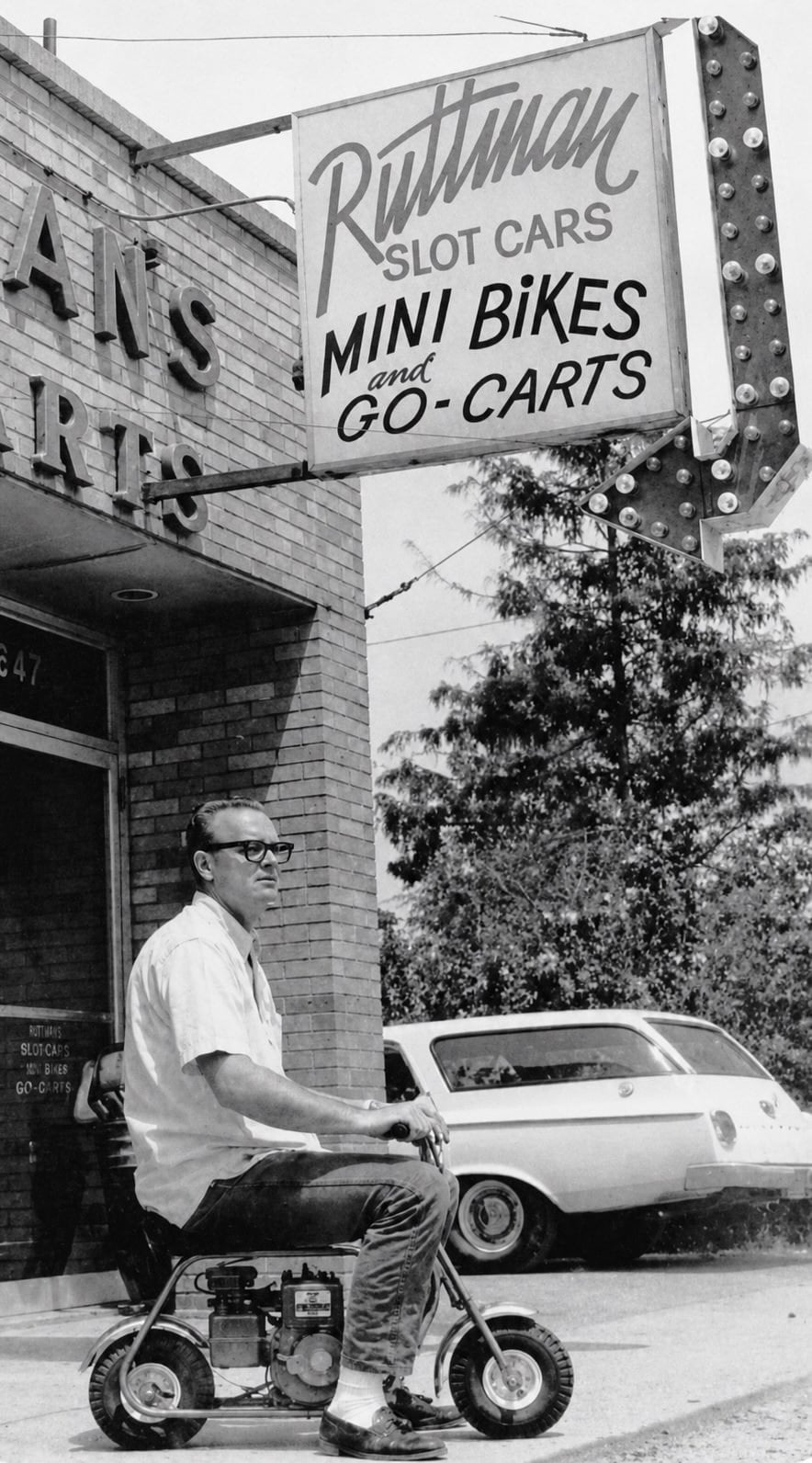
 Here we see Troy Ruttman on one of his creations in the 1960s, outside the store that carried his name. Image courtesy of Ruttman Industries.
History Speedrun: Ruttman Enterprises
Ruttman Enterprises was a small American minibike manufacturer based in Dearborn Heights, Michigan, that built a line of budget off-road two-wheelers for young riders from the 1960s into the late 1970s. The company was closely tied to the family of Troy Ruttman, the 1952 Indianapolis 500 winner and still the youngest driver to triumph at the event.
The commercial minibike is generally credited (with some argument) to the Michrina brothers of Michigan, who built the first production bikes under the Lil’ Indian brand starting in 1959 after being introduced to the concept through a pit bike belonging to Troy Ruttman.
As Lil’ Indian’s orders grew through the mid-1960s, the company outsourced welding to a Michigan shop run by Jim Ruttman, a member of the Ruttman family. Working on Lil’ Indian frames gave Jim direct exposure to the design, and he soon drew up his own minibike and put it into production as the Ruttman. Early Ruttman bikes borrowed heavily from Lil’ Indian in both layout and parts, and the two share many interchangeable parts – which is still quite helpful for collectors.
Ruttman minibikes were built around a remarkably simple recipe – a low, straight-tube steel frame with a horizontal-crankshaft Tecumseh four-stroke engine driving the rear wheel through a chain and a centrifugal clutch.
A recoil pull starter started the engine, a twist-grip throttle controlled speed, and a handlebar-operated band brake acting on the engine output slowed the bike. Suspension was limited to the foam seat and the tire sidewalls.
The wheels were small and steel with knobby tires, and the bikes had chrome fenders, elevated handlebars, and “GT Grips.” A speed governor could be fitted to the throttle so parents could limit the amount of damage kids could do to themselves, and it worked though sometimes with mixed results.
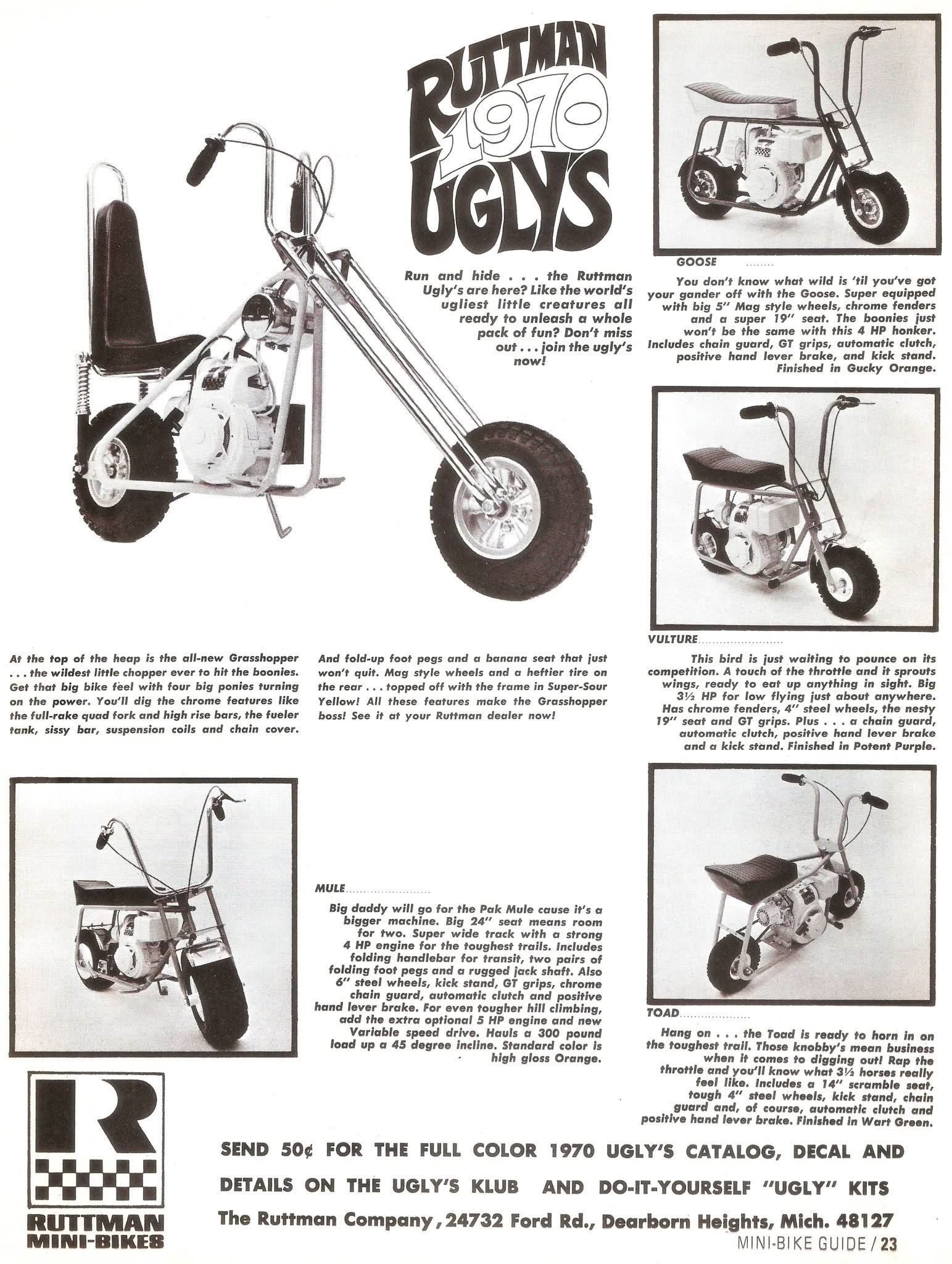
The Ruttman model lineup was branded as “The Uglys,” described in Ruttman marketing as “the world’s ugliest little creatures all ready to unleash a whole pack of fun.” It was clever marketing, taking the simple and perhaps not particularly attractive design of the bikes and turning it into a strength rather than a weakness. Image courtesy of Ruttman Industries.
The model lineup was branded as “The Uglys,” described in Ruttman marketing as “the world’s ugliest little creatures all ready to unleash a whole pack of fun.” It was clever marketing, taking the simple and perhaps not particularly attractive design of the bikes and turning it into a strength rather than a weakness.
The model range included the Pak Mule, Horny Toad, Vulture, Spyder, Grasshopper, and Wild Goose, with the Pak Mule arriving for the 1971 model year. Most bikes used 4 bhp Tecumseh four-strokes, with some models or options using 5 bhp engines. Some used a 3.5 bhp 148cc Tecumseh, listed with a top speed of 25 mph.
Bike weights ran between about 69 and 86 lbs depending on the model, and Ruttmans were sold either fully assembled through sporting goods stores or as kits that needed only fuel, oil, and tire air to ride, and they were advertised heavily in boys’ magazines throughout the era.
Ruttman also built up an accessory business that actually outlived the machines themselves. The company sold windscreens, lighting kits, squeeze horns, custom chrome foot pegs, and a chopper-style variant of the Grasshopper.
Its most famous add-on was the Ski-Trac, a bolt-on kit that replaced the front wheel with a ski for winter use under the slogan “All the Fun of a Snowmobile.” The kit fitted any minibike with a 5/8-inch front axle and was marketed for trikes and dune bikes as well as Ruttman’s own minibikes.
Ruttman Enterprises was formally incorporated in 1974, near the end of the American minibike boom that had peaked at over 140,000 units in 1973 and had fallen sharply by 1977. Increased competition from the far larger Japanese manufacturers had been detrimental, and a lot of focus had shifted over to three-wheelers.
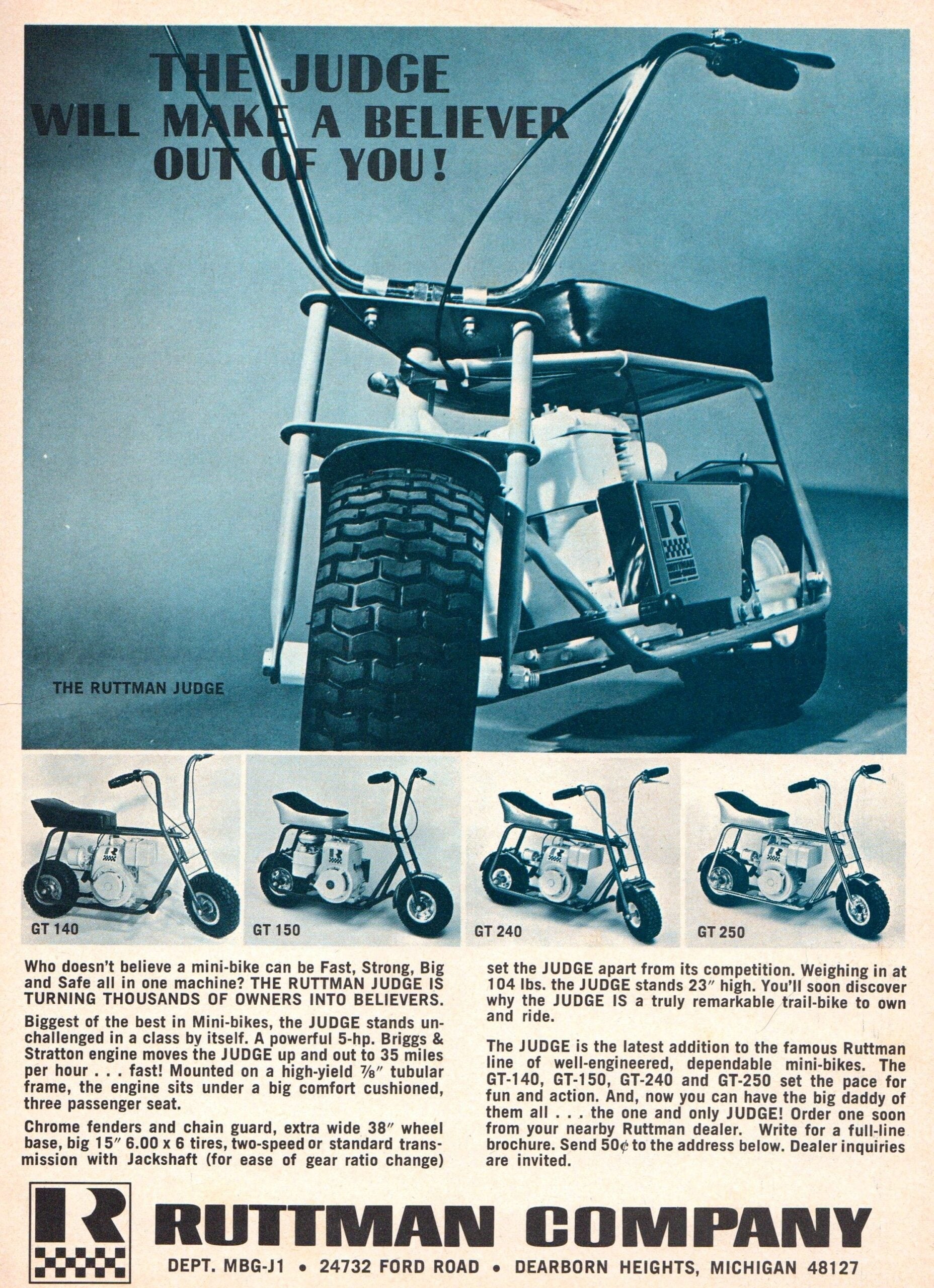
The model range included the Pak Mule, Horny Toad, Vulture, Spyder, Grasshopper, and Wild Goose, with the Pak Mule arriving for the 1971 model year. Most bikes used 4 bhp Tecumseh four-strokes, with some models or options using 5 bhp engines. Some used a 3.5 bhp 148cc Tecumseh, listed with a top speed of 25 mph. Image courtesy of Ruttman Industries.
The company was dissolved in 1978, though the retail side carried on. The Ruttman motorcycle, snowmobile, ATV, and watercraft dealership at 24732 Ford Road in Dearborn Heights continued trading under the family name until July of 1990, when it was bought out by Rosenau and rebranded as Rosenau Powersports – an authorized Yamaha dealer that still operates on the same site.
Surviving Ruttman minibikes have become a collector niche today, loved for their names, their period charm, and their simple design that typically makes maintenance a breeze.
The Evel Knievel Ruttman Minibike Shown Here
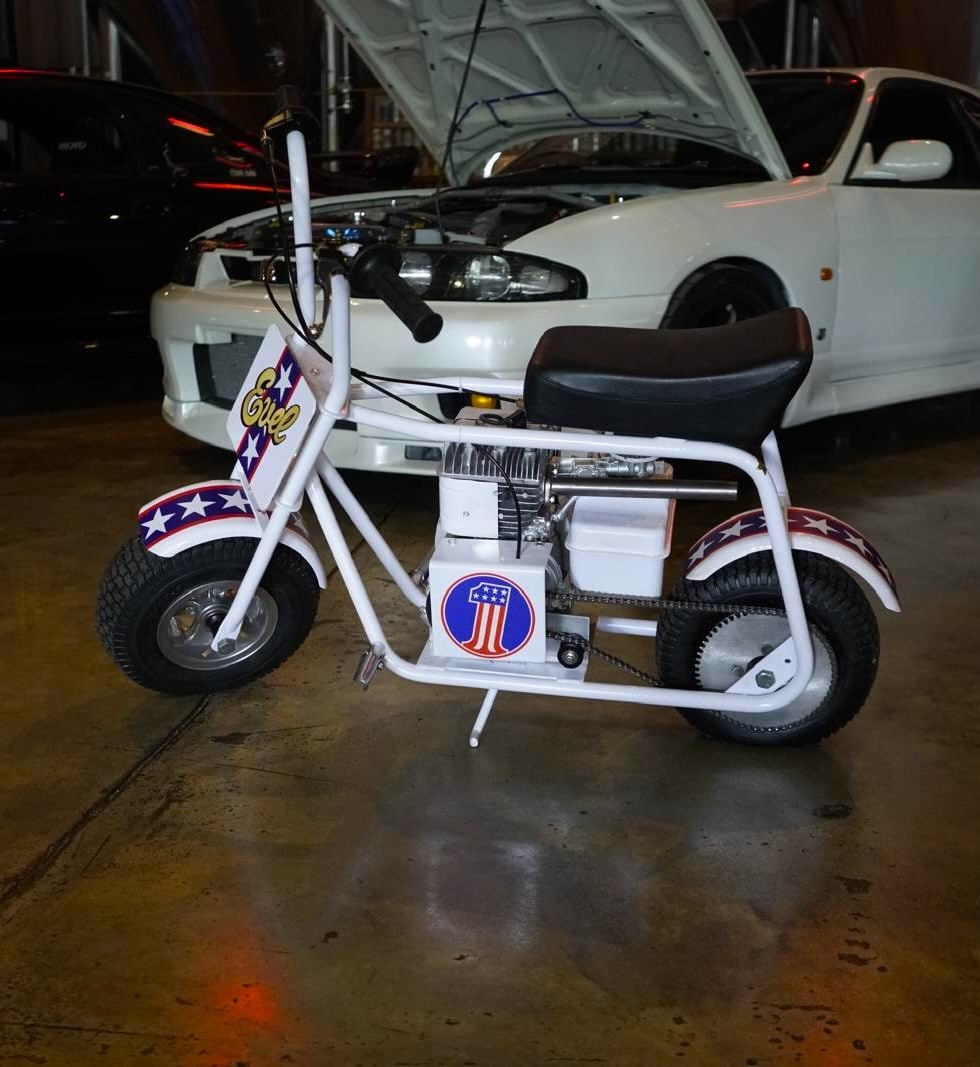
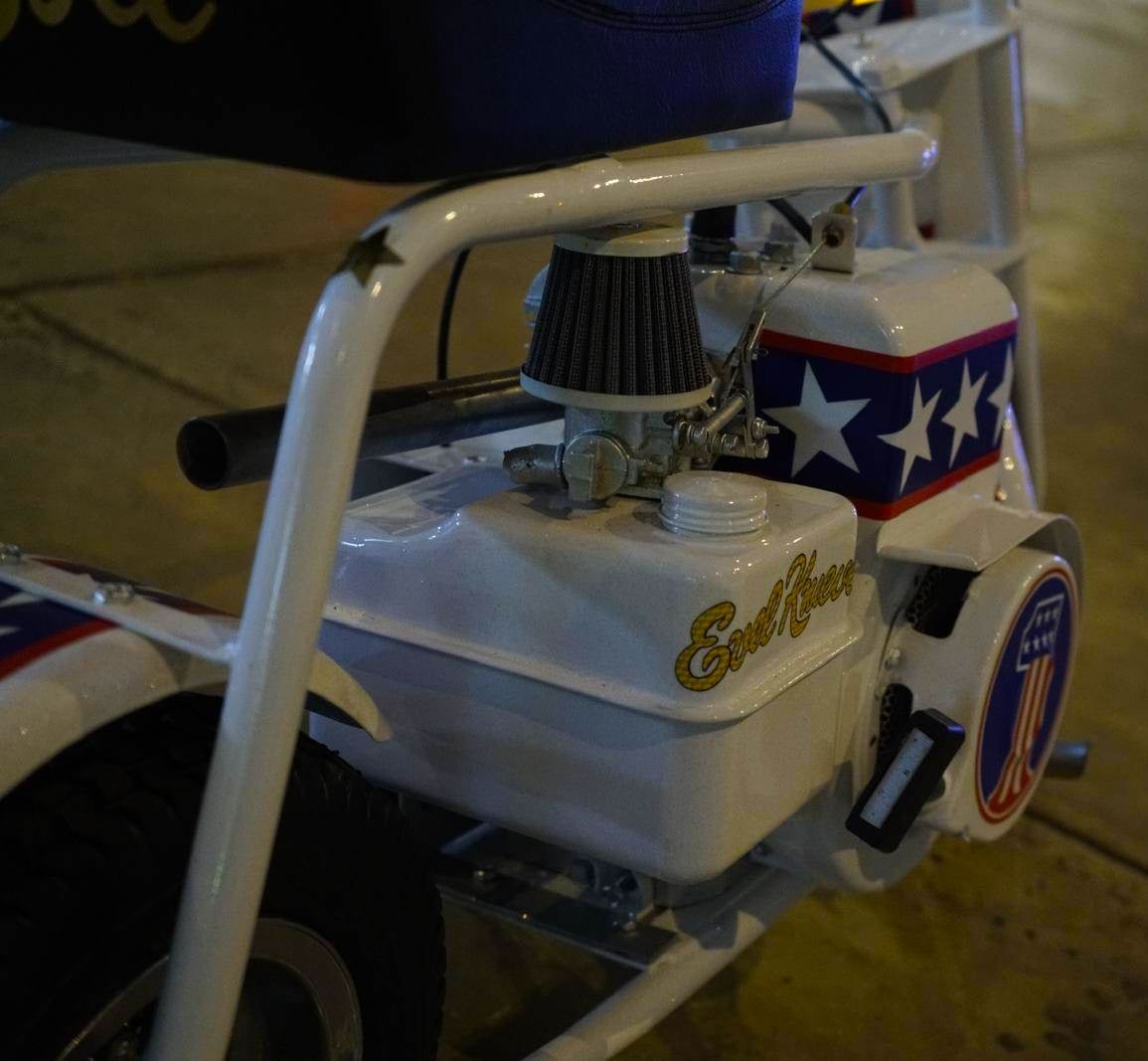
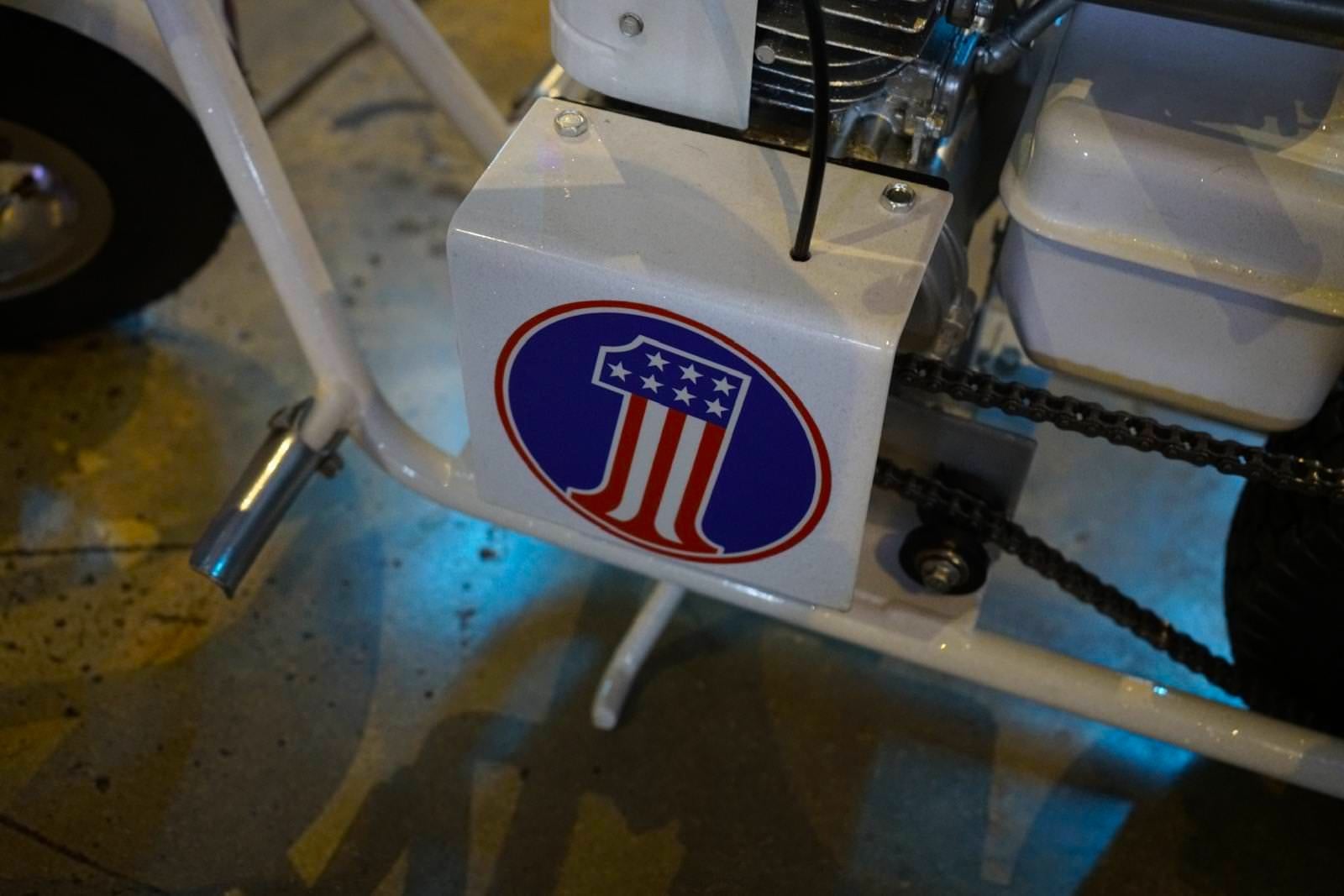
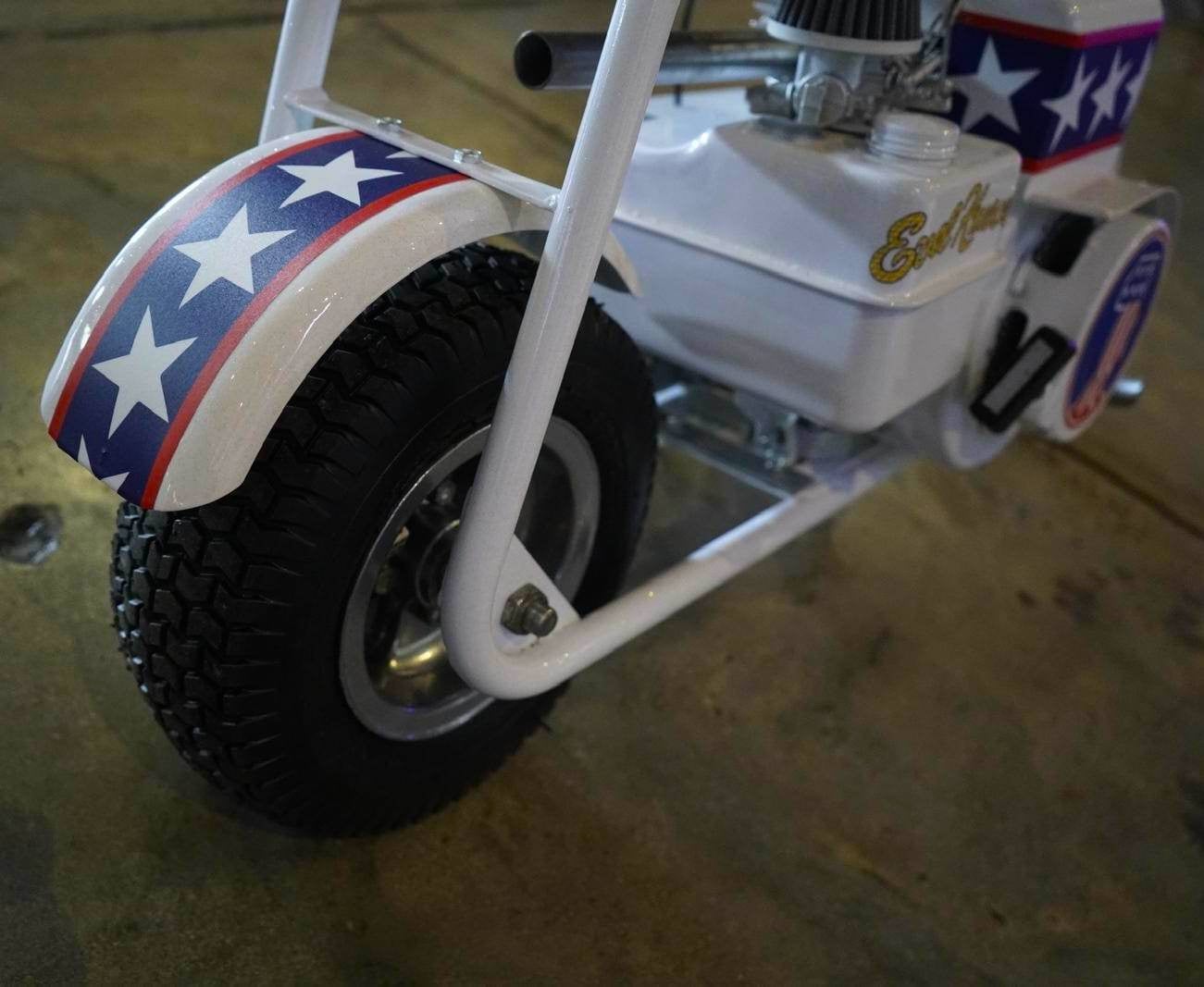
This Evel Knievel-style Ruttman minibike was bought by the seller in 2016 and then had the frame and fork powder-coated in white with a period-correct Evel Knievel livery. It has a reupholstered upswept black vinyl seat, folding foot pegs powder-coated in silver, and a side stand.
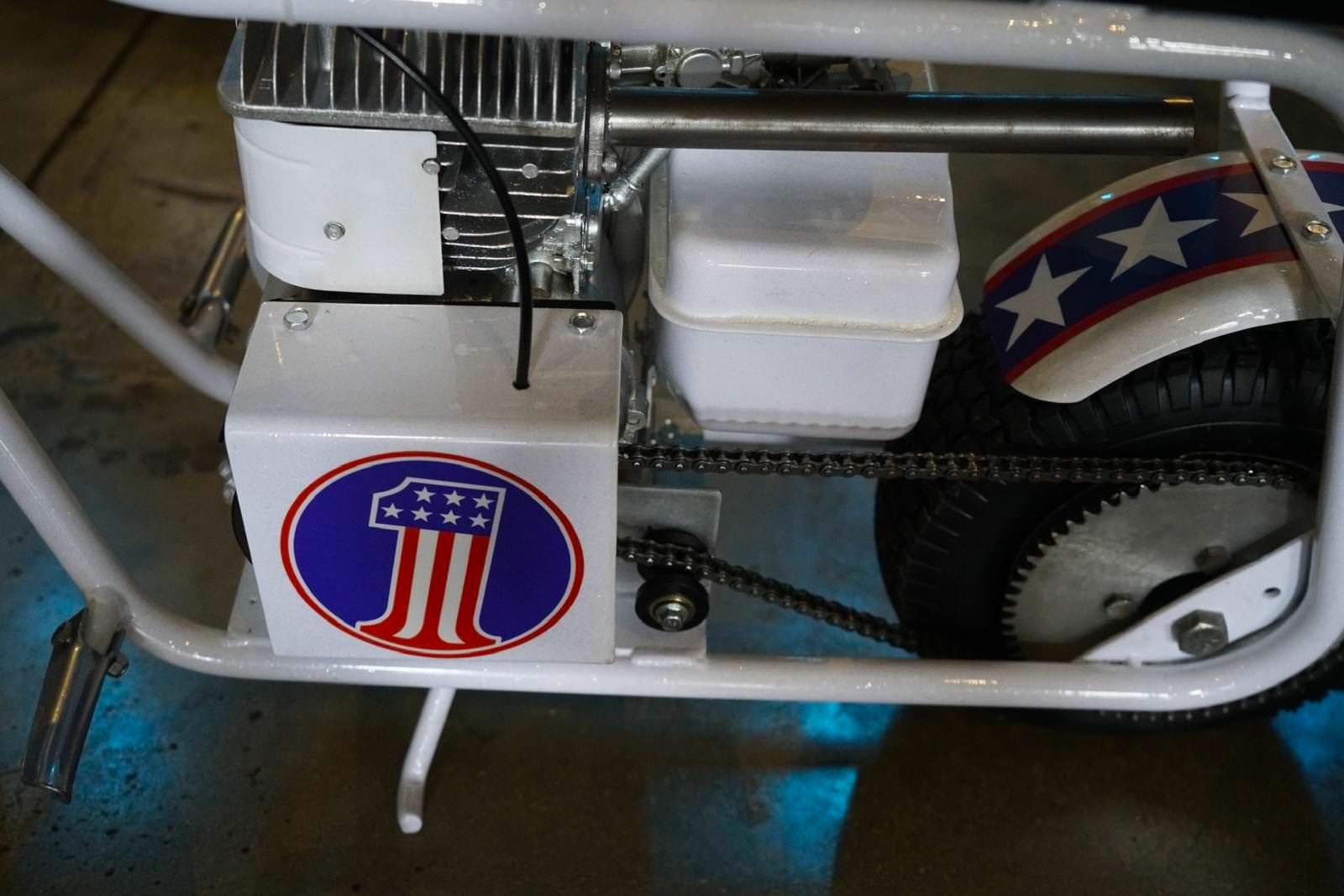
The bike rides on multi-piece aluminum wheels wrapped in street tires, and braking is handled by a band brake mounted on the outside of the centrifugal clutch. The handlebars carry a twist-grip throttle on the right and a brake lever on the left. There’s no instrumentation, so total mileage is unknown.
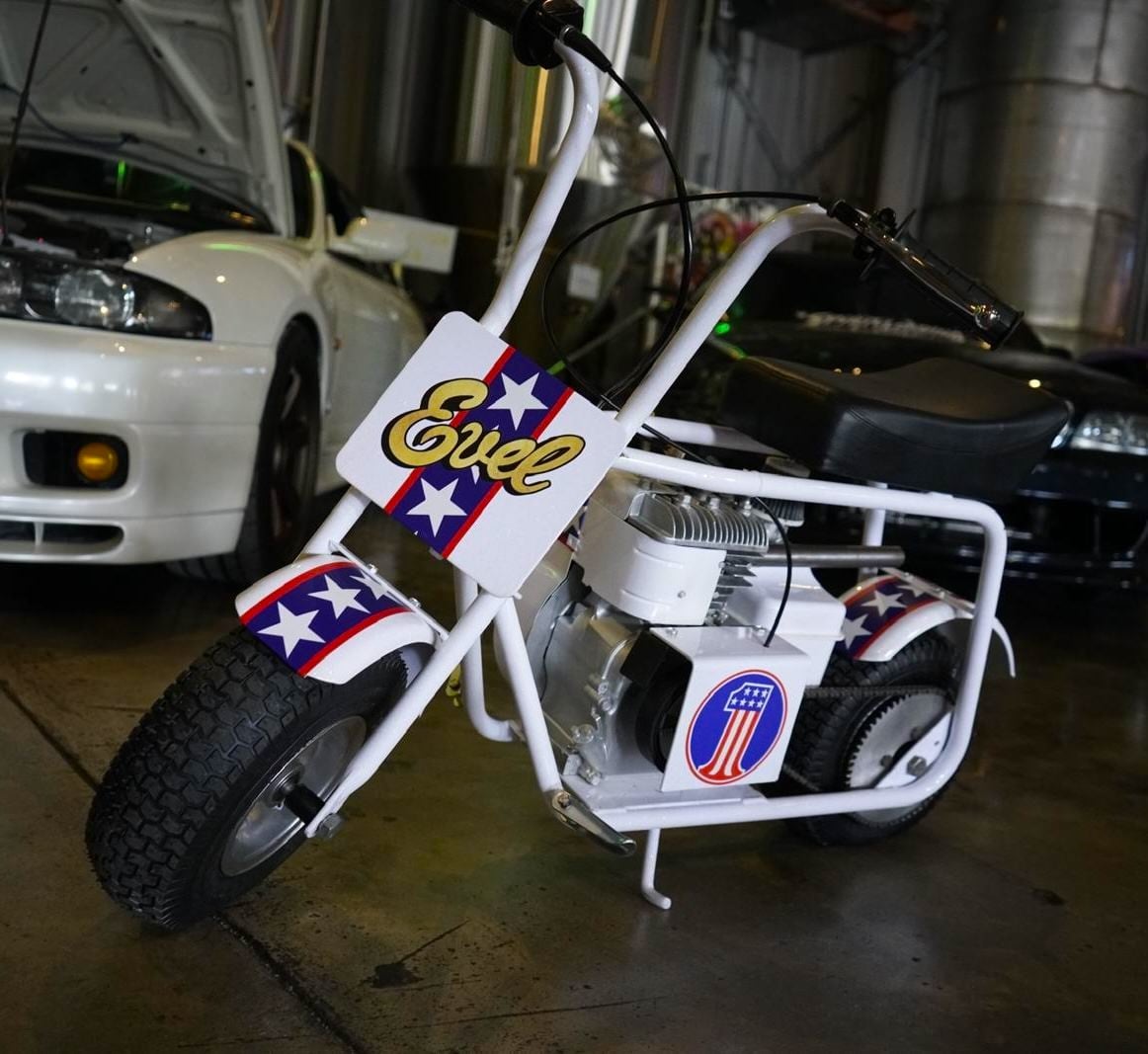
This Evel Knievel-style Ruttman minibike was bought by the seller in 2016 and then had the frame and fork powder-coated in white with a period-correct Evel Knievel livery. It has a reupholstered upswept black vinyl seat, folding foot pegs powder-coated in silver, and a side stand.
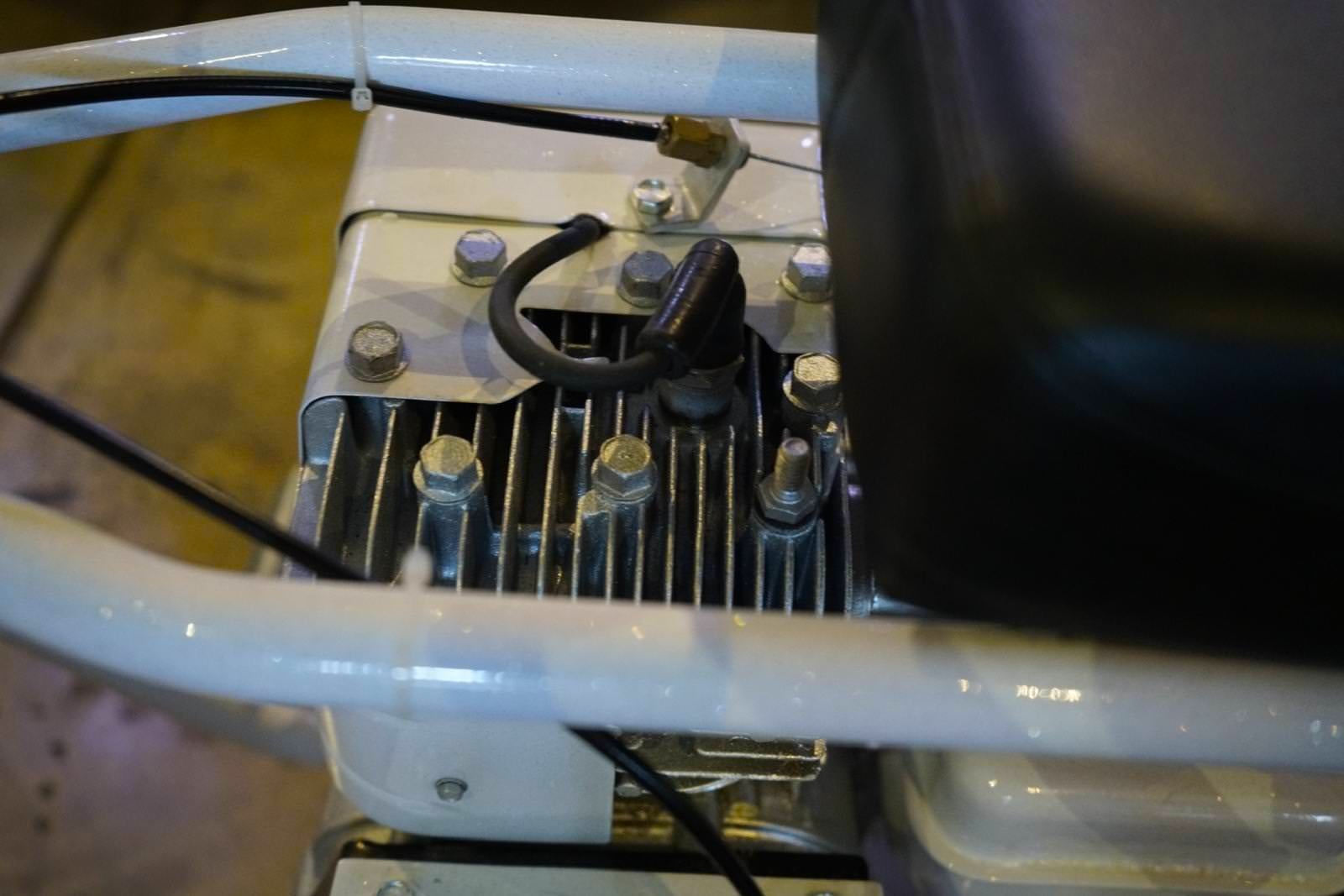
Power comes from a replacement air-cooled Briggs and Stratton four-stroke single, factory rated at 5 bhp when new. The engine has a recoil starter, a partially-shrouded cylinder head, and an open-element air filter, with an exhaust system that exits under the seat. Drive to the rear wheel runs through a shrouded centrifugal clutch and a chain.
It’s now being offered for sale out of Miami, Florida for off-road use only with a bill of sale. If you’d like to read more about it or register to bid you can visit the listing here.
Images courtesy of Bring a Trailer
Articles that Ben Branch has written have been covered on CNN, Popular Mechanics, Smithsonian Magazine, Road & Track Magazine, the official Pinterest blog, the official eBay Motors blog, BuzzFeed, Autoweek Magazine, Wired Magazine, Autoblog, Gear Patrol, Jalopnik, The Verge, and many more.
Silodrome was founded by Ben back in 2010, in the years since the site has grown to become a world leader in the alternative and vintage motoring sector, with well over a million monthly readers from around the world and many hundreds of thousands of followers on social media.