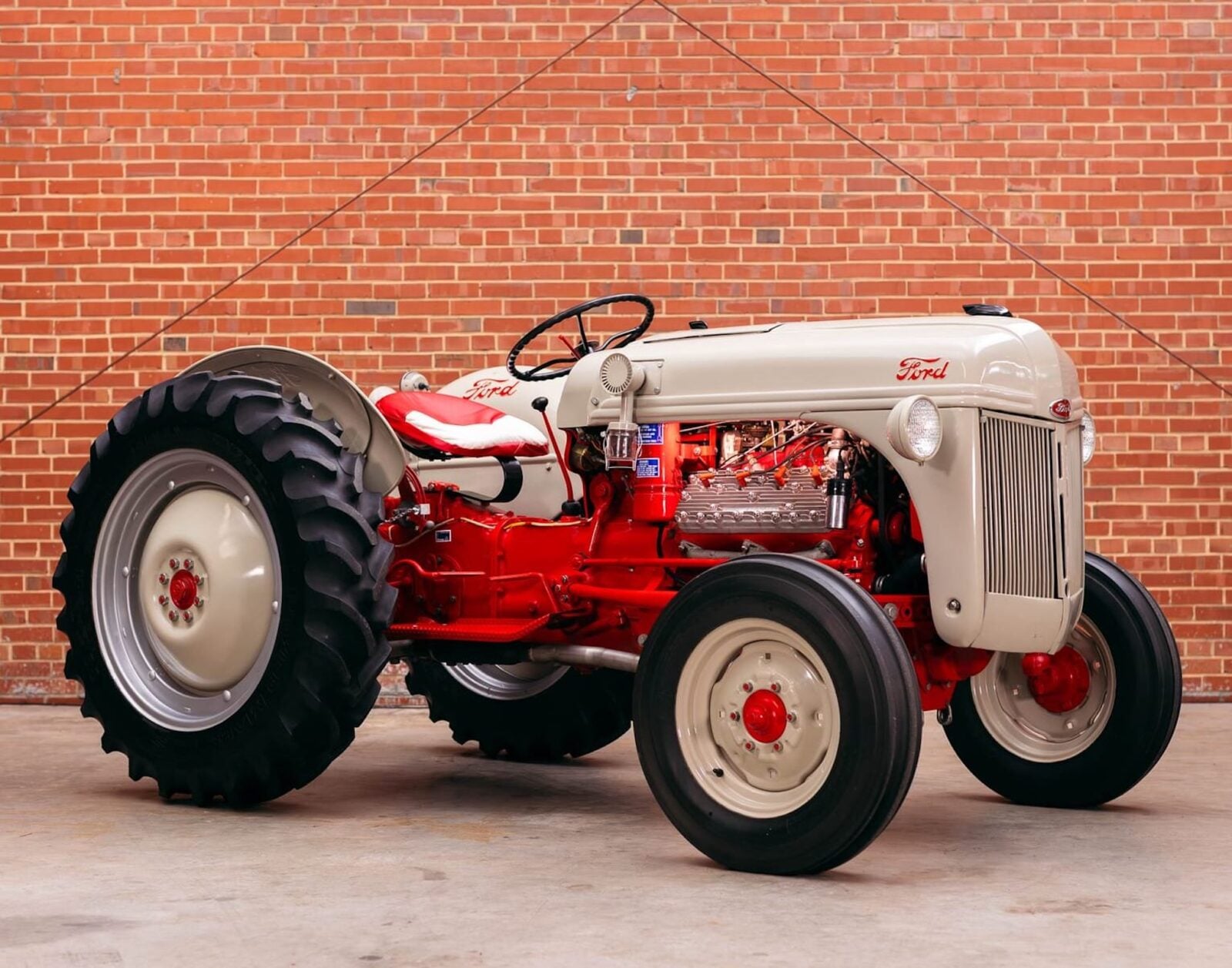
This is a restored 1950 Ford 8N Tractor that as an early prototype for the legendary Flathead V8 engine conversions carried out by the Funk Aircraft Company.
These Funk V8 Ford 8Ns were popular in-period as they vastly increased both the power and torque output over the original four-cylinder engine. Surviving examples are now hugely collectible.
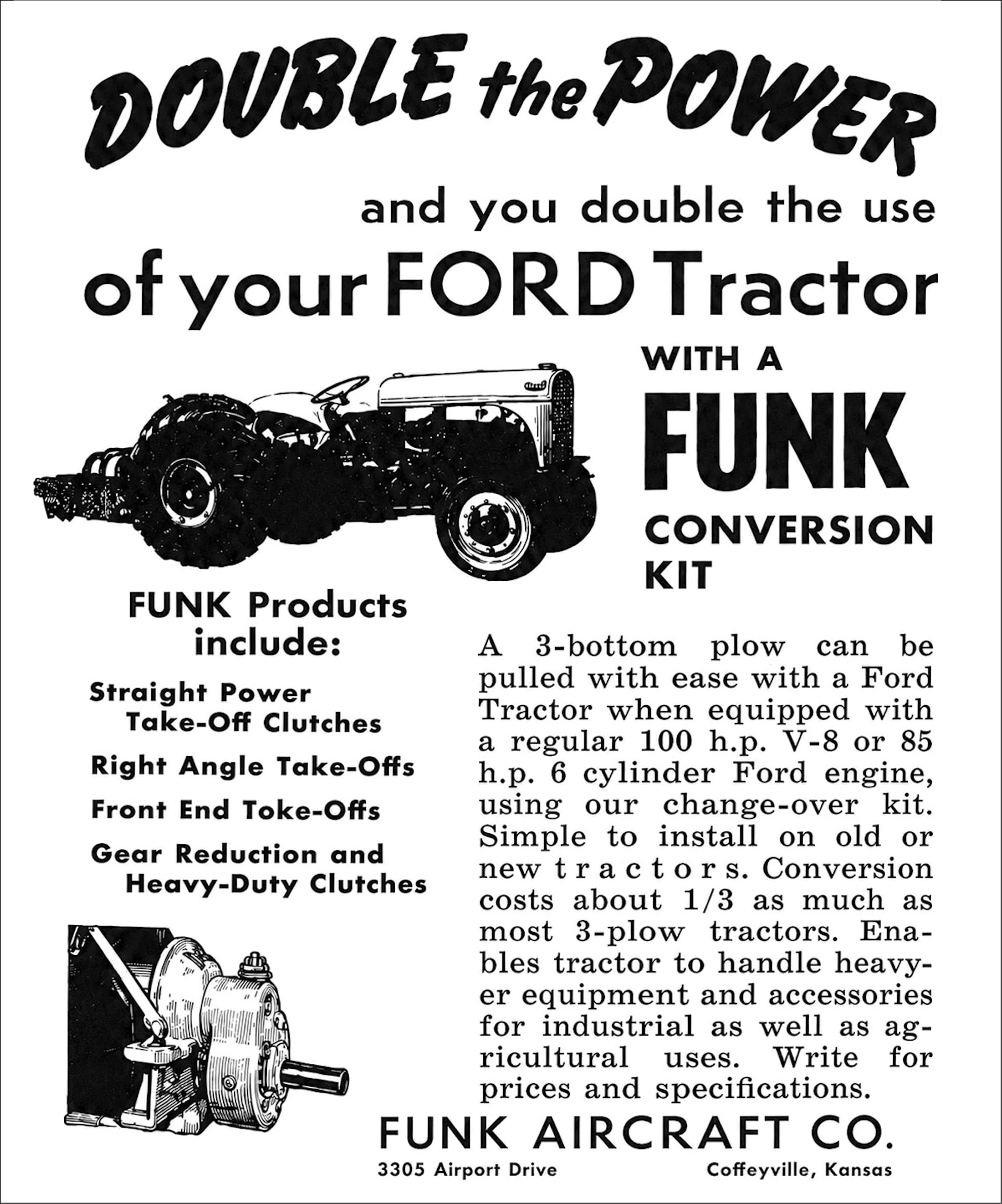
 While Ford never offered its own V8 option for the 8N from the factory, a small number were built with Flathead V8 power by the Funk Aircraft Company of Coffeyville, Kansas. Image courtesy of the Funk Aircraft Co.
History Speedrun: The Ford 8N Tractor
The Ford 8N is generally considered to be the best-selling tractor model ever sold in North America, with over 524,000 examples built between 1947 and 1952. It was also the machine at the very center of one of the largest patent lawsuits of its era, and the reason it came to exist at all is inseparable from Henry Ford’s lifelong preoccupation with farm mechanization.
Henry Ford was born on a Wayne County, Michigan farm in 1863 and left as a teenager to work in Detroit machine shops. He never lost his dislike of the drudgery of manual farm work, later writing in his autobiography that too much labor was required for the results the farm produced.
His goal, as he stated it, was to replace manual labor on farms with mechanical power wherever possible. Though it’s not remembered nearly as well, he pursued his goals for agricultural advancement alongside (and often ahead of) his now legendary automotive work. His early experiments with steam power for farm work dated back to the 1880s.
In 1907, he built an “automobile plow” that borrowed a four-cylinder engine and two-speed transmission from a Ford Model B, the radiator and steering from a Model K, and the rear wheels from a pair of grain binders.
By 1915, a number of Model T-based experimental tractors were being tested at Ford’s Dearborn farm. Ford Motor Company’s board had little interest in these experiments with agricultural equipment due to the low projected sales figures and profitability, so Ford formed a separate entity, Henry Ford and Son Inc., to develop and build a purpose-designed tractor that he hoped would mirror the success of the Model T.
The commercial name became “Fordson” in part because a small Minneapolis outfit called the Ford Tractor Company had already claimed the Ford name in the tractor market. Fordson Model F production began in October of 1917. The first 7,000 units went to Britain to help offset the WWI-era loss of agricultural labor, and American sales began in the spring of 1918.
The Fordson was compact for its era on a 63 inch wheelbase, though it still weighed roughly 2,900 lbs, and its unit-frame construction, in which the engine, transmission, and axle housings bolted together to form the chassis, made it cheap to build and cheap to sell. Roughly 740,000 were built in the United States through to 1928.
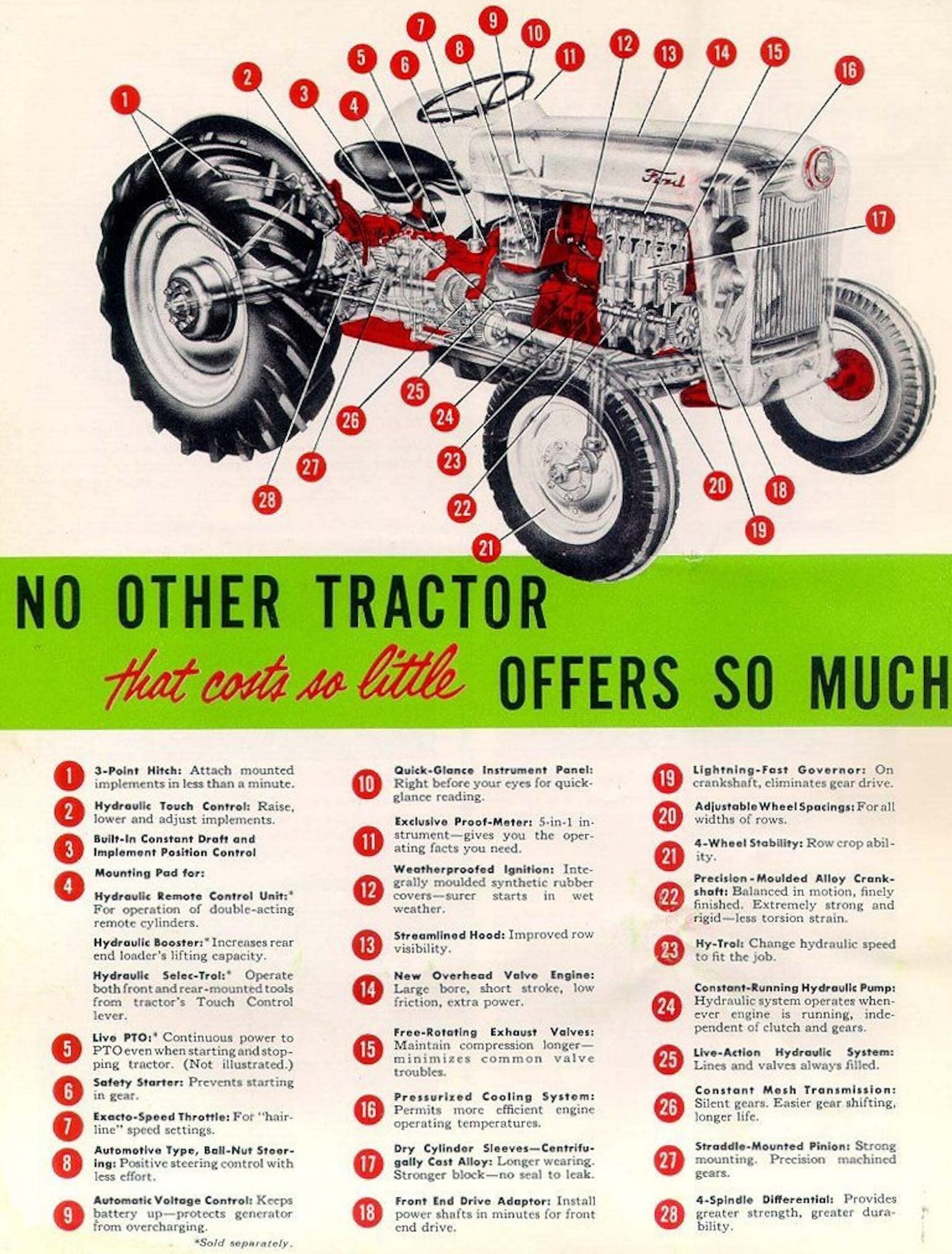
The Ford 8N is widely considered to be the best-selling tractor model ever sold in North America, with over 524,000 examples built between 1947 and 1952. Image courtesy of Ford.
Ford was out of the American tractor market for nearly a decade, but he returned to it because of Harry Ferguson. The Irish engineer had spent the 1920s and 1930s developing what became known as the three-point hitch – this was a set of hydraulically controlled links that bound tractor and implement into a single unit and used the plow’s drag to press the rear wheels down for additional traction.
Ferguson patented the converging three-point linkage in the late 1920s, then added the key suction-side hydraulic control system in the mid-1930s, refining the design further on prototypes built with David Brown Ltd. Yes, the same David Brown who would later buy Aston Martin and whose initials would grace many of the most famous Astons that followed, like James Bond’s favorite, the DB5.
In October of 1938, Ferguson traveled to Ford’s Fairlane estate in Dearborn to demonstrate the Ferguson-Brown Model A, and the two men reached what became known as the handshake agreement. Ford would manufacture the tractor, and Ferguson’s company would distribute it.
The result of all this was the Ford 9N, first shown to the public on June the 29th, 1939 and released later that year. It was the first American production tractor to combine the three-point hitch with a rear power take-off. The 9N used a 119.7 cubic inch L-head four-cylinder engine capable of 23 bhp at the belt, paired with a 3-speed transmission, and it was finished in dark grey with a Ferguson System badge fitted below the Ford oval on the grille.
Production totaled 99,002 units through 1942. WWII-era material restrictions resulted in the release of the 2N in 1942, this was essentially a 9N built with steel wheels and magneto ignition in place of rubber tires and batteries during the shortage period. Postwar 2Ns received the rubber and electrics back.
The 8N arrived in mid-1947 as a substantially revised design. The L-head four remained in place Ford advertised it at 27 PTO bhp and 23 drawbar bhp with 92 lb ft of torque at 1,500 rpm – respectable numbers for the time. The 3-speed gearbox gave way to a 4-speed, a Position Control setting was added to supplement Ferguson’s original hydraulic draft control, and running boards, eight-lug rear wheels, a left-side clutch, and independent right-side brake pedals were introduced.
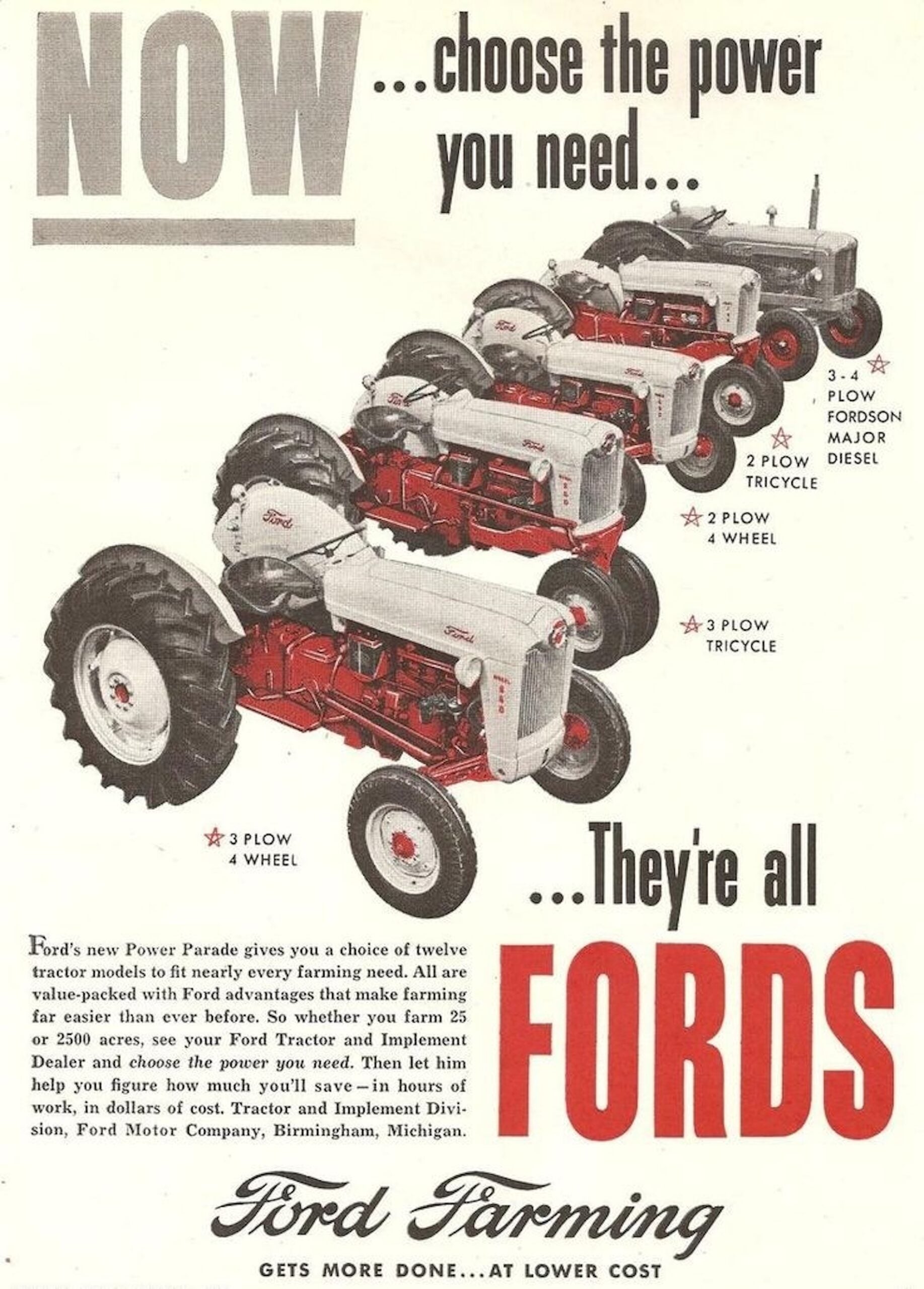
The Ford 8N arrived in mid-1947 with an L-head four offering 27 PTO bhp and 23 drawbar bhp with 92 lb ft of torque at 1,500 rpm – respectable numbers for the time. Images courtesy of Ford.
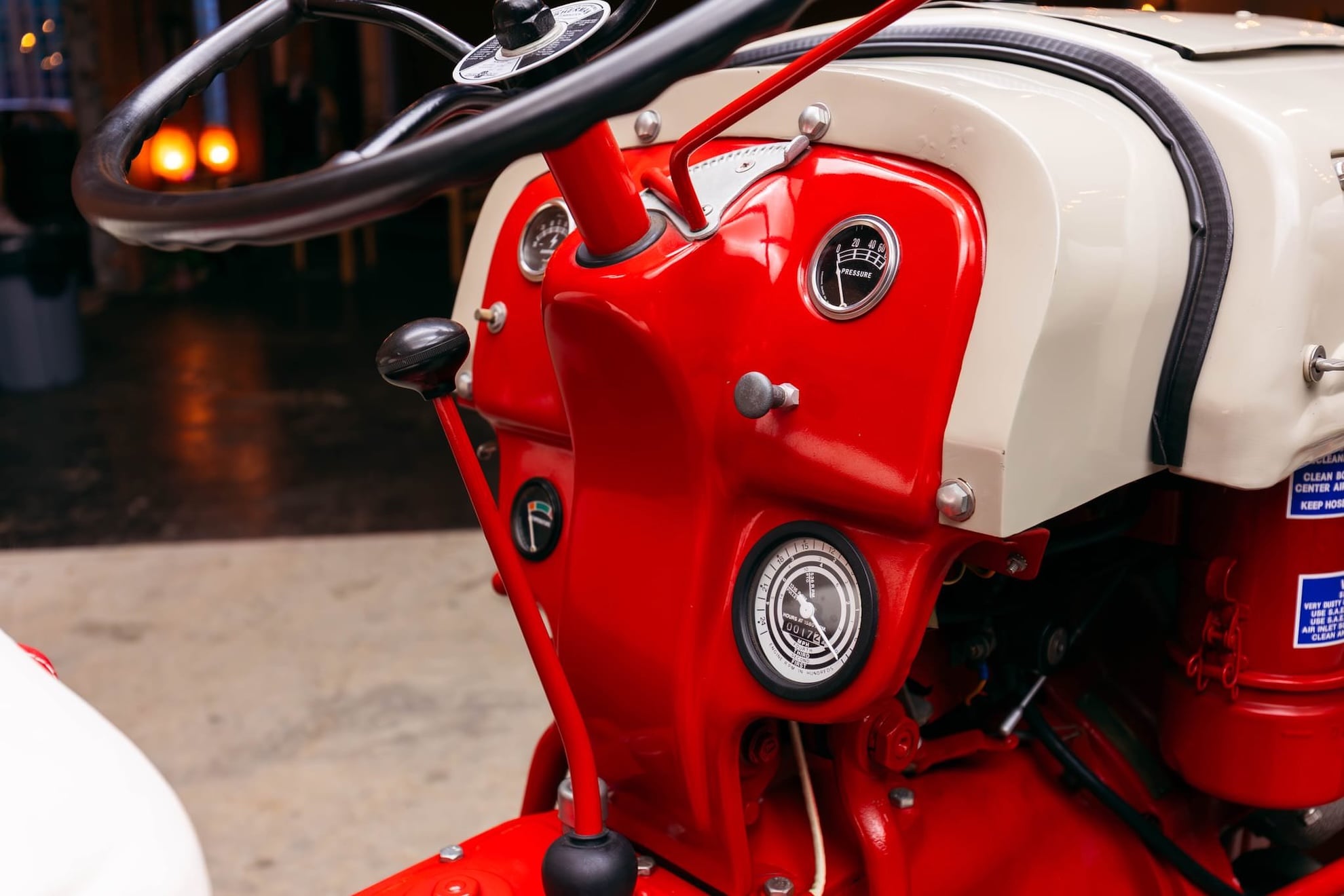
The two-tone livery of a light gray hood and fenders over a red body replaced the earlier all-grey finish. Mid-1950 changes later brought a side-mounted distributor and a Proofmeter combining tachometer, speedometer, and hour meter in a single dash-mounted instrument.
The 8N’s launch also broke the handshake agreement. Henry Ford II had taken over the company in 1945 and viewed the tractor operation as a loss center – He controversially ended the Ferguson arrangement in 1947 while continuing to build the Ferguson System hardware on the new tractor. Unsurprisingly Ferguson filed suit in early-1948 for an eye-watering $251 million for patent infringement and unfair competition.
The case ran until April of 1952, when Ford settled for $9.25 million. By the time of the settlement, Ferguson’s key patents were nearing expiry or had already expired, and the three-point hitch soon became the industry standard.
The settlement forced Ford to redesign the tractor, the result was the NAA “Golden Jubilee” of 1953, launched to coincide with Ford Motor Company’s 50th anniversary. It was four inches longer, four inches taller, and around 100 lbs heavier than the 8N, and it introduced live hydraulics driven by an engine-mounted pump alongside a new 134 cubic inch overhead-valve “Red Tiger” four-banger rated at 32 bhp.
While Ford never offered its own V8 option for the 8N from the factory, a small number were built with Flathead V8 power by the Funk Aircraft Company of Coffeyville, Kansas. The Funk brothers had built light aircraft before the war, and in the postwar period they developed conversion kits that let Ford tractor owners swap in the considerably more powerful engine.
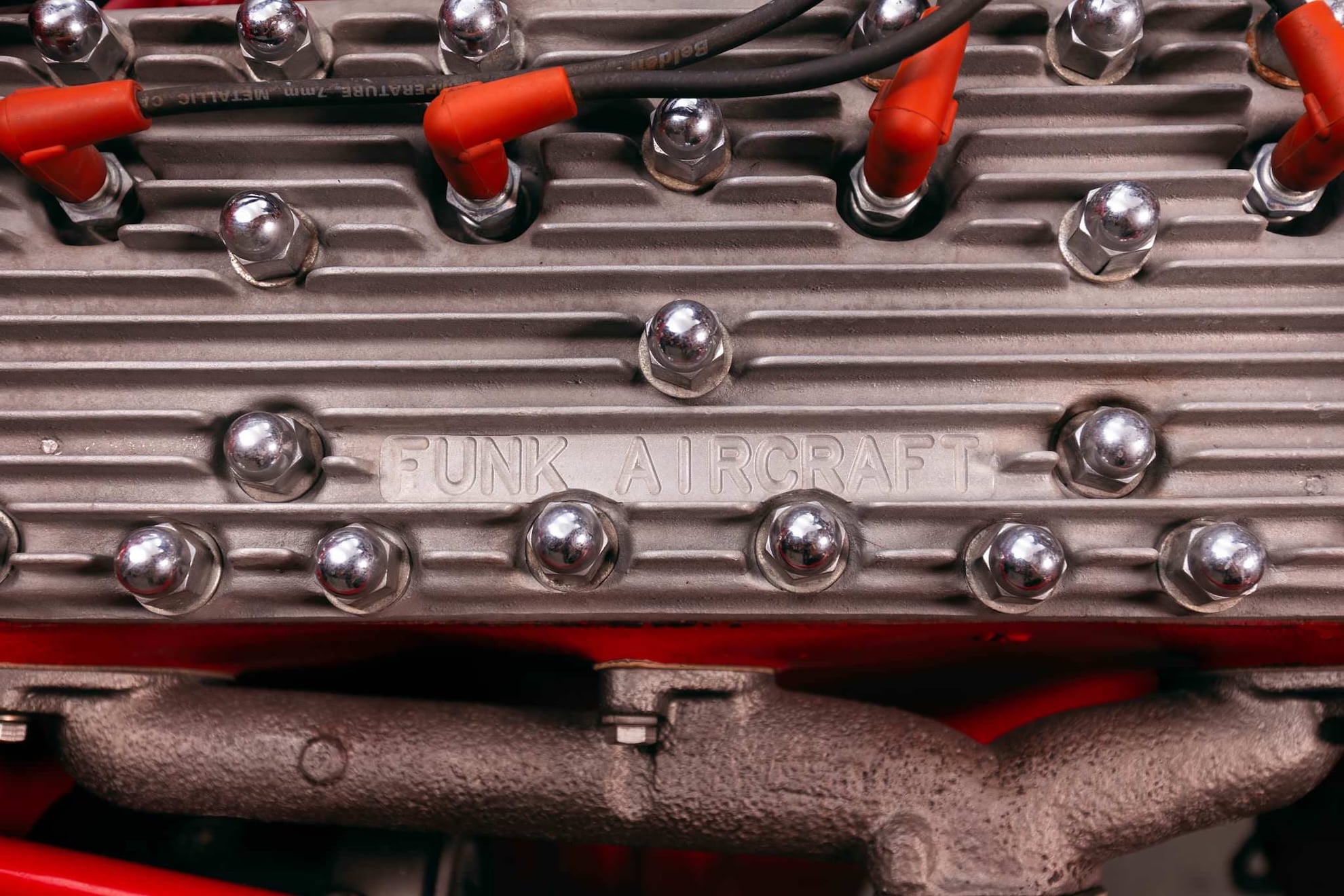
Two versions were offered – one using the 226 cubic inch Ford inline six from the truck line, and the more famous version using the Ford Flathead V8. The kit consisted of an adapter housing, a modified pedestal to accept the taller and longer engine, a lengthened hood and grille shell, and the necessary plumbing and electrical work. Kits were sold to owners and dealers, or installed at the factory as complete tractors, and were fitted to 9N, 2N, 8N, and some later NAA tractors.
Power output roughly doubled or better, with the V8 conversions rated in the 95 to 100 bhp range depending on the specific Flathead used. Funk production continued until late 1952, when the factory burned down, resulting in an abrupt end to the program. Total conversion numbers are believed to be in the low thousands across both engine options, with the V8 versions being significantly rarer than the sixes.
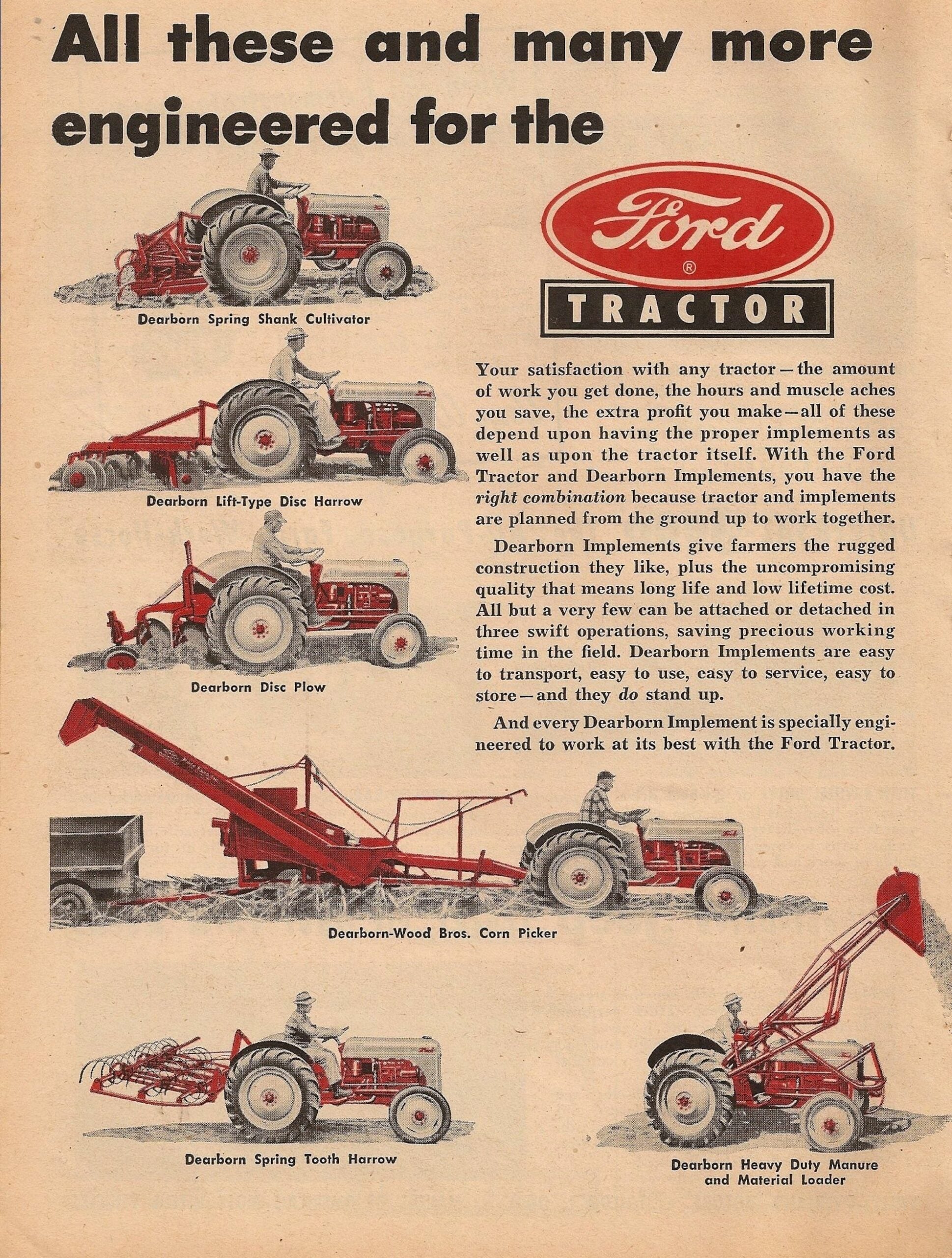
Henry Ford’s goal was to replace manual labor on farms with mechanical power wherever possible. Though it’s not remembered nearly as well, he pursued his goals for agricultural advancement alongside (and often ahead of) his now legendary automotive work. His early experiments with steam power for farm work dated back to the 1880s. Image courtesy of Ford.
Original, documented Funk V8 8Ns are now among the most sought-after variants of the N-series, with well-restored examples occasionally trading into six-figure territory at auction.
The Flathead V8-Powered Ford 8N Tractor
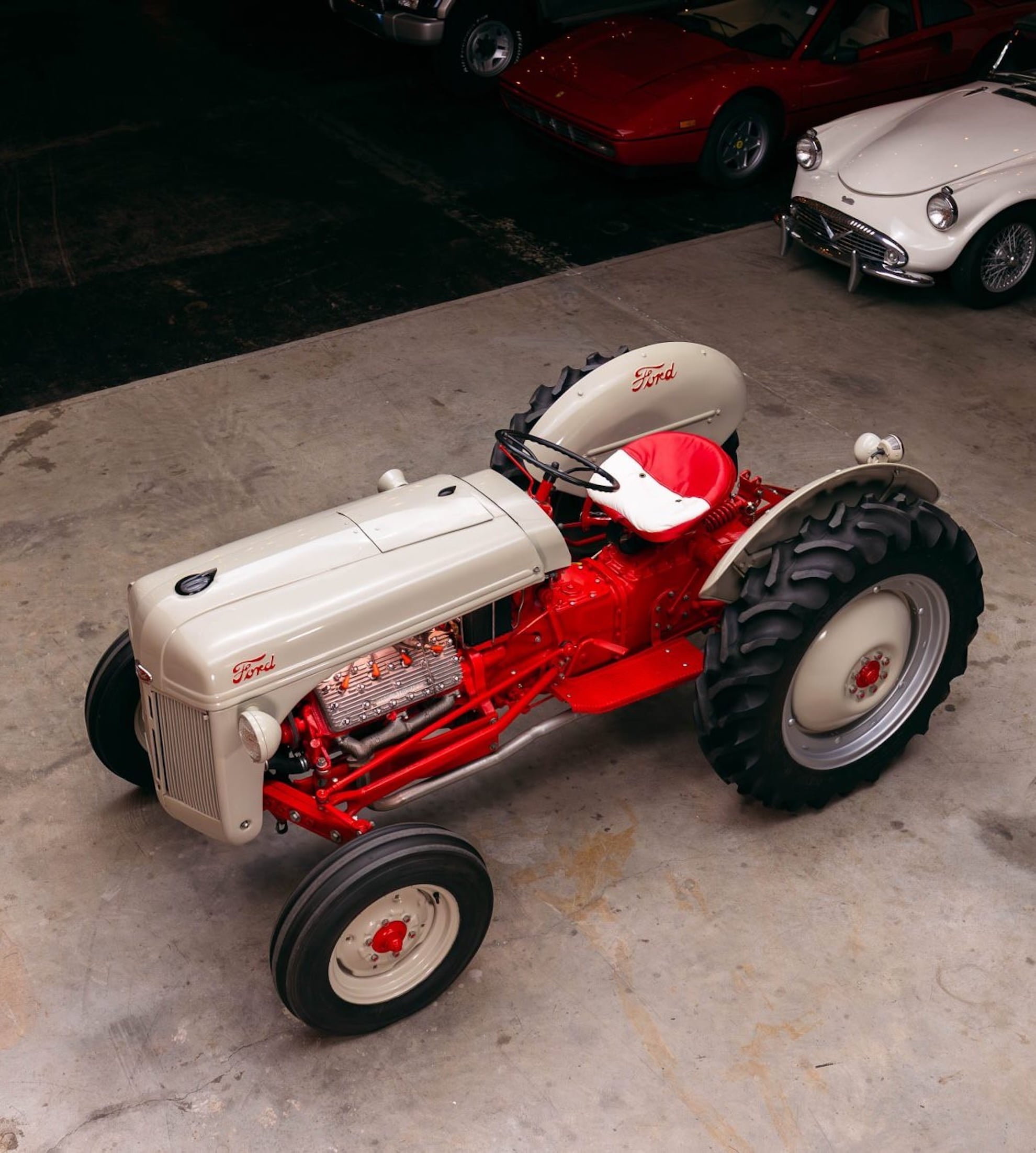
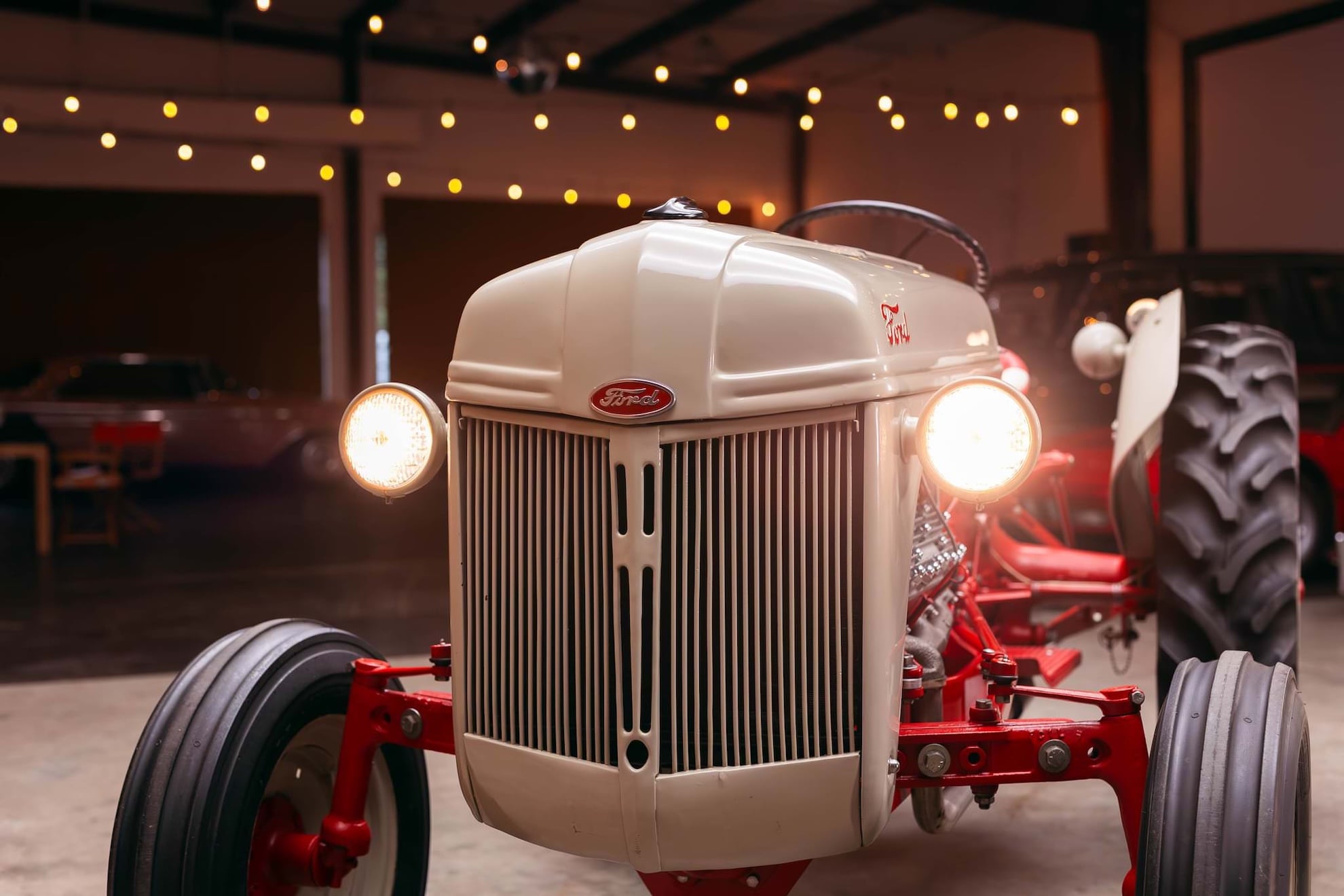
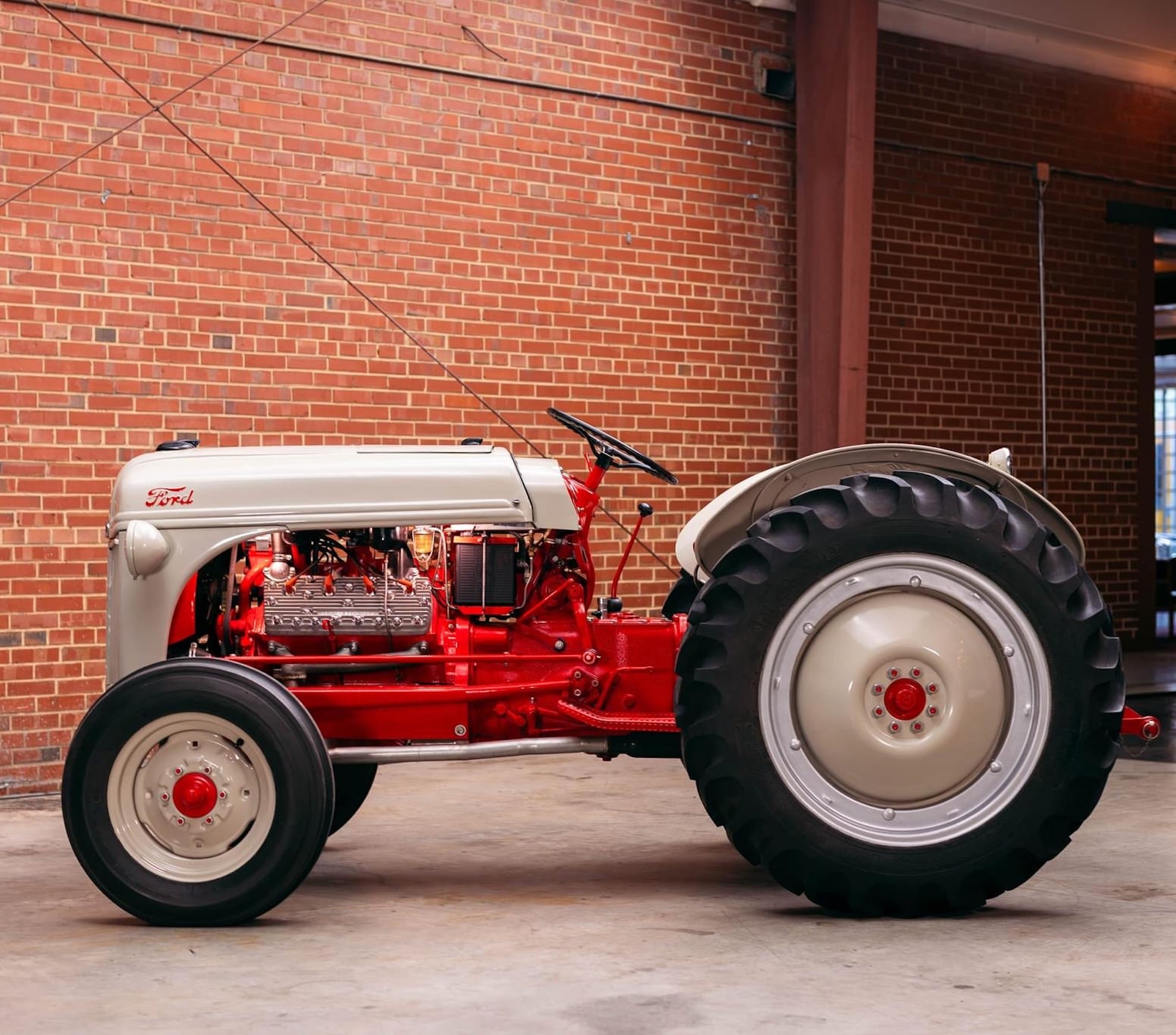
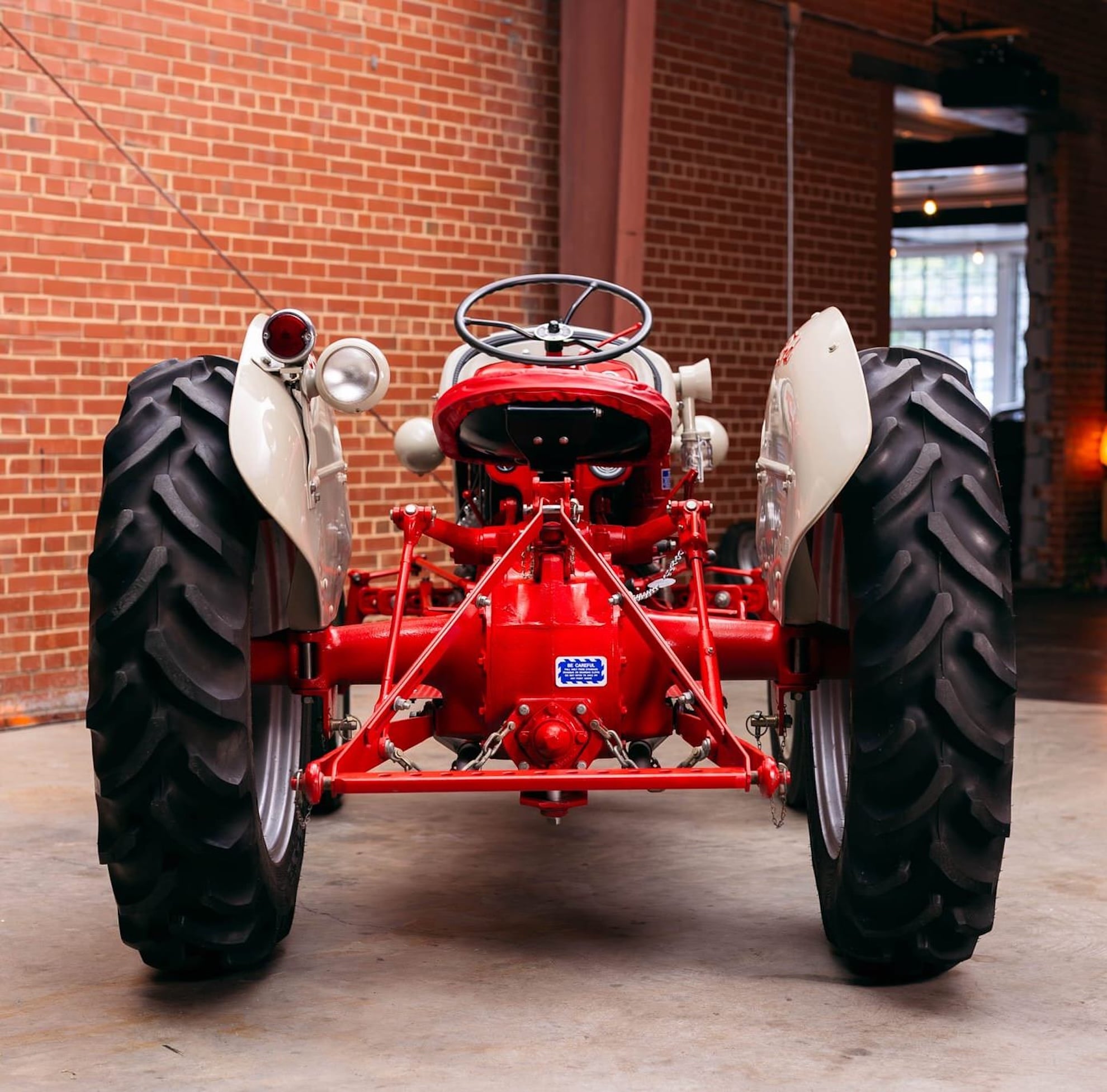
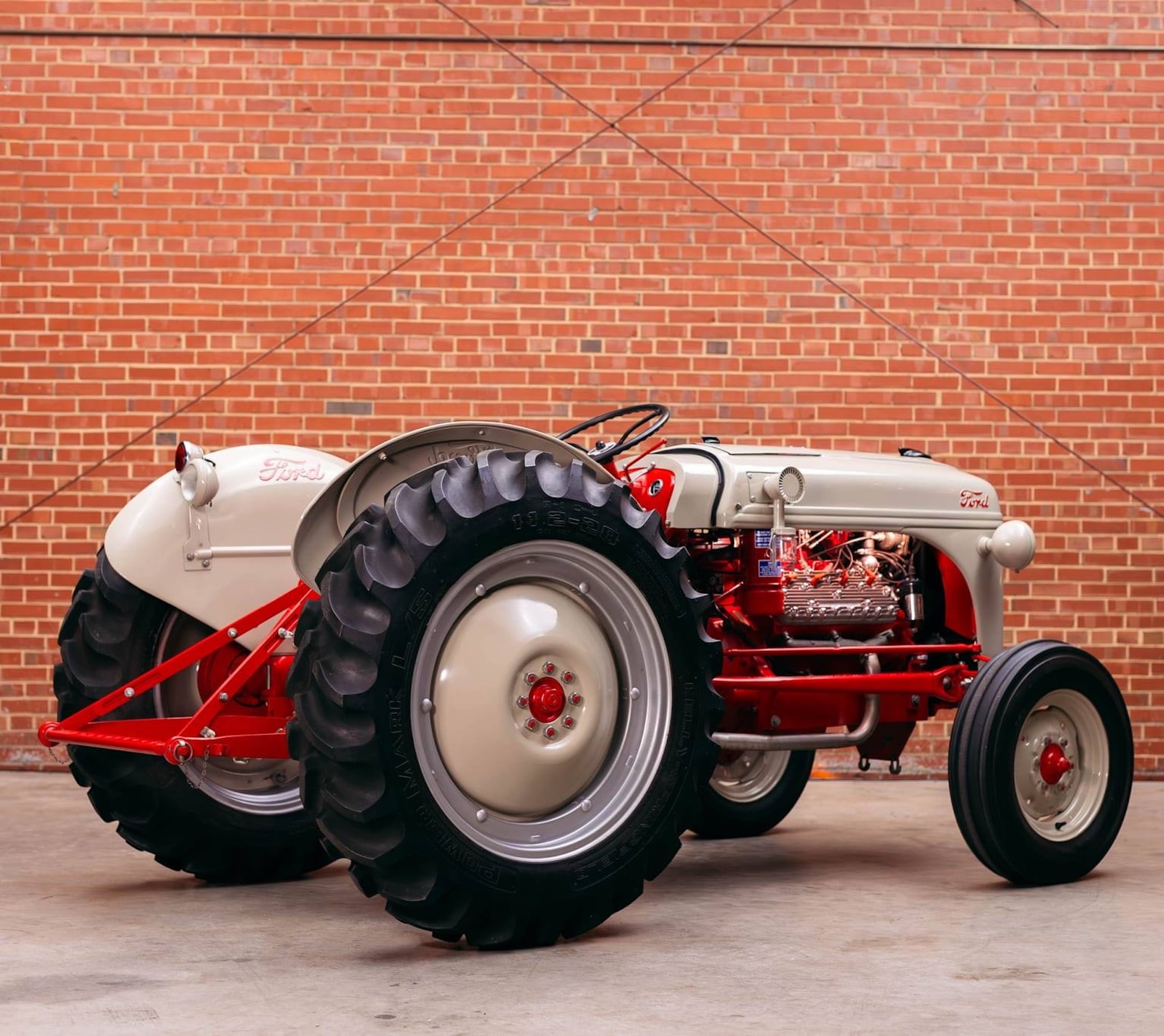
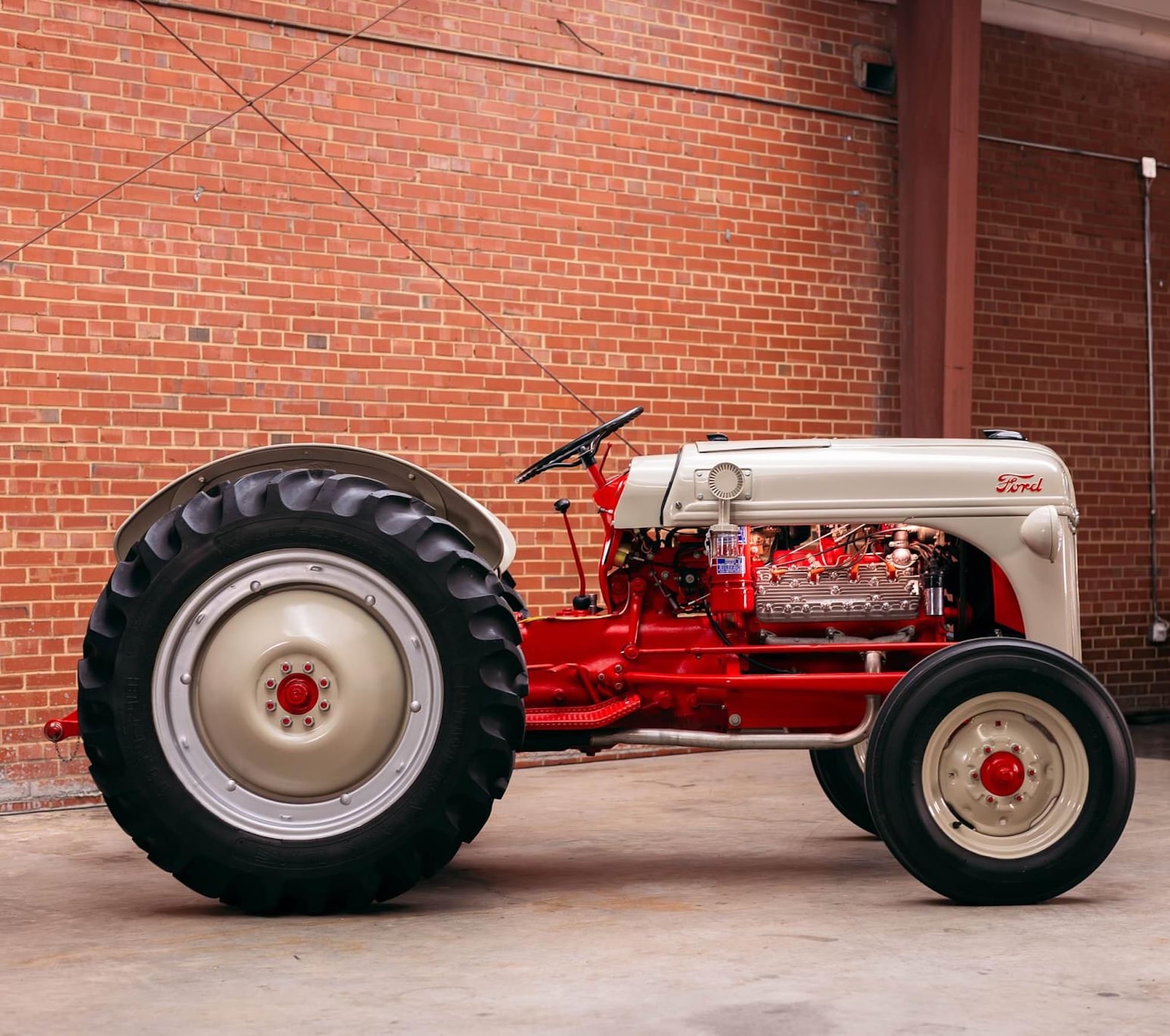
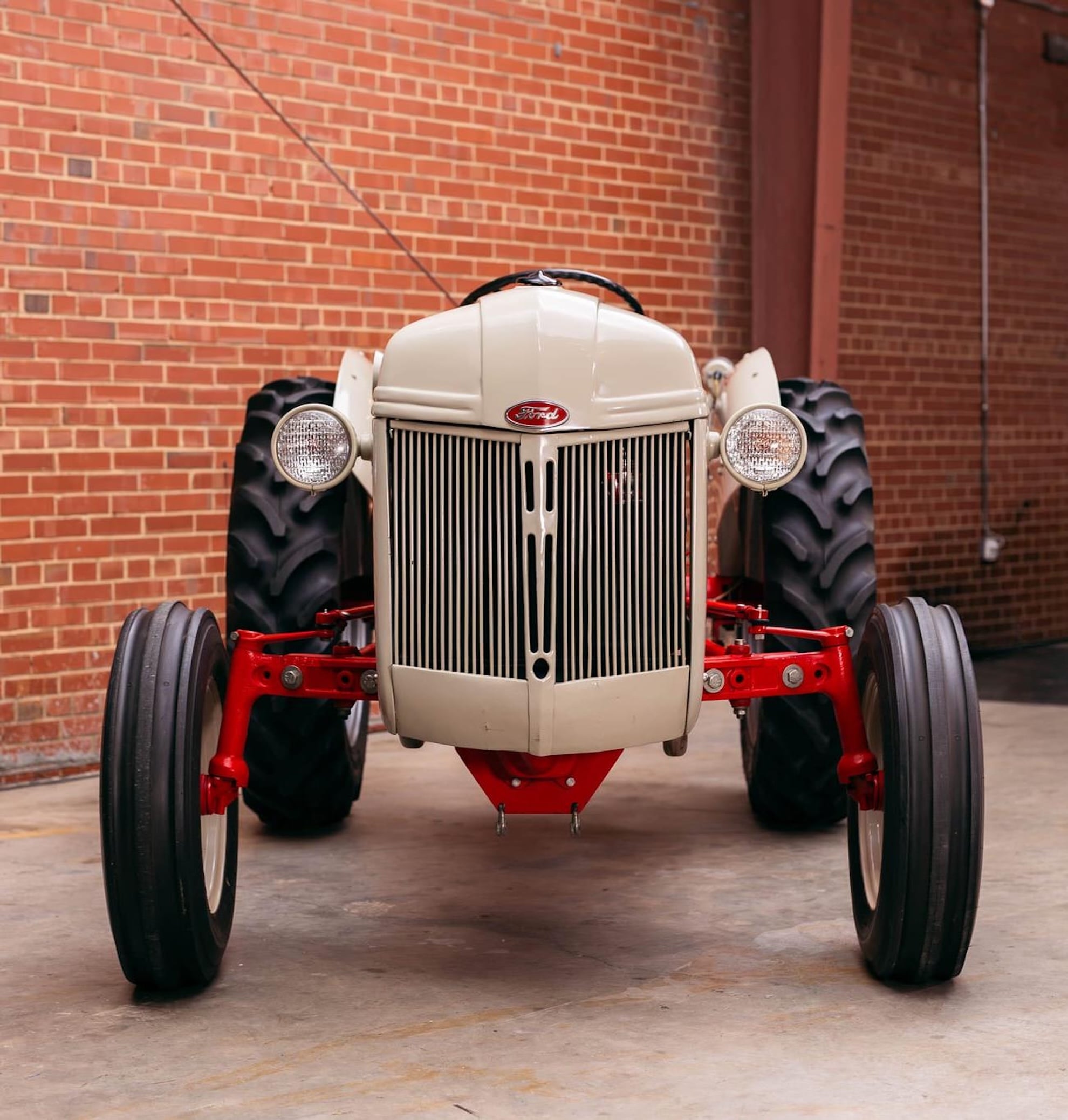
This 1950 Ford 8N is as an early prototype Funk V8 conversion that was restored in the late 1990s and bought by the current owner in the early 1990s.
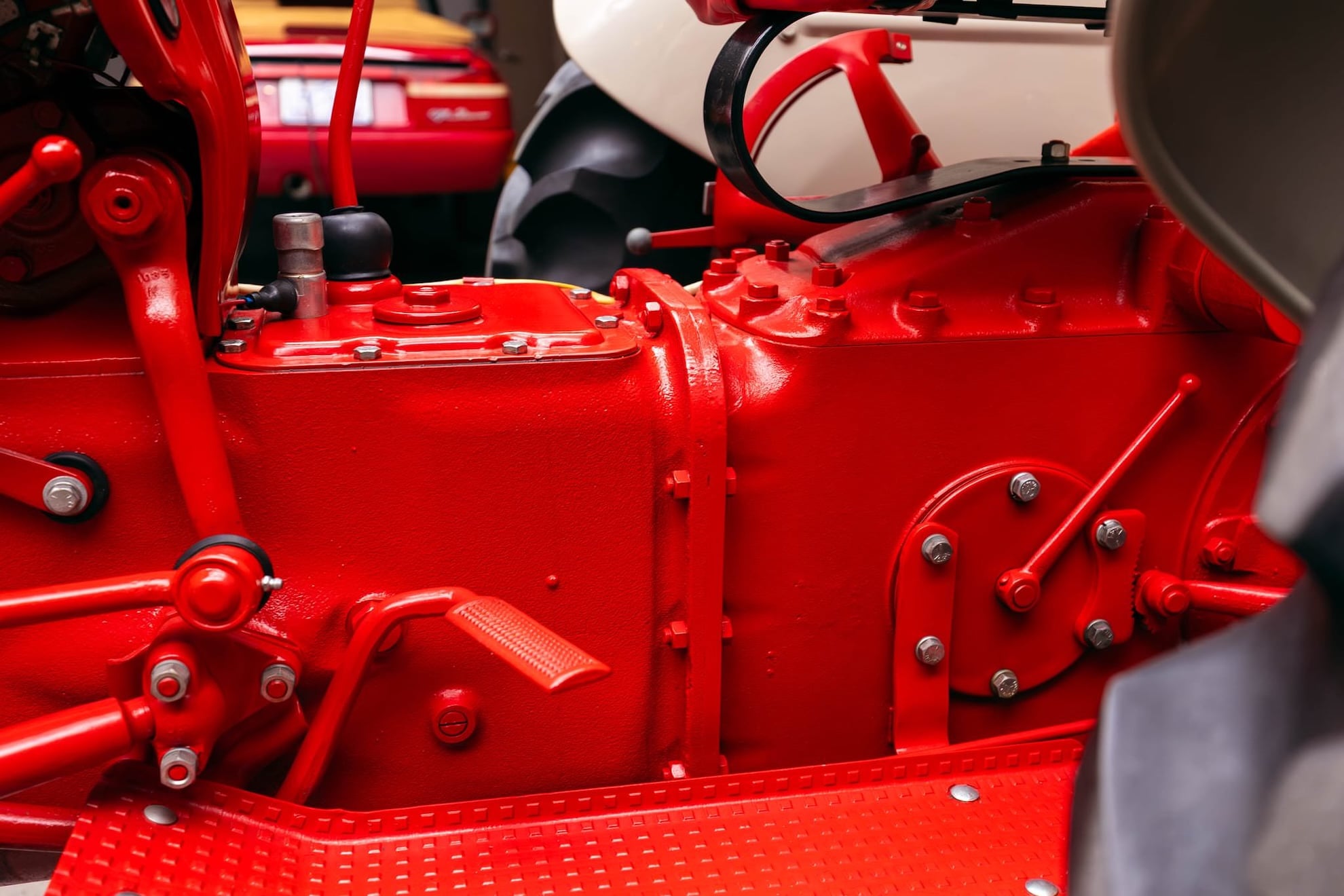
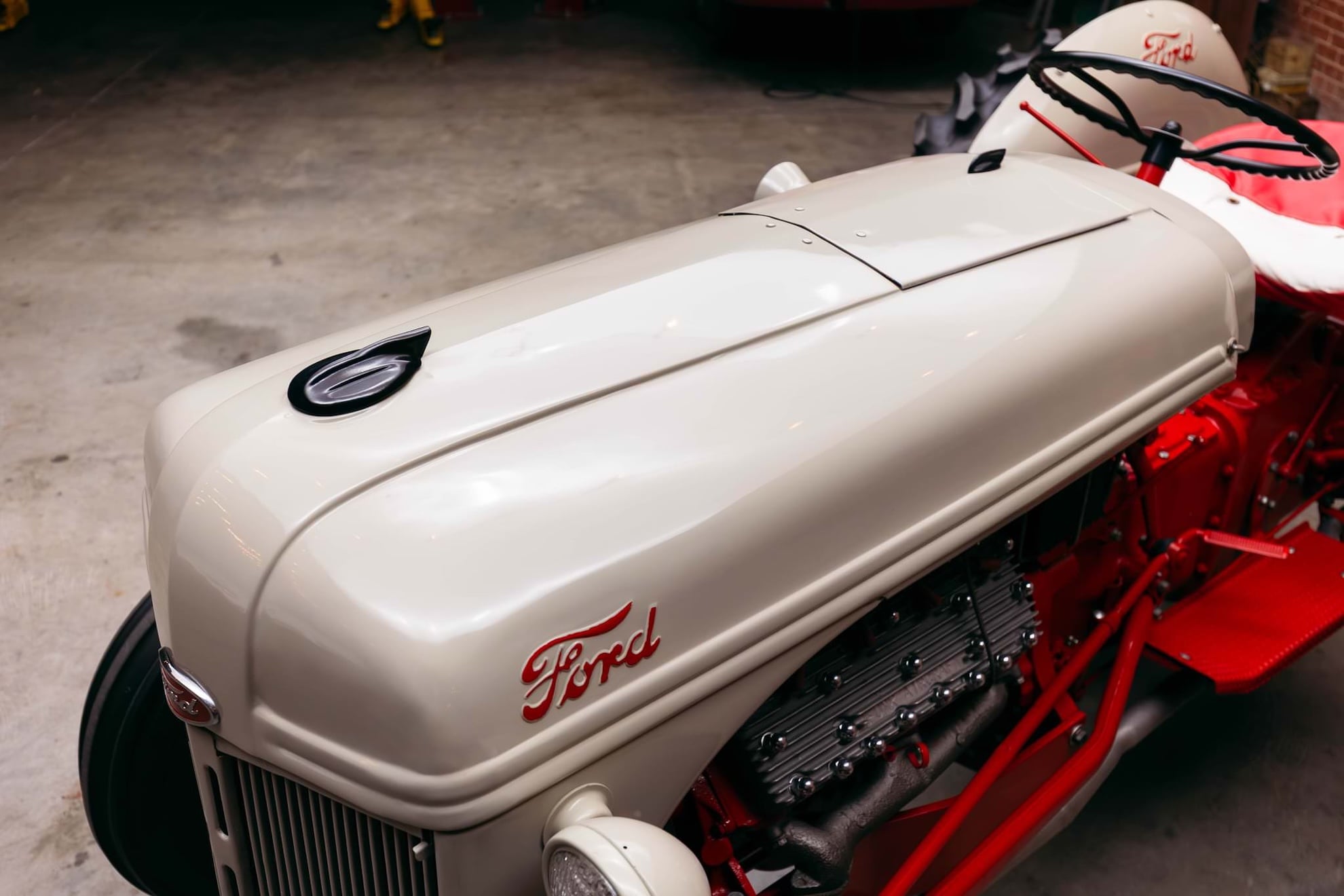
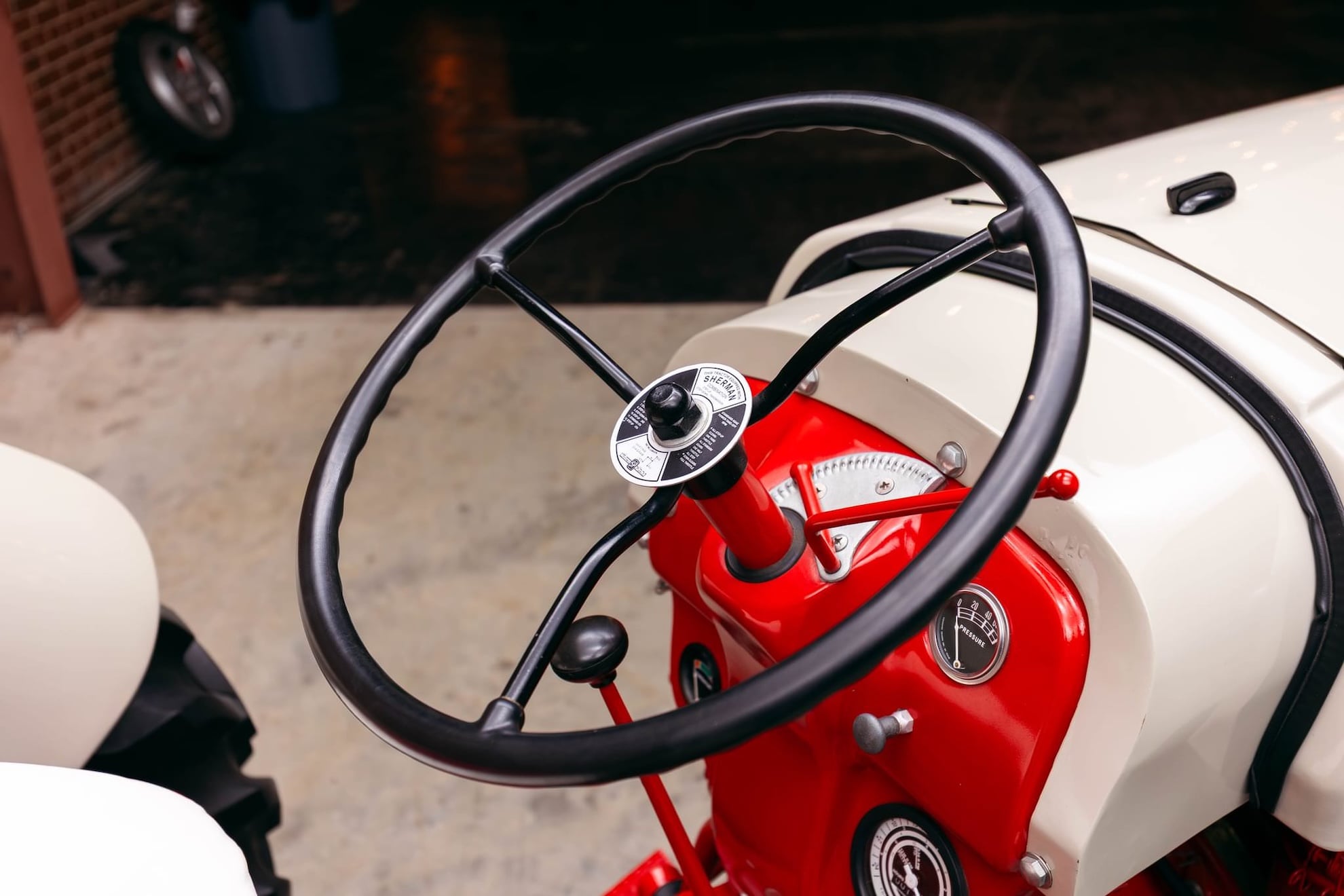
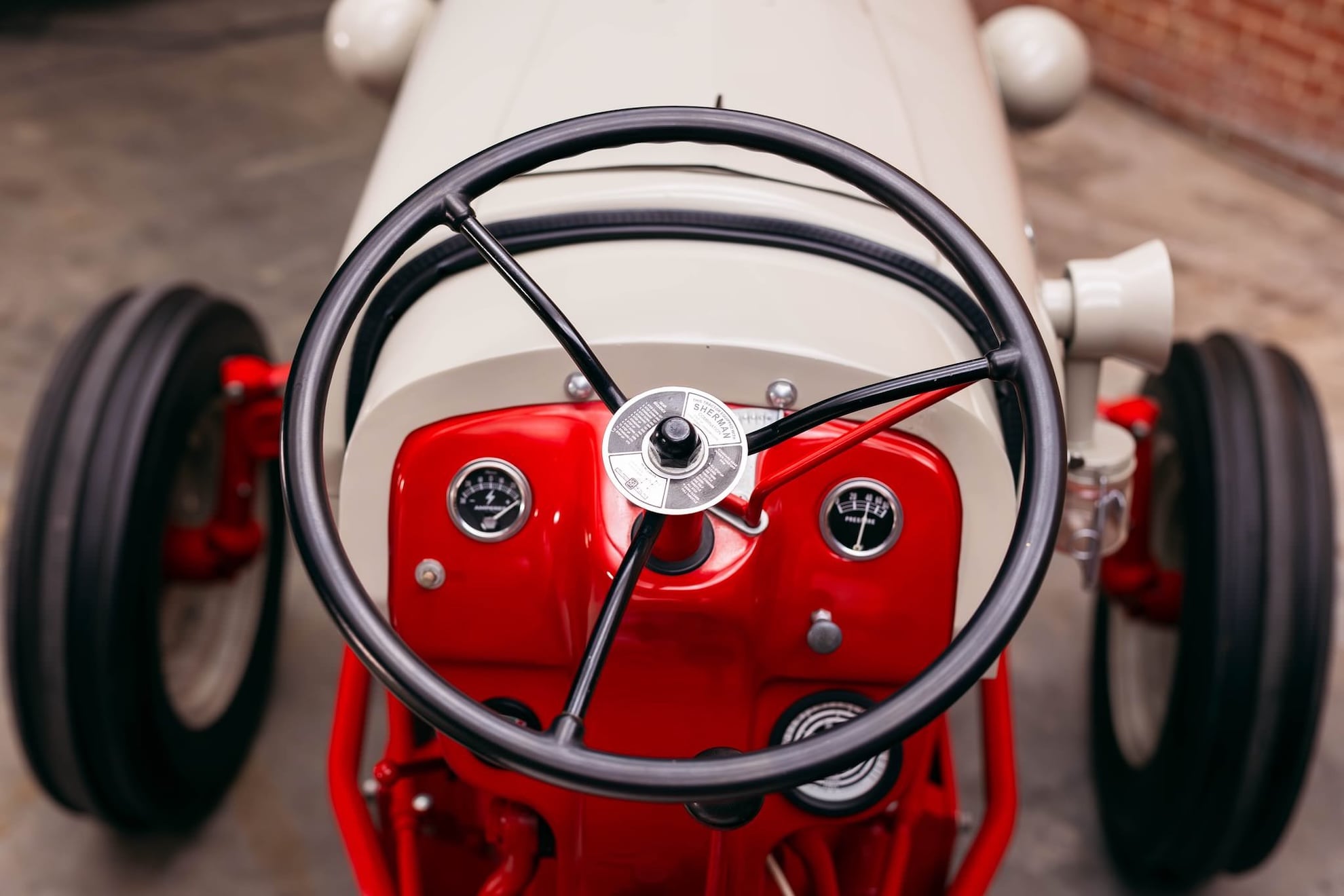
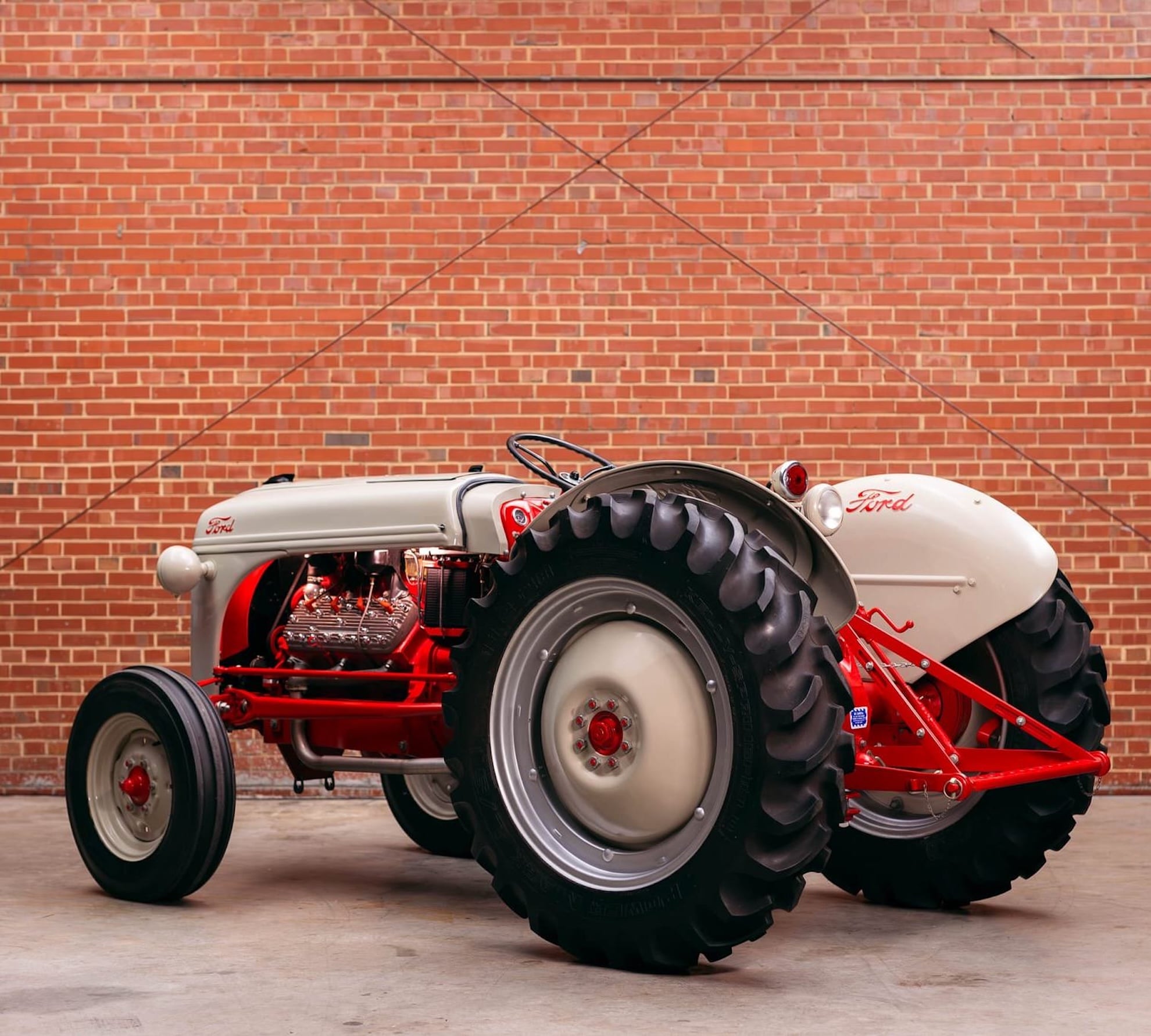
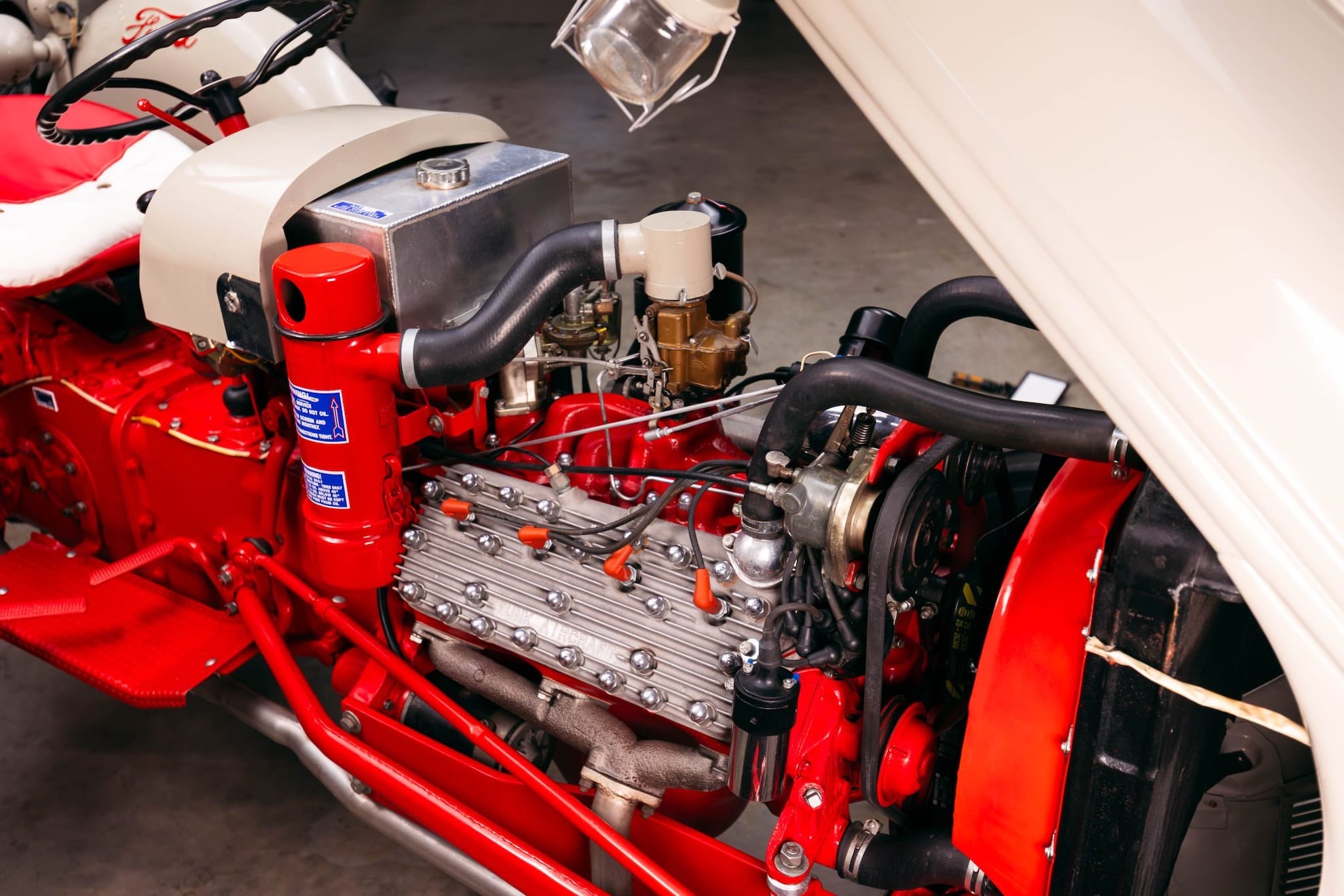
As you would expect, power comes from a 239 cubic inch Ford Flathead V8 topped with finned aluminum Funk Aircraft cylinder heads, driving the rear wheels through a 4-speed manual gearbox and a Sherman 3-speed auxiliary transmission. It has a belt-driven Novi governor, a six-volt electrical system running, and a rear PTO shaft.
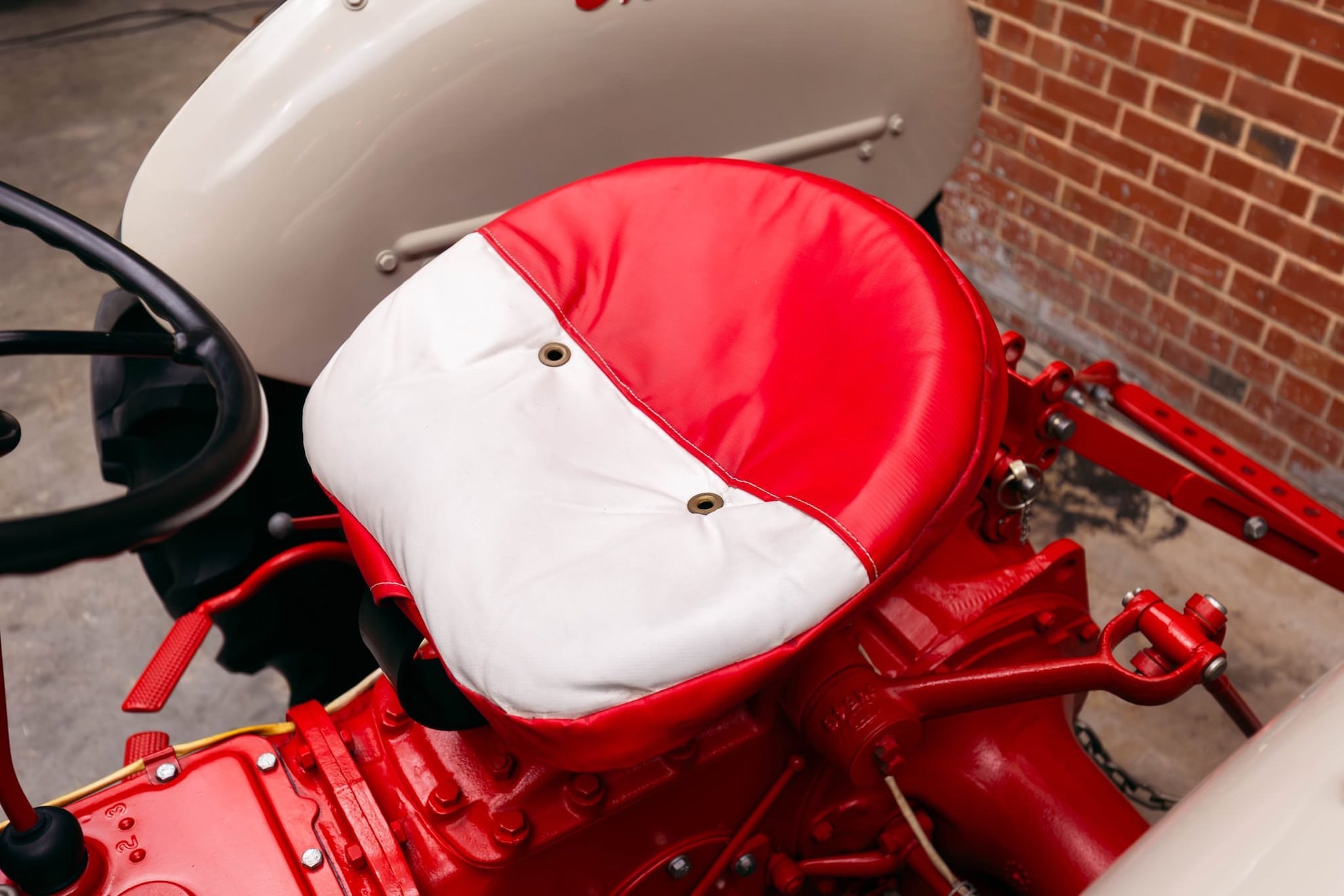
The late-1990s mechanical refurb covered new valves, pistons, bearings, and gaskets, and the selling dealer notes 17 hours of runtime since the work was completed. The driver’s area is fitted with a steel seat mounted on a curved leaf spring and topped with a red and white vinyl cushion. Controls consist of a hand throttle behind the steering wheel, a clutch pedal, and twin levers operating the independent rear brakes.
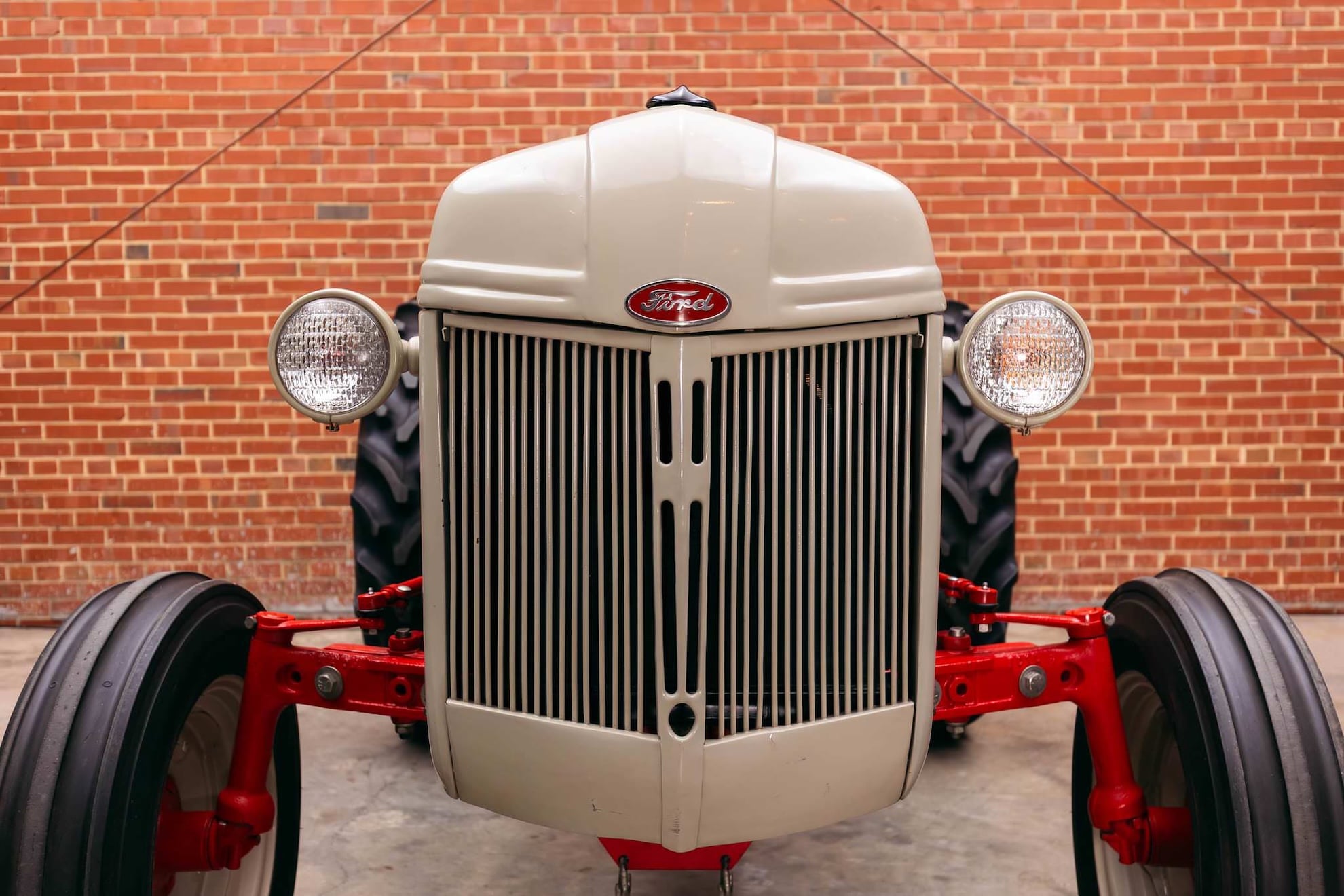
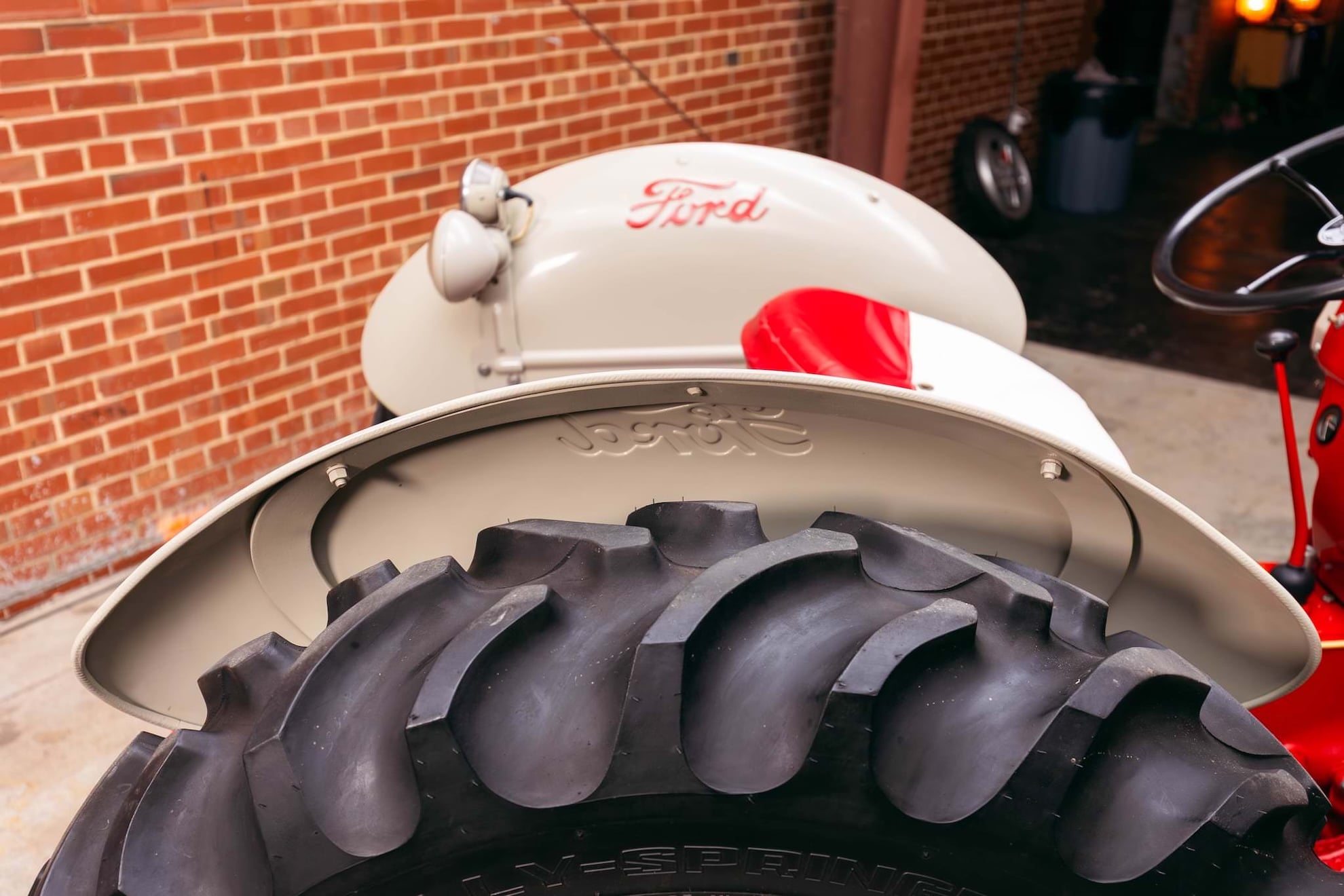
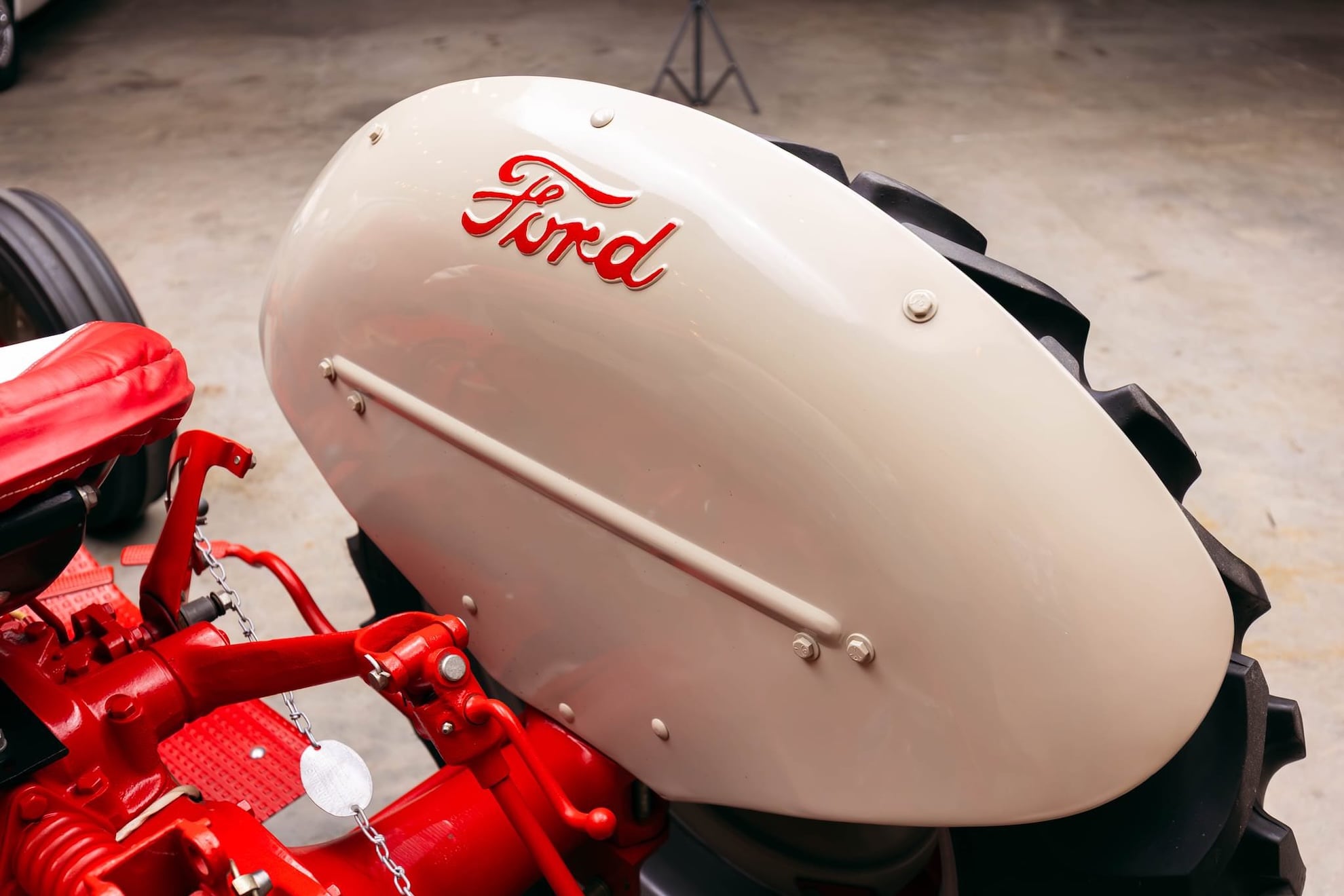
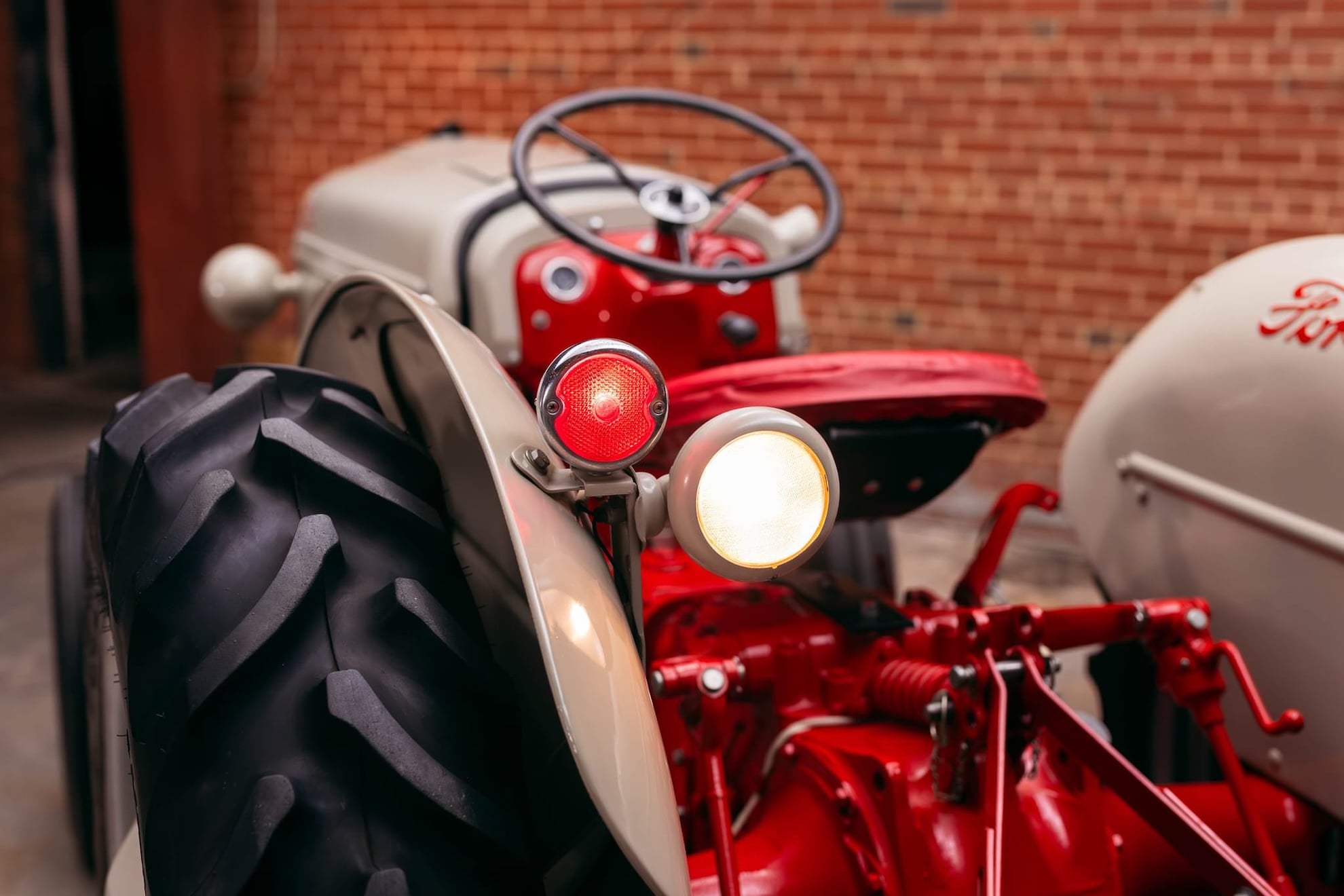
This 8N has white sheet metal over a red chassis, engine block, and drivetrain, with the hood and grille widened by six inches to clear the V8. Additional equipment includes rear half fenders, dual headlights, a rear-facing work light, and dual exhaust outlets.
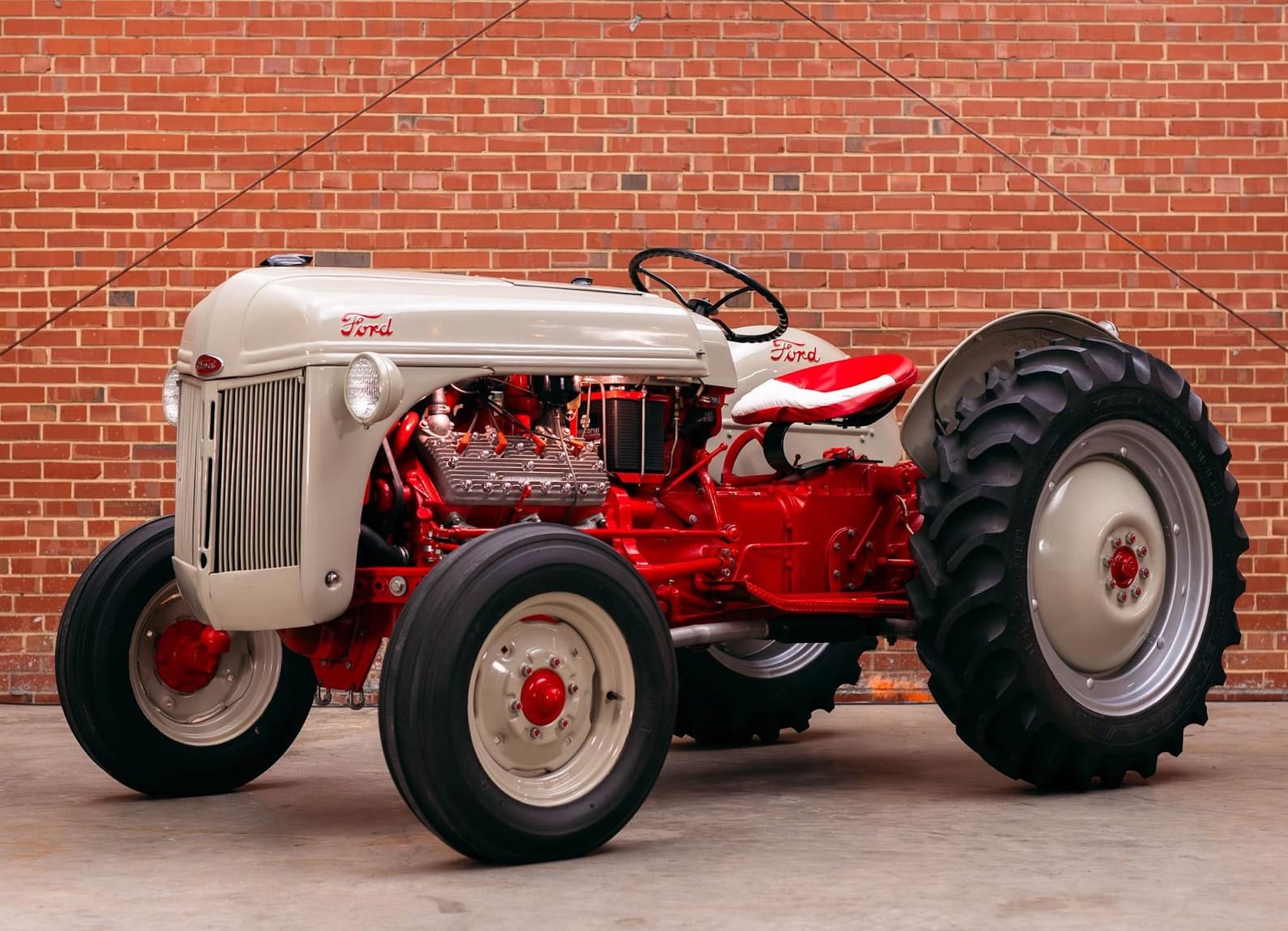
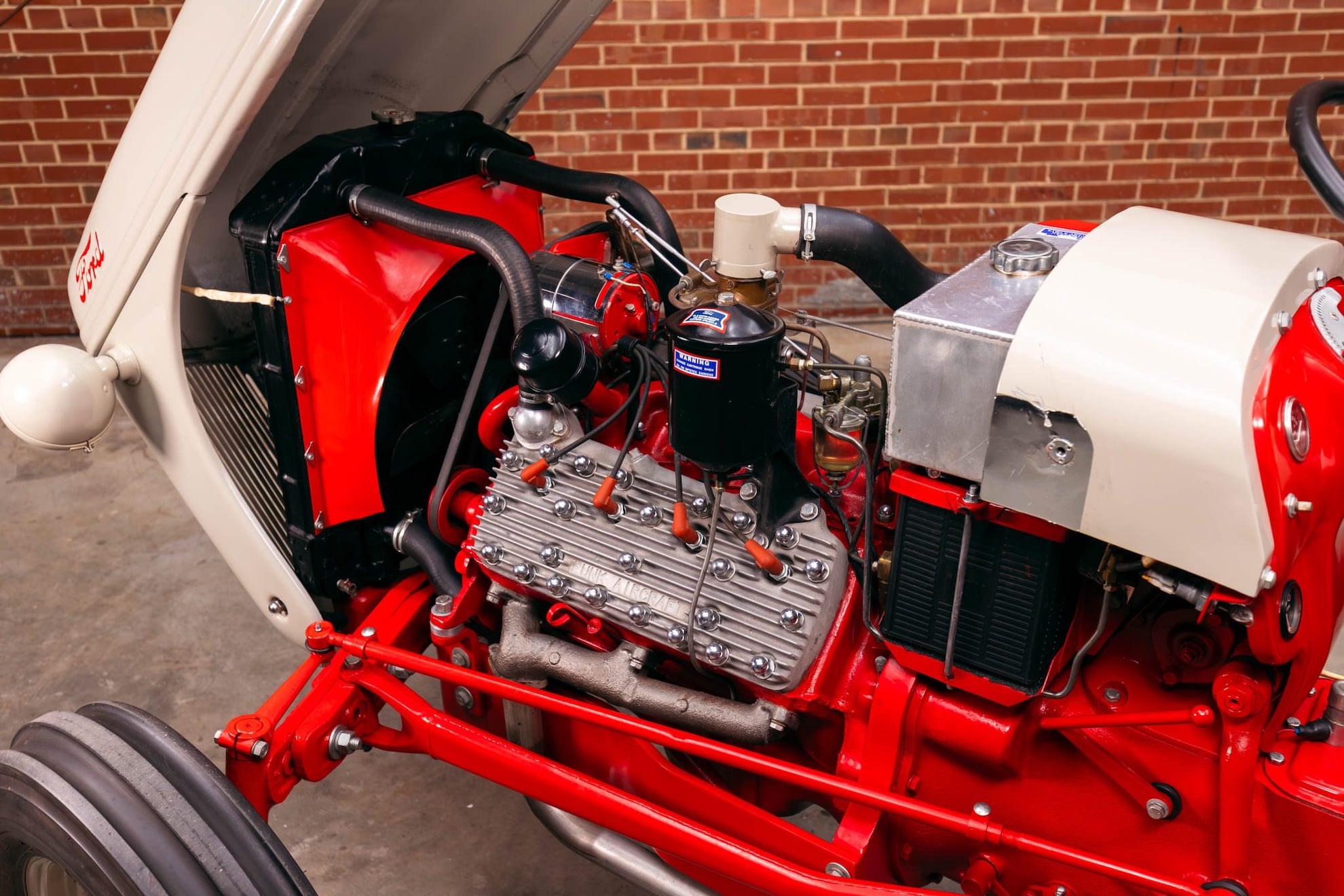
This 1950 Ford 8N is as an early prototype Funk V8 conversion that was restored in the late 1990s and bought by the current owner in the early 1990s.
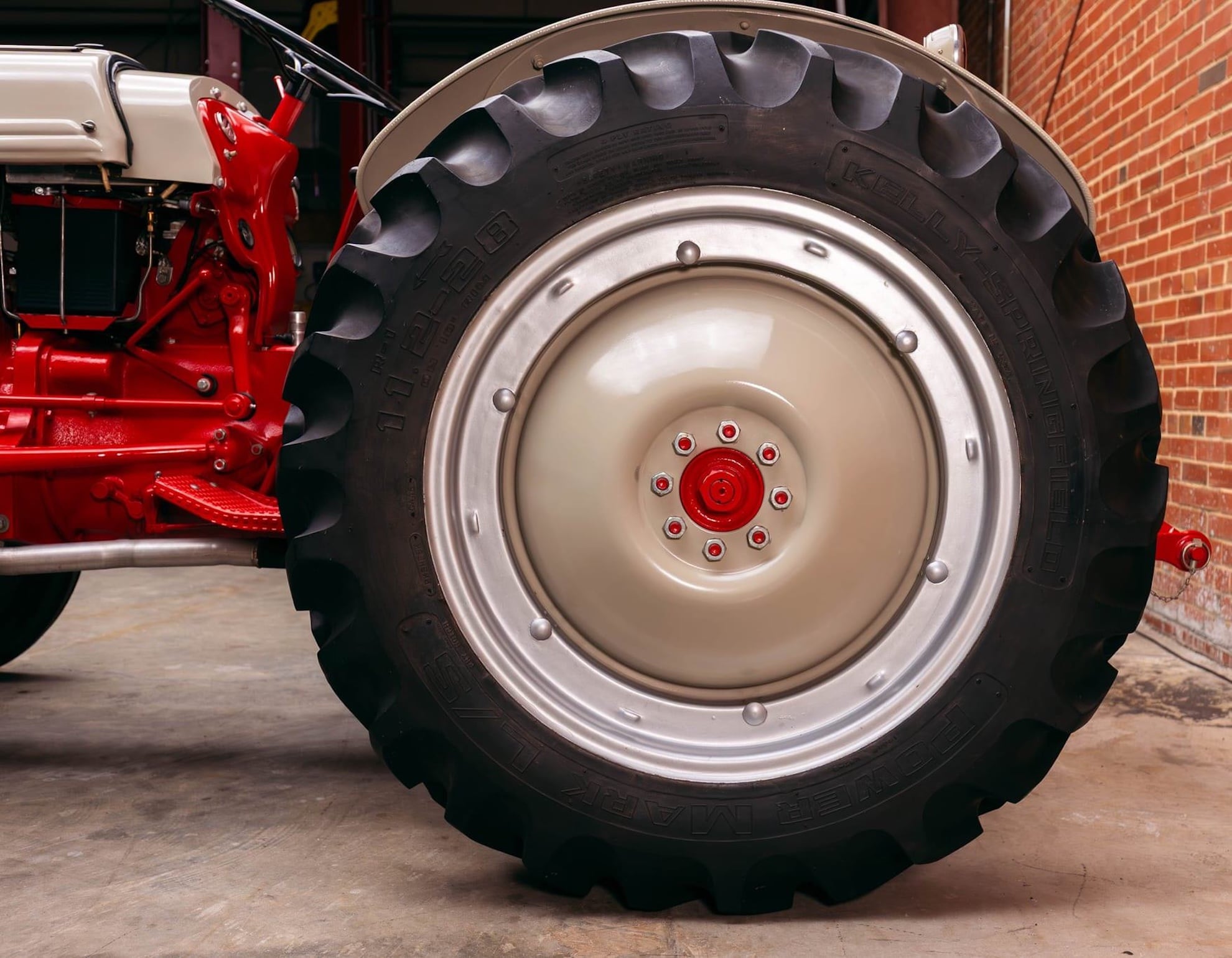
The tractor rides on 16 inch front and 28 inch rear steel wheels fitted with Titan Super Hi-Rib 6.00-16 front tires and Kelly-Springfield Power Mark L/S 11.2-28 rears, with independent rear drum brakes handling stopping duties.
It’s now being offered for sale out of North Carolina with historical documentation and a bill of sale. If you’d like to read more about it or register to bid you can visit the listing here.
Images courtesy of Bring a Trailer + Ford

Articles that Ben Branch has written have been covered on CNN, Popular Mechanics, Smithsonian Magazine, Road & Track Magazine, the official Pinterest blog, the official eBay Motors blog, BuzzFeed, Autoweek Magazine, Wired Magazine, Autoblog, Gear Patrol, Jalopnik, The Verge, and many more.
Silodrome was founded by Ben back in 2010, in the years since the site has grown to become a world leader in the alternative and vintage motoring sector, with well over a million monthly readers from around the world and many hundreds of thousands of followers on social media.