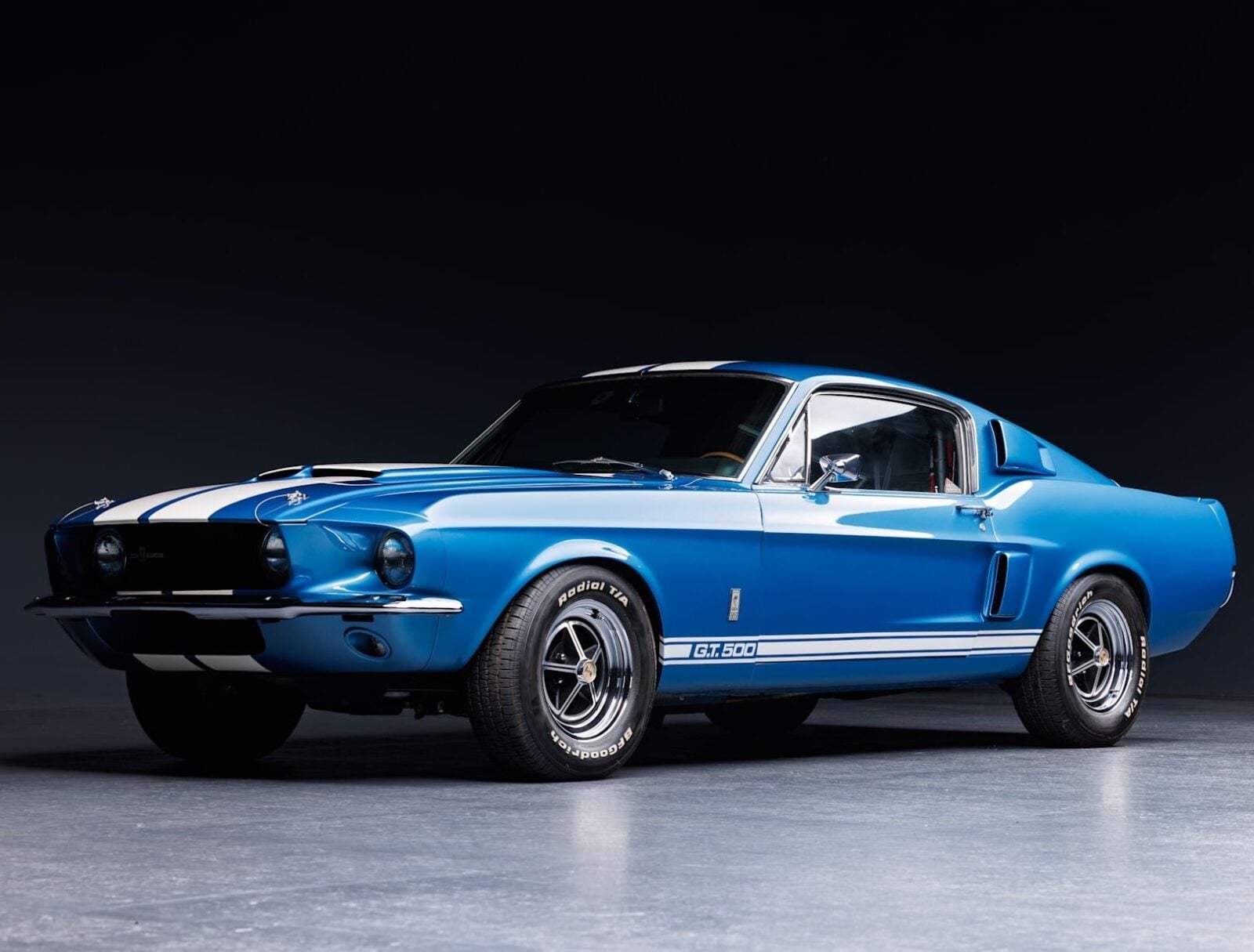
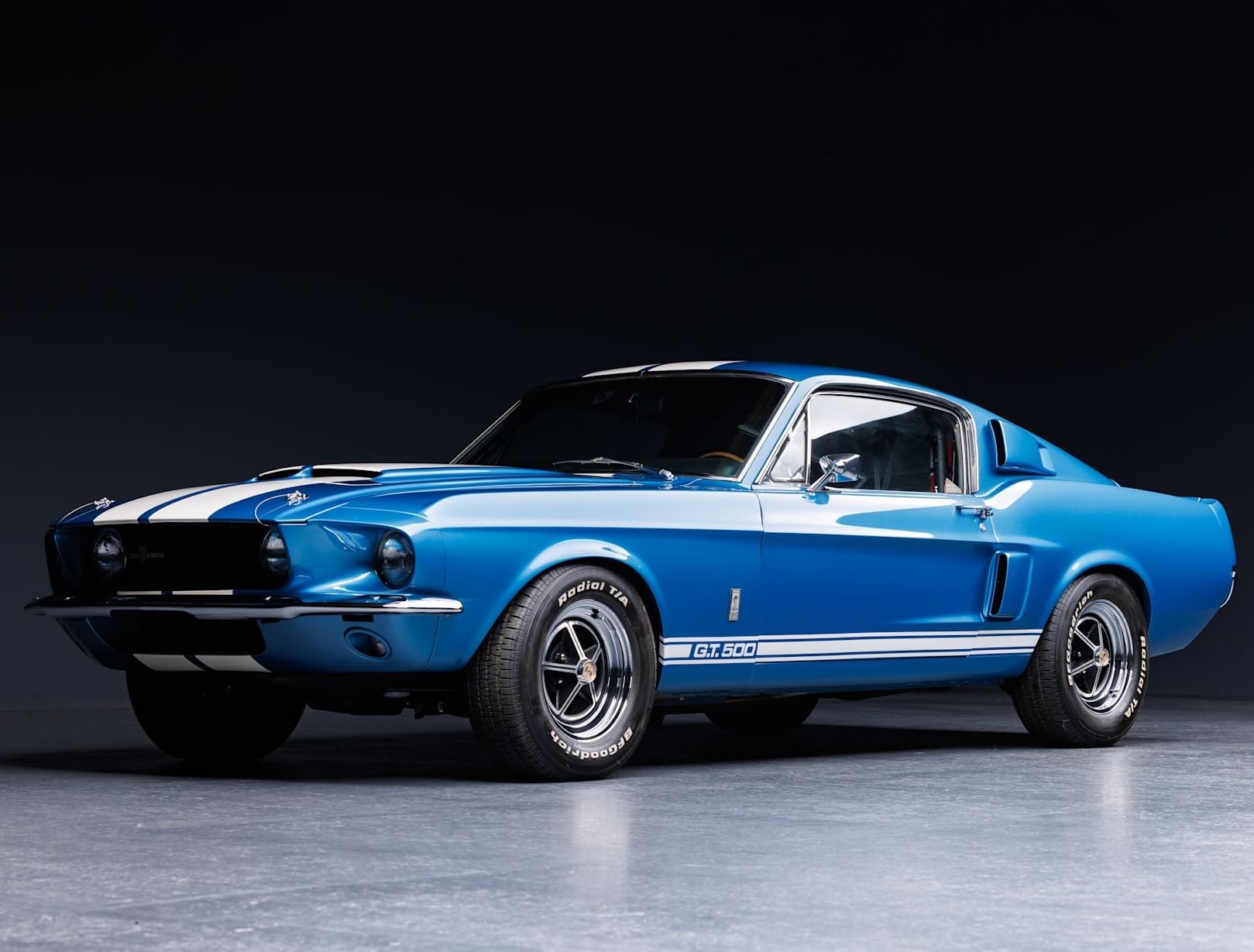
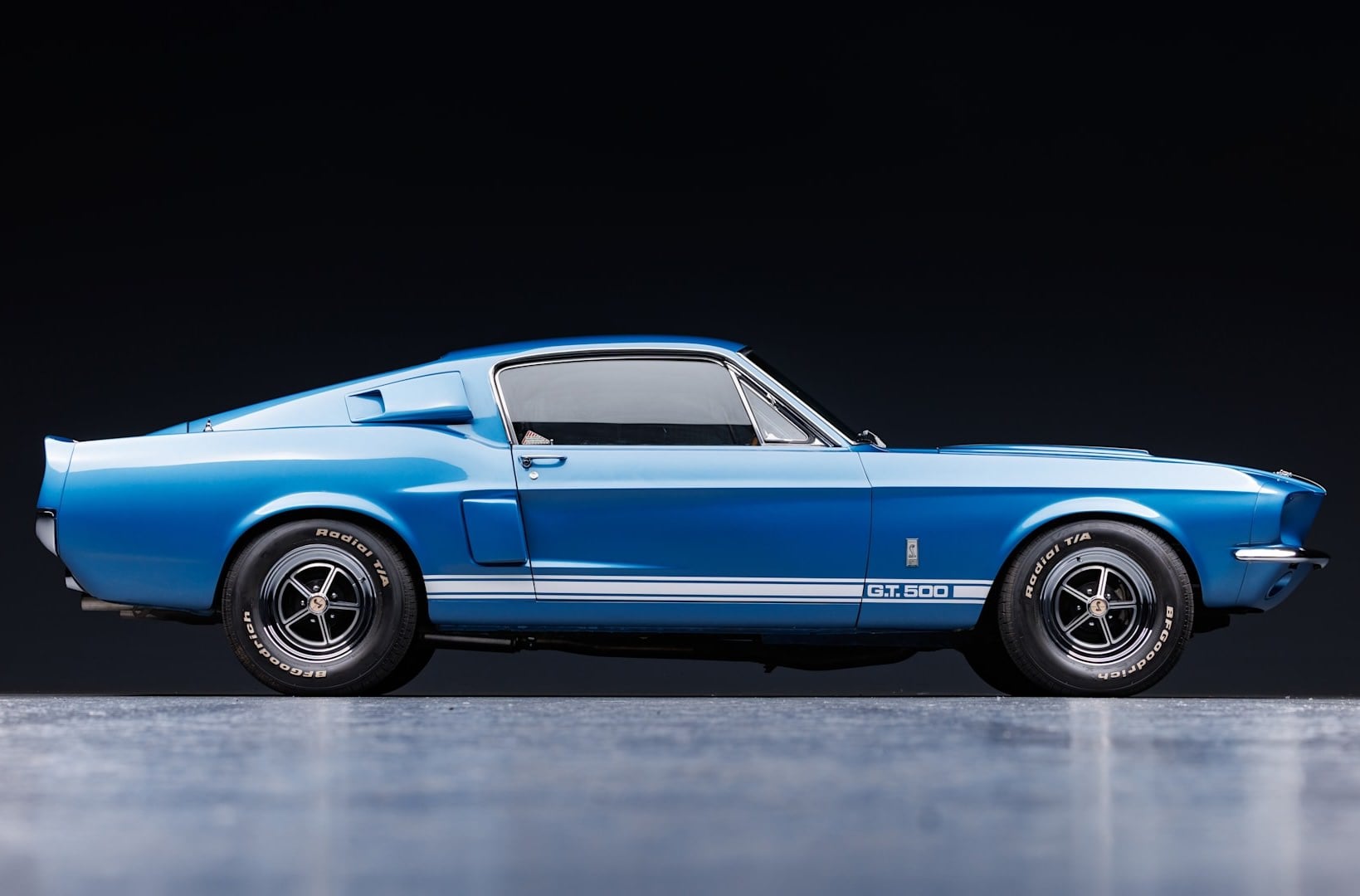
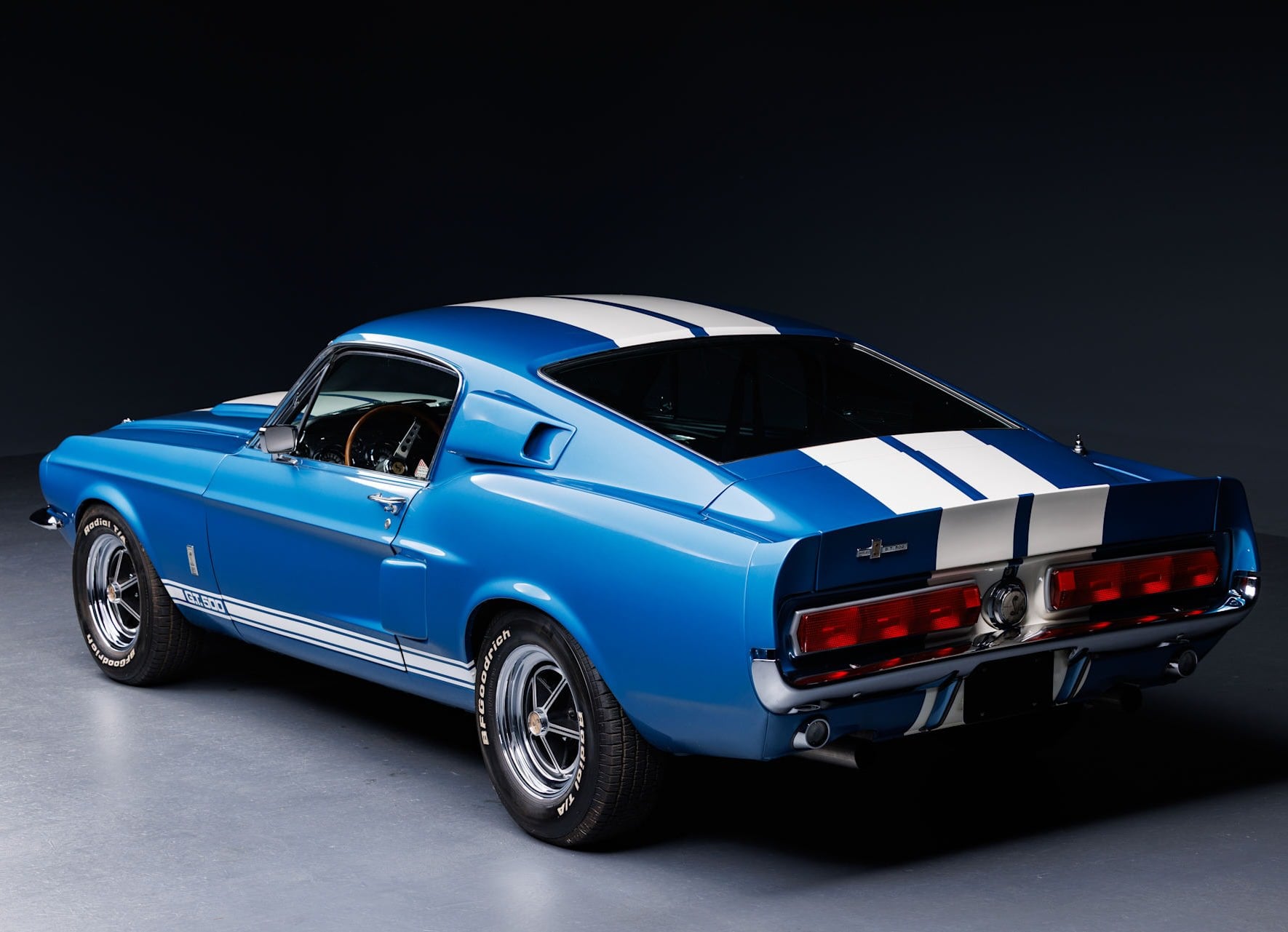
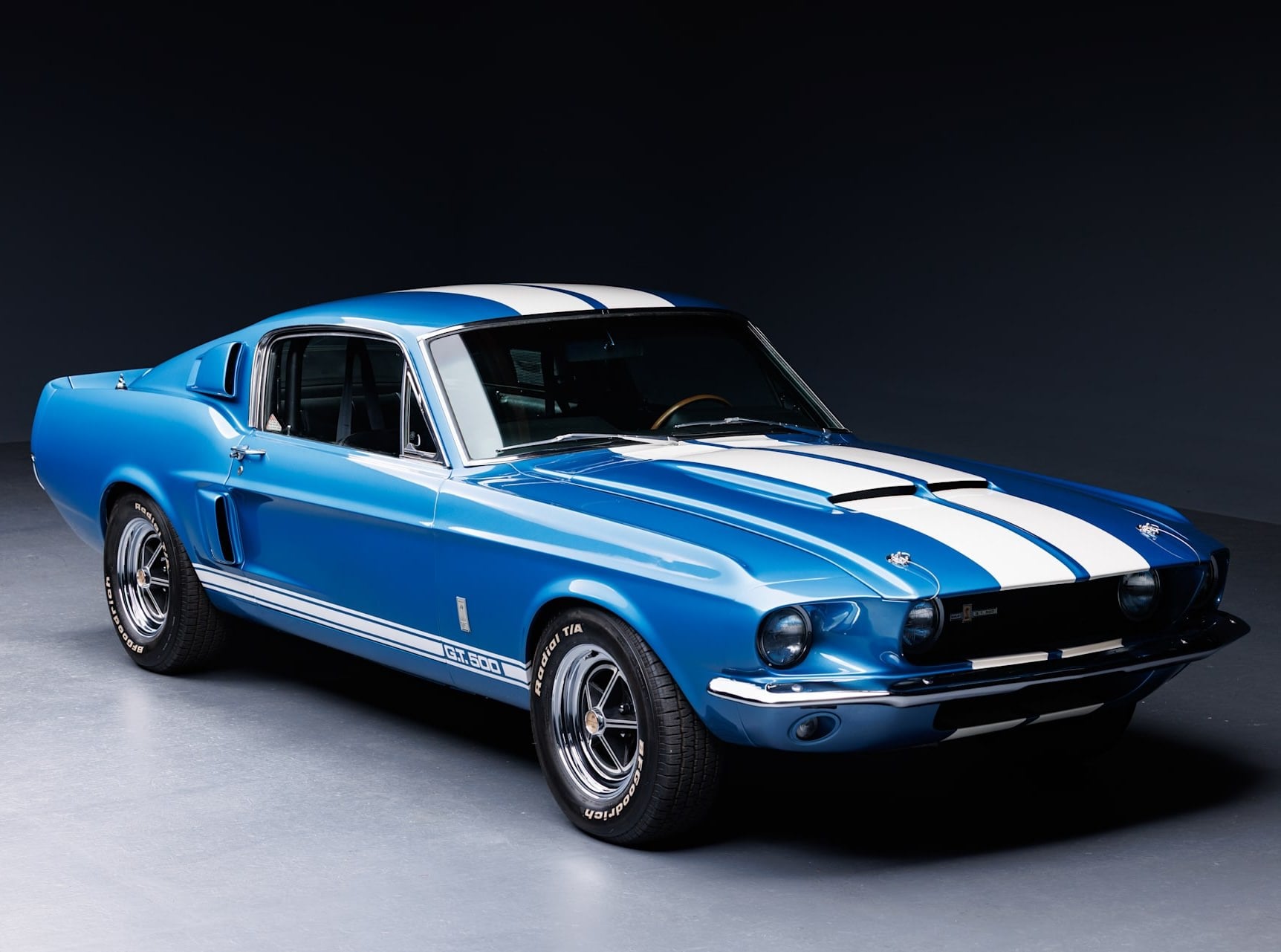
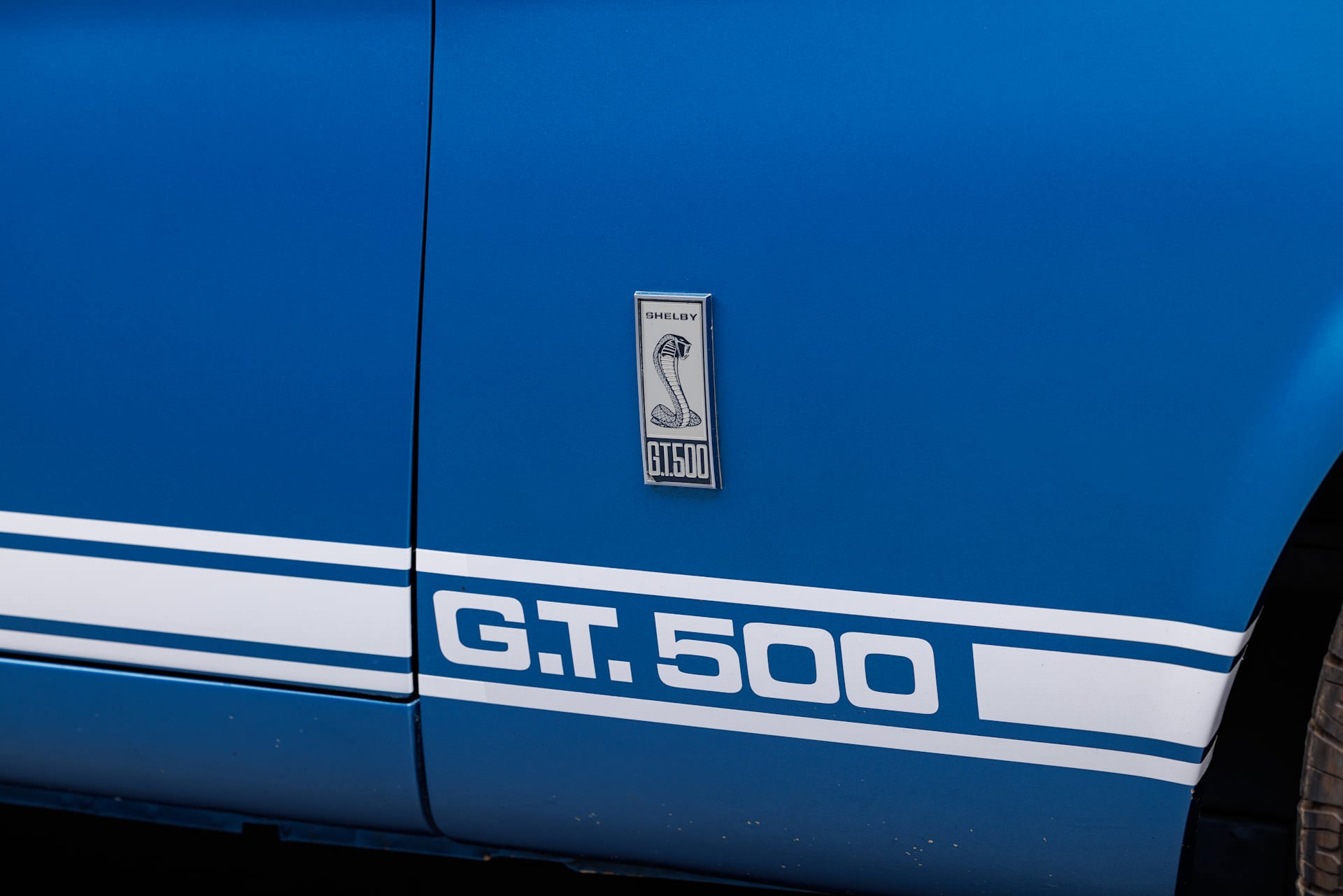
This is a 1967 Shelby GT500, it’s powered by the 428 cubic inch Police Interceptor V8, mated to the highly-desirable 4-speed manual transmission.
In a straight line, the ’67 GT500 was one of the fastest production cars in the United States in its time, with an engine that many believed was actually making over 400 bhp – far more than the official rating of 355 bhp given by Ford.
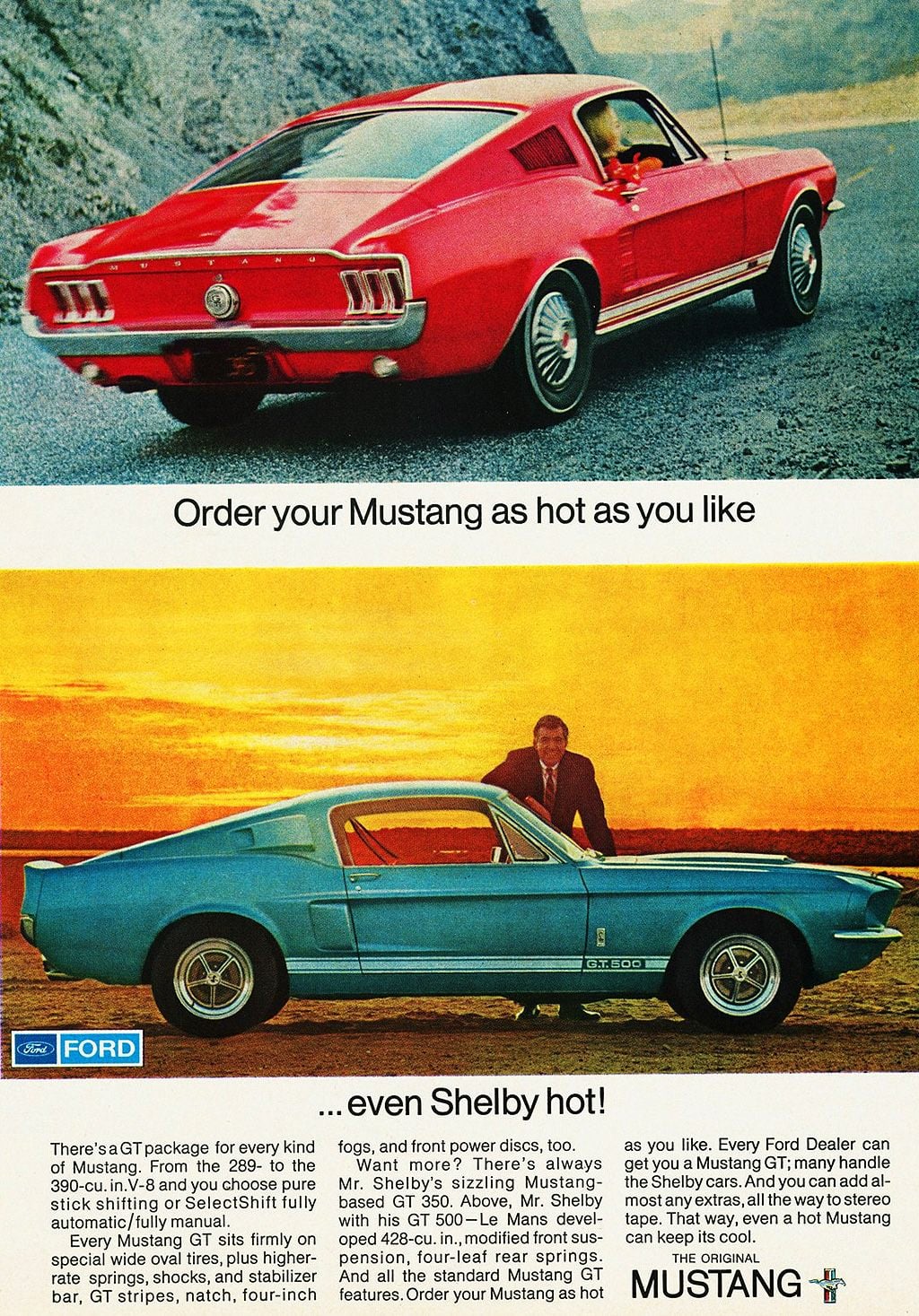
 In a straight line, the ’67 GT500 was one of the fastest production cars in the United States in its time, with an engine that many believed was actually making over 400 bhp – far more than the official rating of 355 bhp given to it by Ford. Image courtesy of Shelby American.
History Speedrun: The Shelby GT500
The Shelby GT500 landed in dealerships from coast to coast ready for the 1967 model year as the new big block V8 companion to the GT350. While the GT350 had been built to win circuit races against sports cars, what many buyers actually wanted was something quicker in a straight line for traffic light drag racing bragging rights, and ideally the car would also be a little easier to live with as a daily driver.
The Origins Of The Shelby Mustang Project
Legendary Ford Division general manager Lee Iacocca approached Carroll Shelby in 1964 about building a competition version of the new Mustang. The result was the 1965 GT350, it was a fastback with the K-code 289 V8 reworked with an aluminum high-rise intake, a large Holley four-barrel, and Tri-Y headers for 306 bhp at 6,000 rpm and 329 lb ft at 4,200 rpm.
To qualify as a sports car under SCCA rules it had no rear seat, and the model took the B-Production championship three years running. Just 562 were built for the model year, a total that takes in 34 race-spec GT350Rs along with prototypes, drag cars, and street production models.
That GT350 sold on its performance rather than its luxury, and Shelby softened it almost immediately due to customer feedback. The 1966 GT350 regained an optional rear seat, offered an automatic gearbox, and it came in colors other than Wimbledon White. Roughly 1,000 of the 2,378 built went to Hertz as GT350H rental cars – now among the most collectible Shelby Mustangs ever made.
The 1967 Mustang redesign is what made the GT500 a possibility, this was because Ford engineered the new shell to accept the FE-series big block under the hood – thanks to the extra room between the front shock towers. The 390 GT V8 proved a little disappointing, so Shelby went to the 428 Police Interceptor instead.
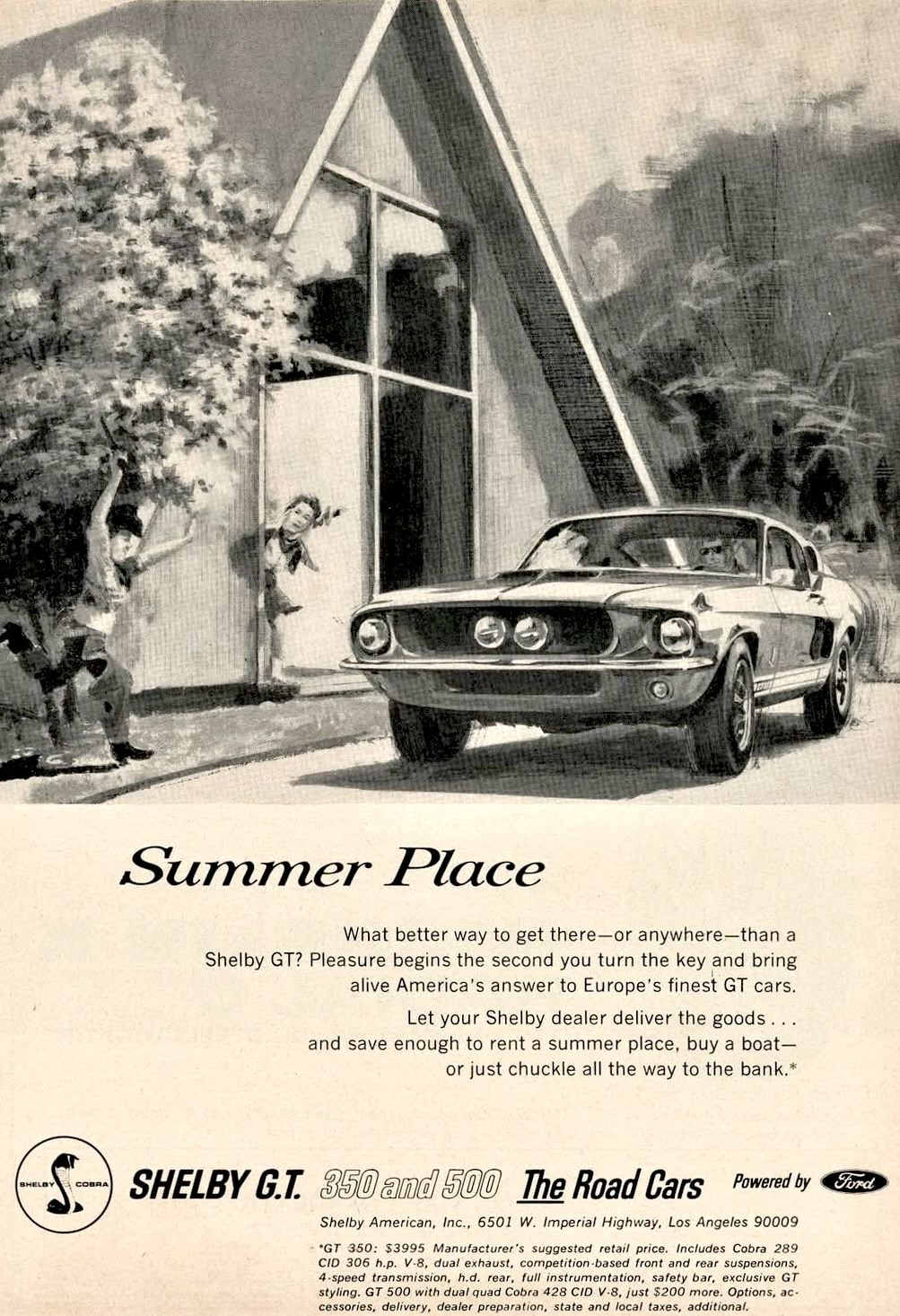
The Shelby GT500 landed in dealerships from coast to coast ready for the 1967 model year as the new big block V8 companion to the GT350. Image courtesy of Shelby American.
A base 1967 Mustang fastback listed at $2,698, a GT350 at $3,995, and a GT500 at $4,195. For two hundred dollars over the small block car, buyers got 139 more cubic inches and a whole lot more power. Though to be fair, the GT350 still went around corners better.
The 1967 Shelby GT500
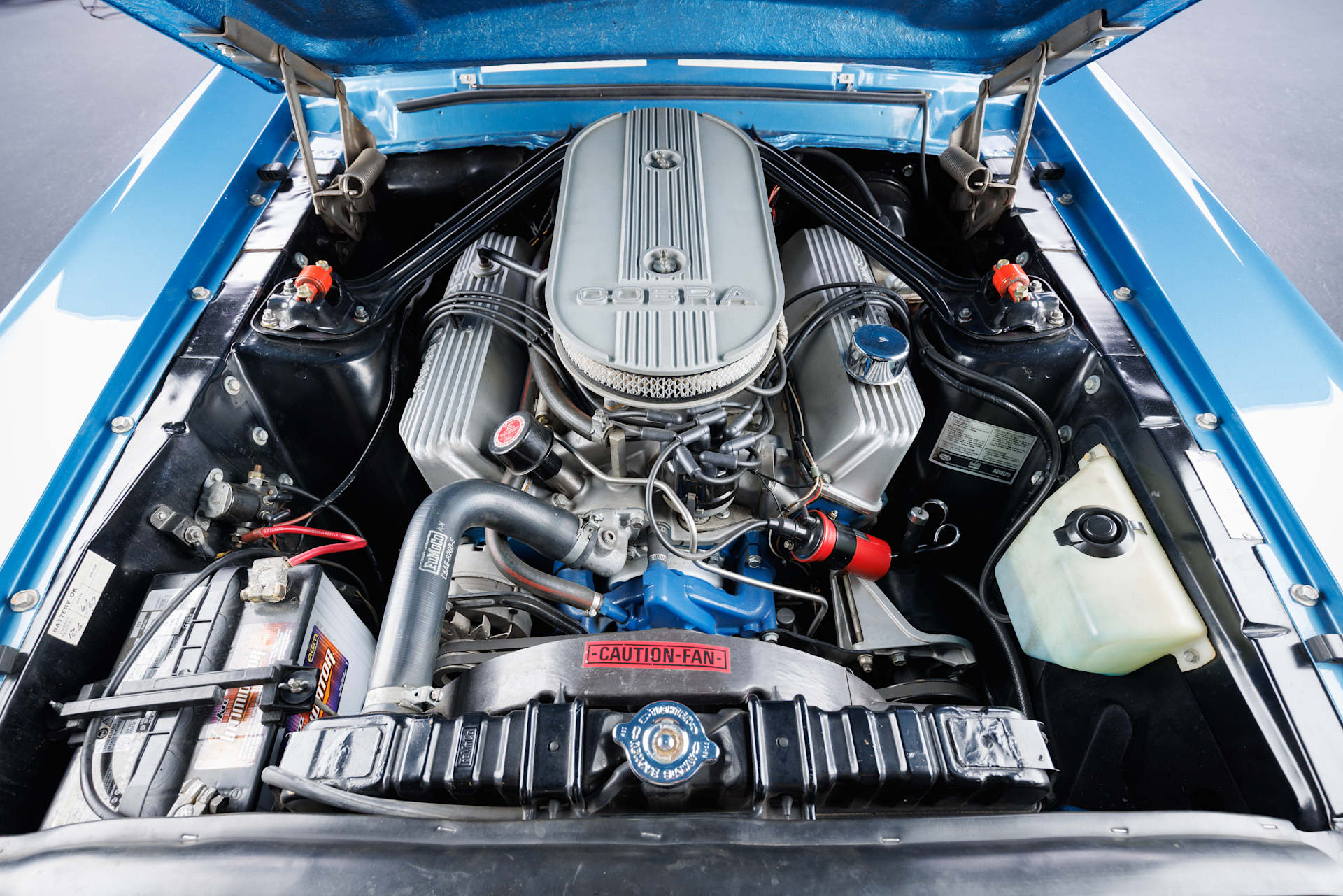
The 428 in the GT500 used hydraulic lifters, an aluminum medium-rise intake, and two 600 cfm Holley four-barrels. Ford rated it at 355 bhp at 5,400 rpm and 420 lb ft at 3,200 rpm, and nobody in the industry took that figure literally – it was widely understood to be understated, with the real power figure being quite a bit higher. Period road tests managed 6.5 seconds to 60 mph and quarter-mile runs near 15 seconds at about 95 mph.
Styling is largely credited to Ford designer Charlie McHose, who began work at Shelby American’s hangar at Los Angeles International Airport in mid-1966, joined later by Joe Farrer and Carl Nasson. The fiberglass front end, hood, side scoops, quarter-panel extensions, ducktail deck lid, and tail panel with Mercury Cougar lamps were all new.
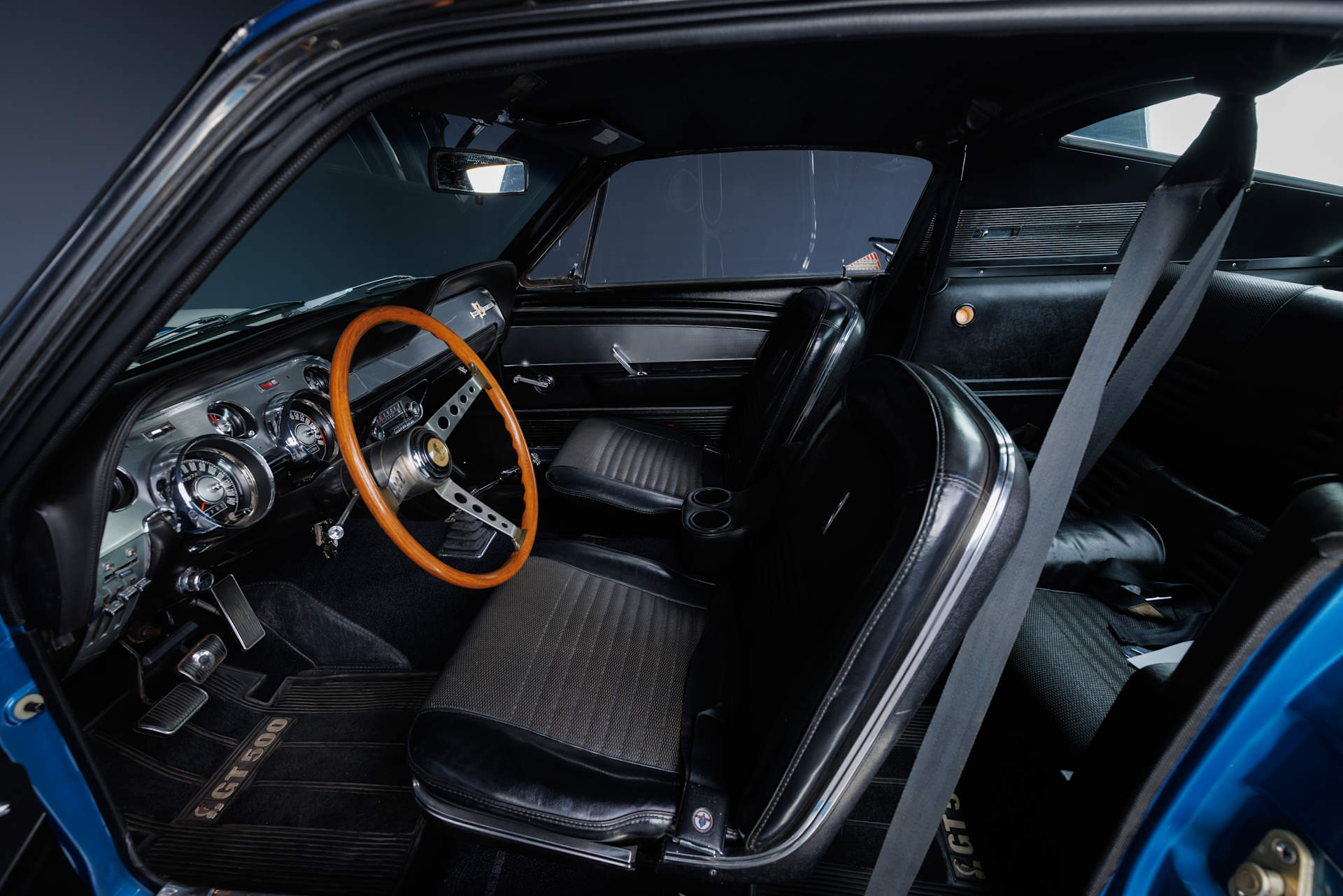
Inside, a padded roll bar carried inertia-reel shoulder harnesses, adapted from aircraft practice, believed to be among the first fitted to a production car.
Shelby American built 2,048 GT500s for 1967, all Fastbacks. A single convertible and a single notchback were completed as prototypes, the notchback, known as “Little Red,” previewed the 1968 California Special. The GT500 outsold the 1,175 GT350s built that year by nearly two to one.
1968 And The “King Of The Road”
Ford’s control of the Shelby program had been increasing since late 1966, and in August of 1967 the Mustang operation moved from California to A.O. Smith in Ionia, Michigan. Both models gained the Cobra name, sold as the Shelby Cobra GT350 and Shelby Cobra GT500, and a convertible entered series production for the first time.
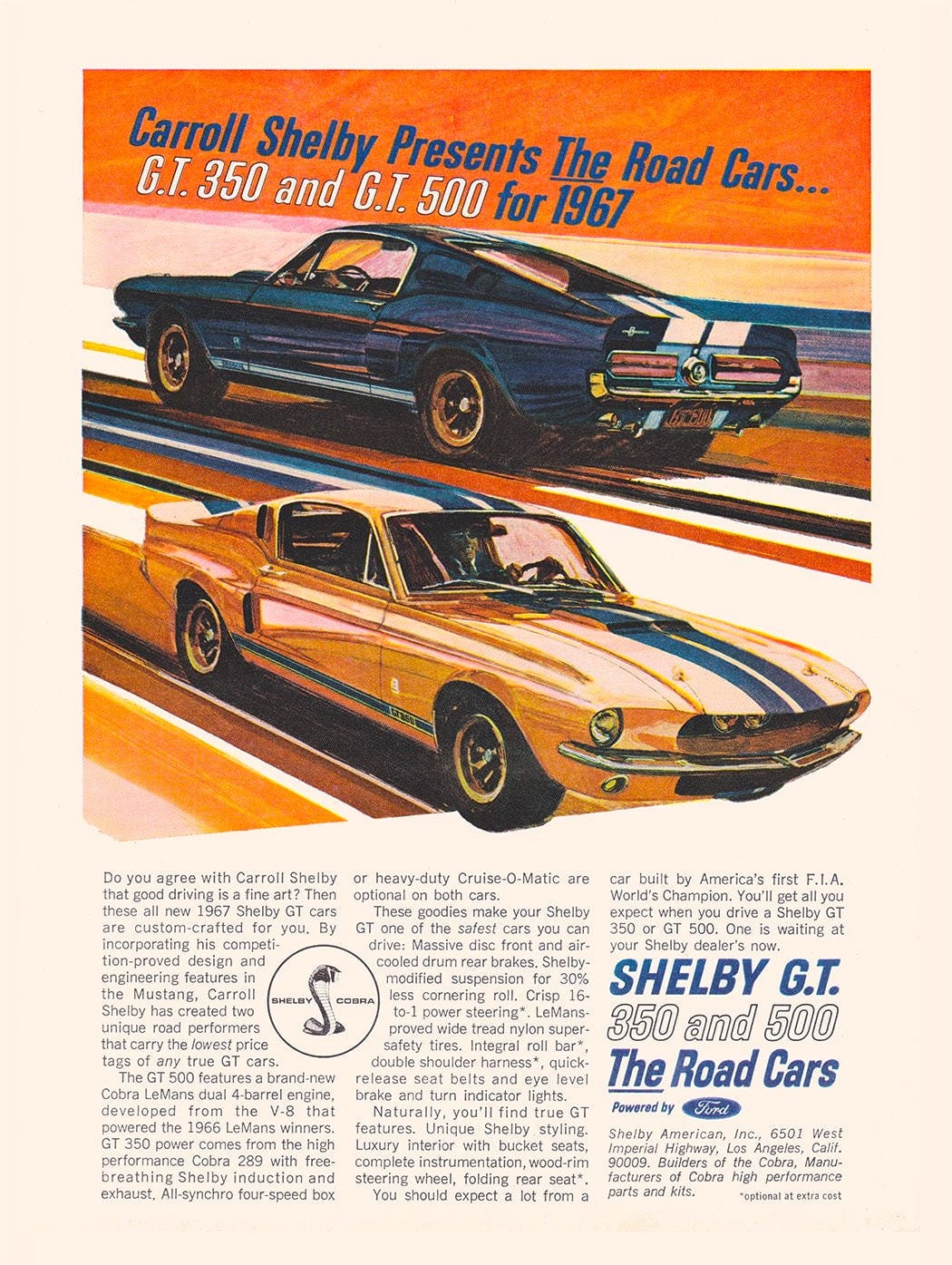
The 428 in the GT500 used hydraulic lifters, an aluminum medium-rise intake, and two 600 cfm Holley four-barrels. Ford rated it at 355 bhp at 5,400 rpm and 420 lb ft at 3,200 rpm, and nobody in the industry took that figure literally – it was widely understood to be understated. Image courtesy of Shelby American.
Early 1968 GT500s used the 428 Police Interceptor with a single four-barrel, rated at 360 bhp.
In April of 1968 Ford began factory-installing the 428 Cobra Jet, with 427-style heads, a 735 cfm Holley, ram-air induction, and a distinctive 16-bolt exhaust flange. Cobra Jet cars became the GT500 KR, for King of the Road, rated at 335 bhp and 440 lb ft at 3,400 rpm. Real output was probably in the low 400s. The valve covers read “Cobra Le Mans,” a reference to Ford’s back-to-back Le Mans wins in 1966 and 1967 with FE power.
The Shelby American Automobile Club puts 1968 GT500 production at 1,020 fastbacks and 402 convertibles, plus 1,053 KR fastbacks and 518 KR convertibles. The 1,571 KRs were all built in May, June, and July of 1968.
1969, 1970, And The End
Ford handled the 1969 redesign in-house, with John Chun credited for the styling and Shelby contributing almost nothing. The body grew four inches longer and the fiberglass hood carried five NACA ducts, three feeding air in and two extracting it.
The GT500 kept the 428 Cobra Jet at 335 bhp and 440 lb ft, while the GT350 moved to a 351 Windsor V8 rated at 290 bhp.
Shelby terminated his agreement with Ford in the summer of 1969, and the program closed that fall. SAAC records 1,157 GT500 fastbacks and 245 convertibles for 1969. Another 788 unsold cars, 470 of them GT500s, were re-serialized as 1970 models under FBI supervision, receiving a chin spoiler, two black hood stripes, and emissions changes to the carburetor and distributor. Nine 1971 “Shelby Europa” cars followed under license from Belgian dealer Claude Dubois.
In a straight line, the ’67 GT500 was one of the fastest production cars in the United States in its time, with an engine that many believed was actually making over 400 bhp – far more than the official rating of 355 bhp given to it by Ford.
The Shelby Mustang Revival
Ford’s Special Vehicle Team (SVT) brought the name back for 2007 as the replacement for the SVT Cobra, and sold it in numbers the original program could never have dreamed of – 22,989 cars across three model years, more than every Shelby Mustang built between 1965 and 1970 combined.
The engine was a supercharged 5.4 liter V8 with an iron block and Ford GT-derived aluminum heads, rated at 500 bhp and 480 lb ft, with a 6-speed manual as the only transmission. A GT500KR followed for 2008 and 2009 at 540 bhp, its 1,571 US cars deliberately matching 1968.
The 2010 car matched that power output, and for 2011 an aluminum block 102 lbs lighter lifted it to 550 bhp and 510 lb ft. Carroll Shelby died on May the 10th, 2012, at 89 years of age, having seen his name grace the side of a series of high-performance Mustangs once again.
The 2013 car used a 5.8 liter supercharged V8 certified at 662 bhp and 631 lb ft, which Ford billed as the world’s most powerful production V8, for $54,200. The last GT500 arrived for 2020 with a hand-built 5.2 liter “Predator” making 760 bhp and 625 lb ft through a seven-speed dual-clutch, no manual was offered.
The 1967 Shelby GT500 Shown Here
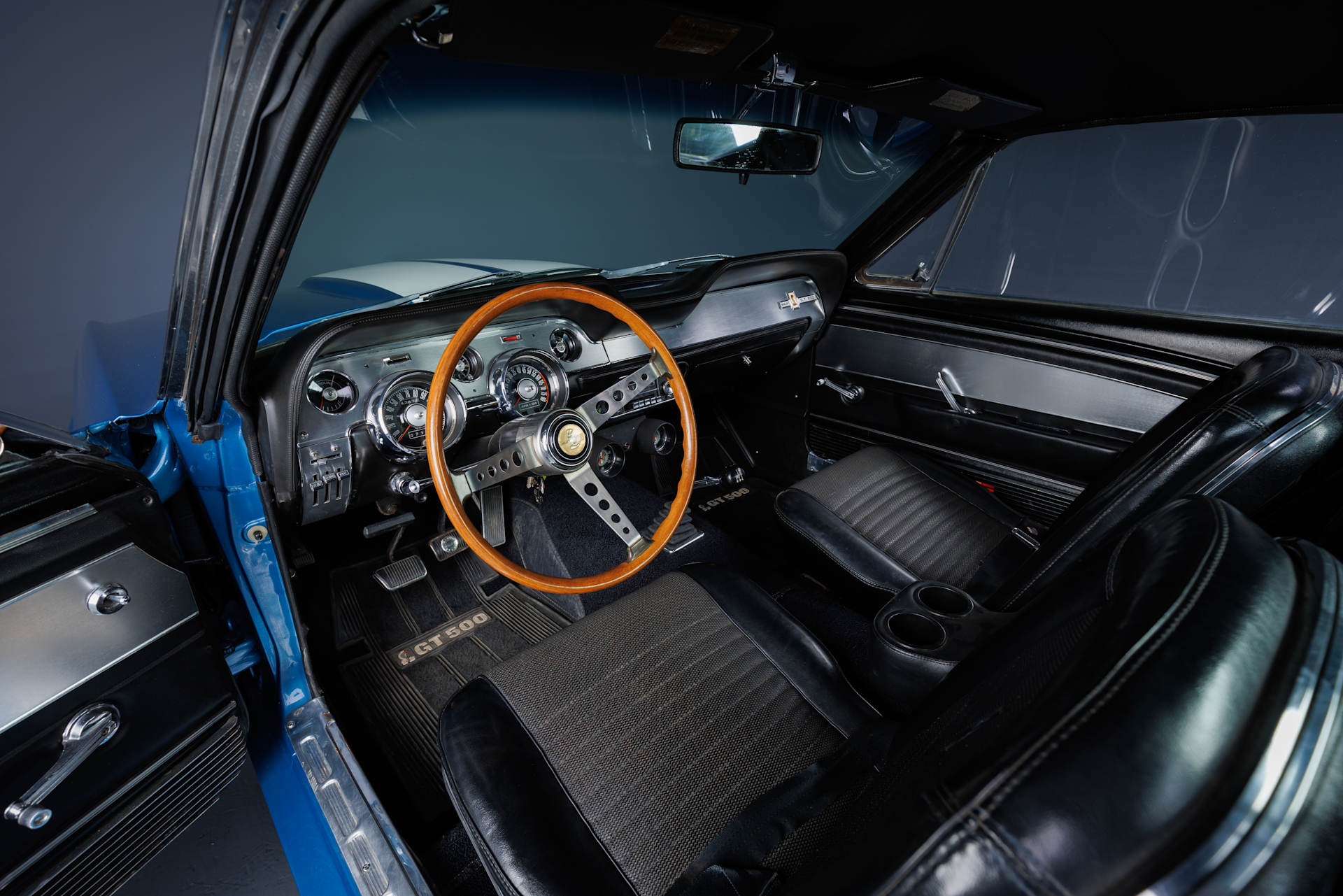
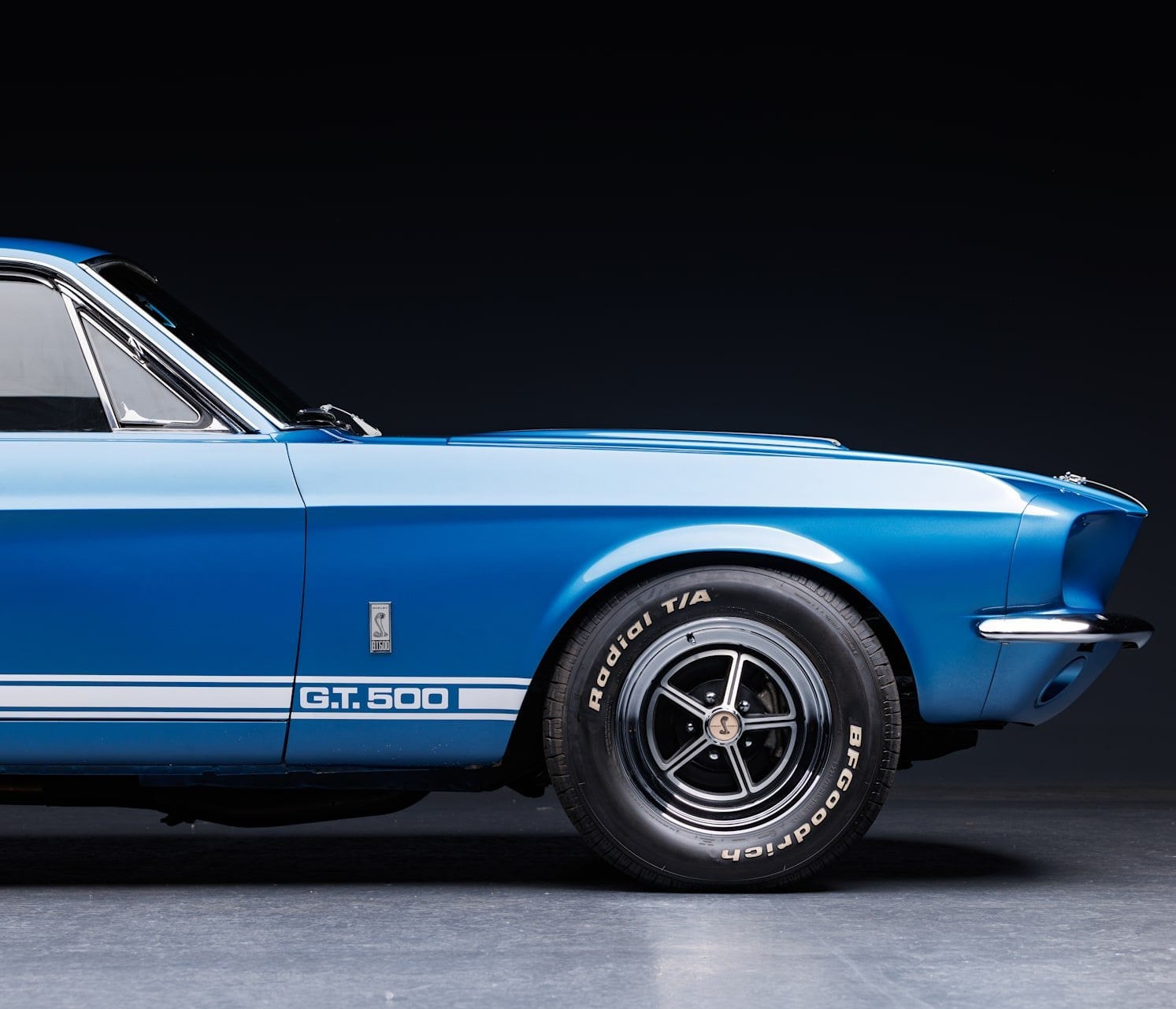
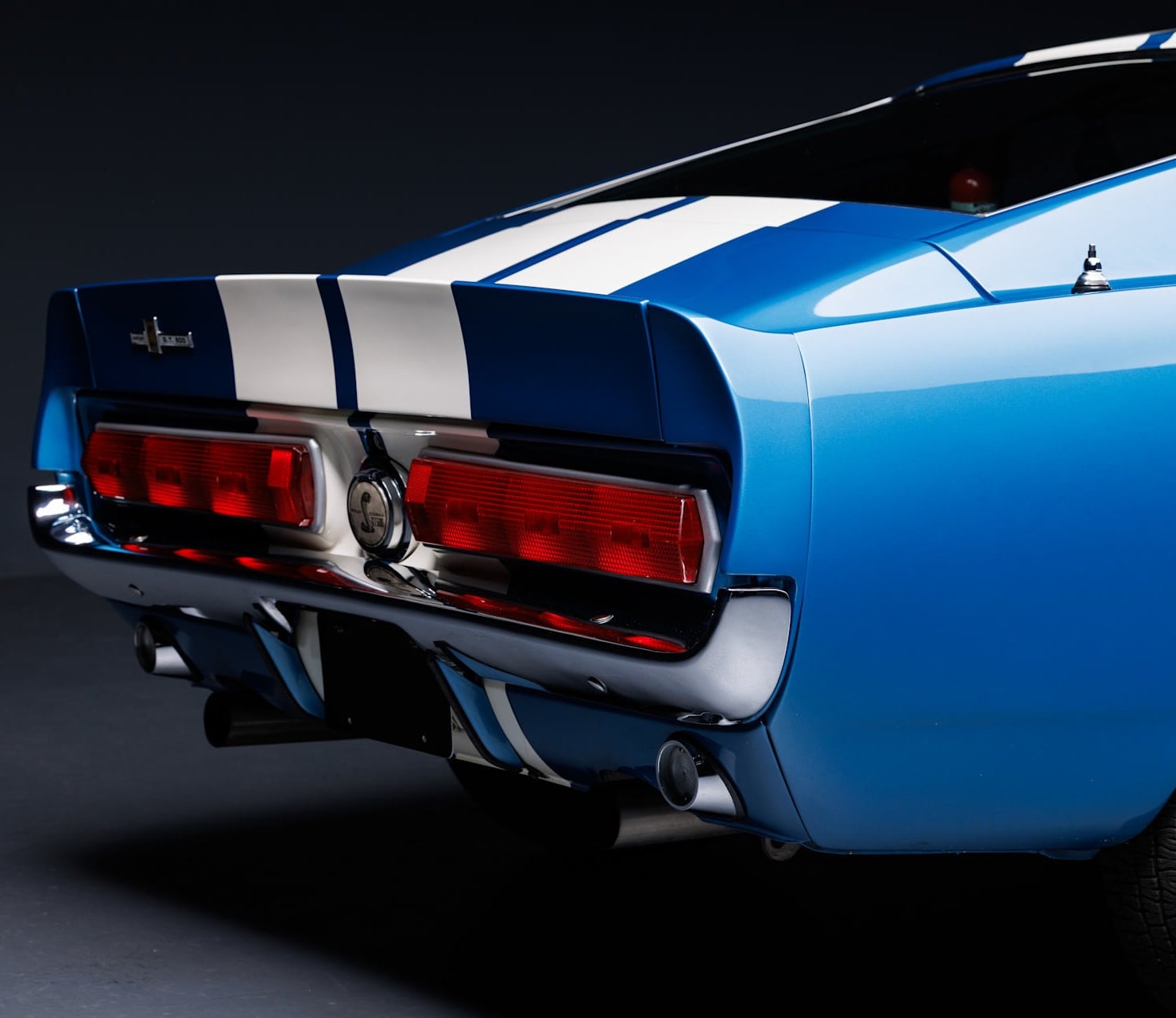
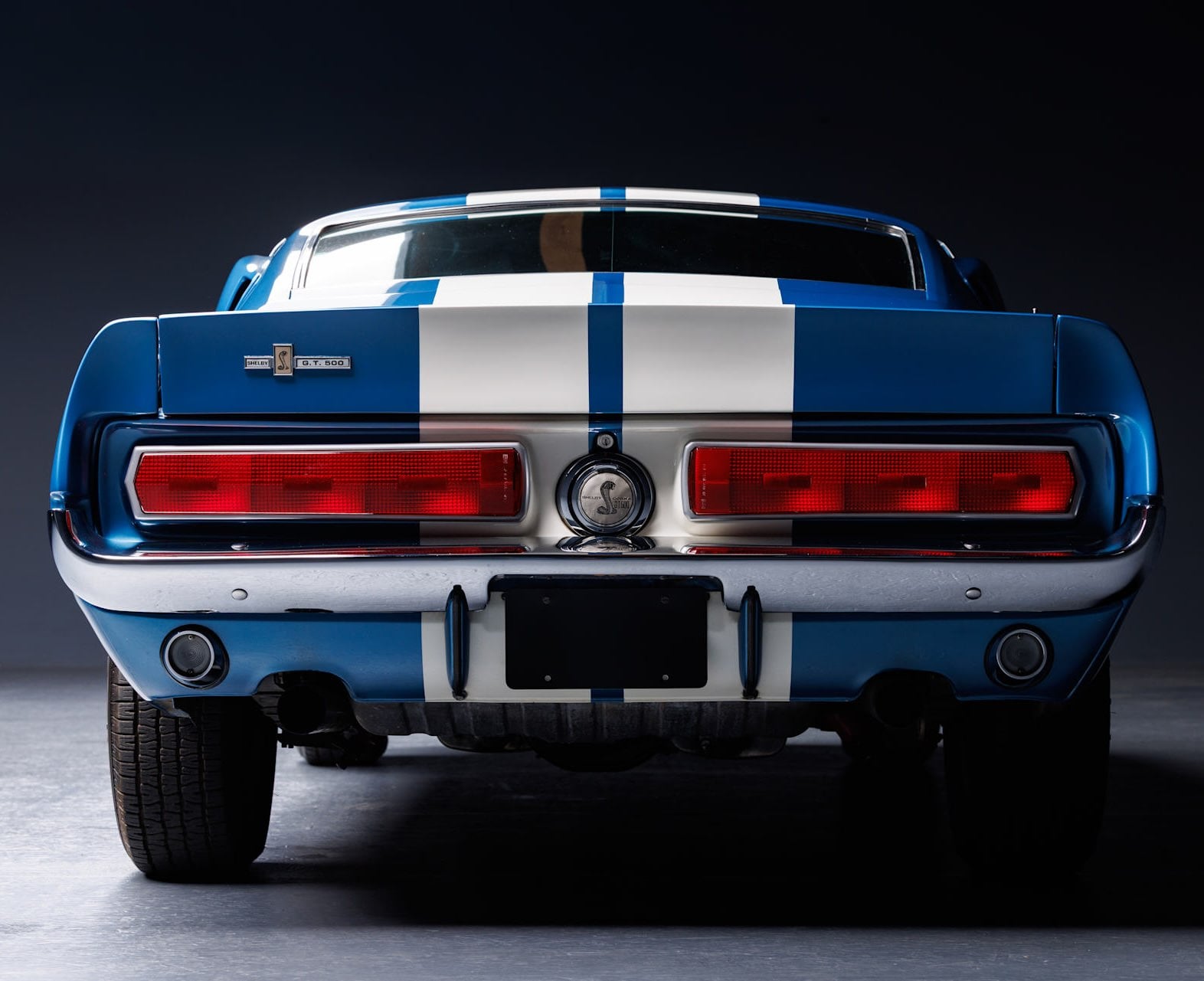
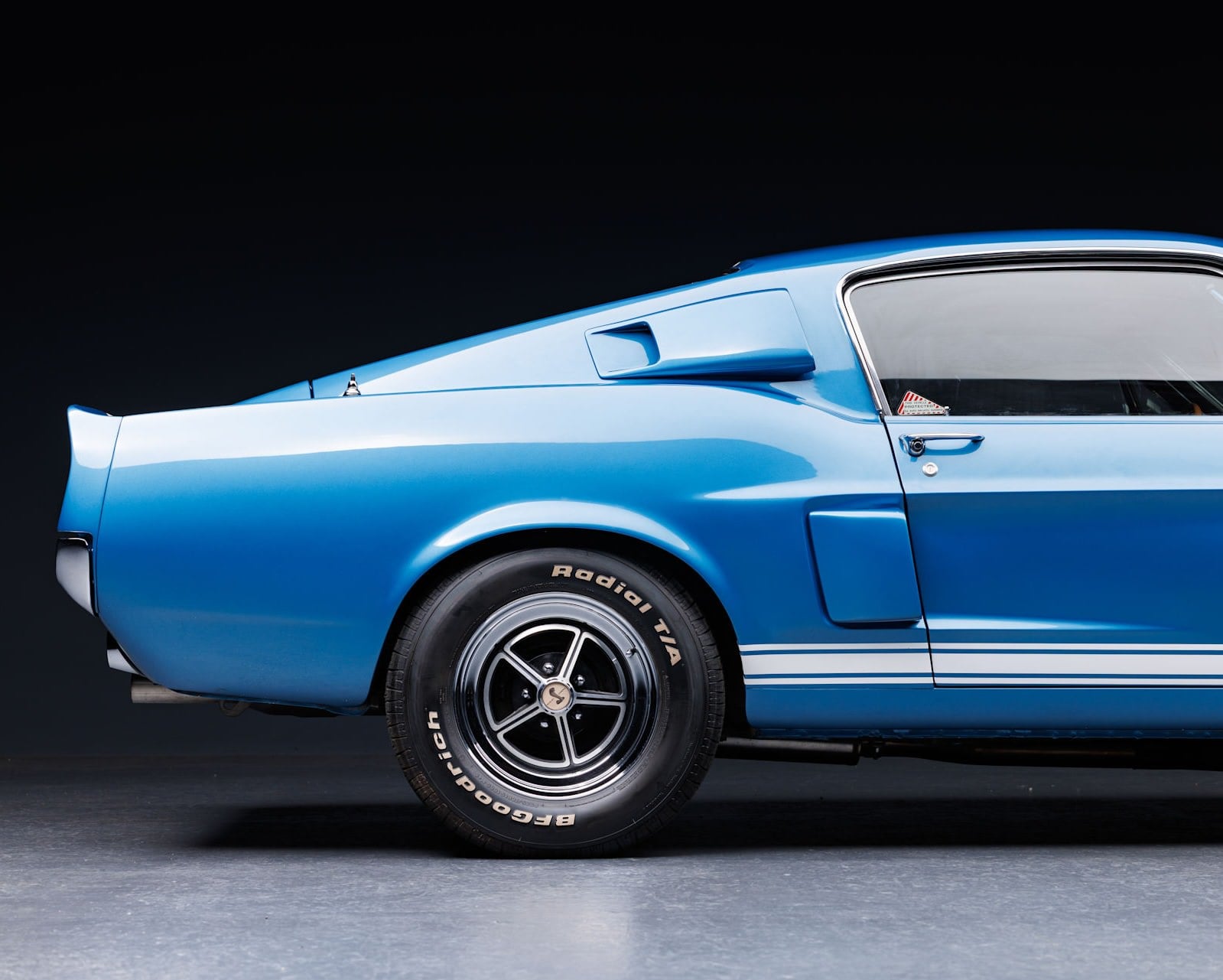
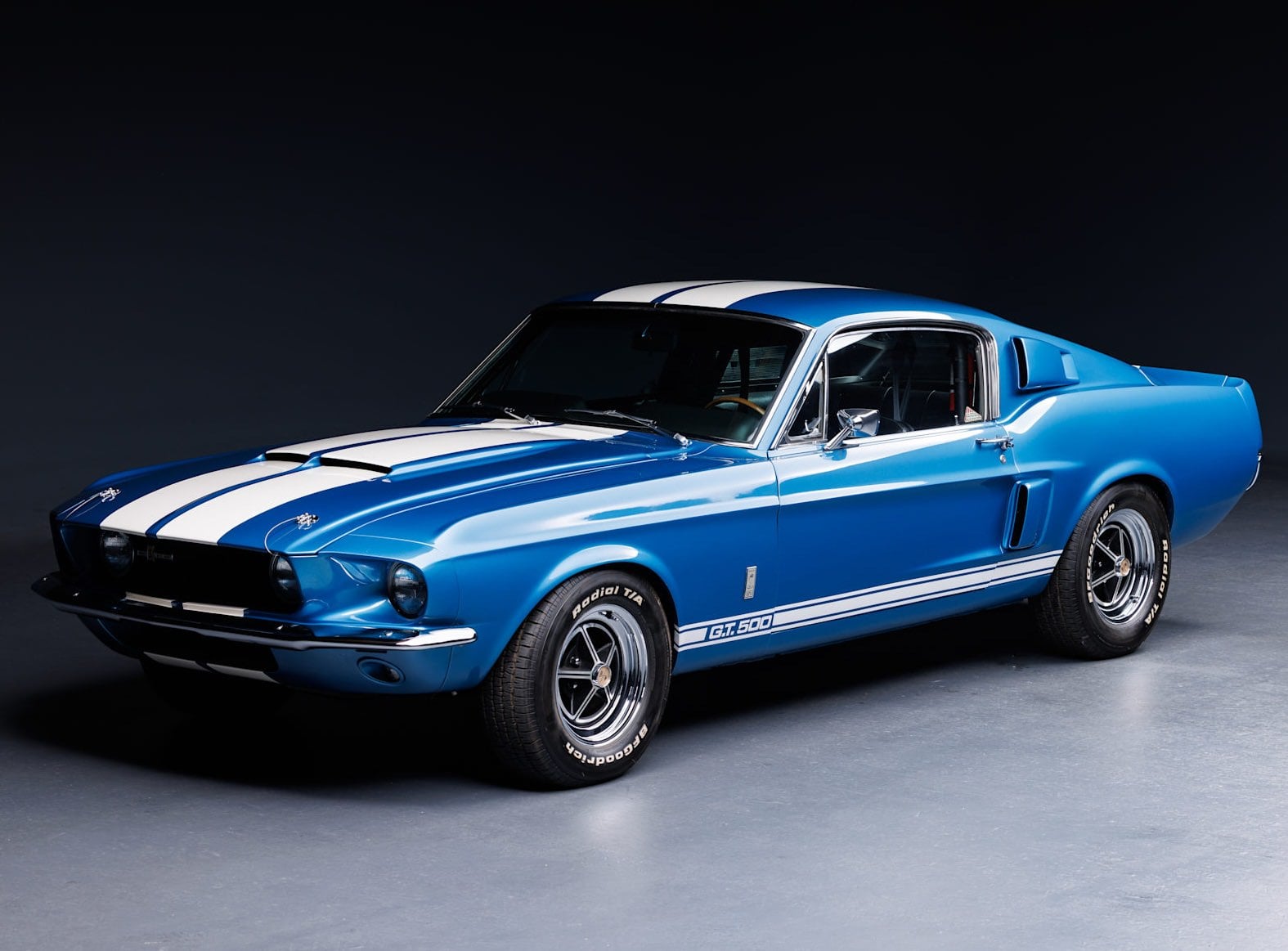
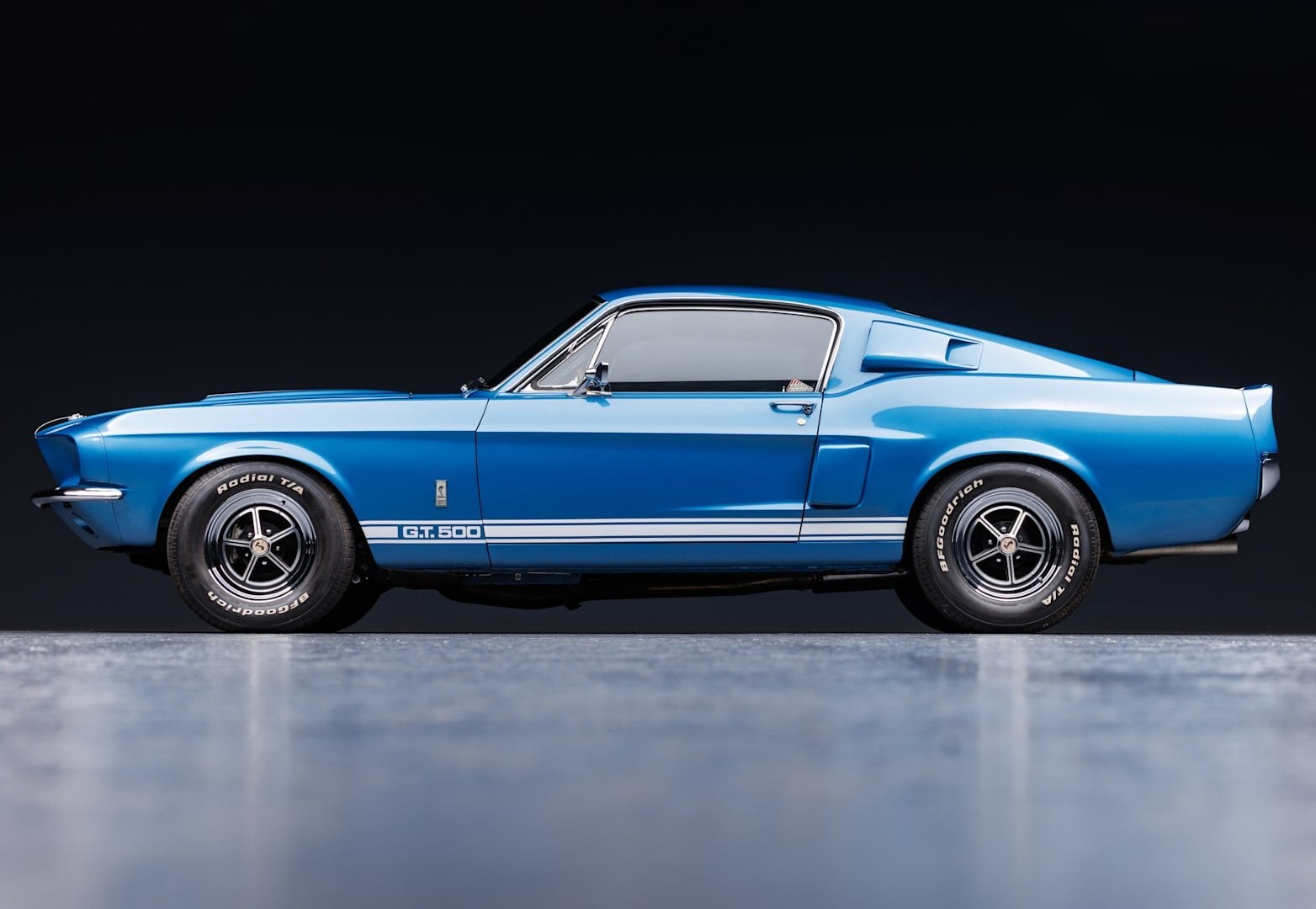
This is Shelby No. 02502, it’s a 1967 GT500, one of 2,048 fastbacks Shelby American completed that model year, and it was delivered new to Stark Hickey Ford in Royal Oak, Michigan, on Detroit’s northern edge. The car carries a white Le Mans stripes over the top.
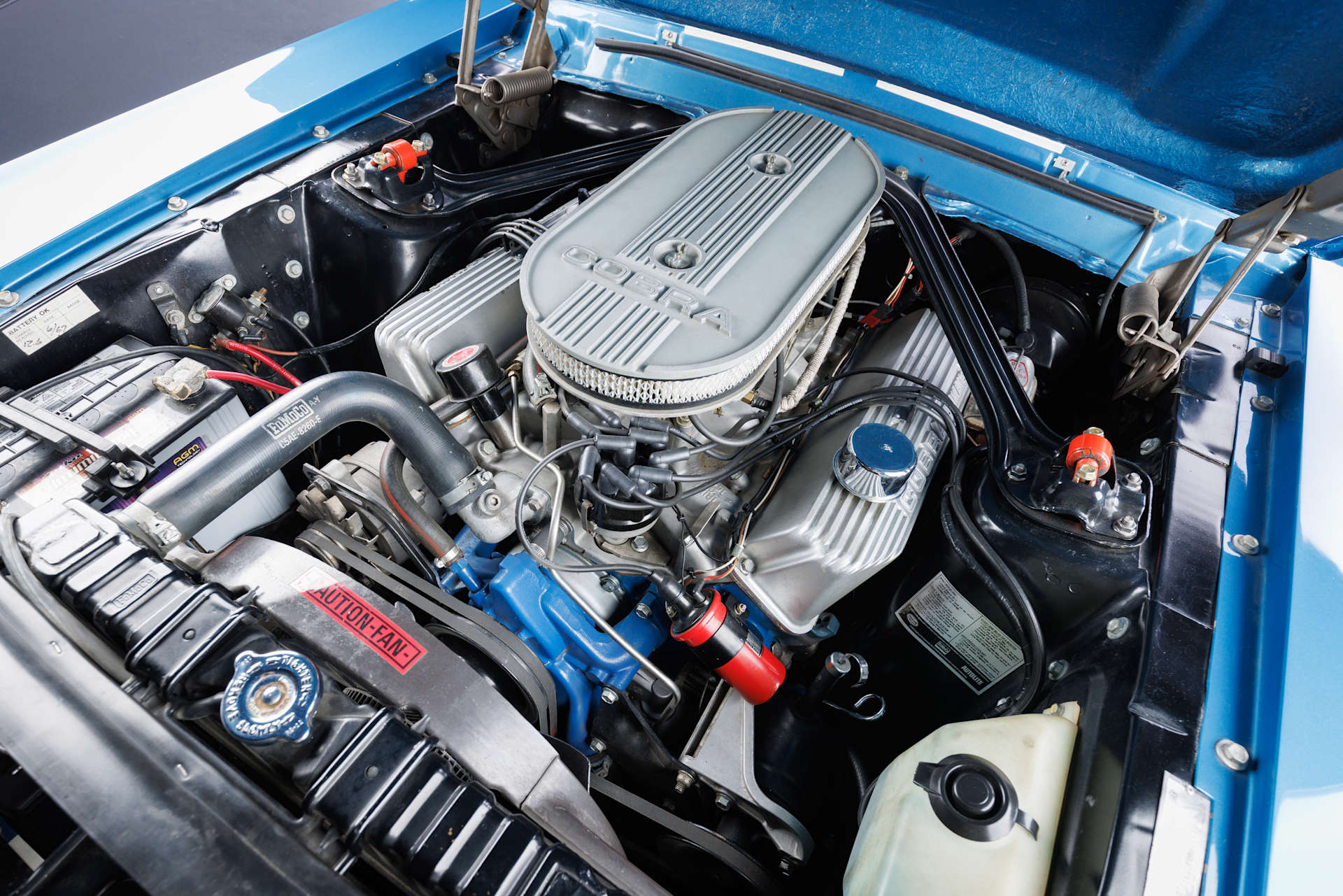
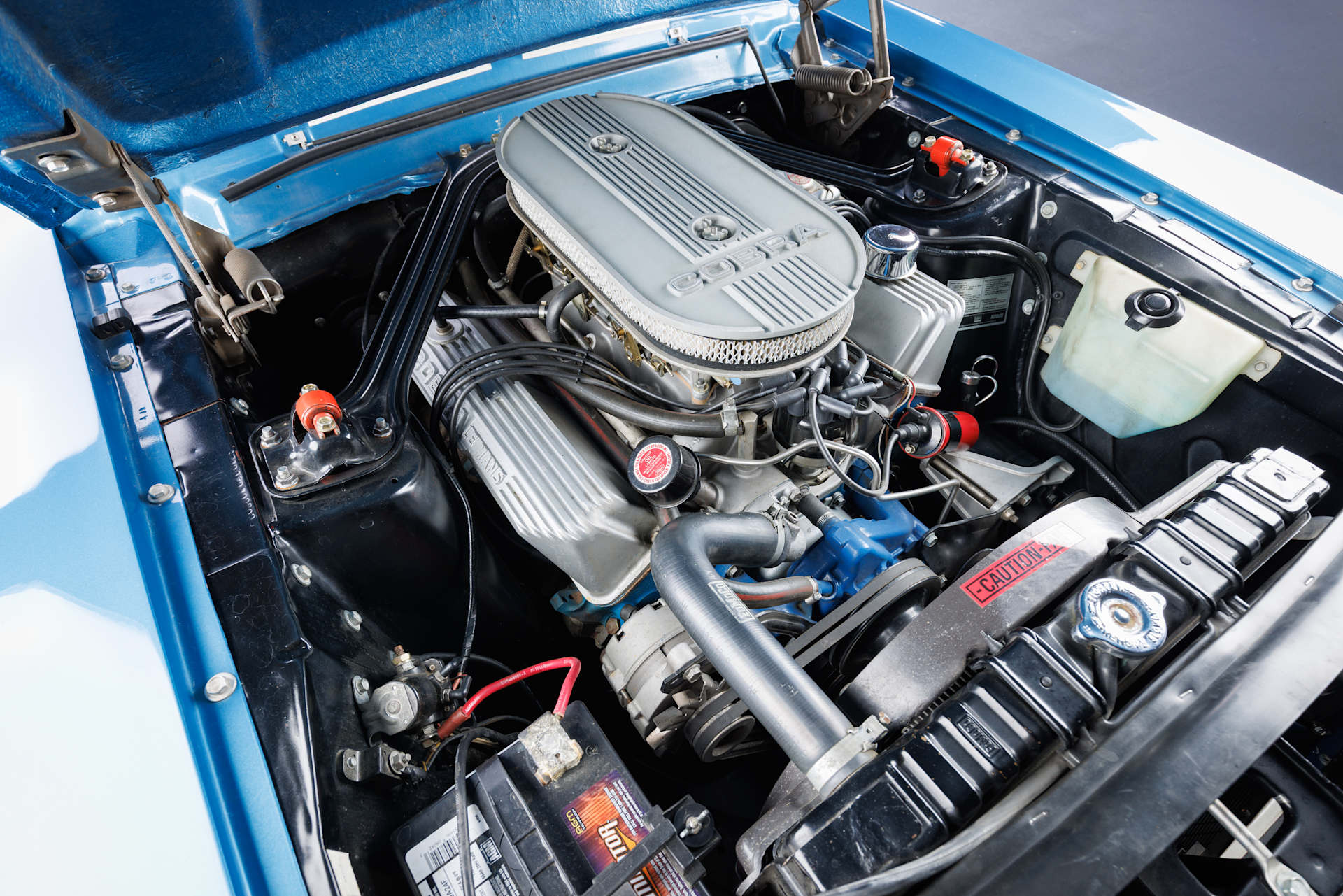
Under the fiberglass hood sits the 428 Police Interceptor V8, topped with an aluminum medium-rise manifold and a pair of 600 cfm Holley four-barrels. Ford rated the combination at 355 bhp and 420 lb ft, gross SAE, and the industry treated that as conservative (to say the least).
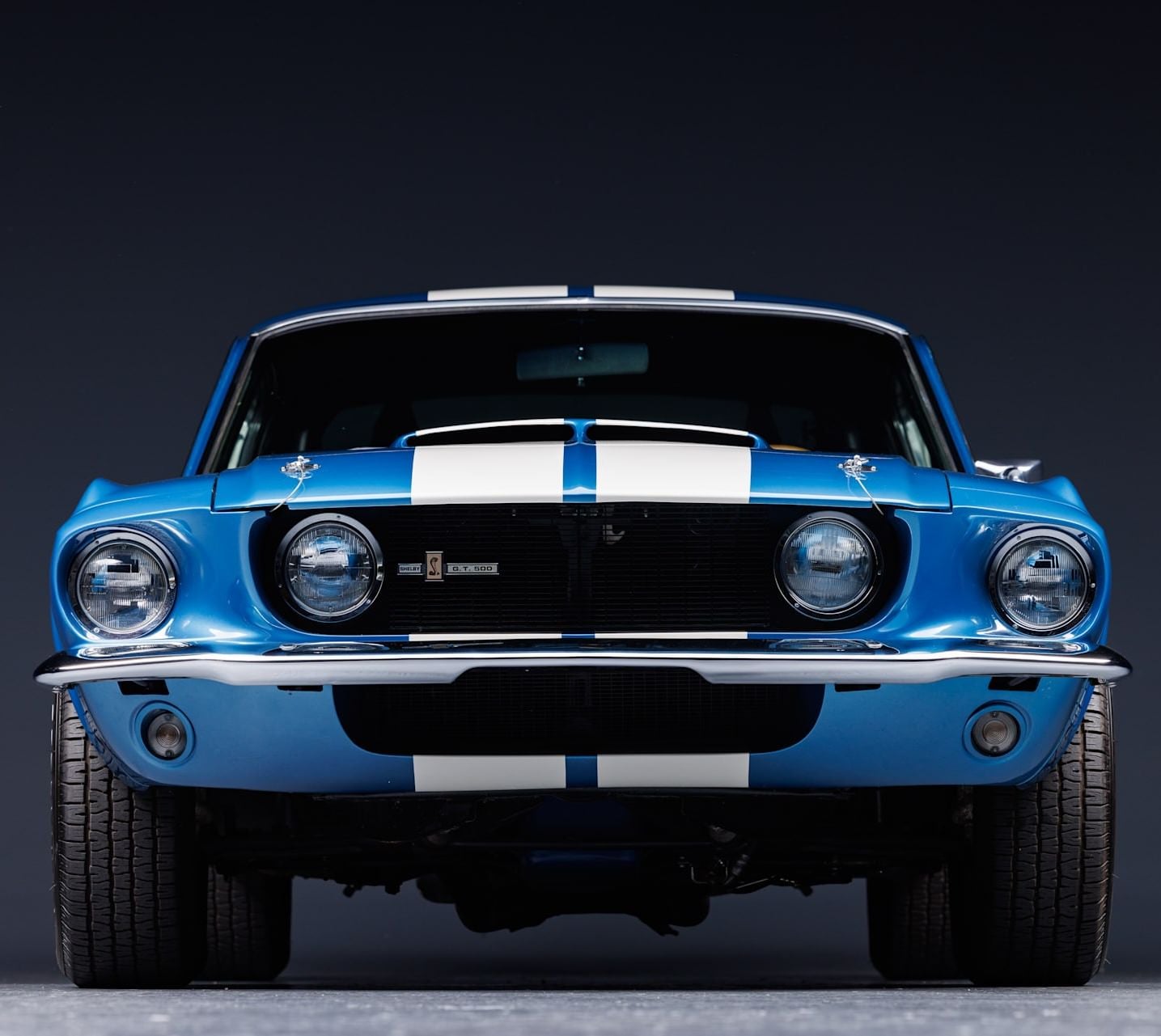
This is Shelby No. 02502, it’s a 1967 GT500, one of 2,048 fastbacks Shelby American completed that model year, and it was delivered new to Stark Hickey Ford in Royal Oak, Michigan, on Detroit’s northern edge. The car carries a white Le Mans stripes over the top.
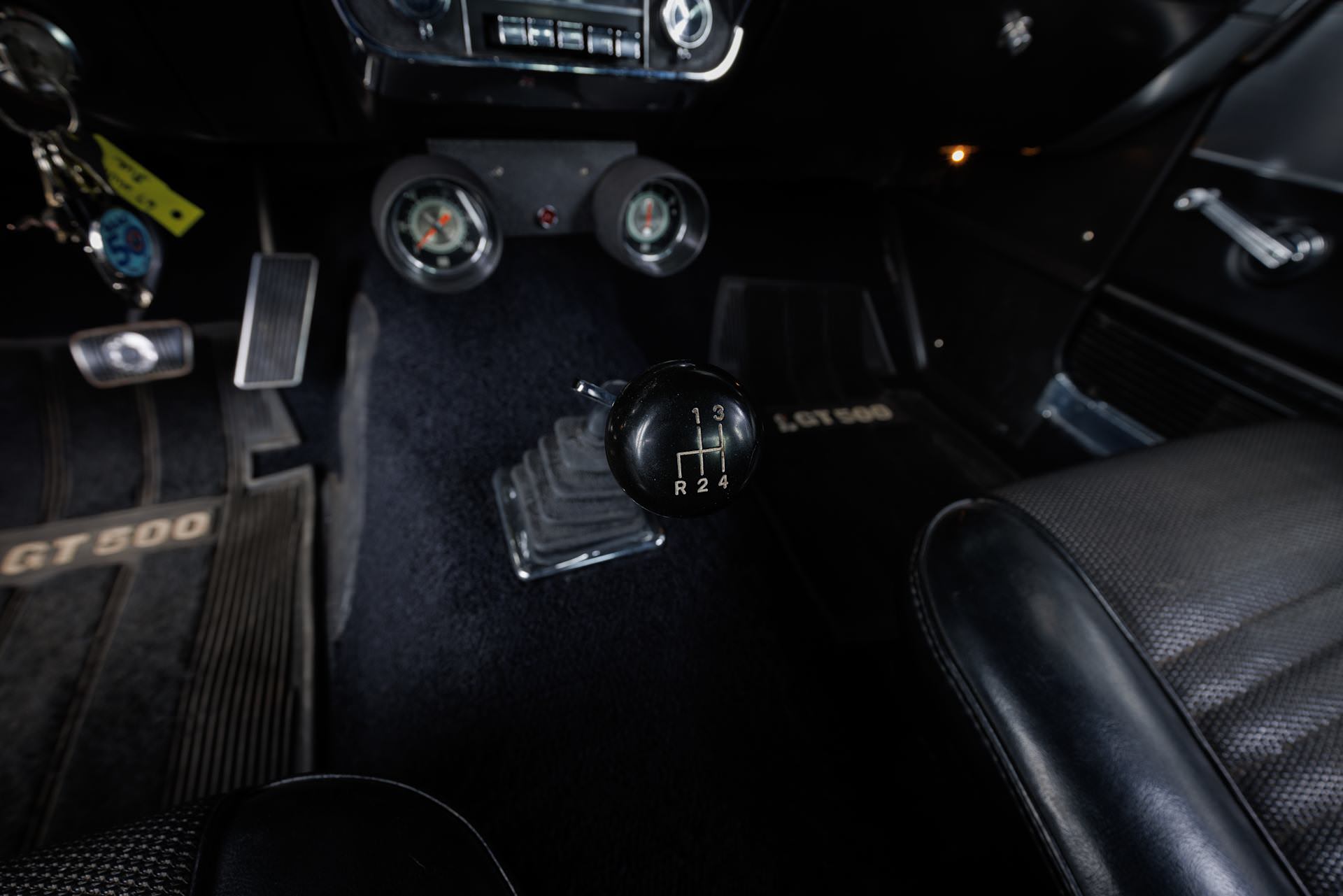
Power is sent back through a 4-speed manual, the more desirable of the two transmissions offered and the one that made the GT500 feel like a Shelby rather than a softer, standard Mustang with a slush box.
It’s now due to roll across the auction block with Mecum in mid-August and you can visit the listing here if you’d like to read more about it or register to bid.
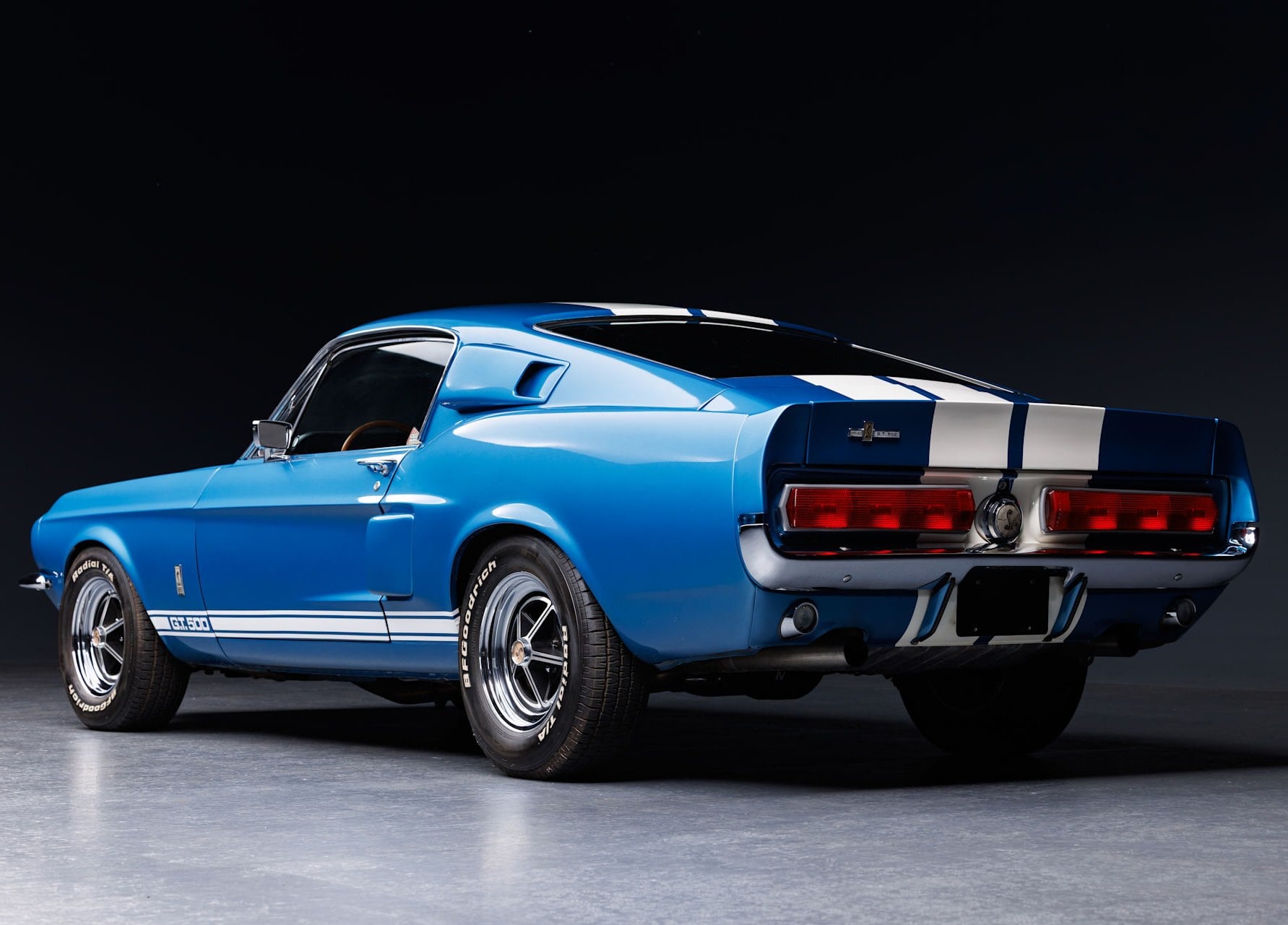
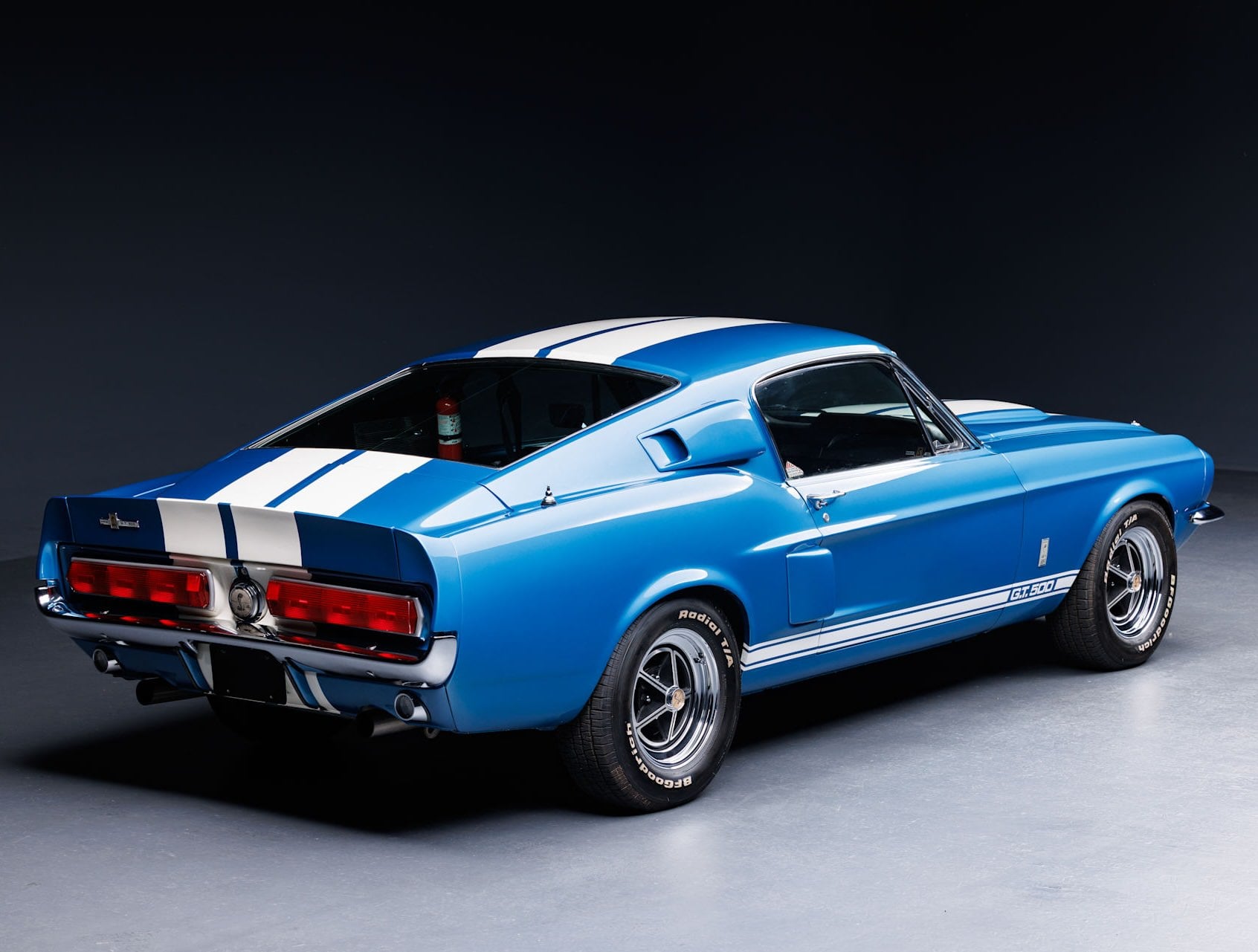
Images courtesy of Mecum + Ford

Articles that Ben Branch has written have been covered on CNN, Popular Mechanics, Smithsonian Magazine, Road & Track Magazine, the official Pinterest blog, the official eBay Motors blog, BuzzFeed, Autoweek Magazine, Wired Magazine, Autoblog, Gear Patrol, Jalopnik, The Verge, and many more.
Silodrome was founded by Ben back in 2010, in the years since the site has grown to become a world leader in the alternative and vintage motoring sector, with well over a million monthly readers from around the world and many hundreds of thousands of followers on social media.