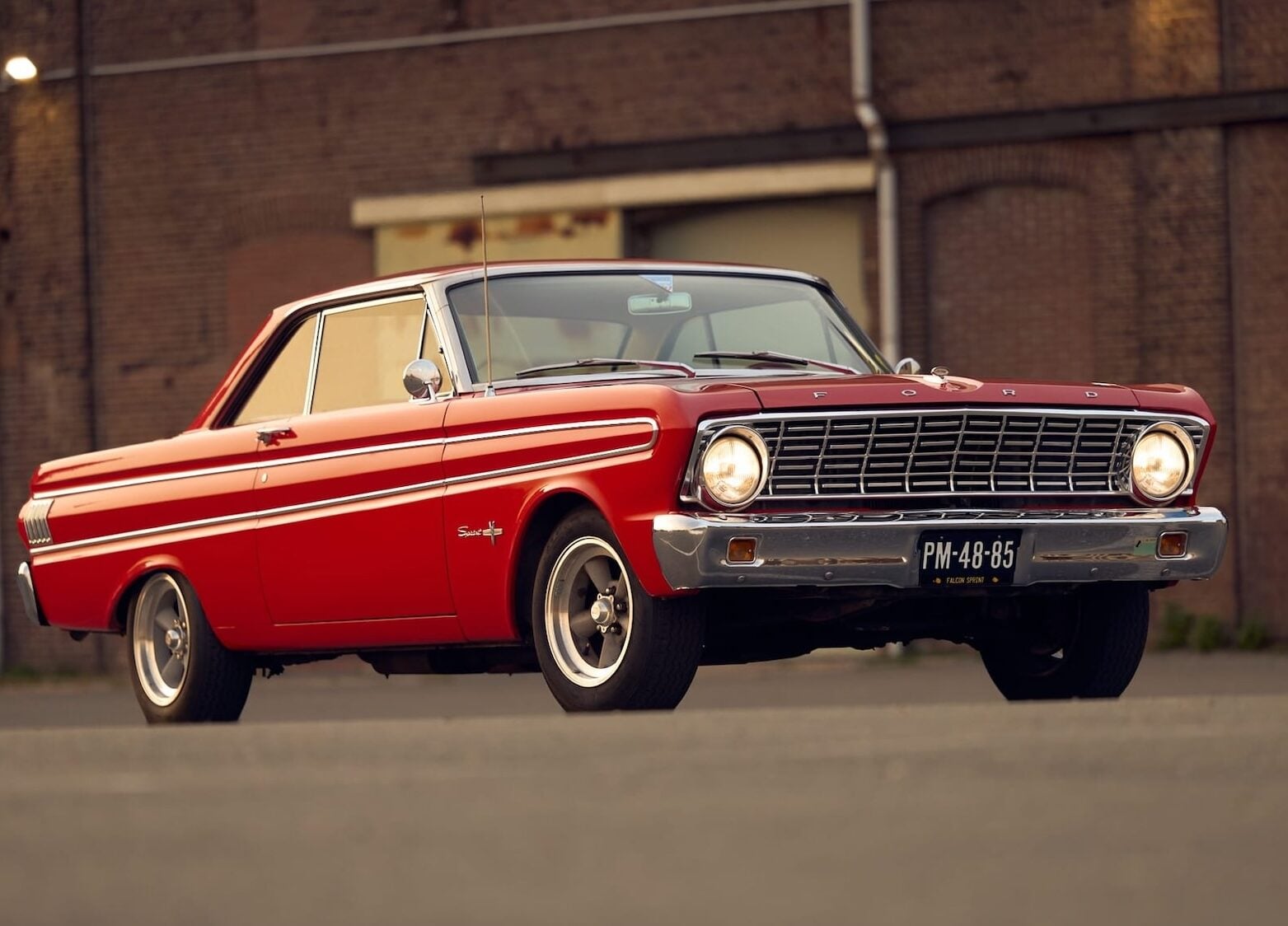
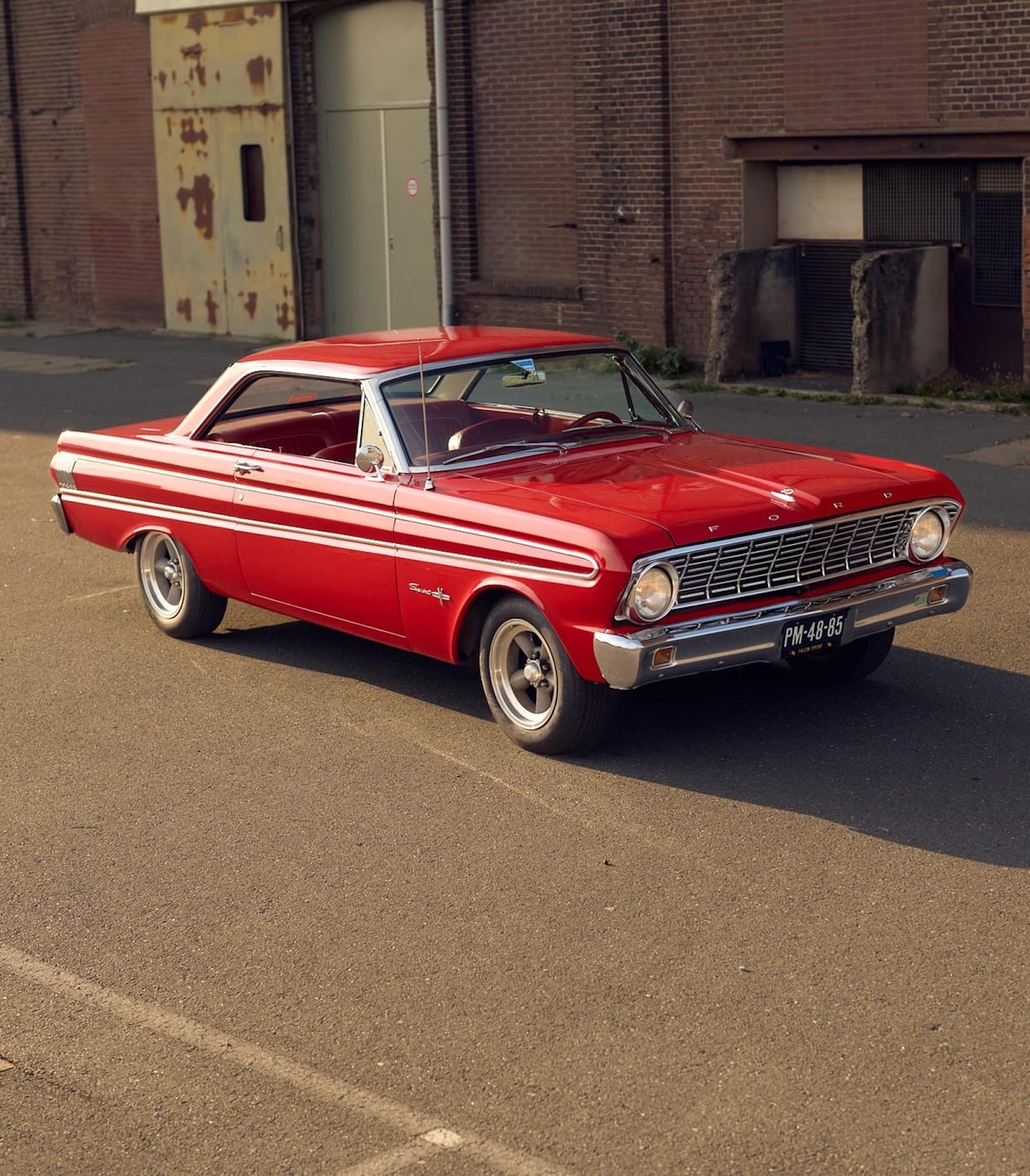
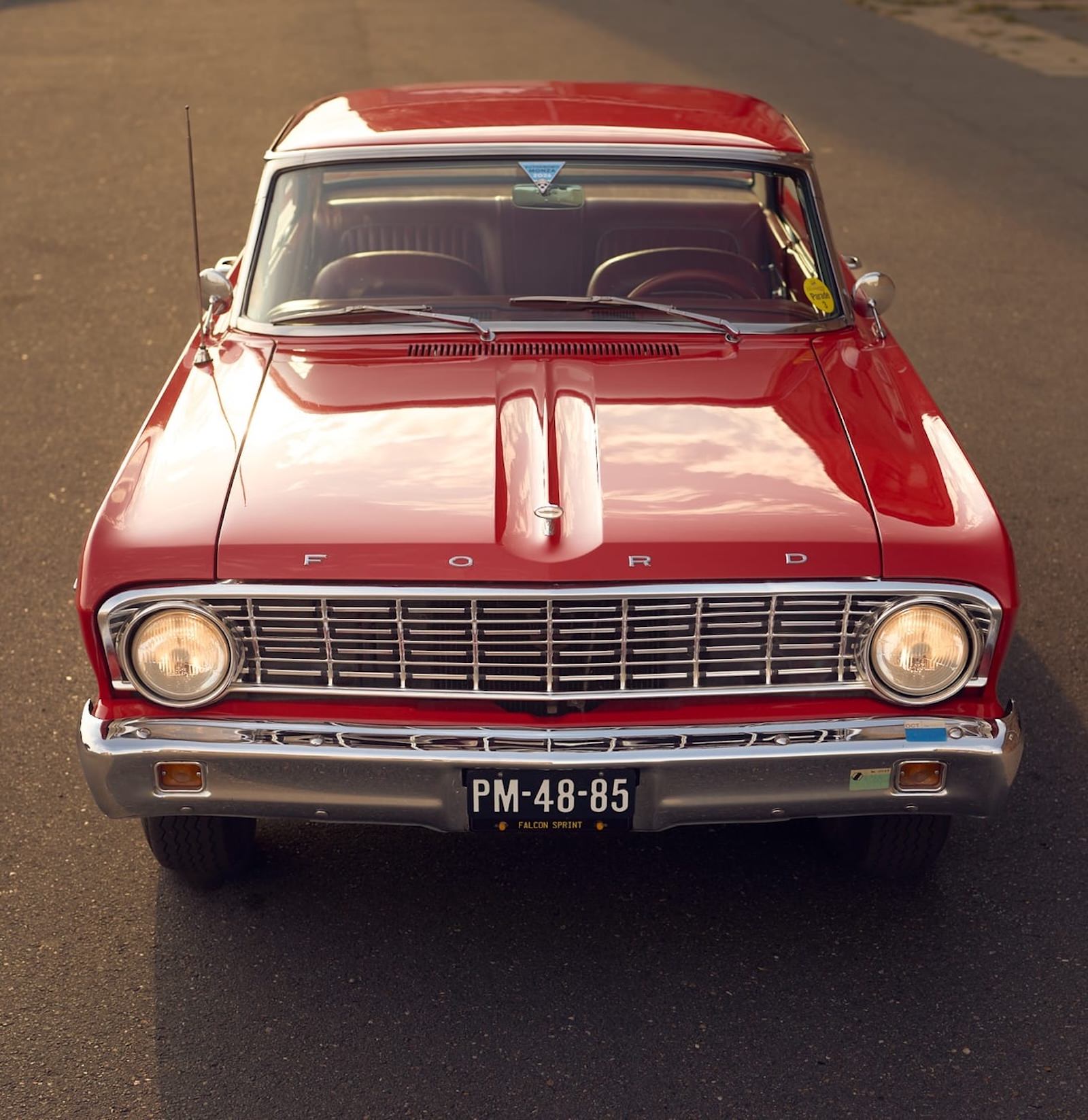
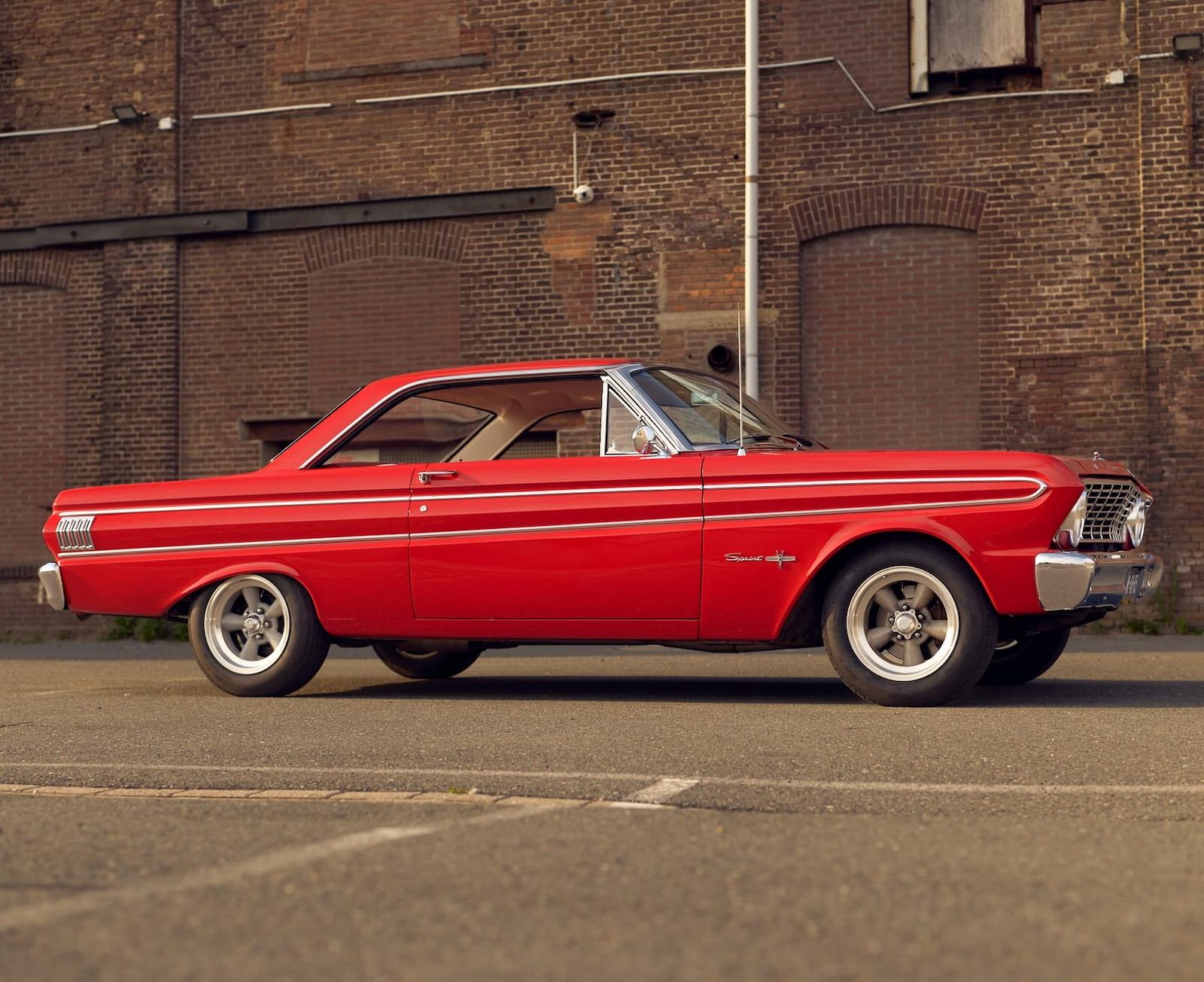
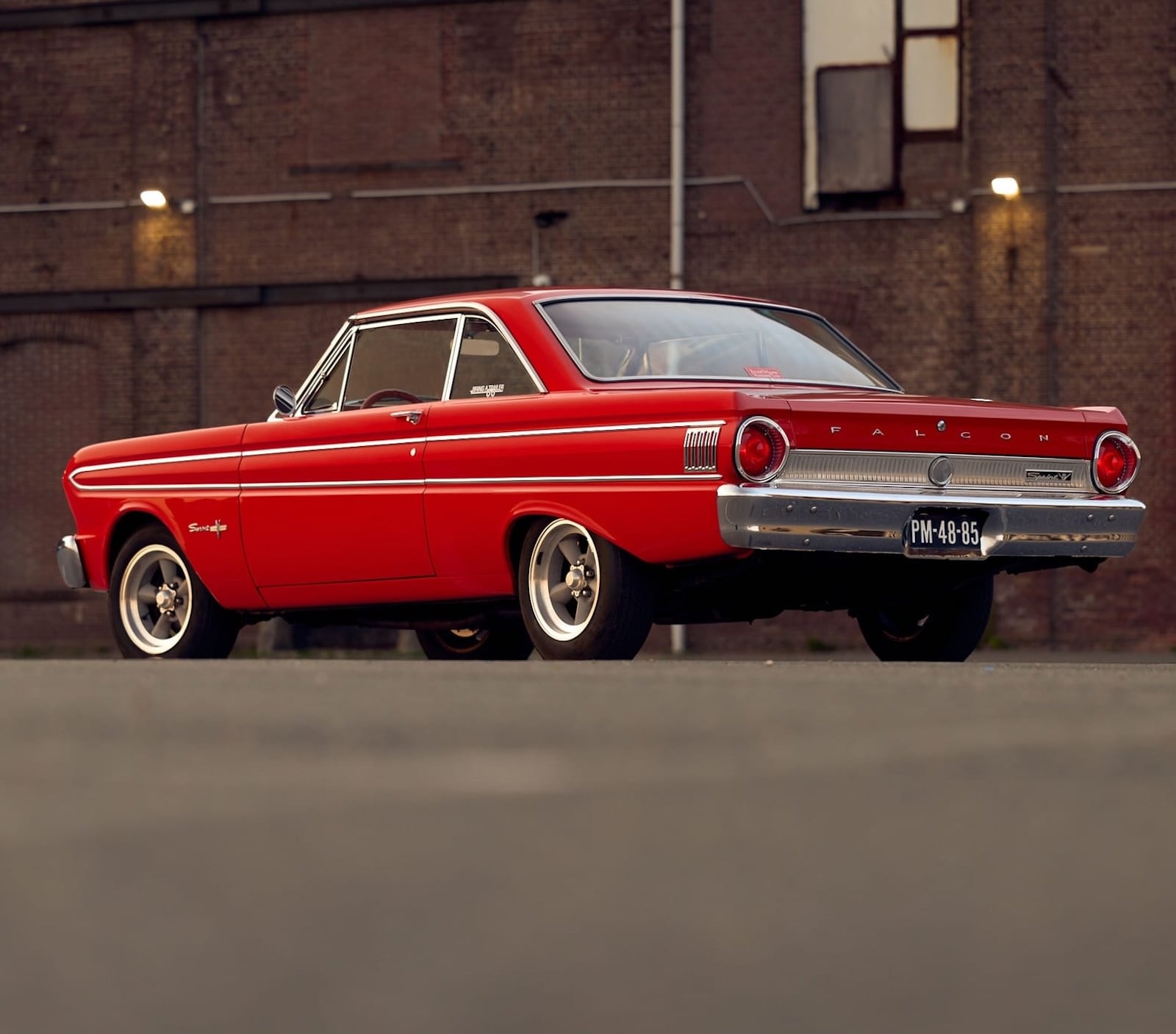
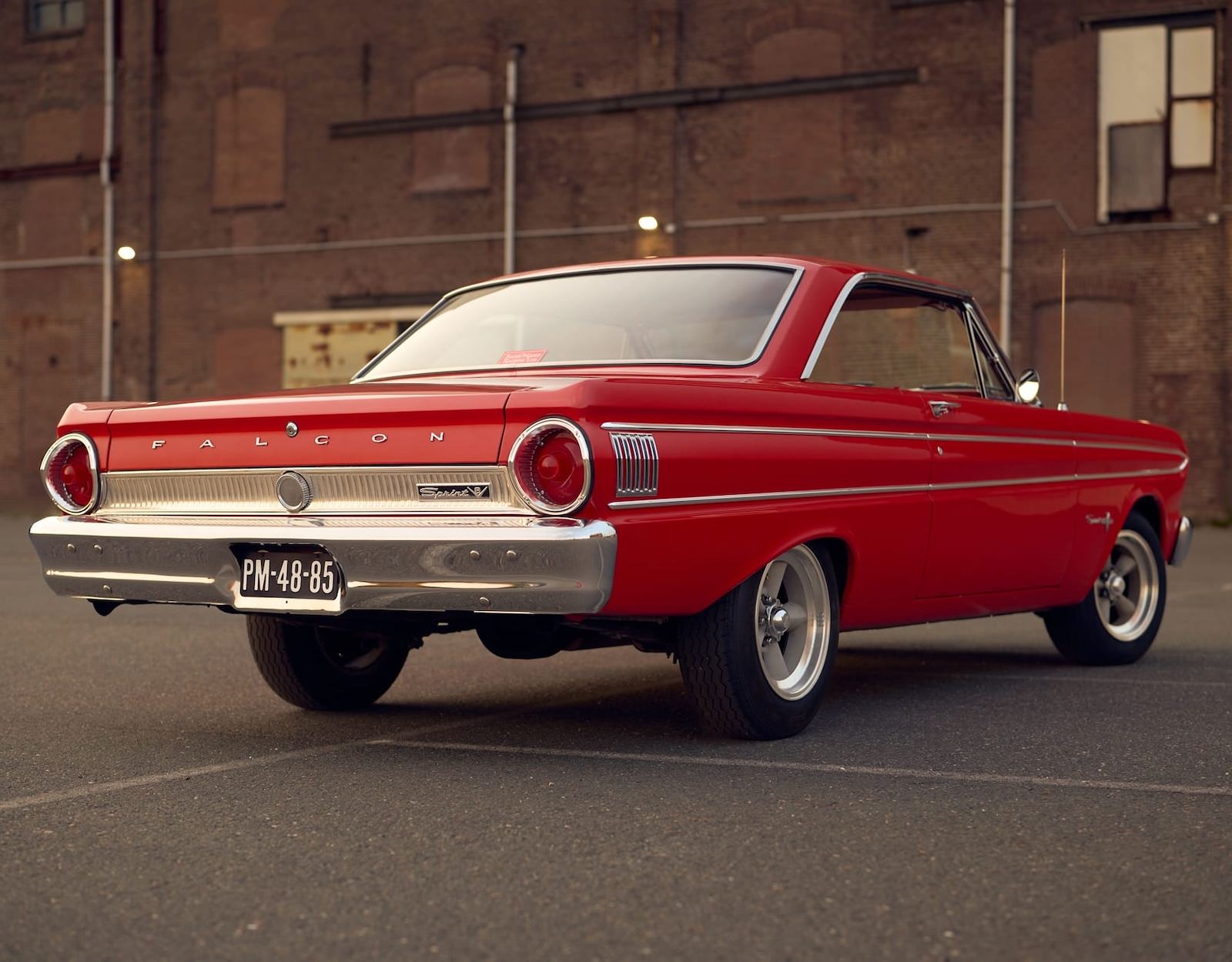
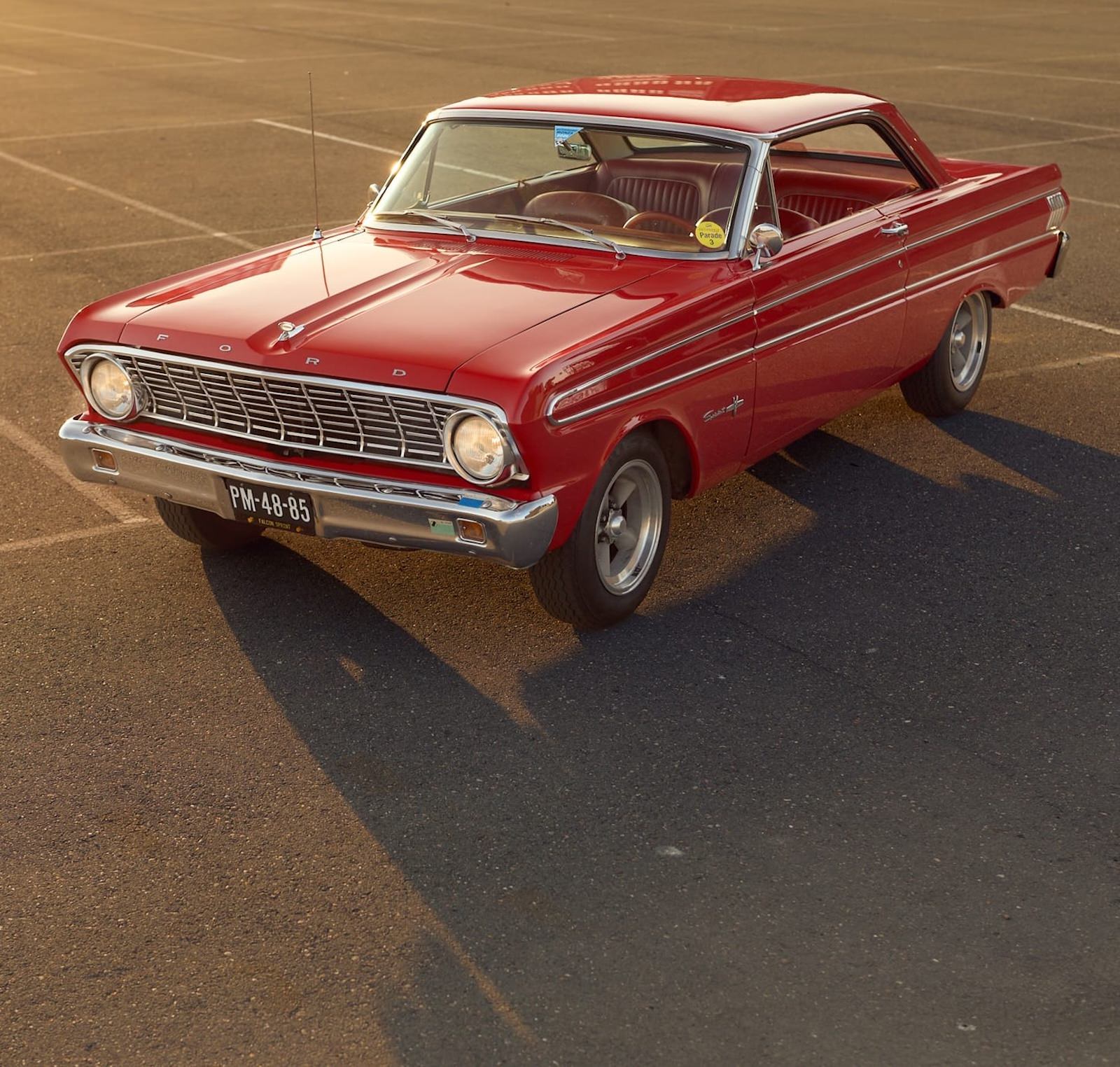
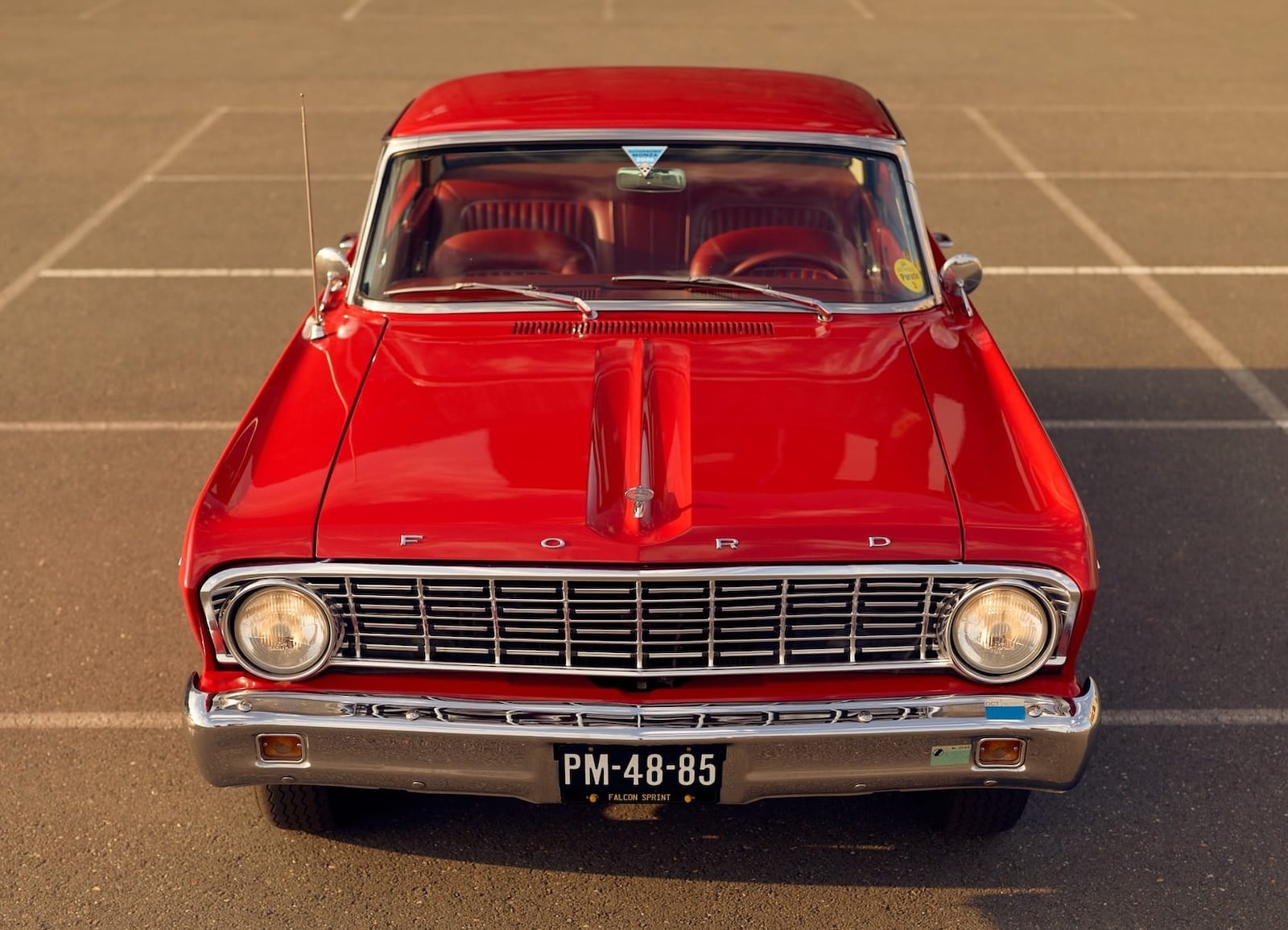
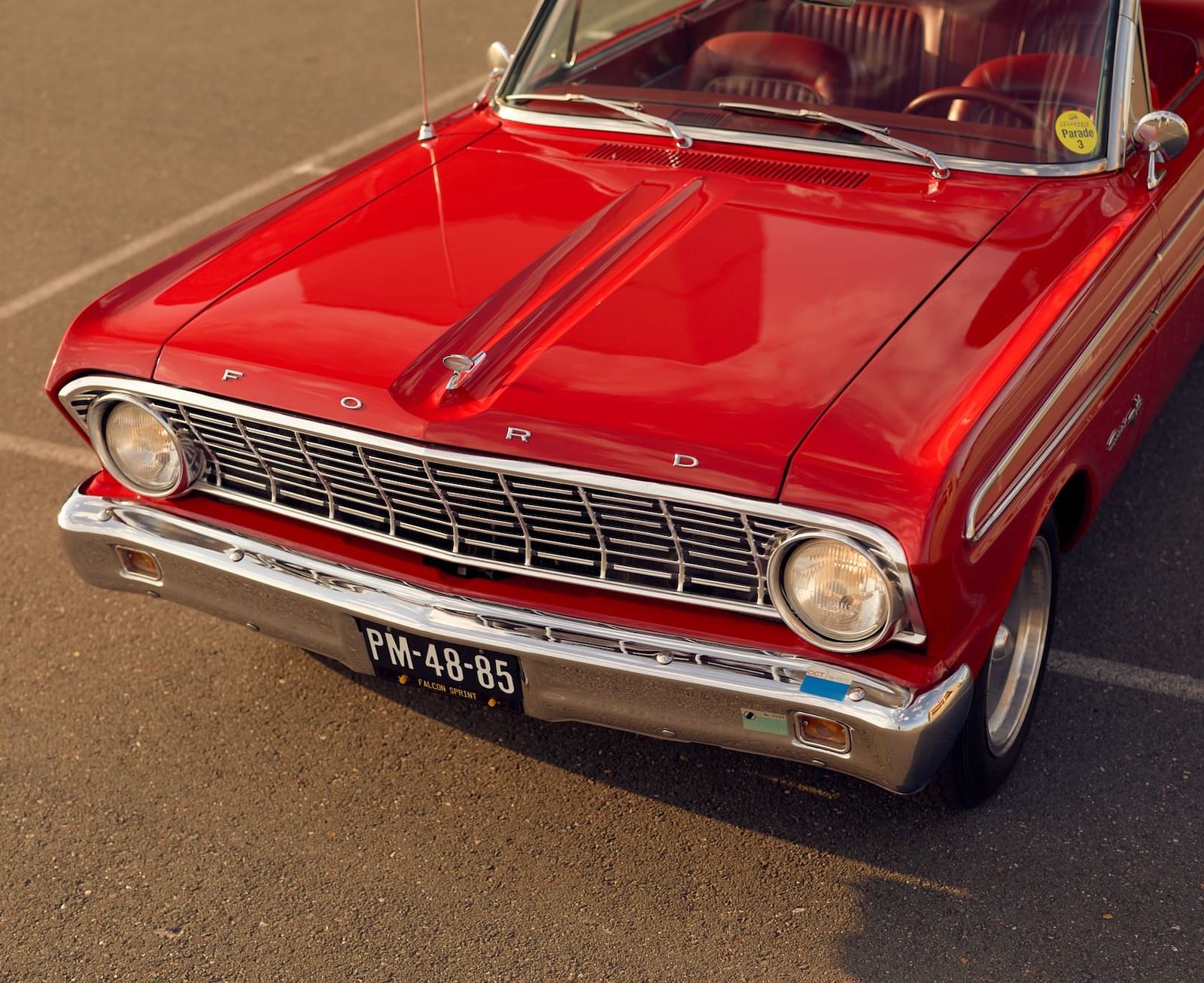
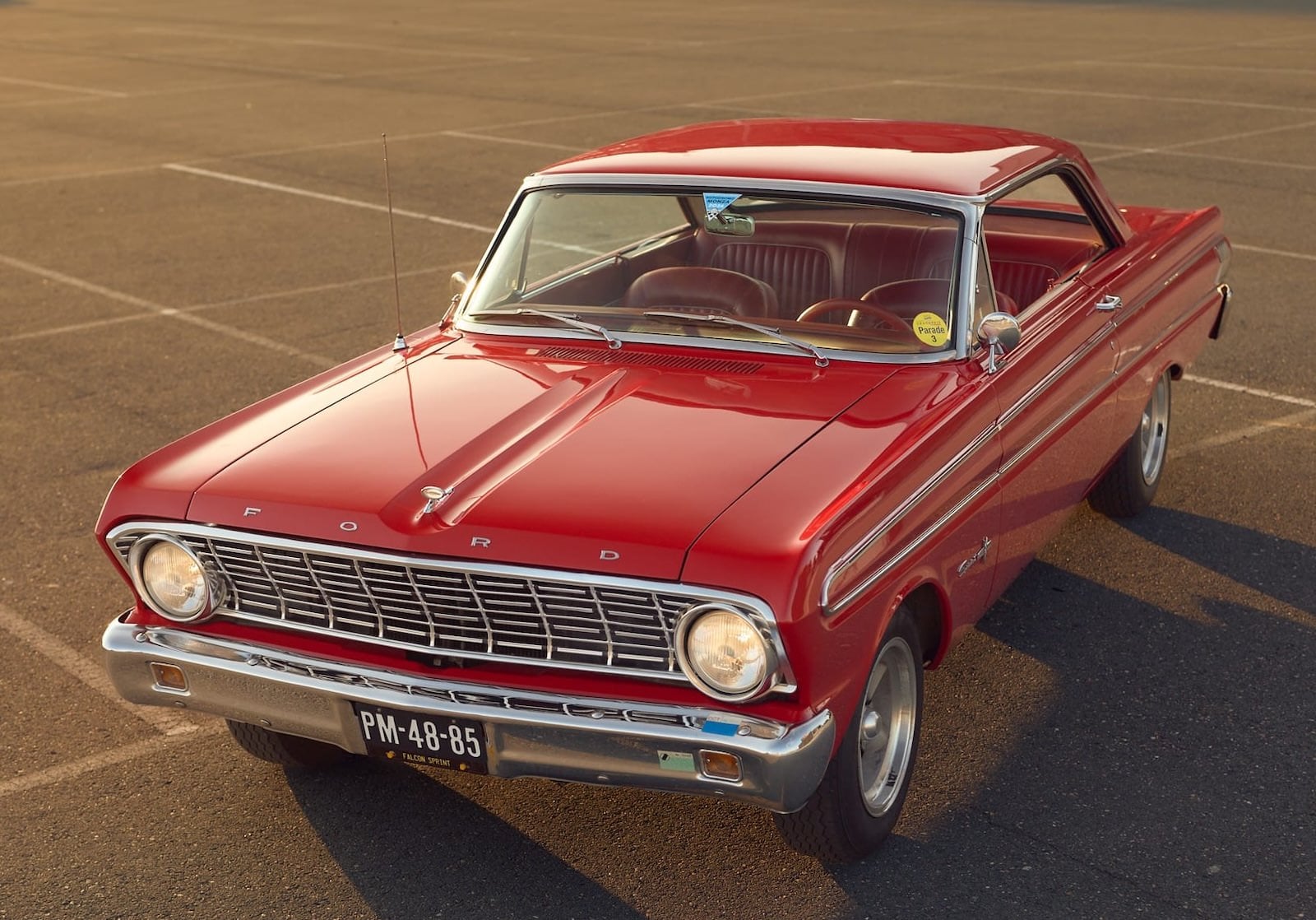
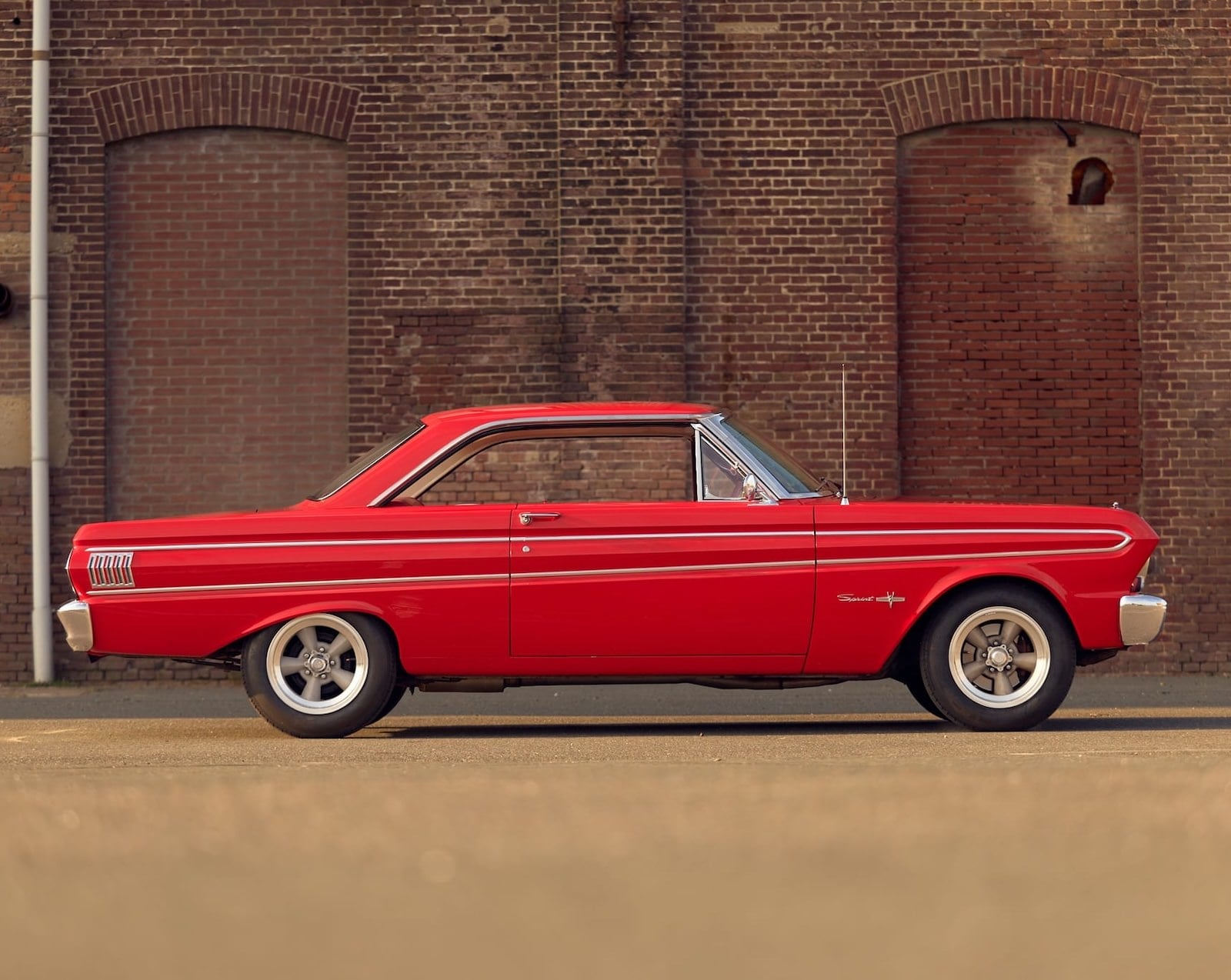
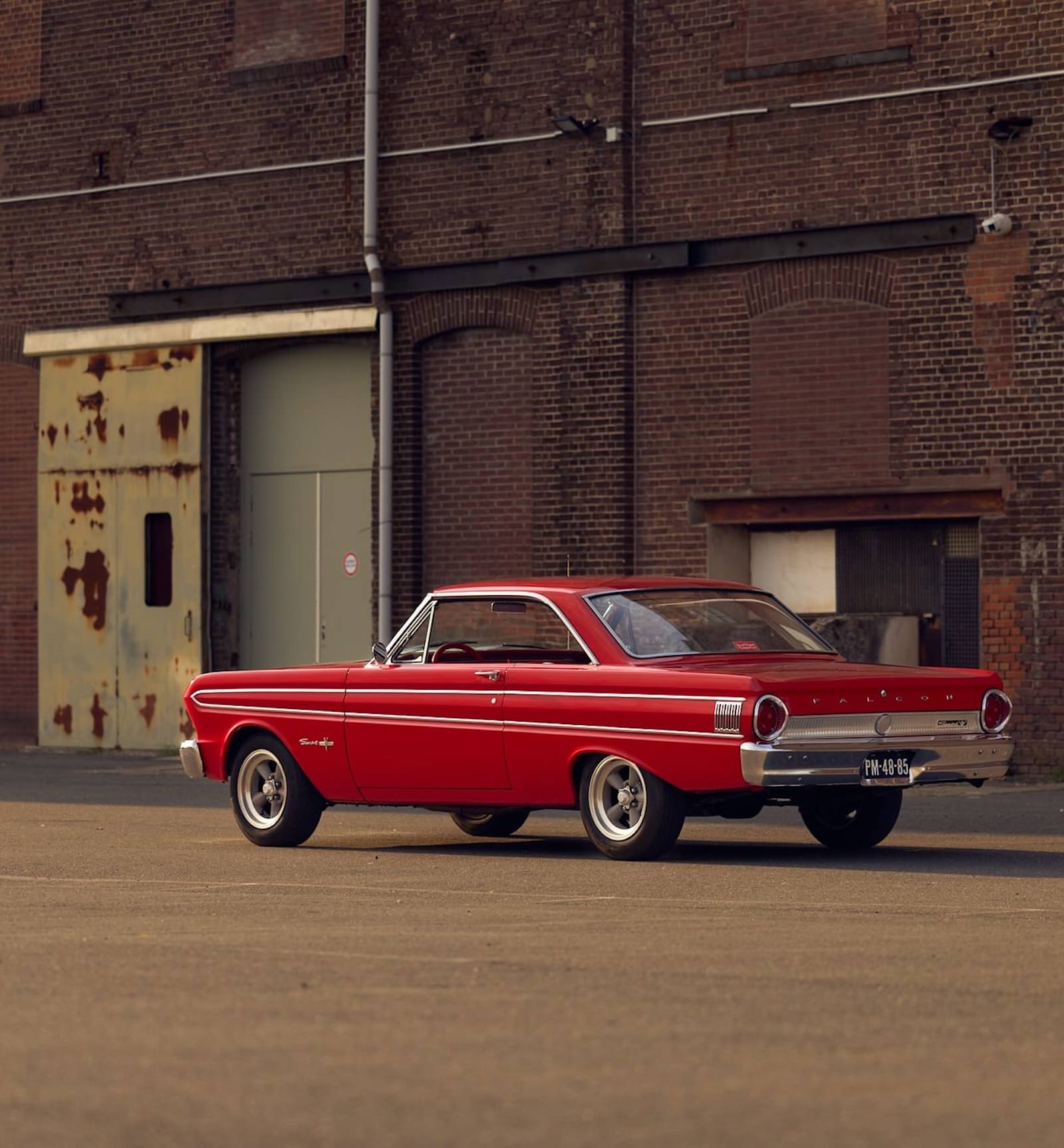
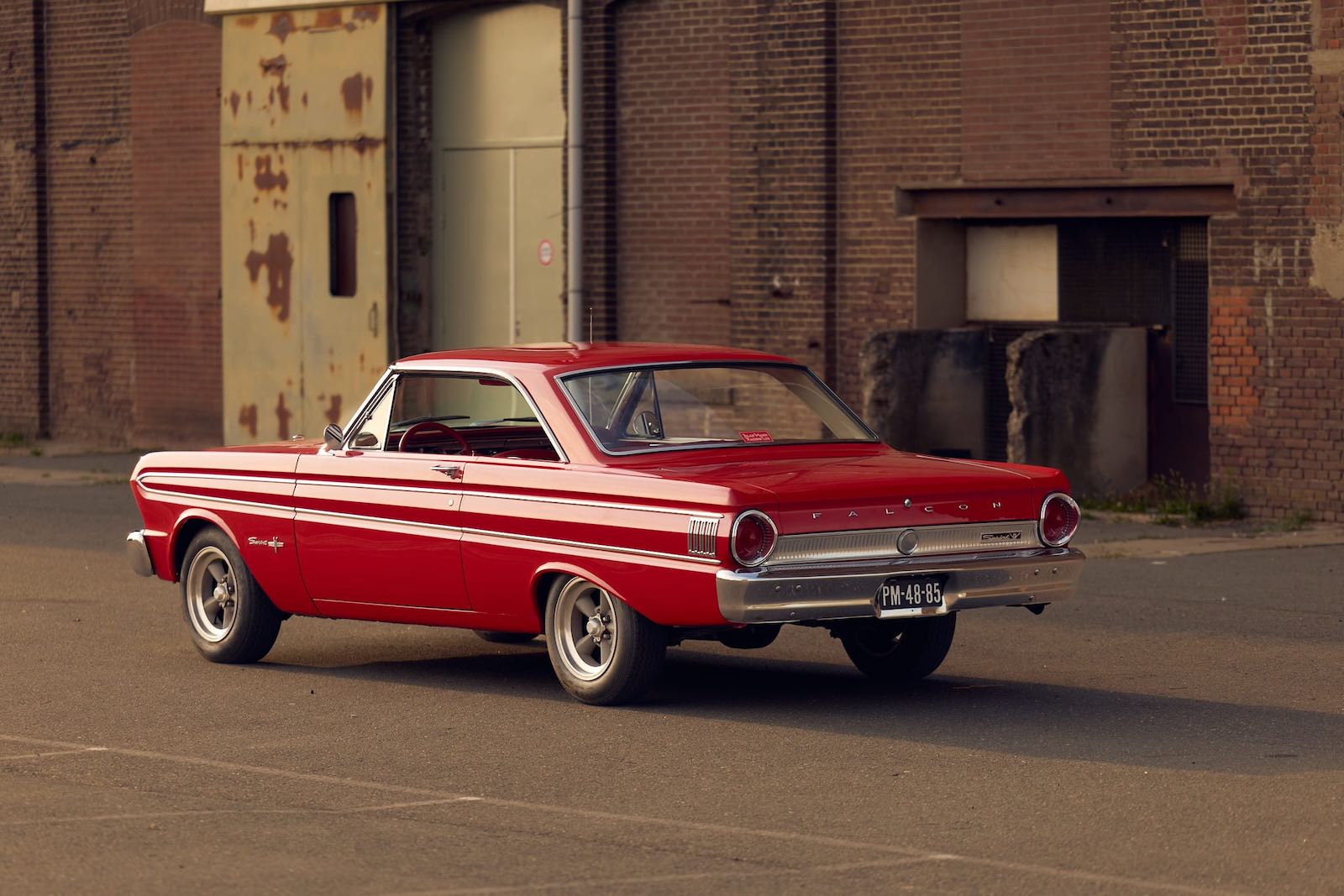
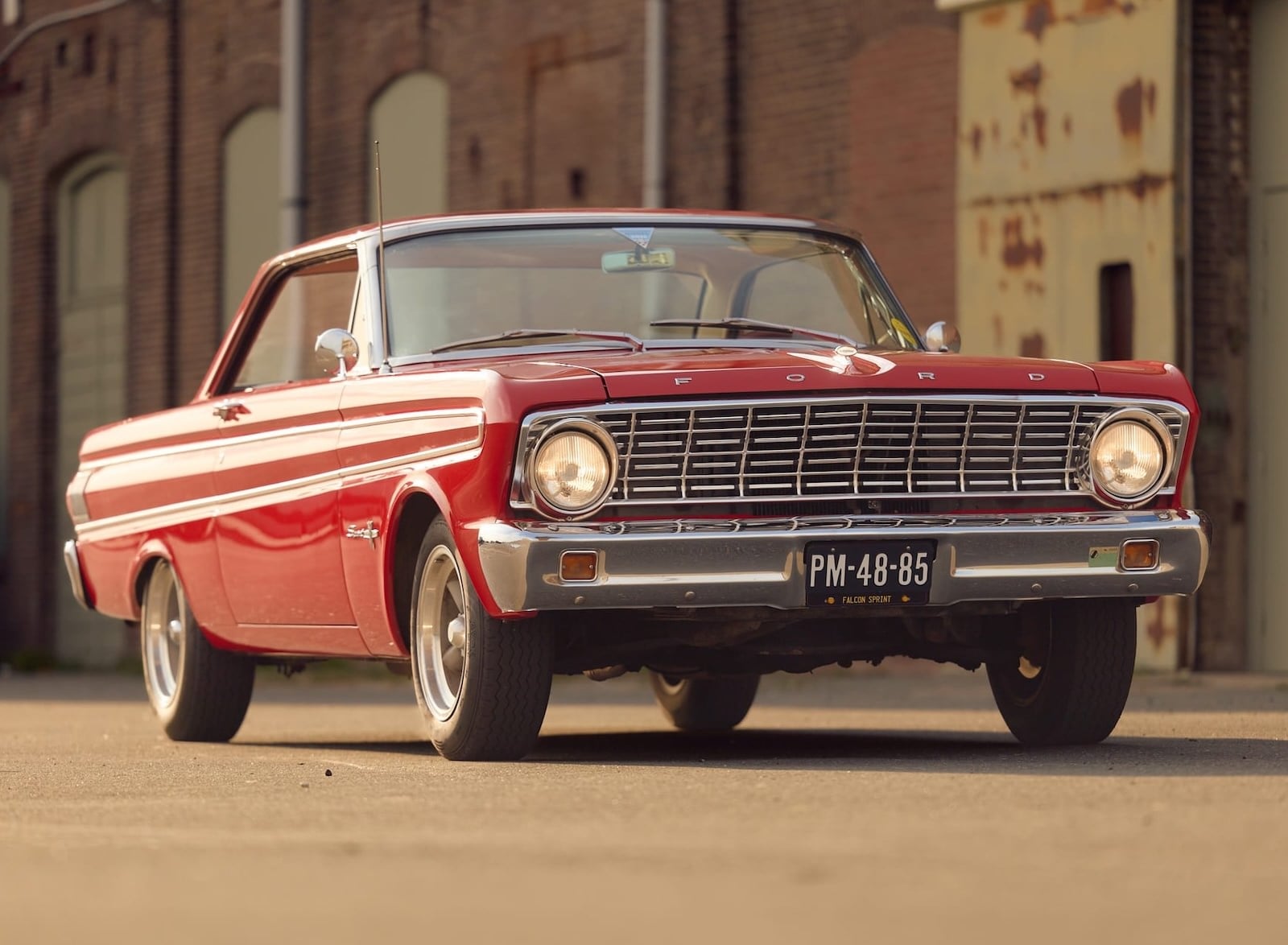
This is a 1964 Ford Falcon Sprint that was given a series of performance upgrades in-period by the legendary folks at Alan Mann Racing in Britain. It was originally destined to be a race car, but it was deemed too nice for the conversion, and converted to fast-road-spec instead.
The Ford Falcon Sprint was famously used as the platform on which the Ford Mustang was built, but it’s proven to be a highly capable car in its own right in both circuit racing and international rally – having come a very close second to the Mini Cooper S at the 1964 Monte Carlo Rally.
Fast Facts: Randy’s 1964 Ford Falcon Sprint 4-Speed
- The Ford Falcon was developed under Robert McNamara as an affordable American compact, debuting for 1960 with lightweight unit construction and six-cylinder engine. Ford progressively added more style and cylinders, eventual;y resulting in the Falcon Sprint for 1963, which combined the compact body with a 164 bhp 260 cubic inch V8.
- For 1964 the Falcon was given sharper styling and revised suspension, while the Sprint kept the 260 V8 as standard and offered 3-speed manual, 4-speed manual, or Fordomatic (automatic) transmissions. Ford built 18,108 Sprints that year, making 1964 the model’s high point before the Mustang arrived and quickly stole its thunder.
- The Sprint also developed a serious competition reputation in-period – Alan Mann Racing ran Ford’s European rally effort, and Bo Ljungfeldt set the fastest time on every special stage of the 1964 Monte Carlo Rally. Despite that pace, the handicap system favored Paddy Hopkirk’s smaller Mini Cooper S, which narrowly took the overall victory.
- The 1964 Sprint shown here was exported to Britain and modified in-period by Alan Mann Racing, although it was considered too good for full race conversion. It was given a 4-speed gearbox, upgraded suspension, front disc brakes, and some engine improvements. Now based in Europe, it’s competed in driving events and it crossed the Alps to Monza.
History Speedrun: The Ford Falcon Sprint
The Falcon was Robert McNamara’s car in the same way that the Mustang would later be Lee Iacocca’s. Ford approved the program in early 1958 for launch as a 1960 model, giving the engineers about 18 months to get the design nailed down and ready for production. This was a remarkably short timeline.
 The Falcon was Robert McNamara’s car in the way the Mustang would later be Lee Iacocca’s. Ford approved the program in early 1958 for launch as a 1960 model, giving the engineers about 18 months to get the design nailed down and ready for production. Image courtesy of Ford.
Known as a compact in the USA (but considered rather large elsewhere in the world), the Falcon was styled under the codename XK-Thunderbird and got its production name in April of 1958. McNamara’s original brief called for a 2,100 lb car with a four-cylinder engine and seats for five. Henry Ford II insisted on six-passenger seating, chief engineer Jack Hooven argued successfully for a six-cylinder engine, and the target weight climbed to 2,300 lbs.
What emerged from this rapid development program was a car that would become the foundation of an icon. It had unit construction (rather than the more traditional body-on-frame), a 109.5 inch wheelbase, coil springs at the front and leaf springs at the rear, drum brakes at all four corners, and a new 144 cubic inch six making 90 bhp.
The creases in the steel down the body sides were structural – stiffening the panels so the steel could be thinner for a lower weight with no loss of strength. The base price was $1,912, that more than $250 below the cheapest full-size Ford.
Falcon sales reached roughly 435,000 for 1960 and climbed in 1961, accounting for about a quarter of Ford Division’s volume. McNamara had, perhaps a little over ambitiously, forecast more than 600,000 sales, a figure the Falcon never came close to. He was promoted to company president around the time the 1961 models reached showrooms and resigned less than eight weeks later to join the Kennedy administration. His name is now far better remembered for his time in politics than his time in Michigan.
Iacocca took over Ford Division and immediately started adding things McNamara had left out. The Futura arrived late in the 1961 model year at $248 above a plain two-door sedan, bringing carpeting, extra sound deadening, a center console and Thunderbird-style bucket seats. A convertible followed for 1963, and in late January 1963, as one of a group of “1963½” models Ford launched mid-season, came the Sprint. This is the one most collectors are chasing today.
The Ford Falcon Sprint – A Surprise Rally Car
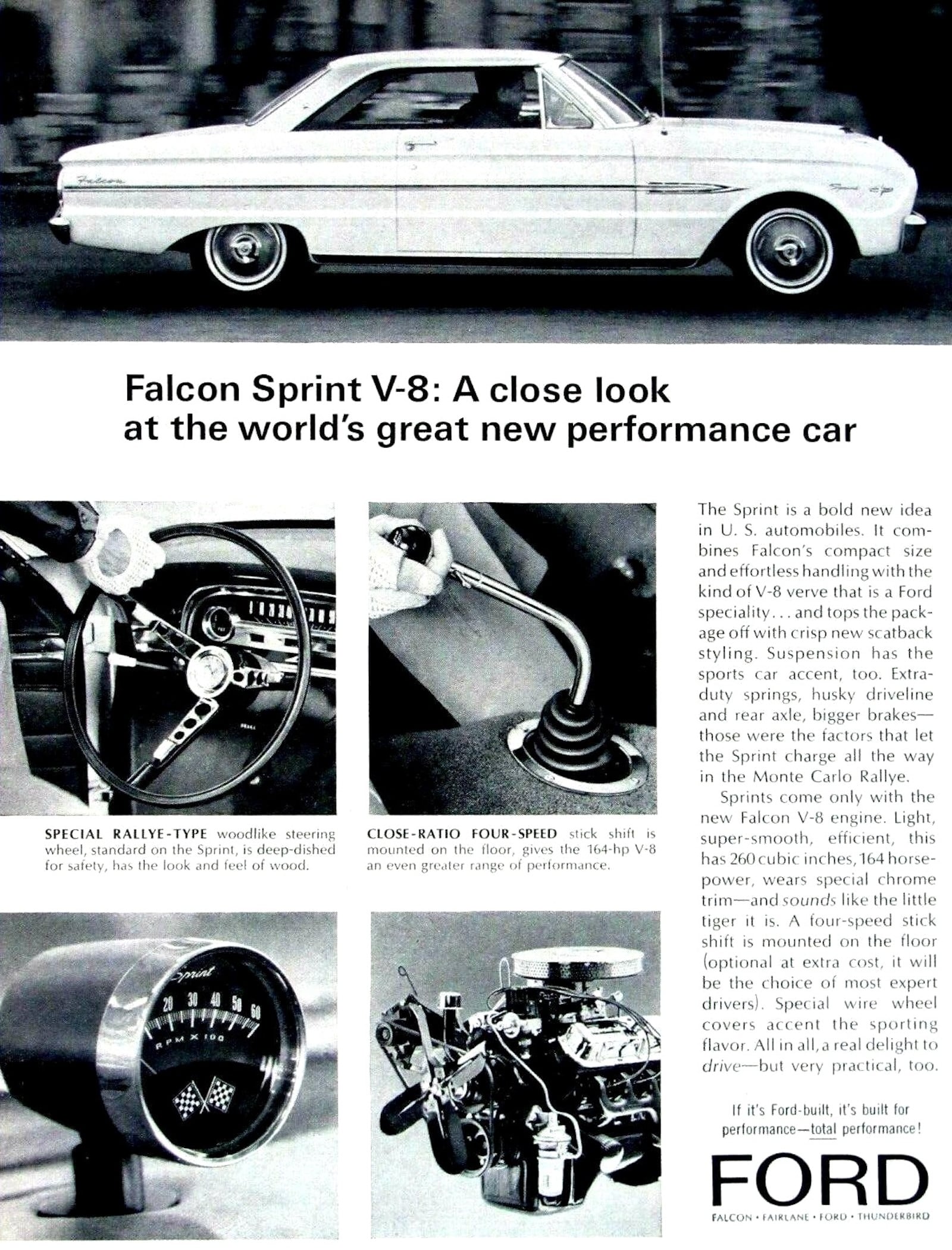
The Ford Falcon Sprint took the 260 Challenger V8 from the mid-size Fairlane, rated at 164 bhp with a two-barrel carburetor, and made it standard equipment in a Falcon – hardtop or convertible. The body and suspension were stiffened to cope, 10 inch drums were bolted up to all four wheels, and five-lug hubs replaced the four-lug wheels used on six-cylinder Falcons.
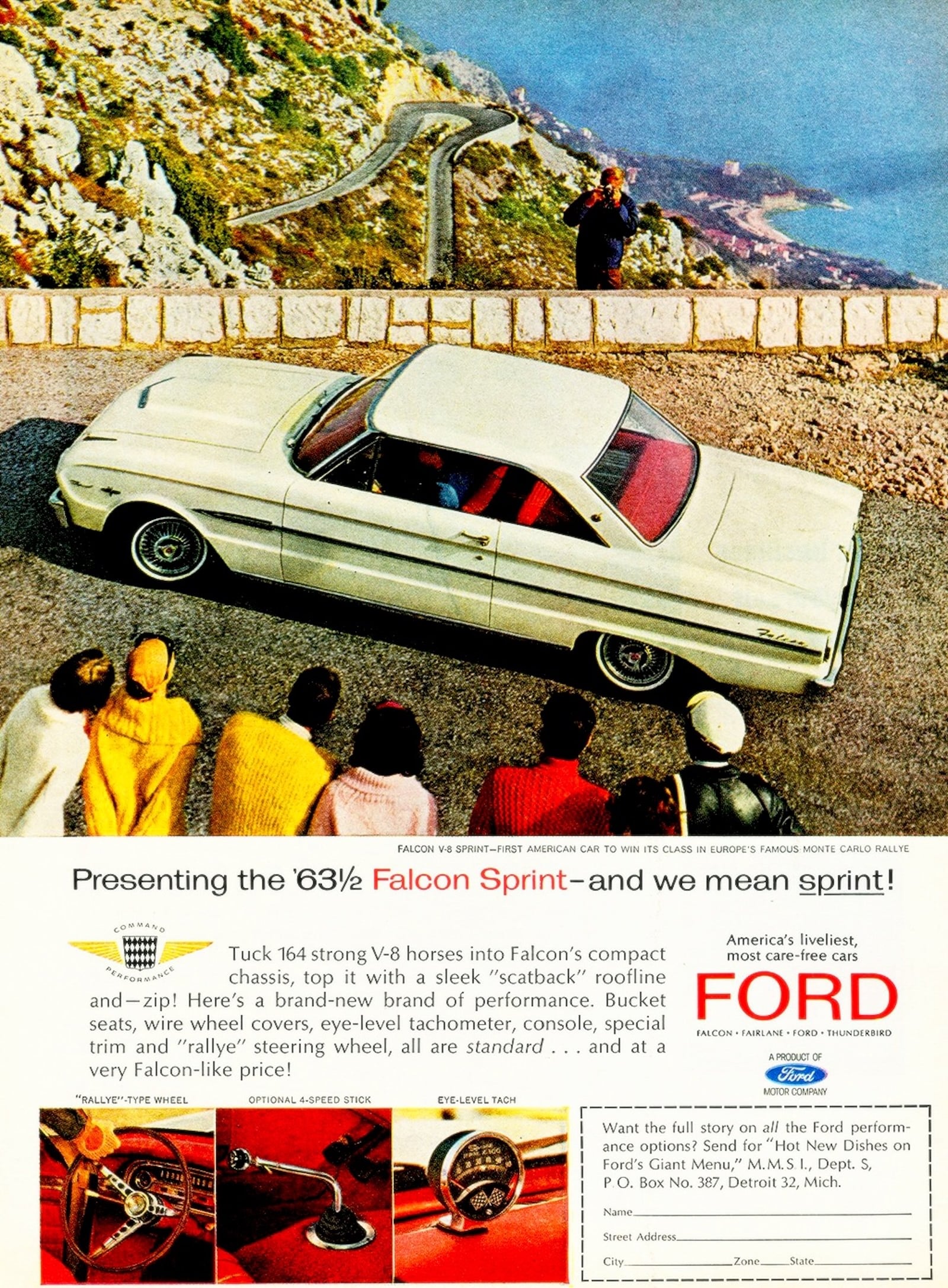
The deep creases in the steel down the body sides were structural – stiffening the panels so the steel could be thinner for a lower weight with no loss of strength. The base price was $1,912, that more than $250 below the cheapest full-size Ford. Image courtesy of Ford.
Ford’s own advertising copy sold it on noise as much as speed, promising a “unique performance sound'” from a special throaty muffler and a 390 Police “power hum” air cleaner. Every 1963 Sprint got bucket seats, a dash-mounted tachometer, chrome engine dress-up and wire wheel covers. Ford built 10,479 Sprint hardtops for the shortened first season, and around 4,600 drop tops.
The 1964 Falcon Sprint Arrives
The Falcon was re-bodied for 1964 on the same 109.5 inch wheelbase, the new car grew slightly in length, width, and weight. The softer shape of 1960 gave way to chiseled body sides, a convex feature line and a forward-slanted grille. Underneath came a wider rear track, longer and wider rear springs, and revised front suspension.
The model range now included four engines and four transmissions. The 144 six was down to 85 bhp by then, the 170 Special Six made 101 bhp, and the 200 Special Six, new to the Falcon line, made 116 bhp. That 200 was available across the line except in the Sprint, which kept the 260 as its only engine.
The 289 didn’t reach the Falcon until the 1965 model year, though some have argued it may have been available as a special order item part way through the 1964 model year. We looked into this and it’s hard to track down, but there were no definitive Ford catalogues that could confirm it. Well, not that we could find.
A 1964 Sprint hardtop measured 181.6 inches long with a curb weight of 2,935 lbs. The convertible got a little more porky, and the weight climbed to 3,130 lbs. Ford offered three transmissions for the Sprint – the synchronized 3-speed as standard, a 4-speed manual, or a Fordomatic automatic box.
Ford built 13,830 Sprint hardtops and 4,278 Sprint convertibles for 1964, a total of 18,108 out of roughly ~300,000 Falcons that rolled out of the factory that year.
Then Came Monte Carlo
Ford entered a fully funded three-car Falcon team in the 1963 Monte Carlo Rally under competition manager George Merwin and team manager Jeffery Uren, with Holman & Moody in Charlotte preparing the cars. Bo Ljungfeldt and Gunnar Haggbom took car 223, Peter Jopp and Trant Jarman car 221, and Anne Hall and Margaret MacKenzie car 207 in the Coupe des Dames.
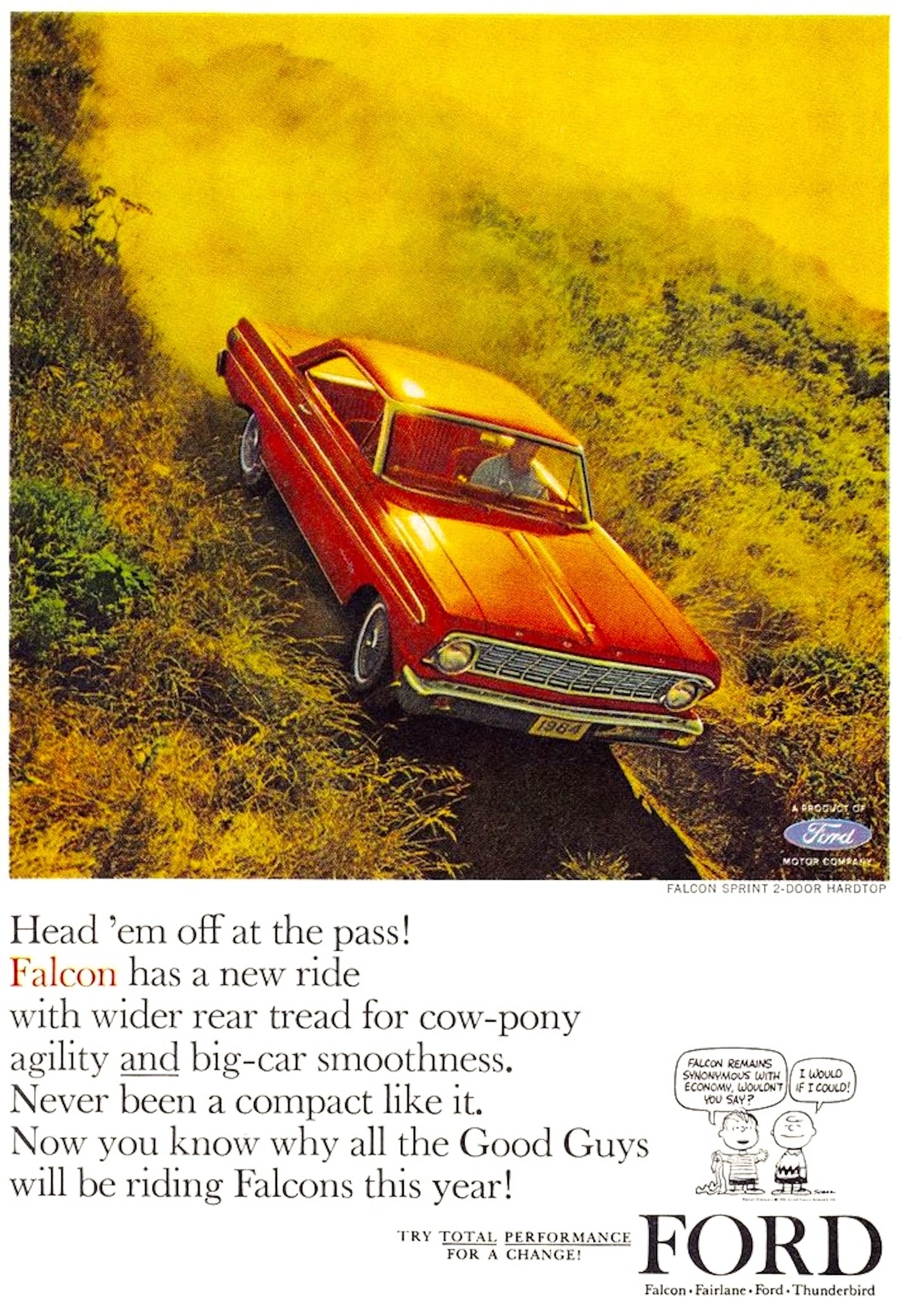
The Ford Falcon Sprint took the 260 Challenger V8 from the mid-size Fairlane, rated at 164 bhp with a two-barrel carburetor, and made it standard equipment in a Falcon – hardtop or convertible. Image courtesy of Ford.
A jam of stranded cars on a snow-choked hill road near Lodève put Hall and MacKenzie out of the rally for missing the one-hour reporting limit, and cost Jopp 13 penalty minutes. Ljungfeldt lost only a minute there. A tire let go at speed the next day, and then the clutch failed because a mechanic had left out a cotter key. He reached Chambéry 31 minutes down and finished 43rd of 296 starters – despite this he still set the best time among all finishers in every one of the six special test sections.
Having seen what the Falcon Sprint could do in Monte Carlo, the effort grew to eight cars in 1964, all lightened with fiberglass panels and aluminum bumpers. Holman & Moody replaced the 260s with 289 V8s and fitted Borg-Warner 4-speeds. Alan Mann Racing ran the cars in Europe.
Ljungfeldt (now partnered with Fergus Sager in car 49) set the fastest time on every special stage of the rally. But he still lost. The Monte Carlo handicap formula of the period rewarded smaller cars by requiring bigger ones to go proportionally faster, and after the Col de Turini stage that the British press called the “Night of the Long Knives,” Paddy Hopkirk’s Mini Cooper S was 17 seconds behind the Falcon on the road and ahead of it on points.
Ljungfeldt won the closing three-lap test on the Monaco Grand Prix circuit, the last year that test was run, with Hopkirk half a minute back. The rally was scored on penalty points, the fewest points wins, and the final classification gave Hopkirk 2,536.2 to Ljungfeldt’s 2,566.7. It was an extremely close finish, but the Mini won out.
The Mustang Debuts
When the Ford Mustang made its debut for the 1965 model year, it was, perhaps unsurprisingly, based on a modified version of the Ford Falcon unibody platform. The two cars might have shared no sheet metal, but what the Mustang did take was the Falcon’s suspension, brakes, steering, engines, transmissions, and instrument cluster, with some drivetrain parts from the Fairlane and, on the quicker cars, from the full-size Fords.
The connection to the Sprint version of the Falcon is a little closer than just some parts-sharing. The early Mustang’s base V8 was the Sprint’s 164 bhp 260, until after August of 1964 when Ford replaced it with the 200 bhp 289 two-barrel. The Mustang interior borrowed from the Futura and Sprint catalogue, with bucket seats, a floor shifter, full carpeting and wheel covers.
Reviewers noticed these similarities and some in the enthusiast press were a little cool on the Mustang at launch, they read it as little more than a restyled Falcon Futura Sprint.
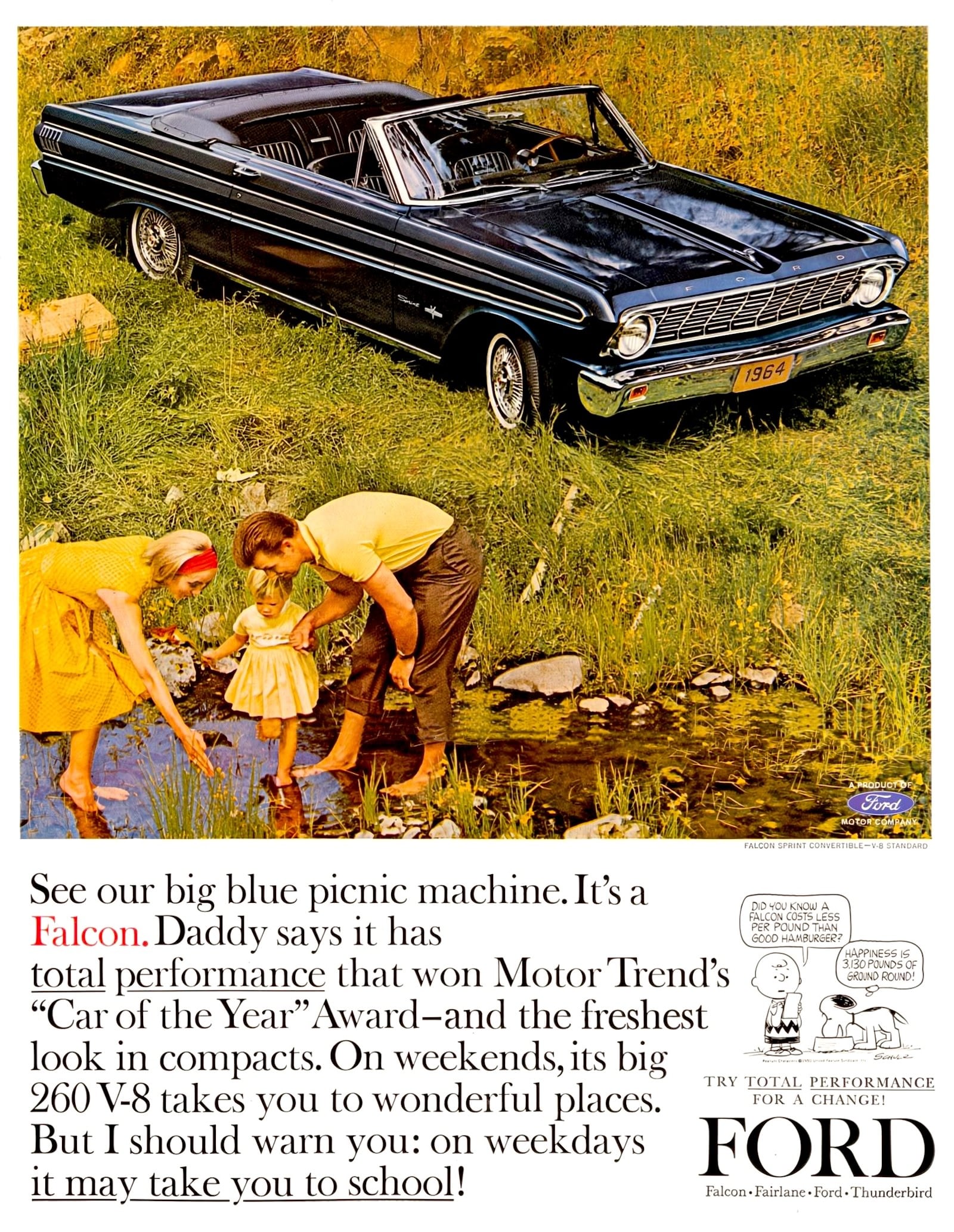
A 1964 Sprint hardtop measured 181.6 inches long with a curb weight of 2,935 lbs. The convertible got a little more porky, and the weight climbed to 3,130 lbs. Ford offered three transmissions for the Sprint – the synchronized 3-speed as standard, a 4-speed manual, or a Fordomatic automatic box. Image courtesy of Ford.
Ford management approved the Mustang’s exterior design in September of 1962, four months before the Sprint reached the public, so the two programs had overlapped closely. The Sprint’s real contribution was demonstrating that Falcon hardware would take a V8 and a heavy right foot, and supplying the shopping list of bucket seats, floor shift and badges that the Mustang would sell far more successfully.
The Sprint had also shown just how successful the platform could be, something the Mustang would dial up to 11, thanks in no small part to Carroll Shelby and his team in California.
The Mustang went on sale in April of 1964, in the middle of the Sprint’s best year, and it sold to basically the same exact customer base. Sprint production collapsed to fewer than 3,000 hardtops and about 300 convertibles for 1965, unsurprisingly Ford dropped the model. Counting the Mustang, the Maverick, the Comets, and the Granada, the North American Falcon platform eventually accounted for more than 11 million cars.
The 1964 Ford Falcon Sprint Shown Here
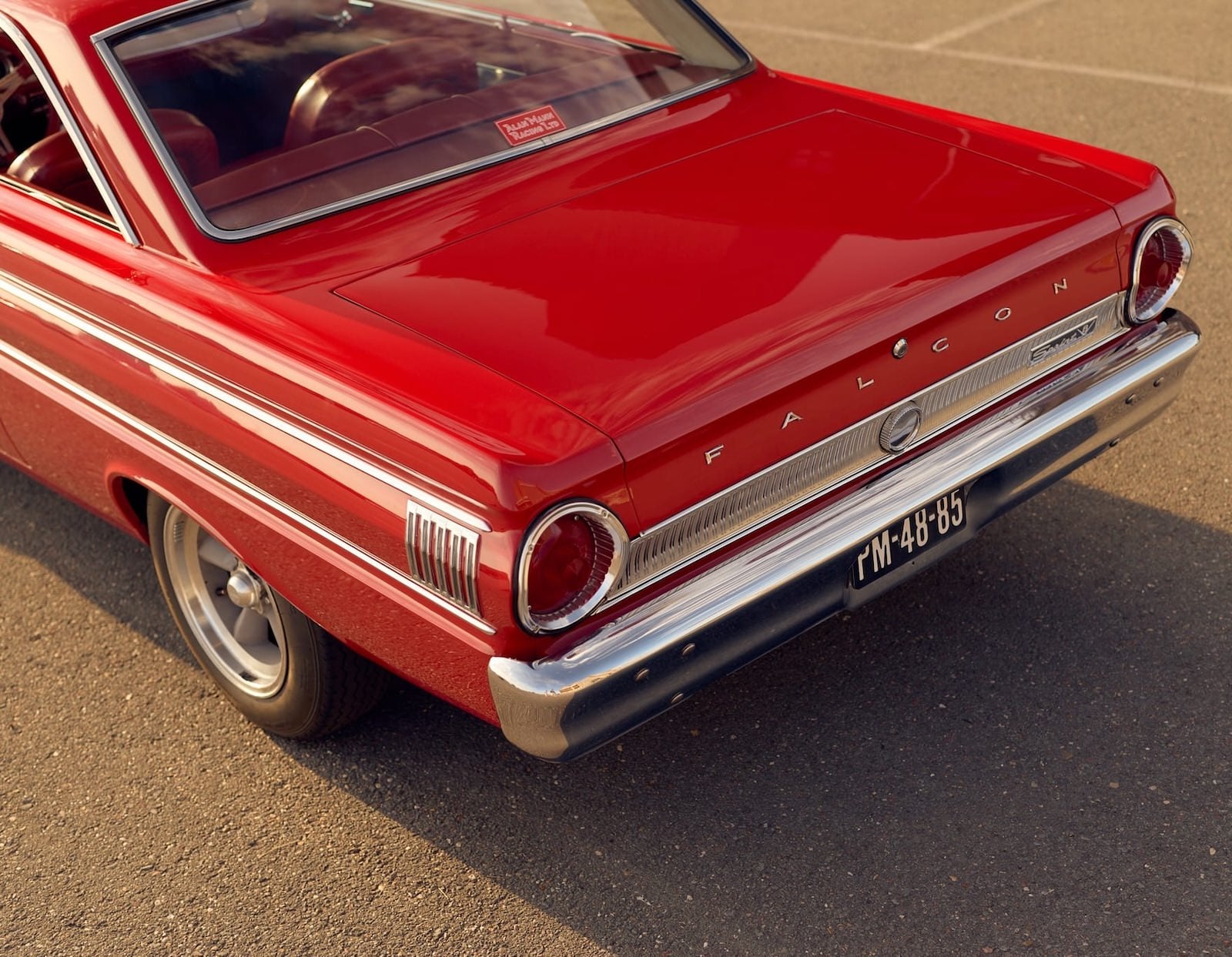
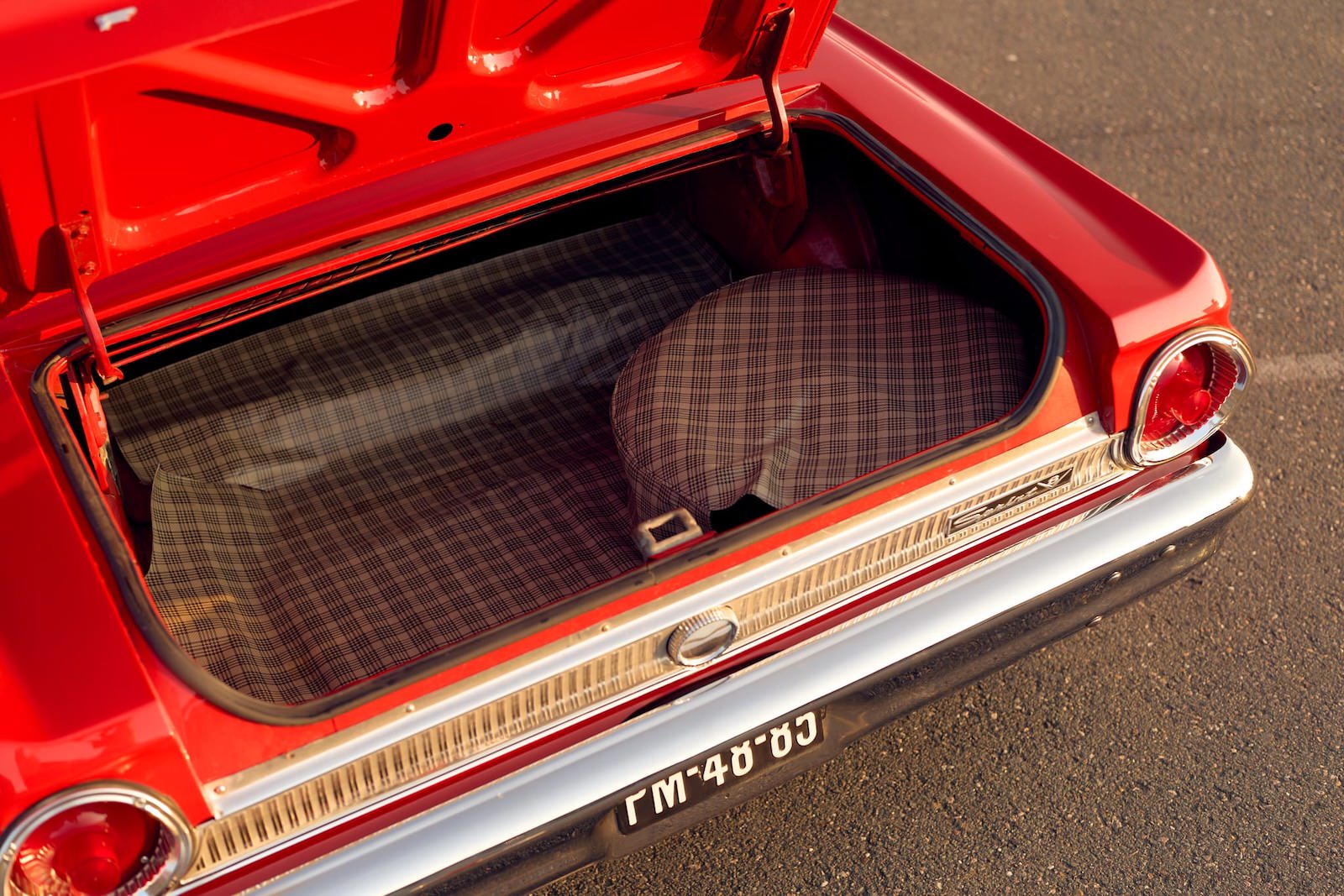
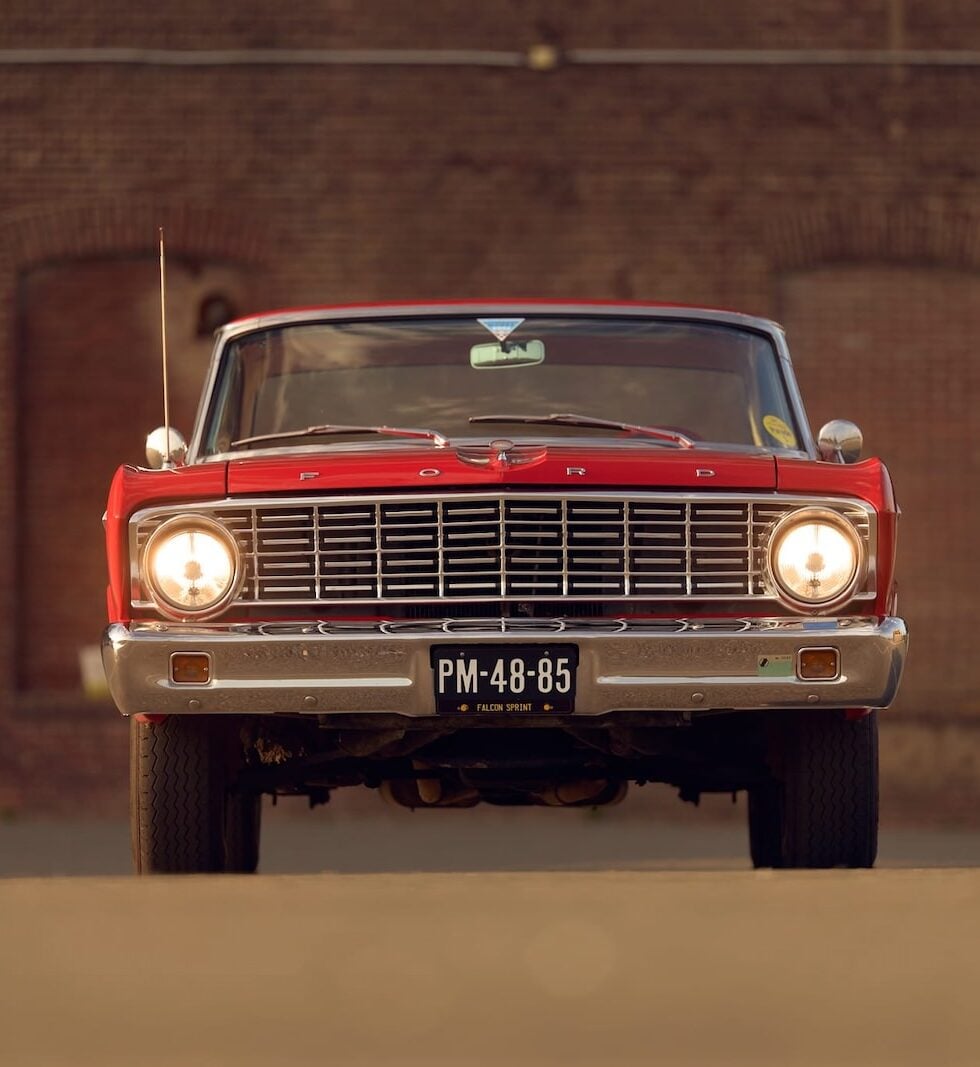
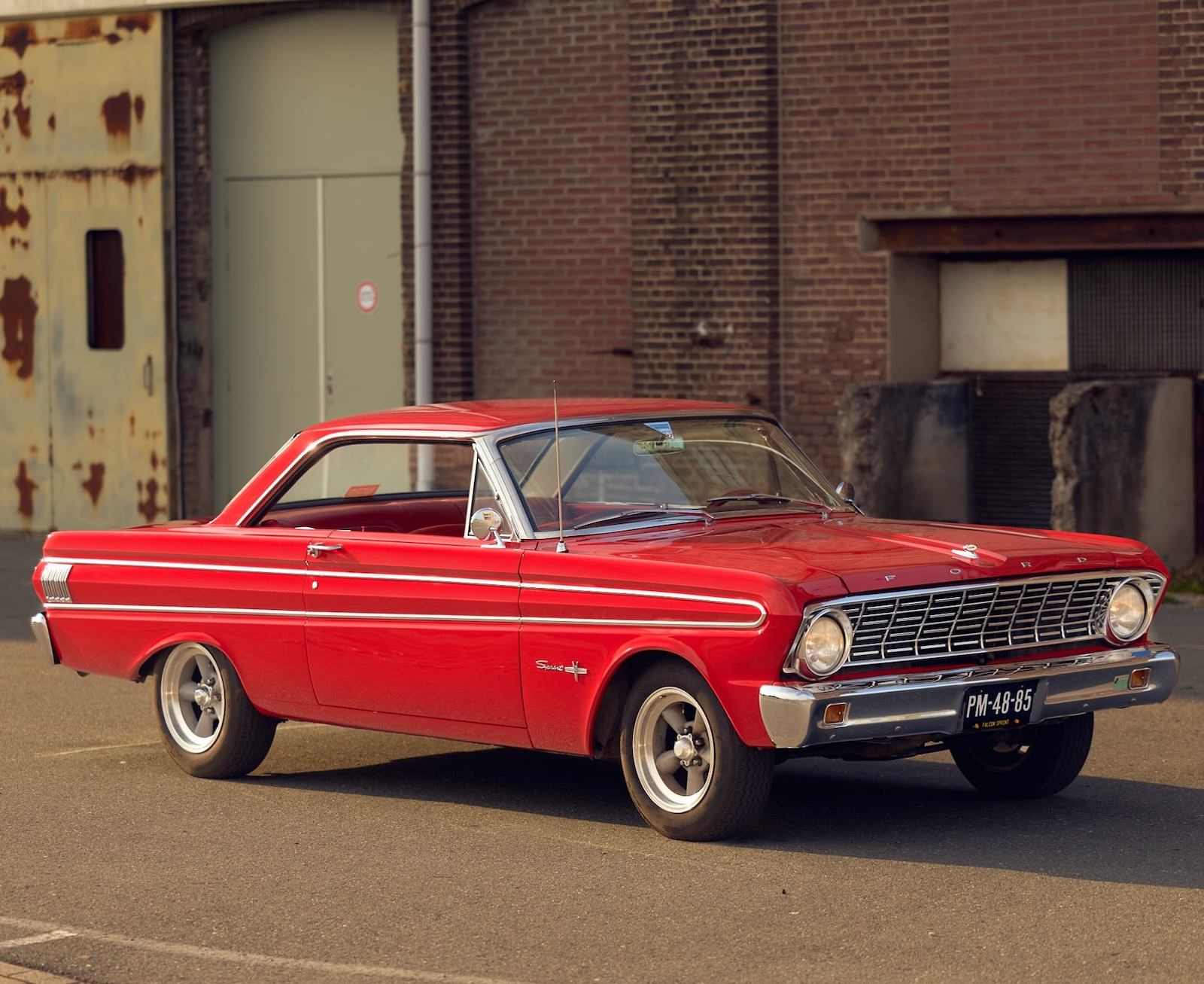
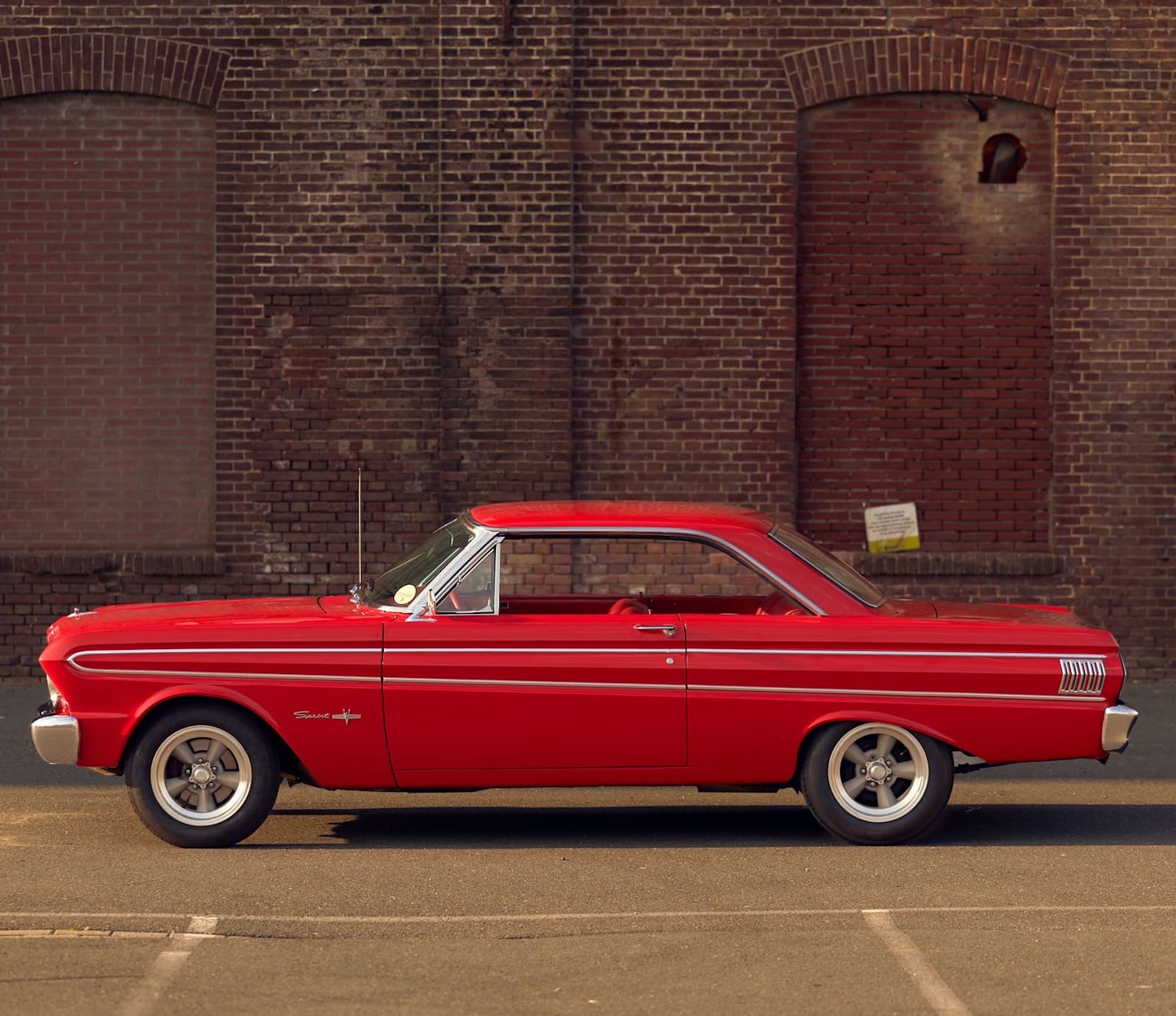
This 1964 Ford Falcon Sprint is a San Jose-built two-door hardtop with an unusually interesting European history – it was exported to England and modified by Alan Mann Racing in-period, reportedly with the intention of turning it into a race car.
The Falcon was apparently considered too good to cut up for a full race conversion, so it kept much of its standard Sprint character while receiving a useful collection of performance upgrades.
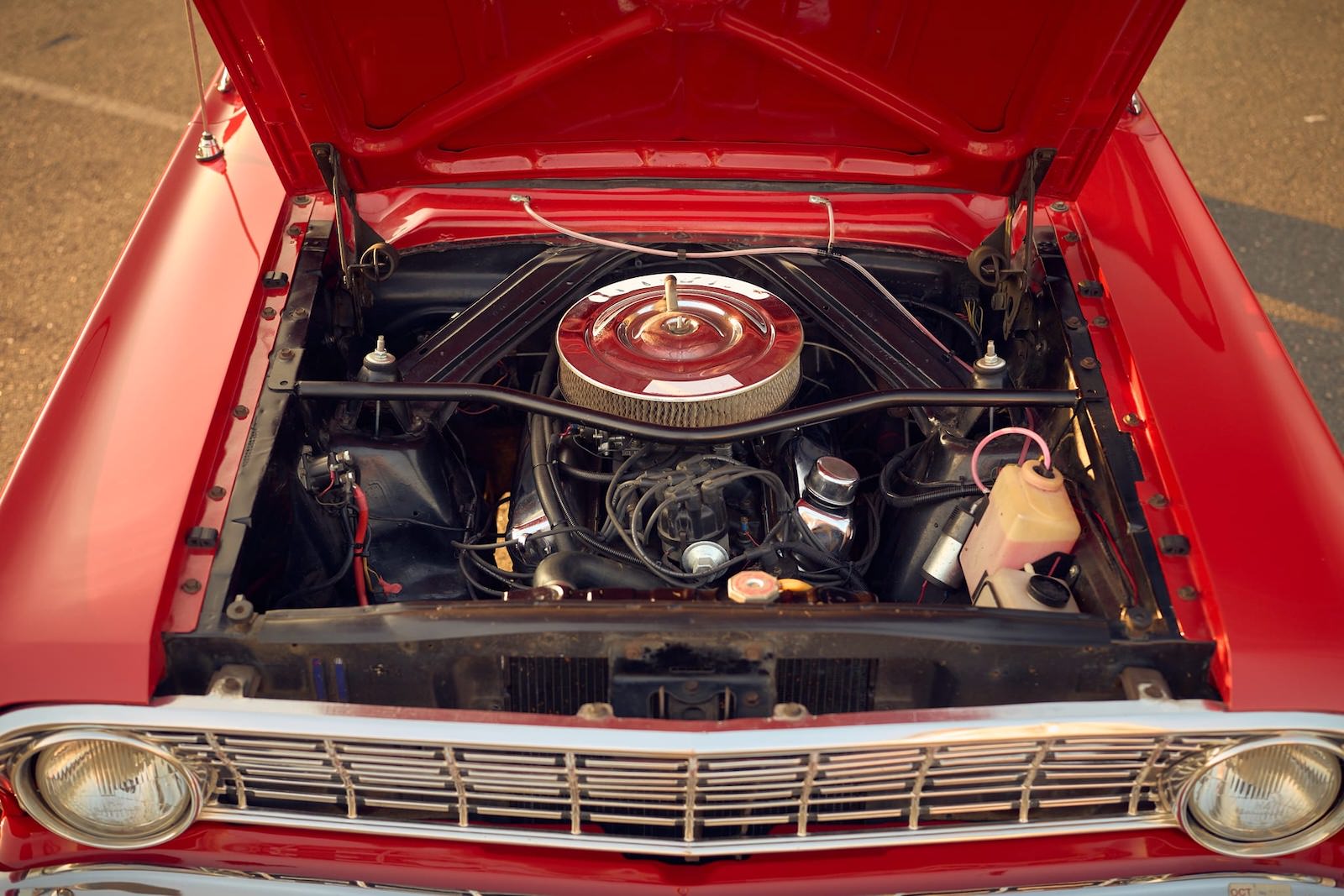
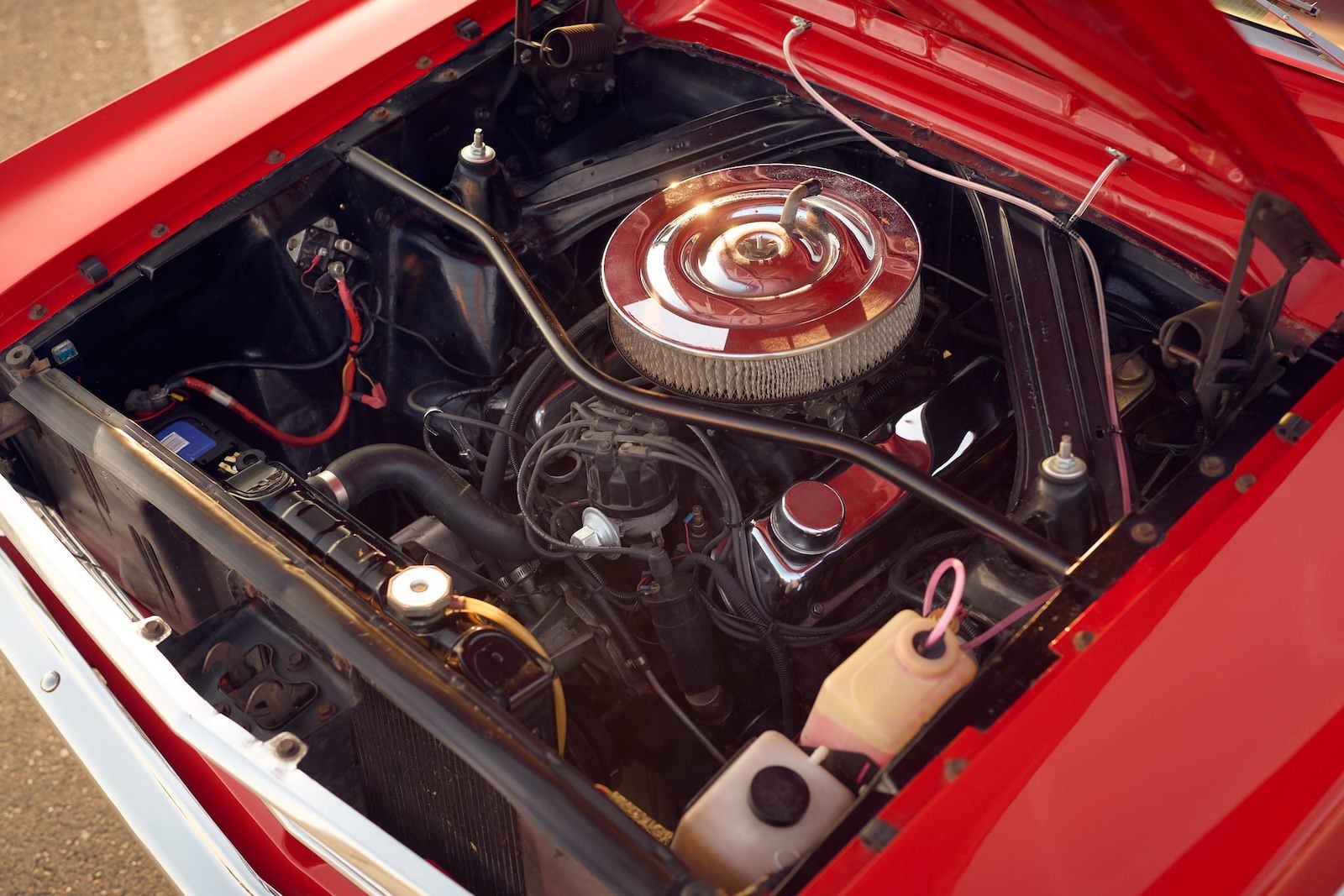
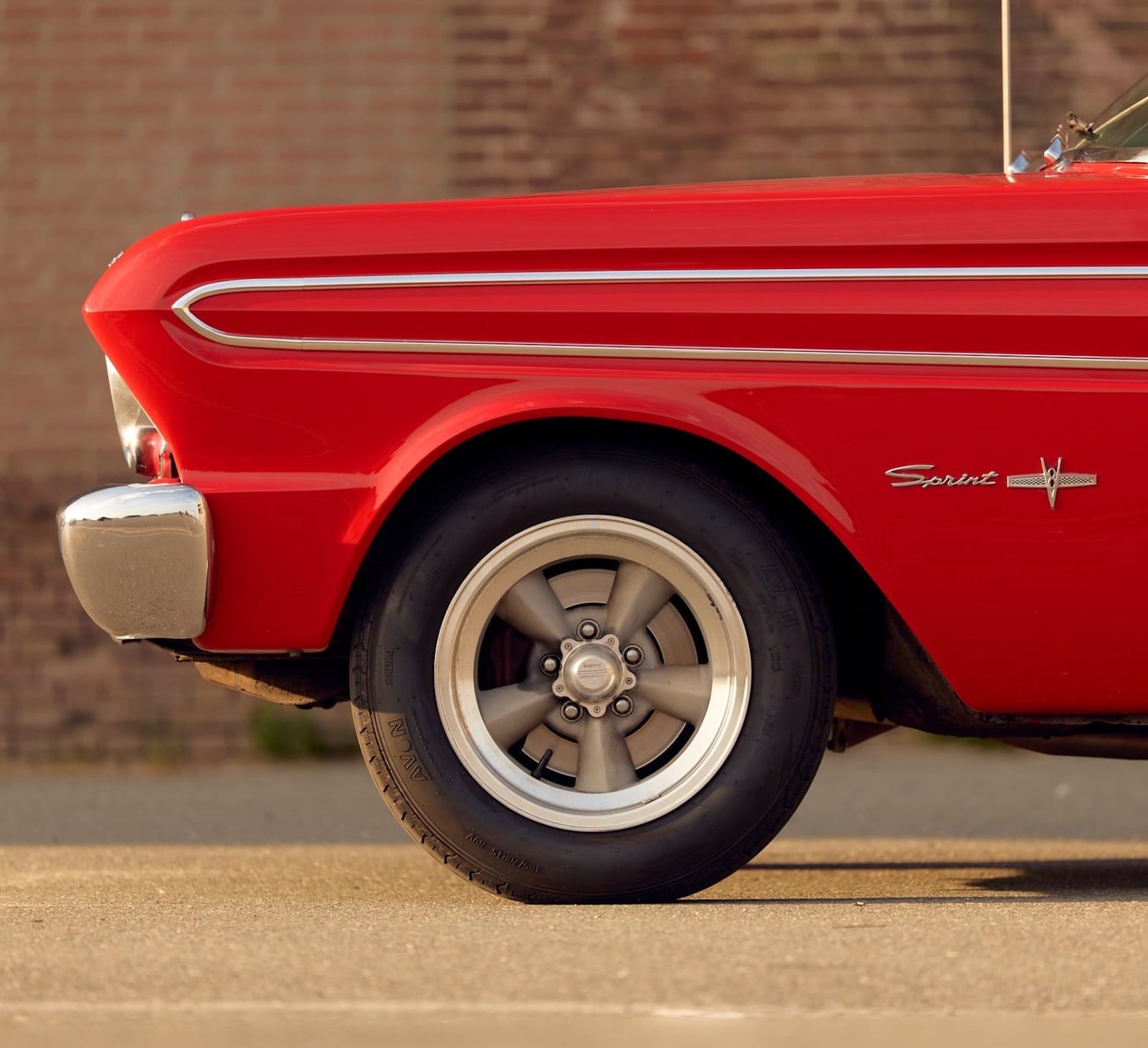
The car still has its original-style 260 cubic inch V8, now fitted with an Edelbrock Performer RPM intake manifold and a 600 cfm four-barrel carburetor, with Flowmaster mufflers and a dual exhaust. Although it left the factory with the optional Ford-O-Matic automatic gearbox, Alan Mann Racing converted it to a Borg Warner T-10 4-speed manual with a Hurst shifter. More recently in 2023, the gearbox was rebuilt and fitted with a billet-aluminum mid-plate.
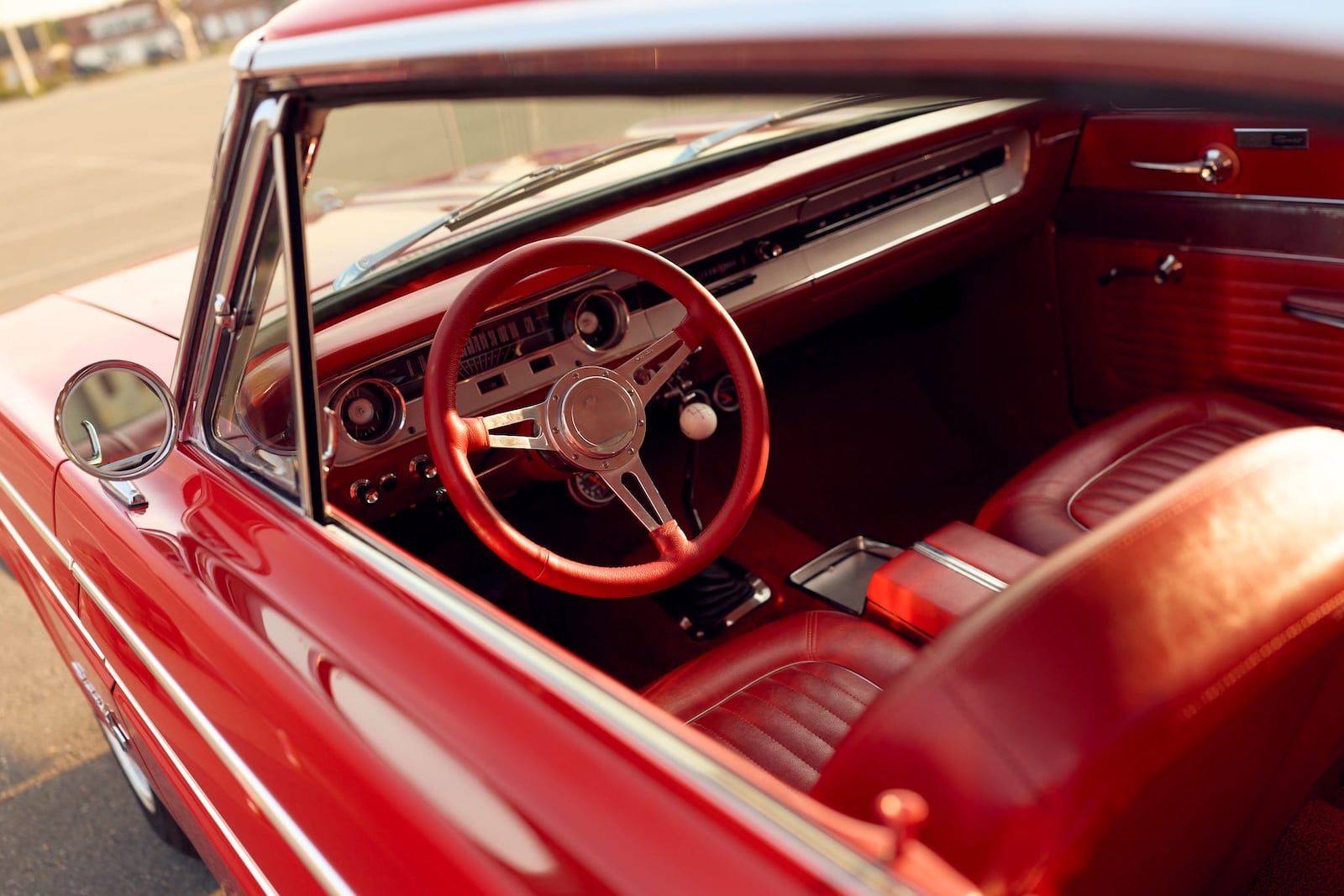
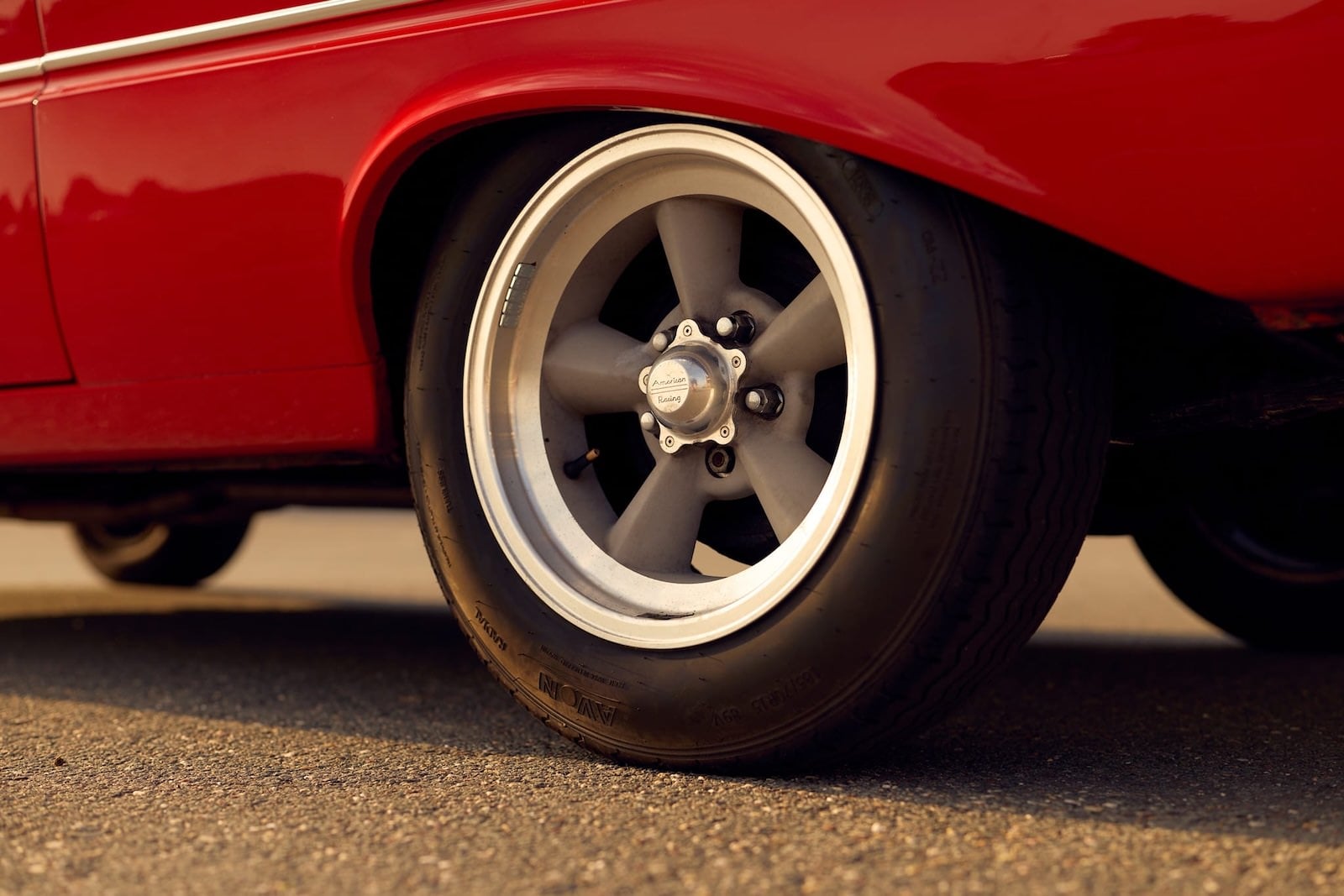
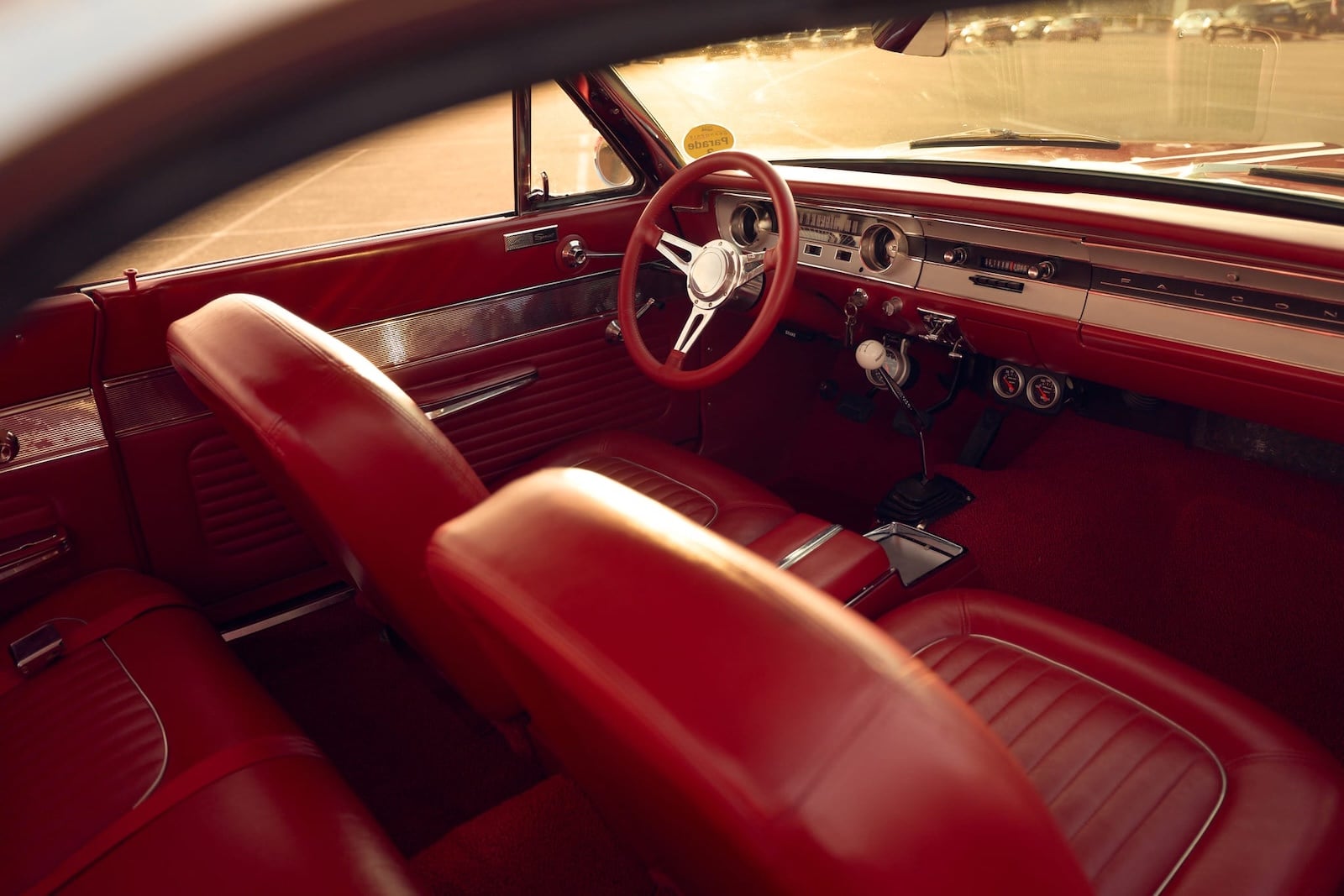
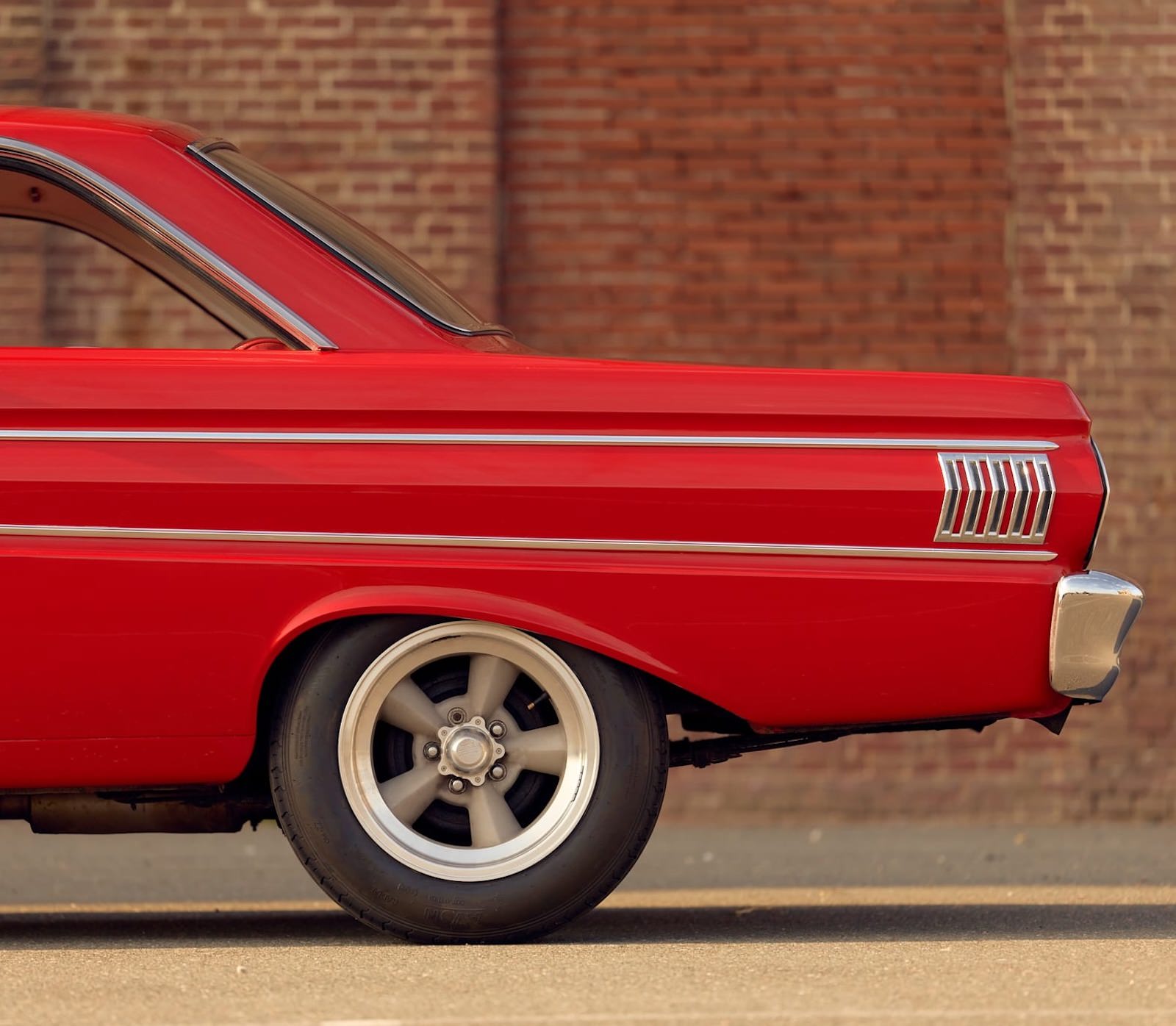
The chassis was also upgraded in England with 1965-specification front disc brakes, stiffer springs, Bilstein dampers, 15-inch American Racing Torq Thrust wheels, and other suspension work. It now runs 185/70 Avon CR6ZZ tires after wider BFGoodrich rubber proved prone to rubbing. Other additions include a Monte Carlo engine-bay brace, H4 headlights, auxiliary gauges, and a Shelby-style steering wheel – although the original wheel accompanies the car.
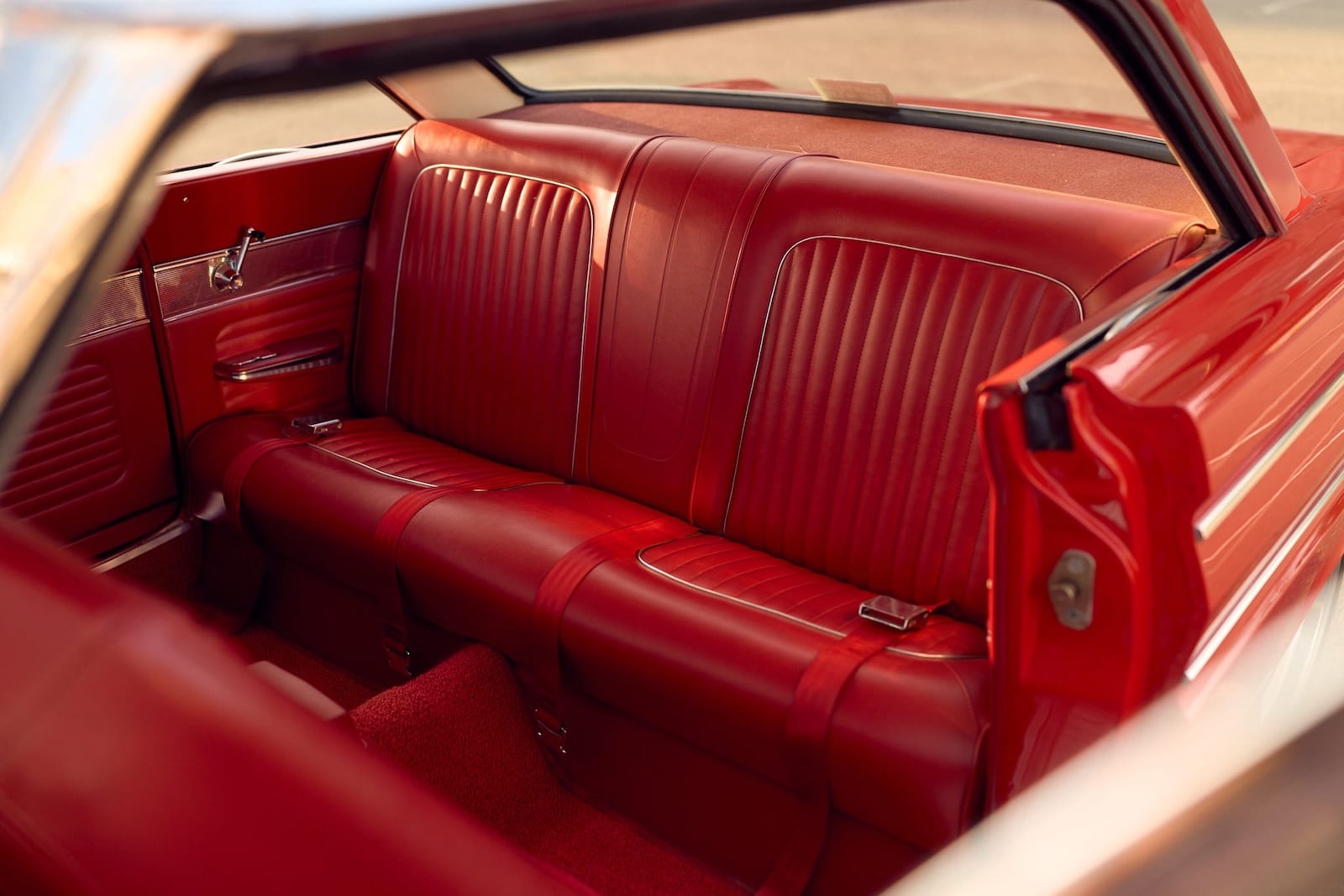
This Falcon was originally painted in Rangoon Red, it’s been repainted at some point but retains much of the Sprint-specific interior equipment, including bucket seats, a center console, full carpeting, tachometer, and Thunderbird-style floating mirror.
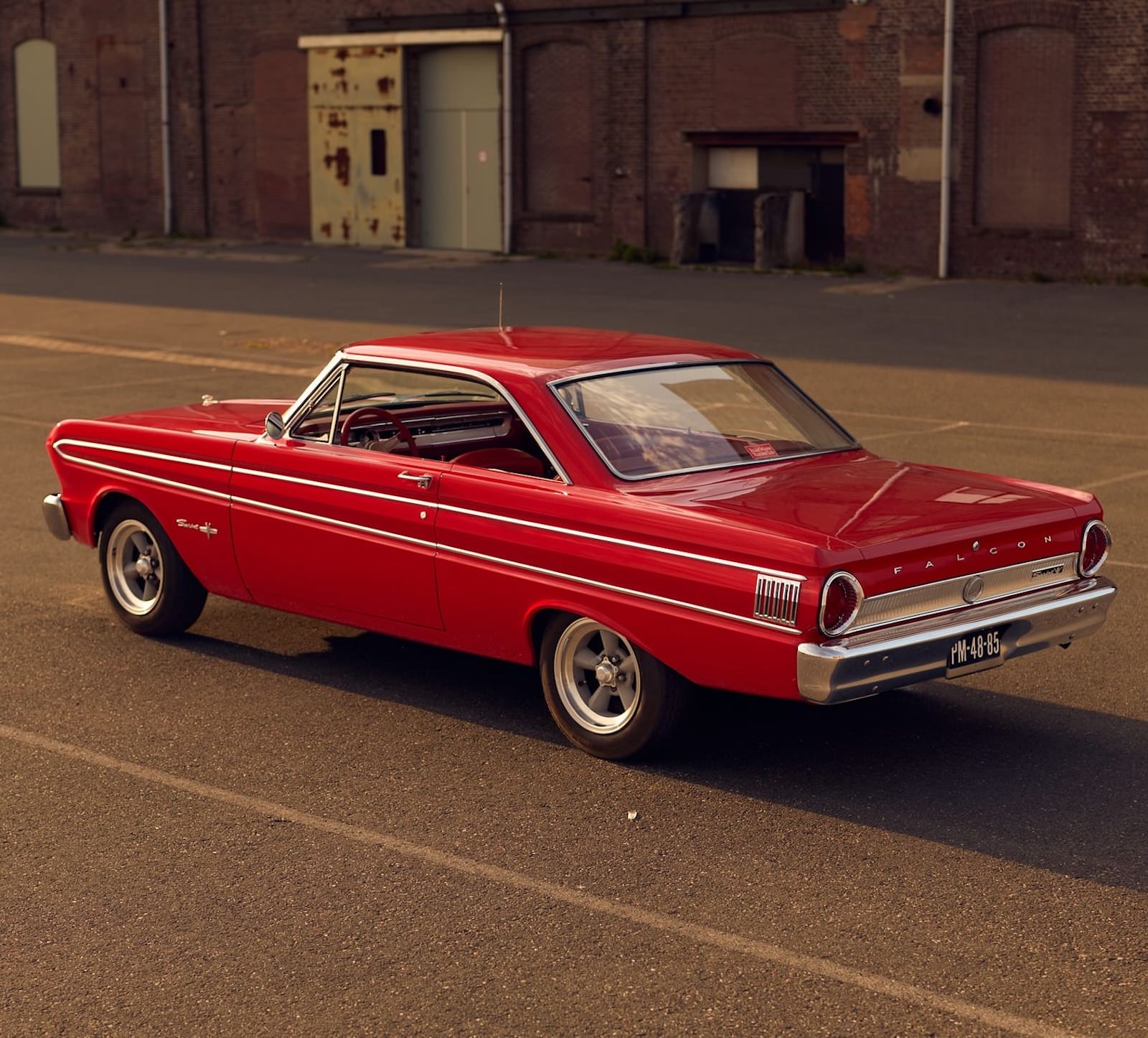
This is a 1964 Ford Falcon Sprint that was given a series of performance upgrades in-period by the legendary folks at Alan Mann Racing in Britain. It was originally destined to be a race car, but it was deemed too nice for the conversion, and converted to fast-road-spec instead.
After moving to the Netherlands in 2022 it was used extensively in events including the 12in12 and Alpine Challenge. BaT co-founder Randy Nonnenberg bought it in 2024 and subsequently drove it across the Alps from Munich to Monza, including track running at Monza. It was also featured in Octane magazine in April 2026.
It’s now being offered for sale on Bring a Trailer (fittingly) out of Amsterdam in the Netherlands and you can visit the listing here if you’d like to read more about it or register to bid.
Images courtesy of Bring a Trailer

Articles that Ben Branch has written have been covered on CNN, Popular Mechanics, Smithsonian Magazine, Road & Track Magazine, the official Pinterest blog, the official eBay Motors blog, BuzzFeed, Autoweek Magazine, Wired Magazine, Autoblog, Gear Patrol, Jalopnik, The Verge, and many more.
Silodrome was founded by Ben back in 2010, in the years since the site has grown to become a world leader in the alternative and vintage motoring sector, with well over a million monthly readers from around the world and many hundreds of thousands of followers on social media.