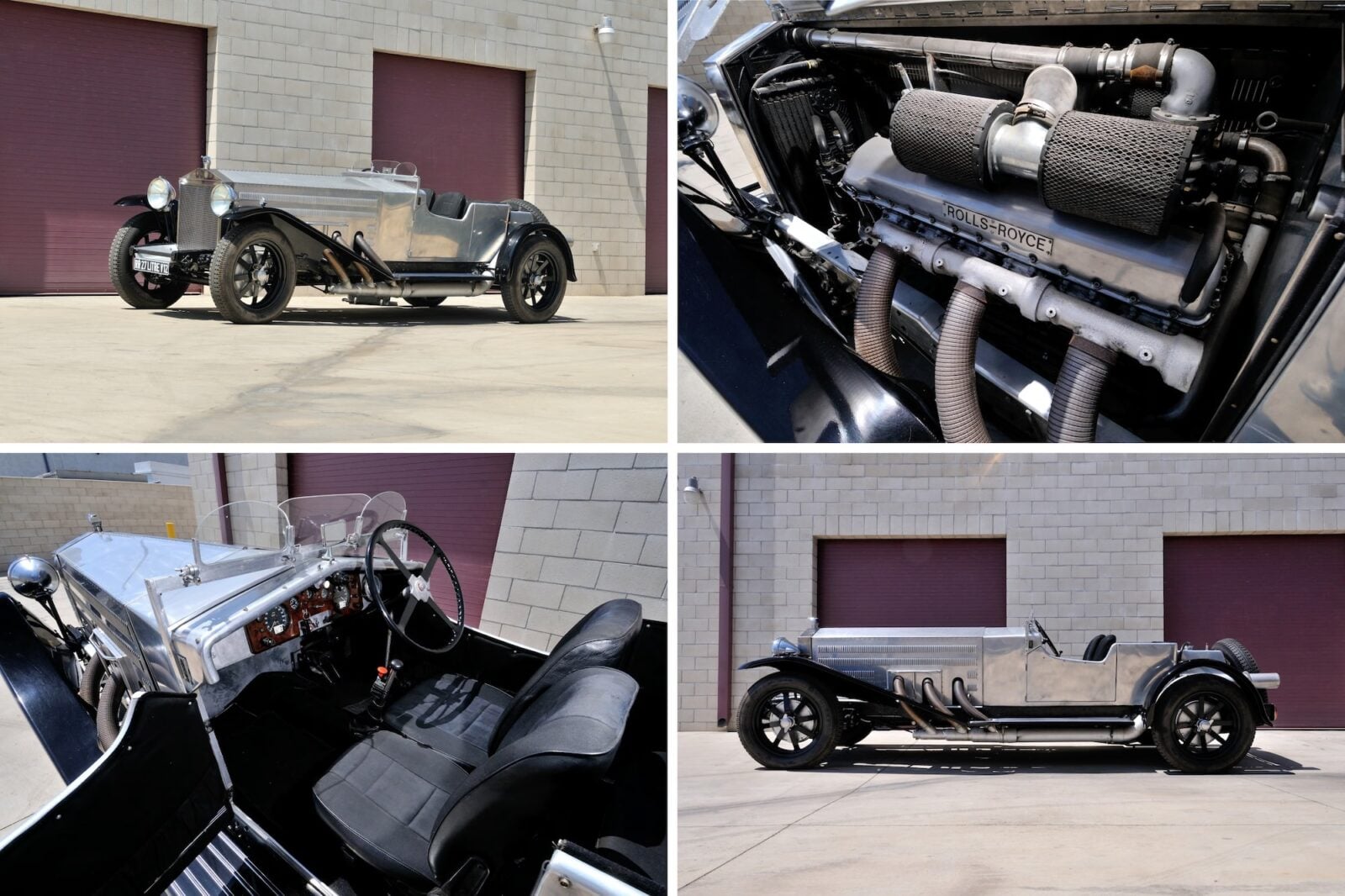
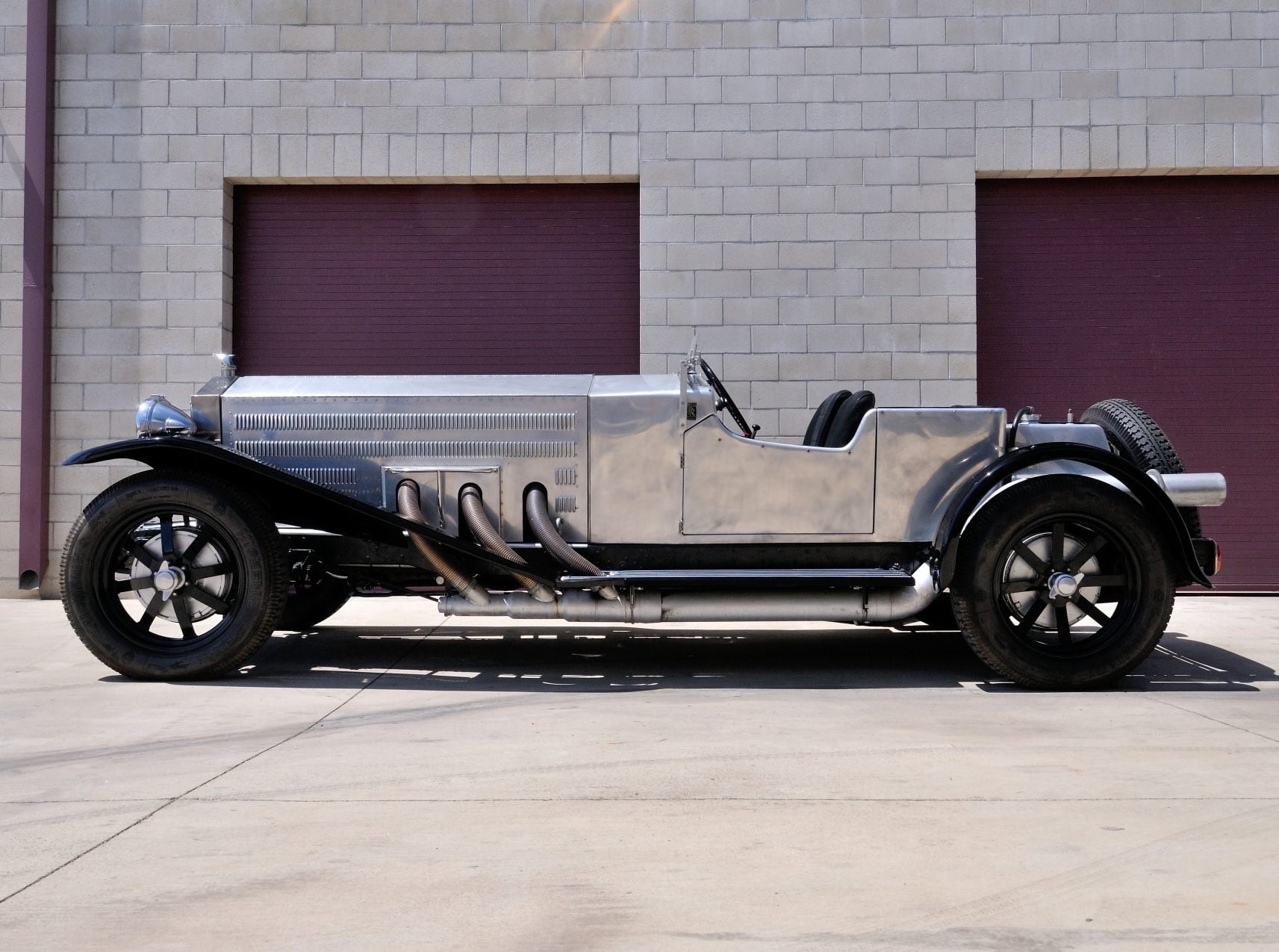
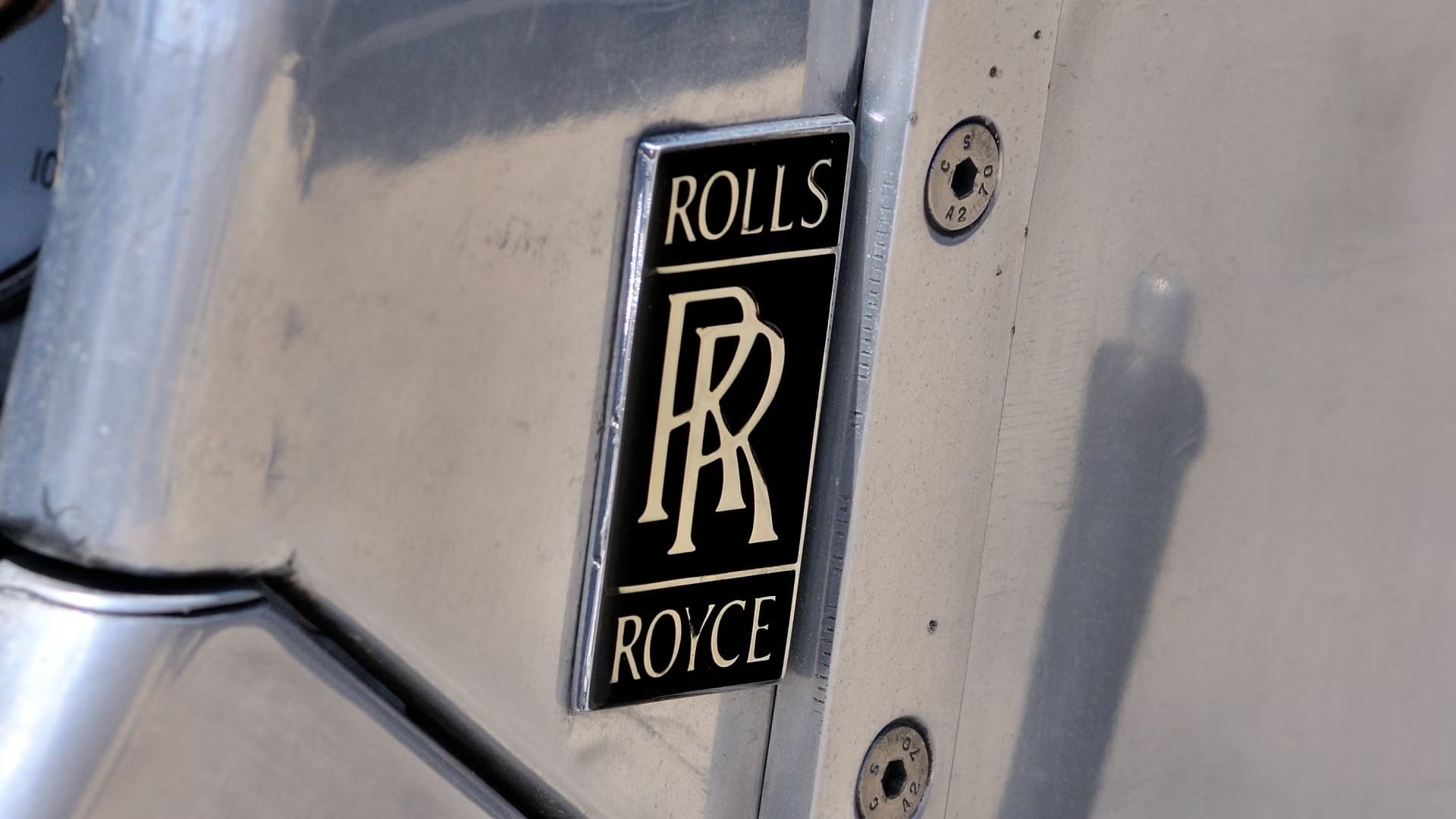
This is a 1930 Rolls-Royce that’s now powered by a 27 liter Merlin V12 aero engine from WWII. It’s a bit of a mystery car and we’re putting the call out for more information – so if you know who built it or when please get in touch with us here.
What we do know is that it’s a custom-built Merlin (or perhaps Meteor) V12-powered special with seating for two and a little unusually, it has a manual transmission. Many Merlin-powered cars have automatics due to their propensity for chewing up clutches Cookie Monster-style.
Fast Facts: The 1930 Rolls-Royce Speed Wagon
- This 1930 Rolls-Royce Speed Wagon is a mystery car built around a Phantom II-style chassis and powered by a 27 liter Rolls-Royce Merlin (or possibly Meteor) V12 aero engine. It runs naturally aspirated through dual Zenith carburetors and is paired with a 4-speed manual transmission.
- The Merlin began life as the PV-12, a private Rolls-Royce gamble that first fired in October of 1933, six months after Henry Royce’s death. It became the obvious answer to Specification F.10/35 and went on to power the Spitfire, Hurricane, Lancaster, Mosquito, and P-51 Mustang.
- The Rolls-Royce Meteor was a de-rated, naturally aspirated Merlin derivative developed with Leyland Motors from 1941 onward to use engines that didn’t meet aero-grade standards. It produced 550 to 810 bhp, powered the Cromwell, Comet, Challenger, and Centurion tanks, and stayed in production until 1964.
- Surplus postwar Merlins and Meteors spawned a small fraternity of road-going aero-engined specials, including John Dodd’s “Beast,” Robin Beech’s Handlye Special, Nicholas Harley’s Wilkinson-bodied 64GX, Jay Leno’s 1934 Rolls-Royce special, and Rod Hadfield’s “Final Objective” Bel Air. This Speed Wagon now joins them.
History Speedrun: The Rolls-Royce Merlin V12
Royal Air Force commander Arthur Tedder later credited British aerial victory in the Battle of Britain to three factors – the skill and bravery of the pilots, the availability of suitable fuel, and the Merlin V12 engine. The first two were people and chemistry, the third was a 27 liter, 60º V12 that began life as a luxury car company’s engineering gamble in Derby, England earlier in the 1930s.
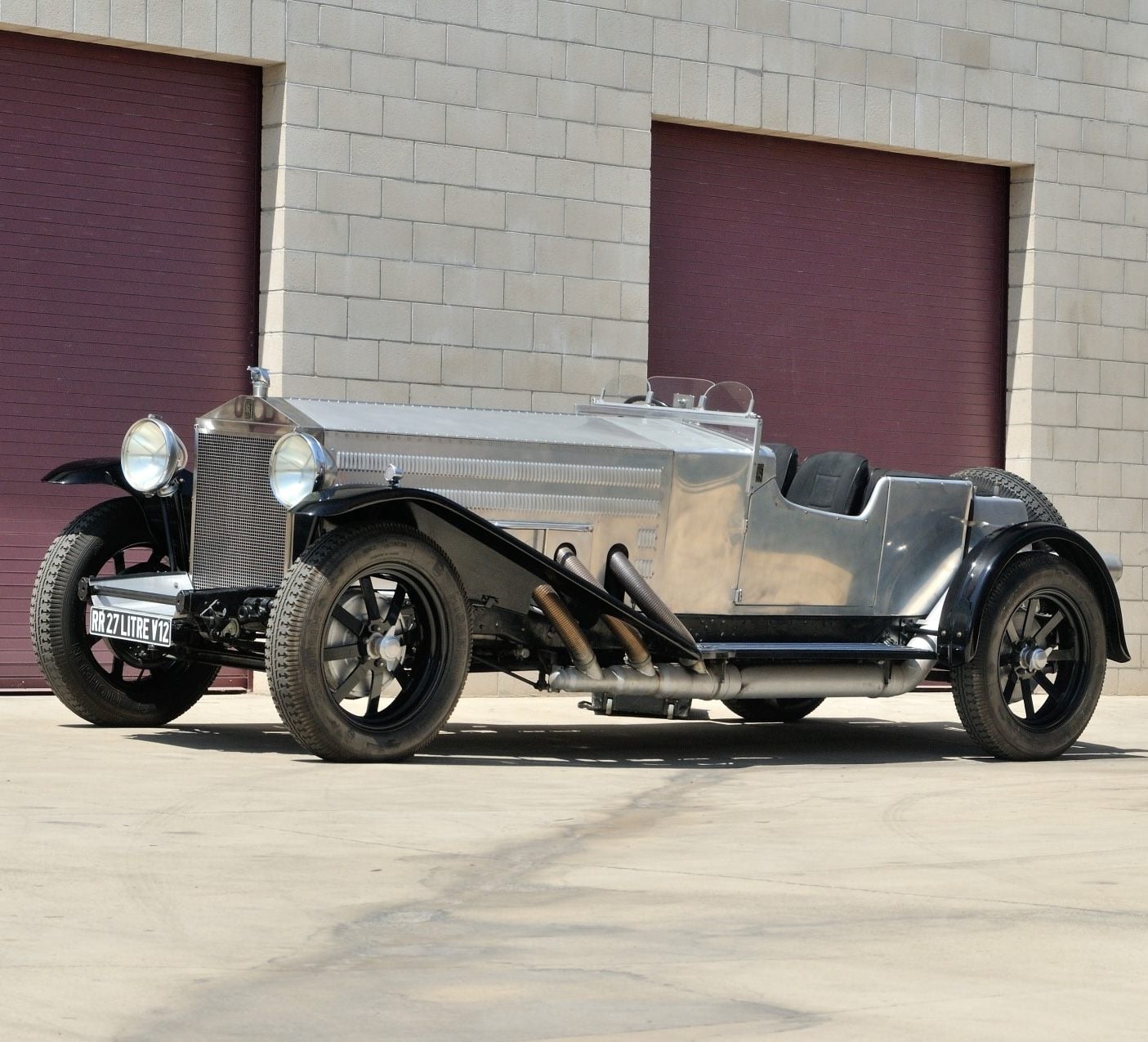
 The 1930 Rolls-Royce Speed Wagon you see in this article is a bit of a mystery, we haven’t been able to find any reliable information about exactly who built it or when, and the auction listing doesn’t (currently) provide a whole lot of information about its origins.
The Merlin started out as the PV-12 (Private Venture, 12-cylinder) because the British government hadn’t asked for it and wasn’t planning on paying for it either. Rolls-Royce designed it anyway, building on Arthur Rowledge’s earlier work on the Kestrel aero engine.
The PV-12 first fired on October the 15th, 1933. Six months earlier, Sir Henry Royce had died at 70, so the engine that would carry his company through the war was barely running on a test stand by the time its co-founder was gone after a bout of ill-health. Interestingly, the day before he died he had reportedly sat up in bed and sketched out a clever new design for an adjustable shock absorber.
The Air Ministry took serious notice of the PV-12 in 1935, when it issued Specification F.10/35. This was a formal requirement for a single-seat fighter capable of 310 mph. No existing British engine could plausibly deliver the power needed to meet the brief, and the PV-12, now called the Merlin, after the small falcon, not the wizard of Arthurian legend (Rolls-Royce named its four-stroke piston aero engines after birds of prey), was the obvious candidate.
Rolls-Royce’s big gamble was about to pay off, and as a little bonus it would also help save the country.
Government funding soon arrived, serious development began, and production contracts for the Hurricane and Spitfire followed in 1936. Early production was rocky, with cylinder head failures and cooling problems, but by the time the Merlin II and III reached service in 1937 and 1938, the engine was making roughly 1,030 bhp at the crank – a staggering figure by the standards of the era and not bad by modern standards either.
Perhaps the single most important part of the Merlin was its single-stage, gear-driven supercharger. As Rolls-Royce’s supercharger work progressed (most influentially under Stanley Hooker, who joined the company in 1938) power output climbed further still.
The Merlin X introduced two-speed supercharging, and the Merlin XX brought it into wider wartime use. The Merlin 60-series of 1942, with its two-stage two-speed supercharger and intercooler, gave the Spitfire Mk IX the high-altitude legs it needed to take on the Focke-Wulf 190. By the end of the war, the Merlin 130/131 series was producing just over 2,000 bhp. Experimental Merlin development went even higher than that on 150 octane fuel and water injection.
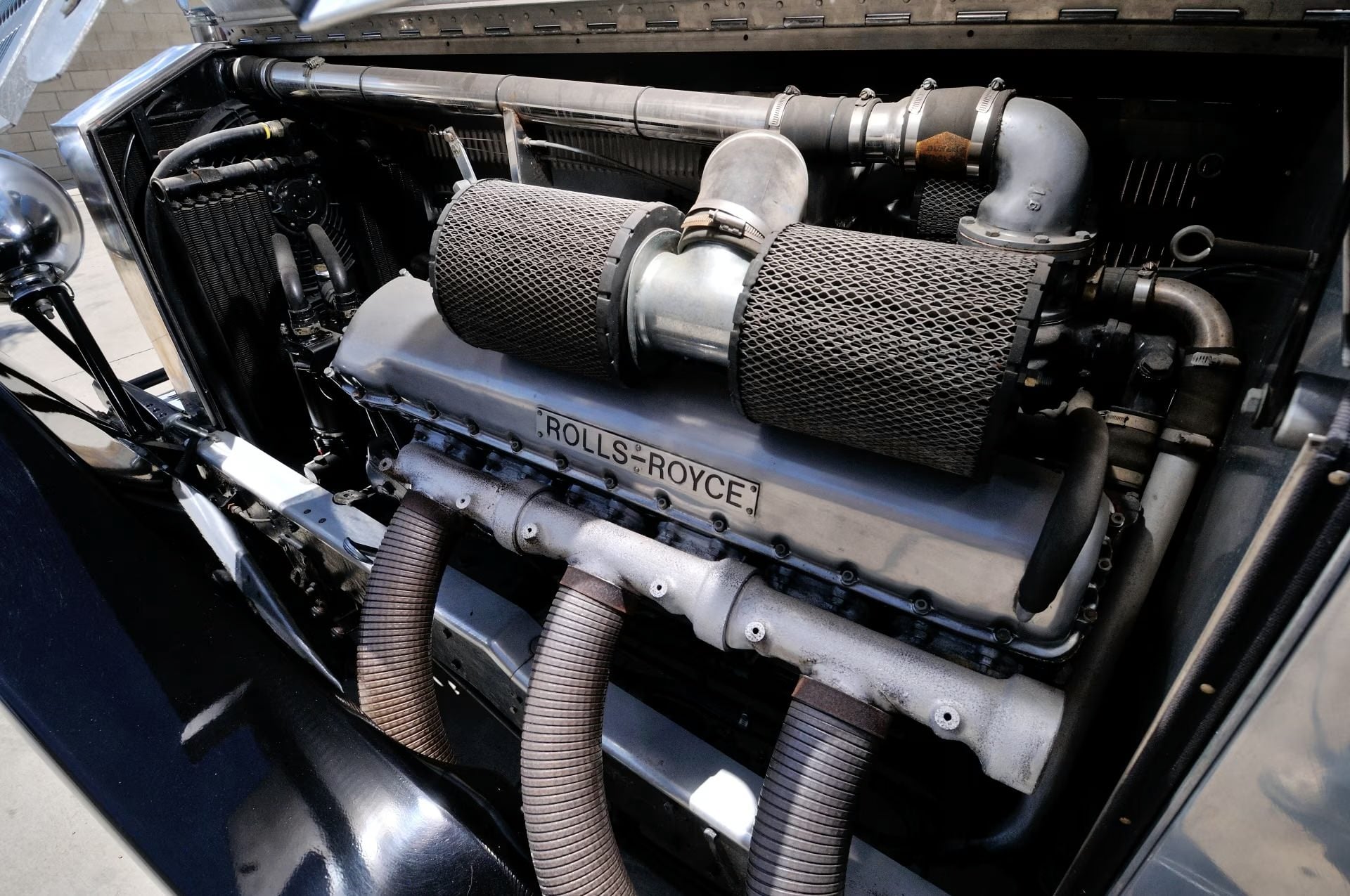
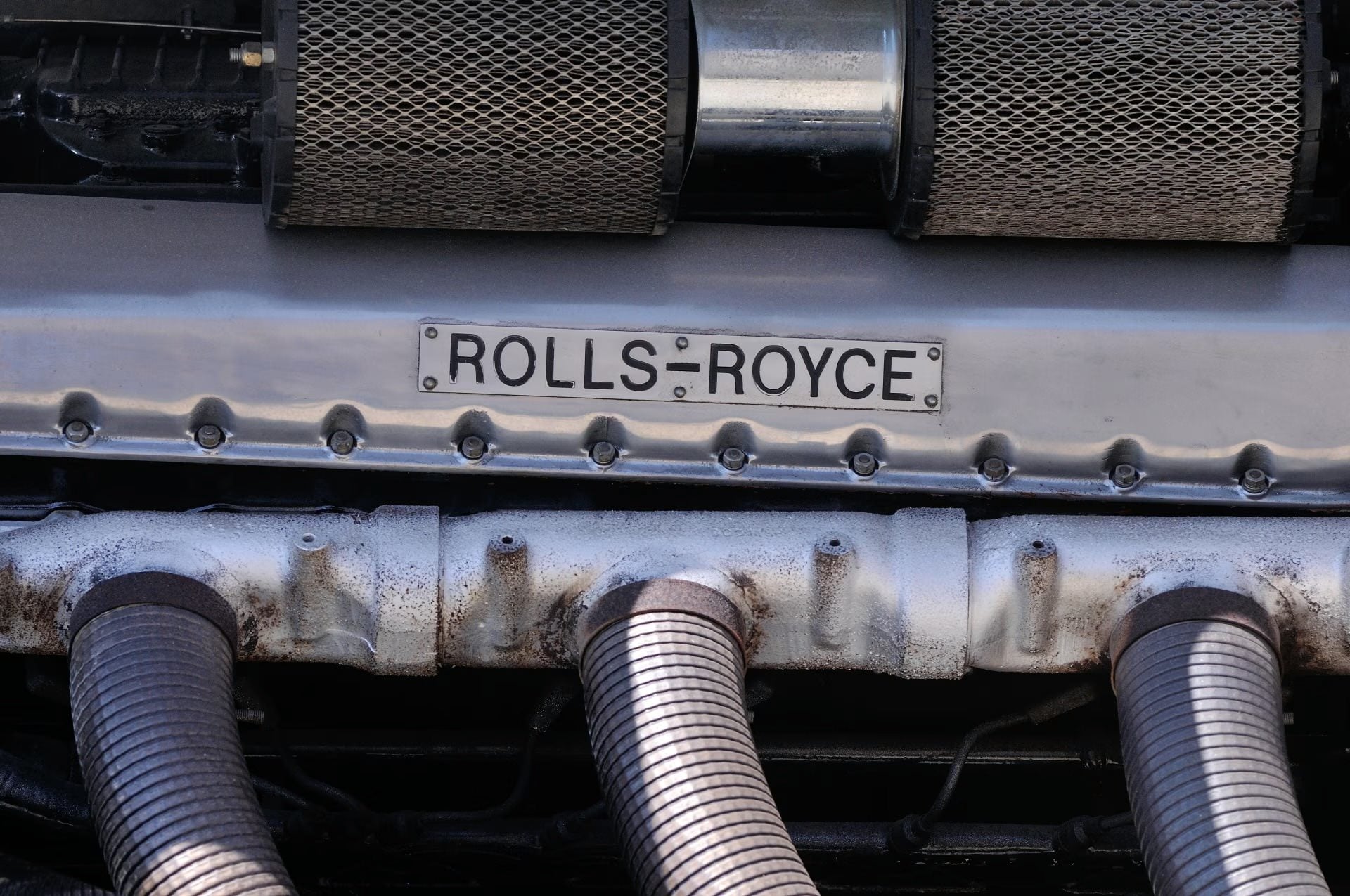
The engine is said to be a Merlin (not a Meteor) however there’s no supercharger fitted, and it’s instead naturally-aspirated and fed through dual brass-bodied twin-throat Zenith carburetors.
The engine ended up in many of the most important British piston-powered combat aircraft of the war. The Spitfire, Hurricane, Lancaster, Mosquito, early Halifax marks, the Wellington Mk II and Mk VI, and crucially, in the North American P-51 Mustang.
Built under license in Detroit by Packard as the V-1650, the American Merlin transformed the Mustang from a competent low-altitude fighter with the Allison V-1710 into the long-range high-altitude escort that helped clear the skies over Germany. Total Merlin production, across Rolls-Royce plants at Derby, Crewe, and Glasgow, Ford of Britain at Trafford Park, and Packard in Detroit, reached an astonishing 149,659 engines.
The Meteor V12 engine later came out of the same overall engineering program. By 1941, Rolls-Royce’s chassis division at Clan Foundry in Belper, under W.A. Robotham, was looking for ways to use Merlins that didn’t meet aero-grade quality standards. Engines that didn’t quite meet tolerances or even engines from (lightly) crashed aircraft.
The result of this, developed jointly with Leyland Motors, was a de-rated, naturally aspirated Merlin derivative intended for armored vehicles, with the supercharger, reduction gear, and other aircraft-specific equipment removed. It had the same 27 liter displacement, the same 5.4 inch bore and 6 inch stroke, and the same single overhead camshaft per bank actuating four valves per cylinder.
Output ranged from 550 to 810 bhp depending on variant. The Meteor powered the Cromwell, Comet, Challenger, and Centurion tanks, and stayed in production until 1964 – this was long after Merlin production had ended.
After the war, surplus Merlins and Meteors became affordable to almost anyone with an idea and a tolerance for fuel bills measured in gallons per mile rather than the other way around.
The list of road-going Merlin and Meteor-powered automobiles is small but completely unforgettable. John Dodd’s “The Beast,” built around a Paul Jameson chassis in the early 1970s, ran a Meteor and then a Merlin and was famously the subject of a Rolls-Royce trademark lawsuit.
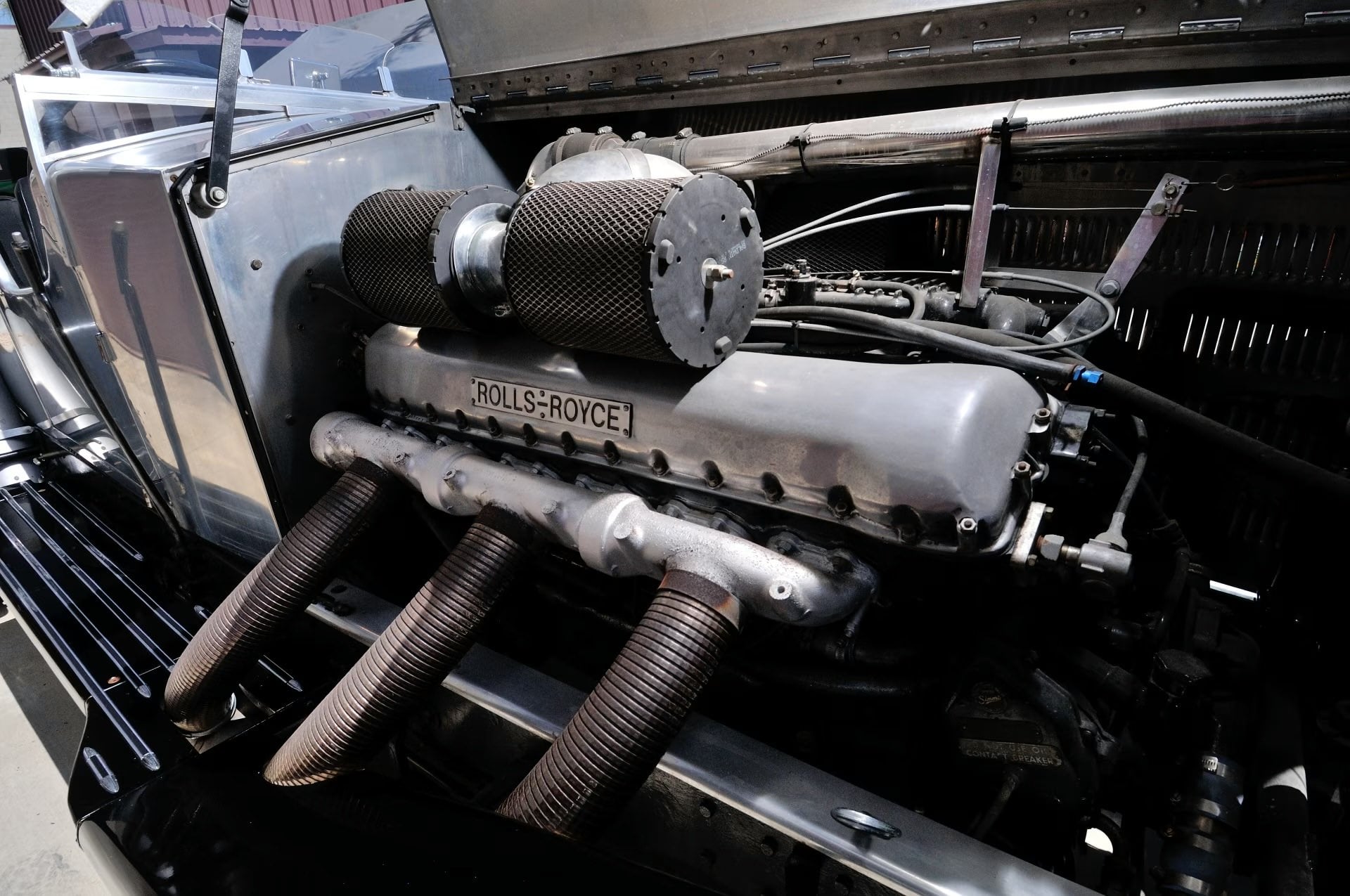
It has twin engine-mounted mechanical fuel pumps, four separate intake manifolds, a twin magneto ignition, a hand-primer Ki Gas system, and a 15 gallon, dry-sump oiling system.
Robin Beech spent decades building the Handlye Special on a 1930 Phantom II chassis, powered by a Merlin/Meteor hybrid assembled from a Merlin 3 and a Meteor Mk 1.
Nicholas Harley’s Wilkinson-bodied 64GX, Jay Leno’s 1934 Rolls-Royce-based special, and Rod Hadfield’s “Final Objective” 1955 Chevrolet Bel Air in Australia all belong to the same small (and very loud) fraternity.
The 1930 Rolls-Royce Speed Wagon Shown Here
The 1930 Rolls-Royce Speed Wagon you see in this article is a bit of a mystery, we haven’t been able to find any reliable information about exactly who built it or when, and the auction listing doesn’t (currently) provide a whole lot of information about its origins.
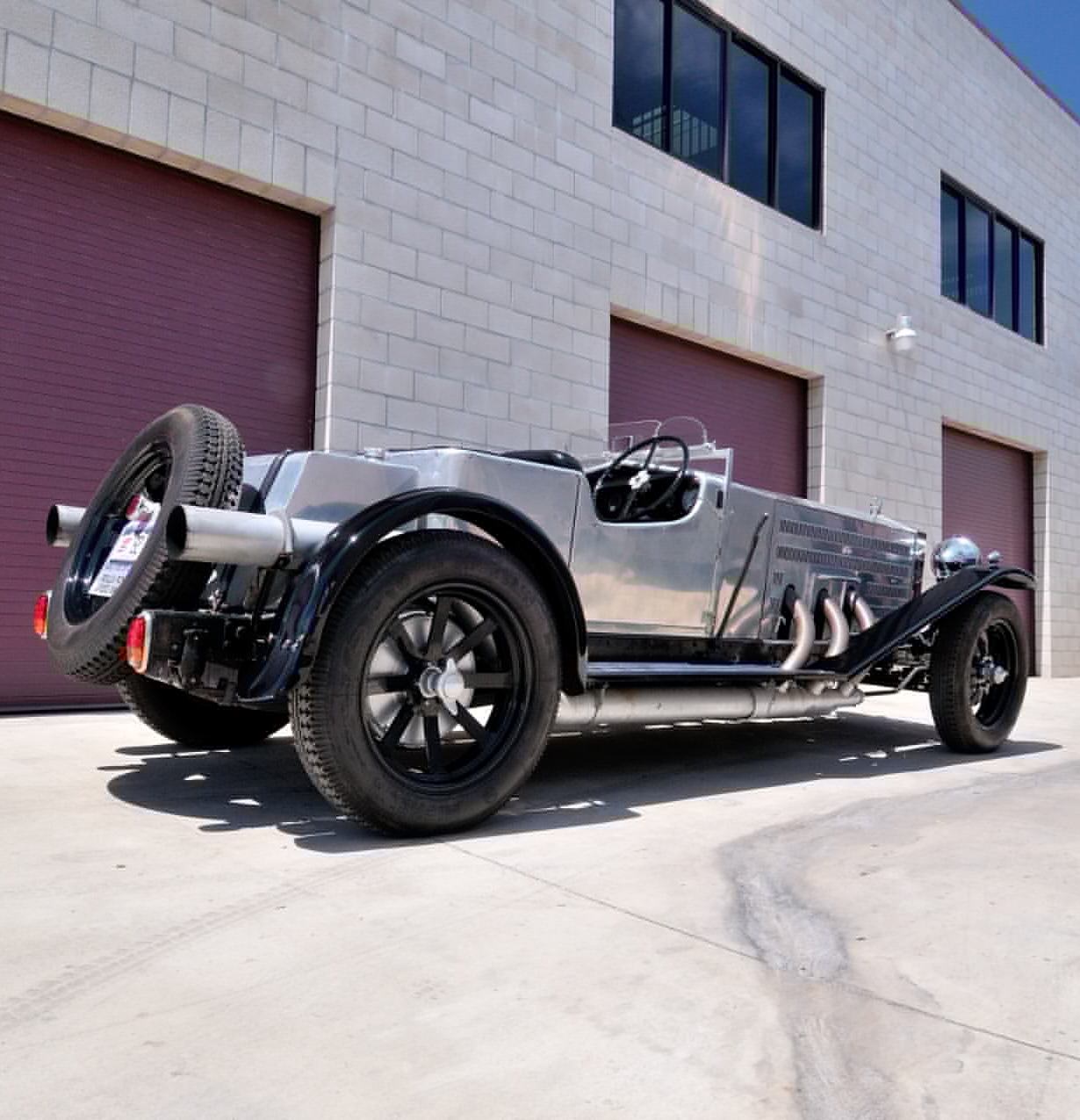
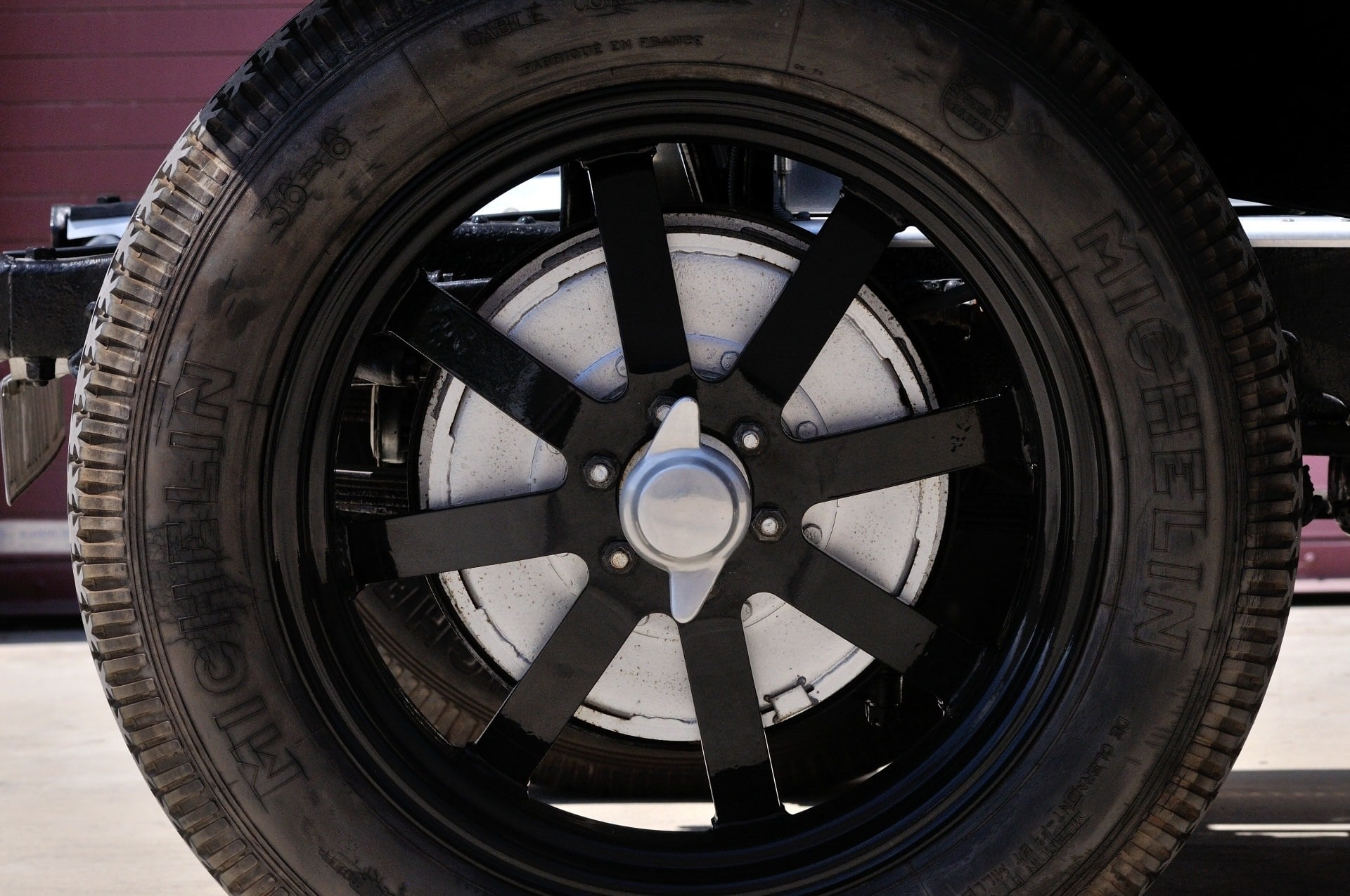
What we do know from the listing and the associated images is that this car is based on a 1930 Rolls-Royce. It has a cantilevered chassis reinforced by seven crossmembers, original heavy-duty front and rear axles on semi-elliptical leaf springs, original Lockheed brakes with finned aluminum drums, 24 inch 8 spoke wheels, and Michelin radial tires.
The engine is said to be a Merlin (not a Meteor) however there’s no supercharger fitted, and it’s instead naturally-aspirated and fed through dual brass-bodied twin-throat Zenith carburetors. It has twin engine-mounted mechanical fuel pumps, four separate intake manifolds, a twin magneto ignition, a hand-primer Ki Gas system, and a 15 gallon, dry-sump oiling system.
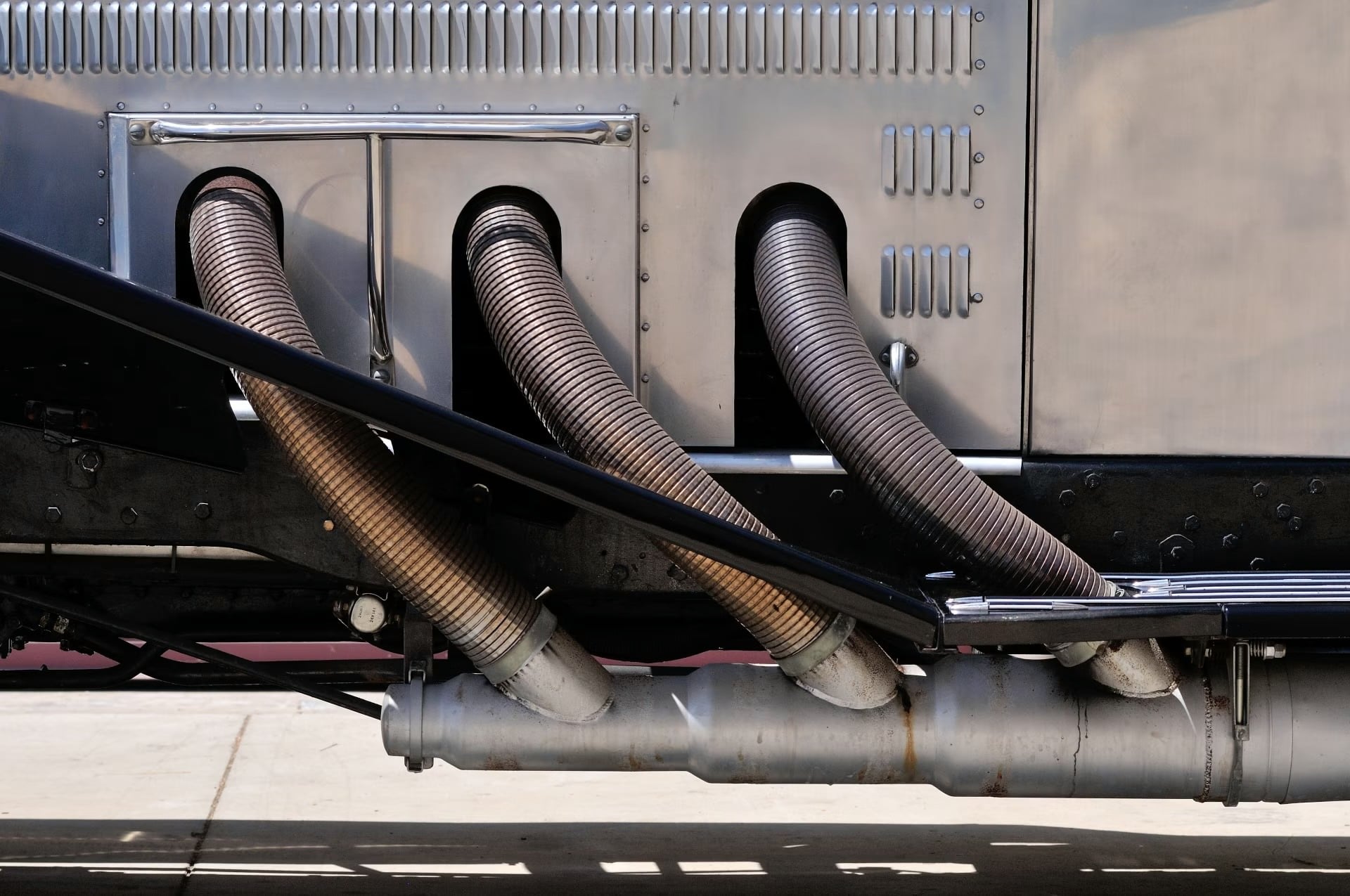
The exhaust consists of cast iron manifolds that feed through a single chamber on each side and three six-inch pipes, and power is sent back through a hydraulically operated clutch and a 4-speed manual transmission to the rear axle.
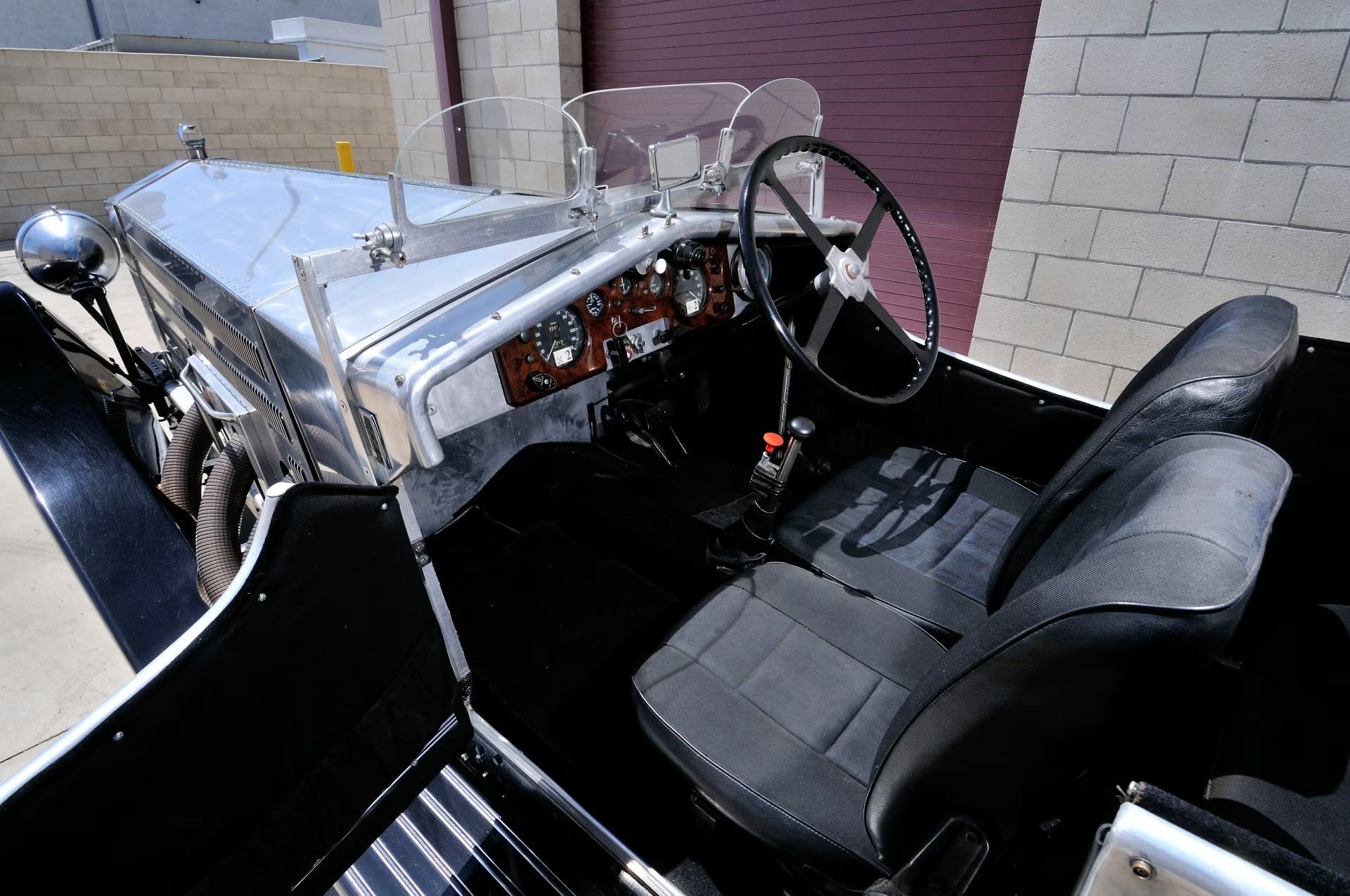
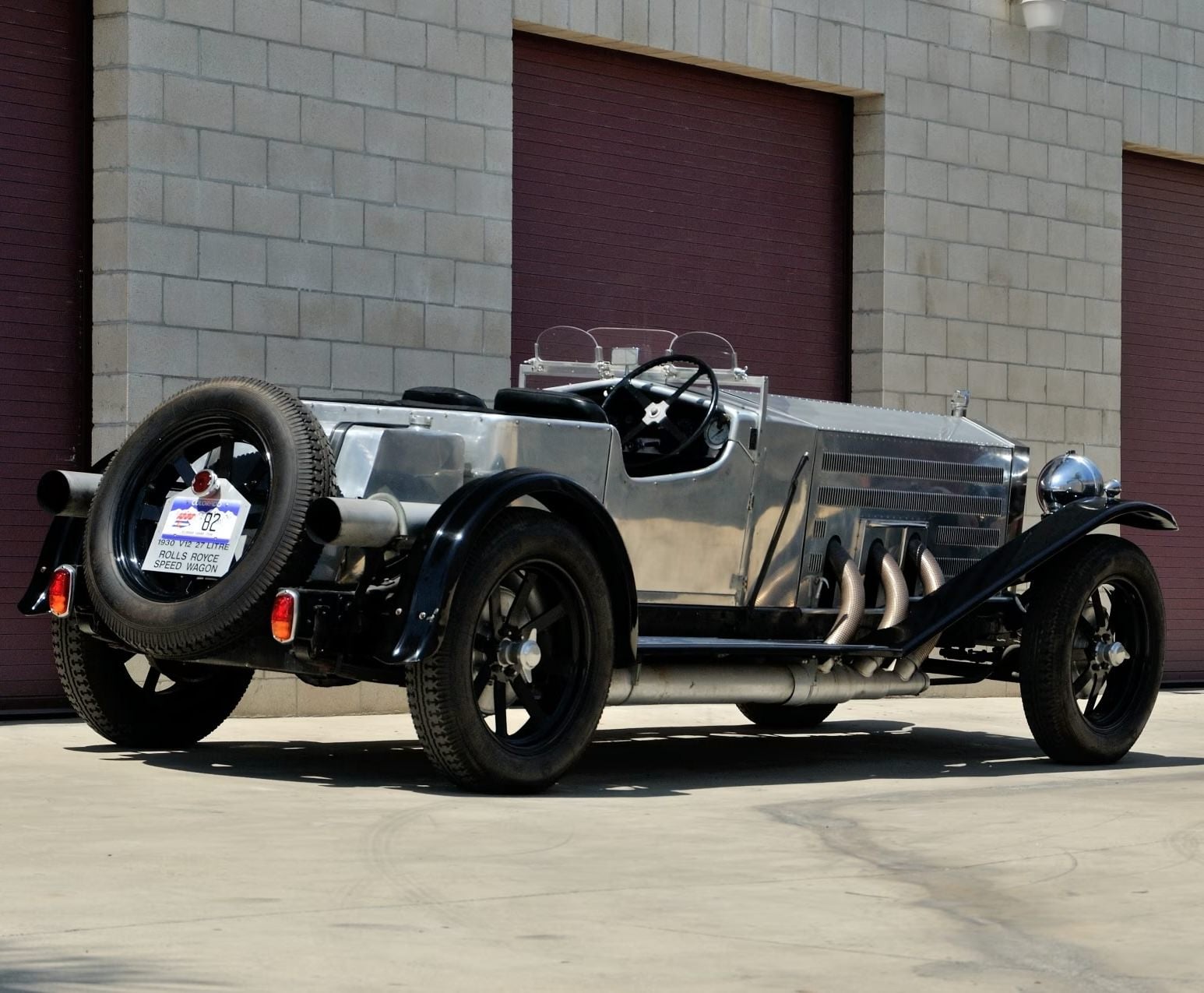
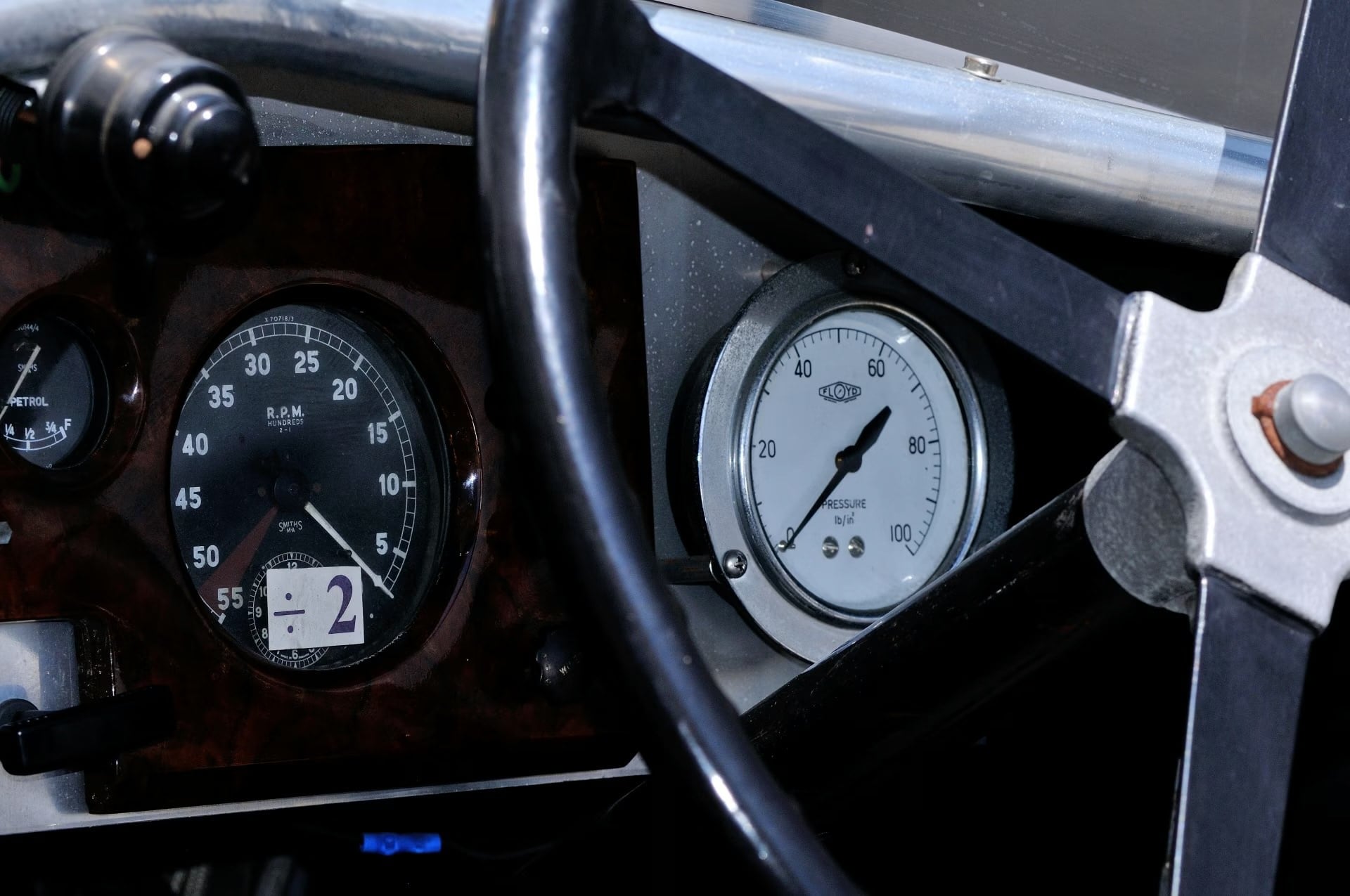
The car has hand-formed aluminum bodywork with black-painted fenders, and inside you’ll find cozy seating for two behind a triplet of period-correct aero screens. The essential gauges are all housed in a central walnut dashboard.
The car has hand-formed aluminum bodywork with black-painted fenders, and inside you’ll find cozy seating for two behind a triplet of period-correct aero screens. The essential gauges are all housed in a central walnut dashboard.
The car is due to roll across the auction block. no doubt somewhat loudly, in mid-August in Monterey, California with Mecum. If you’d like to read more about it or register to bid you can visit the listing here.
Images courtesy of Mecum

Articles that Ben Branch has written have been covered on CNN, Popular Mechanics, Smithsonian Magazine, Road & Track Magazine, the official Pinterest blog, the official eBay Motors blog, BuzzFeed, Autoweek Magazine, Wired Magazine, Autoblog, Gear Patrol, Jalopnik, The Verge, and many more.
Silodrome was founded by Ben back in 2010, in the years since the site has grown to become a world leader in the alternative and vintage motoring sector, with well over a million monthly readers from around the world and many hundreds of thousands of followers on social media.