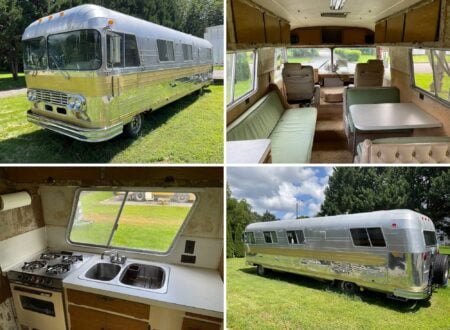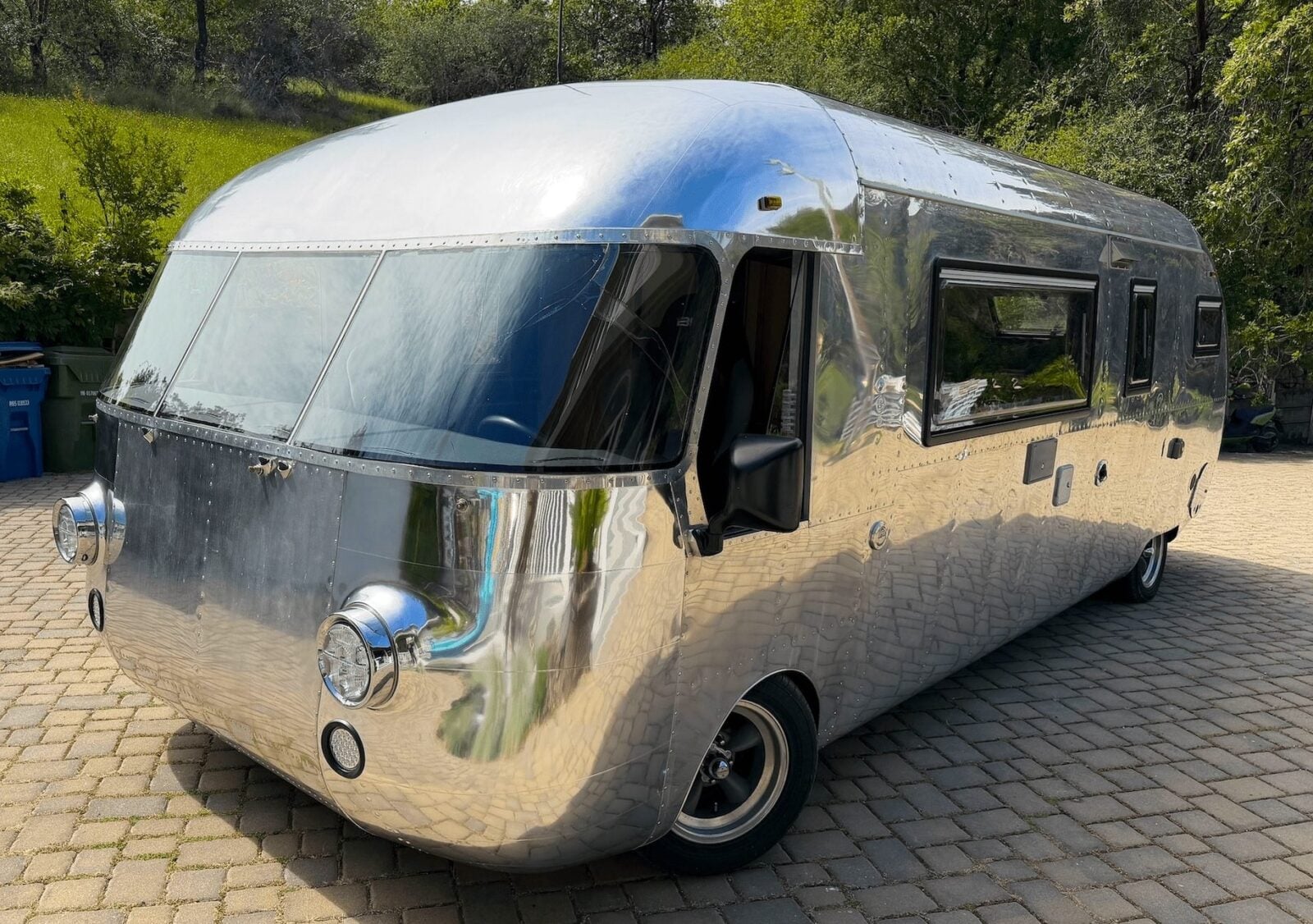
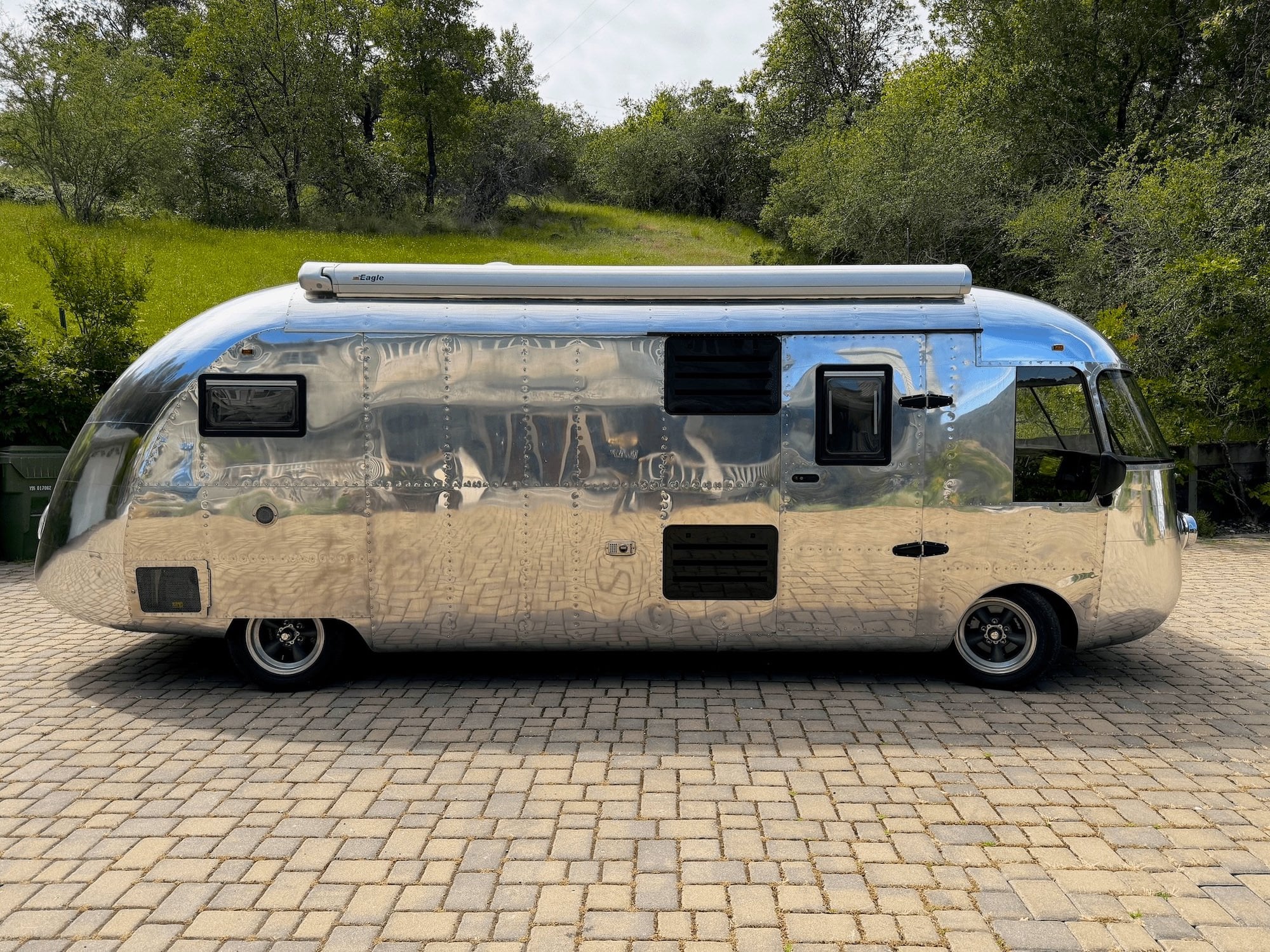
This is a rare 1966 Ultra Van, one of the most futuristic RVs of the era. It’s powered by a 2.7 liter Corvair flat-six, it has independent four-wheel suspension, and it uses aircraft-like monocoque construction.
The Ultra Van was developed by aircraft designer David G. Peterson. In a way, it was a historic parallel with the first aluminum travel trailer – the Bowlus Road Chief, which had also been designed by an aircraft builder in 1934 – Hawley Bowlus, who had a key role in building the Spirit of St. Louis.
Fast Facts: The Ultra Van
- The Ultra Van was designed by aircraft engineer David G. Peterson, who built the first prototype in late 1960, powered by a Chevrolet Corvair flat-six. It had monocoque aluminum construction, four-wheel independent suspension, and weighed just 3,000 lbs fully equipped – making it one of the lightest and most technically advanced motorhomes of its era.
- Production passed through several hands, starting with Peterson’s own small-batch builds, a failed stint under Prescolite Manufacturing, and finally a successful run under John Tillotson’s Ultra Incorporated in Hutchinson, Kansas. Tillotson’s operation produced 346 of the roughly 376 total Ultra Vans built, with production running from January of 1966 to June of 1970.
- This 1966 example was purchased by the current seller in 2009 and refurbished over a 15-year period. The work included replacement exterior aluminum panels, a 19-panel rooftop solar setup, Accuair air suspension, Wilwood four-wheel disc brakes, Bomz Racing bucket seats, and a fully refreshed interior with modern galley appliances and a Pioneer infotainment system.
- Power comes from the original Corvair-sourced 2.7 liter air-cooled flat-six, now fitted with a Microsquirt electronic fuel injection system and dual-exit exhaust, paired with a two-speed Powerglide automatic. The Ultra Van is offered out of Gilroy, California with manuals, service records from 2009, and a clean California title.
History Speedrun: The Ultra Van
The Ultra Van started out as a personal project by aircraft designer David G. Peterson, a veteran of both Beech and Boeing, who developed himself an aluminum camper van built on the Chevrolet Corvair platform. His design, named the Ultra Van, had full monocoque construction, four-wheel independent suspension, and a curb weight lower than any other RV on the market.
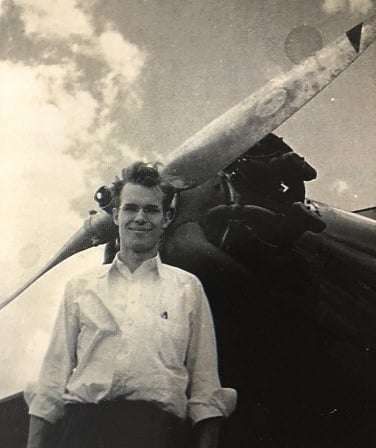
 Here we see a young David G. Peterson when he was still working as an aircraft designer, many years before he would design the Ultra Van. Image courtesy of Ultra Van.
Peterson developed the Ultra Van to solve an issue he faced – he owned both a Spartan travel trailer and a boat, and there was no practical way to tow them both at the same time. His solution was to eliminate the travel trailer entirely by building a self-propelled motorhome light enough to tow the boat behind it.
When General Motors introduced the Chevrolet Corvair for 1960, Peterson immediately saw potential in its rear-mounted, air-cooled flat-six engine and Powerglide automatic transaxle. The compact powertrain could be tucked neatly under a rear bed platform, leaving the rest of the vehicle floorpan for living space.
In the fall of 1960, Peterson rented a large garage in the Oakland/Alameda area and got to work. Four months later, his first prototype rolled out under its own power – he called it the “Go-Home.”
The results of Peterson’s clever engineering were extraordinary. Without interior furnishings, the monocoque aluminum shell weighed less than 1,800 lbs but still offered roughly five times the interior volume of a Volkswagen van – at 400 lbs less weight.
Even fully fitted out with a stove, refrigerator, bathroom, shower, water heater, fresh and waste water tanks, and sleeping for four, the finished coach came in at around 3,000 lbs. This first prototype measured 24 feet long and 8 feet wide, offered over 6 feet of interior headroom, and stood just 8 feet tall overall. Later production models would be shortened to 22 feet, the length that later became standard for the Hutchinson-built versions.
The Ultra Van: Specifications
Peterson’s aerospace engineering background had defined every aspect of the Ultra Van’s design. It used true monocoque construction with no separate frame or chassis – this was a method essentially unheard of in the motorhome world at the time and still not all that common in the automotive world.
The structure was built up from C-shaped aluminum ribs to which riveted aluminum skin panels were attached, exactly as you would design an aircraft fuselage. Compound-curved areas at the front and rear corners were formed from fiberglass. Cast aluminum A-frames were mounted inside the front wheel wells, which doubled as seat platforms.
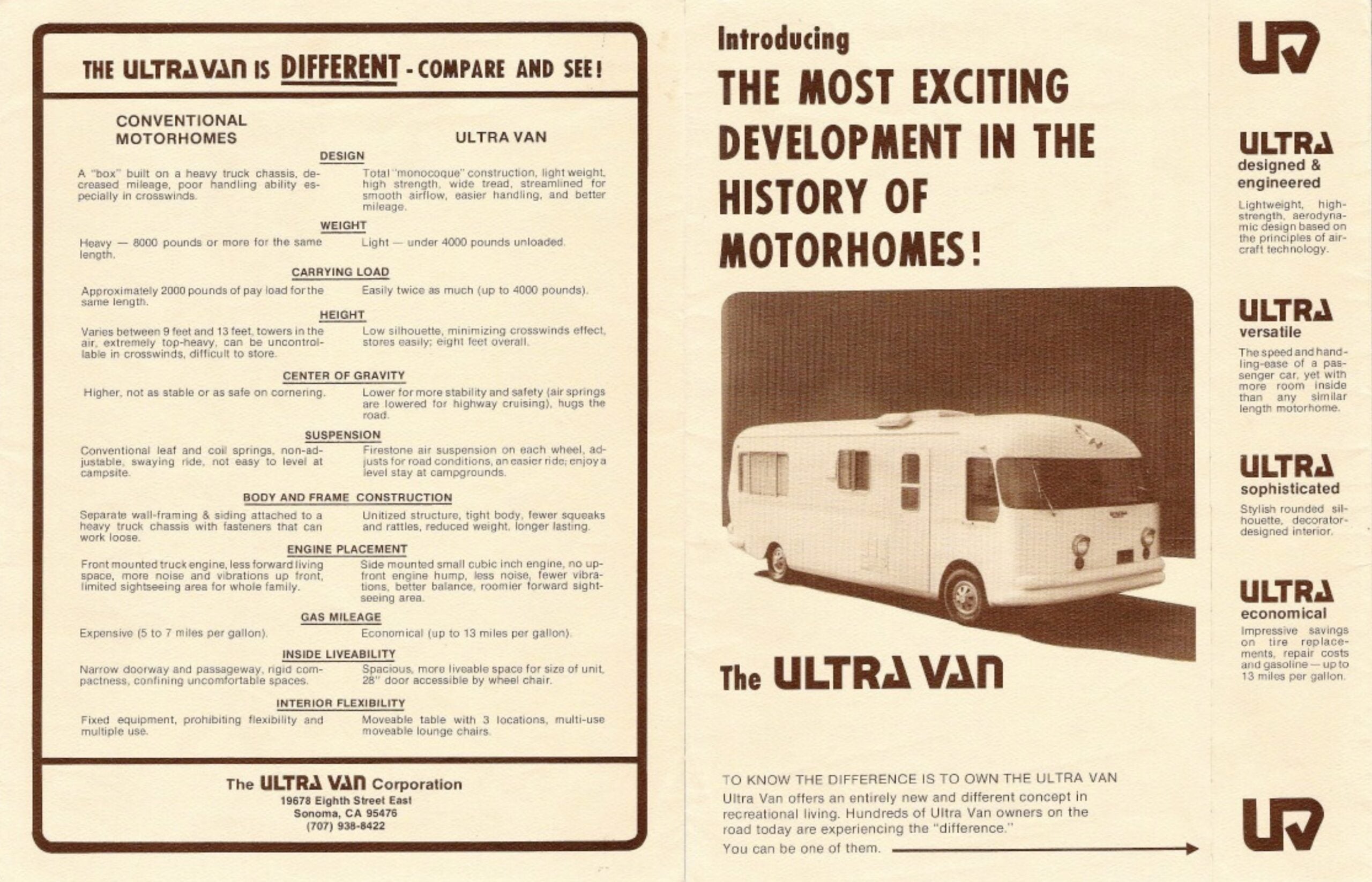
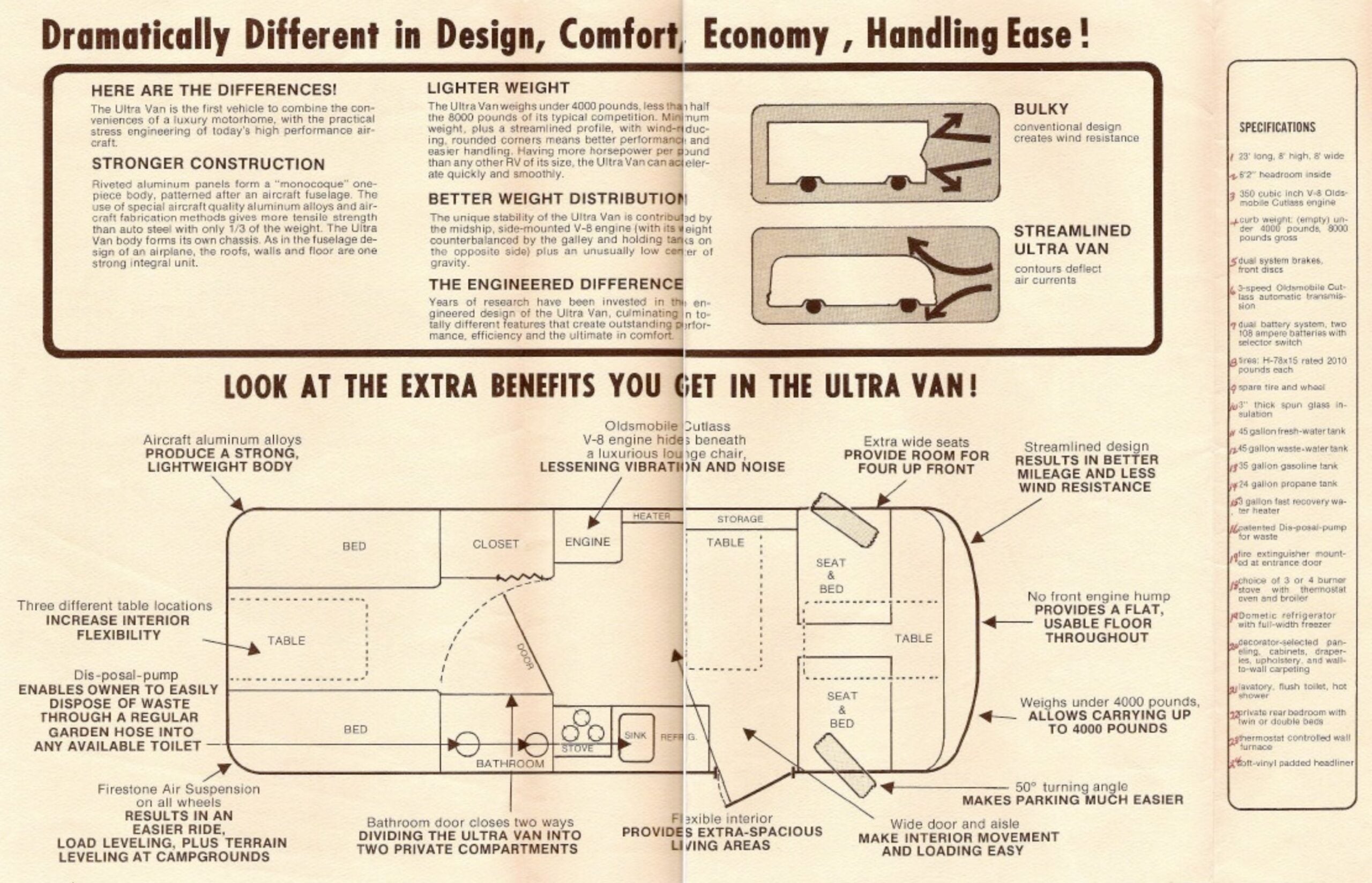
Peterson’s aerospace engineering background had defined every aspect of the Ultra Van’s design. It used true monocoque construction with no separate frame or chassis – this was a method essentially unheard of in the motorhome world at the time and still not all that common in the automotive world. Image courtesy of Ultra Van.
The suspension was fully independent at all four corners, using coil springs and tubular shock absorbers. The front-end geometry was especially clever, allowing the wheels to turn 50º in either direction and giving the Ultra Van a turning circle tighter than most pickup trucks of the time.
The Corvair’s 80 bhp flat-six engine and Powerglide automatic transaxle were mounted at the rear beneath an enormous bed platform that measured over seven and a half feet square. Later models offered the more powerful 110 bhp Corvair engine as standard, with an optional 140 bhp version also available.
The result of all this was a full-size Class A motorhome that could cruise comfortably at 60 mph and return over 15 mpg – these were figures that were remarkable for the era and they remain impressive even by modern standards.
Early Production (And The Prescolite Debacle)
People who saw Peterson’s gleaming new RV creation wanted one, and he was soon fielding orders. Using a technical school apprentice program, Peterson and his students built approximately 15 early Ultra Vans, advertised at under $7,000. In August of 1961, he formally incorporated as the Ultra Van Manufacturing Company.
Peterson’s first attempt at handing off production to a larger manufacturer ended badly. In the spring of 1963, Prescolite Manufacturing Corporation (a lighting fixture company whose president, Preston Jones, had commissioned an Ultra Van as a mobile showroom) took over production.
Prescolite’s Motor Coach Division built just seven coaches, at least four of which were badged as “Travalons” rather than Ultra Vans, before shutting down in February of 1964. The core problem was that Prescolite’s workers were unfamiliar with aluminum aircraft construction techniques and they substituted angle iron for aluminum in some areas, which caused major cracking where the iron met the aluminum skin.
Peterson resumed production himself, completing another 10 coaches in Oakland before finding a more capable partner.
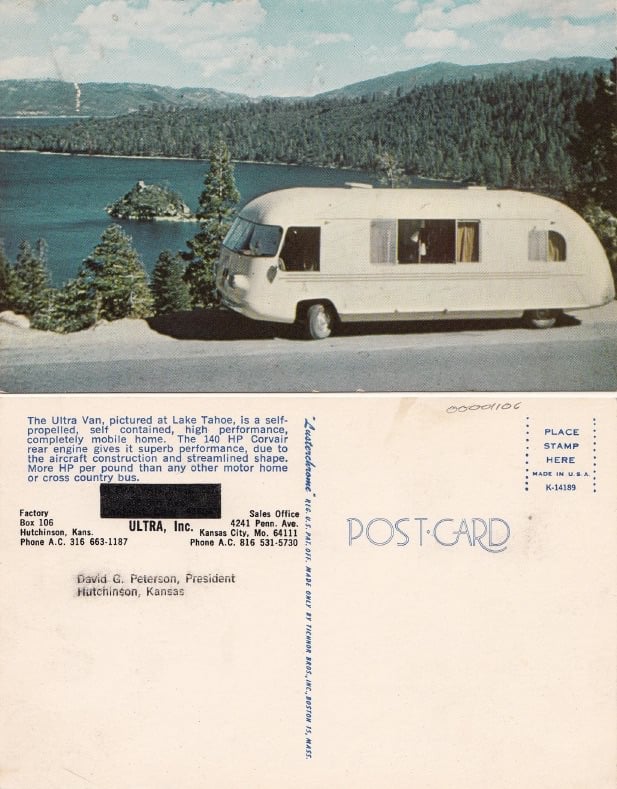
The Ultra Van started out as a personal project by aircraft designer David G. Peterson, a veteran of both Beech and Boeing, who developed himself an aluminum camper van built on the Chevrolet Corvair platform. Image courtesy of Ultra Van.
Tillotson + Ultra, Inc: The Hutchinson Era
In 1964, John E. Tillotson, a Kansas publisher, discovered the Ultra Van and began negotiating for production rights. By August of 1965, Tillotson had licensed the design from Peterson and formed Ultra Incorporated, establishing a production line inside a former World War II aircraft hangar at the Naval Air Base near Hutchinson, Kansas.
The location was strategic to say the least, the Wichita area had a deep pool of workers with aircraft manufacturing experience dating back to the war. Peterson was kept on as a consultant, and several unfinished Oakland coaches were shipped to Kansas as pilot models.
Production ramped quickly. By late of 1966, Ultra Vans were rolling off the line at an average of eight per month, with a base price of $8,995. The first factory showing took place at the 1966 Family Motor Coach Association National Convention in Glenwood, Minnesota. Tillotson’s operation ultimately produced 346 Ultra Vans between January of 1966 and June of 1970 – accounting for the vast majority of the roughly 376 total examples built across all production phases.
As the Corvair approached the end of its production run (GM discontinued it in 1969, thanks in part to the efforts of Ralph Nader) Ultra Inc.’s head engineer, Chuck Burgess, developed the 500 Series V8 model using a Chevrolet 307 small block V8 and Corvette-derived rear suspension and drive parts.
Almost 50 of these 500 Series coaches were built, with the current UVMCC statistics listing 49 307-powered V8 Ultra Vans. Burgess also developed the front-wheel drive Tiara motorhome, of which Ultra Inc. built 14 before finally closing its doors.
The End Of The Line
By 1970, the economics had become untenable, the Ultra Van’s aircraft-grade monocoque construction was expensive, and mass-market competitors like Winnebago were producing far larger motorhomes at far lower prices, thanks in no small part to the efficiencies of scale. Production ceased in June of 1970.
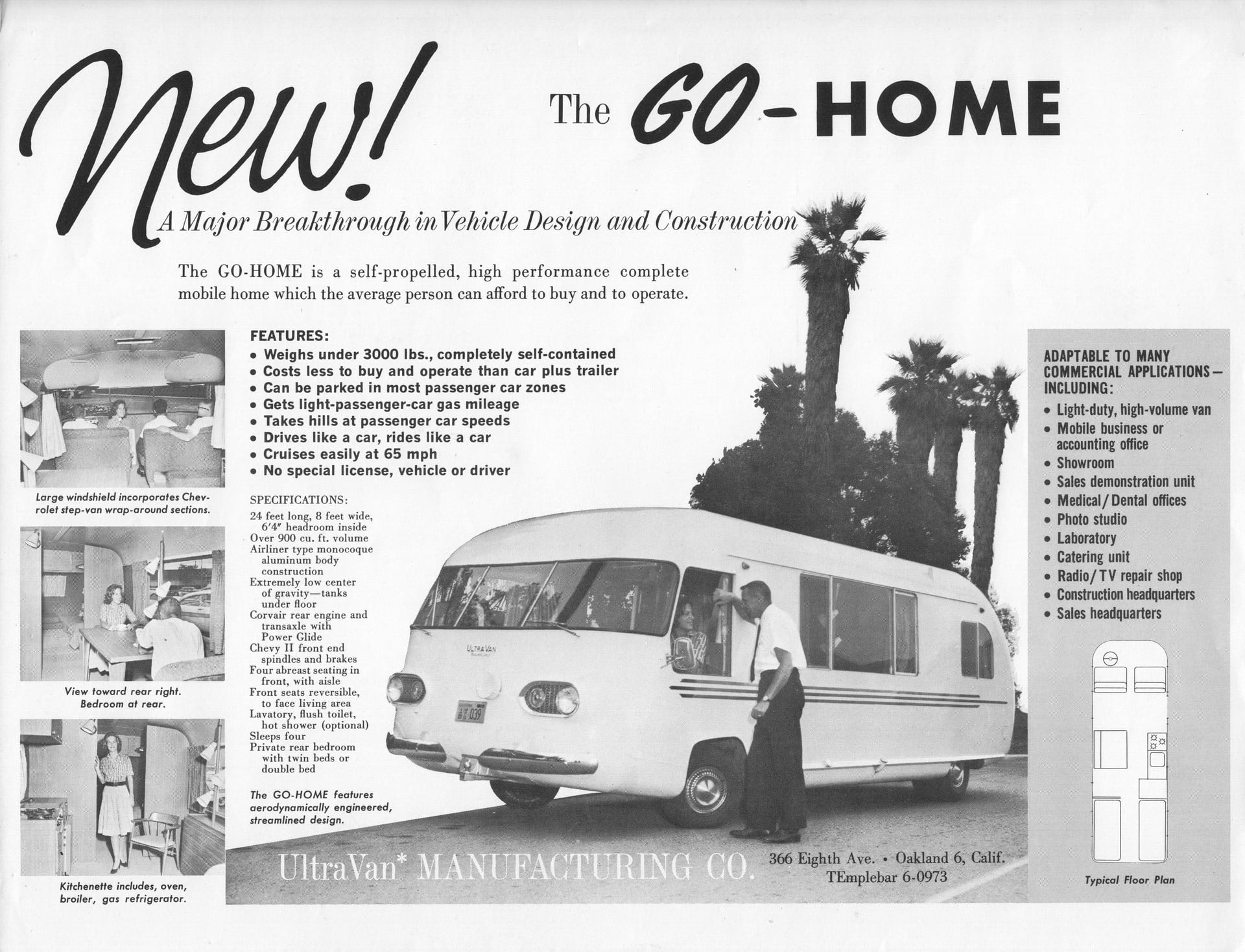
By 1970, the economics had become untenable, the Ultra Van’s aircraft-grade monocoque construction was expensive, and mass-market competitors like Winnebago were producing far larger motorhomes at far lower prices, thanks in no small part to the efficiencies of scale. Production ceased in June of 1970. Image courtesy of Ultra Van.
Peterson wasn’t quite finished, however. He formed a new company called Ultra Coach and began converting early Corvair-powered coaches to Oldsmobile Toronado front-wheel-drive powertrains – this was a configuration he considered superior to the original.
He installed the Toronado conversion on 17 existing coaches in 1970 and 1971. In 1972 and 1973, his new company built five longer, 23-foot coaches known as the 600 Series, powered by Oldsmobile V8 Rocket engines.
Only a few were completed before the Sonoma factory closed in 1974. Peterson continued tinkering with a final prototype, designated #700, in his backyard from 1982 to 1998, but it was never finished.
Skipping forward to the modern day, the Ultra Van Motor Coach Club (organized in 1966 by three California owners and their wives) continues to support a dedicated community of enthusiasts, and the Corvair Society of America recognizes the Ultra Van as a true Corvair marque.
Of the roughly 376 coaches built across all production phases, more than 100 are believed to survive, many with well over 100,000 miles on the odometer and some reportedly surpassing 500,000.
The 1966 Ultra Van Motorhome Shown Here
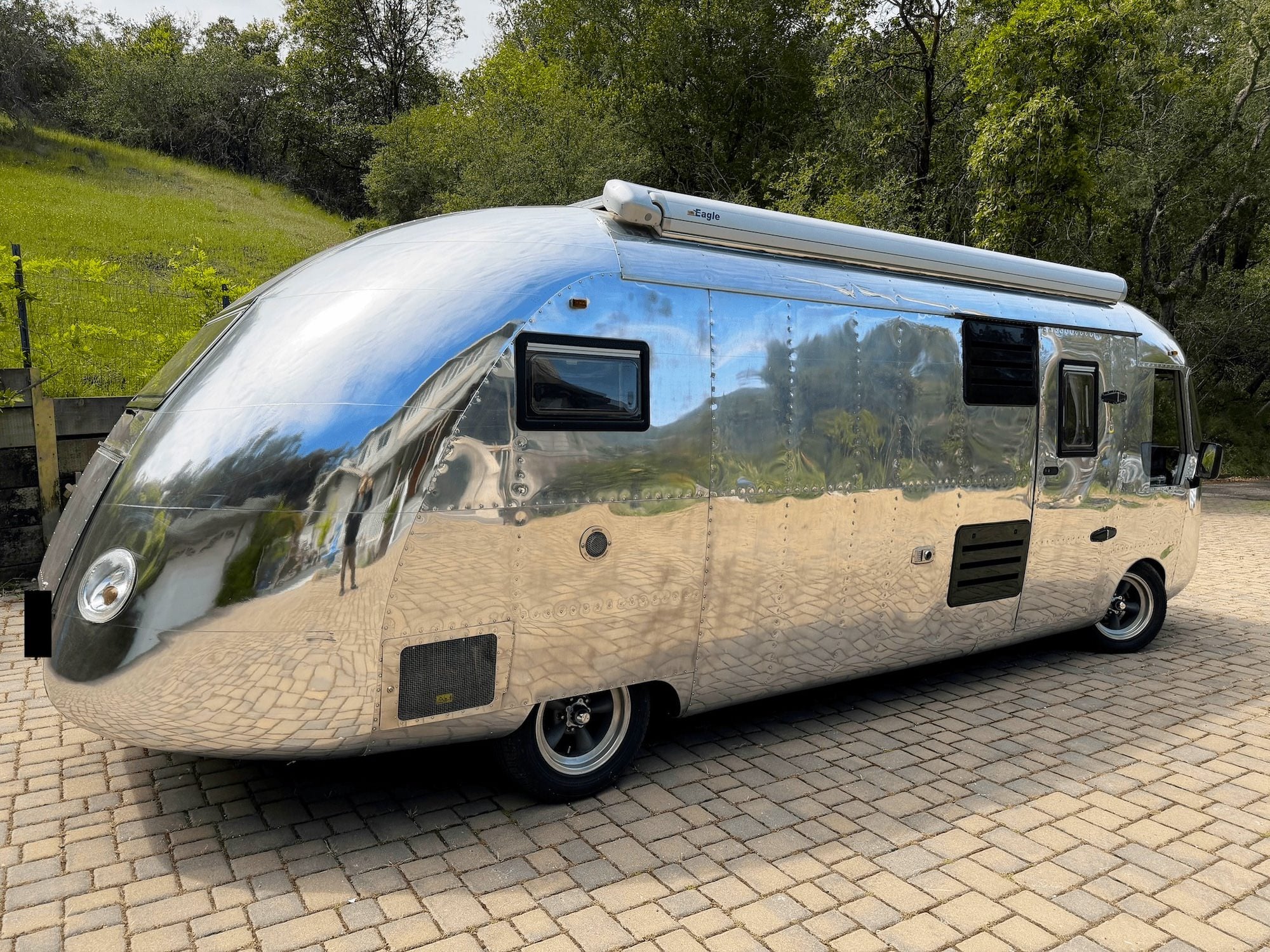
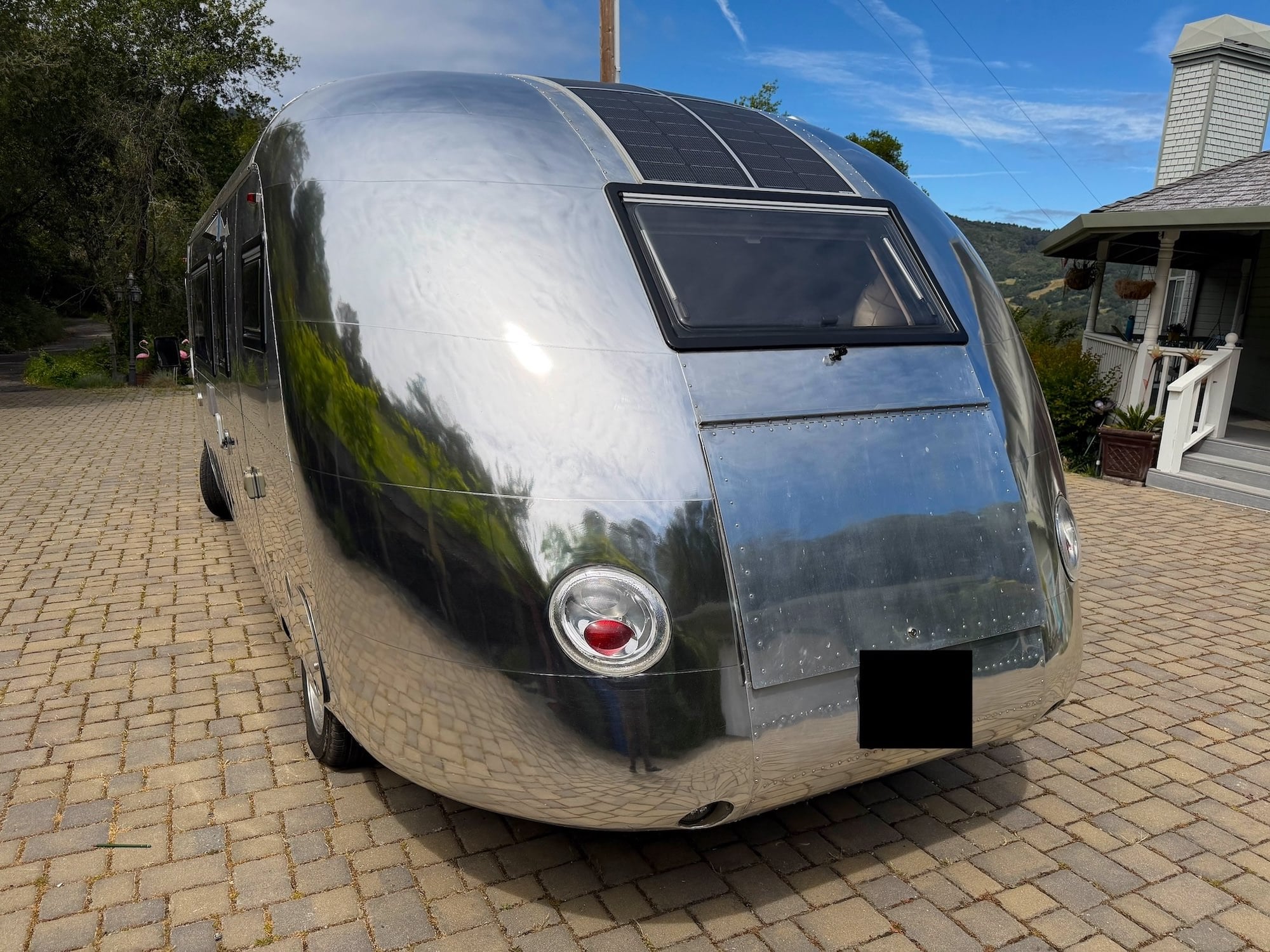
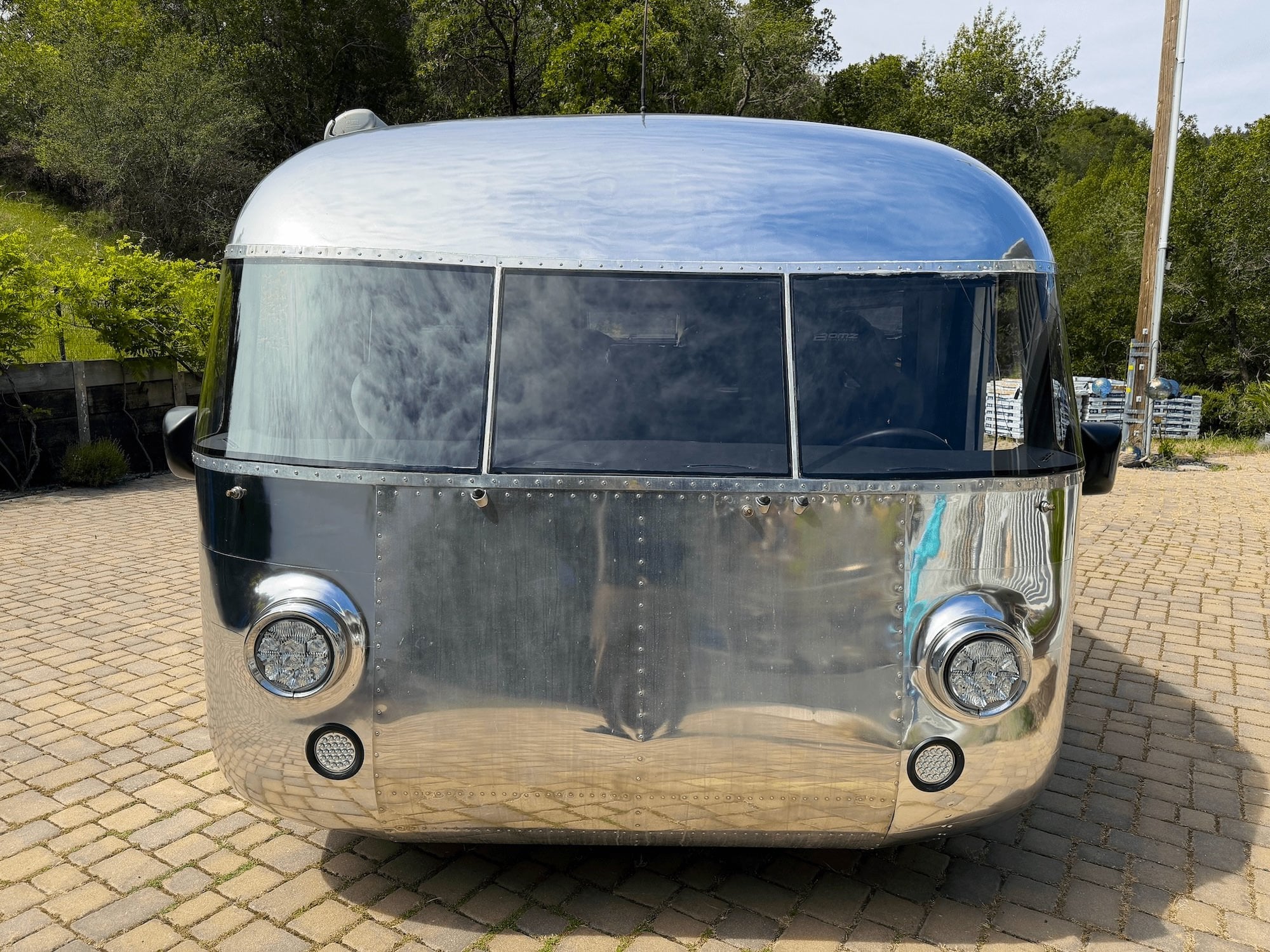
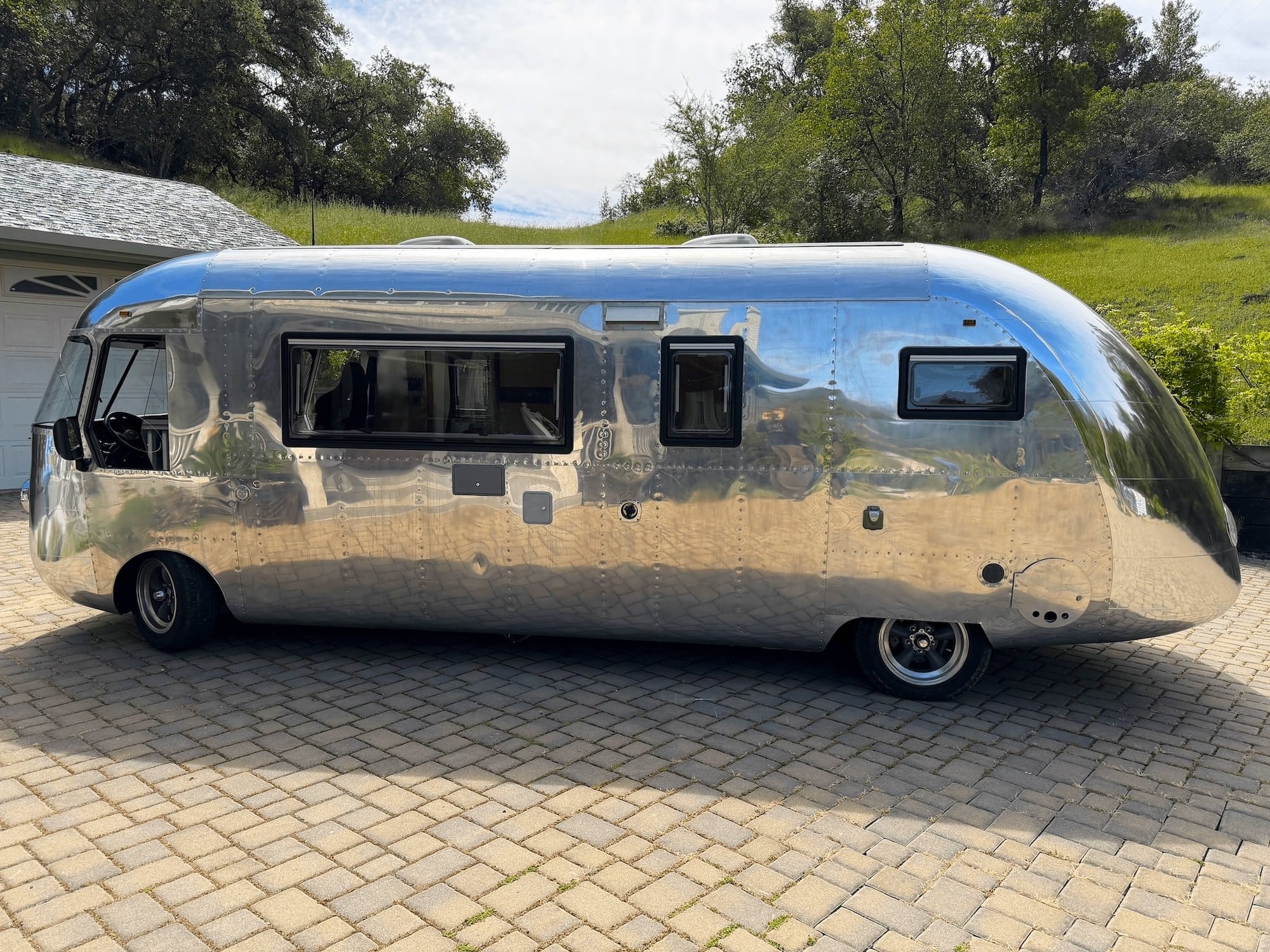
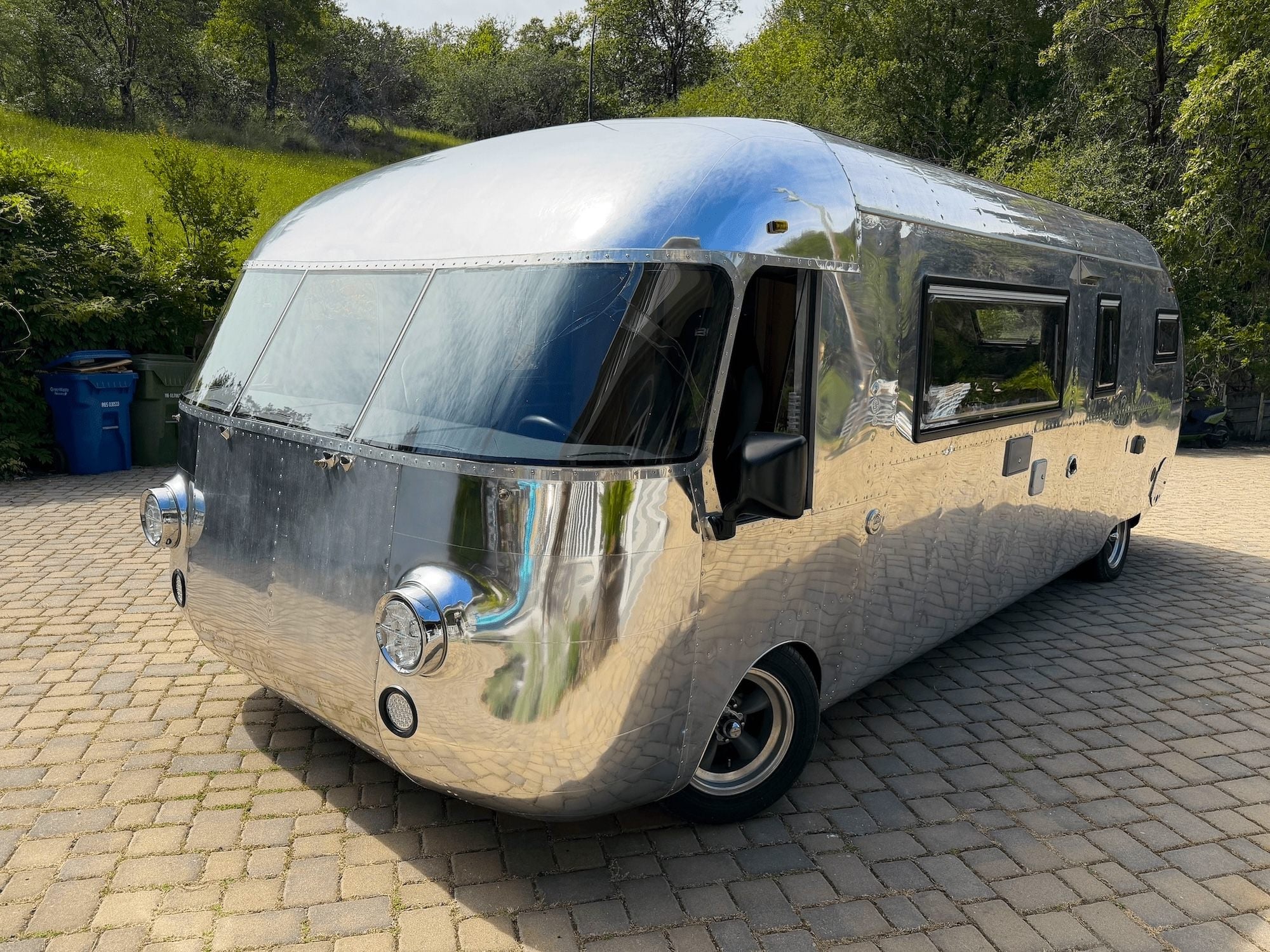
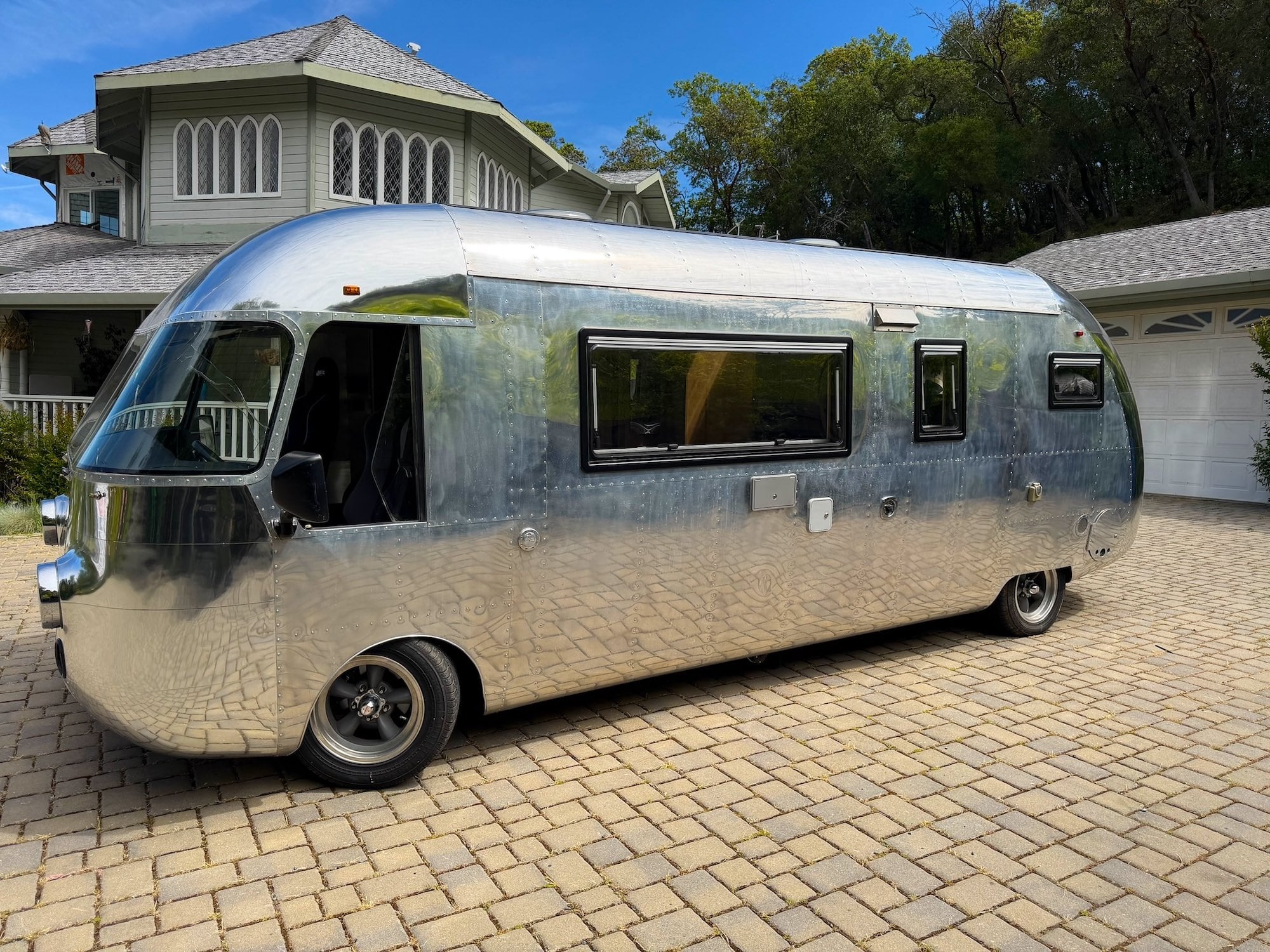
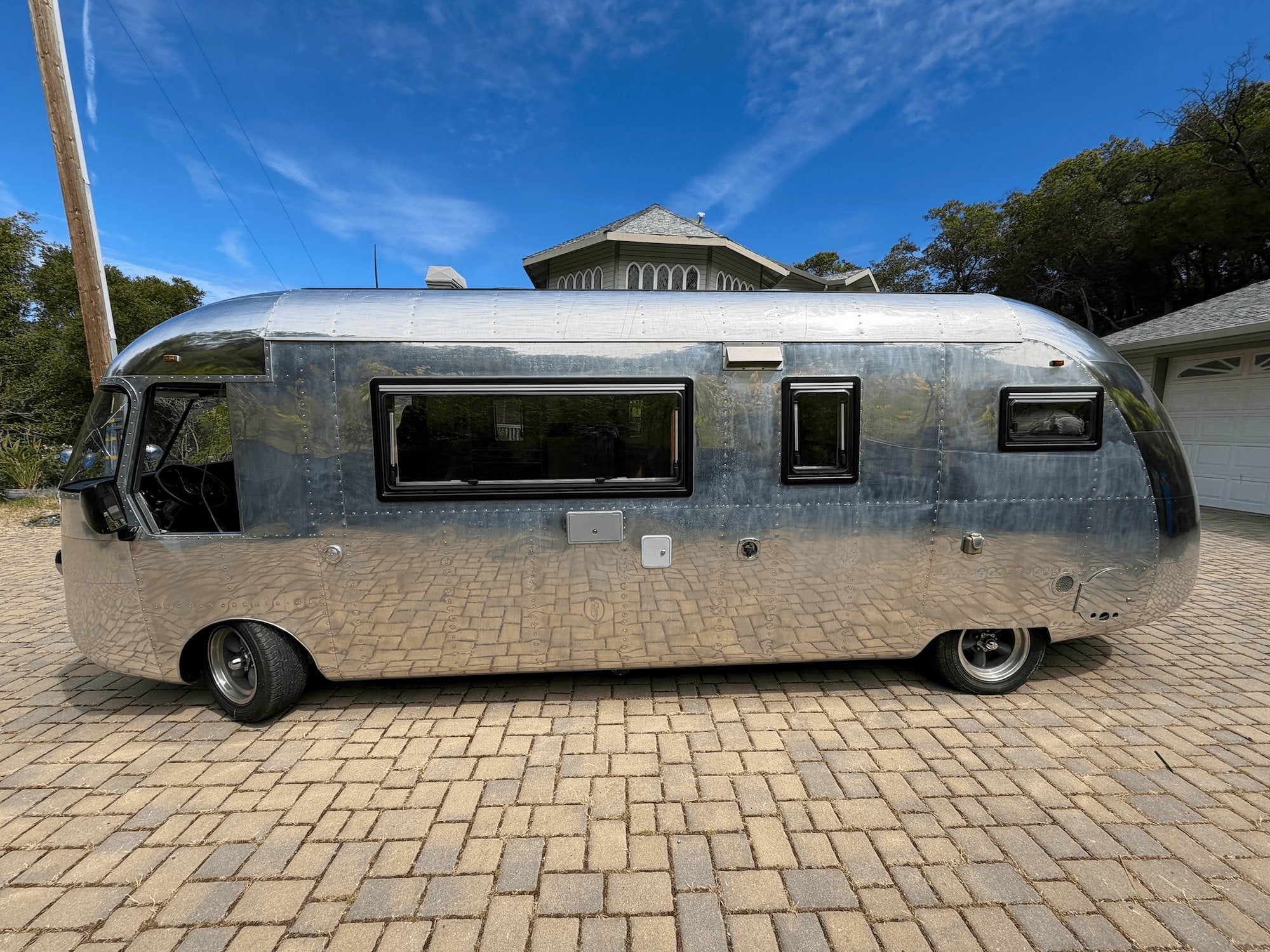
This 1966 Ultra Van is one of 346 examples built by Ultra Incorporated between 1966 and 1970. It was bought by the current seller in 2009, and the subsequent refurbishment work spanned more than 15 years. The exterior was fitted with replacement aluminum panels and a 19-panel roof-mounted solar setup, while the interior dinette, kitchenette, bathroom, and sleeping area were all refreshed.
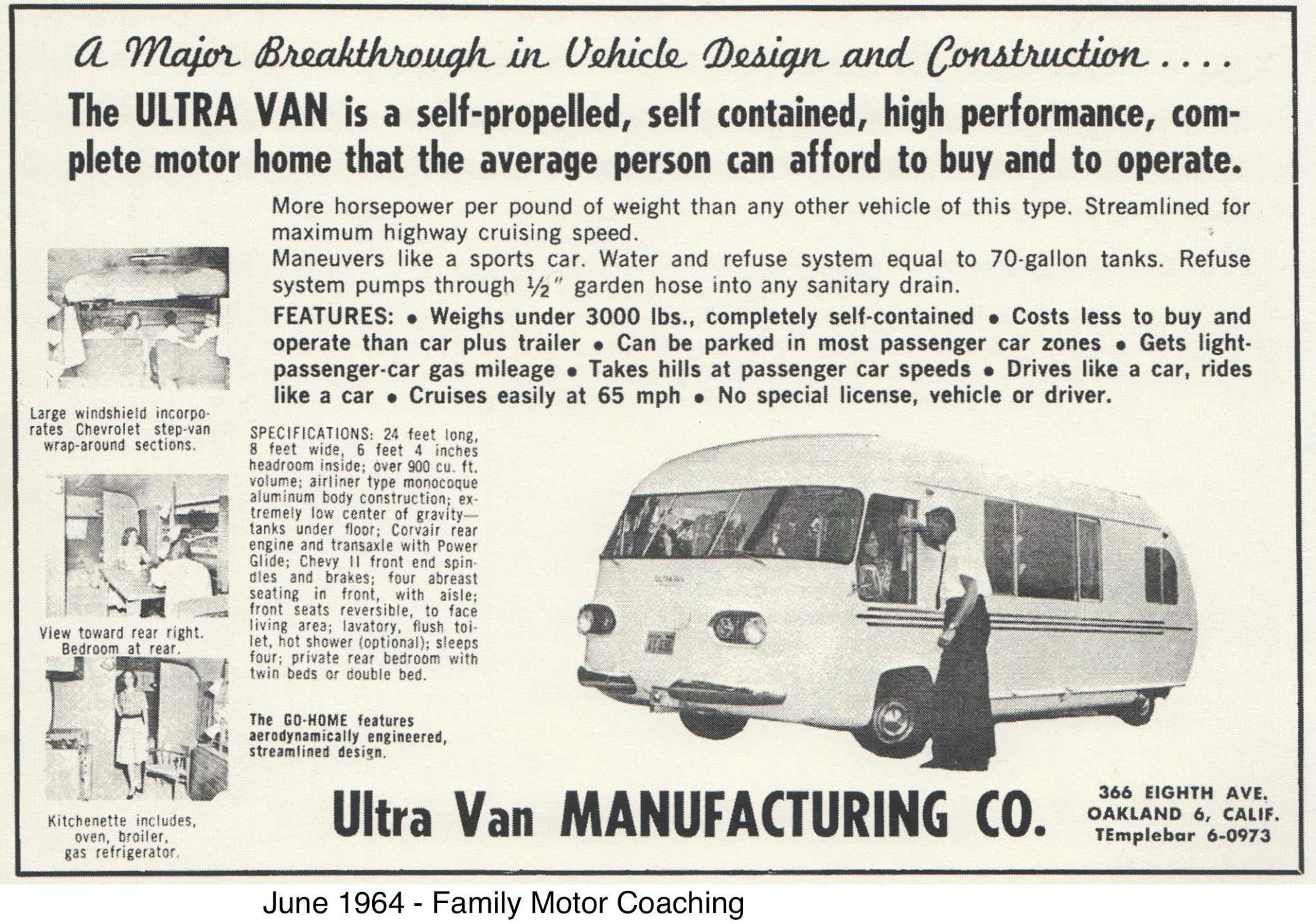
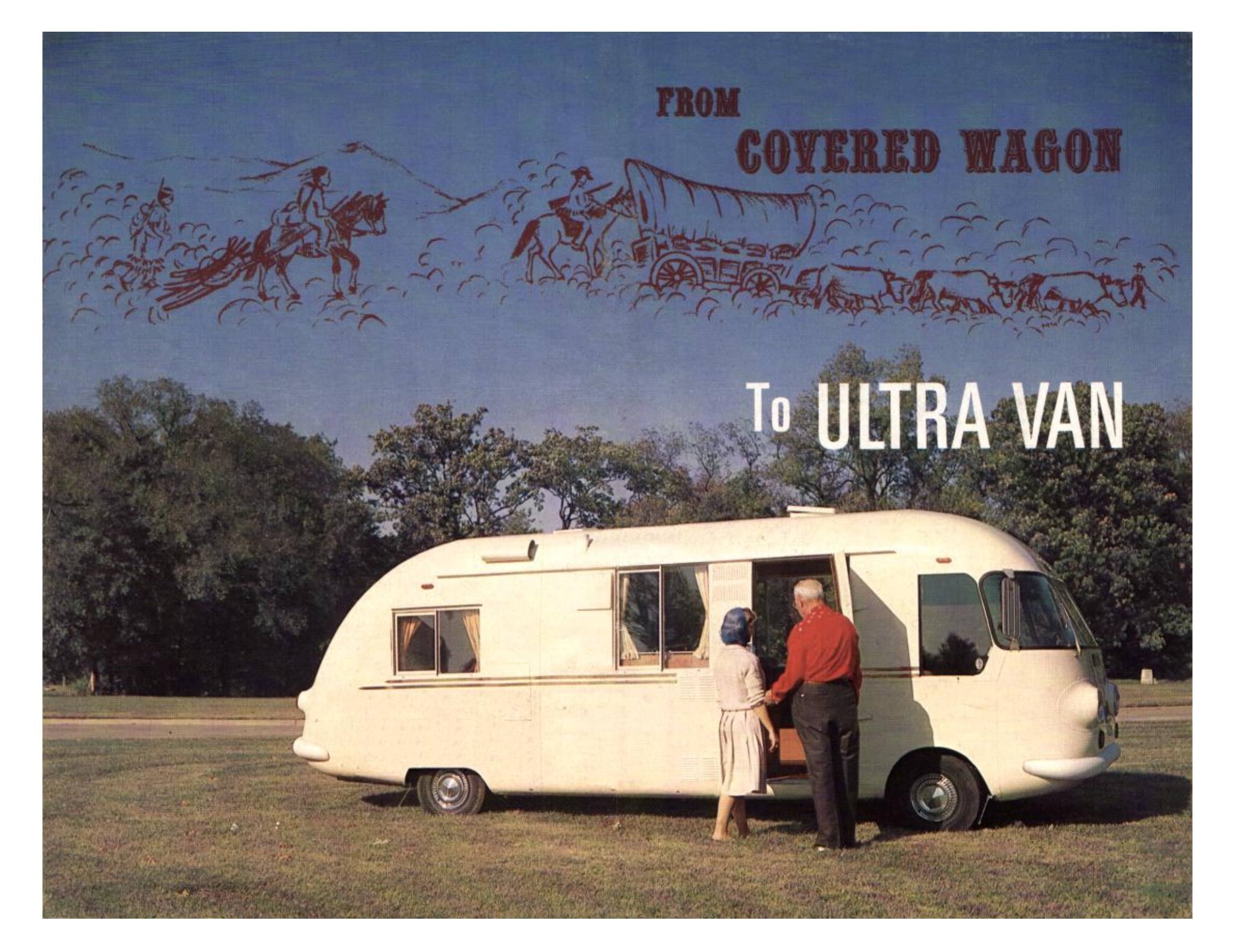
Of the roughly 376 coaches built across all production phases, more than 100 are believed to survive, many with well over 100,000 miles on the odometer and some reportedly surpassing 500,000. Image courtesy of Ultra Van.
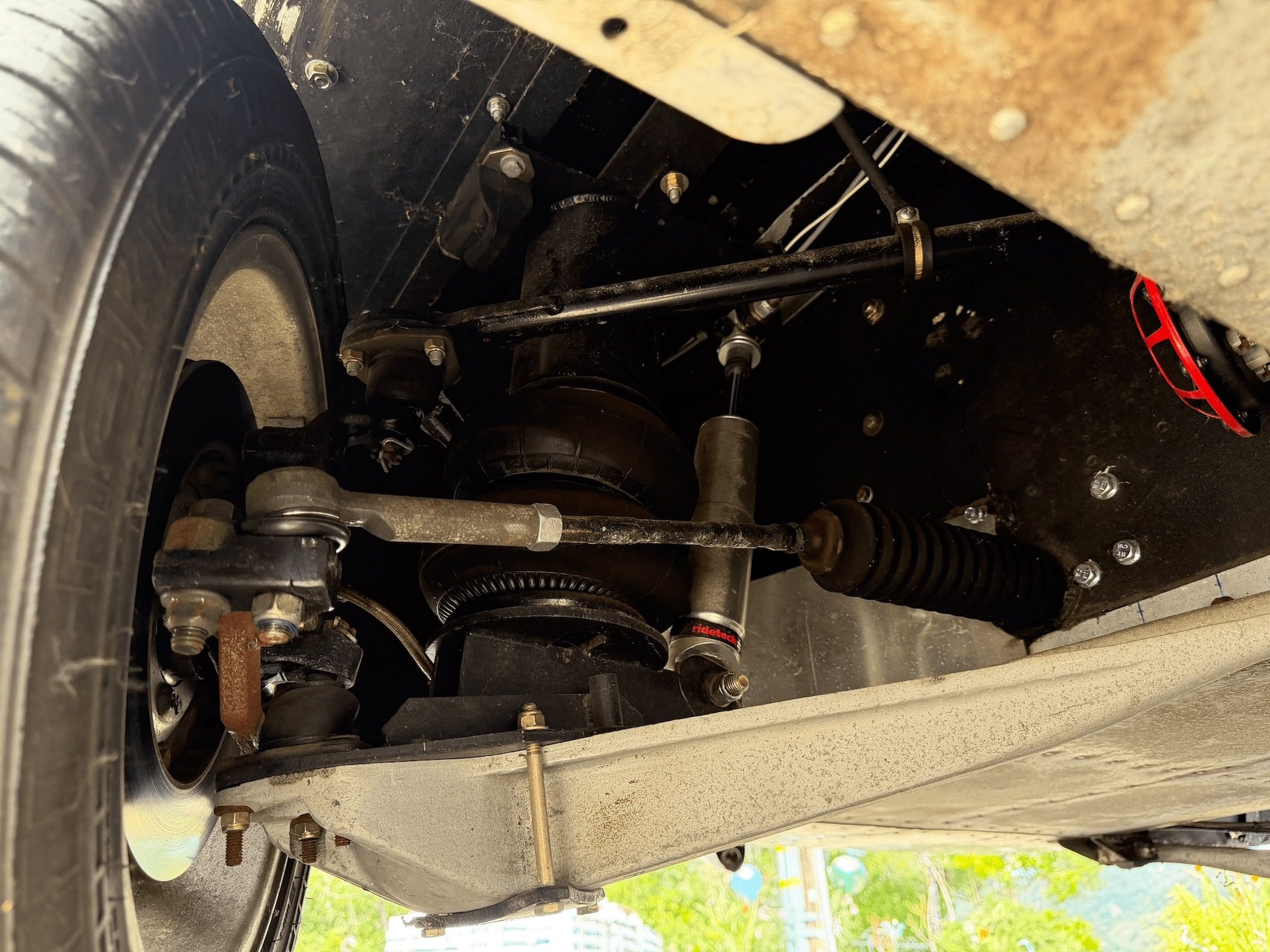
This motorhome measures in at 22 feet long by 8 feet wide on a 152 inch wheelbase, and it rides on an Accuair air suspension with Ridetech shock absorbers, gunmetal 15 inch American Racing wheels, and Wilwood four-wheel disc brakes. Power steering has been added, and the Ultra Van’s original front-end geometry that allows the wheels to turn up to 50º in either direction.
The seller does note that the lithium battery for the solar-power system needs replacement, there is a crack on the left side of the windshield, and the vehicle does not come with a built-in generator.
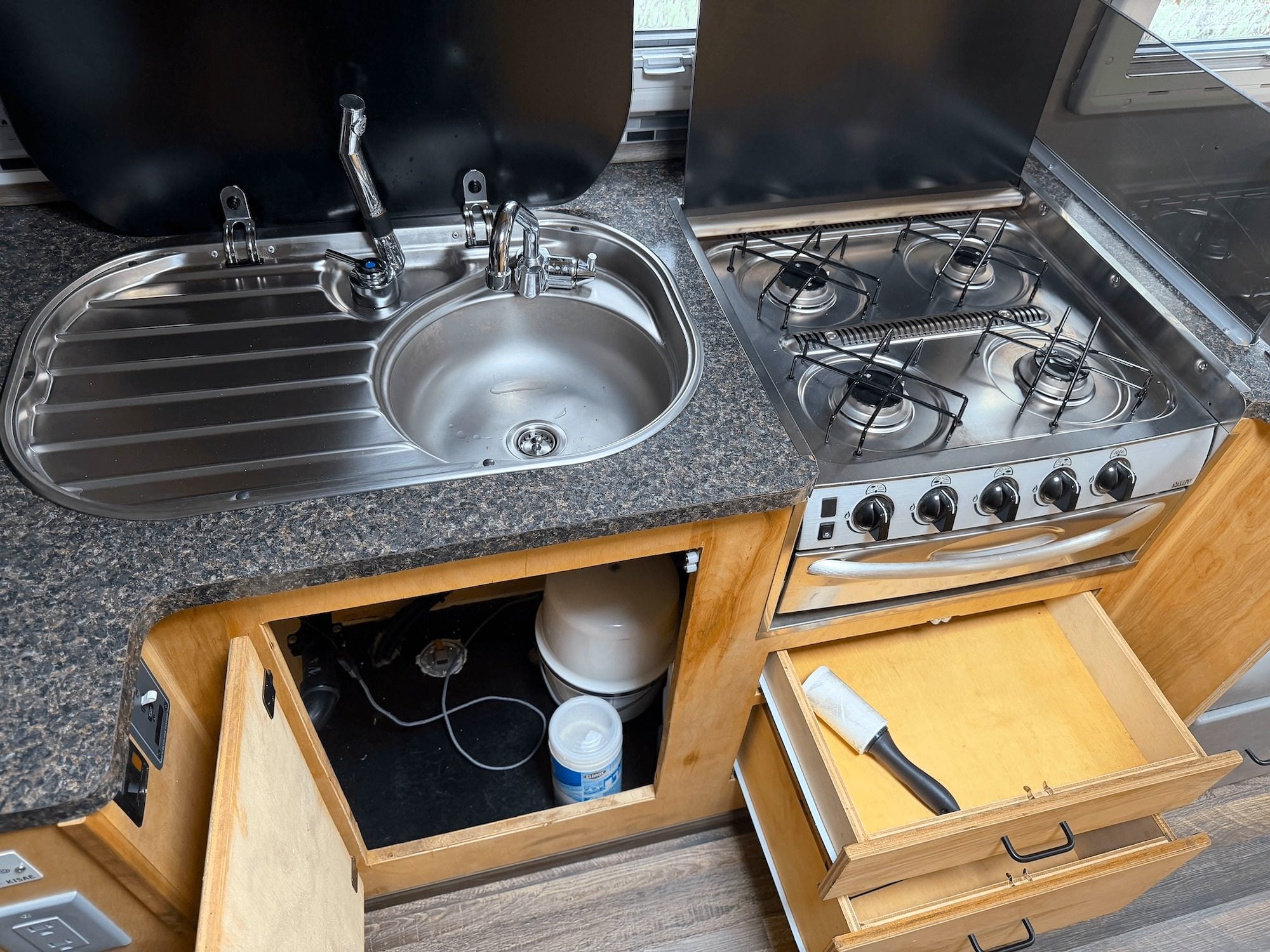
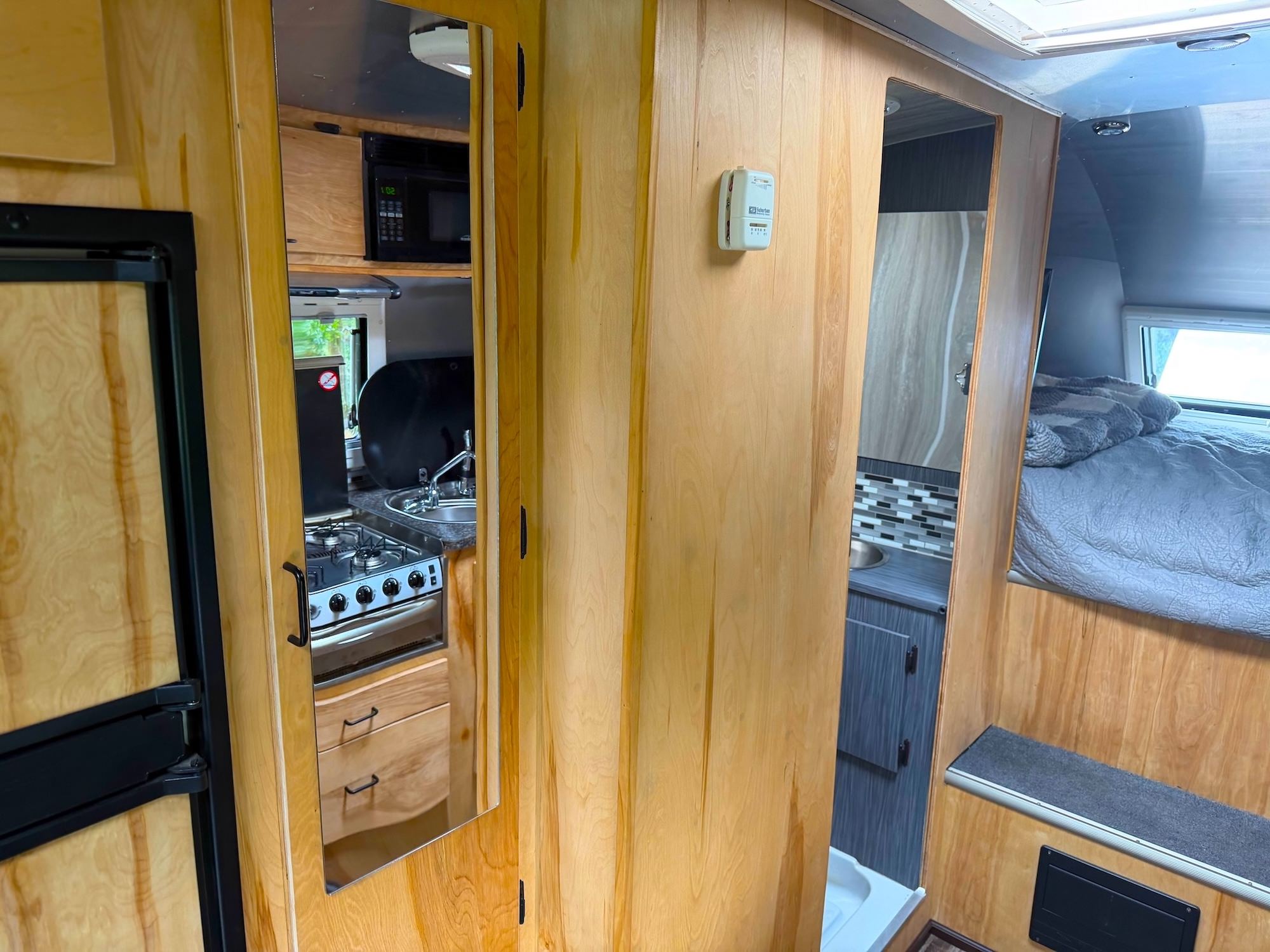
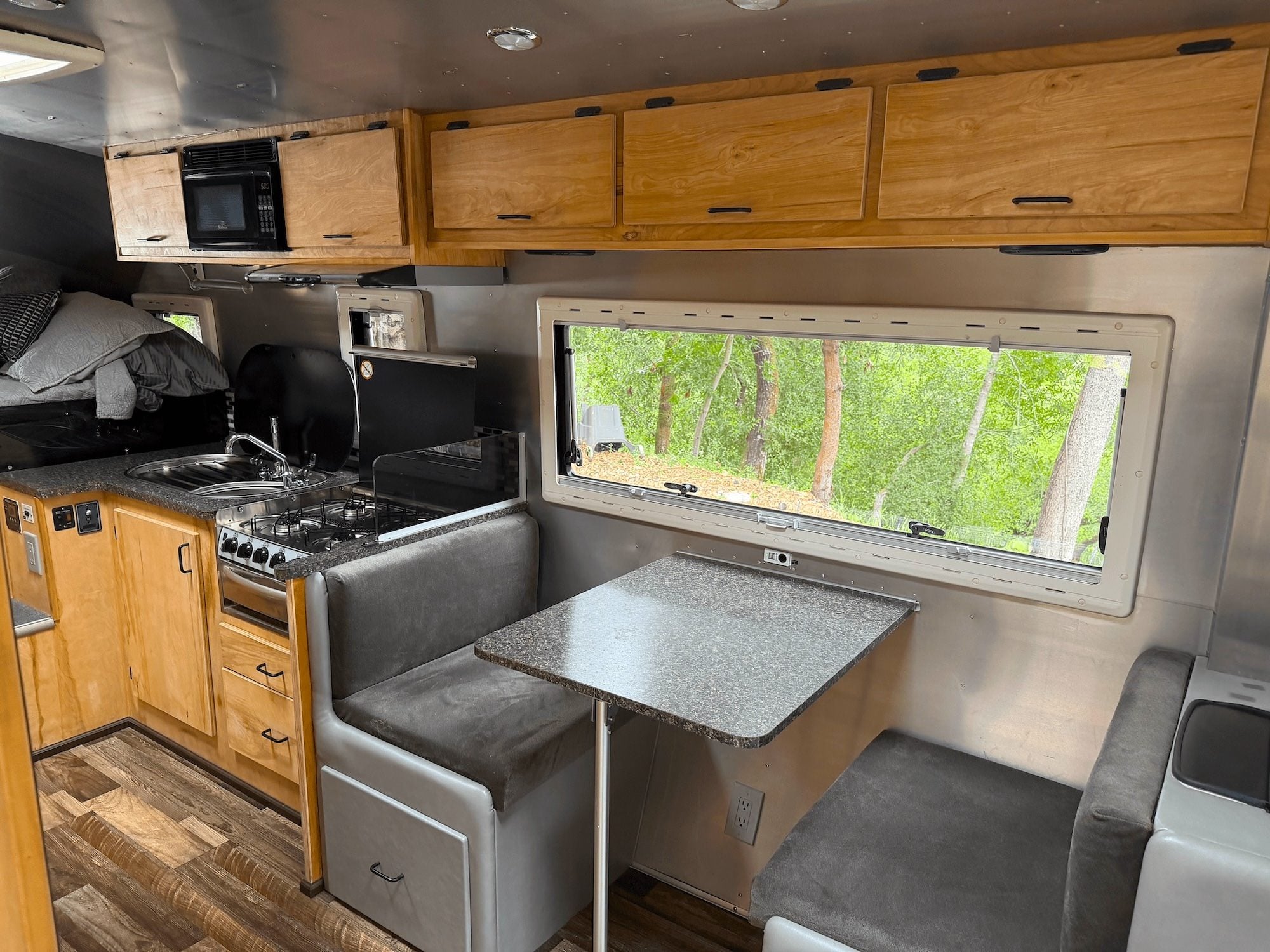
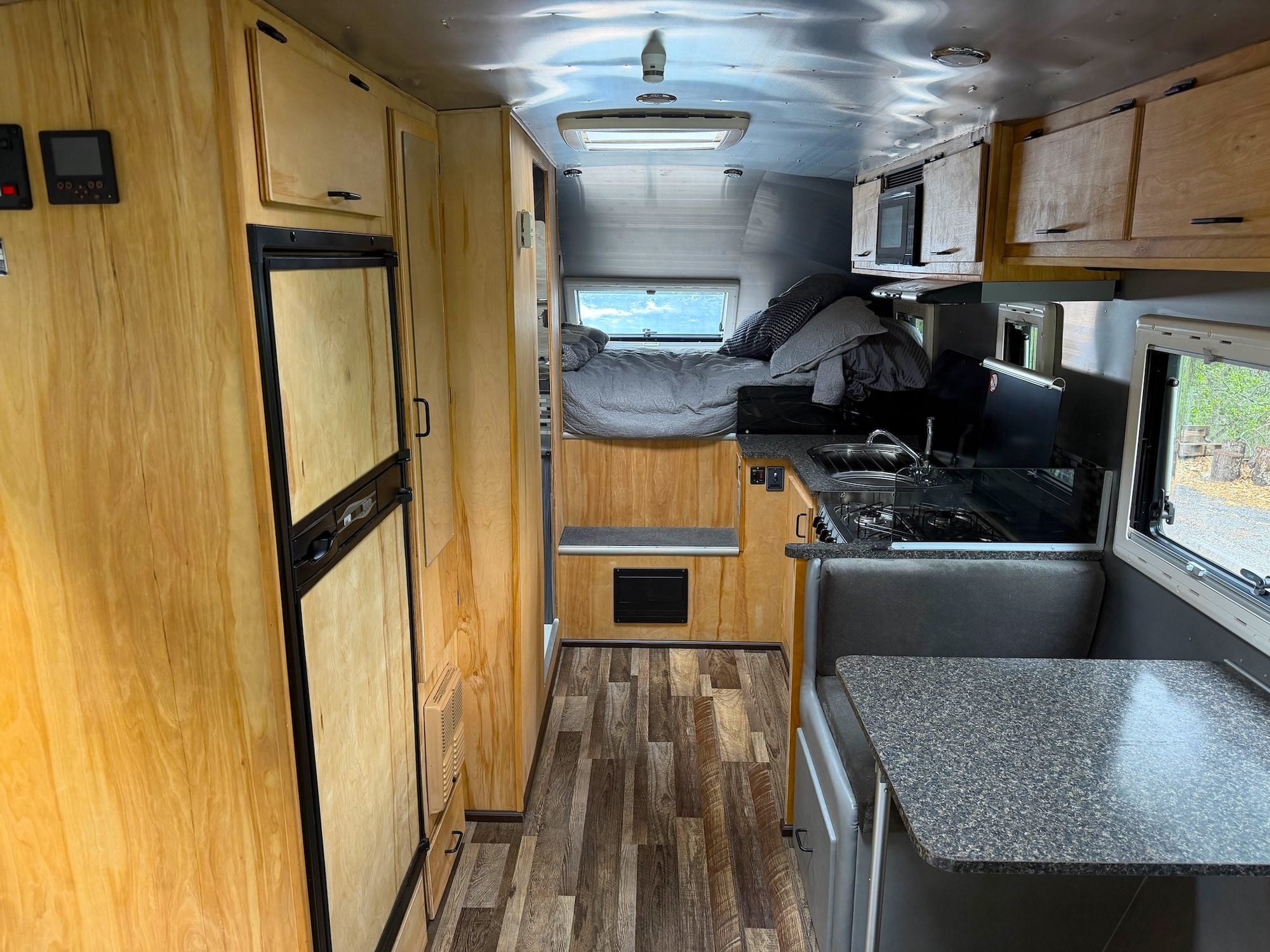
The refurbished living quarters now have woodgrain flooring, wood cabinetry, and a dinette with bench seats, a fold-down table, under-seat storage, and a pop-open picture window. The kitchenette is equipped with a refrigerator, a stainless-steel sink, a four-burner range with a hinged cover, a warming drawer, a range hood, and a microwave, with overhead storage on both sides.
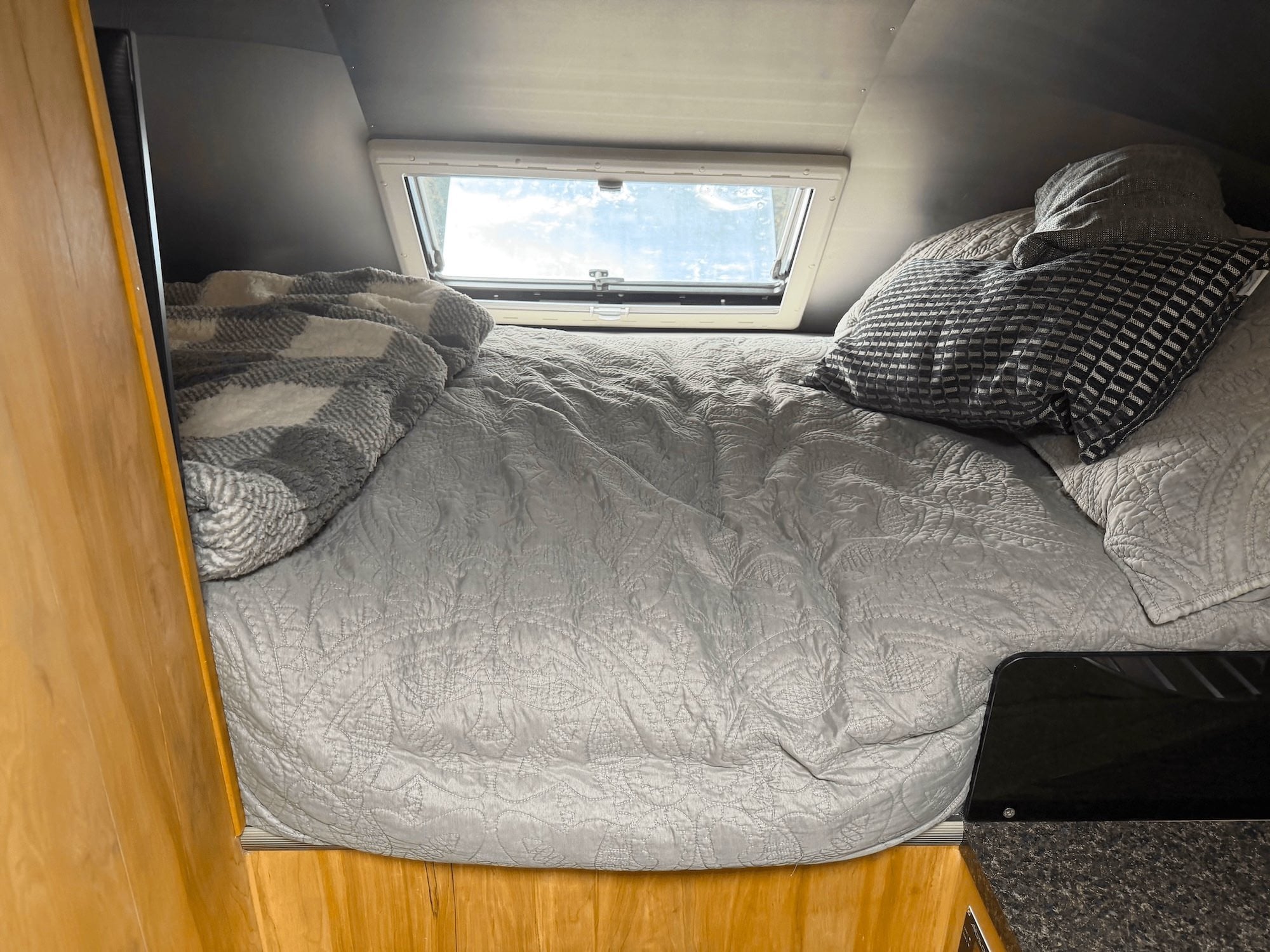
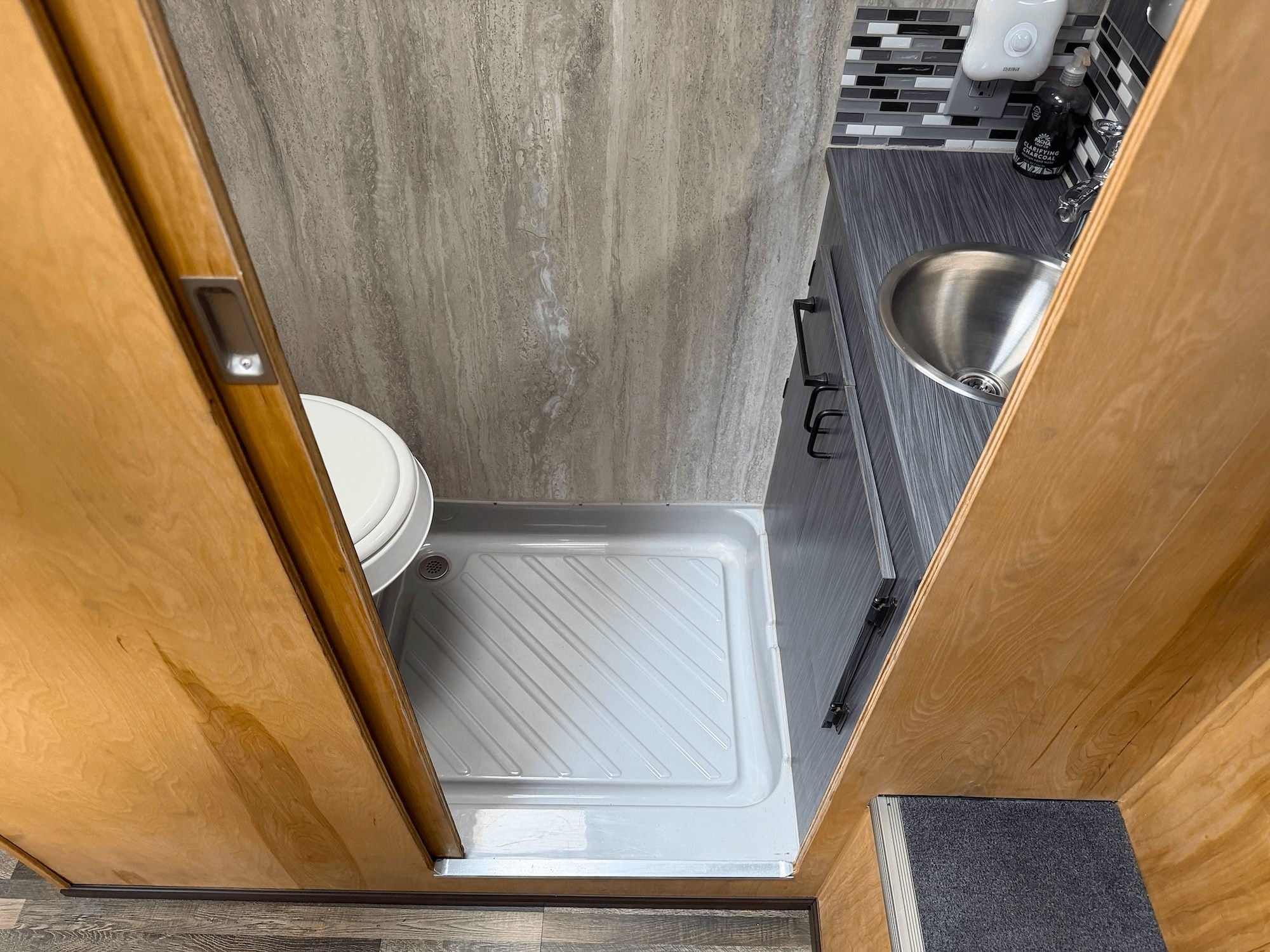
The rear sleeping area is mounted above the cargo space and the engine bay, and the bed is surrounded by pop-open windows on three sides, overhead lighting, a 110-volt outlet, and a flat-panel TV on a swing-out mount. The bathroom has a toilet, sink, and wand-style showerhead with a roof vent overhead.
Additional equipment includes dual side entrances, a power-operated Fiamma curb-side awning, a water heater, a propane tank, utility hook-ups, and holding tanks for fresh, gray, and black water. The plumbing system has a remote-controlled macerator pump with independent electric dump valves for both gray and black water tanks.
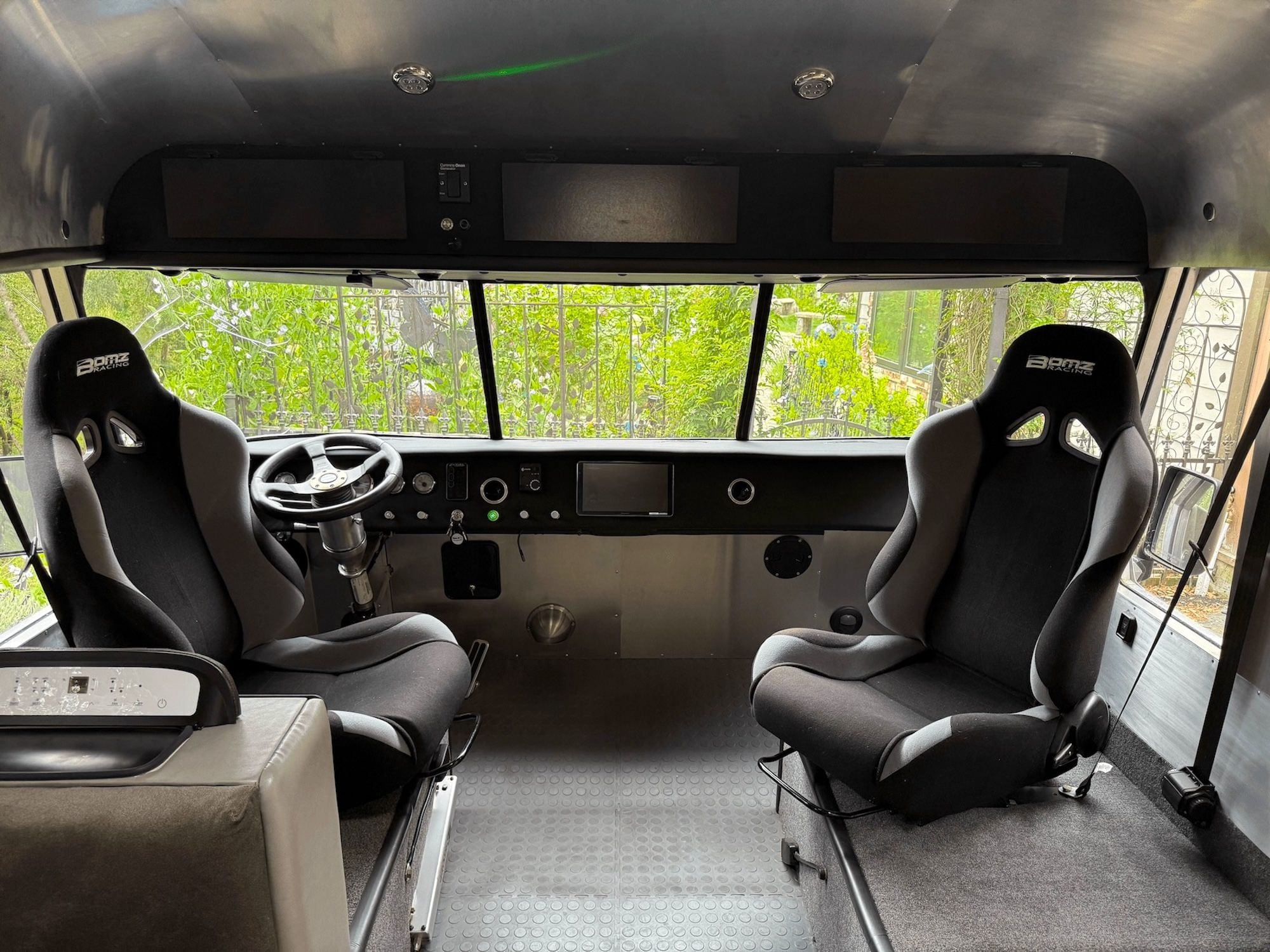
Up front, Bomz Racing bucket seats trimmed in gray and black fabric are installed on swivel bases, and an air conditioning unit has been built in behind the driver’s seat. The dashboard is wrapped in gray leather and houses an air suspension control panel, a Propex thermostat, and a Pioneer touchscreen infotainment system connected to Kicker speakers and a subwoofer. A leather-wrapped MOMO steering wheel sits ahead of a 120-mph speedometer and some auxiliary gauges.
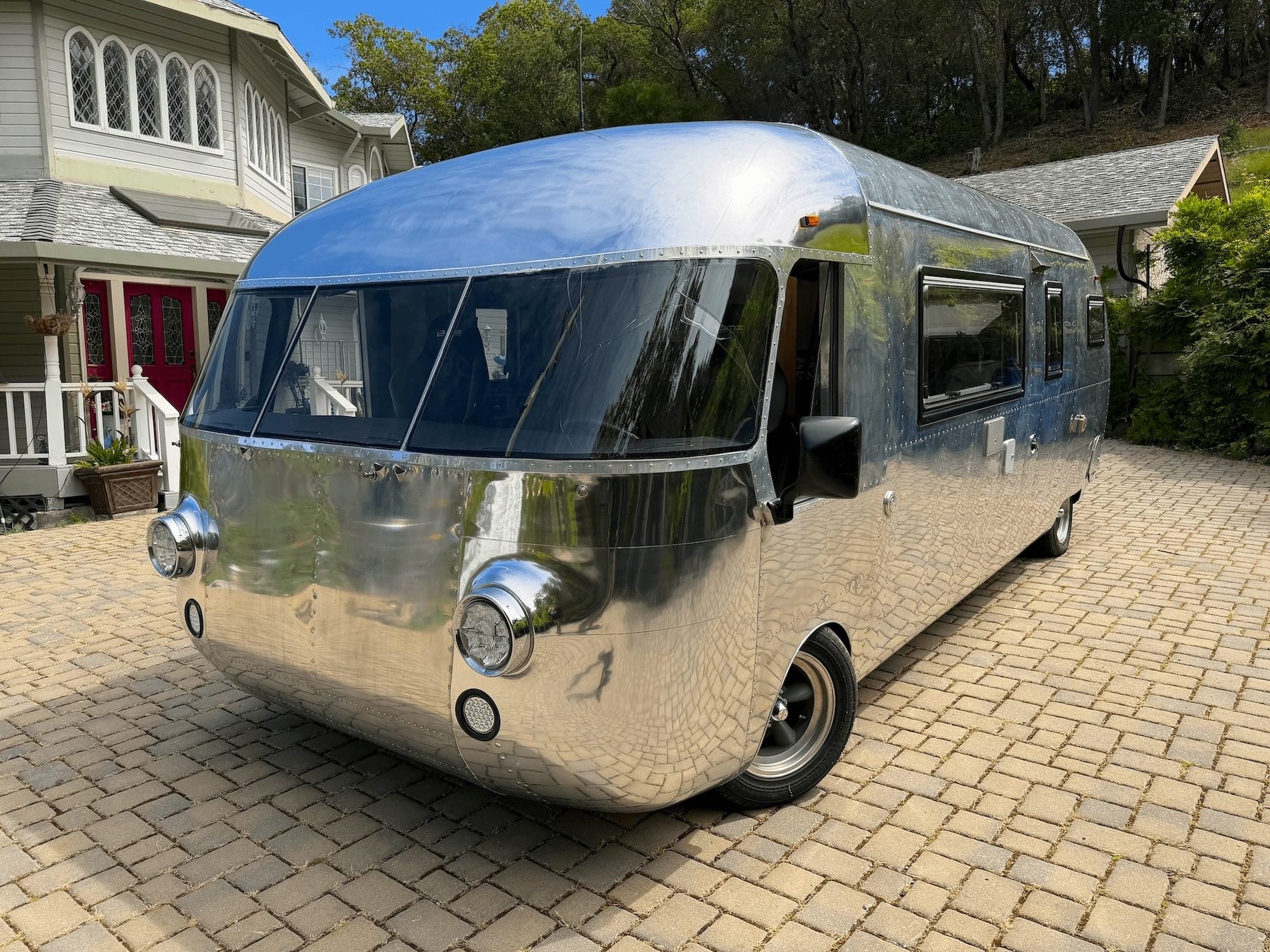
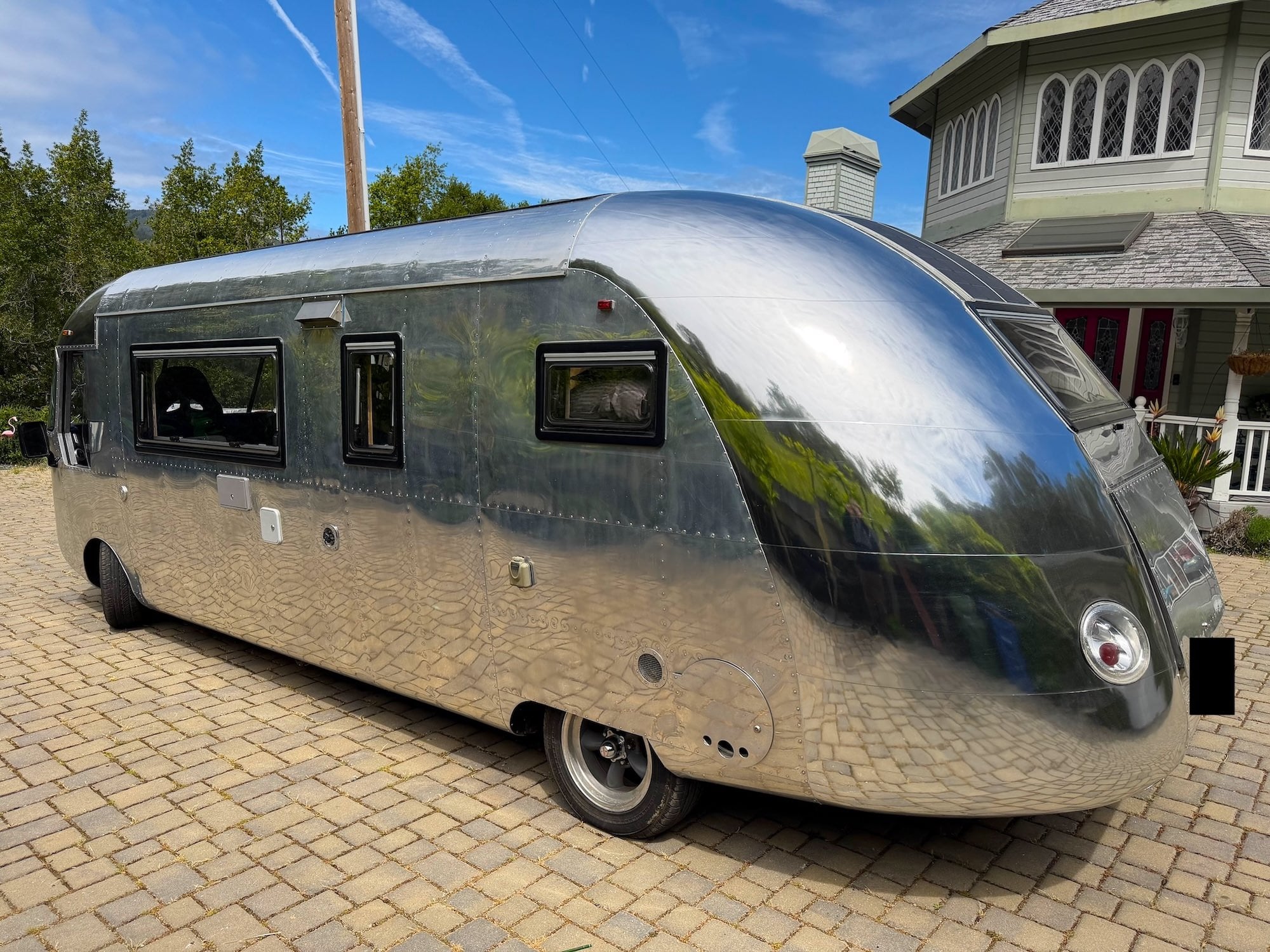
This 1966 Ultra Van is one of 346 examples built by Ultra Incorporated between 1966 and 1970. It was bought by the current seller in 2009, and the subsequent refurbishment work spanned more than 15 years.
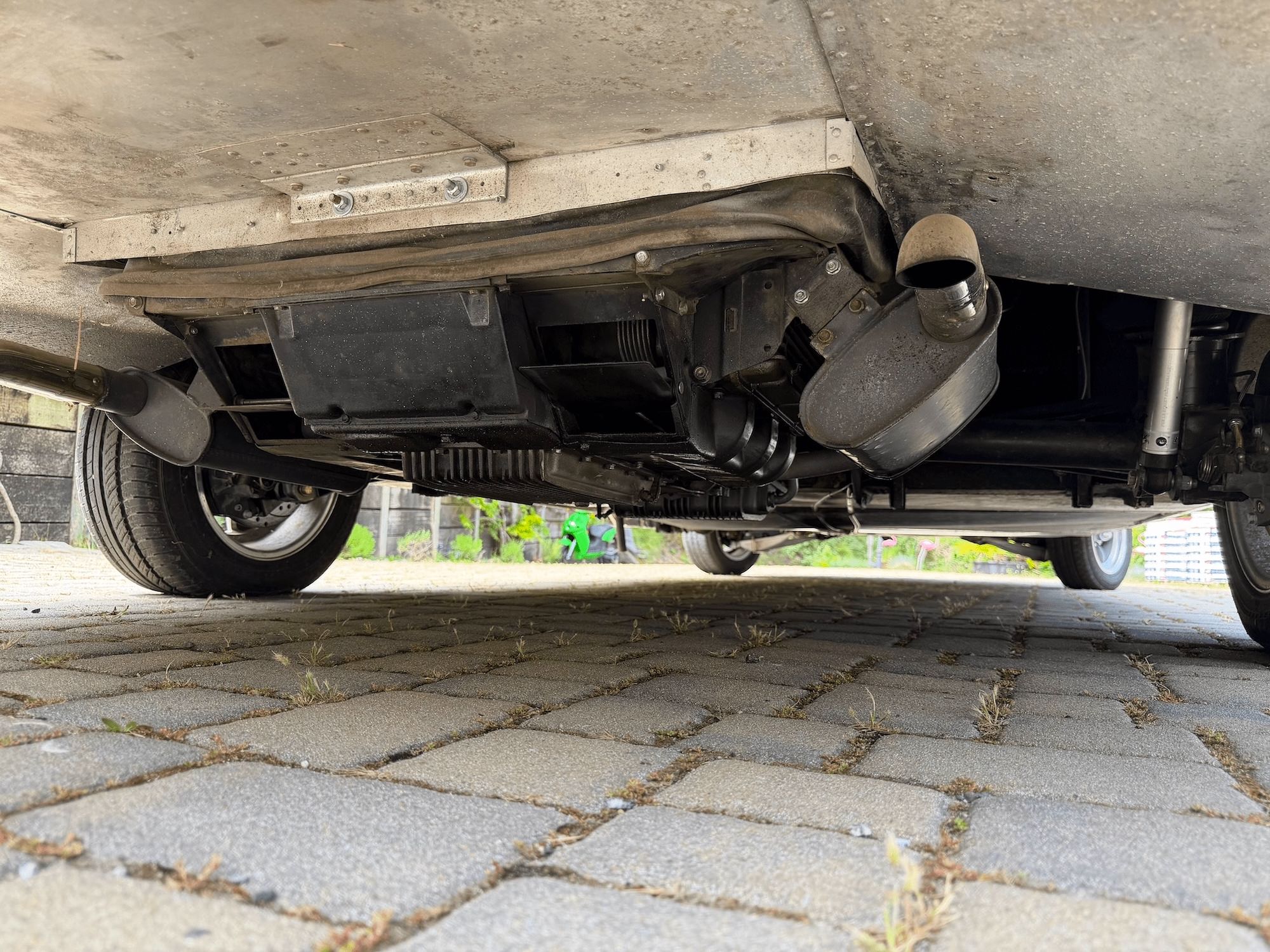
As you might expect, power comes from an air-cooled, Corvair-sourced 2.7 liter flat-six, it’s been fitted with Ted Brown’s Microsquirt ECM-based electronic fuel injection system and a dual-exit exhaust. The engine is mounted beneath removable floor panels in the rear cargo area and sends power to the rear wheels through a 2-speed GM Powerglide automatic transmission.
The Ultra Van is now being offered for sale out of Gilroy, California with manuals, service records dating from 2009, and a clean California title in the seller’s name. If you’d like to read more about it or place a bid you can visit the listing here.
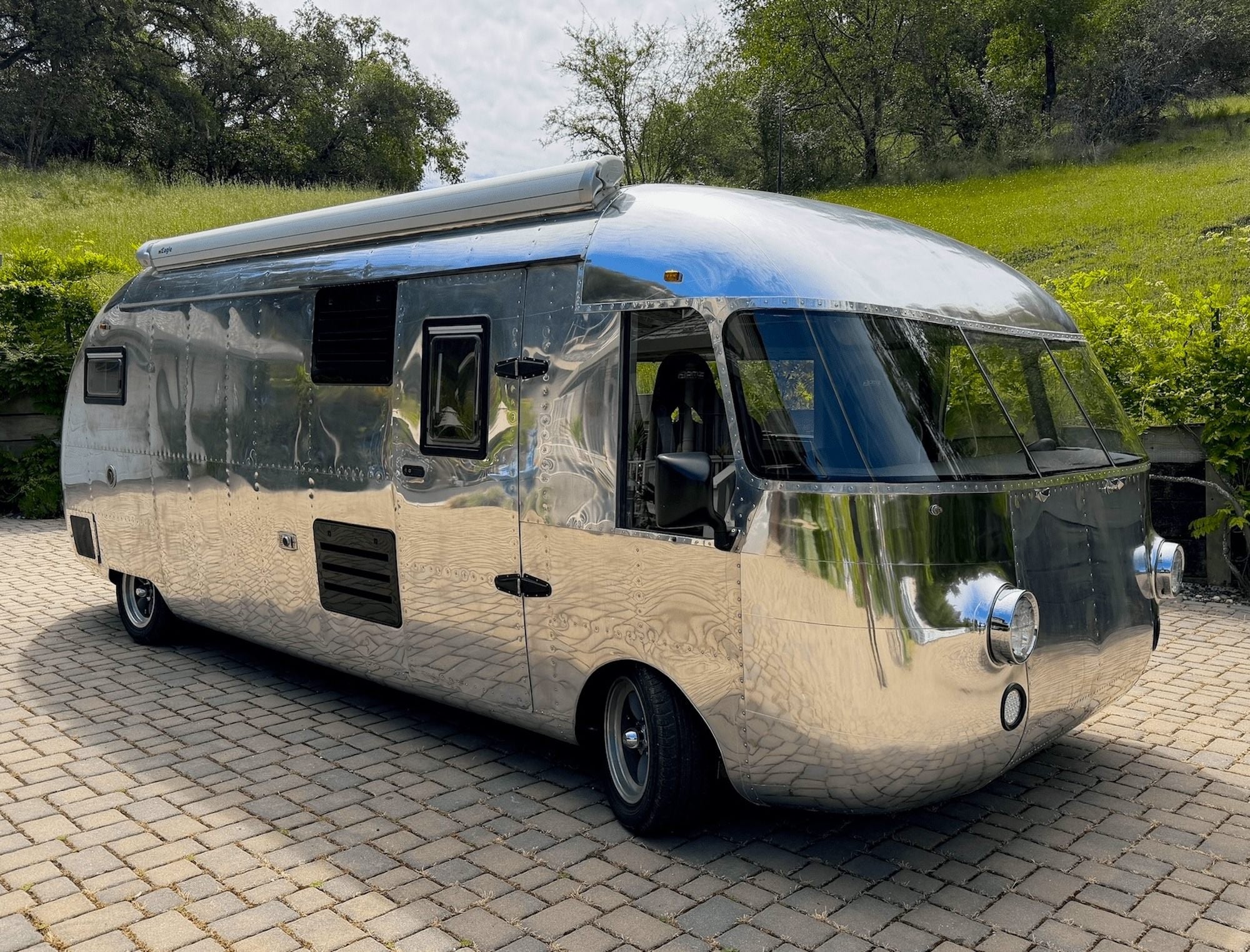
Images courtesy of Bring a Trailer

Articles that Ben Branch has written have been covered on CNN, Popular Mechanics, Smithsonian Magazine, Road & Track Magazine, the official Pinterest blog, the official eBay Motors blog, BuzzFeed, Autoweek Magazine, Wired Magazine, Autoblog, Gear Patrol, Jalopnik, The Verge, and many more.
Silodrome was founded by Ben back in 2010, in the years since the site has grown to become a world leader in the alternative and vintage motoring sector, with well over a million monthly readers from around the world and many hundreds of thousands of followers on social media.