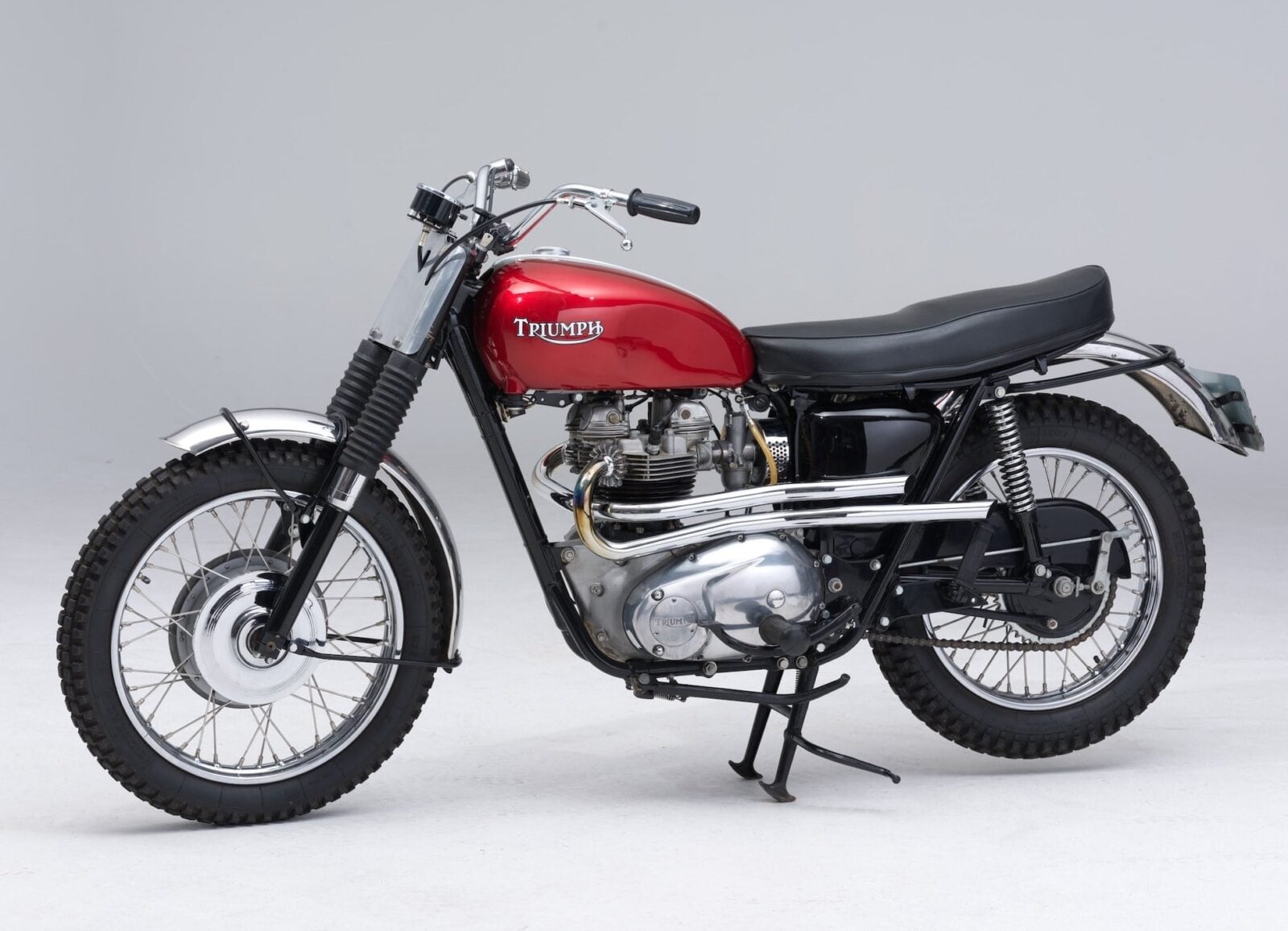
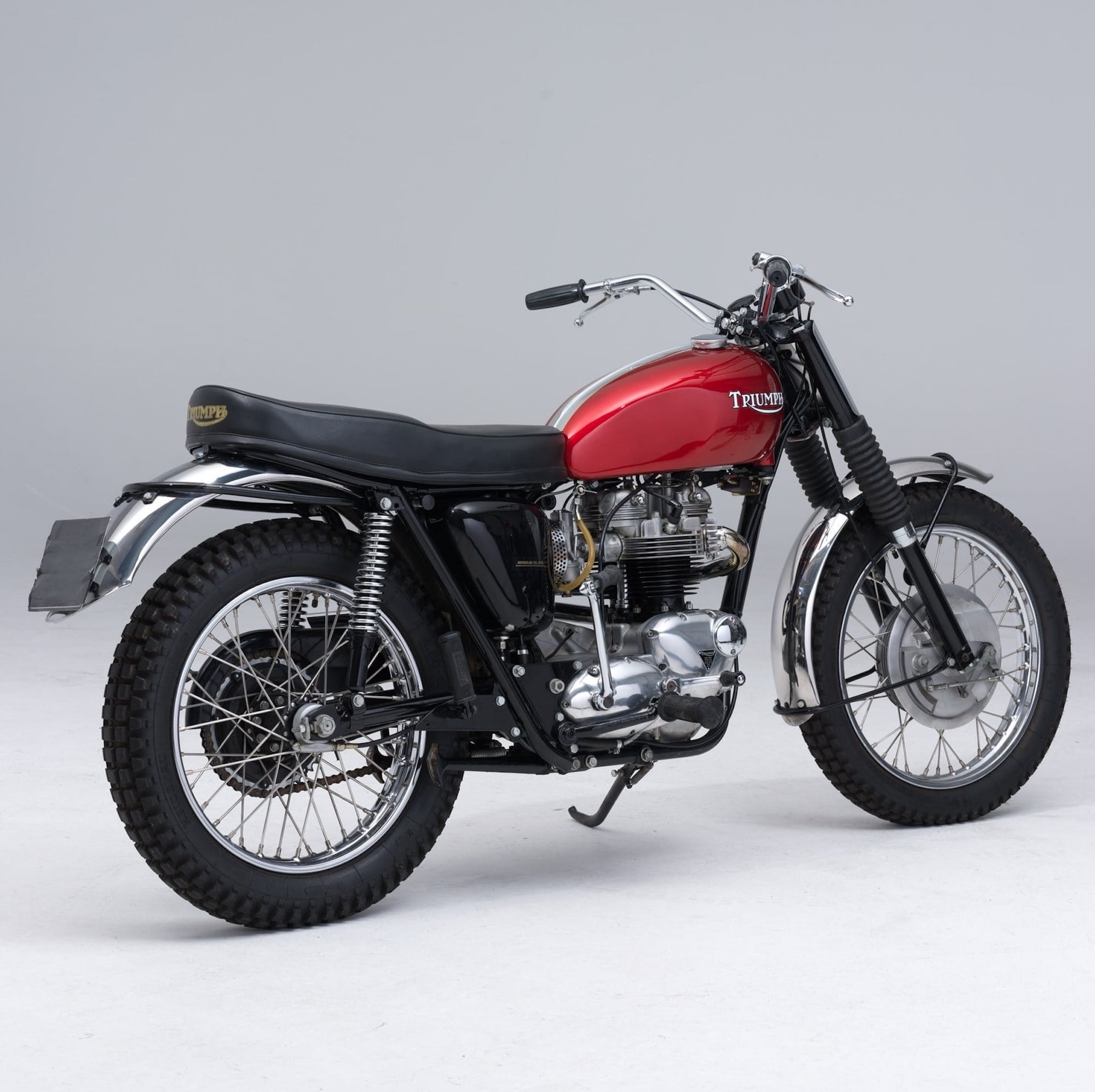
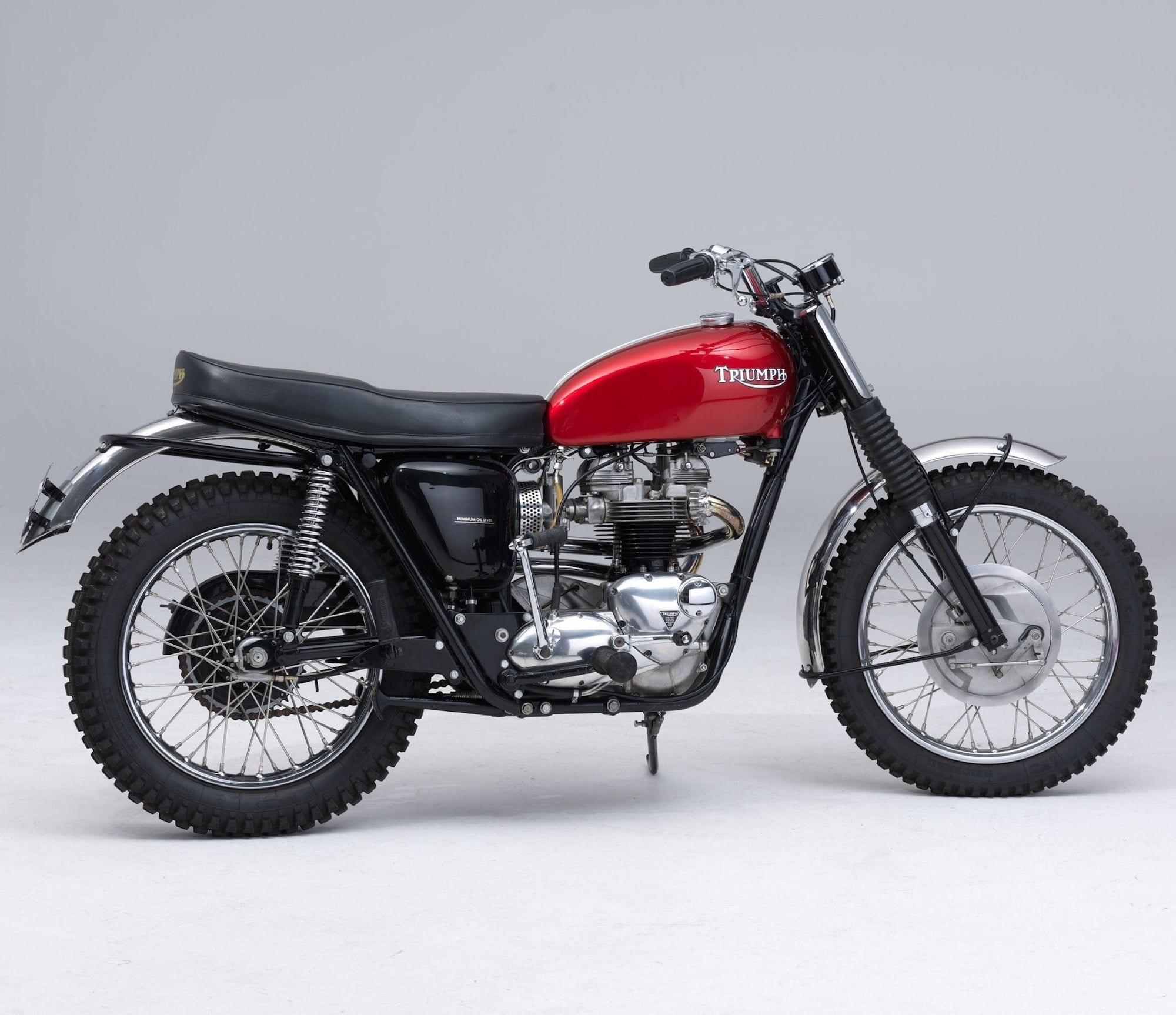
This is a restored Triumph TR6C, an original “Desert Sled,” the model that dominated Southern California off-road motorcycle racing long before the two-strokes from Husqvarna and then from the Japanese arrived and made everything a whole lot more buzzy.
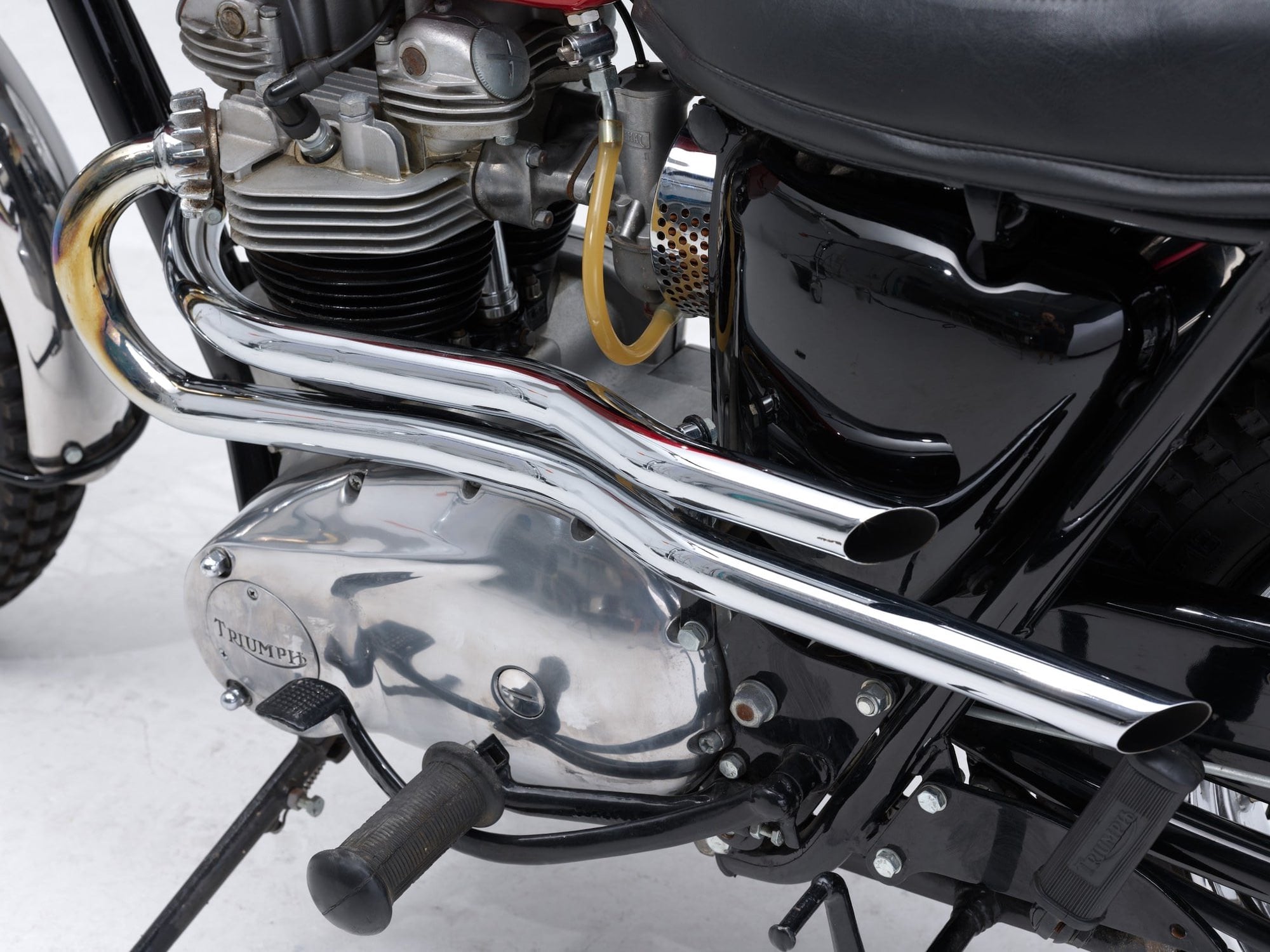
This TR6C has been rebuilt to period-correct Desert Sled-spec, with a headlight delete, high exhausts with no mufflers, polished alloy fenders, off-road tires, and a batteryless ignition system to help keep the weight down.
Fast Facts: The Triumph TR6C “Desert Sled”
- The Triumph TR6 Trophy debuted in 1956 with a 649cc parallel-twin producing 42 bhp, quickly becoming the motorcycle of choice for Southern California desert racers. Triumph riders dominated the Big Bear Run throughout the late 1950s, establishing the stripped-down, lightweight machines as the legendary “Desert Sleds.”
- Triumph developed the competition-focused TR6SC for American desert racing, removing unnecessary equipment and fitting high exhausts, alloy fenders, skid plates, and lower gearing. The TR6C succeeded it as the primary off-road Trophy in 1967, producing 45 bhp and featuring batteryless ignition, a 4-speed gearbox, and drum brakes.
- The TR6 Trophy became closely associated with legendary desert racer Bud Ekins and actor Steve McQueen. Ekins performed the famous motorcycle fence jump in “The Great Escape” aboard a disguised Triumph TR6, while both men competed on Triumph motorcycles in the 1964 International Six Days Trial in East Germany.
- The 1969 Triumph TR6C shown here has been comprehensively restored to period-correct Desert Sled spec, with high-mounted unsilenced exhausts, alloy fenders, off-road tires, and batteryless ignition. Finished in Olympic Flame red and silver, this matching-numbers, American-market motorcycle returned to Britain in 2019 and has covered just 380 miles since restoration.
History Speedrun: The Triumph TR6 Trophy
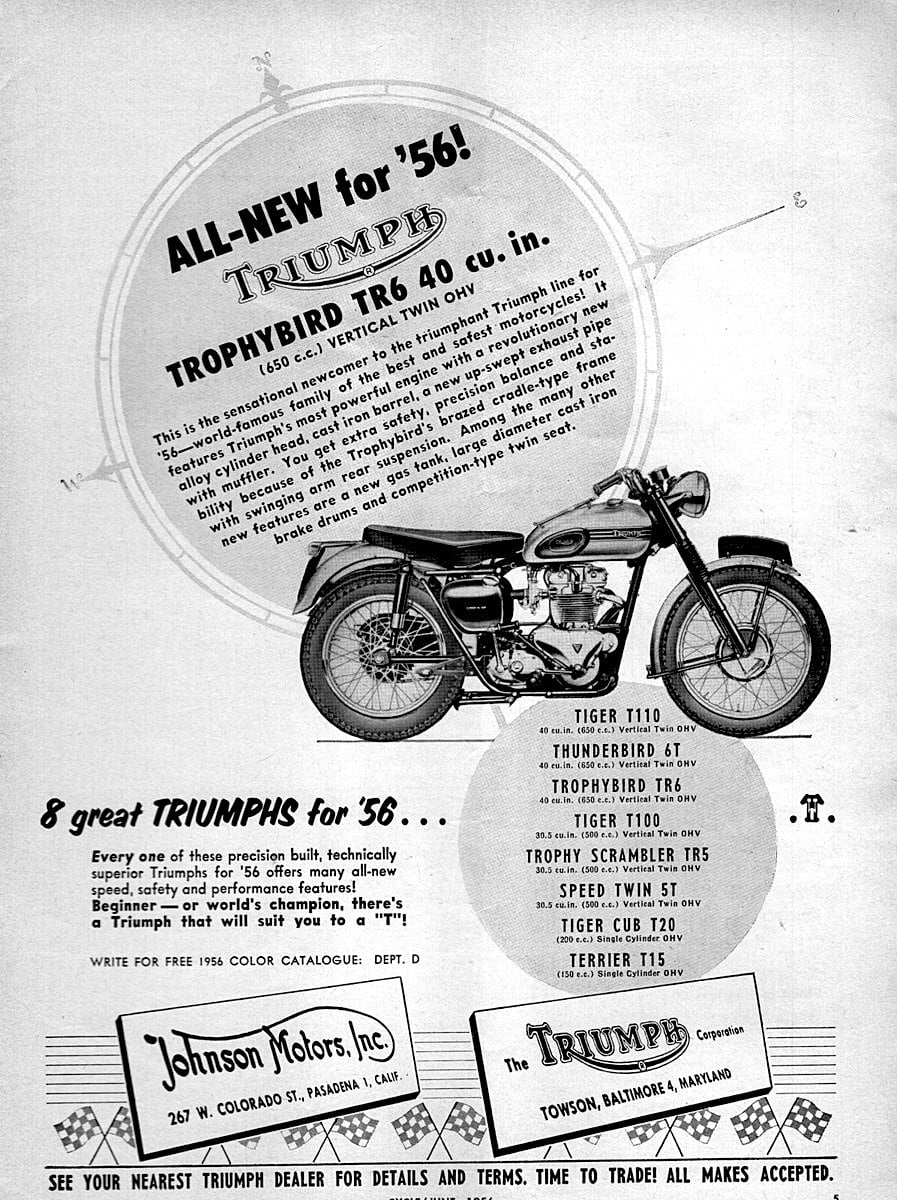
At the 1956 Big Bear Run, a 153 mile race from the high desert up into California’s San Bernardino Mountains, the first three finishers all rode Triumph’s new TR6 Trophy. Impressively, it was the 650’s first year on sale, and over the next decade the single-carburetor twin, and the high-piped TR6C version of it, became the de facto standard mount for Southern California desert racers. TR6 riders gave the stripped-down versions the nickname that still follows the bikes today – the Desert Sled.
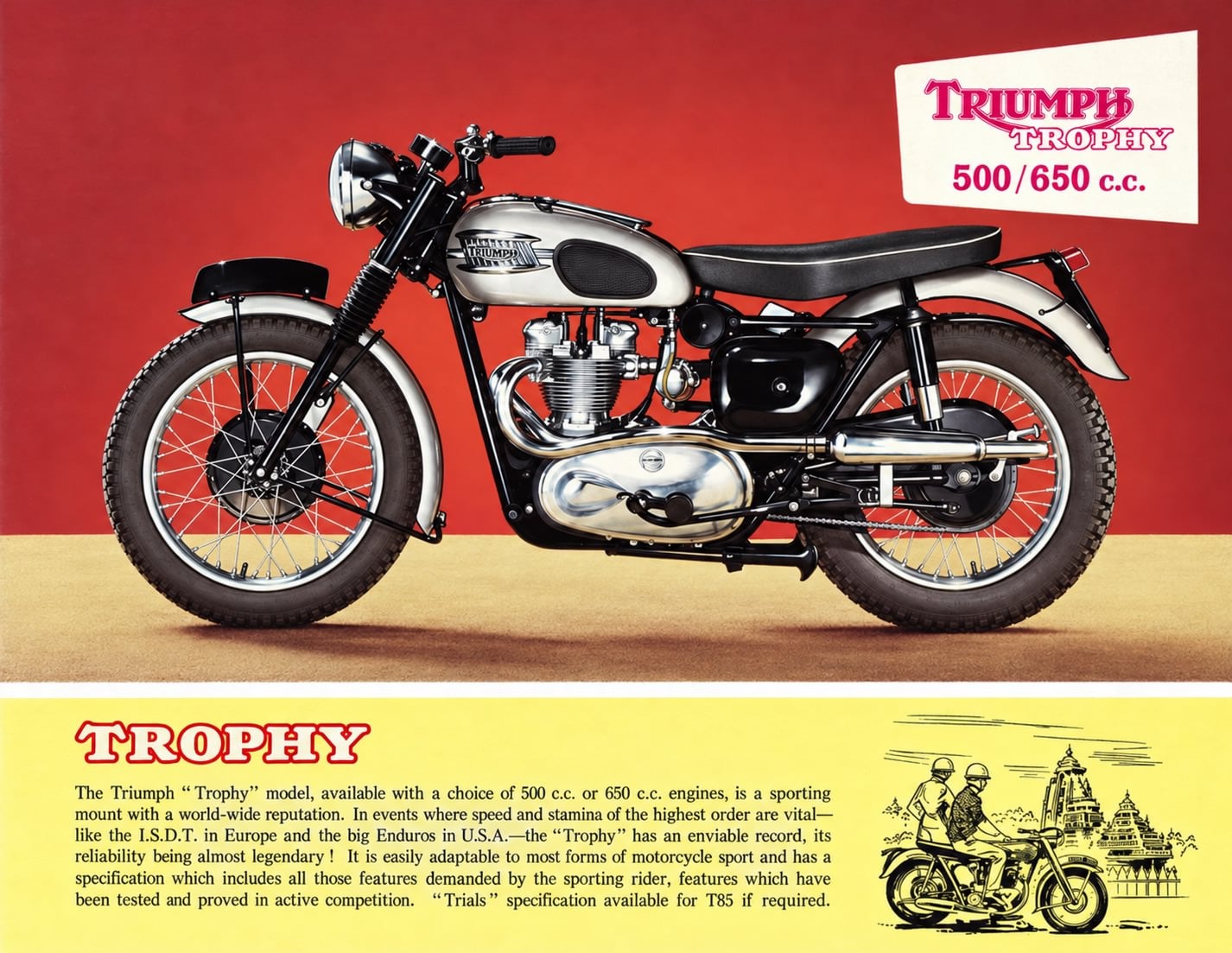
 For 1956 Triumph put the 650cc Tiger 110 engine, with its alloy cylinder head, into what was essentially the TR5 chassis and fed it through a single carburetor. In the United States it was sold as the Trophy-bird. Image provided by Triumph Motorcycles.
A Trophy With A Bigger Engine
The Trophy name originally came from Triumph’s success at the 1948 International Six Days Trial, arguably the toughest off-road motorcycle race in the world at the time. The first Trophy was the 500cc TR5, a twin that could be ridden to an event, stripped of excess weight, and then raced. Its headlight unplugged from the wiring through a multi-pin connector, so the rider could leave it in the pits for the day, it wasn’t going to be needed and would just add weight.
For 1956 Triumph put the 650cc Tiger 110 engine, with its alloy cylinder head, into what was essentially the TR5 chassis and fed it through a single carburetor. In the United States it was sold as the Trophy-bird. Claimed output was 42 bhp, a pretty good number for the time. A Lucas competition magneto arrived for 1957, along with the Tiger’s 8-inch front brake in place of the original 7-inch unit.
In the early 1950s the California desert races were dominated by 500cc singles from the likes of AJS, Matchless, and BSA, and the bigger twin upset that order almost immediately. Bill Postel won the 1956 Big Bear on a TR6, with Bud Ekins second.
TR6 riders won again in 1957 (Ekins) and 1958 (Roger White). According to Triumph, 20 of the top 25 finishers in 1957 were on its motorcycles. Ekins made it four-in-a-row for the marque in 1959, when he beat a field of more than 850 despite losing time to a flat tire and a dented front rim – only 200 riders finished.
Johnson Motors And The TR6SC
Triumph had two American importers in this period, Johnson Motors in the West and TriCor in the East. The West Coast business was closest to the desert scene, and from the early 1960s it offered the TR6SC, a factory-built desert racer.
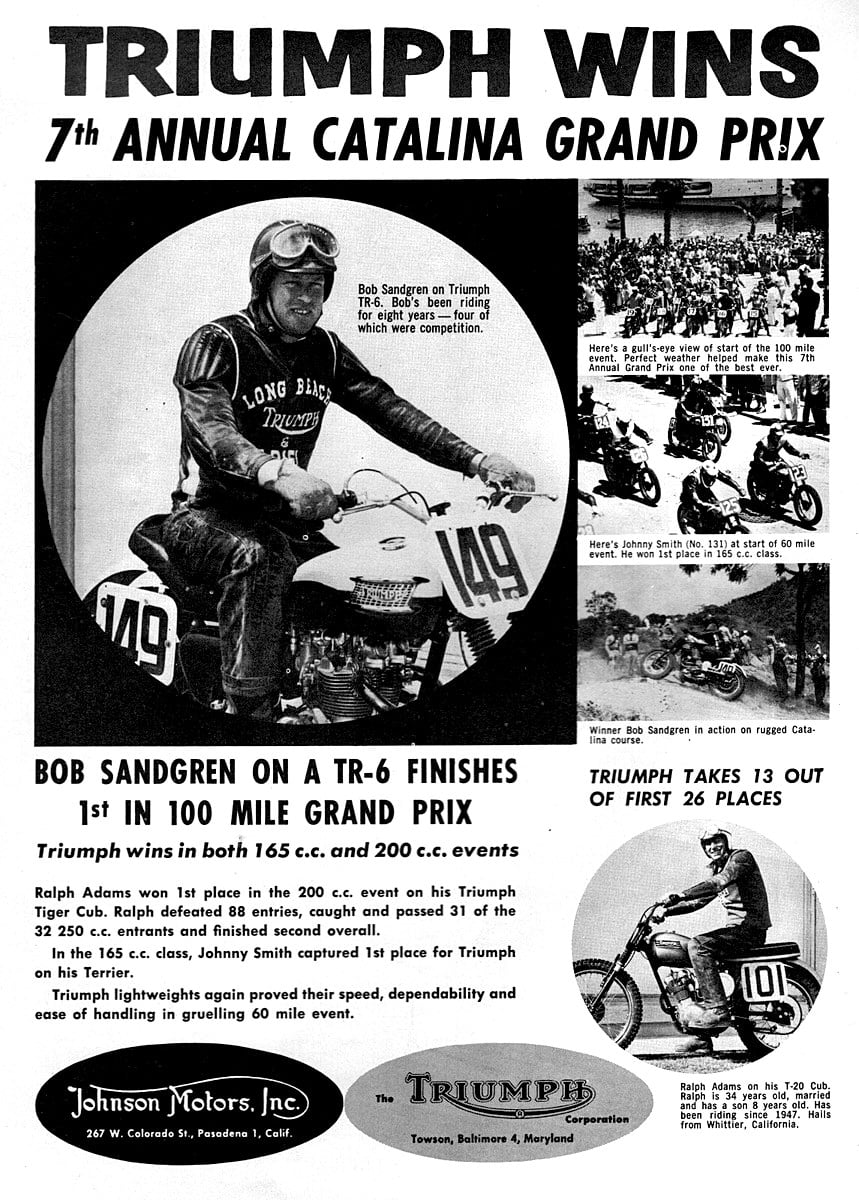
Triumph had two American importers in this period, Johnson Motors in the West and TriCor in the East. The West Coast business was closest to the desert scene, and from the early 1960s it offered the TR6SC, a factory-built desert racer. Image provided by Triumph Motorcycles.
The engine was stock, but nearly everything not needed for racing came off – the headlight and speedometer went, straight-through pipes replaced the mufflers, and the bike got aluminum fenders, a skid plate and lower final gearing. A 1965 road test of the SC said it had “more hair on its chest than King Kong.” For 1966, its last year, both pipes ran together down the left side.
Alongside the SC model, the road going TR6 models were given a frame with twin front downtubes for 1960, and from 1961 the TR6 was, in effect, a single-carburetor version of the T120 Bonneville (which came with dual carburetors).
The same year the American range divided into the TR6R (road) model and the high-piped TR6C (competition). For 1963 all of Triumph’s 650s moved to unit construction (the engine and gearbox shared a casing), and to a new frame whose single front downtube split into two rails beneath the engine.
The Triumph TR6C
When the SC was dropped after 1966, the TR6C became the off-road version of the Trophy. The 1967 bike carried both high-level pipes on the left, took the Bonneville’s larger valves and exhaust camshaft, ran a 9:1 compression ratio and was rated at 45 bhp at 6,500 rpm.
Its batteryless energy-transfer ignition meant it would run with no battery fitted, this was great for racing use as batteries are heavy, and it was a kickstart-only motorcycle anyway. It had a 2.5 gallon tank, a 3.5 x 19-inch front tire and a 4 x 18-inch rear, and it weighed 360 lbs dry. Where the road-going TR6R had a chrome tank rack, painted fenders and twin gauges, the C had stainless fenders and a speedo only.
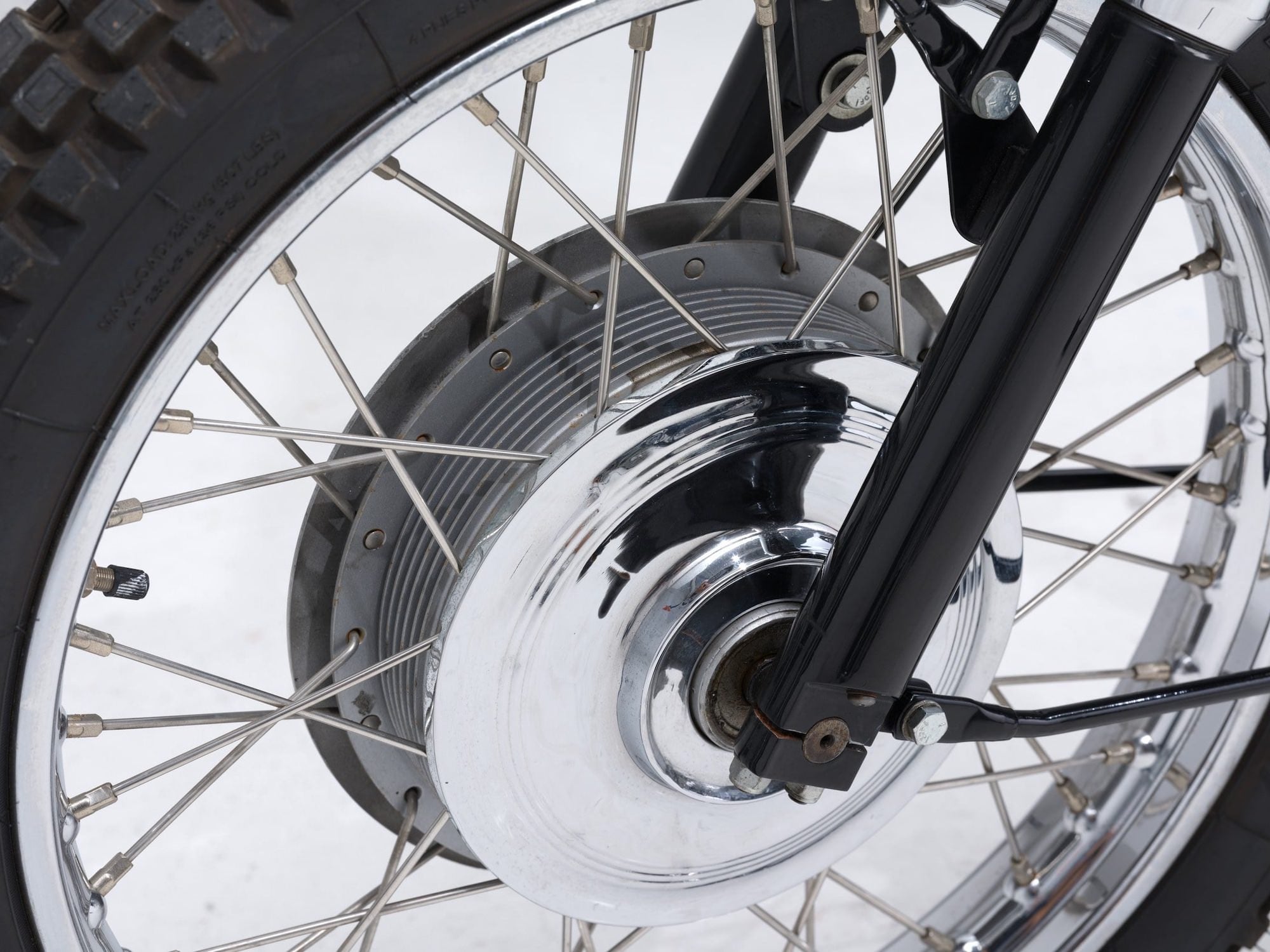
Mechanically, the TR6 was a conventional British twin of the period, the 649cc engine, with a 71 mm bore and 82 mm stroke, was an overhead-valve parallel twin with two gear-driven cams, one ahead of the cylinders and one behind, working the valves through pushrods as you would expect. Power was sent through a 4-speed gearbox and a chain drive to the rear wheel. The frame was brazed steel tube, with telescopic forks at the front and a swingarm on twin Girling shocks at the rear. Both brakes were drums, on the 1967 bike, an 8-inch single-leading-shoe front and a 7-inch out the back.
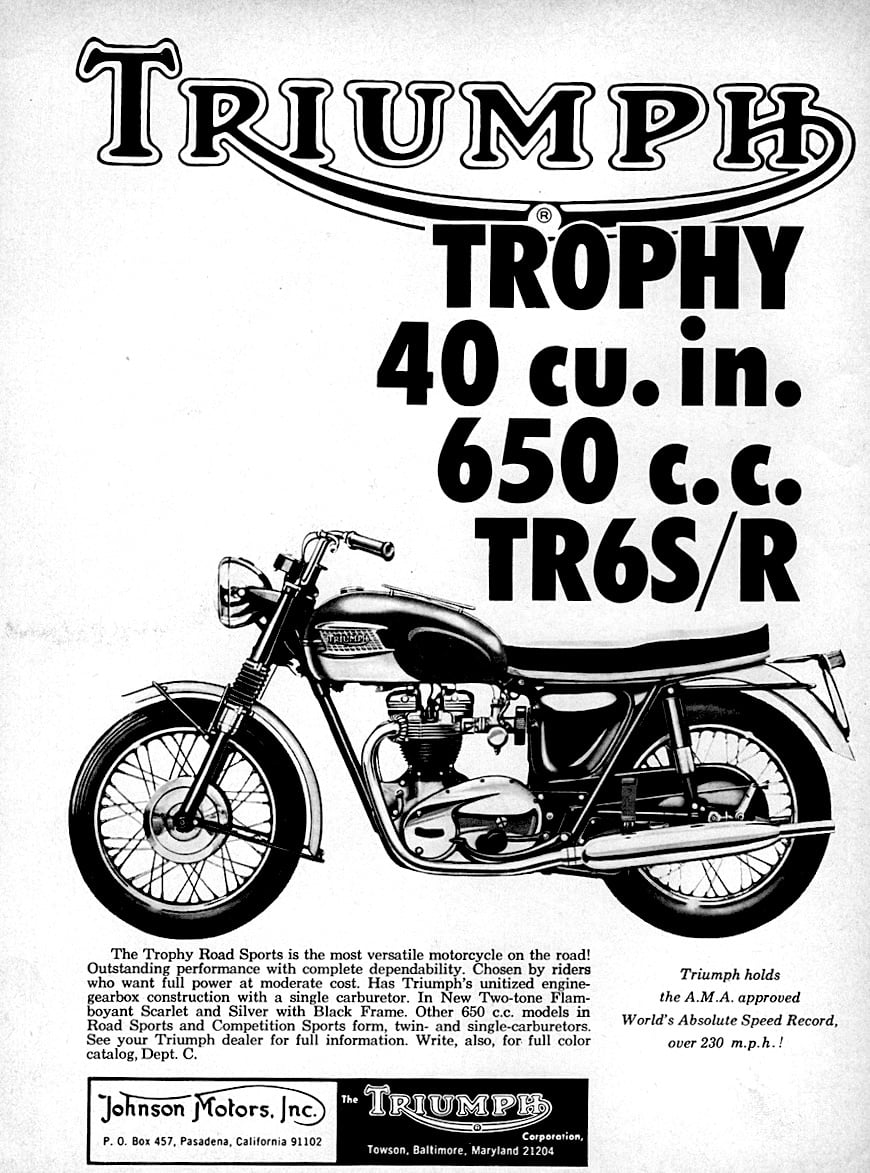
When the SC was dropped after 1966, the TR6C became the off-road version of the Trophy. The 1967 bike carried both high-level pipes on the left, took the Bonneville’s larger valves and exhaust camshaft, ran a 9:1 compression ratio and was rated at 45 bhp at 6,500 rpm. Image provided by Triumph Motorcycles.
An Amal Concentric carburetor replaced the old Monobloc during the 1967/1968 period, and a twin-leading-shoe front brake arrived for 1968, notably improving stopping power. For 1969 the TR6R was renamed Tiger, leaving the Trophy name to the TR6C alone.
That year’s C had a smaller tank and headlight than the Tiger, stainless fenders and upswept pipes, with a tachometer and skid plate on the options list. The 1971 models moved to Triumph’s new oil-in-frame chassis, and the TR6C kept its pair of high pipes on the left. The TR6 line ended in 1973 and the later OiF bikes are generally seen as less desirable now.
Bud Ekins, Steve McQueen + The ISDT
Bud Ekins won a gold medal at the 1962 International Six Days Trial on a TR6SS Trophy, the same year he went to Germany at Steve McQueen’s request to ride in The Great Escape. McQueen had famously wanted to do the jump scene himself, but the movie studio bigwigs vetoed it, and Ekins got to be the one to bottom out the springs on the TR6.
Over seven years of ISDT competition in the 1960s, Ekins collected four gold medals and a silver, an astonishing haul of silverware in one of the toughest off-road motorcycle events of the time.
At the time, the TR6 was the two men’s preferred off-road machine, and a Trophy disguised as a German military motorcycle carried McQueen’s character through the famous chase scene in The Great Escape. McQueen did most of the riding himself, except for the fence jump, and the bike used for the jump is now displayed at Triumph’s factory visitor center in Hinckley, England.
Two years later the pair put together the first American team to contest the ISDT’s Silver Vase, at Erfurt in East Germany in September of 1964. McQueen and Cliff Coleman rode 650 TR6s in the big-bike class, Bud and his brother Dave rode 500cc Triumphs, and John Steen was the reserve.
They collected the machines in England and prepared them themselves. The Americans led the Vase standings after each of the first two days. On day three McQueen crashed hard enough to bend his front fork back toward the frame and had to retire, and Bud Ekins broke his ankle. Coleman and Dave Ekins rode on and both won gold medals.
The 1969 Triumph TR6C Trophy Shown Here
This is a 1969 Triumph TR6C Trophy that’s been given a comprehensive restoration to authentic Desert Sled-spec, with a batteryless ignition system, a headlight delete, twin high pipes with no silencers, a speedometer, off-road tires, alloy fenders, and rubber fork gaiters.
It’s finished in Olympic Flame red and silver over a black frame, with wire-spoked wheels, chrome fittings, and a black saddle with Triumph branding.
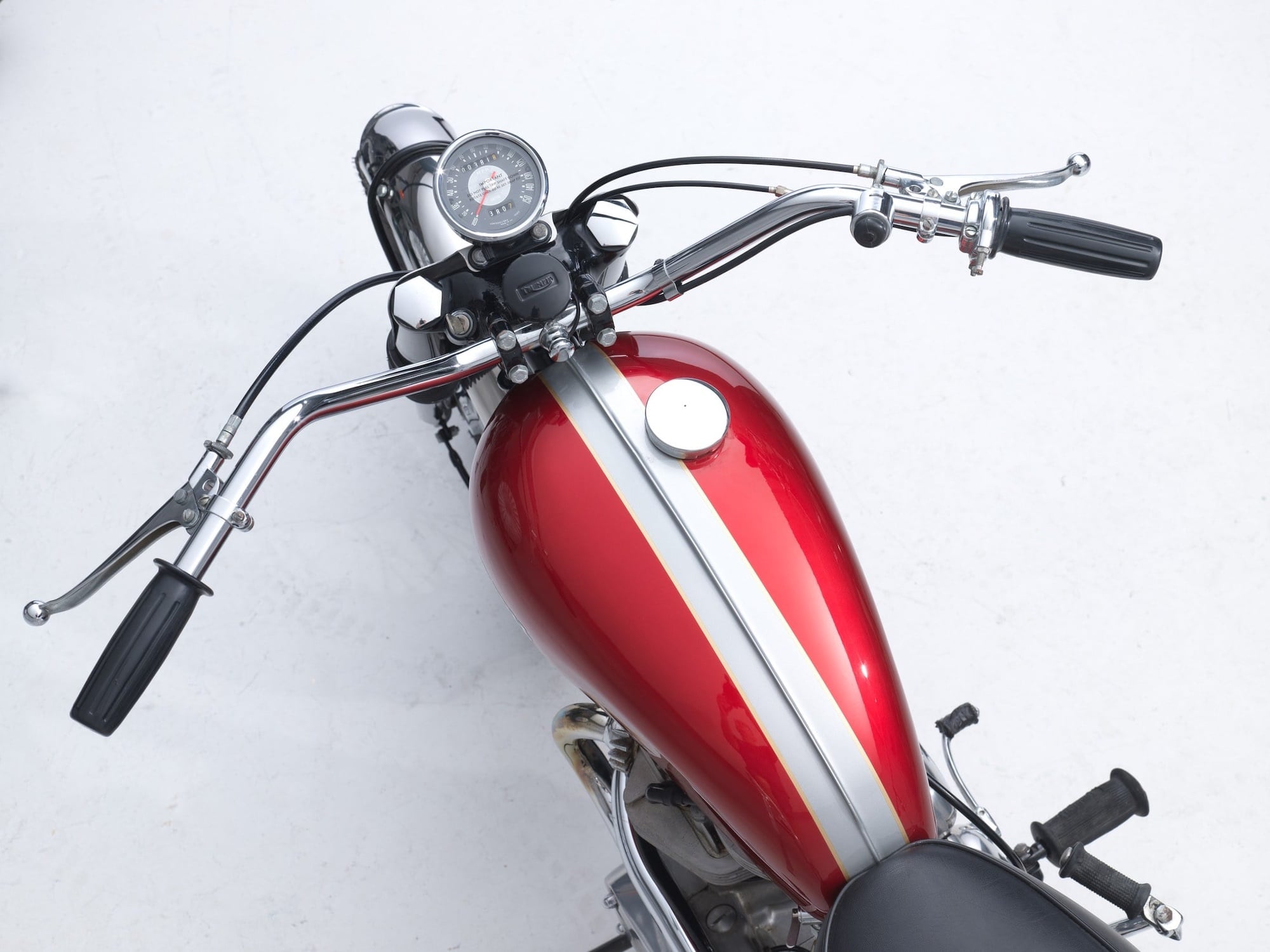
This is a 1969 Triumph TR6C Trophy that’s been given a comprehensive restoration to authentic Desert Sled-spec, with a batteryless ignition system, a headlight delete, twin high pipes with no silencers, a speedometer, off-road tires, alloy fenders, and rubber fork gaiters.
Originally built for the American market, this matching-numbers TR6C remained in the United States until its return to the UK, in 2019. It’s covered just 380 miles since the work was completed and it’s described as being in excellent cosmetic and mechanical condition.
It’s now being offered for sale with matching engine and frame numbers, low mileage since restoration, as a well-preserved example of Triumph’s celebrated TR6C Trophy scrambler. If you’d like to read more or register to bid you can visit the listing here.
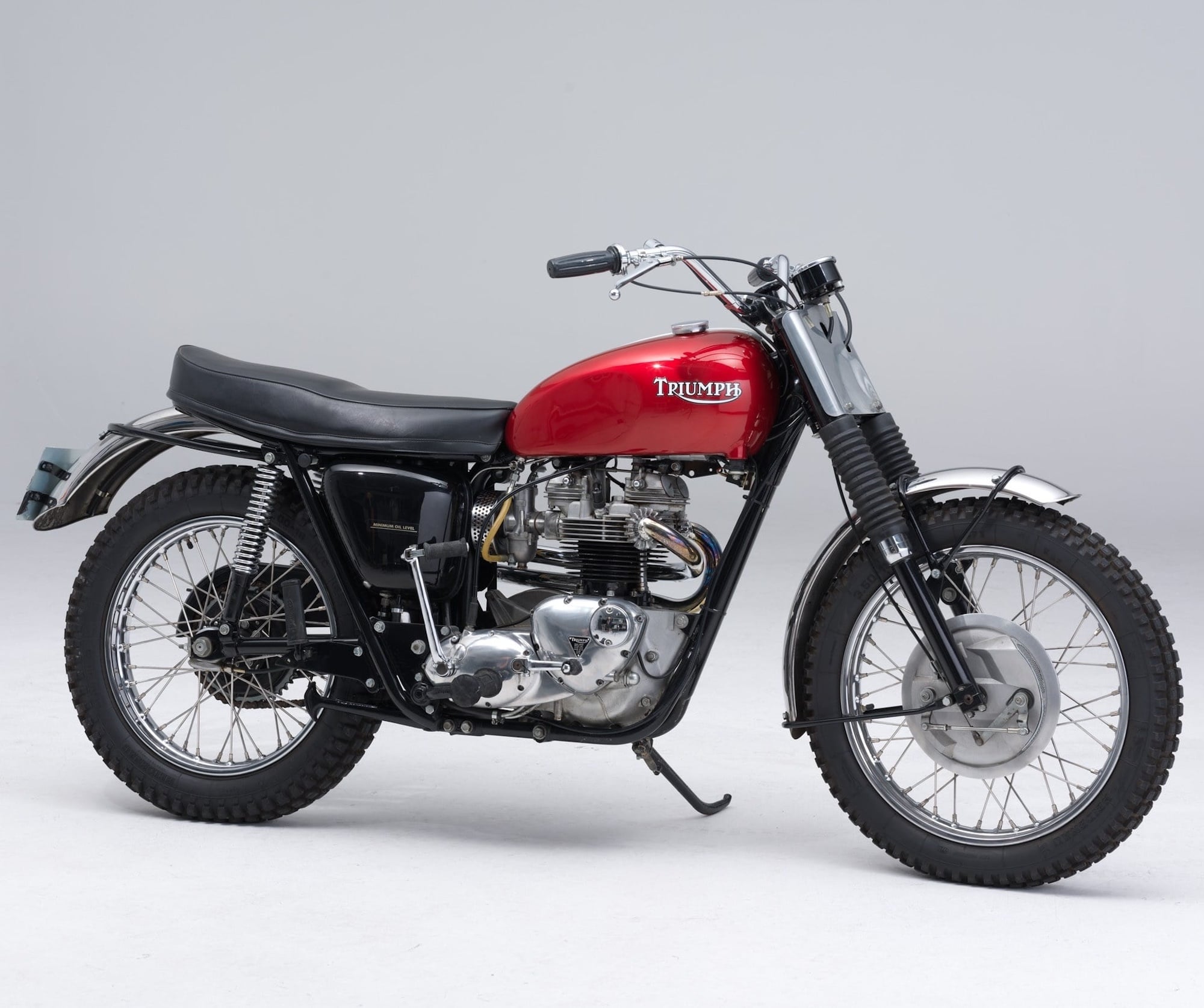
Images provided by Car & Classic + Triumph Motorcycles
Articles that Ben Branch has written have been covered on CNN, Popular Mechanics, Smithsonian Magazine, Road & Track Magazine, the official Pinterest blog, the official eBay Motors blog, BuzzFeed, Autoweek Magazine, Wired Magazine, Autoblog, Gear Patrol, Jalopnik, The Verge, and many more.
Silodrome was founded by Ben back in 2010, in the years since the site has grown to become a world leader in the alternative and vintage motoring sector, with well over a million monthly readers from around the world and many hundreds of thousands of followers on social media.