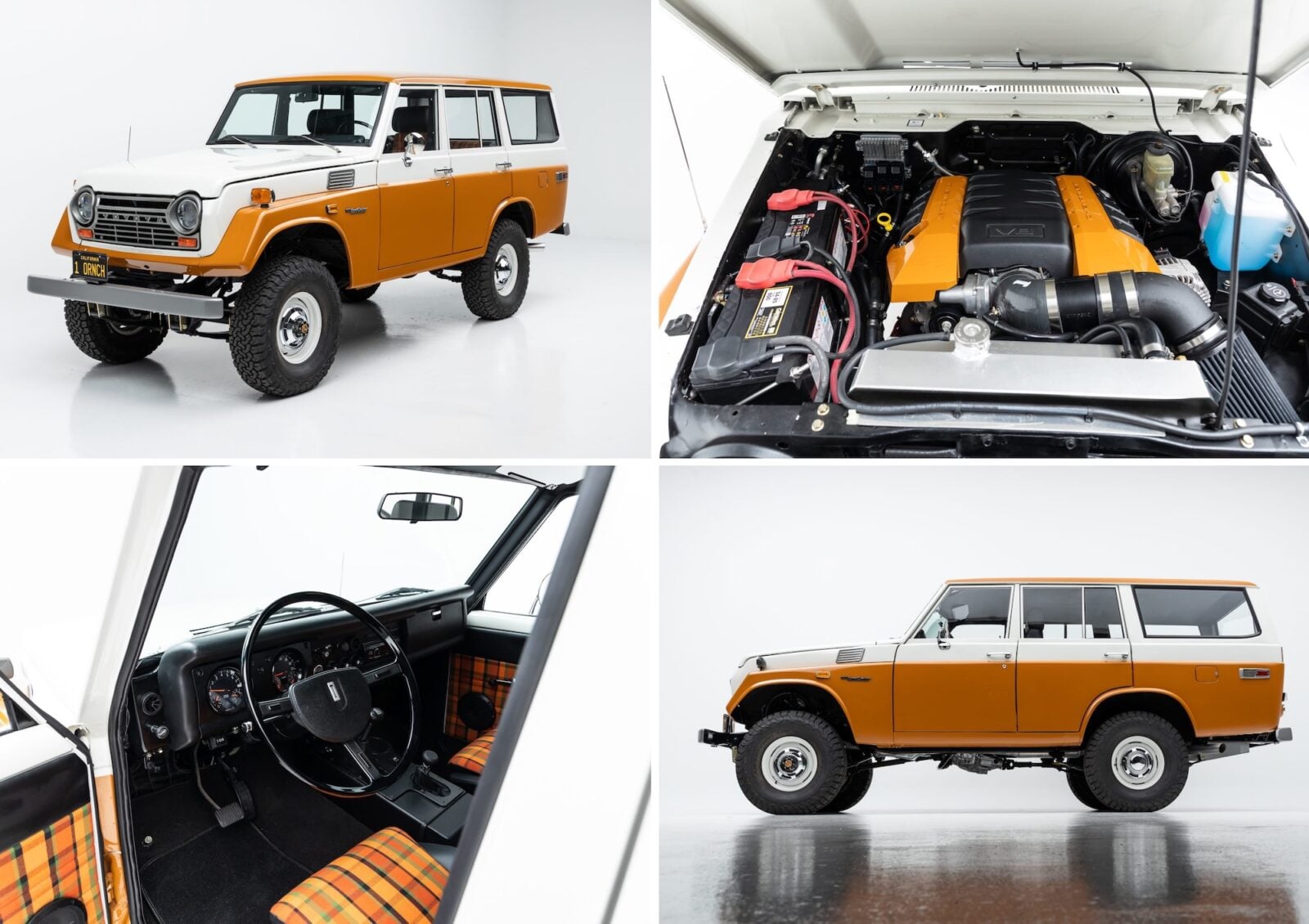
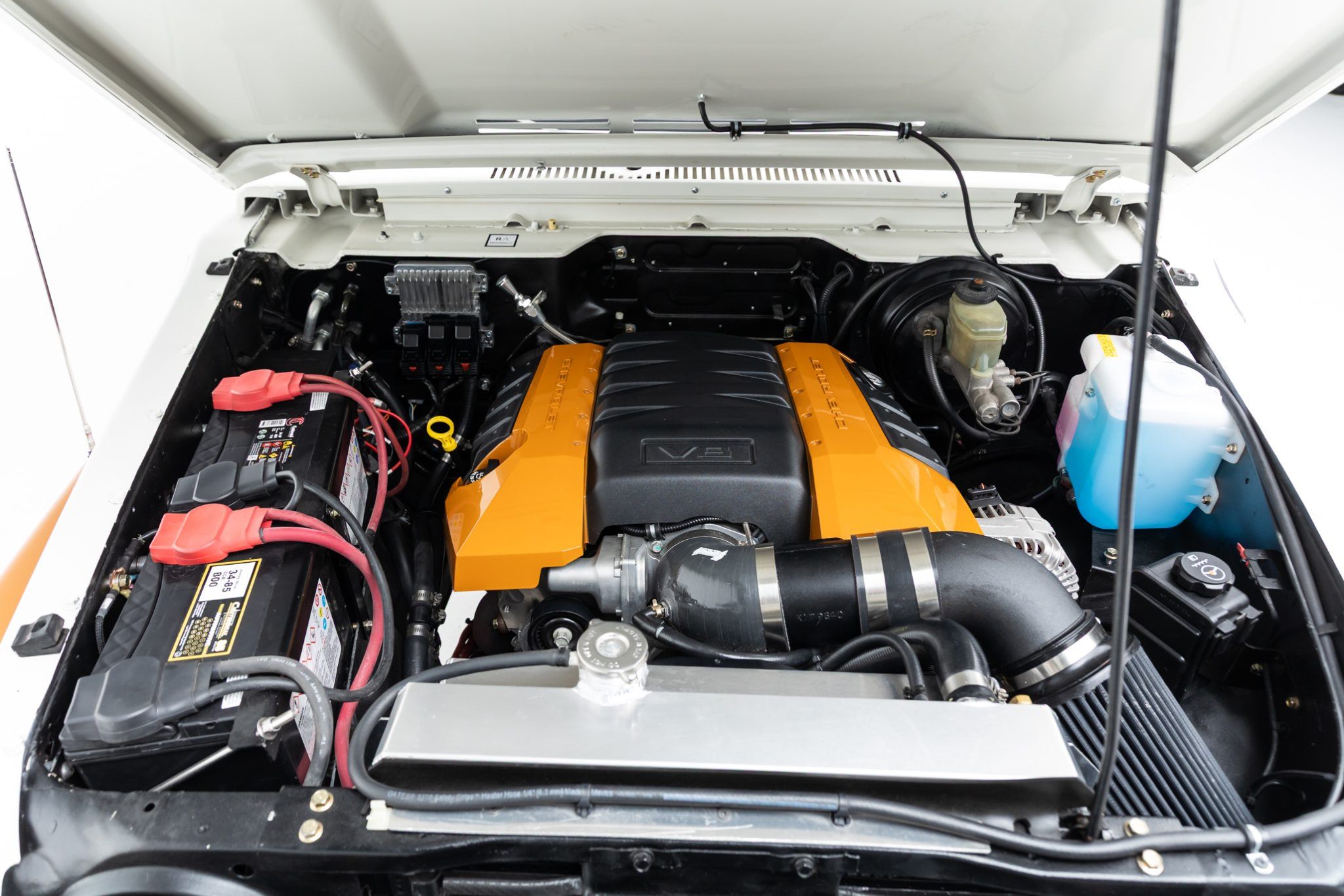
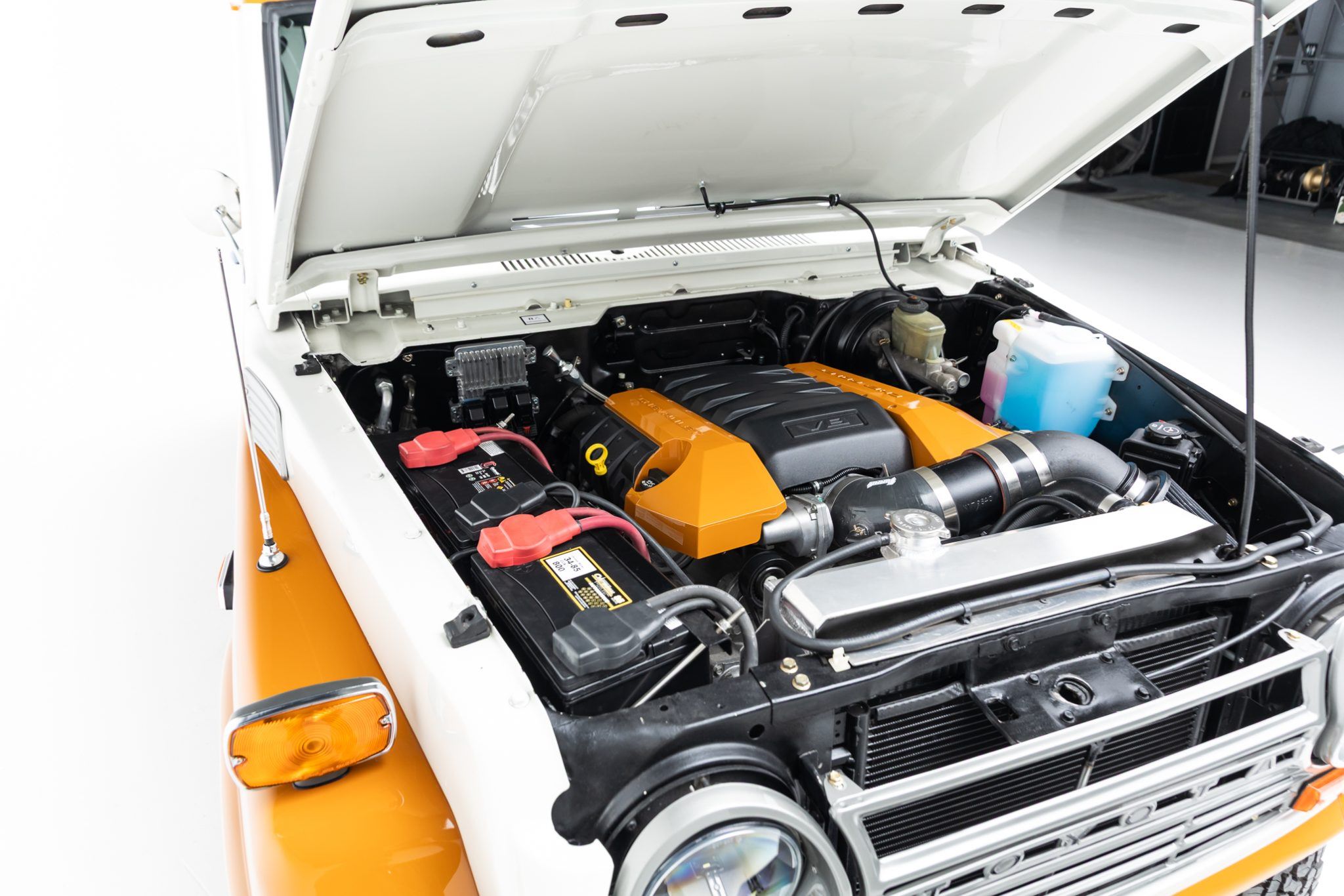
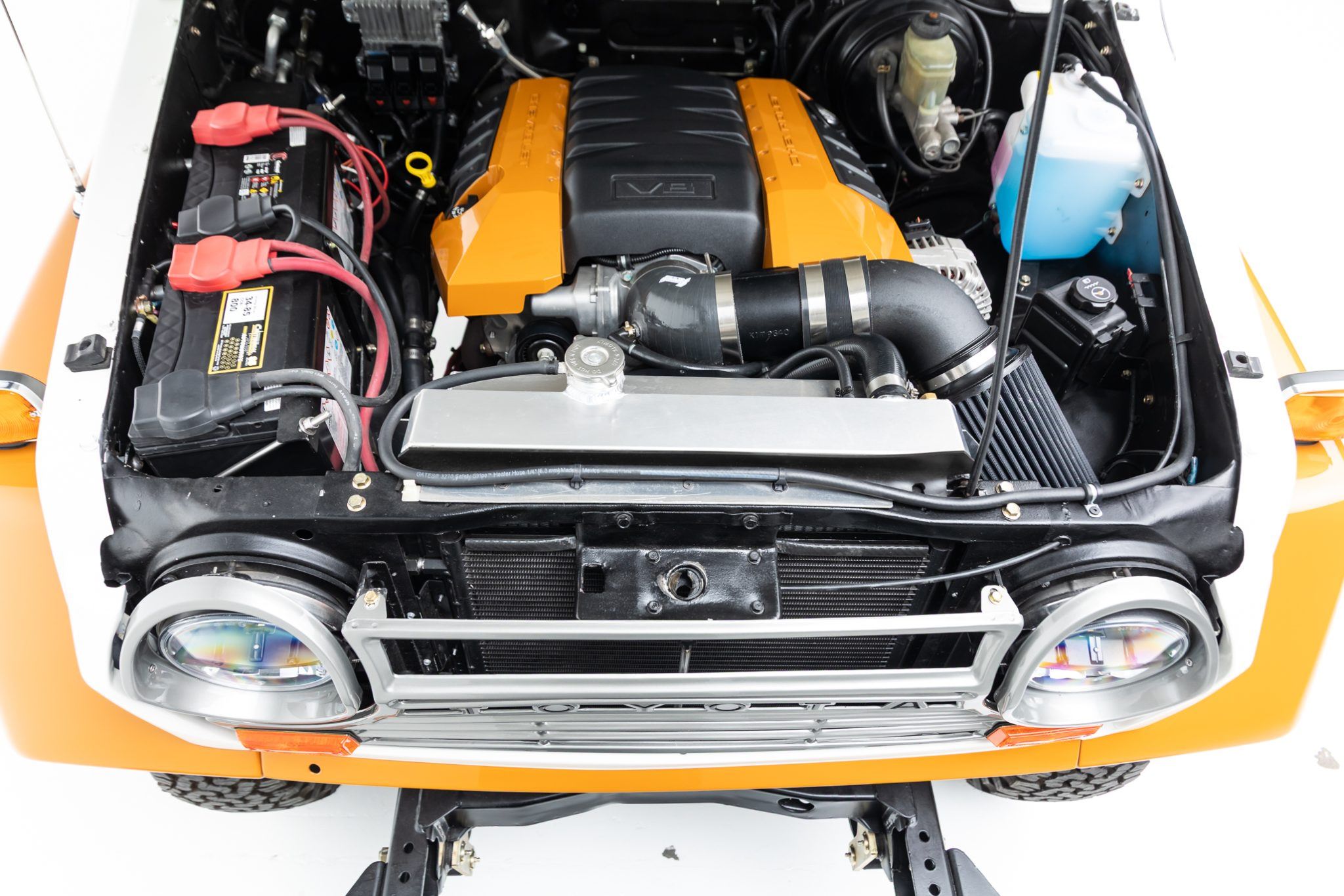
This is an FJ55 Toyota Land Cruiser that now benefits from a raft of major upgrades, the most significant of which is an LS3 V8 in the engine bay with 430 bhp – vastly more than the 130 bhp the vehicle had originally.
A series of additional supporting upgrades have also been made, including a 6L80 6-speed automatic transmission, uprated driveshafts, an FJ60-sourced rear axle, and quite a bit more. Inside you’ll find an all-new interior with Restomod Air climate control.
Fast Facts: An LS-Swapped Toyota Land Cruiser FJ55
- Toyota developed the FJ55 as its first purpose-designed Land Cruiser station wagon, launching it in 1967 for the 1968 model year. It was created to meet growing demand for four-wheel drives that could combine off-road ability with more space, comfort, and family usefulness than earlier utility-focused Land Cruisers.
- Mechanically, the FJ55 stayed close to the FJ40 but used a new boxed frame with greater stiffness and a longer wheelbase. Early models used the 3.9 liter F inline-six, while later versions used the larger 4.2 liter 2F, a 4-speed manual gearbox, and front disc brakes.
- Its unusual front-end styling made the FJ55 instantly recognizable and earned it nicknames including “Iron Pig” and “Moose.” While never as numerous as the FJ40, it helped establish the long-wheelbase, family-oriented Land Cruiser formula that later evolved into the 60 Series and the more luxury-focused Land Cruisers that followed.
- The FJ55 shown here is a heavily modified 1974 FJ55 restomod fitted with a 430 bhp Chevrolet LS3 V8 and 6L80 automatic transmission, plus extensive chassis, suspension, cosmetic, and interior upgrades. It now includes modern comforts including climate control, upgraded seating, audio, instruments, and a custom-finished cabin.
History Speedrun: The Toyota Land Cruiser FJ55
The Toyota Land Cruiser FJ55 was one of the most important vehicles Toyota ever made, but it was also one of the least conventionally attractive. As a result, it was nicknamed the “Iron Pig” and the “Moose” in-period. It was built from August of 1967 to July of 1980 and served as Toyota’s first purpose-designed station wagon Land Cruiser, it was the vehicle that proved the market for a Japanese 4×4 that was comfortable, family-friendly, and affordable. It became the direct ancestor of every luxury Land Cruiser that followed, even though it’s now been forgotten by most.
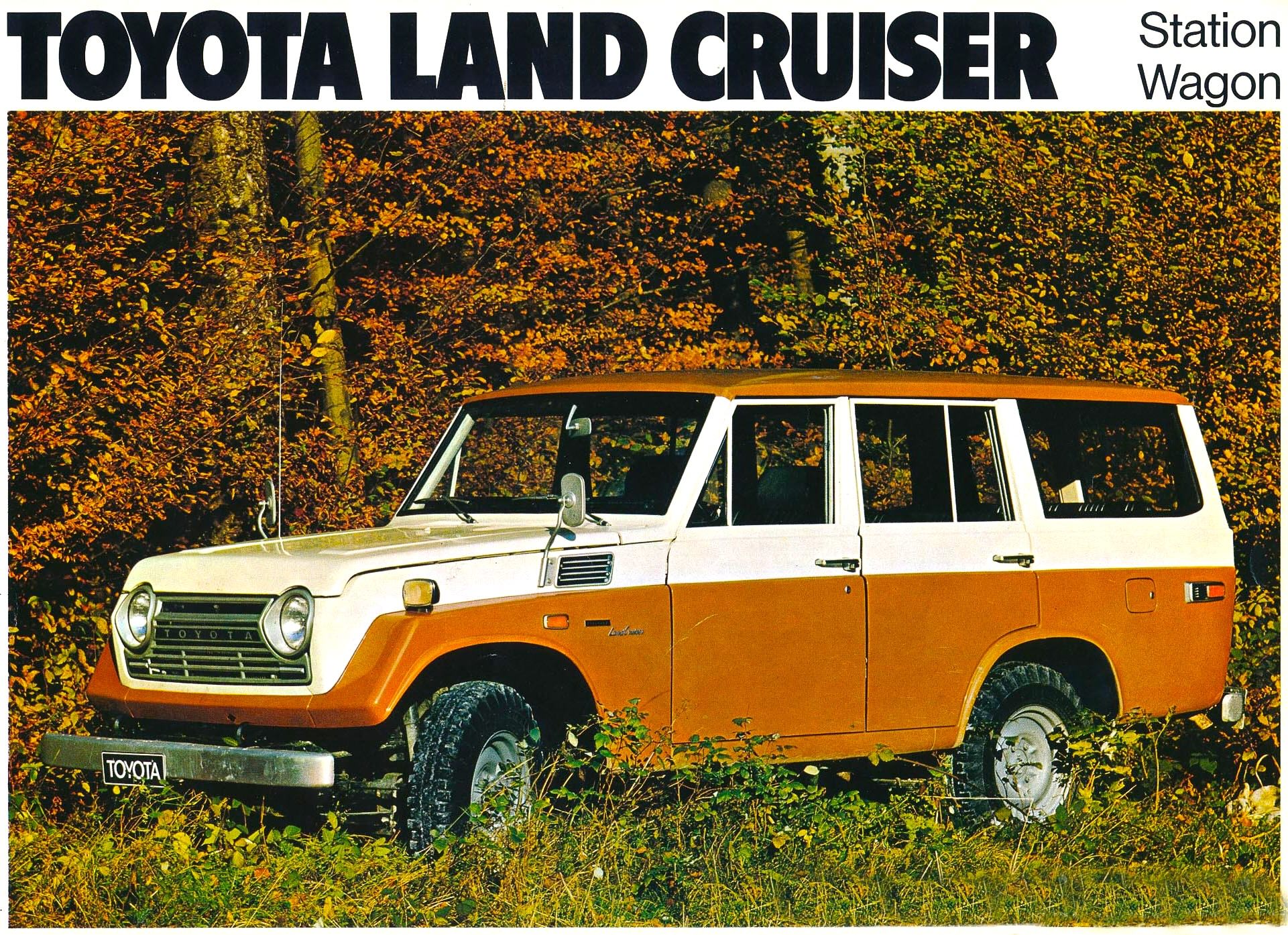
 The Toyota Land Cruiser FJ55 was one of the most important vehicles Toyota ever made, but it was also one of the least conventionally attractive. As a result, it was nicknamed the “Iron Pig” and the “Moose” in-period. Image courtesy of Toyota.
By the mid-1960s the 4×4 market in the United States, and around the world, was shifting. Jeep had introduced the Wagoneer in 1963, International Harvester had the Scout, and Ford launched the Bronco for 1966. Buyers increasingly wanted 4x4s that combined genuine off-road capability with the comfort and highway manners of a passenger car.
The Land Cruiser was already Toyota’s best-selling vehicle in the United States by 1965, and the company had experimented with wagon-bodied Land Cruisers before, the FJ45LV was a four-door derivative of the FJ40, but these were little-more than utility vehicles with longer bodies and extra doors grafted on, not purpose-designed wagons suitable for daily suburban use.
In 1965 Toyota tasked its passenger car design department, which had never previously worked on off-road vehicles, with creating a proper 4×4 station wagon. The result was the FJ55, which made its debut in August of 1967 as a 1968 model, replacing the more utilitarian FJ45LV.
The arrival of this new model divided the Land Cruiser range into two clear-cut lines – the short-wheelbase Land Cruiser FJ40 for heavy-duty off-road work, and the new “Land Cruiser Station Wagon” for buyers who needed to carry families and their cargo in reasonable comfort. The Jeep Wagoneer had proven the market existed for vehicles like this, but no one could have guessed just how popular the genre would become in the ensuing decades.
The FJ55 Toyota Land Cruiser Specifications
Mechanically, the FJ55 was closely related to the FJ40, sharing its axles and drivetrain but the chassis was a new design. It was the first Land Cruiser to use fully enclosed, boxed frame members – the new design used fewer cross-members than the FJ40 despite the longer wheelbase, but it still offered ~20% greater stiffness. The wheelbase was stretched out a further 50mm to 2,700 mm (106.3 inches), up from the FJ45LV’s 2,650 mm.
At the time of its launch, power came from Toyota’s Type F 3.9 liter overhead-valve inline six producing 125 bhp and 209 lb ft of torque, paired with a 3-speed manual gearbox (with a non-synchronized first gear), a dual-range transfer case, and part-time four-wheel drive. Power was increased to 130 bhp in 1969 through incremental improvements to the cylinder head, intake system, and the camshaft.
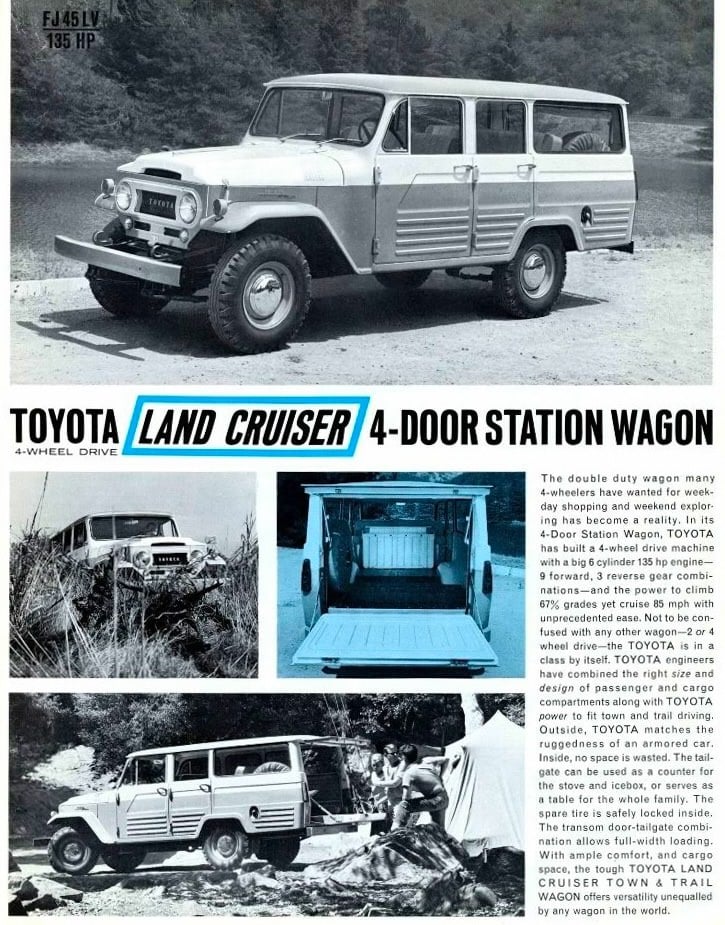
The Land Cruiser was already Toyota’s best-selling vehicle in the United States by 1965, and the company had experimented with wagon-bodied Land Cruisers before, the FJ45LV was a four-door derivative of the FJ40, but these were little-more than utility vehicles with longer bodies and extra doors grafted on, not purpose-designed wagons suitable for daily suburban use. Image courtesy of Toyota.
The most significant mechanical update to the FJ55 series came in January of 1975, when the F engine was replaced by the larger 2F, this was a 4.2 liter inline six producing 135 bhp and 210 lb ft of torque. A 4-speed manual gearbox arrived alongside it, and front disc brakes replaced the original drums for much improved stopping power. The 2F-equipped vehicles were easy to identify by their revised hood, which now had a raised centre dome to clear the new induction system.
Unusually for Toyota, the model designation remained FJ55 on export models, though the Japanese-market version was redesignated FJ56V. Understandably for the era, suspension consisted of semi-elliptic leaf springs front and back with live axles and telescopic shock absorbers. It tipped the scales at over 1,900 kgs (4,190 lbs) unladen, which if anything was on the lightweight side for its class.
That Controversial “Iron Pig” Front End
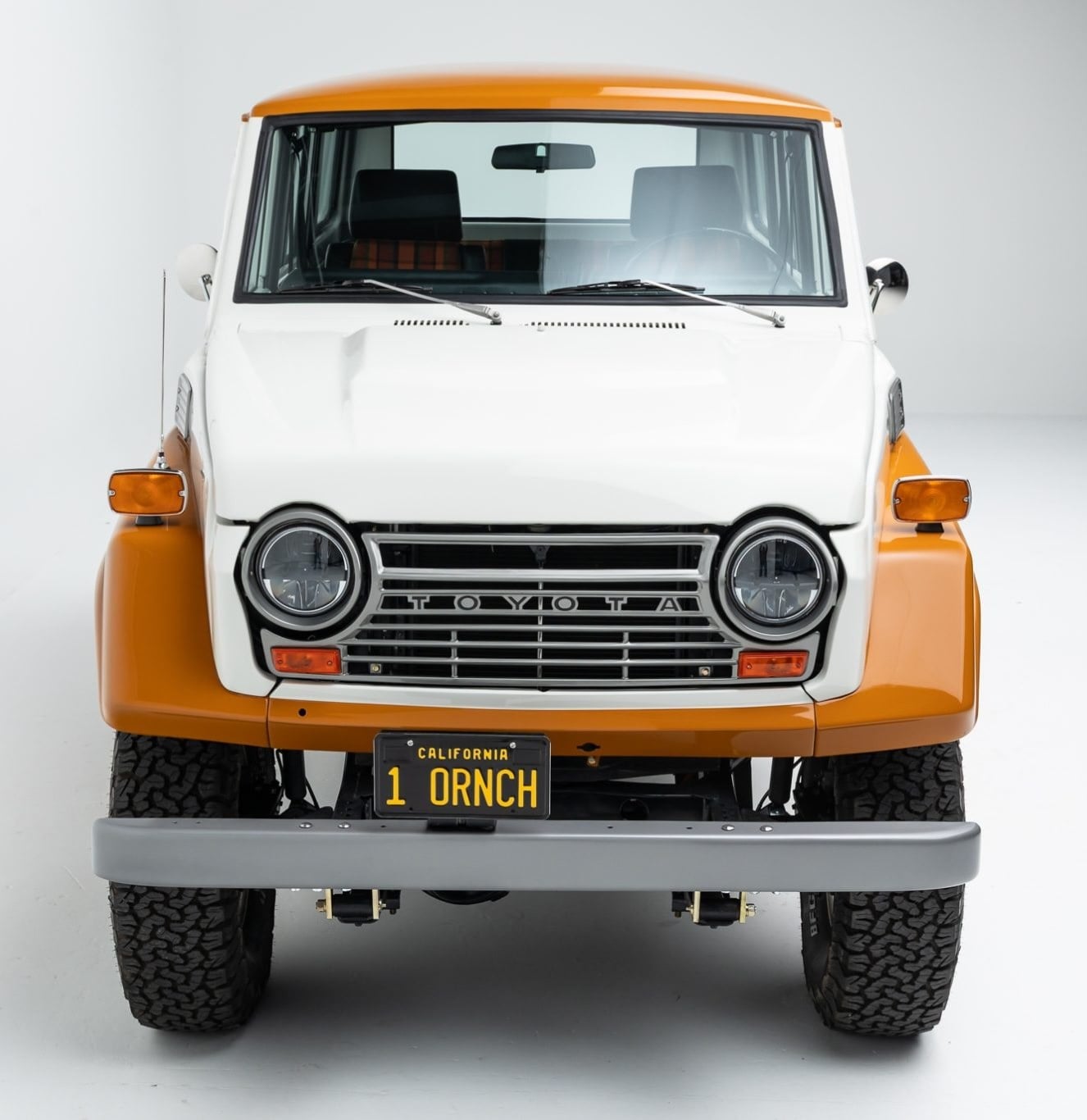
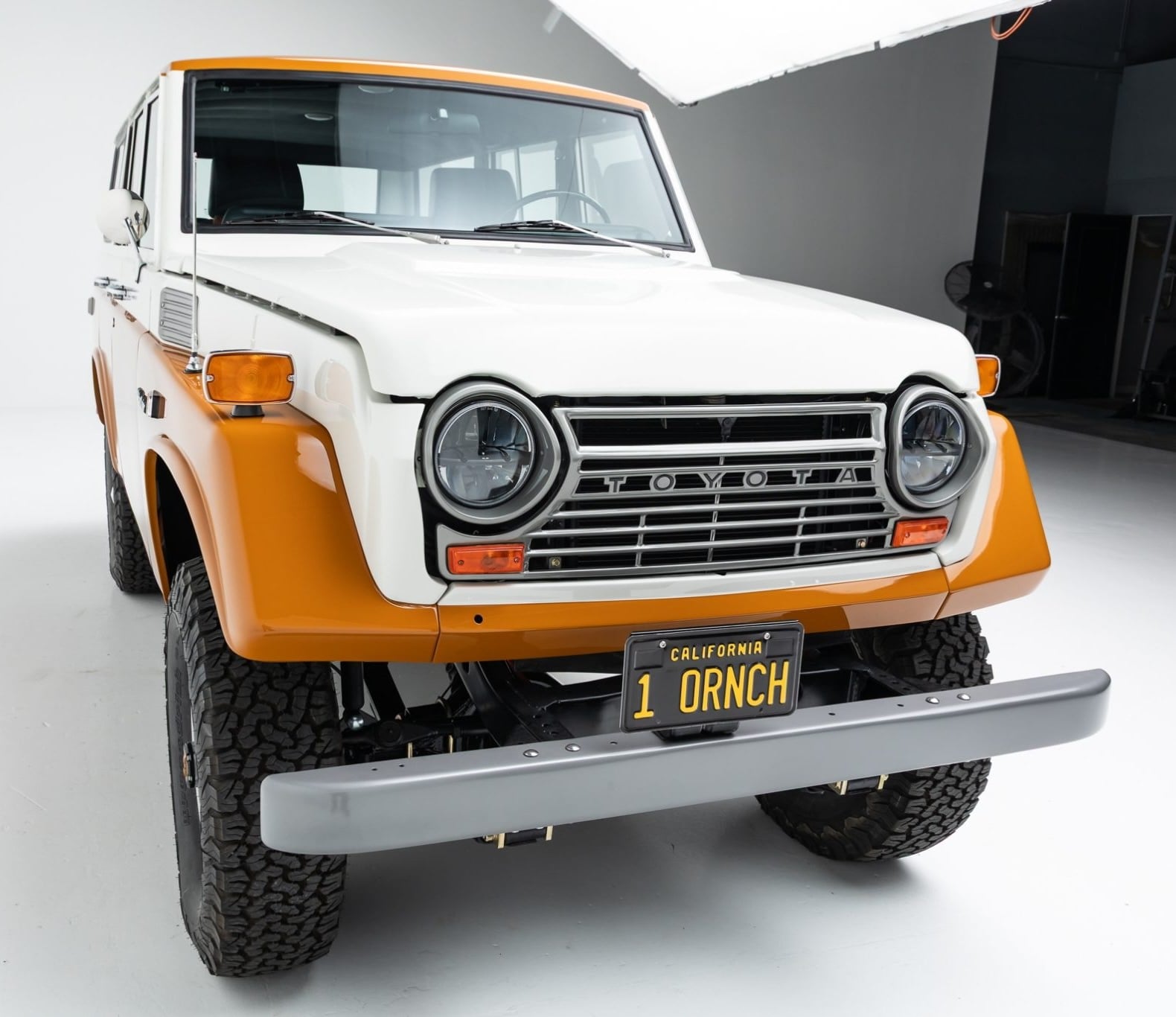
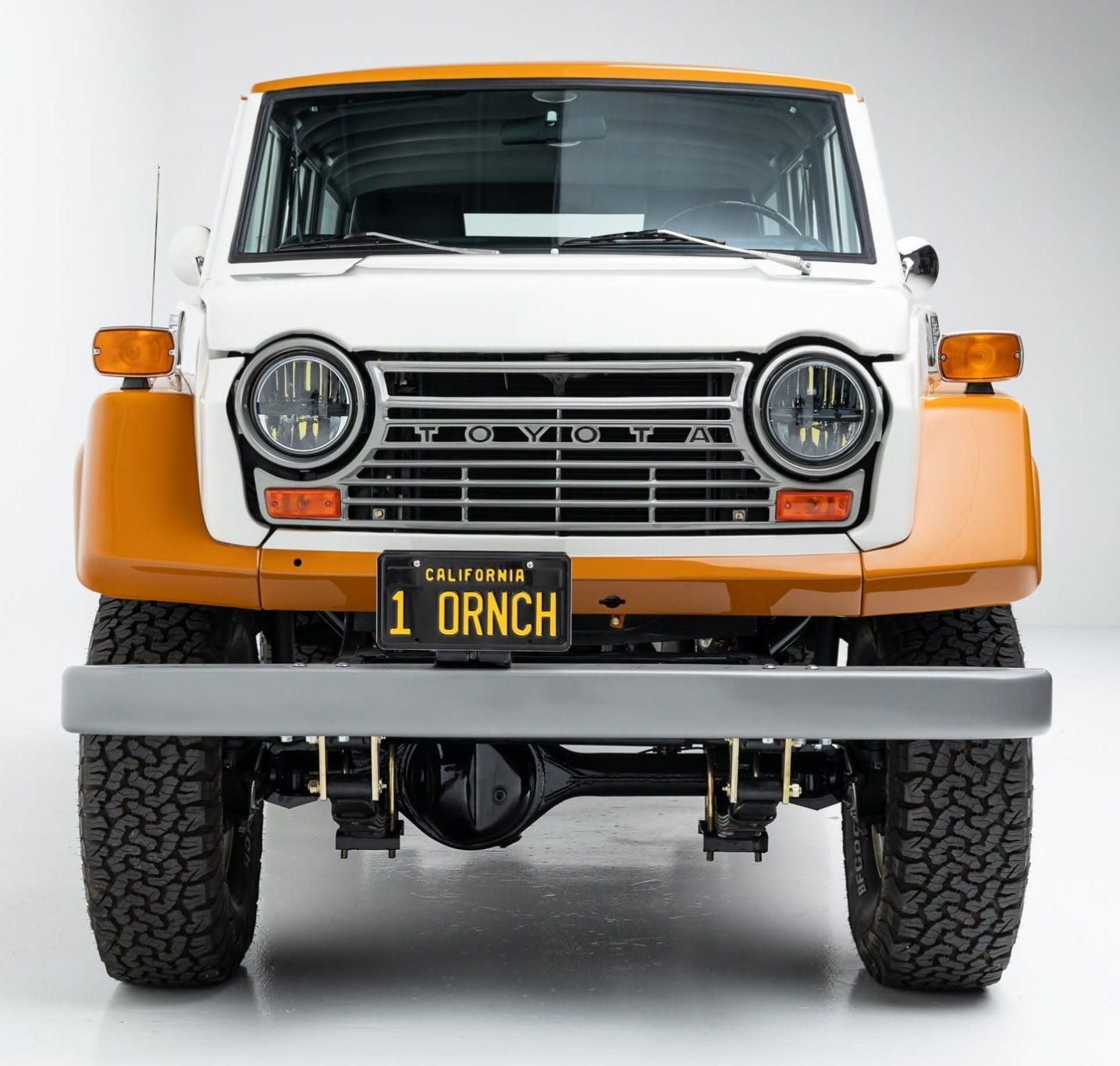
The FJ55’s styling remains its most hotly debated feature. That narrow front face, with headlights set into the grille opening and separated from the wider fenders, gave the front end a distinctive snout-like appearance that was accentuated somewhat by the standard two-tone paint schemes – earning it the aforementioned nicknames like “Iron Pig” and “Moose.” Common color combinations included Royal Blue (often humorously called “Smurf Blue”) over Alpine White, and Green over White.
Inside, the FJ55 was a huge step up from the much more spartan FJ40, with a passenger car-style padded dashboard, full floor coverings, padded door cards, improved seats, and space for up to seven passengers. Available options included a radio, heater, and even air conditioning.
The Marketplace + Competitors
The FJ55 was designed primarily for export, with North America and Australia as its primary markets. In North America, the FJ55 competed directly with the Wagoneer, the Chevrolet Suburban, and the International Harvester Travelall. In Australia, its main rival was the Land Rover Series vehicles, and perhaps to a lesser extent the Nissan Patrol. The Land Cruiser brand had already established a solid reputation in the Australian mining industry and agricultural sector, giving the FJ55 a ready-made customer base ready to sign on the dotted line.
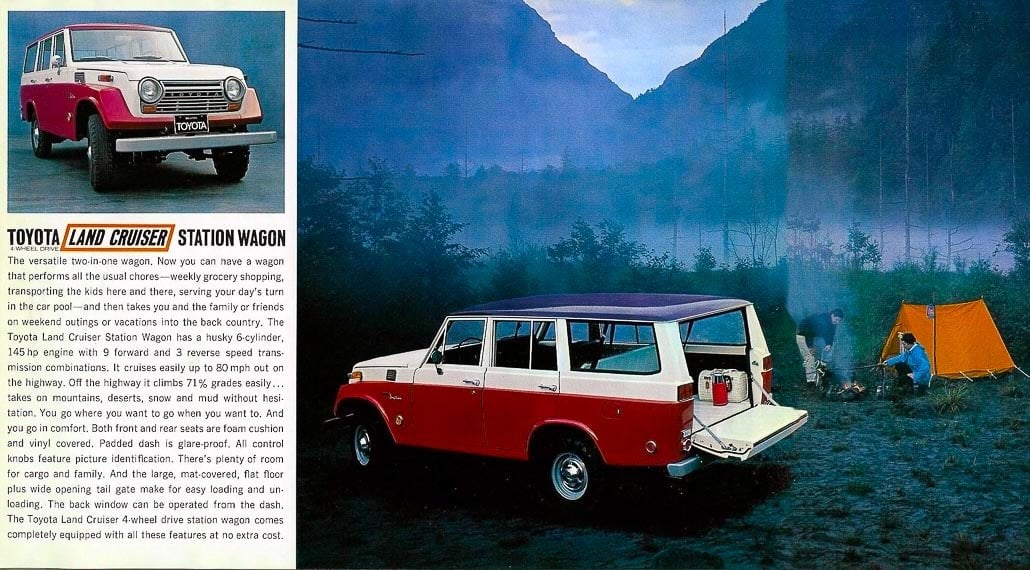
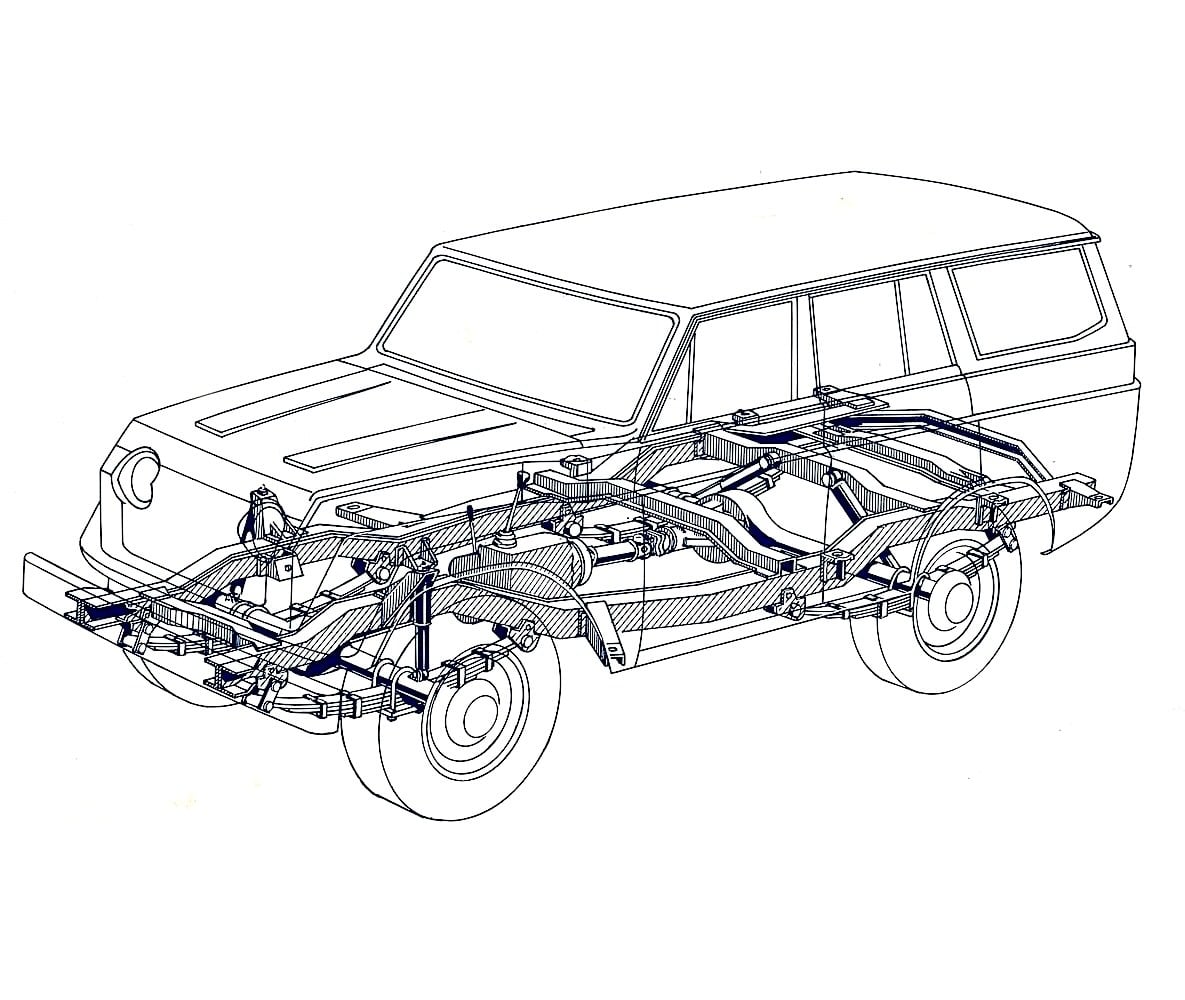
Mechanically, the FJ55 was closely related to the FJ40, sharing its axles and drivetrain but the chassis was a new design. It was the first Land Cruiser to use fully enclosed, boxed frame members – the new design used fewer cross-members than the FJ40 despite the longer wheelbase, but it still offered ~20% greater stiffness. Image courtesy of Toyota.
The FJ55 was never produced in the same volumes as the FJ40, and surviving numbers have been thinned considerably by the model’s well-documented susceptibility to rust – arguably its single most significant weakness. They were also seen as undesirable for a long time, and as a result many were simply scrapped.
The End + Arrival Of The 60 Series
Production ended in July of 1980, and the FJ55 was replaced by the 60 Series – this was a substantially more refined vehicle that would become one of the most iconic 4×4s ever produced. It was also much better looking, with a far more conventional front-end design.
That said, the 60 Series, and every luxury Land Cruiser that followed it through the 80, 100, 200, and 300 Series, owes its existence to the Iron Pig. It was the FJ55 that proved that there was a large and willing market for a Land Cruiser that could serve as a family station wagon, and it established much of the commercial foundation on which Toyota built what is now a 75-year-old dynasty.
The 1974 Toyota Land Cruiser FJ55 Shown Here
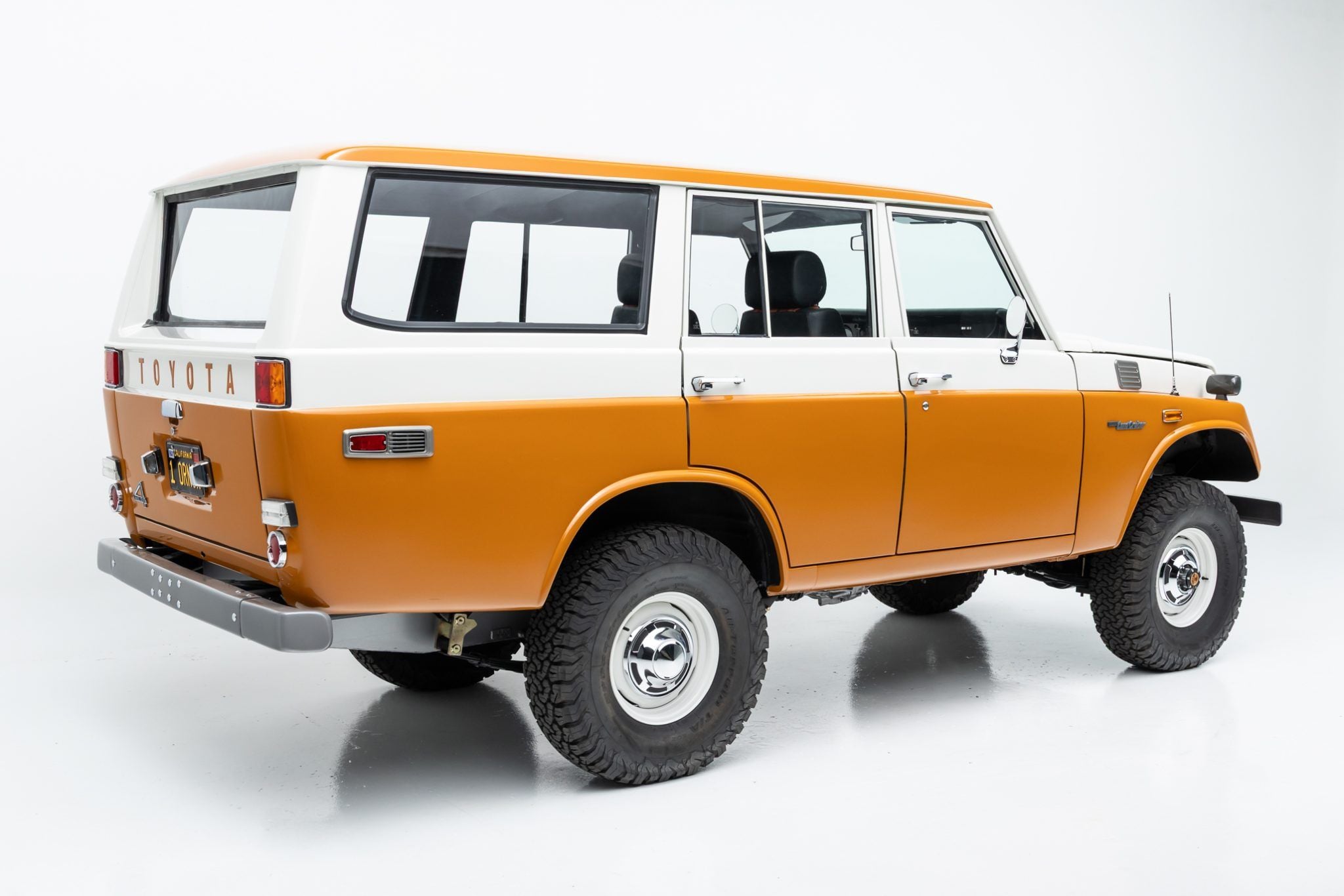
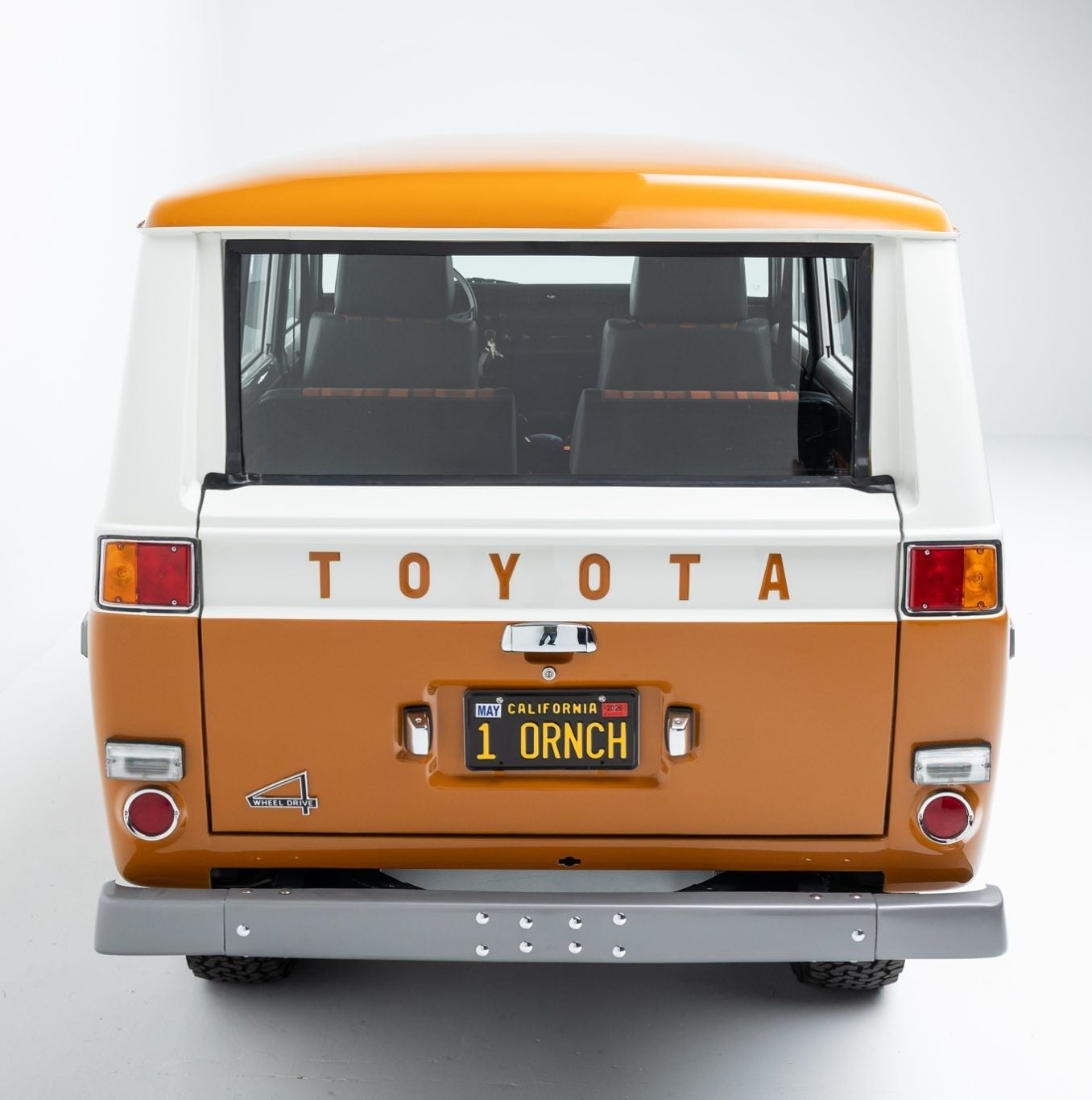
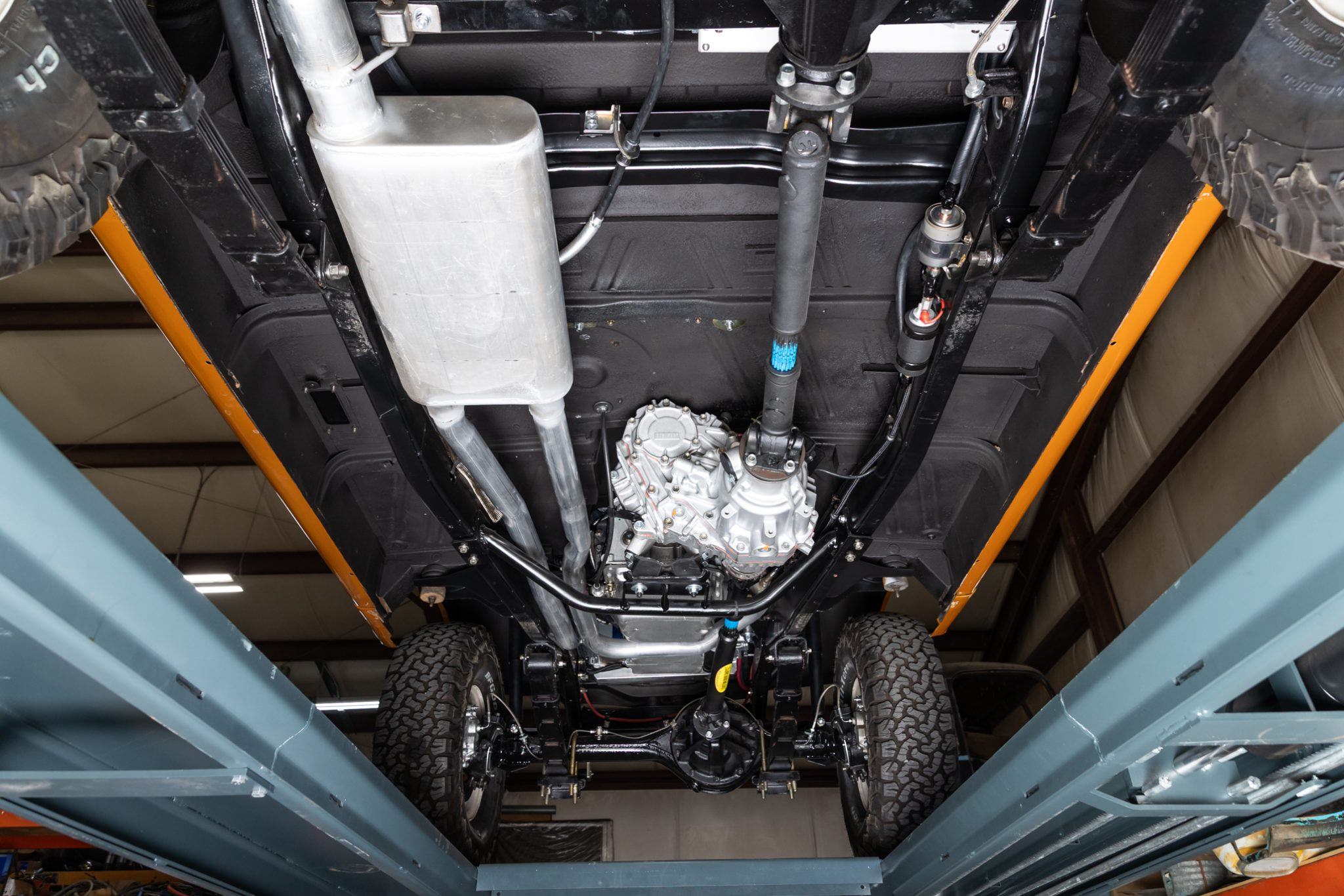
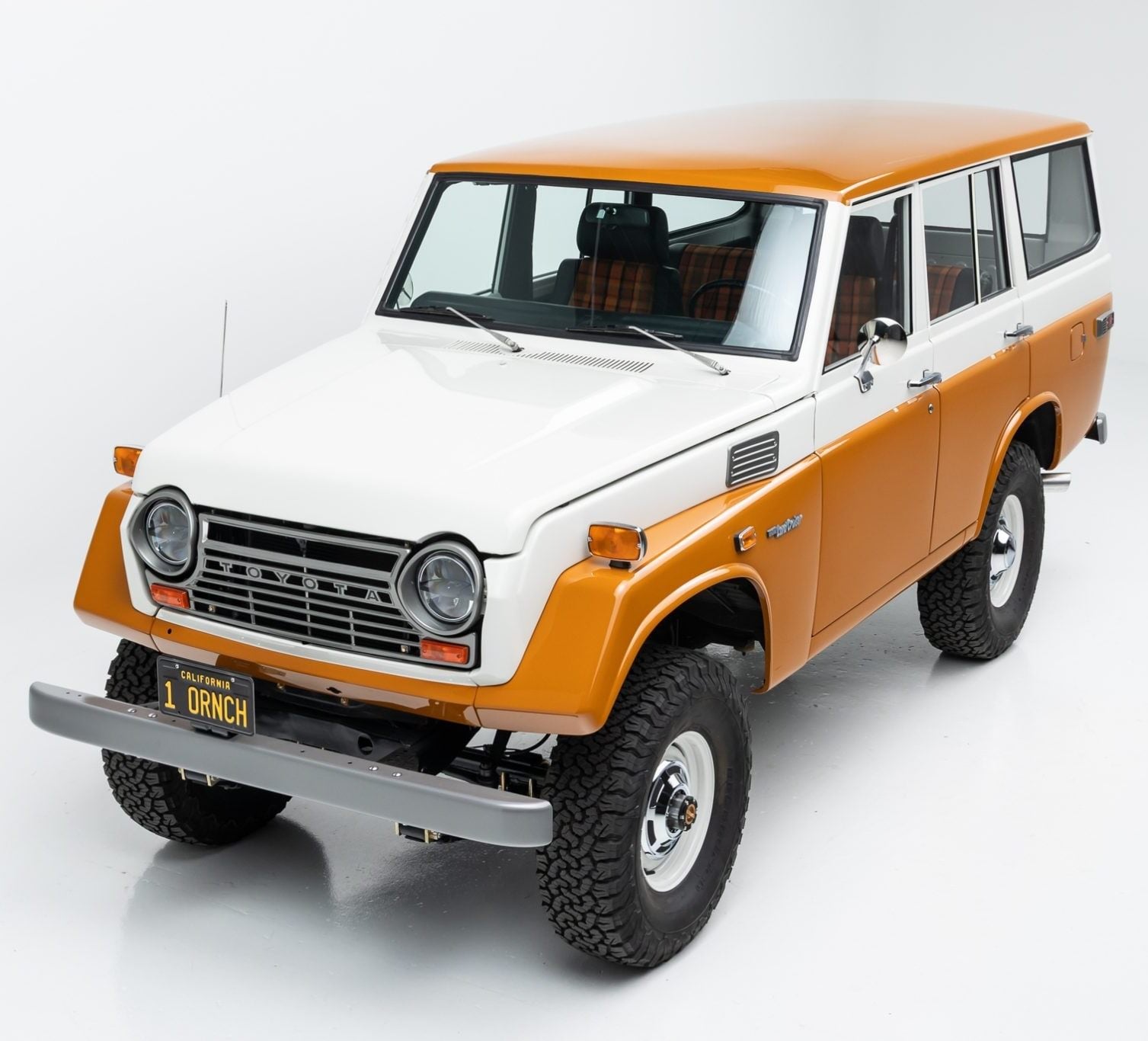
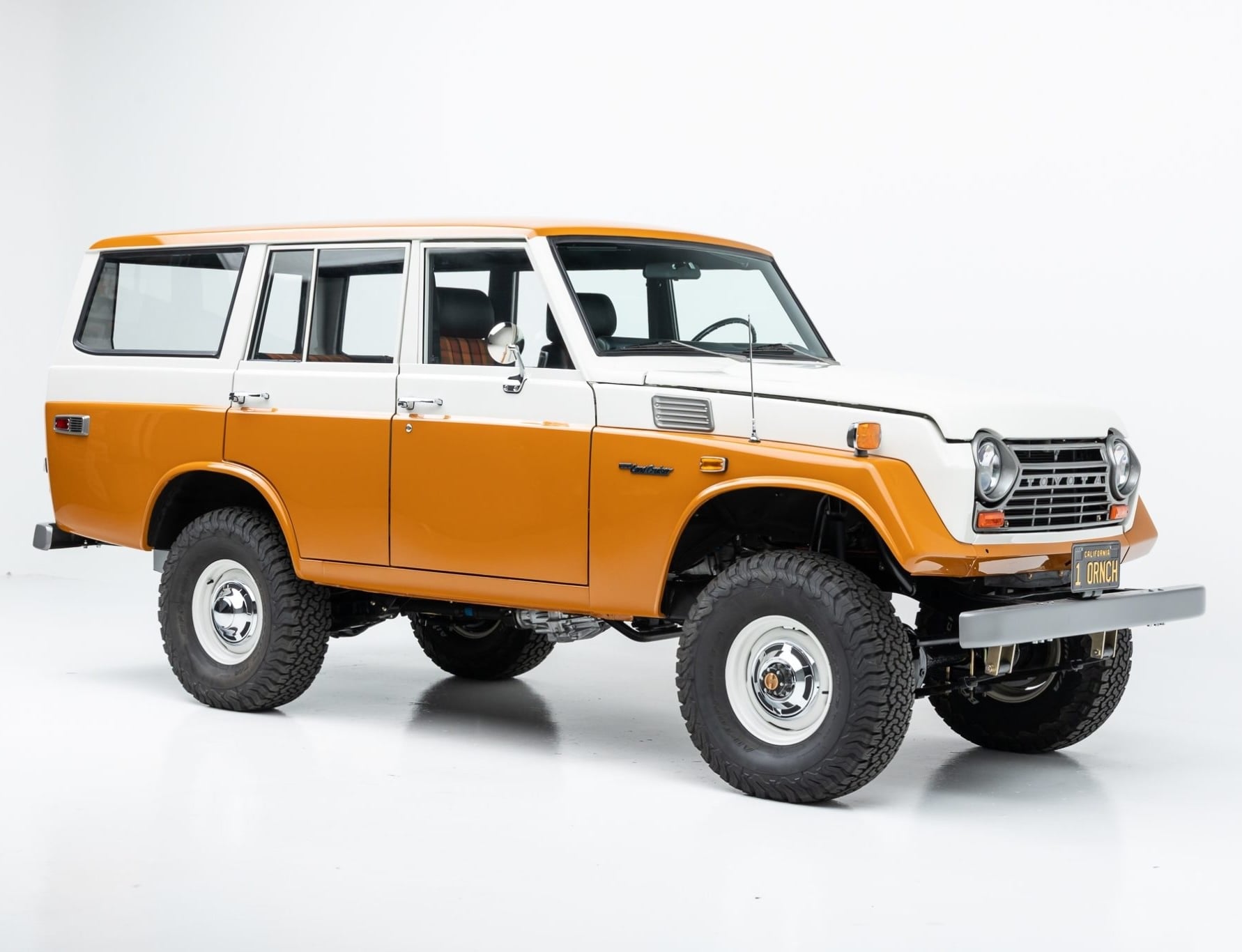
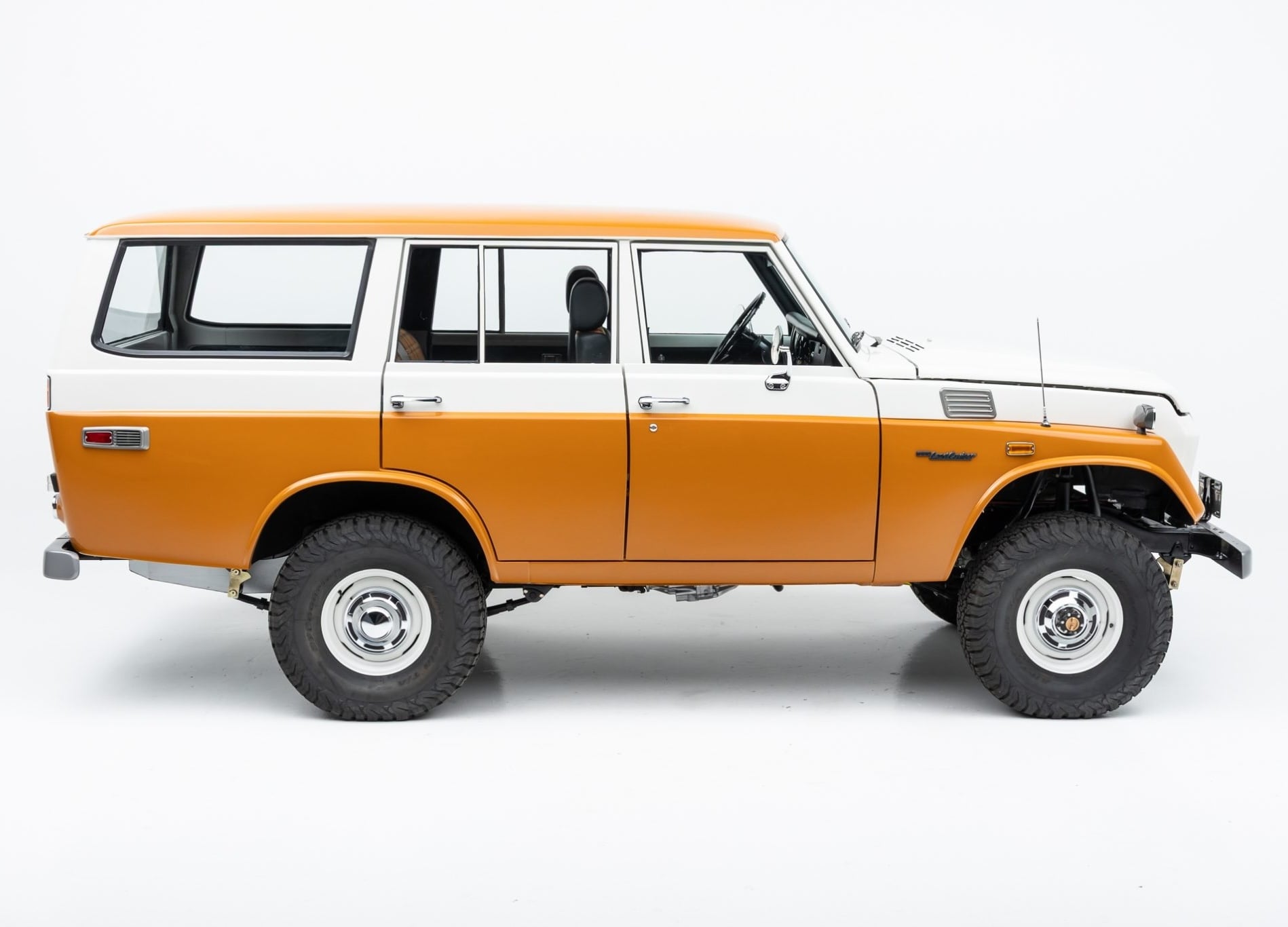
This is a heavily-modified 1974 Toyota Land Cruiser FJ55 restomod that has had its performance completely transformed thanks to the fitment of a Chevrolet Performance 6.2 liter LS3 V8 crate engine producing 430 bhp and 425 lb ft of torque – a massive upgrade over the original Toyota inline-six with its 130 bhp.
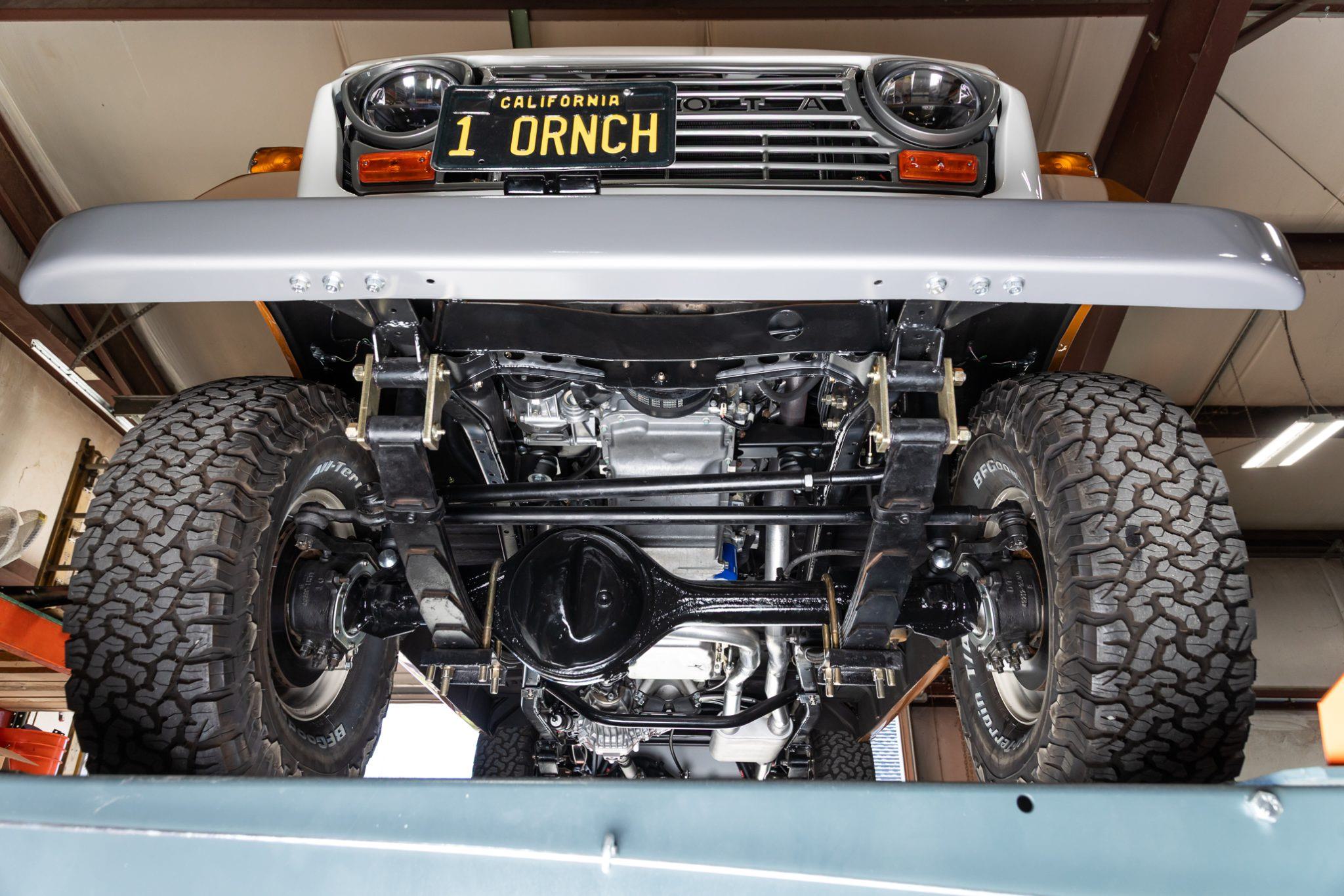
This new LS3 is paired with a 6L80 6-speed automatic transmission, sending power back through a rebuilt dual-range transfer case and Tom Wood’s driveshafts. It also has dual batteries, an aluminum radiator, and a larger 50 gallon fuel tank.
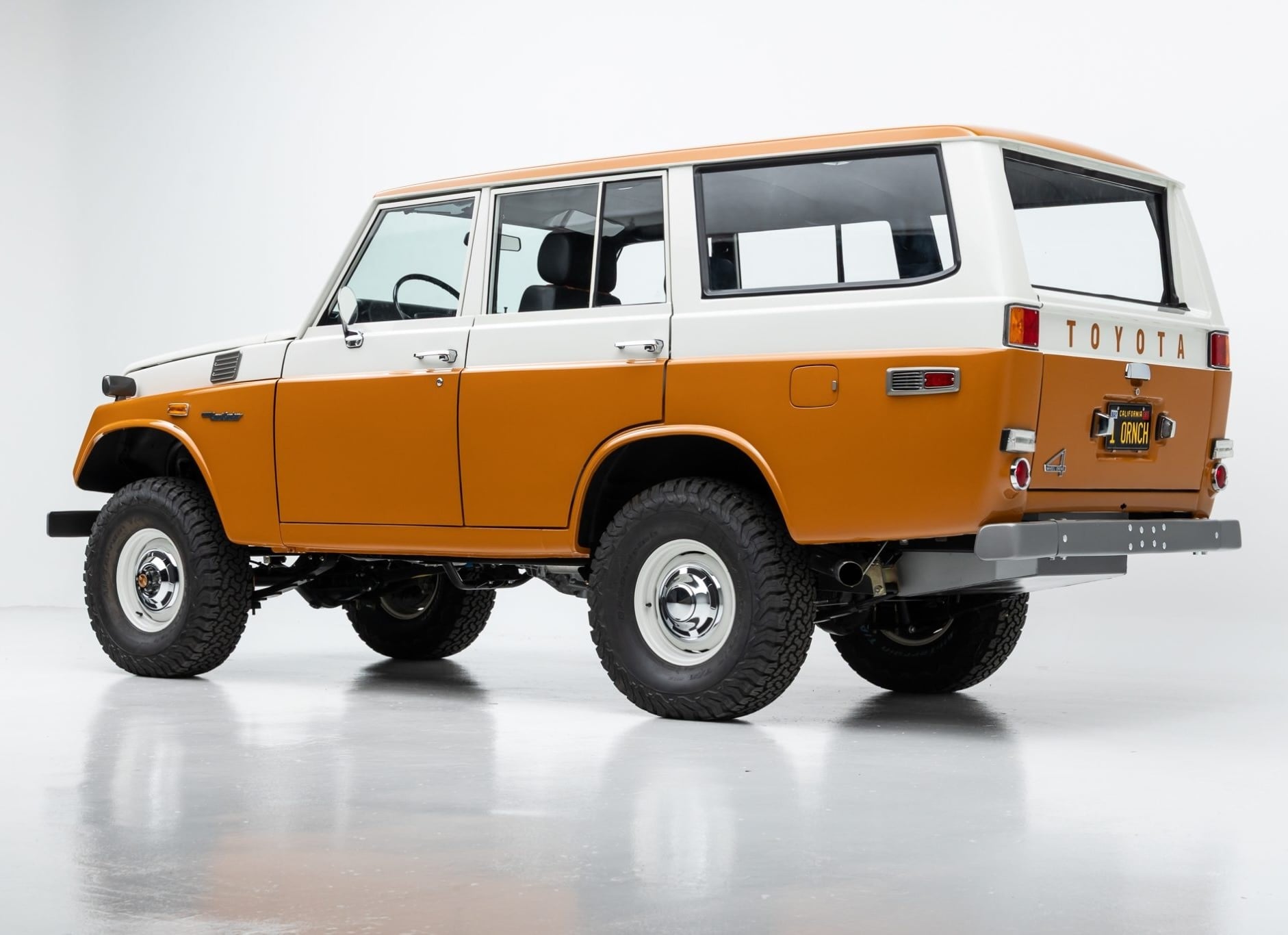
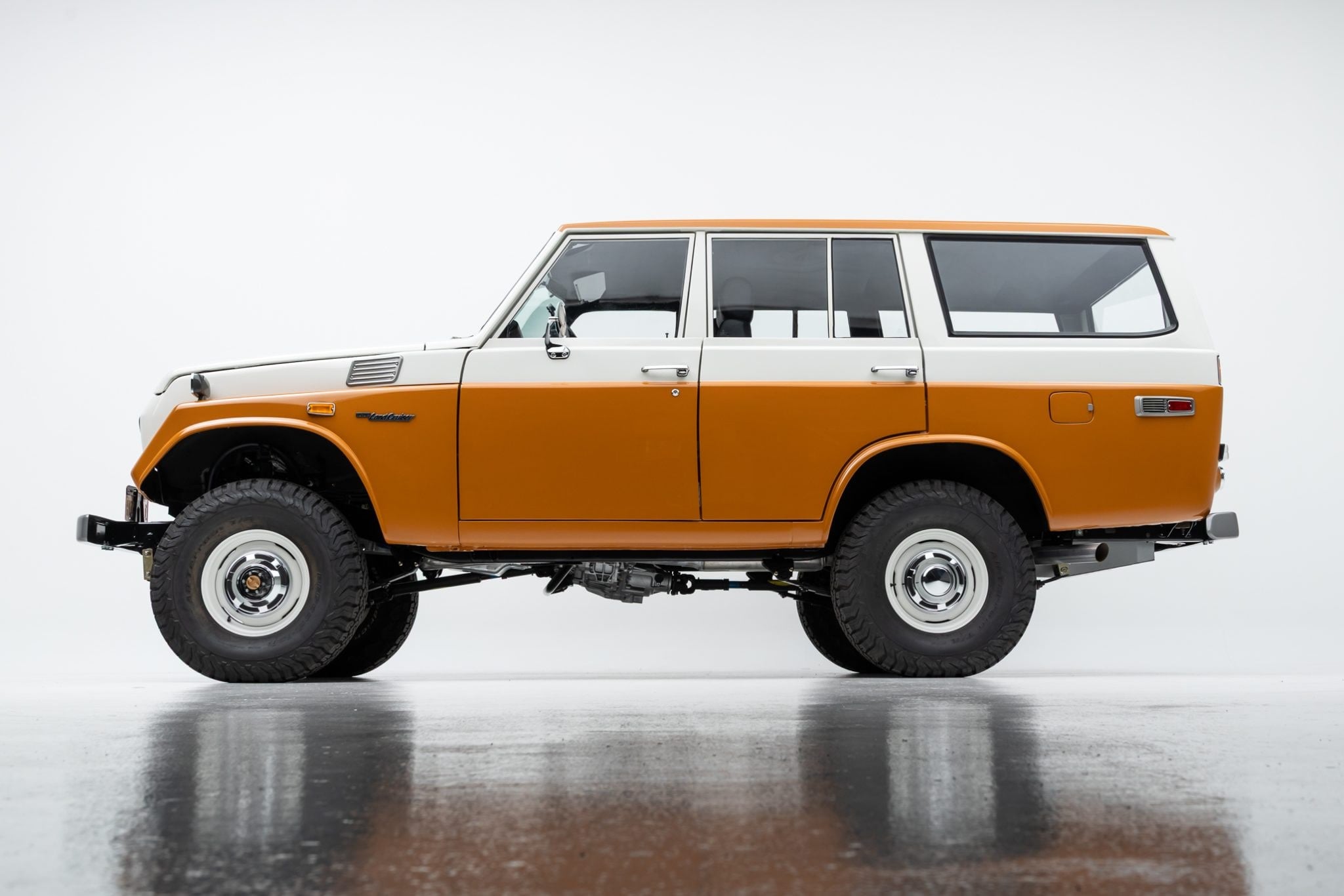
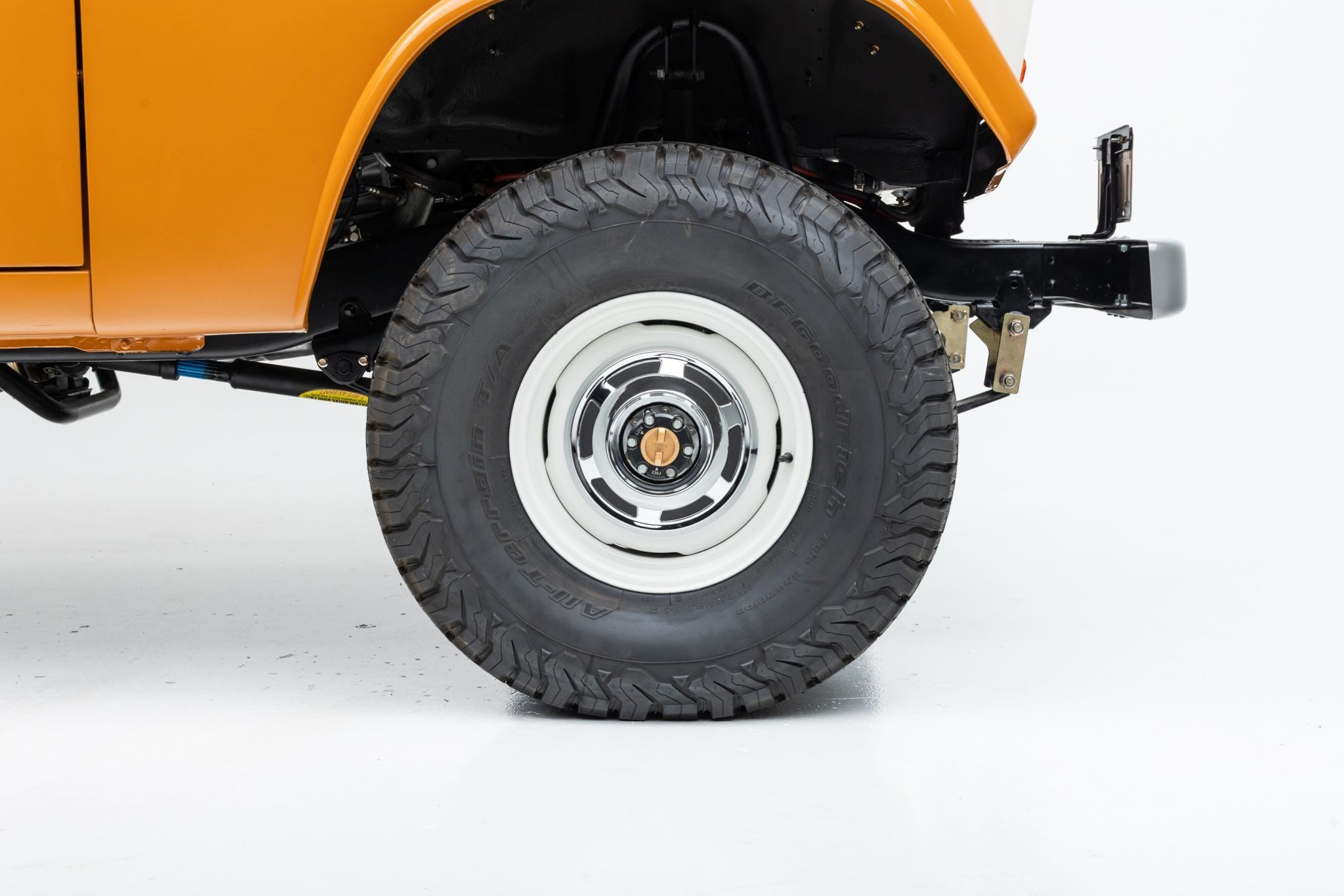
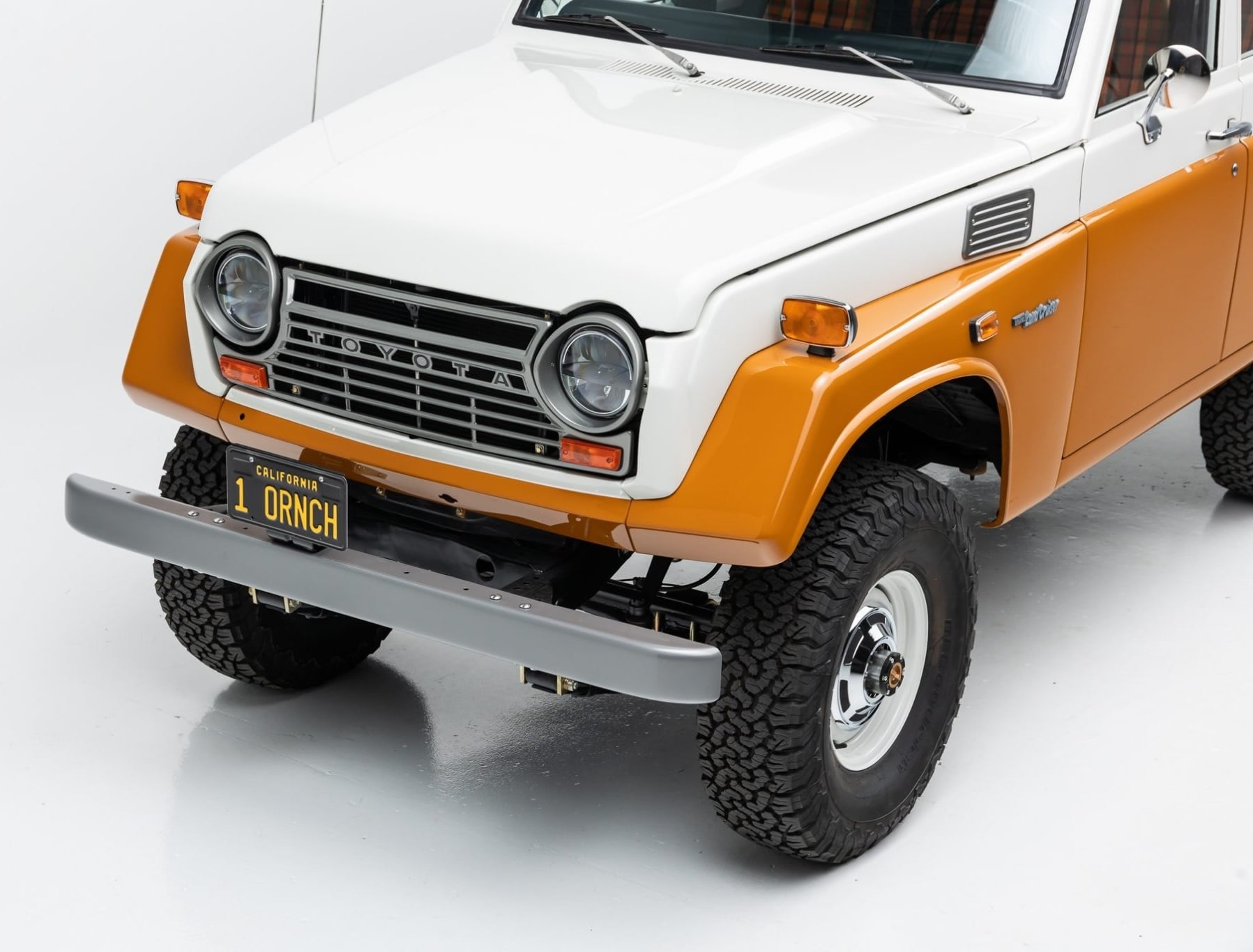
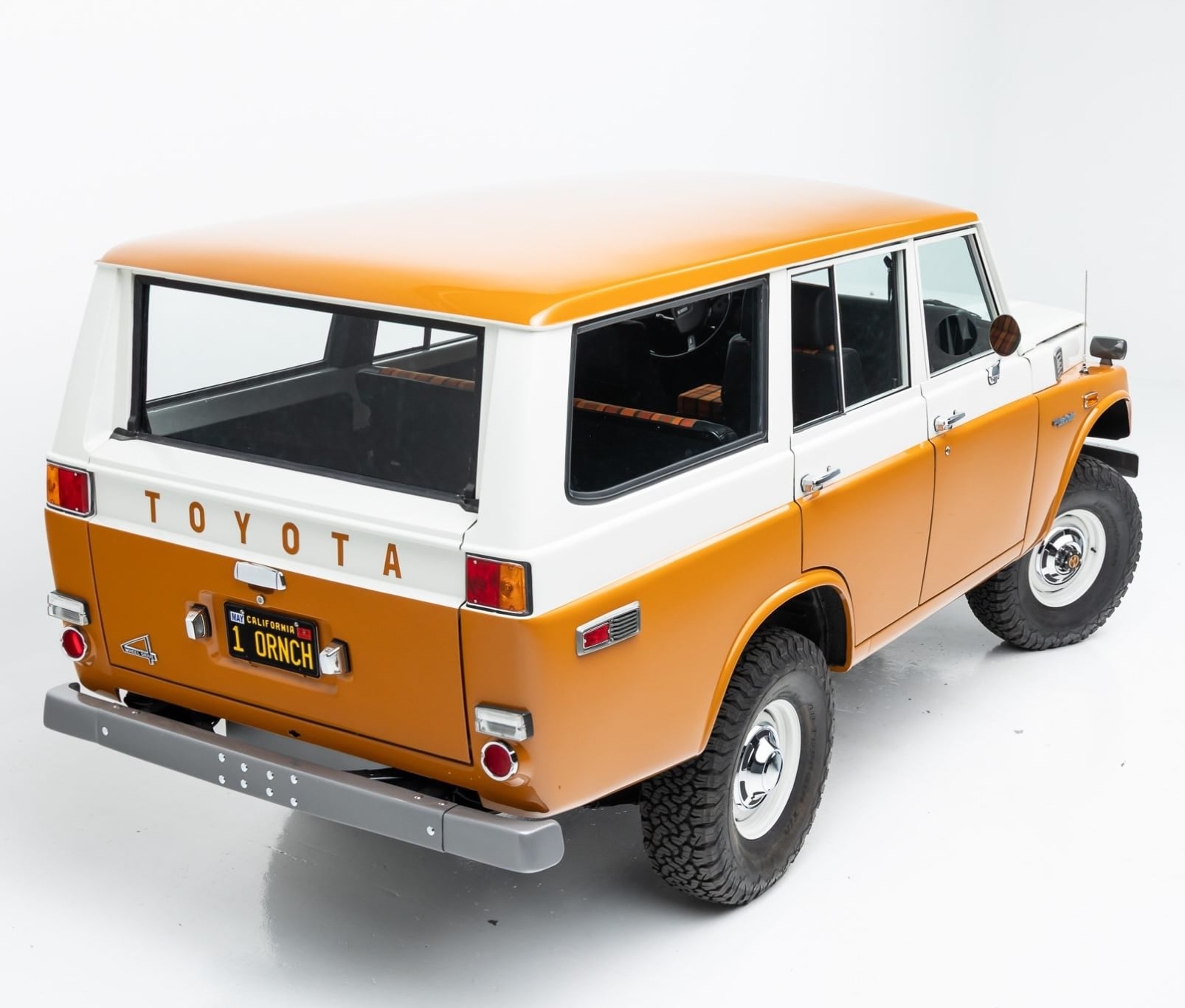
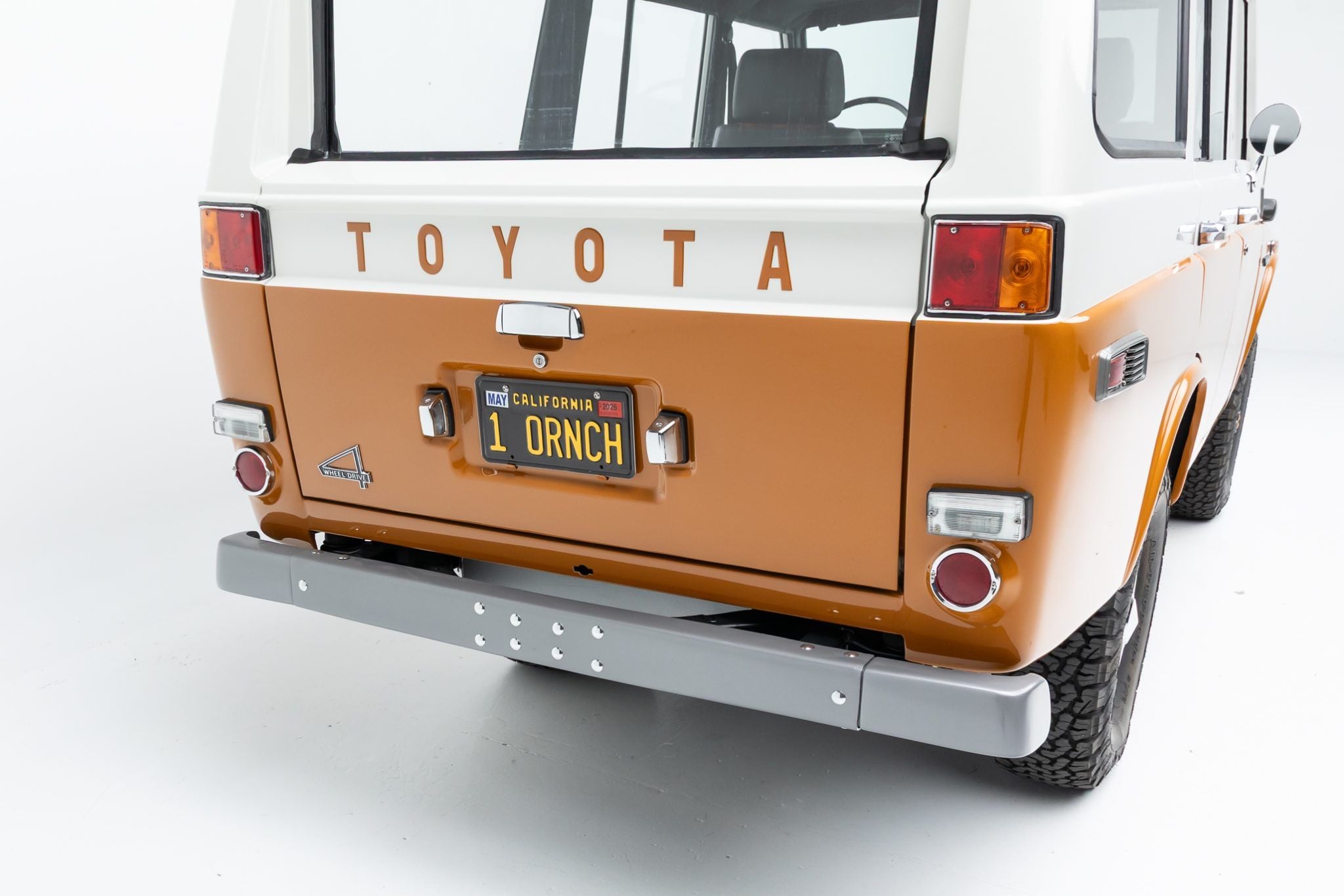
During the rebuild the body was repainted in a White and Orange two-tone scheme, with new chrome trim, mirror assemblies, emblems, weather stripping, rubber seals, and LED headlights fitted. Underneath, the truck now rides on Dobinsons leaf springs, KYB shock absorbers with custom upper front shock tower mounts, and a shortened FJ60-sourced rear axle with an E-Stopp electric emergency brake module.
Aisin manually locking front hubs are also fitted, and the wheels are white-finished 15-inch steels shod with 33×10.5 inch BFGoodrich All-Terrain T/A KO2 tires.
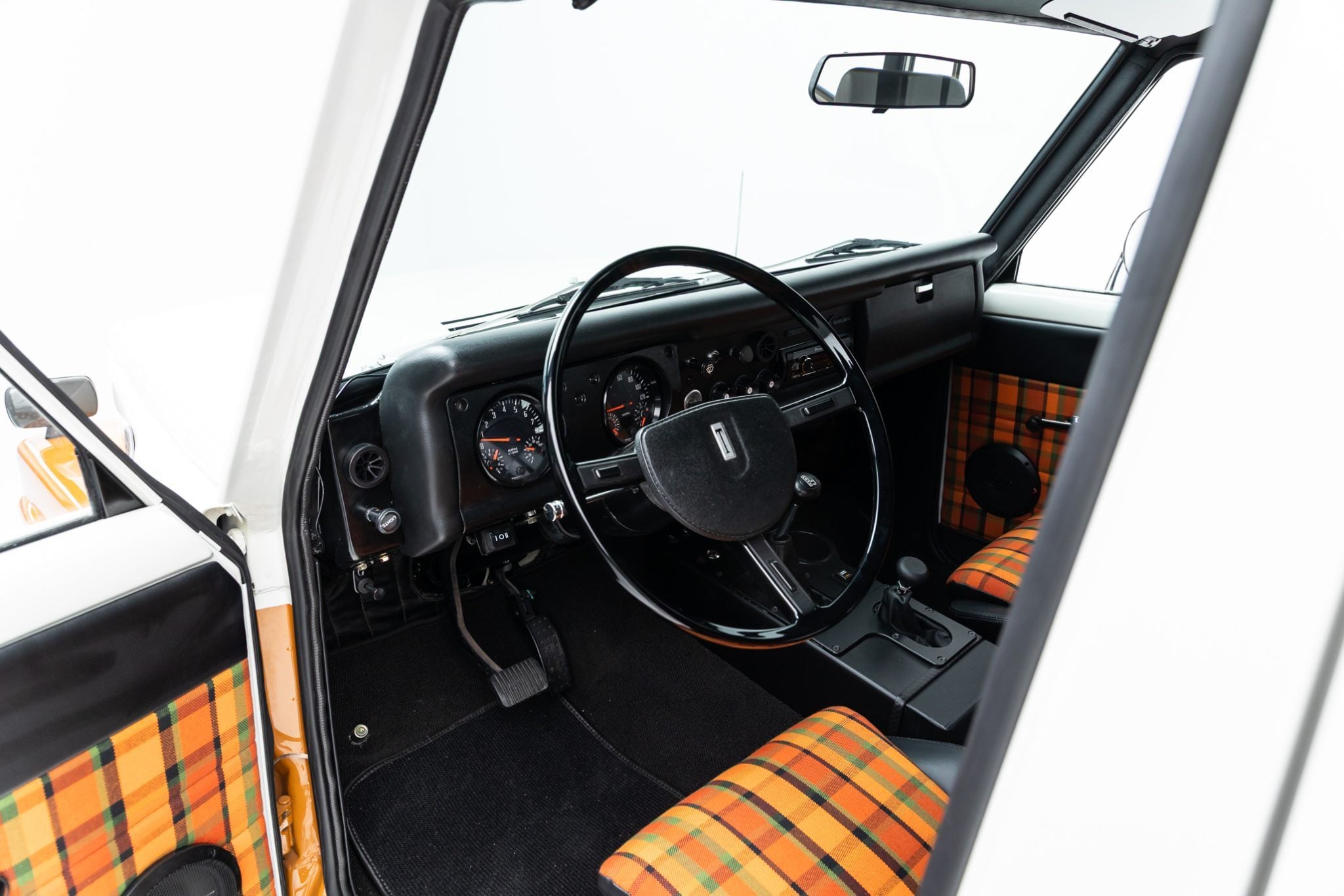
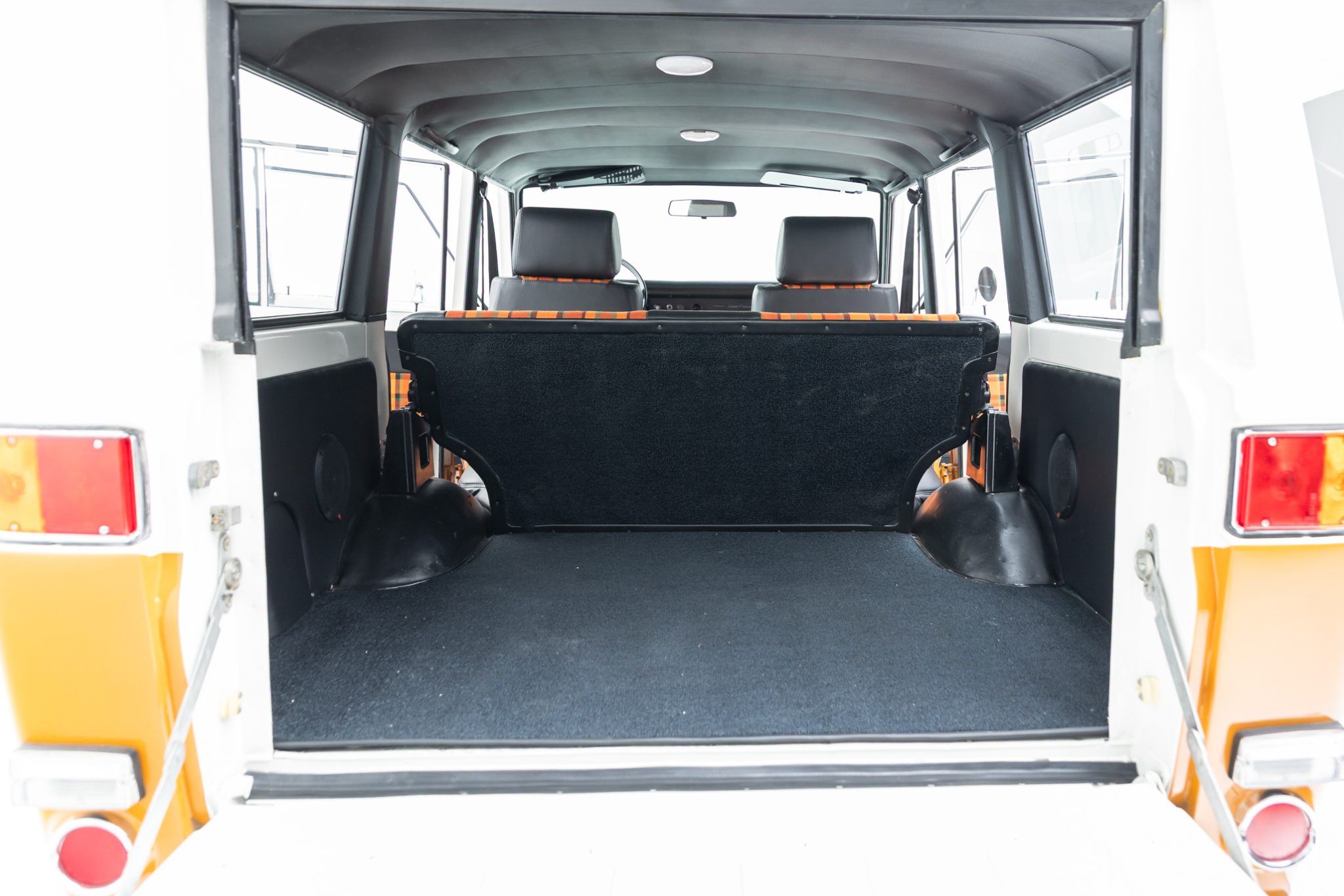
The interior has been completely redone, with heated and ventilated Scheel-Mann front bucket seats in Black leather with Orange plaid inserts, with matching material carried across the folding rear bench, door panels, and centre console armrest.
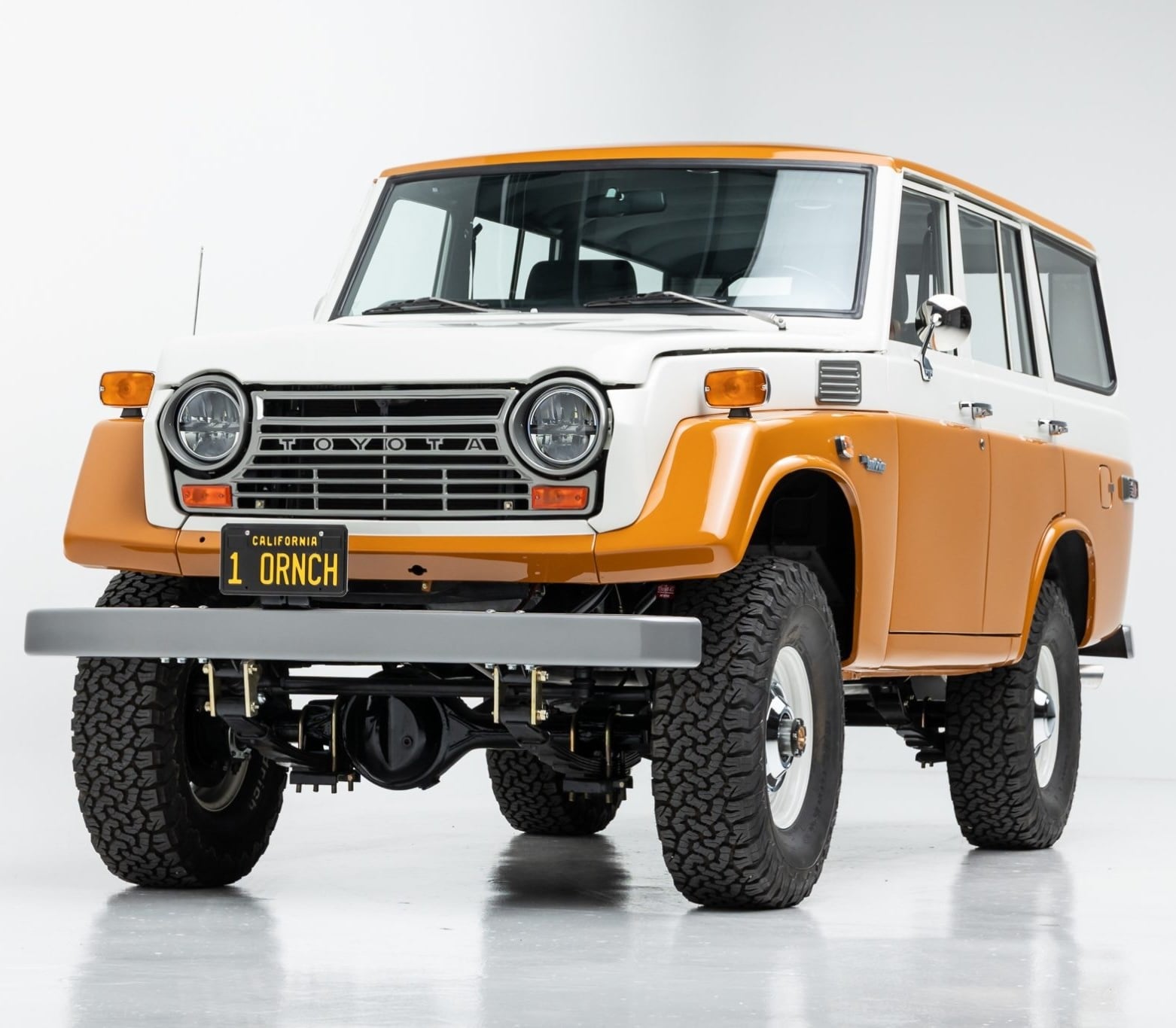
This is a heavily-modified 1974 Toyota Land Cruiser FJ55 restomod that has had its performance completely transformed thanks to the fitment of a Chevrolet Performance 6.2 liter LS3 V8 crate engine producing 430 bhp and 425 lb ft of torque – a massive upgrade over the original Toyota inline-six with its 130 bhp.
The cabin now has Restomod Air climate control fitted, a Pioneer head unit with Rockford Fosgate speakers, a locking centre console, Speedhut instruments including a GPS speedometer and 8k rpm tachometer, and auxiliary power ports in the cargo area. The digital odometer reads 14 miles, said to be the distance covered since the build was completed.
The truck is being offered for sale on behalf of its current owner in Idaho, accompanied by parts purchase receipts and a California title. If you’d like to read more about it or register to bid you can visit the listing here.
Images courtesy of Bring a Trailer

Articles that Ben Branch has written have been covered on CNN, Popular Mechanics, Smithsonian Magazine, Road & Track Magazine, the official Pinterest blog, the official eBay Motors blog, BuzzFeed, Autoweek Magazine, Wired Magazine, Autoblog, Gear Patrol, Jalopnik, The Verge, and many more.
Silodrome was founded by Ben back in 2010, in the years since the site has grown to become a world leader in the alternative and vintage motoring sector, with well over a million monthly readers from around the world and many hundreds of thousands of followers on social media.