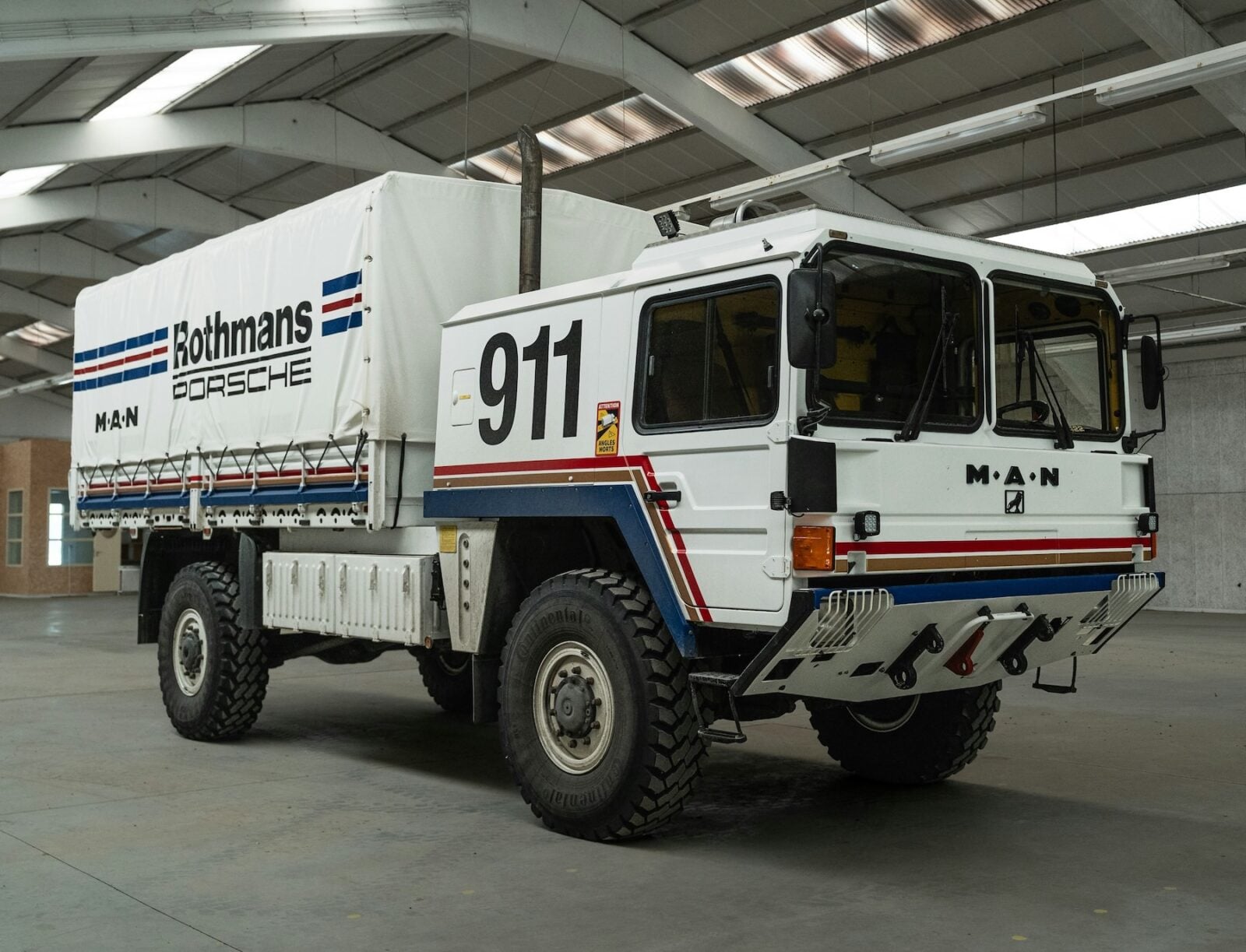
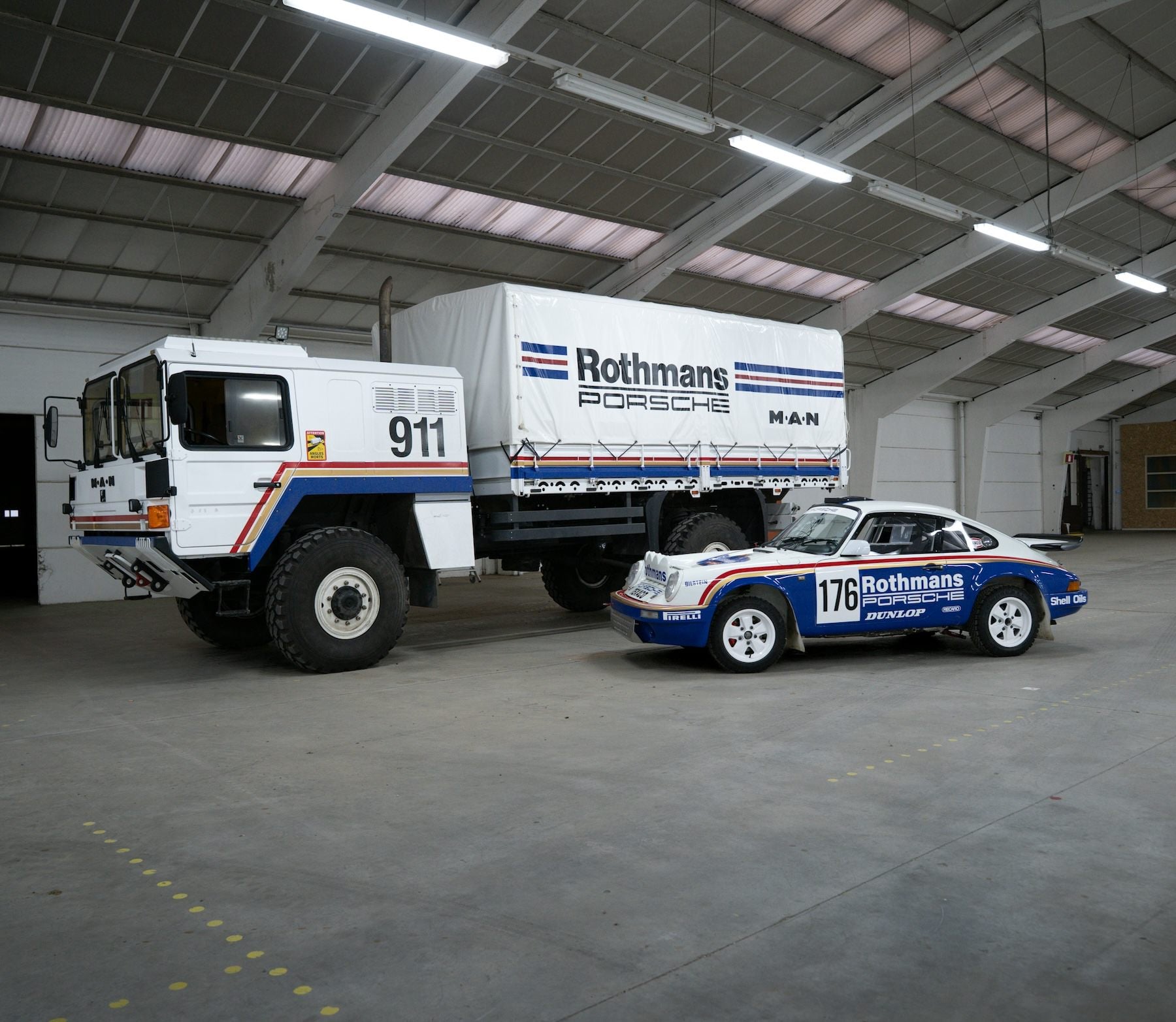
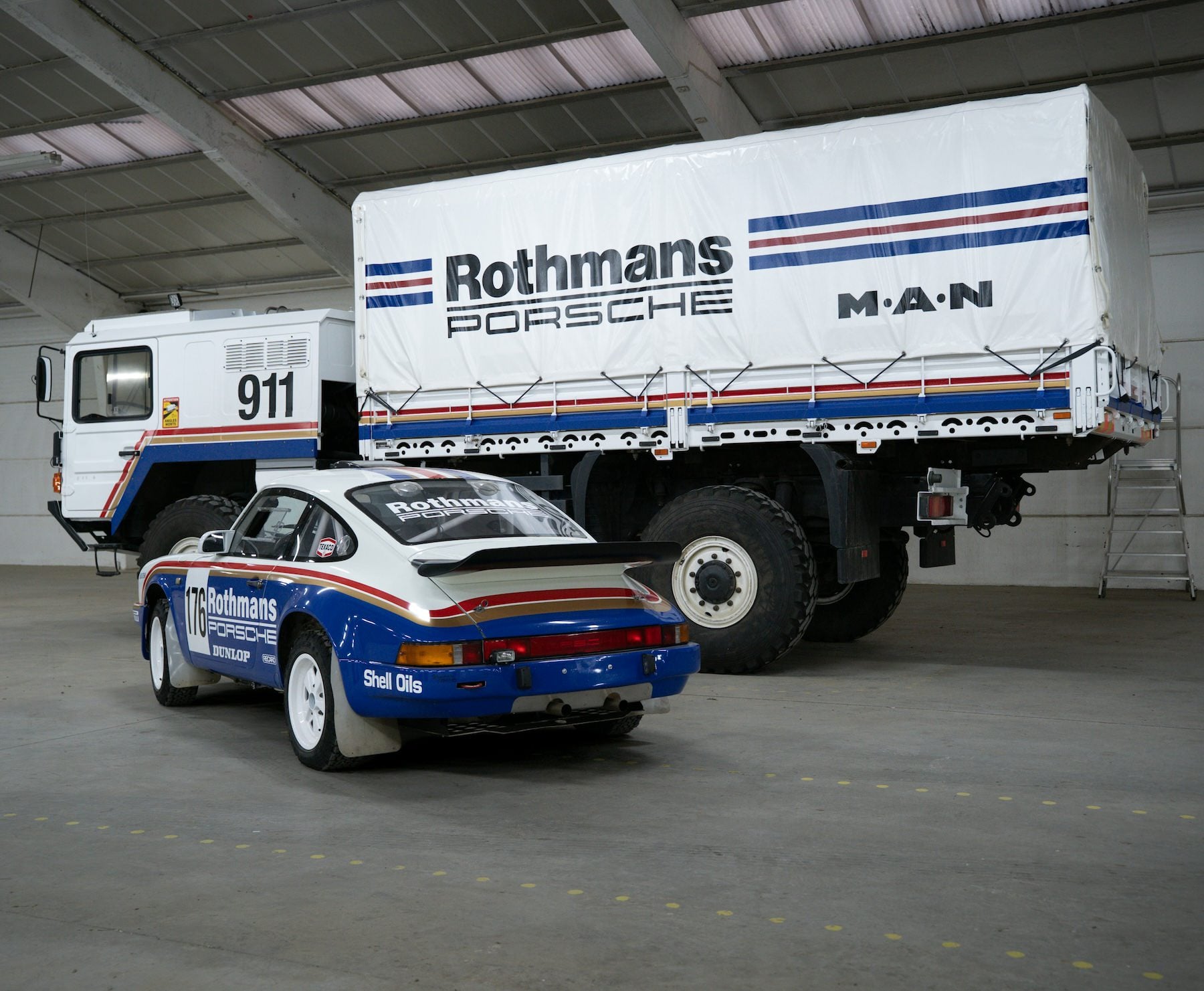
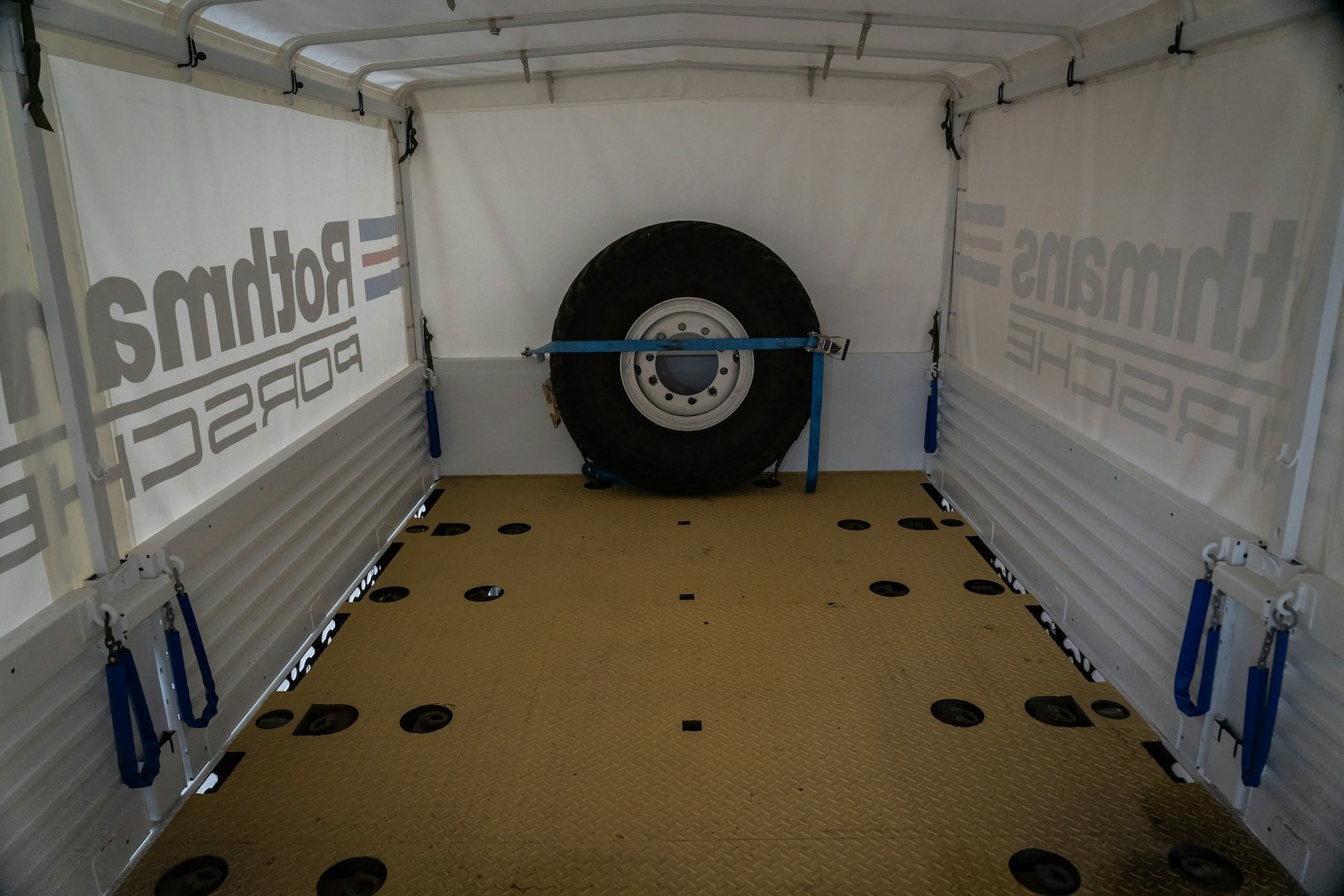
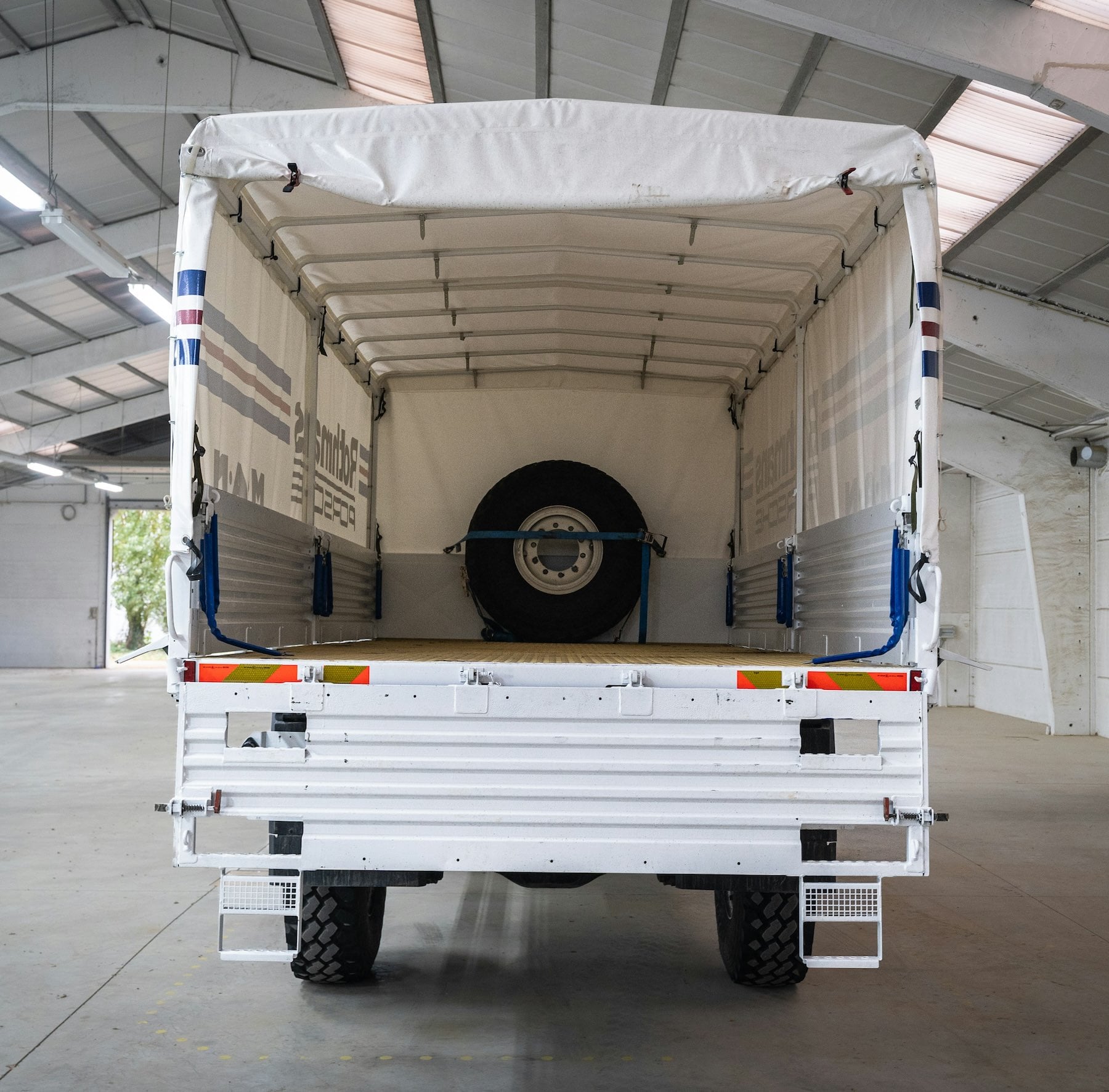
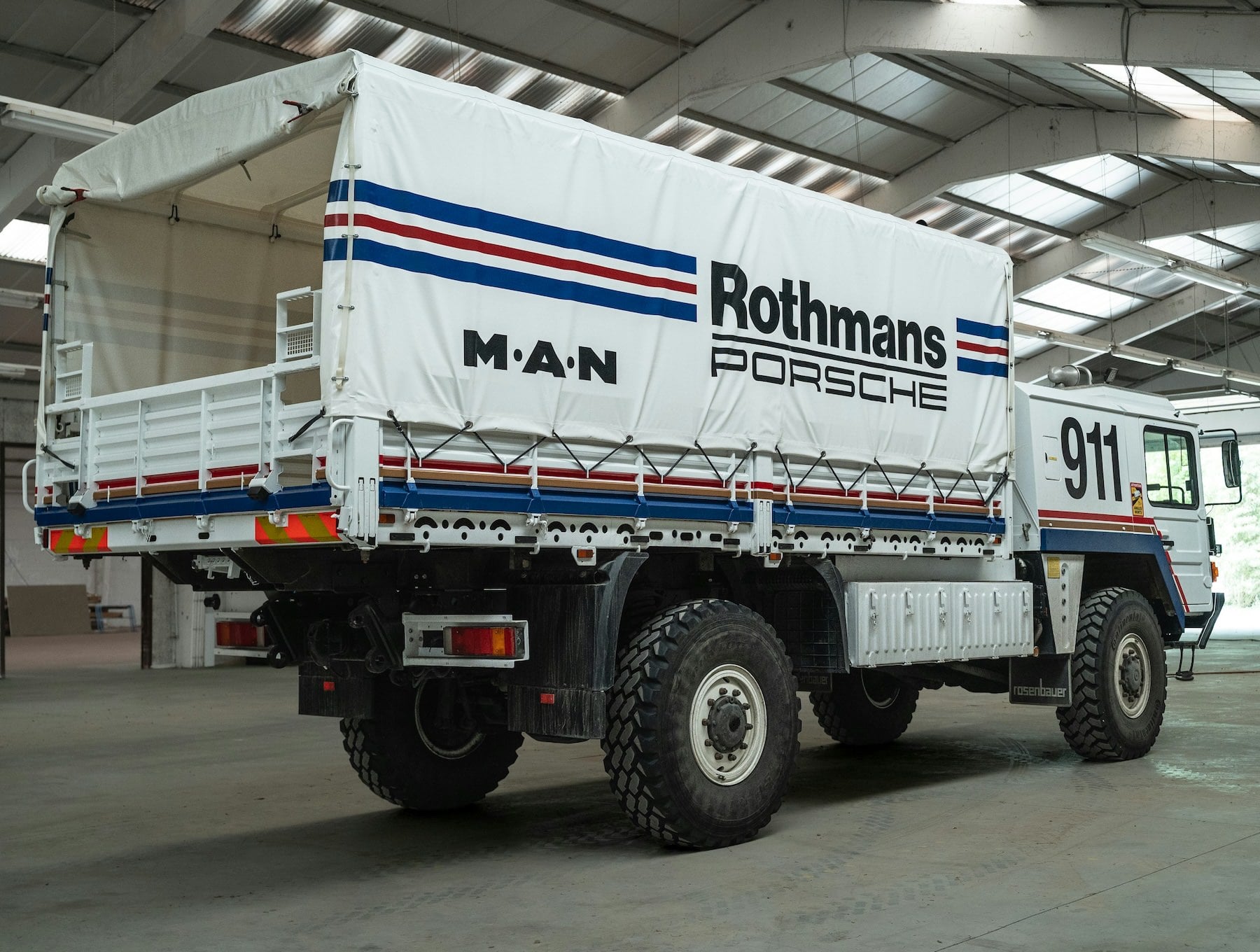
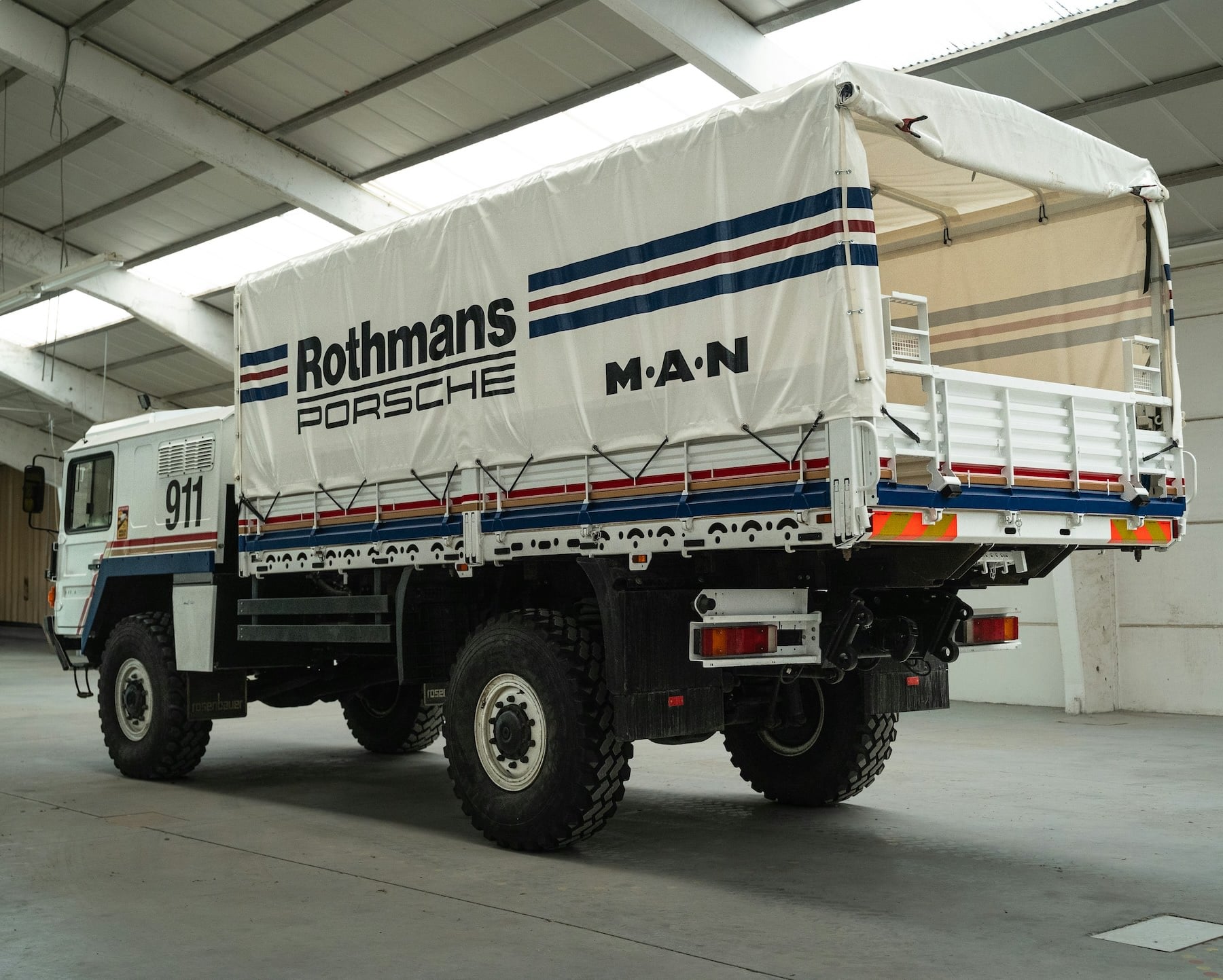
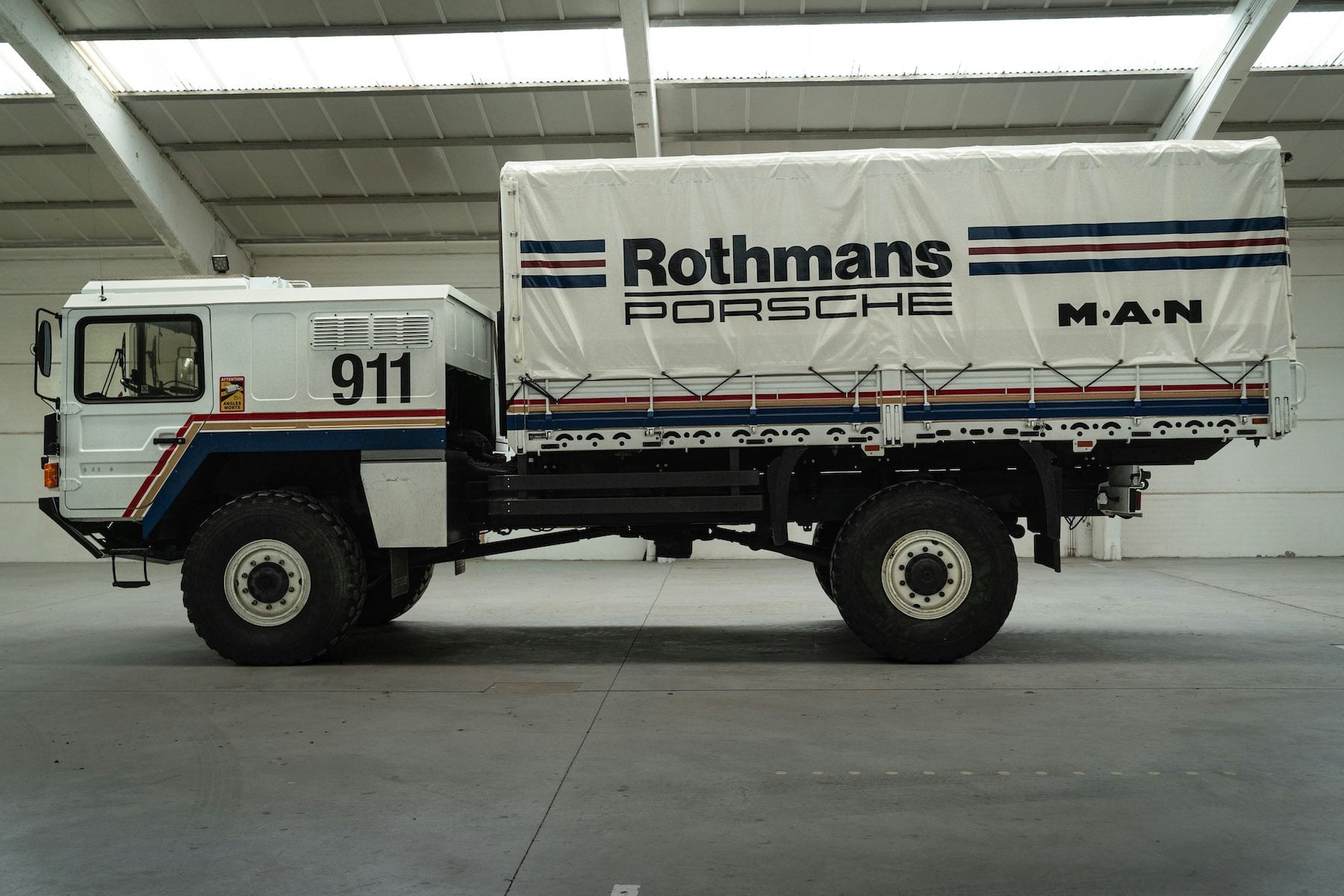
This is a 1997 MAN KAT 1 that’s been converted into a Paris Dakar Rally-style support truck with a full Rothmans Porsche livery. It’s powered by a 12.0 liter turbodiesel, and it had full-time four-wheel-drive.
These MAN trucks took part in the Dakar in-period as support trucks, but still managed to finish as high as 3rd in their class. This example would be ideally suited to a Porsche collector who already has a Rothmans-livery 911, or to someone who wants to turn it into a unique overland expedition vehicle.
Fast Facts: A 1997 MAN KAT 1 Rally Truck
- The MAN KAT 1 was developed for the West German Bundeswehr beginning in the 1960s, with production starting in 1976. Designed for extreme off-road conditions, the range included 4×4, 6×6, and 8×8 configurations. Its military specifications required exceptional mobility, permanent all-wheel drive, high ground clearance, and the ability to ford deep water.
- The original KAT 1 trucks had air-cooled Deutz V8 diesel engines, heavy-duty box-section frames, portal-style hub-reduction axles, and long-travel coil-spring suspension. Their distinctive cabs were designed to meet railway loading restrictions. The revised KAT 1 A1 series arrived in 1987, introducing a tilting cab and other mechanical changes.
- MAN KAT 1 trucks took part in the Paris-Dakar Rally during the 1980s, primarily serving as support vehicles for racing teams. A MAN 6×6 finished third in the truck class in 1984, and MAN trucks supported Porsche’s victorious 959 entries in 1986. These brutal events demonstrated the military trucks’ exceptional off-road ability as well as their reliability.
- This specific 1997 MAN KAT 1 A1 began life as an airport fire truck before being converted into a Dakar-style support vehicle wearing Rothmans-Porsche livery. It has a turbocharged 12.0 liter inline-six diesel, 4-speed automatic transmission, and three locking differentials. Located in Belgium, it shows 28,008 kilometers and is offered for sale through Collecting Cars.
History Speedrun: The MAN KAT 1
In 1962, West Germany’s defense procurement office began planning a second generation of tactical trucks to replace the aging fleet the Bundeswehr had run since its founding. The wish list was long – it needed to include two, three, and four-axle trucks (including amphibious variants), with permanent all-wheel drive, run-flat low-pressure tires, protection against nuclear, biological, and chemical contamination, and engines that would burn almost any fuel imaginable. They were also meant to follow Leopard tanks cross country at at least 25 mph (40 km/h).
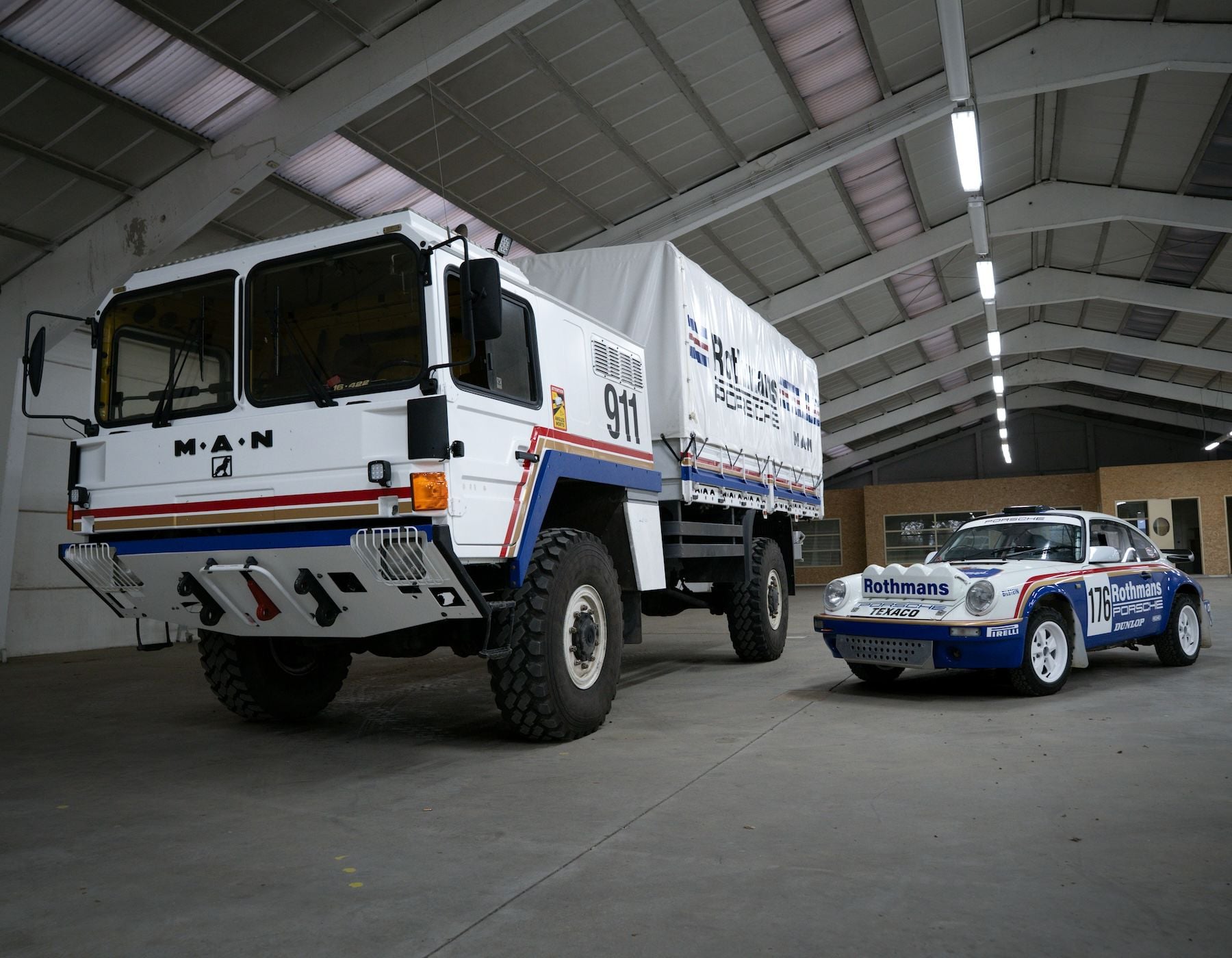
 This is a 1997 MAN KAT 1 that’s been converted into a Paris Dakar Rally-style support truck with a full Rothmans Porsche livery. It’s powered by a 12.0 liter turbodiesel, and it had full-time four-wheel-drive.
The procurement office asked the bidding manufacturers to pool their efforts, and in 1964 a joint development bureau was formed under MAN’s leadership with Klöckner-Humboldt-Deutz, Büssing, Krupp and Henschel. The first prototypes appeared at the end of the 1960s, and three of them could swim.
The sheer scope of the specification proved unaffordable when the rubber hit the road, as a result the amphibious and multi-fuel requirements were dropped in 1972, and in place of swimming the trucks would need to be able to cross 47 inches (1.2 meters) of water. Quite a bit less demanding than actually being a boat.
Even then the Bundeswehr couldn’t afford the full spec list for every truck, so it sorted its new vehicles into categories – Category I (“Kat I”) for purpose-built off-road military designs, Category II for purpose-built military designs without off-road ability, and Categories III through VI for commercial vehicles with differing degrees of modification and off-road ability.
Daimler-Benz built an 8×8 prototype of its own in 1973, the LG 497, then withdrew. MAN won the production contract in December of 1975, for 8,385 trucks, and handed over the first, a 10-ton 8×8, on November the 29th, 1976.
An Engine Behind The Cab
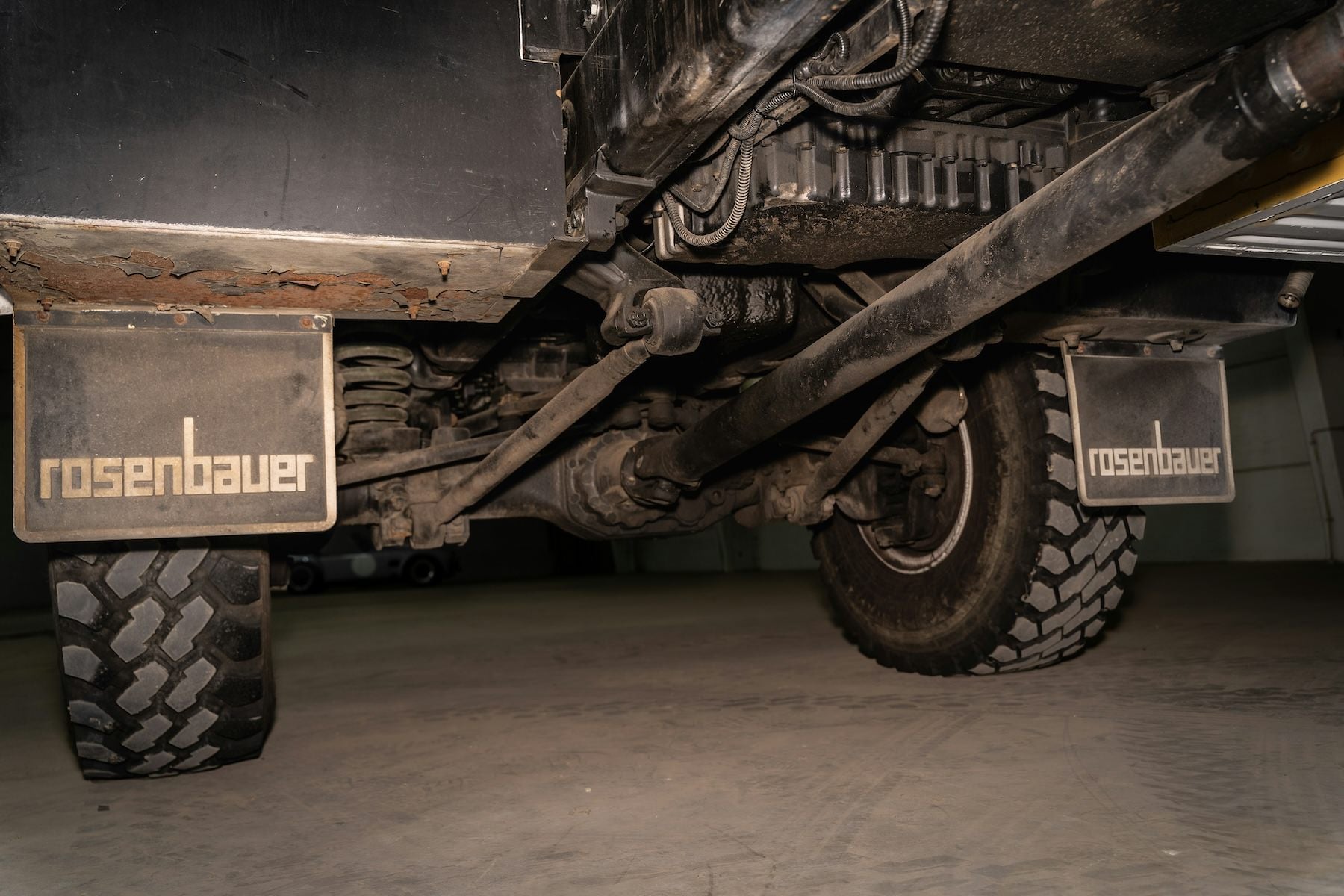
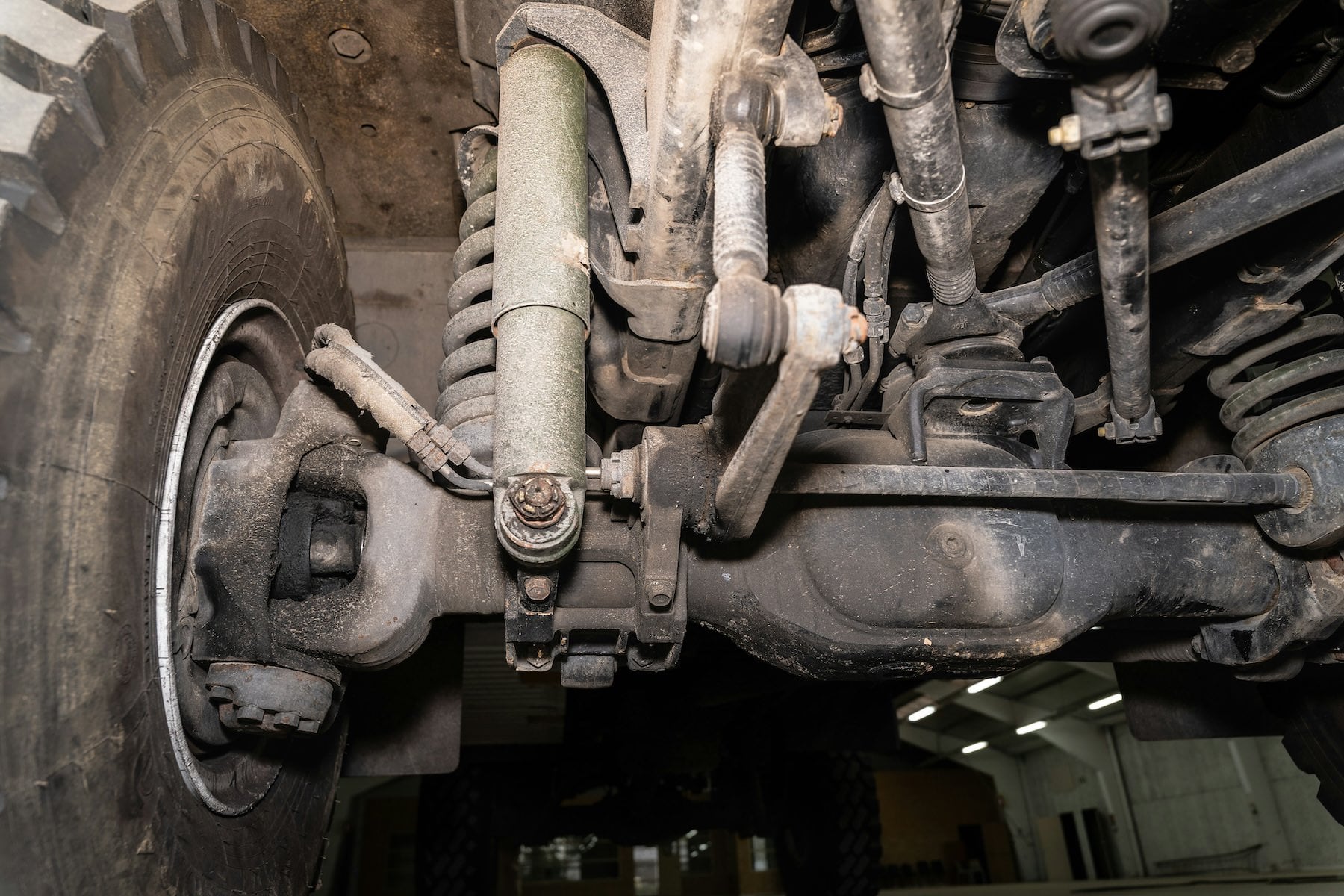
The 5-ton 4×4, 7-ton 6×6, and 10-ton 8×8 (metric tons) share one layout – the frame has closed box-section steel rails with welded tubular cross-members, which resists twisting. Live axles with hub-reduction gears are held by locating arms and sprung on long-travel coil springs with hydraulic dampers. Steering is recirculating ball with hydraulic assistance, on both front axles in the 8×8, and the brakes combine pneumatics and hydraulics.
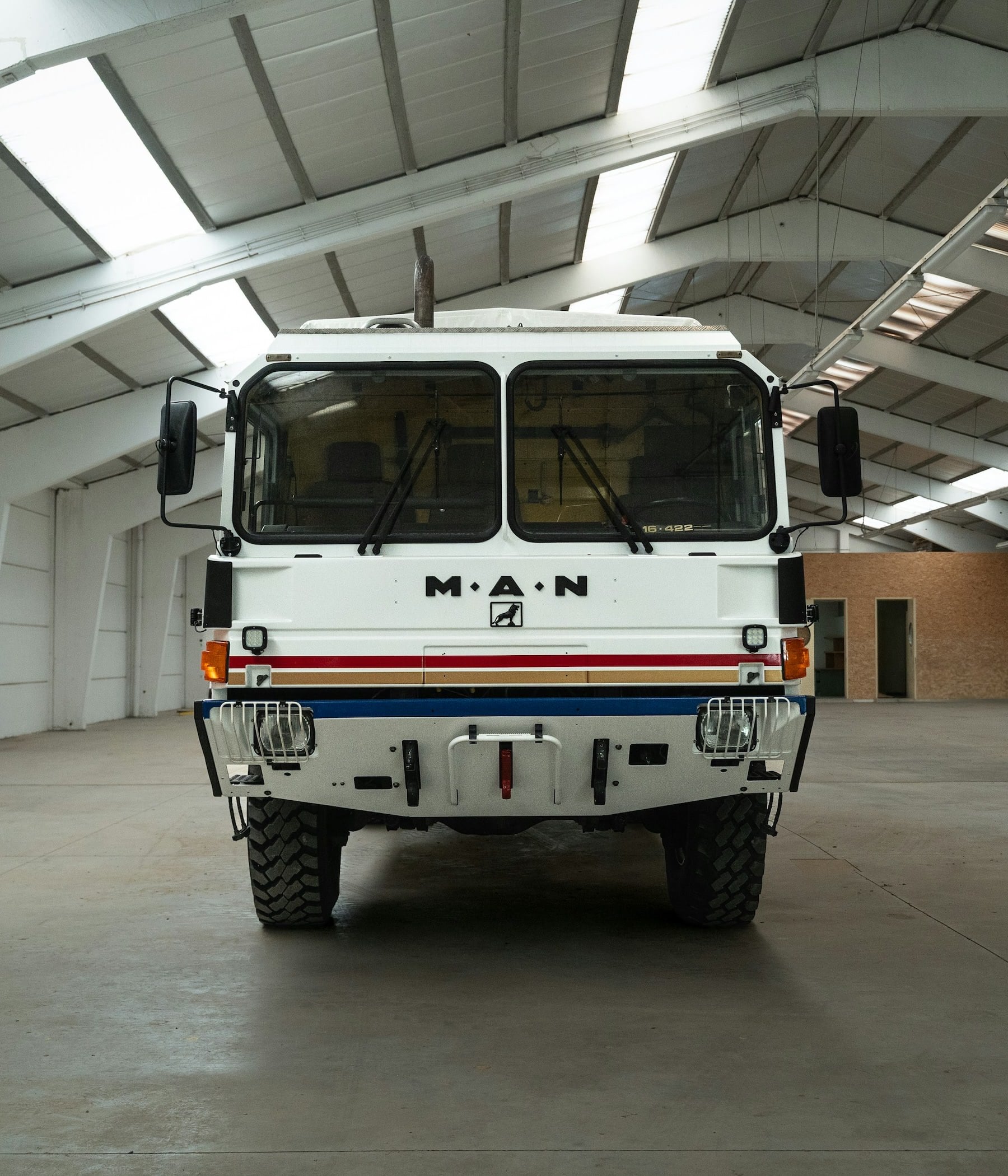
The engine sits behind the cab, not under or in front of it as is more common in commercial trucks. That kept overall height below 9.5 feet (2.9 meters) so the trucks would fit on standard rail flatcars – the cab’s cut-away upper corners are there for the railway loading gauge.
Power comes from an air-cooled Deutz V8 diesel, a 12.8 liter pushrod engine with direct injection. In the 4×4 the naturally-aspirated F8L 413F makes 252 bhp and 579 lb ft of torque.
Power comes from an air-cooled Deutz V8 diesel, a 12.8 liter pushrod engine with direct injection. In the 4×4 the naturally-aspirated F8L 413F makes 252 bhp and 579 lb ft of torque. The 6×6 and 8×8 use a turbocharged and intercooled version with 316 bhp and 738 lb ft.
The engine drives every axle permanently through a torque-converter clutch and a 6-speed ZF gearbox, and the center and rear differentials can be locked. On the 4×4 and 6×6 the transfer case is part of the gearbox unit, on the 8×8 it’s mounted separately and driven by a prop shaft.
The top speed of these first-series trucks was 56 mph (90 km/h), impressive for the time. The 4×4 had a 45º approach angle, a 40º departure angle, and 16.3 inches (415 mm) of clearance under its diffs. Austria’s ÖAF based its own army 10-tonner on the MAN from 1974 but fitted a water-cooled MAN V8, because the air-cooled Deutz could sometimes overheat at very low speeds.
Production + Export
The trucks were all built at MAN’s Watenstedt plant in Lower Saxony, Germany. A 6×6 dump truck and the 4×4 cargo truck followed the 8×8 in 1977, and the 6×6 cargo truck in early-1979. Production tables would eventually list 10,424 built from 1977 to 1983 – 3,601 4x4s, 2,904 6x6s, and 3,919 8x8s.
The United States bought a modified 8×8, known as Category 2. The M1001 tractor and M1002 wrecker served the Pershing II missile system, and the M1013 and M1014 tractors pulled Ground Launched Cruise Missile semitrailers. More than 500 had been delivered to the US by the end of 1986.
The Paris-Dakar Rally
MAN’s all-wheel-drive military trucks ran the Paris Dakar Rally from its early years as supply trucks for other teams. Under the rules, support vehicles had to be registered as race entries and they had to meet the same time limits.
In 1984 seven MANs started among 31 trucks. A 6×6 crewed by Henri Gabrelle, Alain Voillereau, and Adolf Dierl finished 3rd in the truck class, and an 8×8 Kat reached Dakar in 11th, just outside the time limit. Porsche’s 959s finished first and second in 1986 with two MAN trucks in support.
MAN’s all-wheel-drive military trucks ran the Paris-Dakar Rally from its early years as supply trucks for other teams. Under the rules, support vehicles had to be registered as race entries and they had to meet the same time limits.
On that rally, sections of the 4×4 entry’s box frame doubled as compressed-air reservoirs to save weight. For 1987 MAN prepared 12 trucks, a record for the company, all of them support vehicles derived from the standard military models.
The KAT I A1
Production of the revised KAT1 A1 series began in 1987, with a tilting cab, more volume-production parts, and the line continued as the MAN SX until early 2019. The Bundeswehr overhauled its original trucks in the mid-1990s to extend their service life by another 10 years, as there was just nothing that could realistically replace them.
The MAN KAT 1 Shown Here
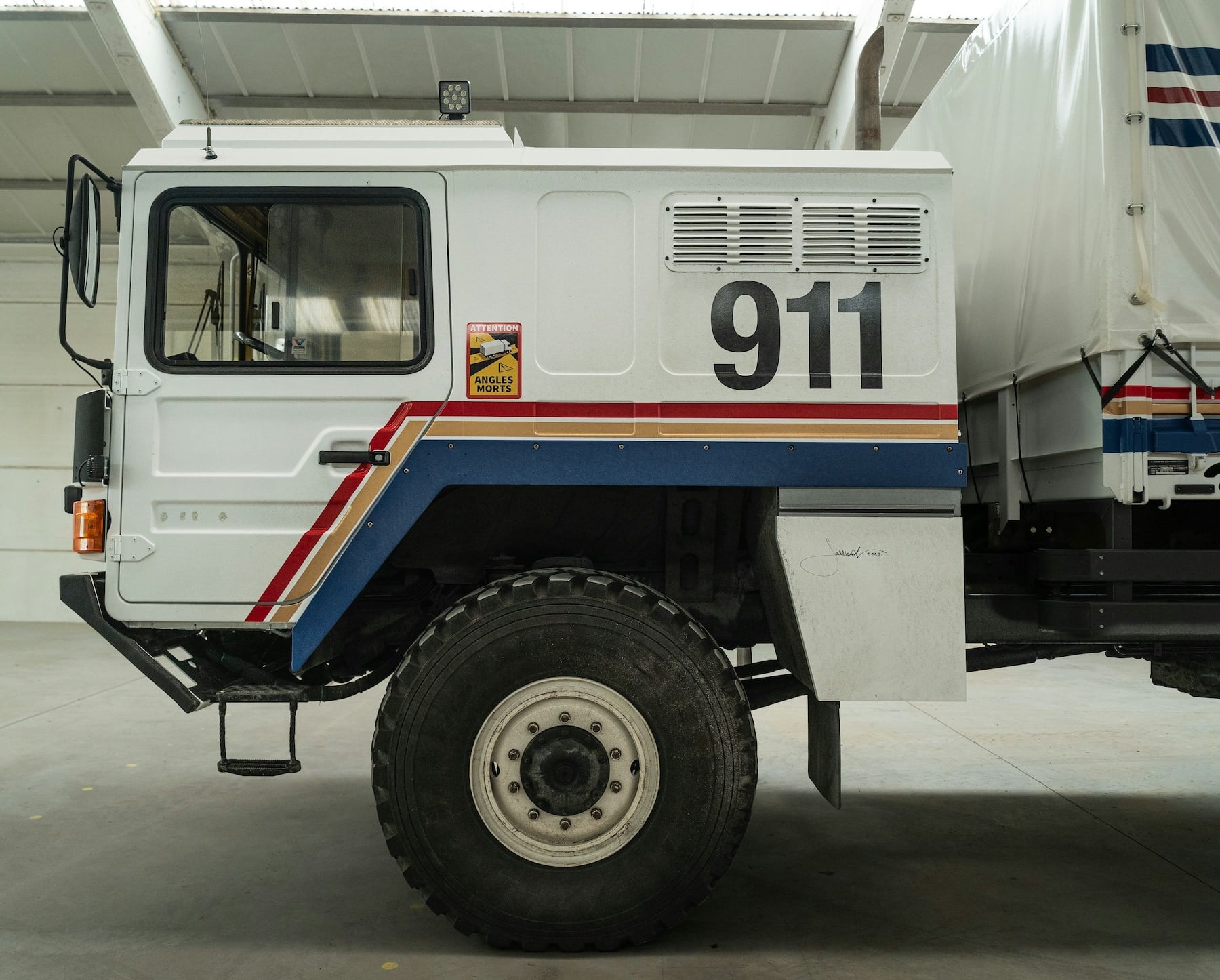
This MAN KAT 1.A1 is a heavily-modified 4×4 truck that originally served as an airport fire truck before being converted into a rally support vehicle with a Rothmans-Porsche rally livery. First registered in August of 1997, it’s finished in white with the familiar blue, red, and gold Rothmans colors, as an homage to the Porsche rally and motorsport support vehicles of the 1980s.
Power comes from a turbocharged 12.0 liter inline-six diesel engine, paired with a 4-speed automatic transmission sending power to all four wheels. The truck rides on 385/95 R20 T4 tires and is equipped with three locking differentials. Other equipment includes protective headlamp grilles, heated door mirrors, a Webasto heater, exterior storage compartments, a Whelen CB radio, and a Mag-Lite torch holder.
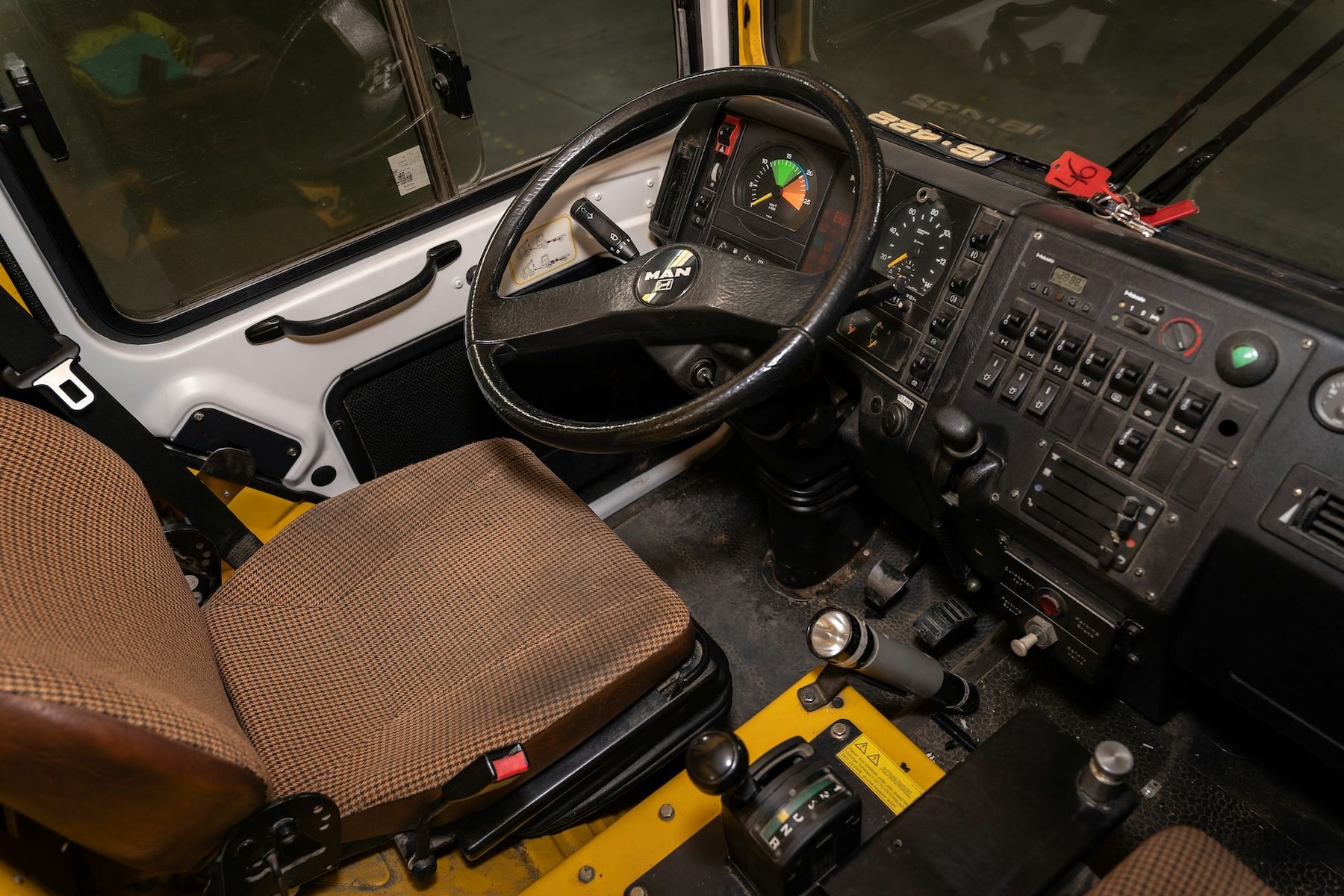
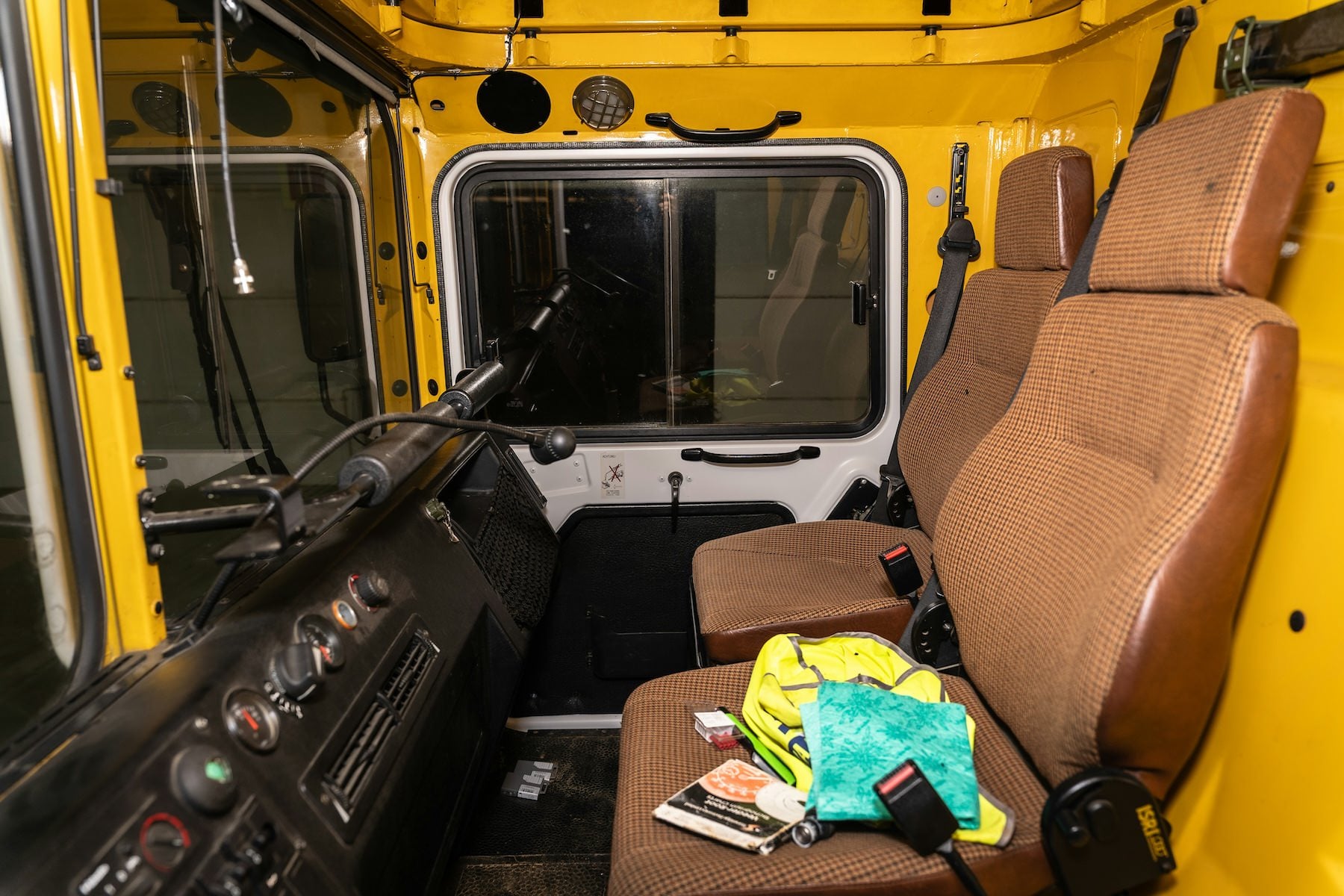
The cabin has a yellow interior with a black dashboard and seats upholstered in brown vinyl and houndstooth cloth. The odometer currently displays 28,008 kilometers (17,403 miles), although the seller does not warrant this reading as accurate.
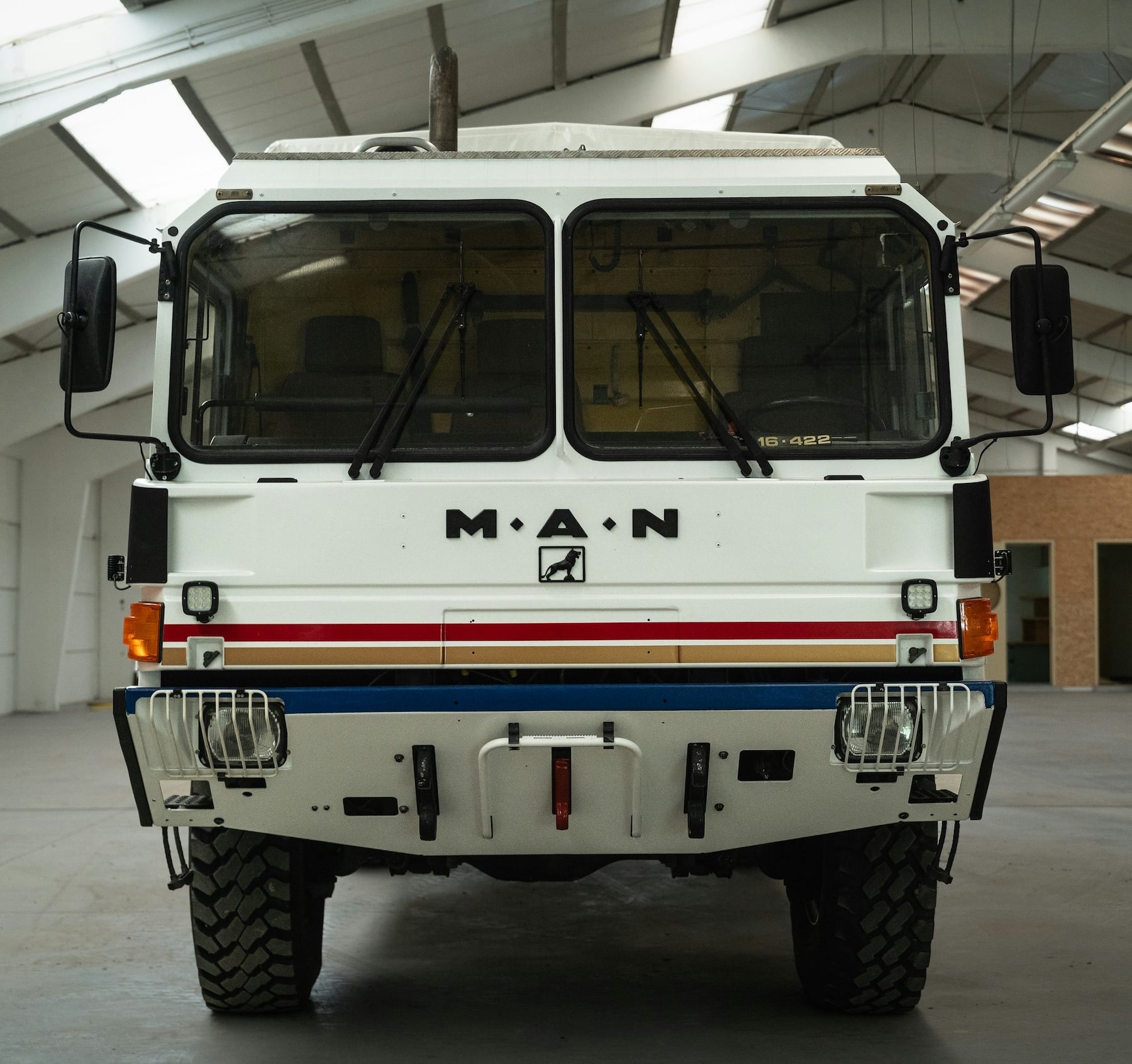
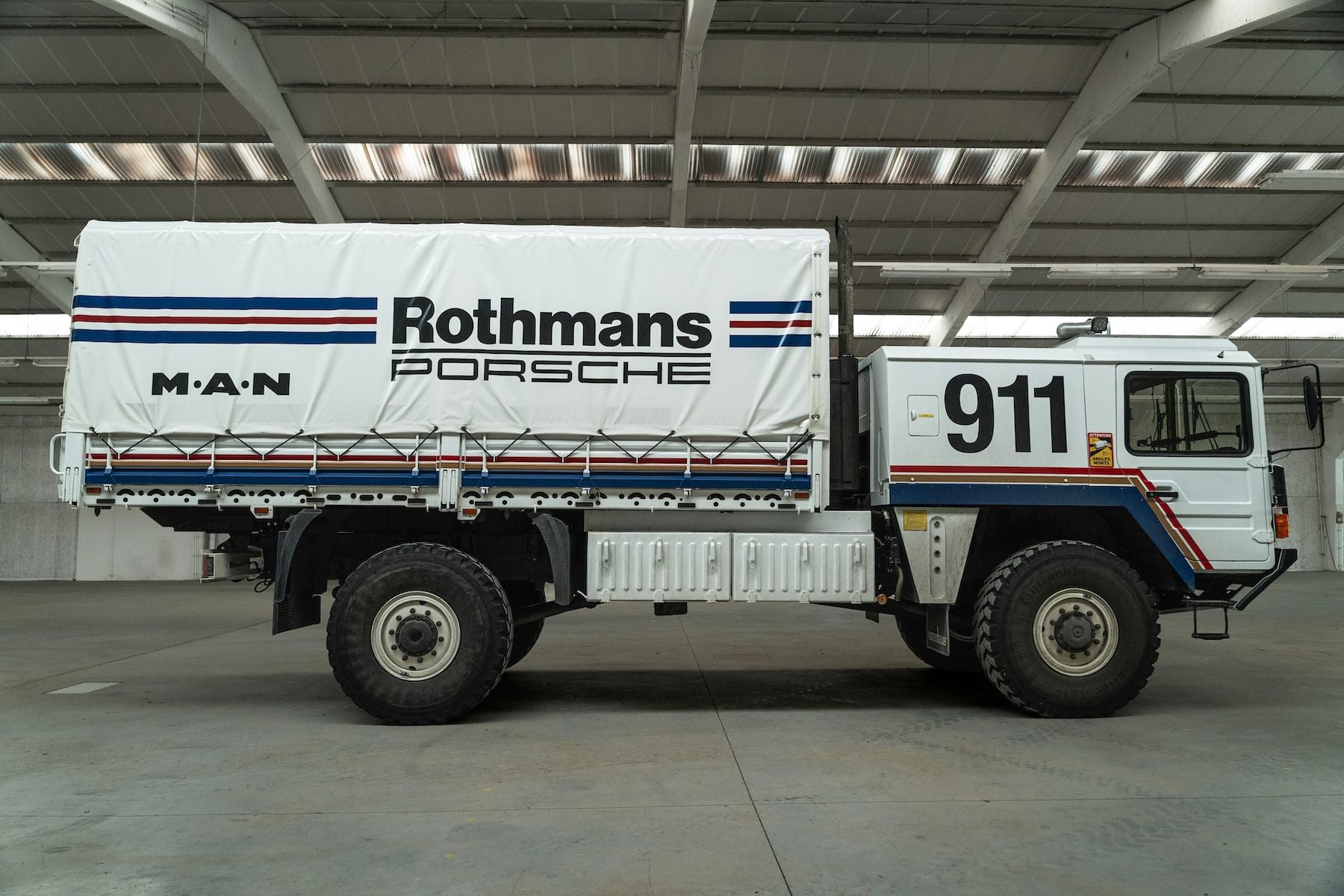
This MAN KAT 1.A1 is a heavily-modified 4×4 truck that originally served as an airport fire truck before being converted into a rally support vehicle with a Rothmans-Porsche rally livery. First registered in August of 1997, it’s finished in white with the familiar blue, red, and gold Rothmans colors, as an homage to the Porsche rally and motorsport support vehicles of the 1980s.
The truck is currently located in Belgium and is offered with two keys. With its former airport service history and subsequent Rothmans-Porsche conversion, this MAN KAT 1.A1 could serve as a motorsport support vehicle, an expedition truck, or a memorable addition to any Porsche-themed car collection.
It’s now being offered for sale out of Maldegem, Belgium on Collecting Cars and you can visit the listing here if you’d like to read more about it or register to bid.
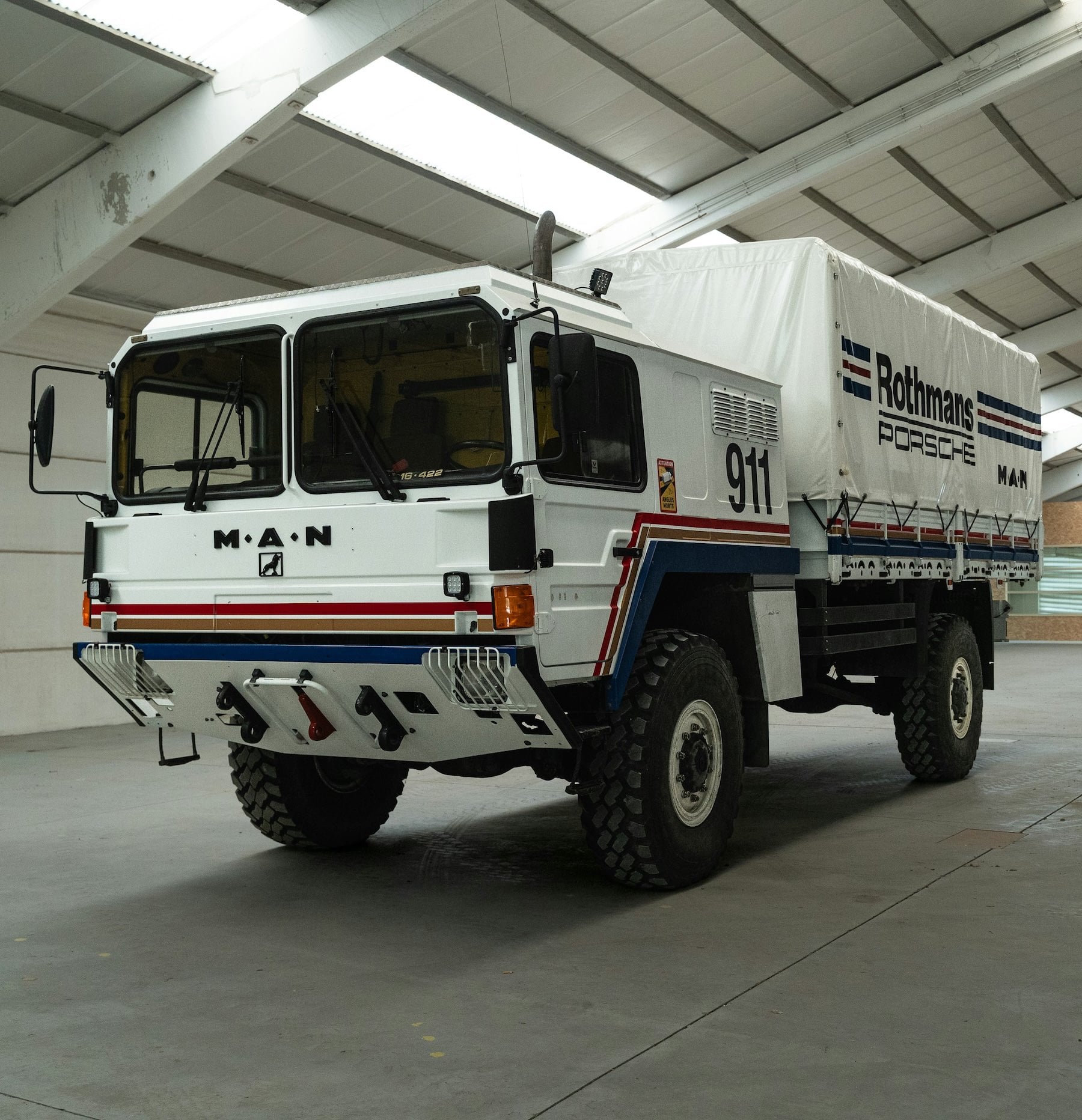
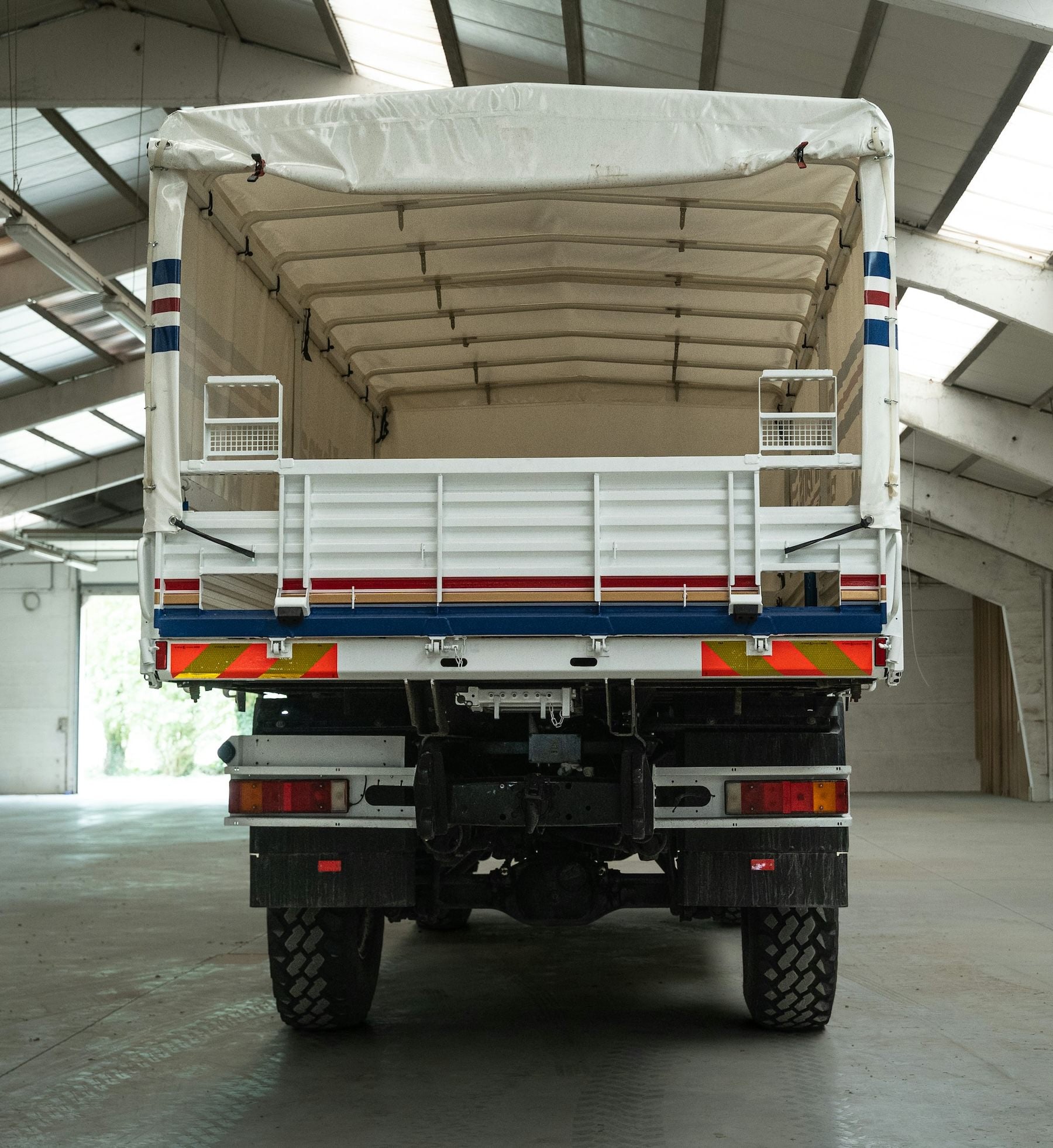
Images courtesy of Collecting Cars

Articles that Ben Branch has written have been covered on CNN, Popular Mechanics, Smithsonian Magazine, Road & Track Magazine, the official Pinterest blog, the official eBay Motors blog, BuzzFeed, Autoweek Magazine, Wired Magazine, Autoblog, Gear Patrol, Jalopnik, The Verge, and many more.
Silodrome was founded by Ben back in 2010, in the years since the site has grown to become a world leader in the alternative and vintage motoring sector, with well over a million monthly readers from around the world and many hundreds of thousands of followers on social media.