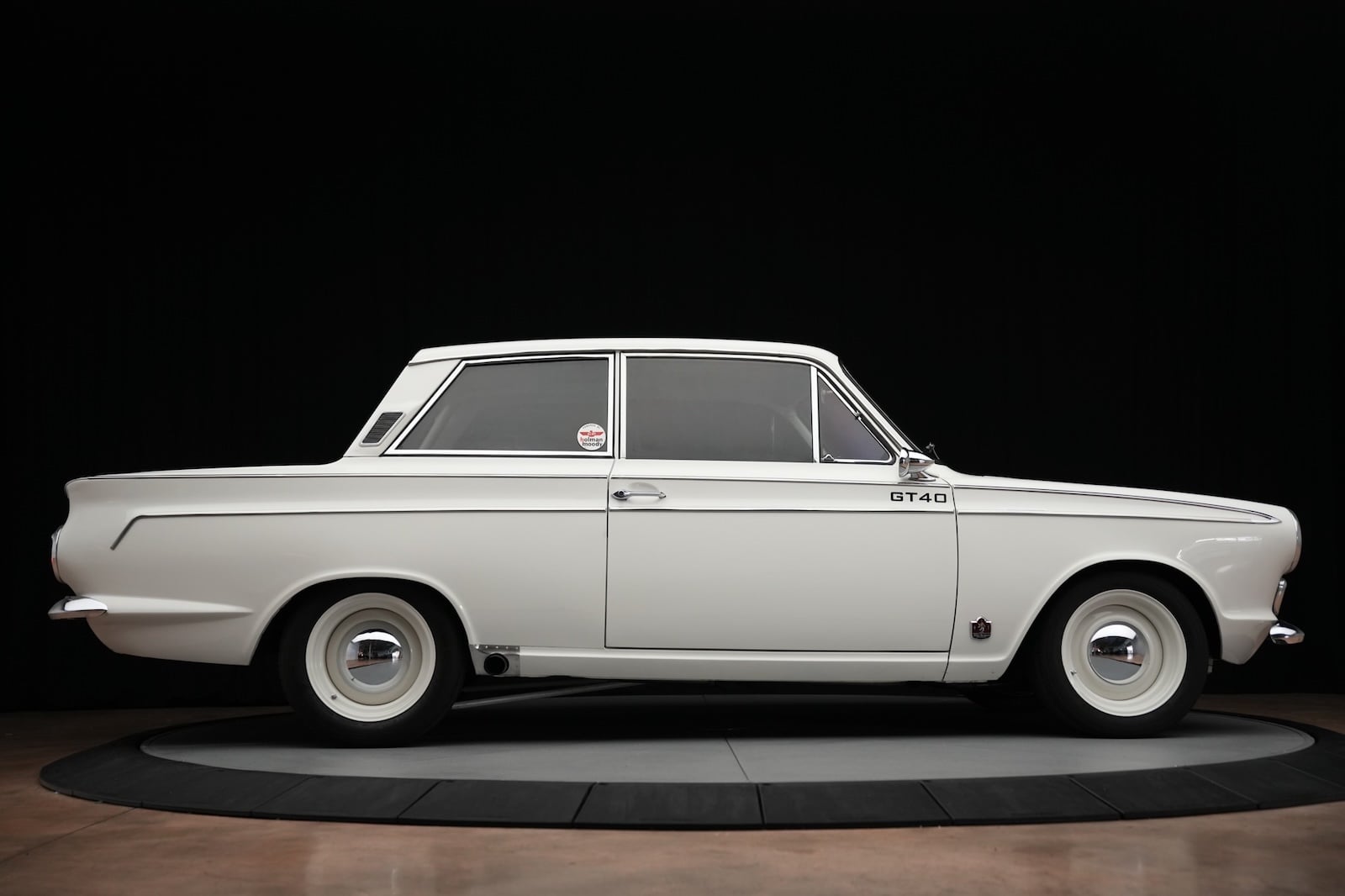
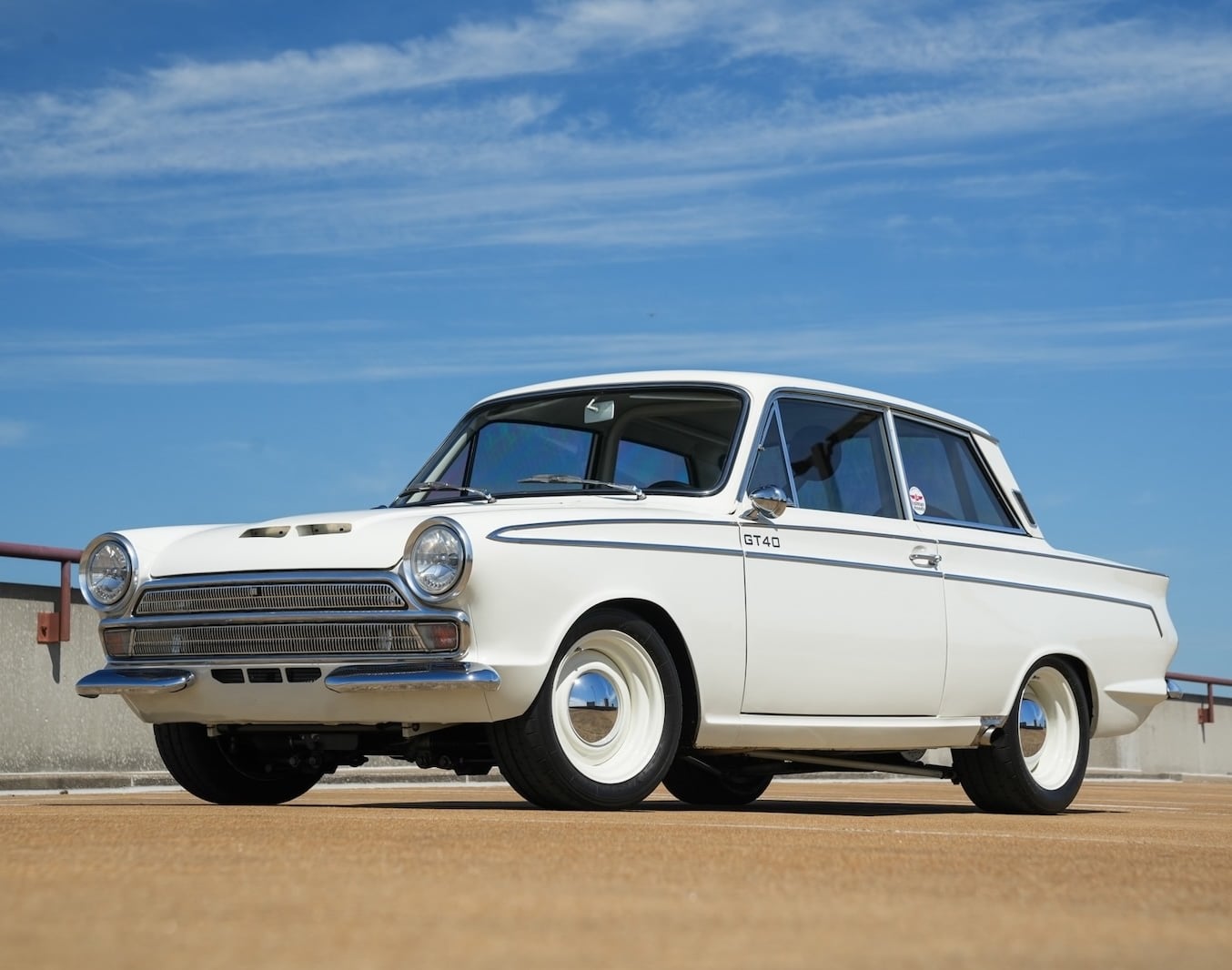
This is a 1965 Ford Cortina GT, but under the skin it’s been significantly modified, it’s now powered by a 347 V8 mated to a 6-speed manual box, sending power back to the rear wheels.
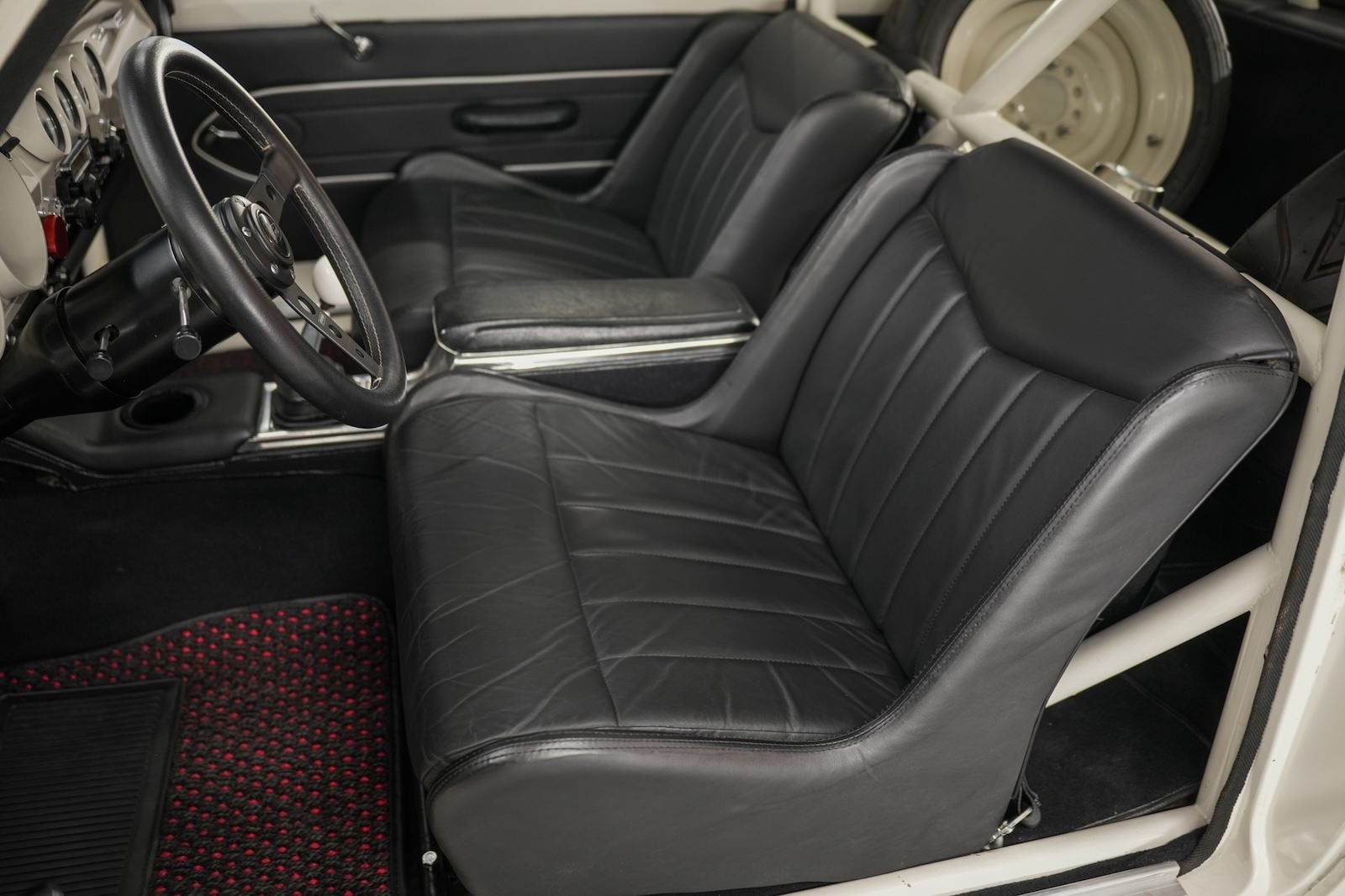
This car rides on independent front and rear suspension, it has four wheel disc brakes, upgraded wheels and tires, a custom interior with a roll cage and black bucket seats, and that 347 V8 is likely producing at least 400 bhp and 400+ lb ft of torque – just slightly more than the 78 bhp managed by the original four-cylinder unit.

 The very first Ford Cortina went on sale in Britain on the 20th of September 1962, a few weeks ahead of that October’s London Motor Show. The car was deliberately conventional, deliberately cheap, and deliberately roomy inside, and it arrived at £639 0s 3d including purchase tax for the base two-door saloon. An absolute bargain by the standards of the time. Image courtesy of Ford UK.
Fast Facts: A 1965 Ford Cortina GT Sleeper
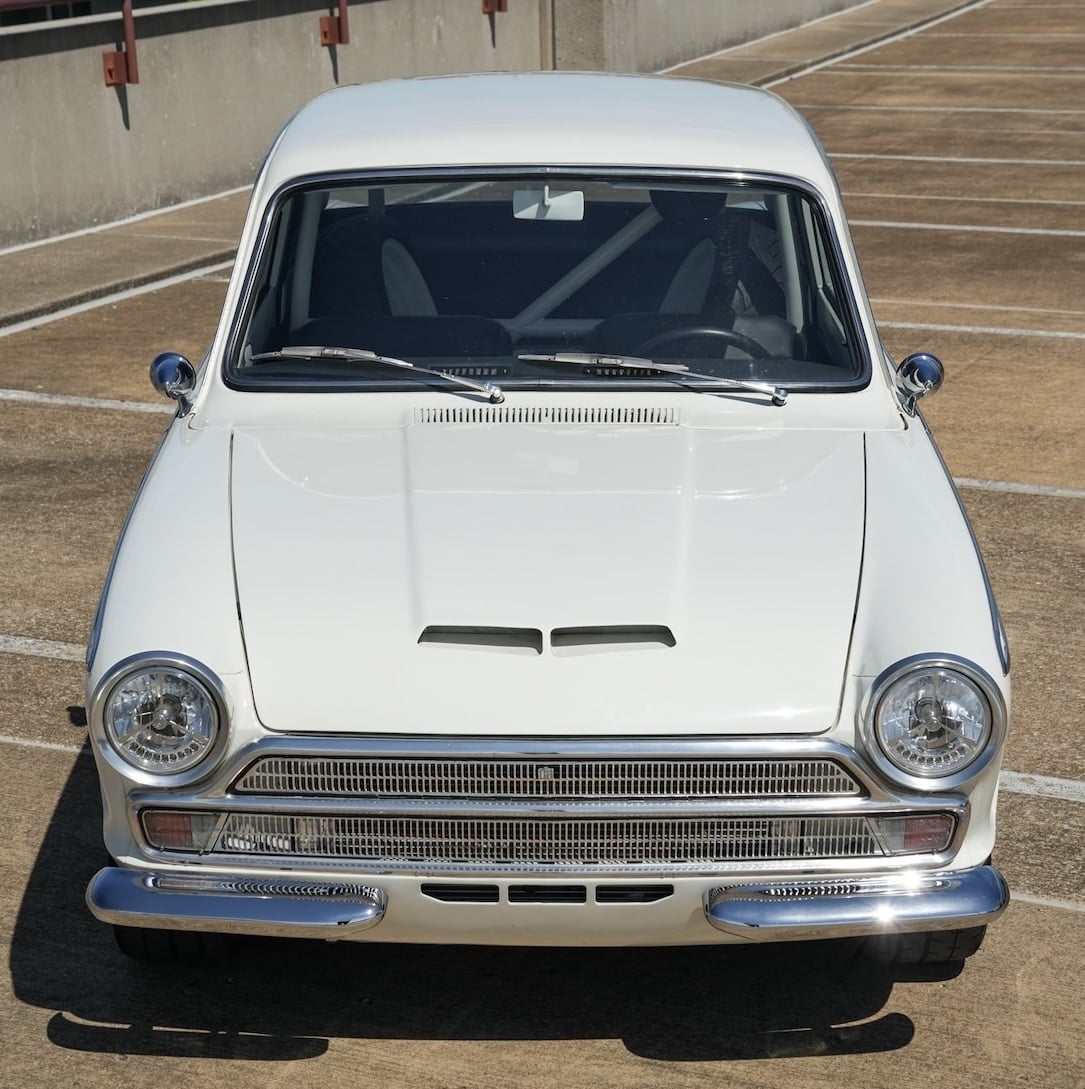
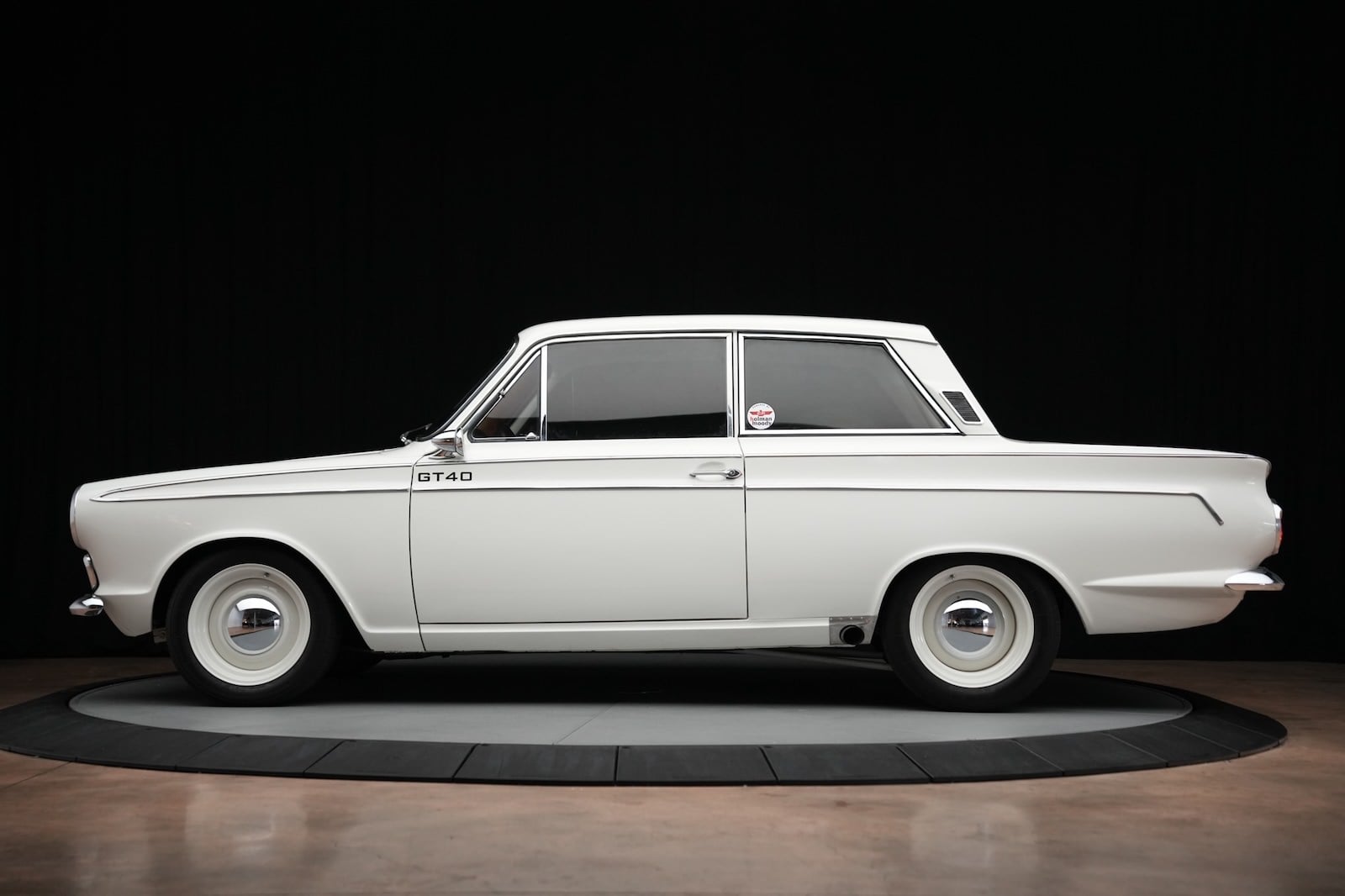
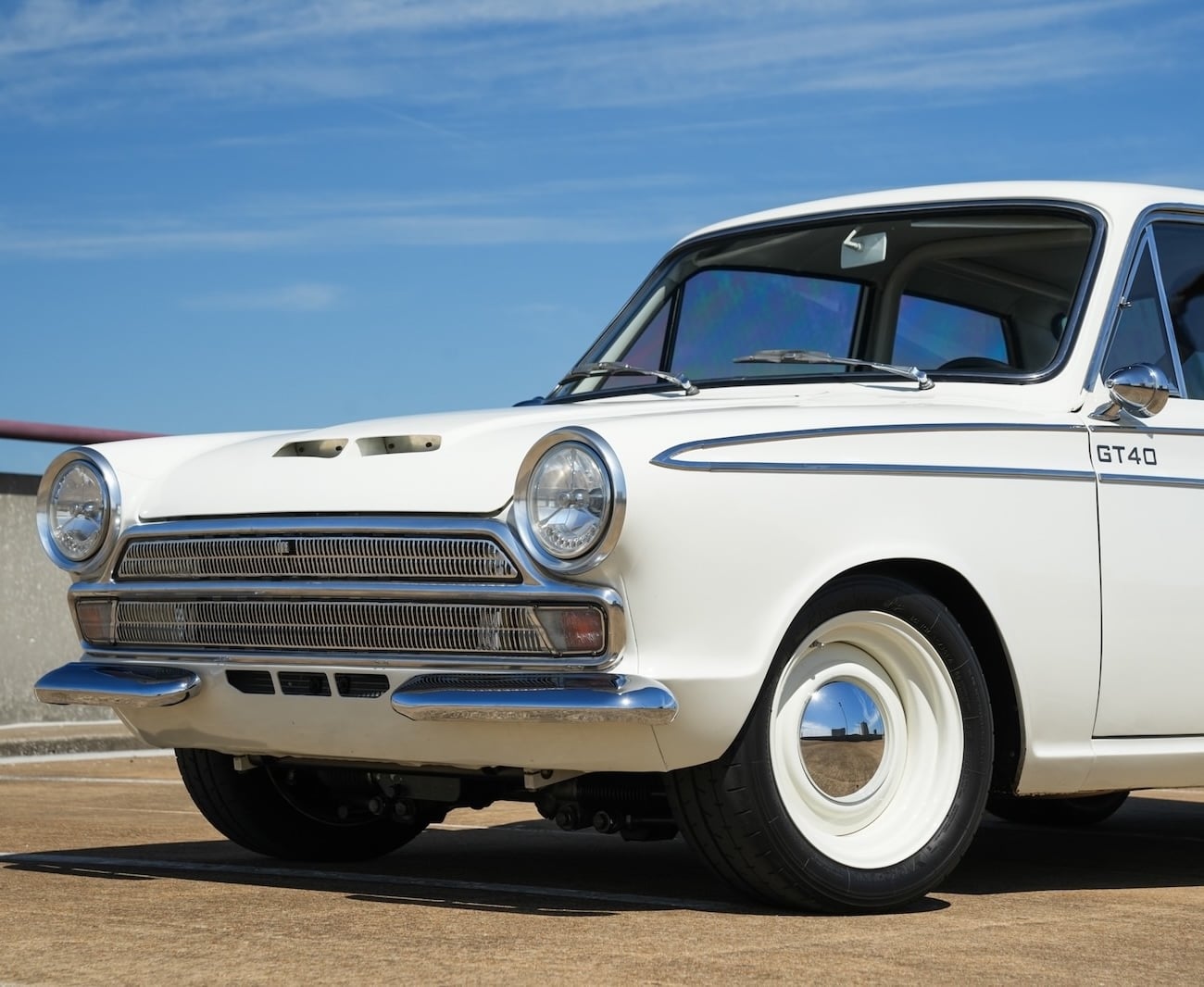
- This 1965 Ford Cortina GT is a left-hand-drive car rebuilt in 2013 over a year-long build by Johnny Riddling of Atlanta, Georgia. Finished in plain white on color-keyed 15″ steel wheels with baby-moon hubcaps, it is a sleeper hiding a fuel-injected 347 V8 making around 400 bhp and over 400 lb ft of torque.
- The 347 breathes through Air Flow Research Renegade aluminum heads and an eight-stack injection system, backed by Holman-Moody valve covers, a low-profile oil sump, an MSD Pro-Billet distributor, an Aeromotive fuel pressure regulator, and an electric water pump. Stainless four-into-one headers feed MagnaFlow mufflers exiting through the rocker panels.
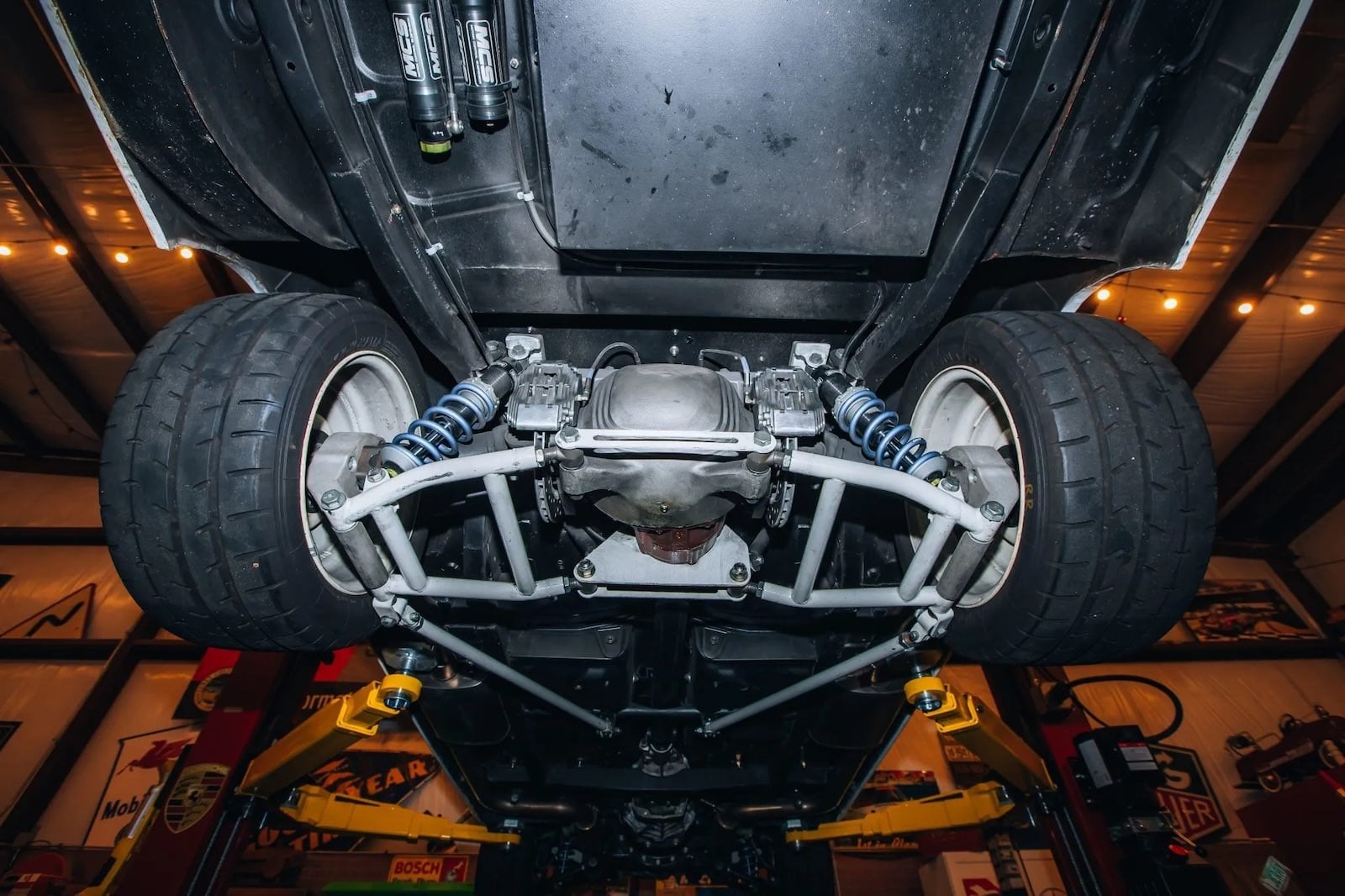
- Power reaches the rear wheels through a Tremec 6-speed manual. The chassis gained a Mustang II-style independent front assembly on tubular control arms, electric-assisted rack-and-pinion steering, and a Heidts independent rear subframe with inboard-mounted brakes. MCS adjustable coilovers sit at all four corners, with Wilwood discs at each.
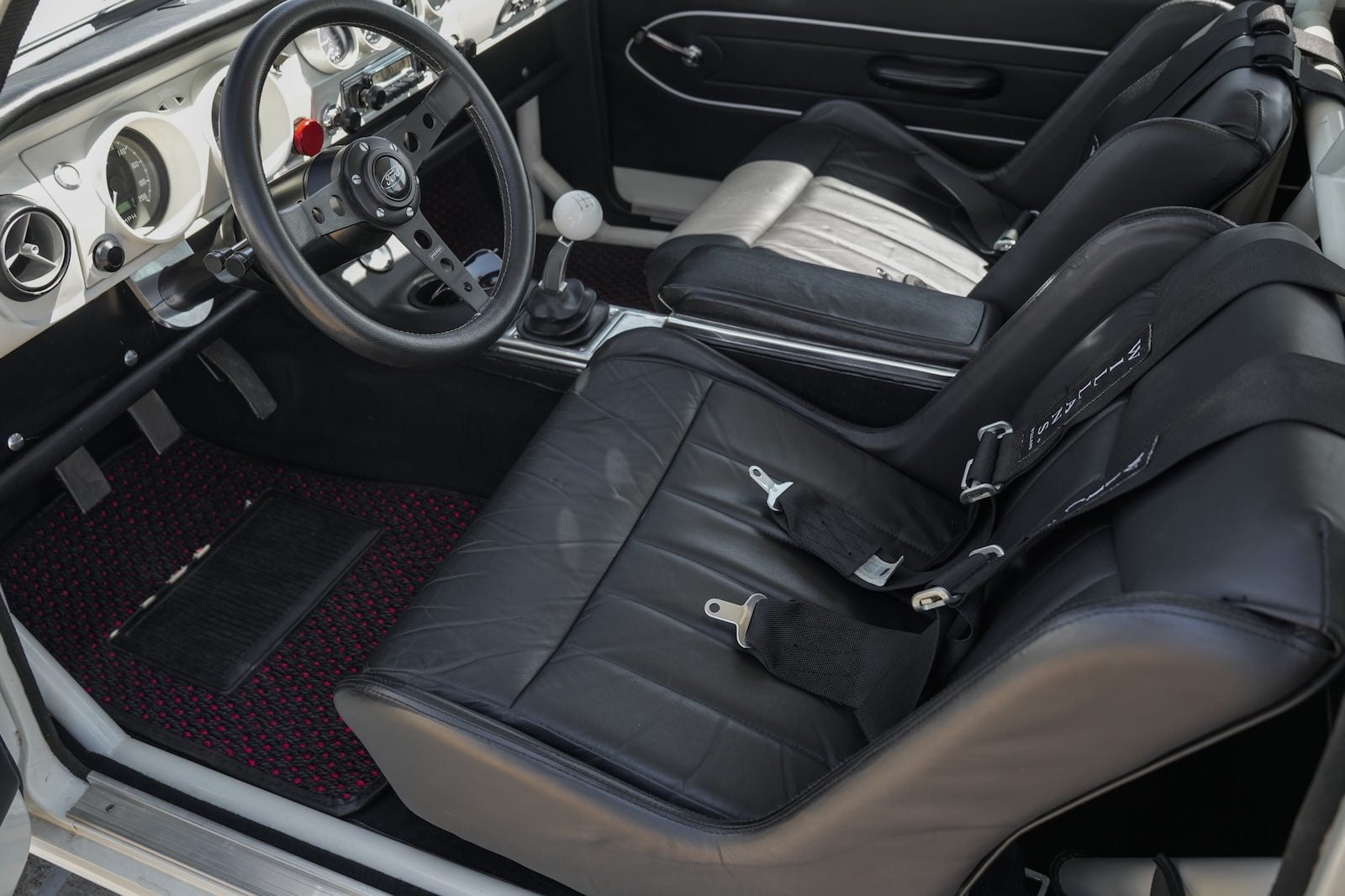
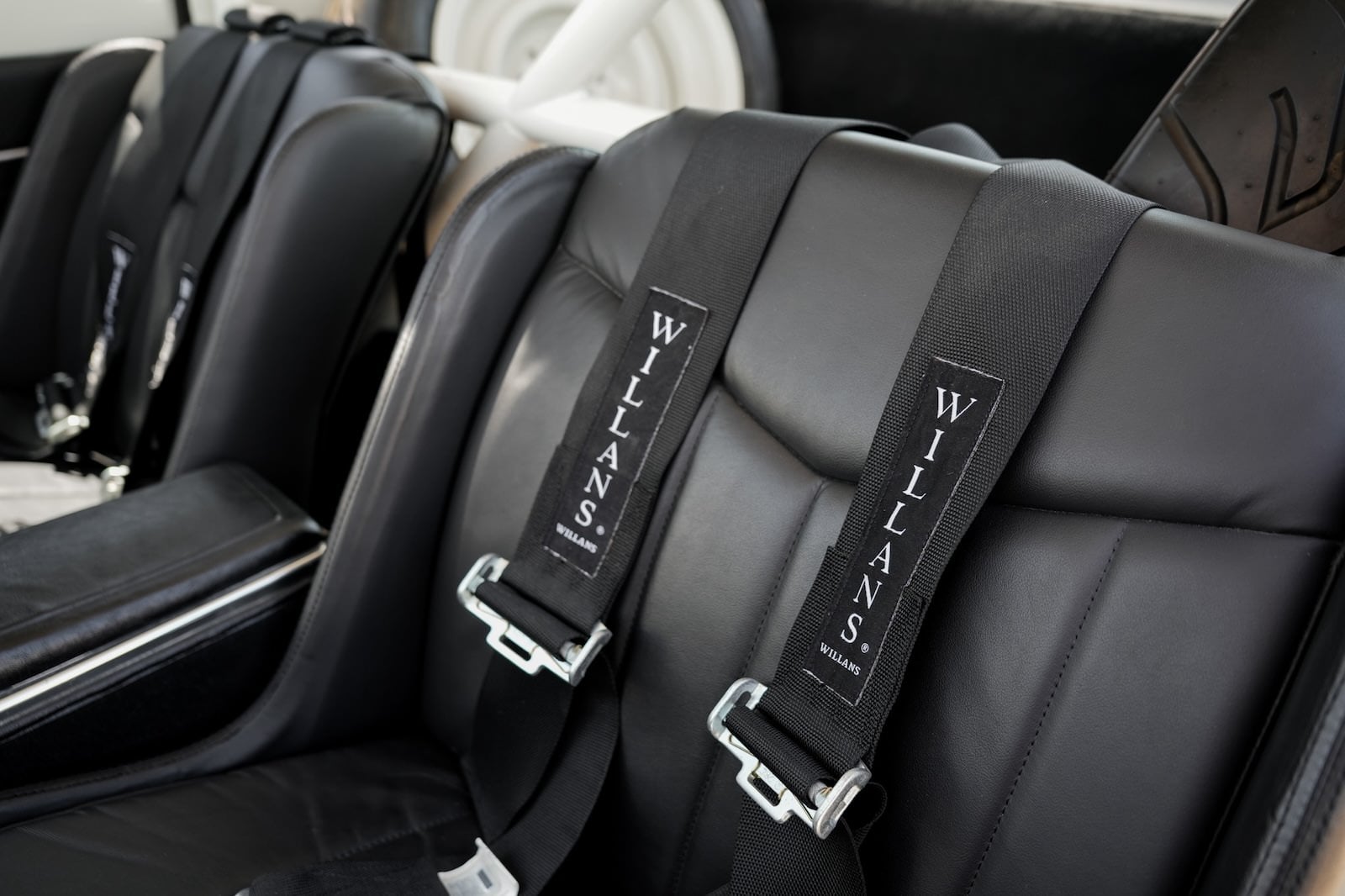
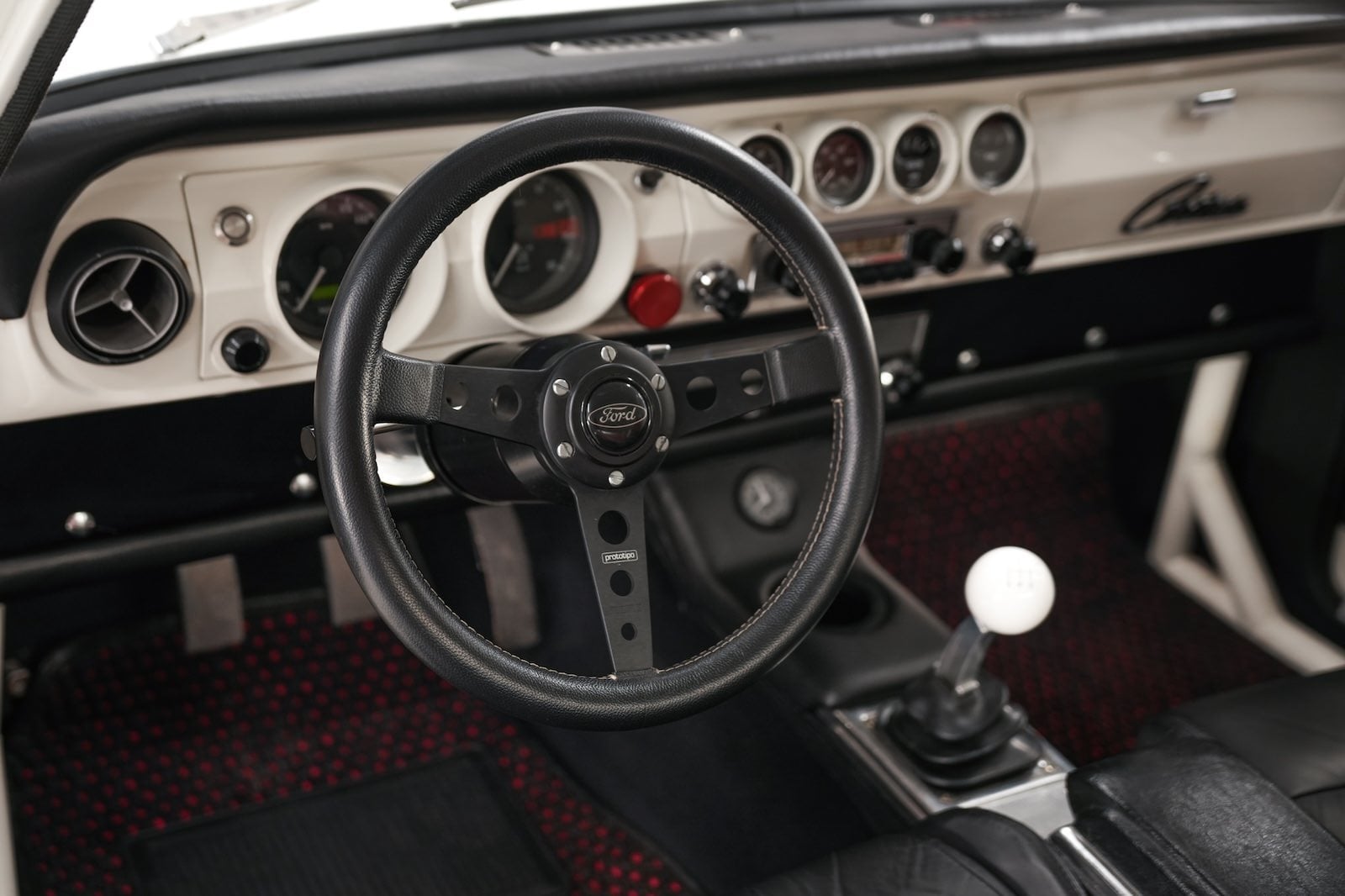
- The body was stripped to bare metal, the transmission tunnel modified and the rear wheel wells tubbed before a repaint in white. Inside is a six-point roll cage, black bucket seats, Willans harnesses, a MOMO Prototipo wheel and Smiths gauges. The Florida title records 21,419 actual miles.
History Speedrun: The First-Generation Ford Cortina
The very first Ford Cortina went on sale in Britain on the 20th of September 1962, a few weeks ahead of that October’s London Motor Show. The car was deliberately conventional, deliberately cheap, and deliberately roomy inside, and it arrived at £639 0s 3d including purchase tax for the base two-door saloon. An absolute bargain by the standards of the time.

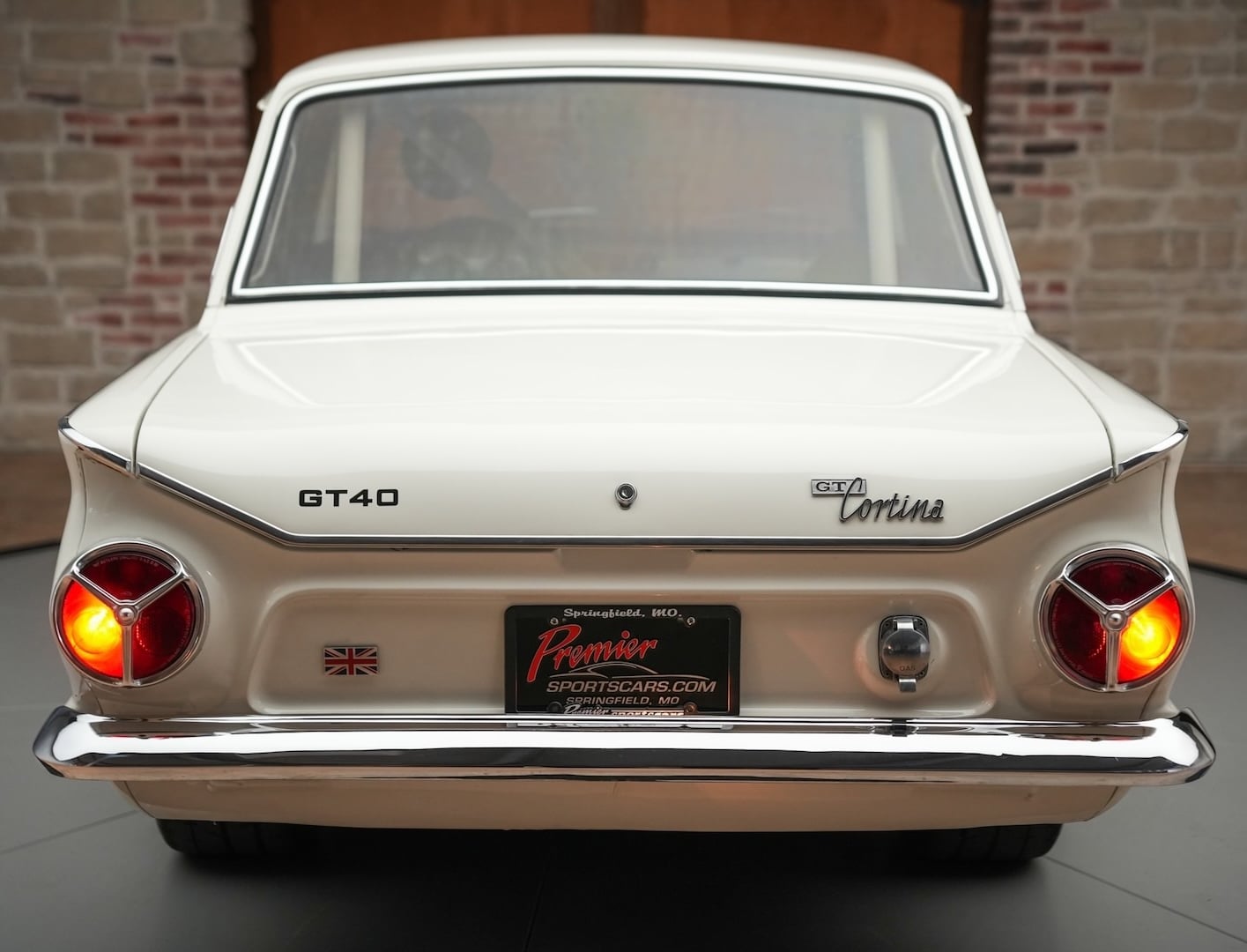
Brown’s Cortina was flat-sided and upright, with tapering flutes along the flanks and round rear lamp clusters that British buyers nicknamed the “Ban the Bomb” lights for their resemblance to the Campaign for Nuclear Disarmament (CND) symbol – better known today as the peace sign. Image courtesy of Ford UK.
Ford of Britain had aimed the Cortina squarely at buyers of the Morris Oxford Farina and the Vauxhall Victor. Within four years they had built more than a million and outsold almost anything that could even be remotely considered competition.
Project Archbishop
The Cortina was developed because Ford of Britain’s chairman, Sir Patrick Hennessy, refused to accept a car designed elsewhere. Dearborn and Ford of Germany had been developing a front-wheel-drive compact under the codename Cardinal, and Ford of Britain had not been consulted on it. Hackles were raised as a result.
Hennessy handed the job of building a cheaper, better rival to product planning chief Terence Beckett and Fred Hart, Executive Engineer for light cars. In a jab at the German program, the project was named Archbishop. Cardinals do not exist in the Anglican church, but Archbishops do, and they sit near the very top of the hierarchy.
Beckett later said the car took 21 months from full-size clay model to Job One, which he claimed was an industry record, and it does appear that he was right. The brief called for a curb weight under 1,700 lbs, and the production car landed close to it. Perhaps even more amazingly, it also came in under budget.
The styling of the Cortina was led by Roy Brown Jr., the American designer responsible for the Edsel, who had been posted to Dagenham after that car’s commercial collapse. It may have been a form of corporate punishment, but Brown took it in his stride – the Cortina was to become one of Ford’s best-sellers, and he would return to the United States in later years and become the Executive Designer of Ford’s prestigious Lincoln Mercury division.
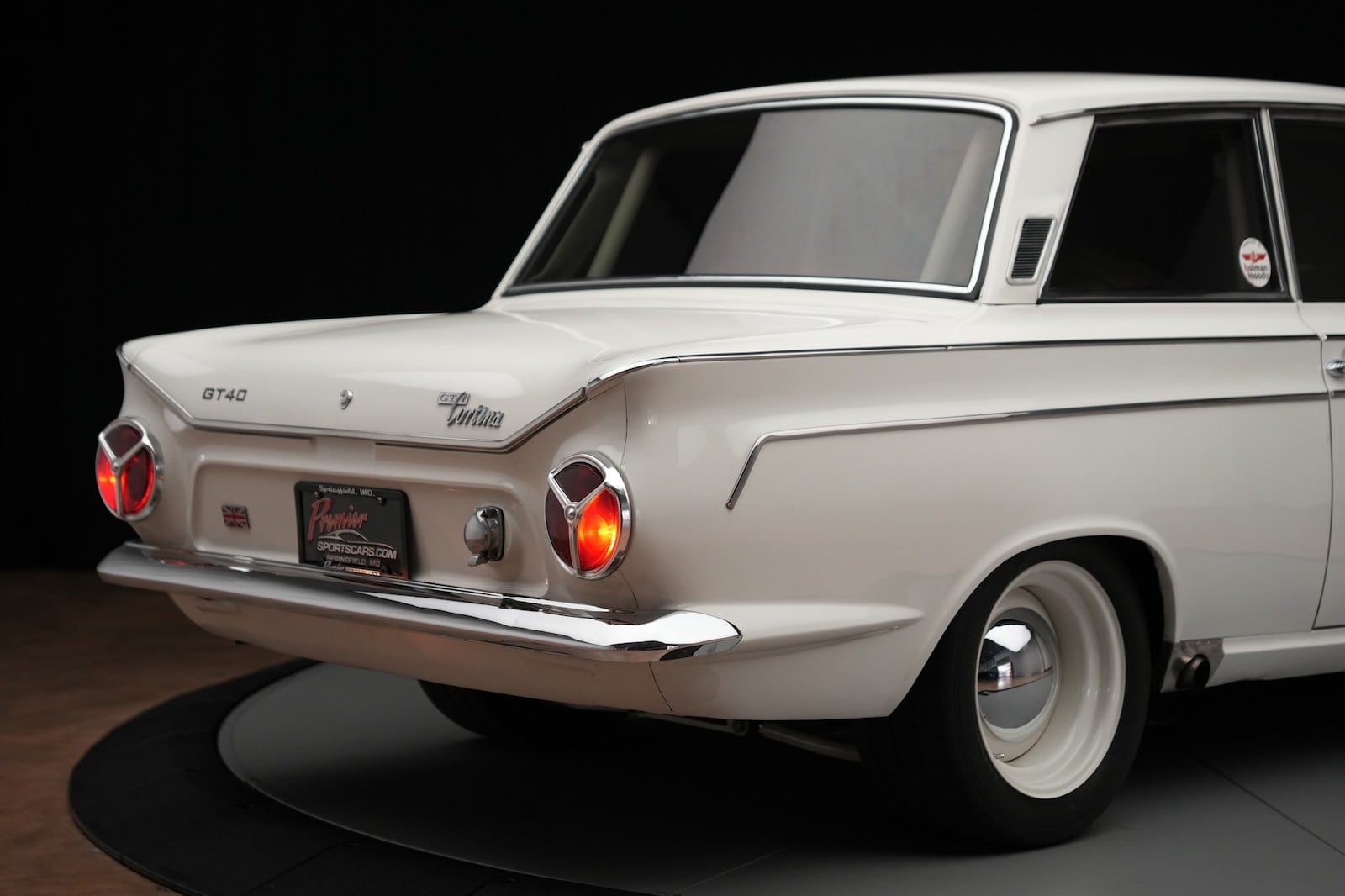
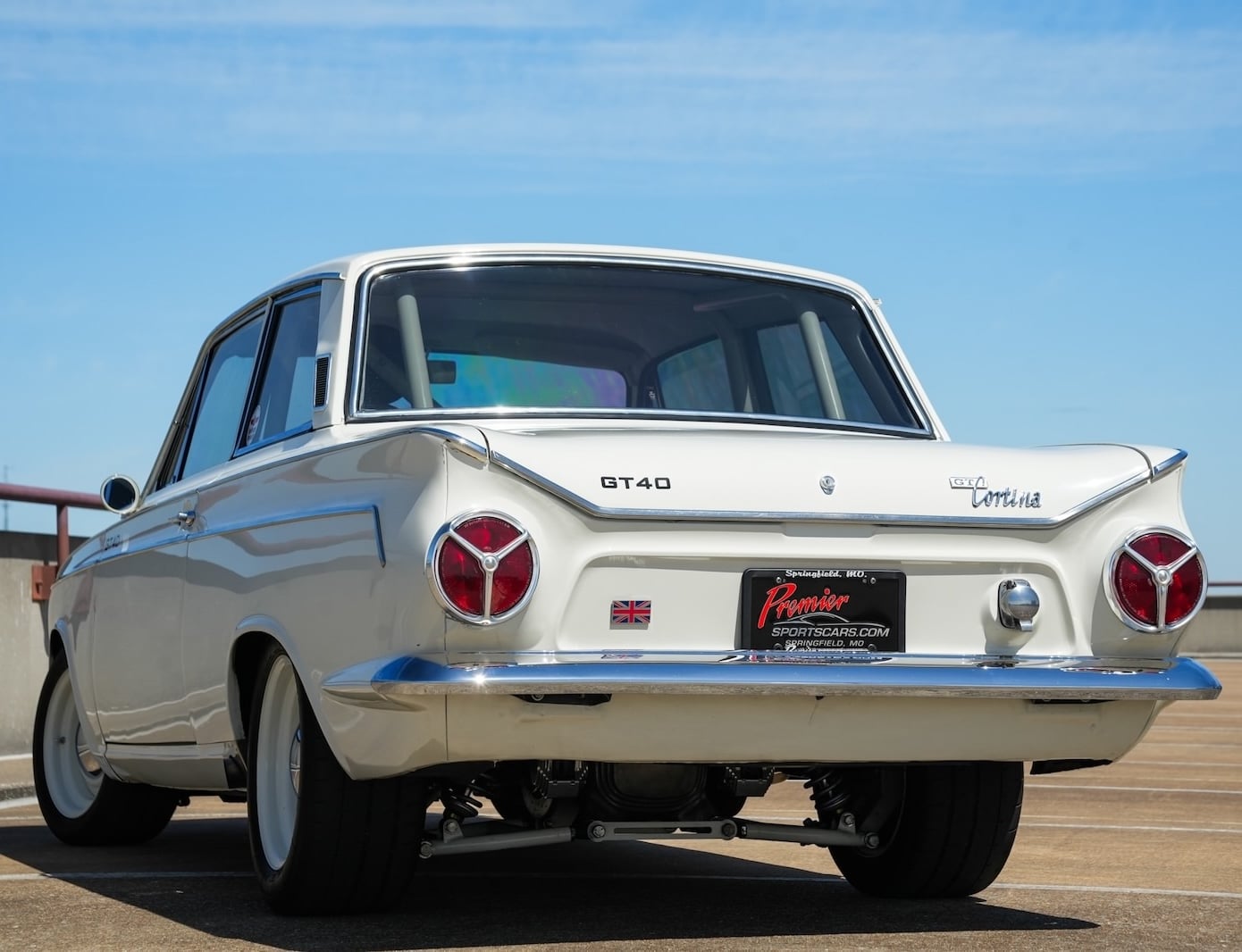
Brown’s Cortina was flat-sided and upright, with tapering flutes along the flanks and round rear lamp clusters that British buyers nicknamed the “Ban the Bomb” lights for their resemblance to the Campaign for Nuclear Disarmament (CND) symbol – better known today as the peace sign.

The styling of the Cortina was led by Roy Brown Jr., the American designer responsible for the Edsel, who had been posted to Dagenham after that car’s commercial collapse. Image courtesy of Ford UK.
Underneath, the Cortina’s spec sheet was carefully conservative – with MacPherson struts up front, a live axle on leaf springs in the back, rear-wheel drive, and a 4-speed all-synchro gearbox. The car was originally going to be called the Consul 225. The name changed late, to Cortina, after the Italian resort of Cortina d’Ampezzo, which had hosted the 1956 Winter Olympics, the name exuded luxury and exclusivity – and Ford wanted some of that panache for their new economy car.
From 1,198cc To The GT
When the Cortina launched, there was one engine on offer – a 1,198cc three-bearing pre-crossflow Kent four-pot, enlarged from the Anglia’s 997cc unit, making 48.5 bhp. A four-door saloon version of the car followed in October of 1962 and a five-door estate in March of the next year.
In early 1963 the Cortina Super landed at dealers, with its five-bearing 1,498cc engine, making 60 bhp. The GT followed in April of 1963, and that was the one that really caught the attention of the sporting-minded members of the general public.
The GT’s version of the 1,498cc engine used a hotter camshaft, a larger-port cylinder head, a tubular exhaust manifold and a twin-choke Weber 28/36 DCD carburetor built under license by Ford – it was good for 78 bhp at 5,200 rpm. The Cortina GT also got lowered suspension, front disc brakes and a tachometer. Autocar magazine’s 1963 test resulted in a 13.9 second dash to 60 mph and 94 mph flat out in fourth. These were solid numbers for a vehicle in this class at the time.
Later in 1964 the facelift usually called the Mk1b arrived, it came with a full-width grille with rectangular indicator and side-light units, front discs standard across the range, and Aeroflow through-flow ventilation with extractor vents in the rear pillars.
The Cortina’s Seven Figure Sales Numbers
Ford had planned on selling at least 100,000 Cortinas a year. These projections proved far too conservative. The company sold more than 260,000 in 1963, its first full year. Total Mk1 production was over a million units, 1,013,391 to be exact, made up of 894,085 saloons, 116,005 estates and 3,301 Lotus Cortinas. Cortinas were built in the Dagenham factory and some were built up from kit assembly plants overseas.

Underneath, the Cortina’s spec sheet was carefully conservative – with MacPherson struts up front, a live axle on leaf springs in the back, rear-wheel drive, and a 4-speed all-synchro gearbox. Image courtesy of Ford UK.
The Lotus Cortina
Walter Hayes, Ford of Britain’s public relations chief, was building a motorsport program and needed a homologation special. He asked Colin Chapman to fit Lotus’s new twin-cam engine to 1,000 two-door Cortinas so the car could be homologated for Group 2. Chapman agreed, and Lotus gave the car type number 28.
The engine was a 1,558cc twin-cam designed by Harry Mundy on the Kent block, with tuning input from Keith Duckworth at Cosworth, rated at 105 bhp. Lotus added the Elan’s close-ratio gearbox, revised suspension, front discs and a coil-sprung rear axle located by an A-bracket. Alloy doors, hood and trunk lid also brought weight down a little. Almost every car wore white paint with a green flank stripe, and final assembly took place at Lotus’s Cheshunt factory.
Racing + Rallying
The Lotus Cortina was homologated in 1963, and two cars ran that same month at the Oulton Park Gold Cup meeting, finishing 3rd and 4th overall behind two 7-liter Ford Galaxies, ahead of the Jaguar Mk2 3.8s that had ruled British saloon racing. It was an incredible result for a debut. Jack Sears took the class win, and went on to win the 1963 British Saloon Car Championship outright, scoring in a Cortina GT, a Galaxie and a Cortina Lotus.
In 1964 Jim Clark, fresh from his first Formula 1 Championship win, won the BSCC in a works Lotus Cortina, taking every round in Class B, three outright wins and 48 points to runner-up John Fitzpatrick’s 38. The sight of a Cortina cornering with an inside front wheel in the air became the defining image of the series.
In Europe, Alan Mann Racing ran the cars on Ford’s behalf, and Sir John Whitmore took the Division 2 title in the 1965 European Touring Car Challenge with KPU 392C, winning his class in eight of the nine rounds, six of those outright. In Australia, Ian Geoghegan won the 1964 Australian Touring Car Championship in a Cortina GT, the first ATCC title for a Ford driver.
Above Video: This vintage newsreel tells the story of the Lotus Cortina, and shows it being raced in period.
The first works rally win came in late-1965, when Roger Clark and Graham Robson took the Welsh International. Then came 1966 – Bengt Söderström and Gunnar Palm won the Acropolis Rally, and closed the year by winning the RAC Rally outright by more than 13 minutes.
The Cortina hadn’t been designed as a race car, but foreshadowing what would happen with the coming Ford Escort, it proved surprisingly successful both on the asphalt and on the dirt.
The Cortinas That Followed
The Mk2 Cortina arrived on the 18th of October 1966, designed by Roy Haynes on the same floorpan but wider and heavier, it became Britain’s best-selling car in 1967. The Mk3 of 1970 adopted coke-bottle styling on a platform shared with the German Taunus, and the Mk4 and Cortina 80 that followed were progressively more conservative rebodies of it. The last Cortina left Dagenham on the 22nd of July 1982, replaced by the Sierra. Ford built 4,279,079 of them in total.
The Ford Cortina GT Sleeper Shown Here
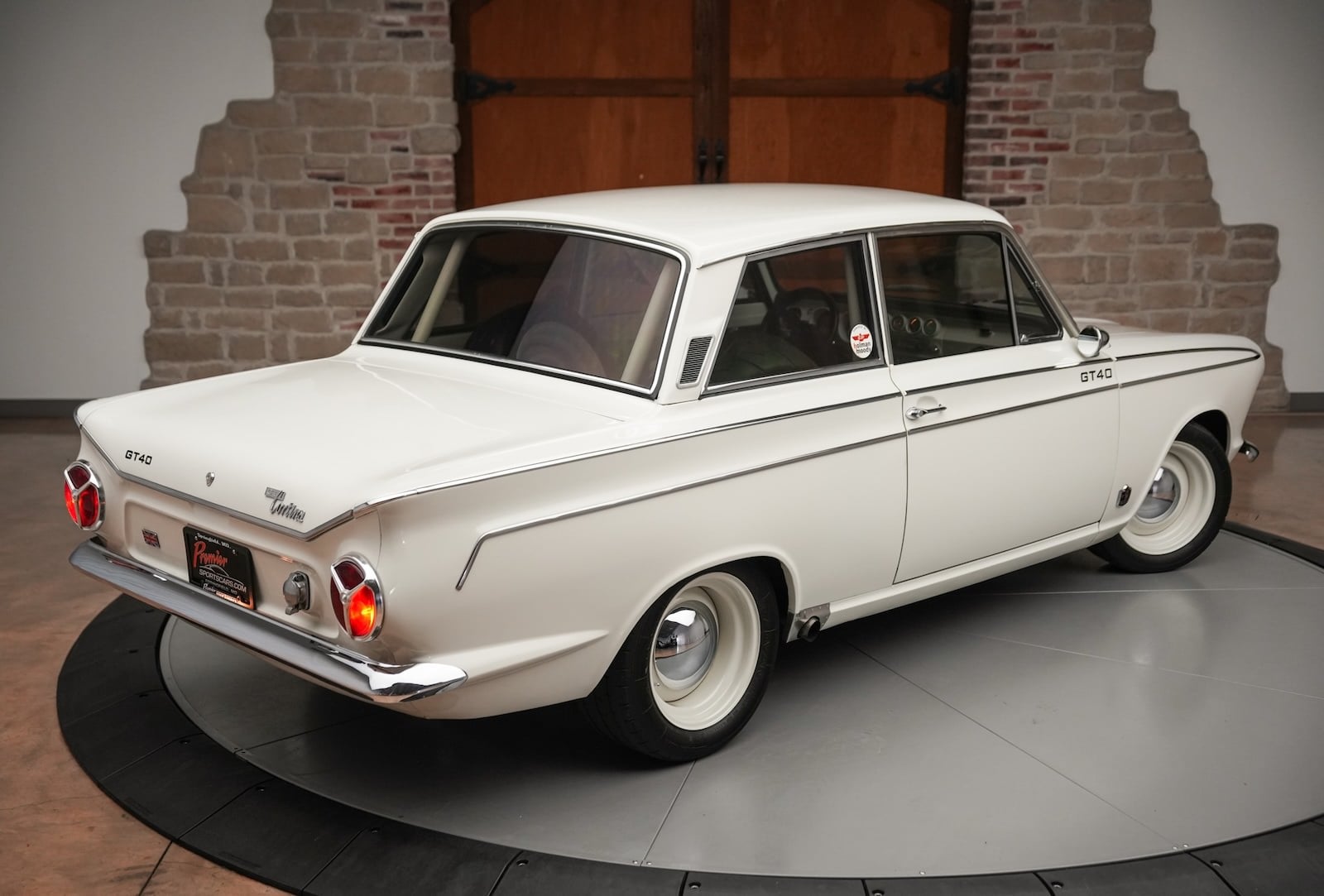
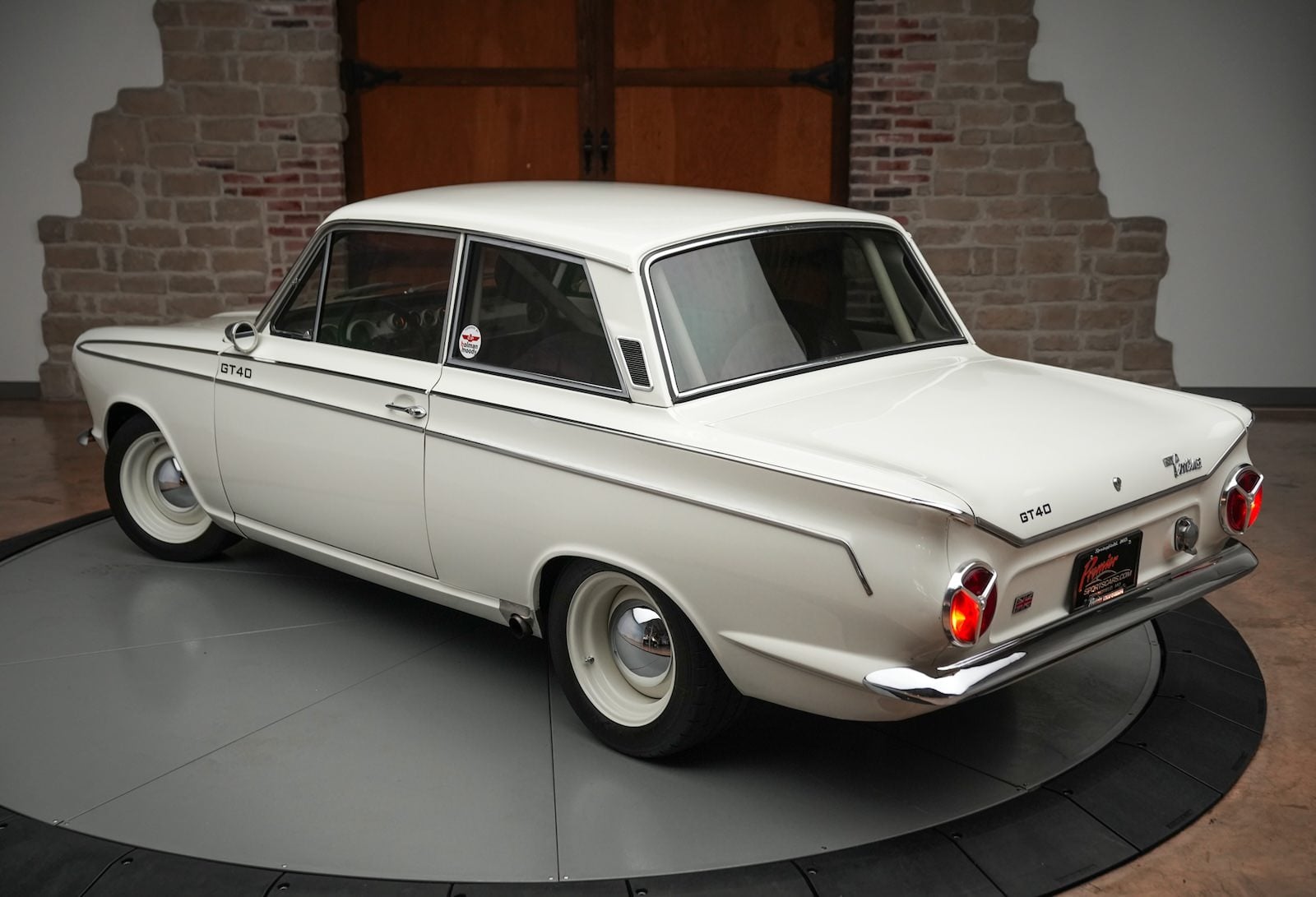
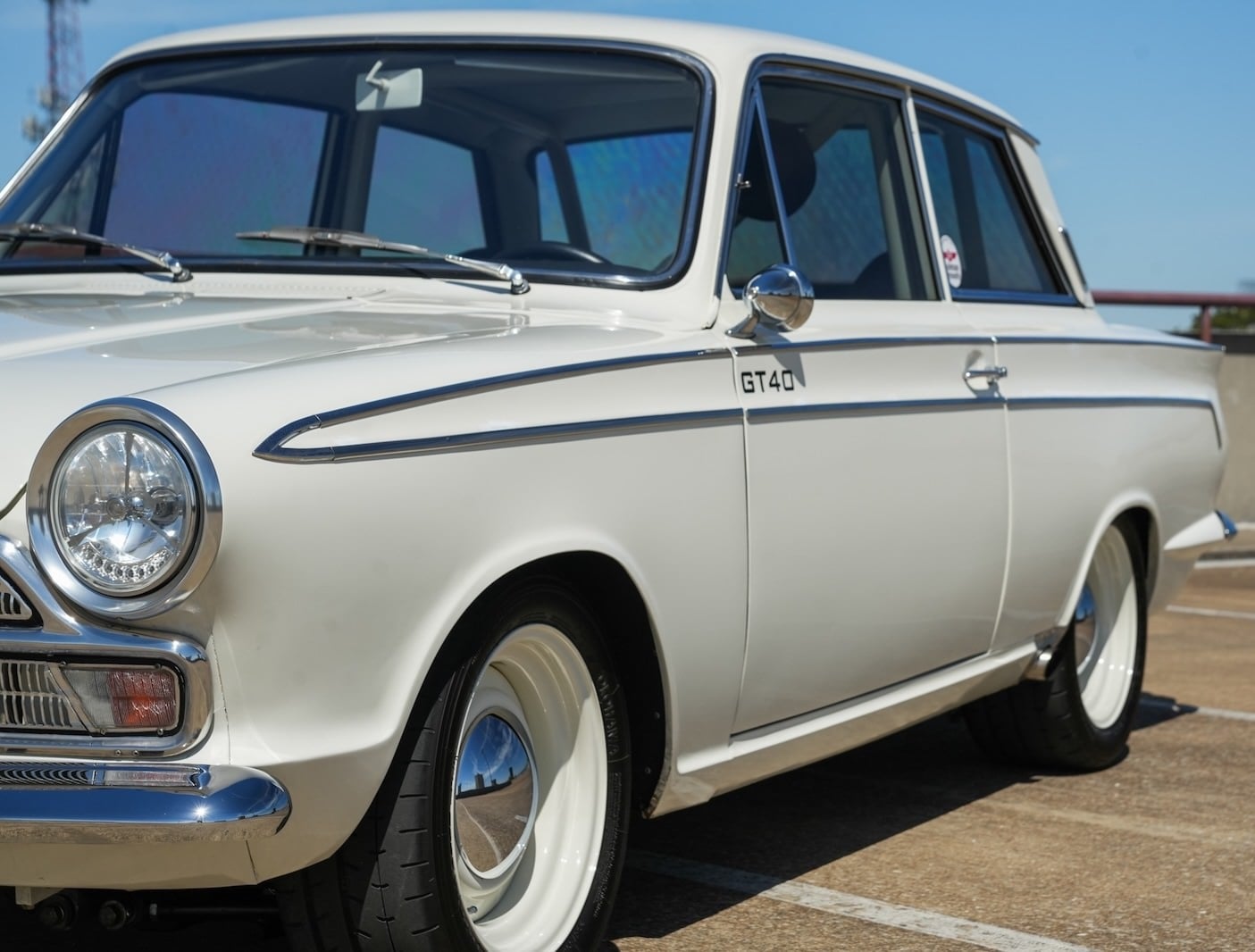
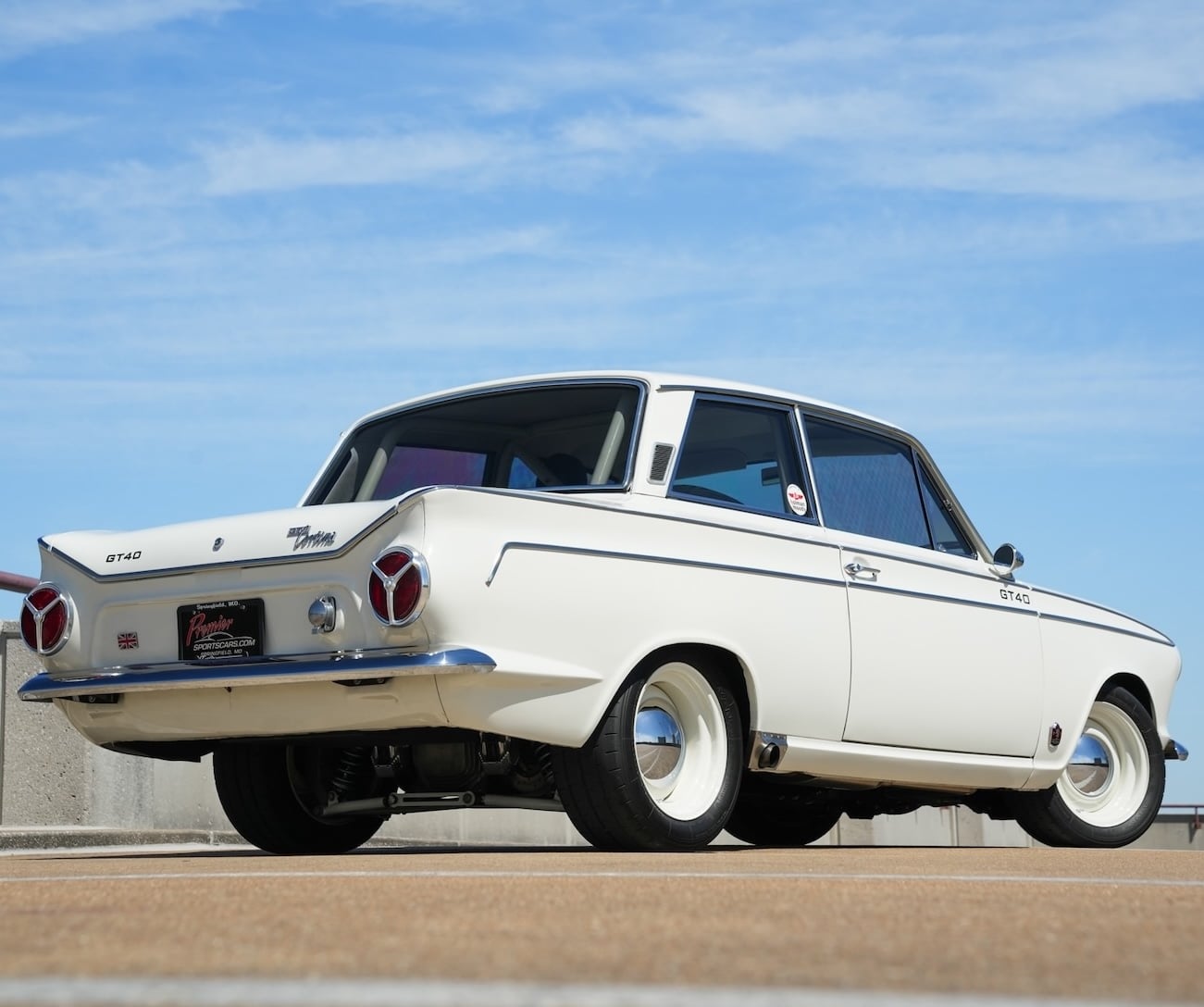
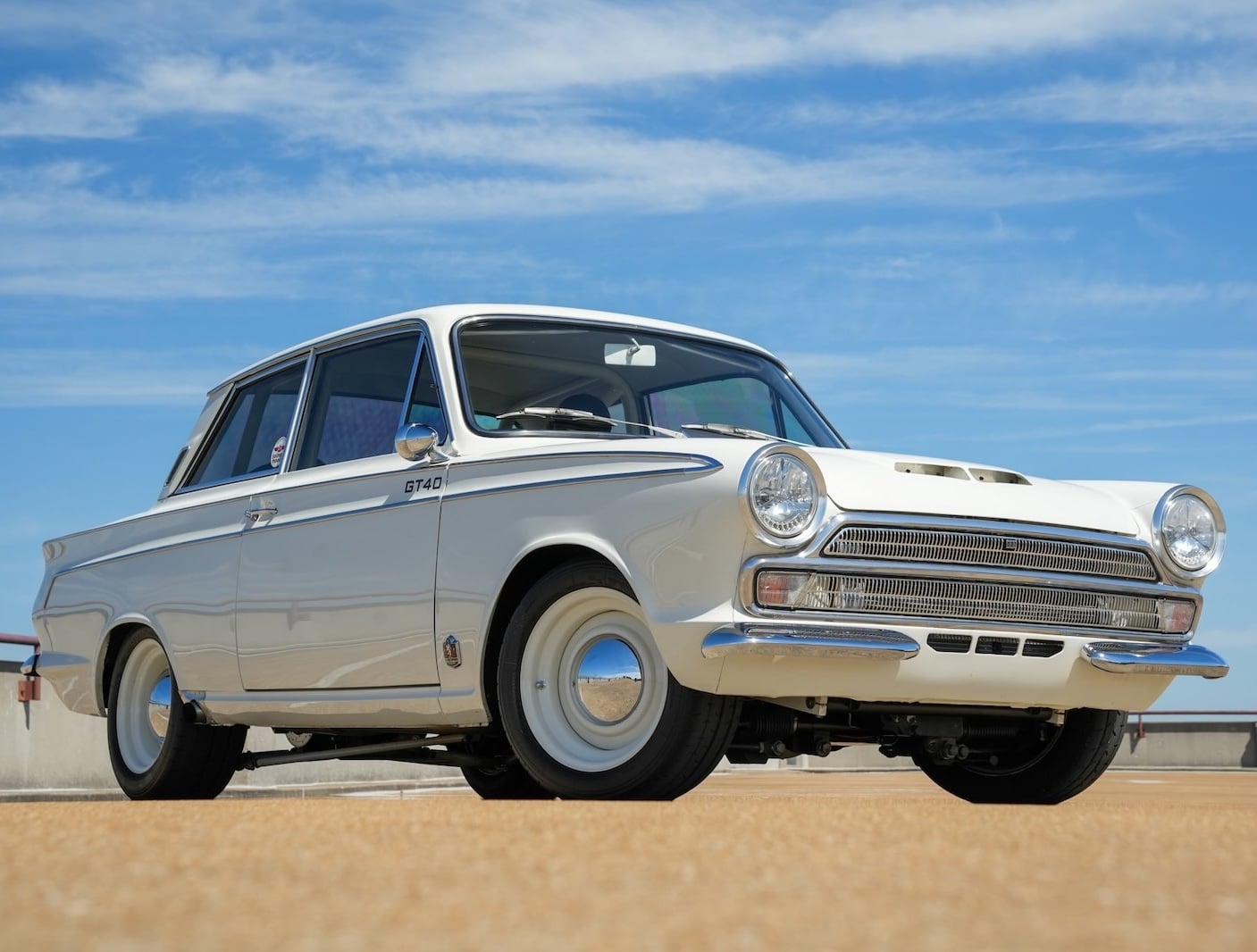
This is a 1965 Ford Cortina GT, a left-hand-drive version, that was rebuilt in 2013 during a year-long build by Johnny Riddling of Atlanta, Georgia.
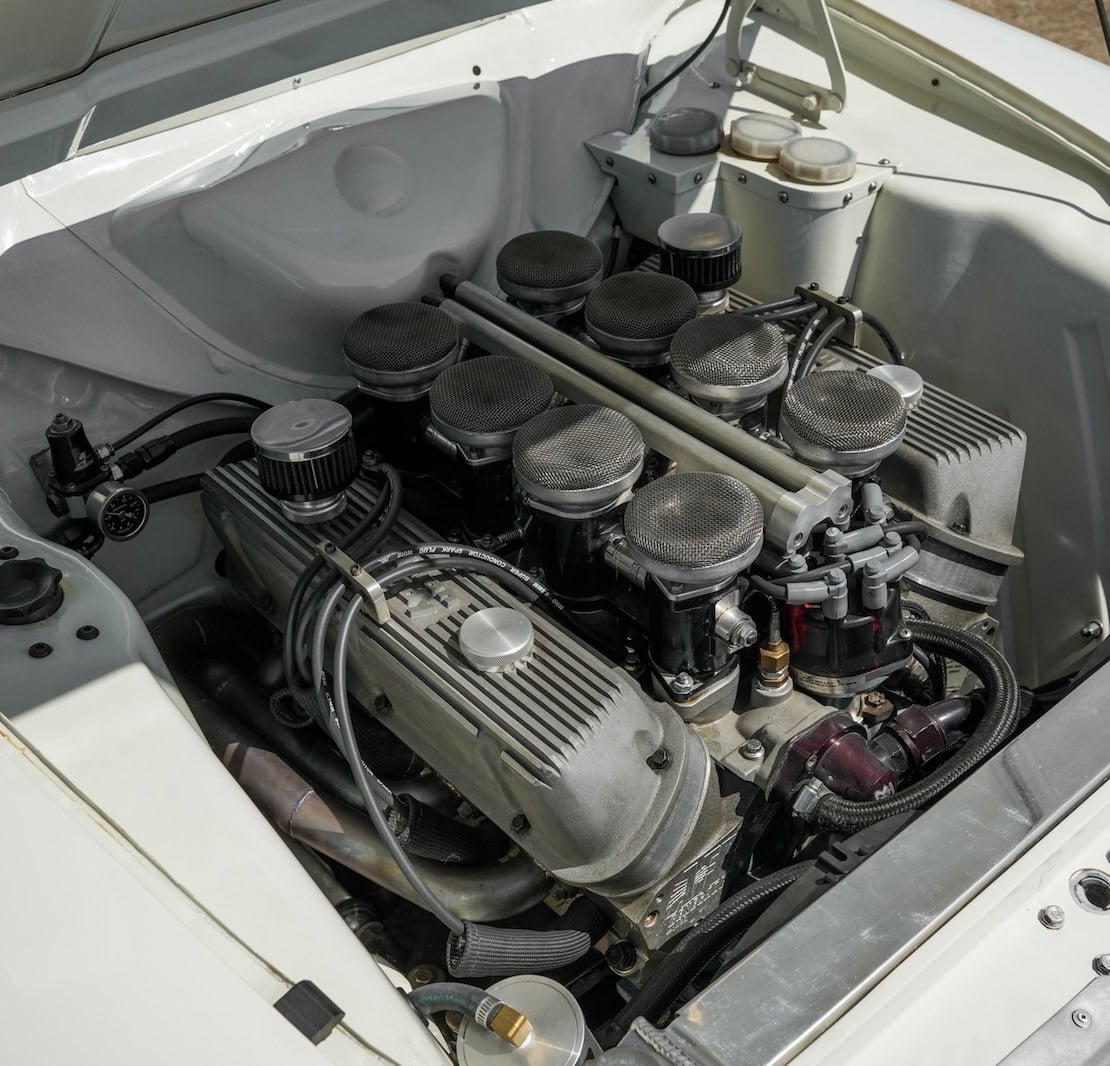
It’s finished in plain white on color-keyed 15″ steel wheels with baby-moon hubcaps. This is a sleeper in every sense of the word – under the hood sits a fuel-injected 347 V8 topped with Air Flow Research Renegade aluminum heads and an eight-stack injection system, producing somewhere in the region of 400 bhp and over 400 lb ft of torque – likely more, but these are conservative numbers based on off-the-shelf crate versions of this engine.
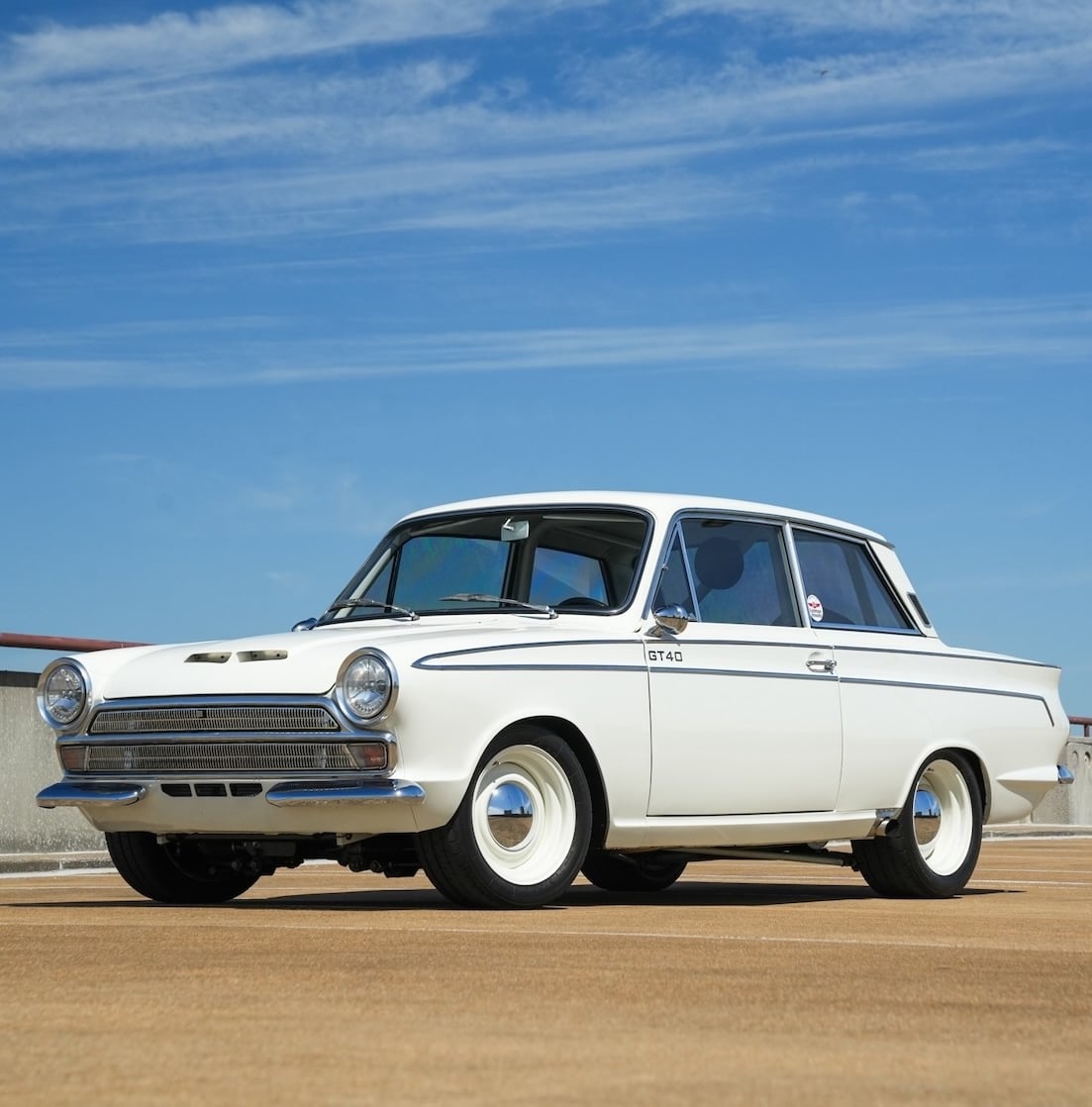
This is a 1965 Ford Cortina GT, but under the skin it’s been significantly modified, it’s now powered by a 347 V8 with power sent back through a 6-speed manual box to the rear wheels.
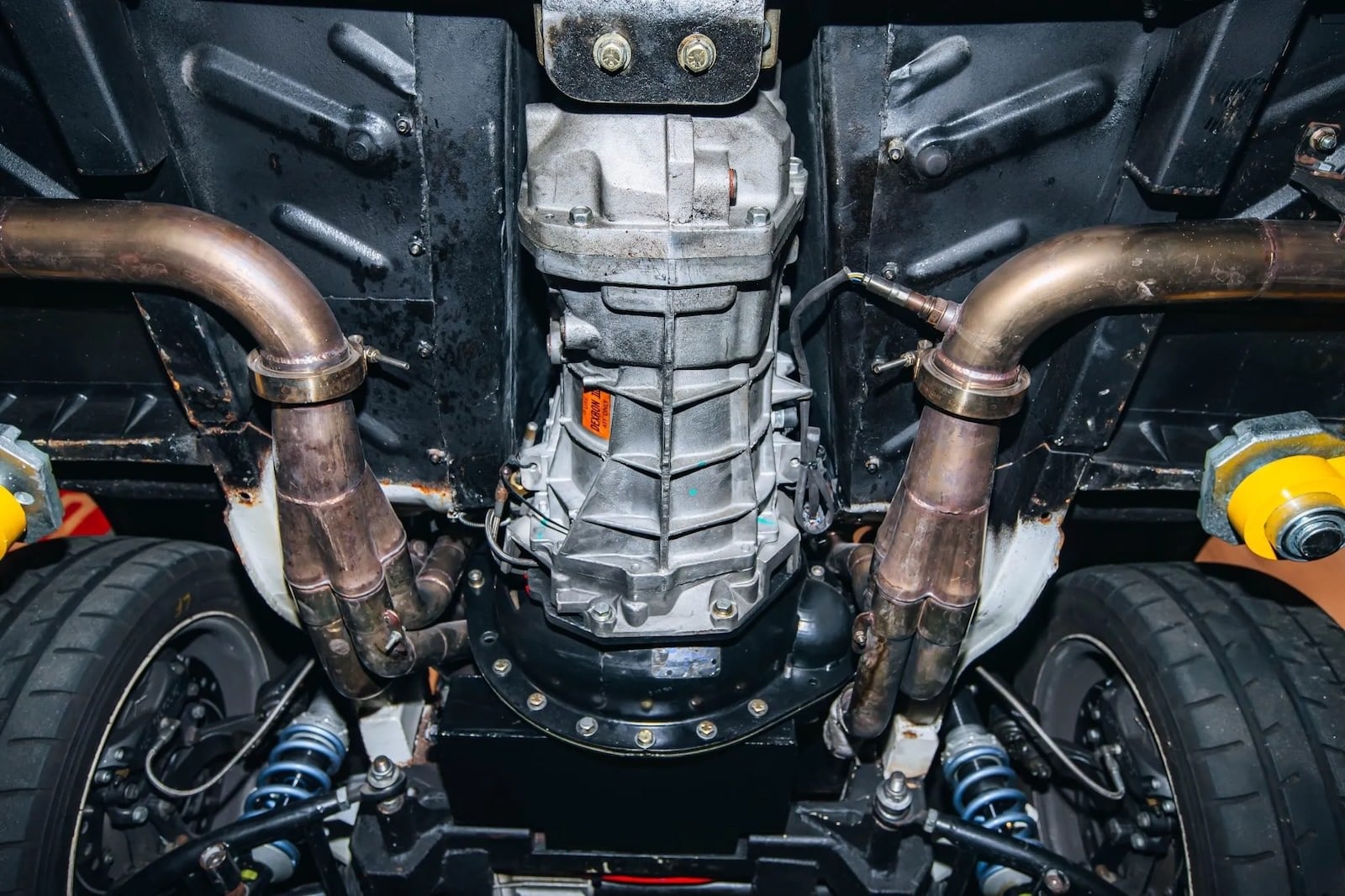
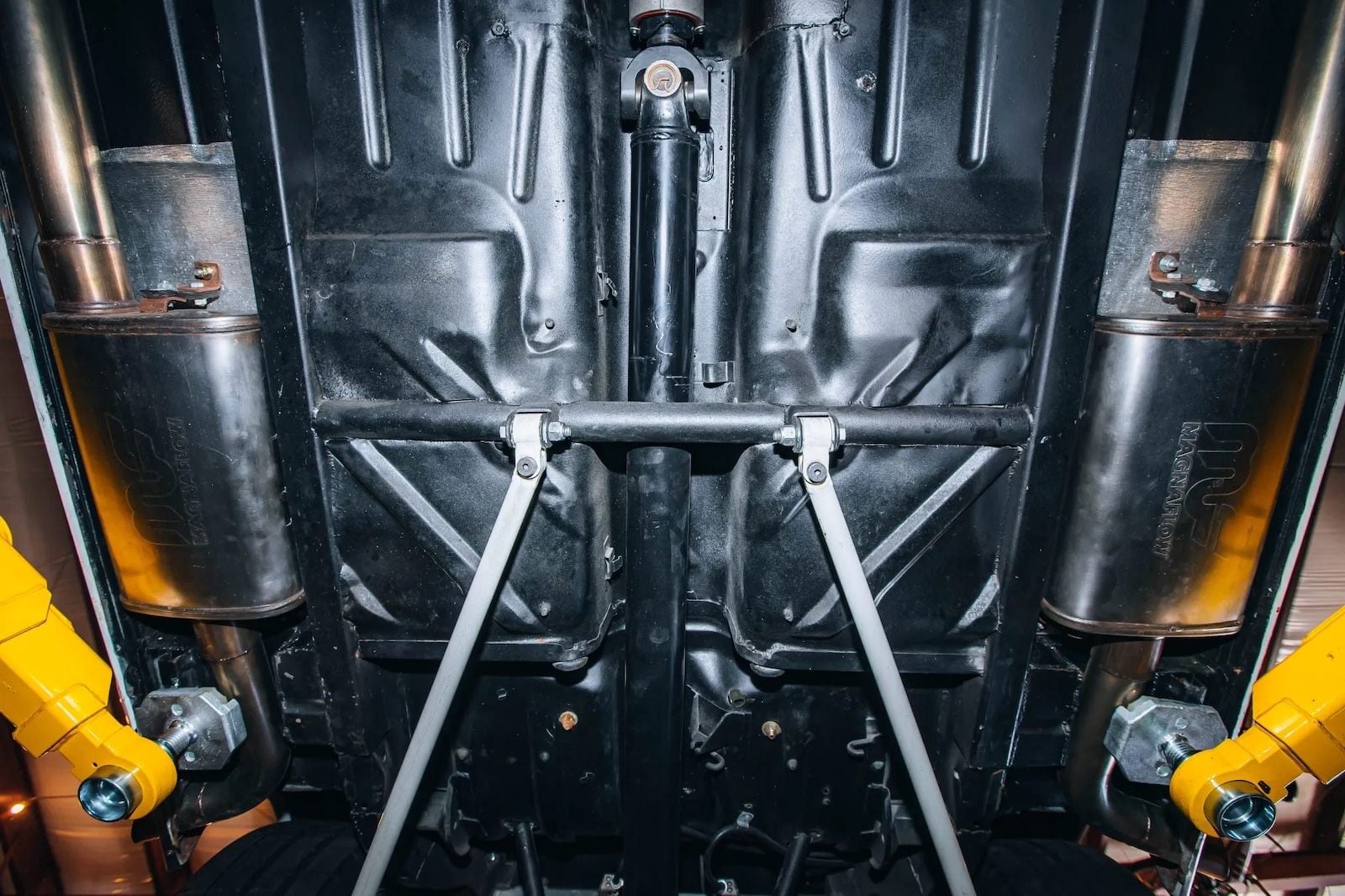
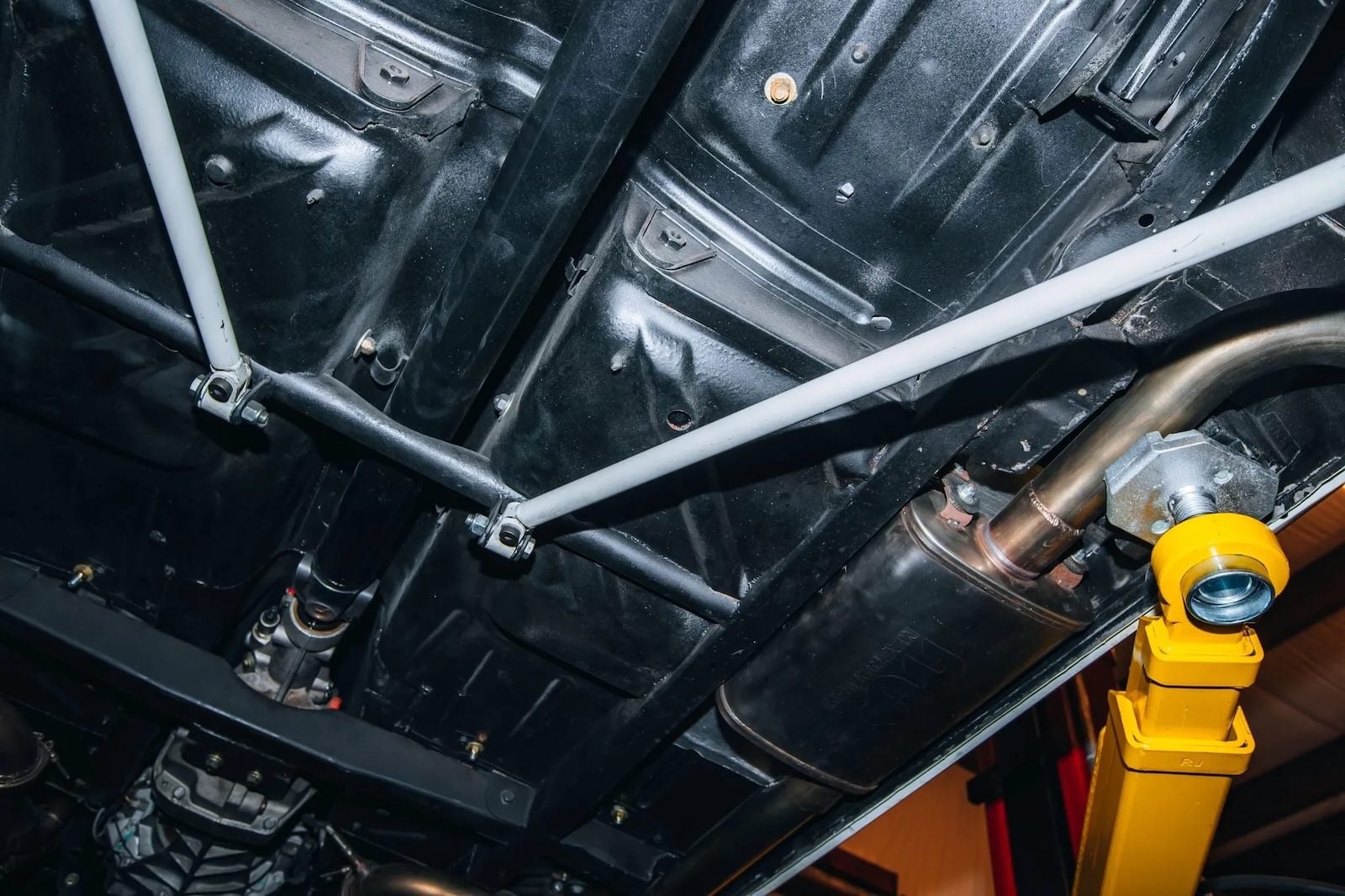
Additional parts include Holman-Moody-branded valve covers, a low-profile oil sump, an MSD Pro-Billet distributor, an Aeromotive fuel pressure regulator, an electric water pump, and an aluminum radiator with dual electric fans. Stainless-steel four-into-one headers feed MagnaFlow mufflers that exit through outlets in the rocker panels.
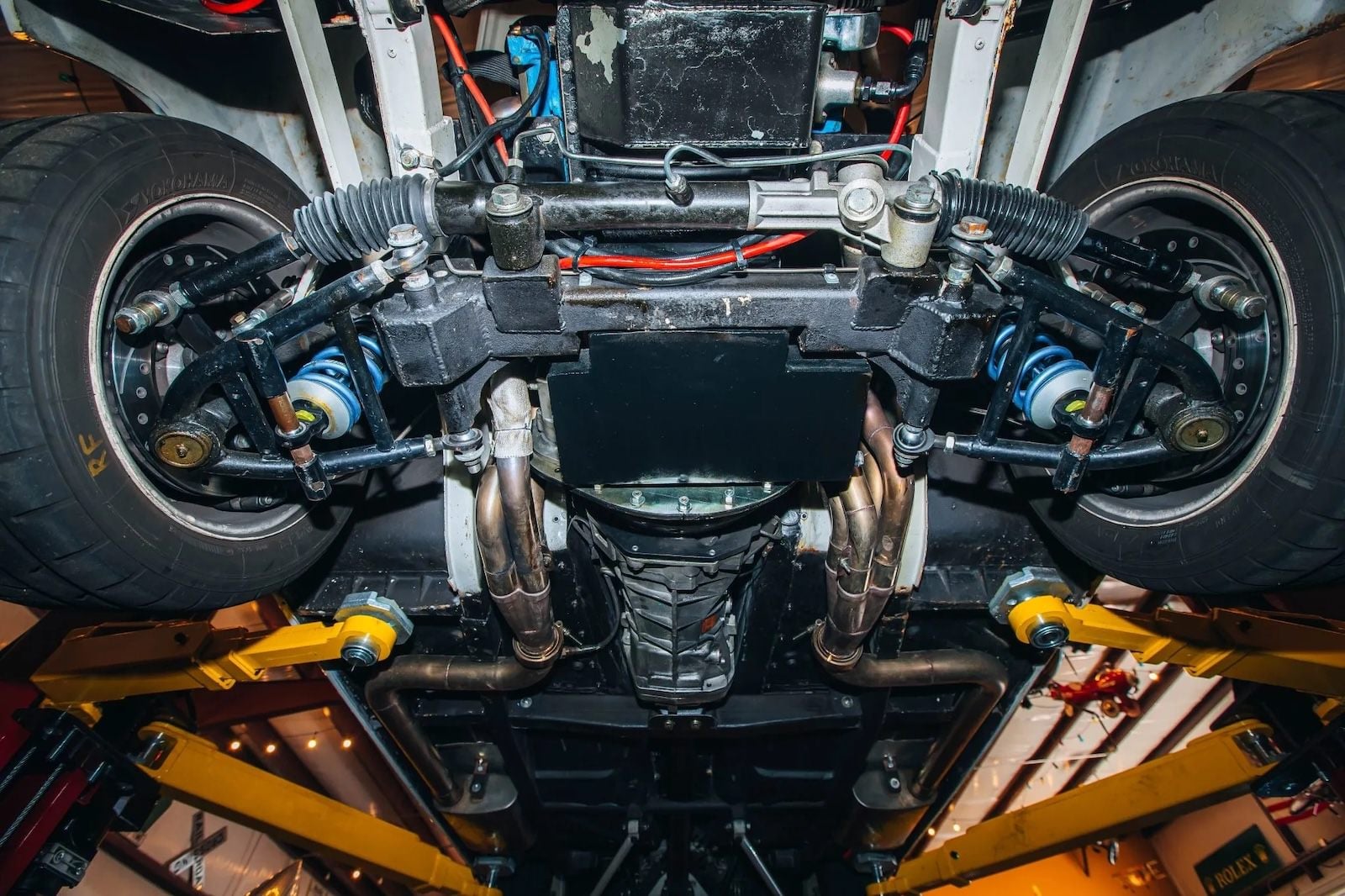
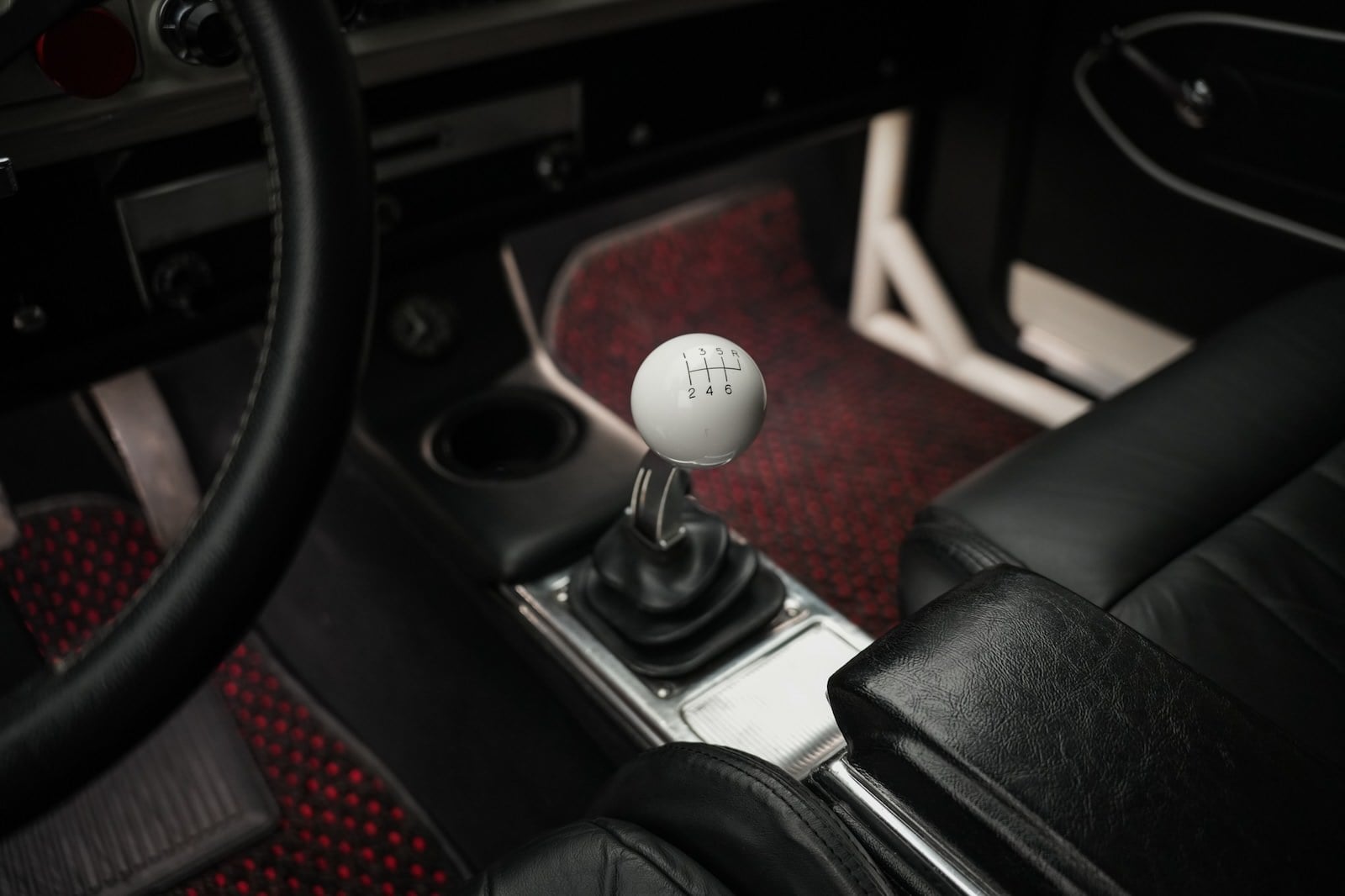
Power is sent to the rear wheels through a Tremec 6-speed manual transmission, and the chassis was heavily reworked with a Mustang II-style independent front assembly on tubular control arms, electric-assisted rack-and-pinion steering, and a Heidts independent rear subframe with tubular linkages and inboard-mounted brakes.
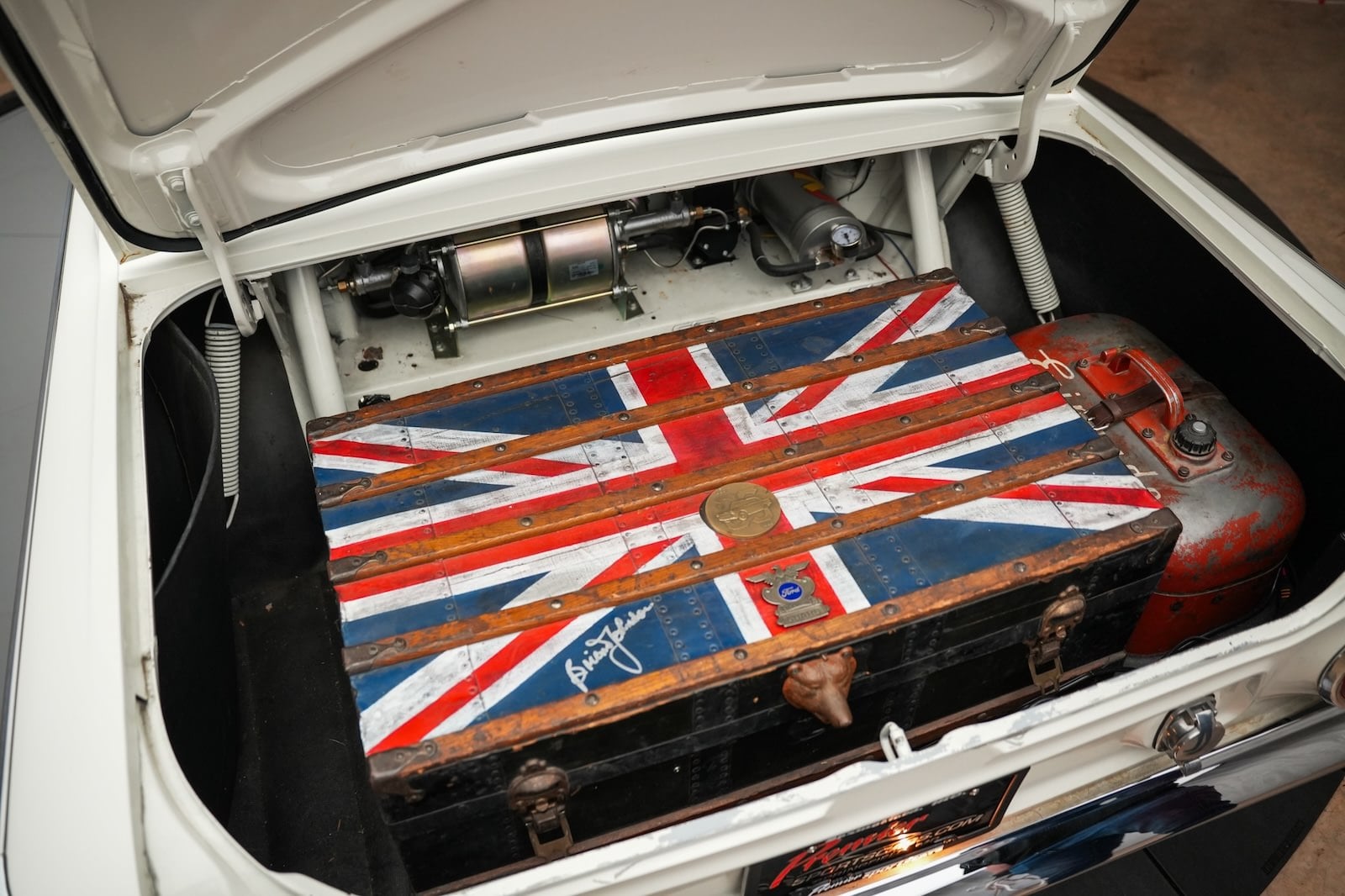
MCS adjustable coilovers are fitted at all four corners, and a trunk-mounted brake booster with dual master cylinders operates Wilwood calipers over drilled and slotted rotors front and rear. The wheels are shod with Yokohama Advan A052 tires.
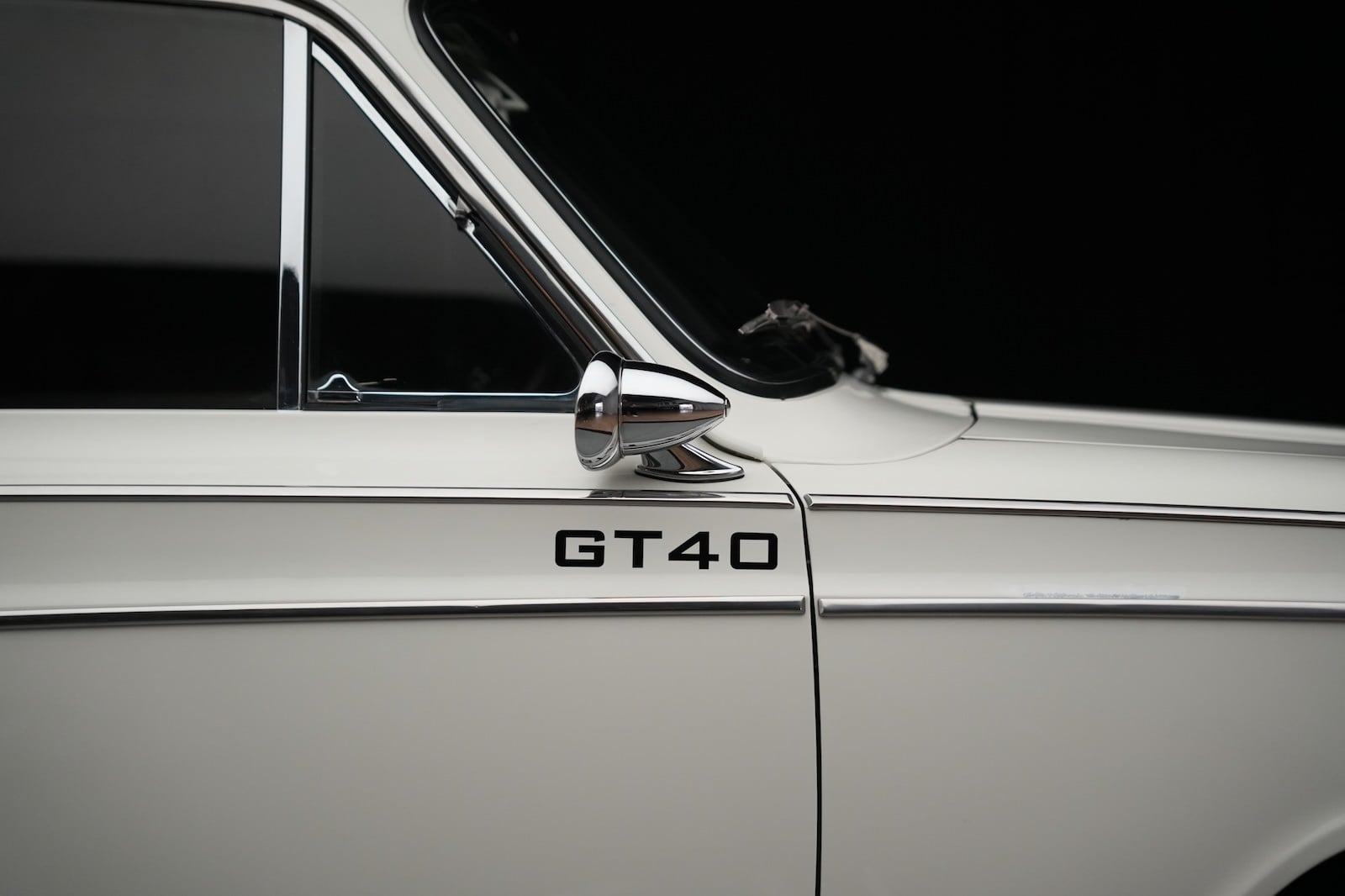
During the build, the body was stripped to bare metal before the transmission tunnel was modified, the rear wheel wells were tubbed, and custom side panels were fabricated for the engine compartment. It was then repainted white. Exterior details now include a bifurcated hood scoop, a Le Mans-style fuel filler, bullet-style side mirrors, and tri-bar headlights with inset LED indicators.
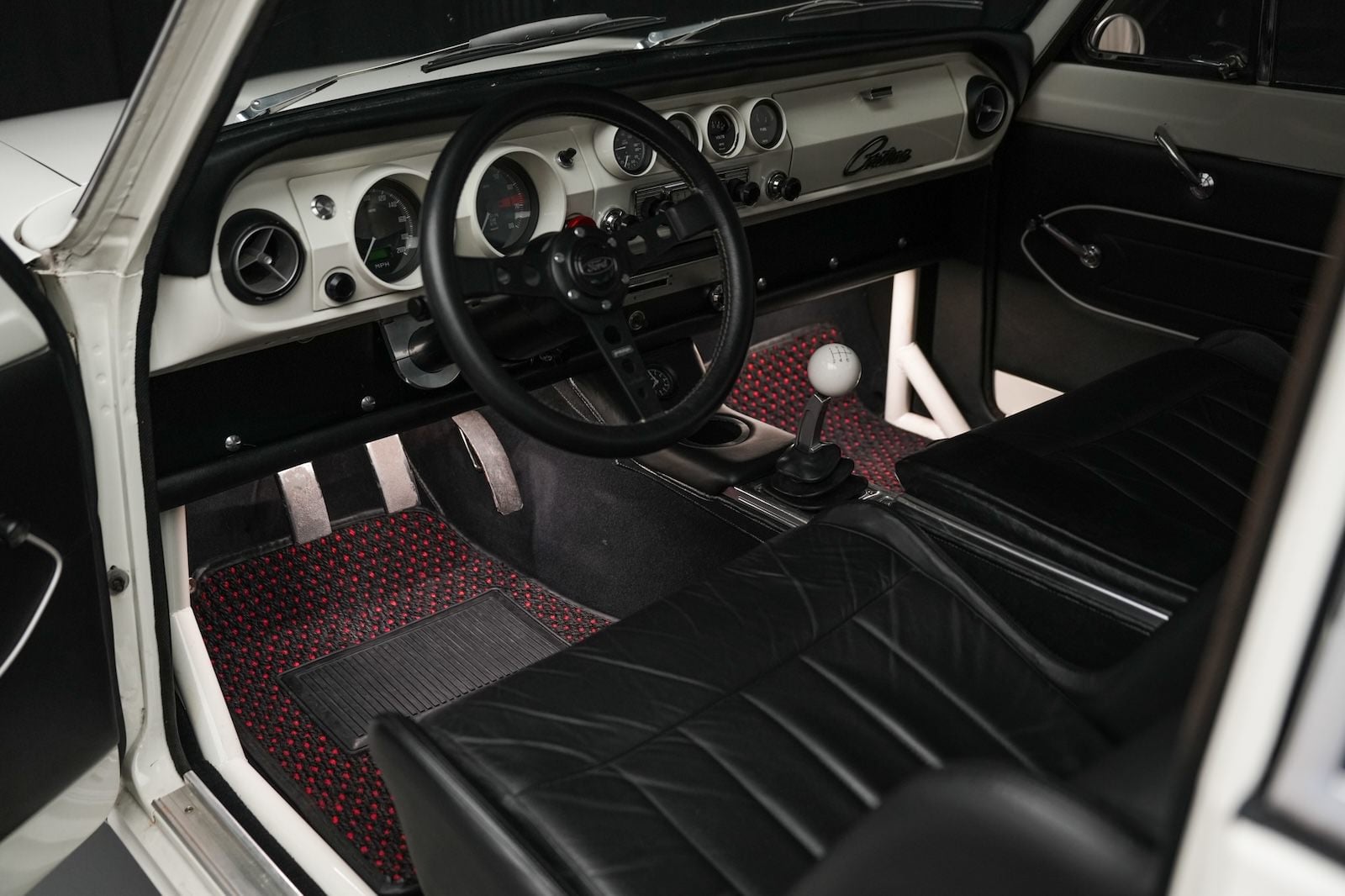
Inside, a six-point roll cage surrounds fixed-back bucket seats trimmed in black, with Willans harnesses provided and Coco mats over color-coordinated carpets. A MOMO Prototipo wheel sits on a tilt column ahead of Smiths instrumentation, including a 200 mph speedometer and a tachometer marked with a 6,500 rpm redline.
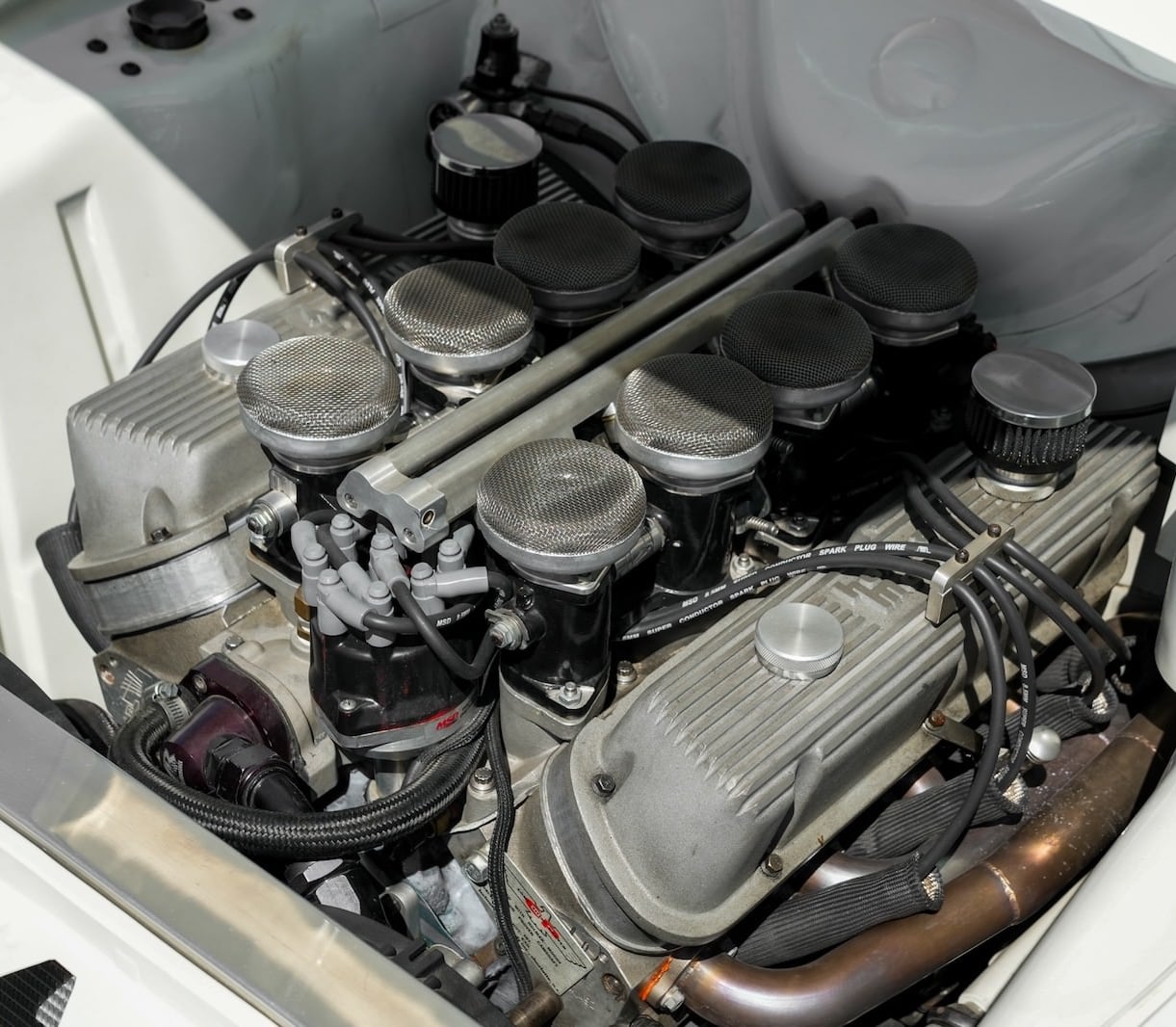
It’s finished in plain white on color-keyed 15″ steel wheels with baby-moon hubcaps. This is a sleeper in every sense of the word – under the hood sits a fuel-injected 347 V8 topped with Air Flow Research Renegade aluminum heads and an eight-stack injection system, producing somewhere in the region of 400 bhp and over 400 lb ft of torque – likely more, but these are conservative numbers based on off-the-shelf crate versions of this engine.
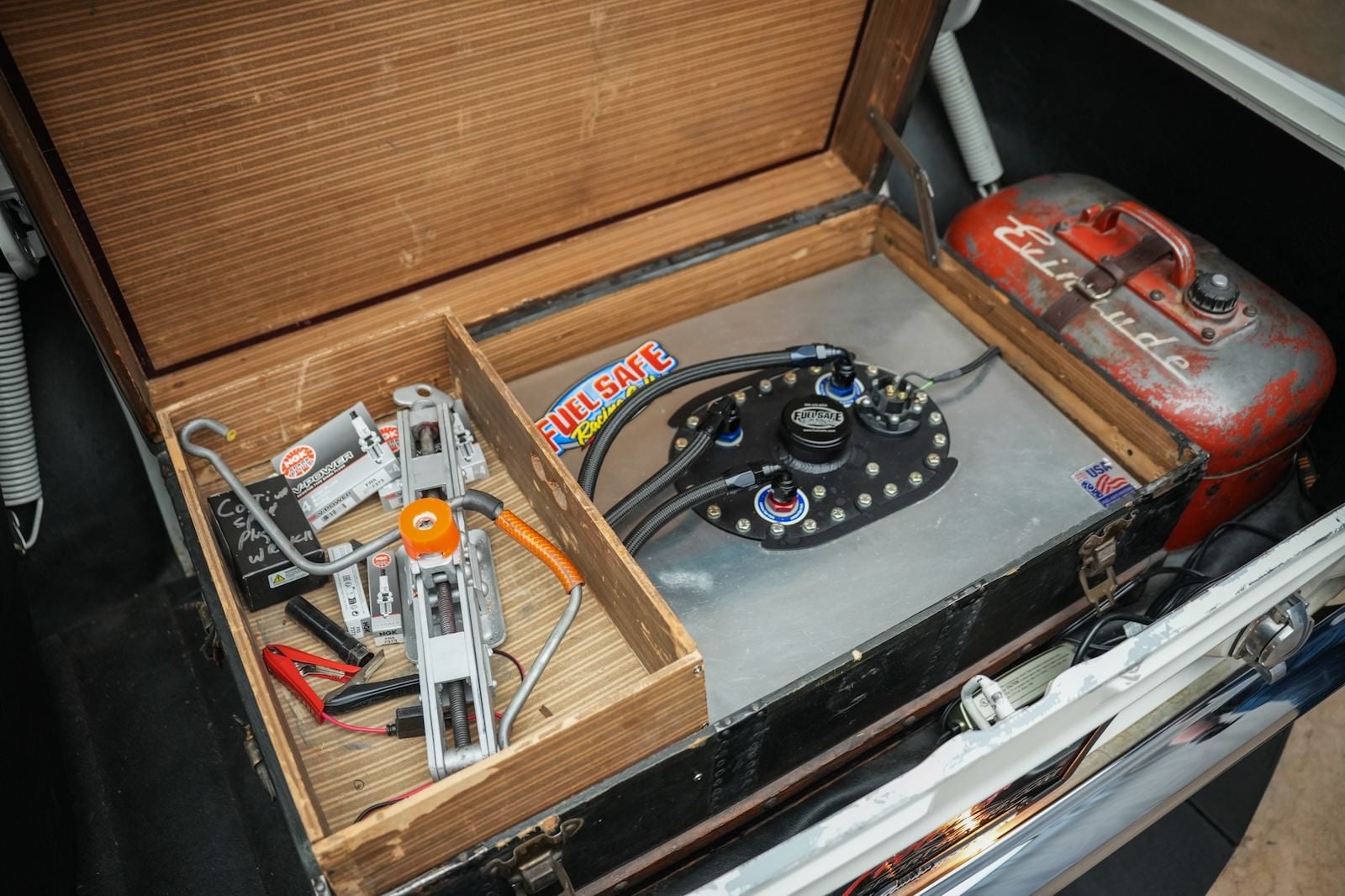
A push-button Motorola AM radio remains in its factory location, and two spare tires and a cooler are stowed behind the seats. In the trunk, a wooden enclosure houses a Fuel Safe fuel cell and a set of tools, while a faux gas can hides the battery. The digital odometer reads 1,200 miles, though the Florida title records 21,419 miles with an Actual notation.
The car is now being offered for sale out of Springfield, Missouri and you can visit the listing here if you’d like to read more or place a bid.
Images courtesy of Bring a Trailer

Articles that Ben Branch has written have been covered on CNN, Popular Mechanics, Smithsonian Magazine, Road & Track Magazine, the official Pinterest blog, the official eBay Motors blog, BuzzFeed, Autoweek Magazine, Wired Magazine, Autoblog, Gear Patrol, Jalopnik, The Verge, and many more.
Silodrome was founded by Ben back in 2010, in the years since the site has grown to become a world leader in the alternative and vintage motoring sector, with well over a million monthly readers from around the world and many hundreds of thousands of followers on social media.