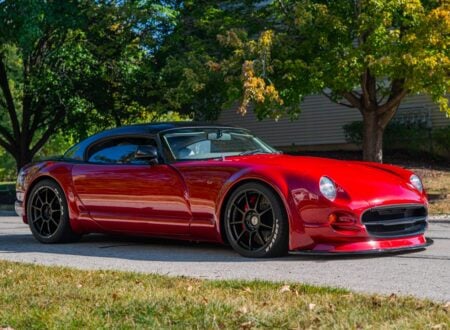
This is a rare AC Brooklands Ace from 1995, it’s a car many haven’t seen before as just 58 of them were built, and they’ve disappeared into automotive obscurity since production stopped, with many people now assuming they’re a TVR.
The Brooklands Ace was built on a unique stainless steel chassis with a hand-formed aluminum body, and this one was factory-fitted with a version of the 5.0 Ford V8 used in the Mustang – making parts sourcing nice and straightforward.
Fast Facts: The AC Brooklands Ace
- This AC Brooklands Ace is one of 58 examples built across both production series, making it a rare sight on the road today. It combined a hand-formed aluminum body with a stainless steel chassis and Ford-sourced mechanicals, giving AC a distinctive modern roadster made with traditional low-volume British construction techniques.
- The Ace name dates back to AC’s lightweight 1950s sports car, which later provided the basis for Carroll Shelby’s Cobra. Decades later, Brian Angliss revived the marque and spent years developing a new Ace, progressing through several Ford-backed prototypes before the rear-wheel-drive V8 production version appeared in 1993.
- Series 1 production cars used Ford’s 4.9 liter pushrod V8, with early examples rated at 260 bhp and later cars at 240 bhp. Buyers could choose a 5-speed Borg-Warner manual or 4-speed automatic. High production costs and weak economic conditions contributed to AC entering receivership in March of 1996.
- The silver 1995 car shown here is a low-mileage, largely factory-standard Series 1 example showing 27,000 miles. It has the 260 bhp V8 and five-speed manual, three owners from new, and has remained with its current keeper since 2001.
History Speedrun: The AC Ace
The first AC Ace appeared at the 1953 London Motor Show. AC had bought the rights to a sports-racing design by John Tojeiro, it was a ladder frame made from two parallel three-inch steel tubes, it had independent suspension at both ends by transverse leaf springs, and an aluminum body whose shape was influenced by the Touring-bodied Ferrari 166 MM Barchetta, though it wasn’t a copy.

 The first AC Ace appeared at the 1953 London Motor Show. AC had bought the rights to a sports-racing design by John Tojeiro, it was a ladder frame made from two parallel three-inch steel tubes, it had independent suspension at both ends by transverse leaf springs, and an aluminum body whose shape was influenced by the Touring-bodied Ferrari 166 MM Barchetta, though it wasn’t a copy. Image courtesy of A.C. Cars Limited.
The Ace was initially powered by AC’s own 2.0 liter overhead-cam six, a John Weller design dating all the way back to 1919, that made 85 bhp. From 1956 the car could be had with the 2.0 liter Bristol straight-six, itself derived from the pre-war BMW 328 engine, which produced between about 100 and 130 bhp depending on tune. An Ace-Bristol finished seventh overall and first in the 2.0 Liter GT class at Le Mans in 1959.
When Bristol moved its own cars to Chrysler V8 power and began winding down production of its six, AC added the 2.6 liter Ford Zephyr engine as a further option from 1961, tuned by AC agent Ken Rudd. By the time production ended in 1963, AC had built 223 cars with its own engine, 463 with the Bristol, and 37 with the Ford.
Carroll Shelby + The Cobra
If it hadn’t been for American racing driver Carroll Shelby, the AC Ace would have been one of those historic sports cars largely forgotten to history. Shelby approached AC in 1961 with a proposal to fit Ford’s new lightweight 260 V8 into the Ace chassis.
Exactly how this idea had come to Shelby isn’t documented, but he did win the 24 Hours of Le Mans in 1959 with co-driver Ray Salvadori, the same year that the AC Ace took its class win. It’s possible that he saw the roadster there, and the idea to build a V8 example began to formulate.
AC agreed to Shelby’s request and built a prototype for him at Thames Ditton by modifying an Ace with a Salisbury limited-slip differential, inboard rear disc brakes, and thicker-walled main chassis tubes. This car shipped to California without an engine in early-1962, it received one of the first 260 cubic inch (4.3 liter) Ford V8s at Dean Moon’s shop and was shown at the New York Auto Show that April as chassis CSX2000.
No one knew it at the time of course, but this little roadster was about to become one of the most iconic sports cars of its age.

No one knew it when it was first released, but this roadster was about to become one of the most iconic sports cars of its age. Image courtesy of Shelby American.
The first 75 Cobras were powered by the 260, after which Ford’s 289 cubic inch (4.7 liter) V8 became standard, rated at 271 bhp in high-performance form. AC’s chief engineer Alan Turner redesigned the front end in late 1962 to take rack-and-pinion steering in place of the Ace’s worm-and-sector, and cars built to that specification from early 1963 are the Mk II.
AC entered its own hardtop 289 at Le Mans in June 1963, where Ninian Sanderson and Peter Bolton finished 7th overall and 1st in class. Six Daytona Coupes followed on AC-built chassis, and in 1965 they won the FIA’s Championship for GT manufacturers.
The Mk III Cobra of 1965 was a new chassis rather than a modified Ace – now with four-inch main tubes in place of the three-inch originals, coil springs at all four corners instead of transverse leaves, and wider fenders to cover the tires the 427 cubic inch (7.0 liter) Ford required.
Shelby needed 100 cars to homologate the 427 for GT racing and had built only about half that number when the FIA inspected, so the car was never homologated and ~30 unsold competition chassis were converted into street-legal S/C models. AC continued to build every Cobra chassis at Thames Ditton until the arrangement with Shelby ended in 1968, by which point the total stood at 998 cars – 655 leaf-spring 260s and 289s, and 343 coil-spring 427s.
A New AC Ace Begins To Take Shape
The AC Ace revival began with Brian Angliss, whose company Autokraft built replica Cobras at Brooklands in Weybridge and who later acquired the AC name from the Hurlock family in 1986 – after which he began building official continuation cars.
Ford took a controlling stake in the new AC Cars, agreed to sell the Cobra Mk IV through its US dealers, and helped develop a new Ace. The car shown at the Birmingham Motor Show in October 1986 was a 2+2 with a targa-style roof, styled at Ford of Europe’s design center by Roberto Giachin and Ed Golden, with a Len Bailey steel platform chassis under an unstressed aluminum body.

The car that reached the 1993 London Motor Show at Earls Court was a rear-wheel-drive V8, which was probably the best possible combination, leaving behind the complexity of the four-wheel-drive system and the V6, which would just never be quite as cool as a V8.
It was specified with Sierra-based four-wheel-drive running gear and either a 2.8 liter V6 or a turbocharged 2.0 liter four. It never progressed beyond the prototype stage.
Ford then handed styling duties over to Ghia in Turin, whose scale models Angliss described as “bald, fat frogs.” It seems he may not have been a big fan.
A Ford design studio at Dunton tried again, and Angliss eventually paid IAD of Worthing out of his own pocket to finish the job. The relationship with Ford soured, between 1990 and 1992 Ford reportedly tried to wind up AC Cars six times. A second prototype appeared early in 1992, still with four-wheel drive and a V6, this time a 220 bhp 24-valve 3.0 liter from the Ford Taurus SHO. Later that year Angliss bought out Ford’s shareholding and continued the project by himself.
The Production Car
The car that reached the 1993 London Motor Show at Earls Court was a rear-wheel-drive V8, which was probably the best possible combination, leaving behind the complexity of the four-wheel-drive system and the V6, which would just never be quite as cool as a V8.
Its chassis was Bailey’s monocoque design, welded up from stainless steel and clothed in hand-rolled aluminum panels. Suspension was by unequal-length wishbones and coil springs at all four corners, with two dampers per side at the rear and a Salisbury differential, a layout similar to Jaguar’s XJS. Brakes were ventilated discs front and back, 273 mm front and 268 mm rear, with an anti-lock system. Steering was power-assisted rack and pinion, and the car sat on 16 inch alloy wheels at each corner.
The engine was Ford’s 302 cubic inch (4.9 liter) pushrod V8 from the Mustang of the period, with electronic fuel injection. Early cars were rated at 260 bhp at 5,250 rpm and 320 lb ft at 3,250 rpm, with a larger throttle body, a reworked plenum, and gas-flowed heads.


AC priced it at £49,995, this was £3,000 below a Jaguar XJ-S convertible and around £20,000 below the Mercedes-Benz 500SL it was aimed at. Reviewing the car in 1993, Richard Bremner called it “a thoroughly professional effort.”
Only the first 18 or so are thought to have received this engine spec, and later cars had a 240 bhp unit. Buyers chose between a Borg-Warner 5-speed manual (the correct choice) or a Ford 4-speed automatic (the incorrect choice). At 3,175 lbs the Ace was good for a 0 to 60 mph time of 5.9 seconds and a top speed of 144 mph.
Much of the rest of the car came from other manufacturers’ parts bins, not dissimilar to the way Lotus, TVR, and Marcos operated. The headlights were BMW 3 Series units, the door mirrors were from a Citroën CX, the electric soft top was from a Peugeot 306 and latched to a BMW cabriolet header rail, and the switches and even the ignition key were from the Ford Fiesta.
AC priced it at £49,995, this was £3,000 below a Jaguar XJ-S convertible and around £20,000 below the Mercedes-Benz 500SL it was aimed at. Reviewing the car in 1993, Richard Bremner called it “a thoroughly professional effort.” It was a good car, but it had been launched right into the tail-end of a global economic recession. This greatly affected sales, and when combined with high build costs, it would ultimately lead to the car’s demise.
By the time AC Cars Ltd went into receivership in March of 1996, 46 cars had been built, 25 of them manuals and, by one owner’s reckoning, only one of them finished in red.
The Second Series
Alan Lubinsky’s Pride Automotive bought the assets and formed AC Car Group Ltd in late-1996. The stainless understructure was simplified and made 20% lighter with half the number of welds, the subframes were stiffened, wheels went to 17 inches, and the round headlights gave way to rectangular units.
Overall weight dropped by 120 kgs (265 lbs). Three engine options were offered, the 240 bhp 5.0 with an automatic, a 320 bhp supercharged 5.0, and Ford’s 281 cubic inch (4.6 liter) 32-valve quad-cam V8 rated at 320 bhp, the latter two were only offered with the Borg-Warner 5-speed.


The chassis of the AC Brooklands was Bailey’s monocoque design, welded up from stainless steel and clothed in hand-rolled aluminum panels. Suspension was by unequal-length wishbones and coil springs at all four corners, with two dampers per side at the rear, and a Salisbury differential.
A revised prototype was shown at the 1997 London Motor Show and the production version at Birmingham in 1998, priced from under £70,000 to almost £80,000, with final assembly in Coventry.
About a dozen were built before production ended in 2000, bringing the total for both series to around 58 cars.
The 1995 AC Brooklands Ace Shown Here
This AC Brooklands Ace is a low-mileage, largely factory-standard example showing just 27,000 miles from new. Finished in silver metallic with a dark blue leather interior and matching fabric roof, it’s described as one of the final Series 1 cars built before AC entered receivership in 1996.
It’s powered by the 260 bhp 4.9 liter Ford Mustang V8 paired with a 5-speed Borg Warner manual gearbox, and the sale includes the appropriate private registration N444ACE. This drivetrain helps take the headache out of parts sourcing, as it’s the same unit used in the Mustang of the time.
This car has had just three owners from new, with the current owner buying it in 2001. Its mileage is supported by the history file and MOT records, while the service book shows regular attention from AC Cars during its early life, including services at 1,028 miles in 1995, 5,689 miles in 1996, 11,995 miles in 1997, 18,880 miles in 1998, and 22,130 miles later that year.

This AC Brooklands Ace is a low-mileage, largely factory-standard example showing just 27,000 miles from new. Finished in silver metallic with a dark blue leather interior and matching fabric roof, it’s described as one of the final Series 1 cars built before AC entered receivership in 1996.
Cosmetically, the aluminum bodywork, factory five-spoke alloy wheels, blue leather cabin, wood veneers, Alcantara dashboard top, and period Alpine radio-cassette all appear well preserved. The seller notes that it isn’t a showroom-perfect example and would benefit from some cosmetic tidying.
It’s now being offered for sale out of West Sussex in the United Kingdom and you can visit the listing here if you’d like to read more about it or register to bid.


Images courtesy of Car & Classic

Articles that Ben Branch has written have been covered on CNN, Popular Mechanics, Smithsonian Magazine, Road & Track Magazine, the official Pinterest blog, the official eBay Motors blog, BuzzFeed, Autoweek Magazine, Wired Magazine, Autoblog, Gear Patrol, Jalopnik, The Verge, and many more.
Silodrome was founded by Ben back in 2010, in the years since the site has grown to become a world leader in the alternative and vintage motoring sector, with well over a million monthly readers from around the world and many hundreds of thousands of followers on social media.