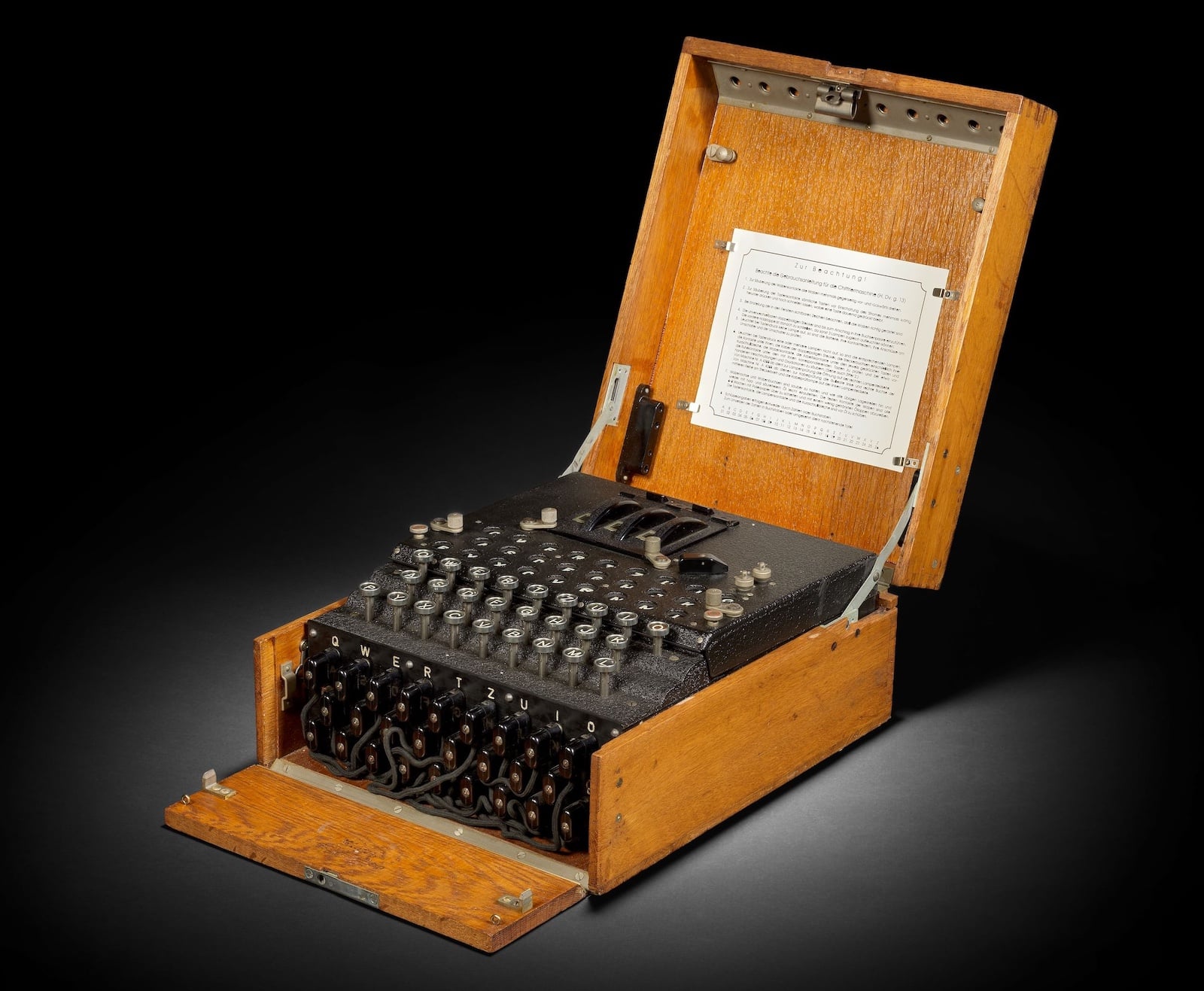
This is a rare, original Enigma I machine from 1941, it comes with rotors II, III, and IV, and it was manufactured by Heimsoeth & Rinke for use by the Wehrmacht during World War II.
Cracking the enigma code was one of the most crucial decryption programs of the war, the British effort (with help from earlier Polish work) was based at Bletchley Park and led by legendary computing pioneer Alan Turing.
Above Video: This is a full-length documentary about the history of the Enigma machine, and the work that went into cracking its codes.
History Speedrun: The Enigma Machine
In 1918, a German electrical engineer named Arthur Scherbius filed a patent for a cipher machine based on rotating wired wheels. He called it Enigma, Greek for “riddle,” and began marketing it through his company, Scherbius & Ritter, as a tool for businesses looking to protect confidential communications. No one could have known it at the time, but this machine would evolve into one of the single most important devices of the still-distant Second World War.
Initially, the sales of the Enigma were modest, but the German military soon recognized its potential. The Navy adopted a modified version in 1926, and the Army followed a few years later. By the time World War II broke out in 1939, the Enigma had become the backbone of German military communications, encrypting everything from U-boat patrol orders to Luftwaffe weather reports.
A Machine Of Astonishing Complexity
The Enigma looked like an oversized typewriter housed in a simple wooden box, but its internals were anything but ordinary. The heart of the machine was a set of rotating cipher wheels called rotors, typically three, chosen from a set of five (though from February 1942 onwards, the U-boat fleet used a four-rotor version).
Each rotor was a disc roughly 10 cm in diameter, made of hard rubber or Bakelite, with 26 brass electrical contacts on each face. Internally, each contact on one side was wired to a different contact on the other, creating a scrambled substitution alphabet unique to that rotor.
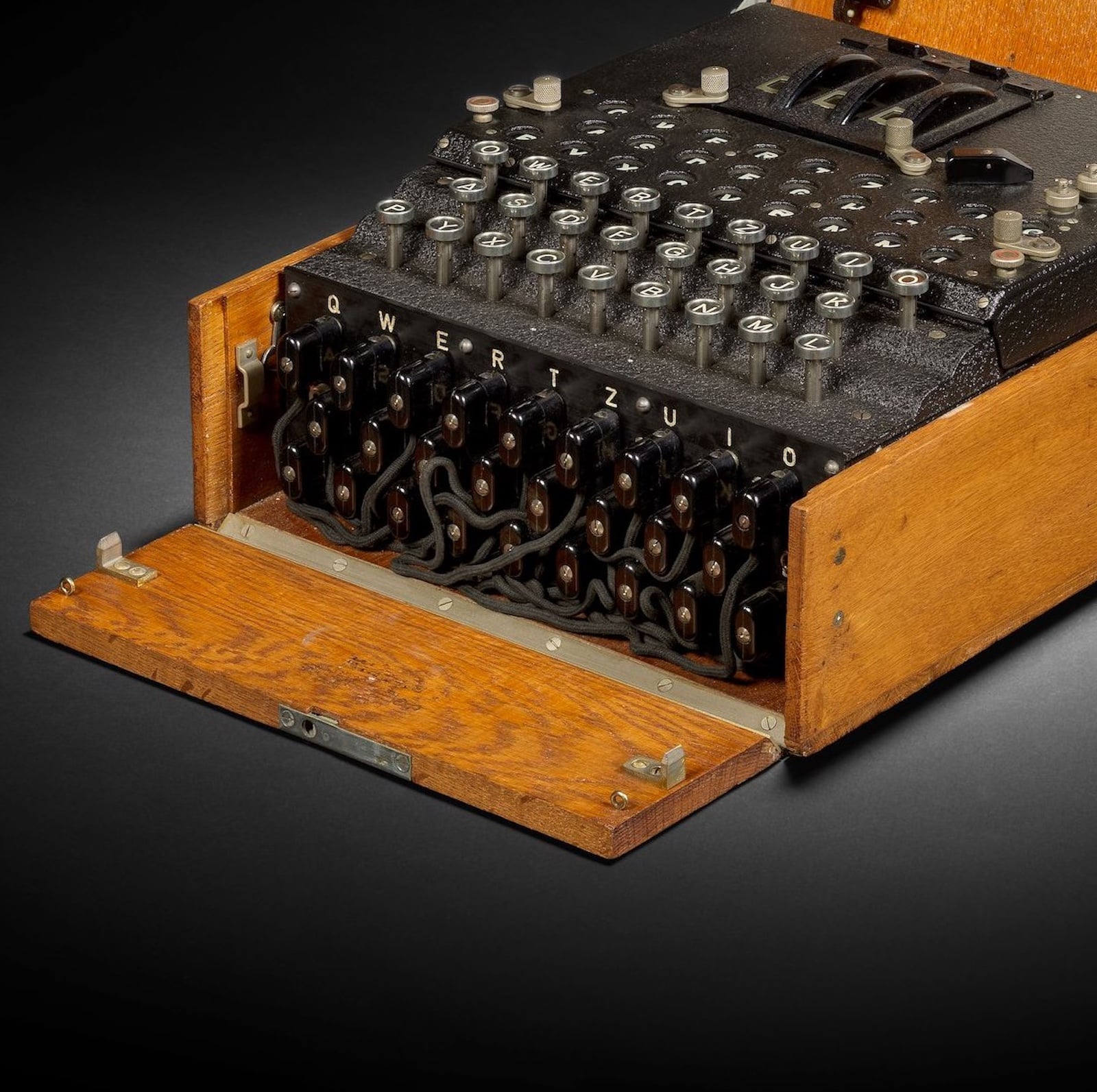
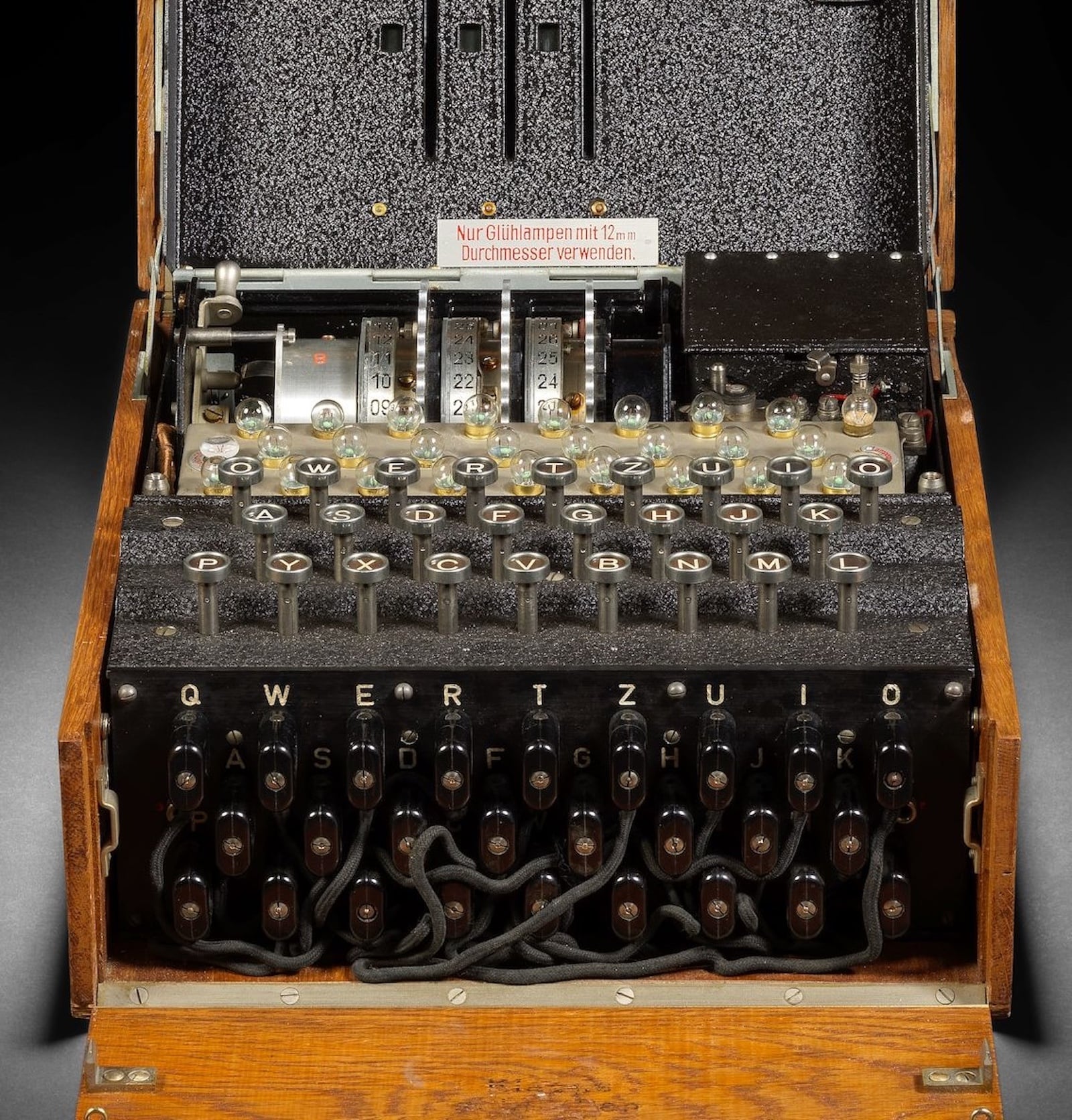
When an operator pressed a letter on the keyboard, an electrical signal flowed through the plugboard (the Steckerbrett, where pairs of letters were swapped via cable connections), then through each of the three rotors in sequence, hit a fixed reflector that bounced the signal back through all three rotors in reverse order, passed through the plugboard again, and finally lit up a lamp on the display panel indicating the enciphered letter.
The genius (and the maddening complexity for the Allies) lay in that internal movement. Each keypress advanced the rightmost rotor by one position before the electrical circuit completed, and mechanical notches on the rotors caused the middle and left rotors to step at specific intervals. This meant that every single keypress produced a completely different substitution alphabet. A letter “A” pressed once might encrypt to “G,” but pressing “A” again immediately afterward might produce “C” or any other letter.
 The Enigma looked like an oversized typewriter housed in a simple wooden box, but its internals were anything but ordinary. The heart of the machine was a set of rotating cipher wheels called rotors, typically three, chosen from a set of five (though from February 1942 onwards, the U-boat fleet used a four-rotor version).
Operators followed codebooks that specified the daily key, which three rotors to install and in which order, the ring settings (an adjustable offset on each rotor), and which letter pairs to connect on the plugboard – typically ten pairs. For each individual message, the operator then chose a fresh starting position for the rotors and transmitted it as a message indicator at the beginning of the transmission.
In its standard three-rotor Army and Air Force configuration, the military Enigma had approximately 159 quintillion possible settings, that’s 159 followed by 18 zeroes. The daily key changed every 24 hours, meaning that even if the Allies cracked one day’s settings, they’d have to start from scratch the next morning.
The Polish Head Start
The first Enigma breach came not from Britain or the United States, but from Poland. In the early 1930s, the Polish Cipher Bureau recruited mathematician Marian Rejewski, who (working partly from intelligence obtained via the French from a German spy) managed to reverse-engineer the internal wiring of the Enigma rotors by late 1932.
The Poles built electromechanical devices called “bomby kryptologiczne” to find daily settings, and from 1933 to late 1938 they were regularly reading German Enigma traffic. But as Germany added rotors and changed procedures through the late 1930s, the Poles could no longer keep pace.
In July of 1939, just weeks before the invasion of Poland, they shared their entire body of work, techniques, reconstructed machines, and bomba designs, with French and British intelligence. It would prove hugely important in kickstarting the code cracking efforts that were to come.
Turing’s Work At Bletchley Park
The British effort to crack the Enigma codes was centered at Bletchley Park, a country estate in Buckinghamshire that served as the headquarters of the Government Code and Cypher School. Alan Turing arrived there on the day after Britain declared war in September of 1939 and was tasked with finding a method to break Enigma.
Building on the Polish mathematical foundations, Turing designed a new electromechanical device called the “Bombe.” His approach exploited a critical weakness in Enigma’s design – no letter could ever encrypt as itself. If you pressed “A,” the lamp for “A” would never light up. This seemingly minor quirk gave codebreakers a tiny foothold.
Turing’s method relied on “cribs” – short segments of plaintext that analysts guessed or knew would appear in a message, such as standard military phrases or weather report formats. The Bombe would take a crib and its corresponding ciphertext and, using the impossibility of a letter encrypting to itself, rapidly test rotor configurations, eliminating impossible settings until only the correct one remained.
The first Bombe, named “Victory,” entered service at Bletchley Park in March of 1940. Gordon Welchman, a fellow mathematician at Bletchley, soon contributed a crucial improvement called the “diagonal board” that dramatically increased the machine’s efficiency.
Harold “Doc” Keen of the British Tabulating Machine Company handled the engineering, turning Turing’s theoretical design into working hardware. By the end of the war, 211 Bombe machines were in operation, tended largely by personnel from the Women’s Royal Naval Service (the Wrens).
From mid-1940 onward, German Air Force signals were being read at Bletchley, and the intelligence derived from Enigma (codenamed Ultra) was helping shape the course of the war.
The full story of Enigma’s defeat remained highly classified until the mid-1970s. By then, the machine that was once considered unbreakable had become the most famous example in history of why no encryption, however complex, is ever completely immune to the right combination of mathematics, engineering ingenuity, computing power, and sheer human determination.
The Heimsoeth & Rinke Enigma Machine Shown Here
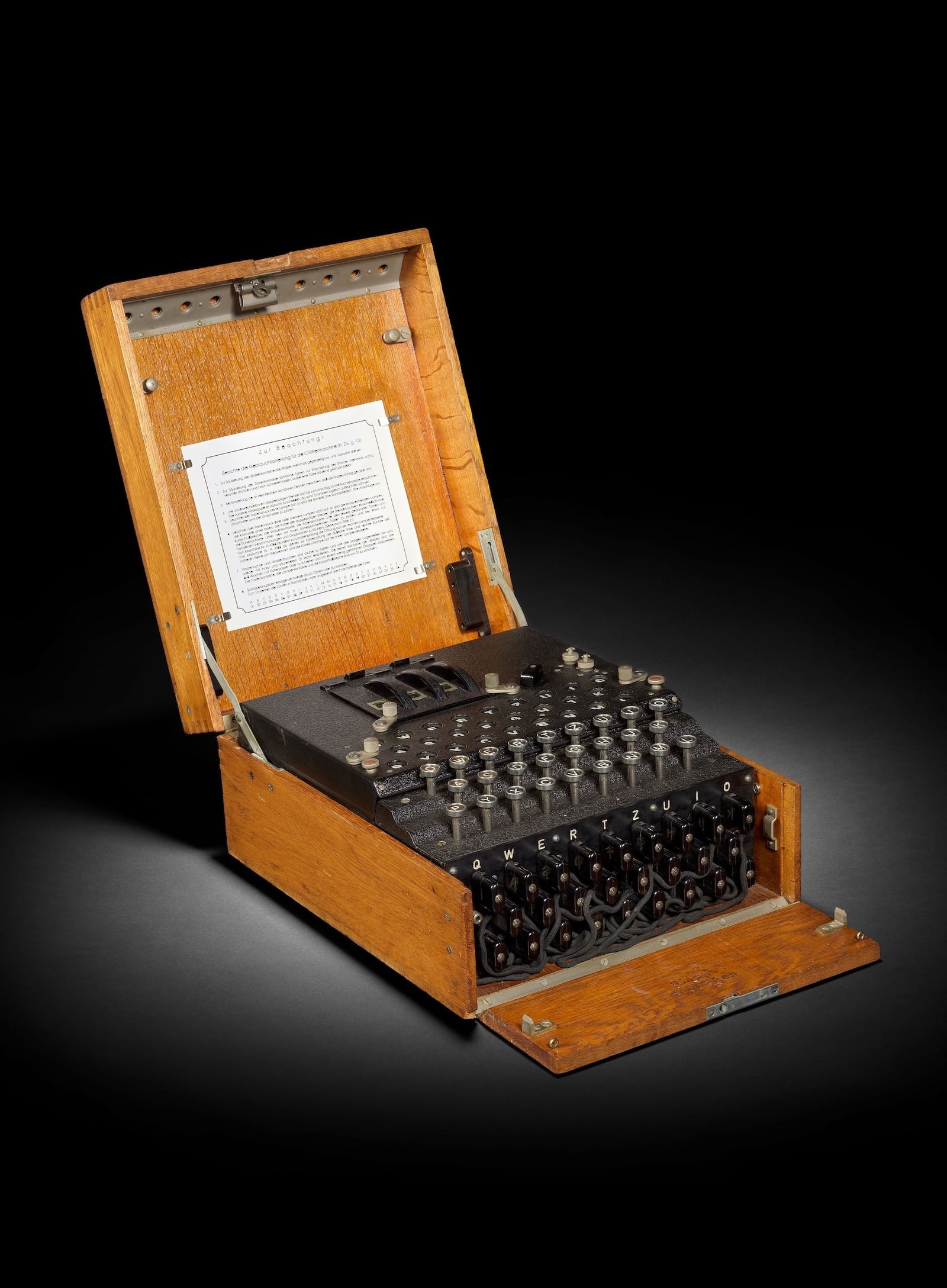
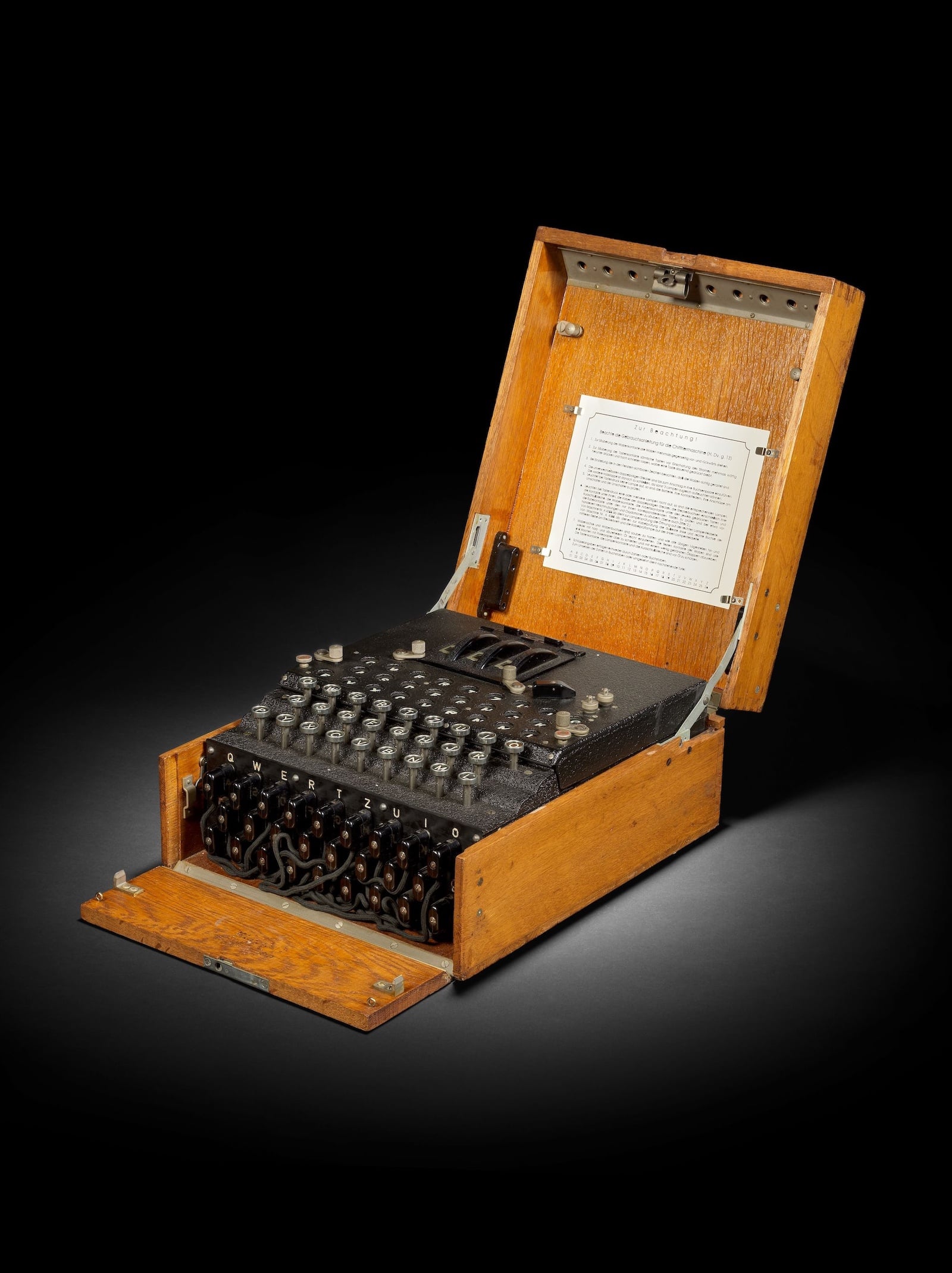
This is a 1941 Enigma I machine, serial number 13489, made by Heimsoeth & Rinke for the German military. It’s a standard three-rotor model, the type used largely by the Wehrmacht as their primary field cipher device throughout the Second World War.
Each rotor was a disc roughly 10 cm in diameter, made of hard rubber or Bakelite, with 26 brass electrical contacts on each face. Internally, each contact on one side was wired to a different contact on the other, creating a scrambled substitution alphabet unique to that rotor.
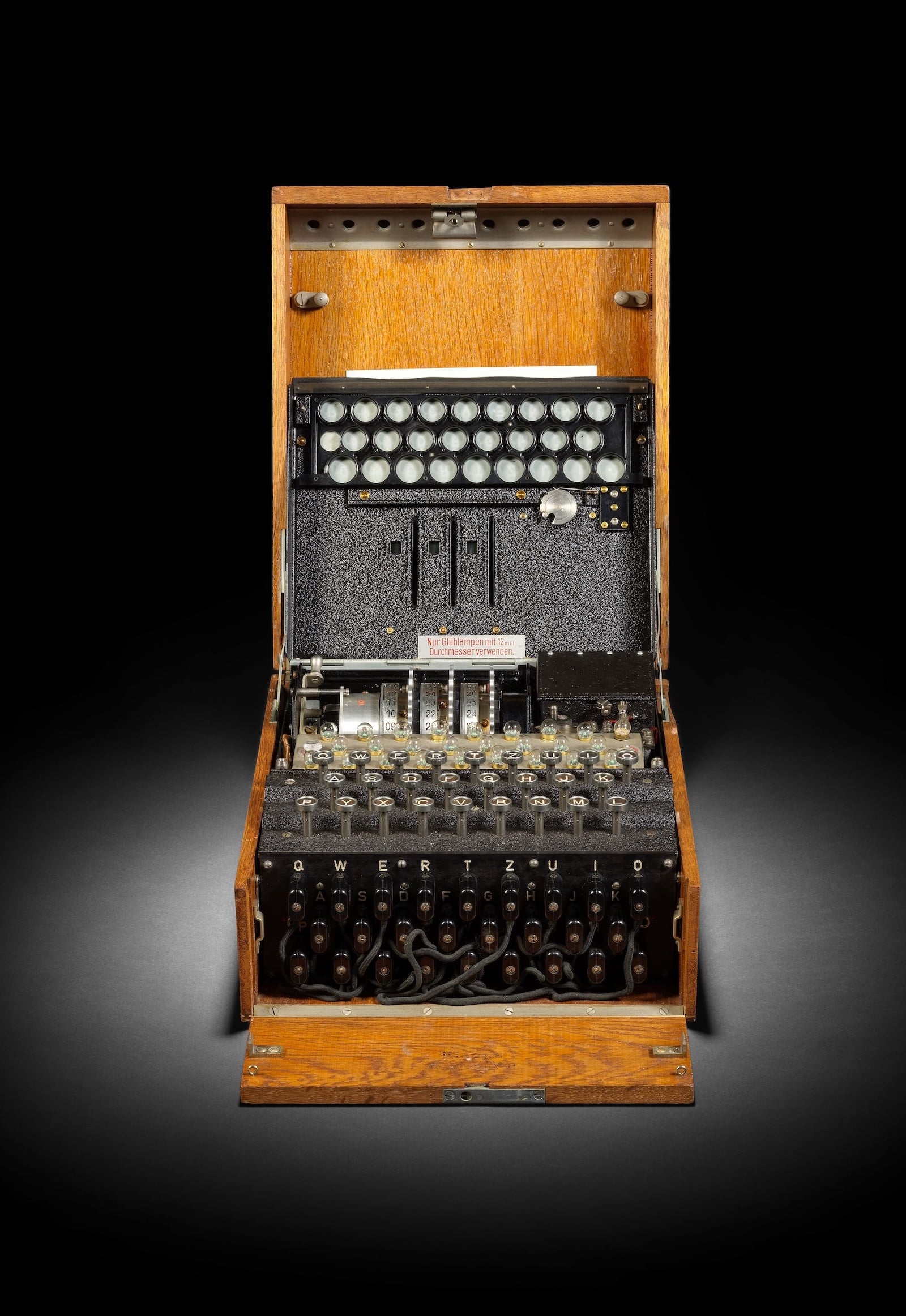
This machine is fitted with rotors II, III, and IV, each stamped with the matching serial number A13489, confirming them as the original set supplied with this specific unit.
This Enigma machine keeps its full QWERTZ keyboard of 26 keys (white lettering on black backgrounds), its ebonite plugboard with all 13 Stecker cables, and a battery switch. The upper lid includes a spare bulb holder, and a replica “Zur Beachtung” instruction card is included.
The case has its original black metal crackle finish and is housed in the original light oak outer carrying case with a hinged front flap, though the lock pin is now detached. The overall dimensions are 6″ by 11″ by 13.5″.
The provenance on this machine is traceable and well documented – it was previously held in the collection of Ion Nicolescu, a former Romanian diplomat based in Buzău, Romania. Nicolescu loaned the machine to the Muzeul Județean Buzău on at least two occasions, first in 2016 for an exhibition commemorating the centenary of Romania’s Second Army, and again in 2019 for a science and technology exhibition. It then later passed into another private collection following the conclusion of the 2019 loan.
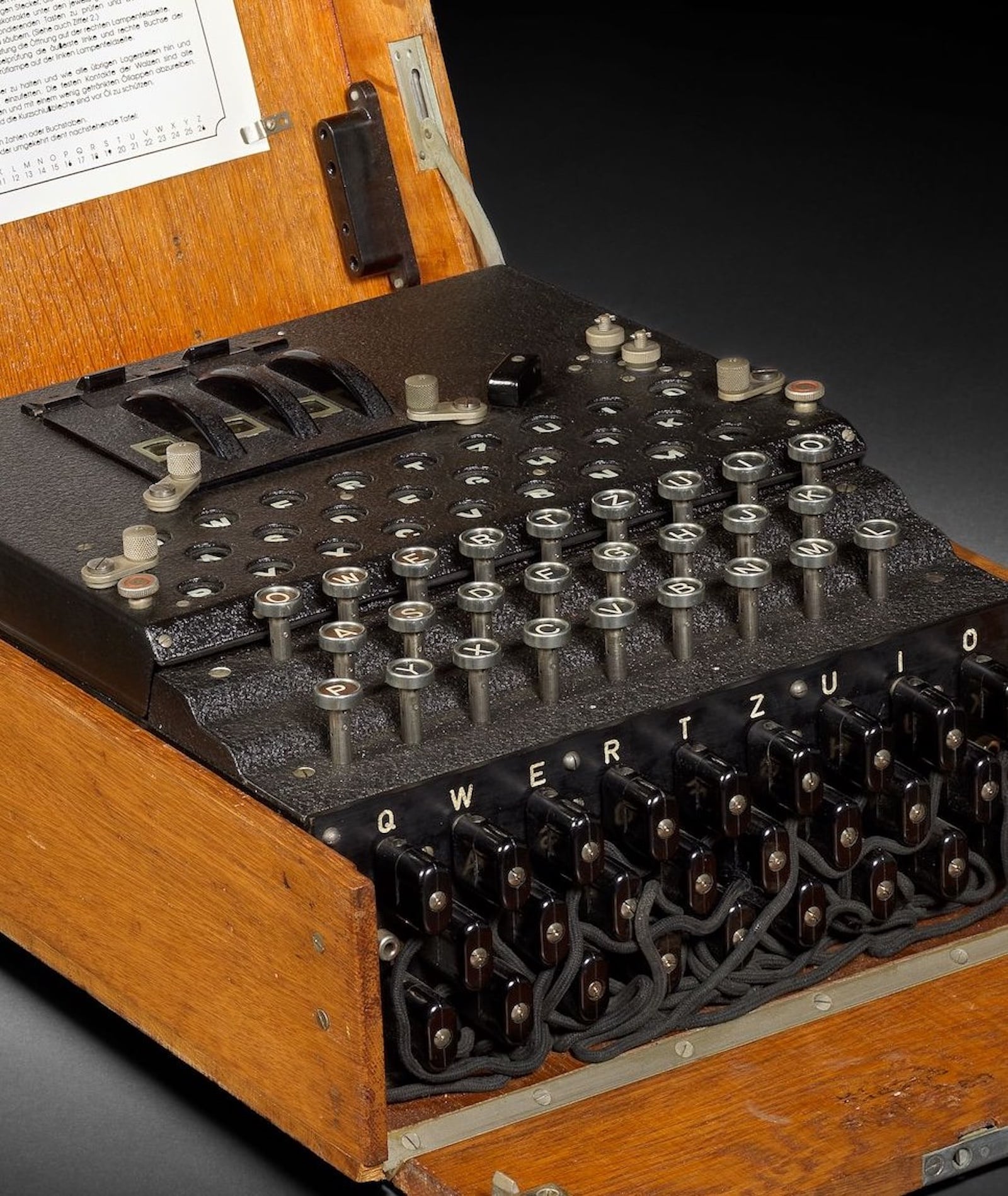
When an operator pressed a letter on the keyboard, an electrical signal flowed through the plugboard (the Steckerbrett, where pairs of letters were swapped via cable connections), then through each of the three rotors in sequence, hit a fixed reflector that bounced the signal back through all three rotors in reverse order, passed through the plugboard again, and finally lit up a lamp on the display panel indicating the enciphered letter.
Enigma I machines with matching serial-numbered rotors, original cases, and documented exhibition history are an increasingly scarce category on the military collector market. The presence of all 13 Stecker cables, the original outer oak case, and a provenance chain that includes institutional loans all adds meaningfully to this example’s desirability.
It’s now due to pass across the auction block with Bonhams on the 28th of May with a price guide of £120,000 – £160,000 which is approximately $160,000 – $214,000 USD. If you’d like to read more or register to bid you can visit the listing here.
Images courtesy of Bonhams

Articles that Ben Branch has written have been covered on CNN, Popular Mechanics, Smithsonian Magazine, Road & Track Magazine, the official Pinterest blog, the official eBay Motors blog, BuzzFeed, Autoweek Magazine, Wired Magazine, Autoblog, Gear Patrol, Jalopnik, The Verge, and many more.
Silodrome was founded by Ben back in 2010, in the years since the site has grown to become a world leader in the alternative and vintage motoring sector, with well over a million monthly readers from around the world and many hundreds of thousands of followers on social media.