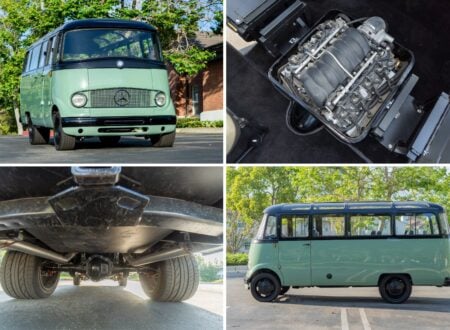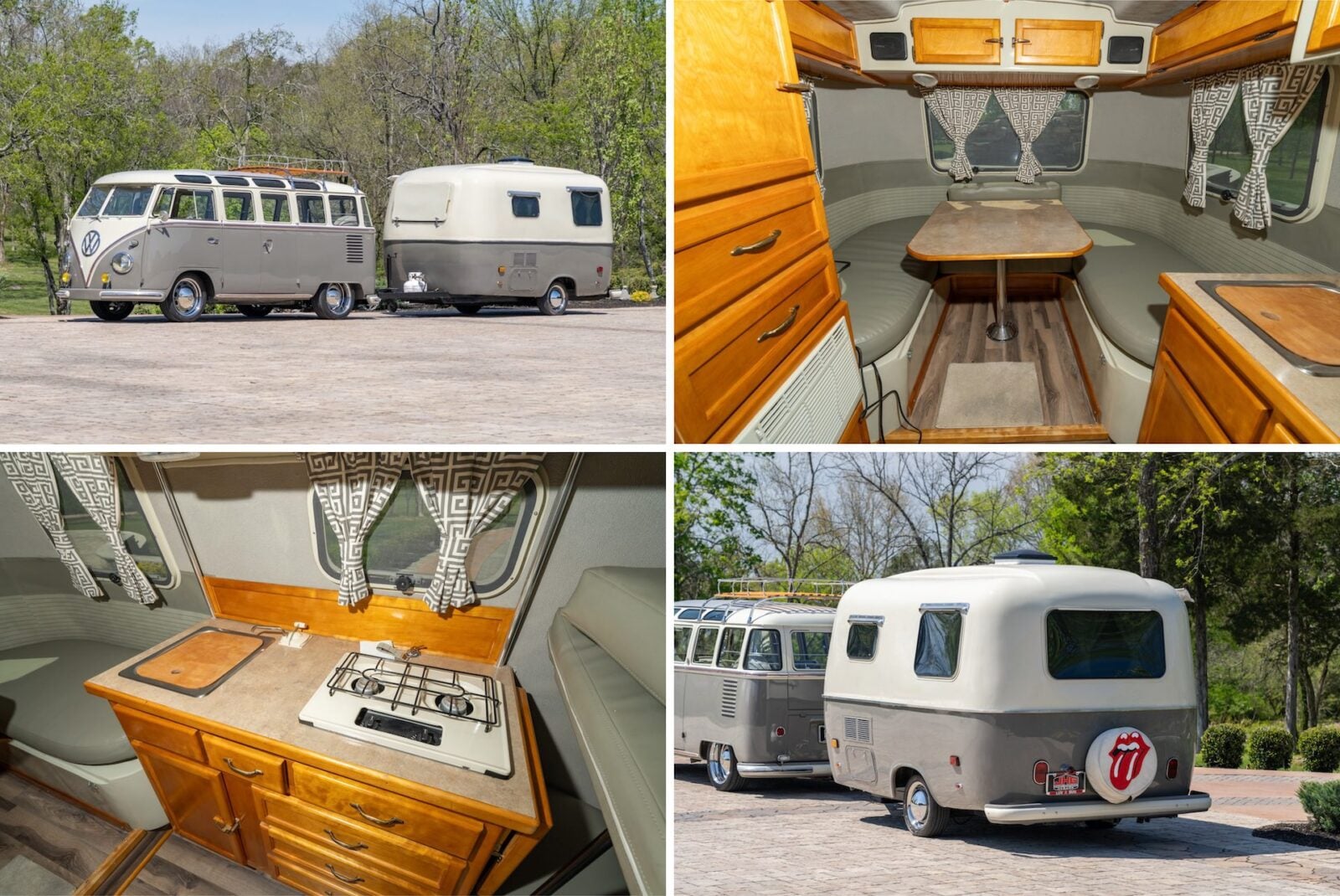
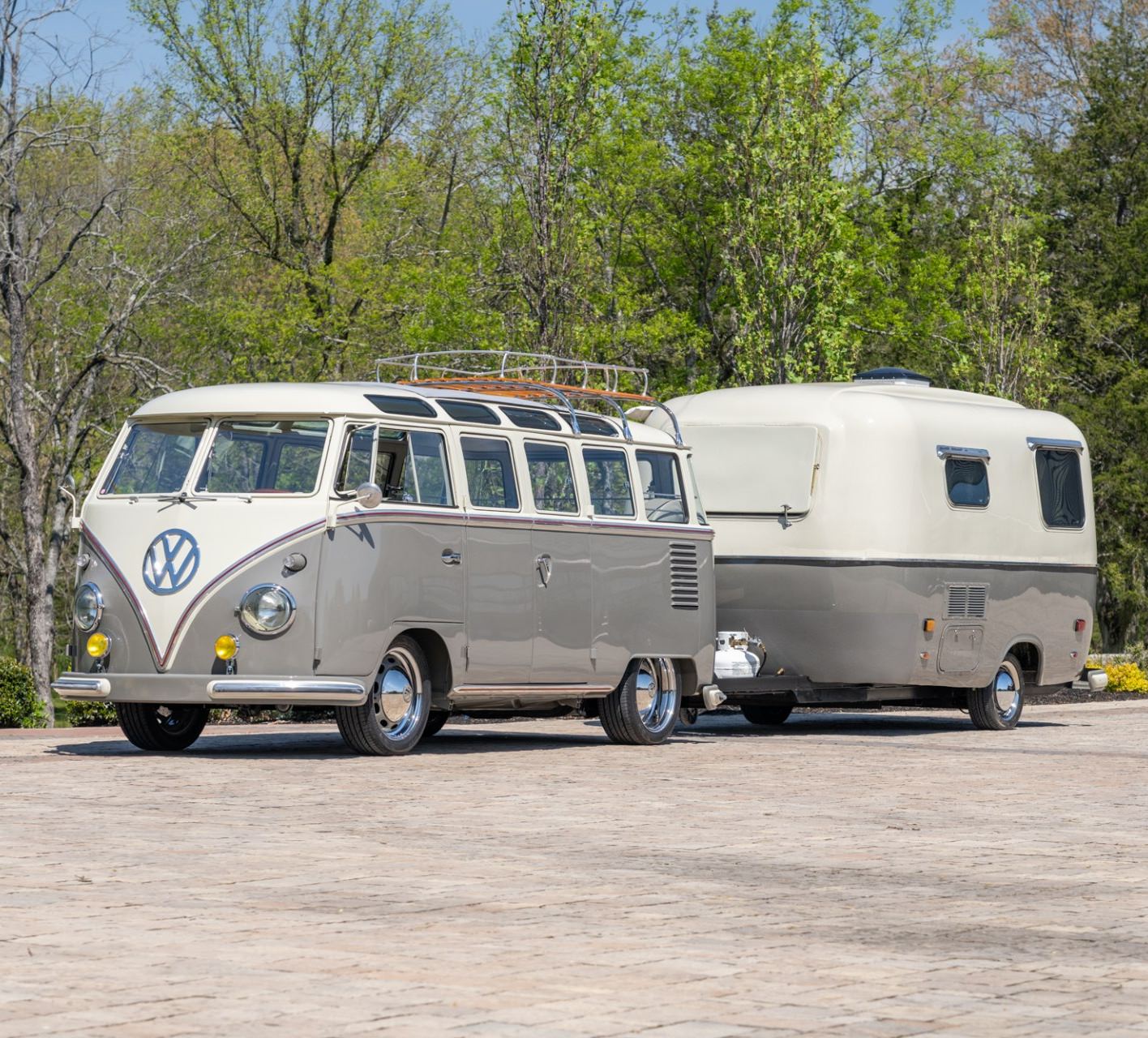
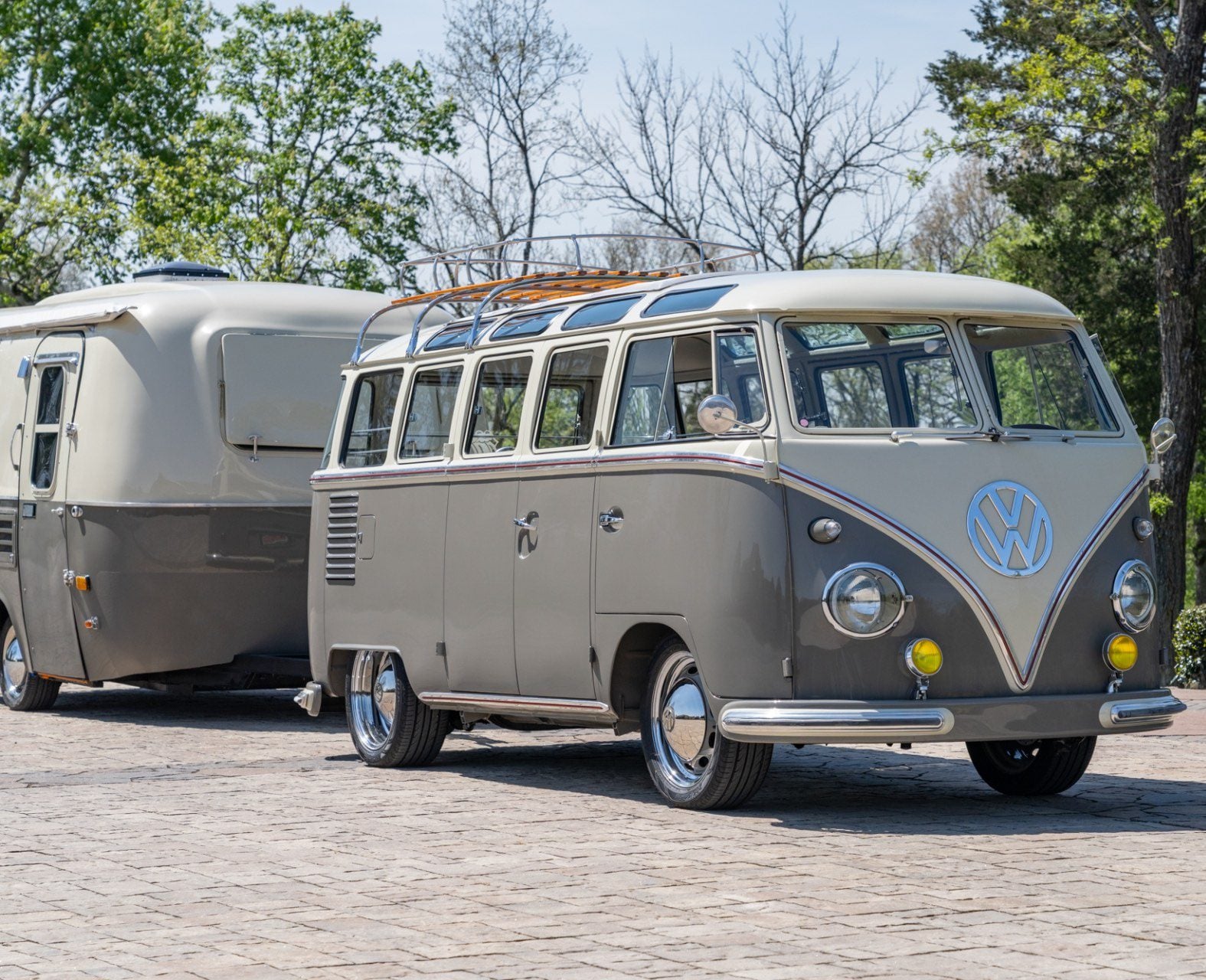
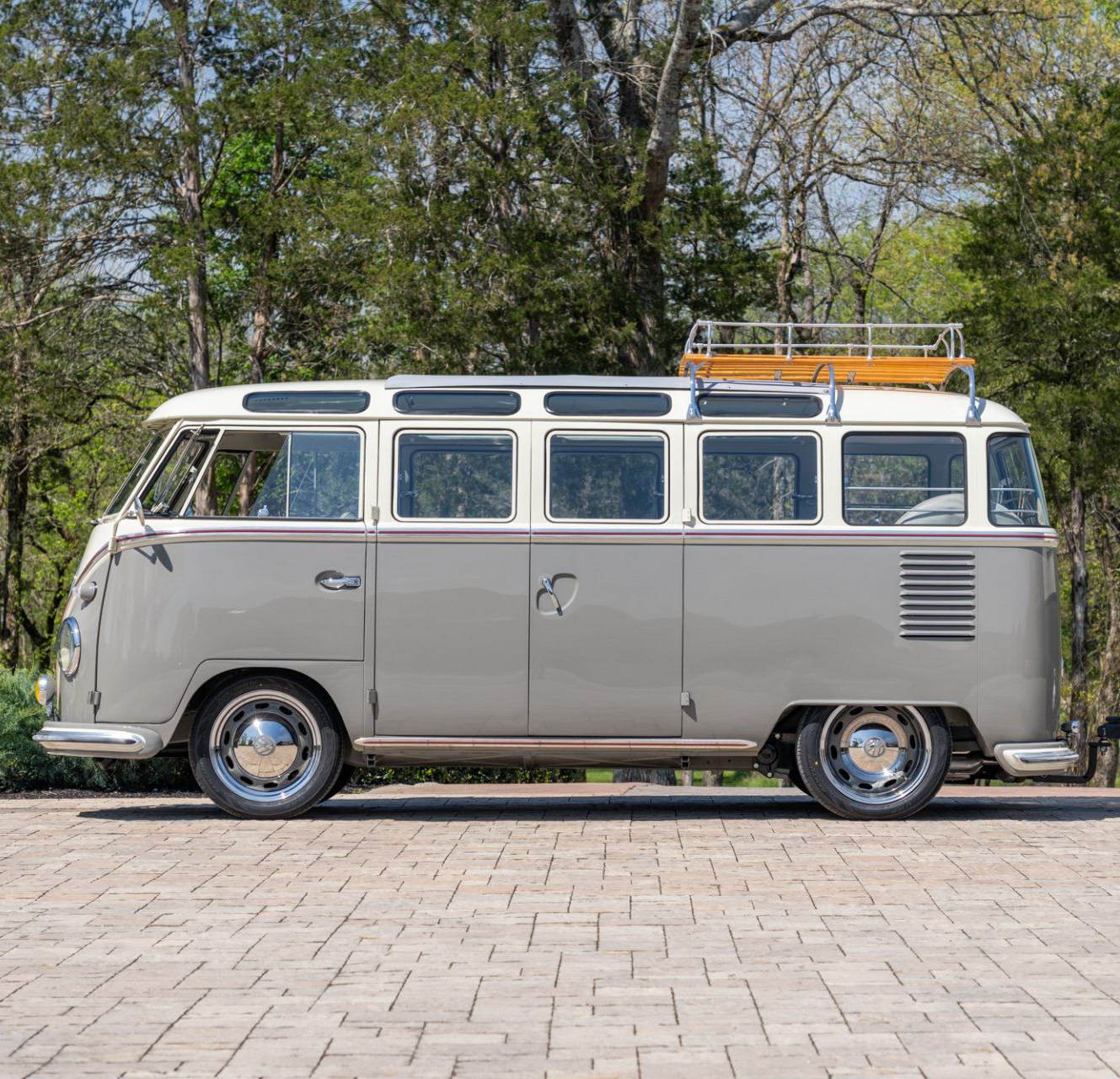
This is a 1962 Volkswagen 15 Window Deluxe Bus that’s now being sold as a package with a matching travel trailer as the perfect retro home-on-wheels.
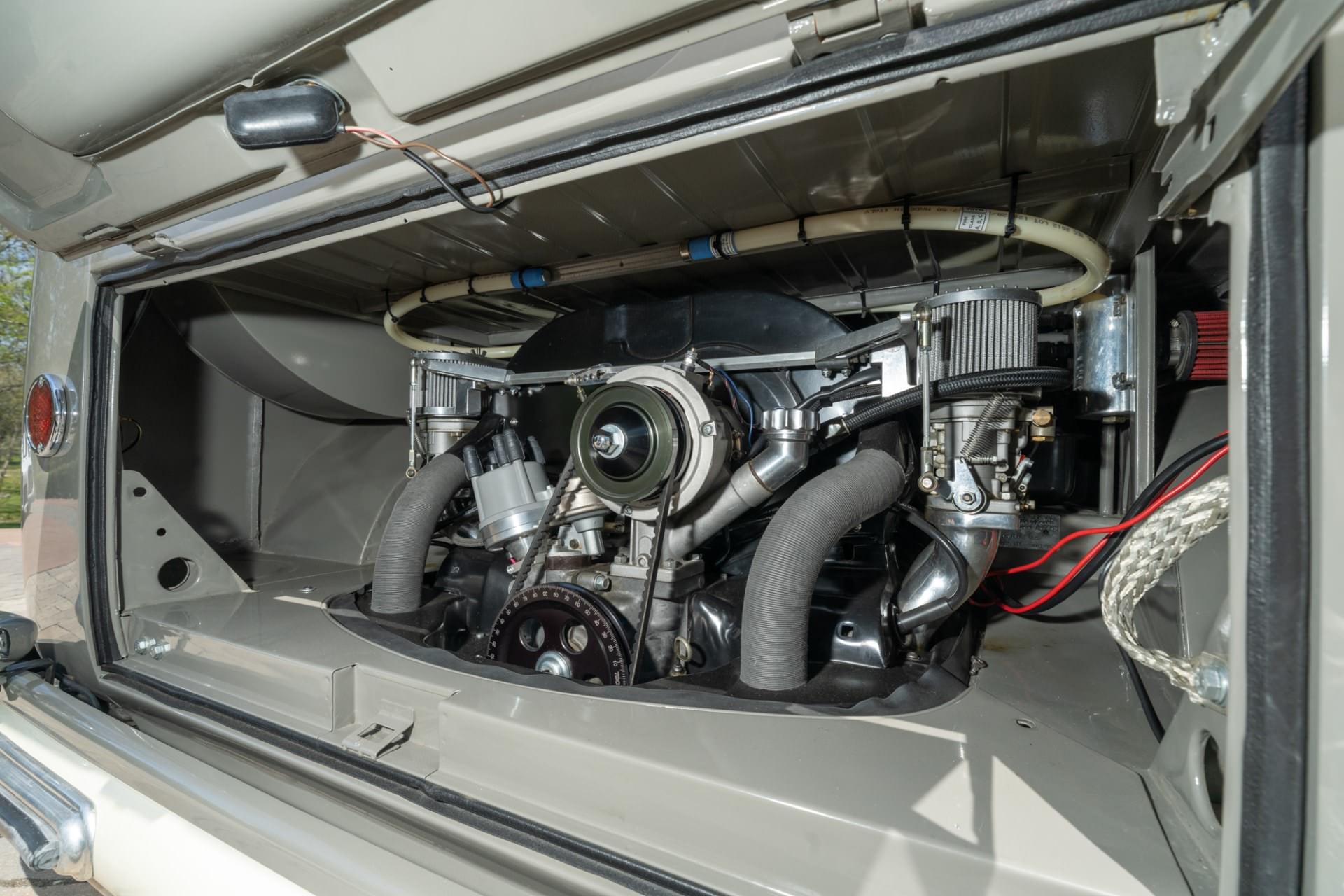
This VW Bus has been significantly modified from original, it’s now powered by a 2.0 liter 130 bhp flat-four with 148 lb ft of torque, mated to a freeway flyer Rancho Performance transaxle. It has Wilwood four wheel disc brakes, uprated suspension, and a full custom interior.
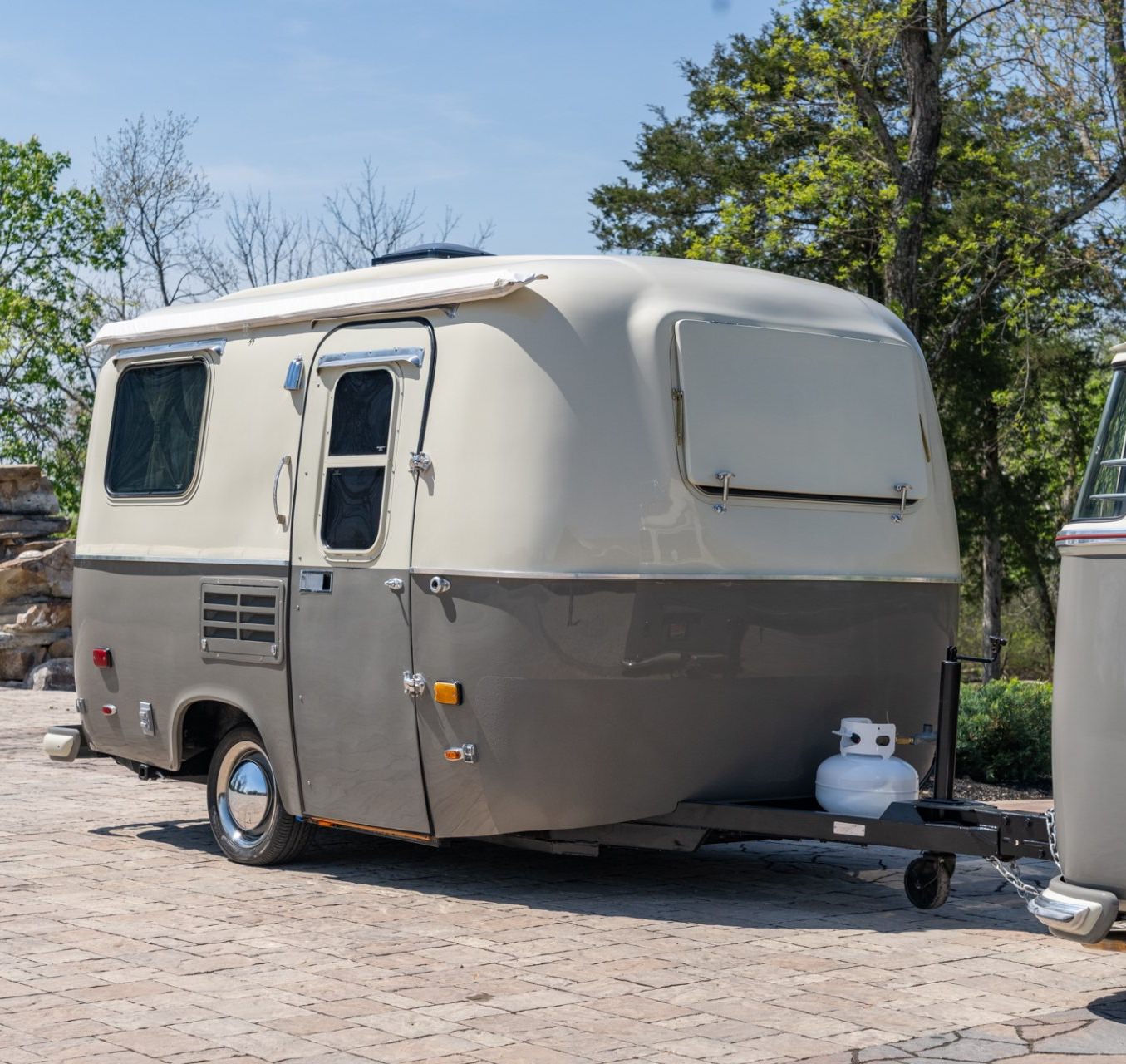
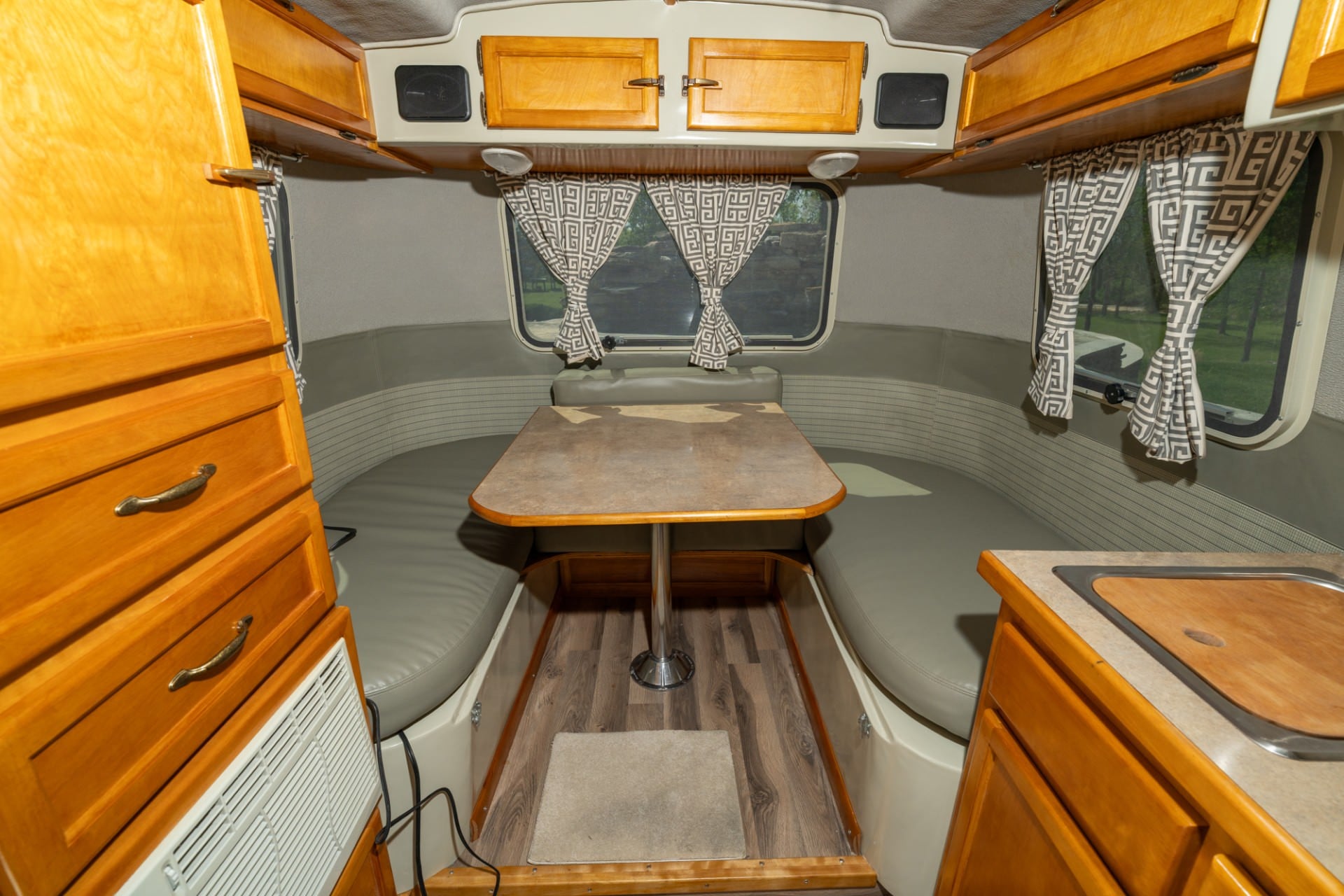
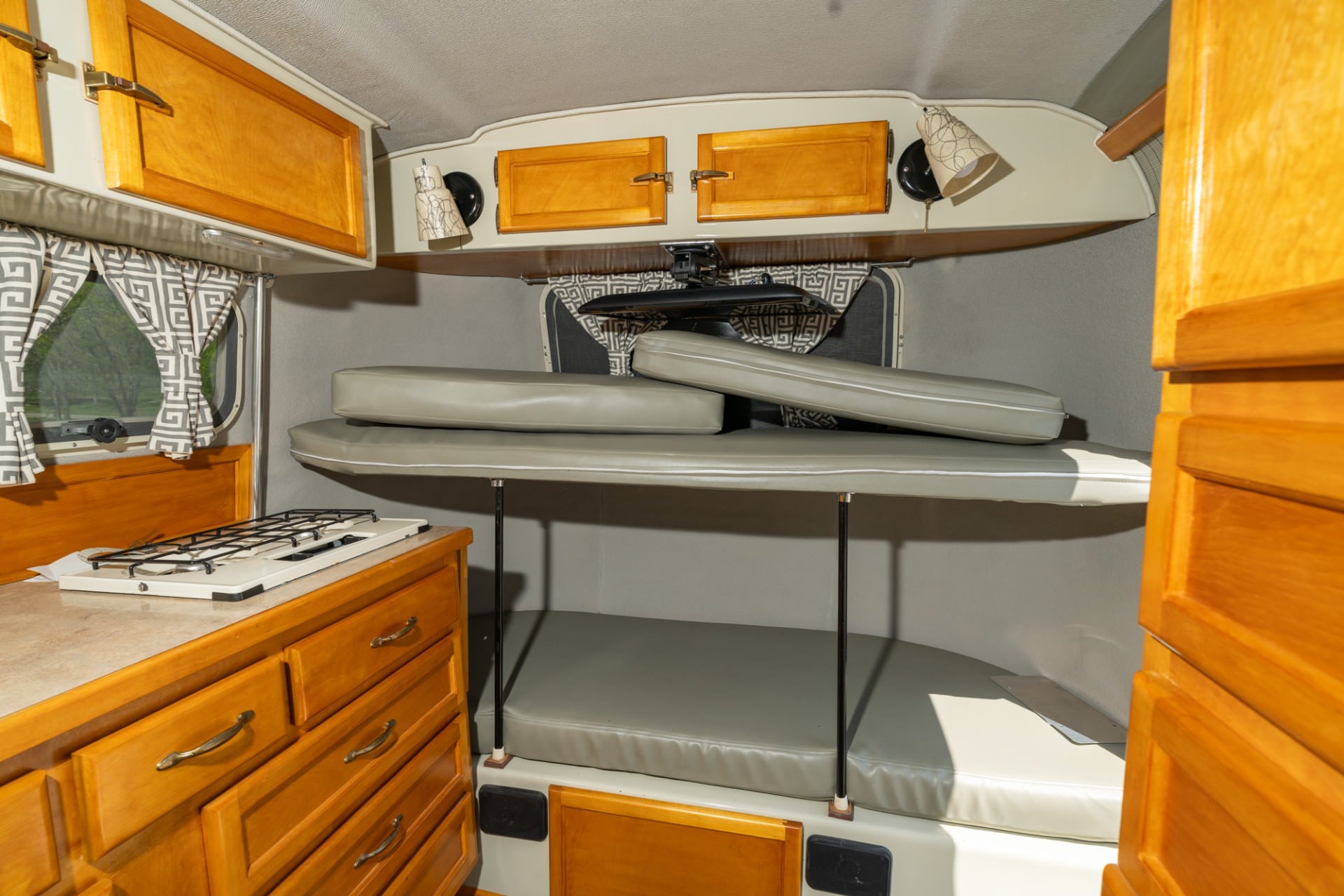
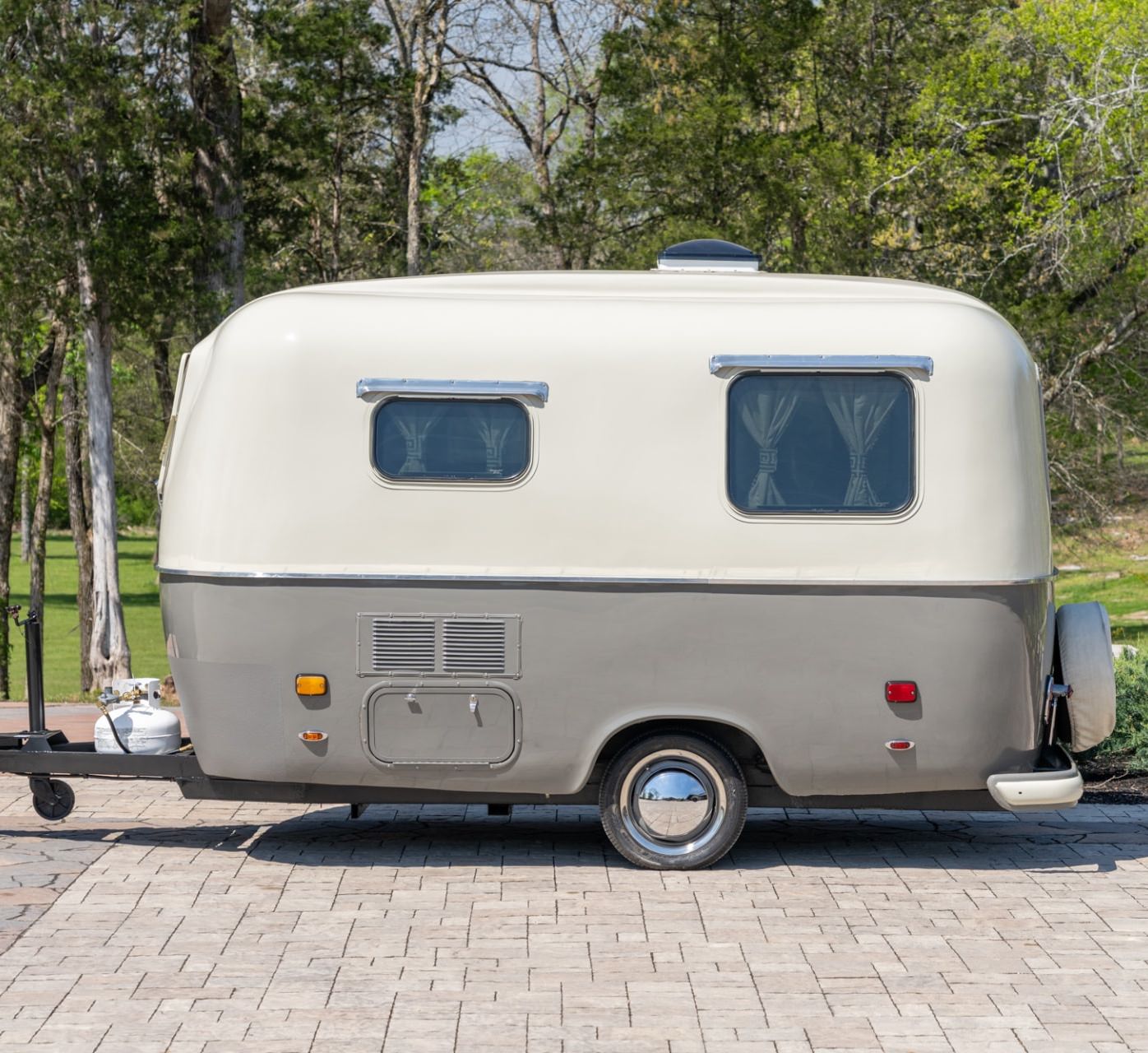
 The matching travel trailer can sleep up to four, in bunk beds and a dinette that converts into a double bed, and it has a kitchenette as well for meals on the go.
History Speedrun: The Volkswagen Type 2 (T1)
Perhaps fittingly, the Volkswagen Type 2 began as a doodle. In 1946 the Dutch dealer Ben Pon, who would become Volkswagen’s Netherlands importer the following year, visited the Wolfsburg factory intending to arrange Beetle imports, but while he was there he noticed the Plattenwagen, a crude flatbed parts-mover the factory had built on a Beetle chassis with the driver perched at the back.
Pon envisioned a new production vehicle based on the same fundamental idea. On April the 23rd, 1947, he sketched a simple box-shaped van with the driver at the very front, the engine at the rear, and a load bay between them, proposing a payload of 1,500 lbs.
The project had to wait for factory capacity, which was completely consumed by the runaway demand for new Beetles, but development began in earnest in 1948 under Volkswagen’s postwar managing director Heinz Nordhoff.
The first prototype, known internally as the Type 29, was built in about three months. Pon’s original notion of bolting a body onto the Beetle’s floor pan proved unworkable because the pan was too weak, so engineers used a ladder-type chassis with a unitized body.
The wheelbase came out at 94.5 inches (2,400 mm), the same as the Beetle’s. Early shapes were aerodynamically poor, and wind-tunnel work at the Technical University of Braunschweig reshaped the nose and windshield into the distinctive V-front, cutting the drag coefficient from 0.75 Cd to 0.44 Cd, bettering the Beetle’s own 0.48 Cd.
Volkswagen presented the finished van in November of 1949 and began series production on March the 8th, 1950. Officially it was the Type 2, following the Type 1 Beetle, and it would be sold under names that depended on body style – Transporter for the panel van, Kombi for the windowed utility version, and Microbus for the passenger model. Germans simply called it the Bulli. Its two-piece windshield later earned it the enthusiast nicknames Splitscreen, Splittie, and split-window bus.
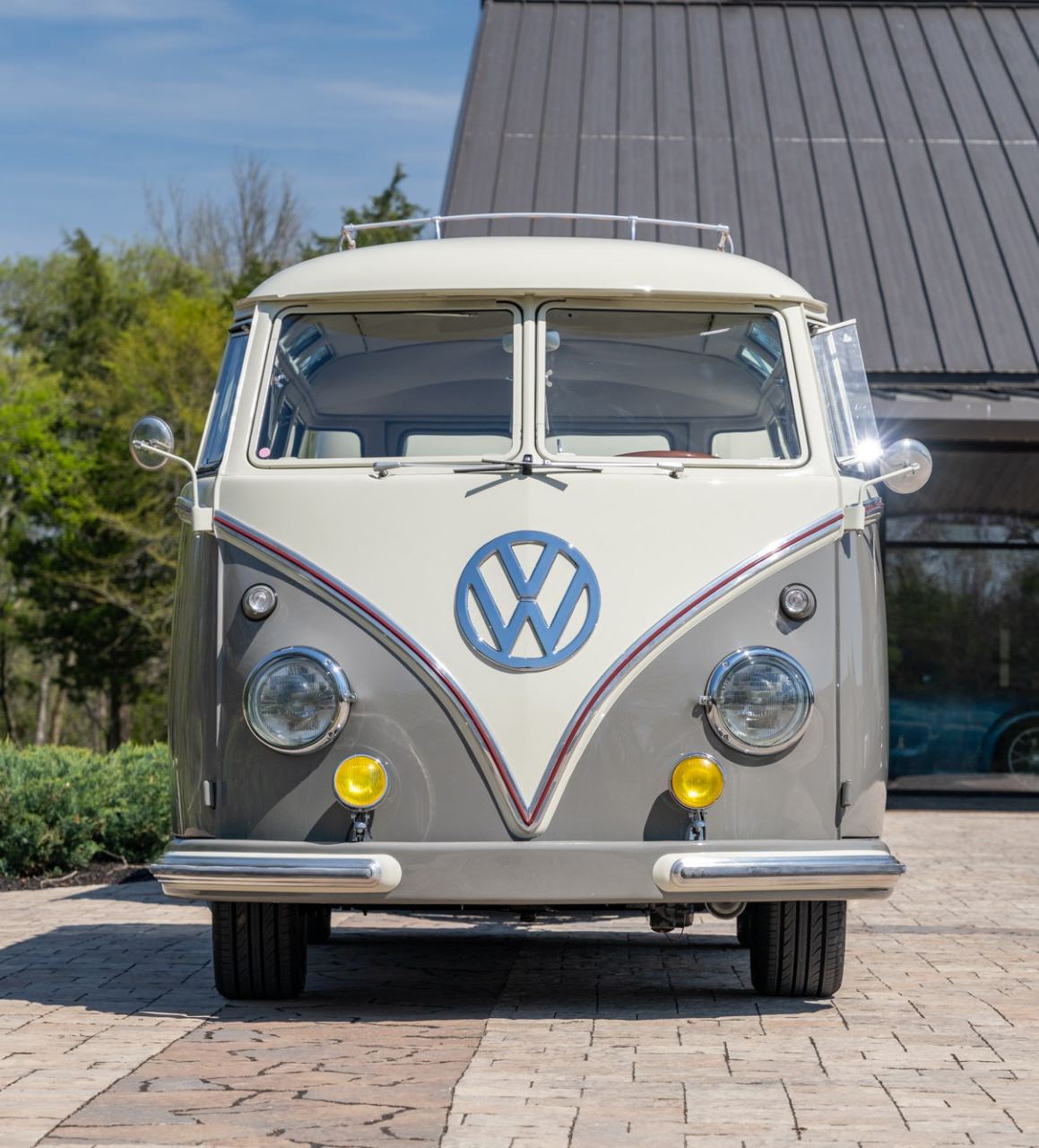
This is a 1962 Volkswagen 15 Window Deluxe Bus that’s now being sold as a package with a matching travel trailer as the perfect retro home-on-wheels.
Mechanically the vans were Beetle-derived and modest in their fitout in order to keep costs low. The first vans used the 1,131cc air-cooled flat-four boxer engine rated at 25 bhp, driving the rear wheels through a 4-speed gearbox with reduction gears in the hubs that traded top speed for the low-end pull a loaded van needed.
Top speed was 50 mph for the earliest vans, rising to closer to 65 mph on later, more powerful models. Power grew over the years, a 1,192 cc unit of 30 bhp arrived in 1953, a higher compression ratio became standard in 1955, and an unusual 34 bhp version offered briefly from 1959 proved troublesome and was discontinued almost immediately.
In 1962 a heavy-duty model introduced a 1.5 liter (1,493 cc) engine rated at 42 bhp, raising the payload to 1,000 kgs from the original 750 kgs. For the 1963 model year the 1.5 liter became standard in the US market and soon replaced the 1.2 liter in the regular range, with some later and export versions rated higher, at around 50 bhp.
The Type 2 grew into a surprisingly wide range of configurations and variants. At launch only two were offered, the Kombi and the Commercial panel van, a passenger Microbus followed in May of 1950 and a luxury Deluxe Microbus in June of 1951, the multi-window model later nicknamed Samba, fitted with skylight windows and a folding canvas sunroof.
An ambulance was added in December of 1951, a single-cab pickup in August of 1952, and later a double-cab pickup and a flatbed. Enthusiasts came to identify the passenger versions by window count – the standard 11 window bus, the 15 window Deluxe, and the range-topping 23 window Samba, which became 13 and 21 window vehicles after a 1964 rear-hatch design change.
Volkswagen delivered 11,943 Type 2s worldwide in 1951 and reached 100,000 examples within four years. Output outgrew Wolfsburg, and in 1956 VW opened a dedicated Transporter plant in Hanover, which still builds Volkswagen vans today.
The one-millionth Transporter was built in the early 1960s, and by the time German T1 production ended after the 1967 model year, well over 1.8 million had been made. Brazil built its own T1-based vans from 1957 until 1975, after which a T1/T2 hybrid known as the “T1.5” (with the later T2 front end and a T1 rear) continued there until 1996.
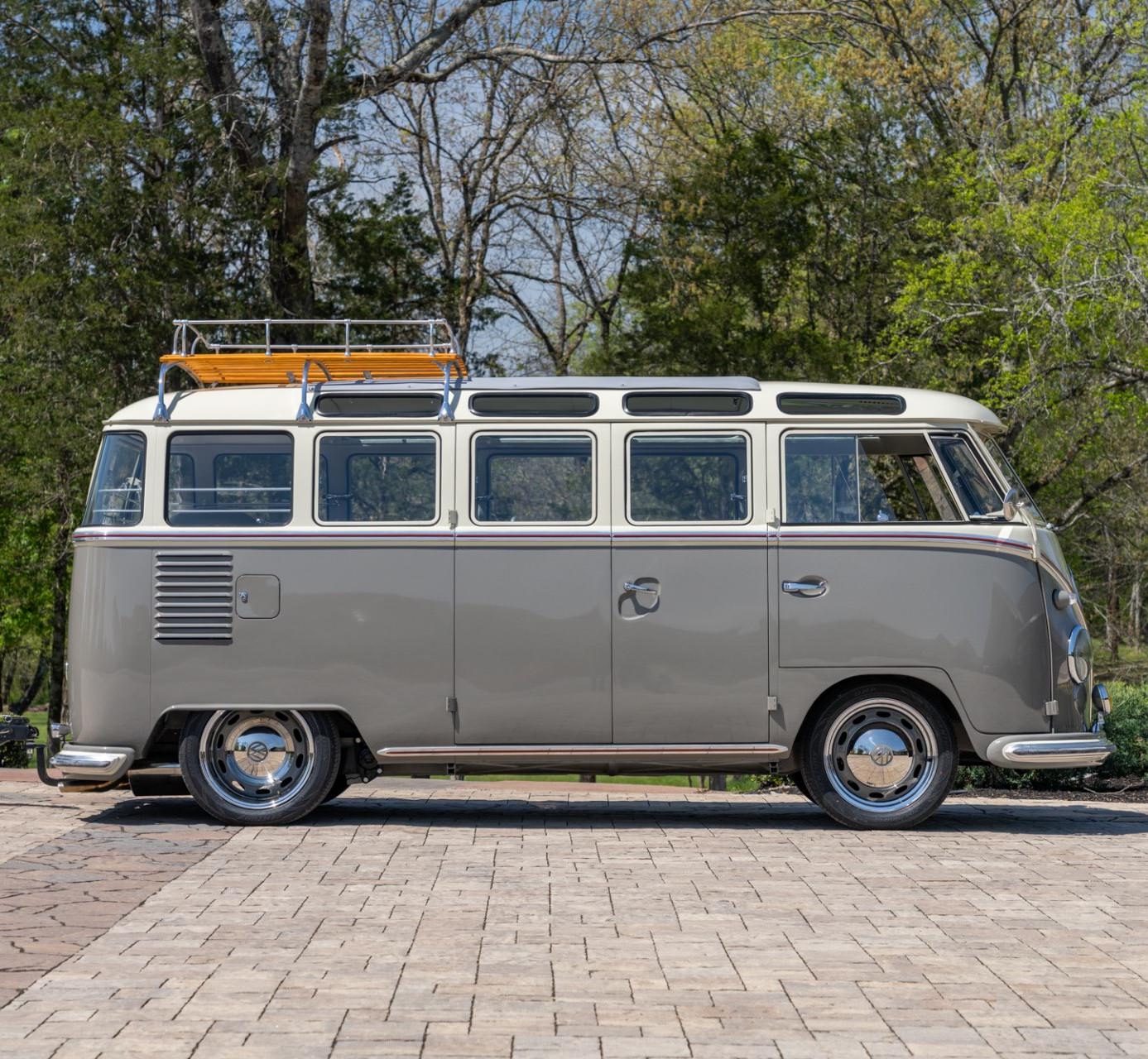
This VW Bus has been significantly modified from original, it’s now powered by a 2.0 liter 130 bhp flat-four with 148 lb ft of torque, mated to a freeway flyer Rancho Performance transaxle. It has Wilwood four wheel disc brakes, uprated suspension, and a full custom interior.
The T1’s most lasting cultural role came from its use for camping. This hadn’t been an original design intent for the van, but an inexpensive box on wheels that could be driven around turned out to be perfect as a little home-on-wheels.
In 1951 the German coachbuilder Westfalia-Werke, based in the Westphalia region of Germany, built a removable “Camping Box” for the Transporter, reportedly at the request of a British officer who wanted a van he could live and travel in.
The kit turned the cargo bay into a small living space with a folding bed, a table, a bench seat, storage, and the checked upholstery that became a Westfalia signature. Westfalia was not strictly the first to convert a Transporter, as a Dresden coachbuilder is credited with beating them to it, but it was the first to do so in volume, and it became Volkswagen’s official camper partner.
About 1,000 Camping Box conversions were built between 1951 and 1958, after which Westfalia introduced its numbered SO (Sonderausführung, or special model) range, beginning with the SO-23 Deluxe, and added features like pop-top roofs late in the T1 era.
Westfalia campers were sold through VW dealers worldwide and offered through a Tourist Delivery Program that let buyers collect a new van in Germany, tour Europe, and have it shipped home. American servicemen stationed in Germany bought them in large numbers and brought them back, and the bus found a natural home first in California surf culture and then in the 1960s counterculture, where the cheap, slow, roomy camper became a symbol of the flower-power-Hippie-era.
Other companies, including Dormobile, ASI/Riviera, and Danbury, built their own conversions, but Westfalia’s name became almost synonymous with the VW campervan.
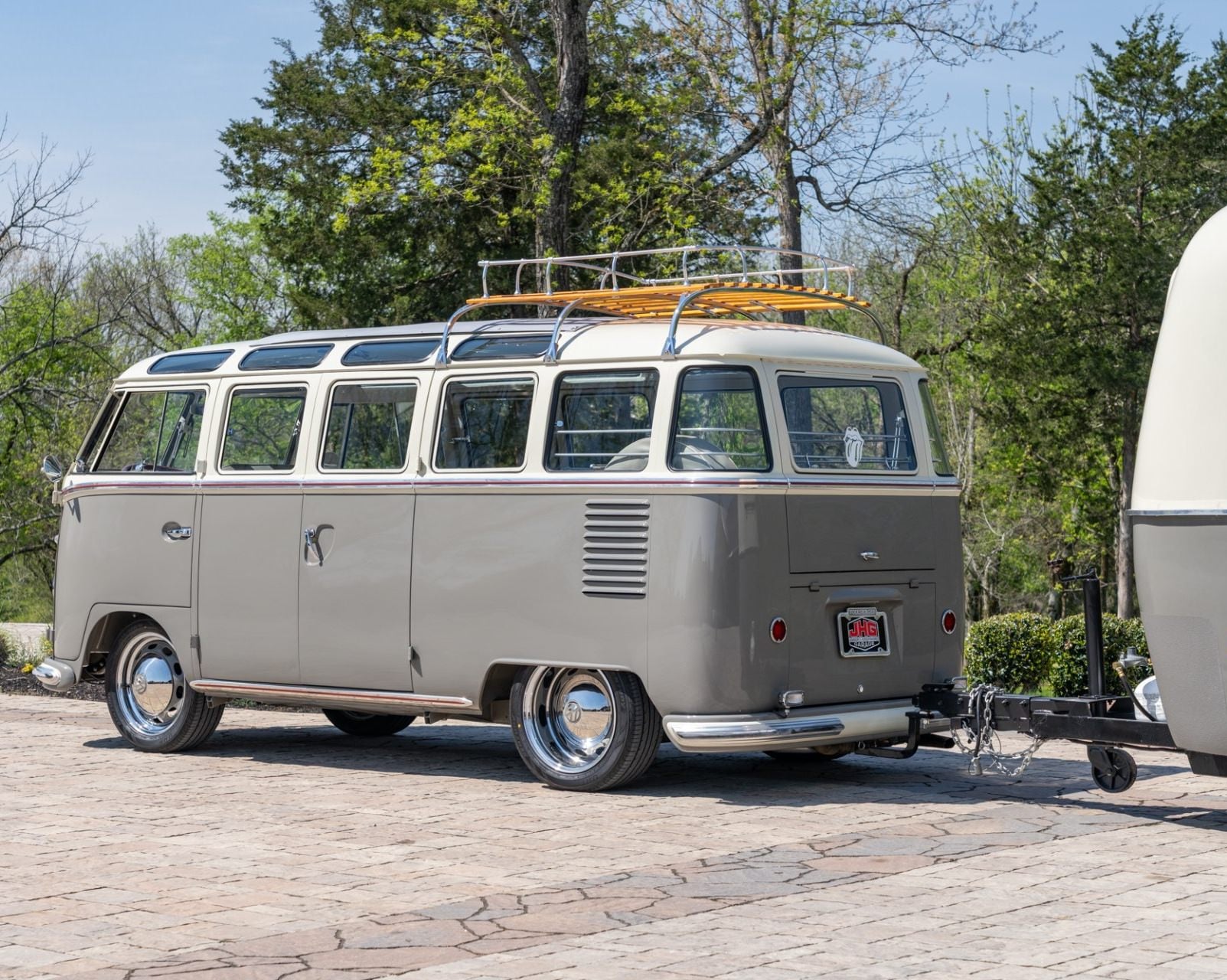
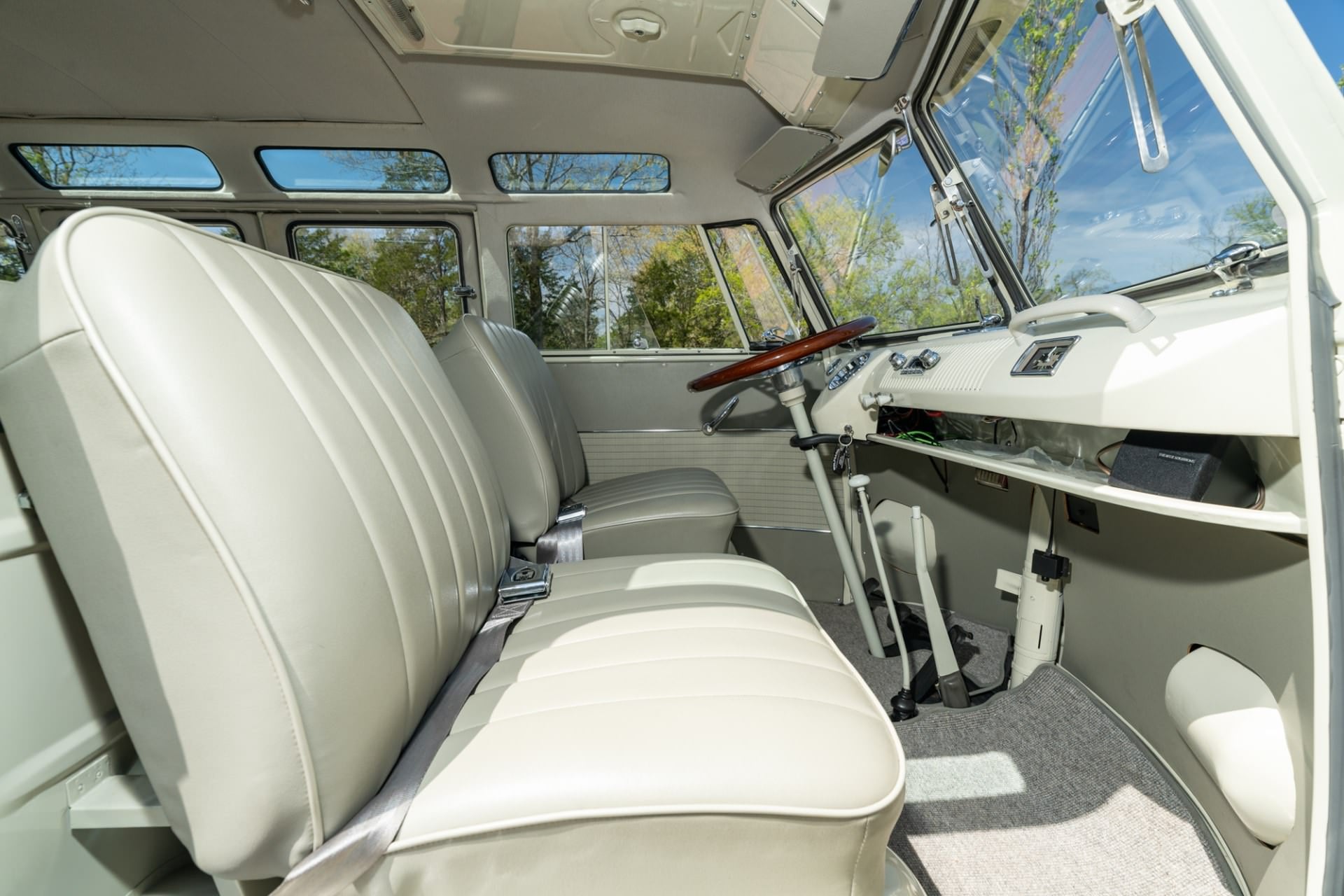
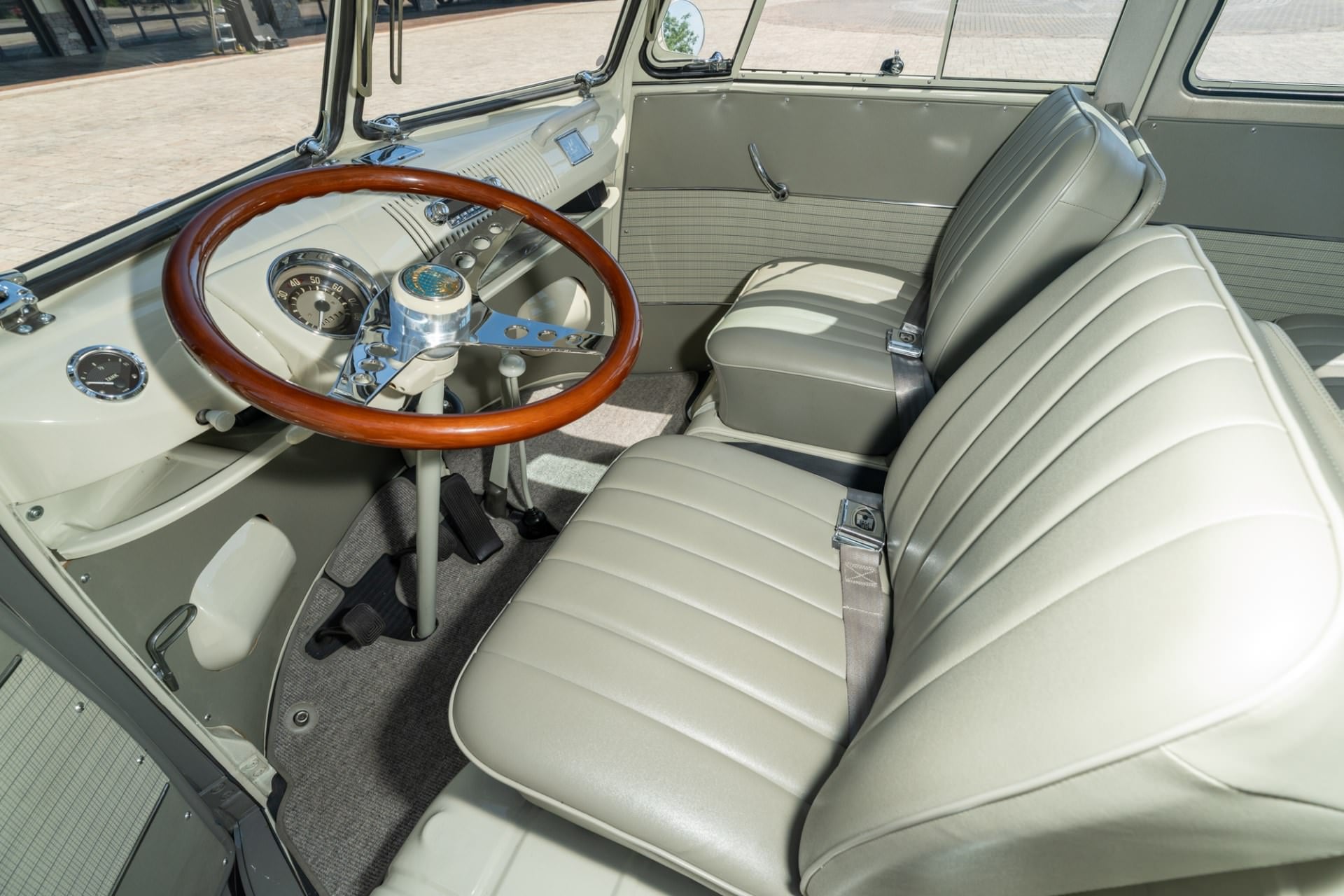
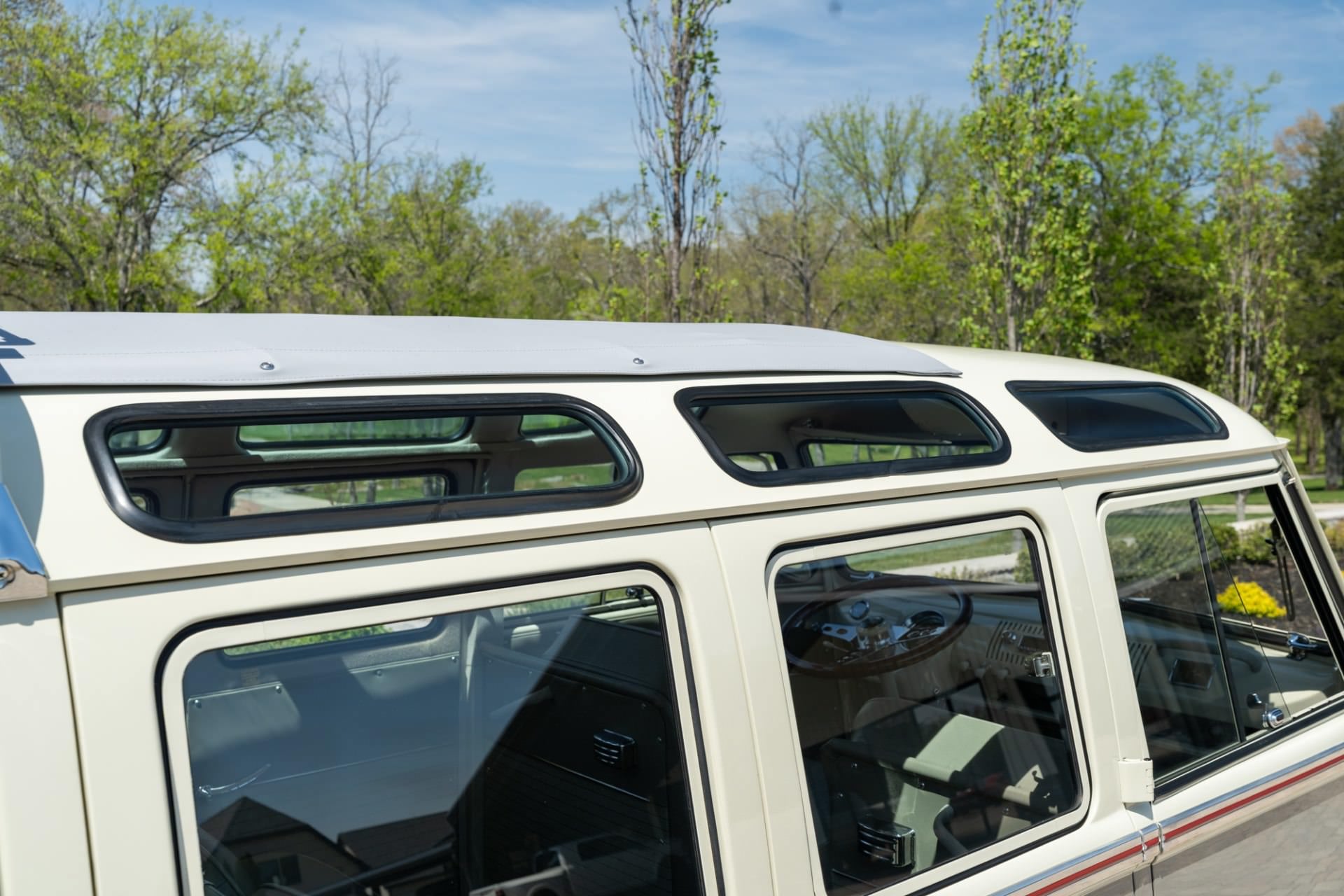
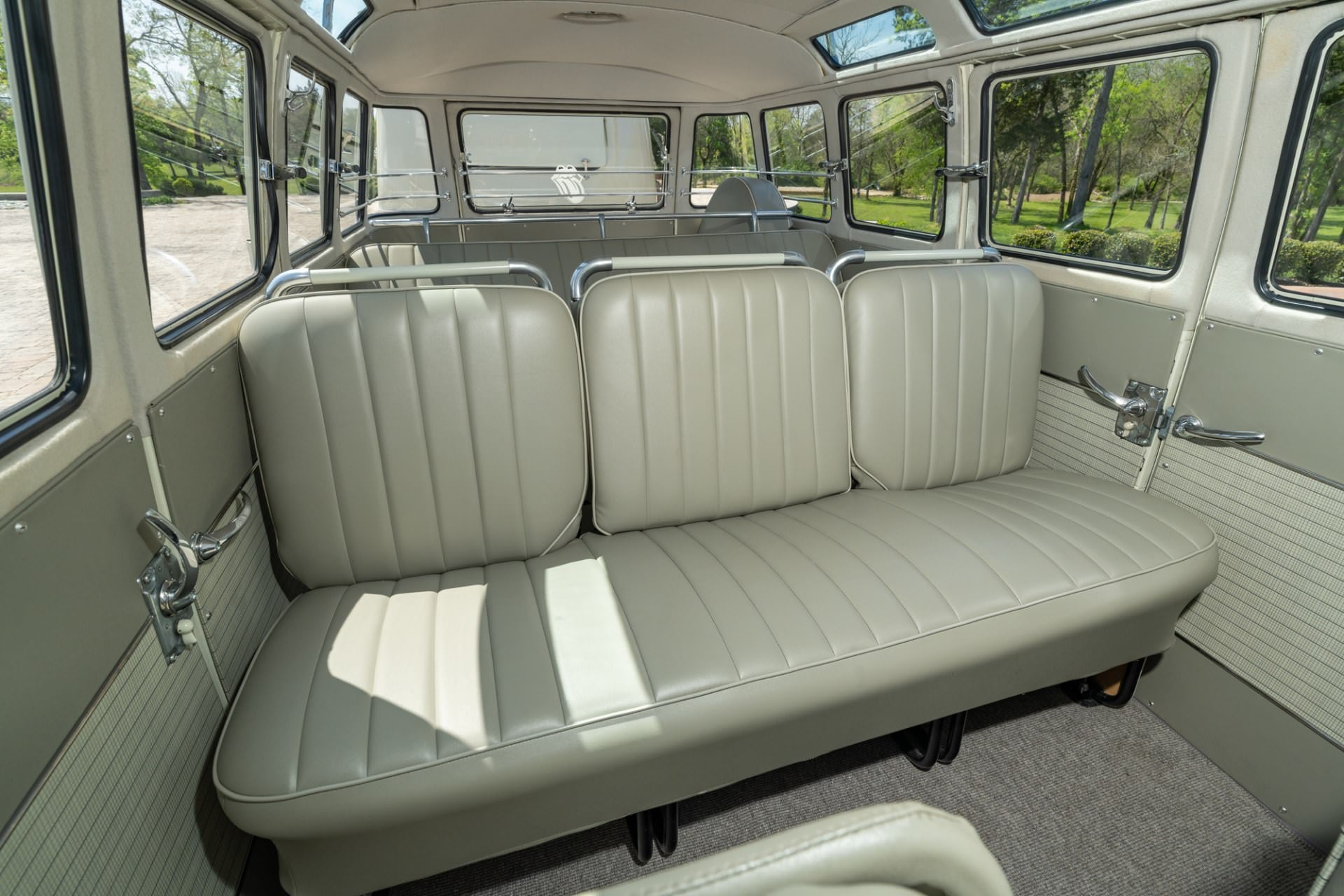
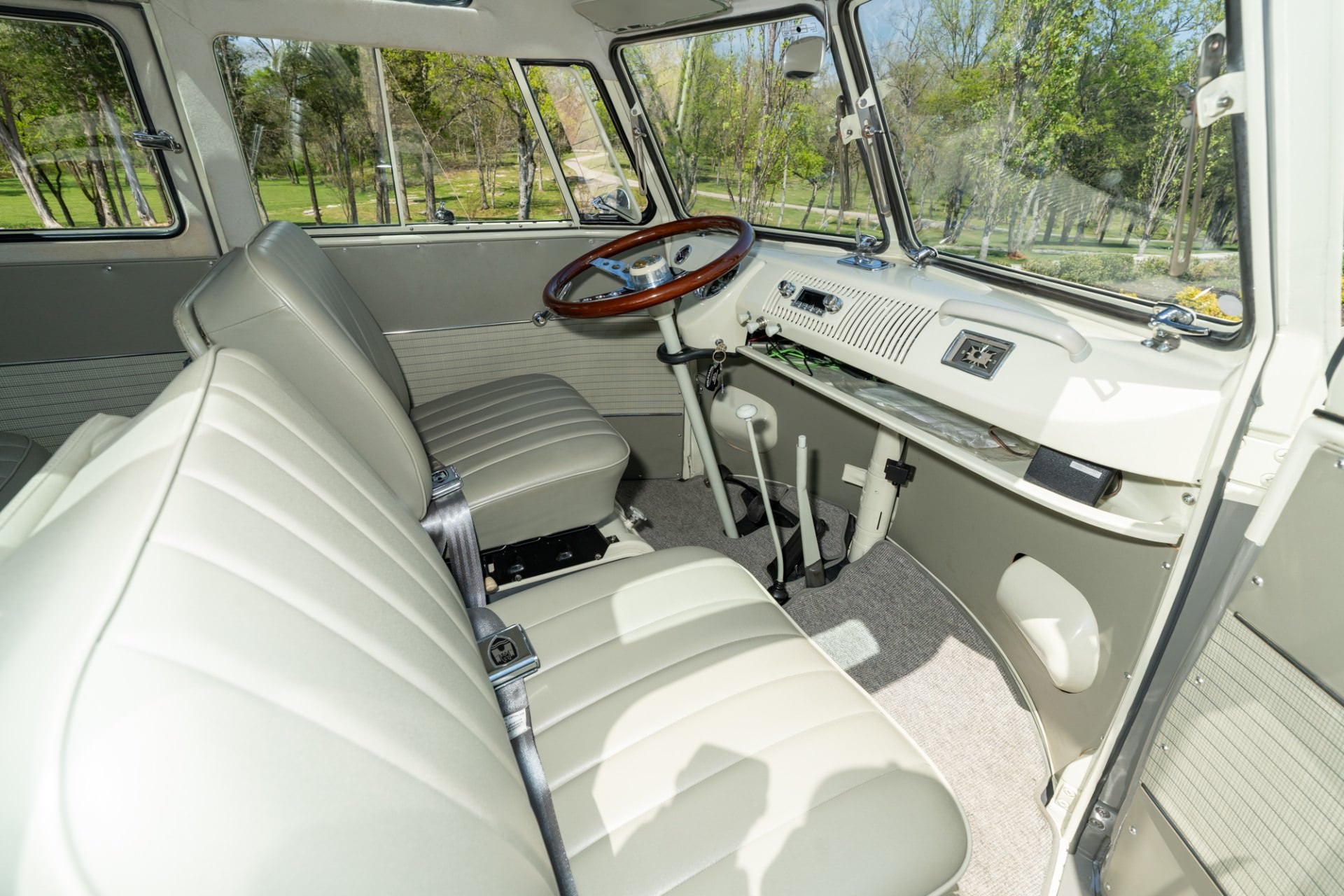
This is a Volkswagen Type 2 T1 that left the line as a 15-window Deluxe Bus and has since been modified with Samba-style upper windows and a sliding canvas sunroof installed by West Coast Classics. It now has a two-tone Mouse Grey and Pearl White paint scheme over a matching gray and white TMI interior fitted by Bustoration.
The split-window T1 gave way to the bay-window T2 for 1968, but the earlier model remains the most collectible of all the Transporters, with restored Samba and Westfalia examples now among the most valuable air-cooled Volkswagens.
The 1962 Volkswagen Bus + Matching Travel Trailer Shown Here
This is a Volkswagen Type 2 T1 that left the line as a 15-window Deluxe Bus and has since been modified with Samba-style upper windows and a sliding canvas sunroof installed by West Coast Classics. It now has a two-tone Mouse Grey and Pearl White paint scheme over a matching gray and white TMI interior fitted by Bustoration.
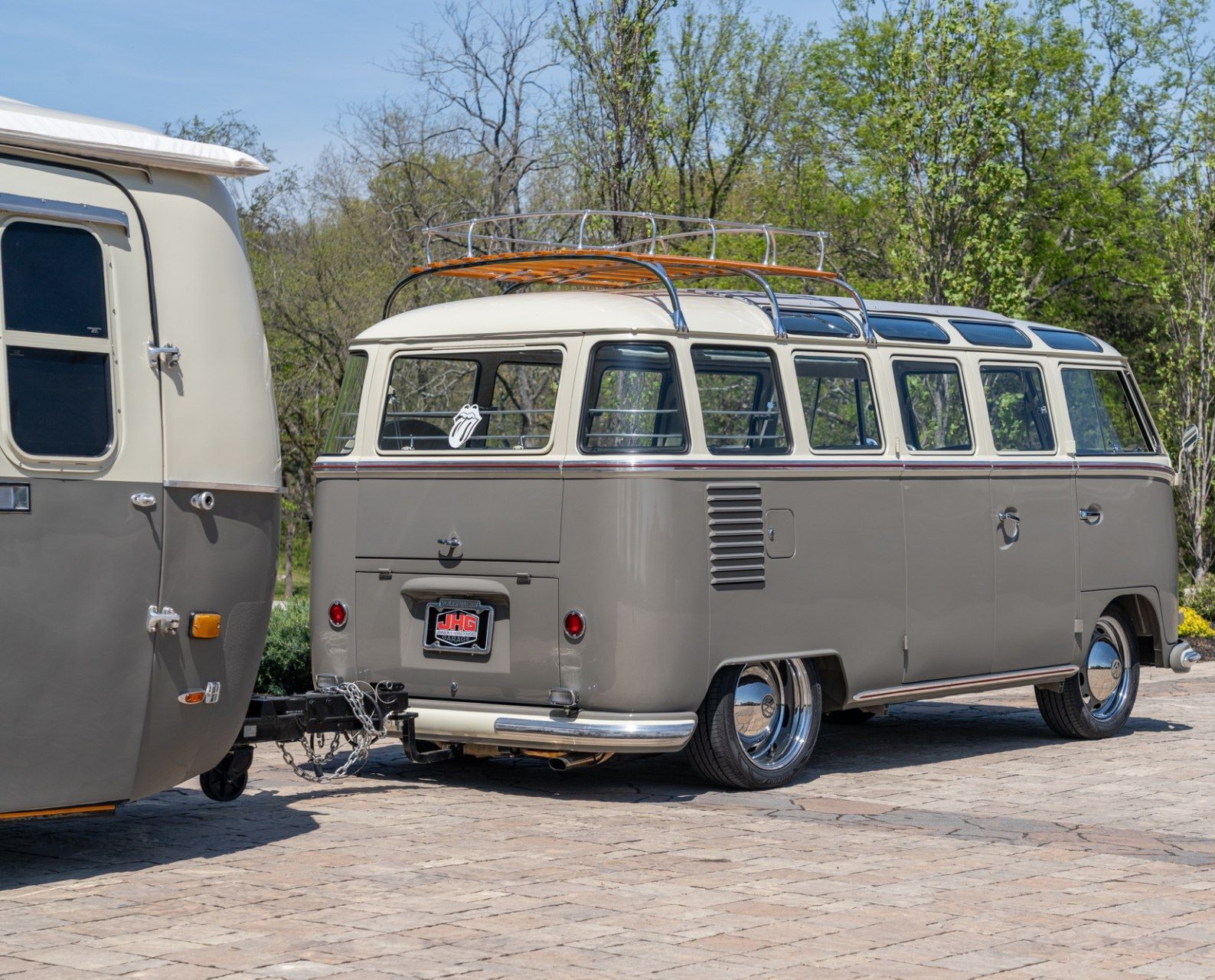
The cabin has the rare pre-1955 double flipper middle seat, a mohair headliner, and a roof rack with wooden slats. The original passenger-side barn doors have been kept, with a second set added on the driver’s side.
Power comes from a 2017cc flat-four built by Bustoration in Lake Havasu City, Arizona, fed by dual downdraft carburetors and rated at 130 bhp and 148 lb ft of torque. Drive is routed through a Rancho Performance transaxle with freeway flyer gearing and a super-diff.
The chassis has been worked over to suit, with a custom narrowed beam, Koni shocks front and rear, and Wagons West Wilwood four-wheel disc brakes. The bus rolls on Pre-A Porsche wheel centers fitted with custom chrome barrels.
It has a Safari windshield up front above a 1961 dash pod, with 1961-and-earlier-style turn signals and taillights, and 1958-and-earlier pressed bumpers at both ends. Audio is handled by a RetroSound radio with a subwoofer, amplifier, and four speakers, paired with an in-dash clock.
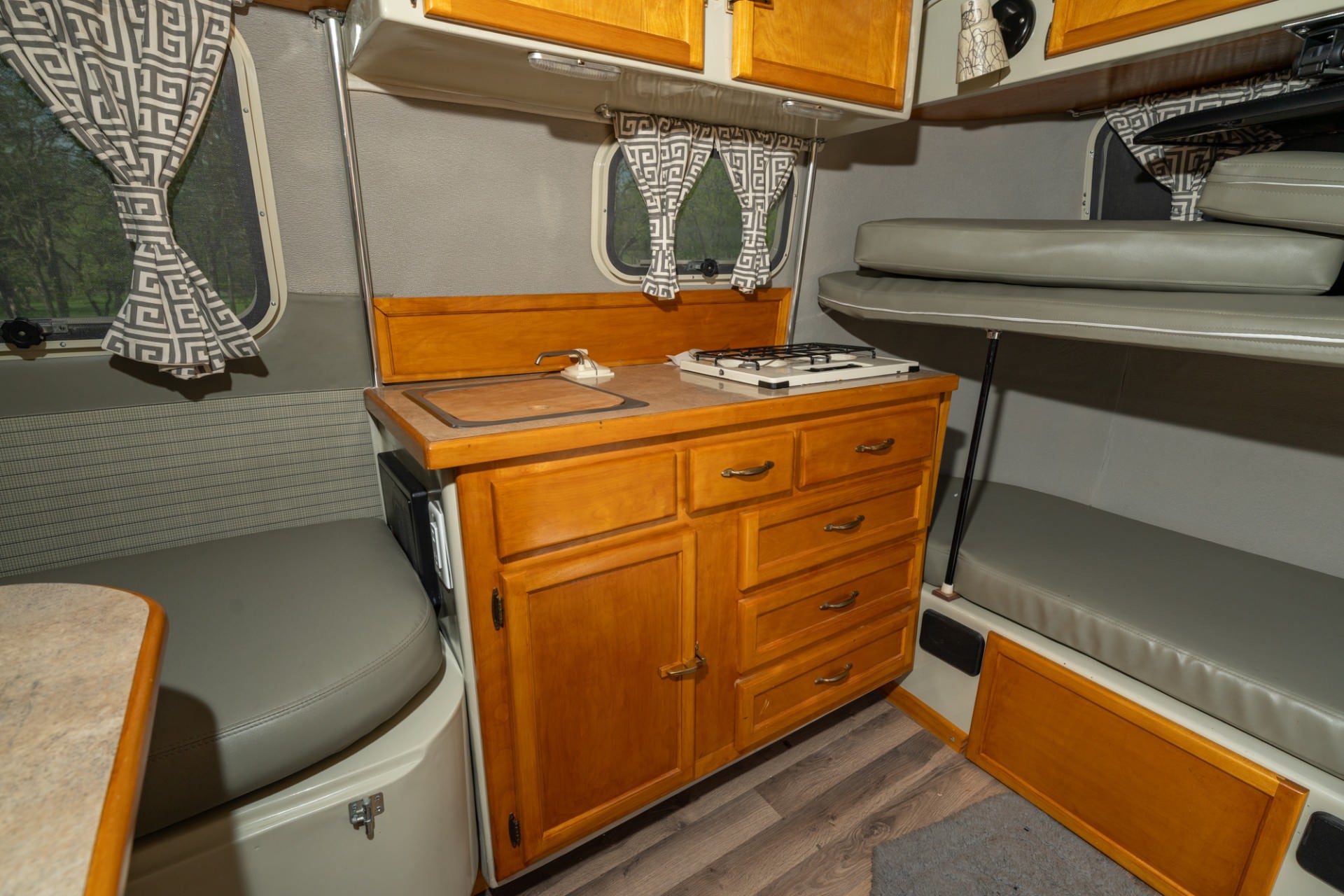
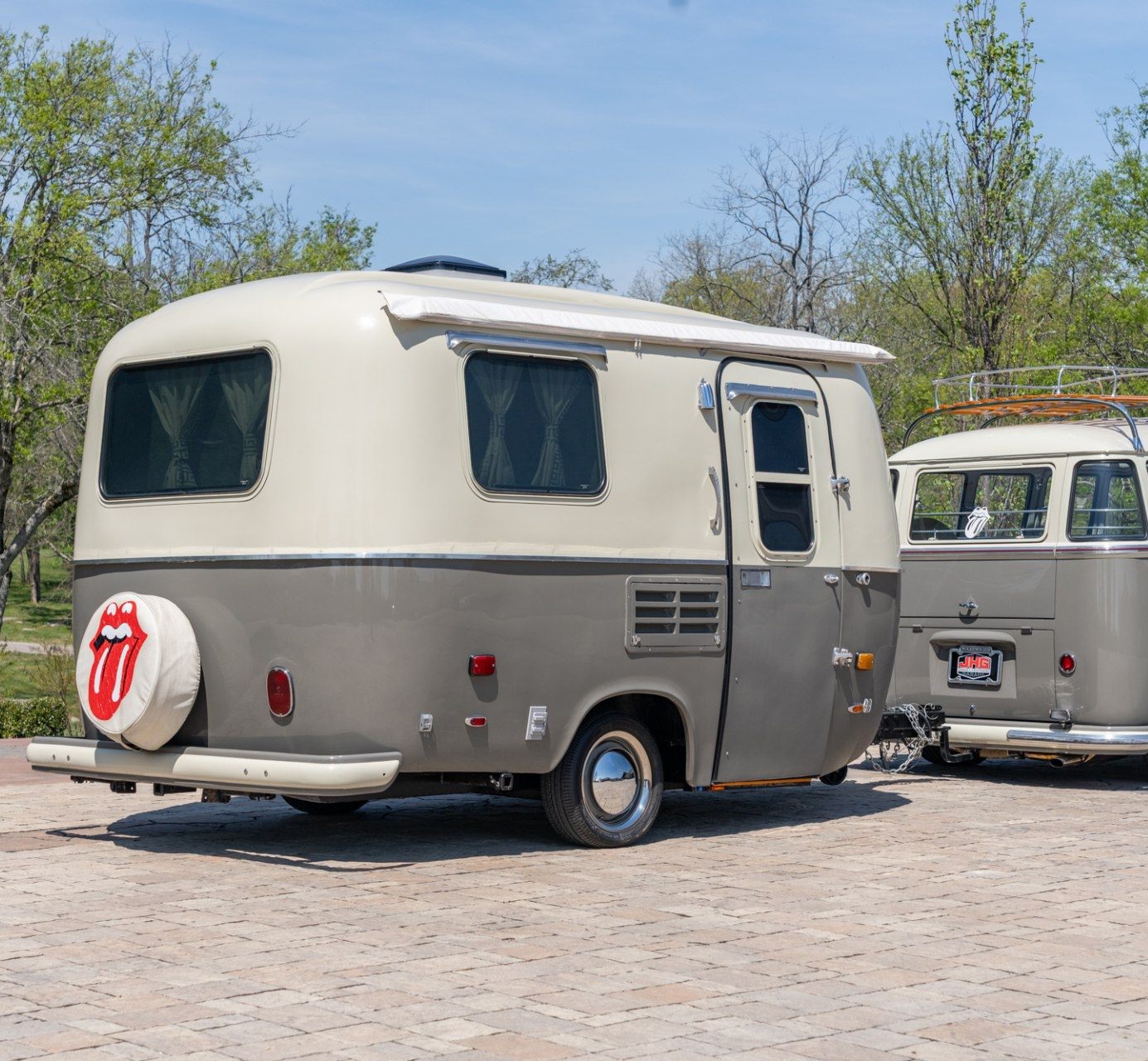
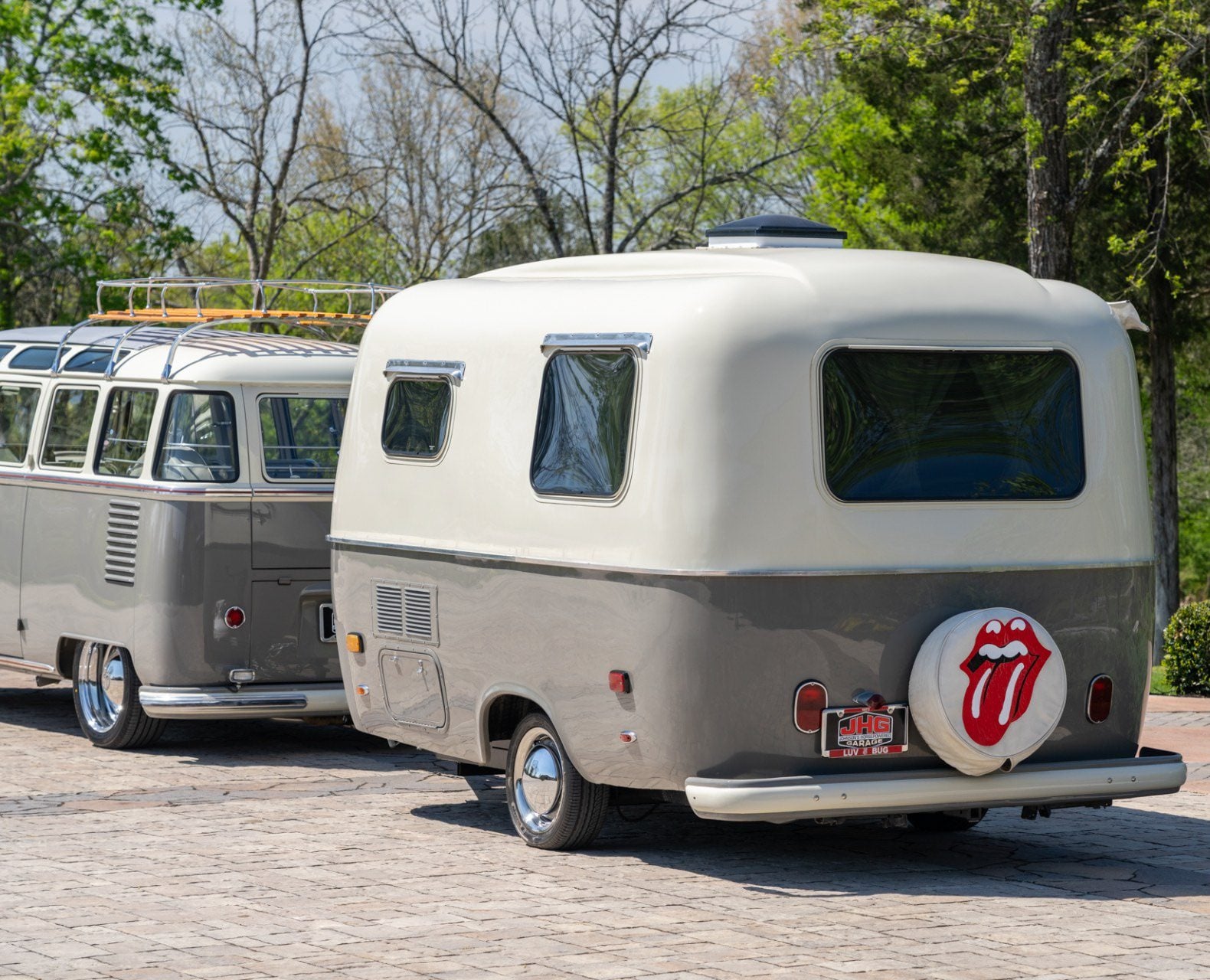
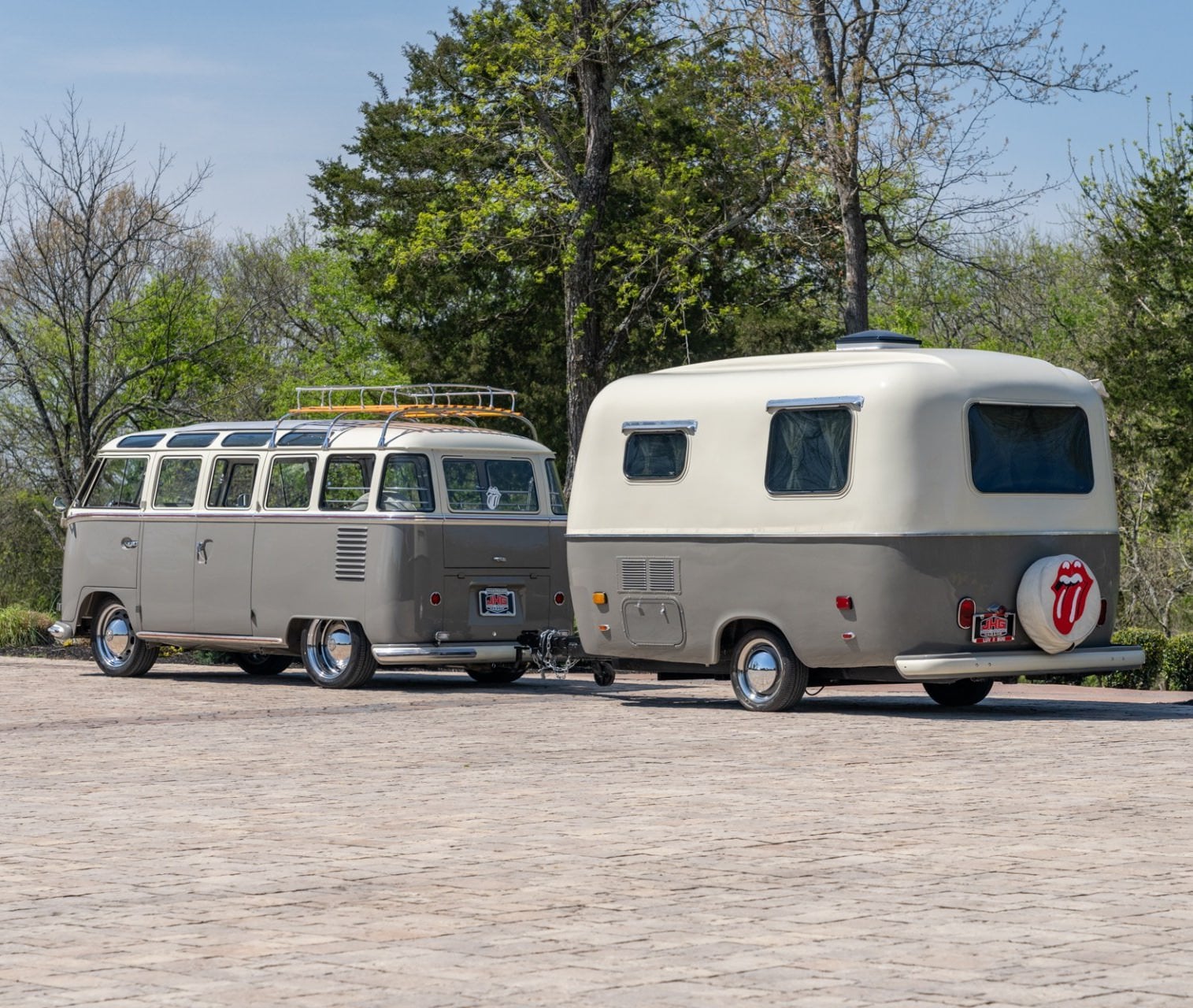
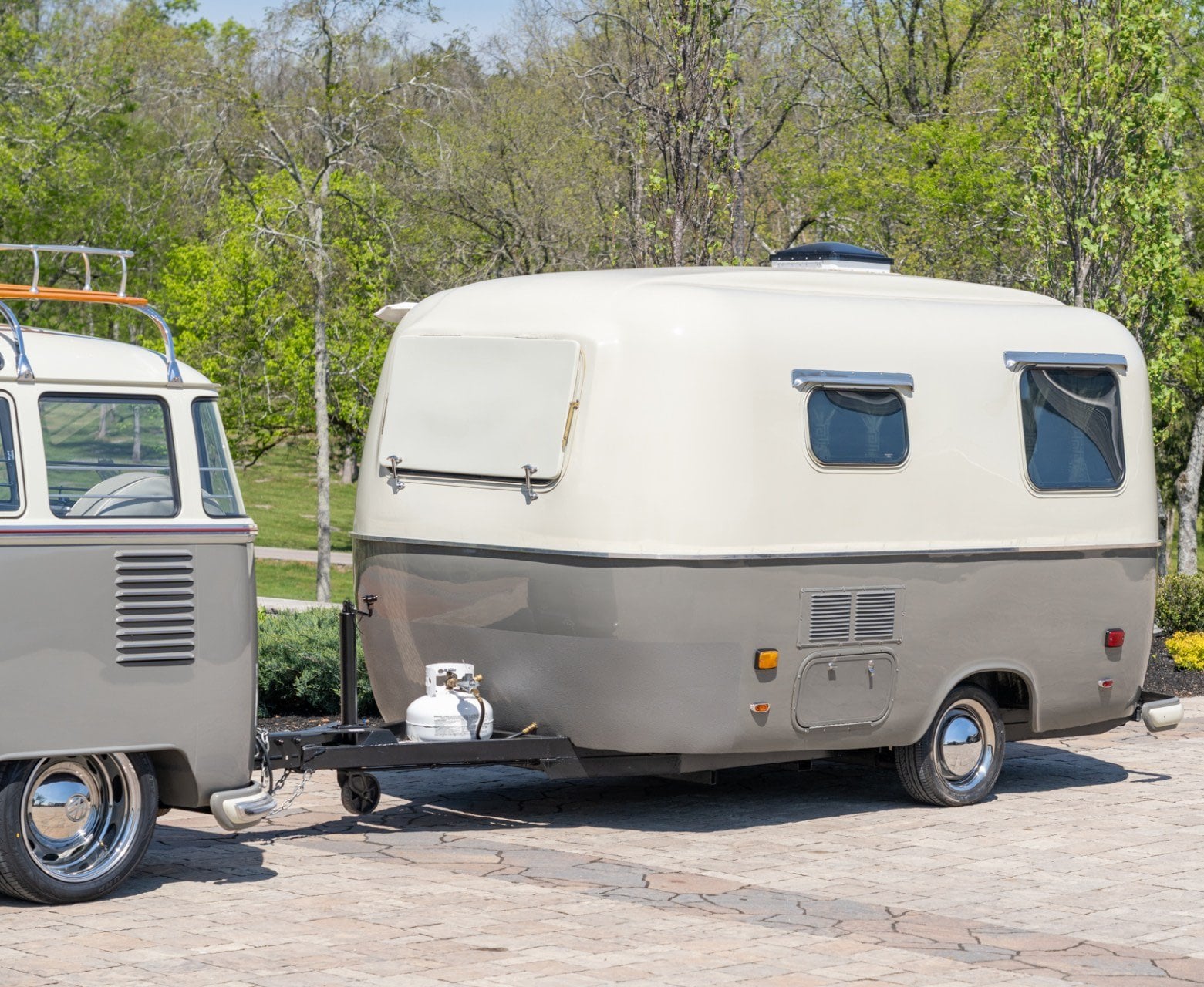
The bus is sold with a matching custom camper trailer finished in the same Mouse Grey and Pearl White colorway by Kyle’s Customs of Lake Havasu City. It has bunk beds, a dinette, and a kitchenette with a two-burner cooktop, a sink with running water, and a refrigerator, and more.
The bus is sold with a matching custom camper trailer finished in the same Mouse Grey and Pearl White colorway by Kyle’s Customs of Lake Havasu City. It has bunk beds, a dinette, and a kitchenette with a two-burner cooktop, a sink with running water, and a refrigerator, along with air conditioning, custom cabinetry, a table with bench seat, tilt-out windows, and a flip-down flatscreen TV with a stereo DVD player, surround sound, and a touchscreen radio.
The pair is now due to roll across the auction block with Mecum in late-September and you can visit the listing here if you’d like to read more about it or register to bid.
Images courtesy of Mecum

Articles that Ben Branch has written have been covered on CNN, Popular Mechanics, Smithsonian Magazine, Road & Track Magazine, the official Pinterest blog, the official eBay Motors blog, BuzzFeed, Autoweek Magazine, Wired Magazine, Autoblog, Gear Patrol, Jalopnik, The Verge, and many more.
Silodrome was founded by Ben back in 2010, in the years since the site has grown to become a world leader in the alternative and vintage motoring sector, with well over a million monthly readers from around the world and many hundreds of thousands of followers on social media.