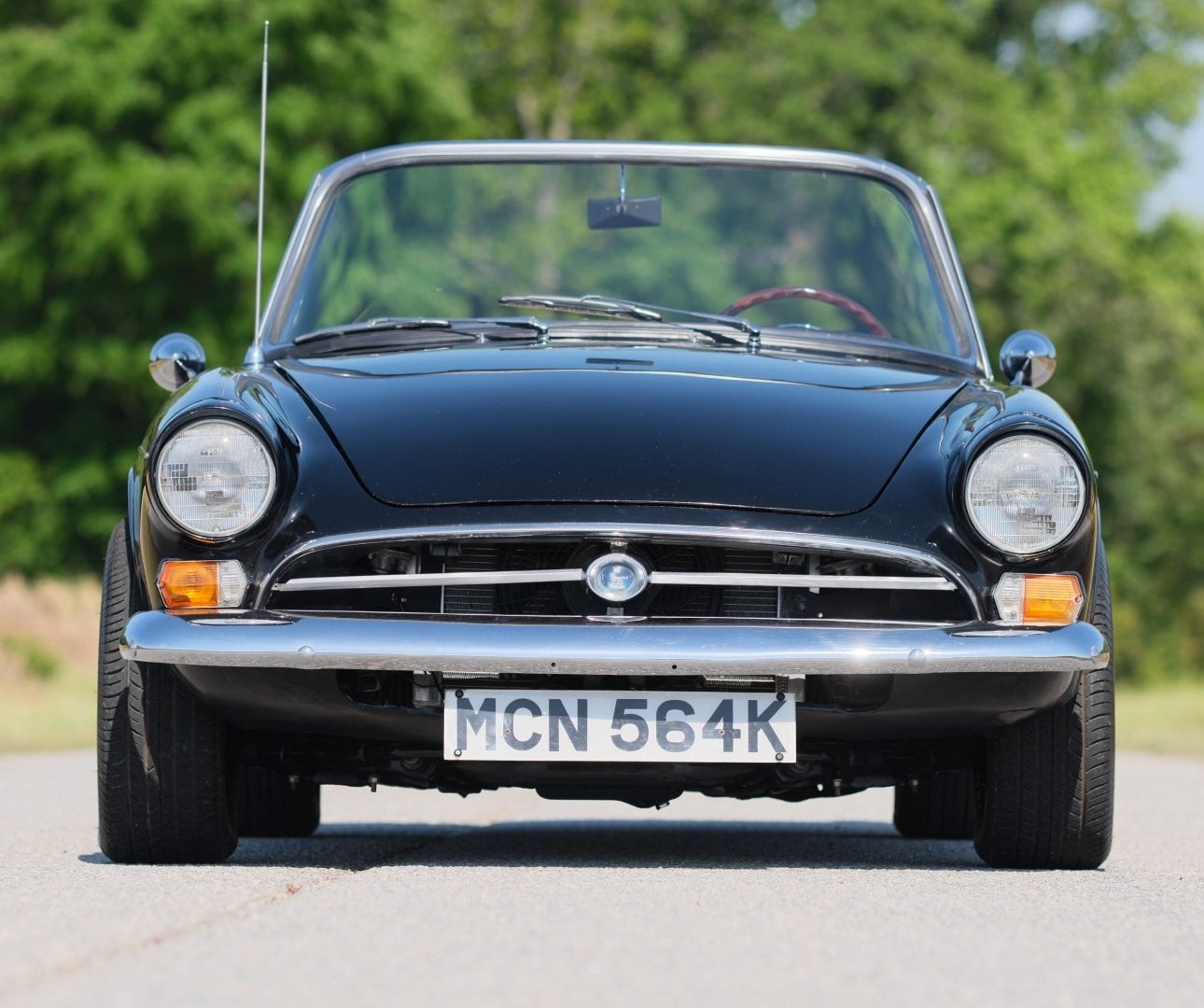
This is a 1965 Sunbeam Tiger Mk1, the fire-breathing V8-powered sibling to the 1.6 liter four-cylinder Sunbeam Alpine – a car for which it’s often mistaken.
The Tiger has been called a factory-built sleeper thanks to close resemblance to the much smaller displacement (and lower powered) Alpine. With a 260 cubic inch Ford V8 under the hood, the Tiger was a genuinely quick sports car by the standards of the time.
Fast Facts: The Sunbeam Tiger Mk1
- The Sunbeam Tiger was a factory-built sleeper of the 1960s – a British roadster that looked almost identical to the four-cylinder Sunbeam Alpine but hid a Ford 260 cubic inch V8 under the hood. It was born from secret prototypes built by Ken Miles and Carroll Shelby in California.
- The Mark I (1964 – 1967) was good for 164 bhp and hit 60 mph in 8.6 seconds, while the rarer Mark II (1967 only) got the 289 V8 with 200 bhp. Only 633 Mark IIs were built, and total Tiger production across all variants fell somewhere between 7,083 and 7,128 cars.
- The Tiger became a pop culture icon through the TV series “Get Smart,” where Don Adams drove a red Mark I as secret agent Maxwell Smart. Rootes capitalized on the car’s image by advertising in Playboy and loaning a pink Tiger to 1965 Playmate of the Year Jo Collins.
- This particular 1965 Mark I is finished in factory Embassy Black with its original 260 V8, LAT 70 magnesium wheels, and the optional hardtop. It’s documented in Norman Miller’s definitive Tiger registry and spent twenty years in climate-controlled storage before being restored. It’s offered for sale by Mecum out of Indianapolis.
History Speedrun: The Sunbeam Tiger
The Sunbeam Tiger is one of the great factory-built sleepers of the 1960s, it’s a tiny British roadster that originally came with a 1.6 liter inline four as the Sunbeam Alpine. To create the Tiger the car was given an American V8 as well as uprated brakes and suspension, but externally it still looked almost identical to its four-pot Alpine sibling.
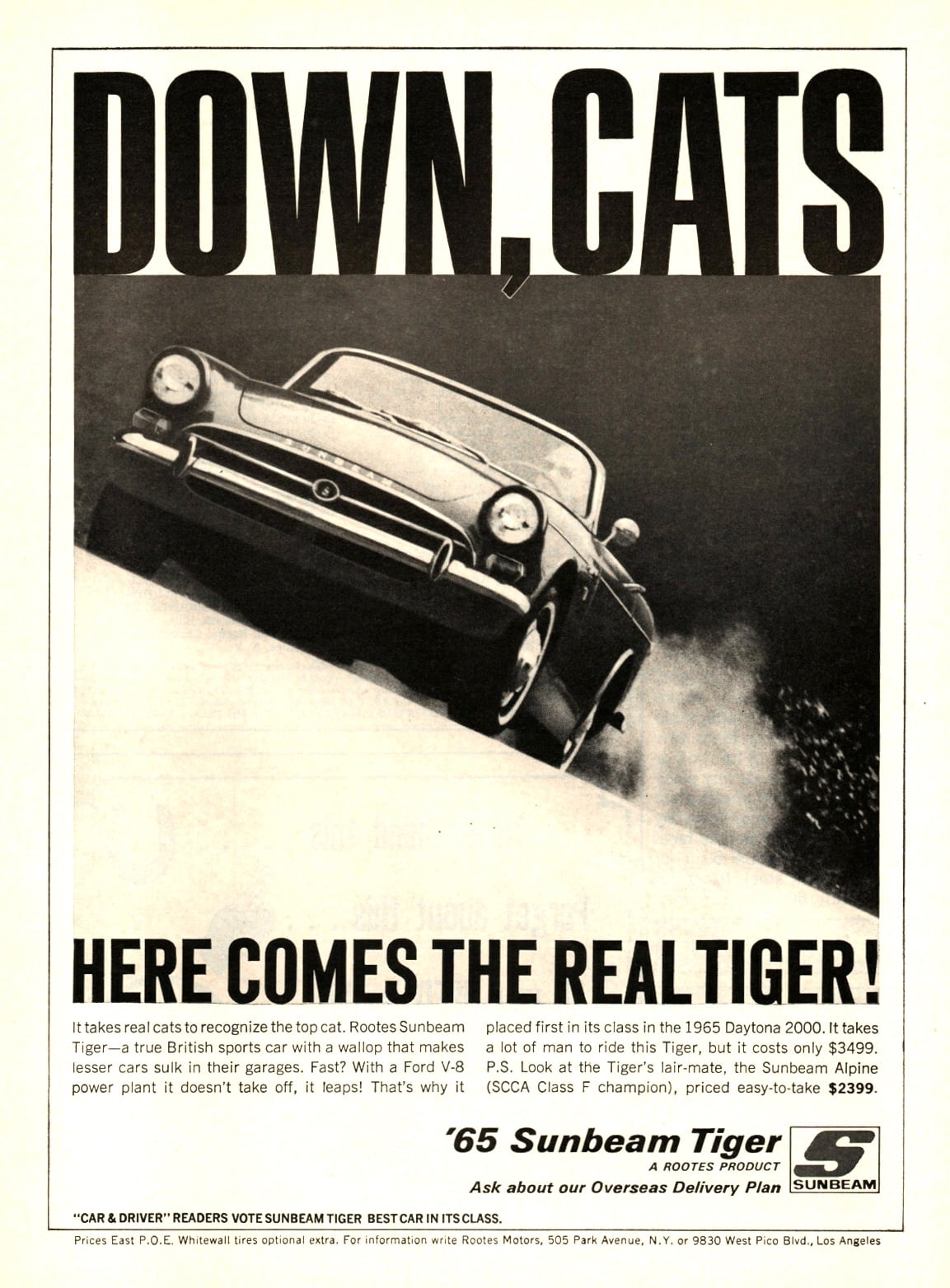
 The Sunbeam Tiger is one of the great factory-built sleepers of the 1960s, it’s a tiny British roadster that originally came with a 1.6 liter inline four as the Sunbeam Alpine. Image courtesy of the Rootes Group.
An Alpine In Need Of A Little Get Up And Go
By the early 1960s, the Rootes Group had a problem. Their Sunbeam Alpine sports car, introduced in 1959, was a handsome two-seat convertible styled (mainly) by Kenneth Howes, a former Loewy Studios and Ford designer.
It looked almost like a 2/3rd scale first-gen Ford Thunderbird and had undeniable charm. But by 1963, its 1,592cc inline four-cylinder could only muster 92 bhp, barely enough for 100 mph. You could buy an MGB with similar performance for less money, and Rootes lacked the resources to develop a more powerful engine in-house.
Their first idea was inspired (if slightly delusional) they approached Ferrari to redesign the four-cylinder engine for more power, hoping a “Powered by Ferrari” badge would deliver both performance and prestige. Perhaps unsurprisingly, the negotiations went nowhere.
Then, in October of 1962, Formula 1 champion Jack Brabham co-drove an Alpine to second in class at the Los Angeles Times Grand Prix at Riverside and suggested to Rootes competition manager Norman Garrad that a Ford V8 would transform the car.
Garrad passed the idea to his son Ian, conveniently stationed in California as the West Coast Sales Manager for Rootes American Motors – which just happened to be right down the road from Carroll Shelby’s operation.
Two Prototypes, One Budget Trick
Ian Garrad took a fantastically pragmatic approach to the idea – he used a wooden stick to measure the Alpine’s engine bay, then sent his service manager Walter McKenzie to local dealerships with the stick to find a V8 that might fit. McKenzie returned with the news that Ford’s 260 cubic inch Windsor V8 (which was only 3.5 inches longer than the Alpine’s four) could just about squeeze in.
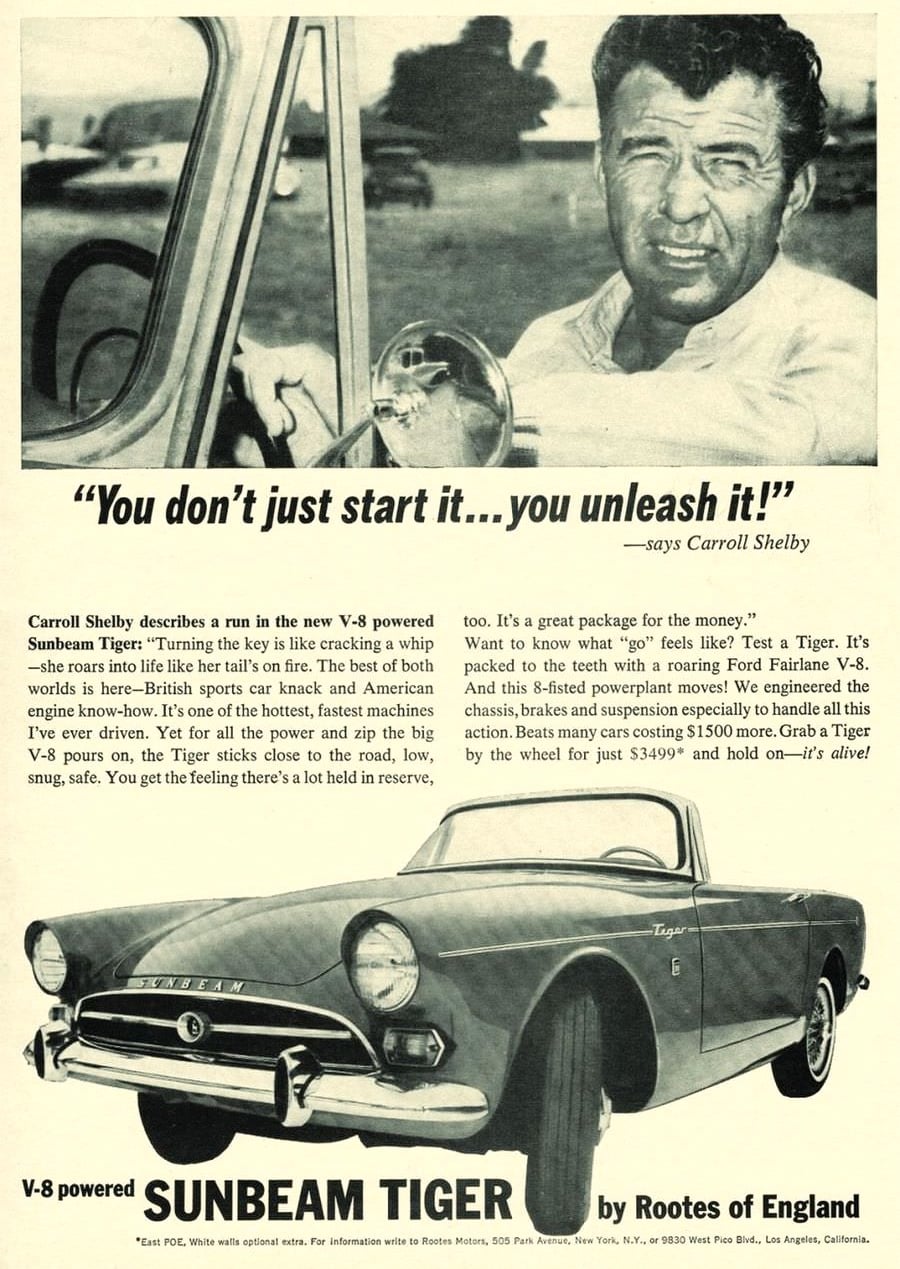
To create the Tiger the car was given an American V8 as well as uprated brakes and suspension, but externally it still looked almost identical to its four-pot Alpine sibling. Image courtesy of the Rootes Group.
Garrad contracted Shelby to build a prototype for $10,000, funding scraped from the advertising budget with Brian Rootes’ help. Sir William Rootes, the company chairman, was kept entirely in the dark.
But Shelby American was stretched thin with Cobra and GT40 work, so Garrad quietly hired Ken Miles – the brilliant British-born racing driver and engineer who had raced Alpines and built successful MG-based specials – to build a separate prototype for the sum of just $800.
Working from his small shop on Cahuenga Boulevard in Hollywood, Miles finished his car before Shelby’s team finished theirs. It was a little on the crude side, the weight sat too far forward and the torque stripped the hubs out of the wire wheels, but it proved the concept had legs. Miles fitted Minilite alloy wheels and Garrad paid $400 for a fresh coat of red paint.
Amazingly, the Ken Miles prototype survives today in the Fred Phillips collection in Calgary, Alberta.
The Shelby-built prototype, fabricated by George Boskoff with help from Phil Remington, was the more refined effort, it had rack-and-pinion steering, the engine set farther back in the chassis, and a 4-speed manual gearbox.
Ken Miles did the shakedown testing on the car at Riverside Raceway. To maintain secrecy, the car ran a single exhaust to help disguise its V8 engine note, and the team never opened the hood around strangers. After some 5,000 miles of testing, it was shipped to England in the hold of a Japanese fruit freighter.
Lord Rootes, despite being reportedly “very grumpy” about the secret project, drove the car himself and was instantly converted. He called Henry Ford II directly to negotiate the engine supply, placing an initial order for 3,000 V8s – this was reportedly the largest single engine order Ford had ever received from an automaker.
The Tiger Goes Into Production
The Tiger was code-named “Thunderbolt” during development but renamed Tiger just before its debut at the 1964 New York Motor Show, in homage to the 1925 Sunbeam Tiger that had set the land speed record at 152.33 mph at Southport.
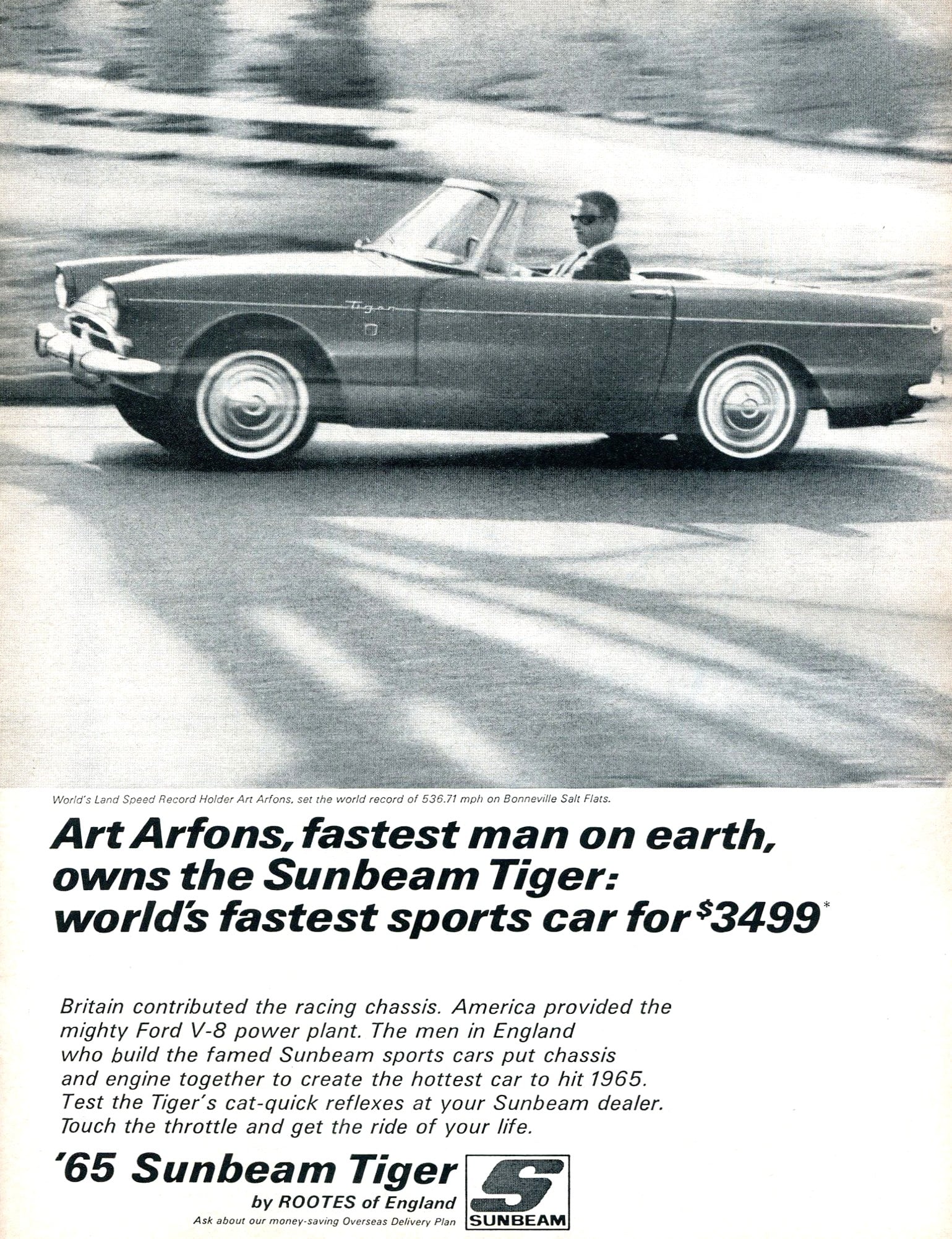
The Mark I Tiger (built from 1964 to 1967) used the Ford 260 cubic inch V8 producing 164 bhp and 258 lb ft of torque, good for 0 to 60 mph in 8.6 seconds and a top speed of 118 mph. Image courtesy of the Rootes Group.
Production was contracted to Jensen Motors at West Bromwich, since the Rootes factory at Ryton lacked capacity. Jensen’s manufacturing process was famously rough – installing the V8 required a sledgehammer to bash in the already-painted bulkhead.
Real Tigers left the factory with dents and rough welds, which later became one of the easiest ways to distinguish genuine cars from the Alpine-based fakes that proliferated in the 1970s. Perhaps ironically, the fakes were often more refined.
The Mark I Tiger Debuts
The Mark I Tiger (built from 1964 to 1967) used the Ford 260 cubic inch V8 producing 164 bhp and 258 lb ft of torque, good for 0 to 60 mph in 8.6 seconds and a top speed of 118 mph.
Curb weight is variously reported between 2,550 and 2,650 lbs depending on the source, and the car had front disc/rear drum brakes, double-wishbone front suspension, and a live rear axle with Panhard bar.
Dealers offered LAT (Los Angeles Tiger) performance packages (developed through the Rootes West Coast operation with Shelby involvement) that could push output to 245 bhp, though the stock suspension and brakes struggled to cope.
Enthusiasts recognize a “Mark IA” sub-variant within the Mark I run – Mark I cars used Series IV Alpine body panels with rounded corners and lead-filled seams, while Mark IA cars transitioned to the Series V square-edged panels without the leaded seams. A total of 6,495 Mark I and Mark IA cars were built.
The Mark II Tiger Arrives
The Mark II (built in 1967 only) received the Ford 289 cubic inch V8 producing 200 bhp and 282 lb ft of torque, cutting the 0 to 60 time to 7.5 seconds and raising top speed to 122 mph.
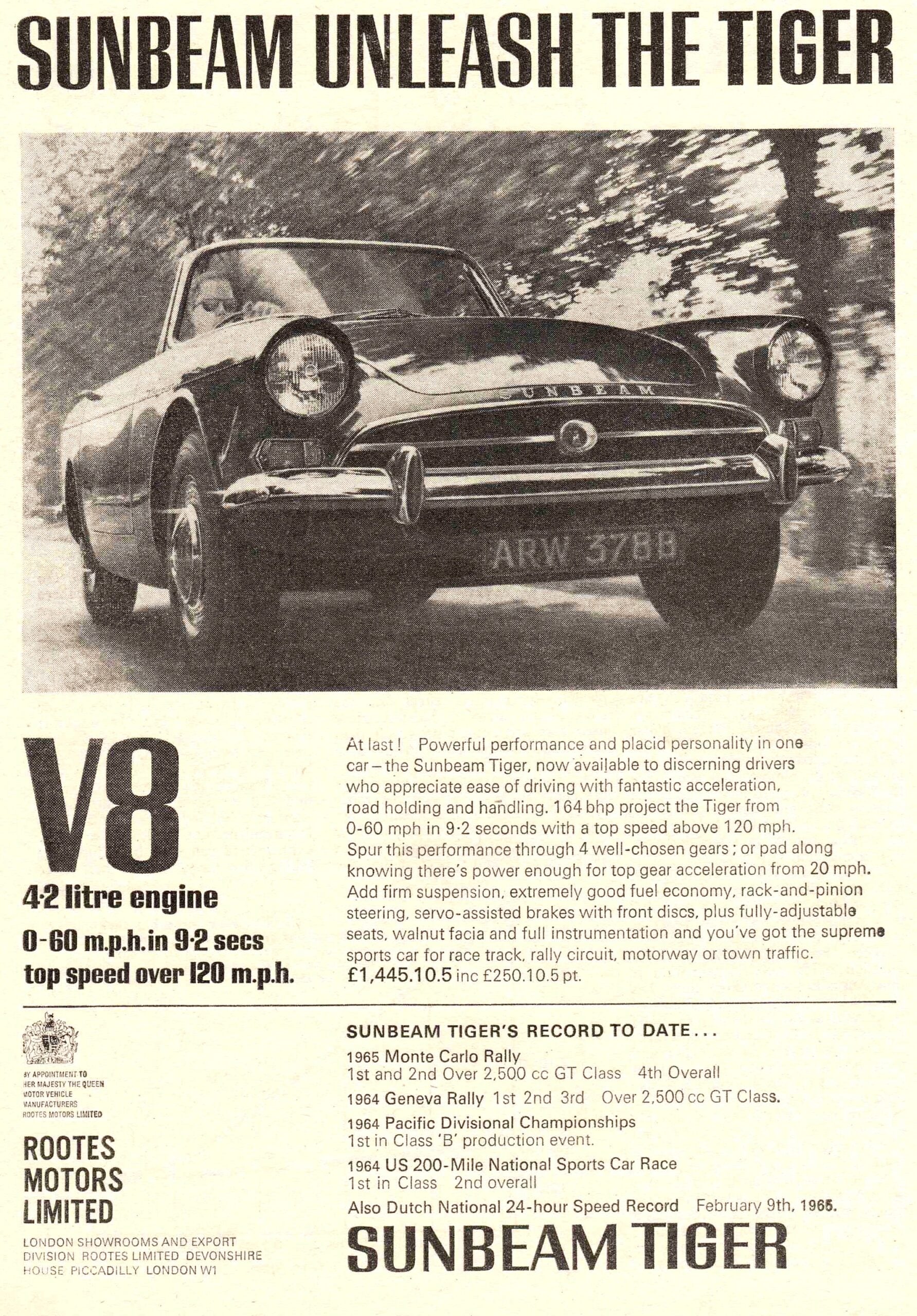
The Tiger was code-named “Thunderbolt” during development but renamed Tiger just before its debut at the 1964 New York Motor Show, in homage to the 1925 Sunbeam Tiger that had set the land speed record at 152.33 mph at Southport. Image courtesy of the Rootes Group.
It was distinguished by an egg-crate grille, prominent side stripes, and “Sunbeam V-8” badges replacing the earlier “Powered by Ford” shields.
Only 633 were built, all officially for the American market, though six right-hand-drive Mark IIs were built for the Metropolitan Police in Britain, with one additional car going to Autosport editor Gregor Grant and three more to Rootes dealers.
The Tiger In Pop Culture
The Tiger became a household name in America thanks to the wildly popular TV series Get Smart, in which Don Adams’ bumbling secret agent Maxwell Smart drove a red Mark I Tiger (fitted with a retractable machine gun under the hood) in the show’s opening credits from 1965.
Adams bought the car when the series ended and later passed it to his daughters. Rootes leaned into the car’s glamour, advertising heavily in Playboy and loaning a pink Tiger with matching interior to 1965 Playmate of the Year Jo Collins.
It’s worth noting that in the pilot episode of Get Smart, Maxwell Smart’s car is actually a 1961 Ferrari 250 GT PF Spider Cabriolet, a car worth considerably more than the Tiger. Interestingly, the pilot was filmed in black and white, whereas all future episodes were filmed in color.
The End of the Road
The Sunbeam Tiger’s end came not from any failing of its own but from corporate politics. By 1967, Chrysler had taken full control of the Rootes Group, and selling a car powered by a Ford engine was unacceptable for obvious reasons.
The Tiger became a household name in America thanks to the wildly popular TV series Get Smart, in which Don Adams’ bumbling secret agent Maxwell Smart drove a red Mark I Tiger (fitted with a retractable machine gun under the hood) in the show’s opening credits from 1965.
Chrysler’s own 273 cubic inch small block V8 was too large to fit the Tiger’s engine bay without major structural revisions, a problem compounded by its rear-mounted distributor.
Their big block V8 was larger still. Chrysler ordered production to cease once existing Ford engine stocks were exhausted, and Jensen assembled the last Tiger on June the 27th, 1967. Depending on the source, total production is usually given as somewhere between 7,083 and 7,128 cars.
The Sunbeam Tiger remains one of the finest examples of Anglo-American automotive collaboration – a car born from a wooden measuring stick, an $800 prototype, and a phone call between two men named Rootes and Ford.
The 1965 Sunbeam Tiger Mk1 Shown Here
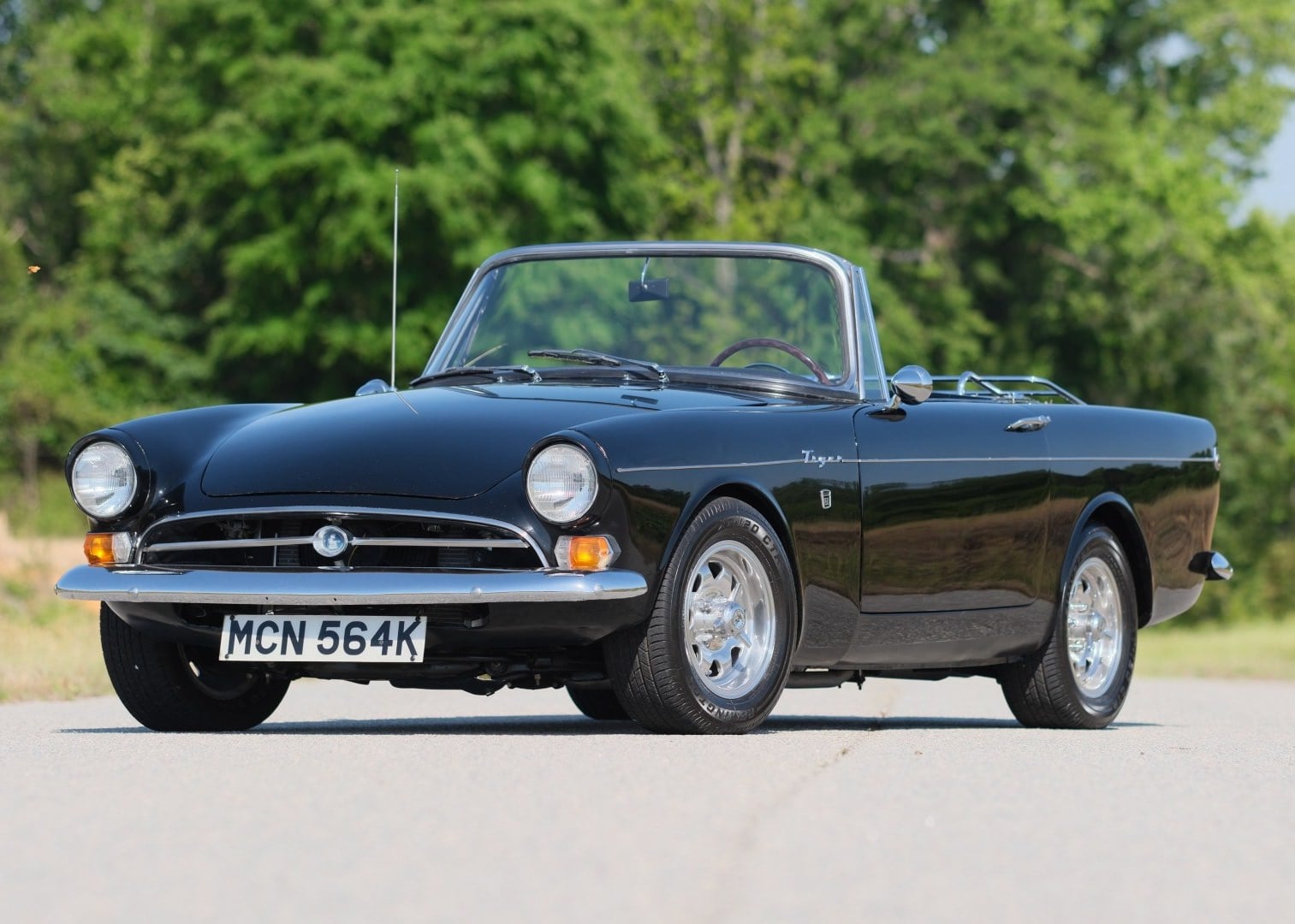
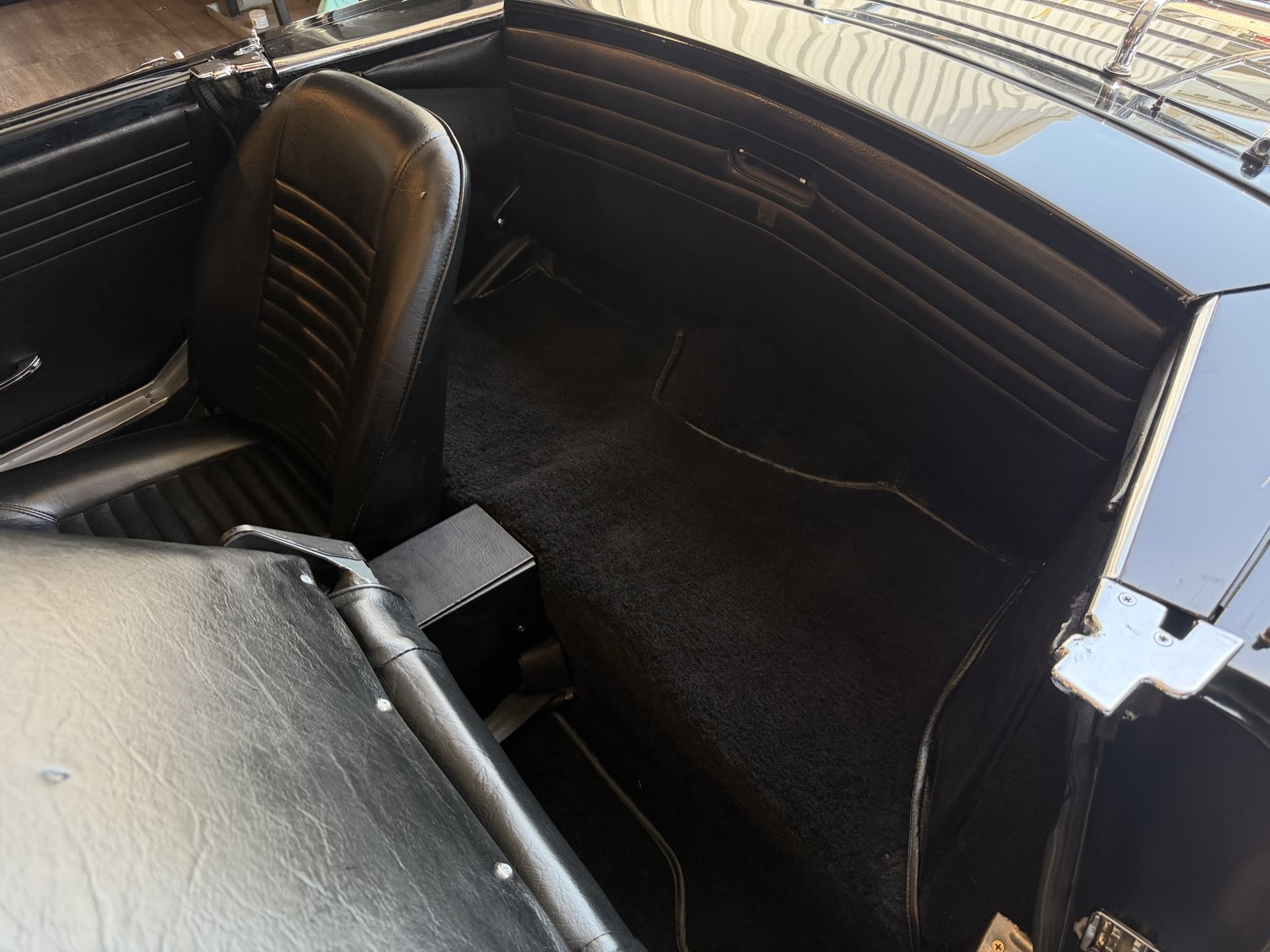
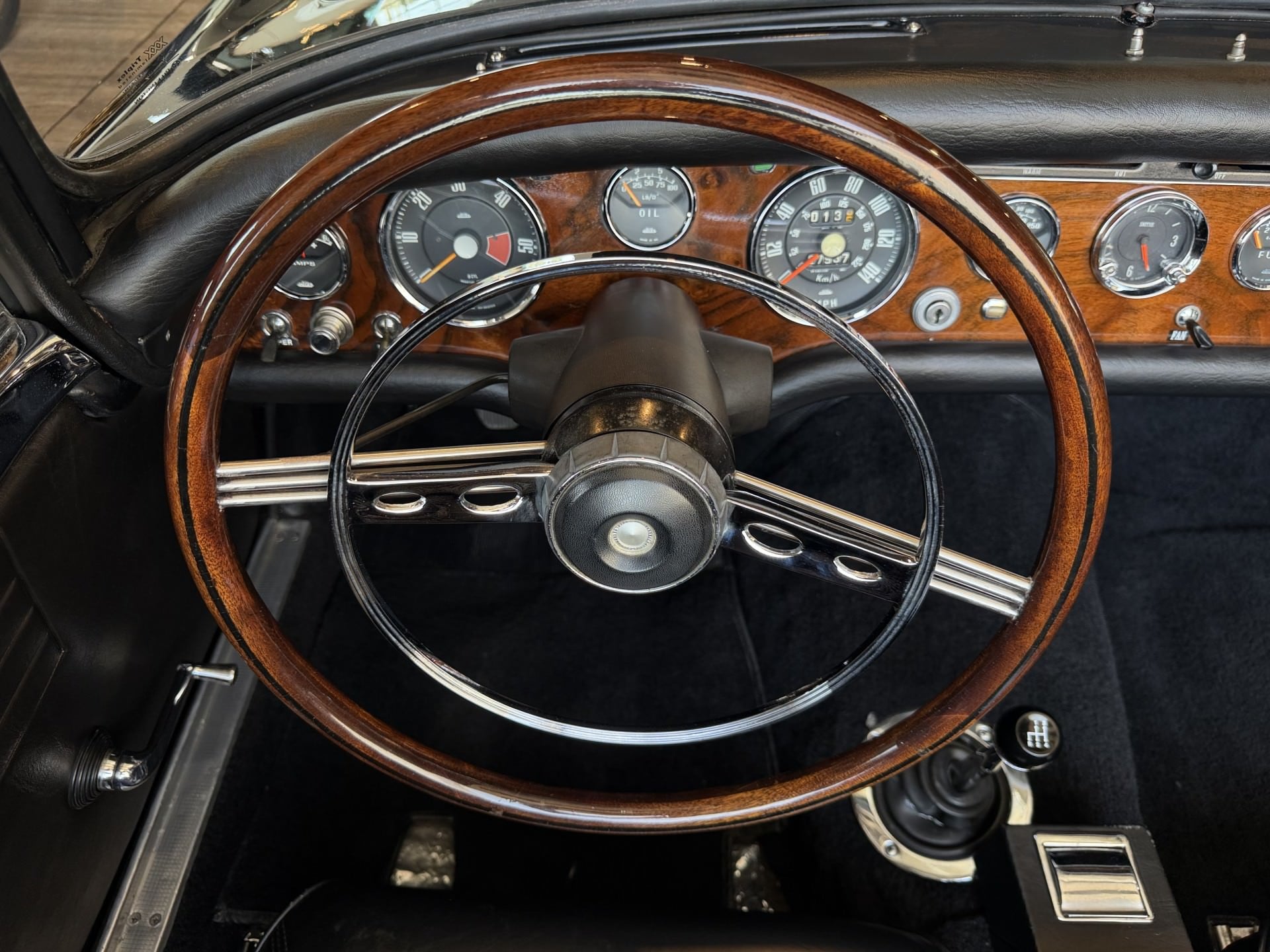
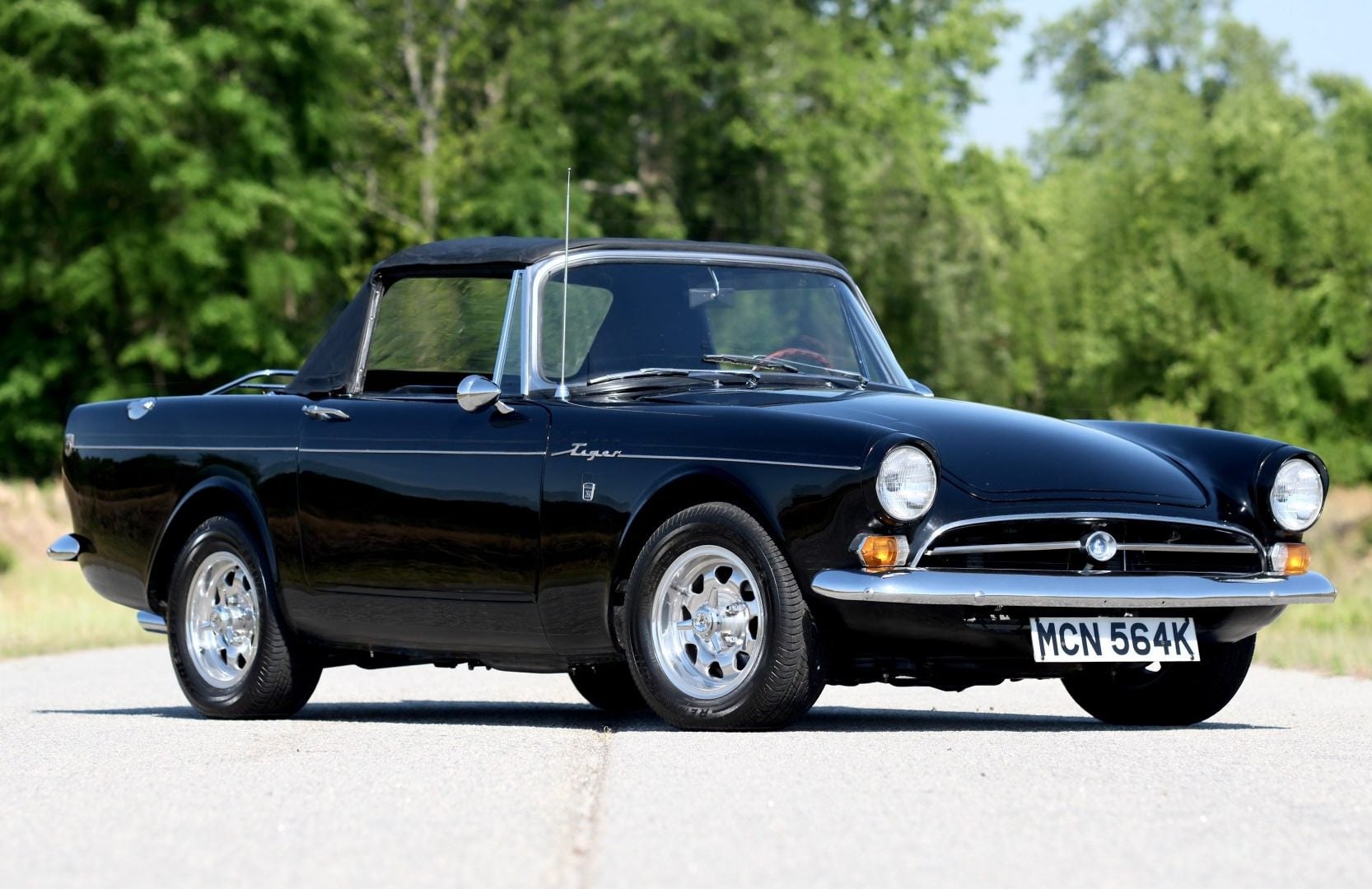
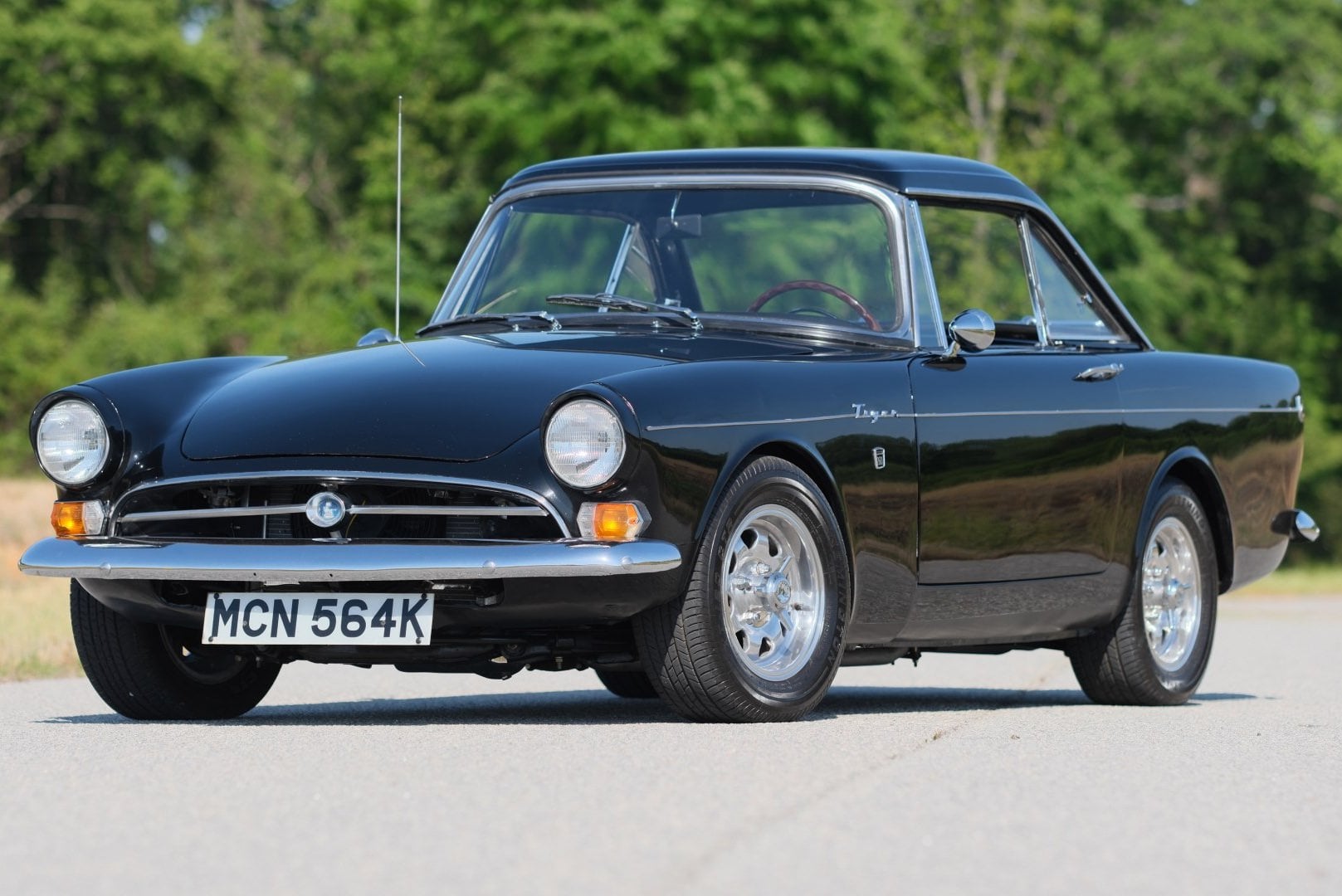
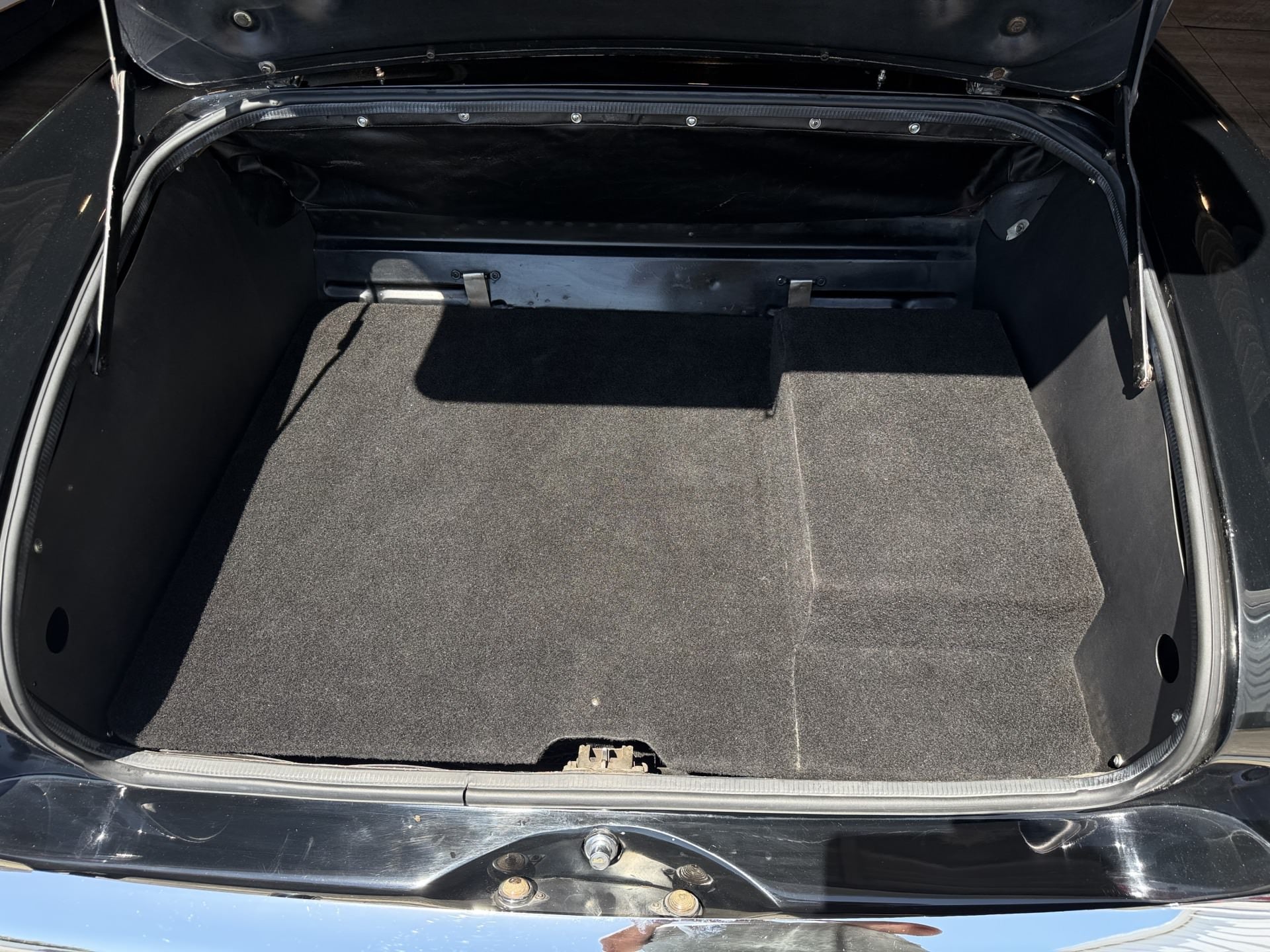
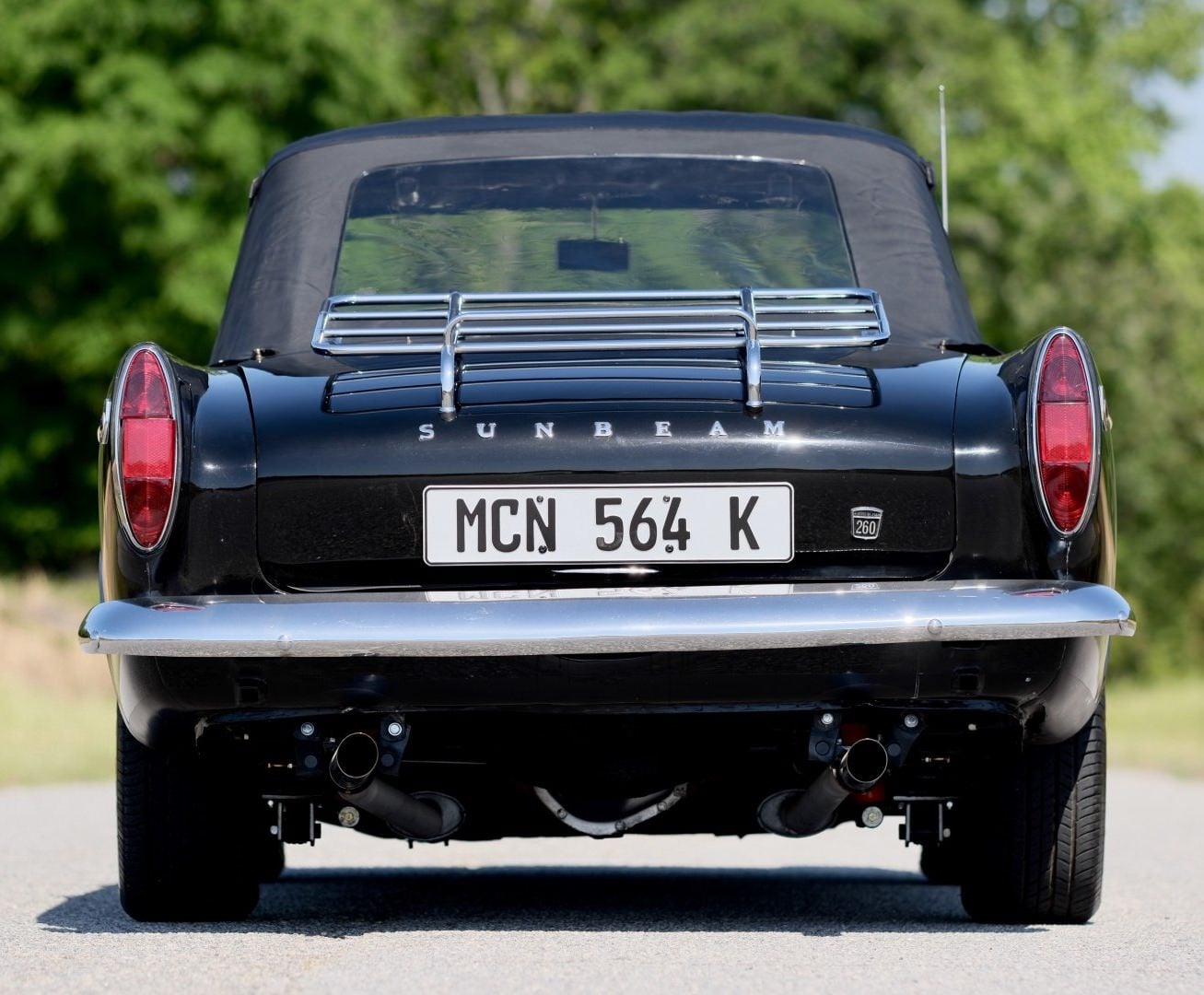
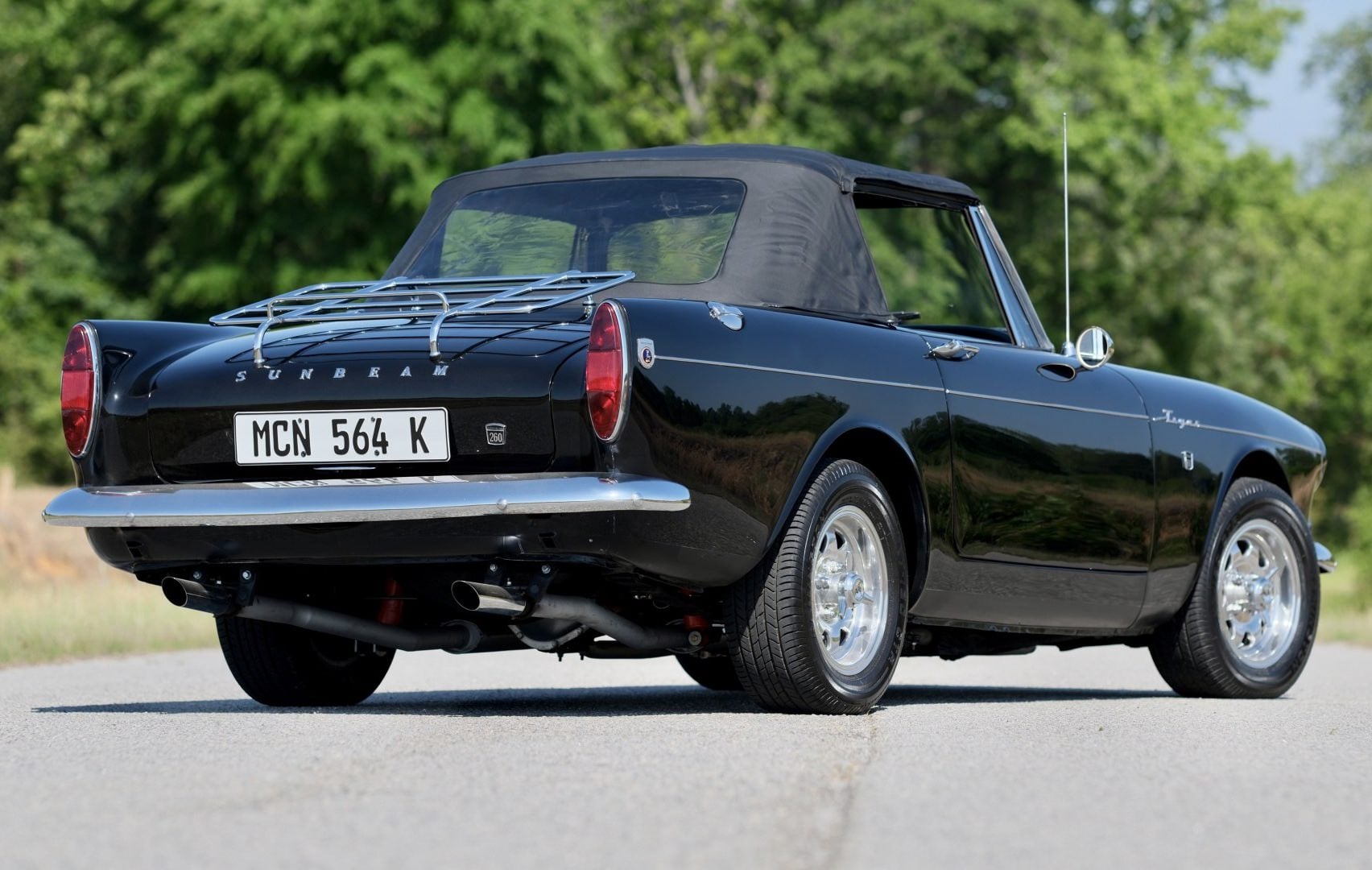
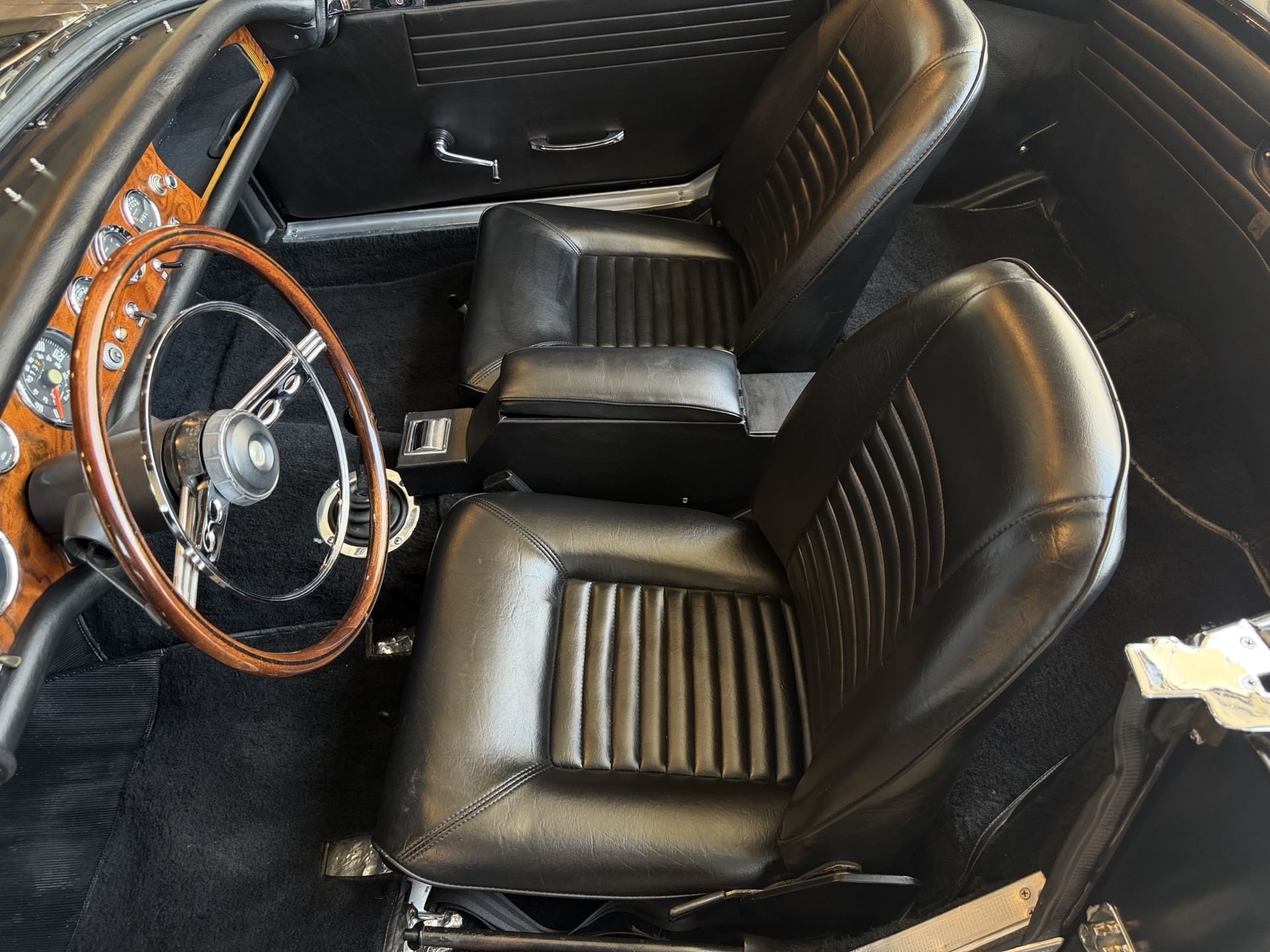
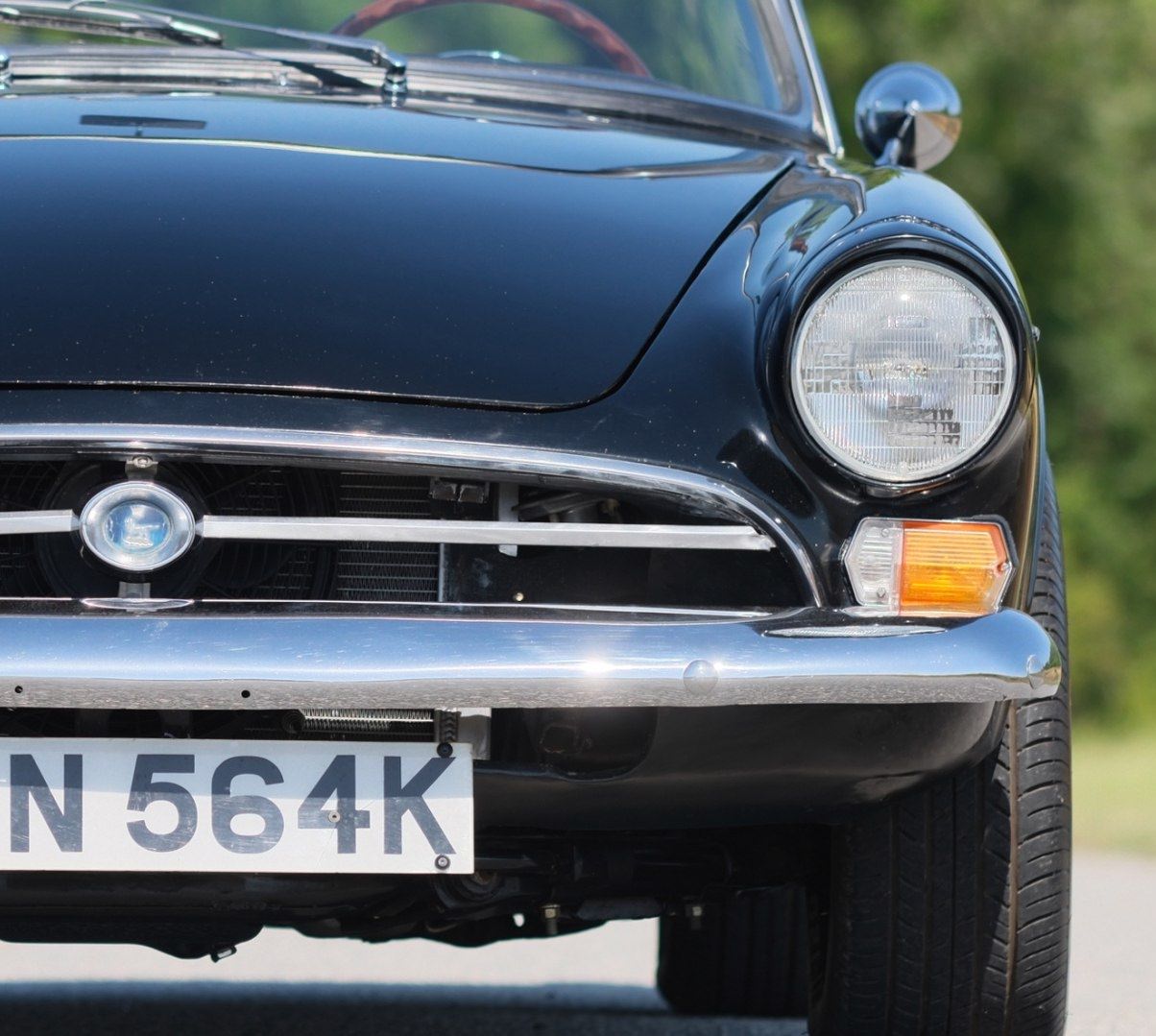
This 1965 Sunbeam Tiger Mark I is finished in its factory Code 1 Embassy Black over a black interior, with a woodgrain dash and steering wheel, a black soft top, and the original optional auxiliary hardtop.
It rides on LAT 70 wheels – the factory optional magnesium wheels offered through the Los Angeles Tiger performance program. This car is also documented in Norman Miller’s “Book of Norm,” the definitive Sunbeam Tiger registry.
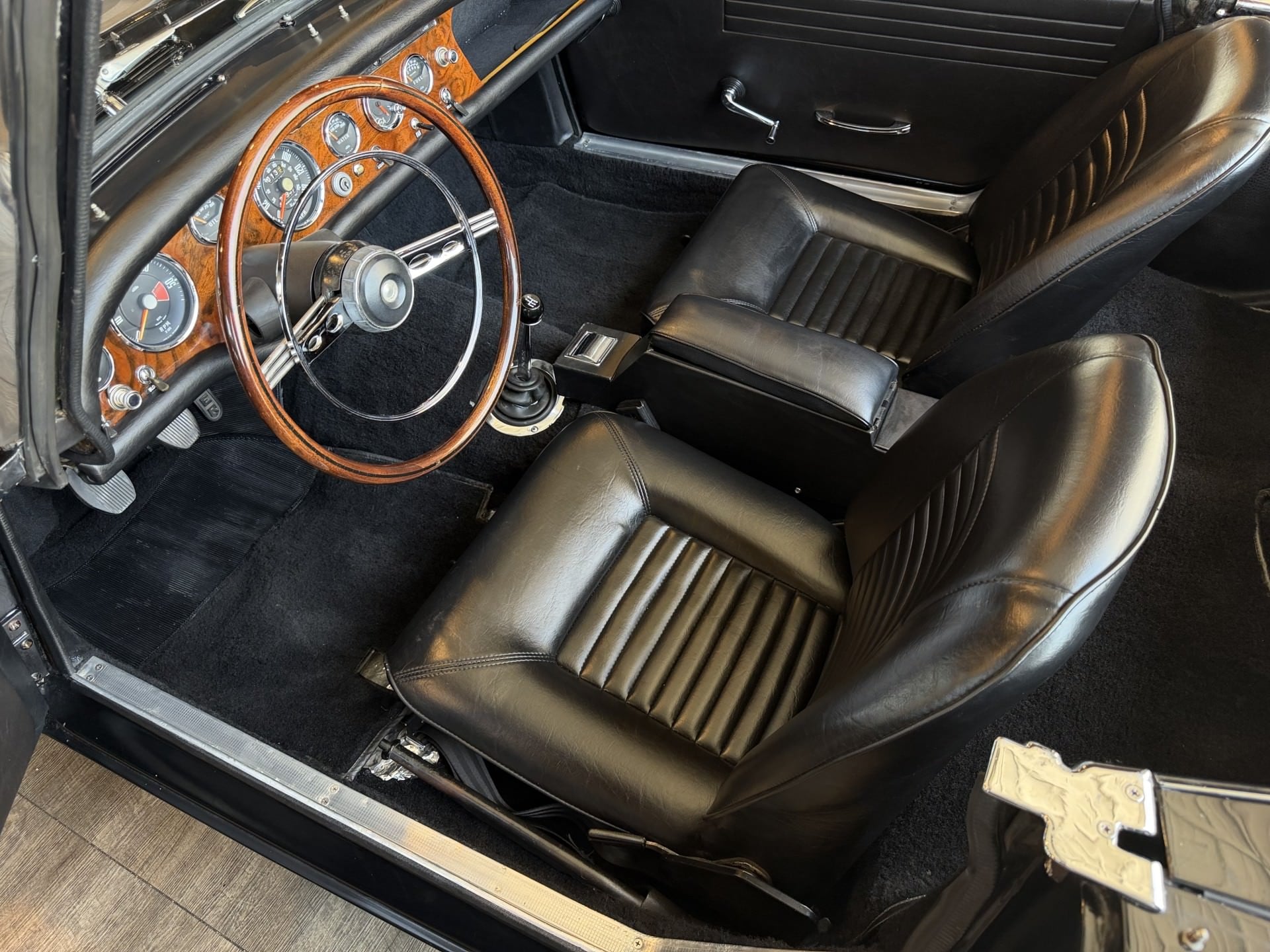
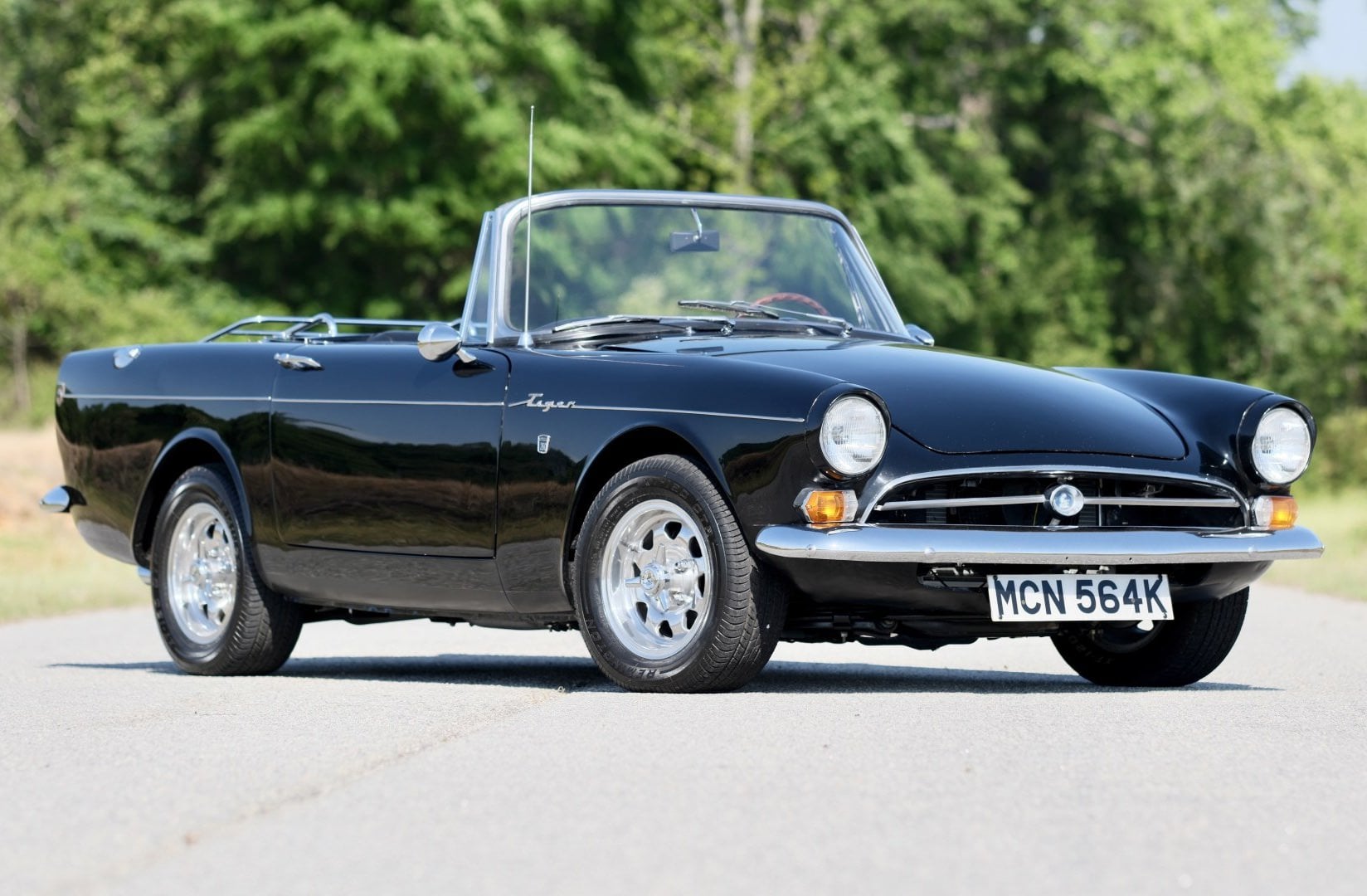
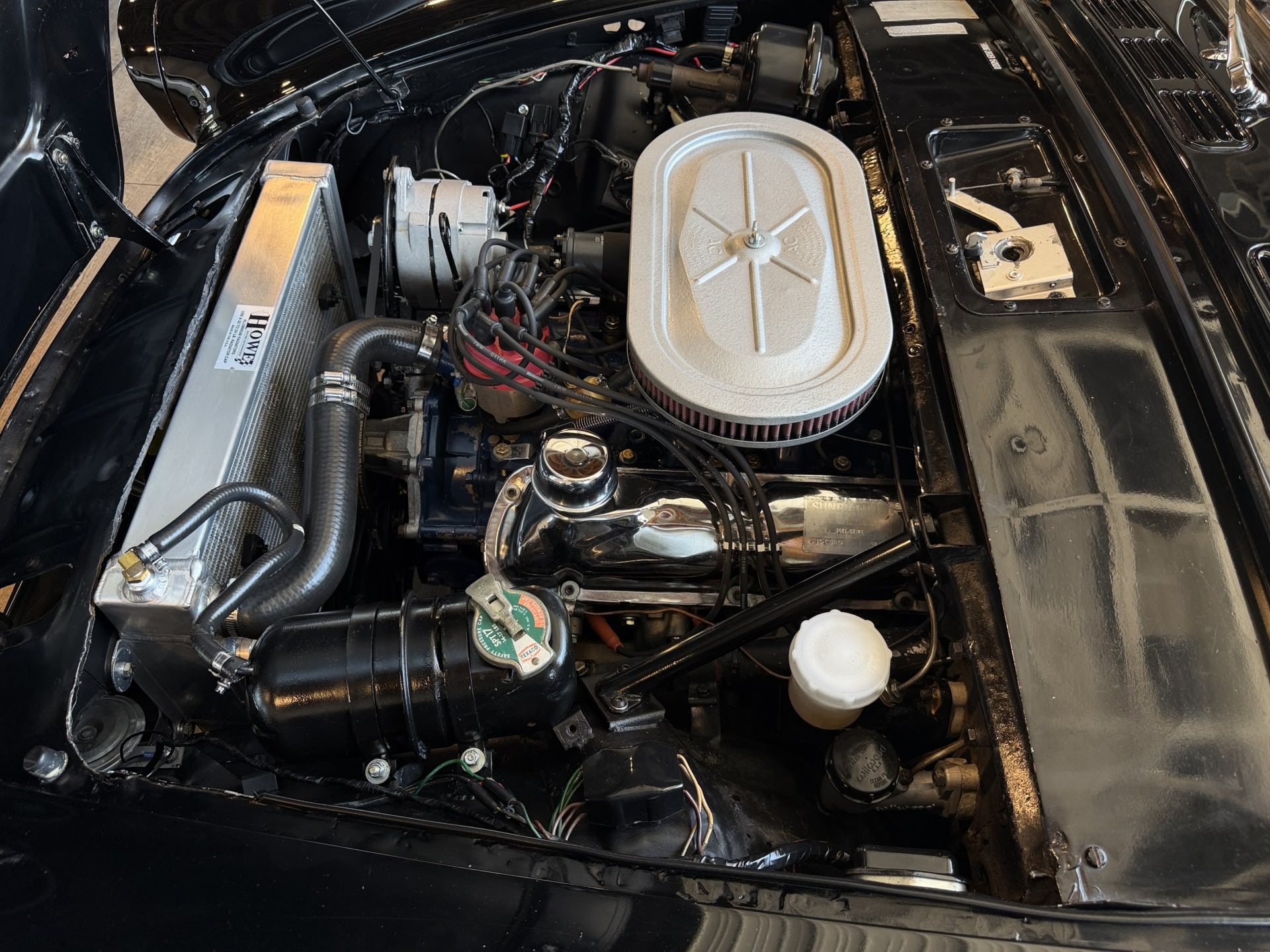
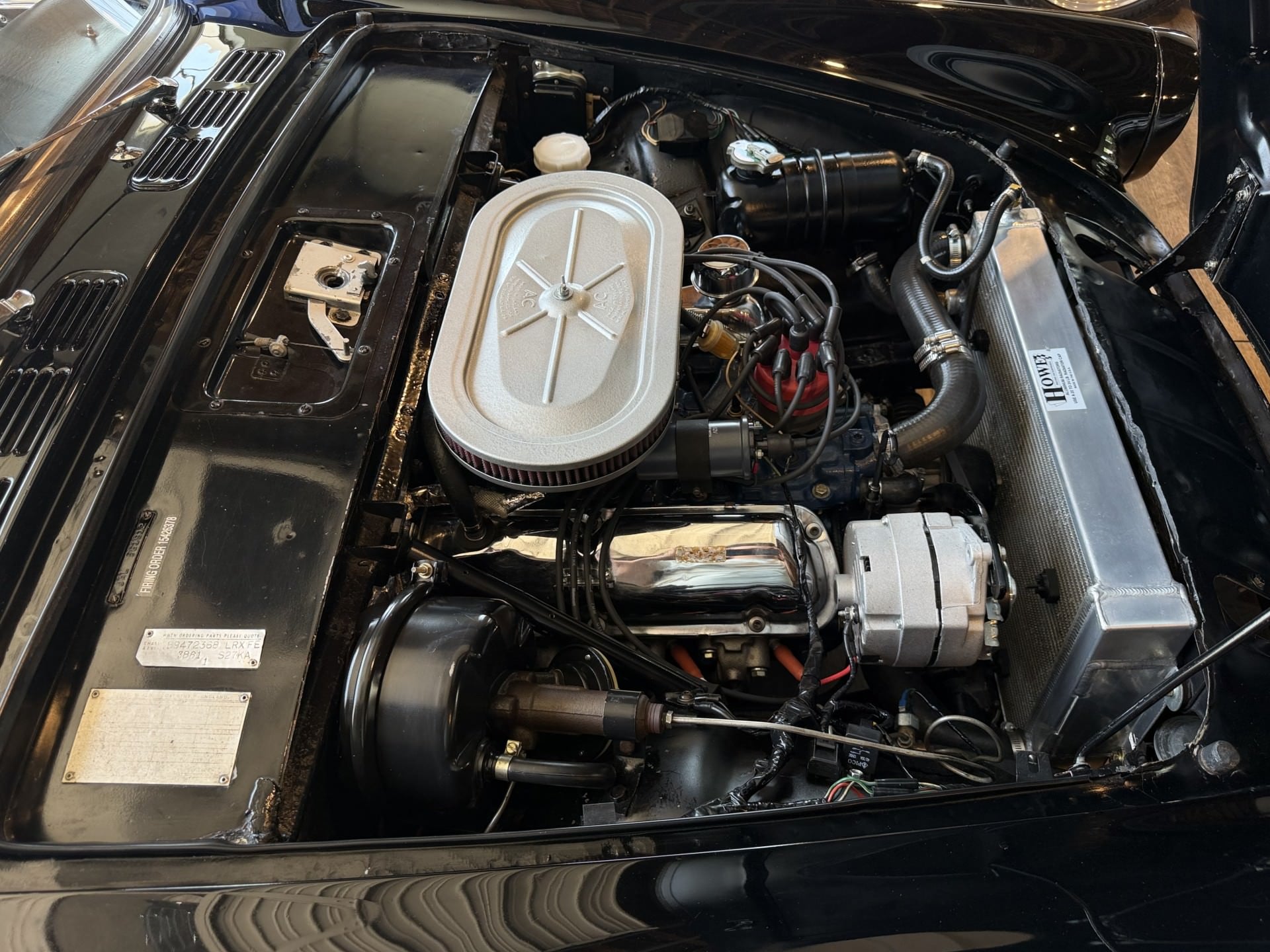
The car keeps its factory 260 cubic inch V8, it has a Ford Toploader 4-speed manual, and a Dana 44 rear end in place of the factory Salisbury unit – a well-known durability upgrade in the Tiger community.
The car keeps its factory 260 cubic inch V8, it has a Ford Toploader 4-speed manual, and a Dana 44 rear end in place of the factory Salisbury unit – a well-known durability upgrade in the Tiger community.
Before its restoration, the car reportedly spent twenty years in climate-controlled storage. It’s now being offered for sale out of Indianapolis by Mecum, and you can visit the listing here.
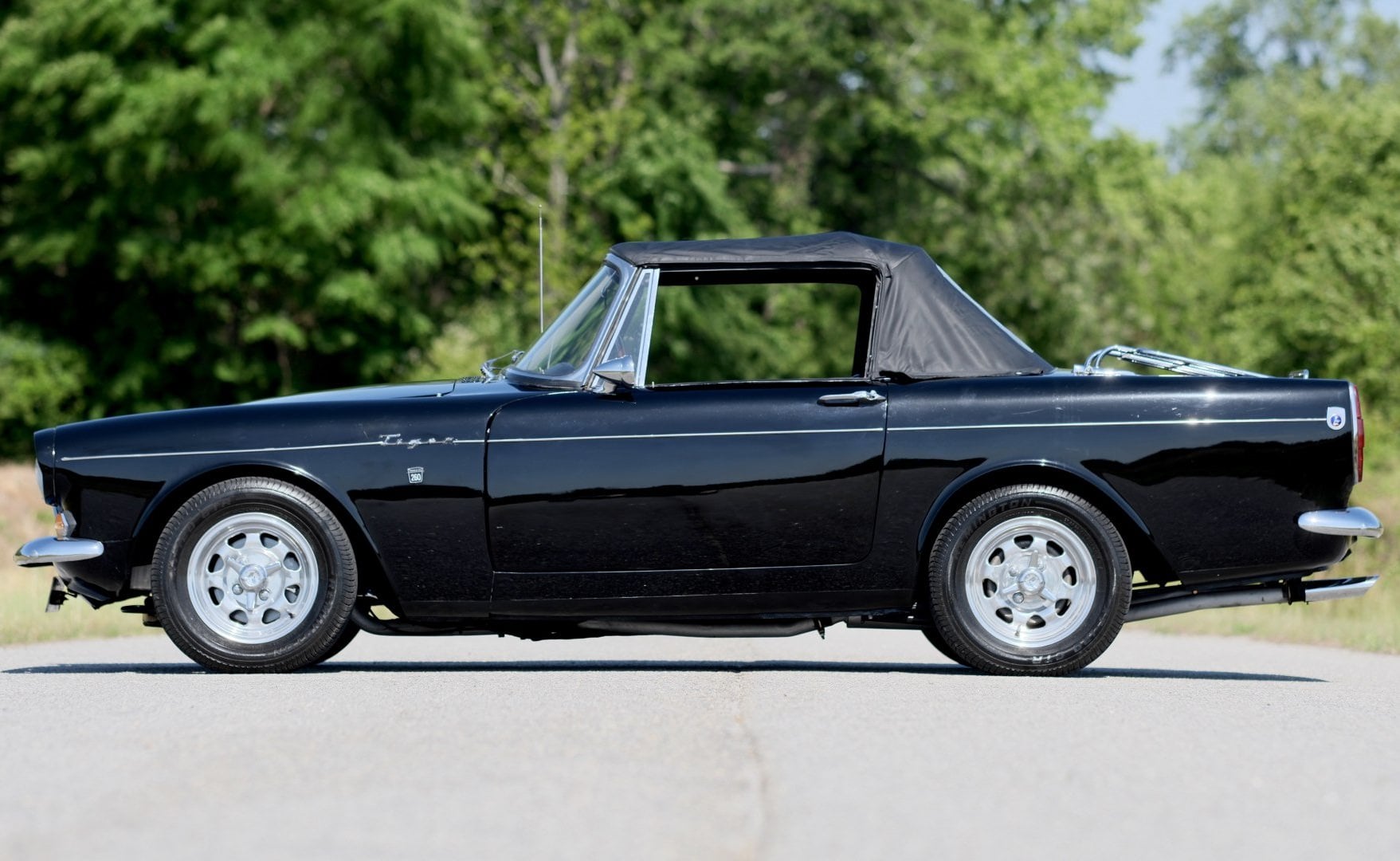
Images courtesy of Mecum

Articles that Ben Branch has written have been covered on CNN, Popular Mechanics, Smithsonian Magazine, Road & Track Magazine, the official Pinterest blog, the official eBay Motors blog, BuzzFeed, Autoweek Magazine, Wired Magazine, Autoblog, Gear Patrol, Jalopnik, The Verge, and many more.
Silodrome was founded by Ben back in 2010, in the years since the site has grown to become a world leader in the alternative and vintage motoring sector, with well over a million monthly readers from around the world and many hundreds of thousands of followers on social media.