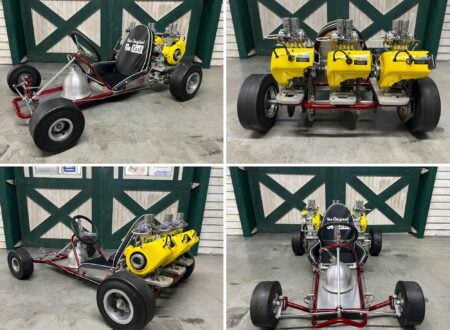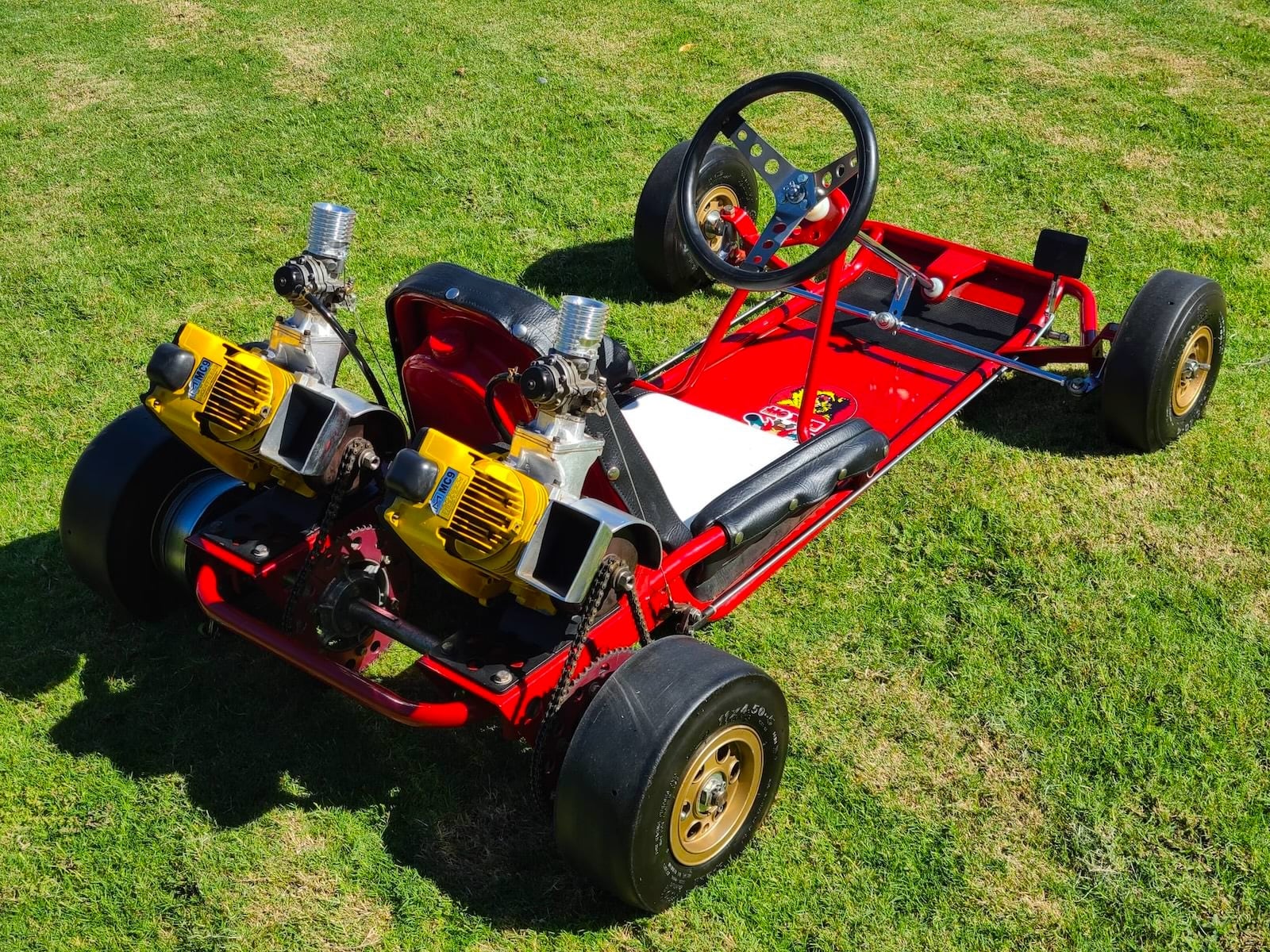
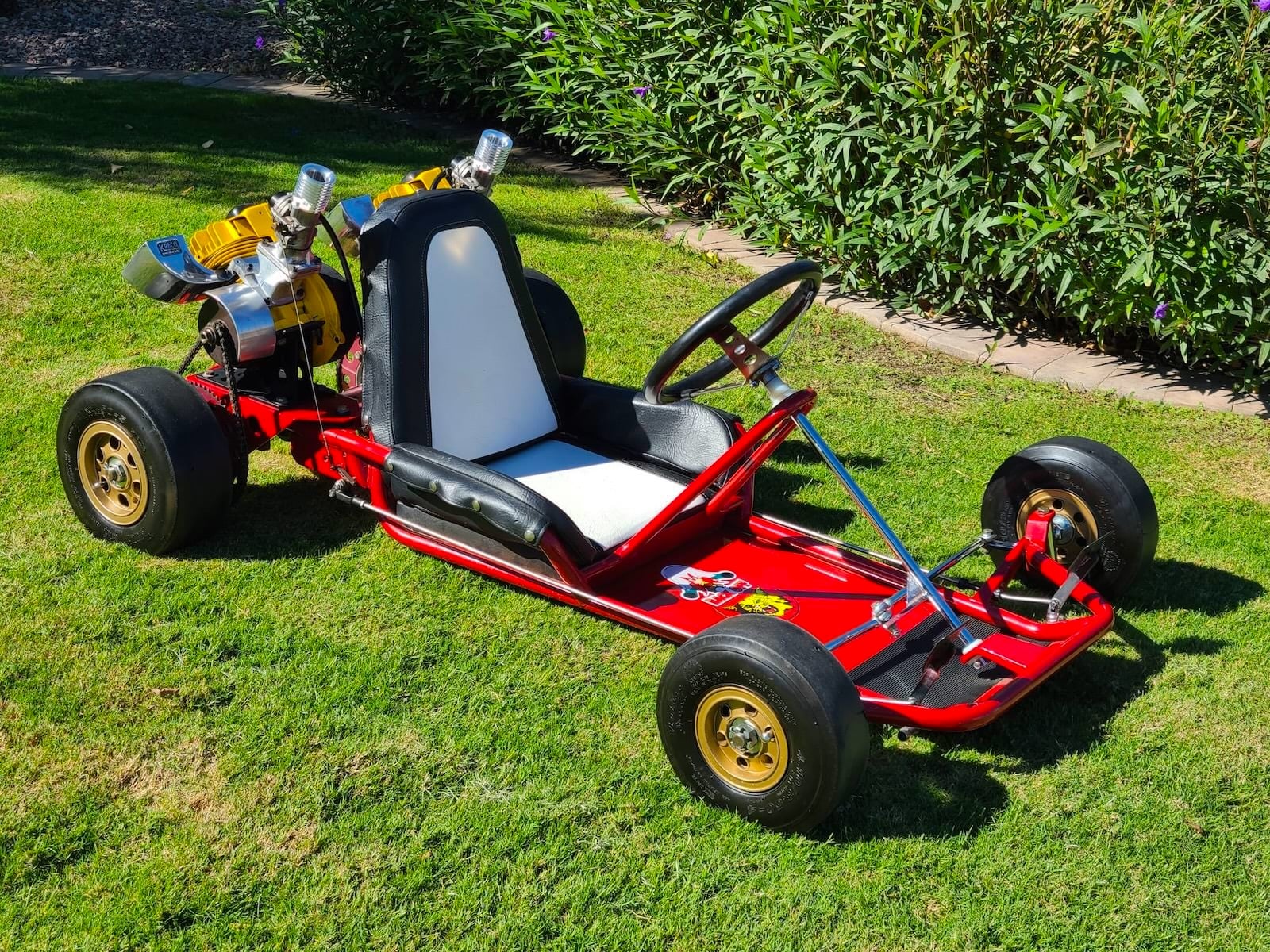
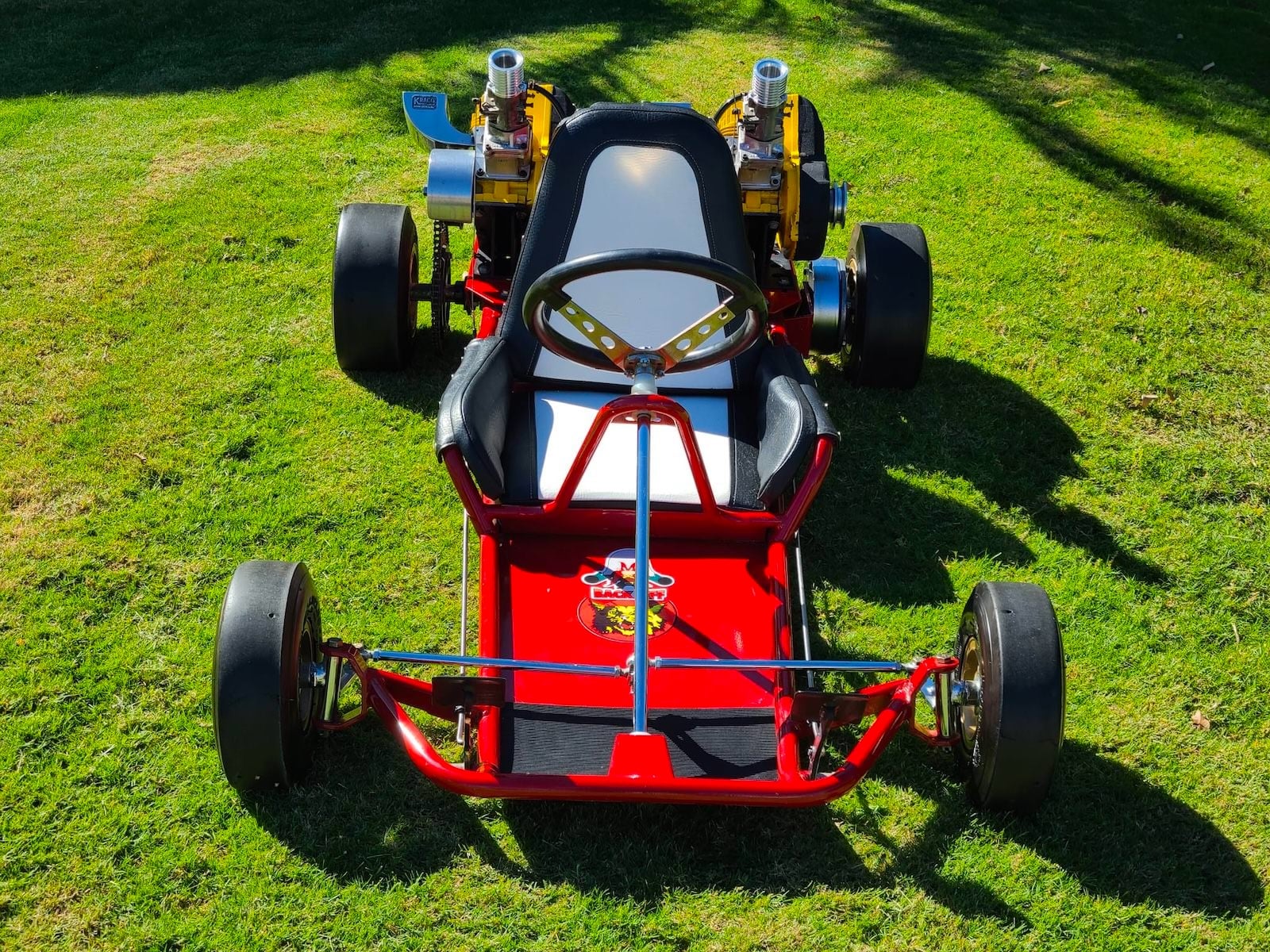
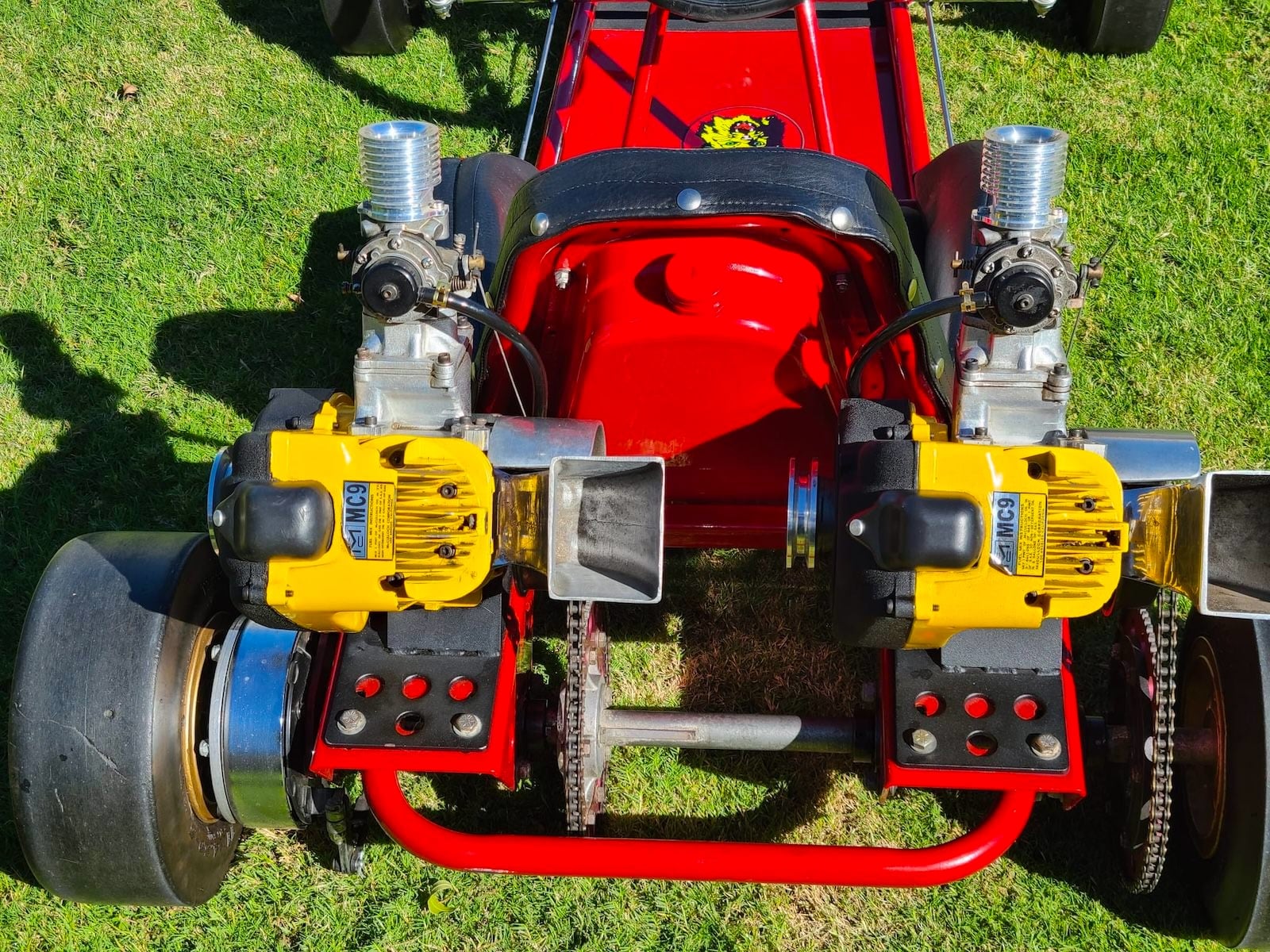
This is a rare original 1963 Percival Wildcat go-kart, it was factory-fitted with two engines, essentially doubling the power output, thanks to the fact that there are two McCulloch MC9 99cc two-stroke engines working on the rear axle.
The history behind Percival is fascinating and we’ve outlined it below, their foray into go kart manufacturing in the late-1950s and early-1960s resulted in a slew of race winning designs, but ultimately they would shutter their kart operations at some point in the 1960s.
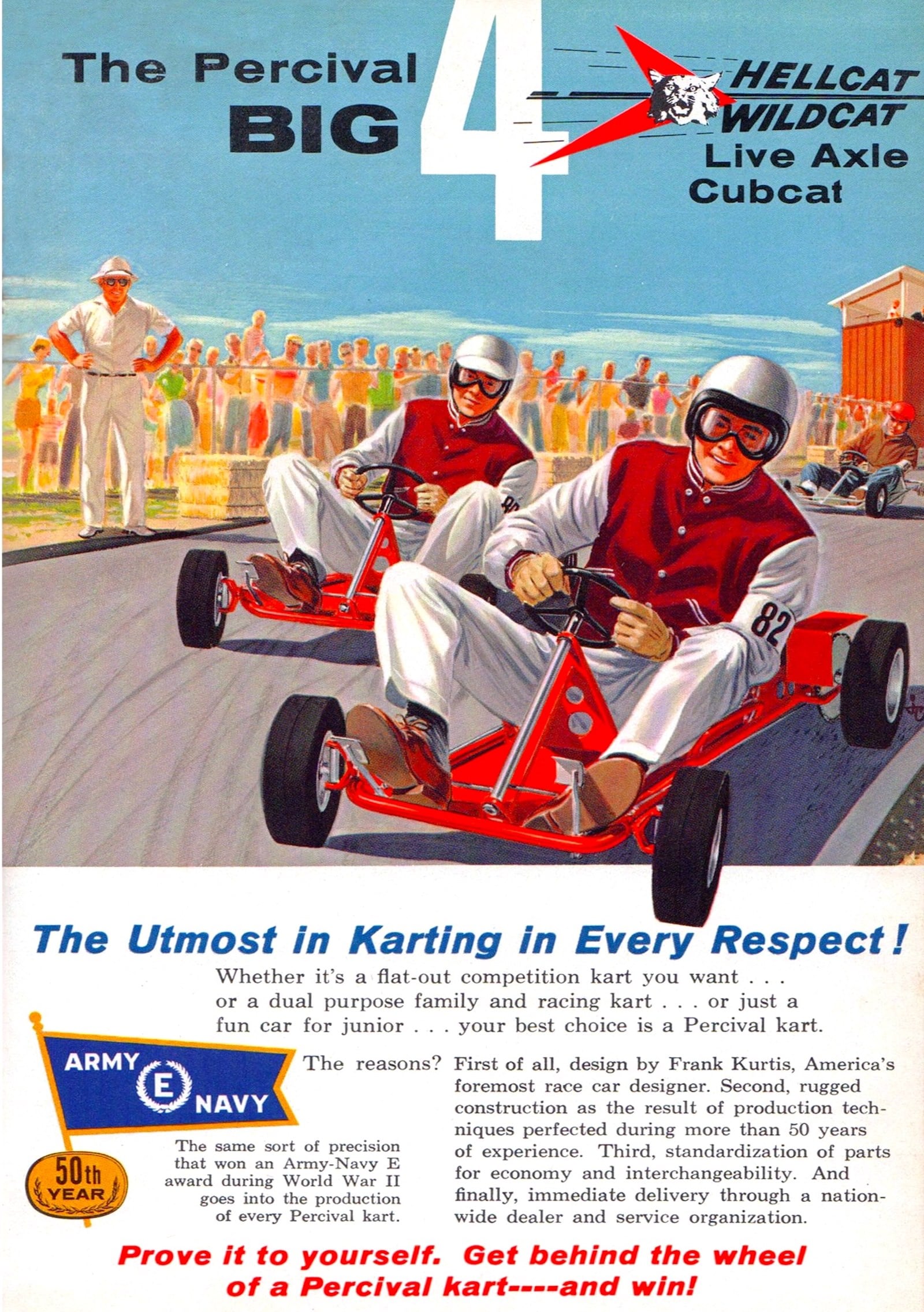
 The history behind Percival is fascinating and we’ve outlined it below, their foray into go kart manufacturing in the late-1950s and early-1960s resulted in a slew of race winning designs, but ultimately they would shutter their kart operations at some point in the 1960s. Image courtesy of Percival Company, Inc.
History Speedrun: Percival
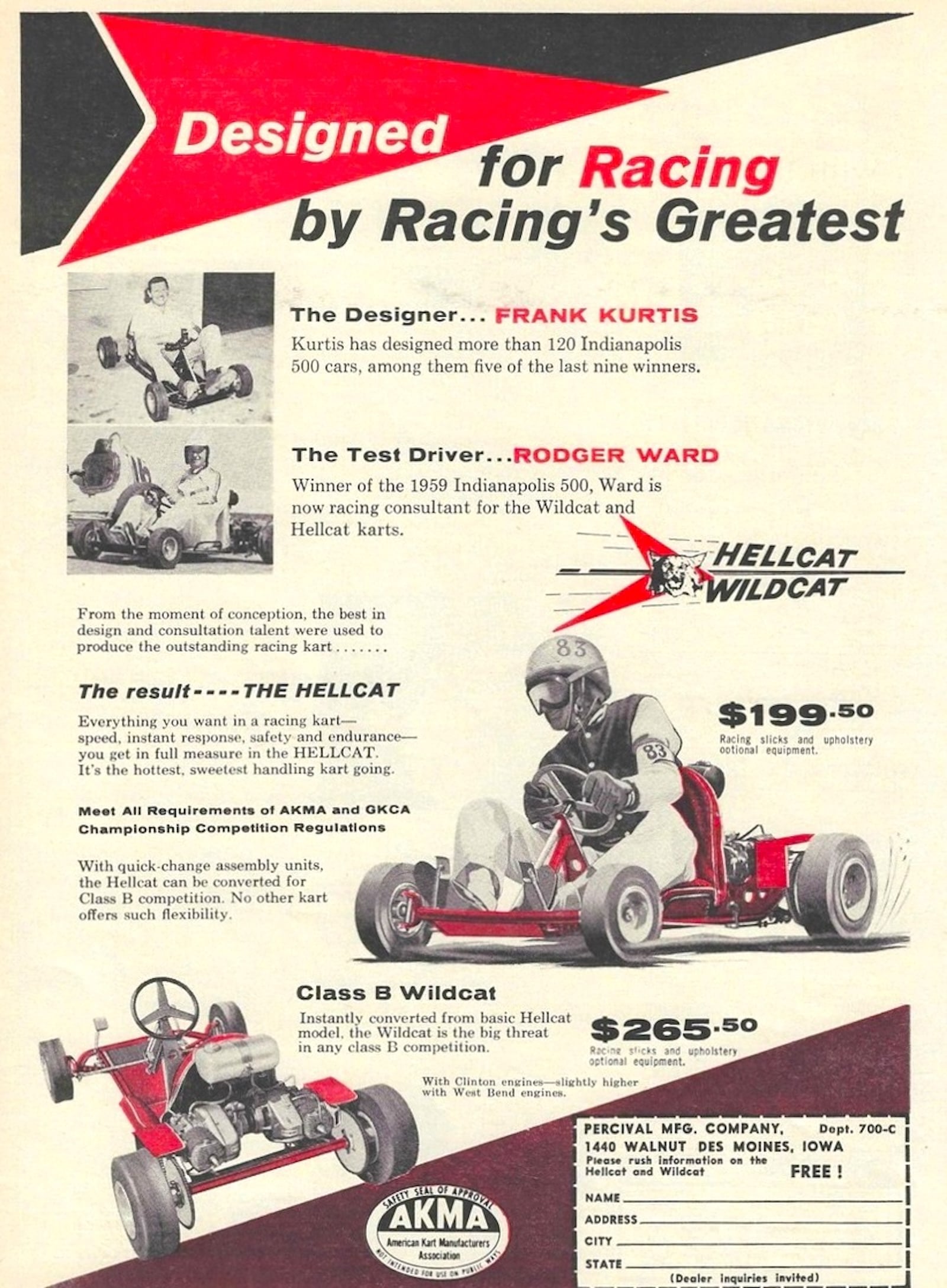
In 1959 an Iowa company named Percival, whose main business was commercial refrigerated display cabinets, made the unusual business decision to start selling go karts, which had been developed from prototypes designed by Frank Kurtis – the builder whose cars had won the Indianapolis 500 five times.
The origins of Percival go back to 1886 and the D.H. McDaneld Company, an Illinois-based outfit. The C.L. Percival Company was incorporated in May of 1901, originally as part of McDaneld, and made Des Moines its home. It traded in butchers’ equipment, furs, sheep pelts, and tallow. A 1901 patent for a forced-air, ice-cooled counter refrigerator, built to show meat, fruit and vegetables to customers while keeping them cold, sent the company on the trajectory it would follow for most of the next century.
By 1917 the company was selling a patented Percival Refrigerator Show Case in quarter-sawn oak, insulated with granulated cork. In early 1941 production moved to a new 24,000 square foot plant in Boone. During WWII, some of the Boone factory capacity was turned over to making ammunition boxes. After the war, in 1949, Percival dropped butcher supplies altogether and began building commercial refrigerators full time – it made sense as by that stage it had long been their primary profit driver.
Go Karting Arrives
Art Ingels, a fabricator at Kurtis Kraft in Glendale, California, built the first go kart in 1956. Large-scale Go Kart Manufacturing followed by 1958, selling kits by mail order for $129, and the market grew fast. Kart building companies went from a handful in 1959 to more than 30 nationwide by 1962, and Percival was among them.
The 1961 karting guide, The Complete Book of Karting, mentioned that Percival’s prototypes were designed by Kurtis and tested by Rodger Ward, and Percival’s advertising carried both names prominently as a way to elevate their profile in what was a crowded marketplace. Ward had won the Indianapolis 500 in 1959 and would win it again in 1962, Kurtis had left Kurtis Kraft in 1956 to form the Frank Kurtis Company, which also built karts under its own name.
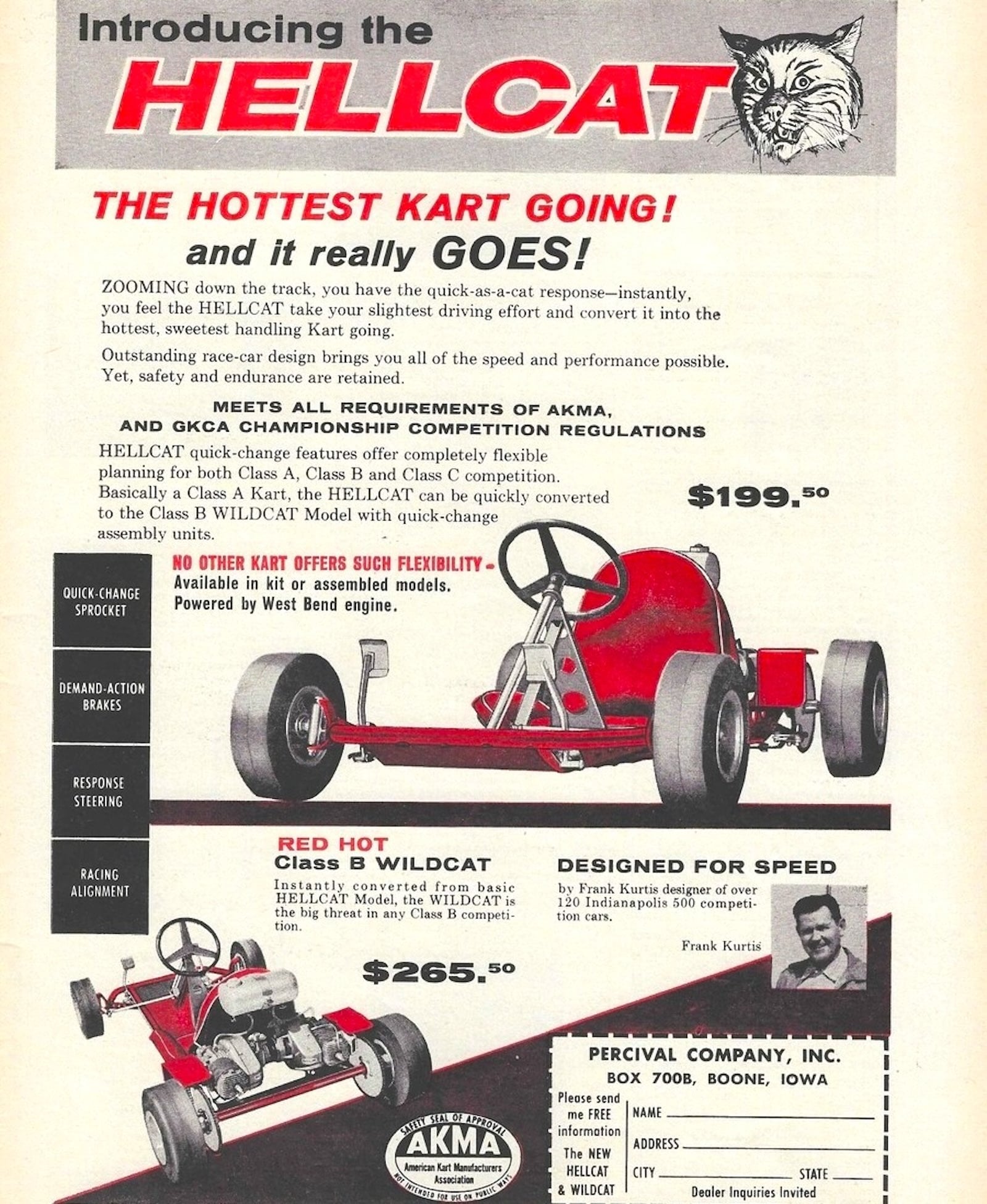
In 1959 an Iowa company named Percival, whose main business was commercial refrigerators made the unusual business decision to start selling racing go karts, which had been developed from prototypes designed by Frank Kurtis – the builder whose cars had won the Indianapolis 500 five times. Image courtesy of Percival Company, Inc.
That same book credited Percival with “corrected steering geometry” and said its karts had run up a list of wins at major events. By 1960 Percival’s dealer literature was offering four models – the Hellcat, the Wildcat, the Live Axle, and the Cubcat, the latter was a junior kart.
Another Pivot From Percival
Percival’s next pivot came from a request made in the early 1950s, when Iowa State University asked it to build a chamber with a controlled environment for growing plants. It wasn’t that dissimilar to making refrigerated display cases, both were insulated boxes with glass doors and a carefully controlled internal temperature.
Plant growing chambers remained a sideline business for nearly 40 years while display cabinets remained the core business. Over time, the plant chambers became increasing popular, and Percival stopped making commercial display equipment in 1989, became Percival Scientific on December the 31st, 1992, and moved to a new factory in Perry, Iowa, in 2000.
The company still builds plant growth chambers there today, and interestingly its official published history covers butcher tools, refrigerated show cases, and plant growth chambers, but it doesn’t mention carts at all.
The 1963 Percival Wildcat Go-Kart Shown Here
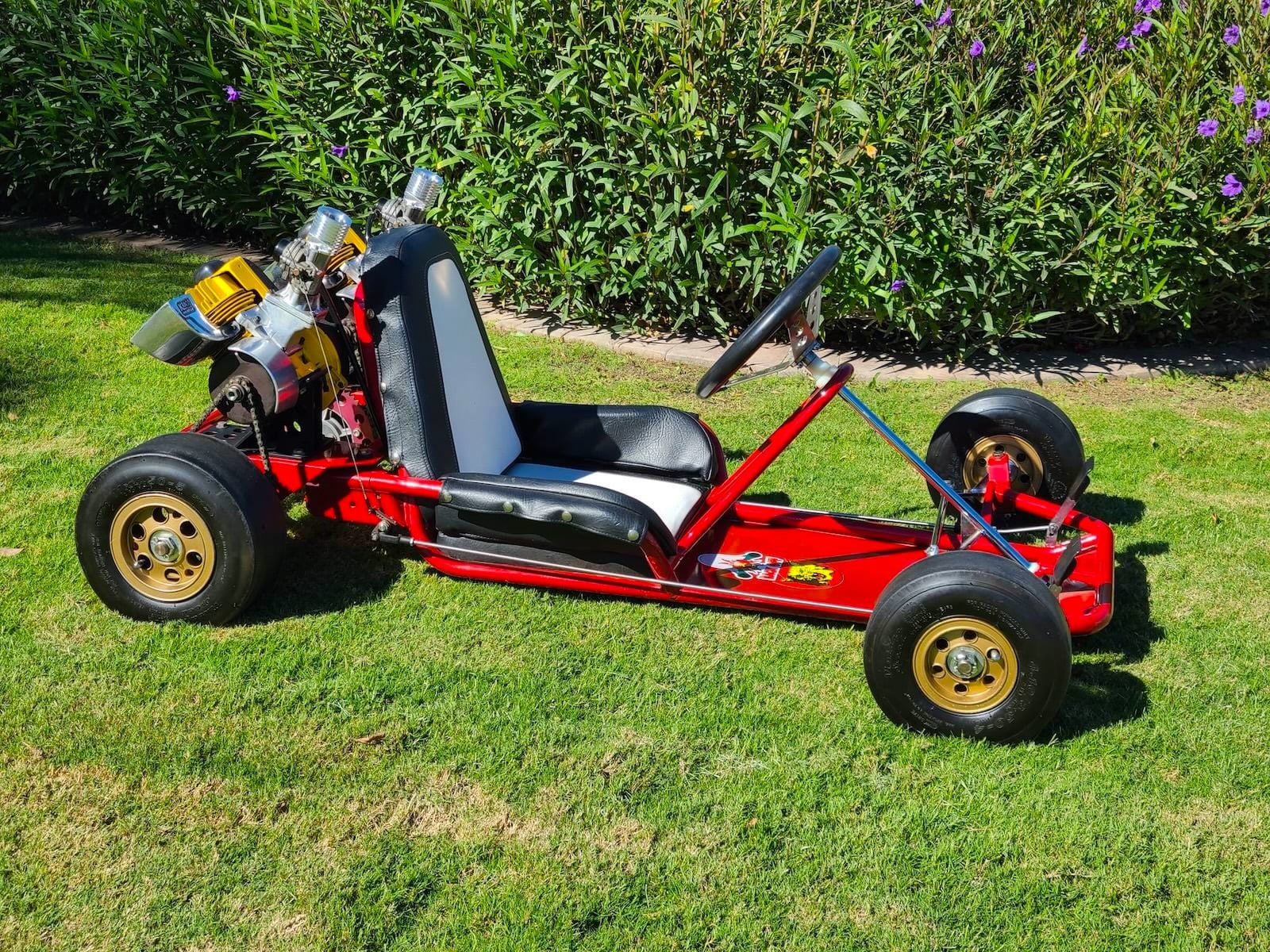
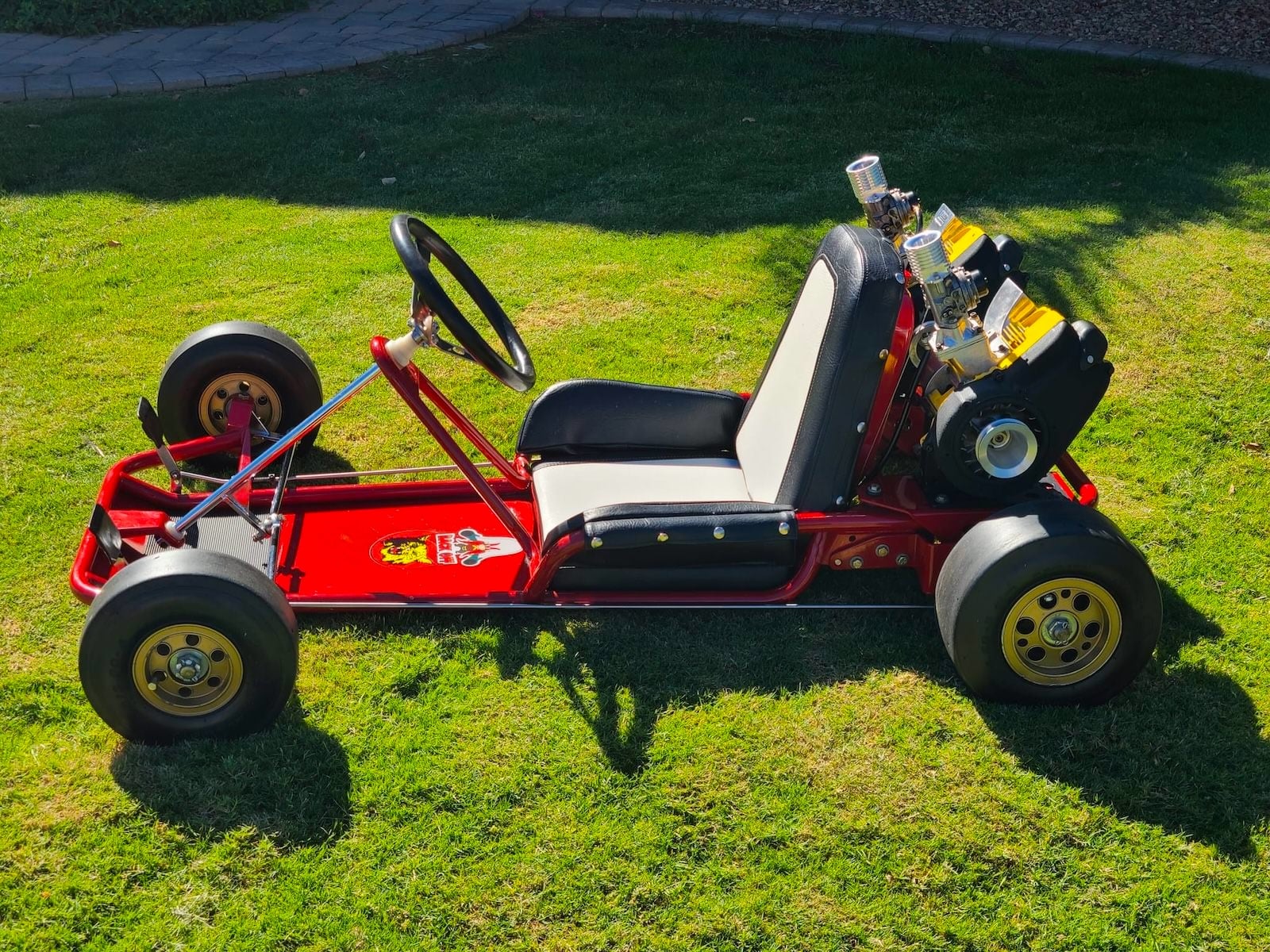
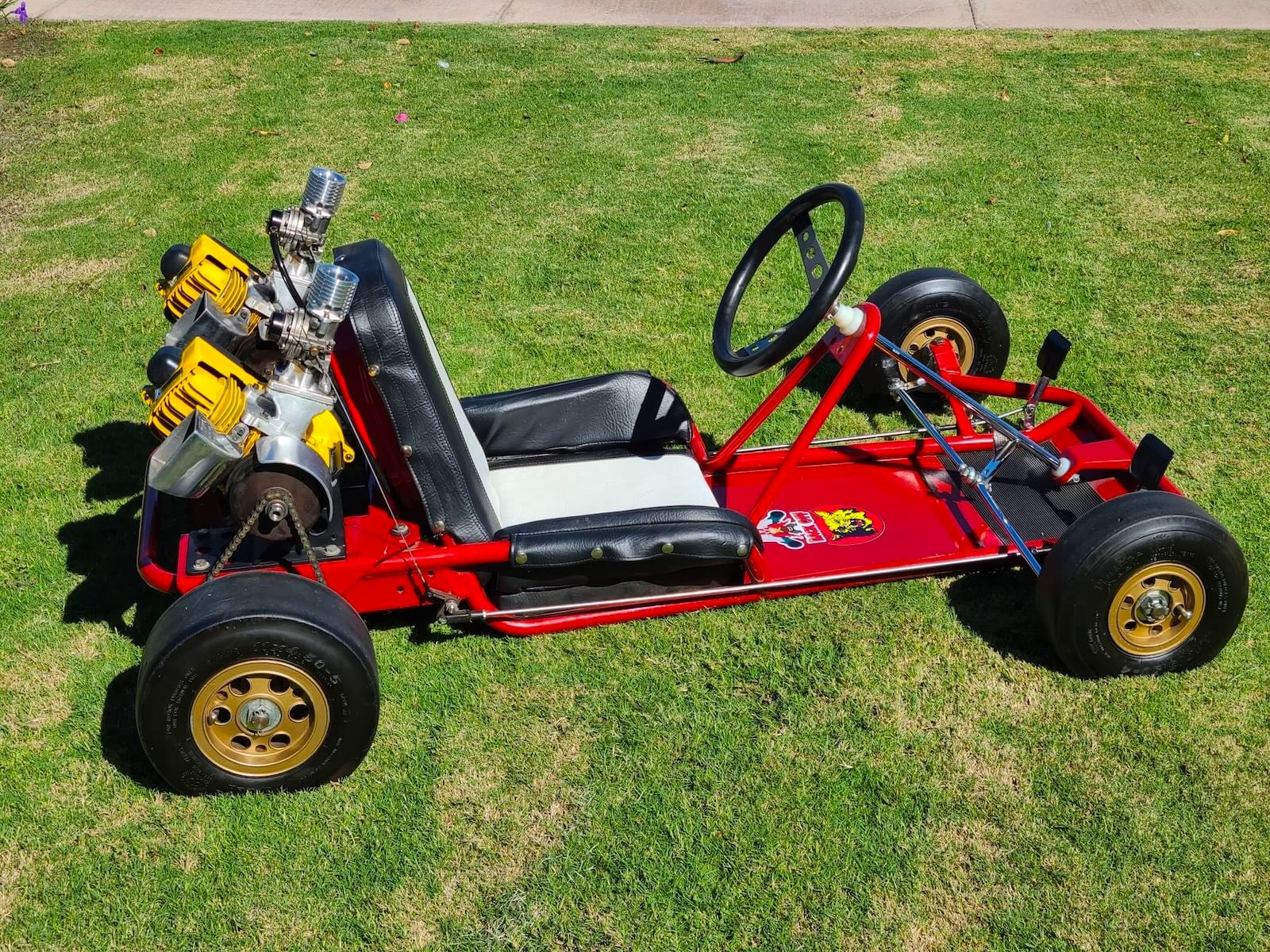
This is a 1963 Percival Wildcat, it’s a twin-engine racing kart that was bought by the seller in 2024 and subsequently given a refurb. The chromoly frame was powder-coated in Fire Engine Red, the hardware was re-chromed, and both McCulloch MC9 two-stroke engines were rebuilt.
The restoration also included the fitment of a matching aluminum floor pan, Wildcat graphics, and replacement Vintage Speed tires fitted to gold-finished GoPower wheels.
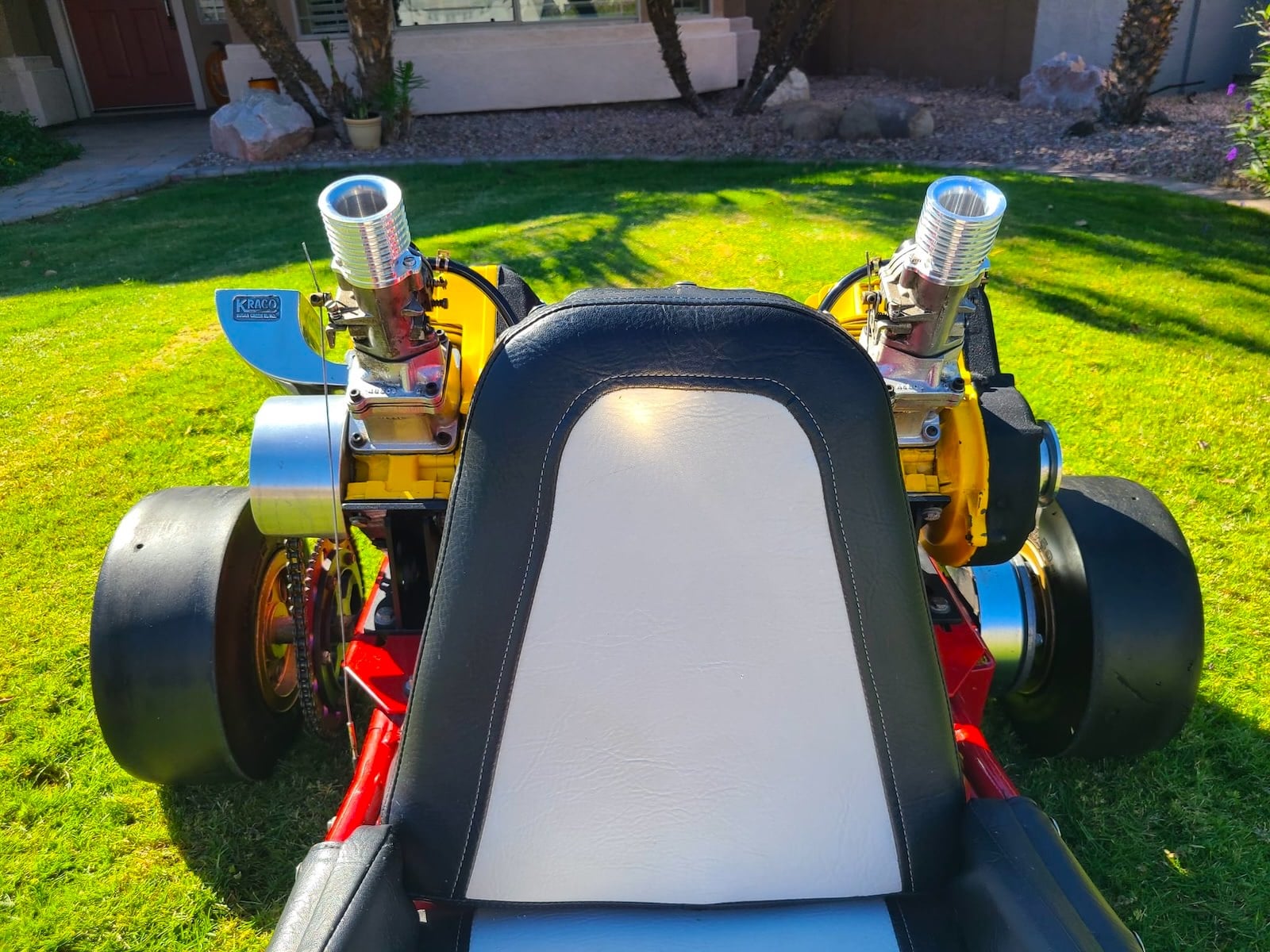
Power comes from a pair of 6.05 cubic inch (99cc) McCulloch MC9 single-cylinder two-strokes, each fitted with a Tillotson performance carburetor, milled velocity stack, McCulloch MC30 manifold, and Kraco exhaust header. Horstman Rev-Grip centrifugal clutches send power to the rear axle through separate drive chains. Braking is handled by a single rear drum.
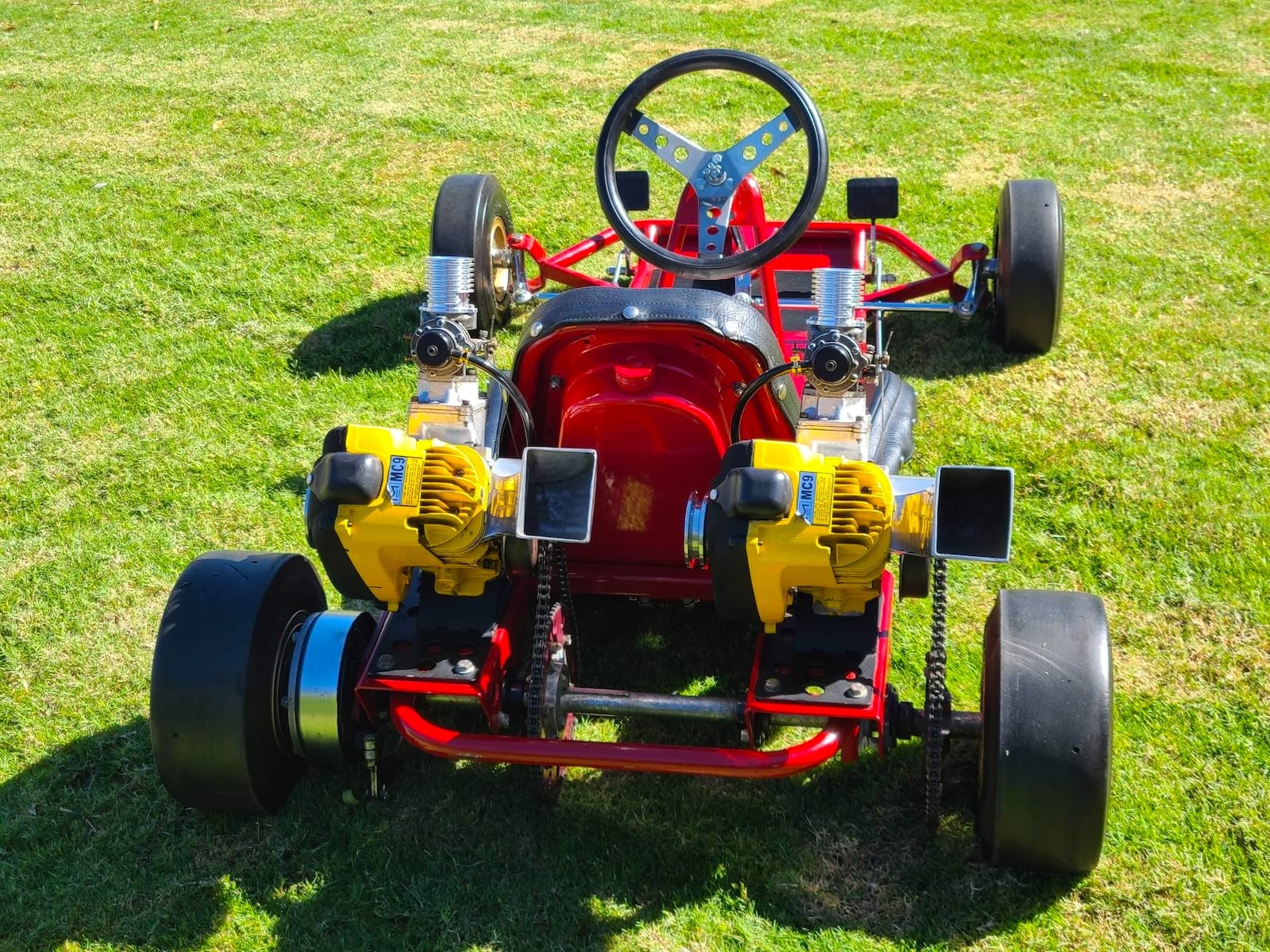
This is a rare original 1963 Percival Wildcat go-kart, it was factory-fitted with two engines, essentially doubling the power output, thanks to the fact there are two McCulloch MC9 99cc two-stroke engines working on the rear axle.
Other period equipment includes a five-quart Chilton fuel tank mounted behind the seat, twin box-style engine mounts, a three-spoke steering wheel, and a black vinyl bucket seat with a white insert.
The kart is now being offered for sale at no reserve in Gilbert, Arizona, with a bill of sale. If you’d like to read more about it or register to bid you can visit the listing here.
Images provided by Bring a Trailer + Percival Company, Inc

Articles that Ben Branch has written have been covered on CNN, Popular Mechanics, Smithsonian Magazine, Road & Track Magazine, the official Pinterest blog, the official eBay Motors blog, BuzzFeed, Autoweek Magazine, Wired Magazine, Autoblog, Gear Patrol, Jalopnik, The Verge, and many more.
Silodrome was founded by Ben back in 2010, in the years since the site has grown to become a world leader in the alternative and vintage motoring sector, with well over a million monthly readers from around the world and many hundreds of thousands of followers on social media.