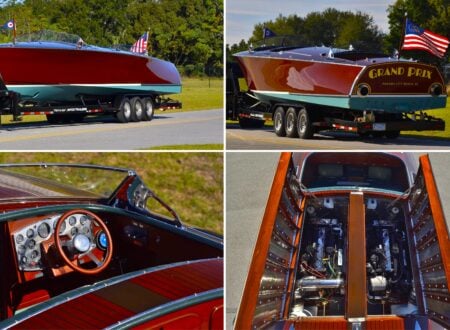
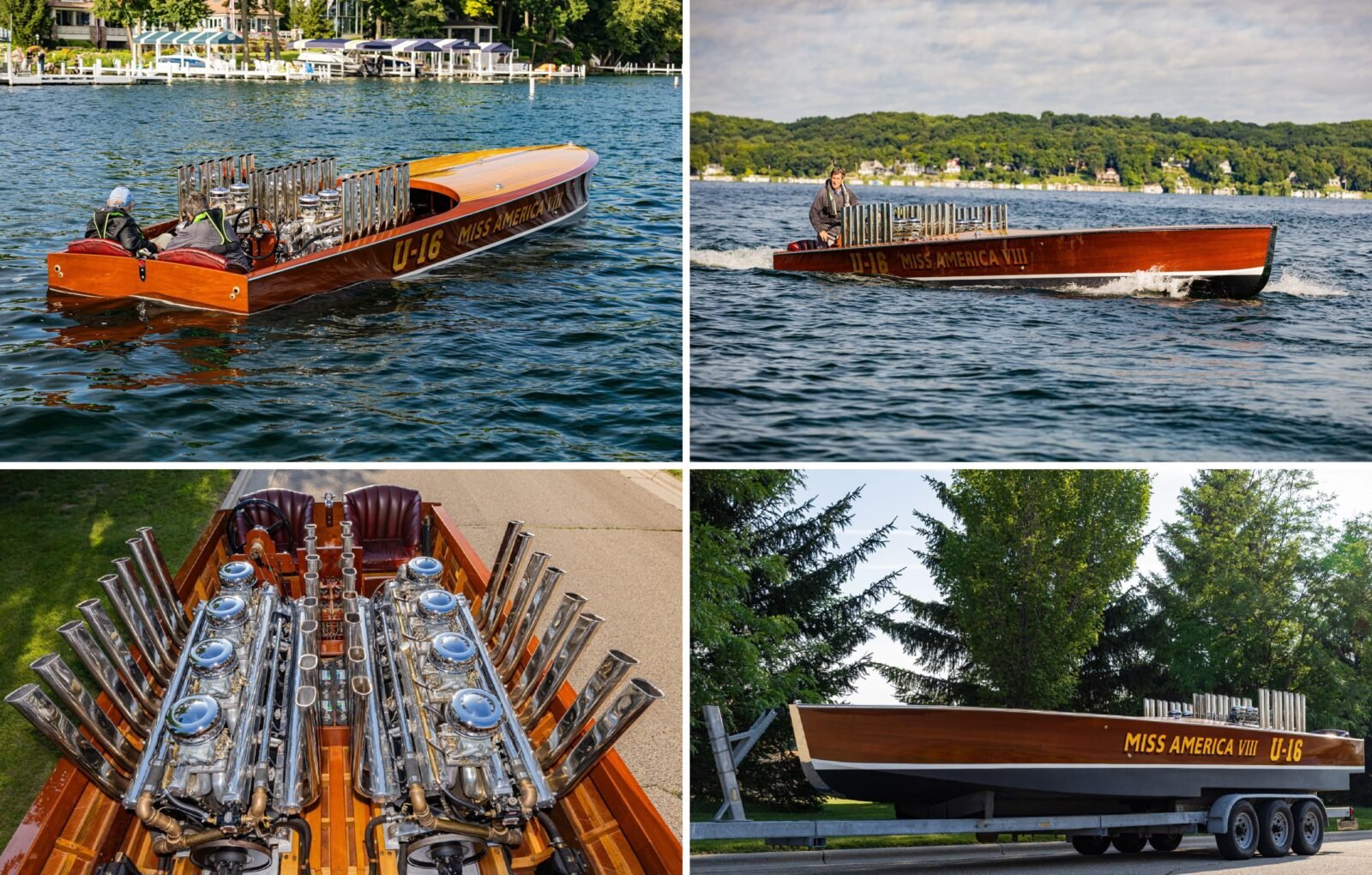
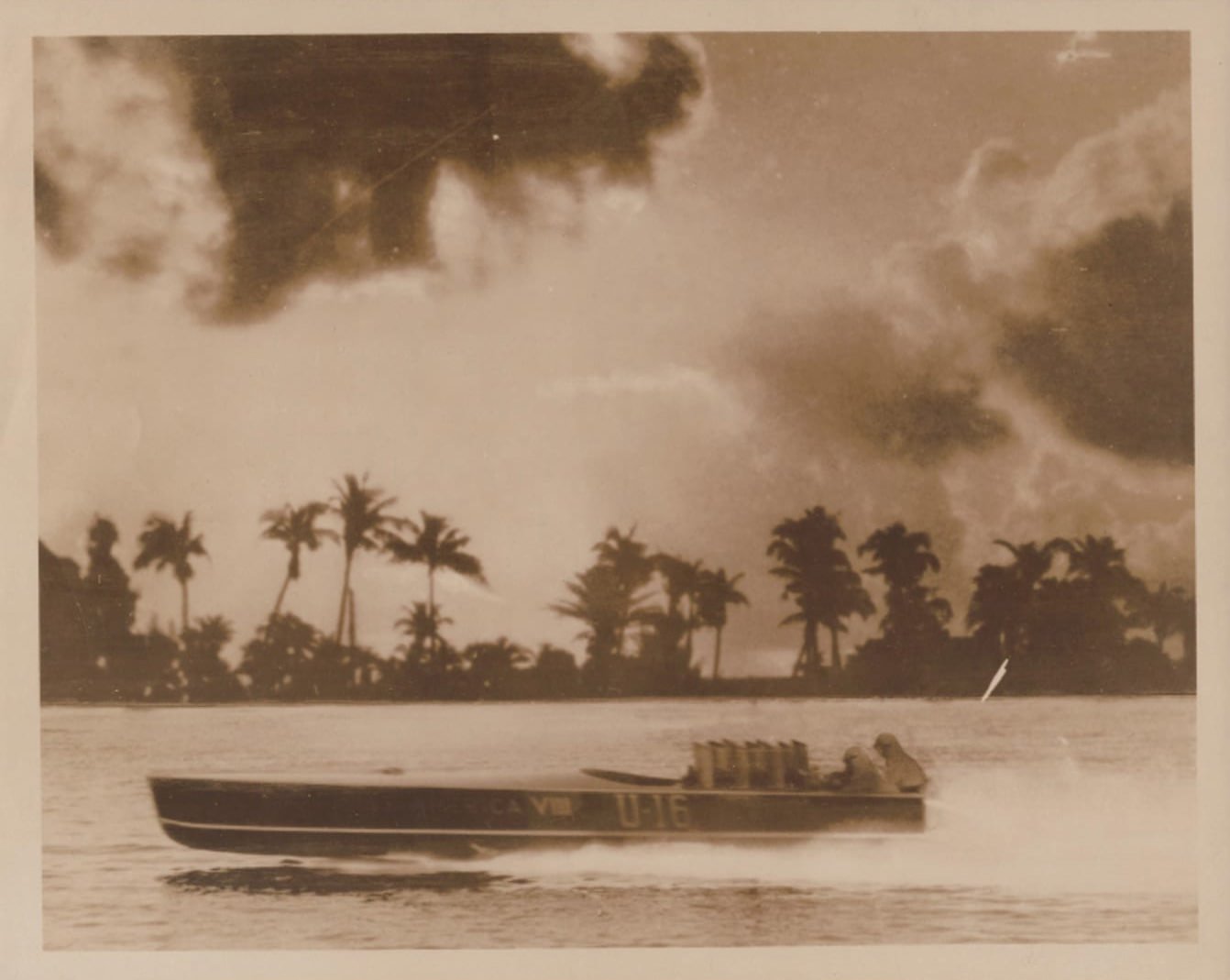
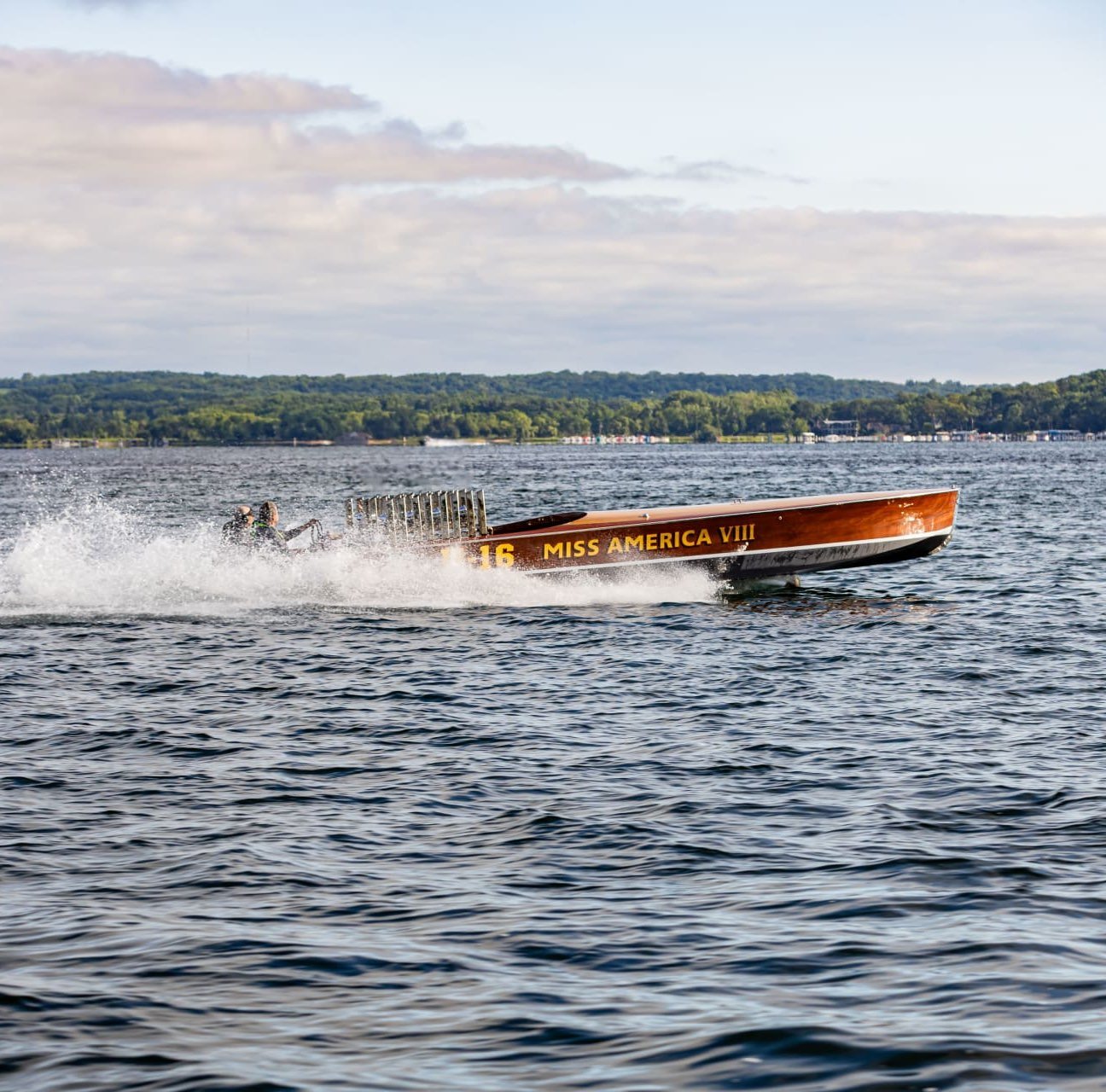
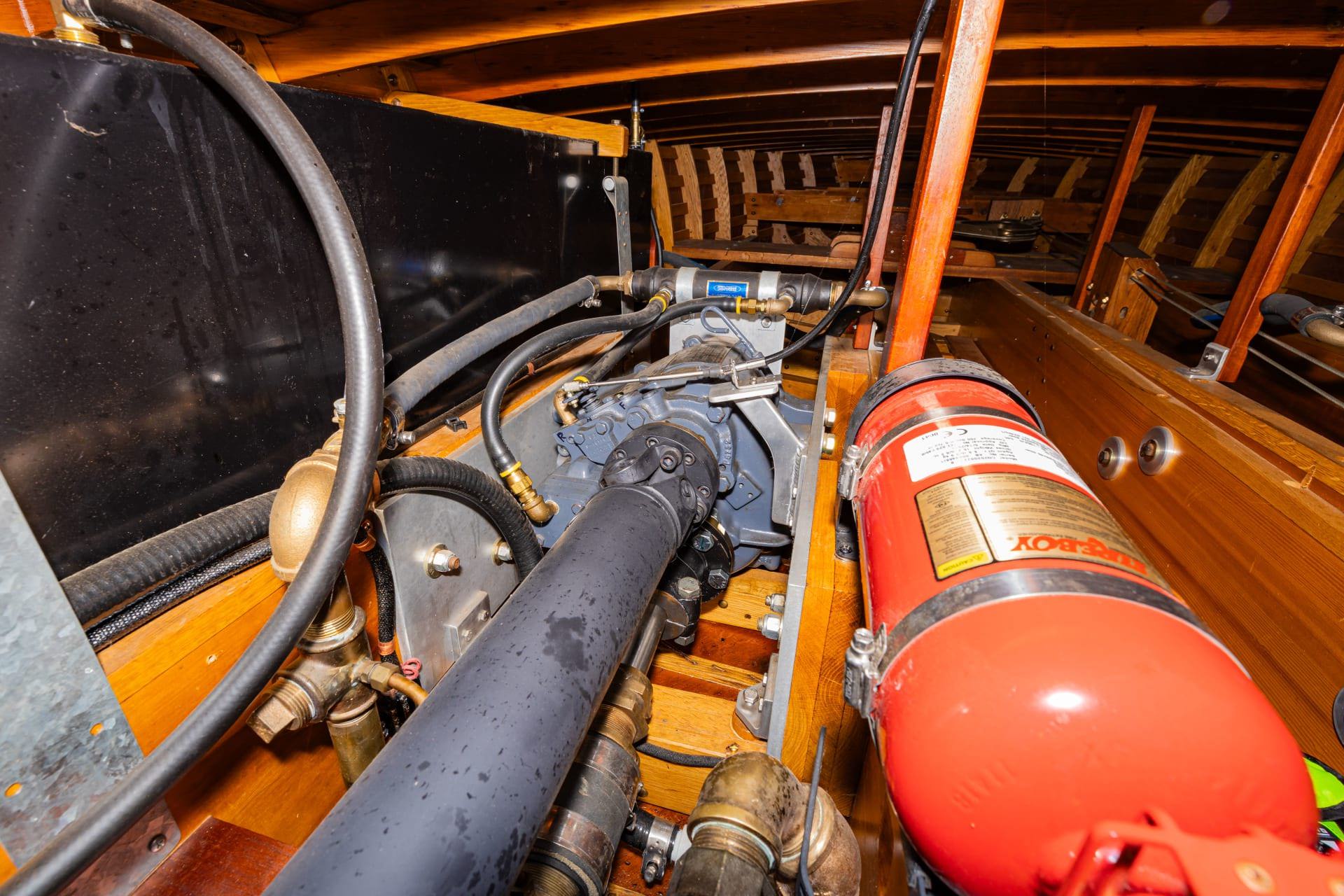
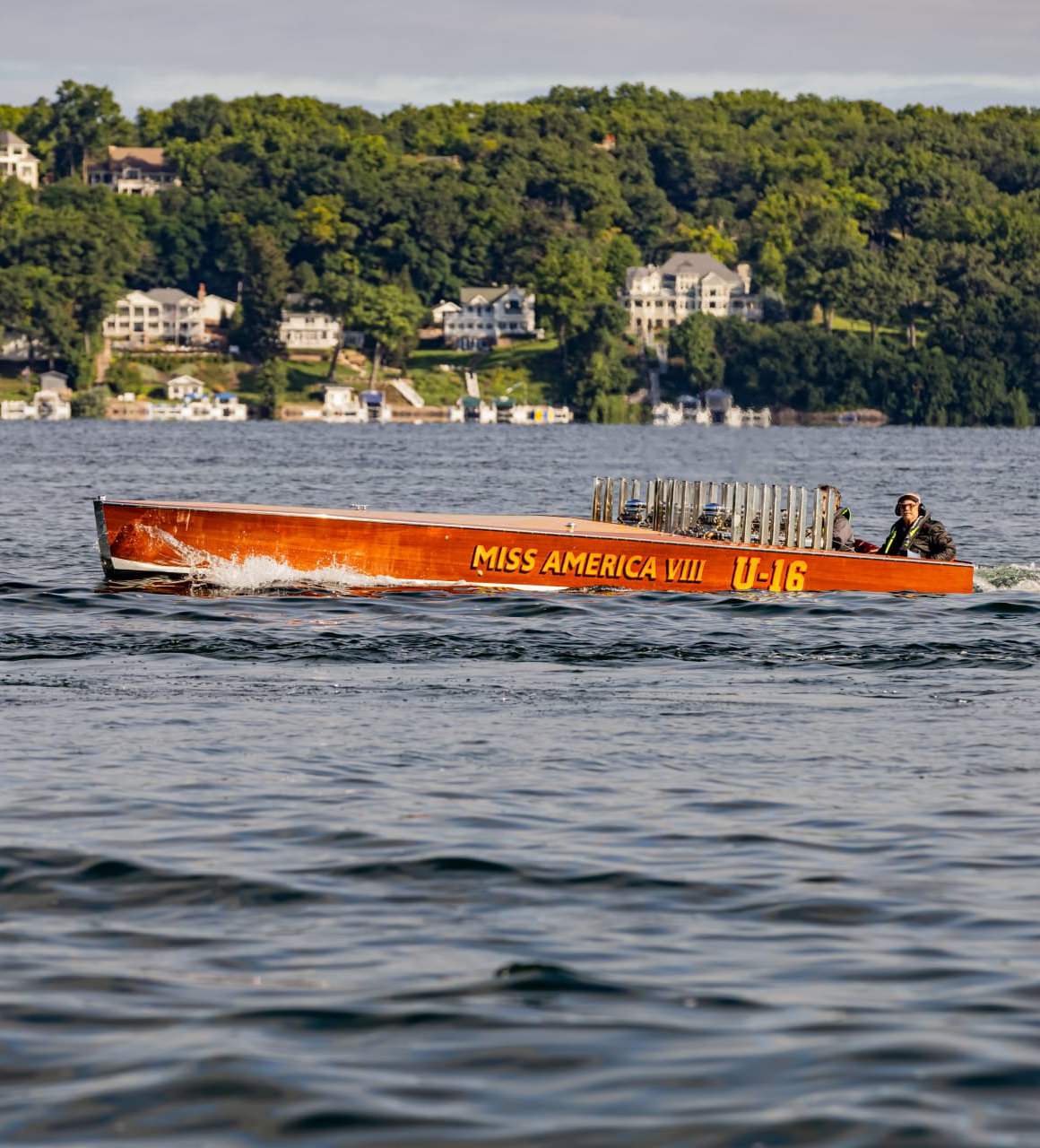
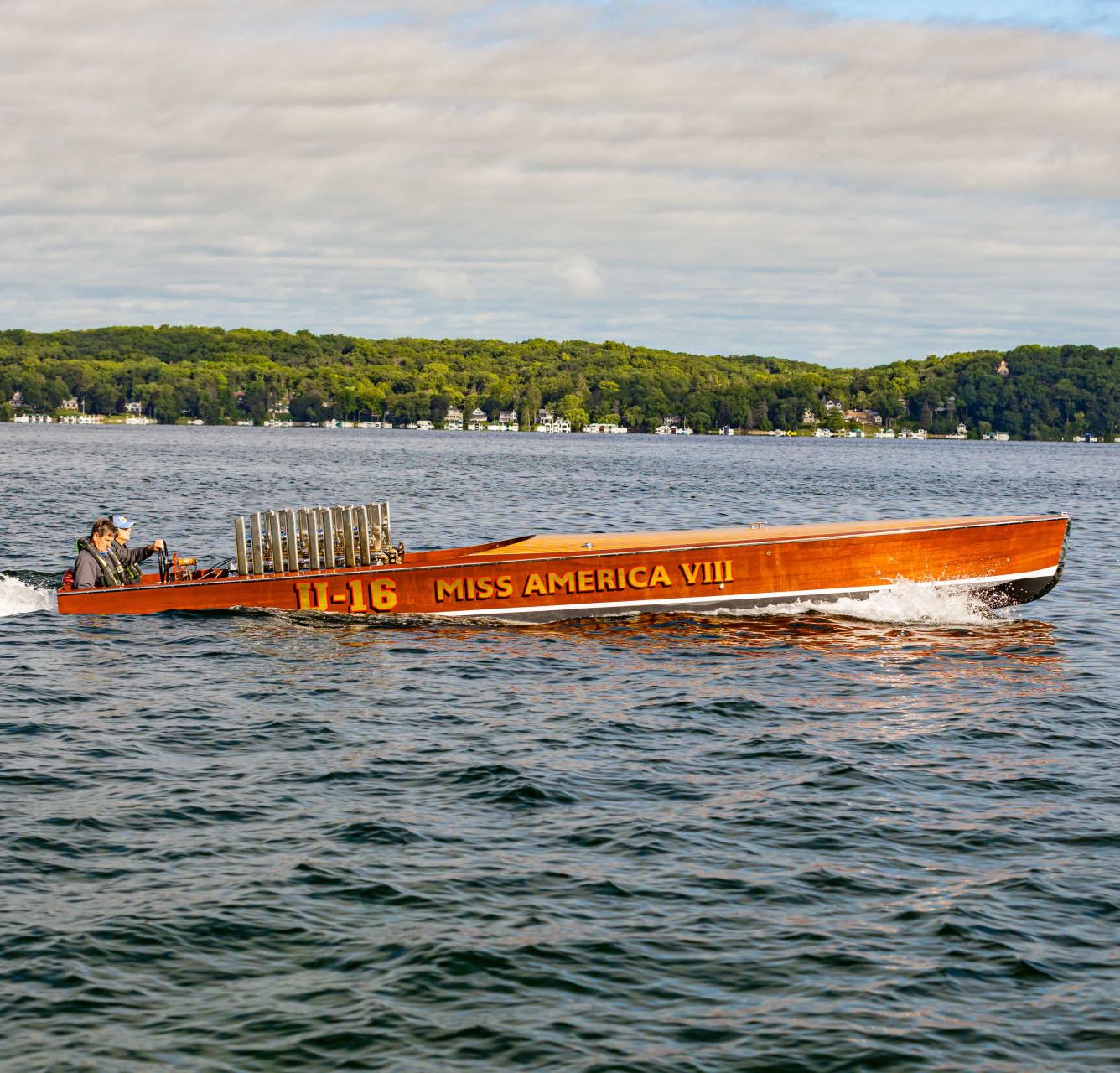
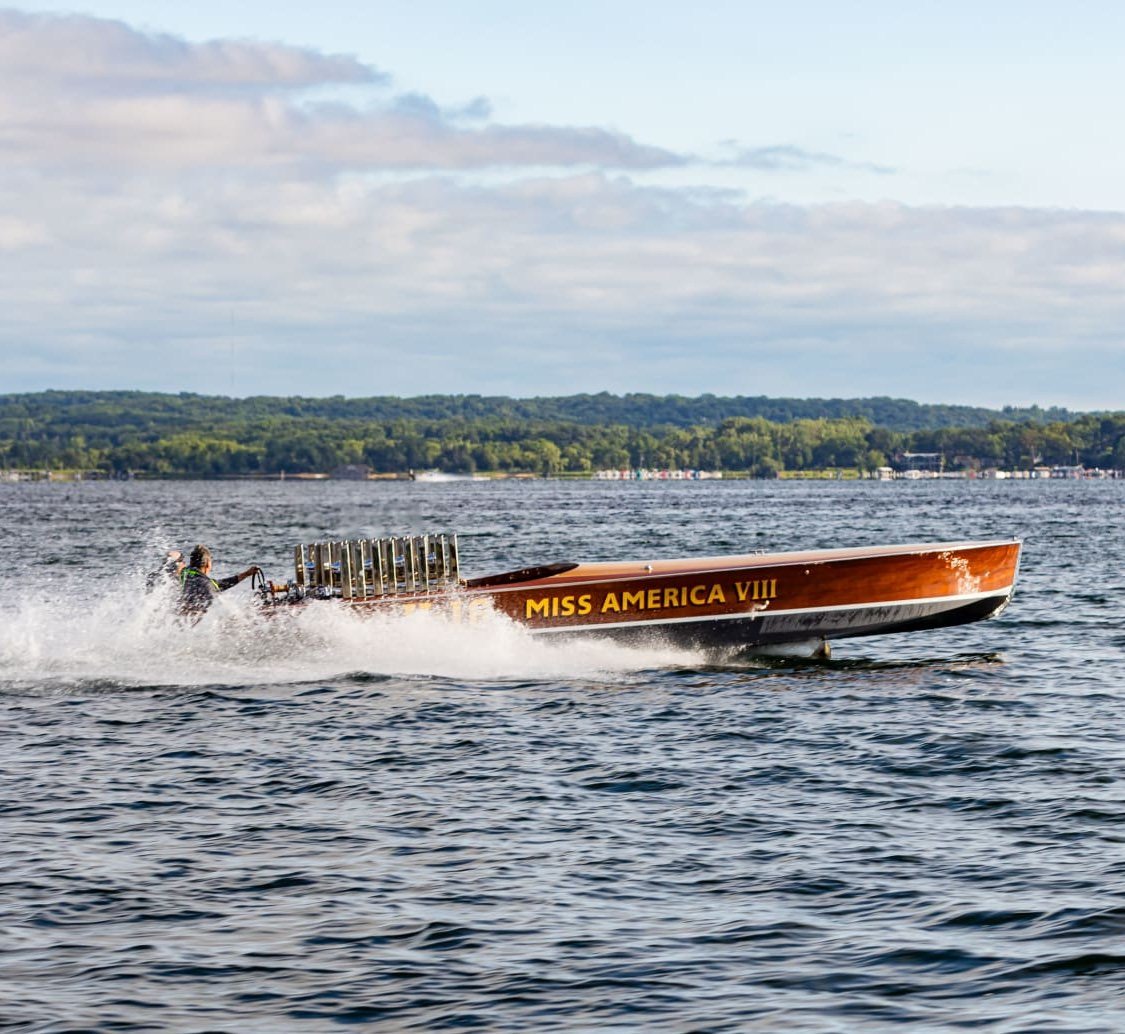
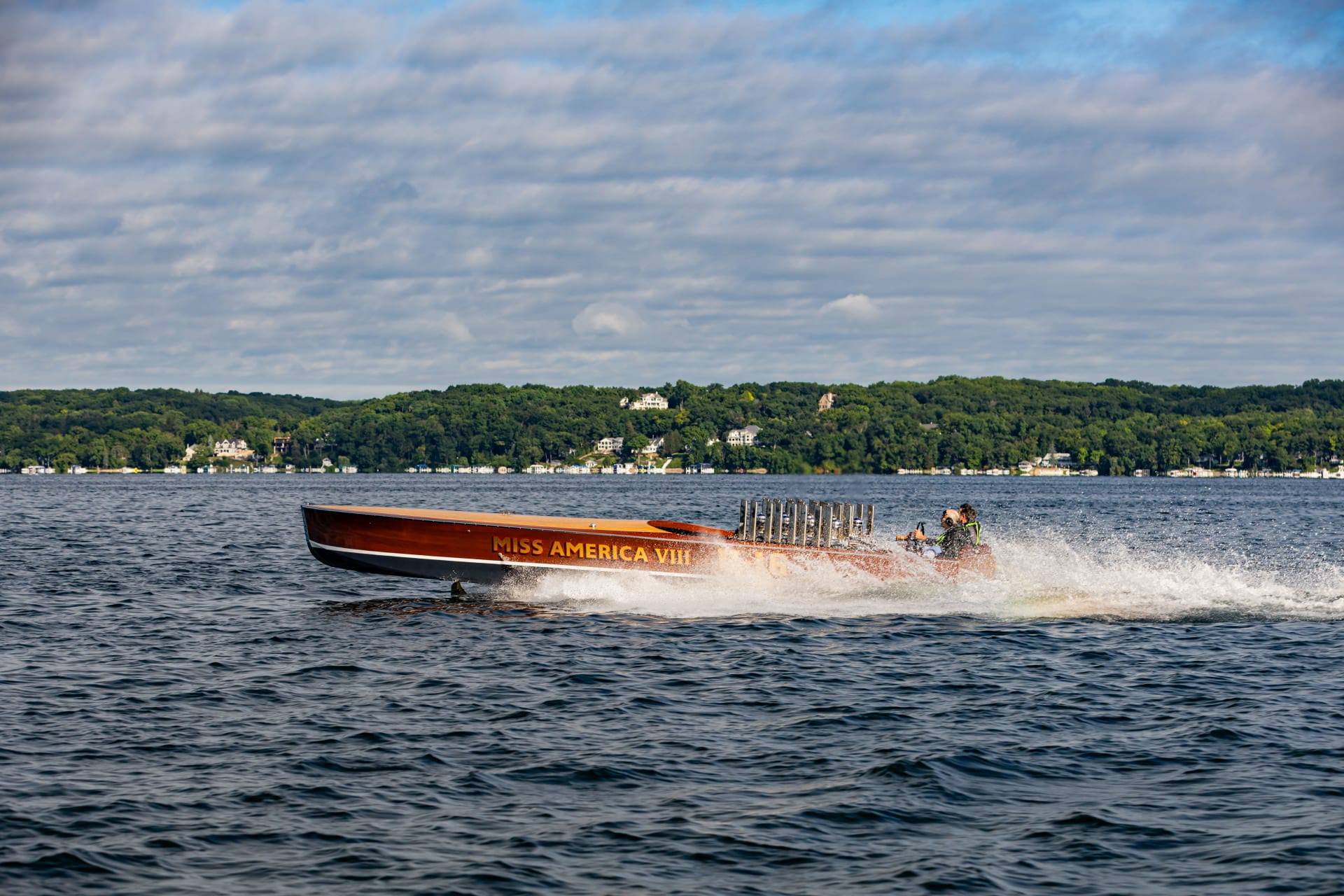
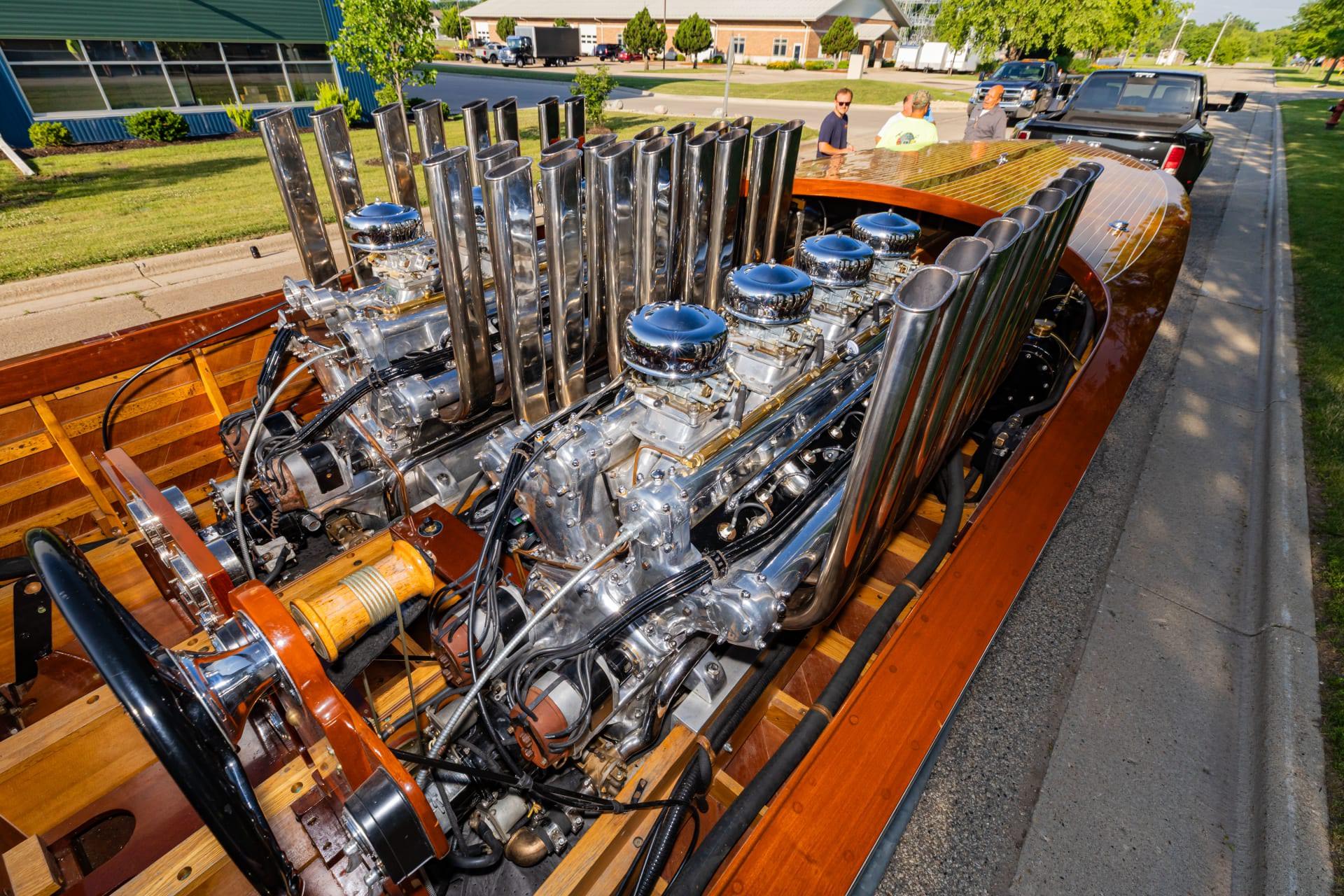
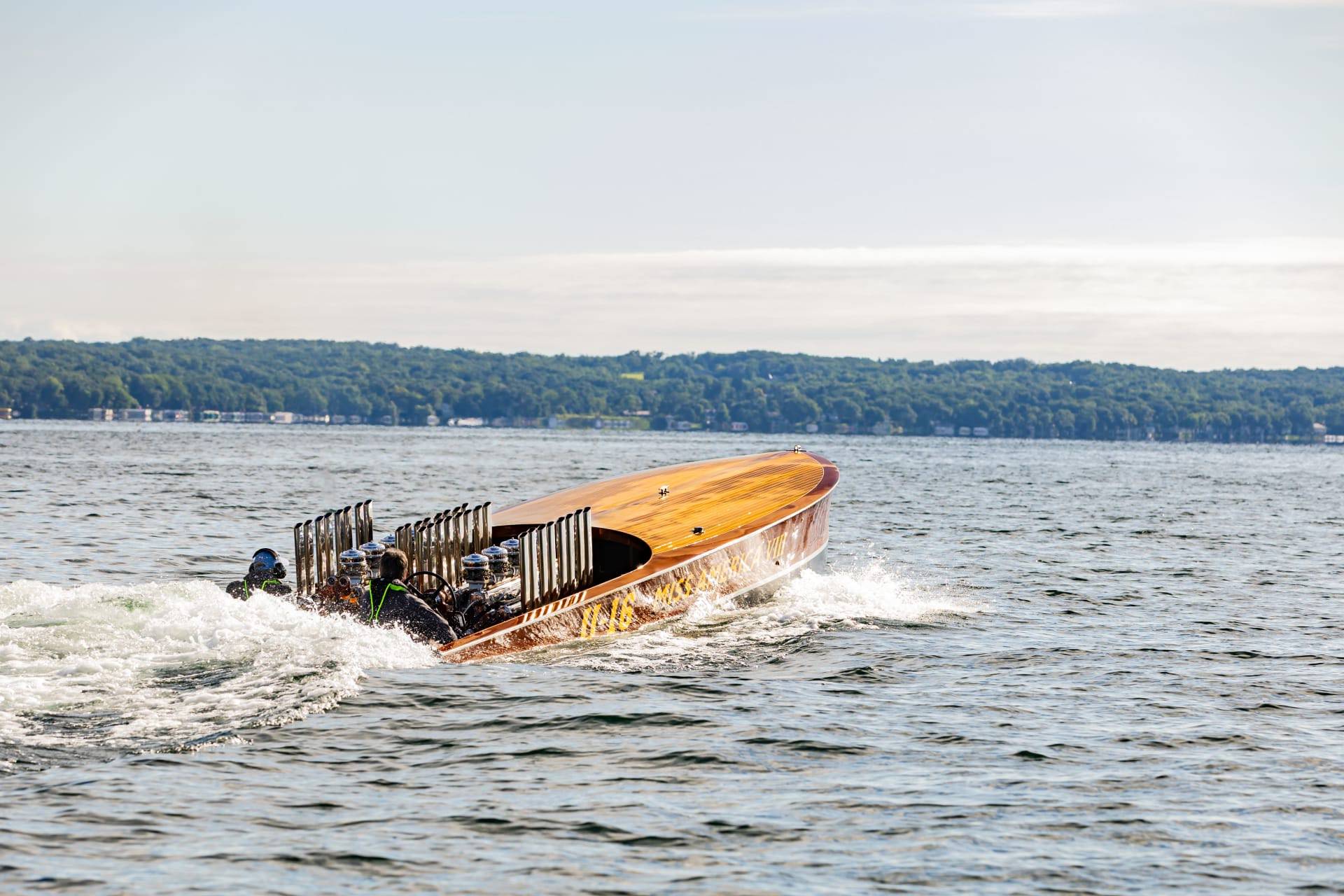
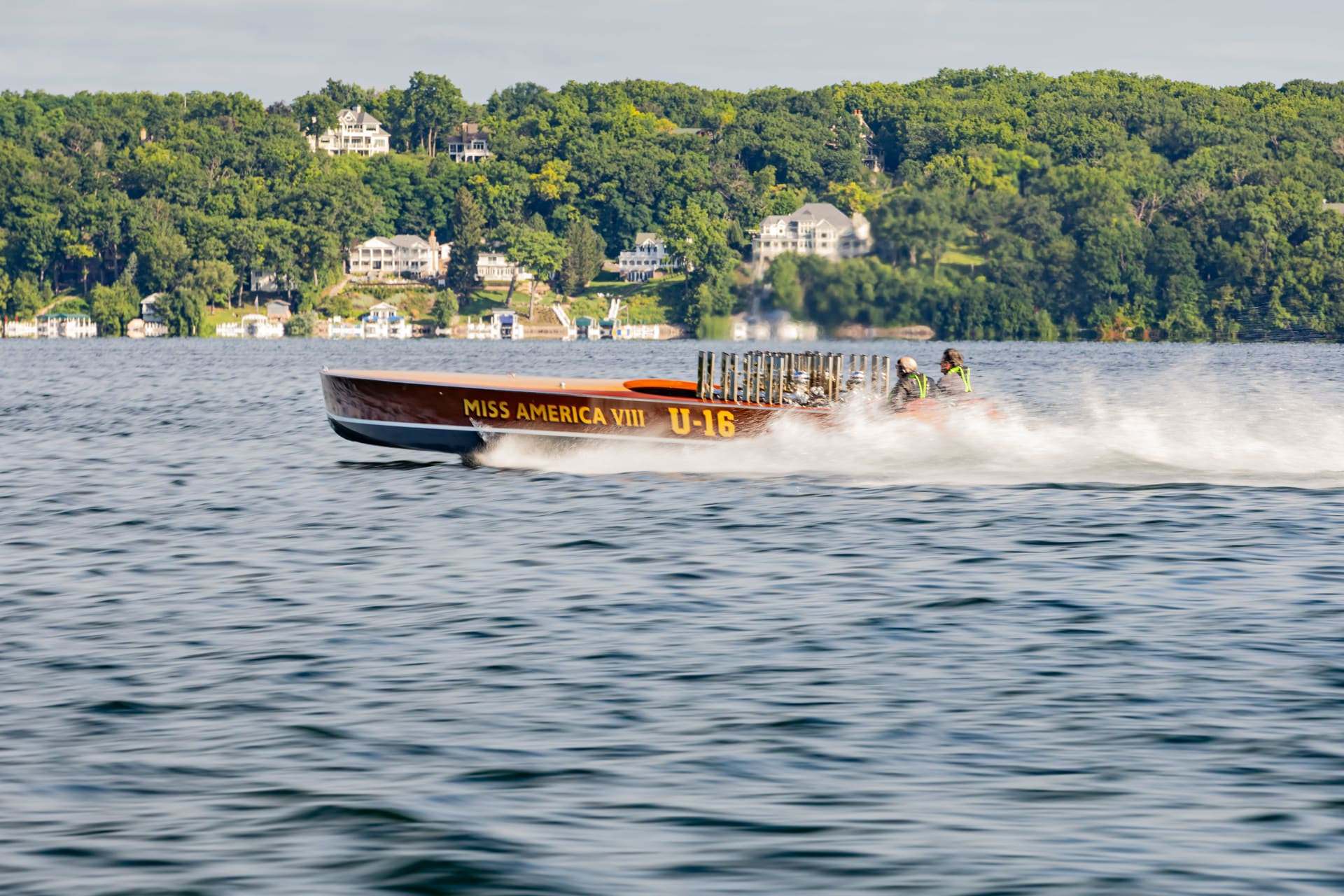
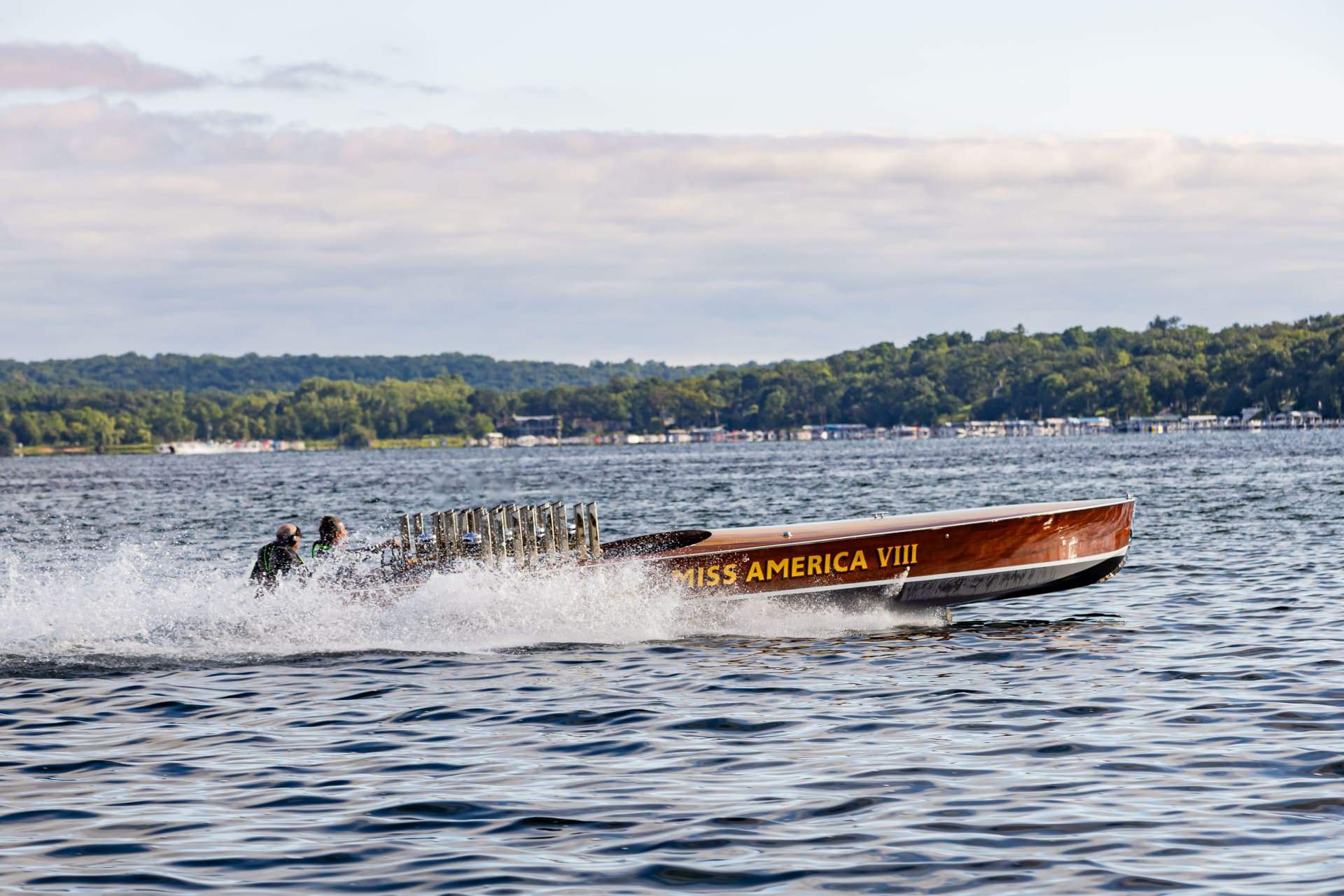
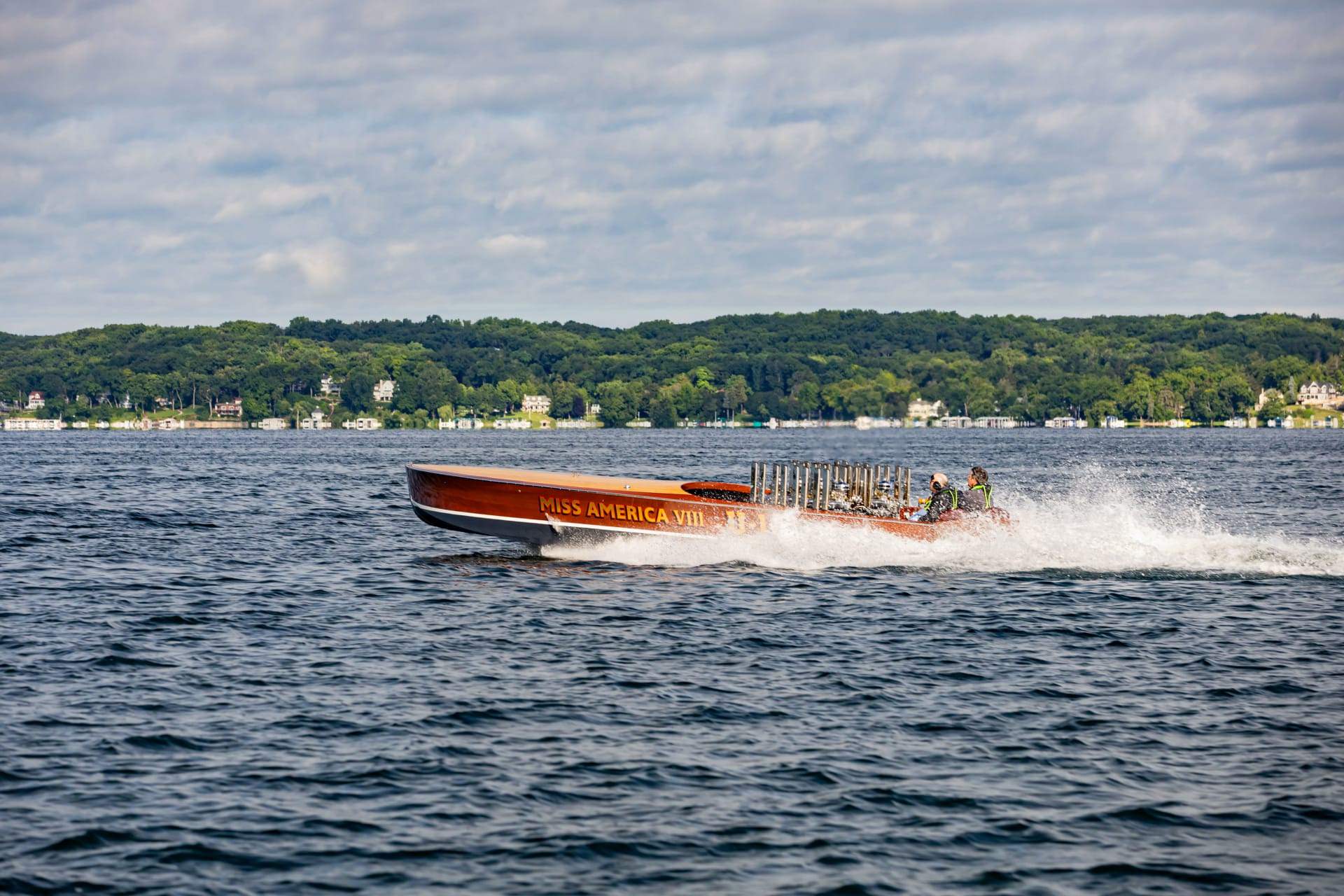
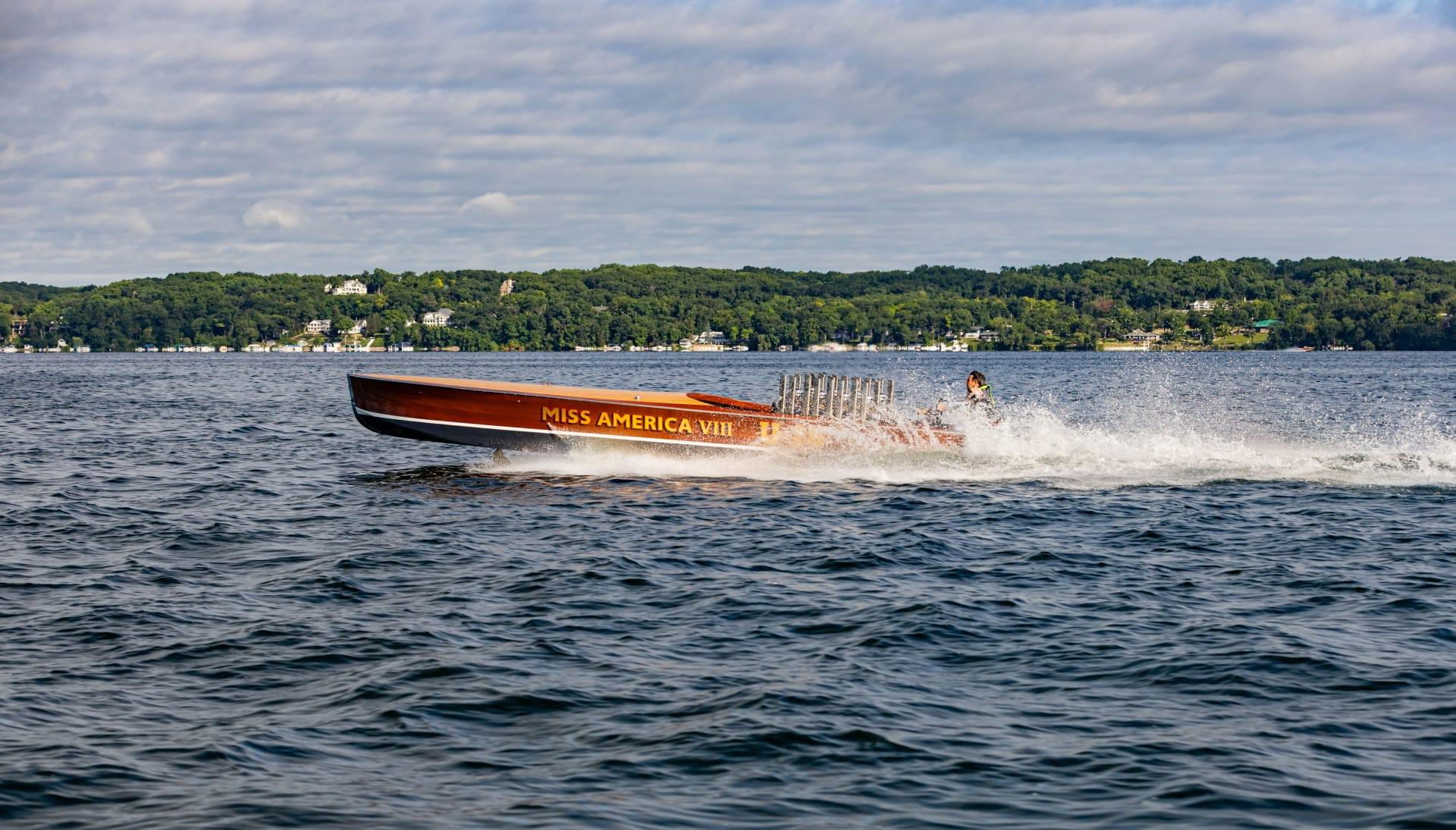
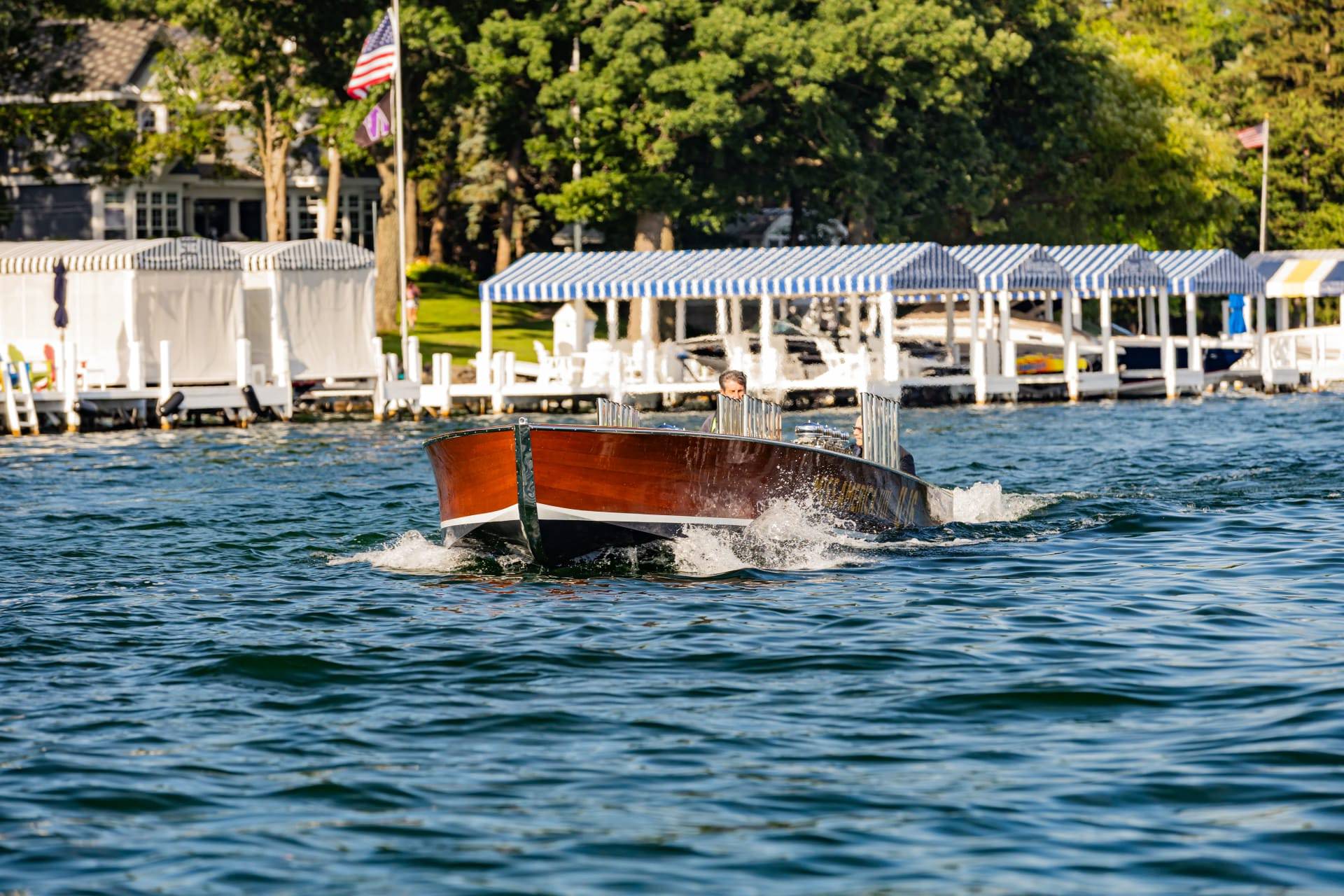
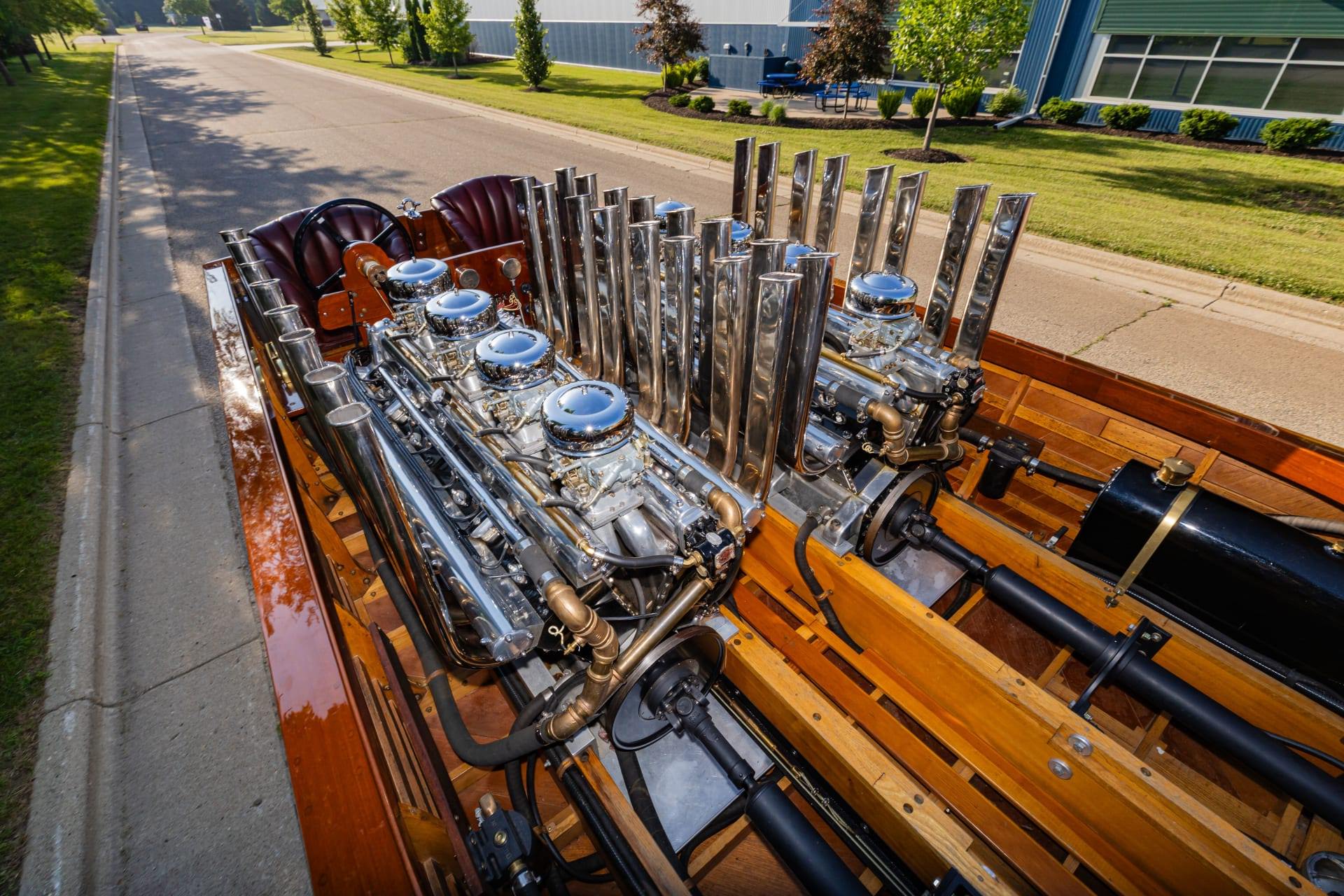
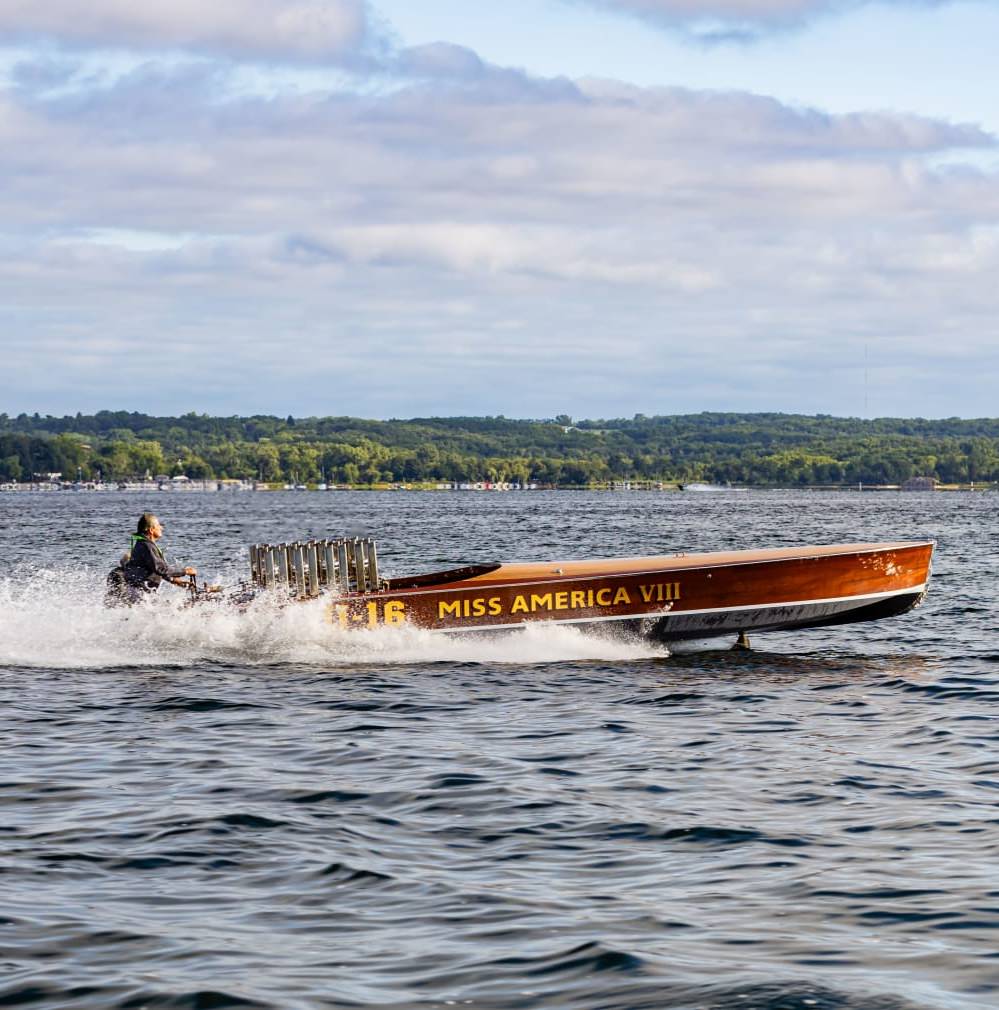
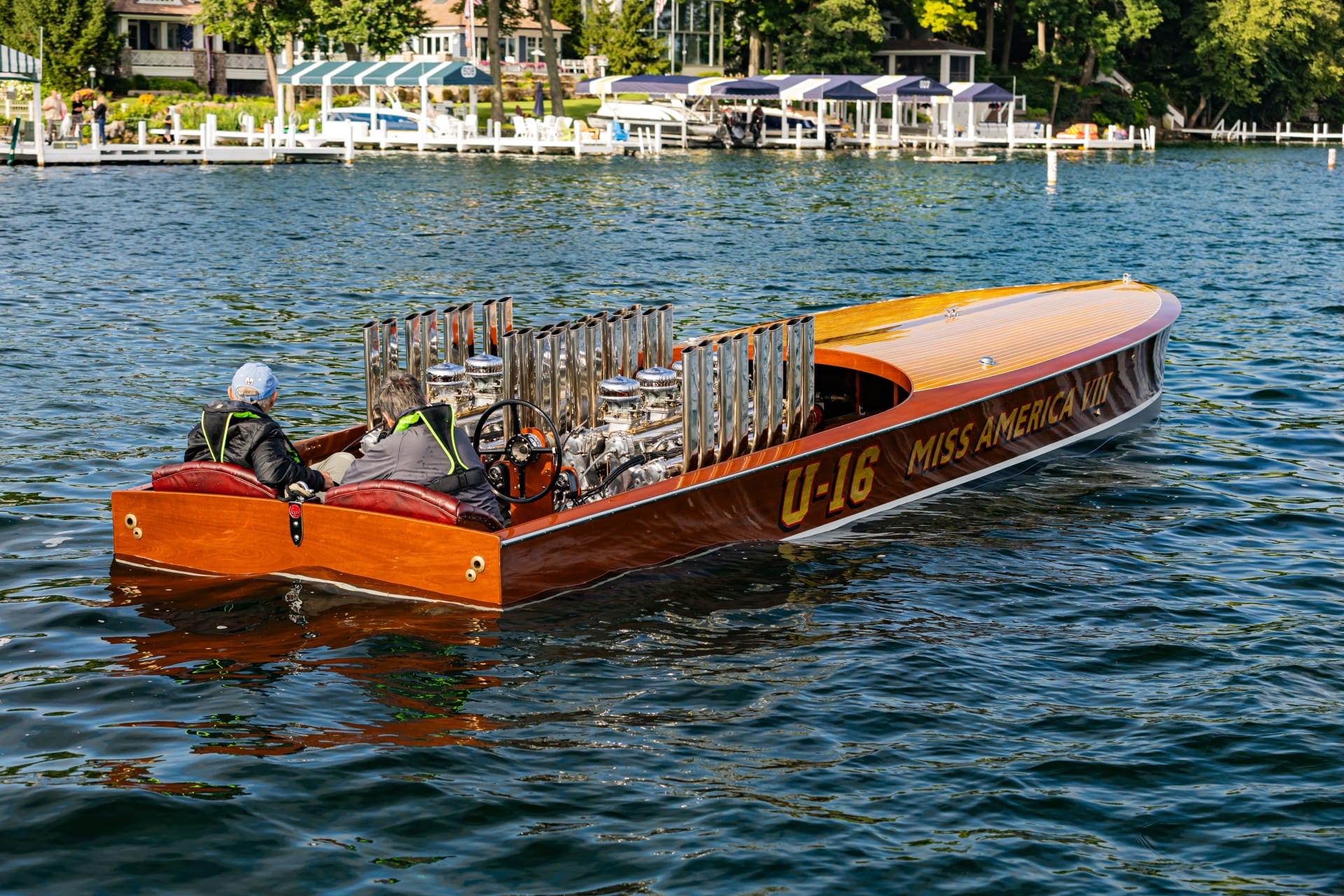
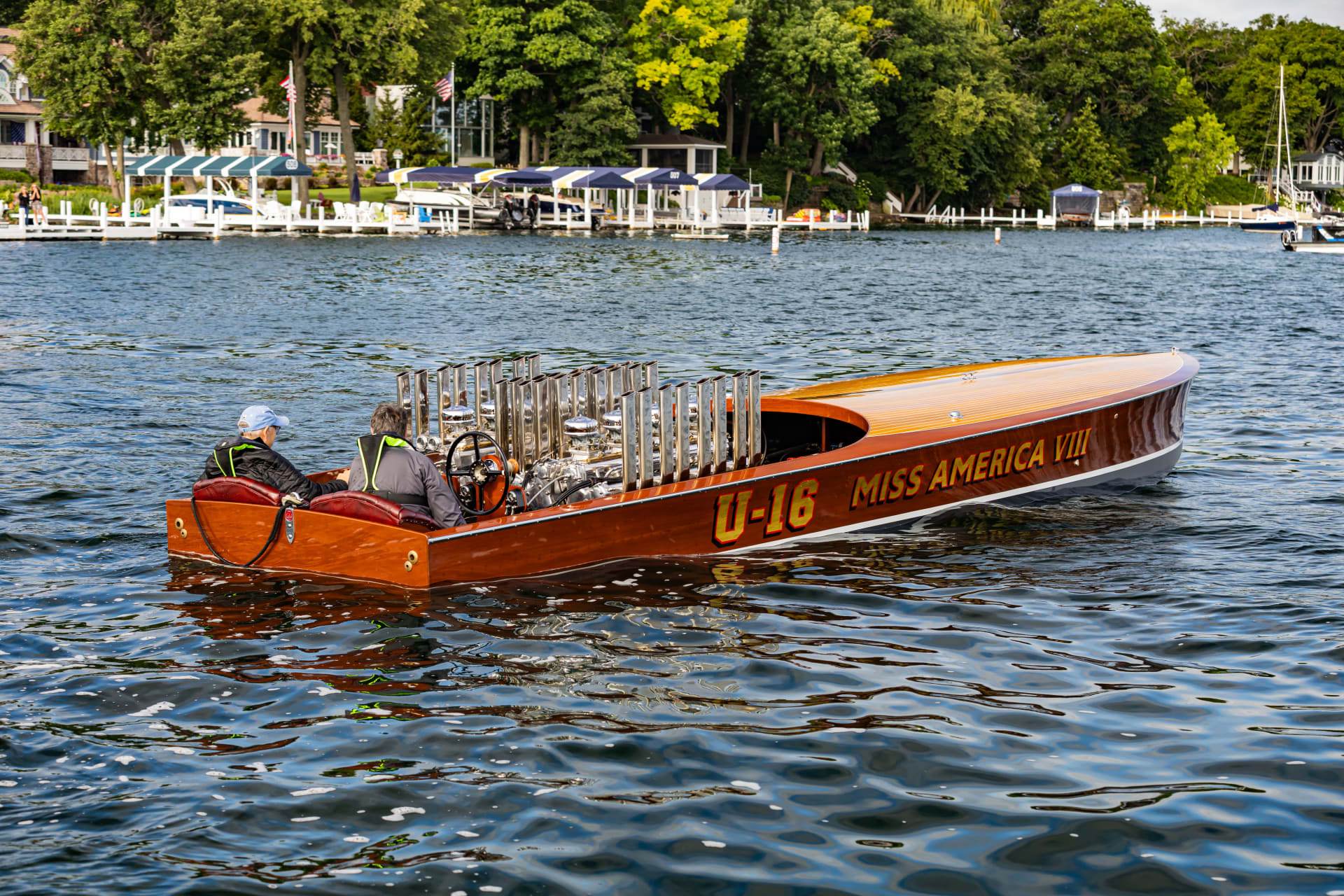
This is the 1931 Gar Wood Miss America VIII, it’s an incredible hydroplane powered by twin Harry Miller double overhead cam V16 marine racing engines producing 930 bhp each for 1,860 bhp in total – a number that must have seemed borderline impossible in the 1930s.
Gar Wood, short for Garfield Wood, was one of the most famous men in the country at the time. He was said to hold more patents than any other American for a time, and he became a wealthy industrialist despite his humble upbringing.
Fast Facts: The Gar Wood Miss America VIII
- Miss America VIII was a stepped hydroplane developed for Harmsworth Trophy competition at the end of the 1920s. Gar Wood and designer Nap Lisee refined an existing hull design instead of replacing it, producing a narrow, lightweight 28 foot racer that carried either Packard V12s or later the experimental Harry Miller V16s.
- The boat debuted in 1929 alongside Miss America VII as part of a two-boat strategy. Early versions used twin Packard marine engines derived from the 1M-2500 line, producing roughly 1,000 bhp each. With these engines, VIII typically ran in the mid-70 to mid-80 mph range during Harmsworth competition.
- In 1931, Wood installed Harry Miller’s DOHC V16s for straight-line speed trials. With these engines the boat reached a documented 104 mph, marking a major step in Wood’s push toward triple-digit speeds. This made VIII a bridge between earlier Packard-powered designs and later record-setters like Miss America IX and X.
- Miss America VIII played a pivotal role in the chaotic 1931 Harmsworth. After penalties eliminated both primary contenders, VIII completed the heat legally and secured the American position. She then ran the final heat alone to clinch the trophy. The boat is now set for auction with its Miller V16s installed.
History Speedrun:
When Garfield Wood (better known simply as Gar Wood) campaigned Miss America VIII in the early 1930s, he wasn’t just racing another high-speed hydroplane. He was continuing the evolution of a series of racing boats that had already dominated American powerboat racing through the 1920s and revolutionised high-speed hull design.
Above Video: This is period newsreel footage of the 1931 Harmsworth Trophy Race and it includes footage of both Gar Wood and Kaye Don, as well as many others.
Earlier Miss America entries had won multiple Harmsworth victories, and by the time VIII appeared in 1929 she was a fully developed step hydroplane ready to help maintain American control of the trophy. But competition tightened as the decade closed. British challenger Kaye Don was closing the speed gap, and the Harmsworth – arguably the most important prize in powerboating – was no longer a foregone conclusion for the Americans. Miss America VIII became one of Wood’s key assets in that rapidly shifting landscape.
The boat arrived in time for the 1929 Harmsworth Trophy, joining Miss America VII as part of a two-boat race strategy. Designer Nap Lisee and Wood refined the proven Gar Wood hull concept into a 28 foot stepped hydroplane capable of delivering the stability needed at racing speeds.
Rather than reinventing the formula, they advanced it in incremental steps – the familiar narrow hull, the stepped running surface, and the enormous power required to stay ahead of increasingly sophisticated rivals. VIII represented the continuation of a design and engineering layout that Wood trusted, then strengthened where necessary to withstand higher speeds and sustained punishment across the water.
Her power initially came from a pair of Packard-built marine V12 engines developed from the 1M-2500 lineage. Contemporary reporting places their output at roughly 1,000 bhp each, placing Miss America VIII comfortably into the upper tier of late-1920s and early-1930s racing machines.
In Harmsworth competition trim she typically reached peak speeds in the mid-70s to mid-80 mph range, competitive for the era and sufficient to help secure victories. Later in 1931, after her Harmsworth duties, Wood fitted the boat with Harry Miller’s experimental DOHC 1,113 cubic inch V16 engines for straight-line testing, and in that configuration VIII achieved a documented 104 mph run – notably faster than her earlier Packard-powered racing speeds.
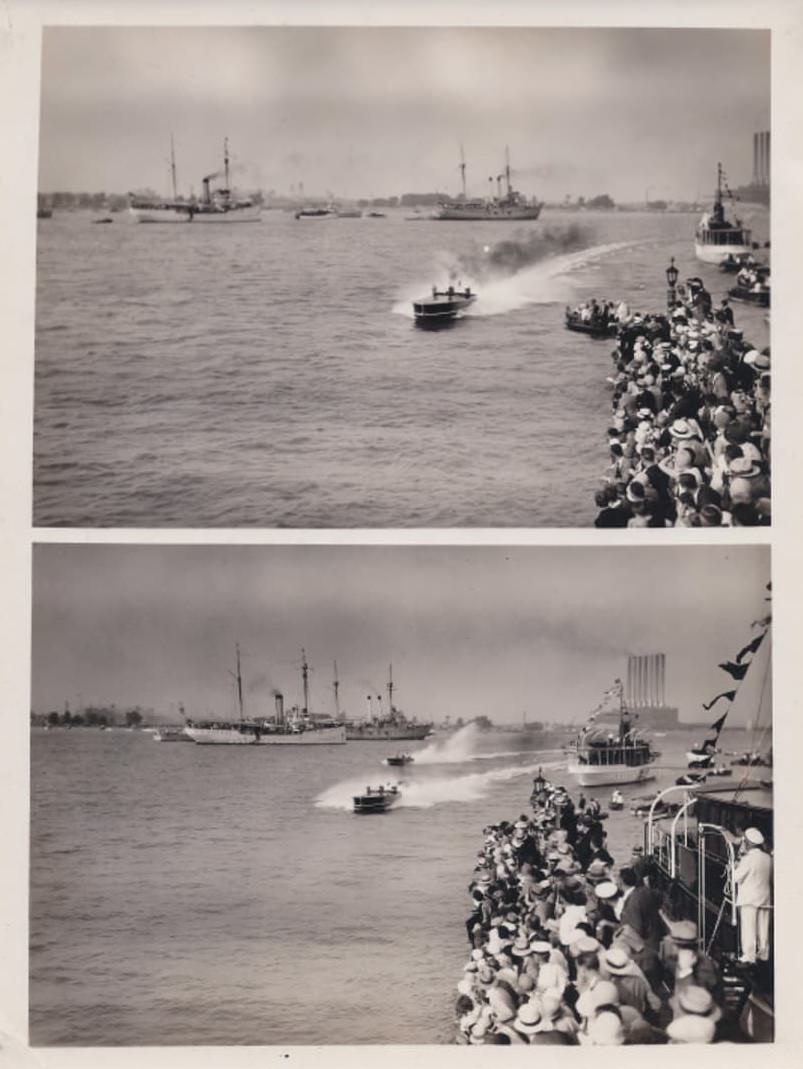
Miss America VIII played a central role in the 1931 Harmsworth Trophy, contested again on the Detroit River – this race became one of the most contentious events of the era. The British team arrived with Kaye Don piloting Miss England II, a powerful twin–Rolls-Royce-engined challenger aimed squarely at ending Wood’s dominance. Wood brought Miss America IX as his primary boat, with Miss America VIII serving as a reliable backup – a legal and well-understood tactic in Harmsworth competition.
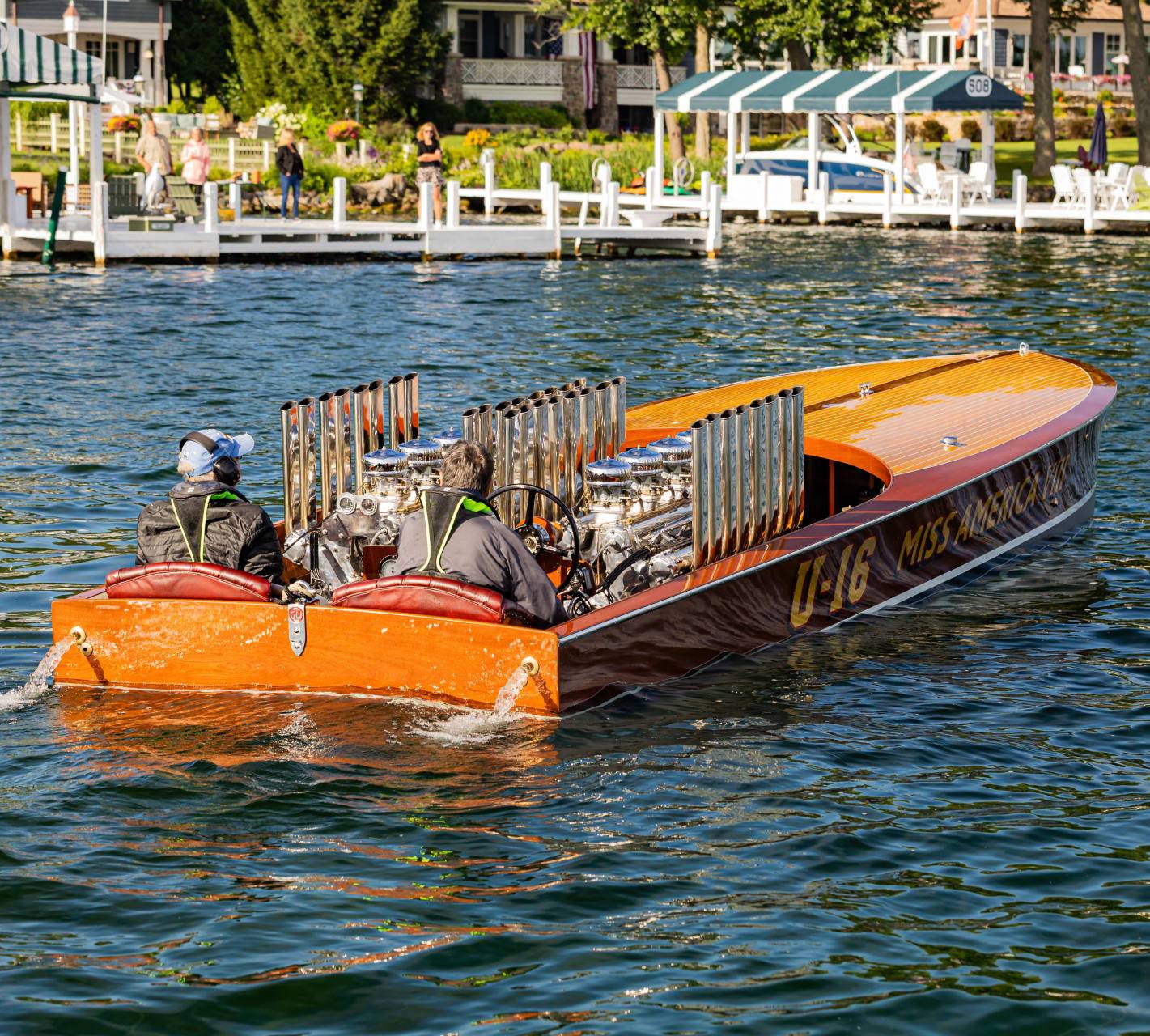
 This is the 1931 Gar Wood Miss America VIII, it’s a hydroplane powered by twin Harry Miller double overhead cam V16 marine racing engines producing 930 bhp each for 1,860 bhp in total – a number that must have seemed borderline impossible in the 1930s.
The controversy that followed was rooted in the so-called “Yankee trick” – in the second heat of the 1931 race, Wood in Miss America IX crossed the starting line early, a move widely interpreted as a deliberate attempt to bait Don into doing the same.
Don indeed followed and was disqualified along with Wood. With both primary boats eliminated from that heat, Miss America VIII – driven conservatively and legally – completed the required laps and preserved the American position. In the final deciding heat, she ran the course alone to secure the trophy for the United States.
The crew and personalities behind Miss America VIII formed a familiar Gar Wood circle – Wood himself served as team leader and strategic mind. Designers at Gar Wood Industries, including Lisee, provided the hydrodynamic engineering.
While other Miss America boats are well documented for their riding mechanics and technical crew, VIII’s specific crew lists are less well preserved, though the program relied on the same tight-knit group that supported Wood’s larger racing efforts.
Although Miss America VIII’s frontline racing career was relatively brief, spanning the 1929, 1930, and 1931 seasons, her achievements and the controversy of the 1931 Harmsworth ensured lasting attention. She was a transitional boat, bridging the earlier Packard-powered era with the experimental Miller-engine phase that pushed the series beyond 100 mph.
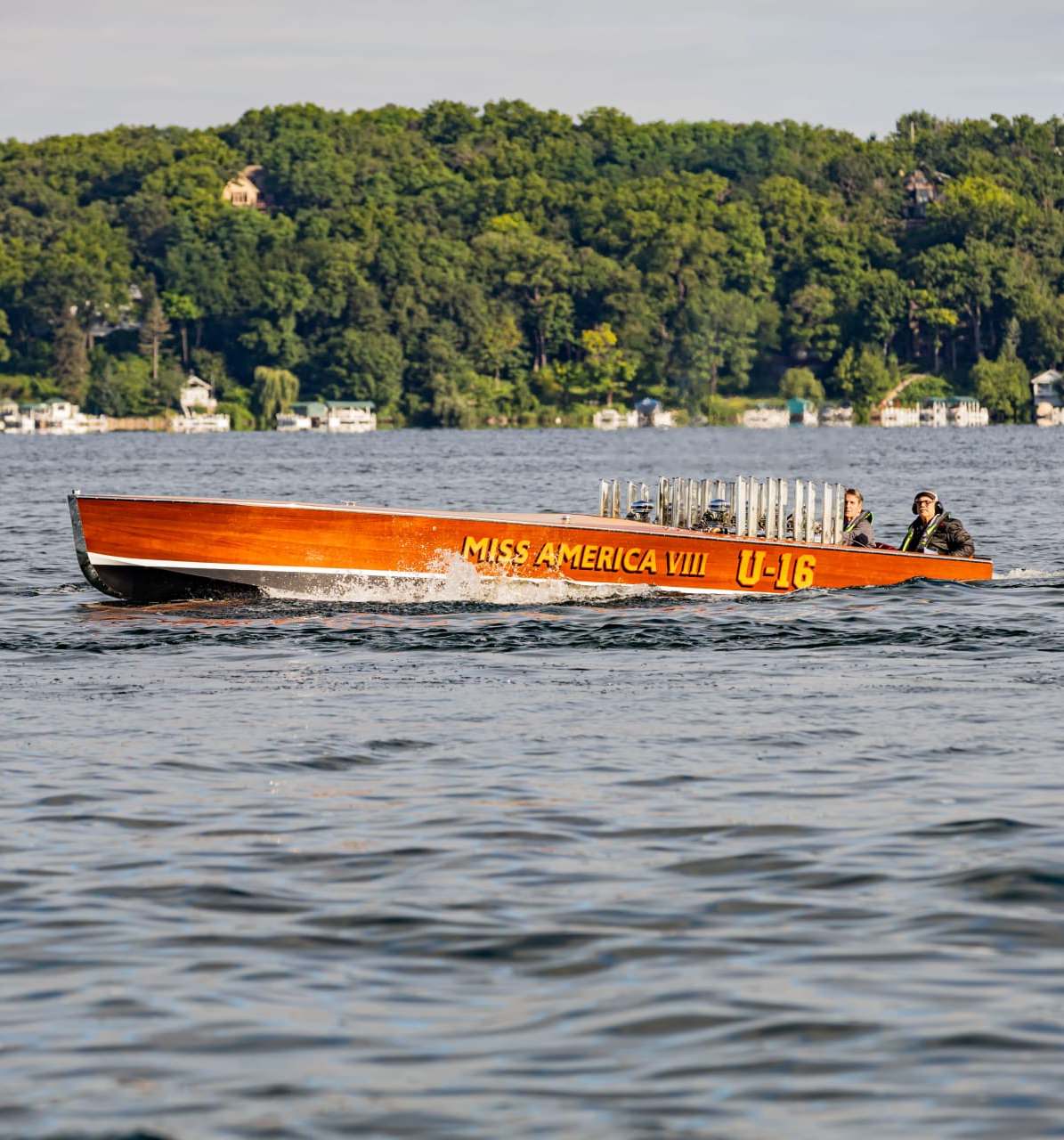
When Garfield Wood (better known simply as Gar Wood) campaigned Miss America VIII in the early 1930s, he wasn’t simply racing another high-speed hydroplane. He was continuing the evolution of a series of racing boats that had already dominated American powerboat racing through the 1920s.
Miss America IX and X would later overshadow her with record-breaking speeds, but VIII was the boat that delivered when the stakes were highest and the rules allowed tactical ingenuity to influence the result.
Gar Wood Miss America VIII is now due to be publicly sold for the first time in many years, it’s going to roll across the auction block with Mecum in January, fitted with those mighty twin Harry Miller V16 engines. If you’d like to read more about it or register to bid you can visit the listing here.




Images courtesy of Mecum

Articles that Ben Branch has written have been covered on CNN, Popular Mechanics, Smithsonian Magazine, Road & Track Magazine, the official Pinterest blog, the official eBay Motors blog, BuzzFeed, Autoweek Magazine, Wired Magazine, Autoblog, Gear Patrol, Jalopnik, The Verge, and many more.
Silodrome was founded by Ben back in 2010, in the years since the site has grown to become a world leader in the alternative and vintage motoring sector, with well over a million monthly readers from around the world and many hundreds of thousands of followers on social media.