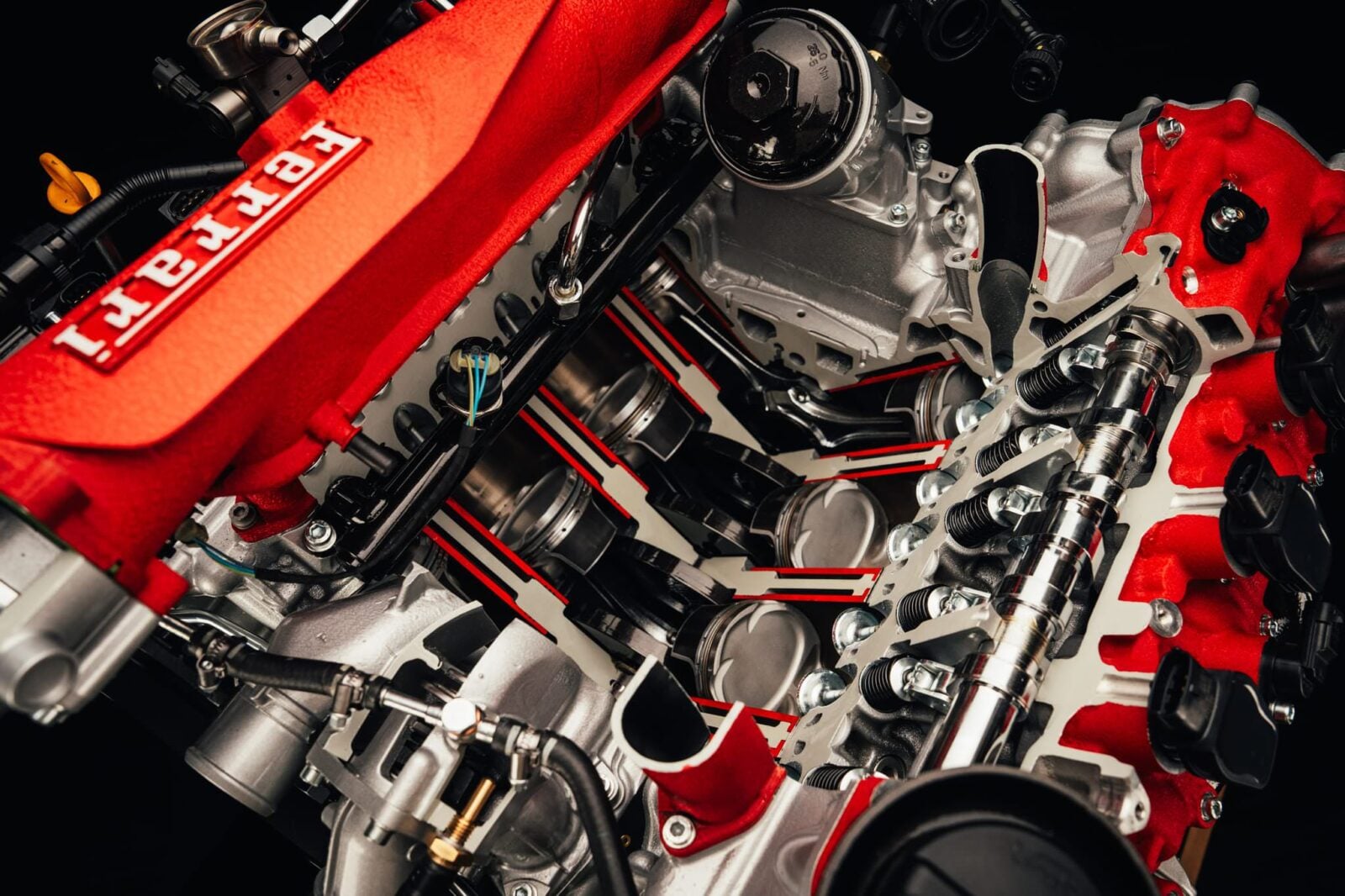
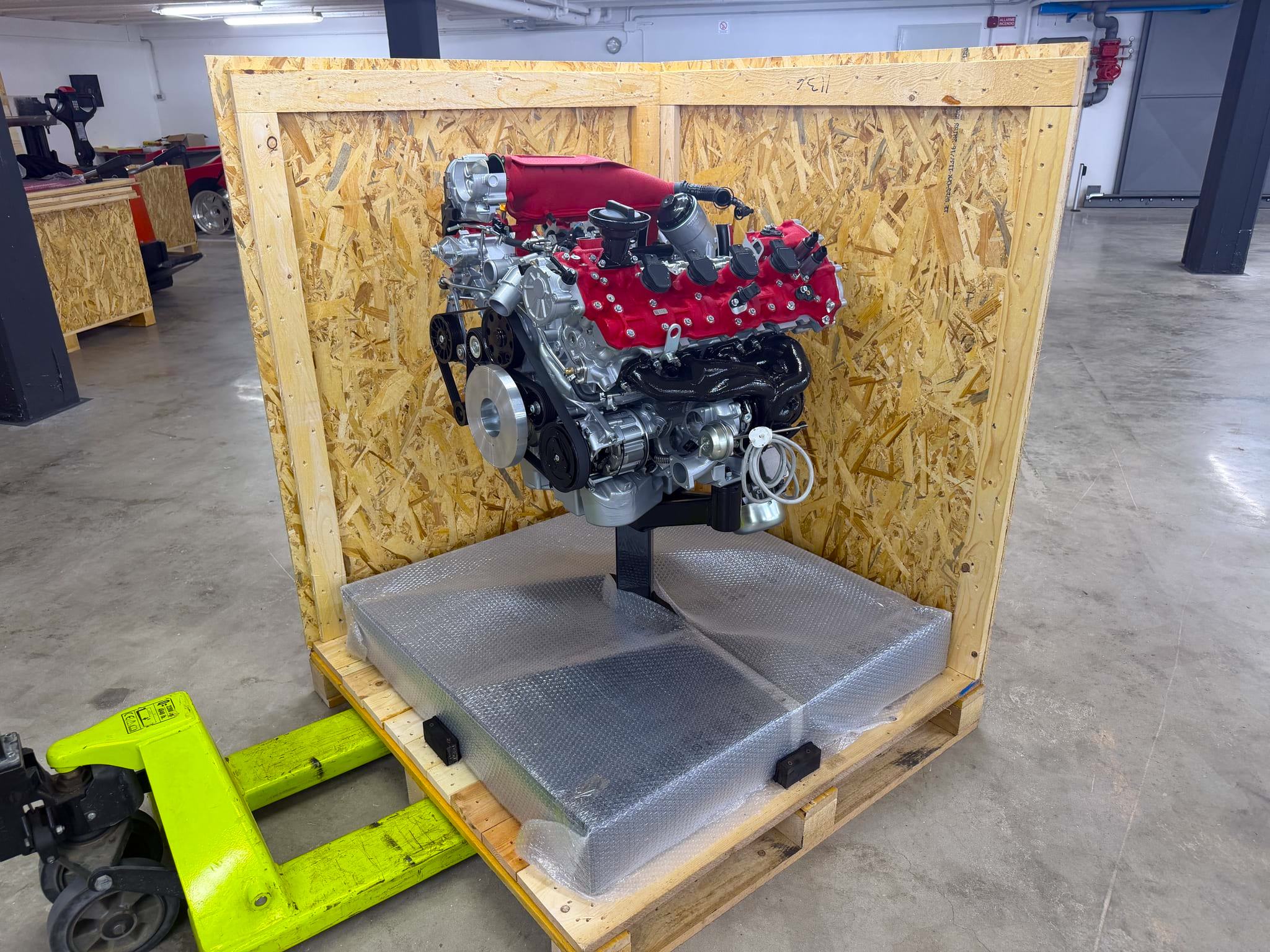
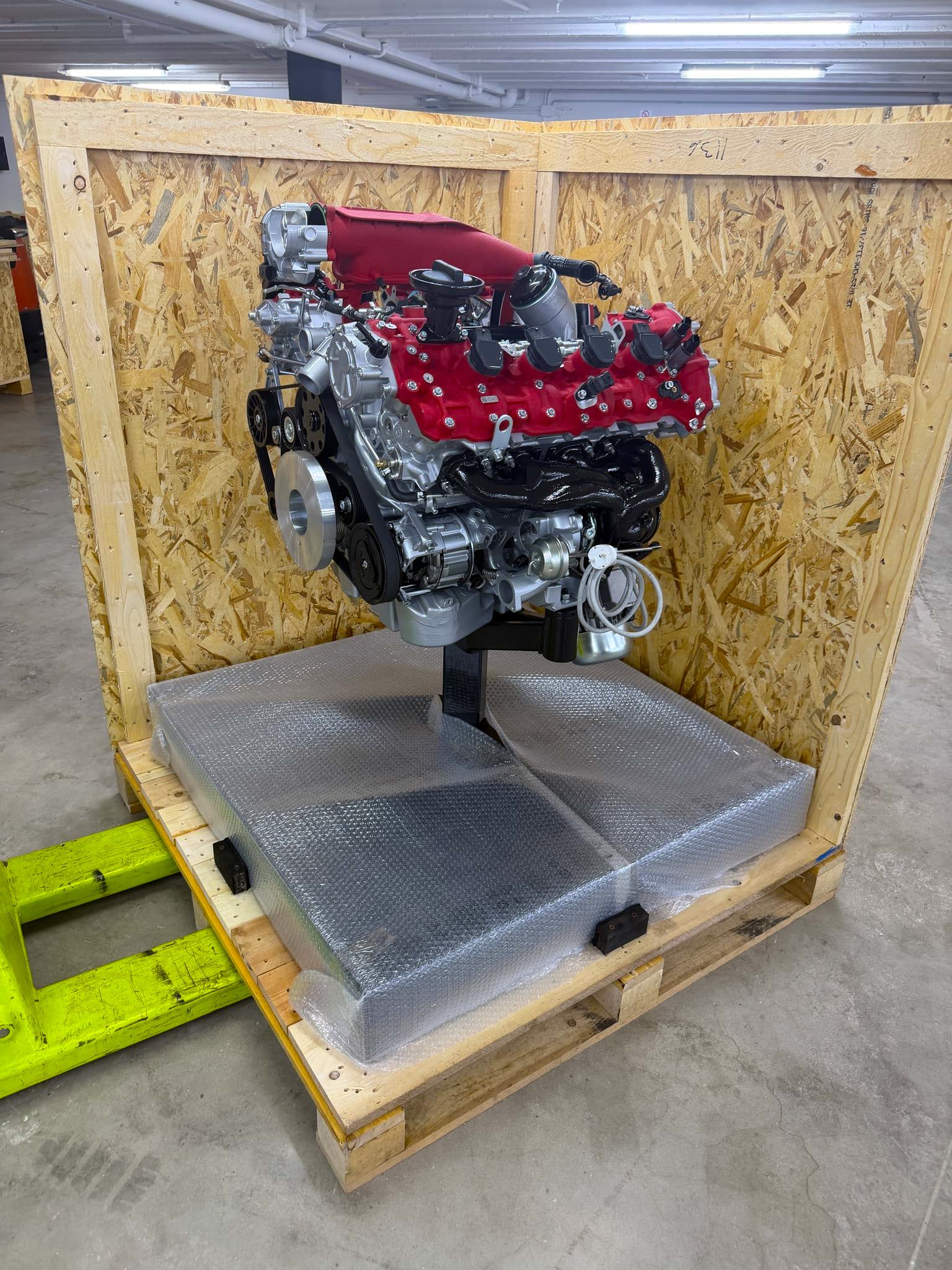
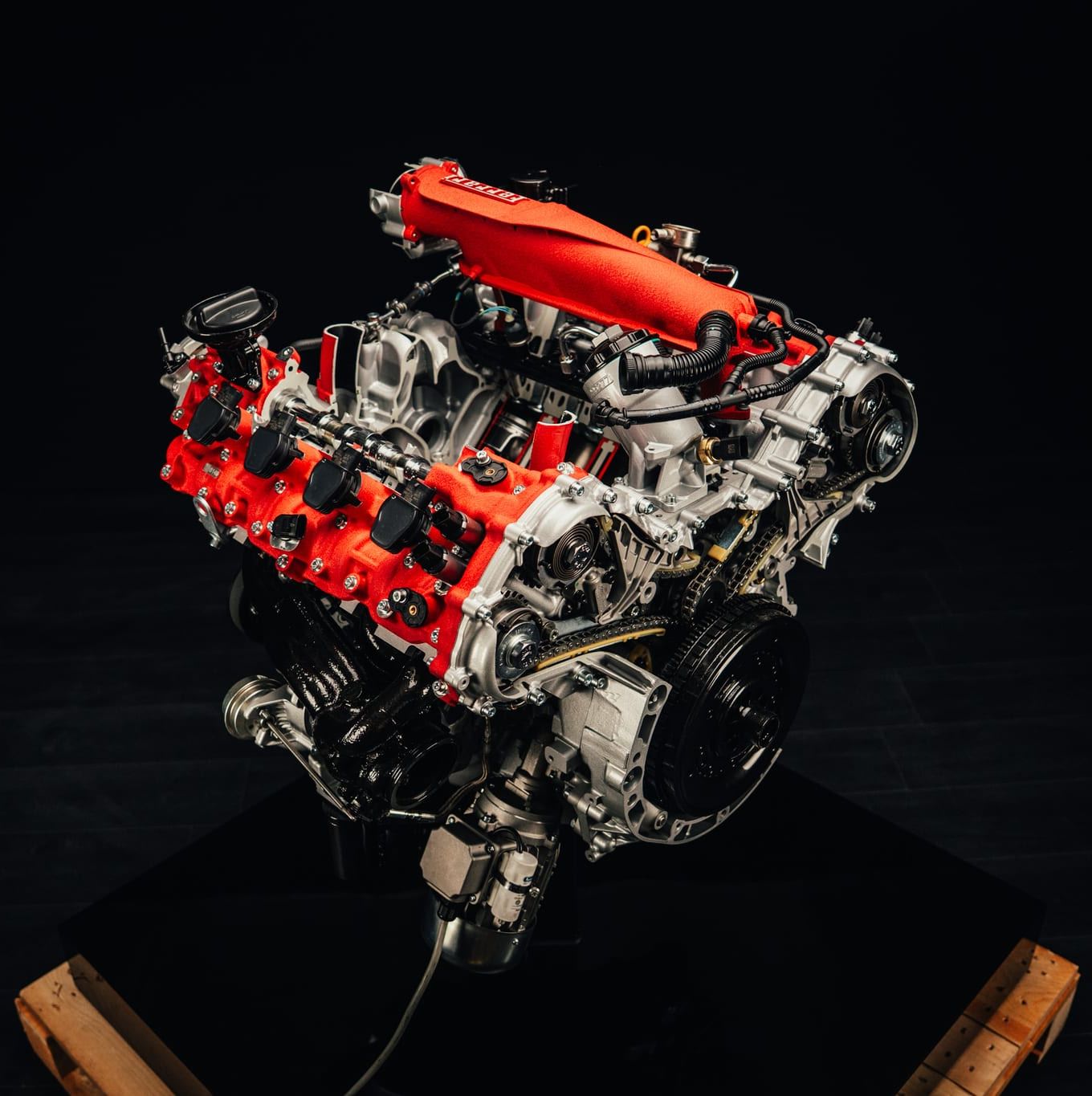
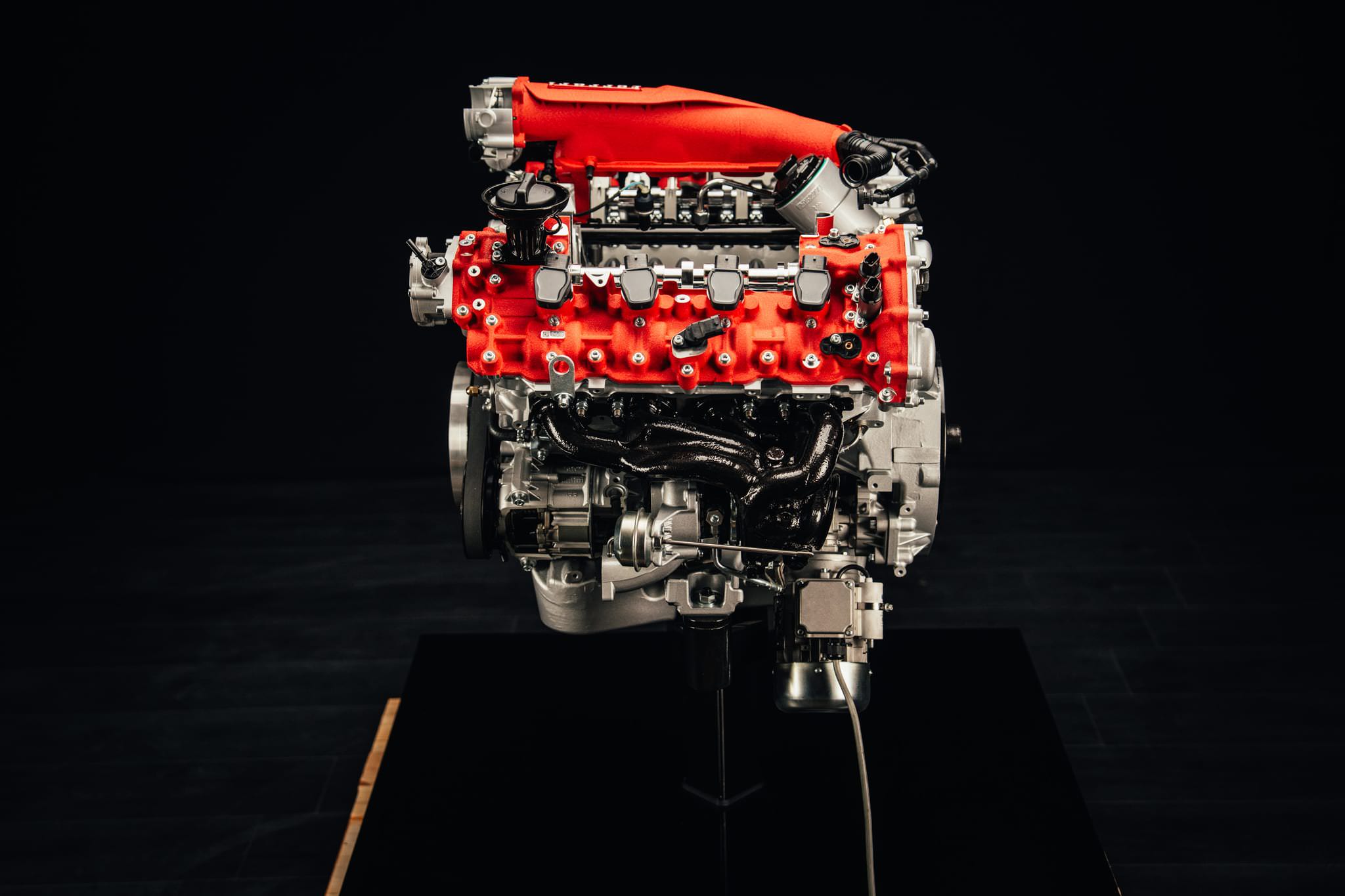
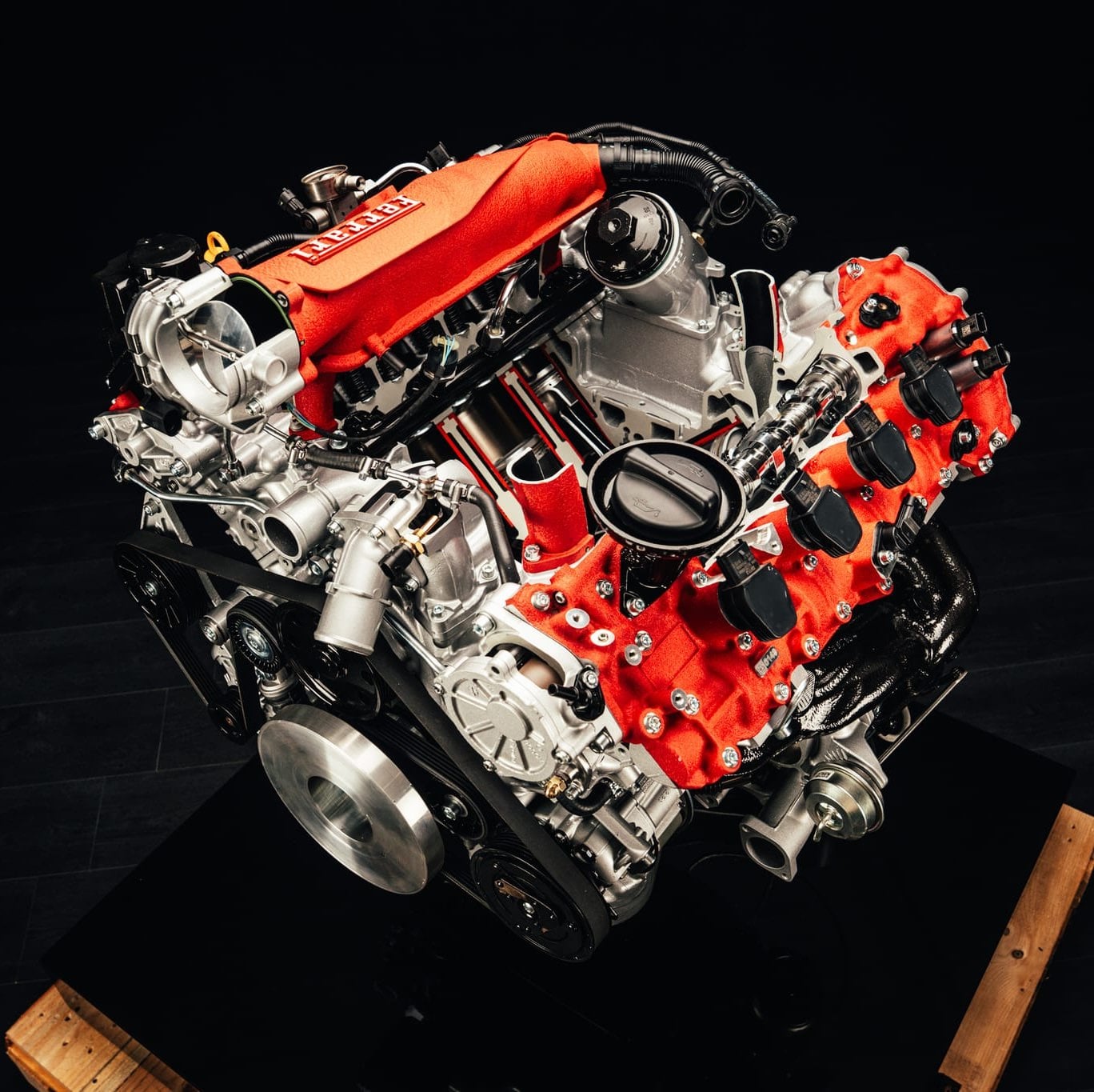
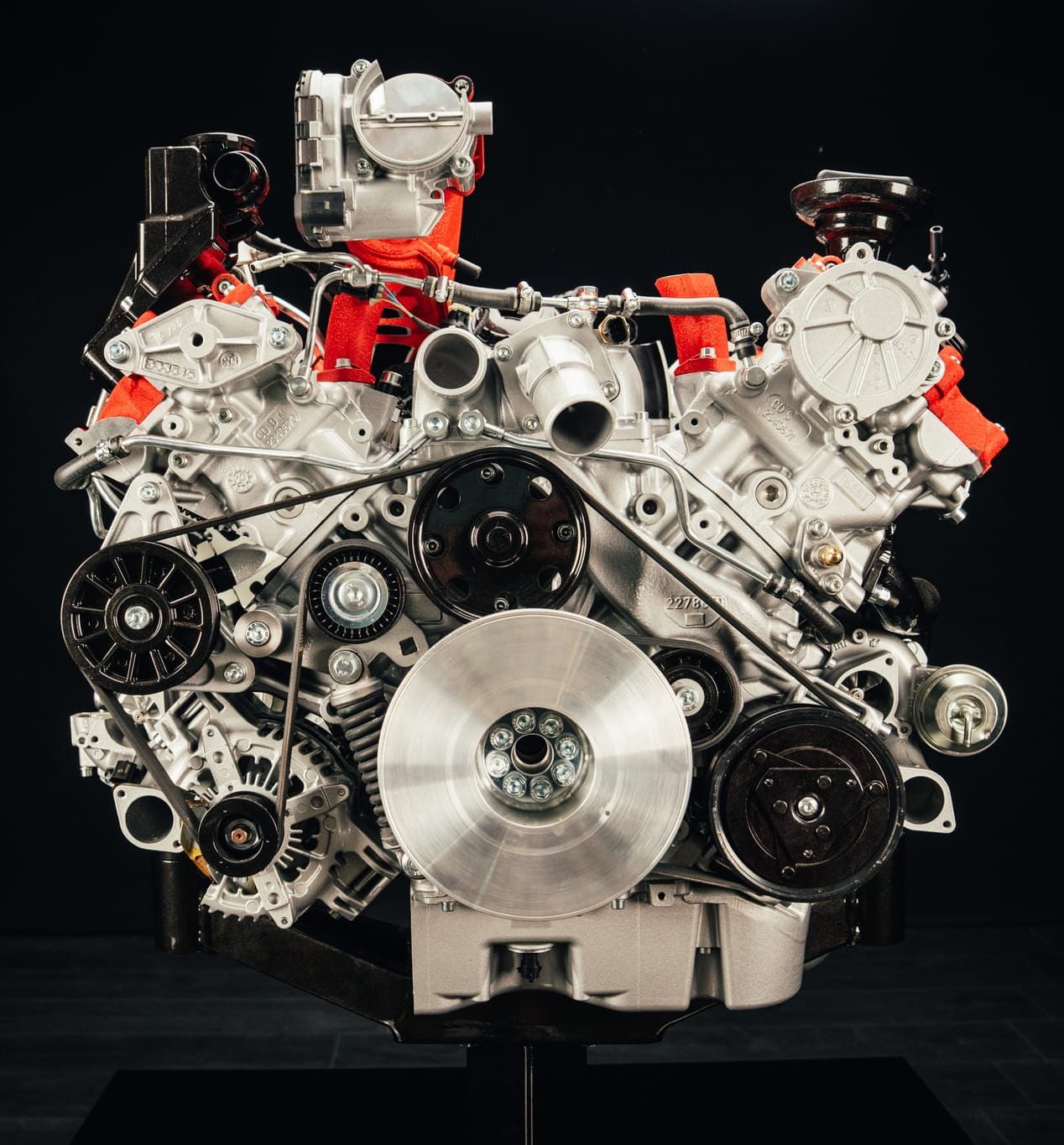
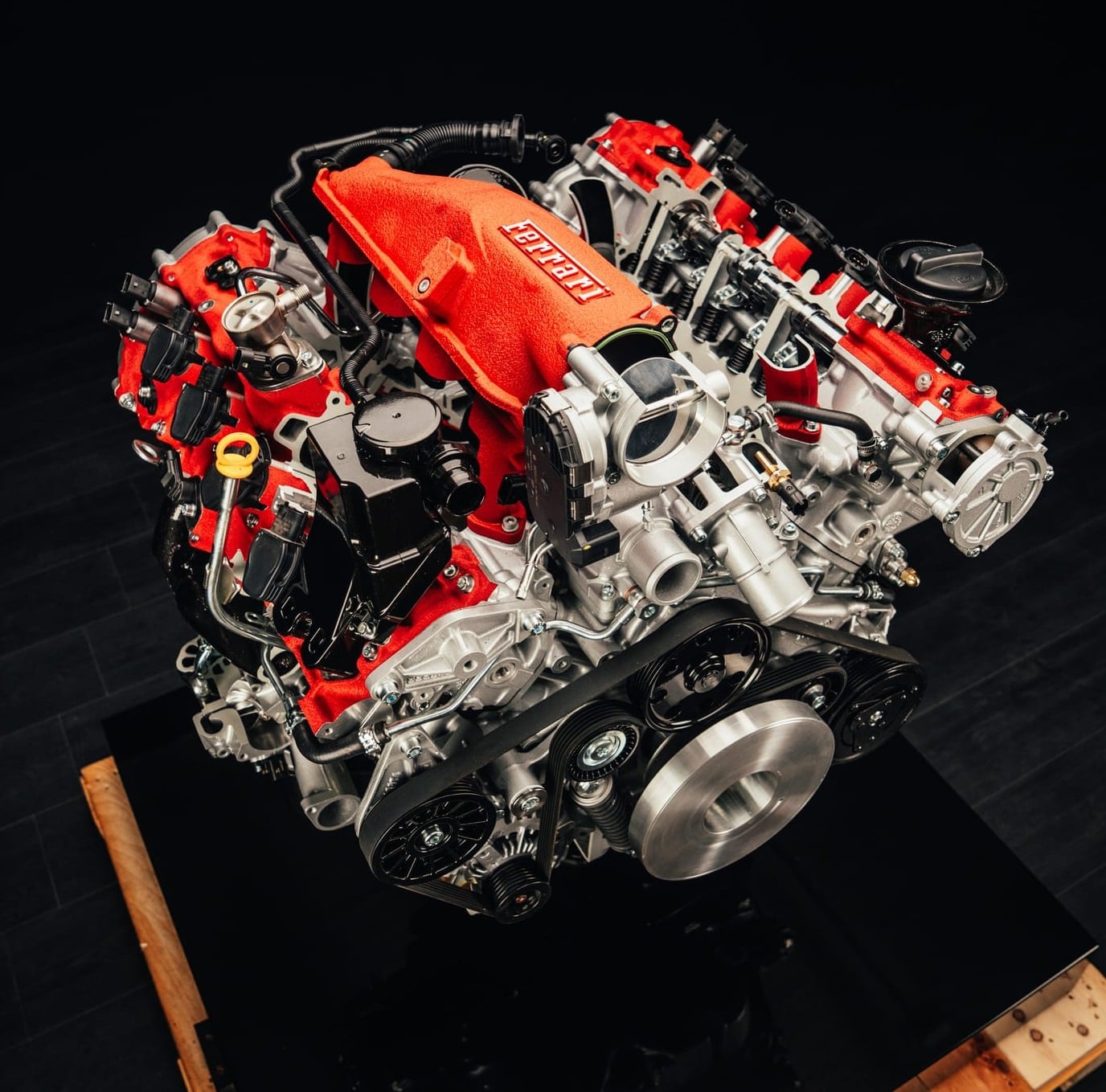
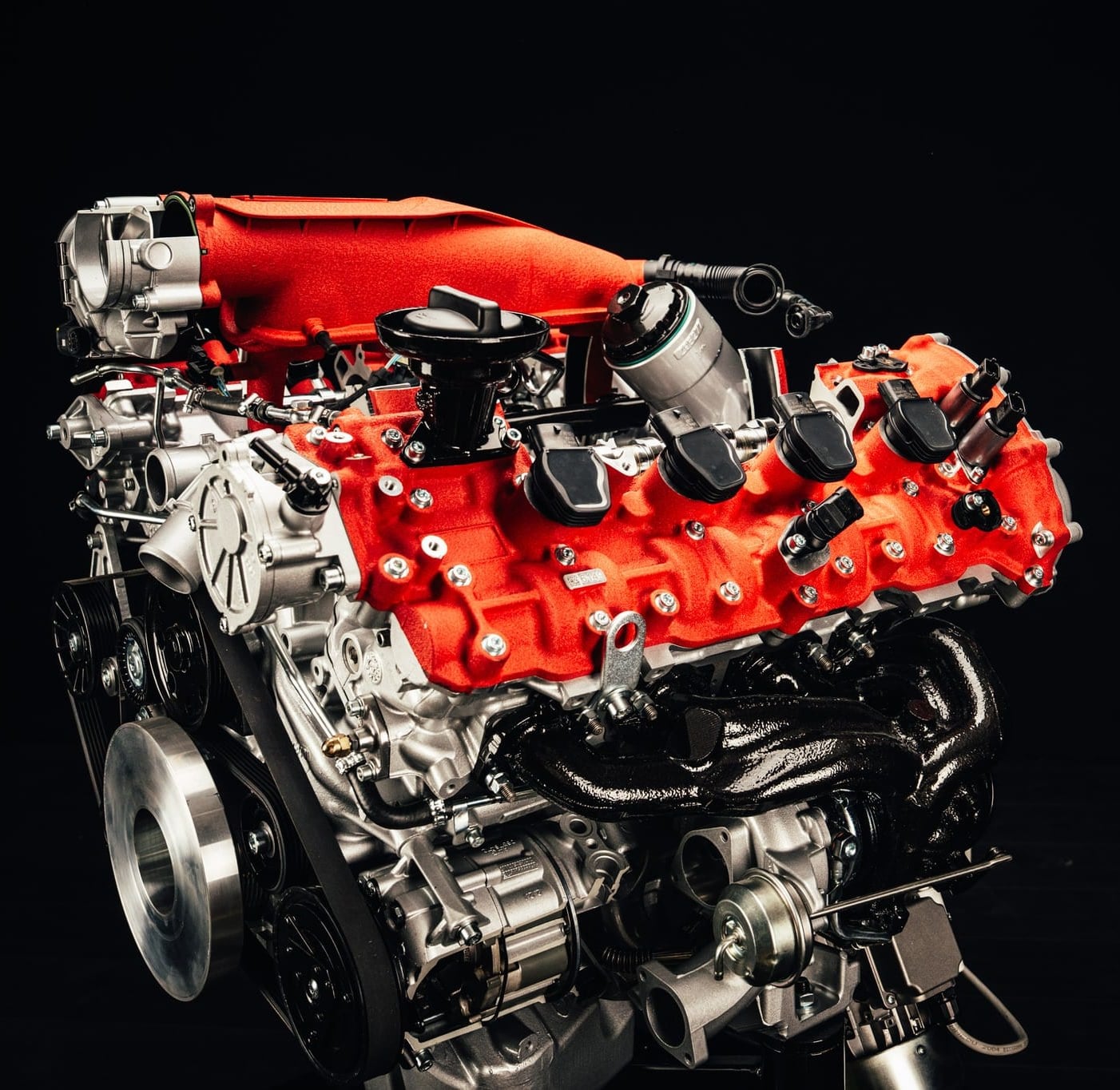
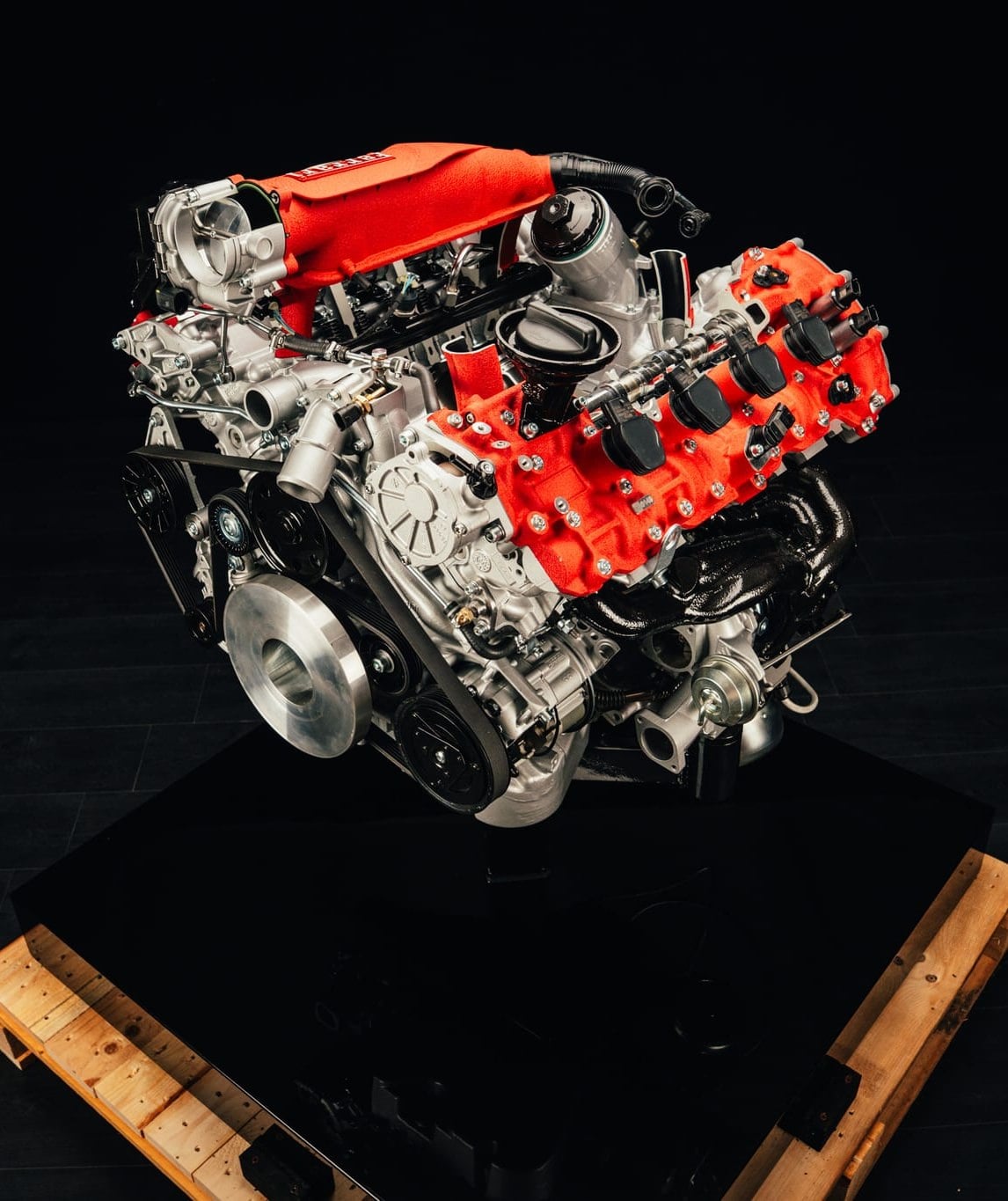
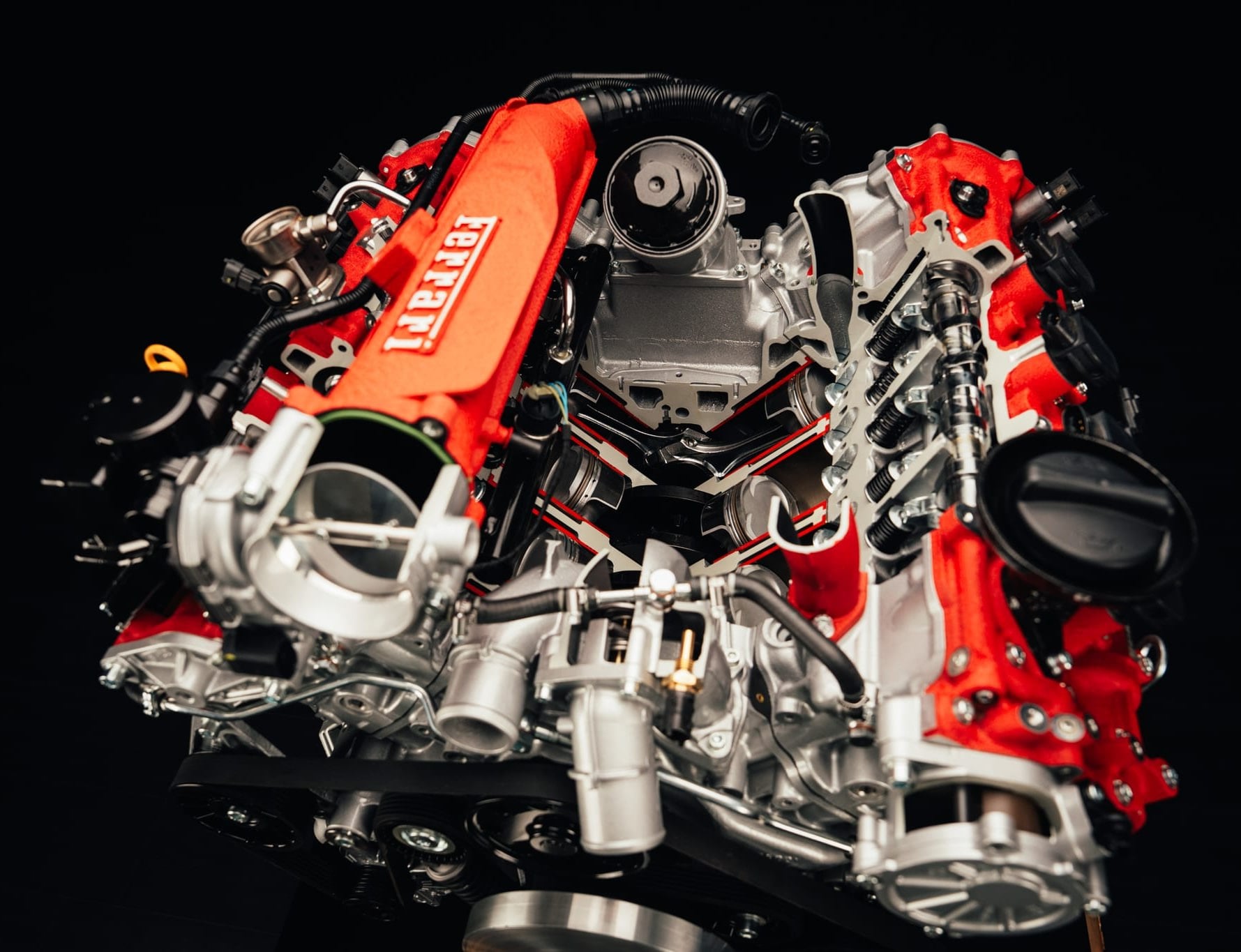
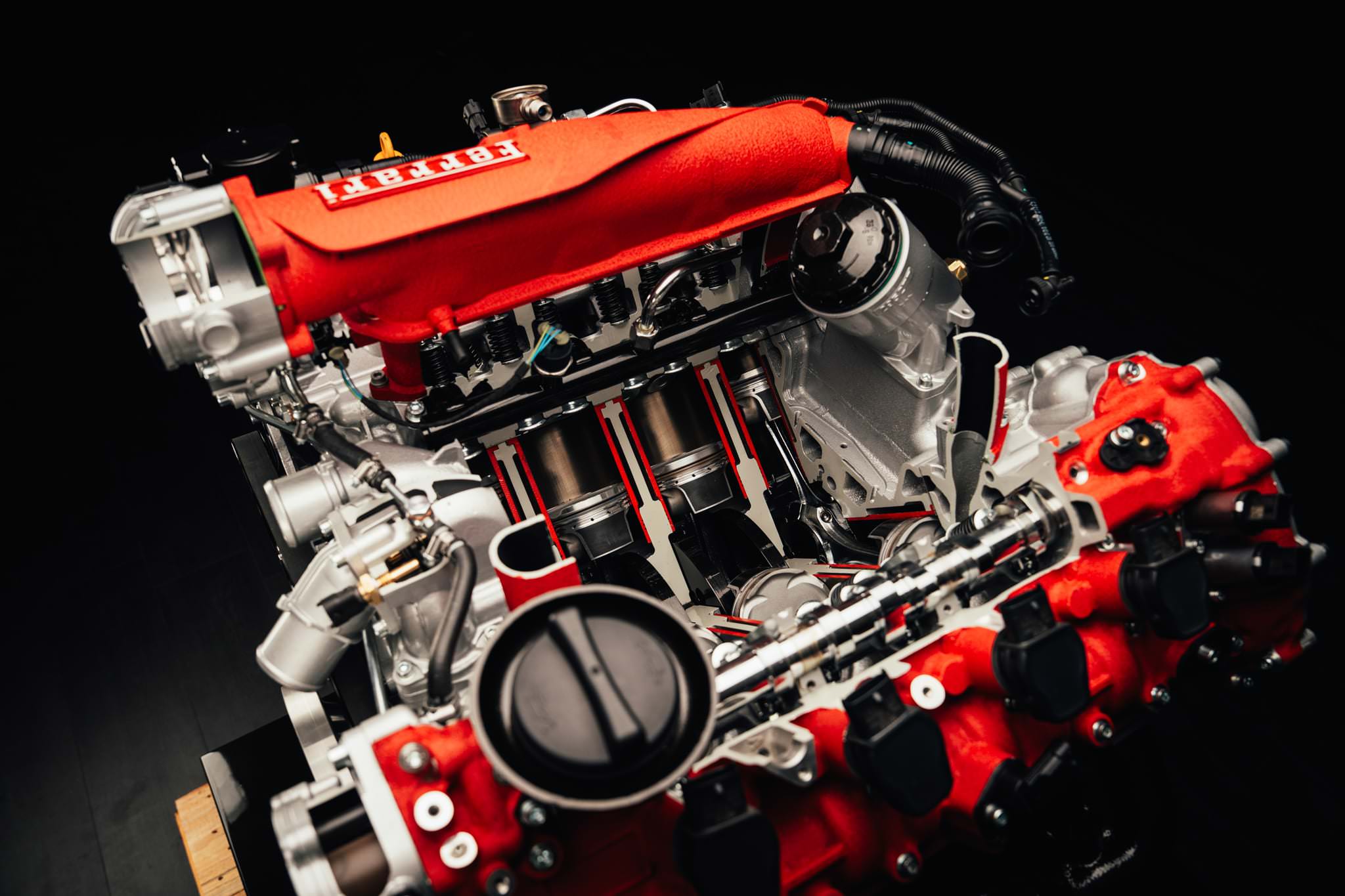
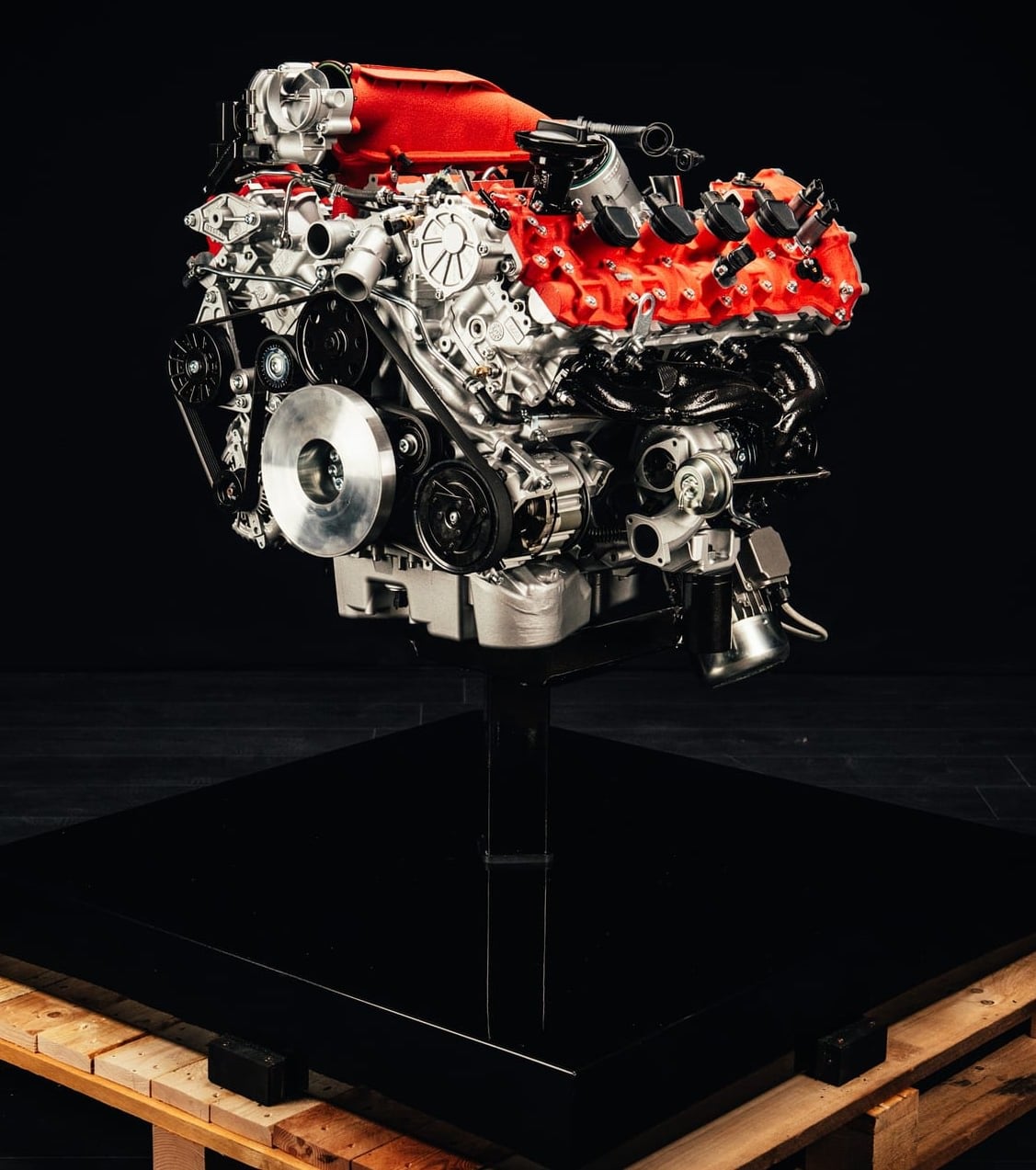
This is a Ferrari F154 V8 kinetic engine display, sections of the engine have been cut away to show the internal workings, and an electric motor now powers the rotating assembly so you can see it all in motion.
The F154 V8 is one of the greatest engines Ferrari has ever made, and while that may sound like a controversial thing to say, this is the motor that won the International Engine of the Year award for four years in a row, and it was then named the best engine of the award’s first 20 years.
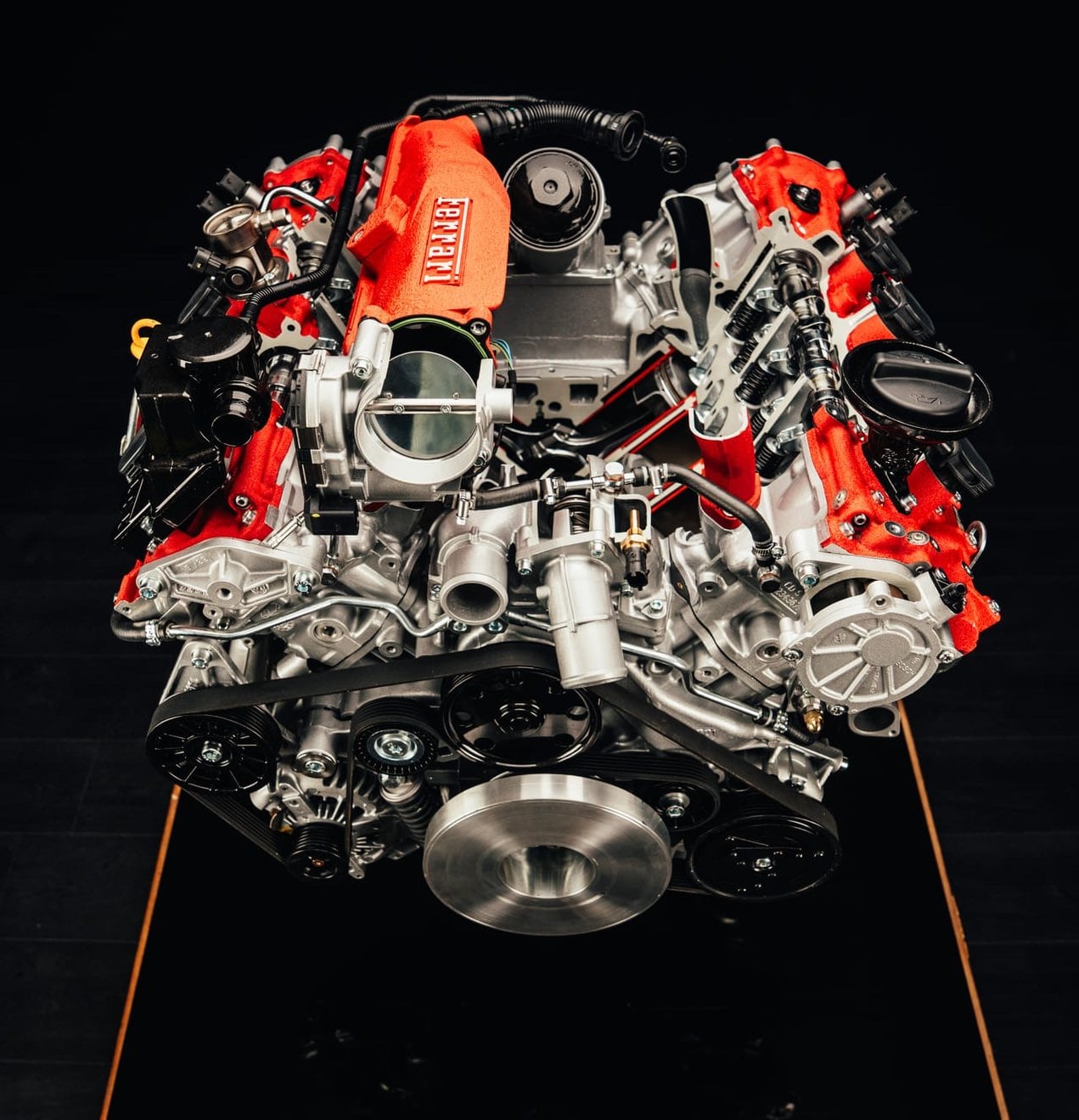
 This is a Ferrari F154 V8 kinetic engine display, sections of the engine have been cut away to show the internal workings, and an electric motor now powers the rotating assembly so you can see it all in motion.
History Speedrun: The Ferrari F154 V8
The Ferrari F154 engine entered production in 2013, it was a modular twin-turbo V8 that had been designed to replace the naturally-aspirated F136 V8 engine family that Ferrari had shared with Maserati since 2001. Interestingly, the F154’s first home was in a Maserati, the Quattroporte GTS of 2013, but its Ferrari debut in the 2014 California T won it global headlines – it was the first turbocharged engine in a Ferrari road car since the 2.9 liter F120A V8 in the Ferrari F40, introduced all the way back in 1987.
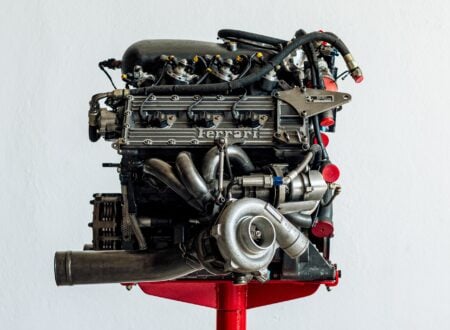
The F154 was developed under engineer Gianluca Pivetti, it’s a 90º V8 with an aluminum block and heads, four valves per cylinder, gasoline direct injection, and continuously variable valve timing on both intake and exhaust. Two parallel twin-scroll turbochargers supplied by IHI sit outboard of the block, fed through twin air-to-air intercoolers. Most Ferrari versions pair a flat-plane crankshaft with dry-sump lubrication, though the latest Amalfi runs a wet sump, like the crossplane Maserati versions.
Turbo lag was the persistent problem Ferrari worked hard to engineer around – the California T introduced Variable Boost Management, which limits boost in the lower gears and releases the full 557 lb ft only in 7th, so the 3,855cc engine’s 552 bhp arrived with something close to naturally aspirated throttle response. It was a clever solution, and it worked remarkably well.
The 3,902cc version in the 2015 488 GTB (its 488cc per cylinder gave the car its name) made 661 bhp and 561 lb ft, rising to 710 bhp and 568 lb ft in the 488 Pista and F8 Tributo.
The judges of the International Engine of the Year competition voted it overall winner four years on the trot from 2016 to 2019, and in 2018 named it the best engine of the award’s first 20 years. It was an incredible accolade for any engine, let alone a supercar engine from the likes of Ferrari.
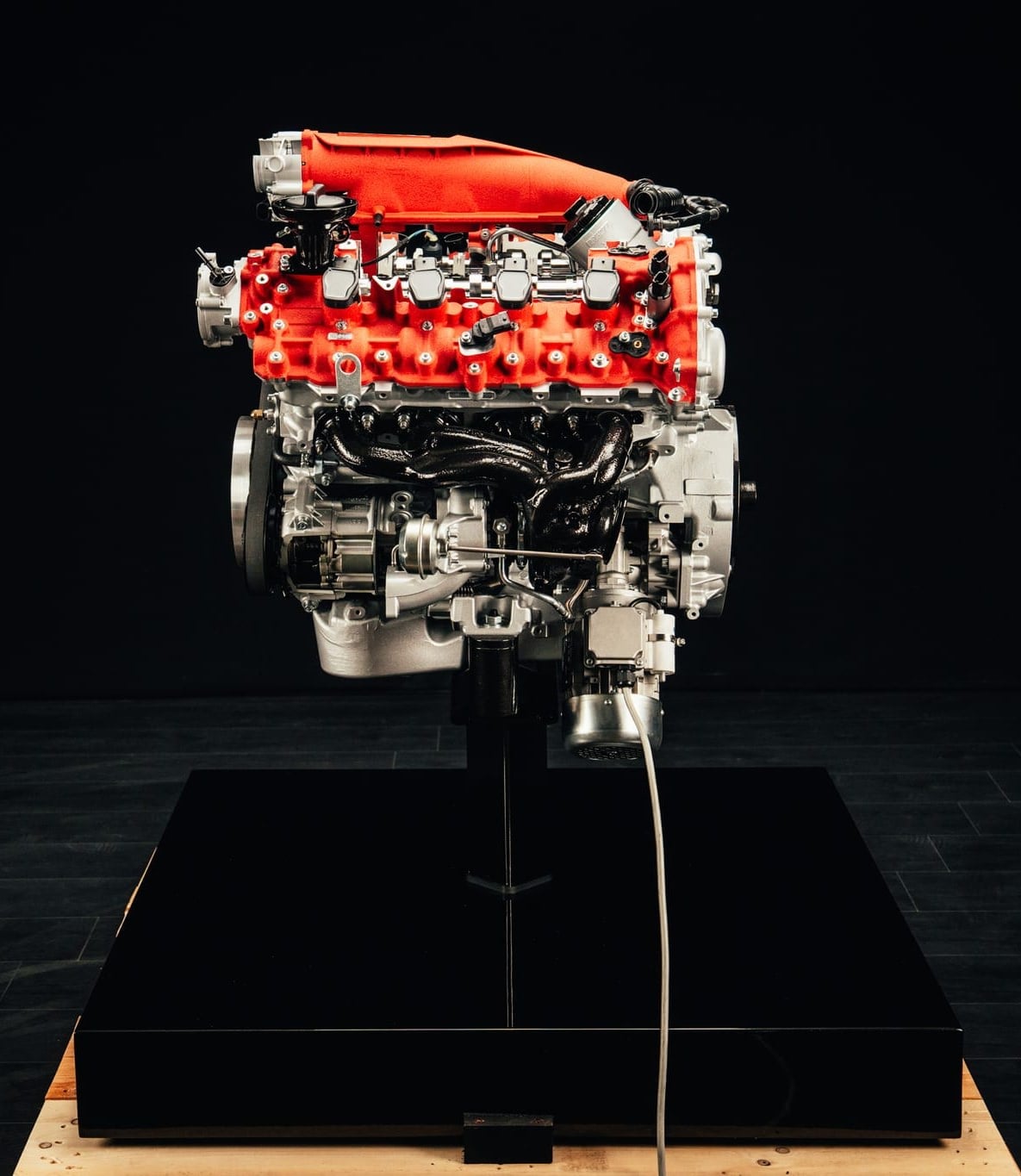
The F154 V8 is one of the greatest engines Ferrari has ever made, and while that may sound like a controversial thing to say, this is the motor that won the International Engine of the Year award for four years in a row, and it was then named the best engine of the award’s first 20 years.
The Ferrari Roma, unveiled in late-2019, used the F154 BH engine variant, this was the 3,855cc V8 with an 86.5 mm bore and 82 mm stroke, producing 612 bhp between 5,750 and 7,500 rpm and 561 lb ft from 3,000 to 5,750 rpm.
Compared to the closely related Portofino engine, it gained new cam profiles, a turbine speed sensor permitting 5,000 rpm more from the turbochargers, and a gasoline particulate filter, paired with an 8-speed dual-clutch gearbox derived from the SF90 Stradale’s transmission. The Roma coupe was produced from 2020 to 2024, the Spider until 2026, and an evolved version of the same 3,855cc F154 continues at 631 bhp in the Amalfi.
The F154 engine family spread beyond Maranello’s own showrooms, as noted higher up, Maserati’s version powered the Quattroporte GTS with 523 bhp, then the Ghibli, Quattroporte, and Levante in Trofeo trim with 572 bhp – the earliest Levante Trofeo had a 590 bhp rating in some markets.
The Ferrari F154 V8 Kinetic Engine Display Shown Here
This is a Ferrari F154 V8 said to have been sourced from a Roma. Exactly what happened to the car itself isn’t known, but the engine ended up being used for the kinetic engine display shown here.
A series of sections of the engine have now been cut away, and an electric motor has been fitted to turn the rotating assembly. As a result, you can now see what’s happening inside the cylinders and heads as the pistons and valves move, you can see the crankshaft turning, and you can even see inside the alternator.
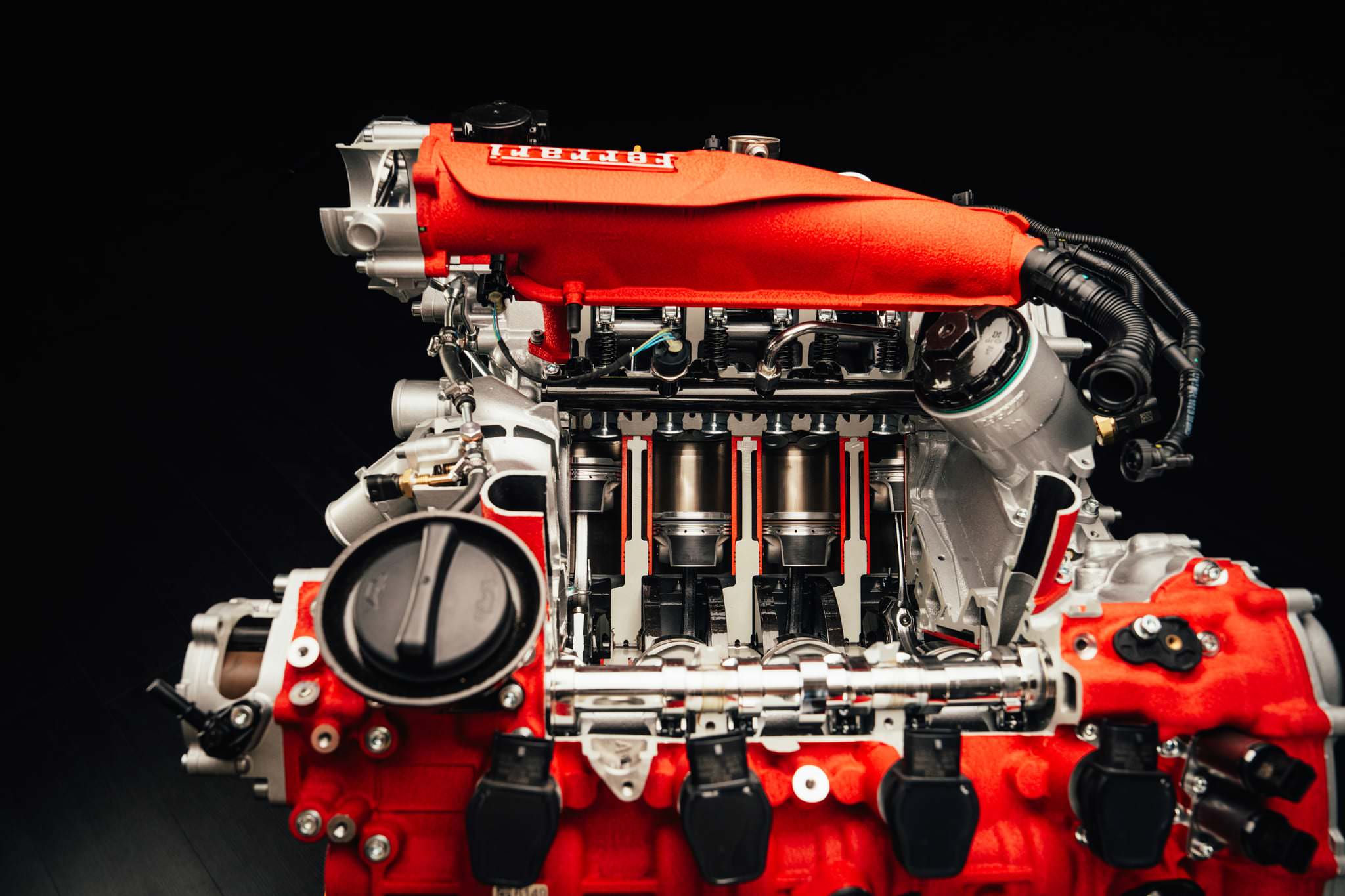
A series of sections of the engine have been cut away, and an electric motor has been fitted to turn the rotating assembly. As a result, you can now see what’s happening inside the cylinders and heads as the pistons and valves move, you can see the crankshaft turning, and you can even see inside the alternator.
If you’re curious to see it all in motion, the good news is that there’s a video in the listing that shows the front, back, and the inside of the V as the engine is turning over, and the attention to detail is remarkable.
It’s now being offered for sale out of Napa, California and you can visit the listing here if you’d like to read more about it or register to bid.
Images courtesy of Bring a Trailer

Articles that Ben Branch has written have been covered on CNN, Popular Mechanics, Smithsonian Magazine, Road & Track Magazine, the official Pinterest blog, the official eBay Motors blog, BuzzFeed, Autoweek Magazine, Wired Magazine, Autoblog, Gear Patrol, Jalopnik, The Verge, and many more.
Silodrome was founded by Ben back in 2010, in the years since the site has grown to become a world leader in the alternative and vintage motoring sector, with well over a million monthly readers from around the world and many hundreds of thousands of followers on social media.