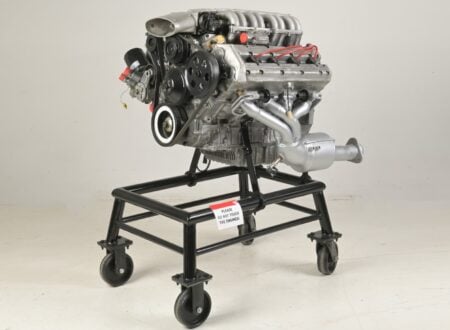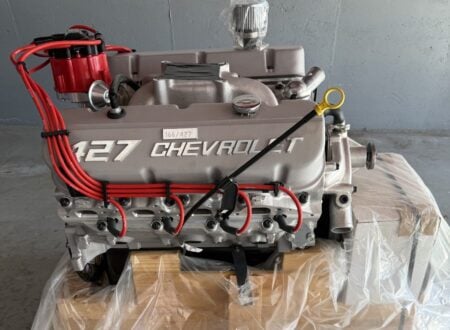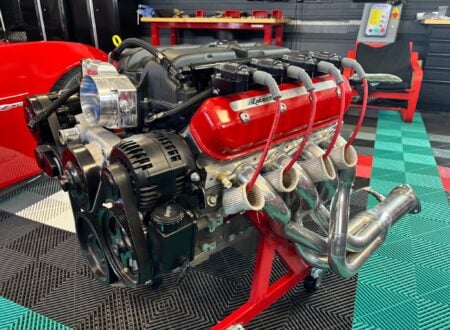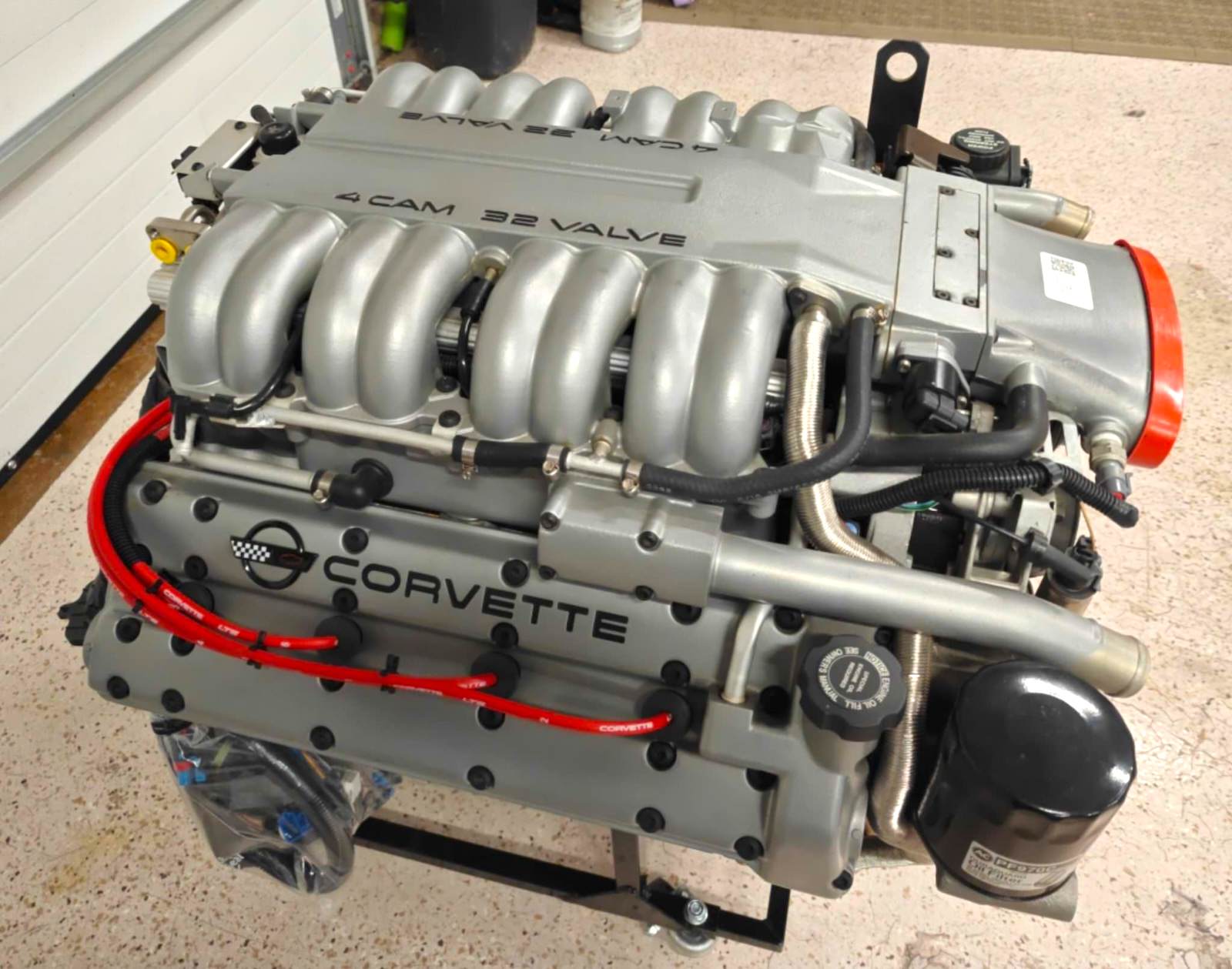
This is a Chevrolet Corvette ZR-1 LT5 crate engine from the early 1990s, from the factory it was rated at 405 bhp and 385 lb ft, and it could propel a ZR-1 C4 Corvette from 0 – 60 mph in just 4.5 seconds.
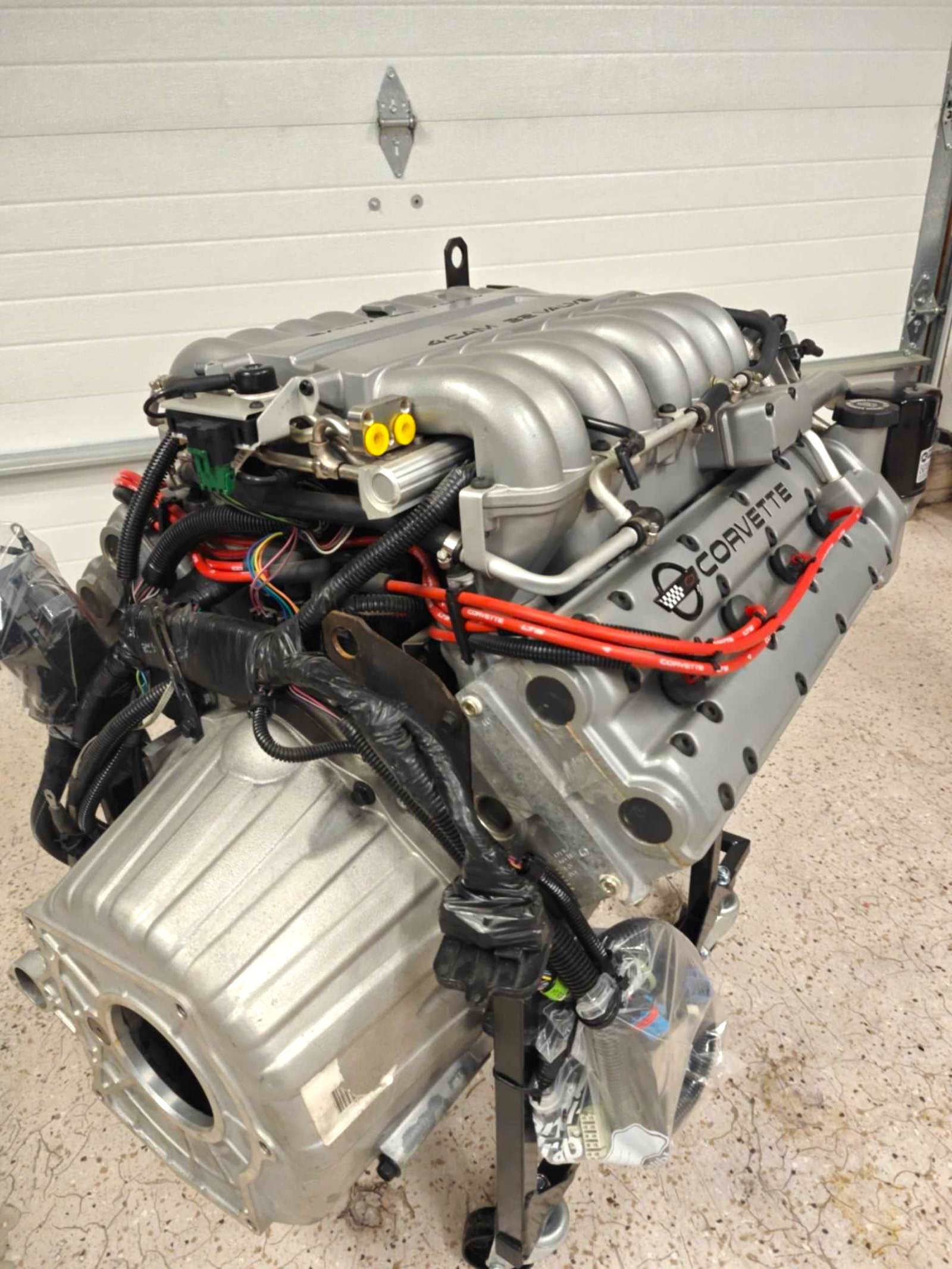
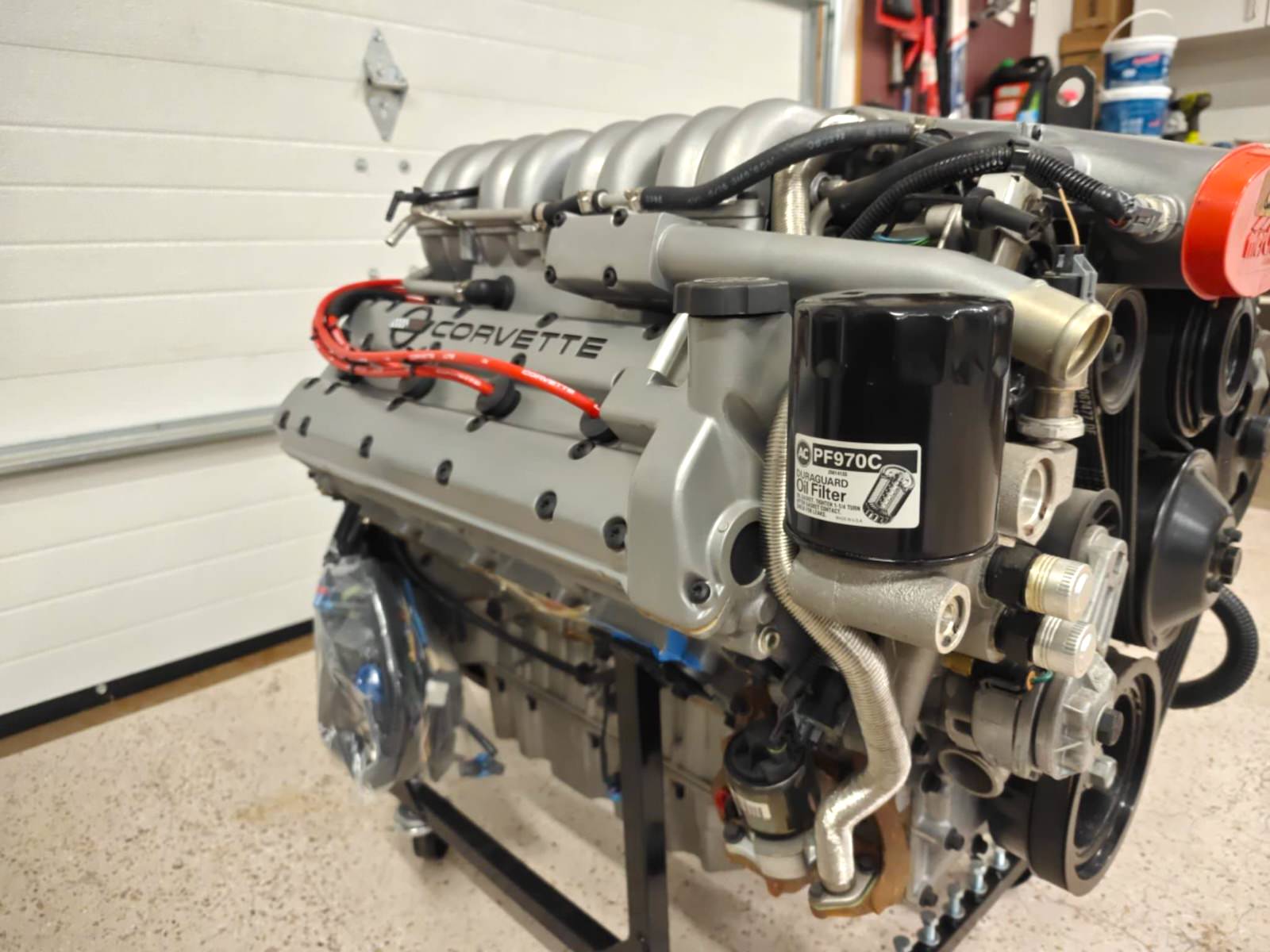
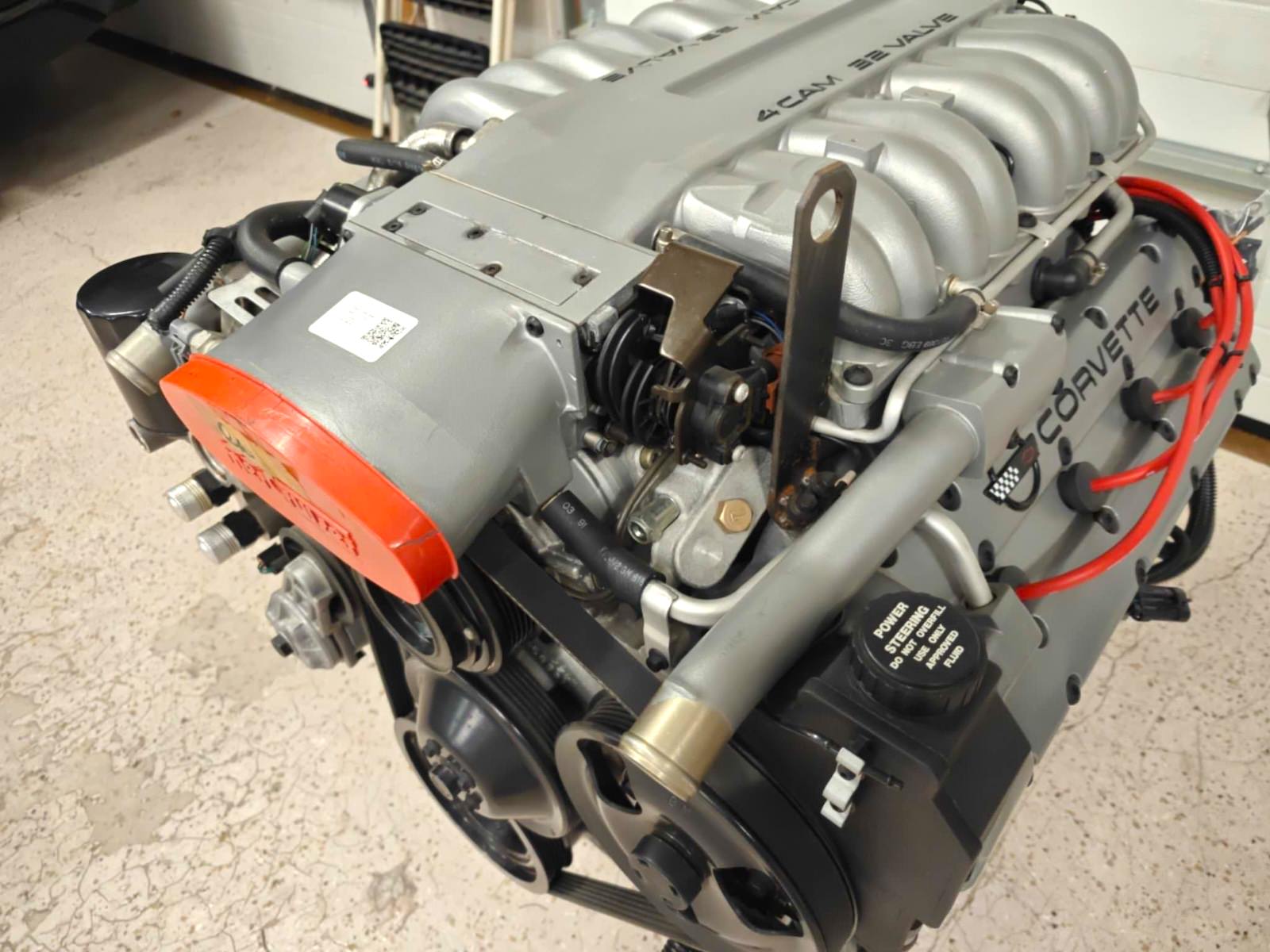
This LT5 crate engine is an unused example, a new-old-stock engine, that’s been part of a private collection for many years. Its original crate disintegrated, so it’s now fitted to a steel frame with caster wheels to make it easy to move around.
Fast Facts: A Corvette ZR-1 LT5 Crate Engine
- The Chevrolet LT5 was developed jointly by General Motors and Lotus in the 1980s for the C4 Corvette ZR-1. The all-aluminum 5.7 liter V8 had double overhead cams, 32 valves, 16 fuel injectors, and a sophisticated dual-port intake system. It initially produced 375 bhp and 370 lb ft of torque.
- The LT5 was manufactured by Mercury Marine in Stillwater, Oklahoma, using computer-controlled machining equipment and largely manual assembly. Each engine underwent dynamometer testing before being shipped to Bowling Green, Kentucky. The ZR-1 could reach 60 mph in 4.5 seconds and achieve a top speed of 175 mph in period testing.
- Chevrolet upgraded the LT5 for 1993 with revised cylinder heads, cams, lighter connecting rods, and four-bolt main bearings, increasing output to 405 bhp and 385 lb ft of torque. Just 6,939 C4 Corvette ZR-1s were built between 1990 and 1995, with LT5 production ending in November of 1993.
- The LT5 crate engine shown here is believed to be an unused example built to 1993 specifications. It reportedly spent time in a museum before entering private ownership, and was acquired by the seller in January of 2024. It retains its intake system, accessories, and wiring harnesses, and is now for sale in Illinois.
History Speedrun: The Chevrolet ZR-1 LT5 Crate Engine
Relatively early in the fourth-generation Corvette’s life, Chevrolet’s engineers realized they wanted more power than the pushrod L98 V8 could reasonably supply. They looked first at turbocharging, both V6s and twin-turbo small block V8s, before cost and real-world reliability concerns ruled out forced-induction entirely.
Above Video: This is an original MotorWeek review of the 1996 Corvette ZR-1, as you can see, they were huge fans of the model and went so far as to call it a “supercar.”
Lloyd Reuss, who ran GM’s Chevrolet-Pontiac-Canada group, wanted something different – a modern four-cam, four-valve V8 that would keep the Corvette ahead of any supercar Honda or Toyota might build. Chevrolet’s in-house engineering staff were tied up keeping the regular production cars emissions-legal, so in 1985 the engine development work went to Lotus.
The plan at that stage was to put four-valve heads on the existing L98 block, and Porsche was asked for a competing cylinder head design. Lotus won, and its Engineering Director Tony Rudd then argued that the heads deserved an all-new engine underneath them. Reuss agreed.
A Chevrolet Small Block V8 In Name Only
The first LT5 ran at Lotus in Hethel, England, on May the 1st, 1986, the same year GM bought the company. The program was a joint one, GM Powertrain engineers shared the design and development work with Hethel, and the engine-control software was developed at GM’s Milford Proving Ground and finalized by Delco Electronics.
GM held to one condition – the engine had to keep the small block’s 4.40 inch bore spacing. That limited the bore to 3.90 inches, which with a 3.66 inch stroke gave 349 cubic inches (5.7 liters), and it limited valve size too. Lotus had aimed for 400 bhp. The production engine was rated at 375 bhp and 370 lb- ft of torque, against 245 or 250 bhp for the L98 V8, depending on specification of course.
Apart from the bore spacing, almost nothing else carried over. The block and heads are aluminum, the cylinders are Nikasil-coated forged aluminum liners made by Mahle, and the nitrided crankshaft sits in a ladder-frame lower crankcase with iron bearing inserts cast in. Four chain-driven camshafts work 32 valves through hydraulic lifters, and the compression ratio is 11.0:1 – relatively high for the time.
Each cylinder has two intake ports, each with its own runner and fuel injector, 16 of each in all. One port works all the time. The other, feeding a valve with hotter cam timing, stays shut behind its own throttle until the engine computer opens it at higher revs and wider throttle openings.
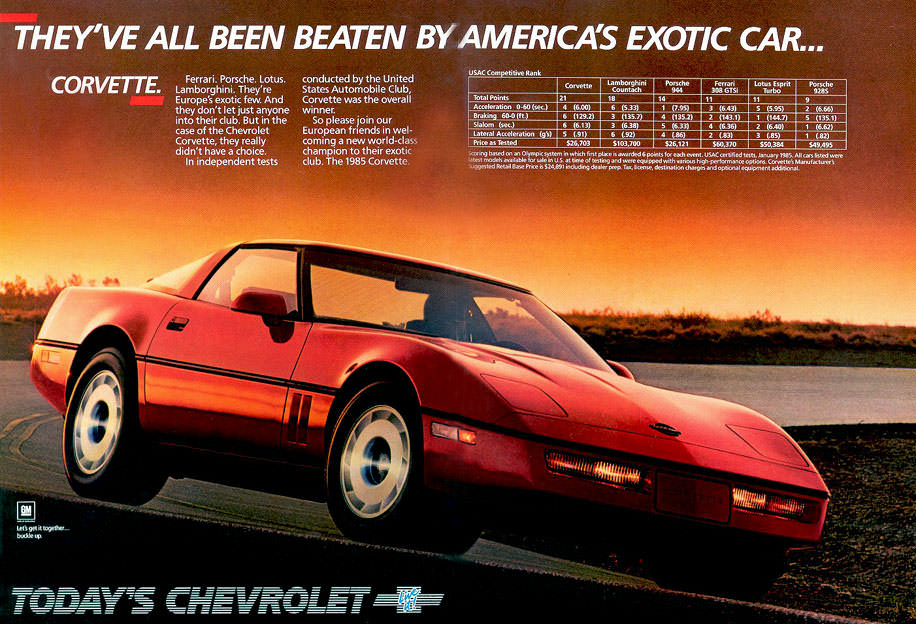
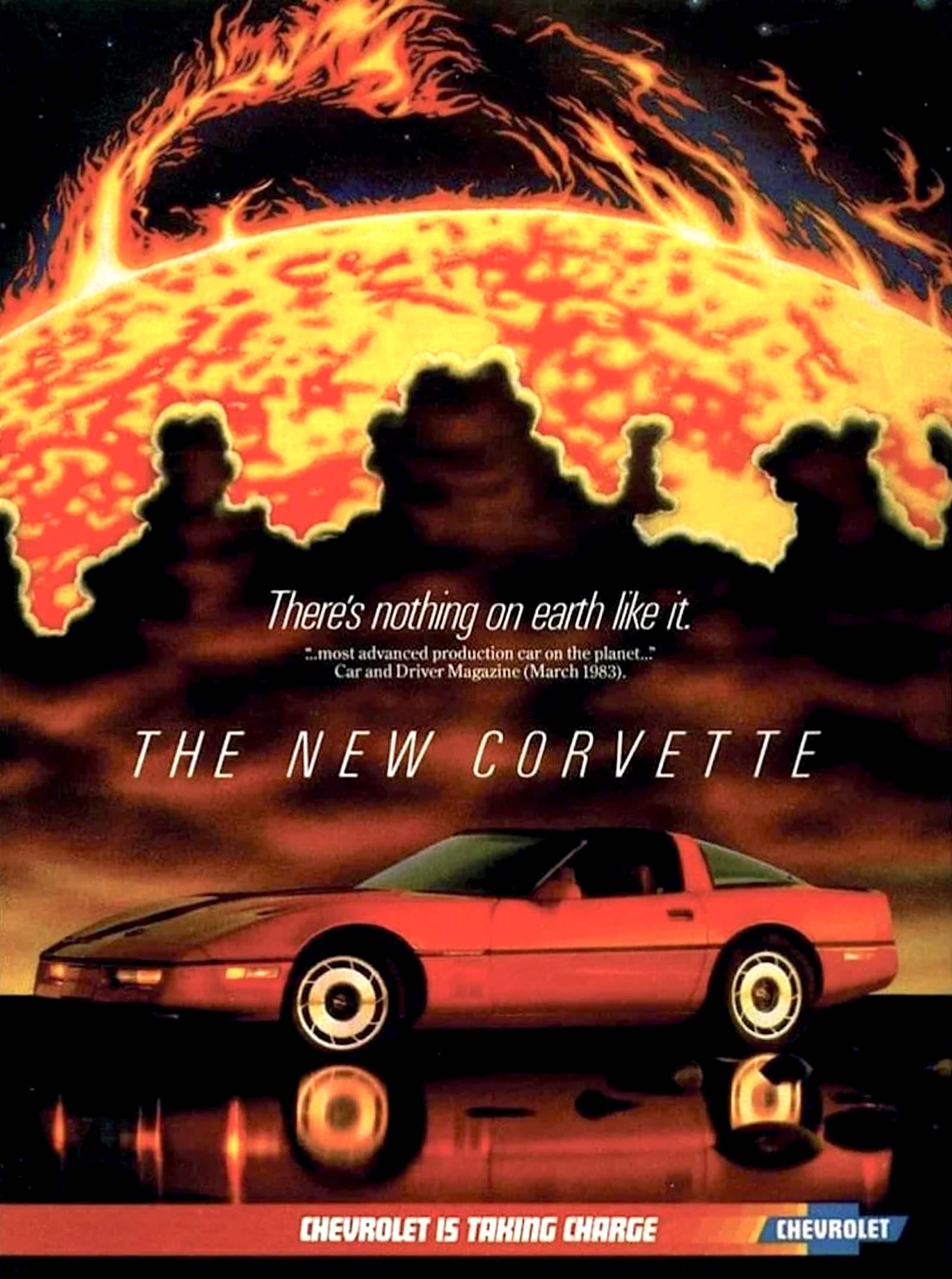
 The C4 Corvette debuted for the 1984 model year, it was a clean-slate design intended to compete squarely with the European sports cars of the day. The high-performance ZR-1 version would debut in 1990. Images courtesy of General Motors.
That resulted in an engine that happily revved past 7,000 rpm, but still had the low-speed manners of a much milder V8. A key switch on the console let the owner lock the secondary ports and their injectors out completely, which cut output to about 210 bhp. One period road test by Car and Driver magazine said the torque band felt “about as wide as, say, Utah.”
Built In Oklahoma – At MerCruiser
General Motors ruled out building the LT5 in its own engine plants, which were set up for high volume and couldn’t produce the LT5’s aluminum castings.
On March the 20th, 1986, GM signed with MerCruiser, the Mercury Marine division in Stillwater, Oklahoma, that had been converting Chevrolet engines for boats for decades. The first MerCruiser-built LT5 ran on the dynamometer on Christmas Eve of 1987, and series production began in mid-1989.
The engines were machined on computer-controlled equipment in a temperature-controlled room and assembled largely by hand. Each one was run at full throttle on a dynamometer to confirm its rated output, then shipped to the Corvette plant in Bowling Green, Kentucky, to be fitted to cars. Output peaked at 22 engines a day.
The C4 Corvette ZR-1 Package
The LT5 was sold only as part of the ZR-1 package on the Corvette C4, which reached buyers for the 1990 model year after a European press launch at Geneva in 1989.
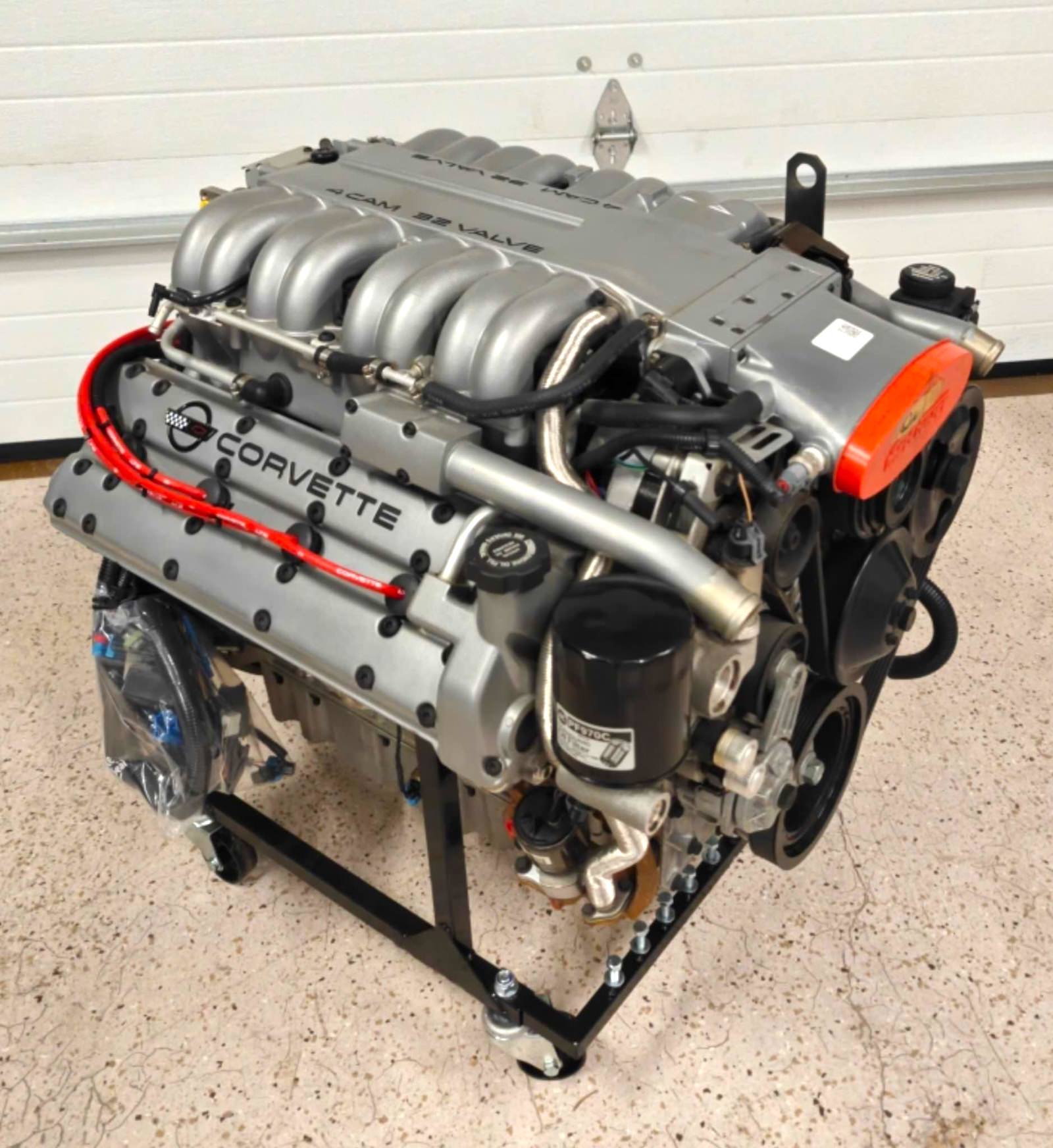
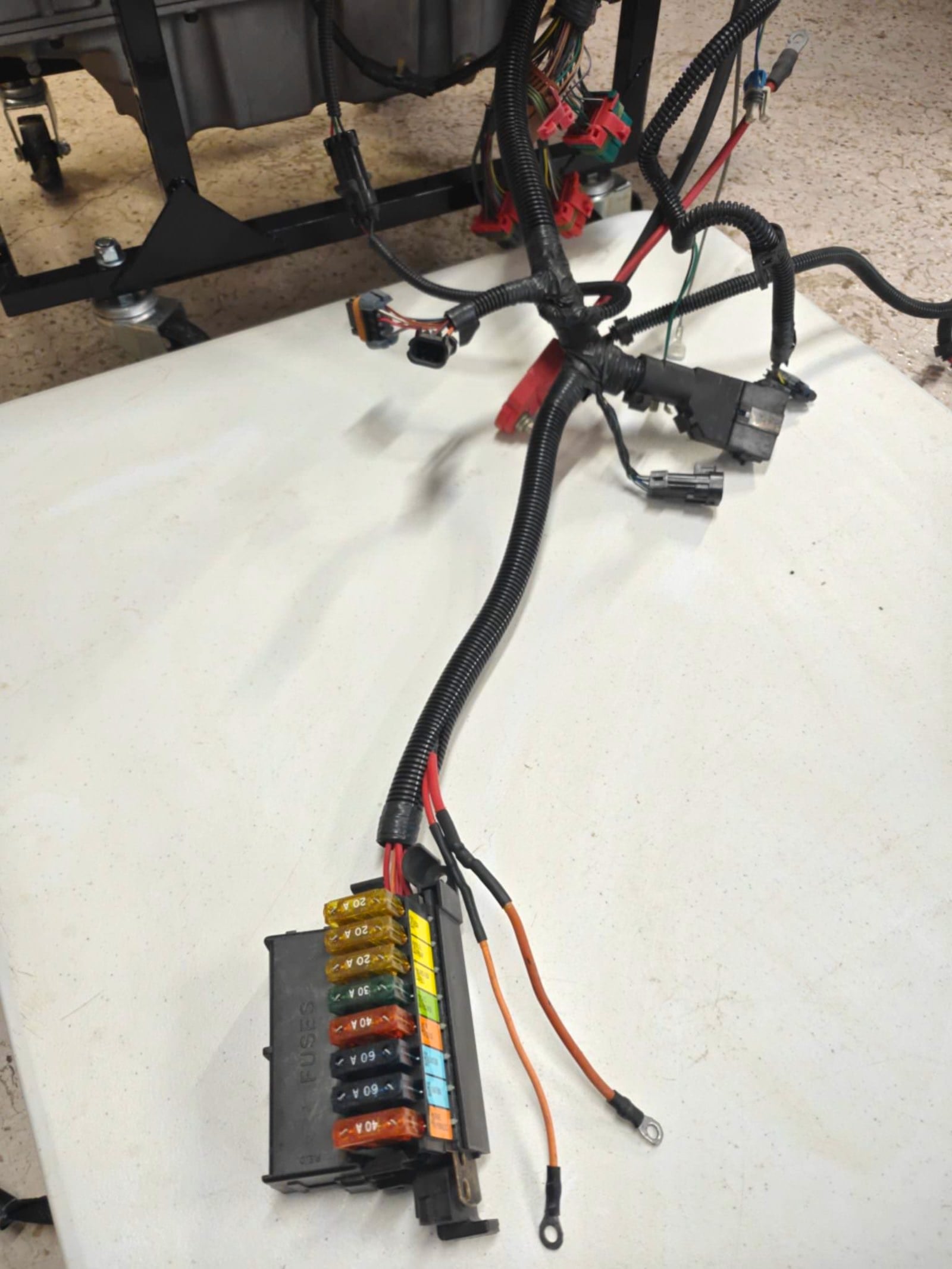
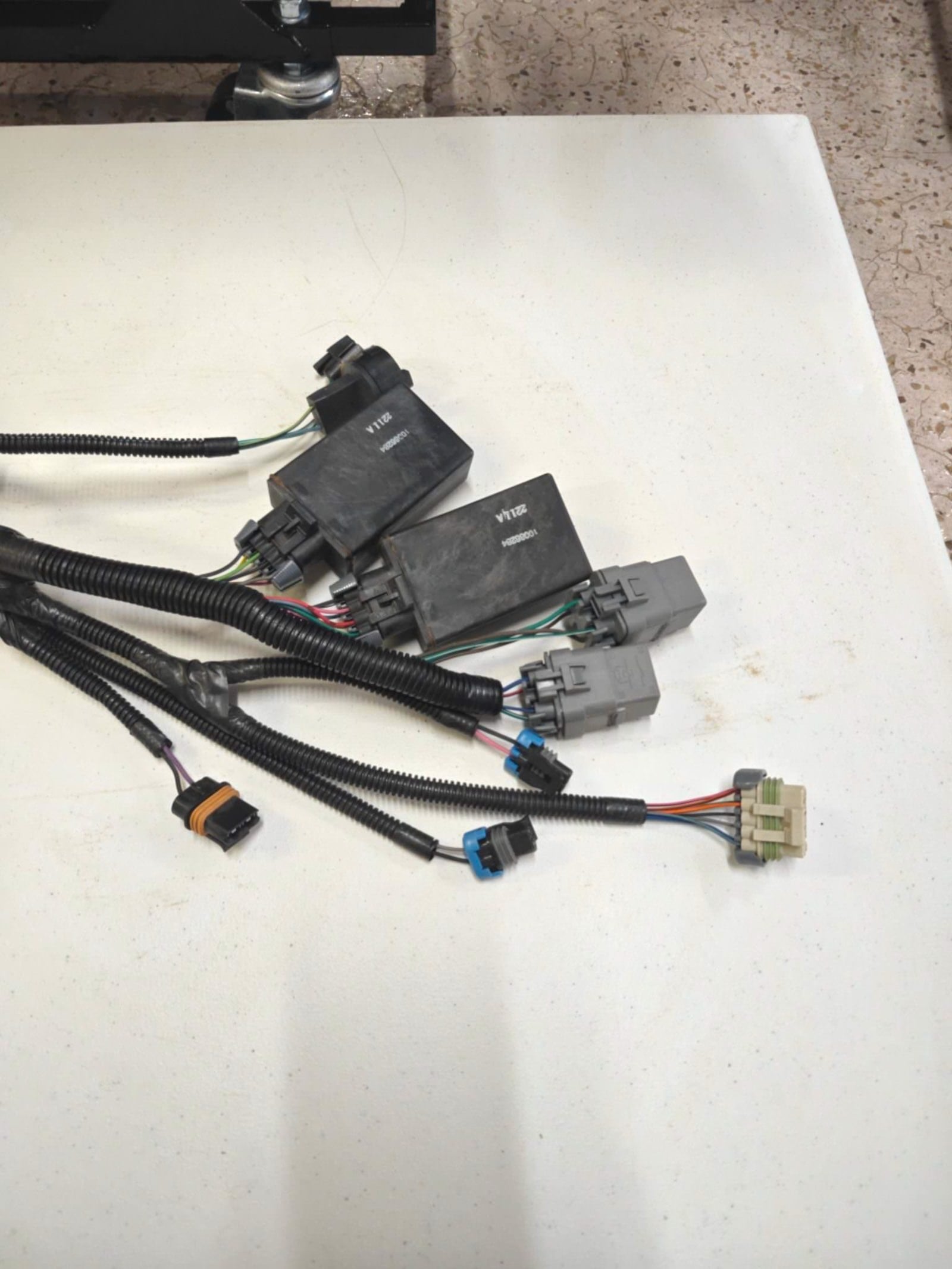
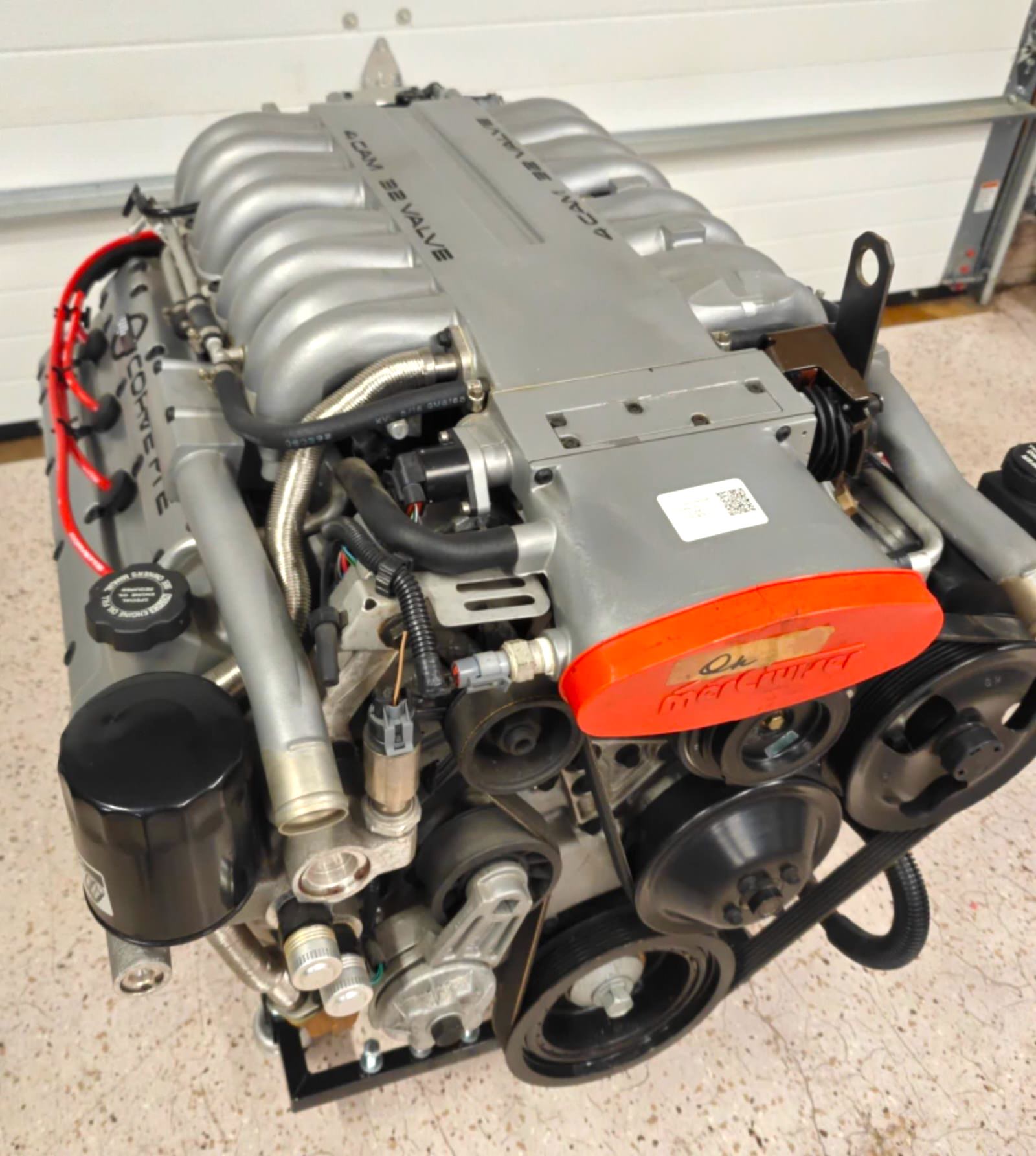
This Chevrolet Corvette ZR-1 LT5 crate engine keeps its original twin-plenum intake system, primary and secondary fuel injectors, ignition system, alternator, starter motor, air conditioning compressor, and wiring harnesses.
The standard C4 already had a galvanized steel uniframe under plastic composite body panels, aluminum suspension arms, a transverse fiberglass leaf spring at each end, a five-link independent rear, rack-and-pinion steering and four-wheel disc brakes.
The ZR-1 package widened the body three inches from the doors back to cover 11 inch rear wheels and P315/35ZR17 tires, and gave it a convex tail. It also made standard several items offered on other Corvettes – larger front brakes, electronically adjustable dampers, and the ZF 6-speed manual, the only transmission available with the LT5 engine. The option cost $27,016 USD (about $69,800 USD in 2026), and that was on top of the coupe’s $31,979 USD sticker price (about $82,600 USD in 2026 dollars).
A pre-production car recorded 0 to 60 mph in 4.5 seconds and a top speed of 175 mph in a 1989 Car and Driver magazine test. On March 1 and 2, 1990, a ZR-1 averaged 175.885 mph for 24 hours at a test track near Fort Stockton, Texas, covering 4,221 miles and beating a record of 161.180 mph that had stood since 1940. Its LT5 was internally stock but ran without catalytic converters or mufflers and on revised engine software.
Variants + The End Of The Road
For 1993 each main bearing went from two bolts to four, the heads and camshafts were reworked, and the connecting rods were lightened. The rating rose to 405 bhp at 5,800 rpm and 385 lb ft, top speed in testing rose to 179 mph.
A twin-turbocharged LT5 making 650 bhp powered the mid-engined CERV III research car shown in Detroit in January of 1990, and Mercury converted one engine for marine use in a 24 foot Baja show boat comically named the Wette Vette.
The seller believes the engine was built to 1993 specifications, which would give it a factory-rated output of 405 bhp and 385 lb ft of torque. A 1992 date stamp is visible on the clutch, which helps to verify that date claim.
Lotus was also developing a third version with variable valve timing and a 475 bhp target for 1995, but Chevrolet stopped that work in the fall of 1991. Graham Behan, the Lotus engineer who led it, later assembled one from surviving prototype parts, and on the dynamometer, without accessories, it made a blistering 528 bhp.
Buyers had already started to drift away from the ZR-1 by this time, Chevrolet built 3,049 ZR-1s for 1990 and 2,044 for 1991, the year every Corvette received the convex tail. In 1992 the base car was given a 300 bhp pushrod LT1, and ZR-1 production fell to 502, then to 448 in each of the last three years, for a total of 6,939. MerCruiser finished its last LT5 in November of 1993, and the final ZR-1 left Bowling Green in April of 1995.
Chevrolet reused the LT5 name in 2019 for the ZR1’s supercharged 376 cubic inch (6.2 liter) V8, a pushrod engine rated at 755 bhp that had no direct engineering link to the earlier Lotus-designed unit.\
The Chevrolet Corvette ZR-1 LT5 Crate Engine Shown Here
This is a Chevrolet LT5 V8 crate engine intended for use in the Chevrolet Corvette ZR-1. It’s believed to have never been installed in a vehicle, having reportedly spent time in a museum before entering private ownership. It was acquired by the current owner (and now seller) in January of 2024.
As you would expect, it has a displacement of 5.7 liters (349 cubic inches) and has an aluminum-alloy block with Nikasil-coated cylinder liners, aluminum cylinder heads, double overhead cams, and four valves per cylinder. Internally, it has a forged steel crankshaft, forged steel connecting rods, and aluminum pistons.
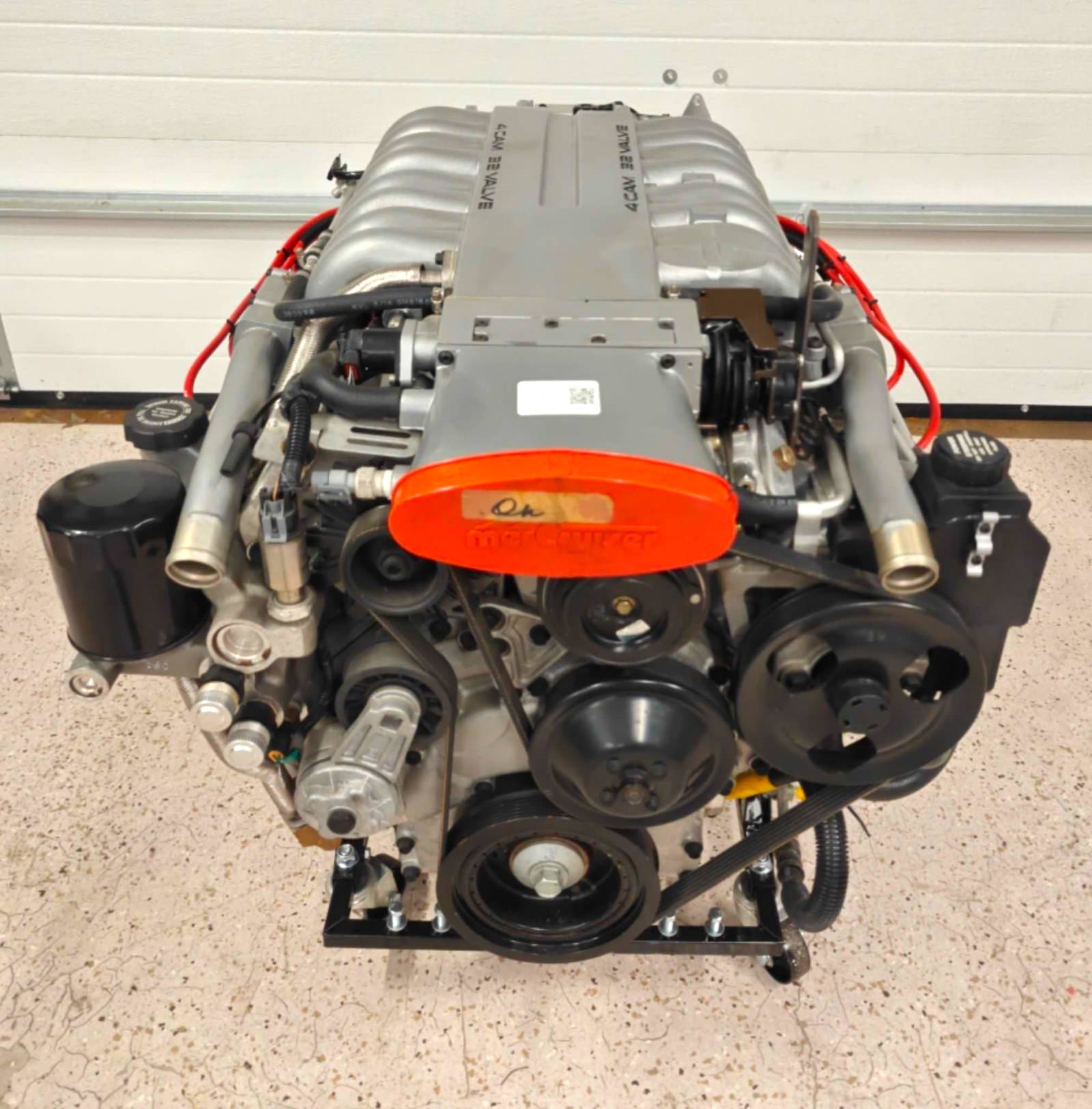
The seller believes the engine was built to 1993 specifications, which would give it a factory-rated output of 405 bhp and 385 lb ft of torque. A 1992 date stamp is visible on the clutch, which helps to verify that date claim. The engine keeps its original twin-plenum intake system, primary and secondary fuel injectors, ignition system, alternator, starter motor, air conditioning compressor, and wiring harnesses.
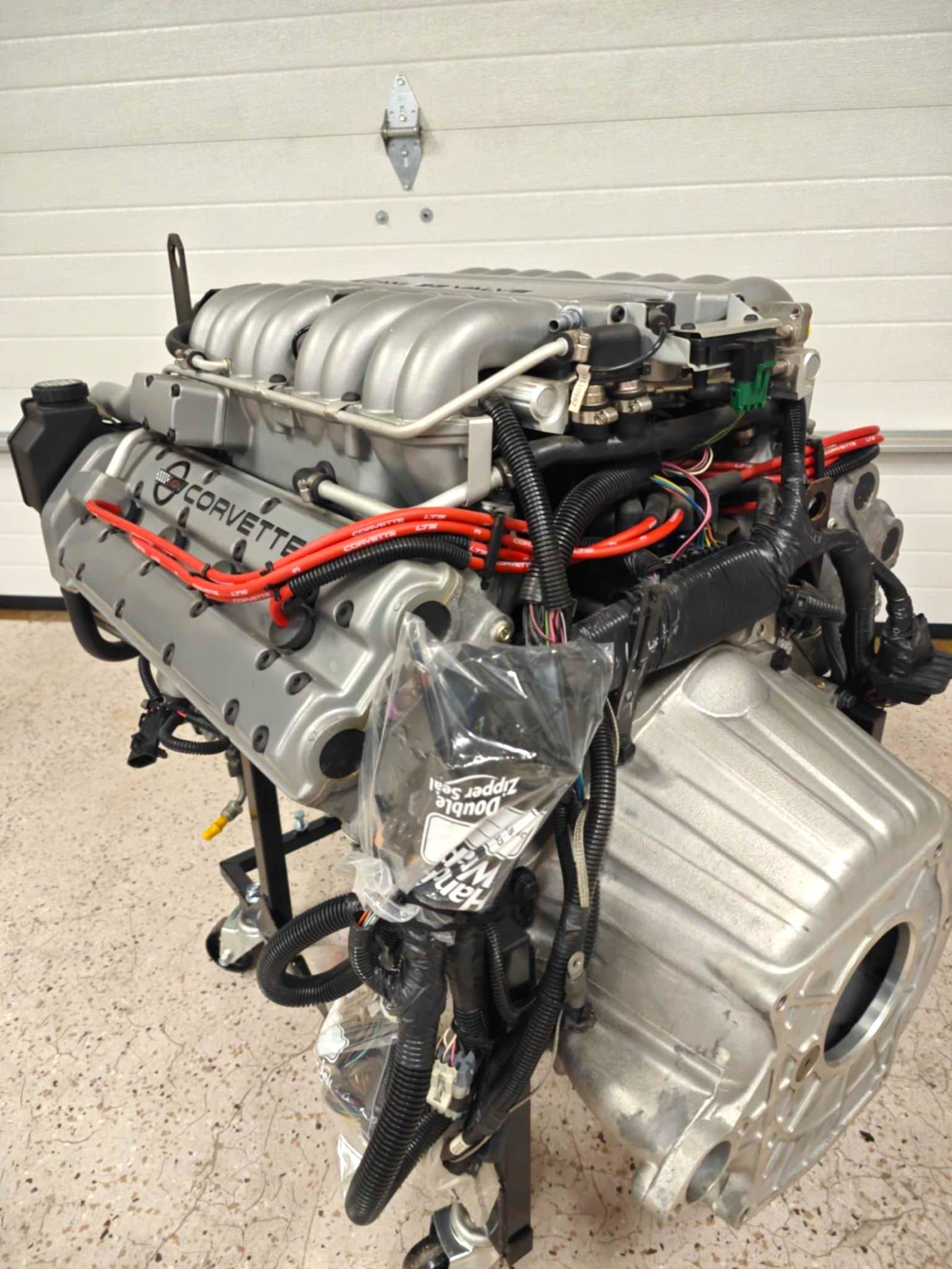
This is a Chevrolet LT5 V8 crate engine intended for use in the Chevrolet Corvette ZR-1. It’s believed to have never been installed in a vehicle, having reportedly spent time in a museum before entering private ownership.
According to the seller, the engine underwent its standard factory break-in and dynamometer testing at Mercury Marine but has remained unused ever since. Its original shipping crate had disintegrated, so the seller modified a wheeled cart to carry it.
The engine reportedly turns freely and is now being offered for sale out of Chillicothe, Illinois. If you’d like to read more about it or register to bid, you can visit the listing here.
Images courtesy of General Motors + Bring a Trailer

Articles that Ben Branch has written have been covered on CNN, Popular Mechanics, Smithsonian Magazine, Road & Track Magazine, the official Pinterest blog, the official eBay Motors blog, BuzzFeed, Autoweek Magazine, Wired Magazine, Autoblog, Gear Patrol, Jalopnik, The Verge, and many more.
Silodrome was founded by Ben back in 2010, in the years since the site has grown to become a world leader in the alternative and vintage motoring sector, with well over a million monthly readers from around the world and many hundreds of thousands of followers on social media.