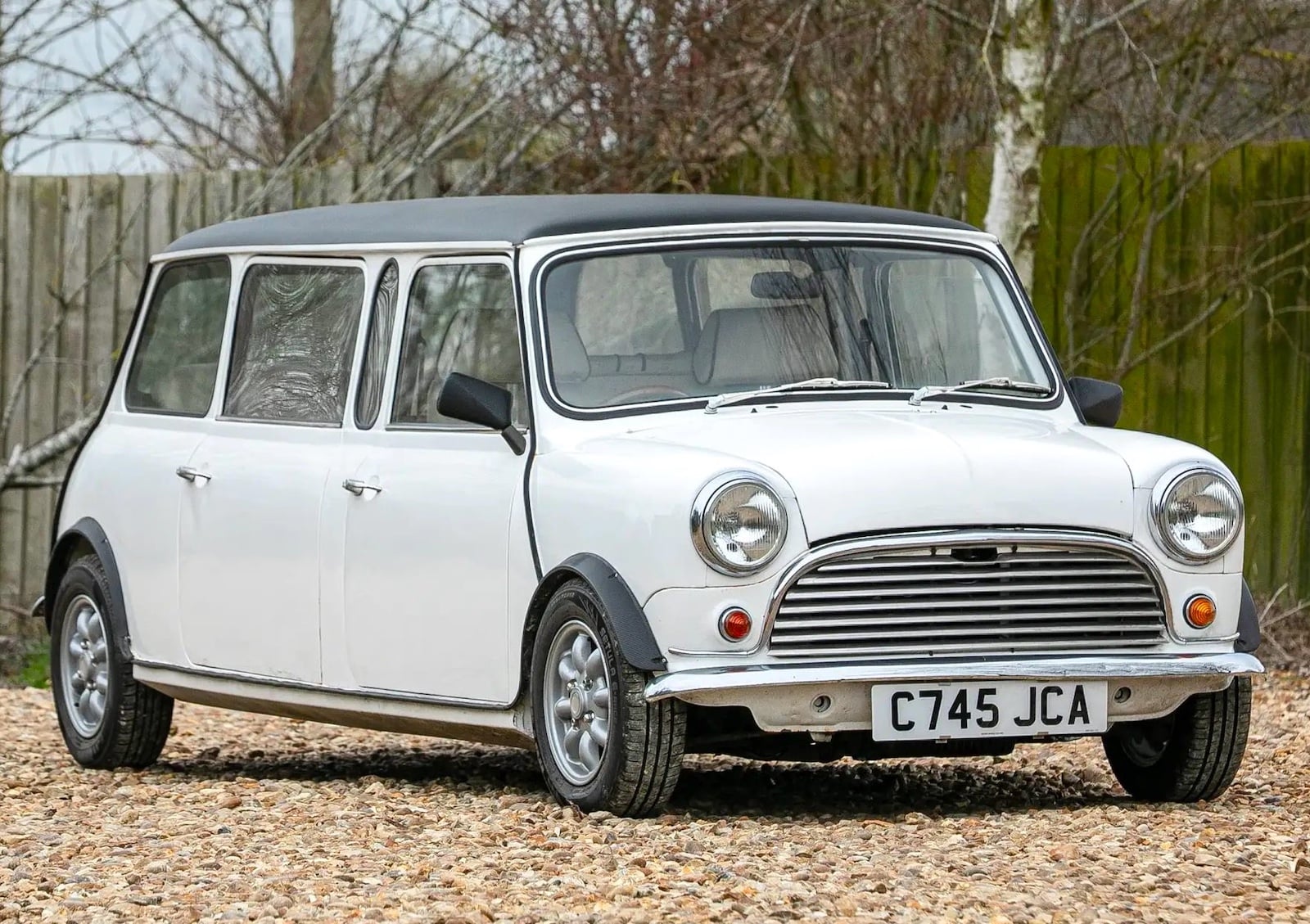
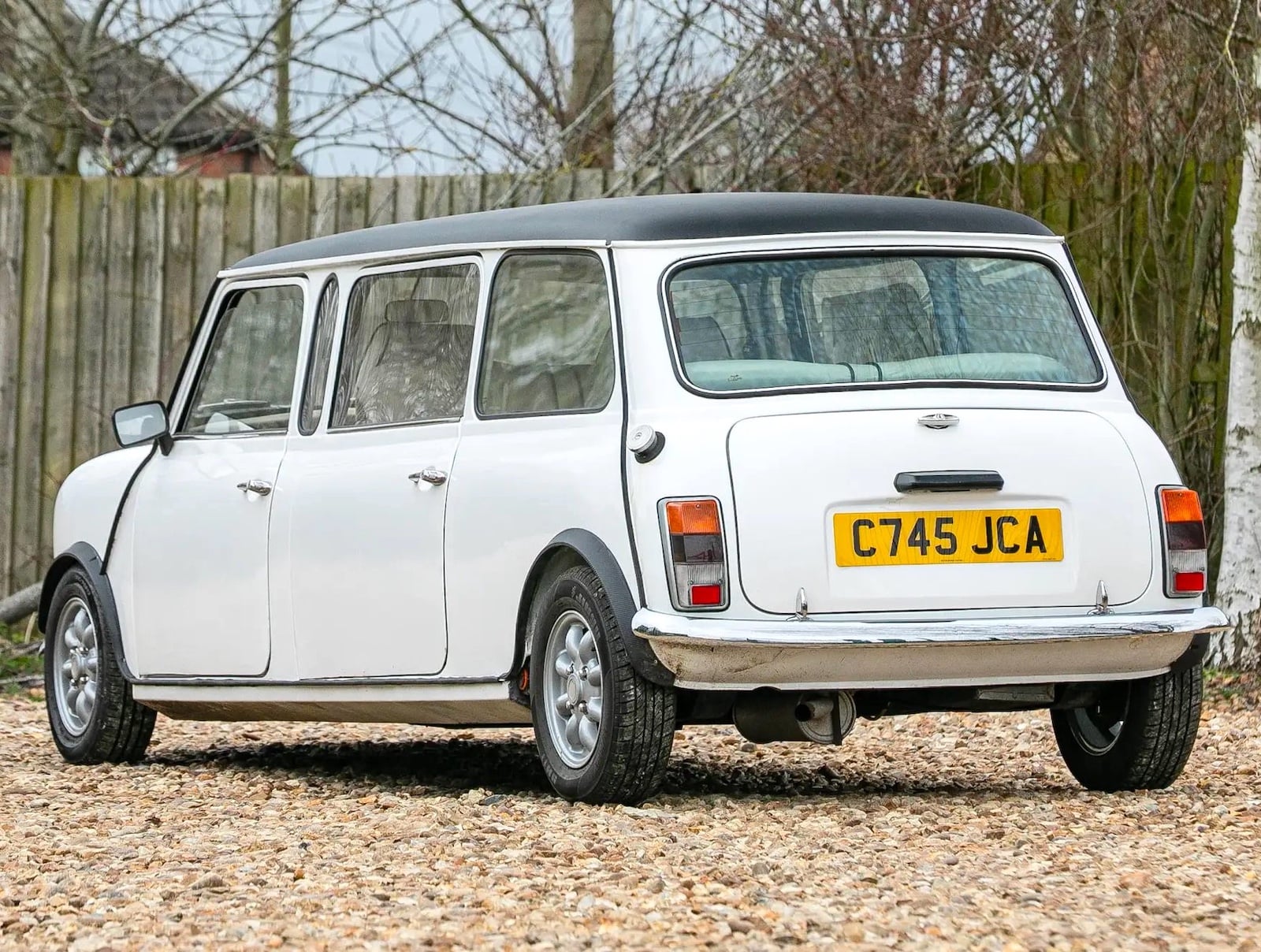
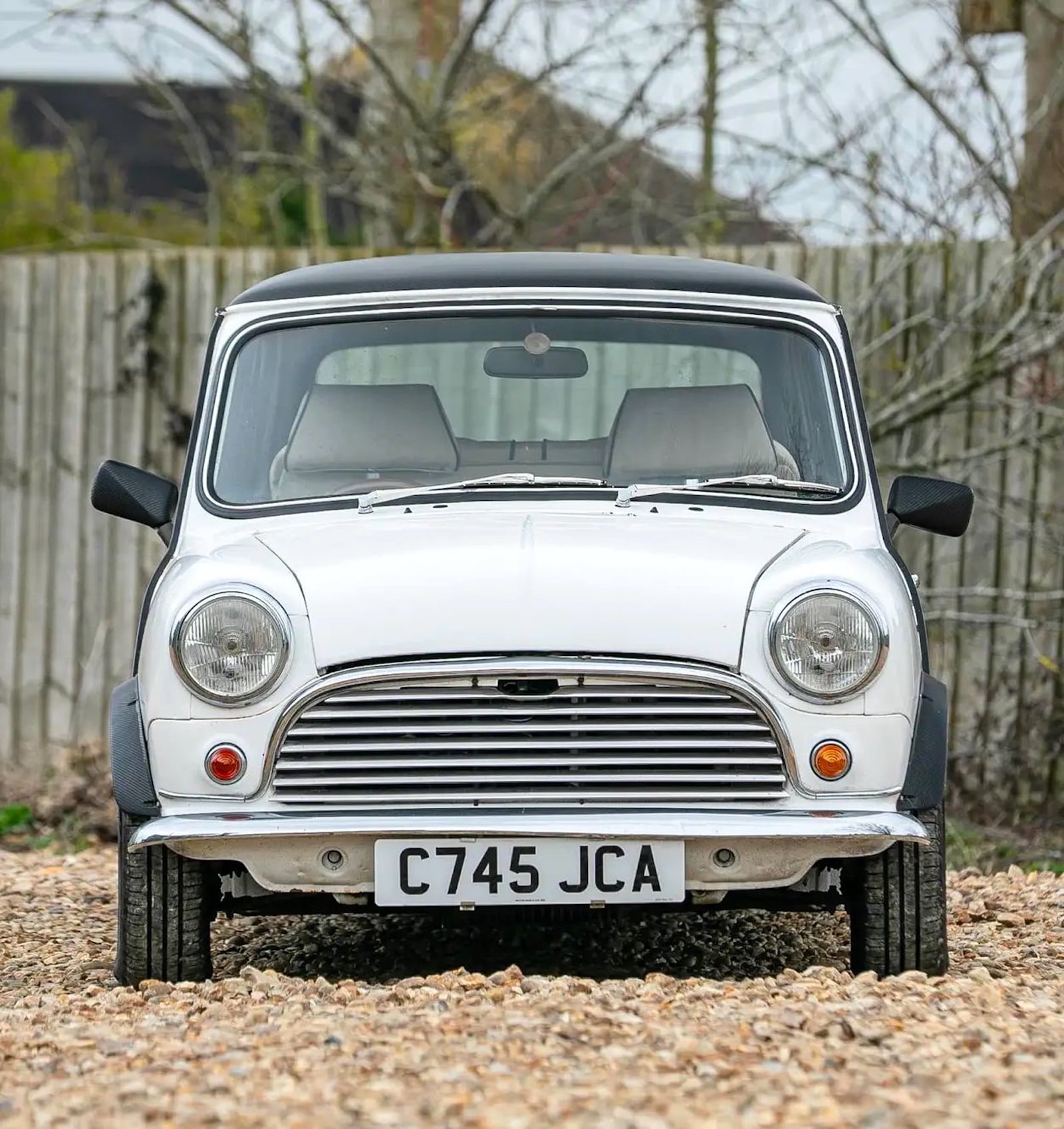
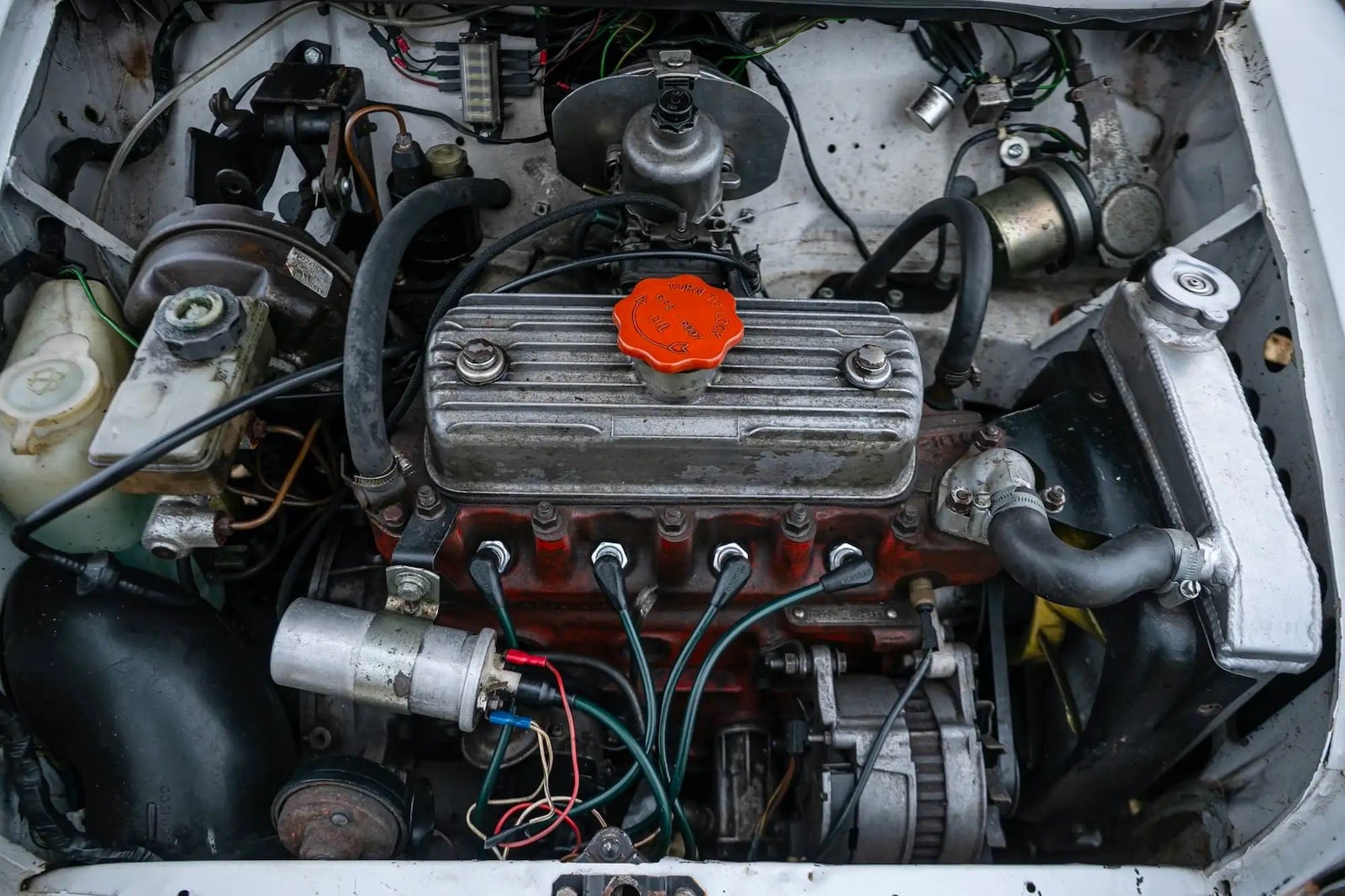
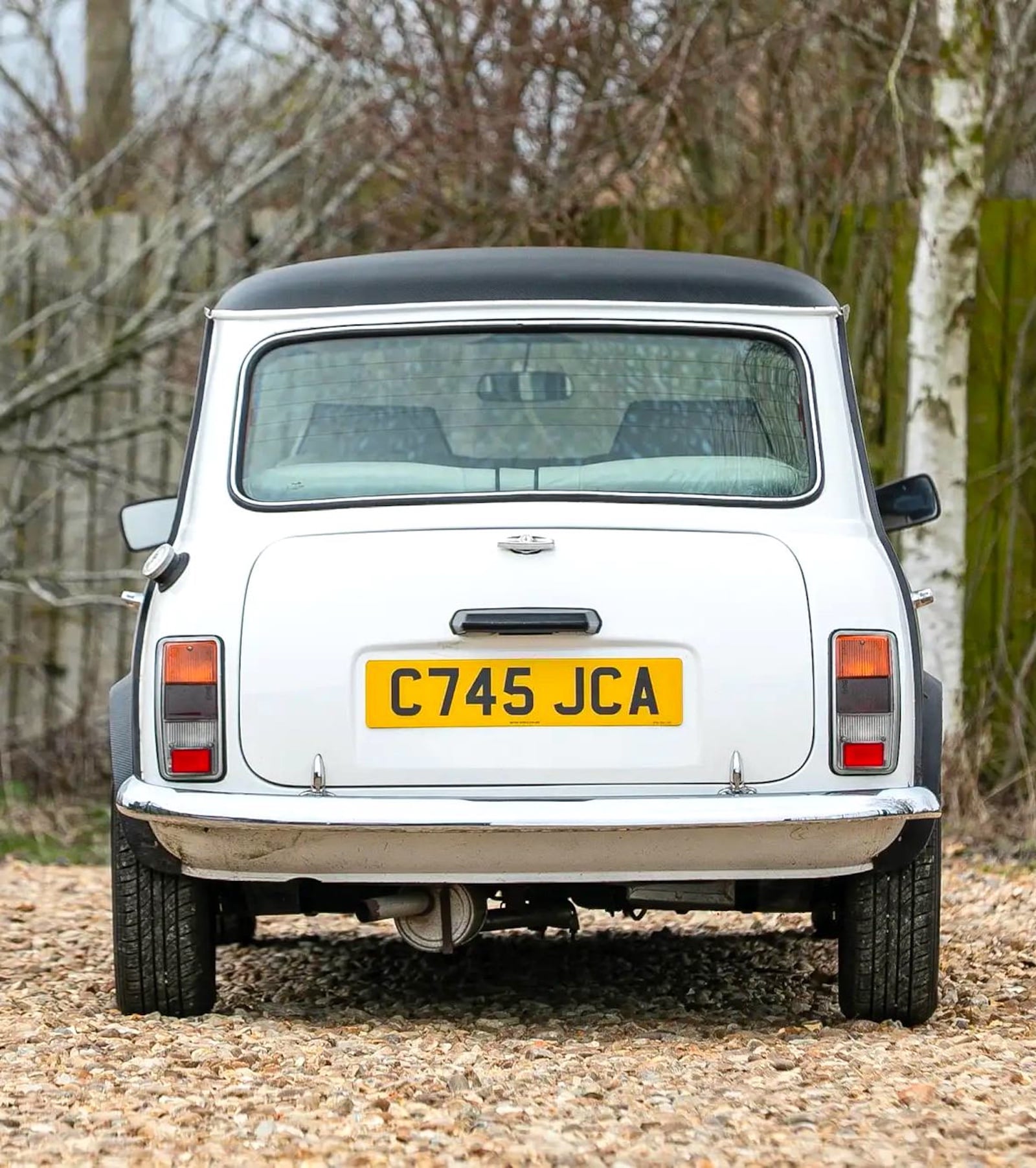
This is a 1985 Austin Mini that has been professionally converted into a stretch limousine, with four doors and seating for up to six people. The car was built by a specialist in the UK, and it’s powered by the 1,275cc A-Series engine.
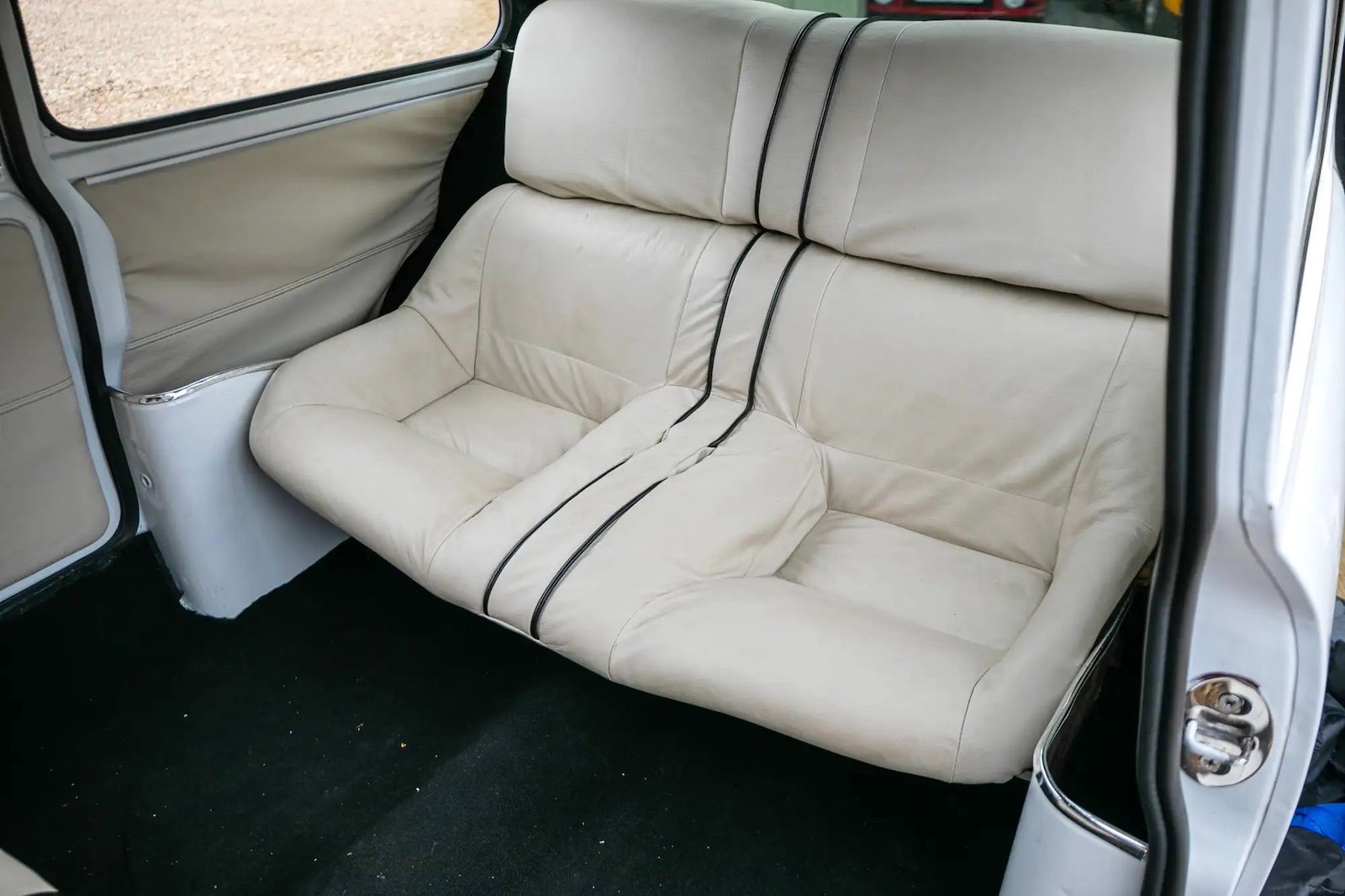
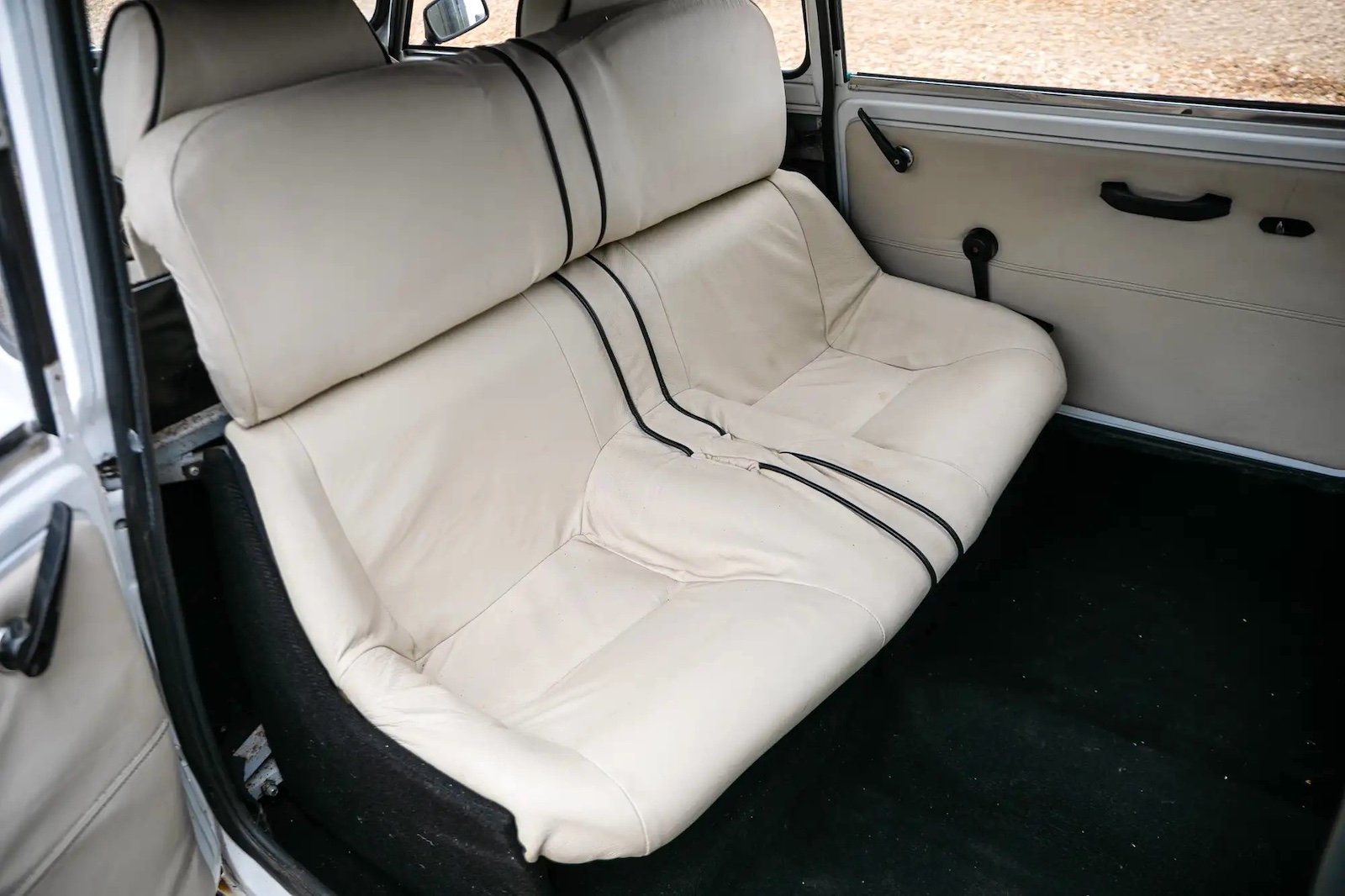
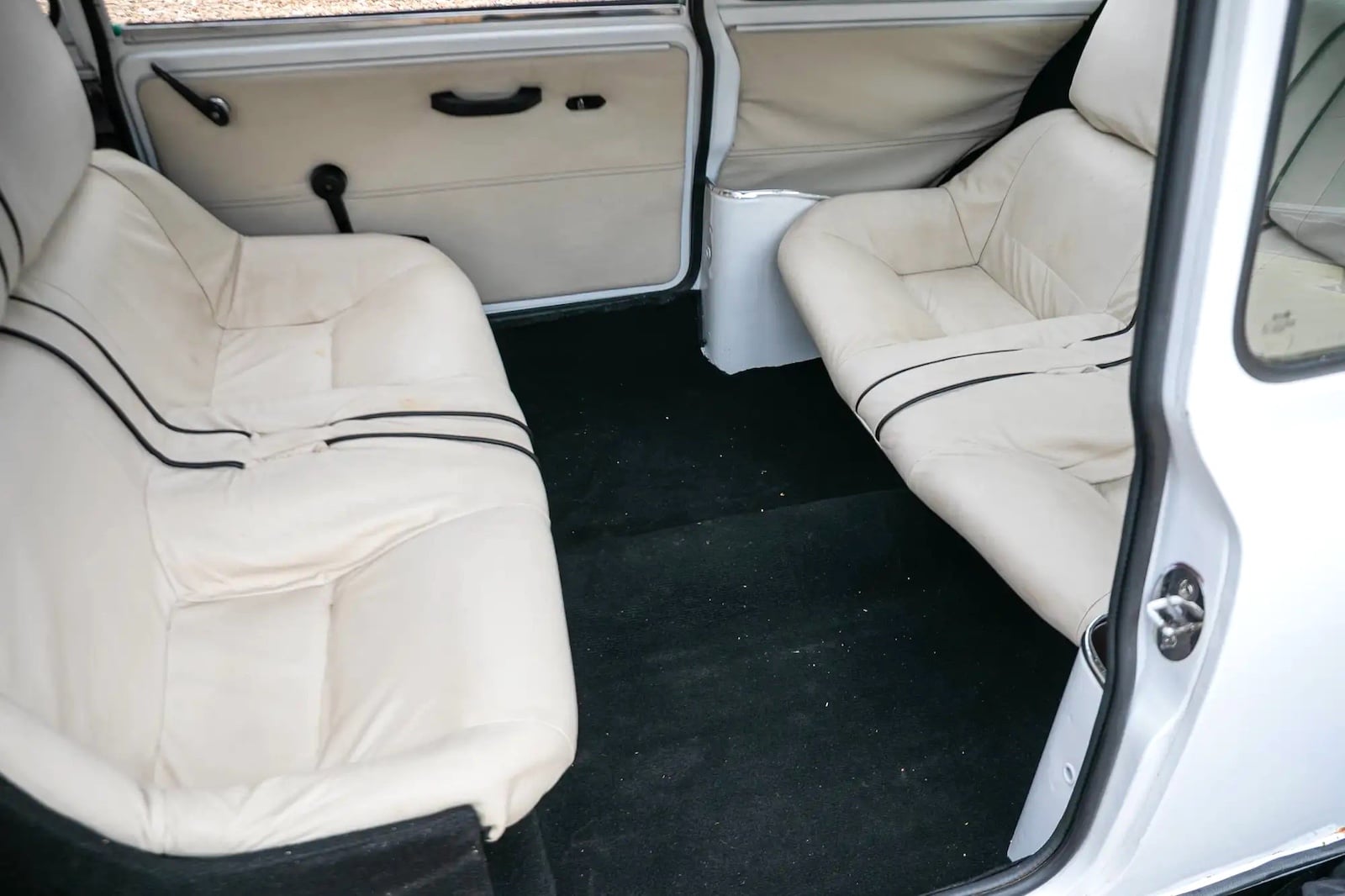
During the conversion the wheelbase was extended and strengthened, a pair of new white seats were fitted in the rear, and the car received an extra pair of doors in the back to make life a little easier for the backseat passengers.
Fast Facts: A Mini Stretch Limousine
- This 1985 Austin Mini was professionally converted in the UK into a stretch limousine with four doors, a lengthened and reinforced body, and seating for up to six people. The rear cabin was reworked with white seats and trim, turning a tiny economy car into a novelty chauffeur-style vehicle.
- The original Mini was born out of Britain’s late-1950s fuel crisis, when BMC boss Leonard Lord wanted a small, efficient alternative to imported microcars. Alec Issigonis answered the design brief with a space-efficient design that used a transverse A-Series engine, gearbox-in-sump layout, tiny 10-inch wheels, and compact rubber-cone suspension.
- That engineering made the Mini far more important than its size suggested – it carried four adults in a very short body, delivered nimble handling, and helped set the template for later front-wheel-drive small cars. Early versions were basic, but the design’s cleverness quickly gave it wide appeal and lasting cultural impact.
- Over time the Mini grew into a huge family of variants, from estates and luxury versions to the Cooper and Cooper S, which built its motorsport reputation on a slew of wins in rally and touring car racing. More than 5.3 million original Minis were made by 2000, and this stretch limo example stands out as one of the stranger custom offshoots of the breed.
History Speedrun: The Mini
When the Suez Crisis of 1956 choked off two-thirds of Europe’s oil supply, WWII-style petrol rationing returned to Britain and sales of large cars collapsed seemingly overnight. Demand for tiny economy vehicles surged across the country, and in some respects it began to reshape the British automotive industry.
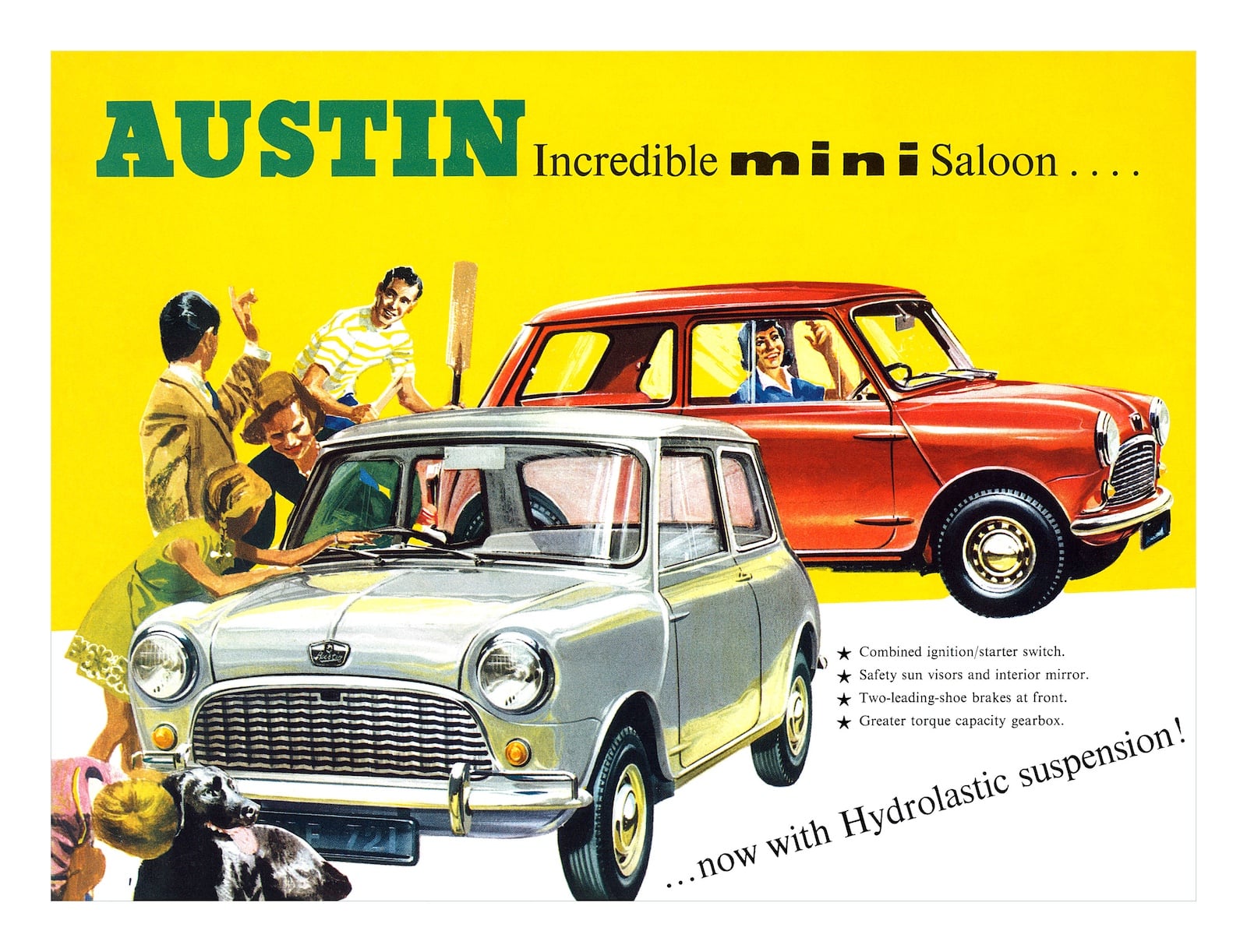
 Every detail of the Mini served a function. Sliding windows eliminated complex winding mechanisms, allowing slim, single-skin doors with built-in storage bins. External door hinges and exposed weld seams kept assembly simple and cheap. The original car famously lacked a heater, a radio, or exterior mirrors – Issigonis reportedly considered them all superfluous. Image courtesy of Austin.
Leonard Lord, head of the British Motor Corporation, despised the foreign micro-cars flooding British roads and issued a directive to his engineers in late 1956 to build a “proper miniature car.” It had to fit within a box measuring ten by four by four feet, passenger space had to dominate the interior, and it had to use an existing engine to speed up development.
The task to design this “proper” miniature car fell to Alec Issigonis, a brilliant Anglo-Greek engineer. Working with a team of just ten designers, Issigonis produced a running prototype by October of 1957. Legend holds that his concept was first sketched on a restaurant tablecloth, whatever the truth may be, the development pace of the car was lightning fast.
Issigonis’ Innovative Design
Issigonis solved the packaging puzzle that had been handed to him through a cascade of remarkably simple innovations. He took BMC’s existing A-Series four-cylinder engine, placed the gearbox in the engine’s oil sump, and mounted the entire assembly transversely (sideways) in the engine bay.
This allowed the powertrain to occupy just 20% of the car’s footprint, freeing the remaining 80% of the floorpan for passengers and their luggage/groceries. His friend Alex Moulton designed a compact suspension system using rubber cones in place of steel springs, saving weight, space, and expense.
10 inch wheels (requiring entirely new tires from Dunlop) were pushed to the outermost corners, giving the car a wide stance and maximizing interior room. It would be discovered later, that this would also help bestow excellent handling on the little car, and result in it becoming a race and rally champion.
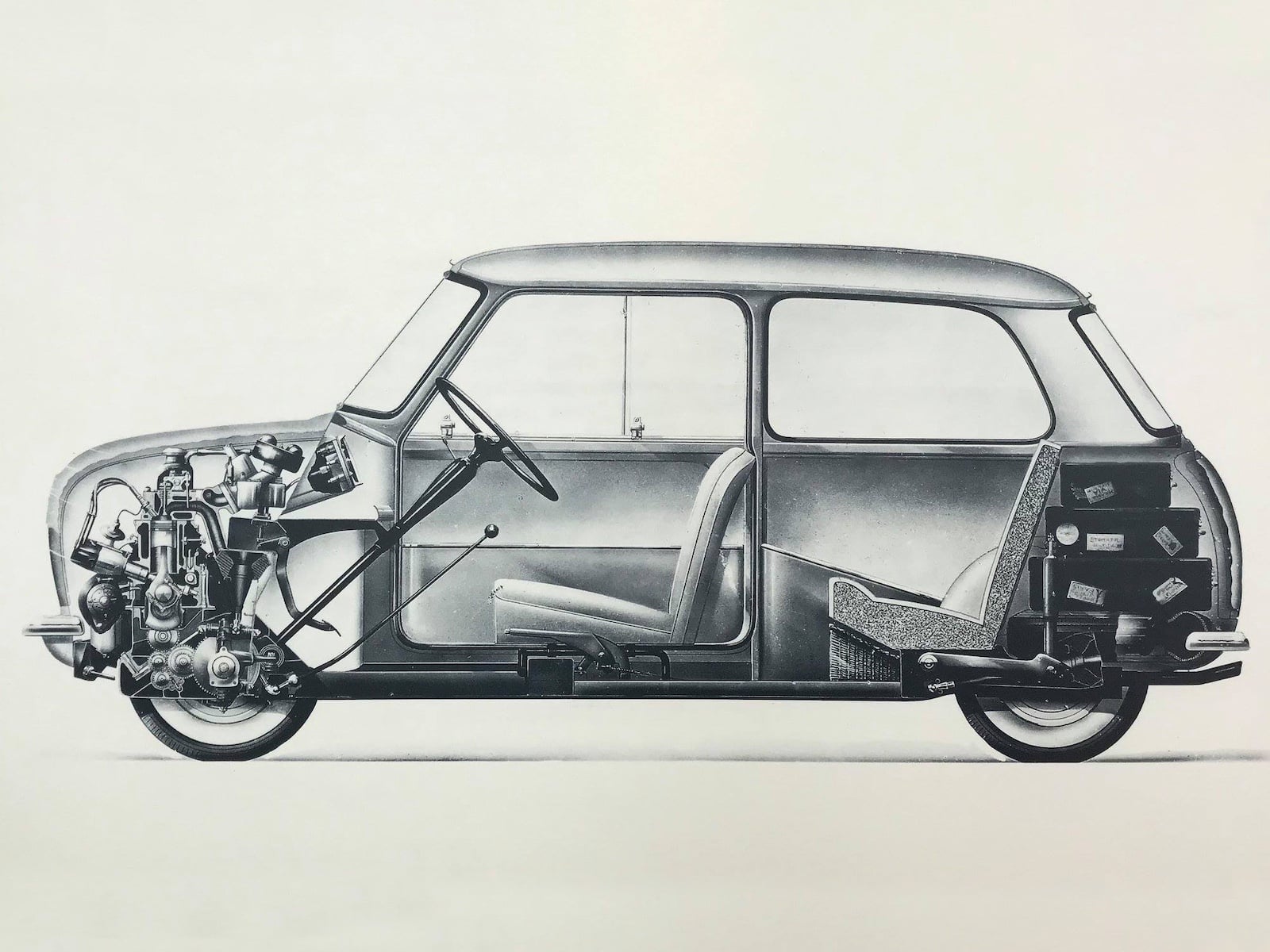
Alec Issigonis solved the packaging puzzle that had been handed to him through a cascade of remarkably simple innovations. He took BMC’s existing A-Series four-cylinder engine, placed the gearbox in the engine’s oil sump, and mounted the entire assembly transversely (sideways) in the engine bay. Image courtesy of Austin.
Every detail of the Mini served a function. Sliding windows eliminated complex winding mechanisms, allowing slim, single-skin doors with built-in storage bins. External door hinges and exposed weld seams kept assembly simple and cheap. The original car famously lacked a heater, a radio, or exterior mirrors – Issigonis reportedly considered them all superfluous.
The Mini’s Launch Specifications
The base Mini was powered by the humble 848cc A-Series engine producing 34 bhp, good for roughly 72 mph. It measured just 3,054 millimetres long yet seated four adults with 195 litres of luggage space. A 4-speed manual gearbox drove the front wheels, and the launch price was £496.
Shown to the press in April 1959, the car was officially revealed on the 26th August and displayed in nearly 100 countries. Marketed as the Austin Seven and Morris Mini-Minor, the two versions differed only in grille design, hubcaps, and paint.
Early sales were sluggish, Ford went so far as to claim that their rivals BMC were losing £30 on every car, but by the early 1960s the Mini had caught fire as a cultural phenomenon it was embraced by everyone from factory workers and school teachers to The Beatles.
The Key Mini Variants
Over its 41 year production life, the Mini would spawn an astonishing number of variants and derivatives. These included estate versions, both the Austin Countryman and Morris Traveller arrived in 1960, built on a slightly longer chassis with barn-style rear doors.
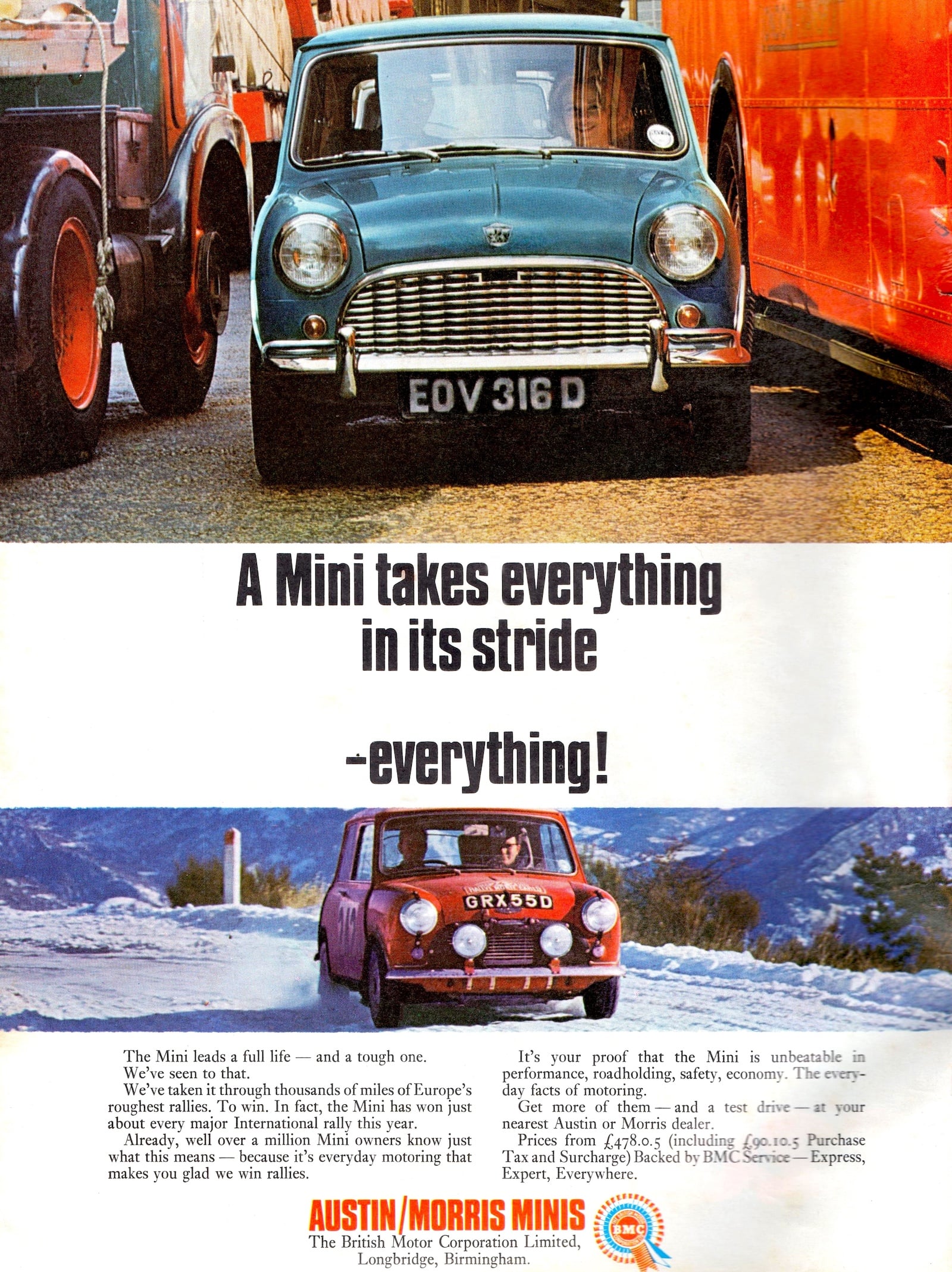
The Mini Cooper S won the Monte Carlo Rally outright in 1964, 1965, and 1967 and helping to define the Mini’s performance credentials to a worldwide audience. Image courtesy of Austin.
In 1961, upmarket Riley Elf and Wolseley Hornet models added a traditional booted tail, a revised front end, chrome trim, and wood-veneer dashboards. That same year, racing constructor John Cooper persuaded Issigonis to build a performance variant – the Mini Cooper, fitted with a 997cc engine and improved brakes.
The 1,071cc and later 1,275cc Cooper S models followed, winning the Monte Carlo Rally outright in 1964, 1965, and 1967 and helping to define the Mini’s performance credentials to a worldwide audience.
The open-topped Mini Moke, originally conceived as a lightweight military vehicle, later found its true calling as a holiday hire car in sunny destinations from Mauritius to Australia.
The 1969 Mini Clubman introduced a squared-off nose, while the 1275 GT offered a sporting alternative to the Cooper. Italian manufacturer Innocenti produced its own versions, and through the 1980s and 1990s dozens of limited editions kept the car fresh.
In total, more than 5.3 million original Minis were built before the last one, a red Cooper Sport, rolled off the Longbridge line in October of the year 2000.
The Legacy Of The Little Car That Could
In 1999, the Mini was voted the second most influential car of the twentieth century, behind only the Ford Model T. Its transverse-engine, front-wheel-drive layout became the universal template for small car design that persists to this day – it’s even now used on many mid-sized cars and small-to-mid-sized SUVs.
What they were converting it into was a stretched limousine, now with four doors and seating for up to 6 people. The wheelbase was significantly extended and reinforced, new rear doors were added, as well as two opposing sets of matching rear seats.
While the Mini was not technically the first car to mount an engine transversely, it was the first to do so with a four-cylinder unit with an integrated transmission, transforming the concept into industry standard.
When BMW launched the modern Mini in 2001, it kept the transverse four-cylinder engine and front-wheel-drive formula Issigonis had pioneered four decades earlier, and the styling (penned by Frank Stephenson) was a masterful modern tribute to the original car.
The 1985 Mini Stretch Limousine Shown Here
The car you see here started out as a relatively standard 1985 Austin Mini, and it remained that way for much of its life, until it was bought in the early 2000s and cut in half. Fortunately it was cut in half for a good reason, it was being converted into something a little unusual by a North Wales specialist garage.
What they were converting it into was a stretched limousine, now with four doors and seating for up to 6 people. The wheelbase was significantly extended and reinforced, new rear doors were added, as well as two opposing sets of matching rear seats.
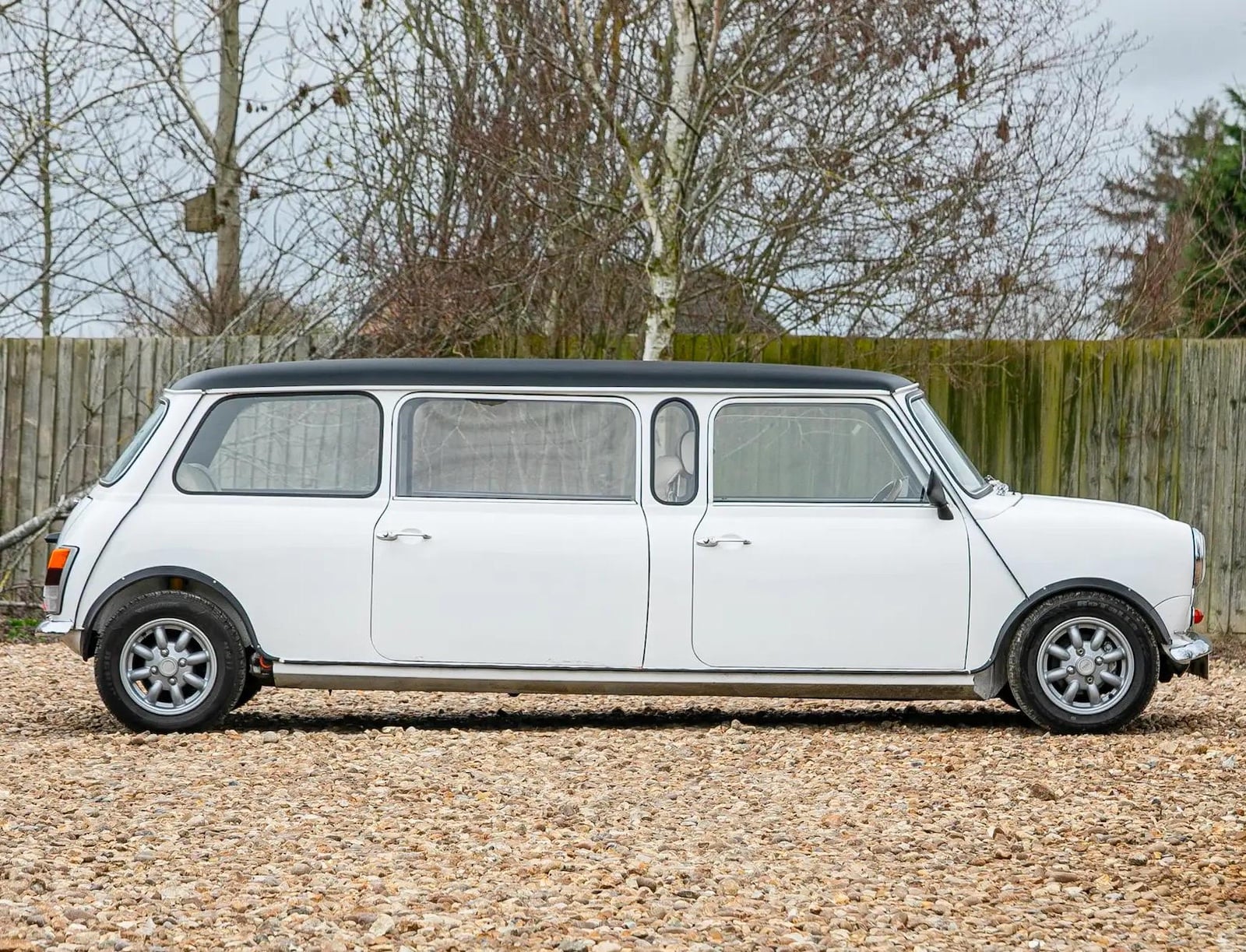
The car you see here started out as a relatively standard 1985 Austin Mini, and it remained that way for much of its life, until it was bought in the early 2000s and cut in half. Fortunately it was cut in half for a good reason, it was being converted into something a little unusual by a North Wales specialist garage.
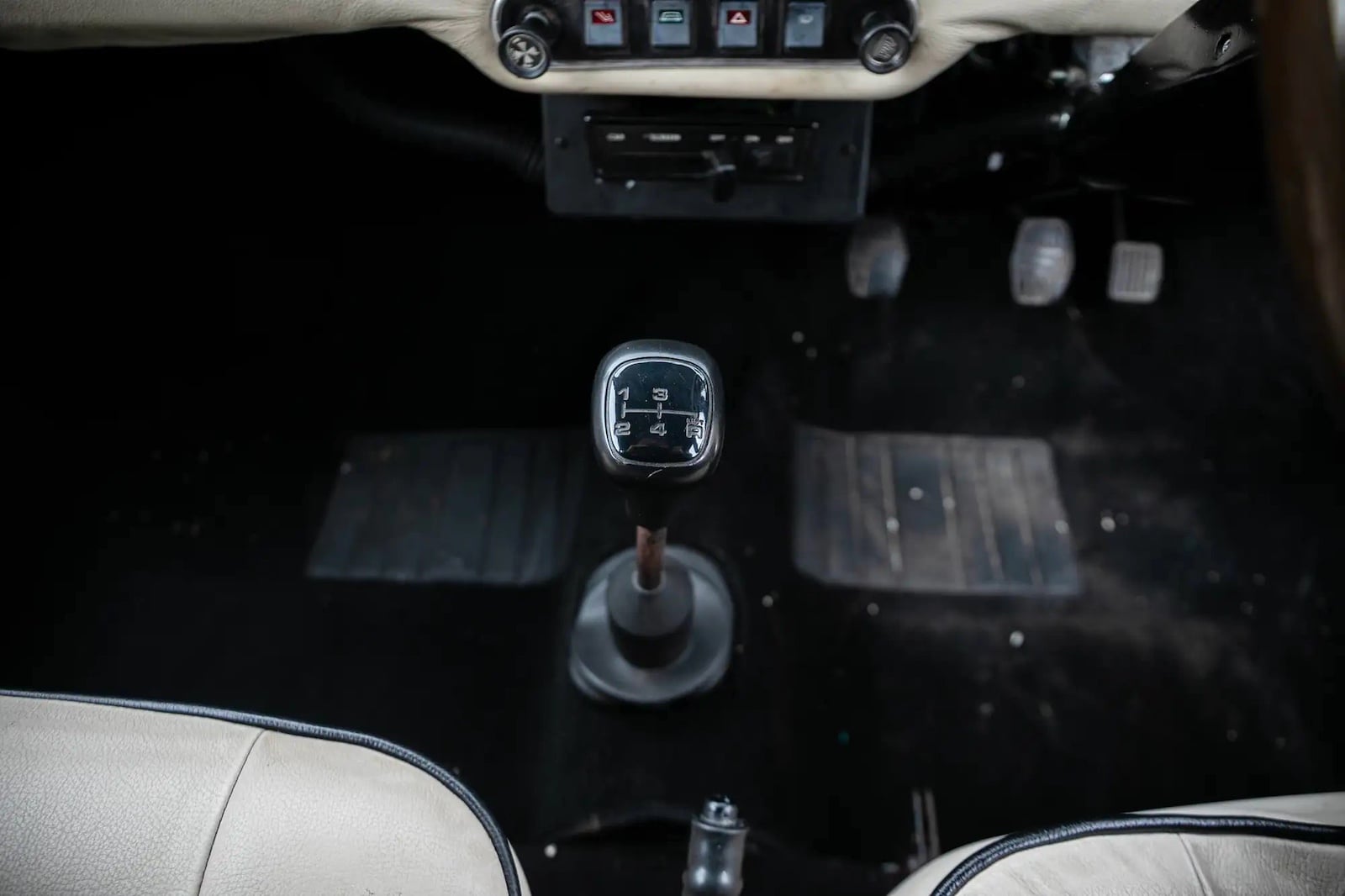
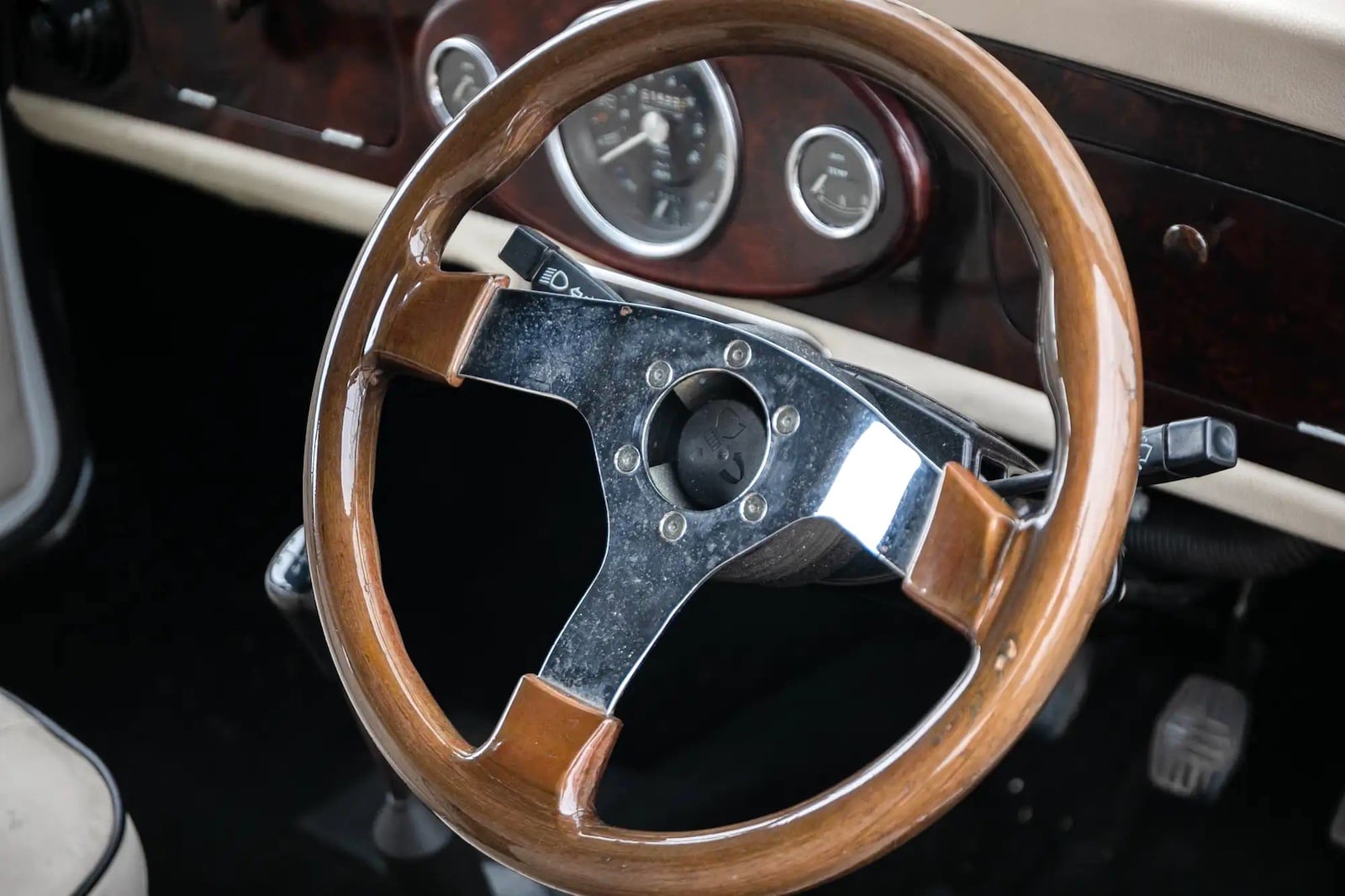
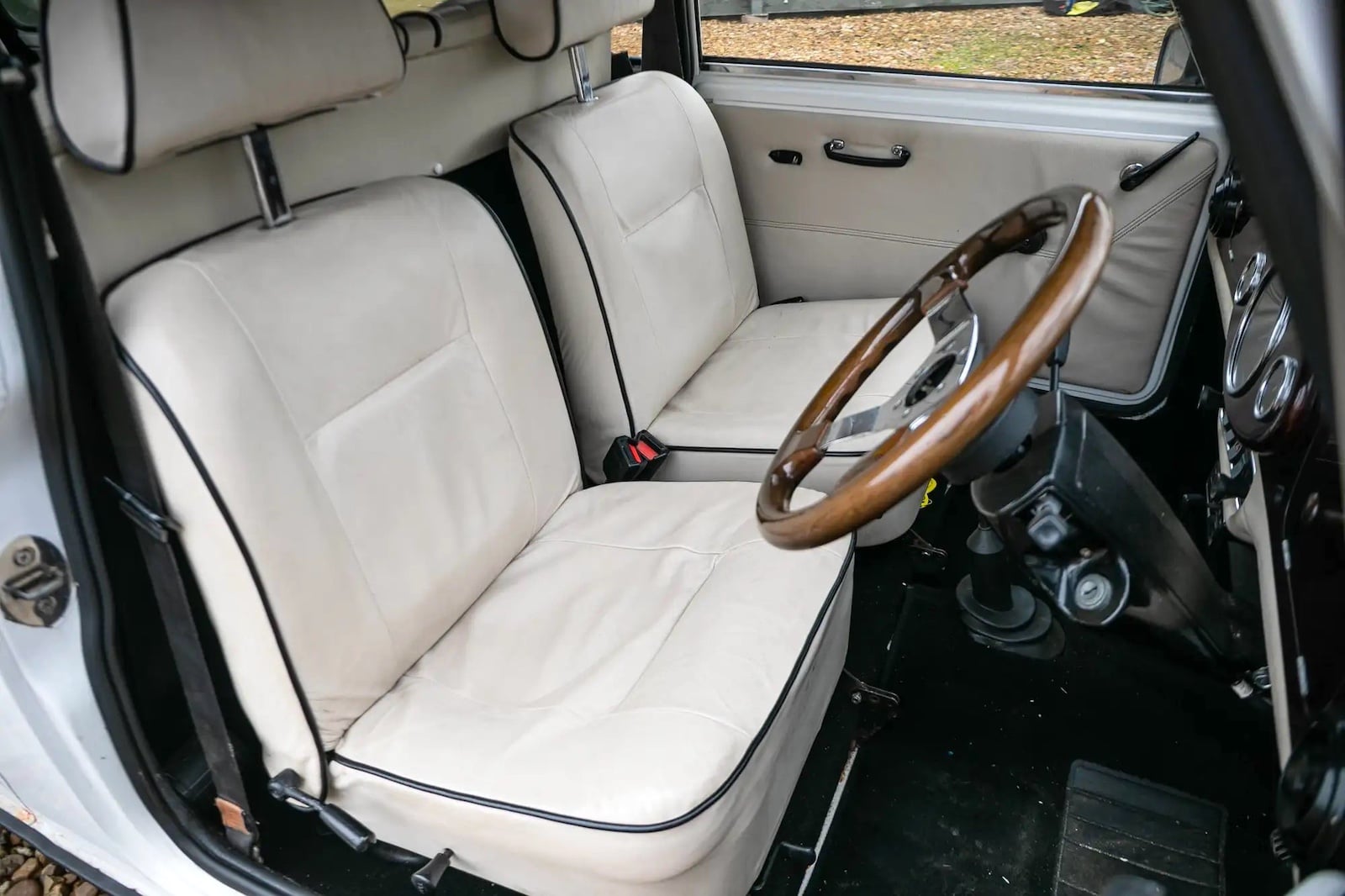
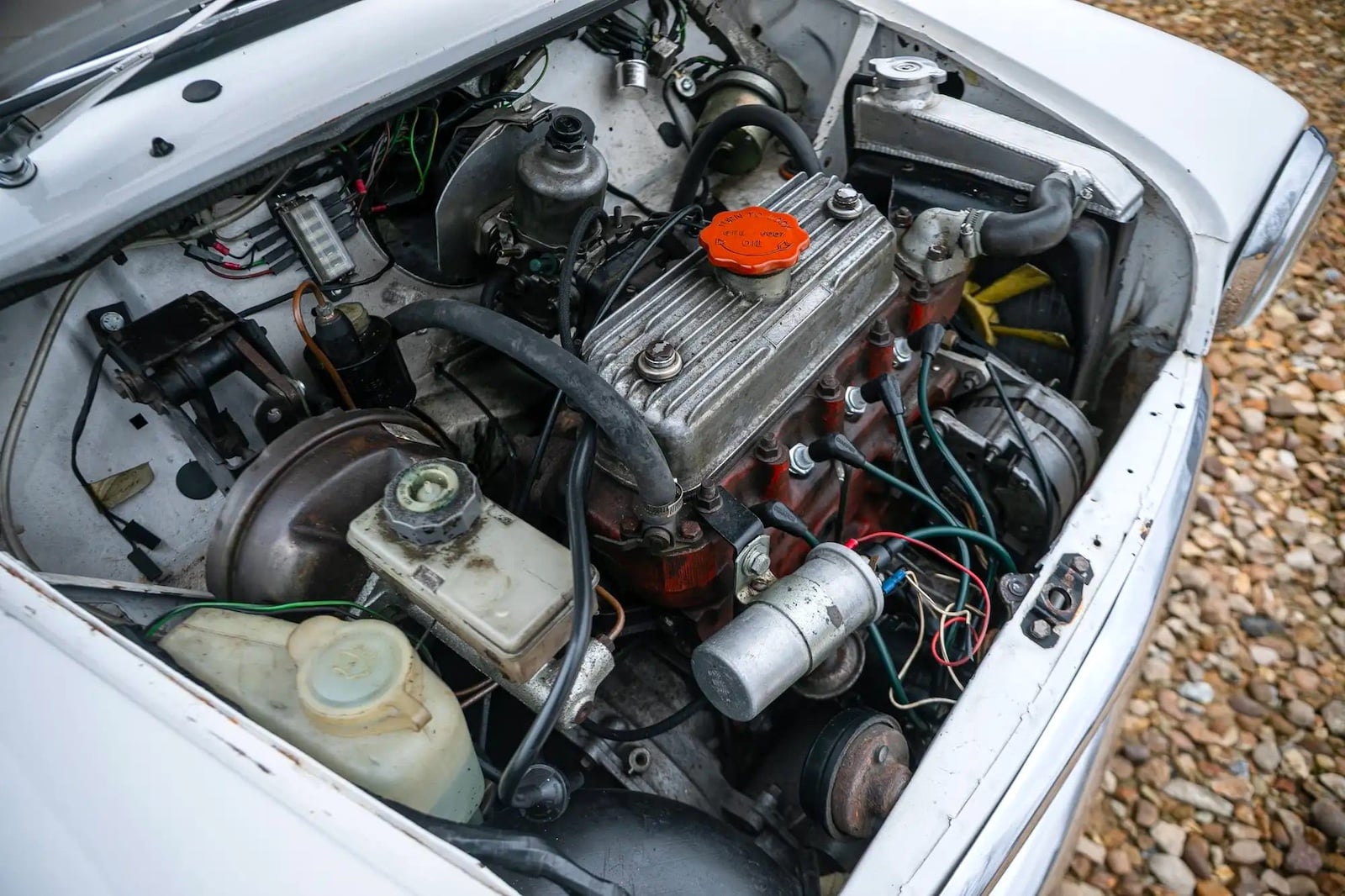
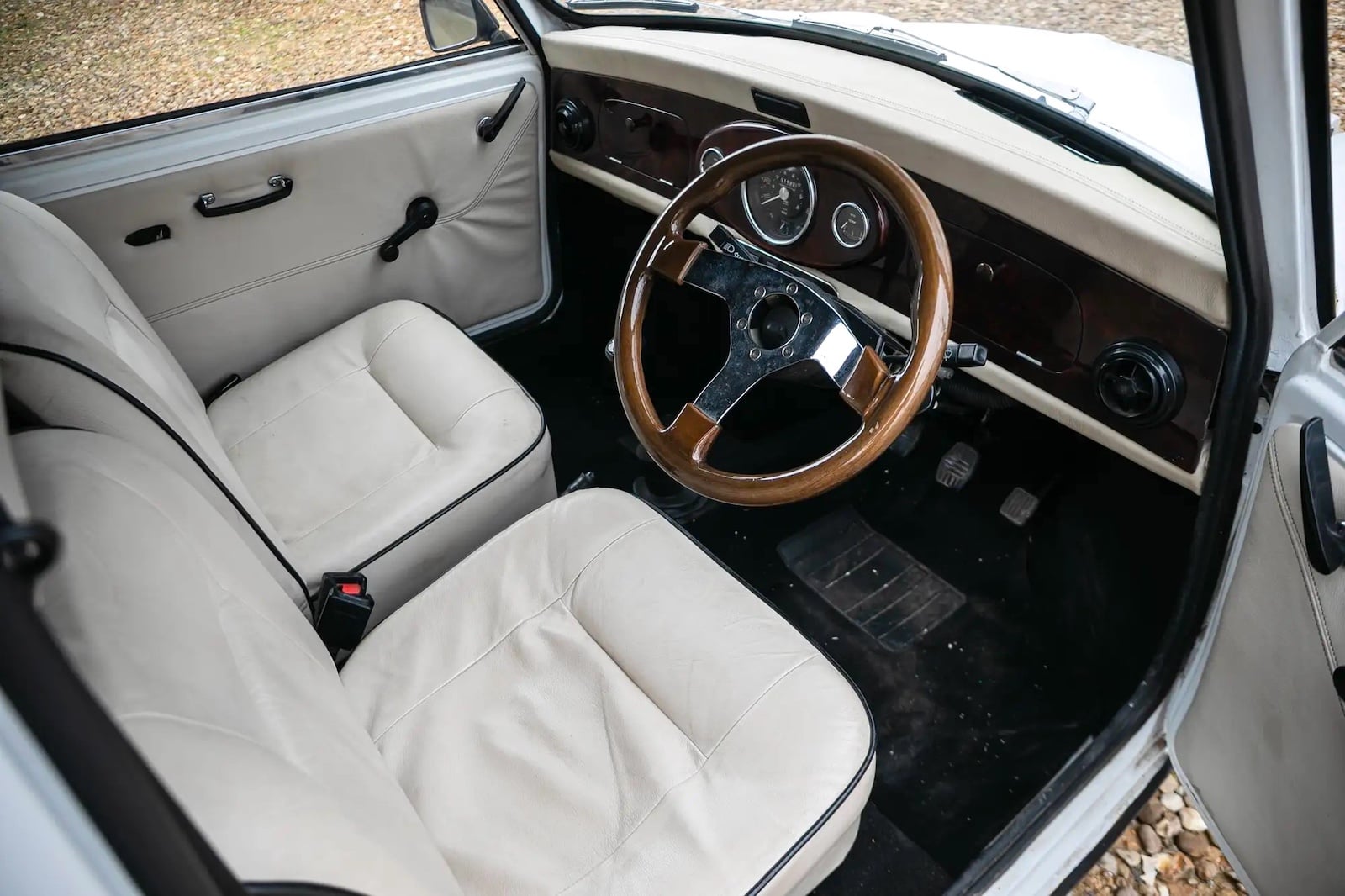
The 1,275cc version of the A-Series engine was chosen as it was the most powerful factory option, and it was paired with the standard 4-speed manual transmission. Inside the car you’ll find white vinyl upholstery throughout, with black carpeting, white door cards, and a wood-rimmed steering wheel.
The car is now due to roll across the auction block with Iconic Auctioneers on the 21st of March with a price guide of £8,000 – £10,000, that’s approximately $10,685 – $13,357 USD. If you’d like to read more or register to bid you can visit the listing here.
Images courtesy of Iconic Auctioneers

Articles that Ben Branch has written have been covered on CNN, Popular Mechanics, Smithsonian Magazine, Road & Track Magazine, the official Pinterest blog, the official eBay Motors blog, BuzzFeed, Autoweek Magazine, Wired Magazine, Autoblog, Gear Patrol, Jalopnik, The Verge, and many more.
Silodrome was founded by Ben back in 2010, in the years since the site has grown to become a world leader in the alternative and vintage motoring sector, with well over a million monthly readers from around the world and many hundreds of thousands of followers on social media.