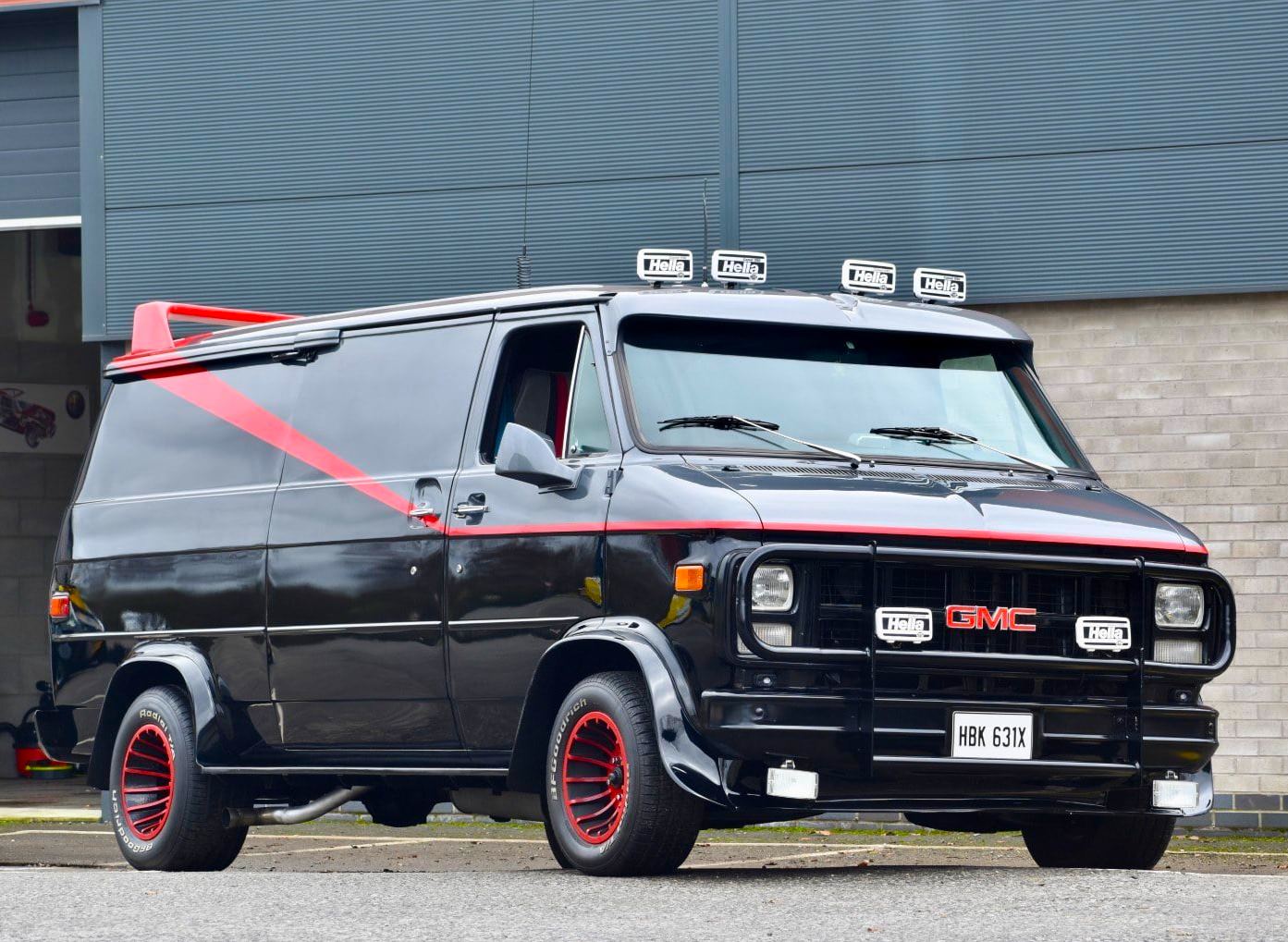
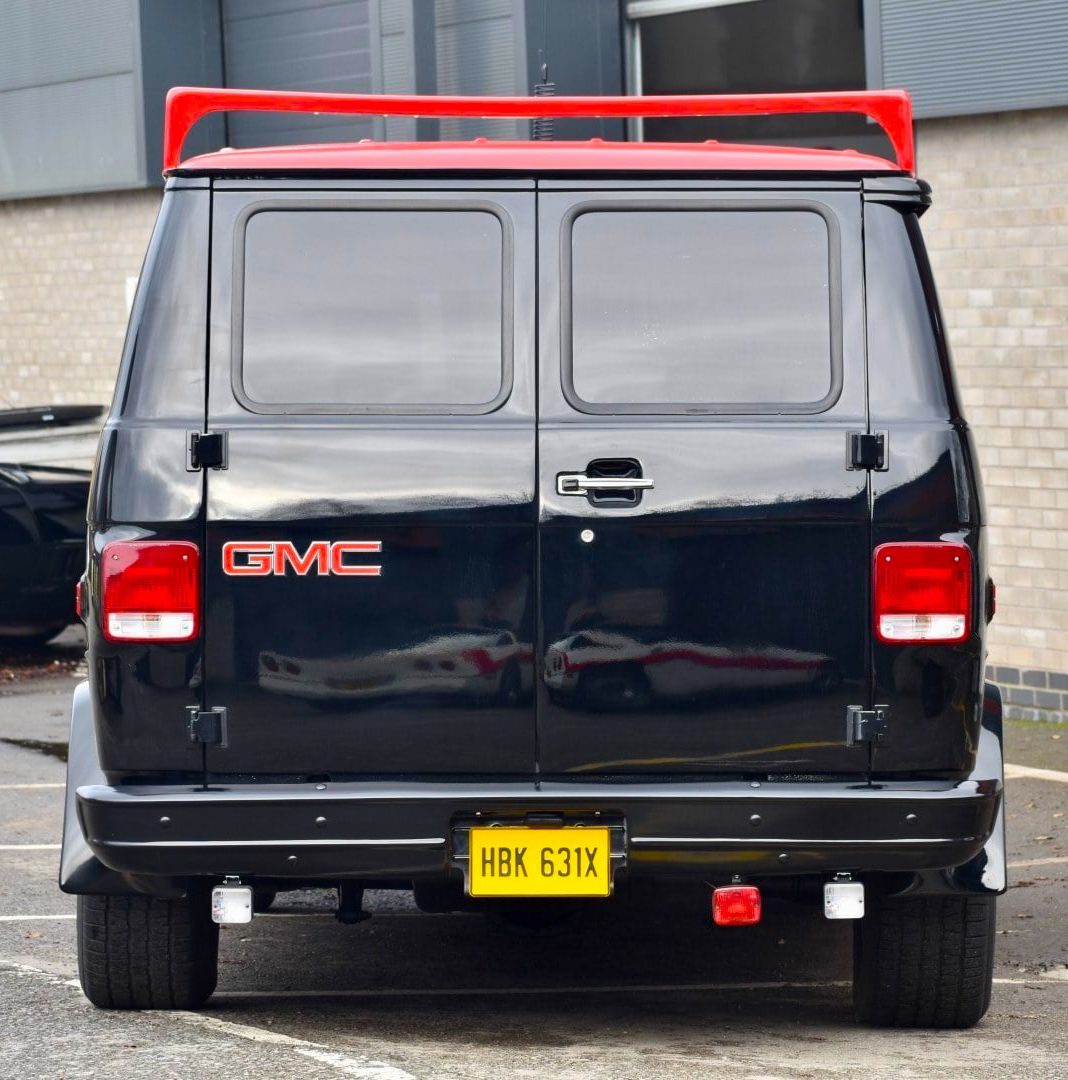
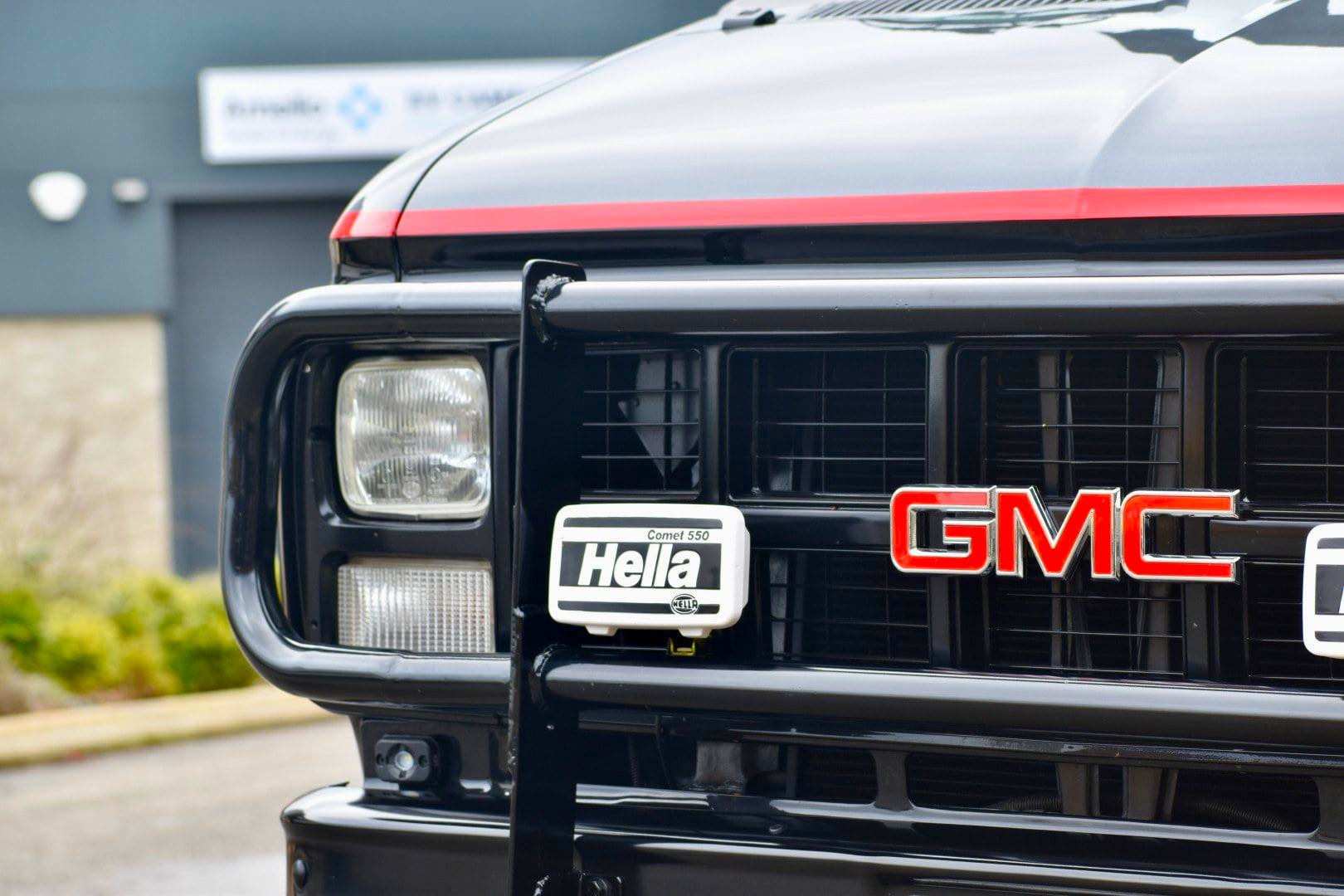
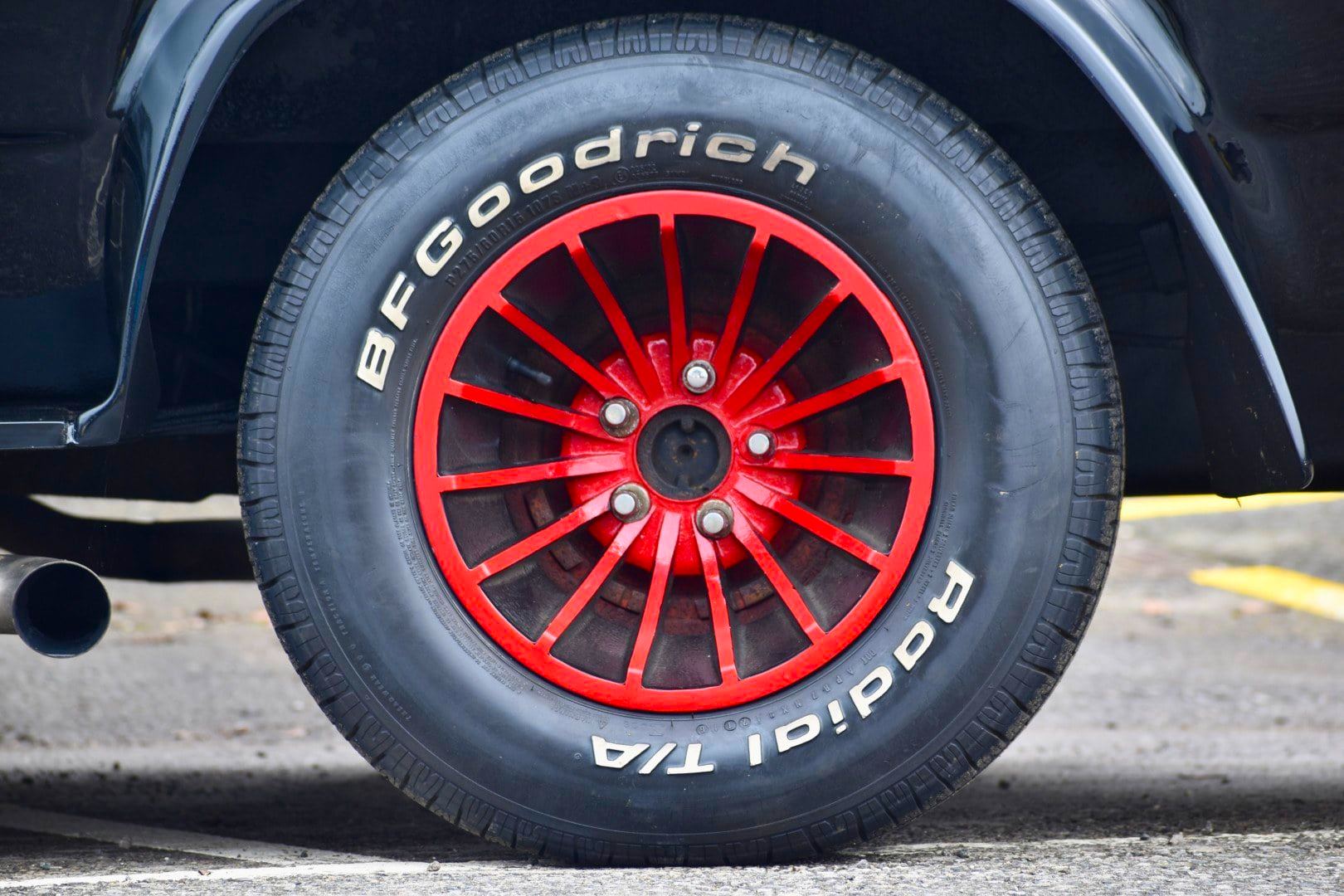
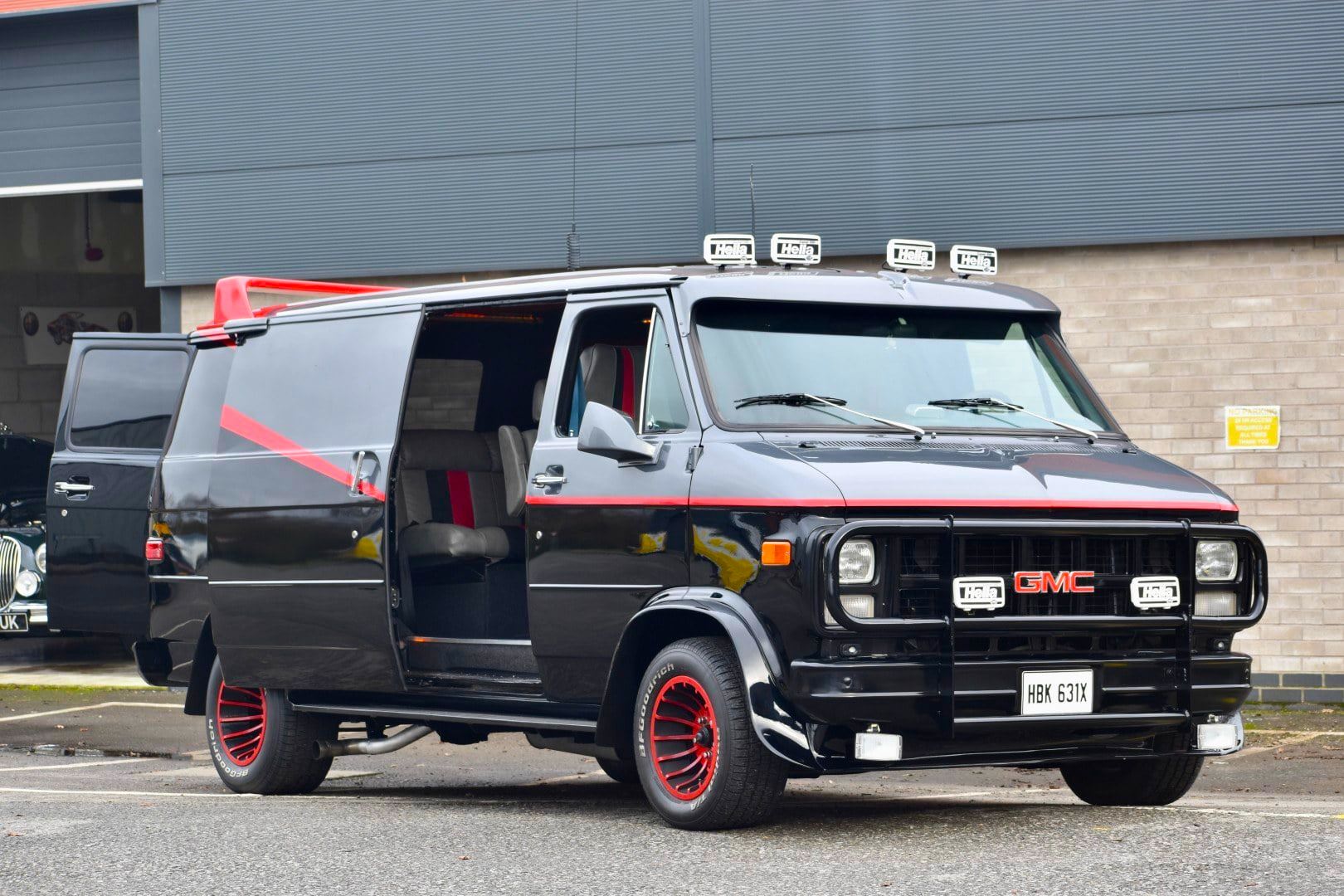
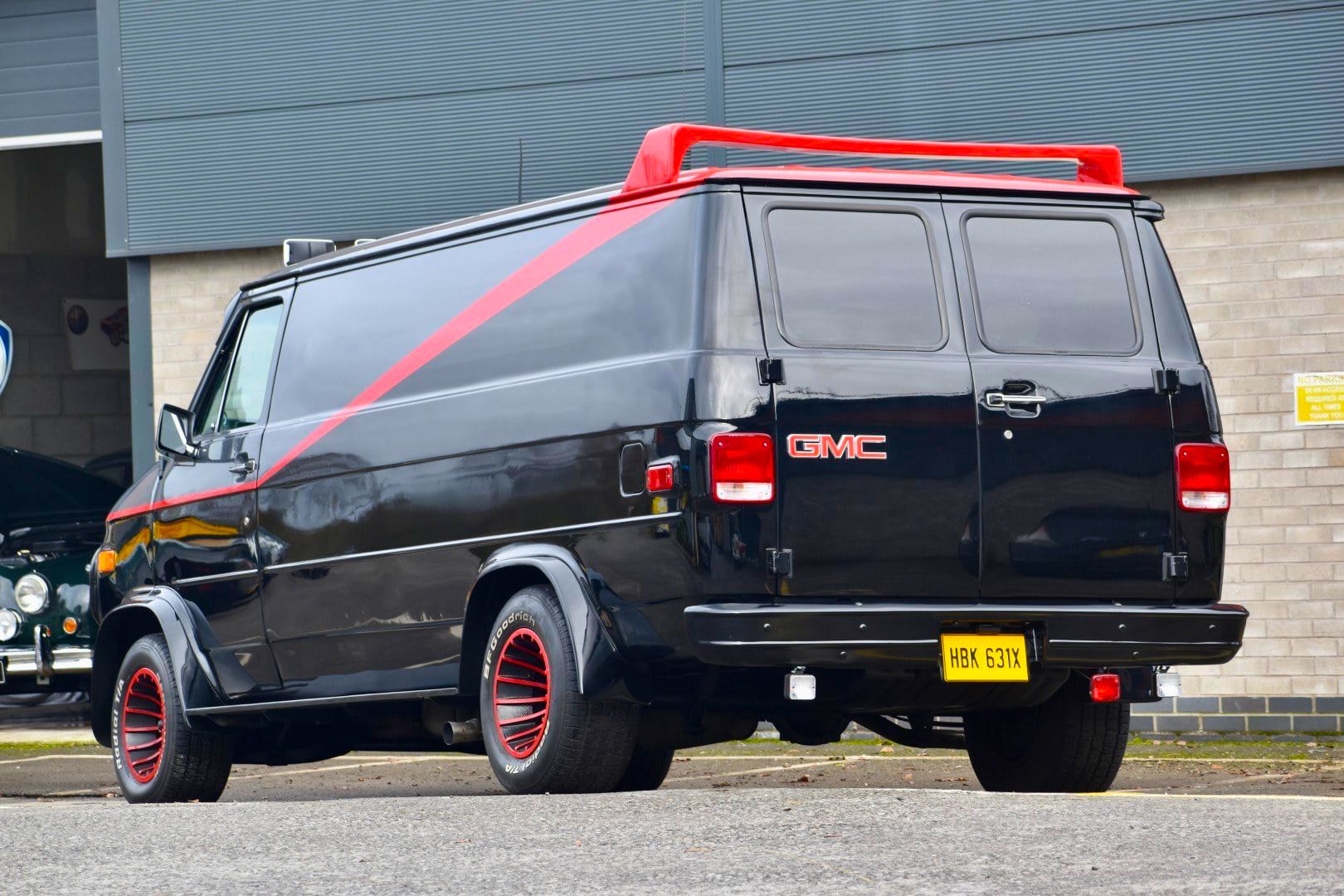
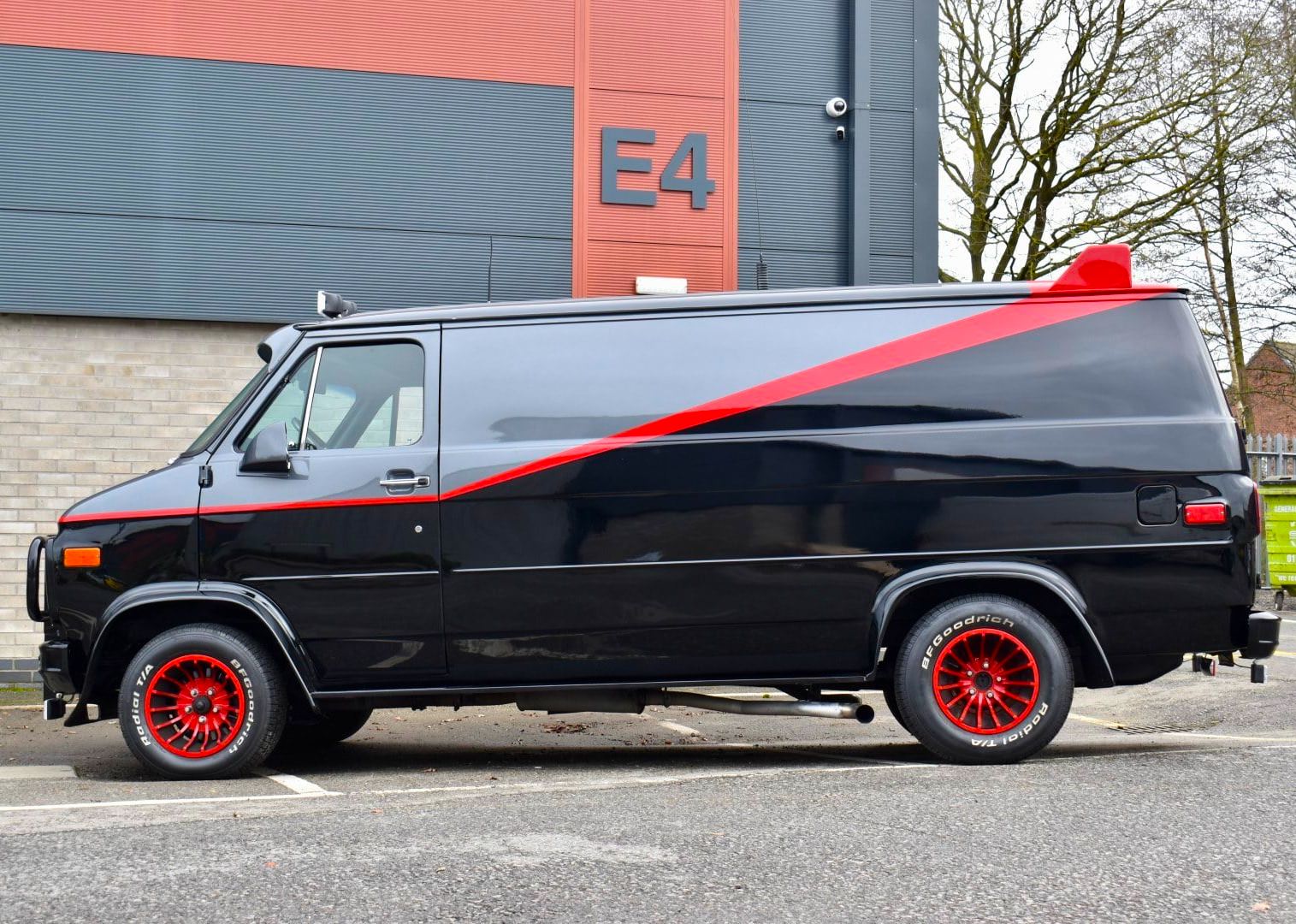
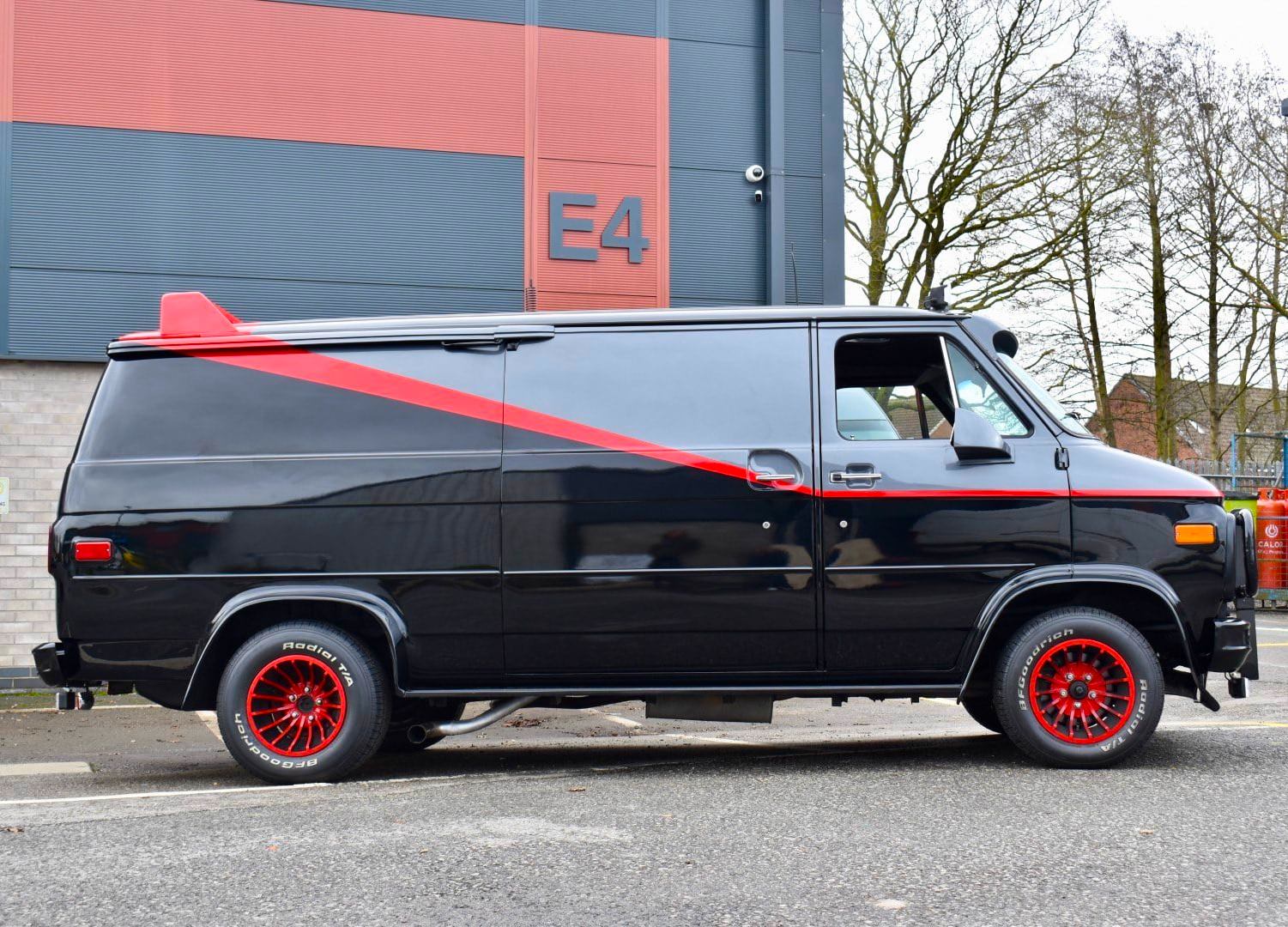
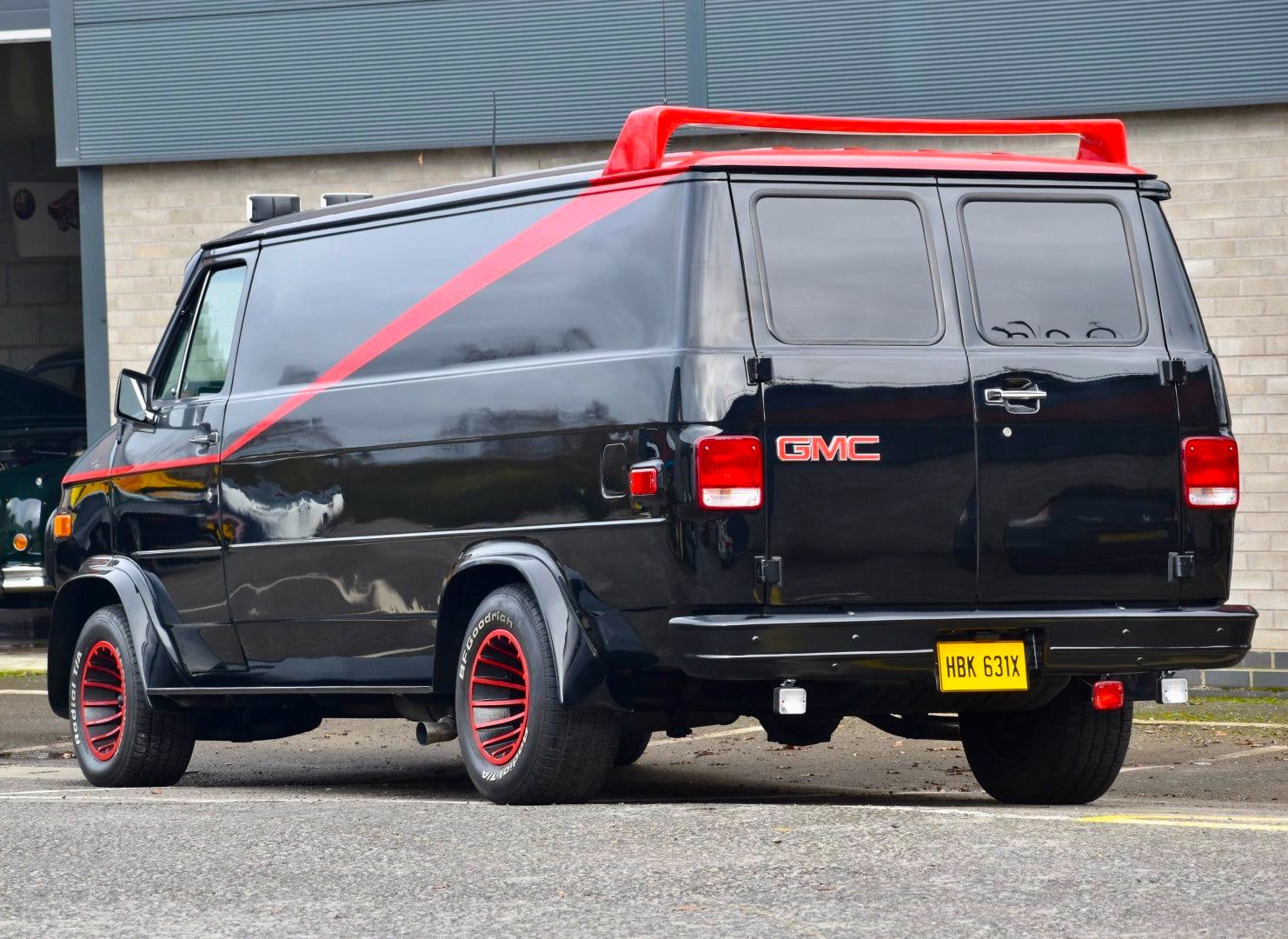
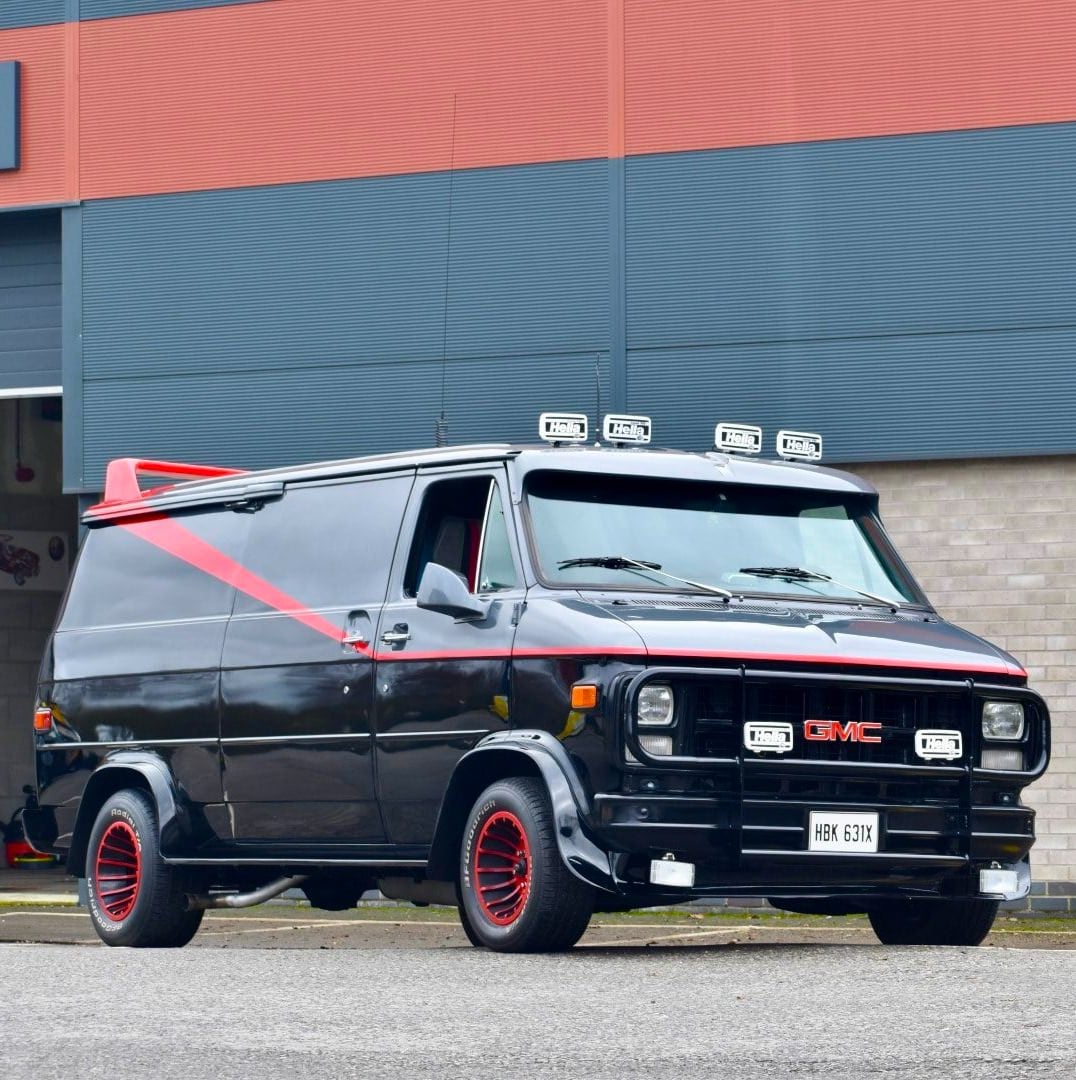
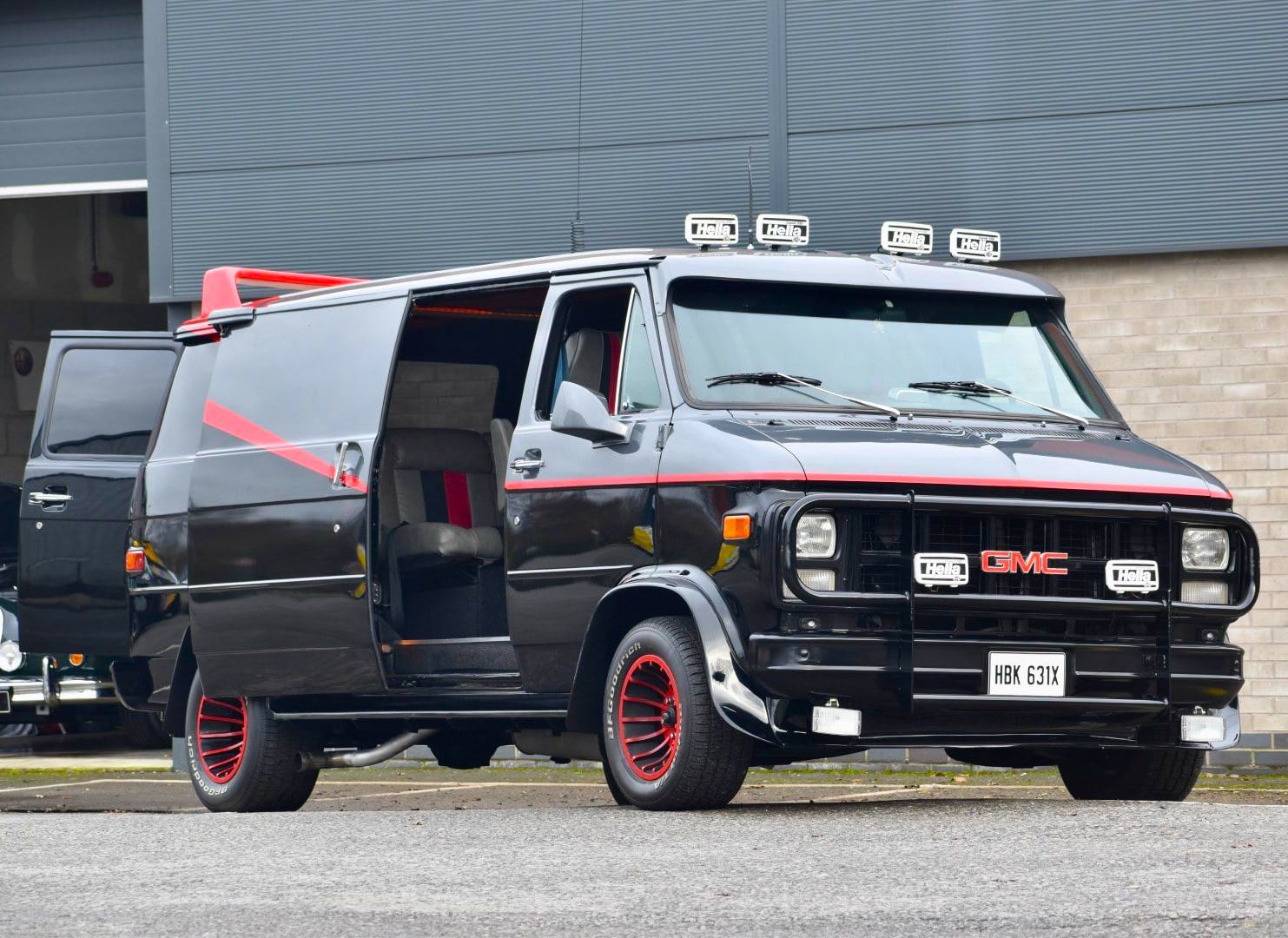
This is a 1981 GMC Vandura powered by a 5.0 liter V8. It was recently restored to a cost of over $20,000 USD, and it’s now finished in “A-Team” specification, with the classic paint job, roof spoiler, bull bar, red hurricane wheels, and spotlights.
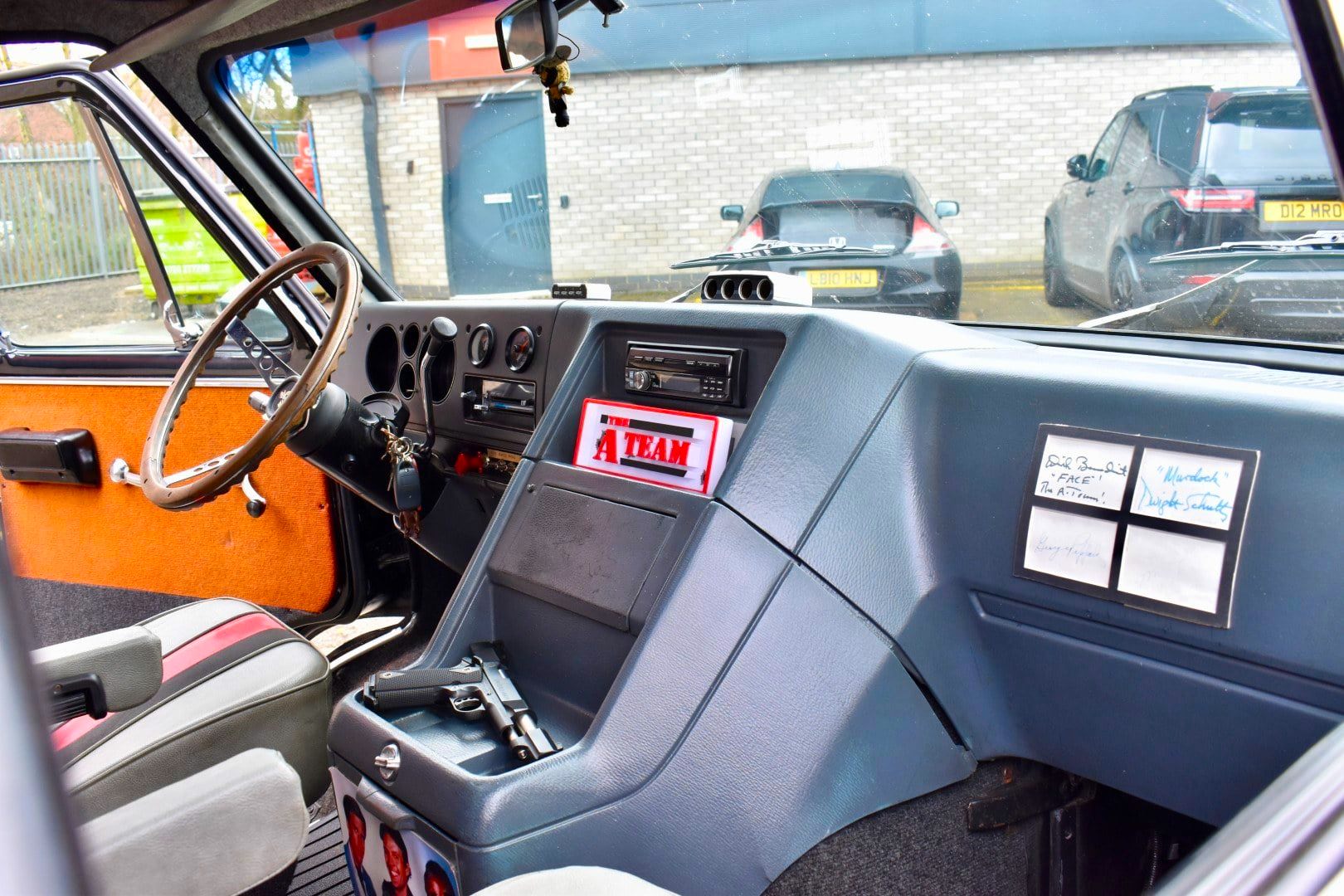
The van is now being sold in original left-hand drive configuration out of England, it comes with a stack of A-Team memorabilia, and just 55,486 miles on the odometer which are believed to be original. It’s the best replica of the famous 80s van we’ve seen come up for sale in quite some time, and it even has autographs from the original cast on the dash.
Fast Facts: An “A-Team” Spec GMC Vandura
- The 1981 GMC Vandura shown here is a left-hand drive van restored at a cost of more than $20,000 USD and finished to resemble the famous A-Team van. It has the familiar grey-and-black paint, red striping, roof spoiler, bull bar, spotlights, red wheels, A-Team memorabilia, and an odometer reading of 55,486 miles.
- The Vandura belonged to GMC’s long-running G-Series van family, which evolved from the cab-forward Handi-Van and Handi-Bus of the 1960s into the better-known third-generation models introduced for 1971. That redesign moved the engine ahead of the driver under a short hood and stayed in production through 1996.
- Over its long production life, the third-generation Vandura was sold in 1500, 2500, and 3500 forms with a wide spread of engines, transmissions, and related body styles. Passenger and commercial variants helped make it a common base for custom vans, camper conversions, and work vehicles throughout the 1970s and 1980s.
- The Vandura became a pop-culture icon through “The A-Team,” where a customized 1983 example driven by B.A. Baracus became one of television’s most recognizable vehicles. This specific van is a replica rather than an original screen-used vehicle, powered by a 5.0 liter V8 and a THM350 automatic, and offered for sale in England.
History Speedrun: The GMC Vandura
The GMC Vandura was part of the General Motors G-Series van platform, which ran for three generations between 1964 and 1996. While the G-Series platform dates all the way back to 1964, the Vandura nameplate was not introduced until 1971 – the earlier generations were sold as the Handi-Van and Handi-Bus. The Vandura was GMC’s direct counterpart to the Chevrolet Chevy Van, they were mechanically identical in most respects, but sold through GMC’s dealer network under its own branding and badging.
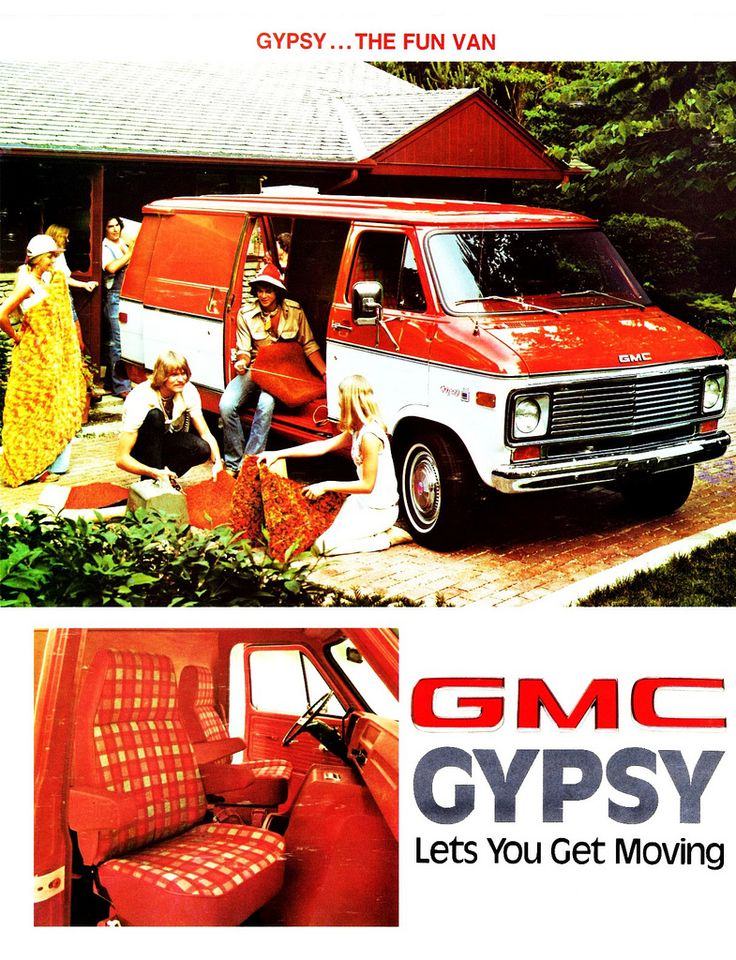
 Beyond the base cargo van, GMC offered several related models on the same underlying platform. The Rally was the passenger van variant, produced across multiple trim levels including the Rally Custom and Rally STX. The Gypsy was a two-passenger package intended as a starting point for owner customization. Image courtesy of GMC.
The first generation of the GMC G-Series van was offered from 1964 to 1966, it used a cab-forward layout with the engine mounted between and behind the front seats, a design common at the time among competitors like the Ford Econoline and Dodge A100. GMC sold this version as the Handi-Van (the cargo version) and Handi-Bus (the passenger variant). These were pretty basic vehicles, with no available power steering, power brakes, or factory air conditioning, and rear windows were offered only as an option.
The second generation, sold from 1967 to 1970, brought a more modern curved windshield, a longer available wheelbase of 108 inches alongside the standard 90 inch option, and optional V8 engines, which required a larger front grille for better cooling.
The Vandura Officially Debuts
The third generation arrived in 1971 and would remain in production for 25 years, making it one of the longest-running vehicle platforms in GM’s long and storied history. This redesign moved the engine forward of the driver under a short hood, abandoning the cab-over layout entirely.
The new architecture used unibody construction, integrating the frame rails into the floorpan, with truck-derived hubs, brakes, and suspension parts sourced from the Chevrolet C/K pickup truck line. It was also in 1971 that GMC first applied the Vandura name to its G-Series cargo vans. From 1977 to 1982, the badge was stylized as VANdura.
The third-gen Vandura was offered in three main payload classifications that mirrored the classifications used on the C/K pickups – the 1500 (half-ton), 2500 (three-quarter-ton), and 3500 (one-ton). Engine choices widened considerably over the model’s 25 year run, ultimately spanning a range from a 4.1 liter inline six to a 7.4 liter big block V8.
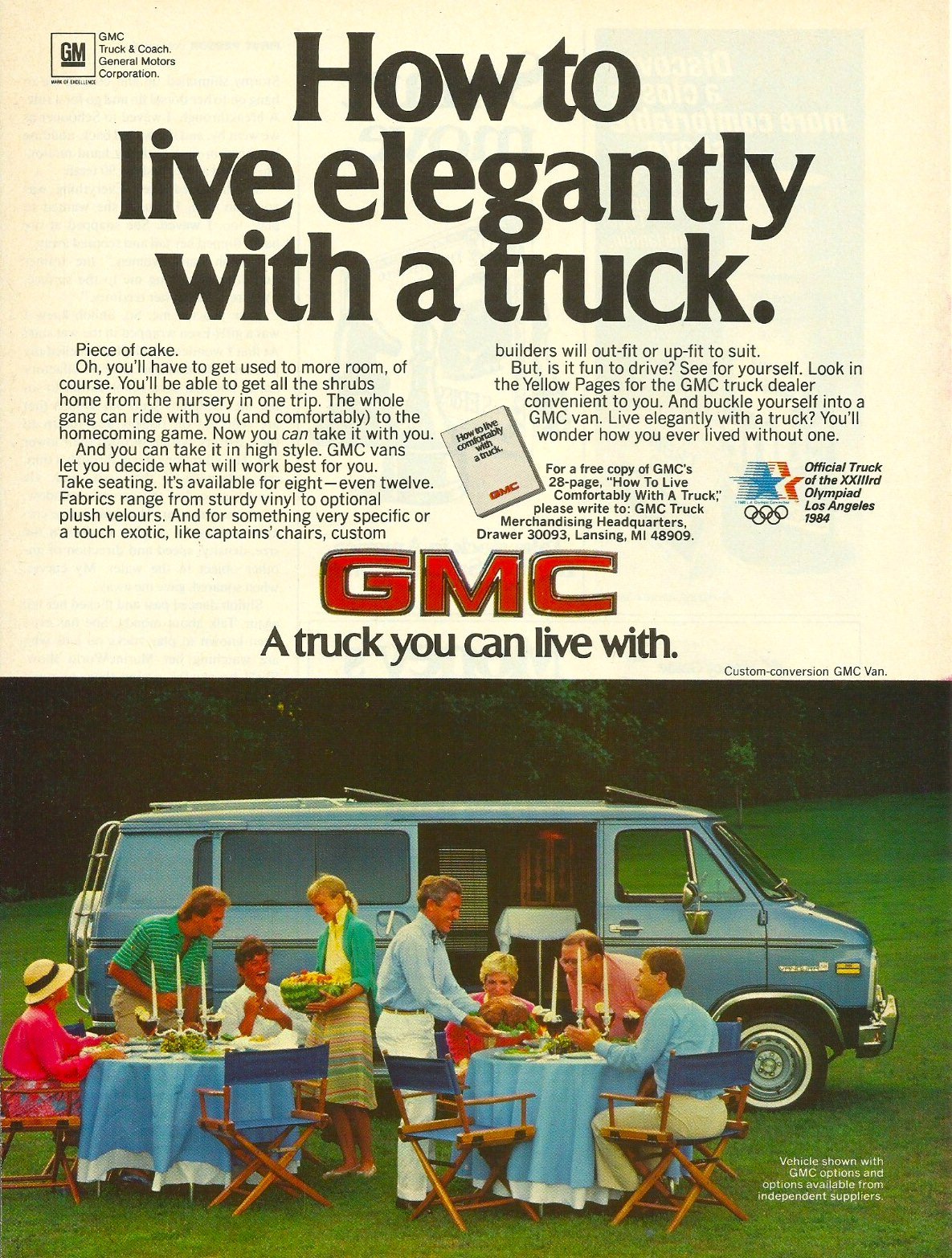
The third generation arrived in 1971 and would remain in production for 25 years, making it one of the longest-running vehicle platforms in GM’s long and storied history. This redesign moved the engine forward of the driver under a short hood, abandoning the cab-over layout entirely. Image courtesy of GMC.
A 6.2 liter diesel V8 became available in 1982, later replaced by an updated 6.5 liter diesel in 1994. Transmission options included three and four-speed manuals (with the shifter relocating from the steering column to the floor in 1983) and automatic units that eventually gained overdrive for improved highway fuel economy, which was particularly important with the big V8s.
Beyond the base cargo van, GMC offered several related models on the same underlying platform. The Rally was the passenger van variant, produced across multiple trim levels including the Rally Custom and Rally STX.
The Gaucho, produced from 1977 to 1981, was a five-passenger configuration that combined passenger-van interior trim with a large rear cargo area finished in wood paneling. The Gypsy was a two-passenger package intended as a starting point for owner customization. Cutaway van chassis for commercial applications were also sold under the Vandura name, but these were offered exclusively in the one-ton series.
The third-gen platform became one of the most popular bases for the conversion van industry that exploded in popularity during the 1970s and well into the 1980s. Companies like Starcraft, Curtis, and Vanguard/Frontier transformed Vanduras into camper vans, mobile lounges, and Class B motorhomes, outfitting them with full custom interiors, fold-out beds, entertainment systems, and even disco balls.
The Vandura And The A-Team
The Vandura’s most important cultural moment came in 1983 with the premiere of The A-Team on NBC. The pilot episode aired on January the 23rd, 1983, with the first regular episode broadcast the following week after Super Bowl XVII on January the 30th.
Above Video: “The A-Team” was a wildly popular TV show, and it’s commonly cited as one of the best shows of the decade.
The A-Team ran for five seasons and 98 episodes through till March the 8th, 1987. The team’s primary vehicle was a 1983 GMC Vandura equipped with a 5.7 liter (350 cubic-inch) V8. The van was customized with a two-tone black and metallic gray exterior, a red stripe extending from the hood line to the rear spoiler, red turbine mag wheels, and auxiliary lights mounted on the front grille and roofline.
It was driven on screen by the character B.A. Baracus, played by Mr. T. The production used multiple Vanduras during filming, at least one with a sunroof for standard shots and another without for stunt work, which did create occasional continuity inconsistencies between scenes. A 2010 feature film adaptation of the series brought plenty of new attention to the van, though the movie version was built on a different, more modern G-Series van from 1994.
GM discontinued the Vandura and the rest of the G-Series line after the 1996 model year, replacing them with the GMT 600-platform GMC Savana and Chevrolet Express. Given the rise in the popularity of the “Van Life” movement and the enduring popularity of The A-Team, good-condition, third-gen Vanduras tend to fetch a premium over other vans from the era.
The 1981 “A-Team” Spec GMC Vandura Shown Here
This 1981 GMC Vandura has been modified into an A-Team replica after going through a £15,000 bare metal restoration that the seller describes as museum quality. This van was first registered in January of 1982, it’s covered 55,486 miles, and it was bought by its current owner (and now seller) in October of 2016.
It’s powered by a 5.0 liter V8 paired with a THM350 3-speed automatic transmission, it weighs 1,940 kgs (4,277 lbs), and it remains left-hand drive.
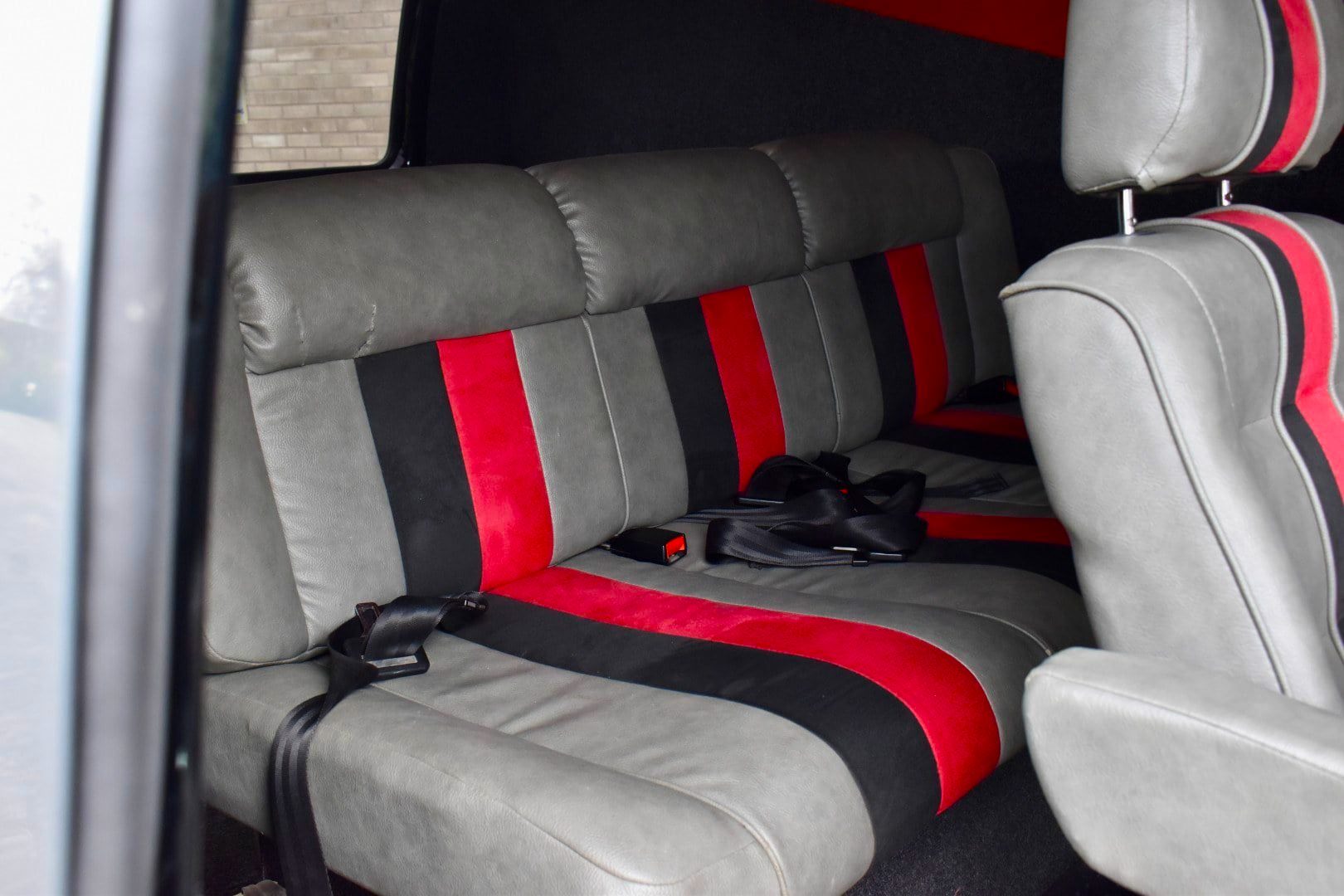
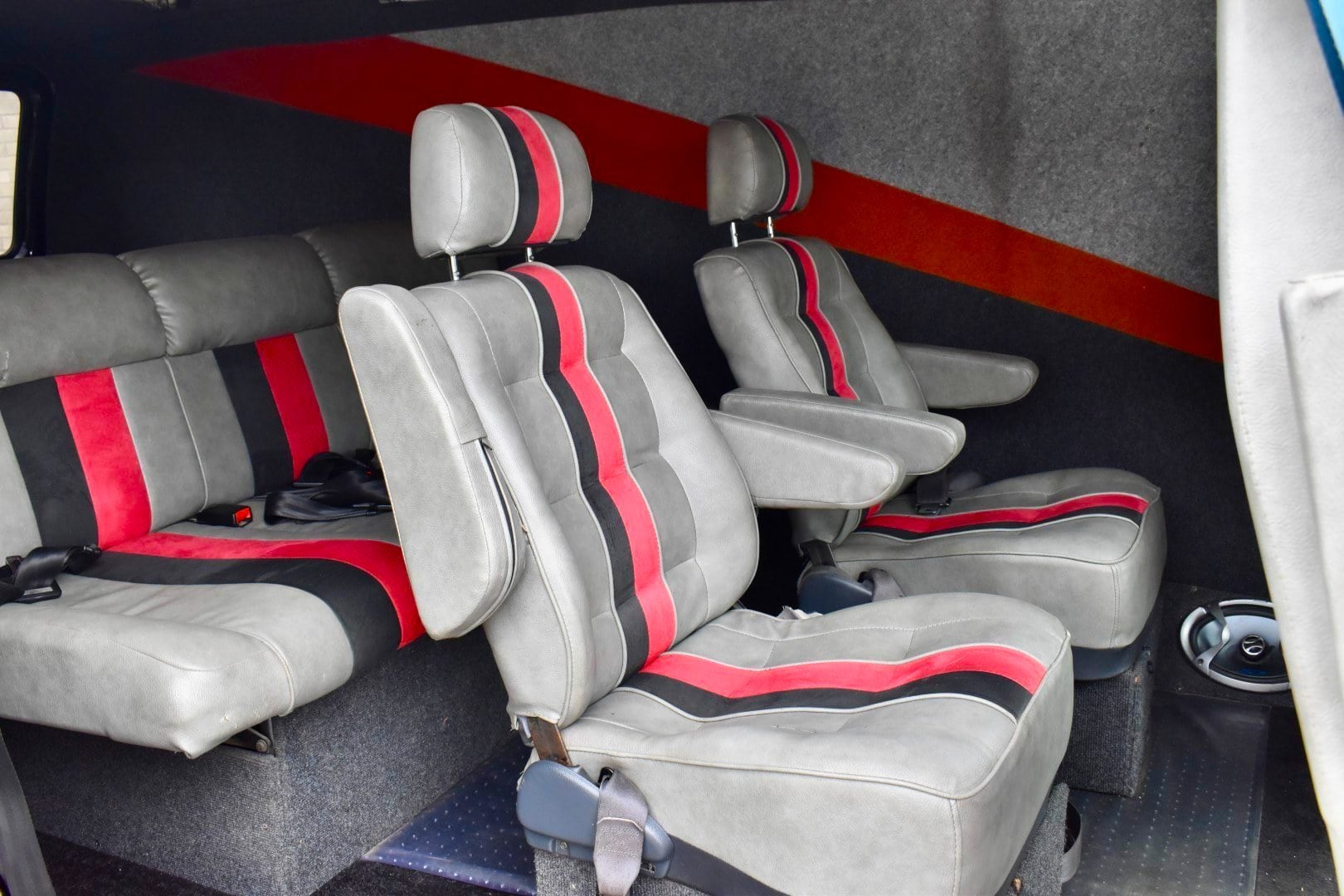
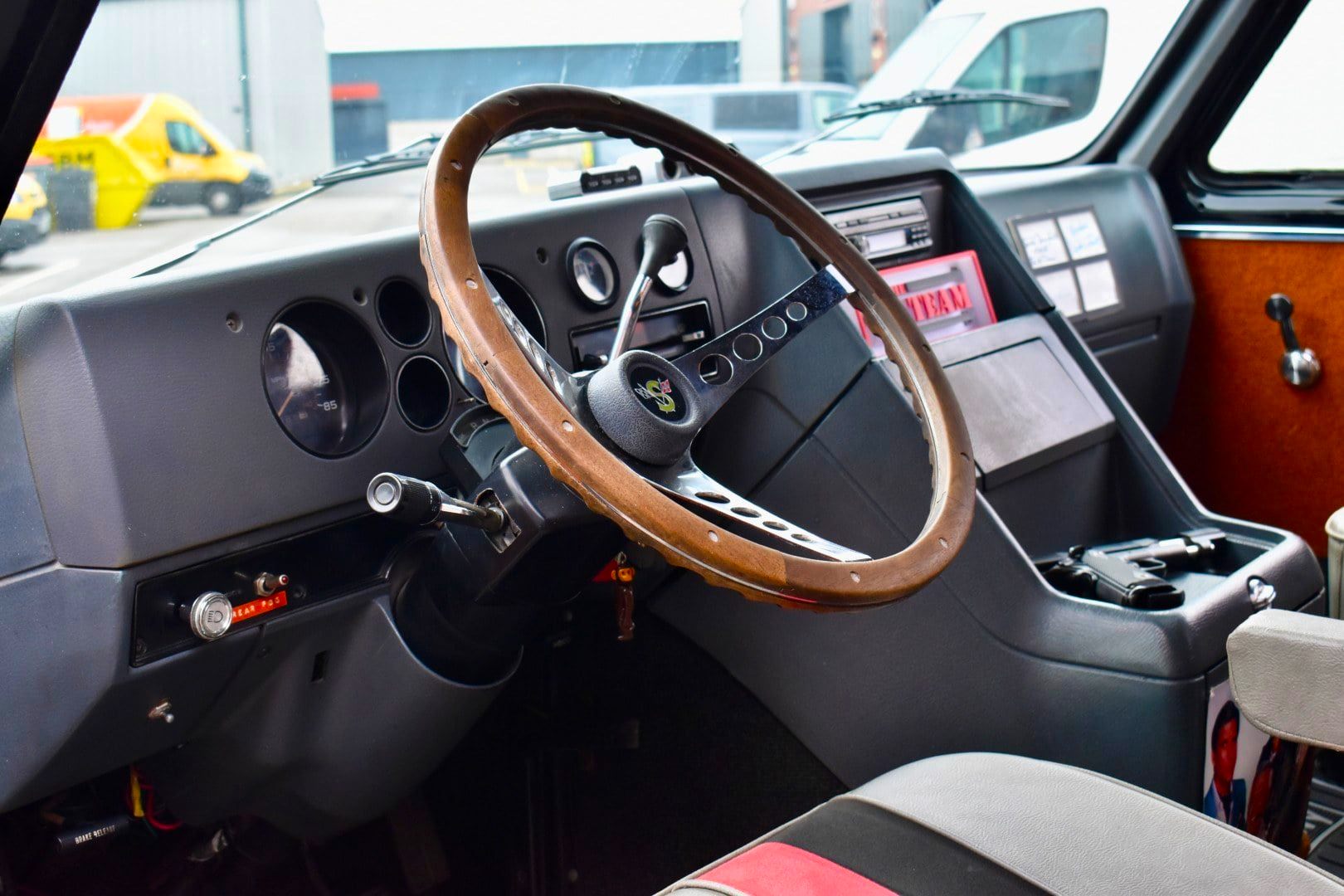
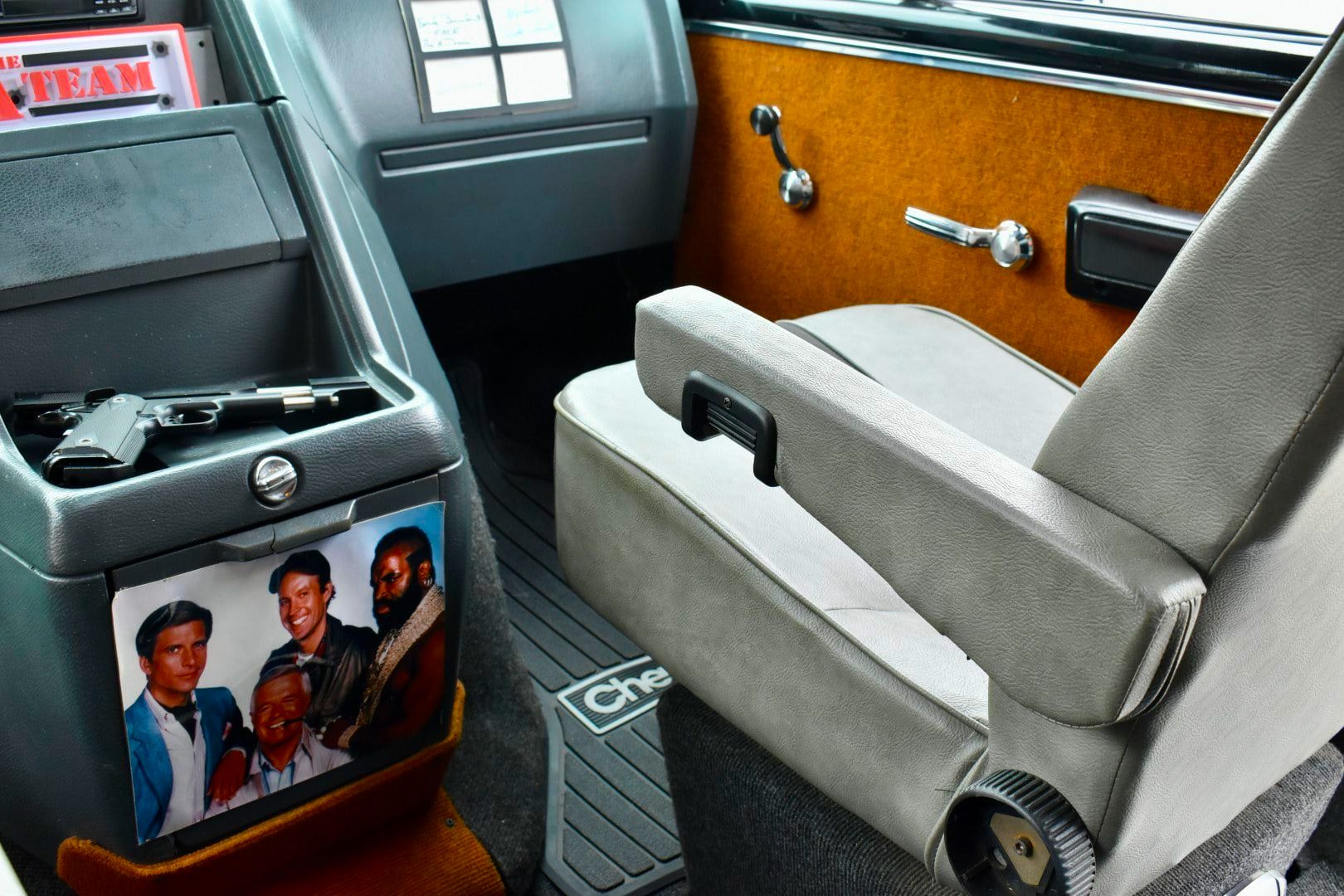
The van’s exterior is finished in the signature “A-Team” gray-over-black paintwork with red striping and it rides on red 15 inch wheels with BFGoodrich tires. Inside, the van seats seven on grey, black, and red leatherette upholstery, and has a sunroof, a wood and chrome steering wheel, original switchgear, and a single-DIN stereo. The seller notes in the listing that both the engine bay and underside present tidily for their age.
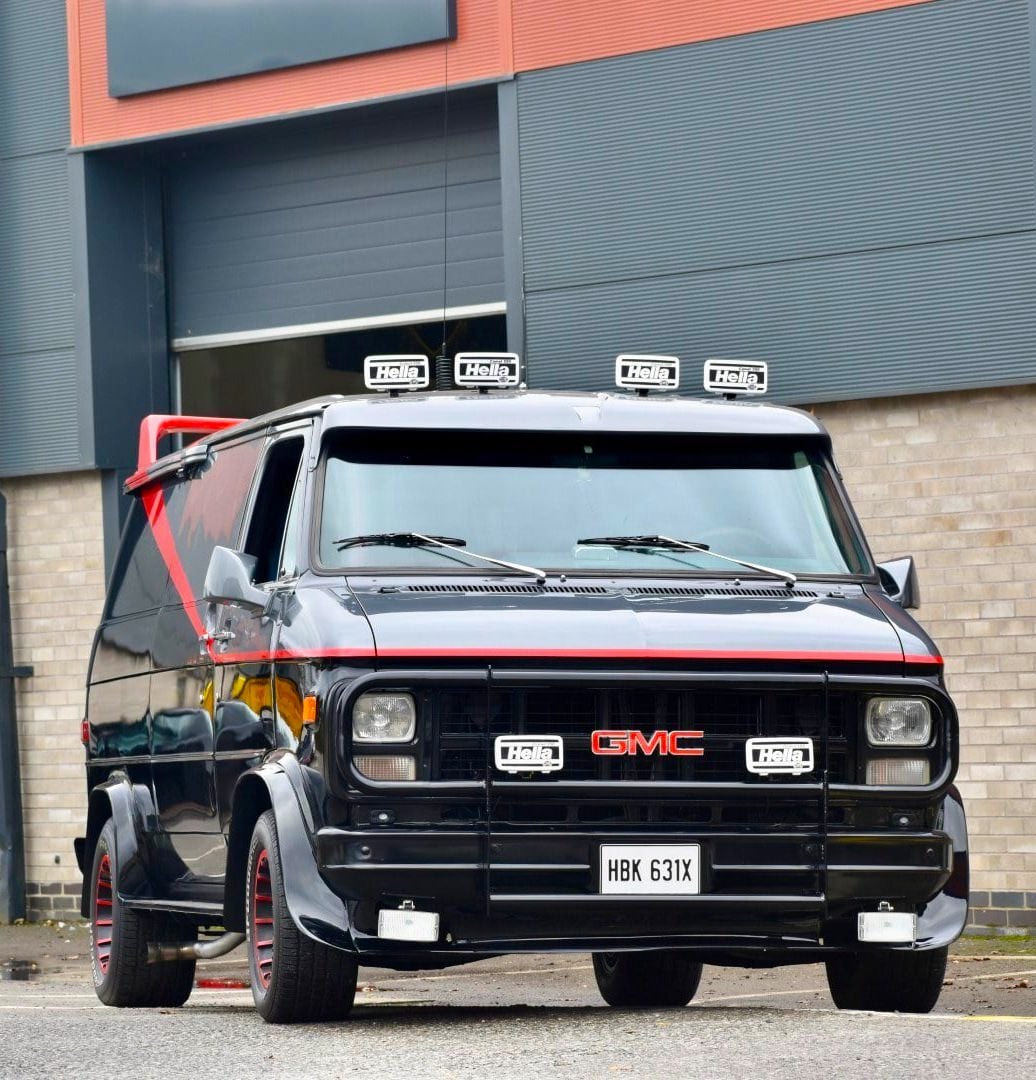
This 1981 GMC Vandura has been modified into an A-Team replica after going through a £15,000 bare metal restoration that the seller describes as museum quality. This van was first registered in January of 1982, it’s covered 55,486 miles, and it was bought by its current owner (and now seller) in October of 2016.
The van comes with A-Team memorabilia including a prop handgun, a members photo, a signed plaque, and a California-style A-Team registration plate. Being tax and MOT exempt in the UK, it had a last clean, advisory-free MOT in August of 2025.
It’s now bering offered for sale on Car & Classic out of Lincolnshire, England and you can visit the listing here if you’d like to read more about it or register to bid.
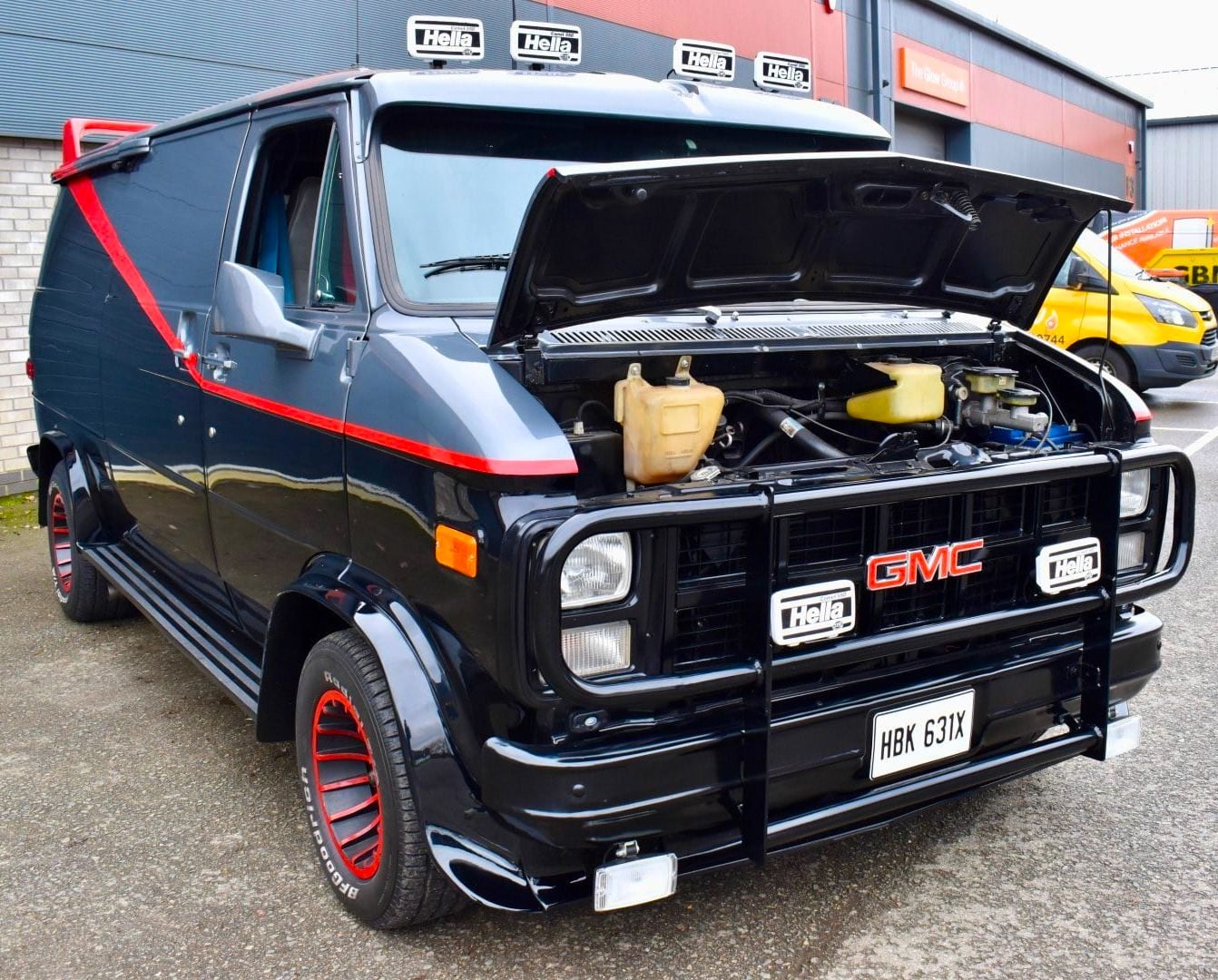
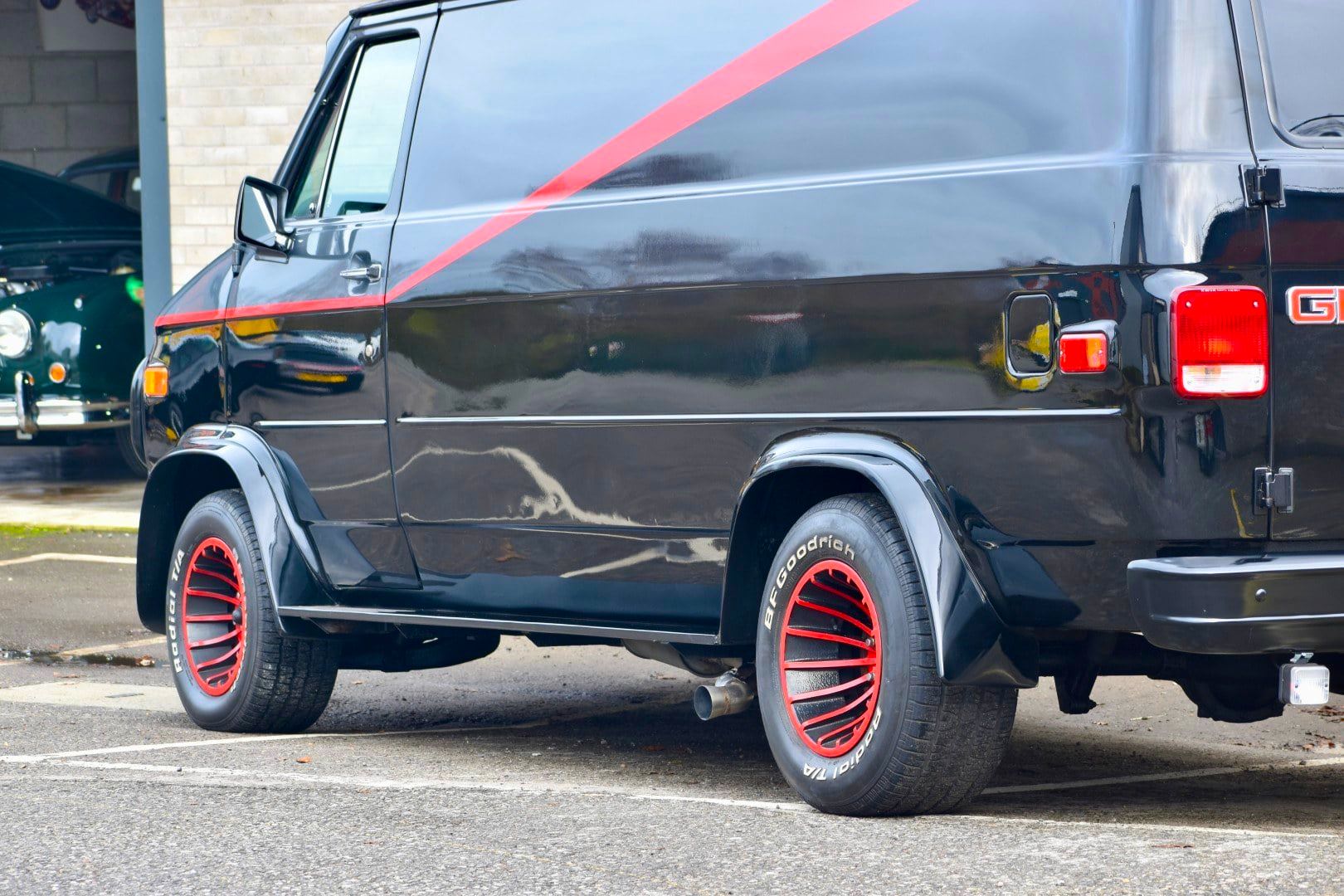
Images courtesy of Car & Classic

Articles that Ben Branch has written have been covered on CNN, Popular Mechanics, Smithsonian Magazine, Road & Track Magazine, the official Pinterest blog, the official eBay Motors blog, BuzzFeed, Autoweek Magazine, Wired Magazine, Autoblog, Gear Patrol, Jalopnik, The Verge, and many more.
Silodrome was founded by Ben back in 2010, in the years since the site has grown to become a world leader in the alternative and vintage motoring sector, with well over a million monthly readers from around the world and many hundreds of thousands of followers on social media.