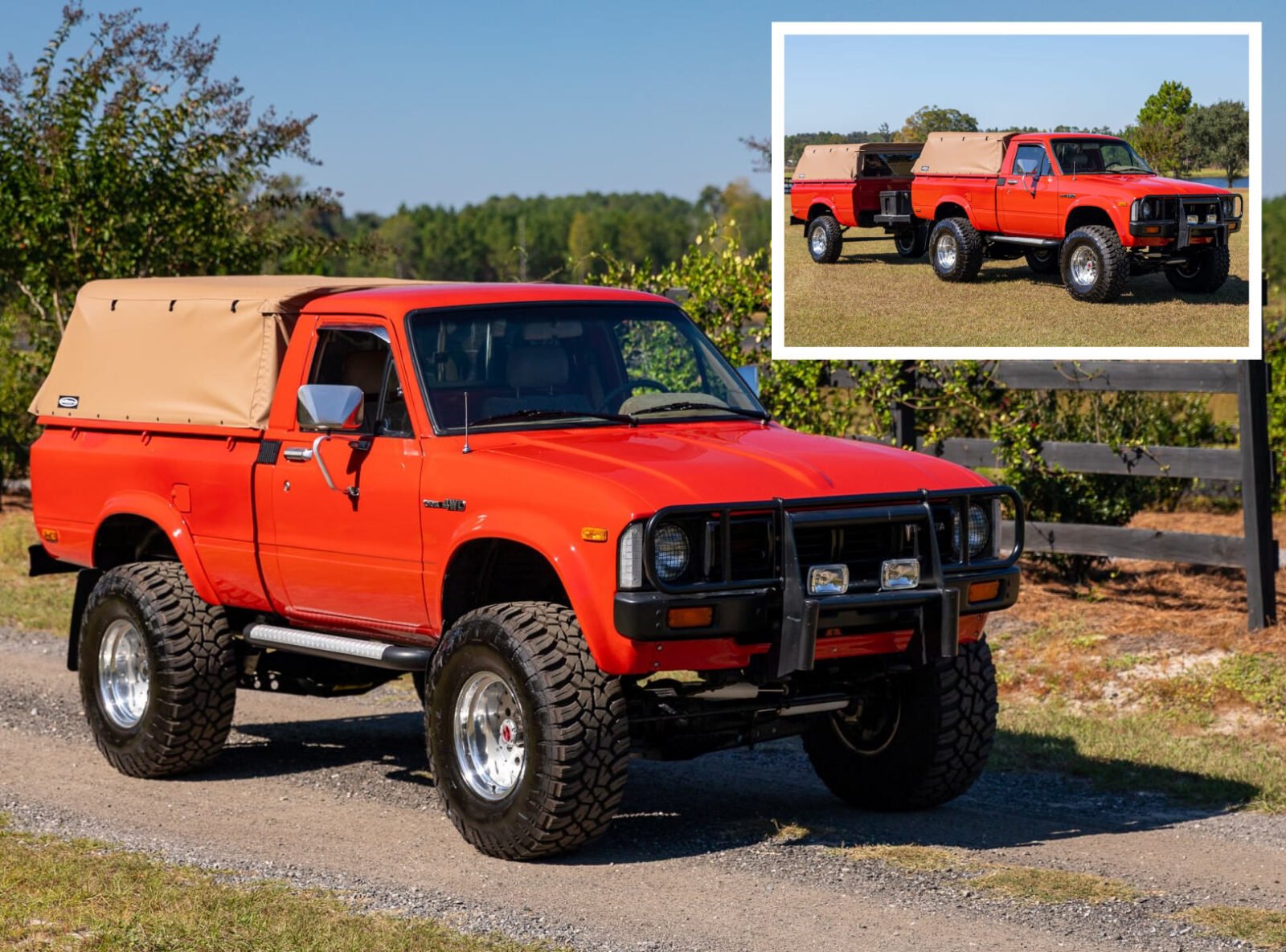
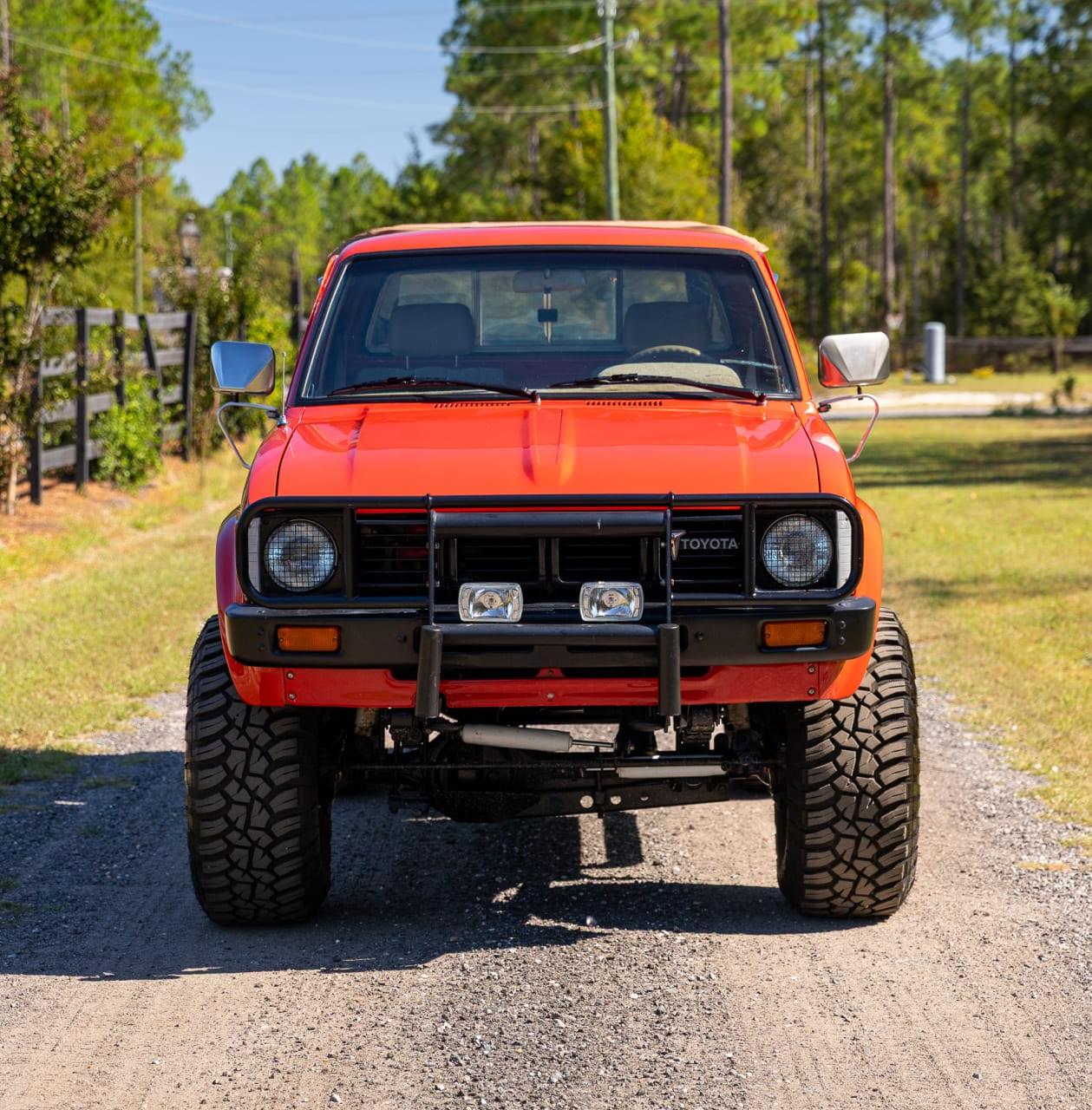
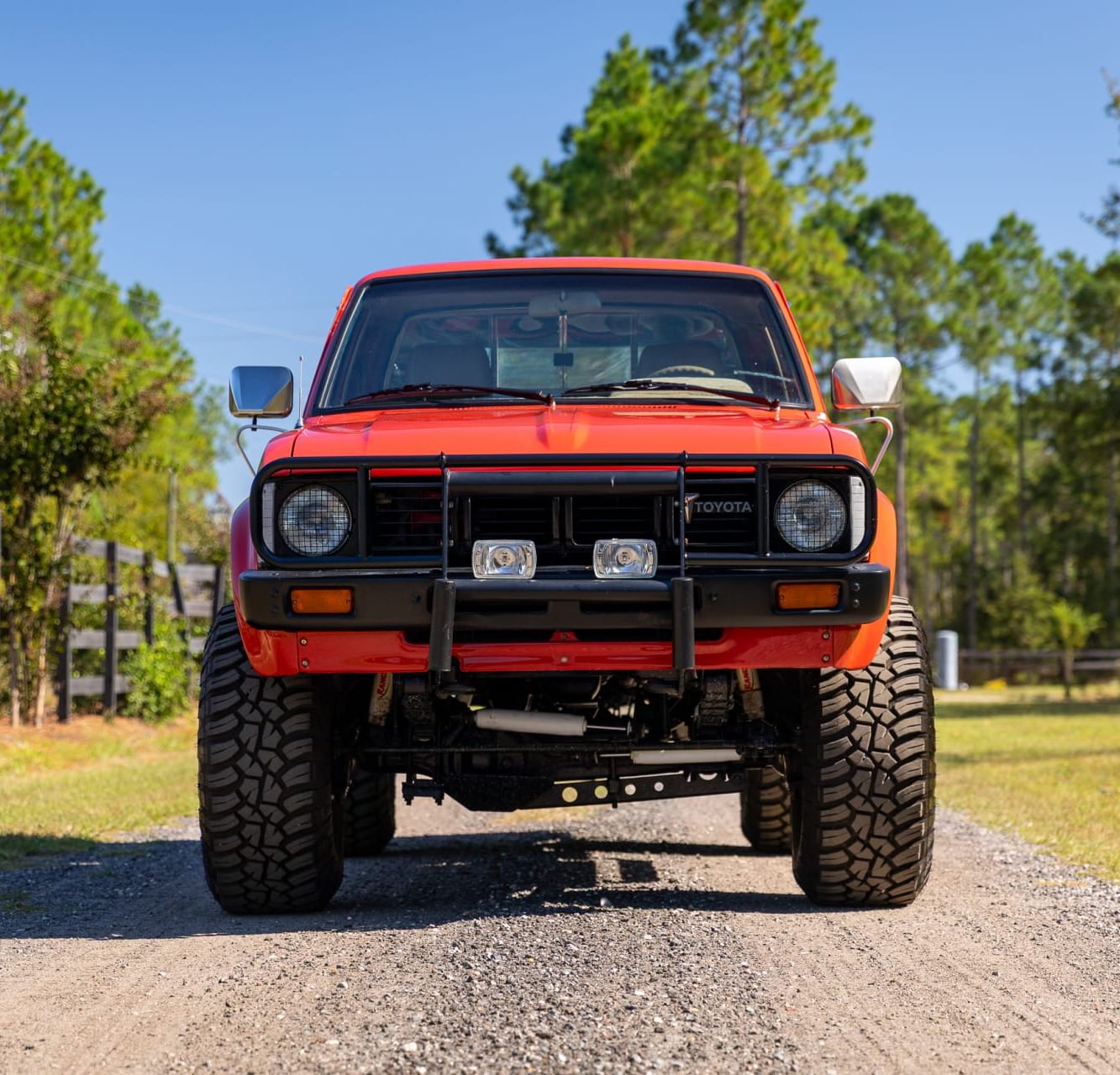
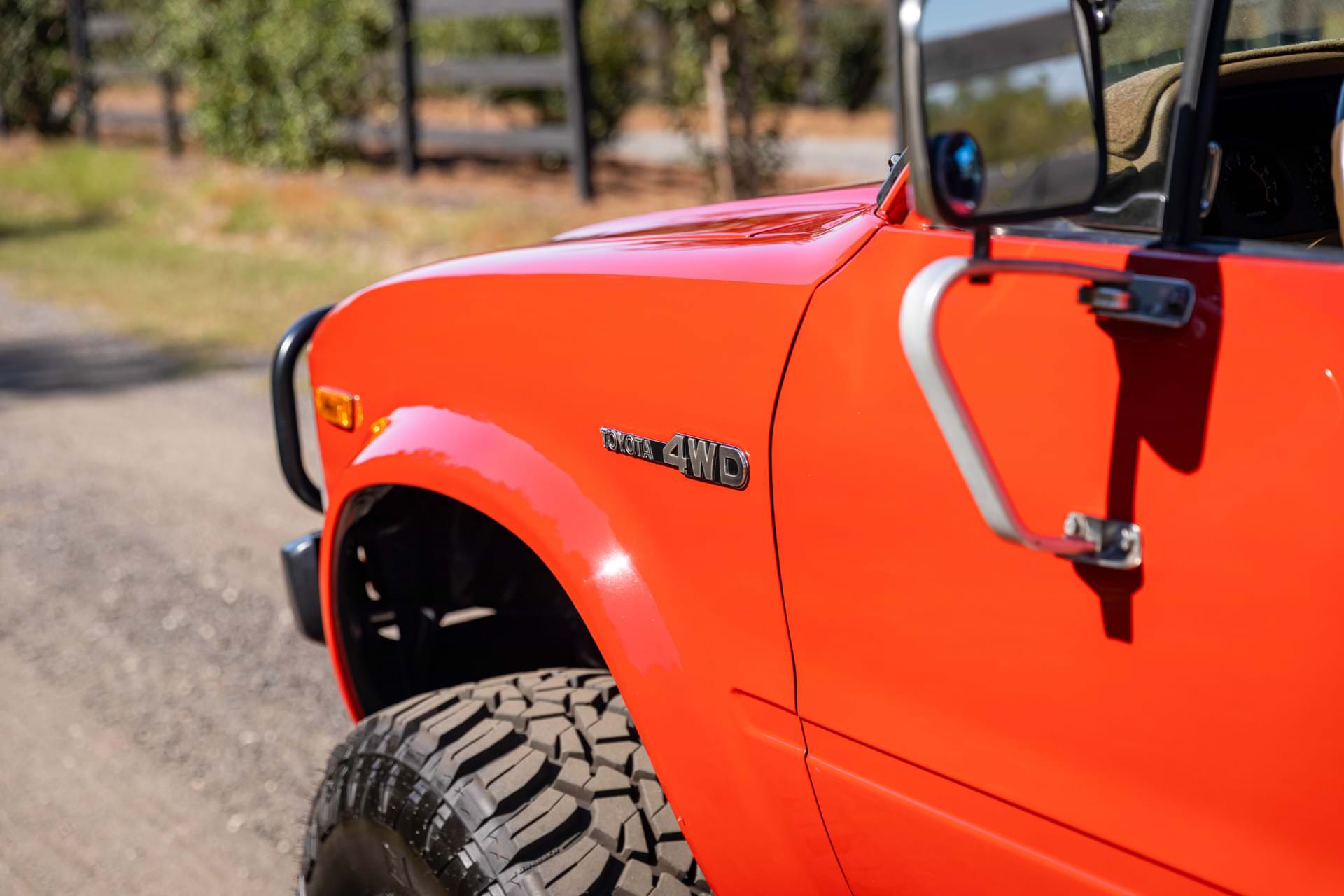
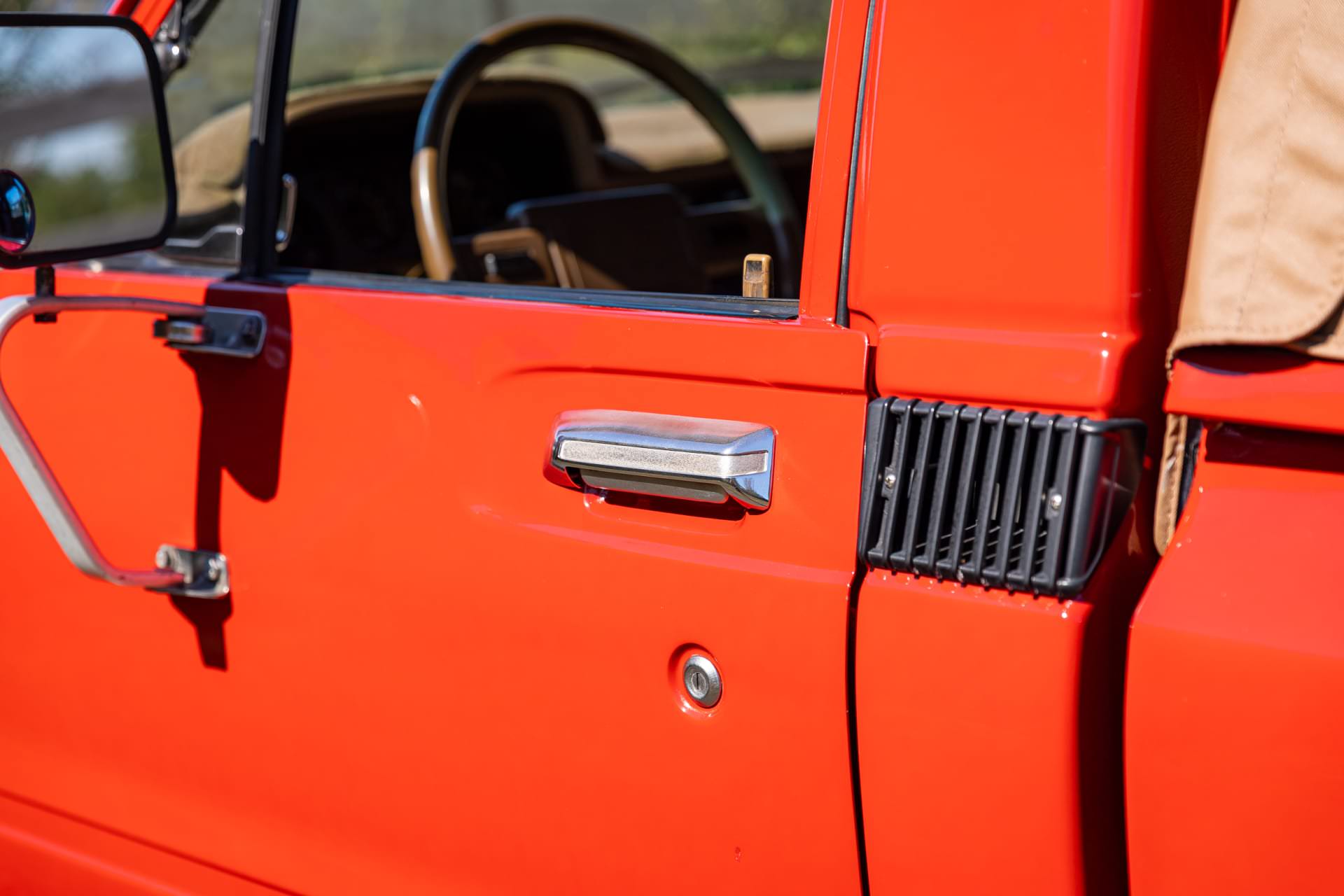
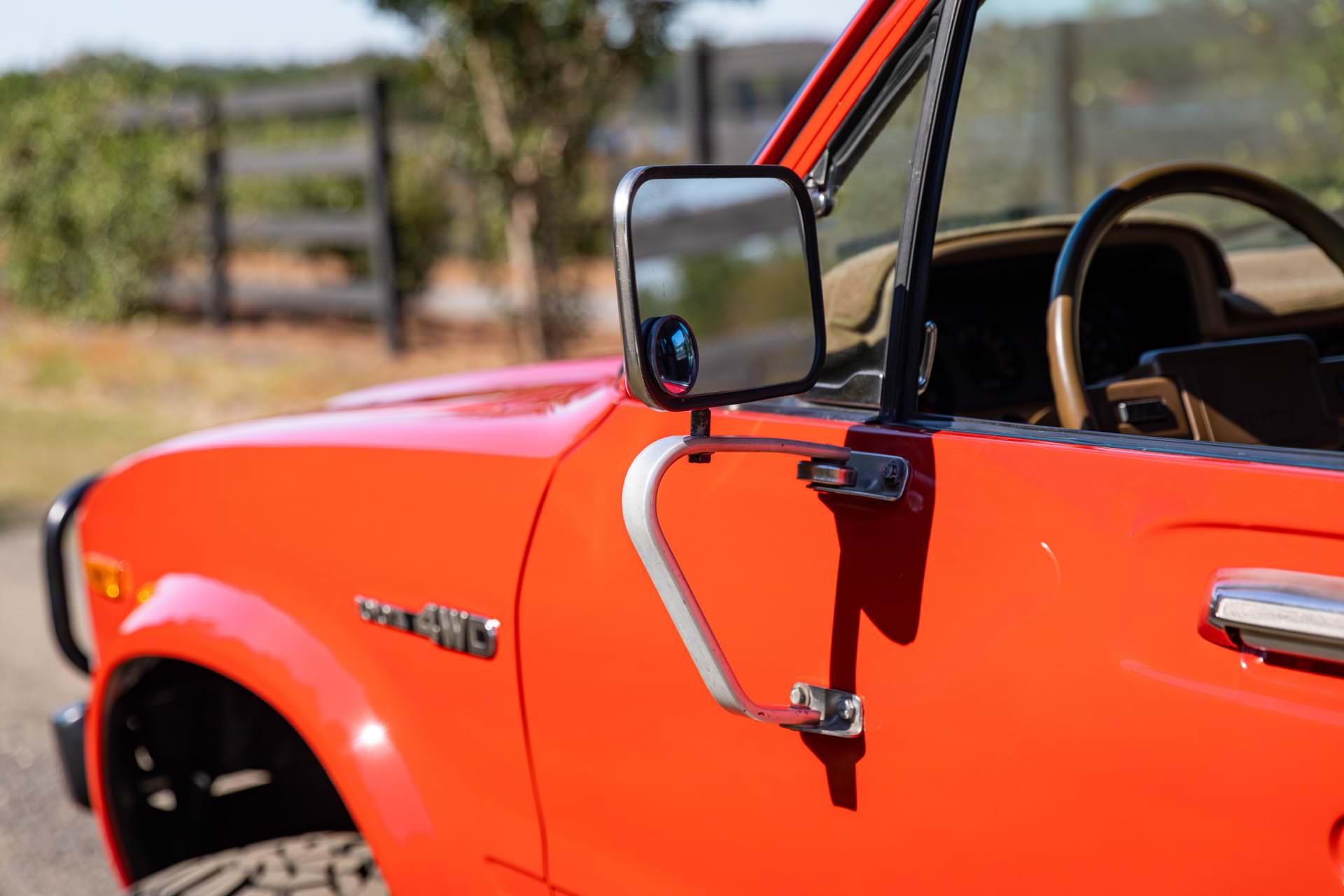
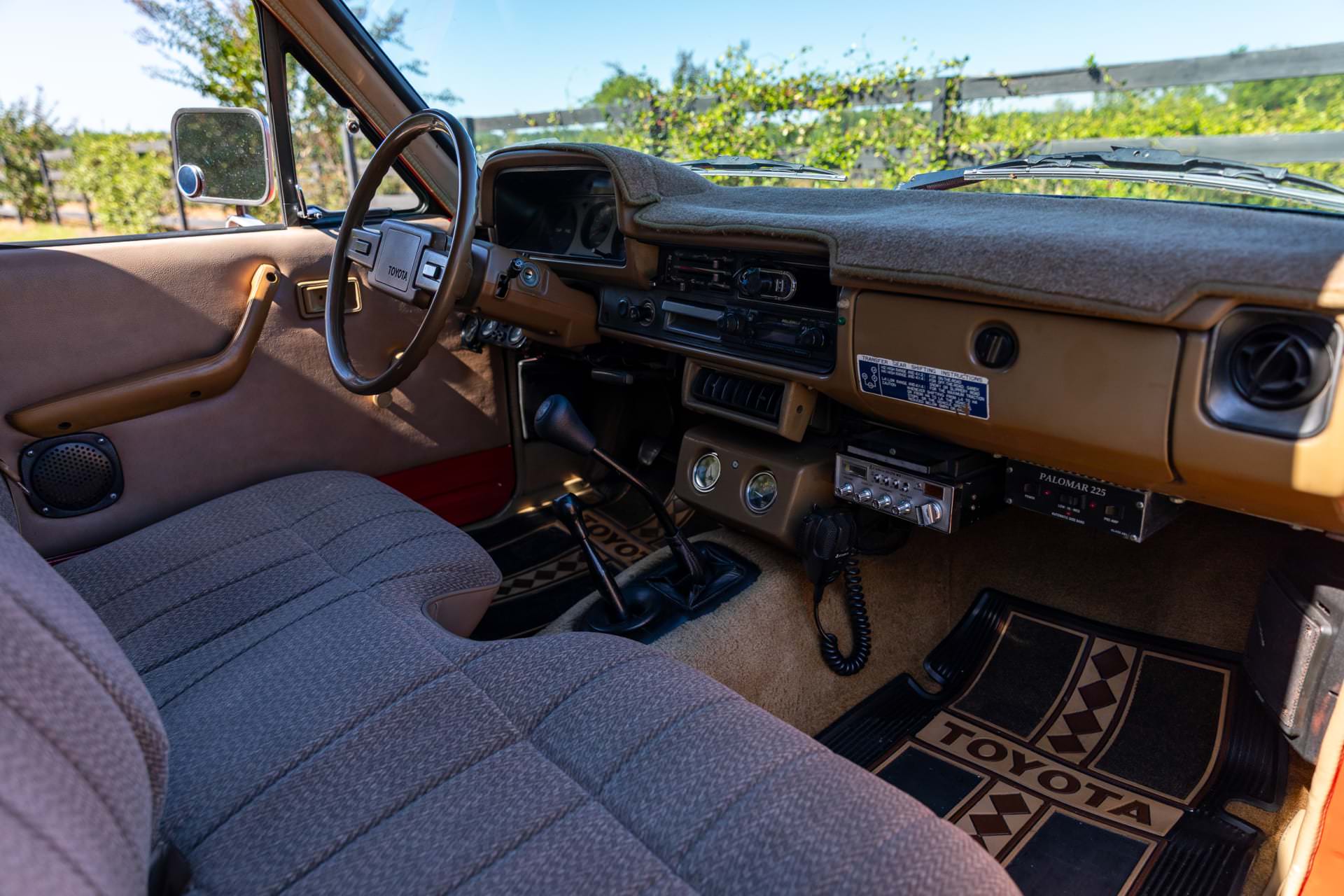
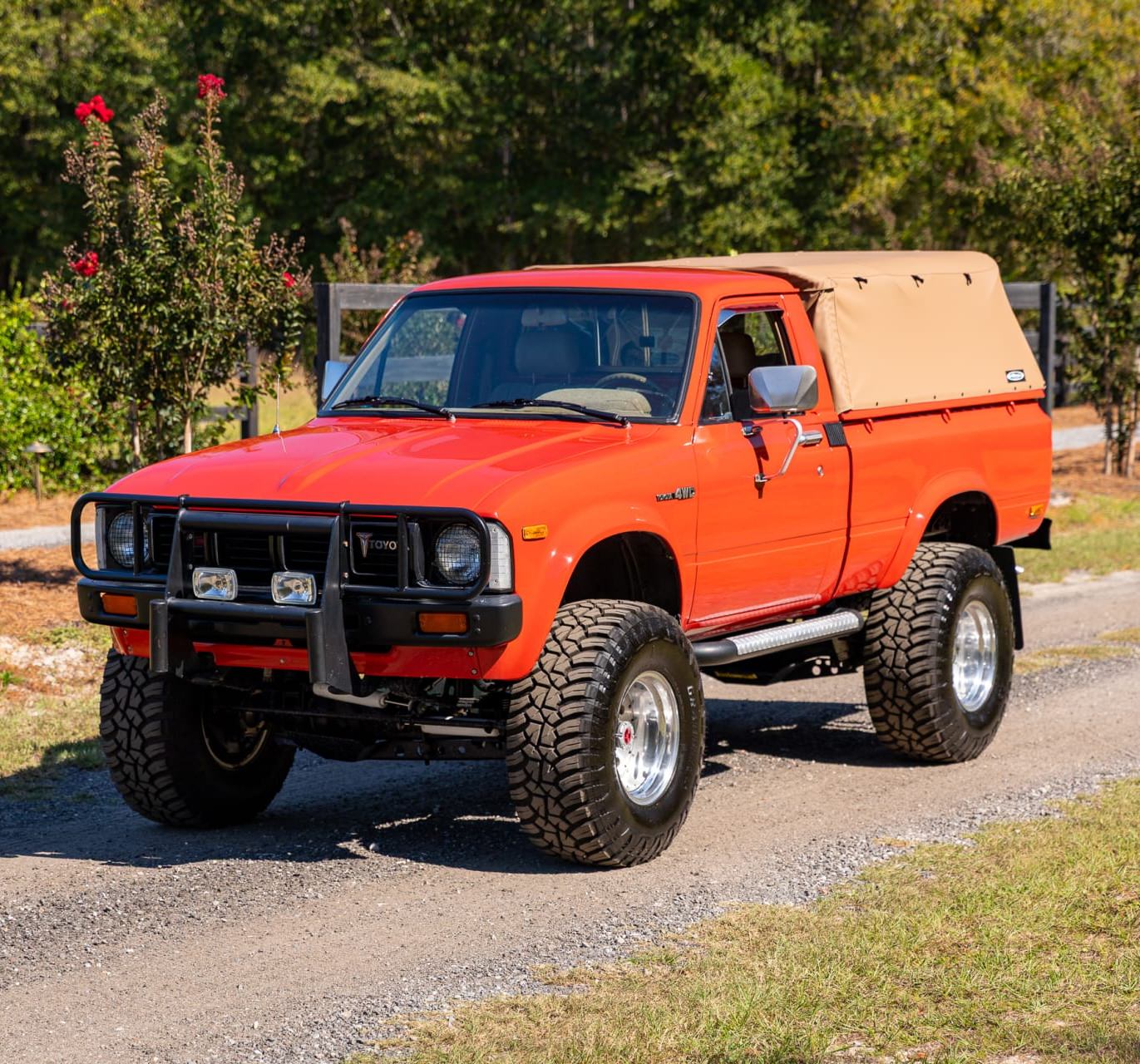
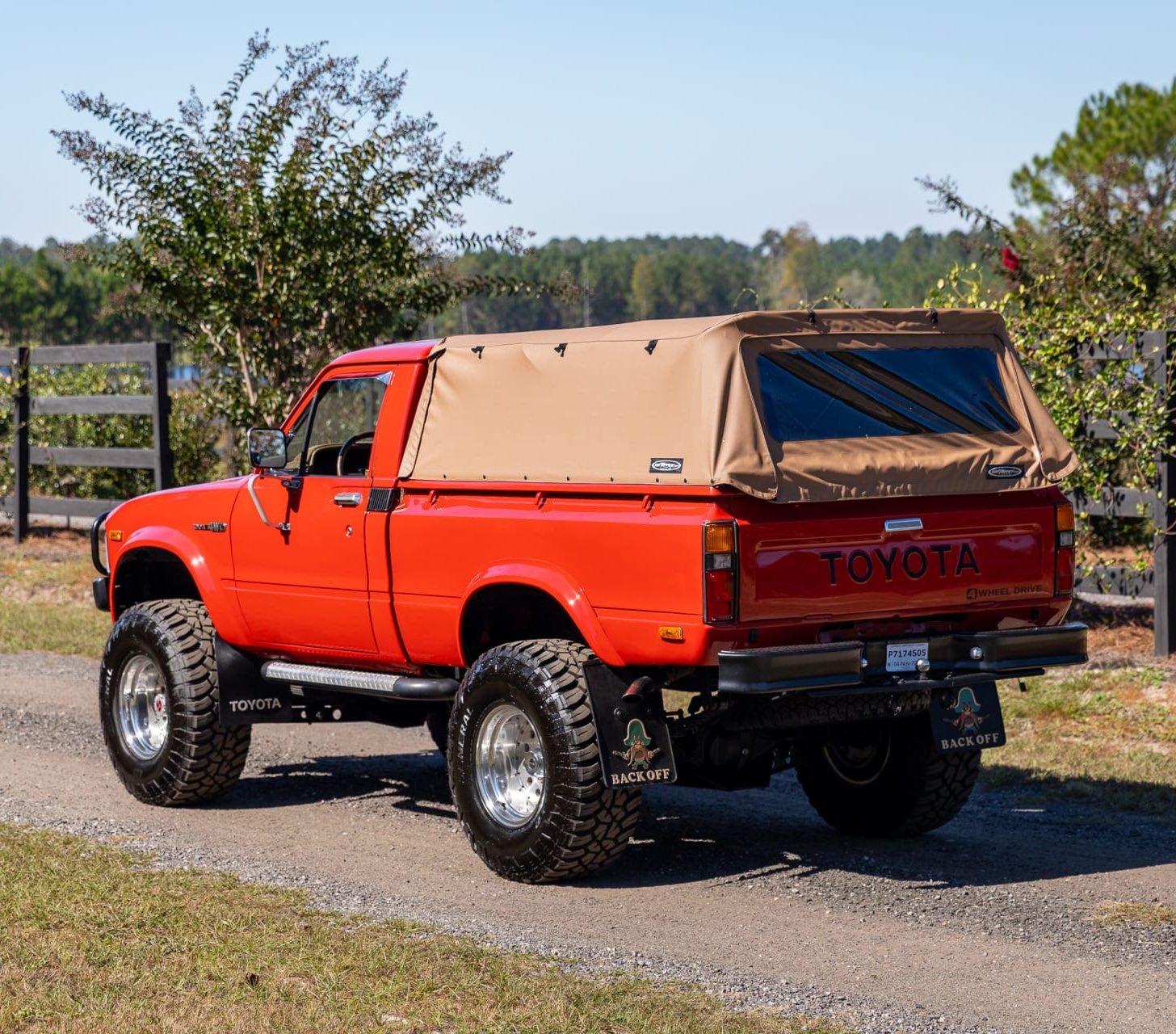
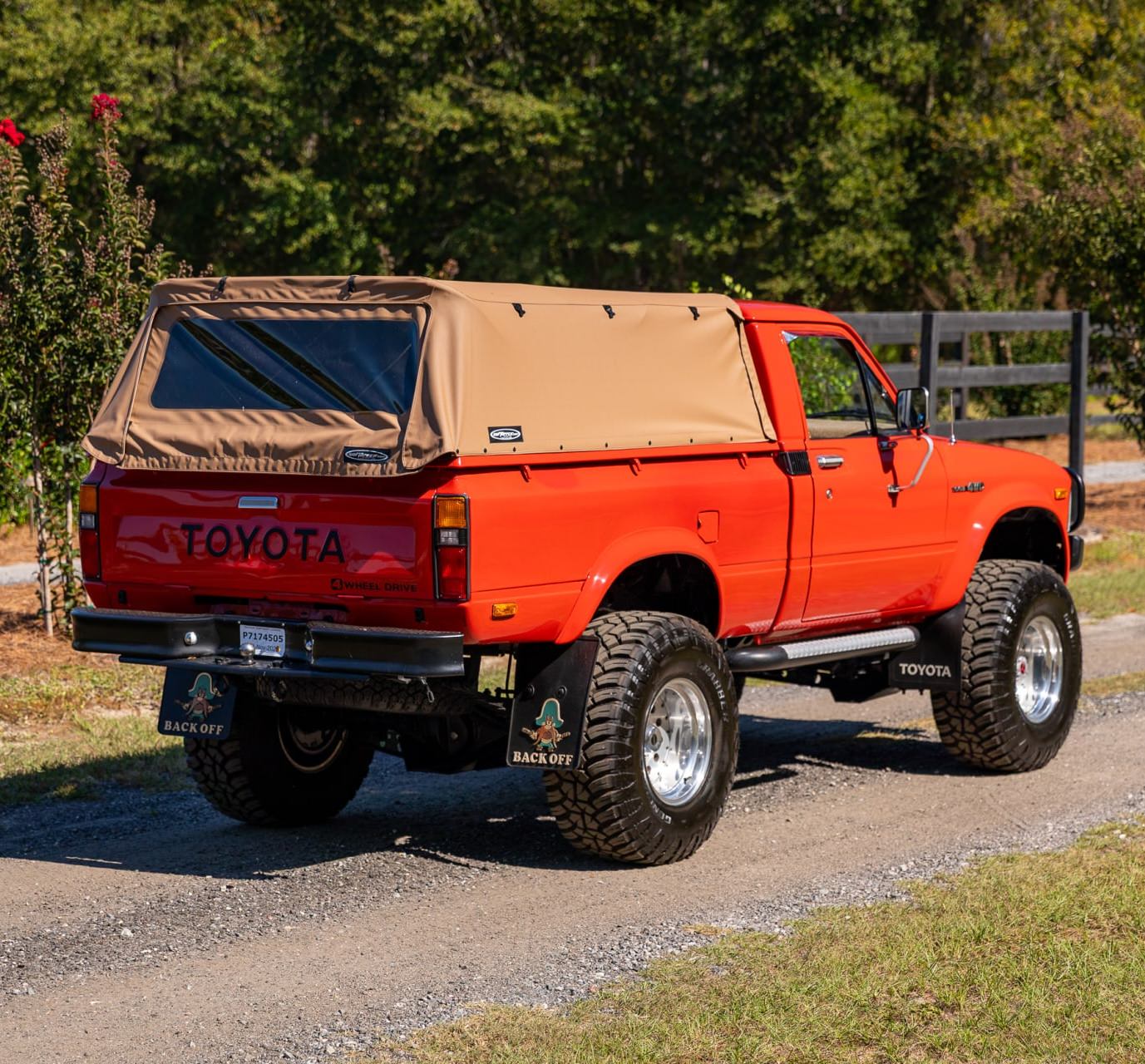
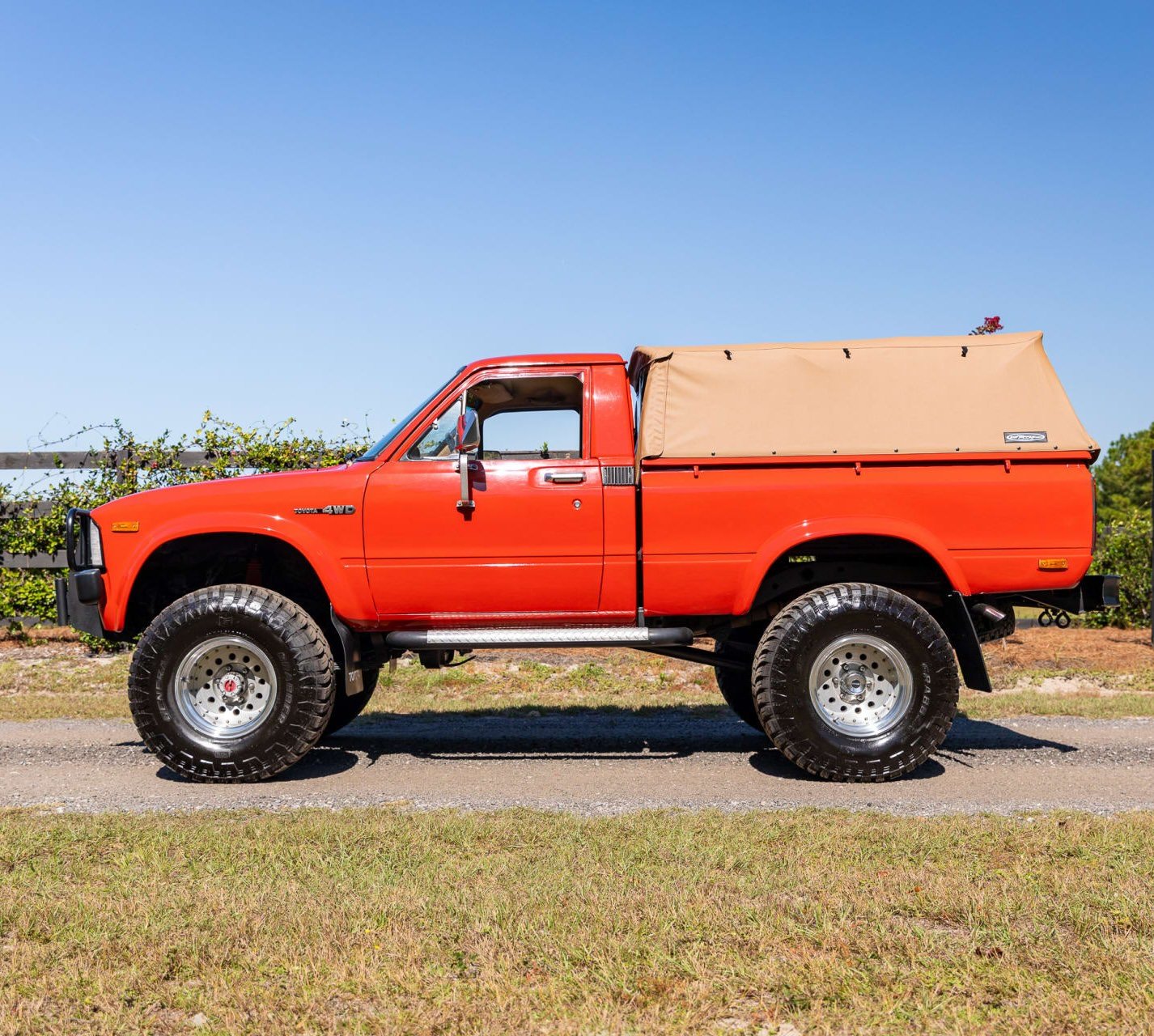
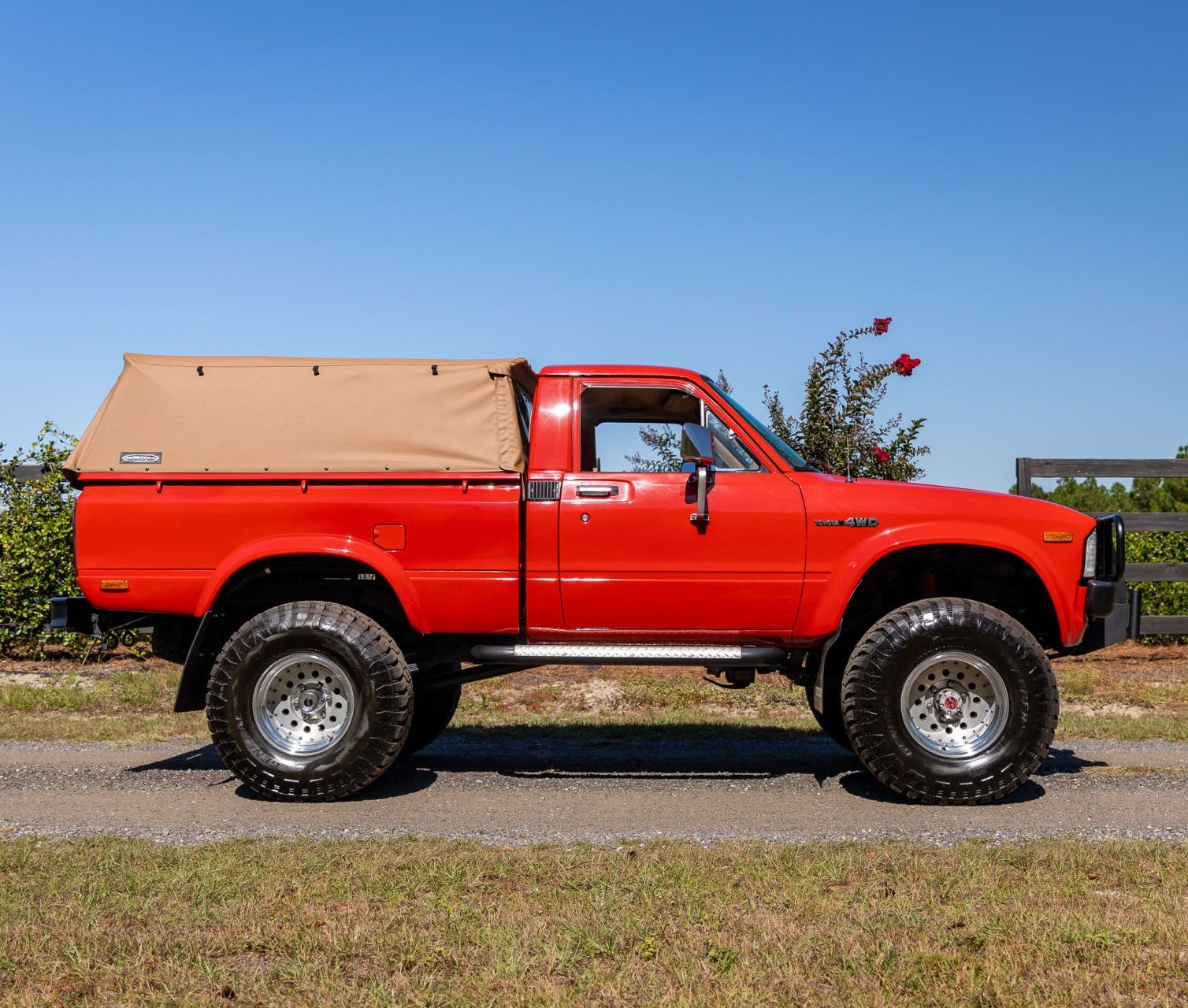
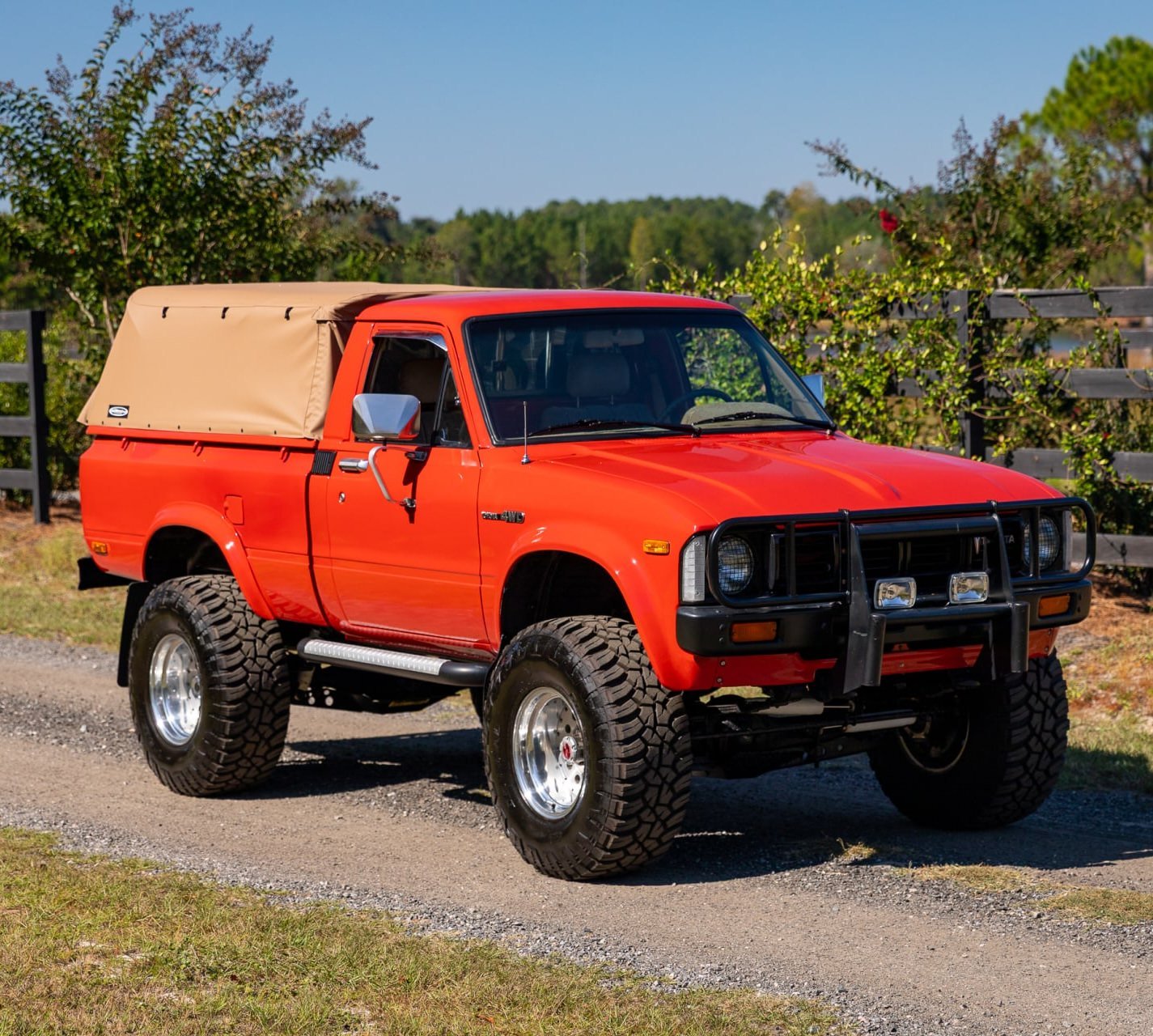
This is a third-generation Toyota Hilux from 1981, it was modified in-period by an off road dune buggy facility in California with equipment and upgrades that made it perfectly adapted for use in California’s desert terrain.
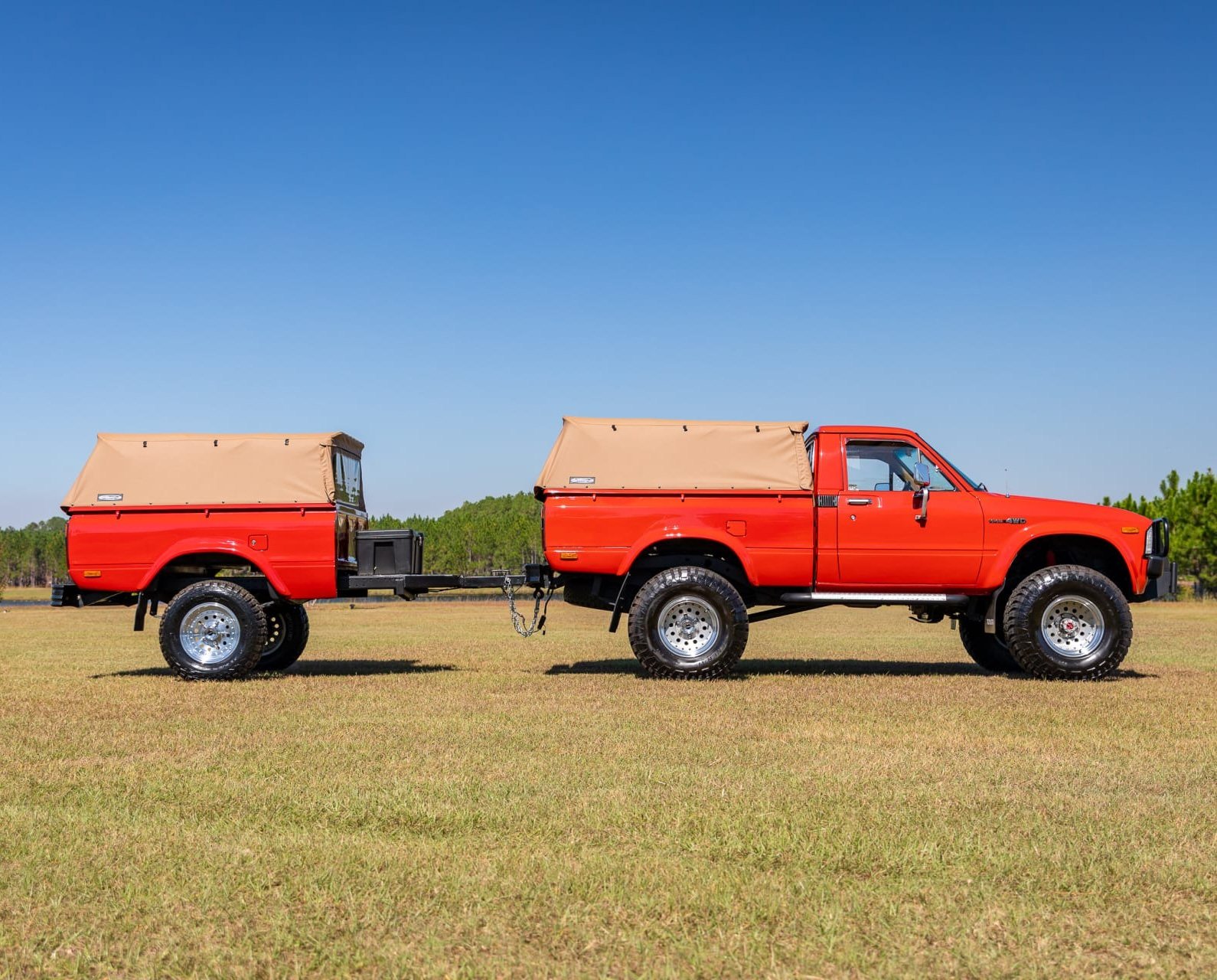
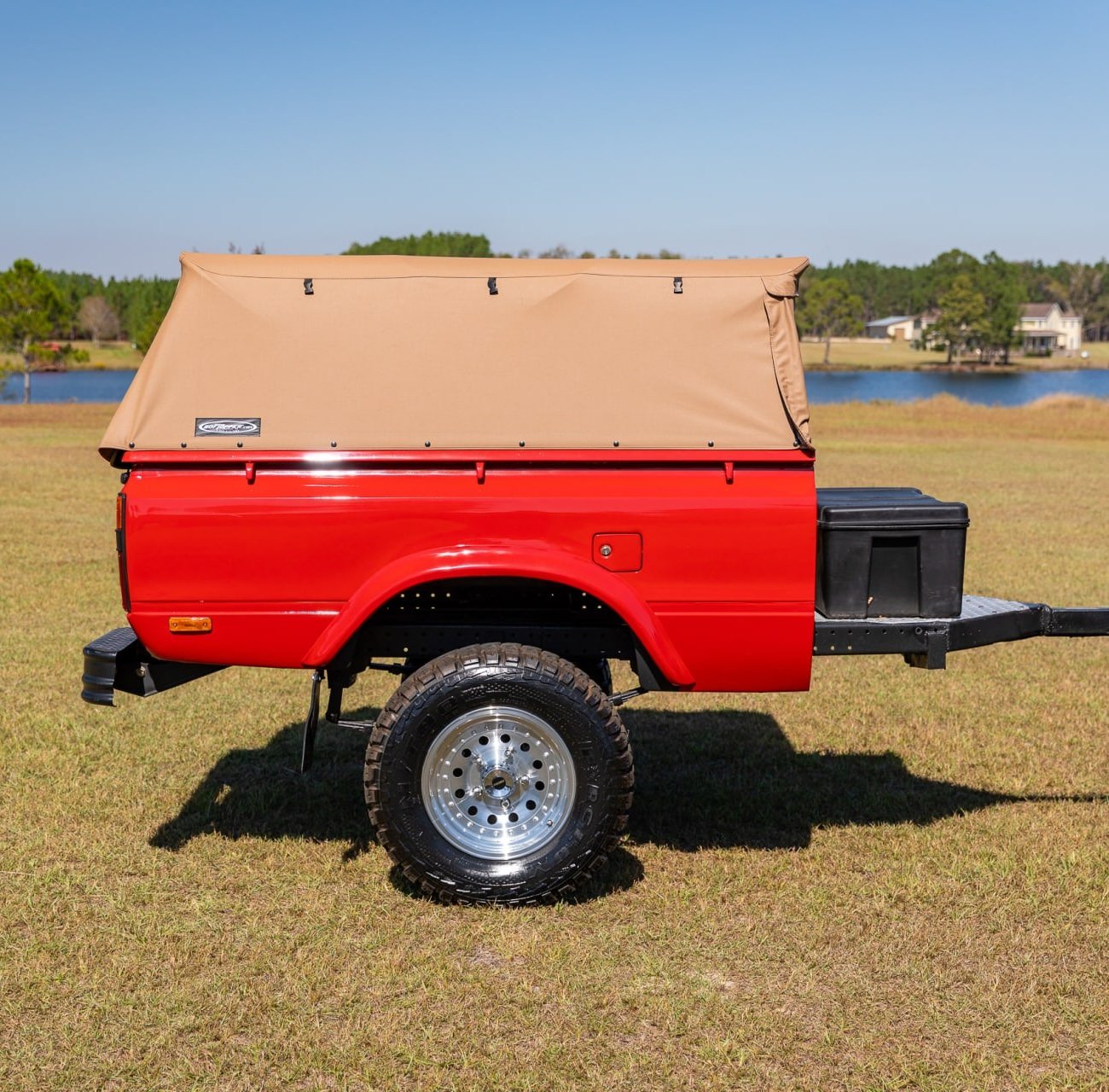
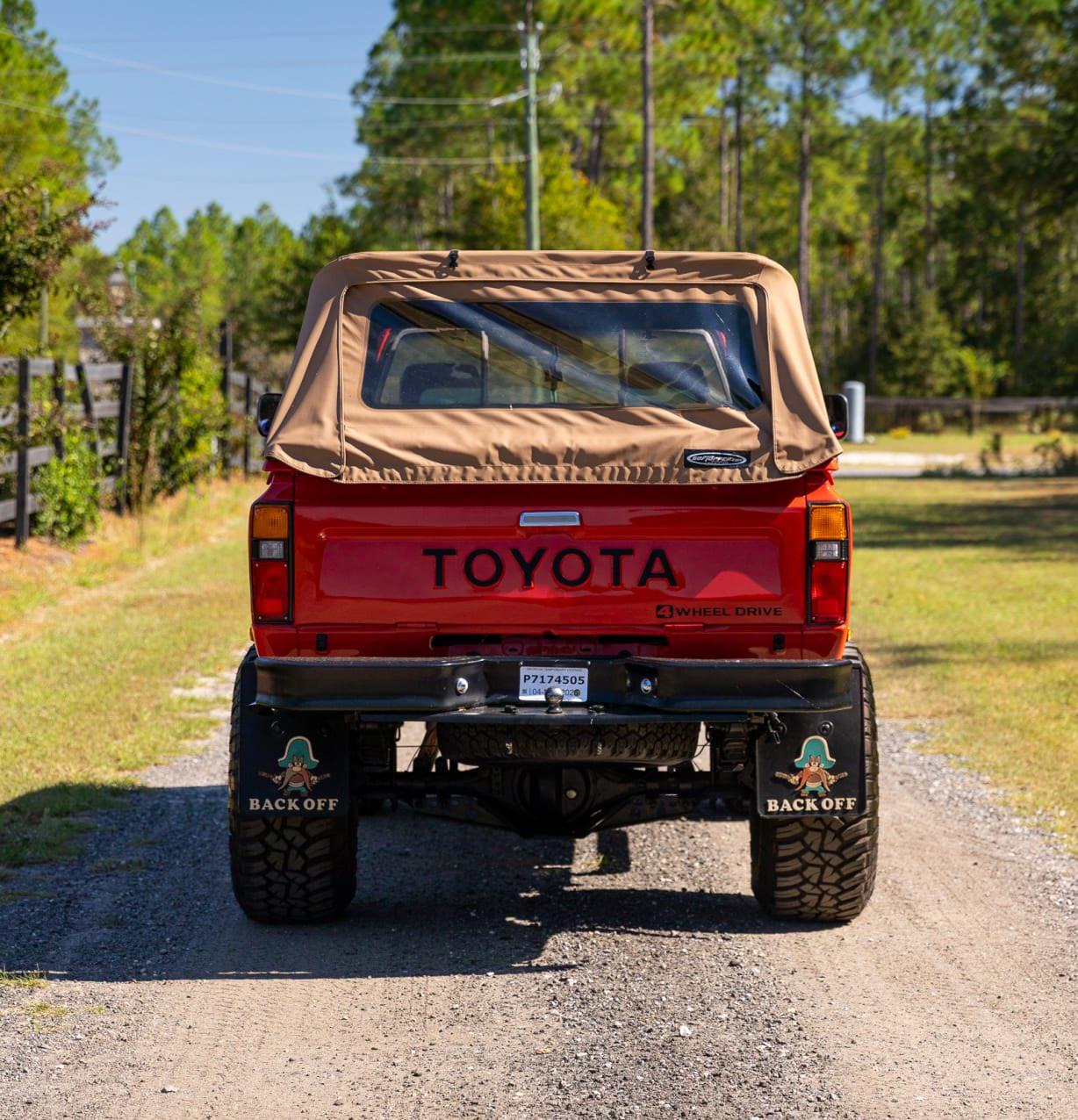
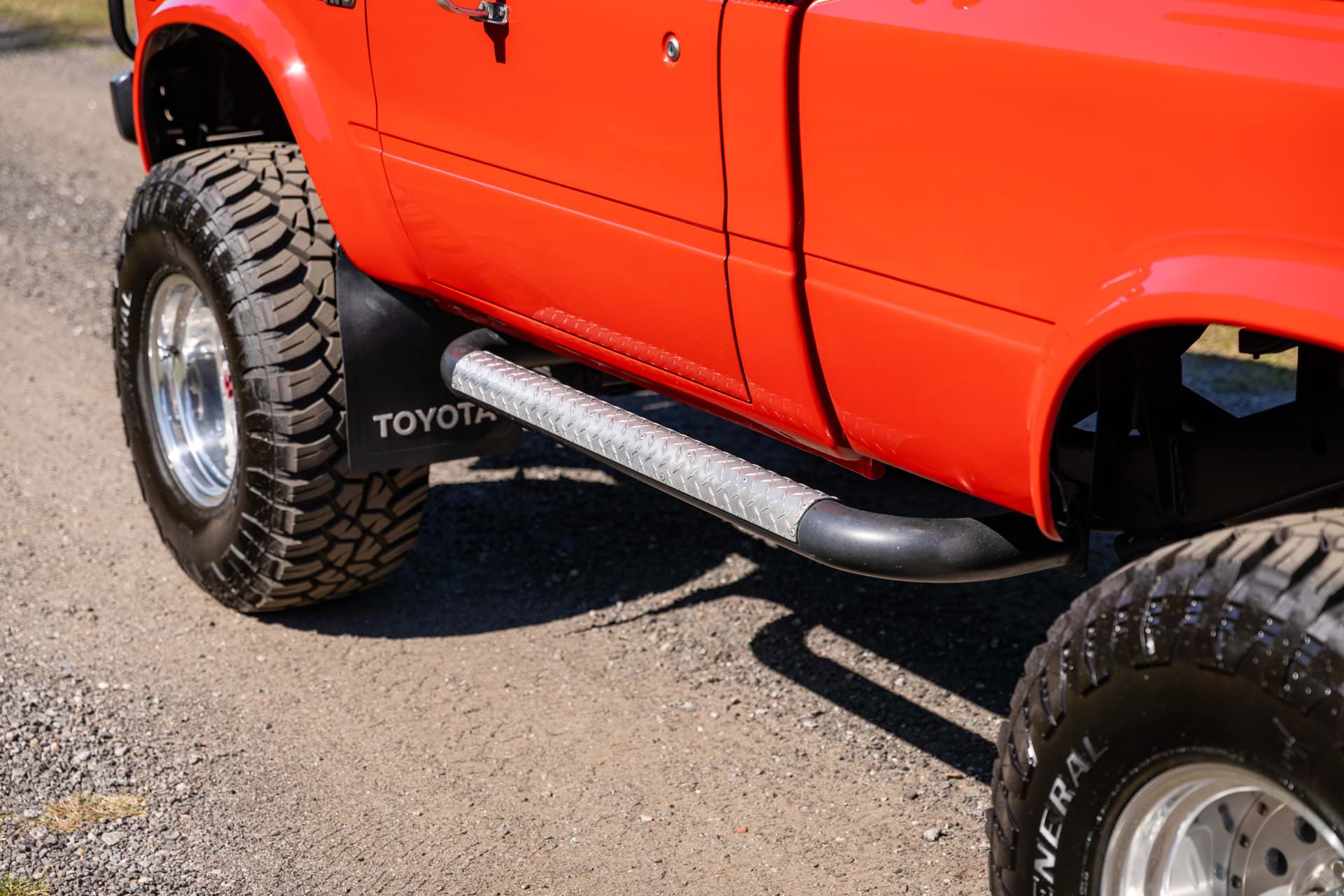
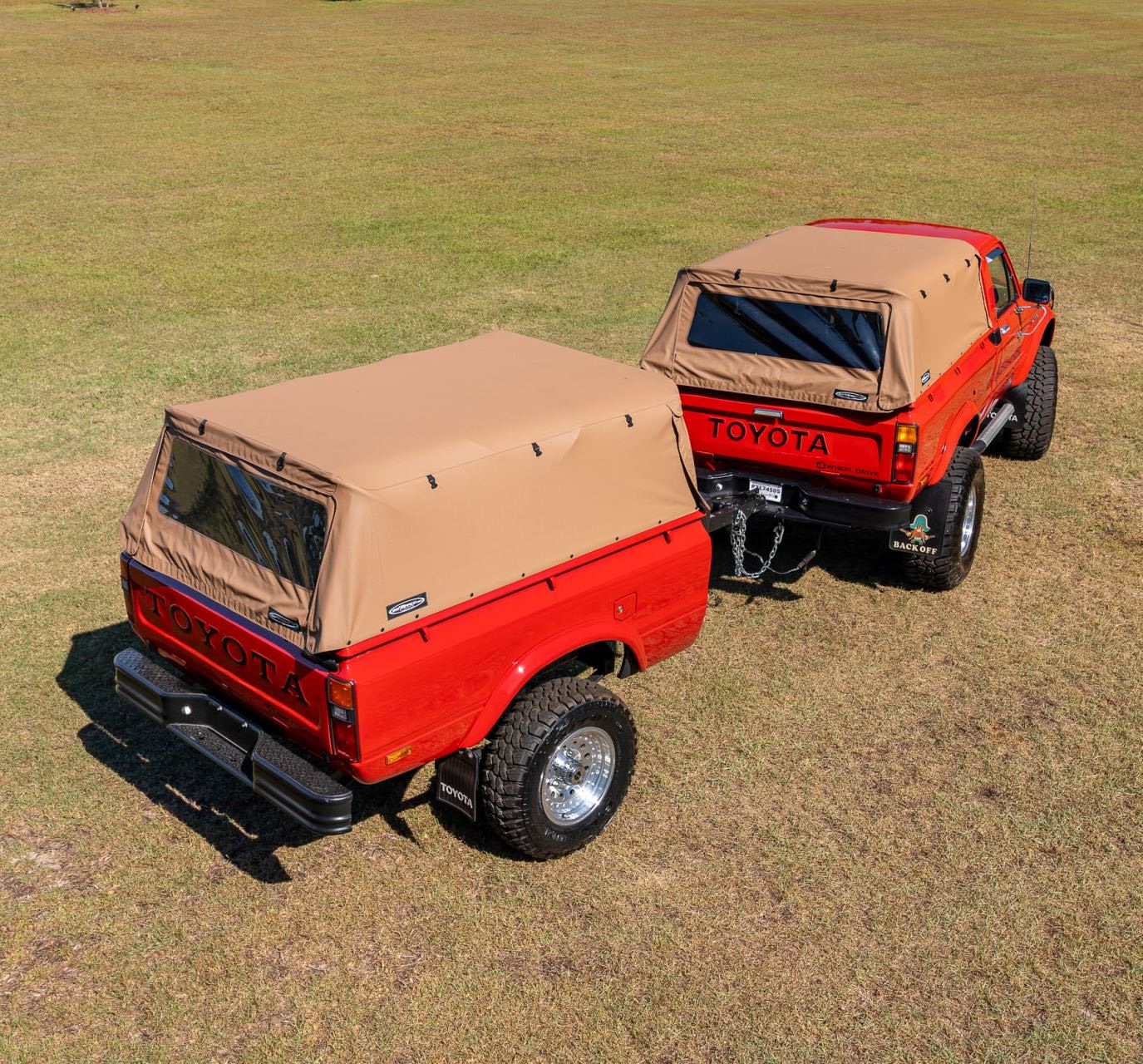
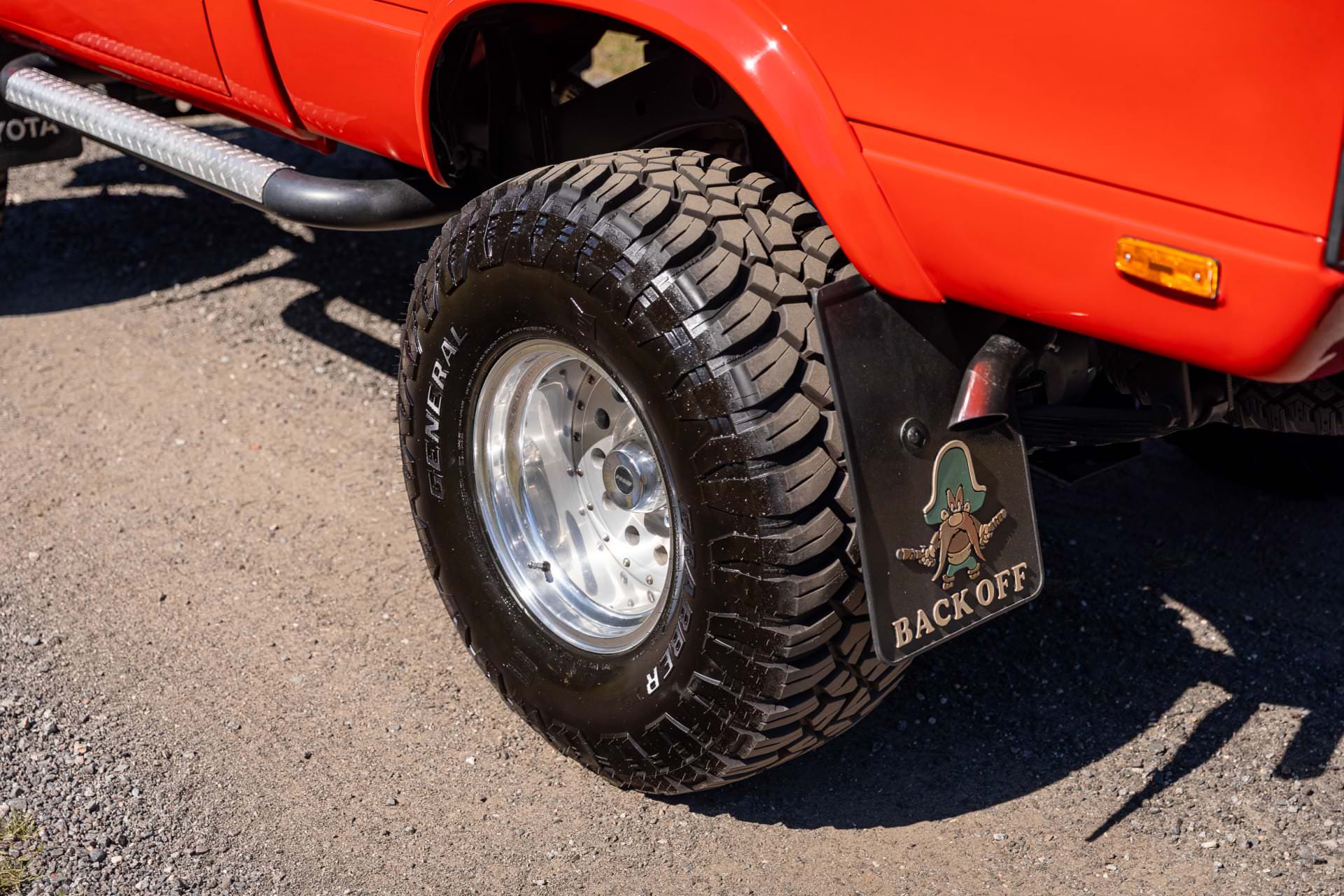
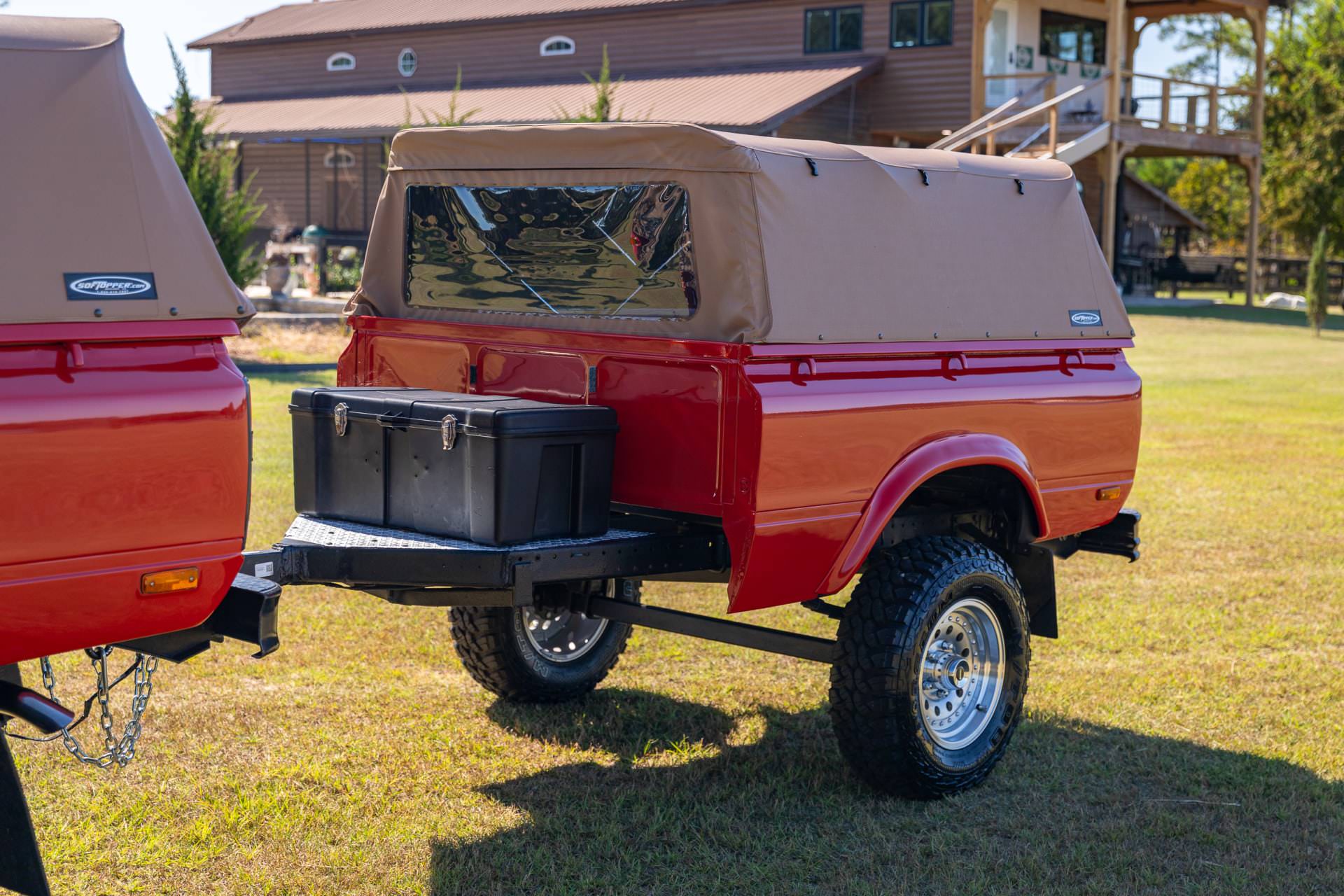
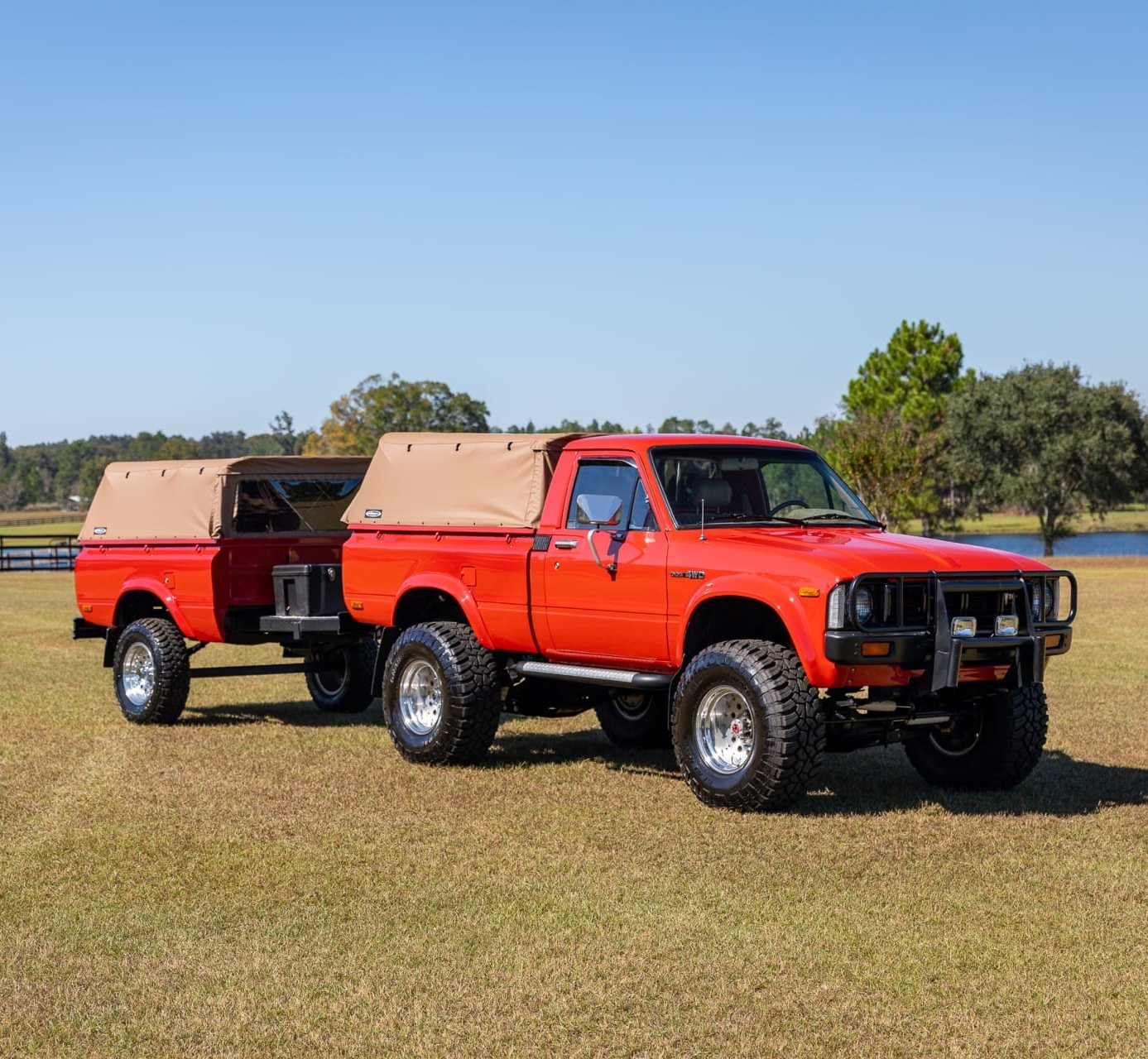
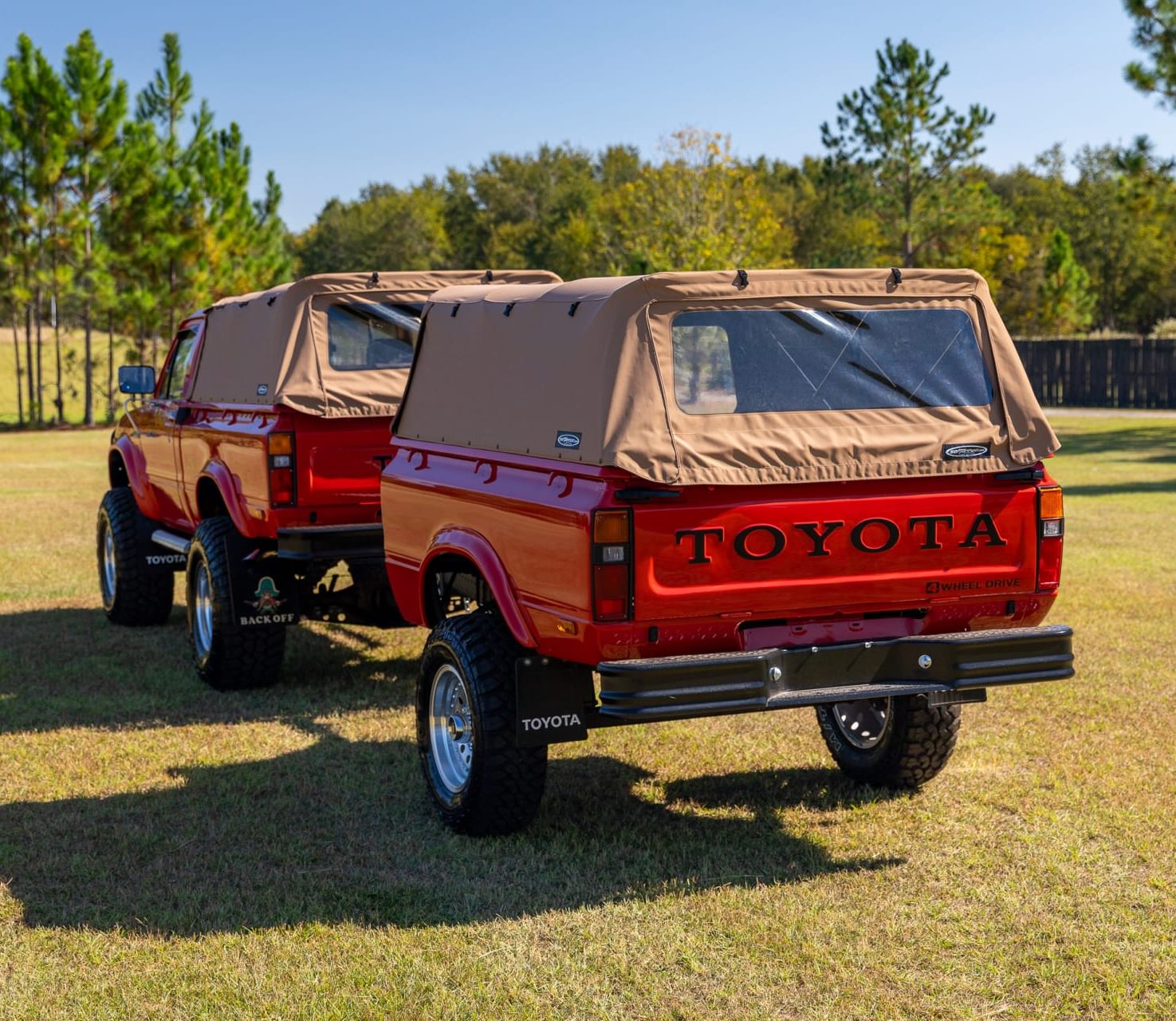
It rides on original 15 inch slotted mag wheels fitted with 33” General Grabber tires, and it has upgraded suspension, diff gearing, skid plates, and chassis reinforcement. It also has a trailer painted to match with an identical soft top.
Fast Facts: A 1981 Toyota Hilux + Matching Trailer
- This 1981 third-generation Toyota Hilux was upgraded in-period by a California dune-buggy shop, giving it the gearing, suspension, and chassis work needed for regular use in desert terrain. It retains its original 15-inch slotted mags with 33-inch General Grabbers and comes with a matching custom trailer.
- The third-generation Hilux debuted in 1978 as Toyota shifted the model toward broader global appeal with a wider track, revised suspension layouts, and a more comfortable cabin. A key milestone arrived in early 1979 with the first factory 4×4 Hilux, which helped move the truck into the recreational off-road space.
- Markets worldwide received distinct mixes of petrol and diesel engines, including the 12R, 18R, 20R, later 22R, and a 2.2 liter diesel. Most trucks used 4 or 5-speed manuals, with the 4×4 variants paired with a dual-range transfer case. Automatics appeared in selected 2WD trims but remained uncommon.
- This particular Hilux was restored in 2015 and repainted in Campbell’s Soup Tomato Red along with its trailer, which began life as a Bayliner boat trailer. Upgrades include a 15 gallon auxiliary fuel cell, 4.37 differential gearing, cab-controlled air-adjustable Rancho shocks, heavy-duty leaf packs, nerf bars, and significant chassis reinforcements.
History Speedrun: The Third-Generation Toyota Hilux
When the Toyota Hilux first debuted as a small, cheap, rear-wheel drive truck at the lower end of the market, no one could have guessed that it would become globally renowned for its reliability and toughness – but that’s exactly what happened over the course of nine generations and millions of trucks sold in every major global market.
 This is a third-generation Toyota Hilux from 1981, it was modified in-period by an off road dune buggy facility in California with equipment and upgrades that made it perfectly adapted for use in California’s desert terrain.
When Toyota launched the first Hilux in 1968, it was intended as a light pickup truck that could serve both small business owners and private buyers – particularly in markets where a small, efficient workhorse made more sense than a full-size truck.
Early Hilux designs were basic, almost austere in fact, but they built up a reputation quickly – they had simple mechanicals, tough frames, and engines that seemed to just keep going and going. Demand grew across Asia, Australia, the Middle East, Africa, and Latin America – as a result the Hilux developed into Toyota’s most important global utility vehicle, even surpassing the Land Cruiser.
By the late 1970s, Toyota knew its pickup needed to evolve to keep pace with the rapidly evolving market. The competition was improving fast and customer expectations were shifting – perhaps most importantly, the market for recreational 4WD vehicles was heating up.
This all set the stage for the third-generation Hilux which was introduced in September of 1978. It wasn’t a radical reinvention of the platform, but it marked a turning point for the model series that would still influence the Hilux all the way through to the modern day, with more comfort, refinement, and a clear goal of further increasing global reach.
Toyota widened the track width, revised the front suspension, upgraded the cabin, and expanded the model mix to cover everything from basic commercial trucks to well-equipped personal-use pickups. In Japan, the new Hilux even offered an extended-cab option, the “Super Deluxe,” with an extra 90 mm of interior length.
One of the most important developments in Hilux history, if not the most important outright, arrived a few months later. In early 1979, Toyota launched the first factory Hilux 4×4, with the global introduction occurring in January and some markets, like the UK, seeing it slightly later in the year.
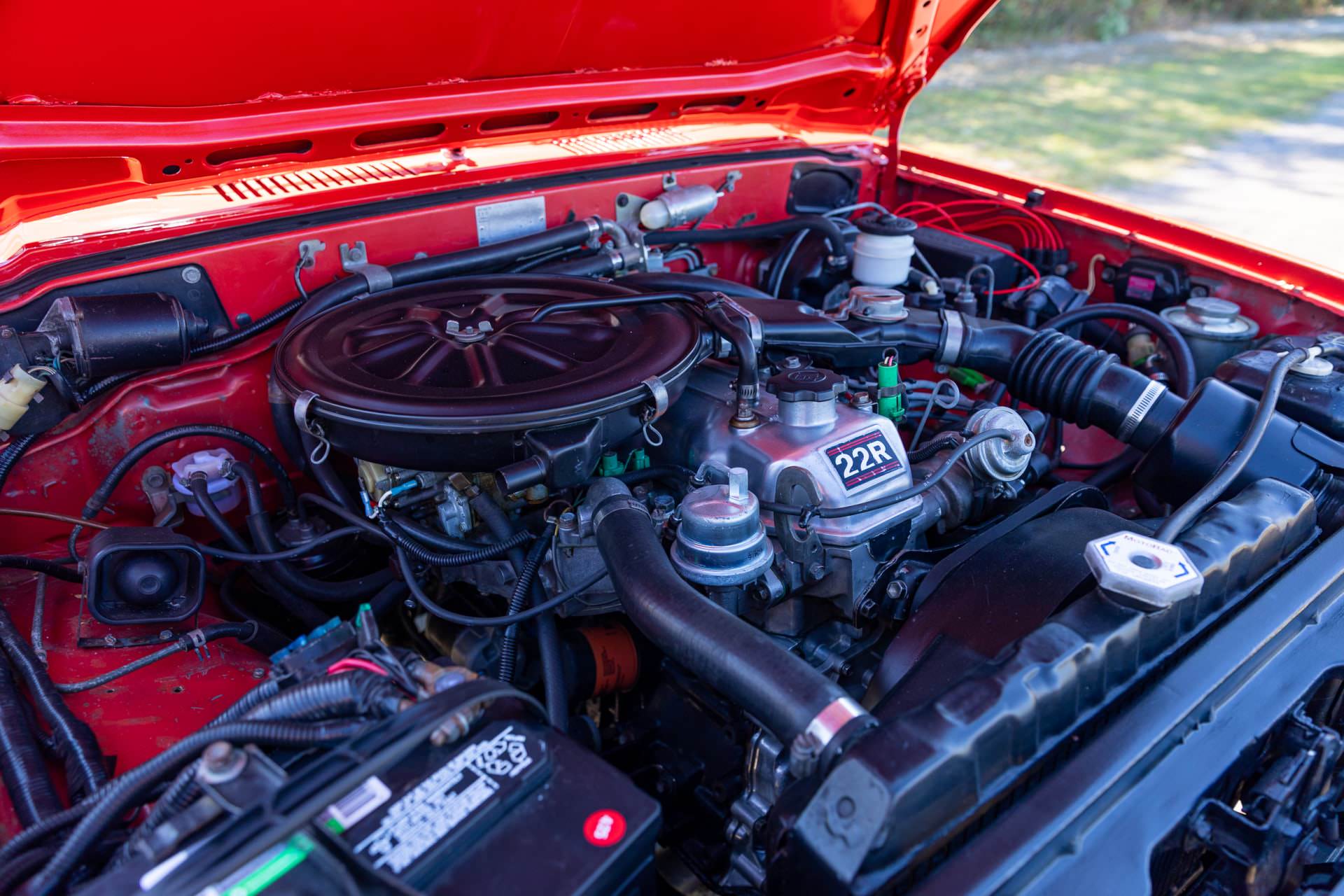
Power is provided by the Toyota 22R 2.4 liter inline 4-cylinder engine, and sent back through a 5-speed manual transmission and a dual-range transfer case.
This was the point where the Hilux truly entered the world of recreational off-roading. The four-wheel drive model kept leaf springs up front, simpler and stronger for off-road use, while the rear-wheel drive version switched to a torsion-bar double-wishbone front setup that provided better road handling.
The third-generation Hilux was built from 1978 into the early 1980s, with the four-wheel drive line ending production in mid-1983. The 4×4 version became a global seller during this period, Australia embraced it almost immediately, where it was used in farming, mining, leisure, and remote-area travel. Southeast Asian markets sold a mix of commercial and passenger variants, and European markets received multiple petrol and diesel options depending on emissions requirements and tax categories.
North America had largely shifted to the locally targeted Toyota Pickup nameplate by then, but much of the underlying platform remained shared. It offered an important mid-size 4×4 pickup truck option that American buyers loved, playing a part in inspiring the development of the Ford Ranger.
Engine choices for the Hilux varied quite widely by market – in Japan and some Asian regions, the entry-level petrol was the 1.6 liter 12R, a longstanding Toyota workhorse. Above that sat the 2.0 liter 18R and the 2.2 liter 20R, depending on the market. Late in the cycle, some regions received the 2.4 liter 22R – an engine that would go on to underpin Toyota’s reputation for bulletproof reliability through the 1980s.
Diesel buyers had options too – this generation introduced a 2.2 liter diesel in many markets, giving long-distance and commercial operators a more economical choice.
Transmission options were straightforward. Most markets offered either a 4-speed or 5-speed manual gearbox in the 2WD models, while 4WD trucks typically paired the manual transmission with the dual-range transfer case. Automatic transmissions were available in certain markets and configurations, mostly in higher-spec 2WD models, but manuals remained the dominant choice by far.
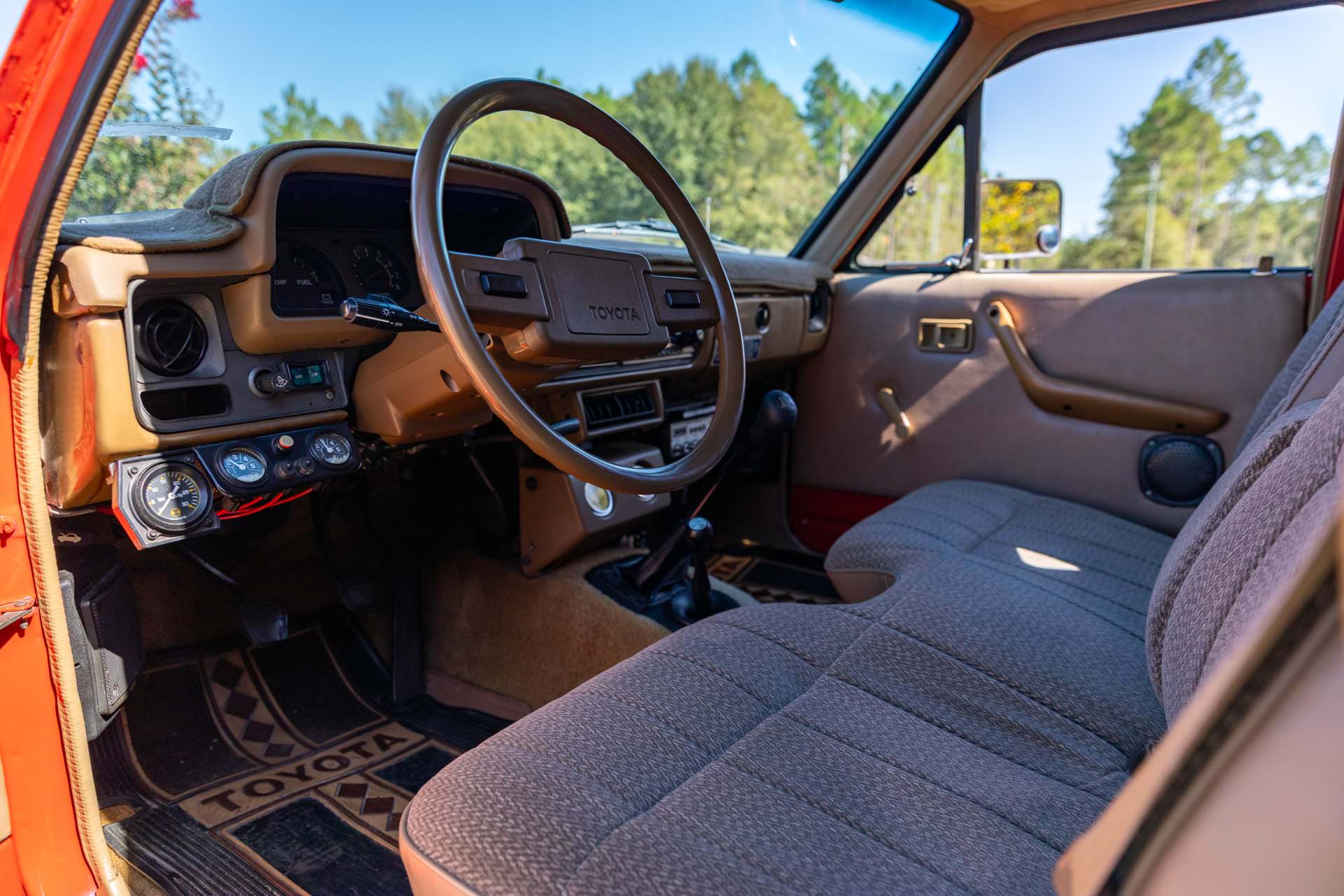
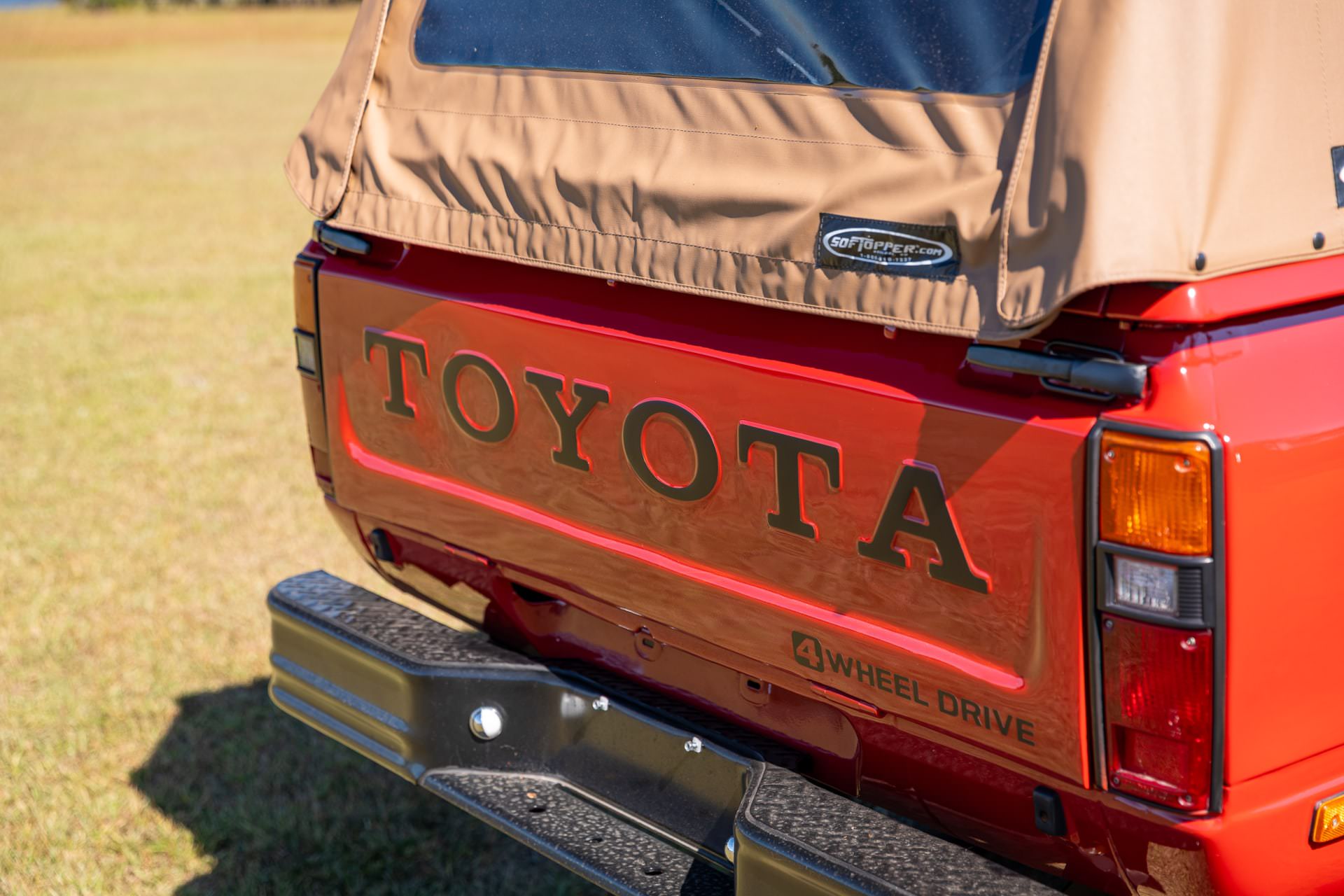
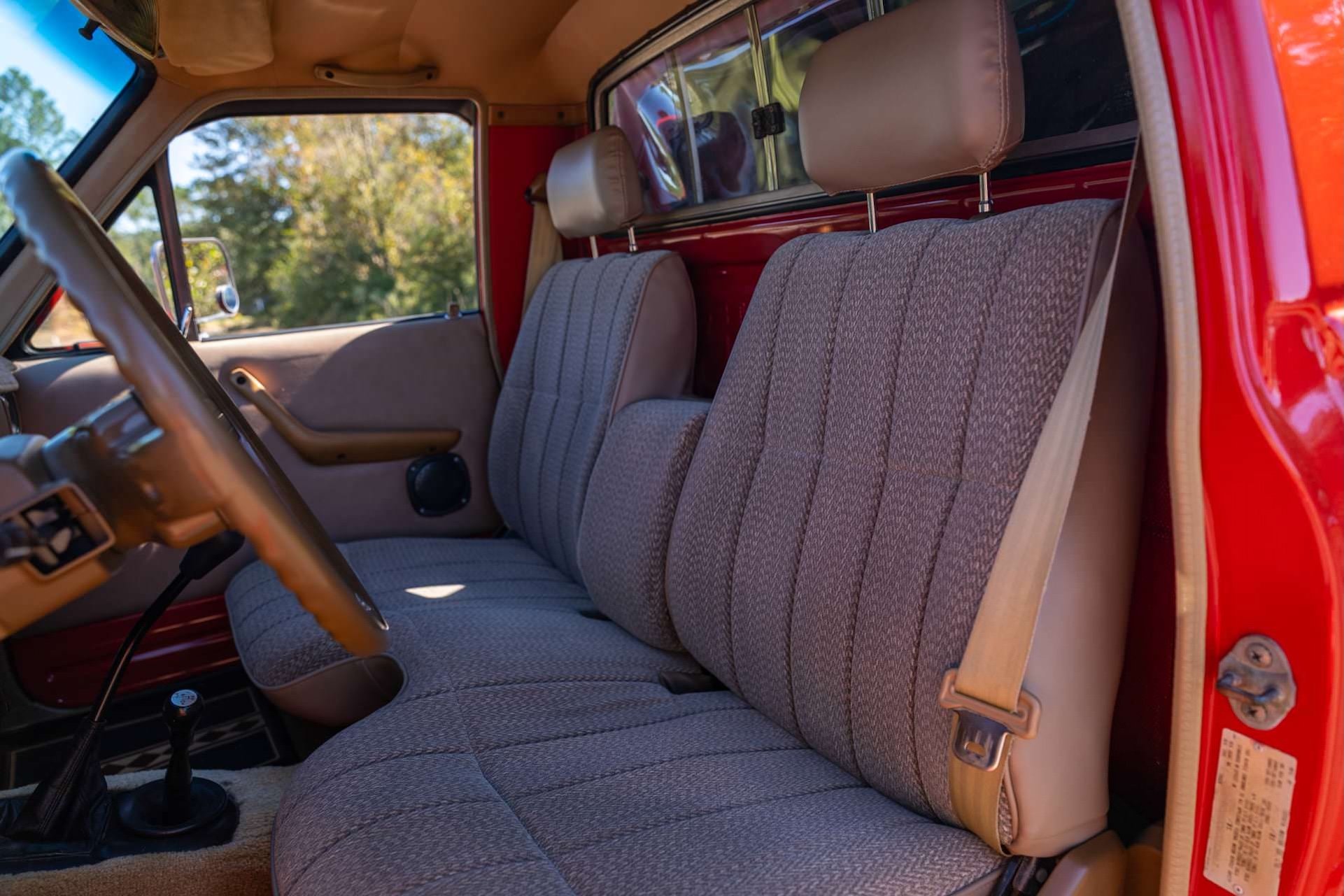
The 1981 Toyota Hilux you see here benefits from a slew of major upgrades that were completed in-period, as it was originally used at a dune buggy facility in the California high desert. It received a cab-on/bed-and-doors-off restoration in 2015 and it was repainted in Duxone factory code 391 Campbell’s Soup Tomato Red paint along with the matching trailer.
Toyota’s development of the third-generation would permanently broaden the Hilux’s identity, it was no longer just a small, cheap work truck – it became something that could be comfortably driven every day, it was capable off-road, and it was highly adaptable.
The 1981 Toyota Hilux + Trailer Shown Here
The 1981 Toyota Hilux you see here benefits from a slew of major upgrades that were completed in-period, as it was originally used at a dune buggy facility in the California high desert. It received a cab-on/bed-and-doors-off restoration in 2015 and it was repainted in Duxone factory code 391 Campbell’s Soup Tomato Red paint along with the matching trailer.
The period upgrades include a one-off specially-built extra 15 gallon fuel cell connected to the factory fuel tank, as well as special 4.37 gear ratios in the front and rear differentials, and an onboard air compressor system that’s adjustable from the cab to adjust the Rancho RS 9000 air shock absorbers which are fitted front and back.
It’s also fitted with diamond plate covered nerf bars which are affixed to chassis for additional support, and it has one-ton suspension with 8 leaf springs in the rear and 4 HD leaf springs up front with specially-designed HD shackles and pins.
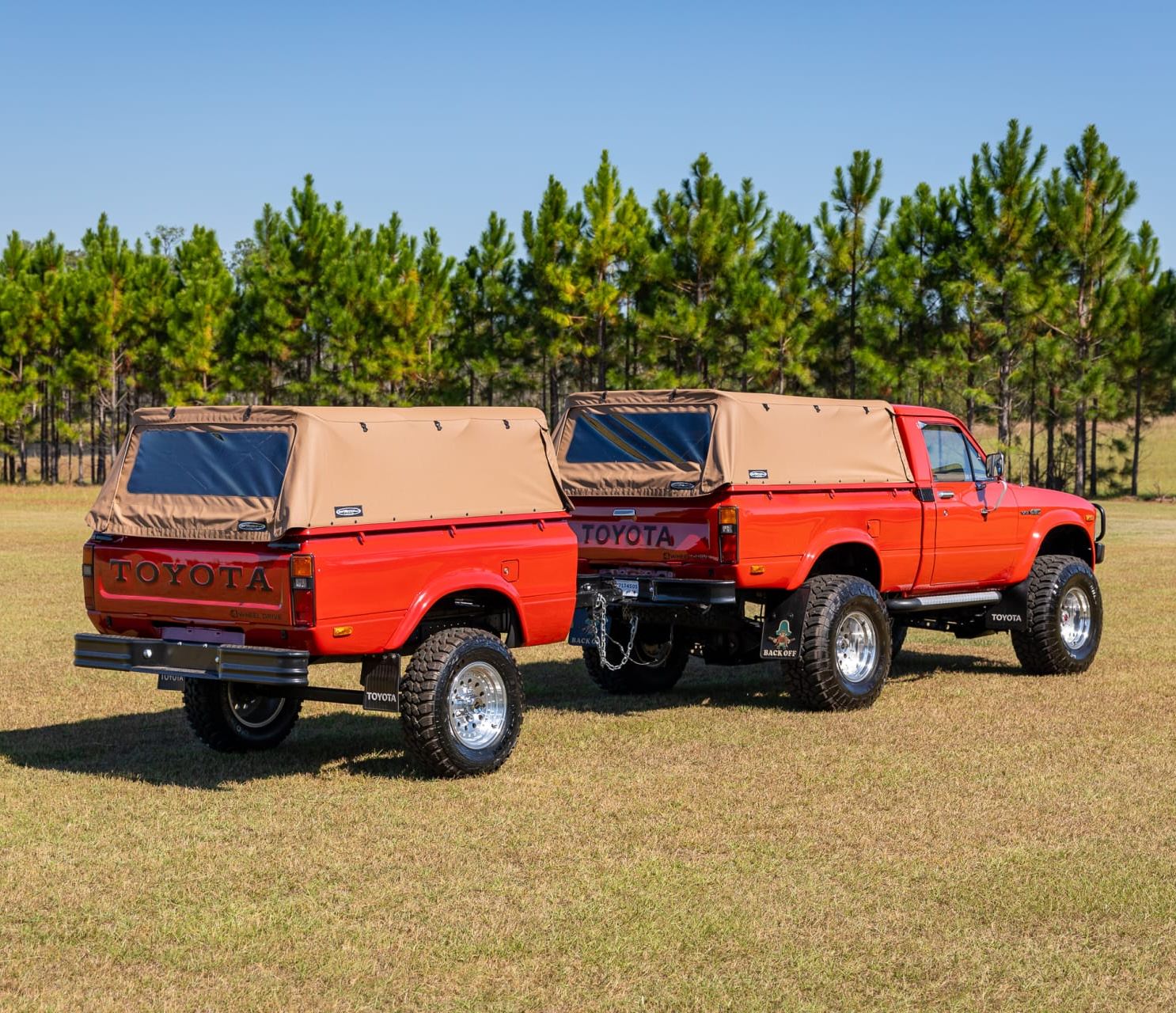
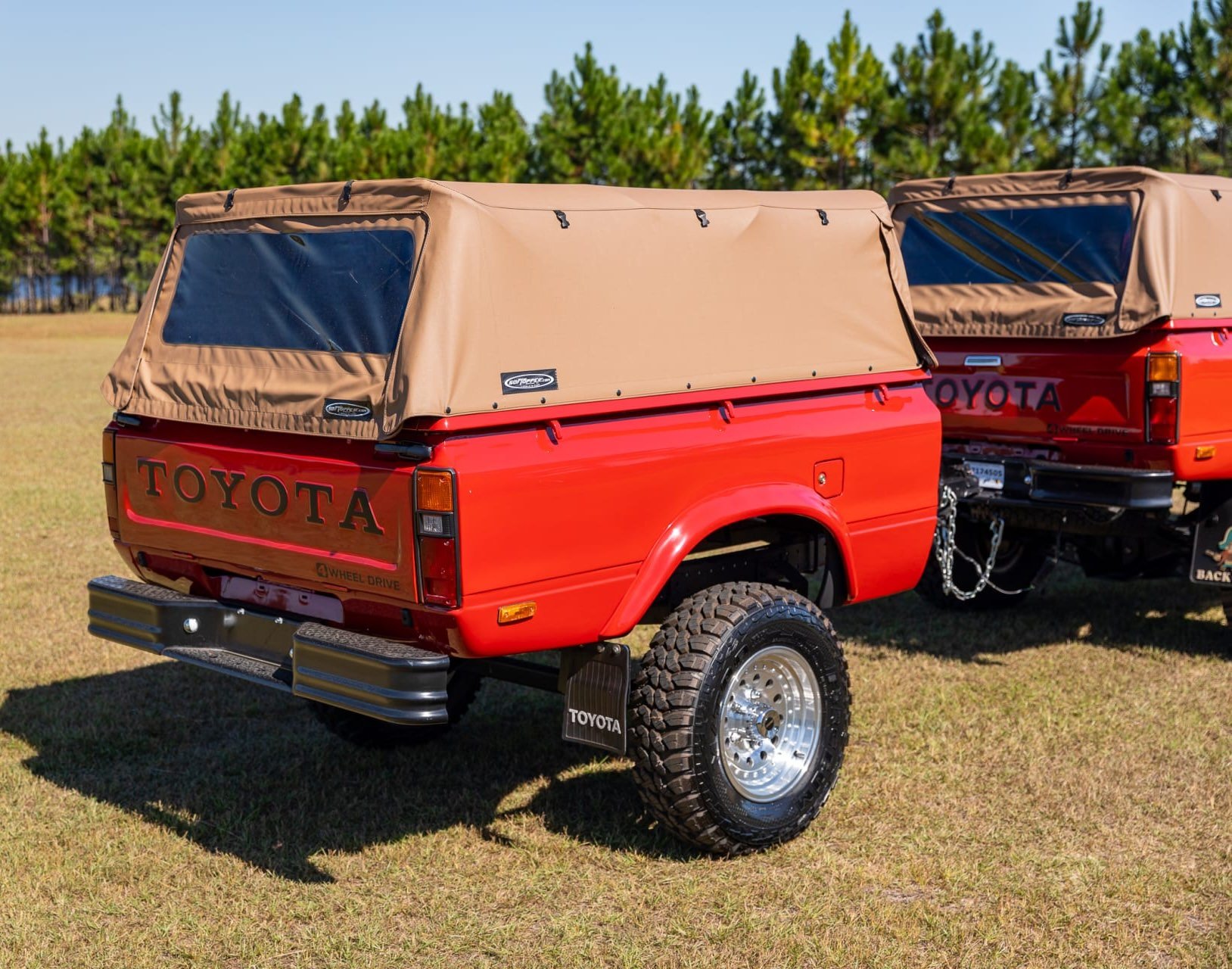
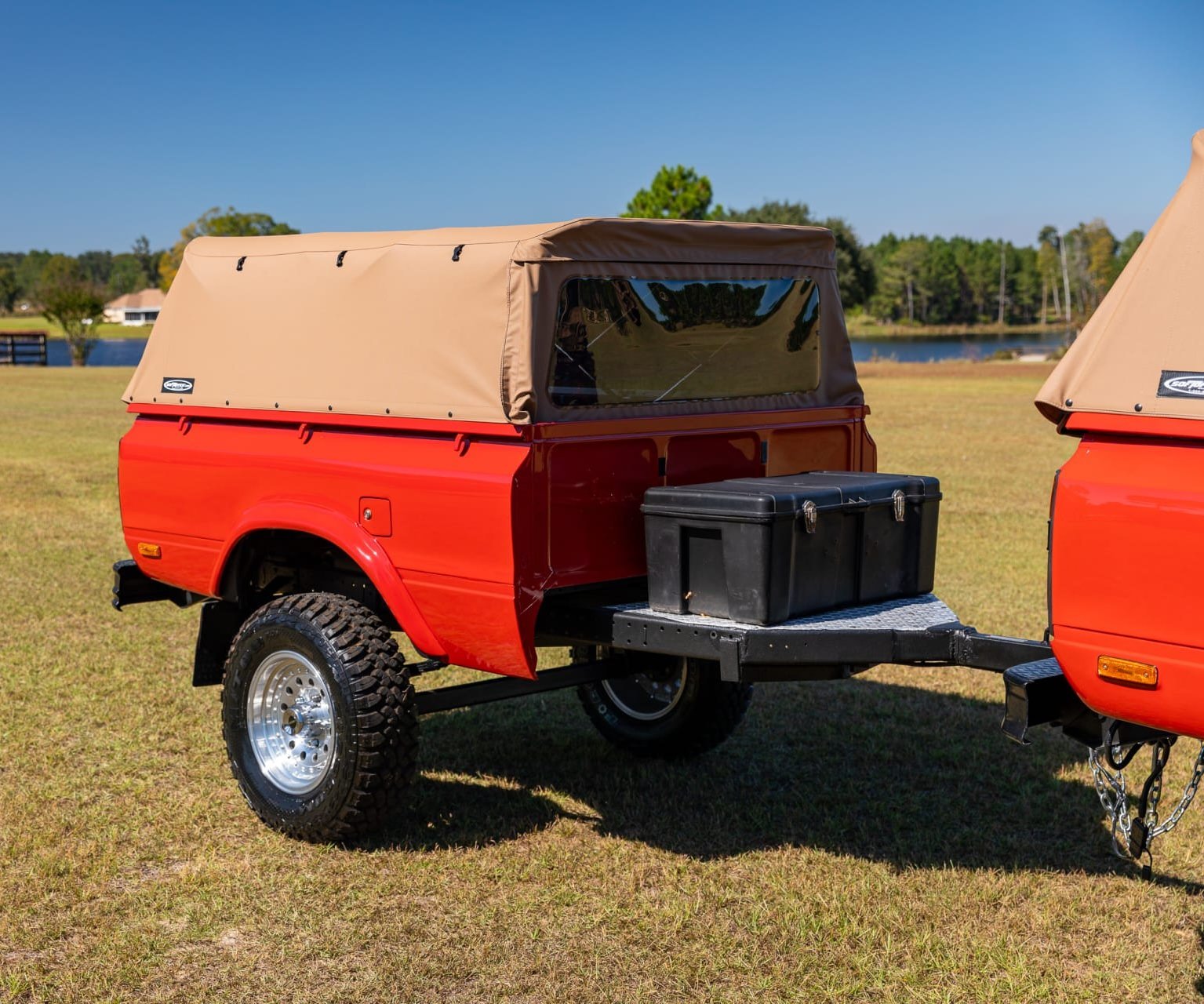
The trailer started life as a 28′ Bayliner boat trailer, it was shortened and modified to accept a Toyota Hilux Pickup bed which was then painted to match and given an identical cargo cover.
The trailer started life as a 28′ Bayliner boat trailer, it was shortened and modified to accept a Toyota Hilux Pickup bed which was then painted to match and given an identical cargo cover.
The vehicle is now due to roll across the auction block with Mecum (with the trailer included) on the 10th of January and you can visit the listing here if you’d like to read more about it or register to bid.
Images courtesy of Mecum

Articles that Ben Branch has written have been covered on CNN, Popular Mechanics, Smithsonian Magazine, Road & Track Magazine, the official Pinterest blog, the official eBay Motors blog, BuzzFeed, Autoweek Magazine, Wired Magazine, Autoblog, Gear Patrol, Jalopnik, The Verge, and many more.
Silodrome was founded by Ben back in 2010, in the years since the site has grown to become a world leader in the alternative and vintage motoring sector, with well over a million monthly readers from around the world and many hundreds of thousands of followers on social media.