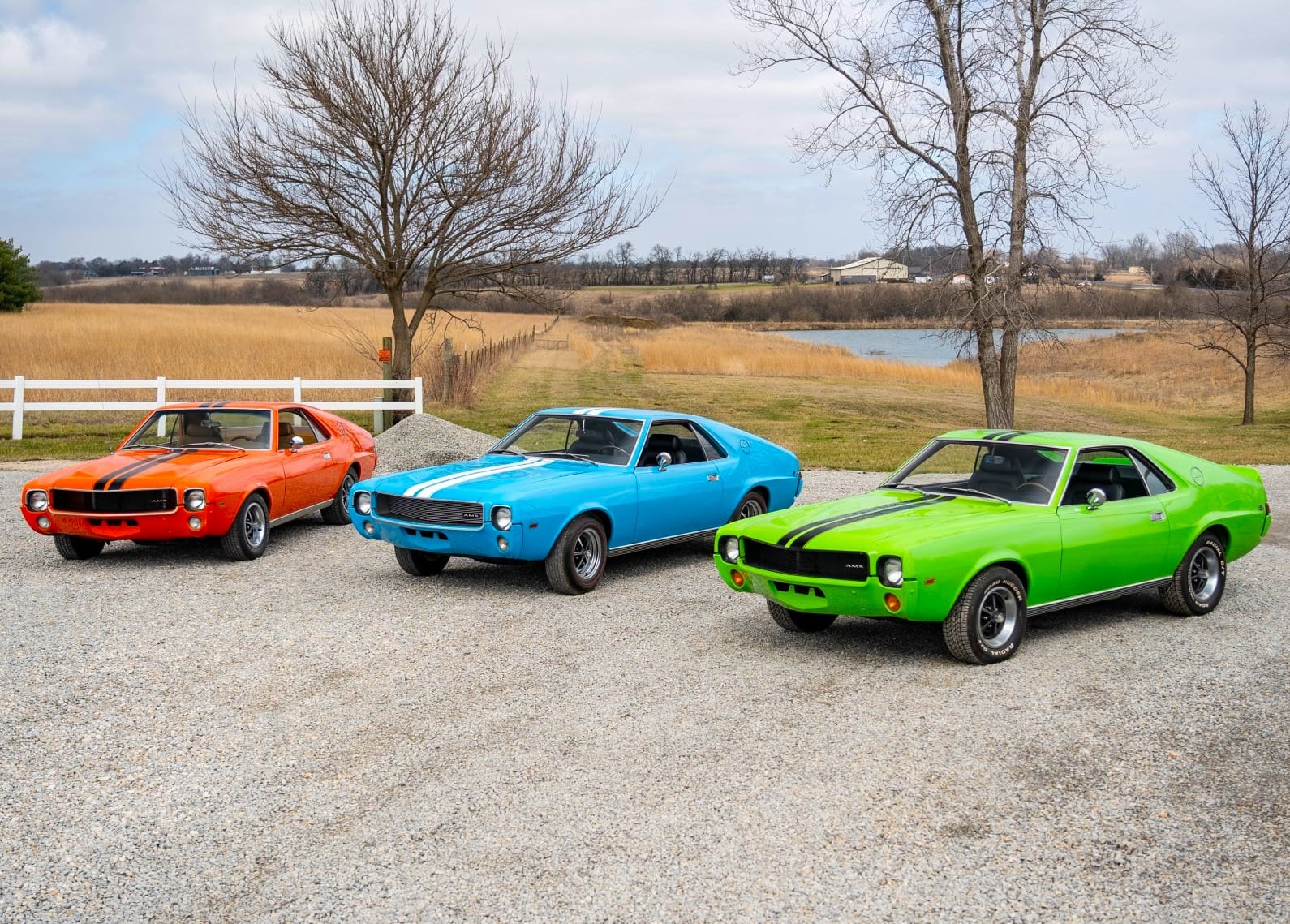
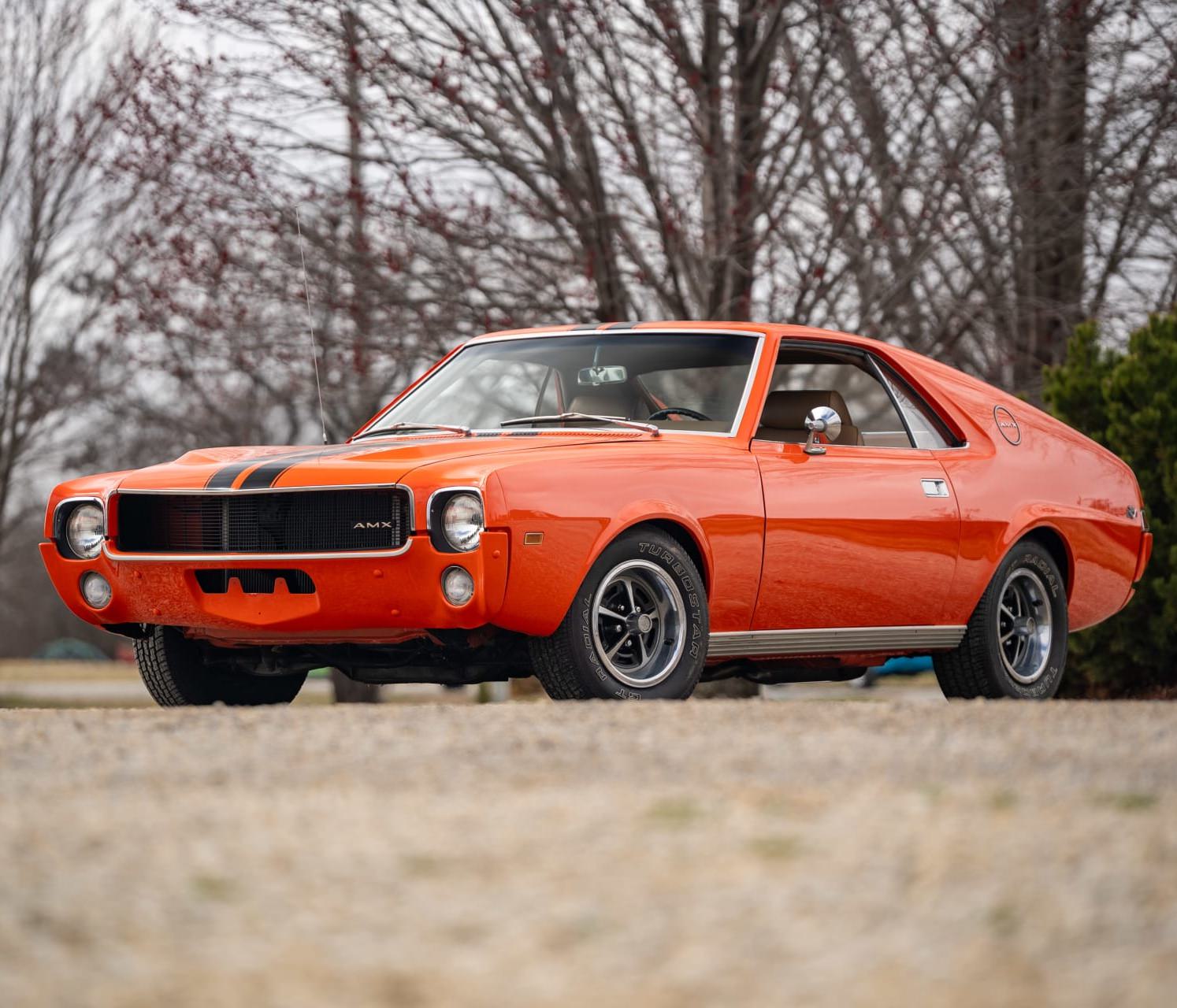
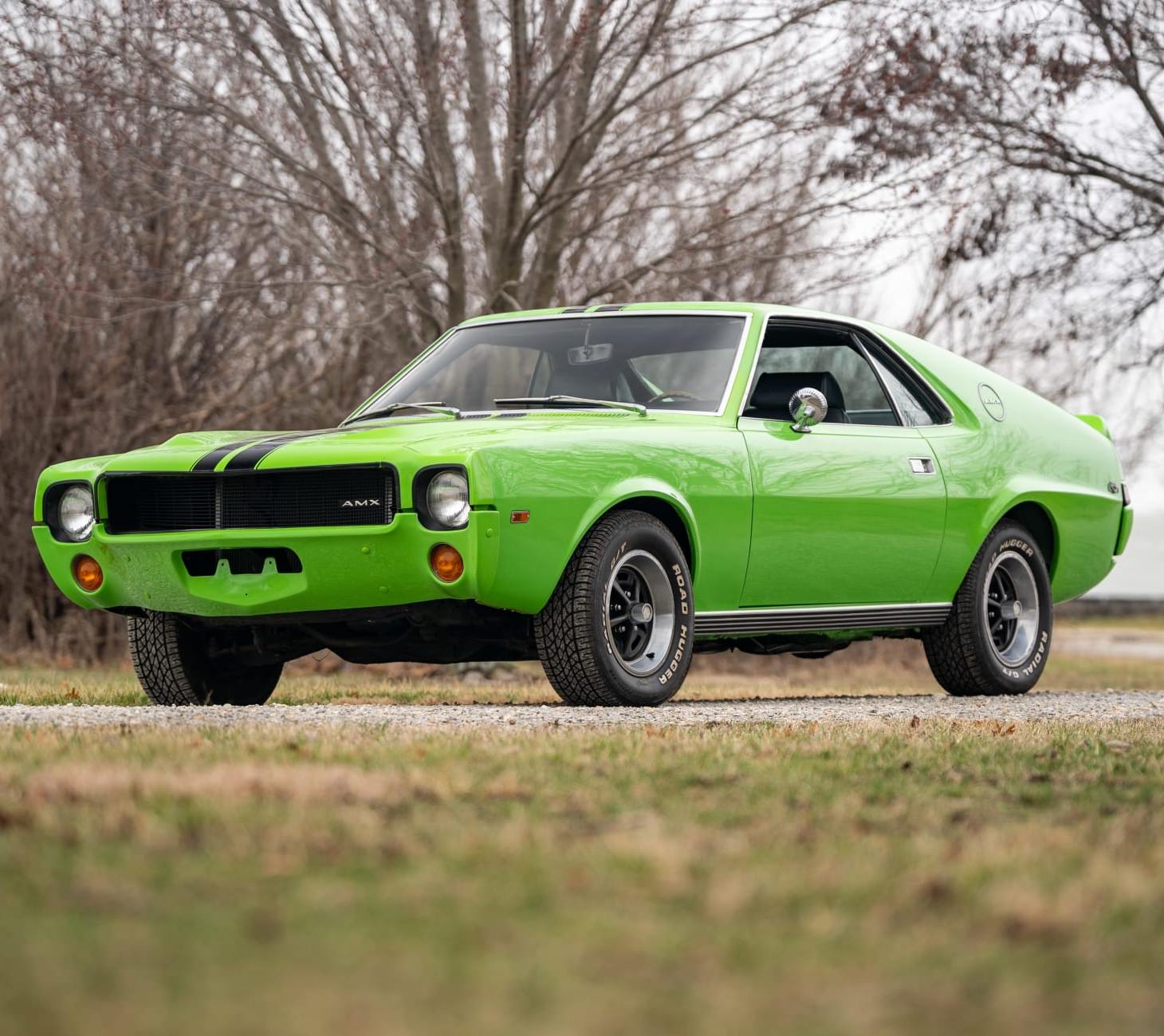
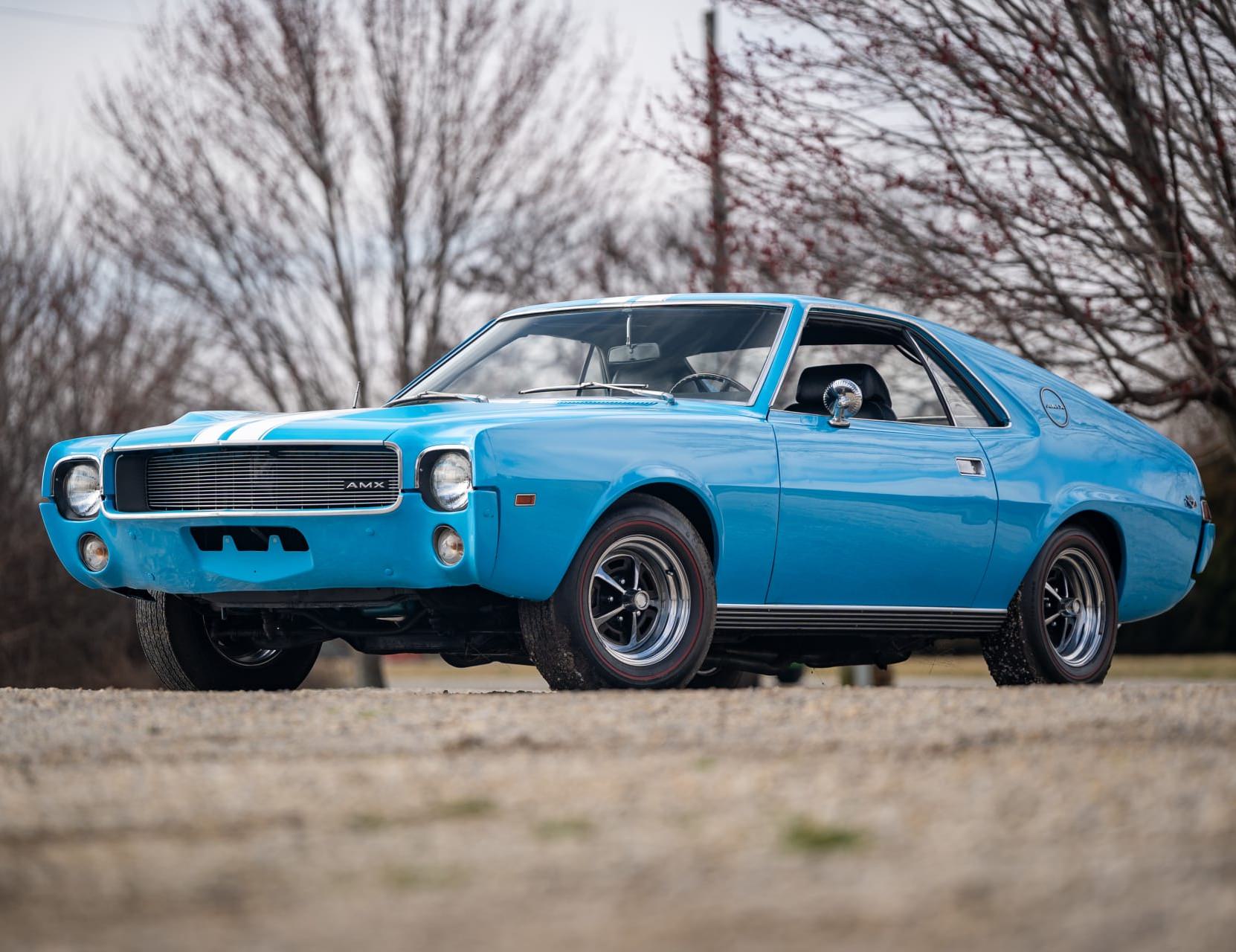
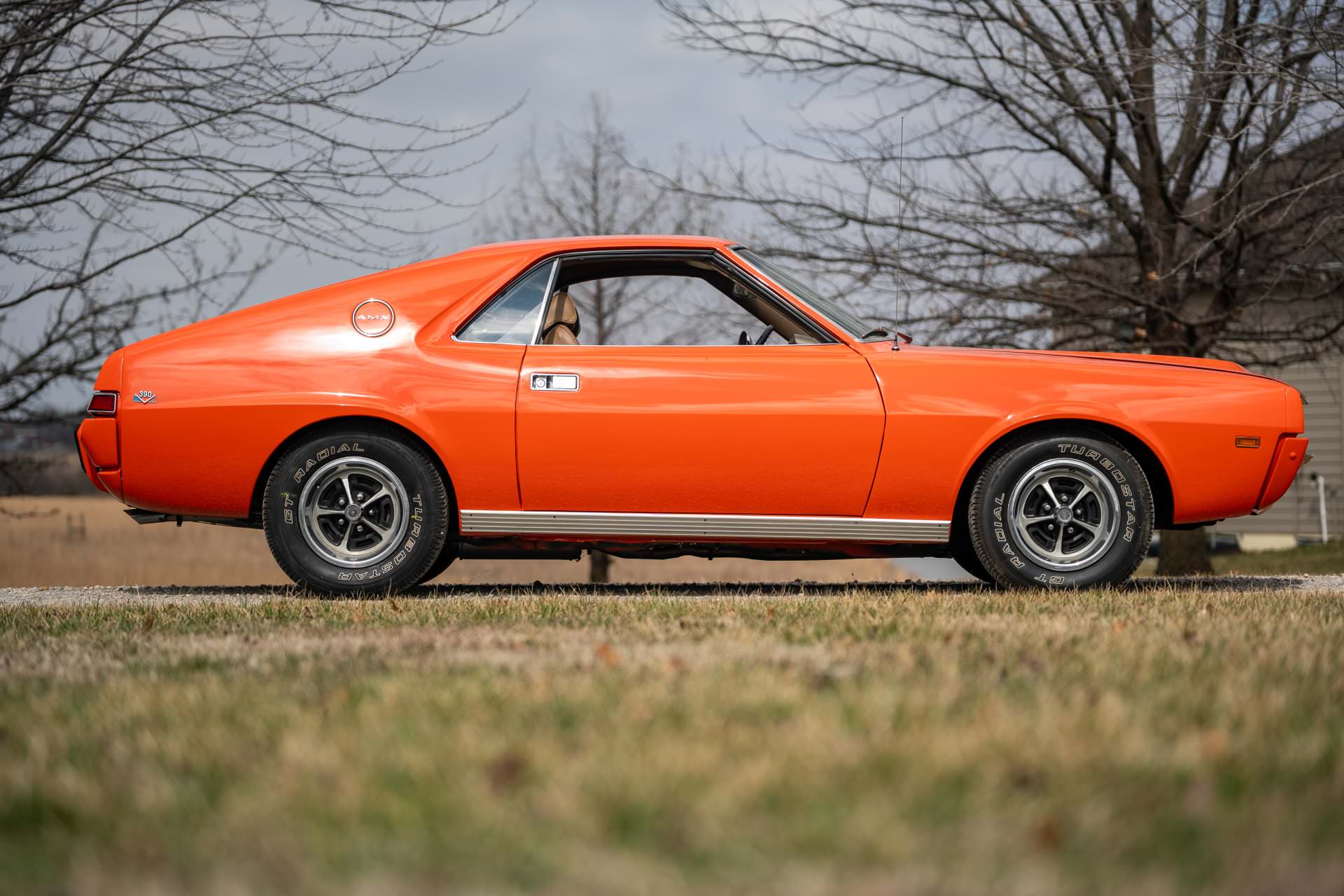
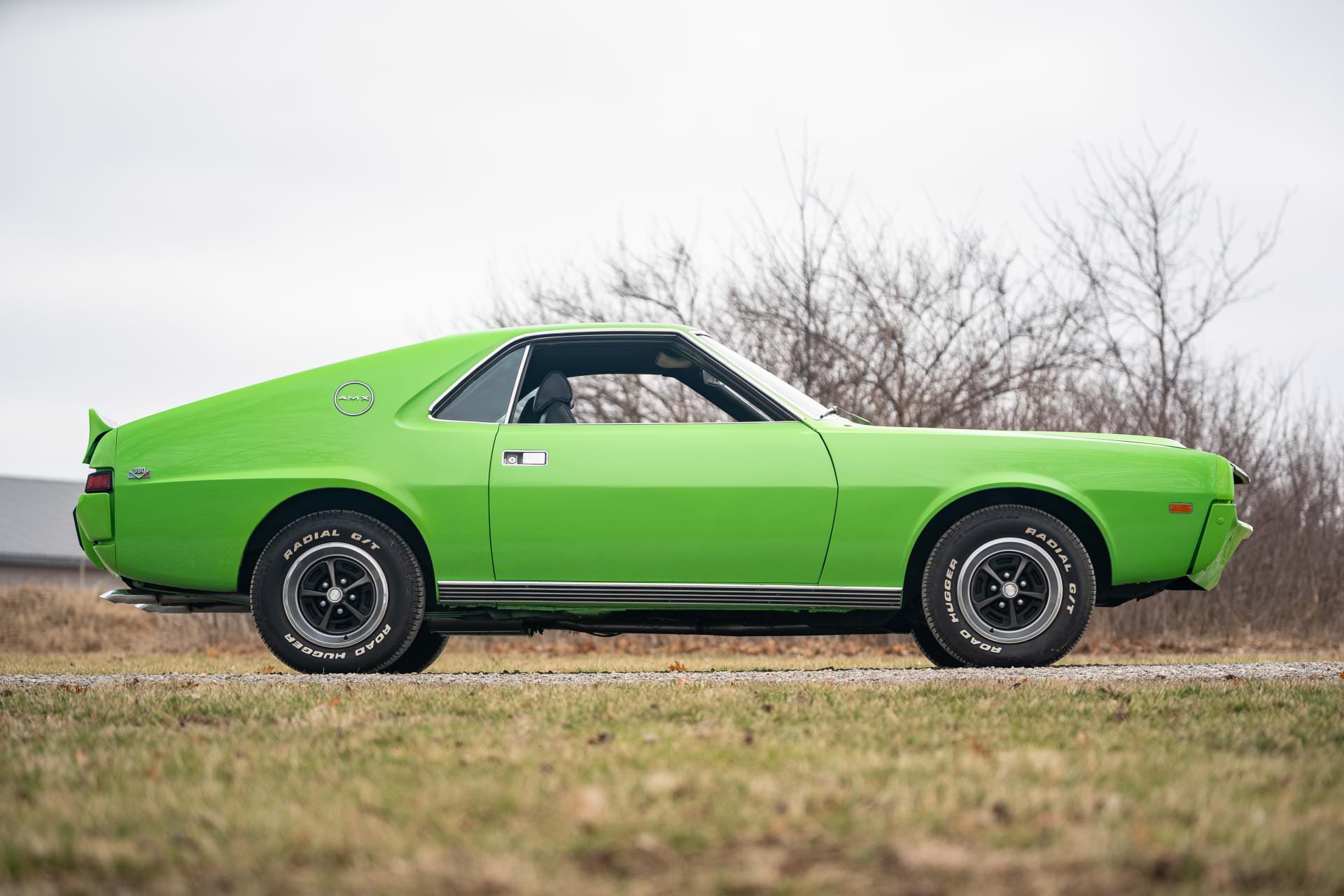
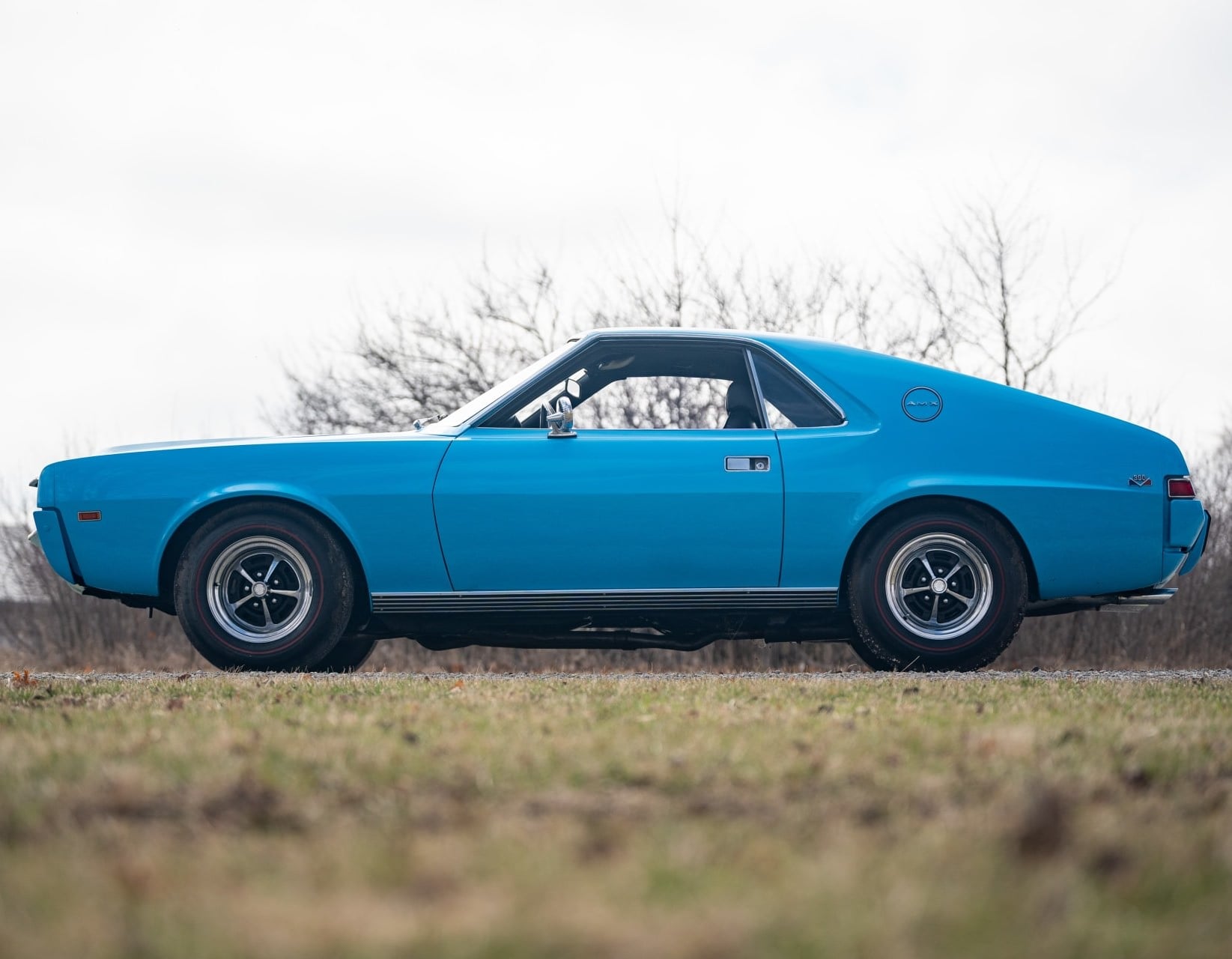
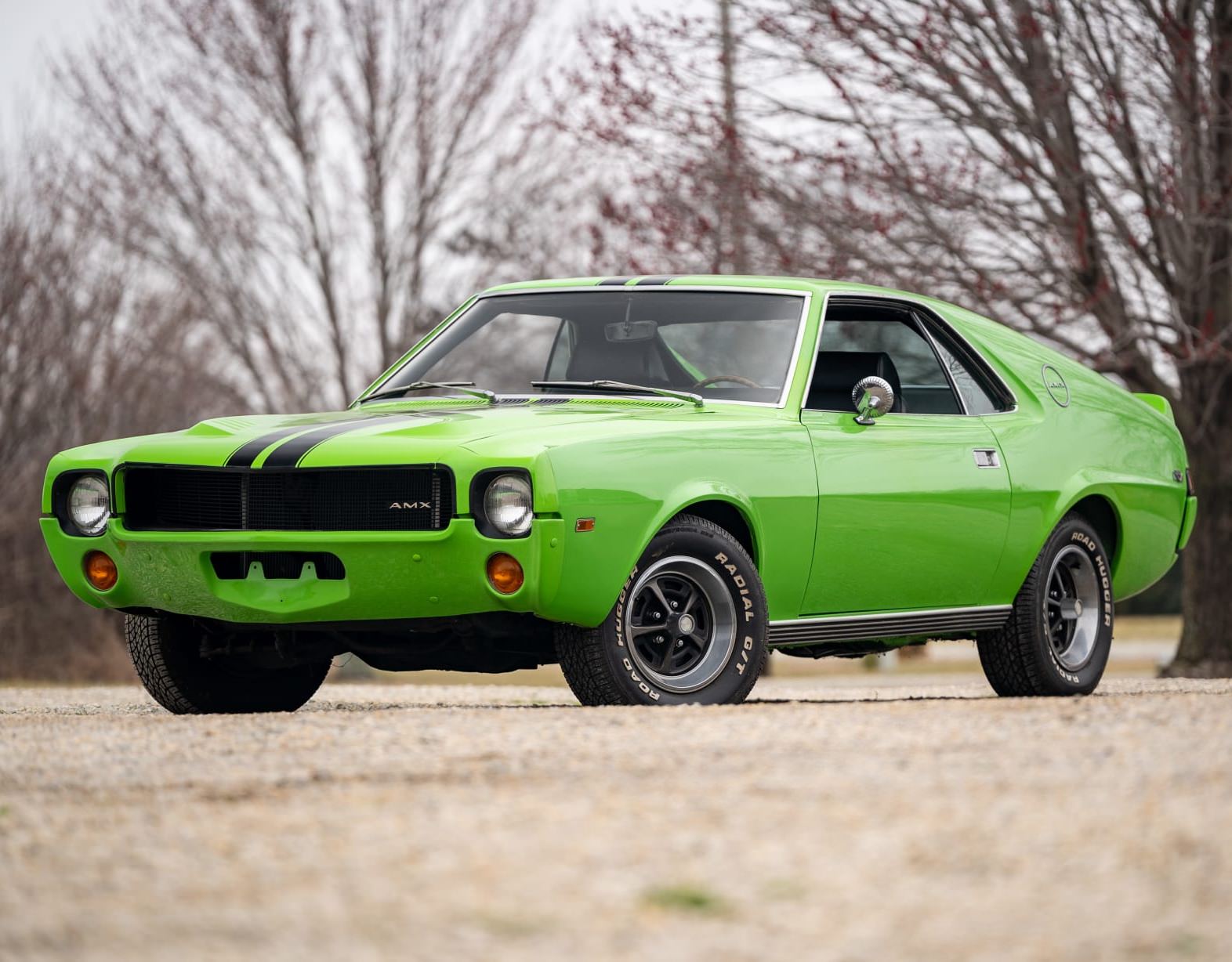
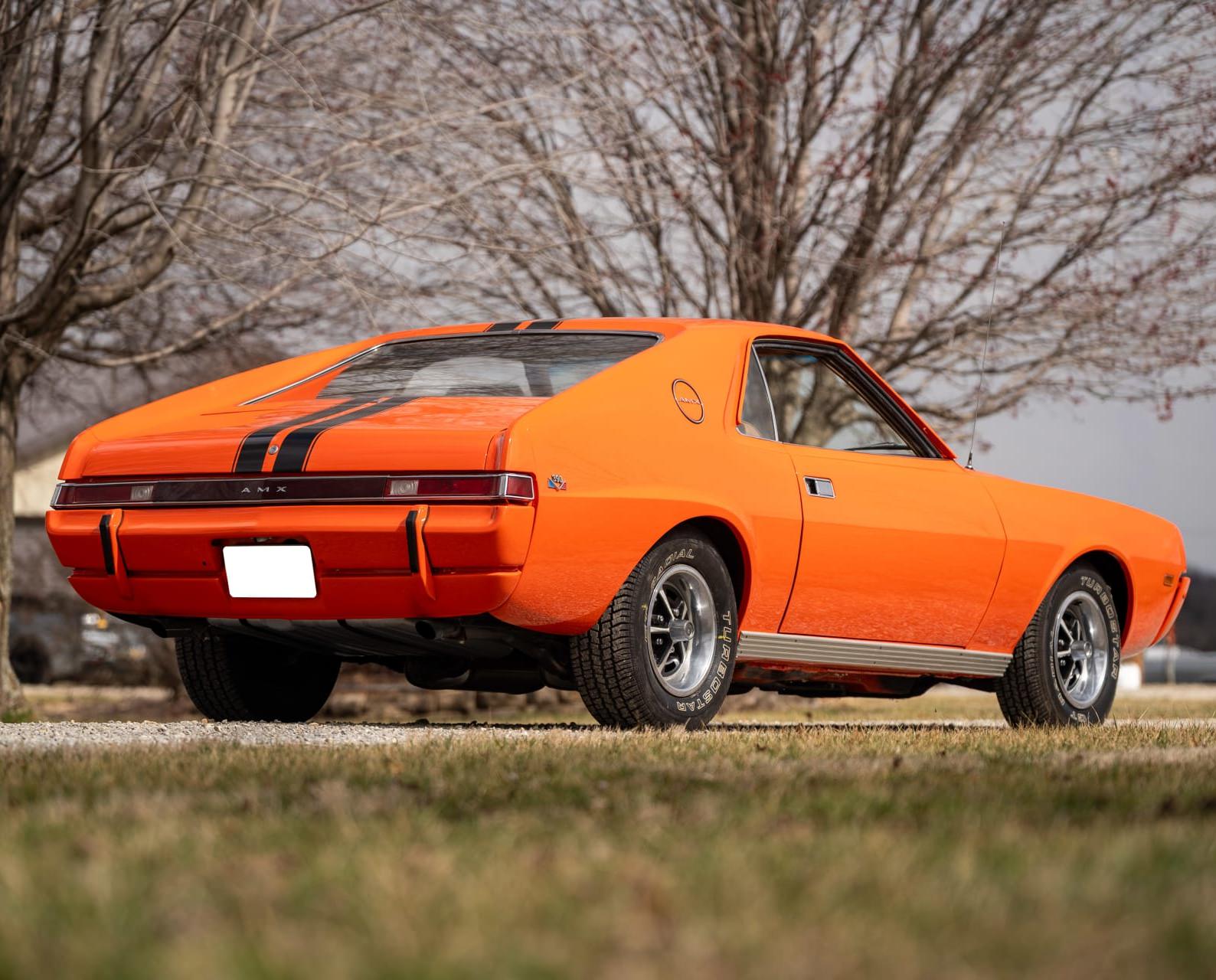
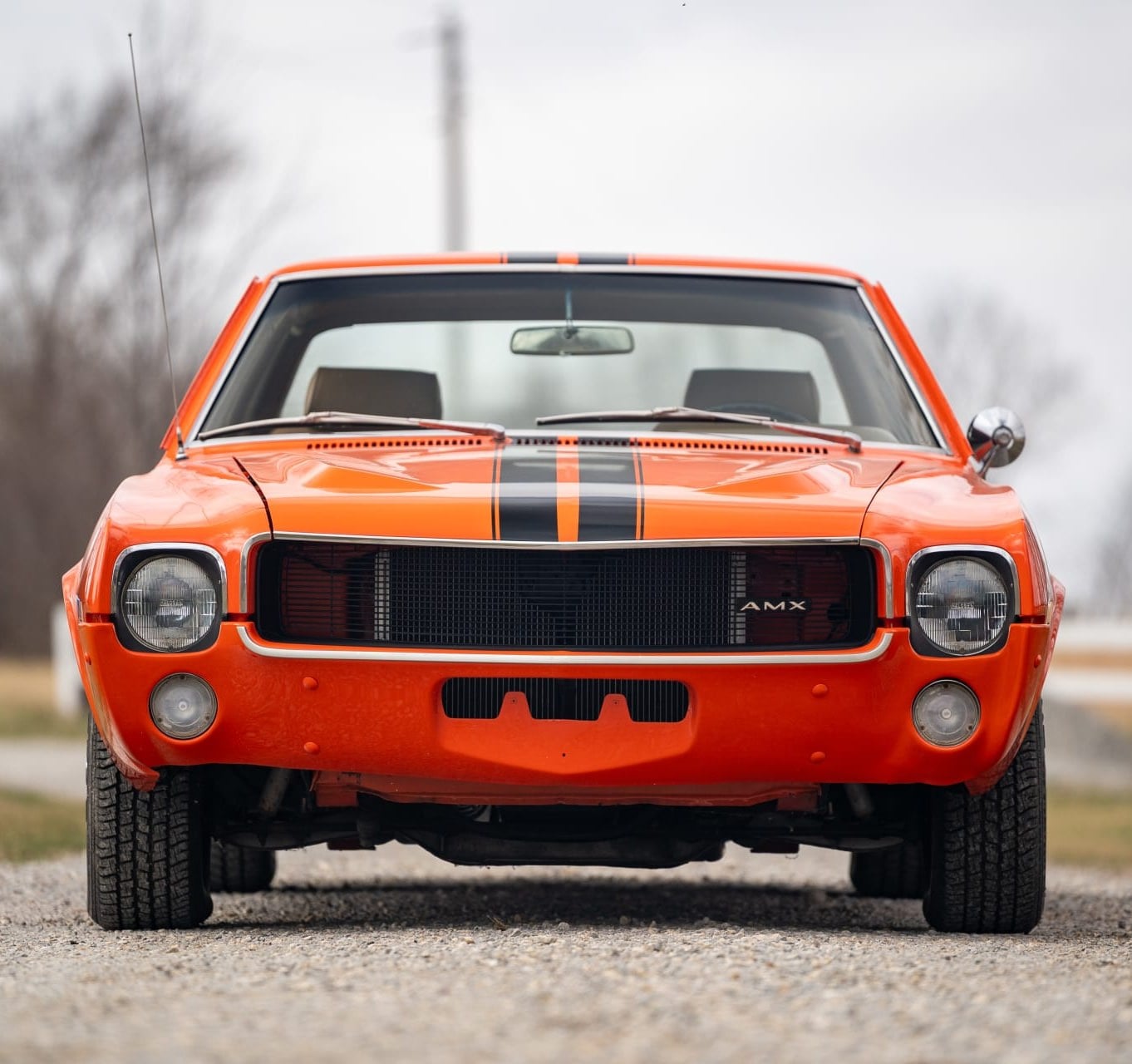
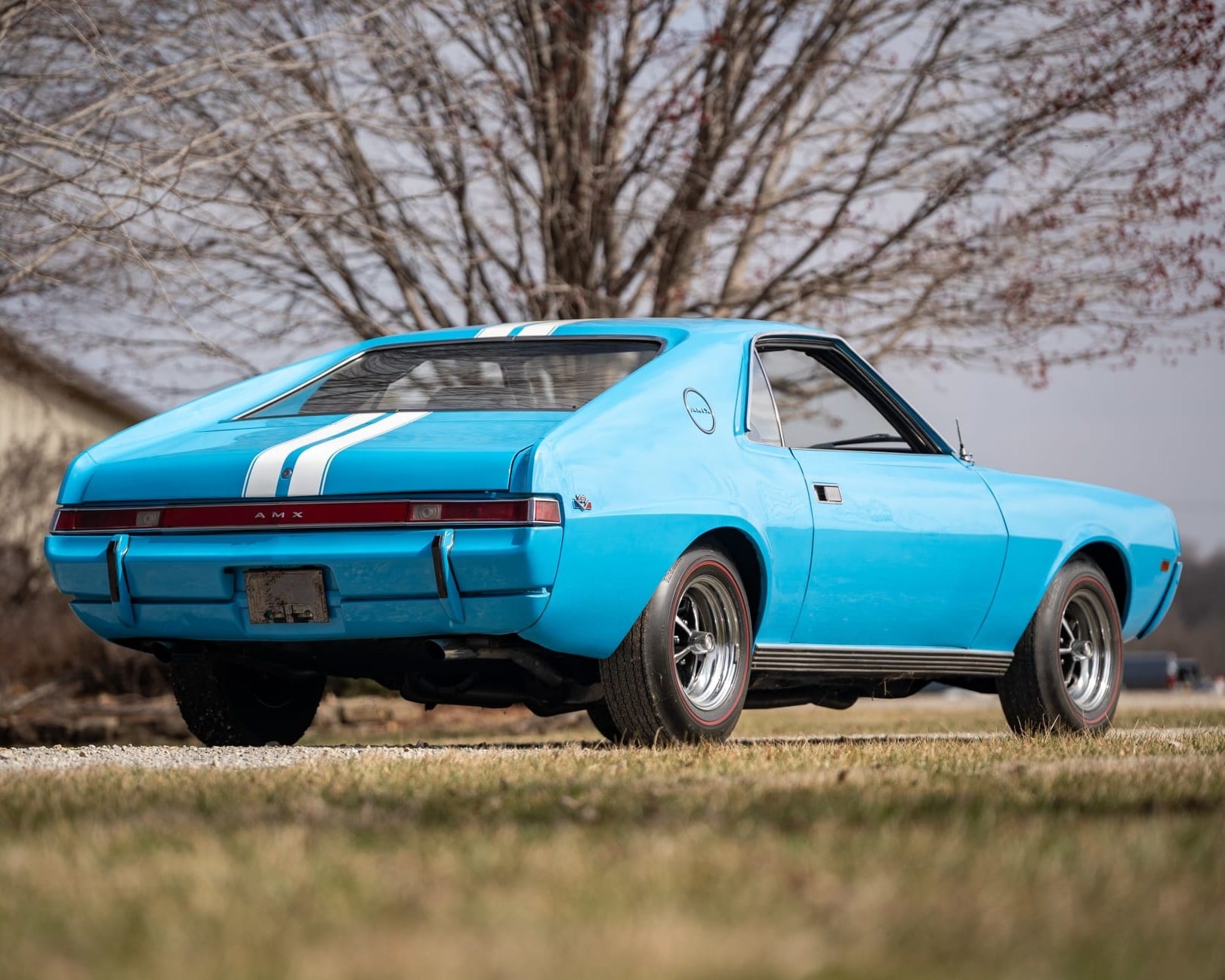
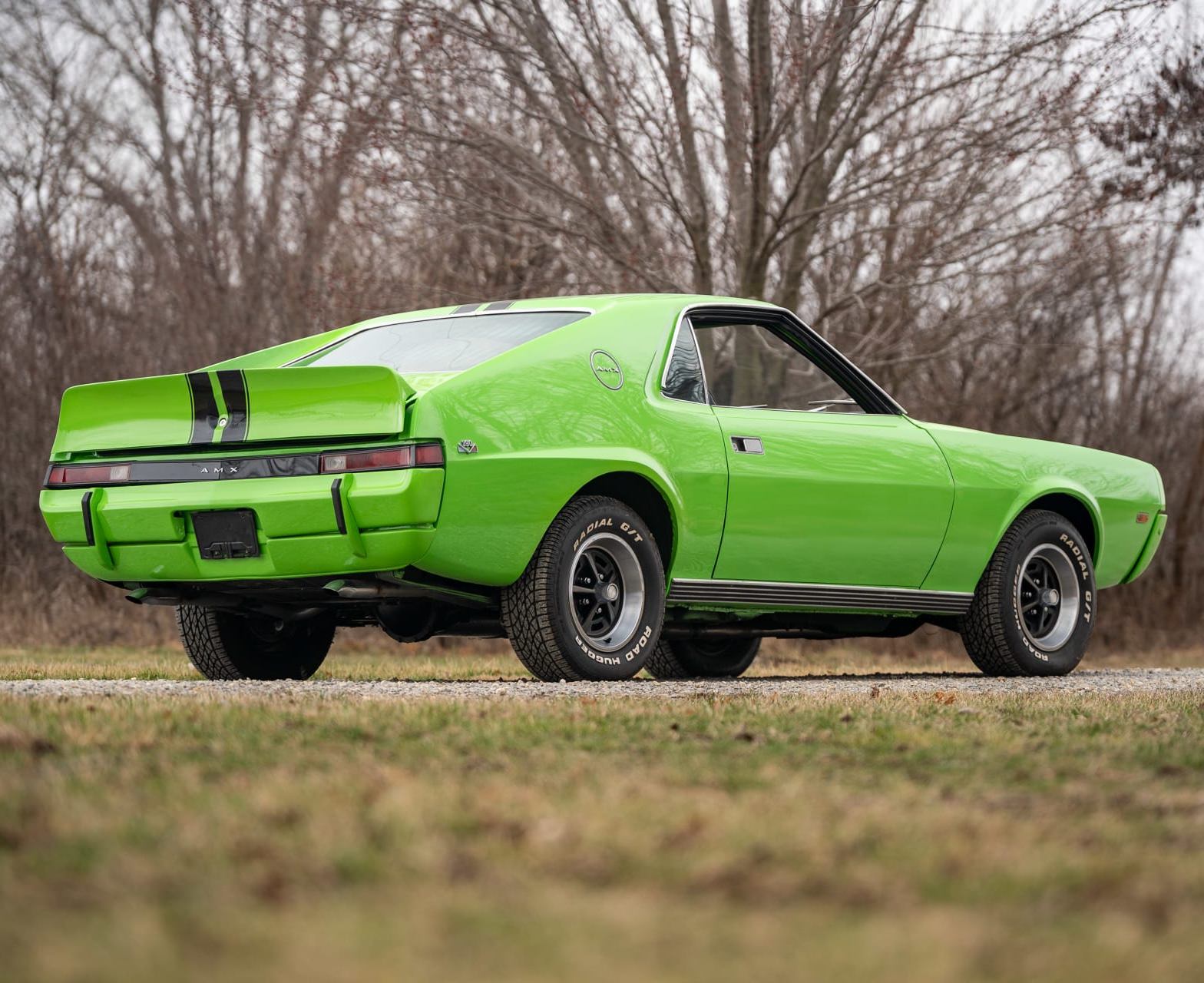
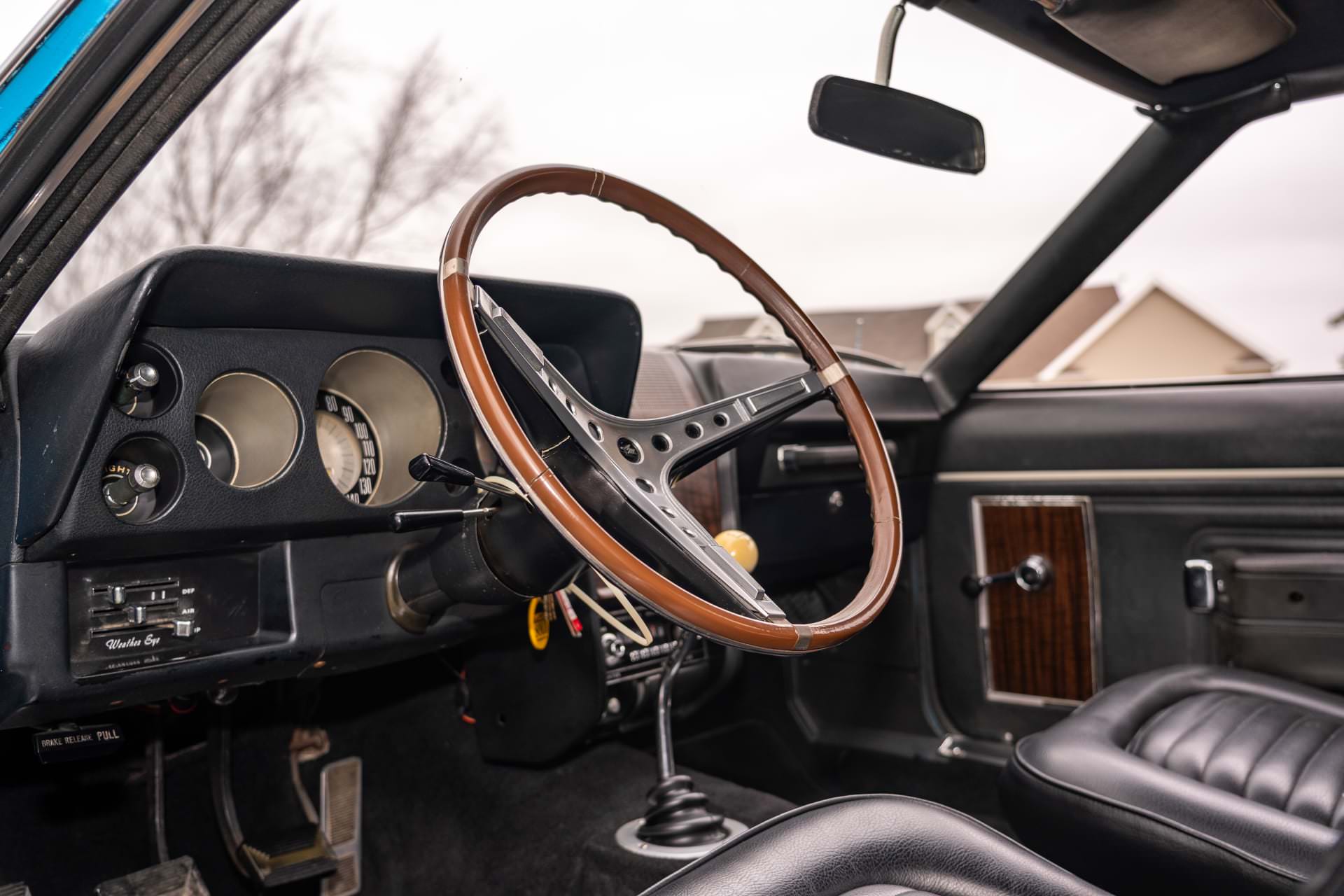
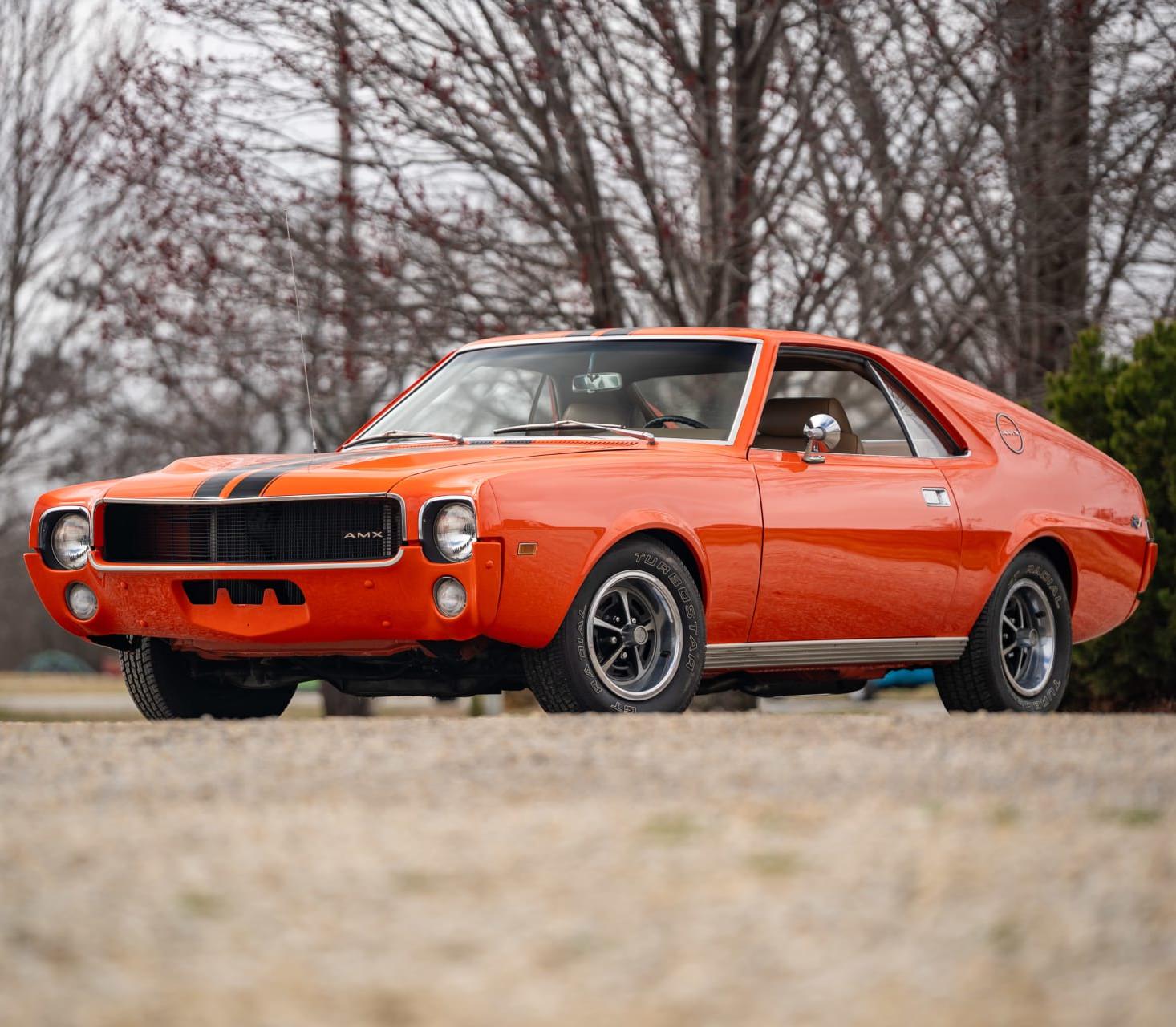
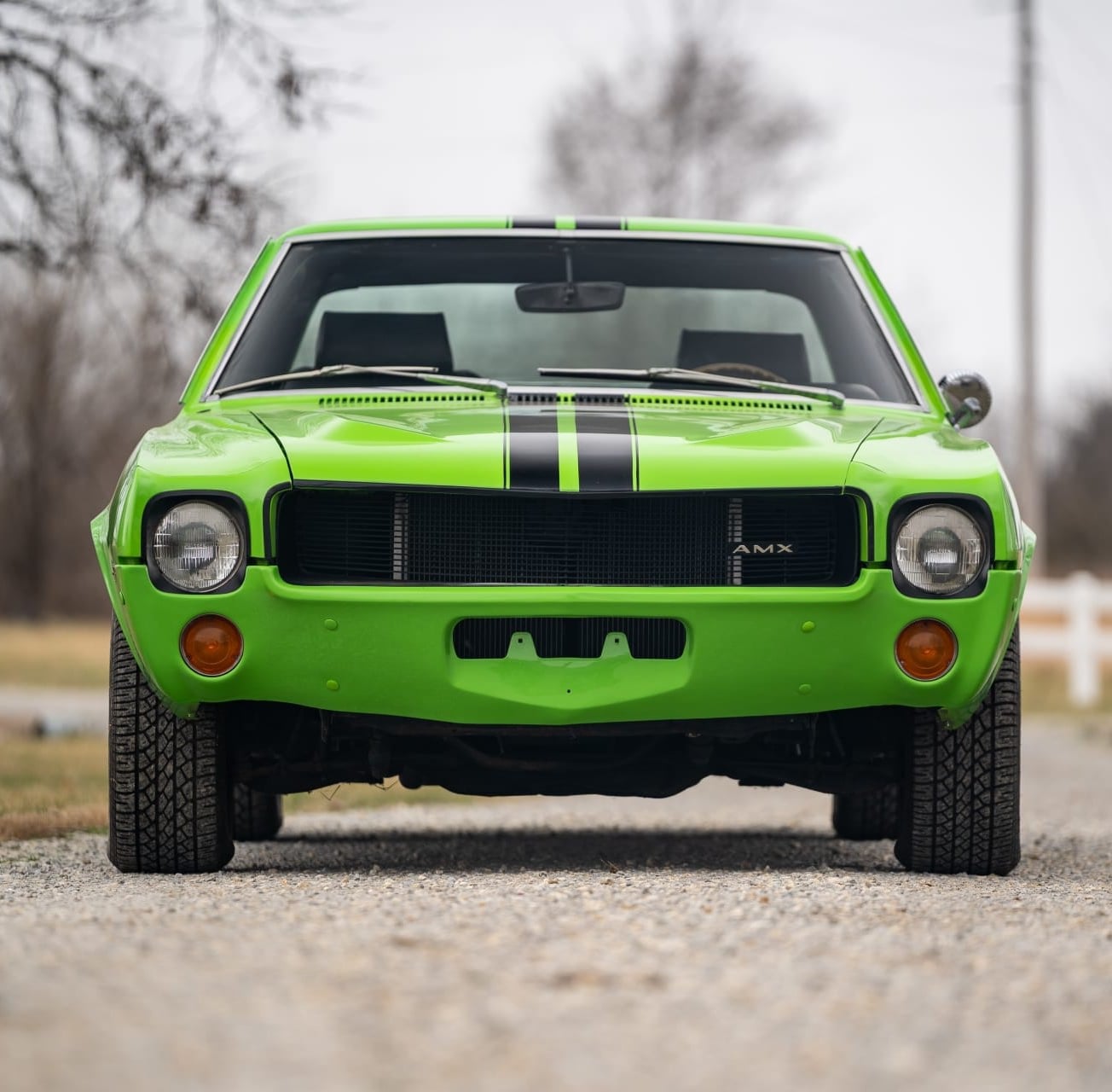
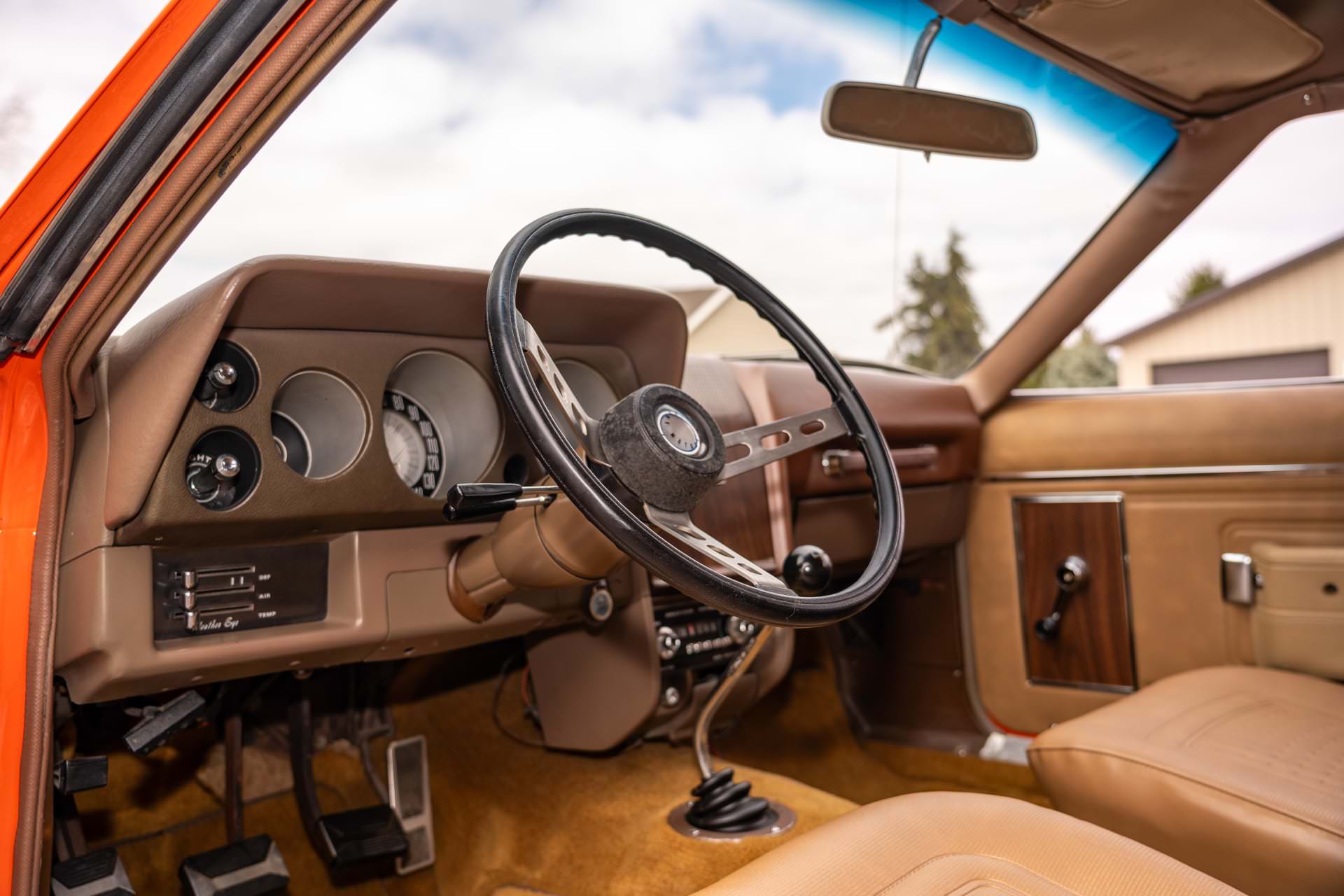
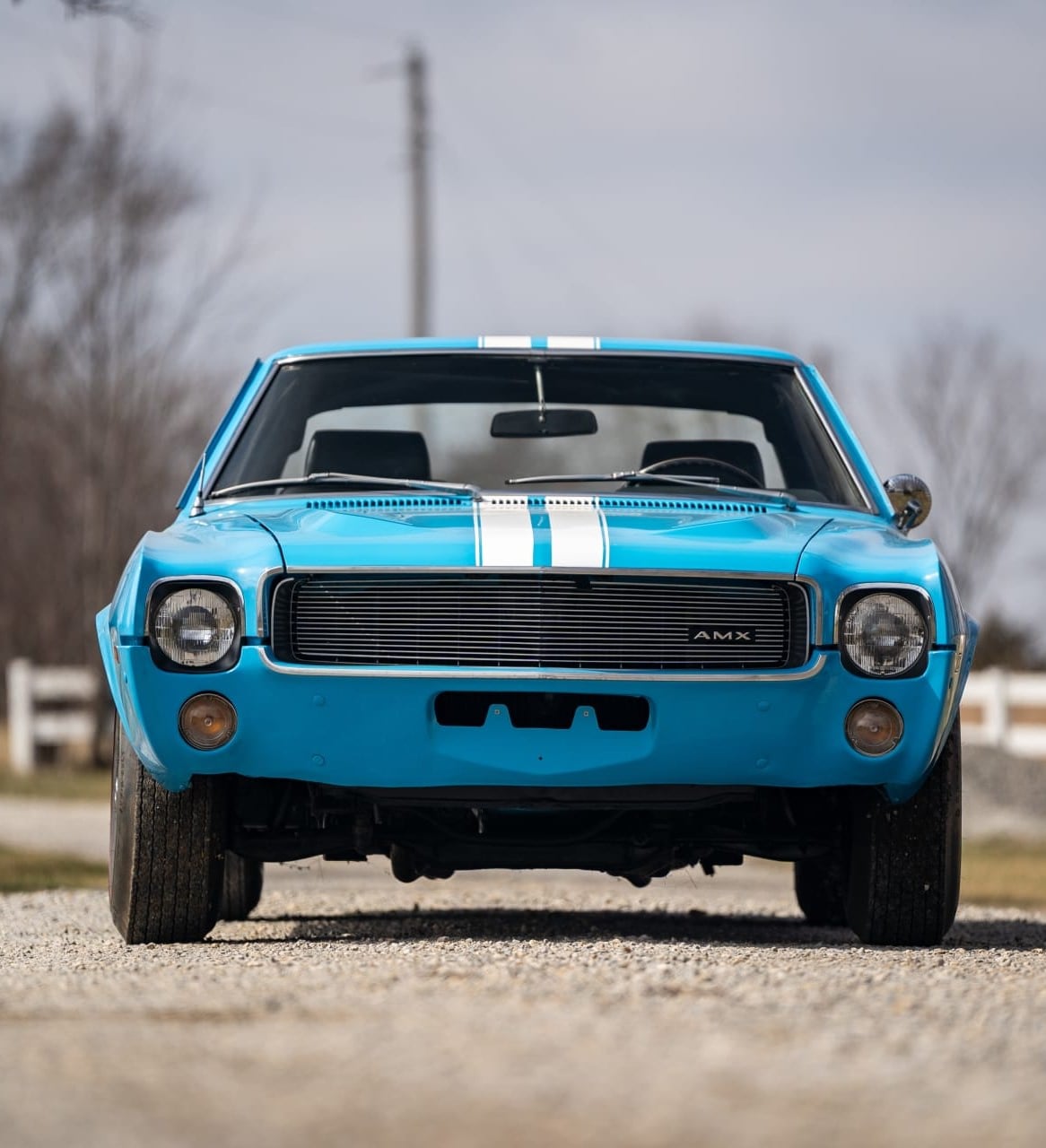
This is the Big Bad AMX Trio, it’s a private collection of all three of the Big Bad Colors of the 1969 AMC AMX, and they’re now being sold as a single lot – possibly for the first time in history.
The AMC AMX was a two-door, two-seat sports car that was offered as a lower-budget competitor for the Corvette – the only other two-seat American coupe in mass production at the time. The AMX became a cult classic in the years that followed, and it still enjoys a strong following today.
Fast Facts: The Big Bad AMX Trio
- The Big Bad AMX Trio is a private collection of three 1969 AMC AMXs, one in each of the model’s famous Big Bad colors: Big Bad Blue, Big Bad Orange, and Big Bad Green. They are now being sold together as a single lot, which may be the first time a complete trio has been publicly offered.
- The AMC AMX began as a 1966 fiberglass concept shown on AMC’s Project IV tour. AMC then developed the production car from the Javelin platform by shortening the wheelbase and creating a two-seat coupe. Launched in 1968, it was marketed as a lower-cost American alternative to the Chevrolet Corvette.
- The AMX mixed sports car and muscle car traits, with V8 power, a short wheelbase, and options including the Go Package. From 1968 to 1970, AMC offered several engine choices and made yearly refinements, but total production remained relatively low, helping establish the AMX’s later reputation as a cult collectible.
- AMC introduced the Big Bad paint package during 1969, adding bright special-order colors and body-colored bumpers for a more aggressive appearance. Only a small number were built, making them especially desirable today. The trio featured here consists of restored Go Pack, 390 V8, 4-speed cars, making the set unusually rare and significant.
History Speedrun: The AMC AMX
The AMC AMX has its origins in an unusual fiberglass concept car first shown on American Motors Corporation’s “Project IV” automobile show tour in 1966. The AMX abbreviation comes from the name “American Motors eXperimental” used on the concept. The two-seat car, designed under the direction of Charles Mashigan, had a clever fold-out “Ramble Seat” and it proved to be a surprise hit on the show circuit, convincing AMC management to green-light a production version.
 Under AMC’s Vice President of Design Dick Teague, along with engineer Vic Raviolo, the production AMX was created by cutting 12 inches from the Javelin’s wheelbase, removing the rear seat, and giving the car a bolder grille and clean, fastback roofline. Image courtesy of American Motors Corporation.
Two development paths were considered for the proposed car – a modified version of the upcoming Javelin pony car and an entirely new fiberglass-bodied vehicle, possibly influenced by the Corvette. AMC chose the Javelin-based approach, largely for cost savings reasons, as it allowed the company to leverage its existing unibody manufacturing expertise and manufacturing capability, and to use many parts in common with the Javelin.
Under AMC’s Vice President of Design Dick Teague, along with engineer Vic Raviolo, the production AMX was created by cutting 12 inches from the Javelin’s wheelbase, removing the rear seat, and giving the car a bolder grille and clean, fastback roofline.
The result was a 97 inch wheelbase two-seat coupe, the first steel-bodied American two-seat performance car since the 1955 to 1957 Ford Thunderbird. AMC introduced the AMX to the press at Daytona International Speedway on February the 15th, 1968, where demonstration cars reached speeds of 130+ mph. It went on sale to the public on February the 24th, 1968, promoted as “the only American sports car that costs less than $3,500” – a direct jab at Chevrolet’s Corvette.
Craig Breedlove + The World Records
To build excitement before launch, AMC enlisted the help of legendary world land speed record holder Craig Breedlove. In January of 1968, two specially prepared AMXs set no less than 106 world speed and endurance records at Goodyear’s test track in Texas. Breedlove later took an AMX to Bonneville, achieving 189 mph in a USAC-sanctioned run and reportedly exceeding 200 mph in unofficial runs.
The Competition
As one of only two American-built two-seater sports cars, the AMX’s most direct competitor was the Corvette. The AMX’s wheelbase was one inch shorter than the Corvette’s and its base price of $3,245 was nearly 25% (over $1,000) less than the Corvette’s cost off the showroom floor.
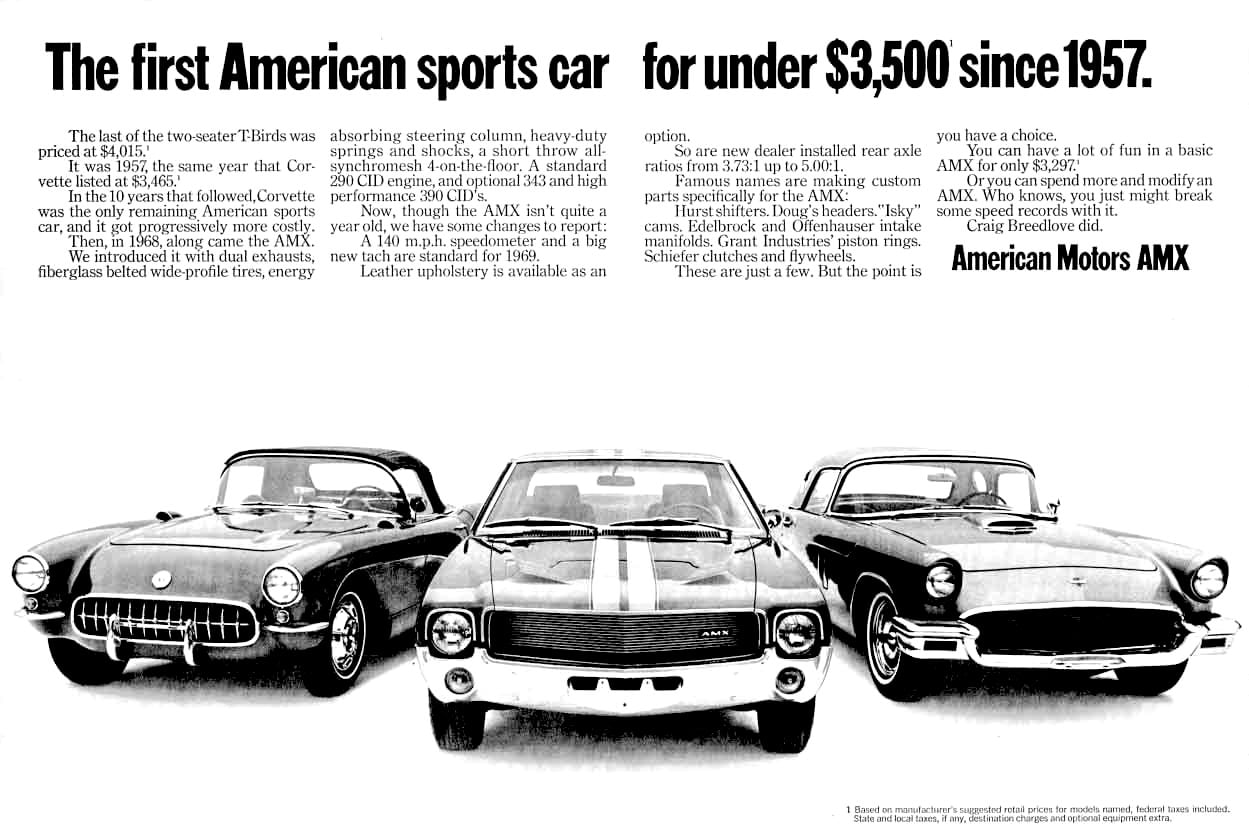
As one of only two American-built two-seater sports cars, the AMX’s most direct competitor was the Corvette. The AMX’s wheelbase was one inch shorter than the Corvette’s and its base price of $3,245 was nearly 25% (over $1,000) less than the Corvette’s cost off the showroom floor. Image courtesy of American Motors Corporation.
The AMX was designed to appeal to both muscle car and sports car enthusiasts, a combination that, while it was praised by the automotive press, sometimes proved confusing for the American buying public. In reality, the AMX competed for attention against pony cars like the Ford Mustang, Chevrolet Camaro, and its own sibling, the four-seat AMC Javelin, much more than it did against the two-seat Chevy.
Key AMX Model Year Changes
1968
The first year examples of the AMX offered three four-barrel AMC V8 engine choices – the base 290 cubic inch (225 bhp, N-code), the mid-range 343 cubic inch (280 bhp, T-code), and the top 390 cubic inch (315 bhp, 425 lb ft of torque, X-code).
A BorgWarner T-10 4-speed manual was standard, with a 3-speed “Shift-Command” automatic optional. The popular “Go-Package” added front disc brakes, a Twin-Grip differential, performance tires, and heavy-duty suspension. In 1969, the Society of Automotive Engineers recognized the 1968 AMX as best engineered car of the year, noting its industry-first one-piece injection-molded dashboard among other features. AMC built 6,725 AMXs for 1968.
1969
The second year of the AMX brought mostly minor refinements, the cars had revised interior door panels, upgraded carpeting, optional leather upholstery, and a suspended gas pedal. The tachometer moved to match the speedometer, now calibrated to 140 mph.
Starting in January of 1969, all manual-transmission AMXs received a Hurst floor shifter. The “Big Bad” paint option debuted mid-year (see more about that below). AMC also introduced the Super Stock AMX, a factory drag racer with twin Holley carburetors and 12.3:1 compression heads, rated at 340 bhp by AMC but 420 bhp by the NHRA. Production rose to 8,293 units, the highest of the three-year run, and a respectable number by AMC standards.
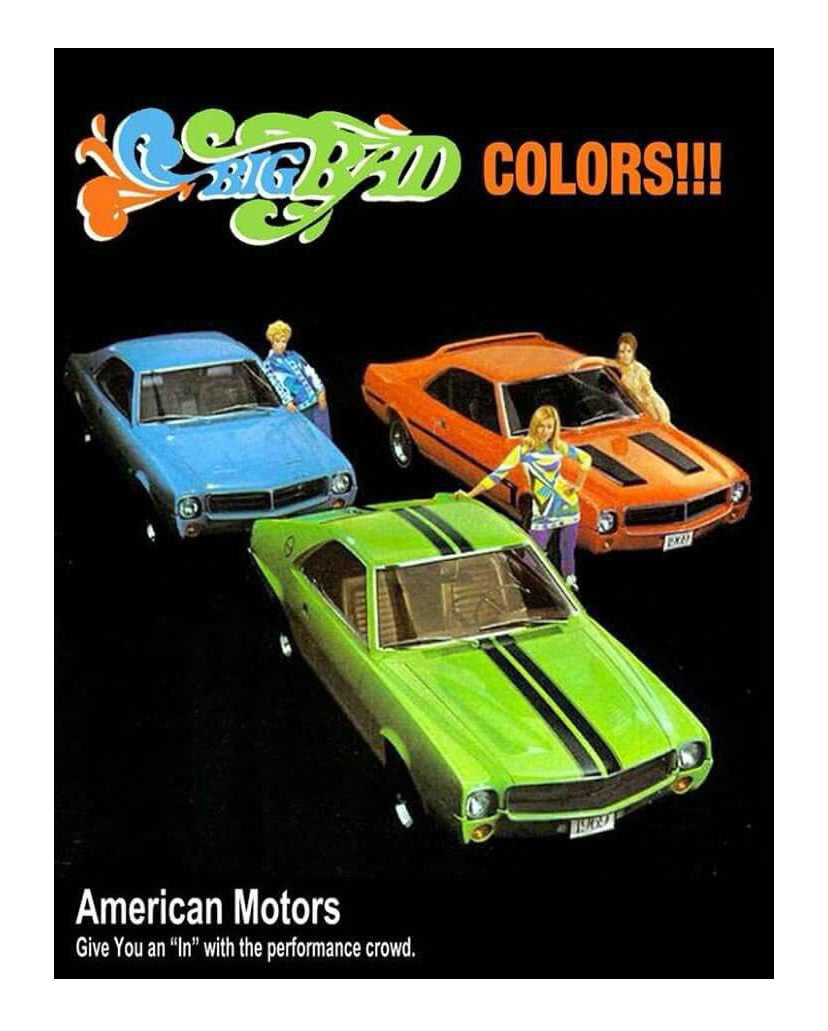
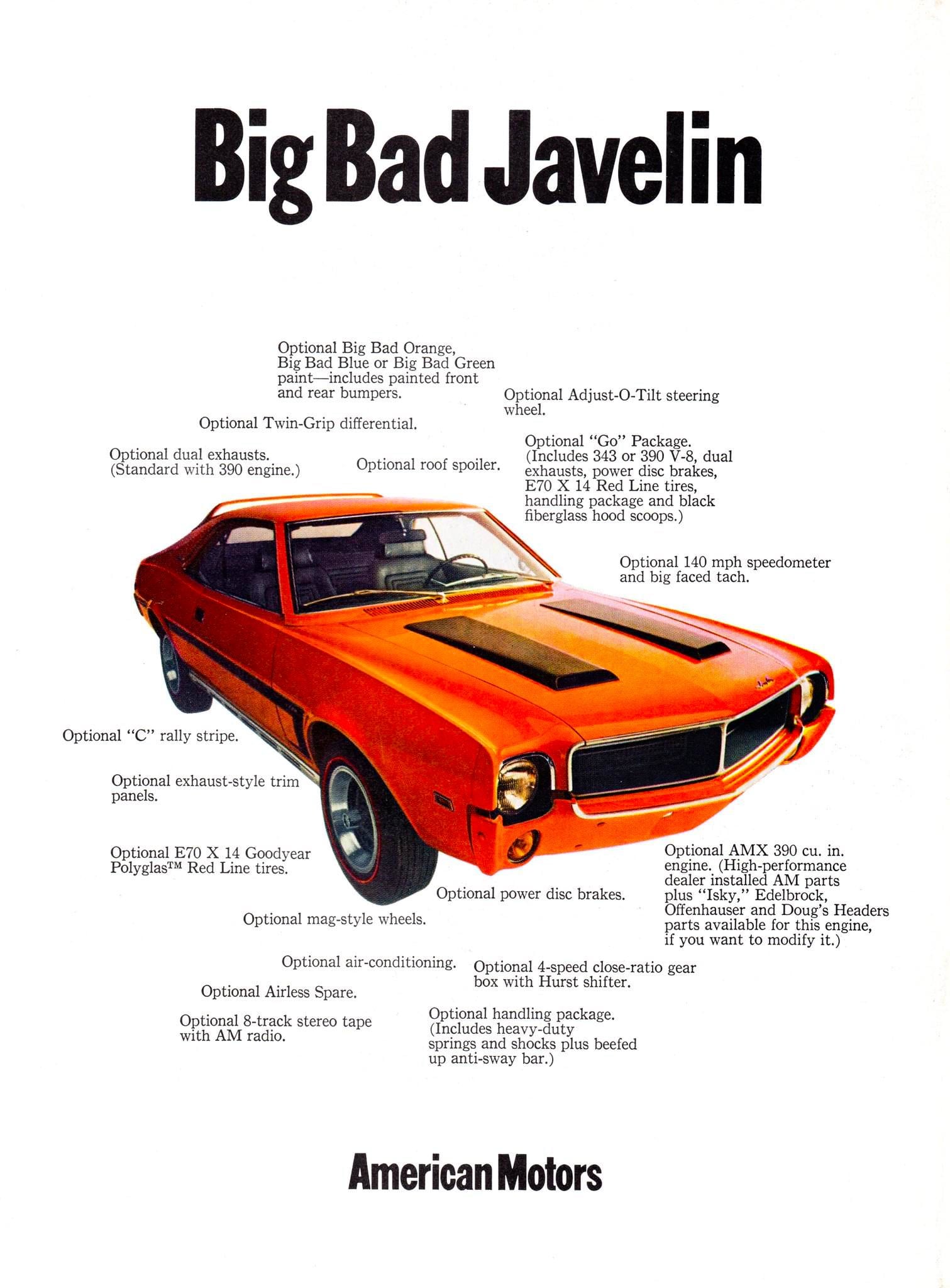
In mid-1969, AMC introduced one of the most memorable options in its history – the “Big Bad” paint package. For just $34, buyers could order their AMX (or Javelin) in one of three neon-bright colors: Big Bad Blue (paint code P-2, “Brite Blue”), Big Bad Orange (P-3, “Orange”), or Big Bad Green (P-4, “Jade Green”). Image courtesy of of American Motors Corporation.
1970
The final year of the original two-seat version of the AMX brought a minor facelift with a new front-end design including a longer hood with ram-air intake scoops, a flush full-width grille incorporating the headlamps, and revised full-width taillights.
The engine lineup changed with the 290 dropped, a new 360 cubic inch V8 (290 bhp) replaced the 343, and the 390 was upgraded to 325 bhp with new cylinder heads. The interior was redesigned with a wood-grained dashboard, new center console, and clamshell-type bucket seats with integrated headrests.
The AMX again won the SAE best engineered car award in 1970, this time for its advanced Corning-developed laminated windshield. Motor Trend called the 1970 AMX “one of the better-constructed cars around.” Production fell to 4,116 units before the two-seater was discontinued, bringing the total across all three years to 19,134.
The AMX Big Bad Colors
In mid-1969, AMC introduced one of the most memorable options in its history – the “Big Bad” paint package. For just $34, buyers could order their AMX (or Javelin) in one of three neon-bright colors: Big Bad Blue (paint code P-2, “Brite Blue”), Big Bad Orange (P-3, “Orange”), or Big Bad Green (P-4, “Jade Green”).
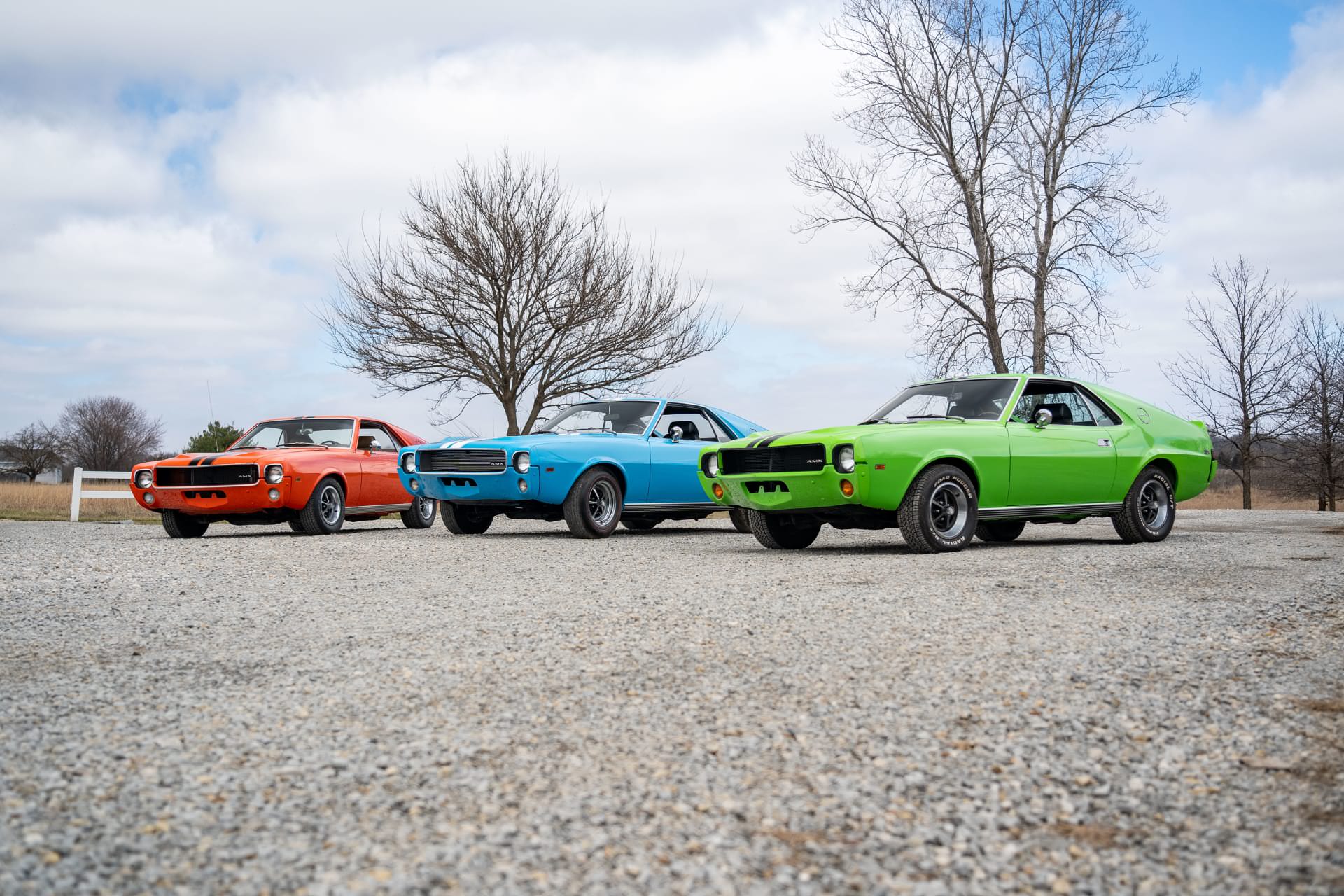
This is the Big Bad AMX Trio, it’s a private collection of all three of the Big Bad Colors of the 1969 AMC AMX, and they’re now being sold as a single lot – possibly for the first time in history.
What set the Big Bad package apart was more than just the lick of bright paint. The option included body-colored front and rear bumpers, a notable departure from the universal chrome of the era, along with rear bumper guards and a slim stainless steel trim piece below the front grille.
The effect was a seamless, aggressive look from nose to tail. AMC’s factory brochure captured the spirit: “They’re called the Big Bad Colors. They happen on the new Javelins and AMXs, from bumper to bumper… including the bumpers.” A Big Bad AMX could be ordered with any engine and transmission combination, with or without racing stripes.
Production numbers of the Big Bad cars were small even by AMX standards. For 1969, AMC built just 195 AMXs in Big Bad Blue, 285 in Big Bad Orange, and 283 in Big Bad Green for a total of only 763 Big Bad AMXs, less than 10% of that year’s production.
The colors continued into 1970, but with one notable change, the body-colored bumpers were replaced by standard chrome, making the 1969 models the more distinctive and sought-after versions. Today, Big Bad AMXs command a premium of roughly 25% over comparably equipped standard-color cars, and a dedicated registry tracks surviving examples.
Ultimately the Big Bad AMXs failed to drive any appreciable increase in sales, possibly because it was a cosmetic package only, with no performance increases. That said, the low sales numbers are what makes them so collectible today.
The Big Bad AMX Trio Shown Here
This is believed to be a first-of-its-kind offering – three 1969 AMXs with one in each of the Big Bad colors, are being offered for sale as a single lot. The seller spent 17 years searching to assemble the complete set – a Big Bad Blue (serial no. 293569), a Big Bad Green (serial no. 250113), and a Big Bad Orange (serial no. 340911).
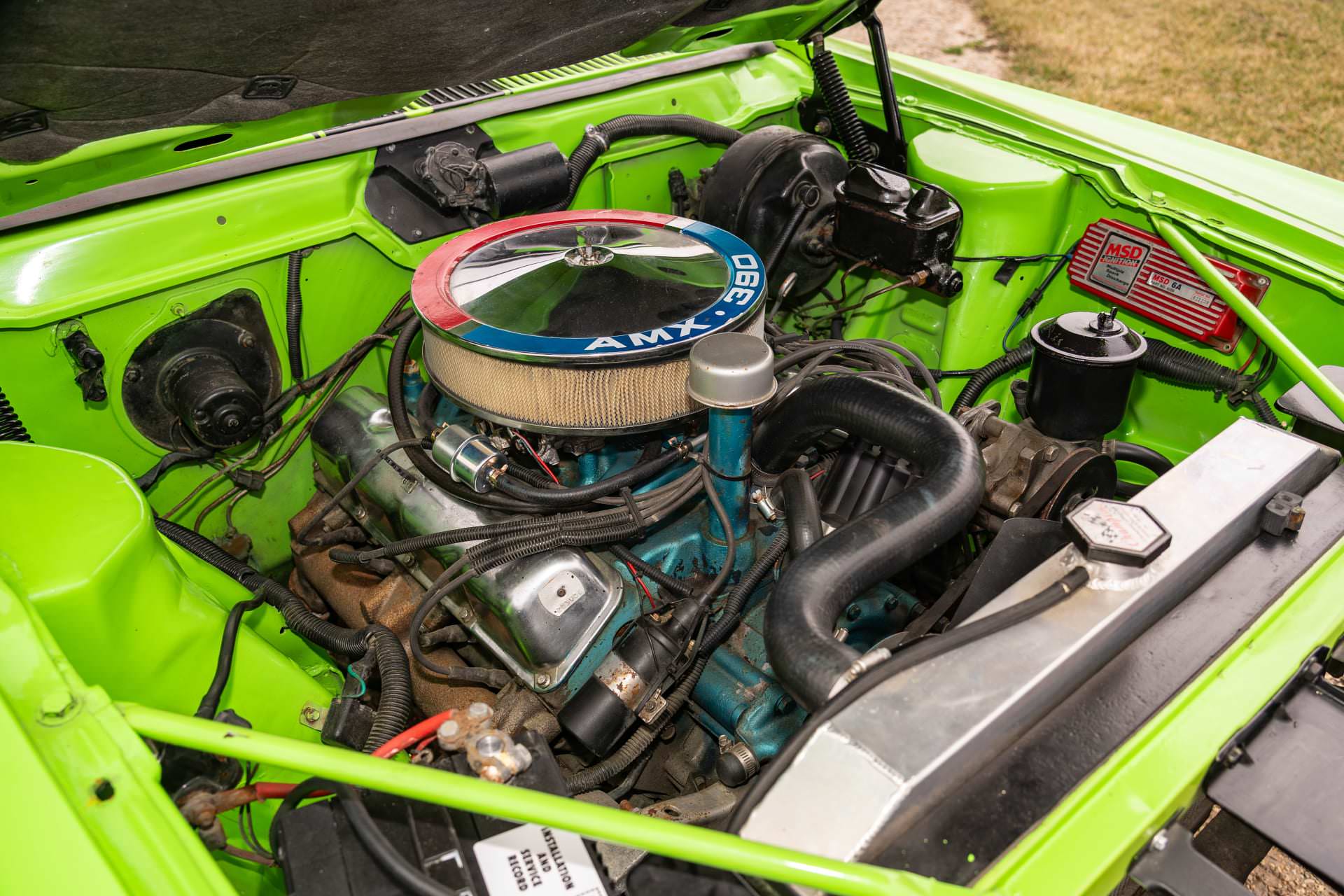
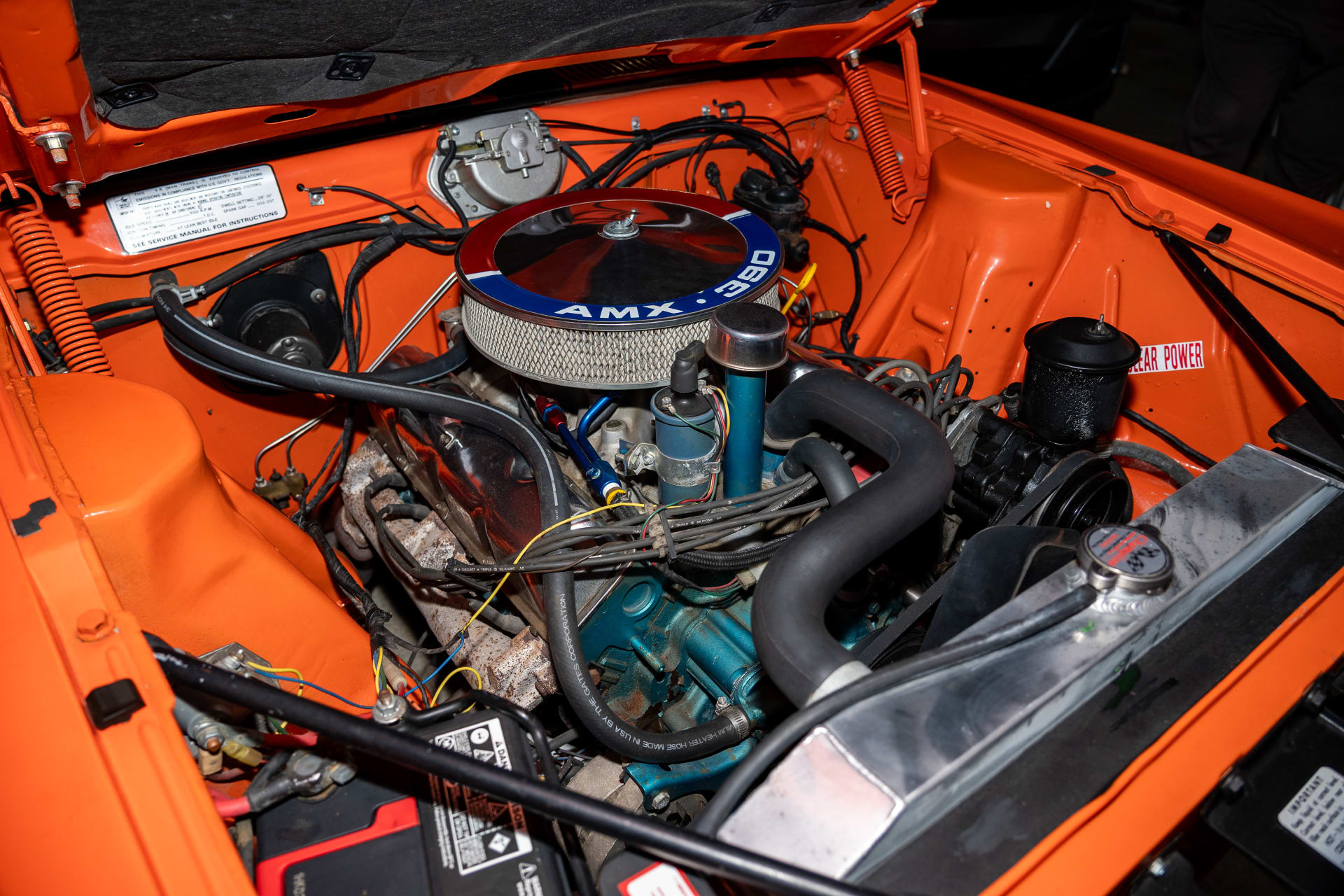
All three are factory Go Pack cars equipped with the 390 cubic inch V8 and 4-speed manual transmission, and all have been comprehensively restored. When it comes to Big Bad AMXs, it just doesn’t get any better than this.
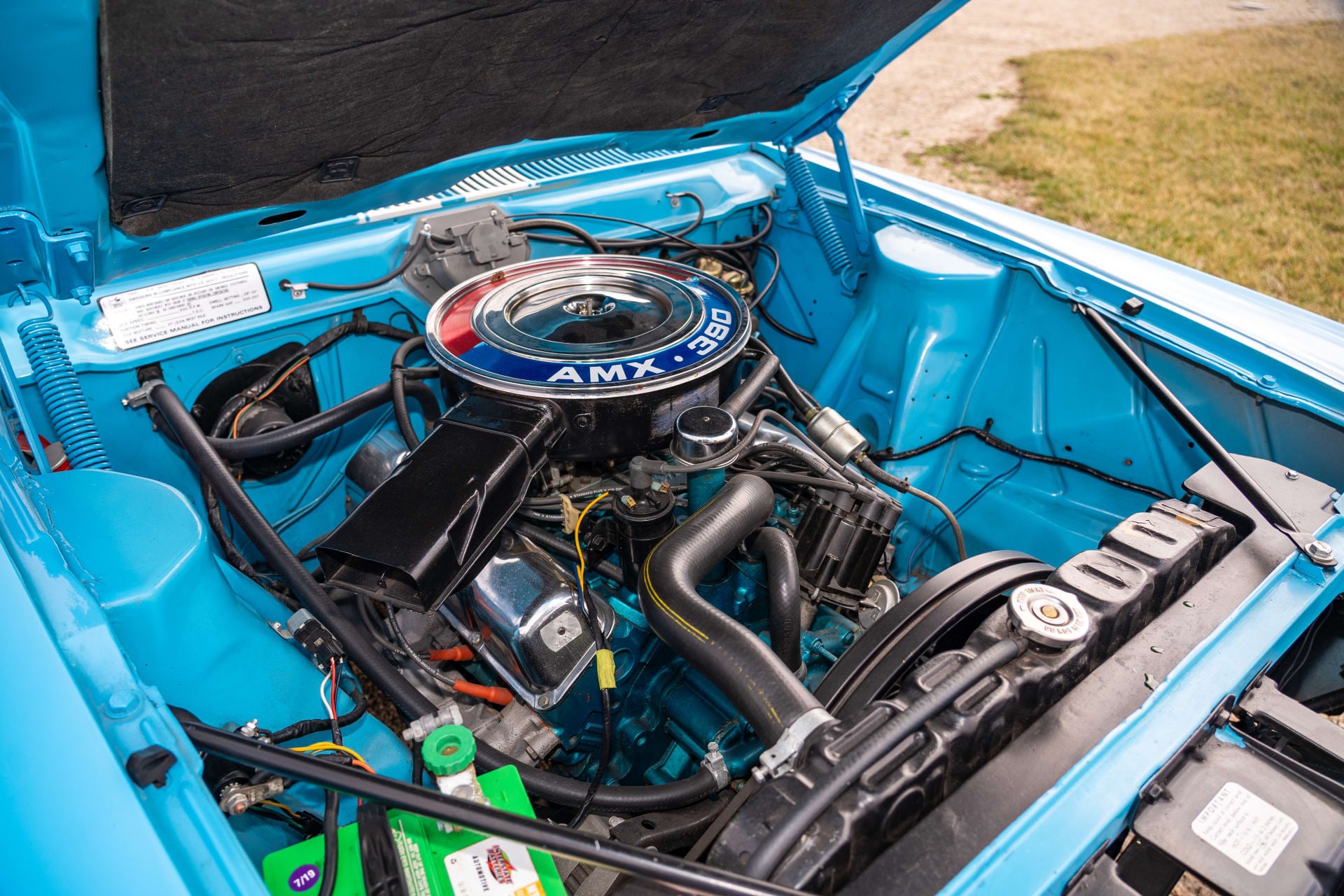
All three are factory Go Pack cars equipped with the 390 cubic inch V8 and 4-speed manual transmission, and all have been comprehensively restored. When it comes to Big Bad AMXs, it just doesn’t get any better than this.
Of the 8,239 AMXs produced for 1969, only 762 were finished in a Big Bad color, 10.9% of that year’s production (as noted above). Big Bad Blue was the rarest at just 195 examples, followed by Big Bad Orange at 284 and Big Bad Green at 283. Finding even one clean example is difficult – assembling a matched trio of restored, numbers-matching 390 V8 4-speed cars borders on the extraordinary.
The three cars are now due to be offered as a headline lot by Mecum in mid-May. If you’d like to read more about them or register to bid you can visit the listing here.
Images courtesy of Mecum

Articles that Ben Branch has written have been covered on CNN, Popular Mechanics, Smithsonian Magazine, Road & Track Magazine, the official Pinterest blog, the official eBay Motors blog, BuzzFeed, Autoweek Magazine, Wired Magazine, Autoblog, Gear Patrol, Jalopnik, The Verge, and many more.
Silodrome was founded by Ben back in 2010, in the years since the site has grown to become a world leader in the alternative and vintage motoring sector, with well over a million monthly readers from around the world and many hundreds of thousands of followers on social media.