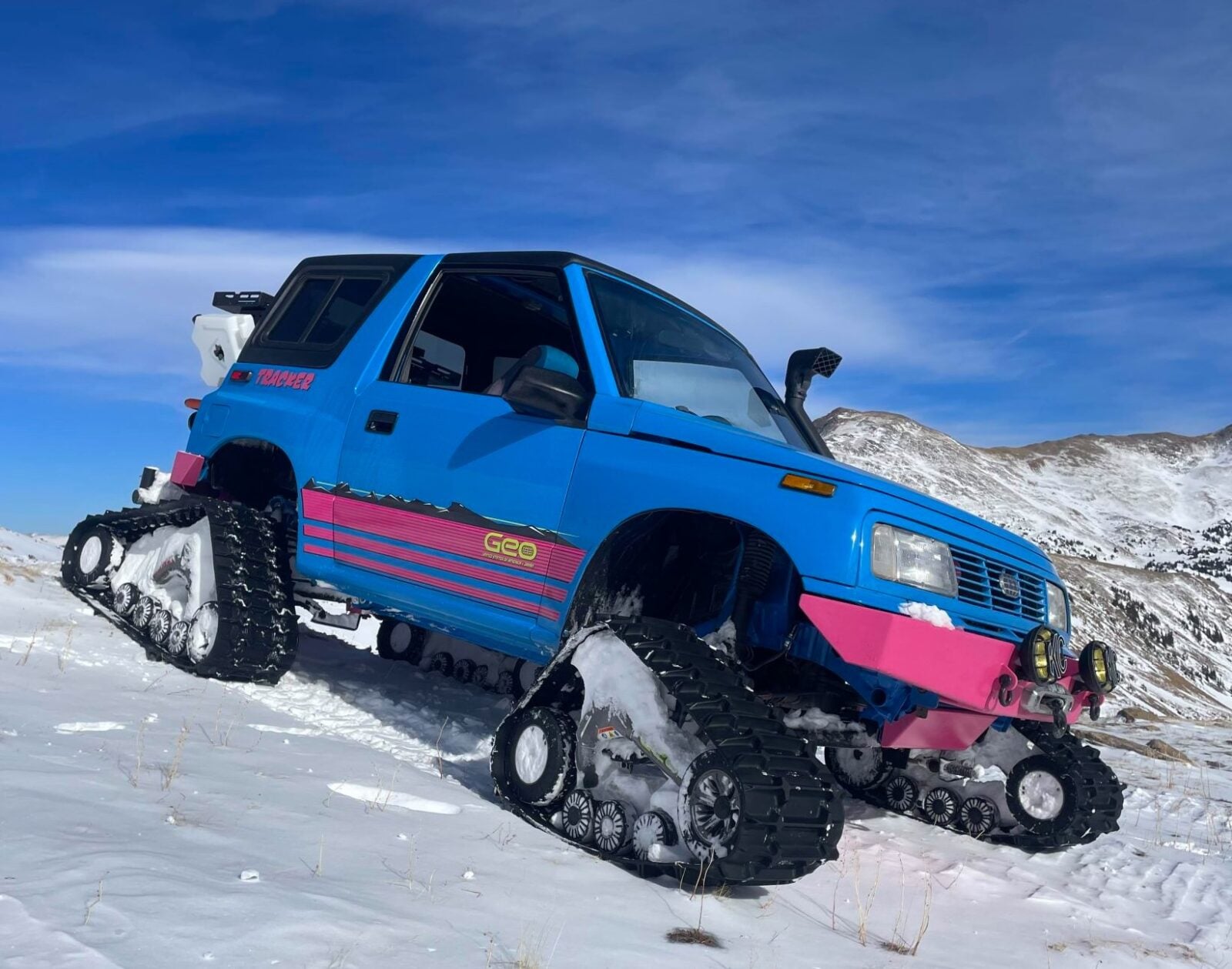
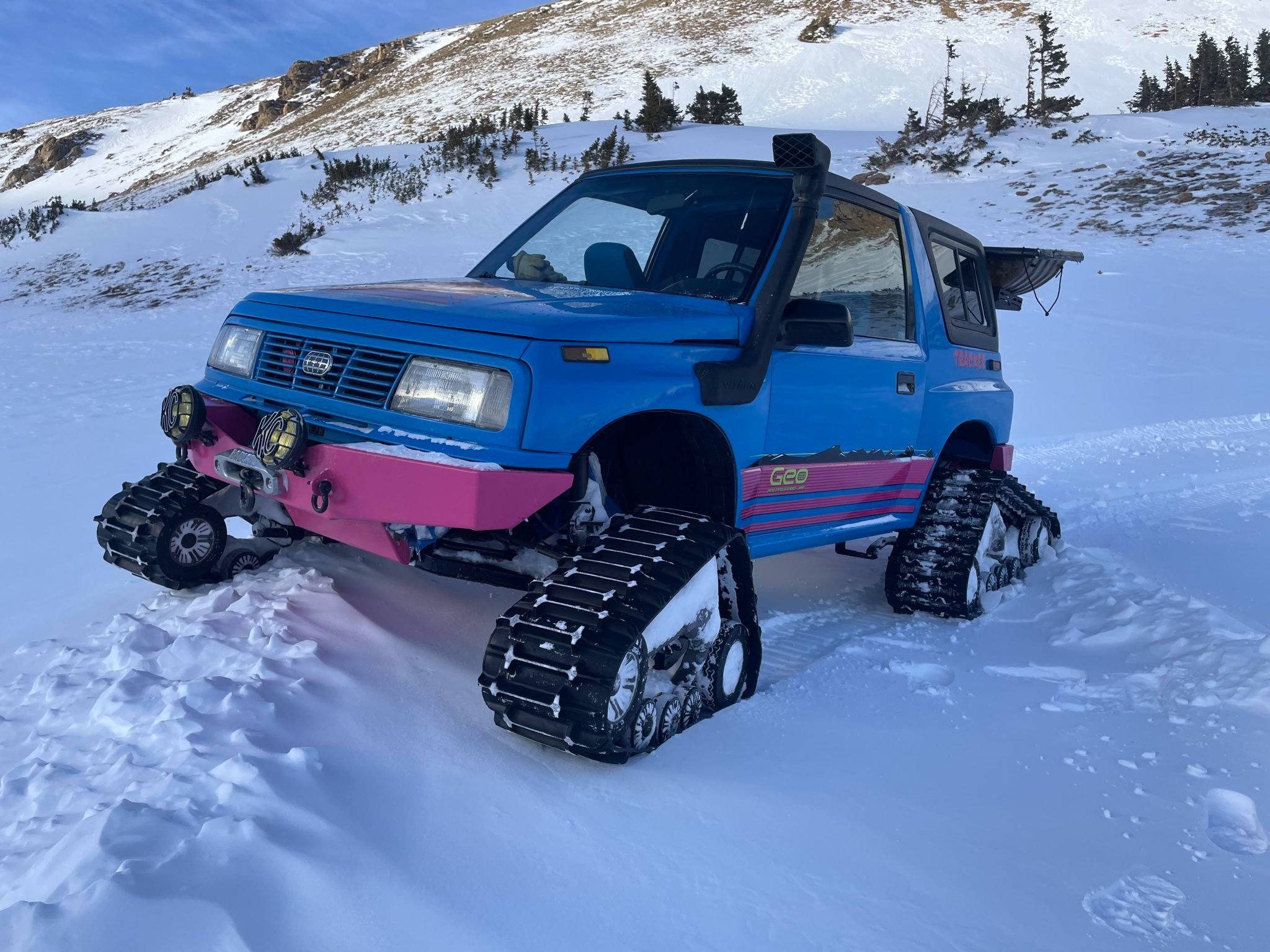
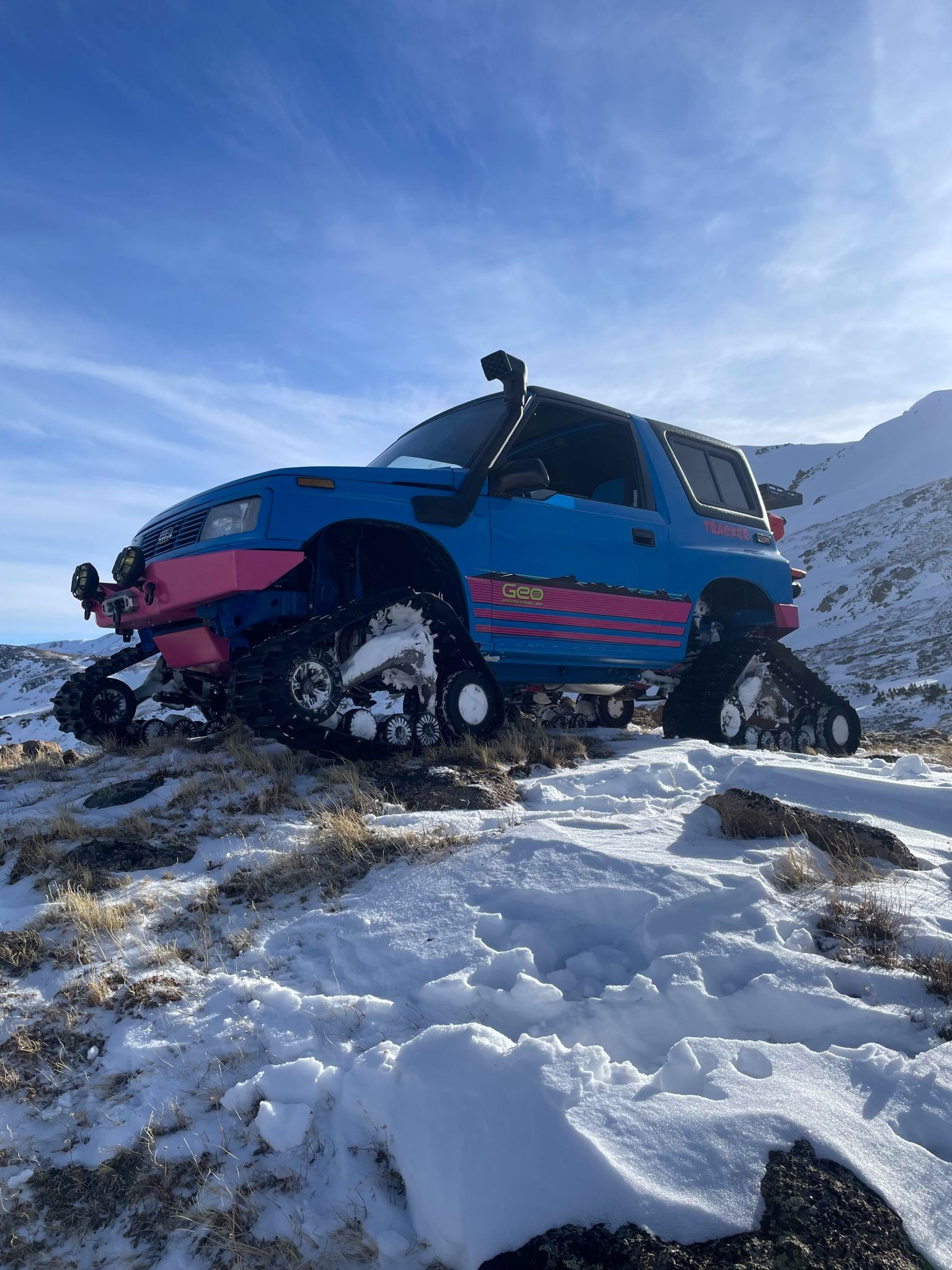
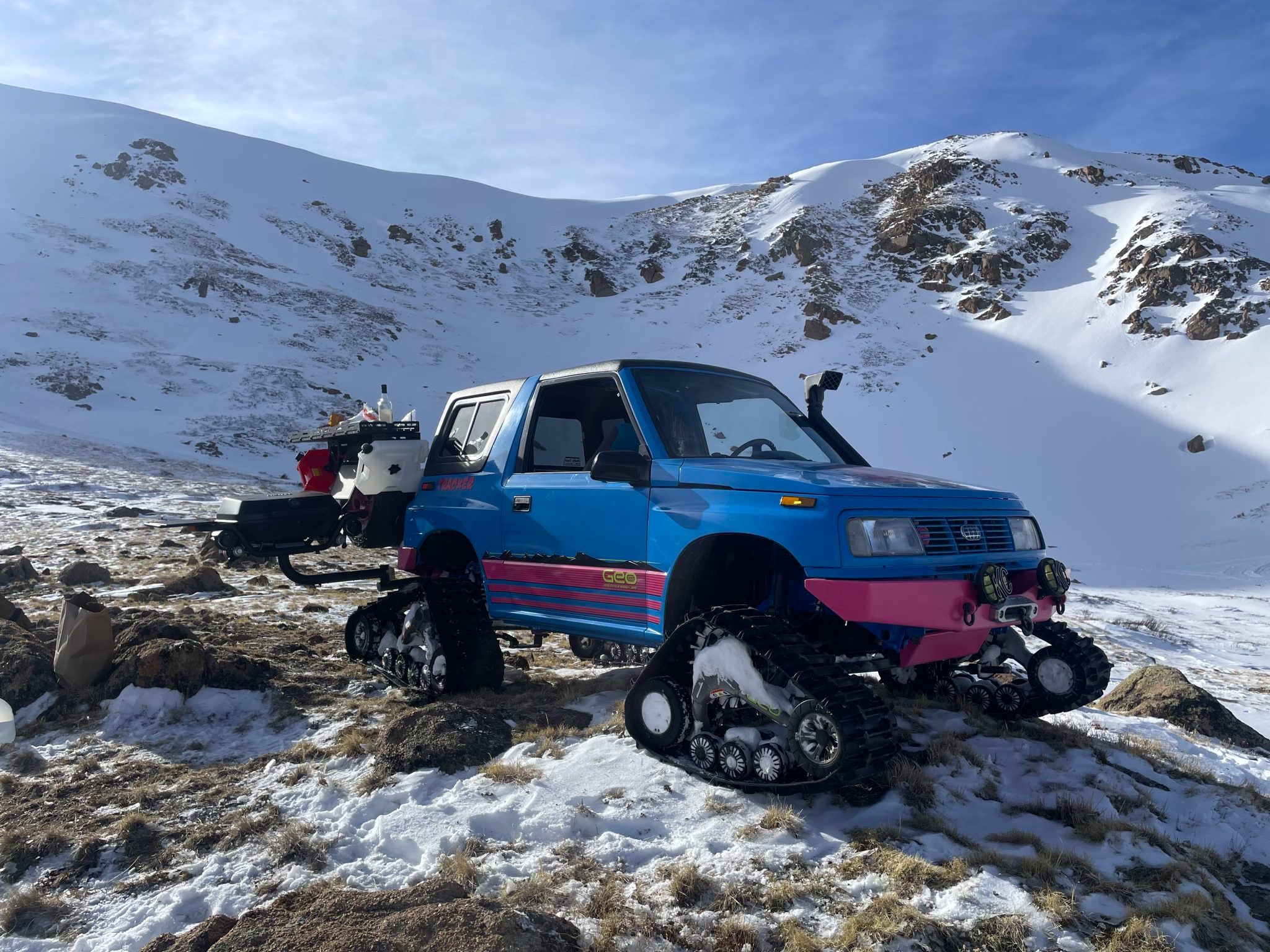
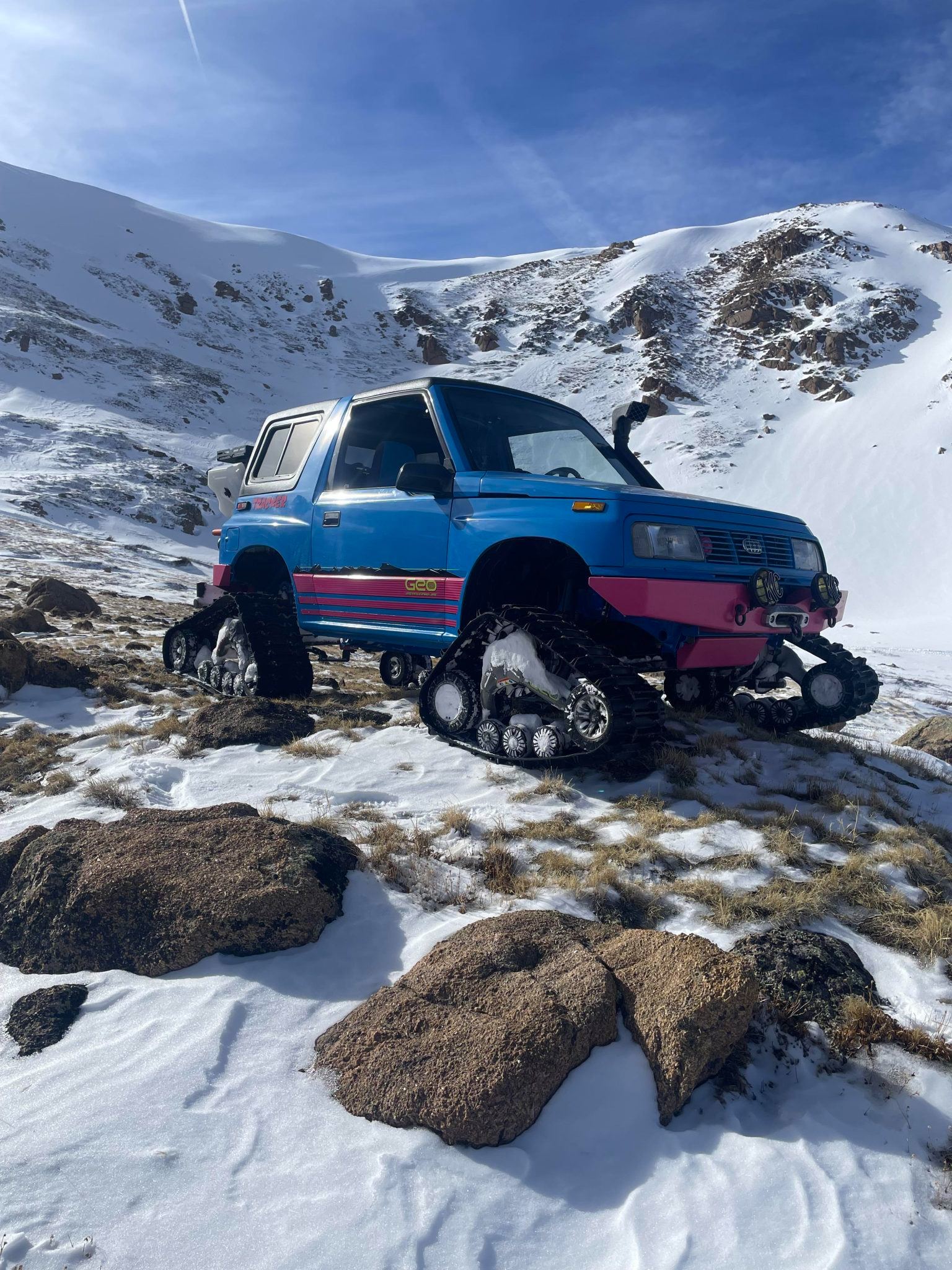
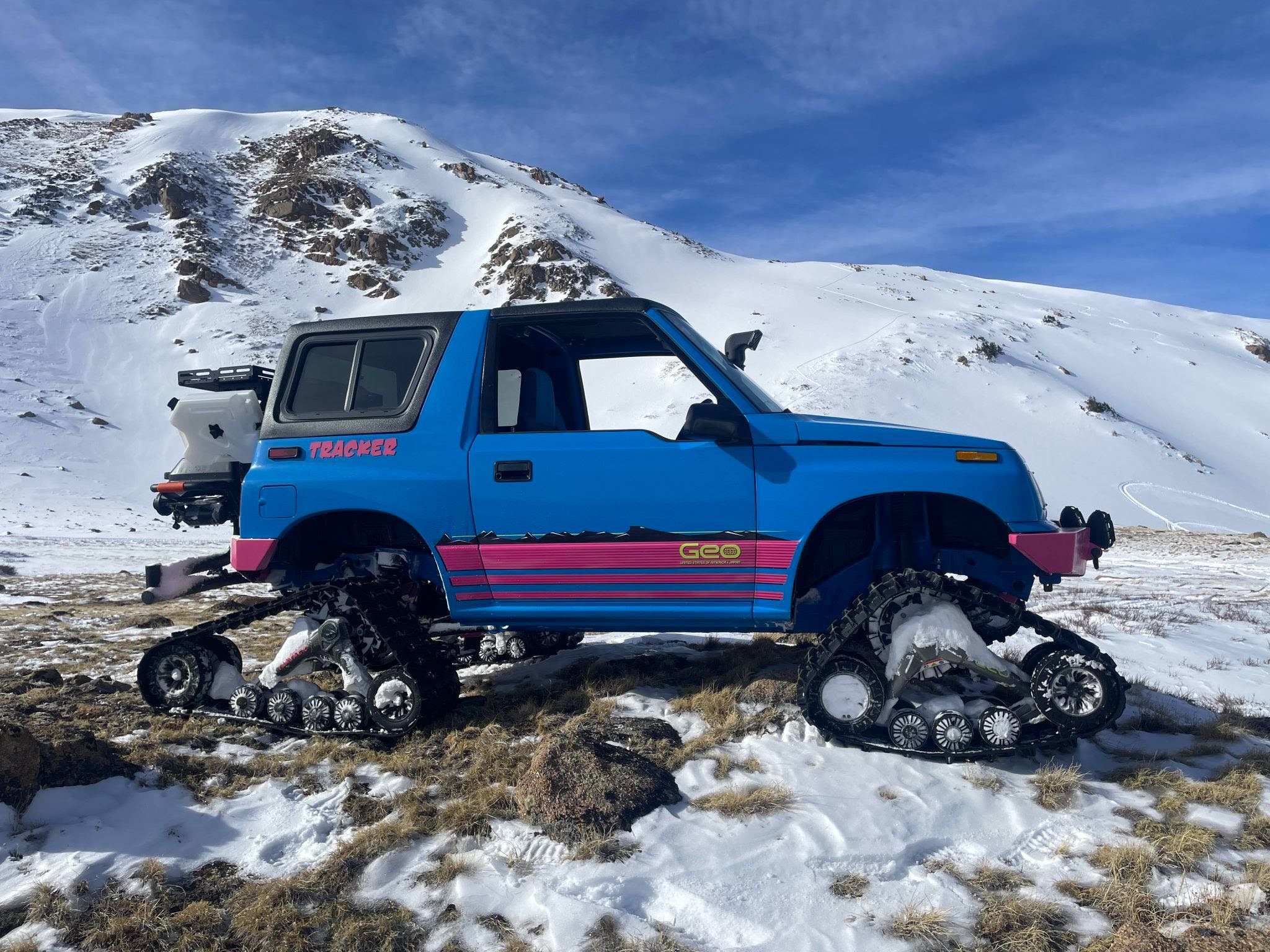
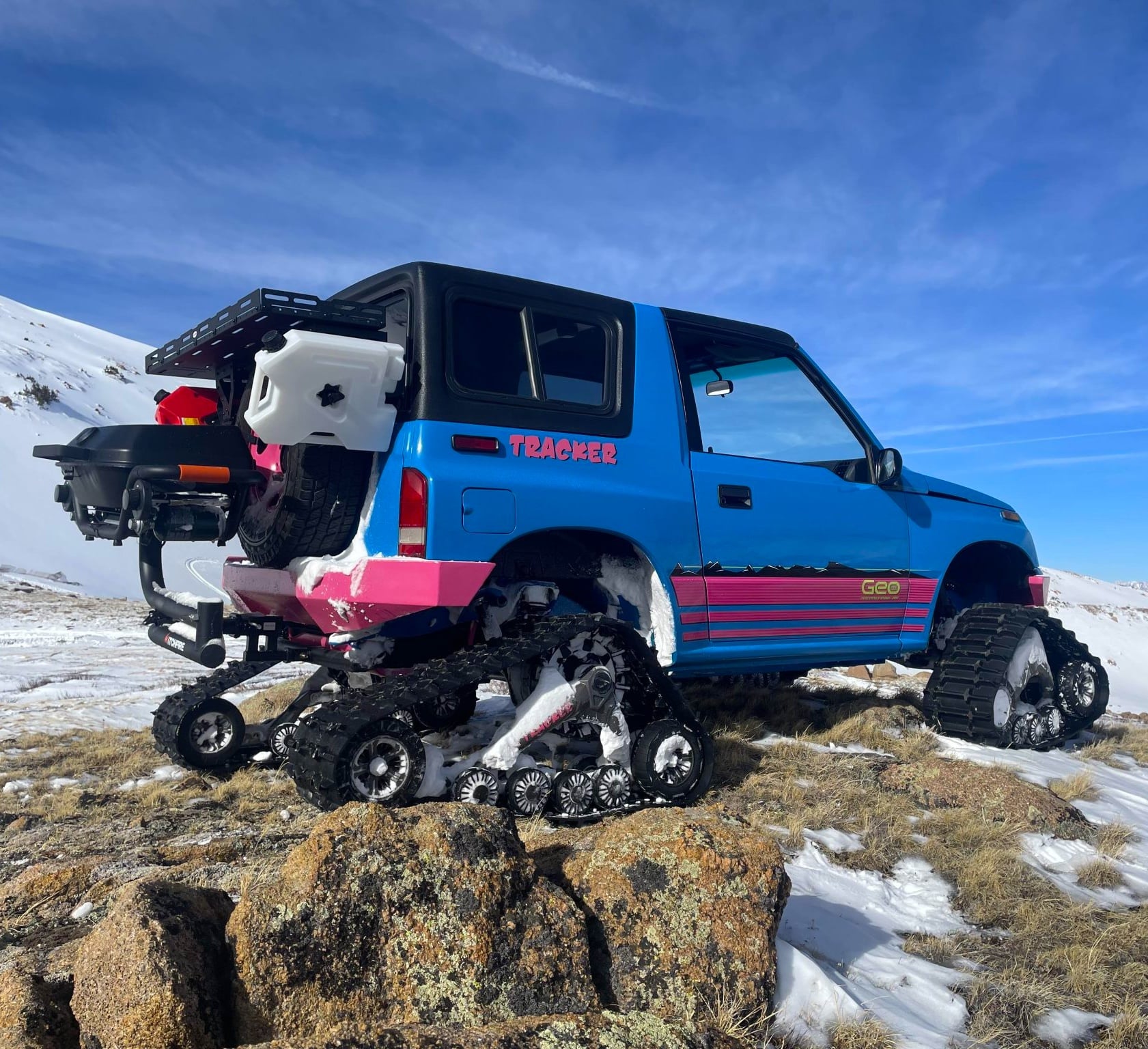
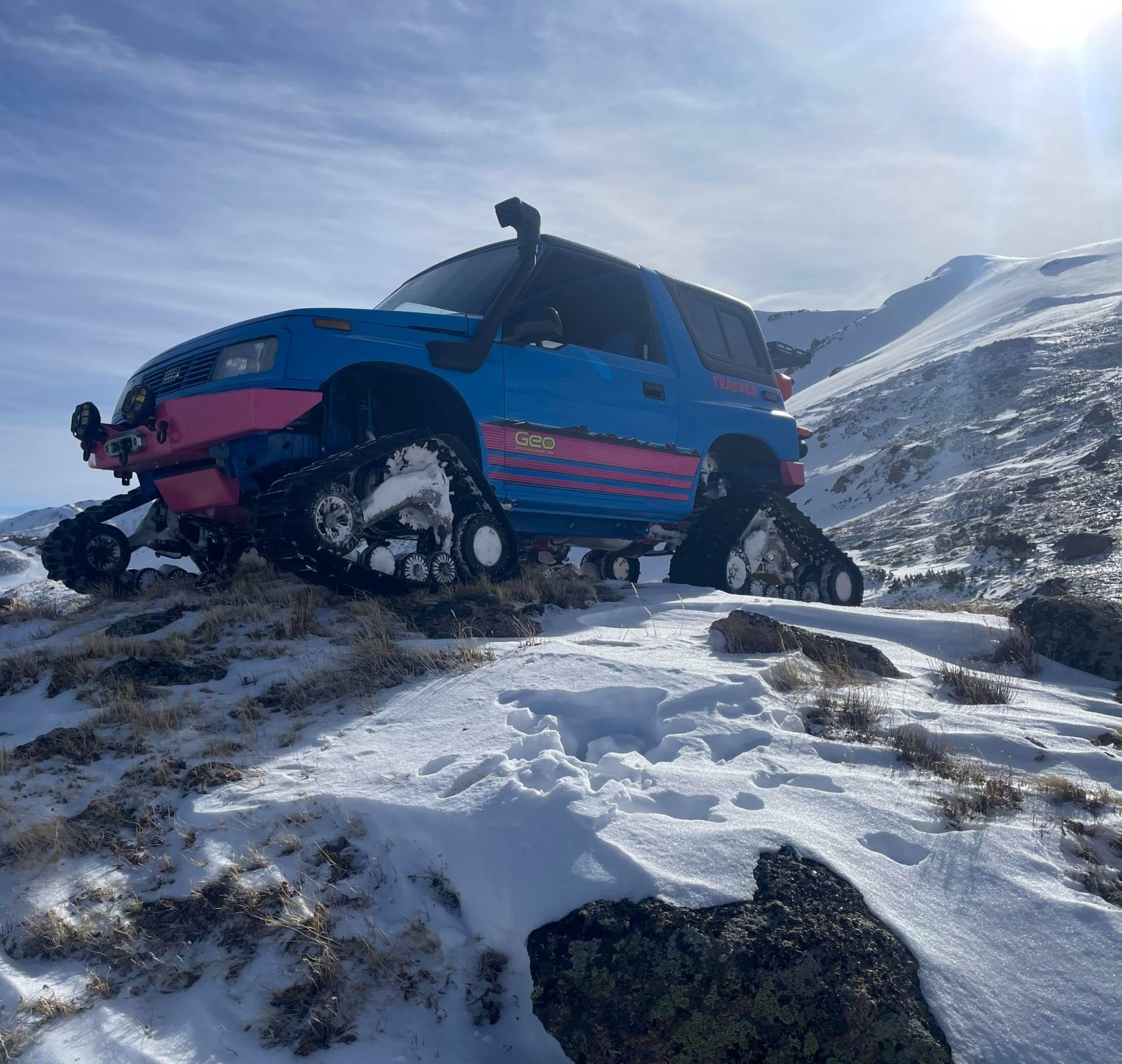
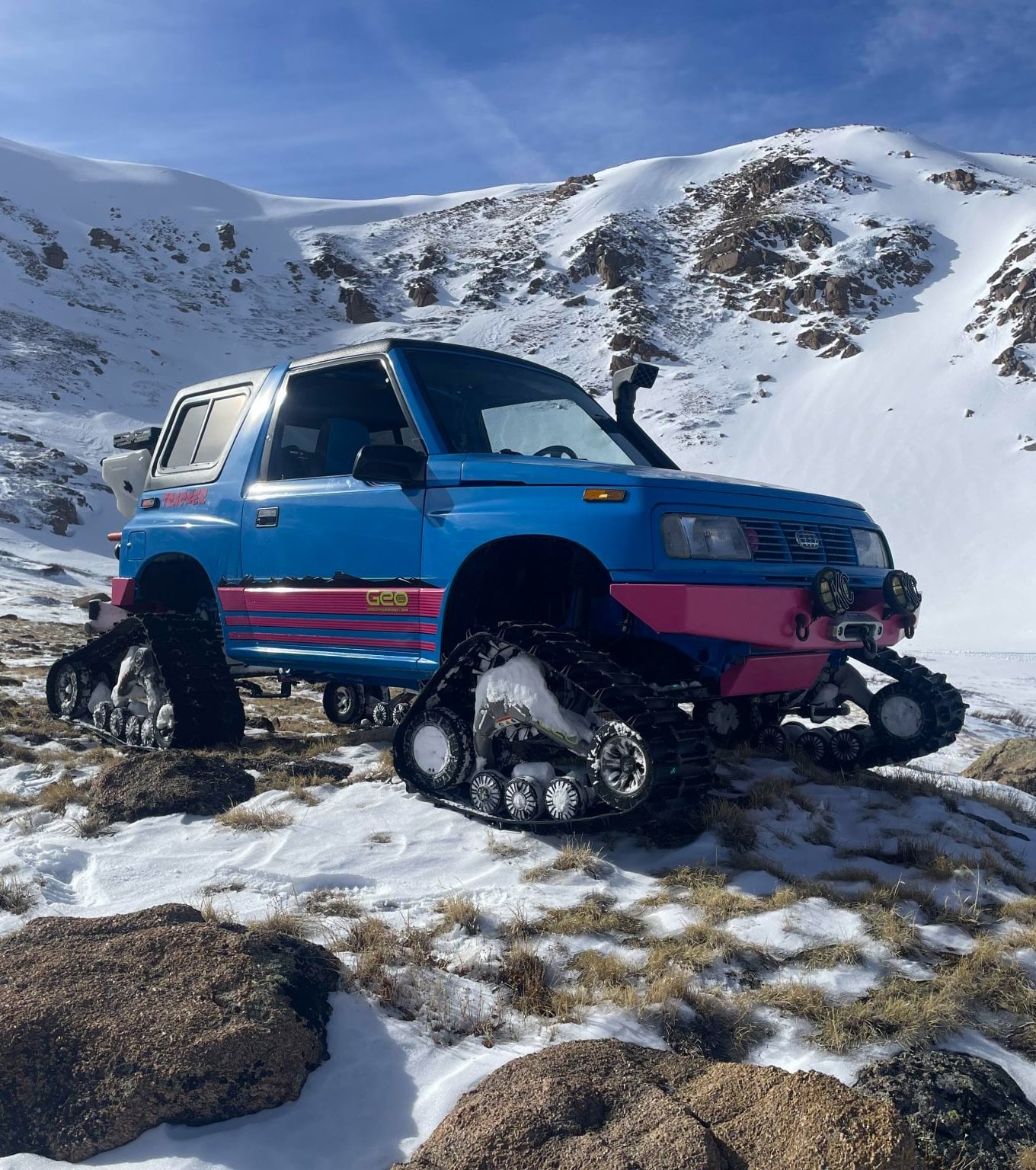
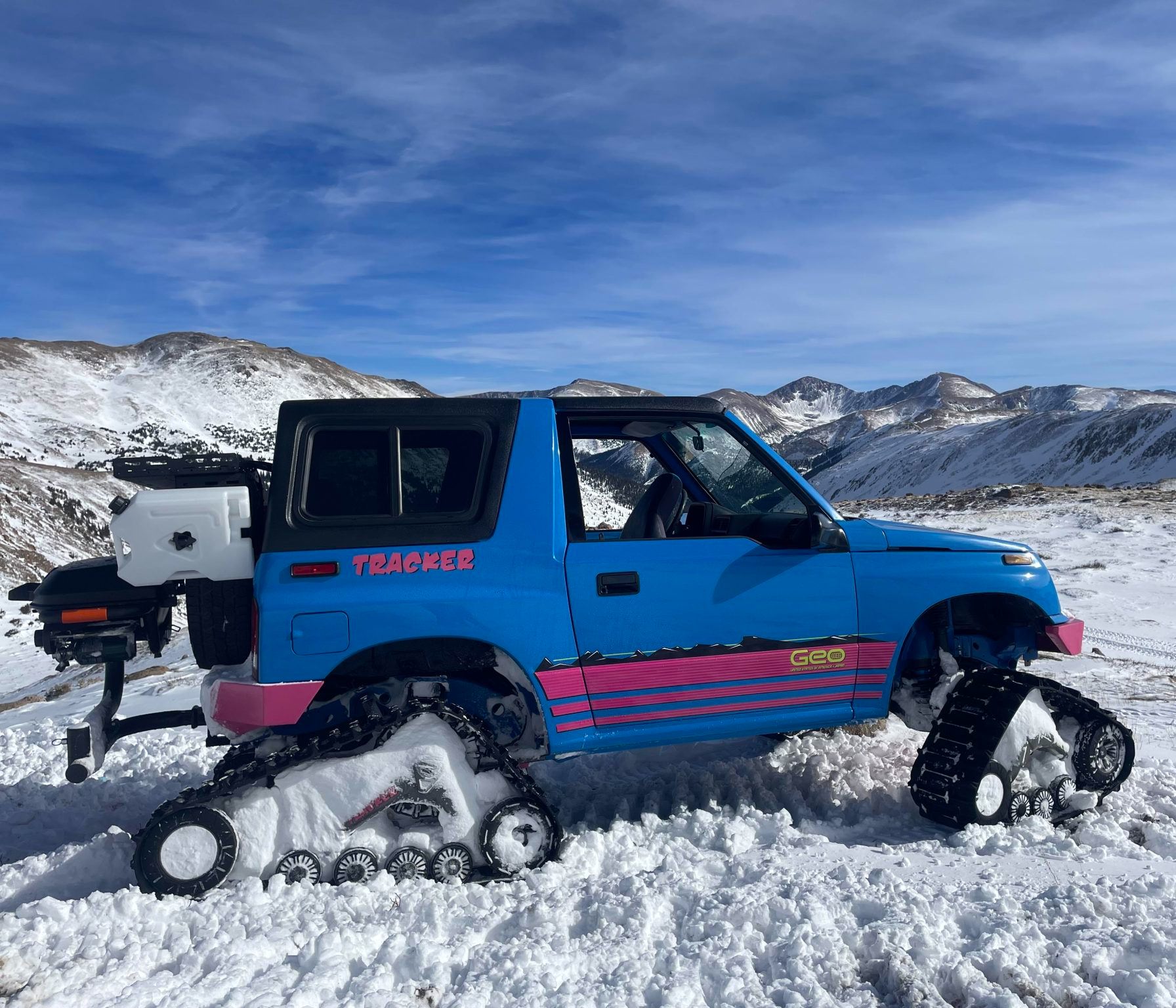
This is a 1993 Geo Tracker 4×4, it’s the upmarket LSi version with the 5-speed manual transmission. This Tracker is a little bit special thanks to the fact that it’s been fitted with a Camso Track System worth almost $7,500 USD.
Unlike many of its rivals in the small SUV segment, the first-gen Tracker was built with body-on-frame construction and it came with a dual-range transfer case – making it a “real” 4×4 by any measure, and not just an AWD unibody commuter with a little extra ground clearance.
Fast Facts: A Geo Tracker With A Camso Track System
- The 1993 Geo Tracker LSi shown here is a first-generation, body-on-frame compact 4×4 with a 5-speed manual and dual-range transfer case. What makes this example stand out is that it’s fitted Camso track system, turning the small, affordable SUV into a far more capable off-road, all-terrain machine.
- The Geo Tracker debuted for 1989 as a GM-Suzuki joint-venture product built by CAMI Automotive, sharing most of its engineering with the Suzuki Sidekick. Sold through Geo dealerships, it targeted younger buyers with light-truck appeal, compact dimensions, modest running costs, and genuine off-road hardware uncommon in later crossovers.
- Early Trackers used a 1.6 liter SOHC four-cylinder making 80 bhp, while later 16-valve versions brought more power. The model range gradually expanded from two-door hardtops and convertibles to include a four-door wagon, while manual gearboxes, optional automatics, and part-time, dual-range 4×4 remained a central part of its identity.
- This modified Tracker has been lifted, repainted, and fitted with tracks, winch, snorkel, KC lights, skid plates, custom bumpers, upgraded interior trim, and modern audio equipment. Though the Tracker faced criticism over rollover risk and safety ratings when new, surviving examples have earned a loyal, cult-like following.
History Speedrun: The Geo Tracker
The Geo Tracker was a compact sport-utility vehicle that was introduced in late 1988 as a 1989 model. It was developed by CAMI Automotive, this was a joint venture between General Motors of Canada and Suzuki, and it was built at CAMI’s plant in Ingersoll, Ontario, Canada.

 The Geo Tracker was a compact sport-utility vehicle that was introduced in late 1988 as a 1989 model. It was developed by CAMI Automotive, this was a joint venture between General Motors of Canada and Suzuki, and it was built at CAMI’s plant in Ingersoll, Ontario, Canada. Image courtesy of Suzuki.
The Tracker was mechanically damn-near-identical to the Suzuki Sidekick (also known as the Suzuki Escudo in Japan), which was built on the same assembly line. Nearly all 1989 models and some 1990 models were actually imported from Japan, as construction delays at the Canadian factory prevented domestic production from beginning until later on in 1989.
The Tracker was sold under General Motors’ Geo brand, this was a marque created in 1989 to market a series of import-derived smaller vehicles at Chevrolet dealerships. The Tracker was positioned at the entry-level end of the SUV market and targeted young, first-time buyers who needed fuel economy, initial purchase price affordability, and a fun driving experience. Its main competitors included the Jeep Wrangler, Isuzu Amigo, and its own close sibling, the Suzuki Sidekick.
At the time of its launch, the Tracker was offered only as a two-door model in convertible and hardtop body styles, with 4×4 as standard. A two-wheel drive convertible was added in 1991, it was a little less expensive but only sold in very modest numbers.
Early Trackers were powered by a 1.6 liter SOHC inline four-cylinder unit producing 80 bhp. A 16 valve version making 95 bhp first appeared on California-market Trackers in 1994, then became standard on all 4×4 models by 1995.
In 1996, a four-door hardtop wagon joined the lineup, powered by Suzuki’s G16B 16 valve 1.6 liter engine rated at 96 bhp. A 5-speed manual transmission was standard, with a 3-speed (later 4-speed) automatic optional.
Unlike many of its later competitors like the Toyota RAV4 and the Honda CR-V, the Tracker was built on a traditional body-on-frame chassis with a part-time 4×4 system and proper dual-range transfer case, making it a genuine light truck rather than a car-based unibody crossover.
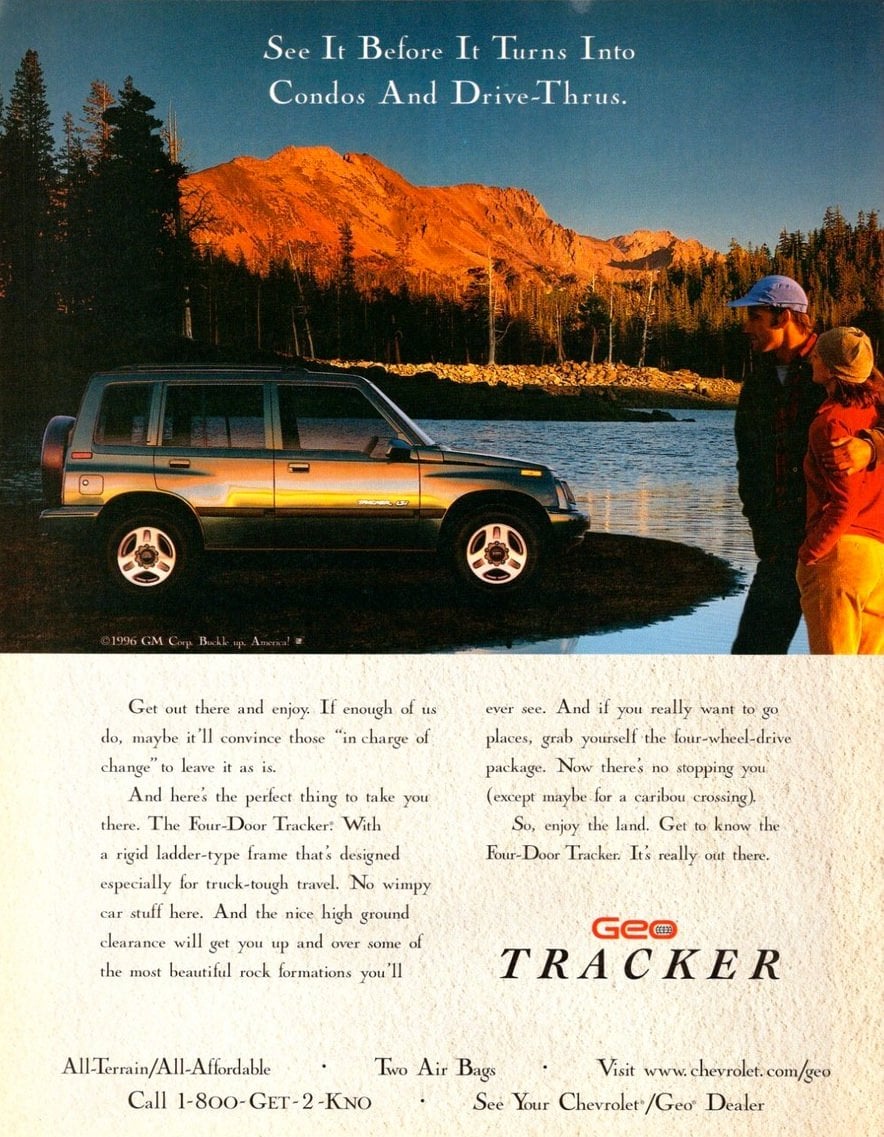
In 1996, a four-door hardtop wagon joined the lineup, powered by Suzuki’s G16B 16 valve 1.6 liter engine rated at 96 bhp. A 5-speed manual transmission was standard, with a 3-speed (later 4-speed) automatic optional. Image courtesy of Suzuki.
The Geo Tracker Controversies
The Geo Tracker was not without its controversies – like other tall, narrow SUVs of the era, (I’m looking at you Bronco II) the Tracker made news headlines due to rollover risk. A 1995 study by the Insurance Institute for Highway Safety found that the two-wheel drive version of the Suzuki Vitara/Geo Tracker had an exceptionally high fatality rate, with many of those deaths attributed to rollovers.
The NHTSA’s crash testing also gave the 1997 model relatively low ratings, with two out of five stars for the driver’s side frontal impact. A number of lawsuits were filed against General Motors and Suzuki alleging design defects related to the vehicle’s rollover potential.
In 1997, and possibly due to the above reasons and subsequent bad publicity, General Motors discontinued the Geo brand, and the Tracker was rebadged as the Chevrolet Tracker beginning with the 1998 model year.
The Second Generation Model Debuts
First-generation Tracker production at the Ingersoll plant ended after 1998, giving way to a redesigned second-generation model. The Chevrolet Tracker continued in production until January of 2004, when it was discontinued and replaced on the assembly line by the (arguably much more boring) Chevrolet Equinox.
Despite its shortcomings the Geo Tracker has developed a cult following and perhaps surprisingly, Kelley Blue Book has reported that owners of the 1989-1997 first-gen Tracker gave it a 4.4 out of 5.0 rating, with 97% recommending it.
The Track-Equipped Geo Tracker Shown Here
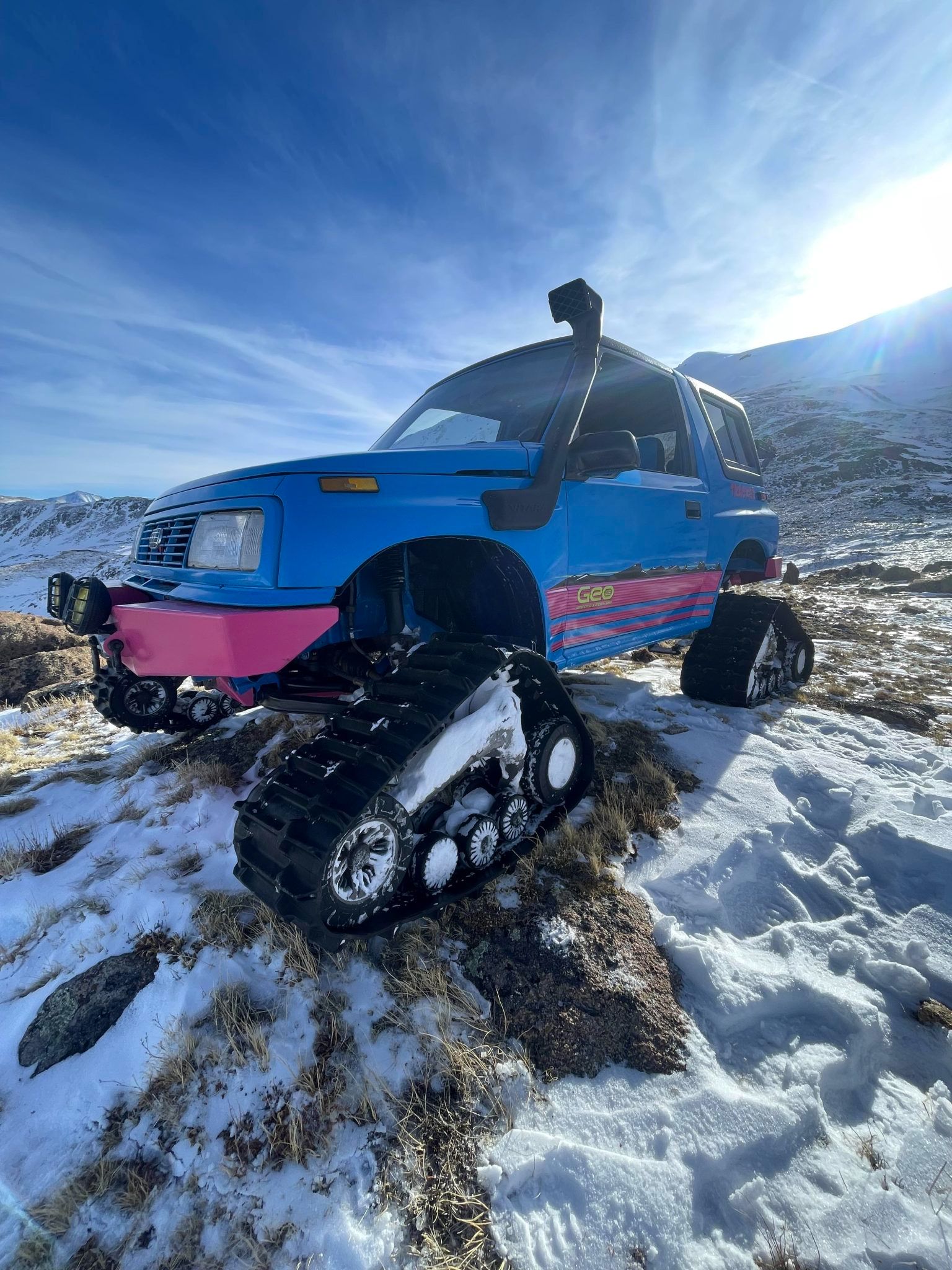
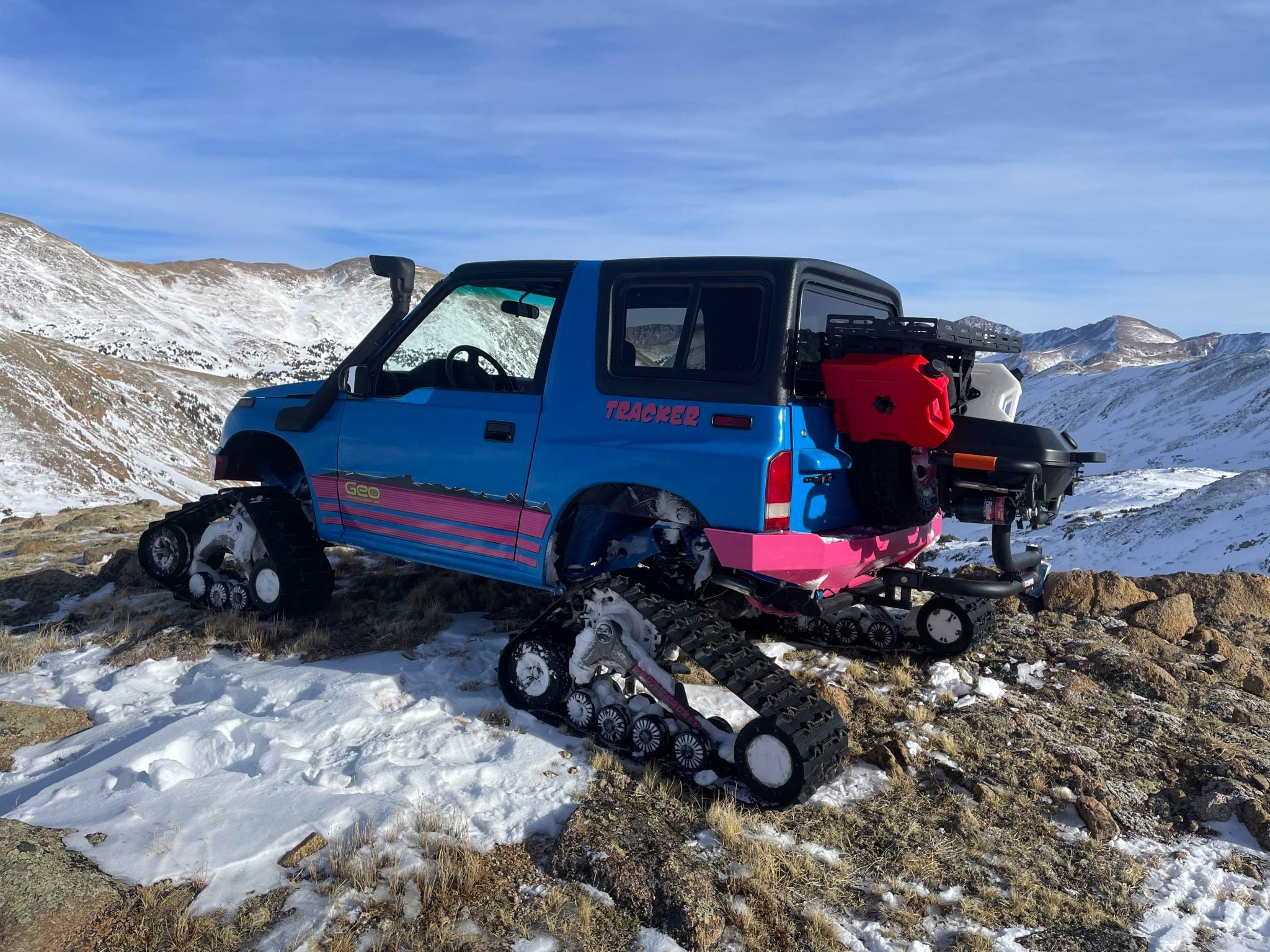
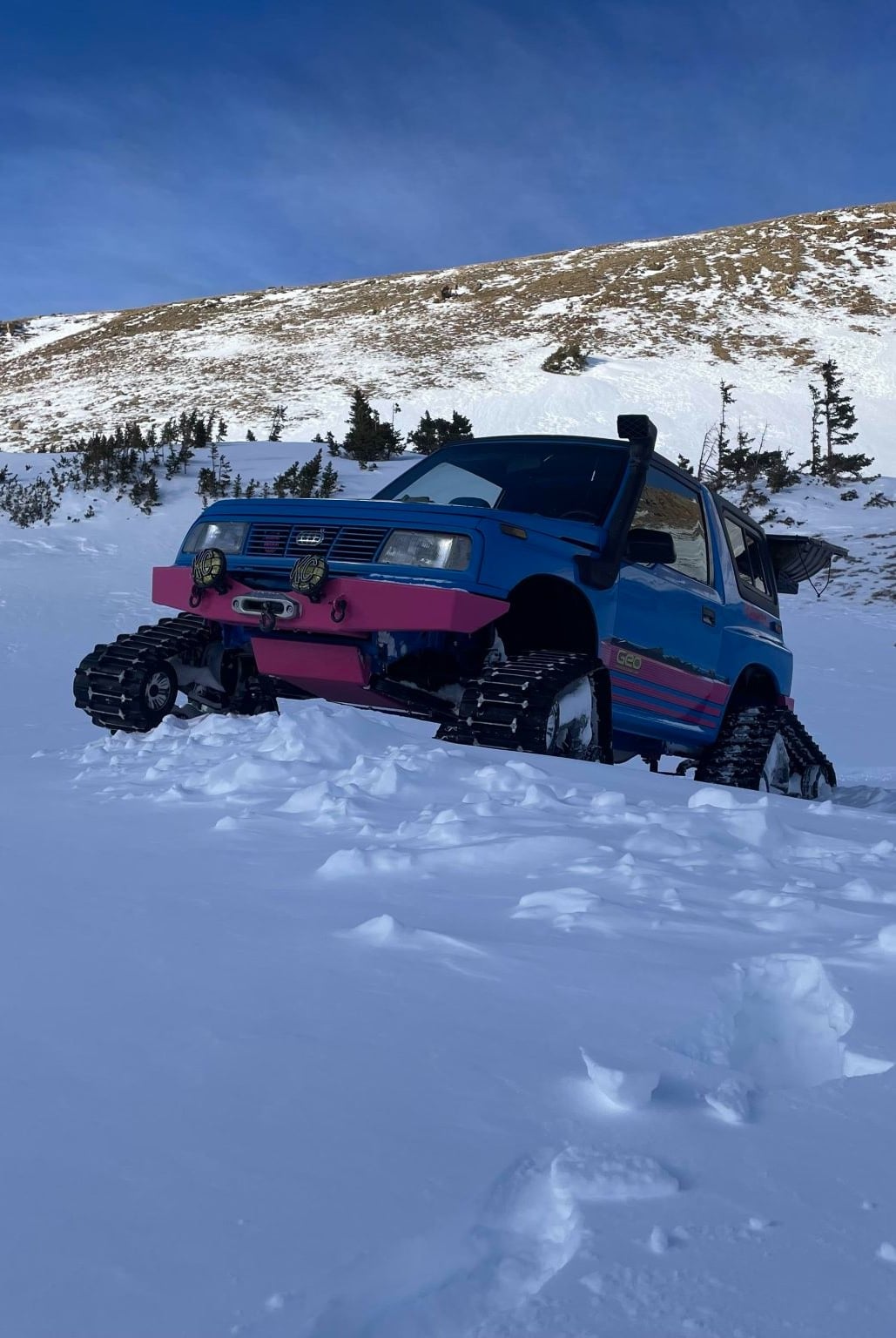
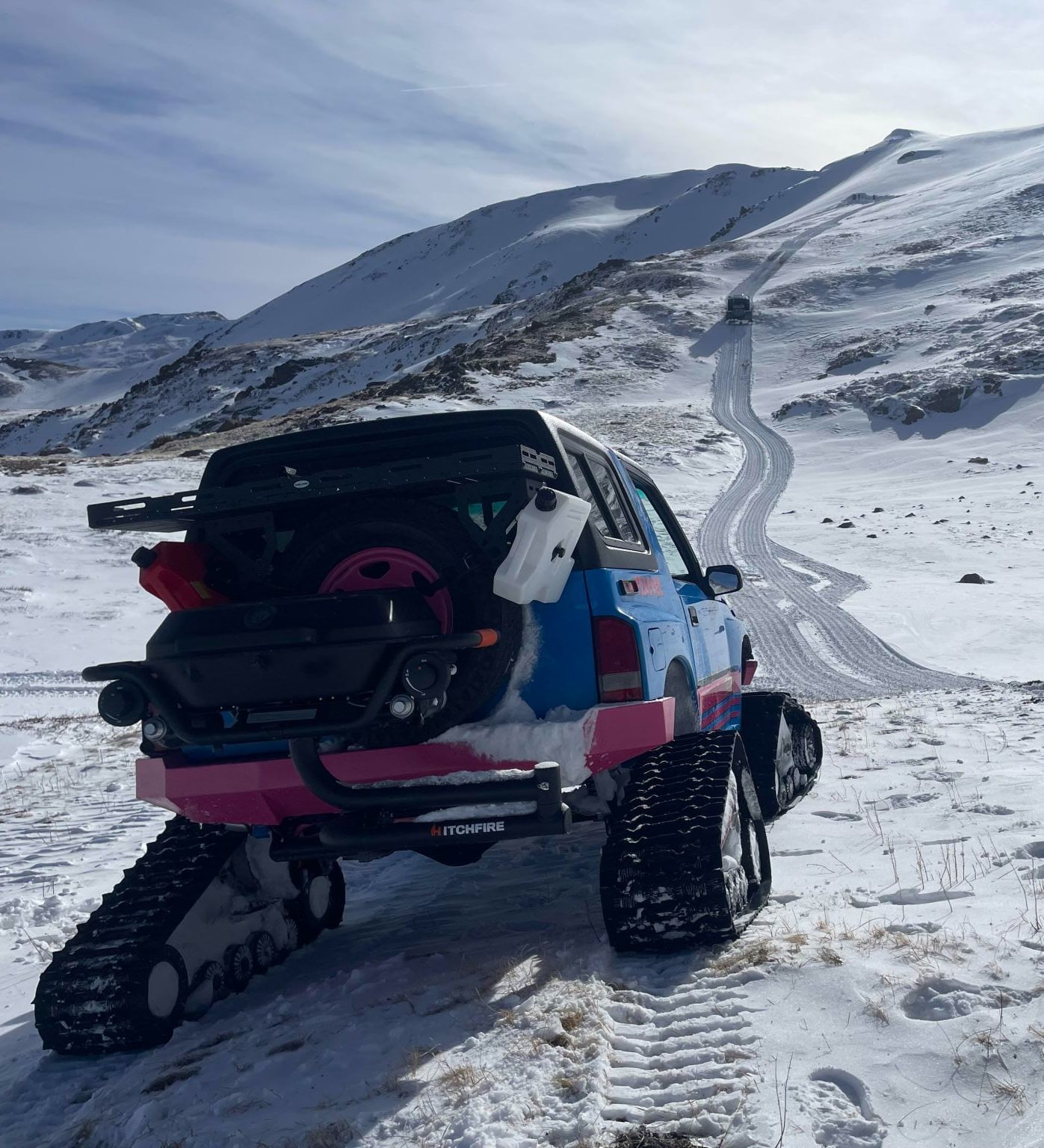
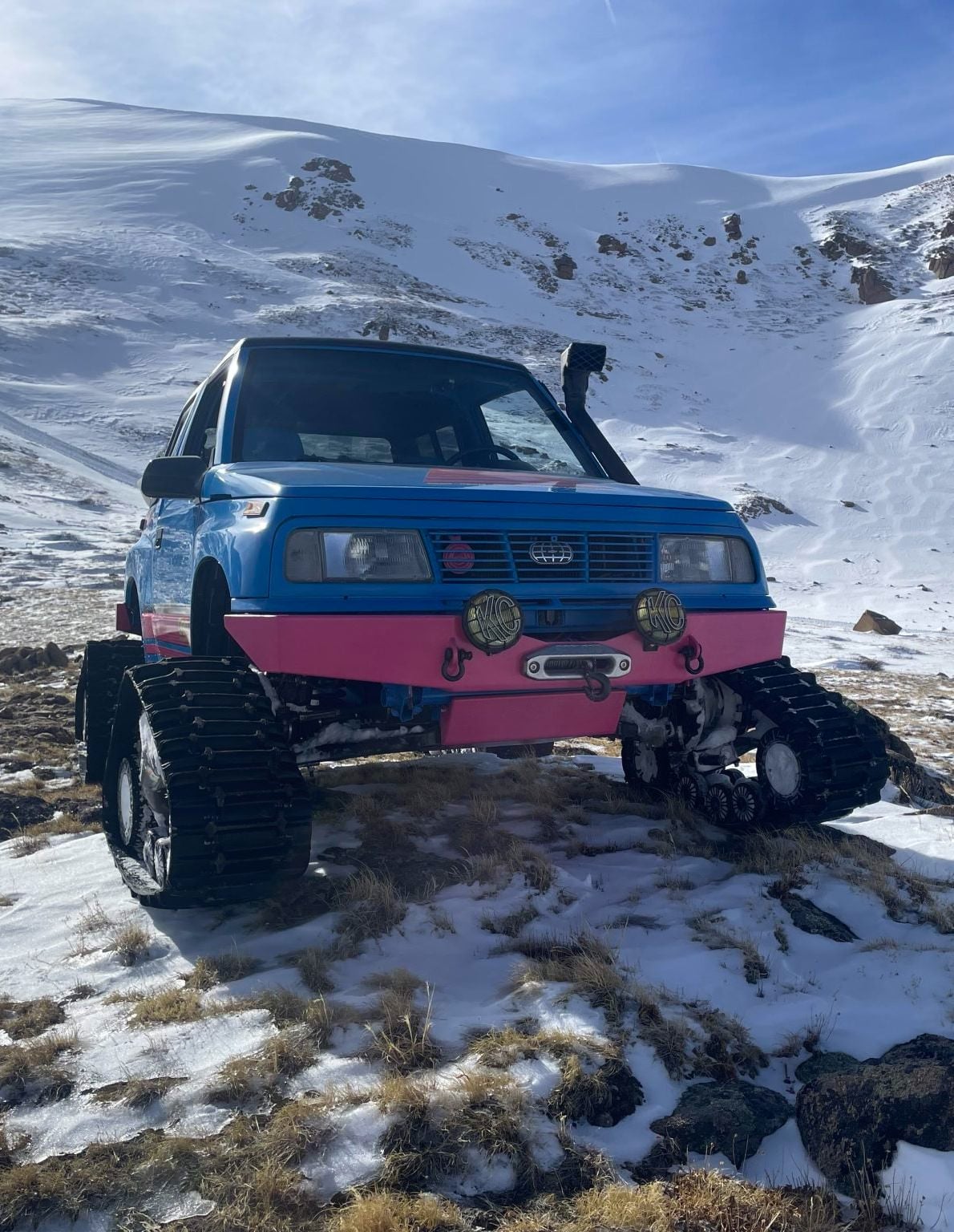
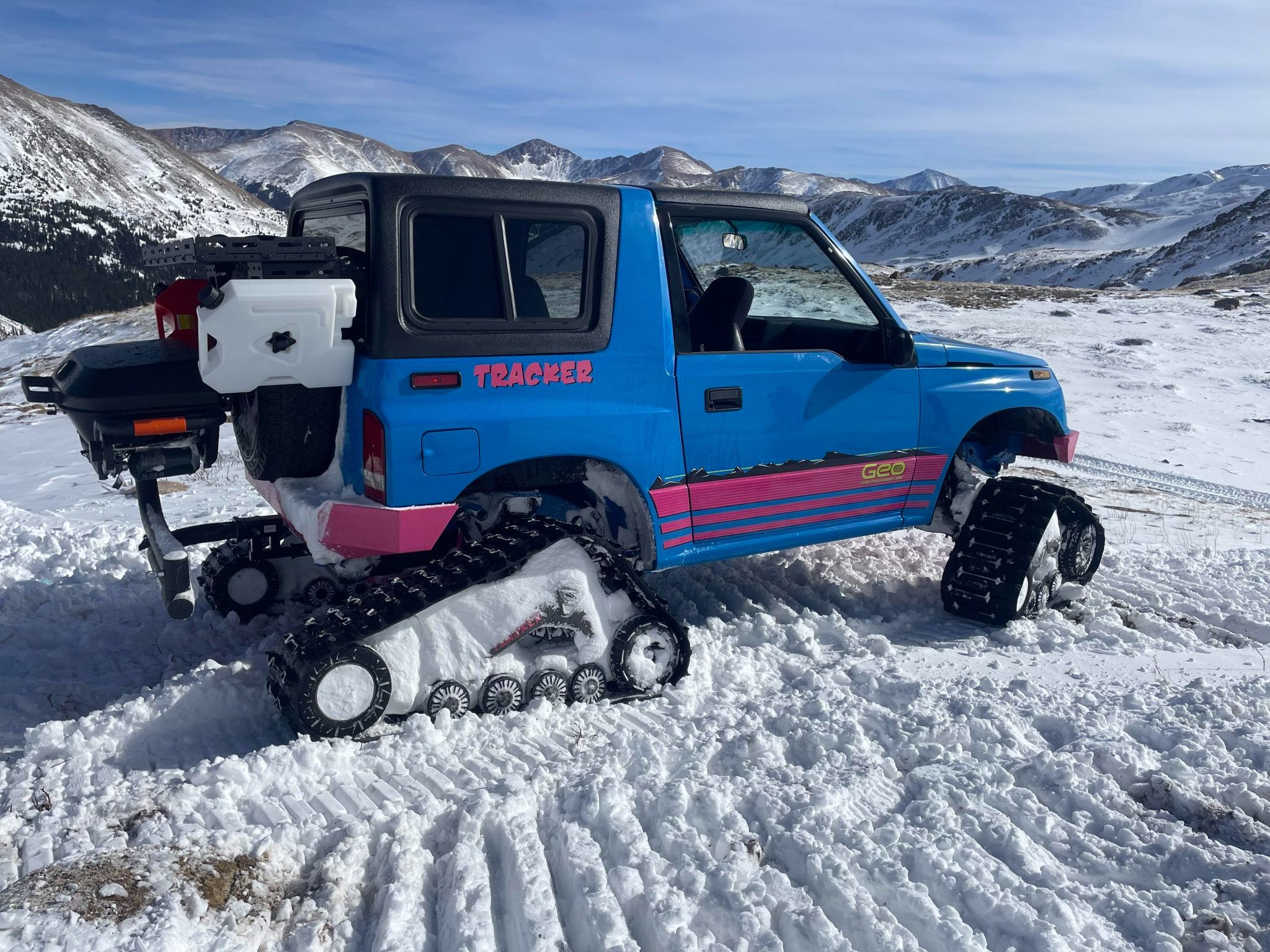
This 1993 Geo Tracker LSi is a modified version of the two-door 4×4 variant that has been transformed into a purpose-built adventure rig, albeit in slightly smaller scale than usual. It now rides on a Camso track system which is secured with lug nuts to the original hubs, keeping the stock front disc, rear drum brake set up.
The Camso tracks have built-in reduction gears and anti-rotation arms, and they significantly increase the vehicle’s footprint and traction, improving off-road ability across snow, ice, mud, sand, and almost any other terrain you point it at.
The suspension has been lifted by 2″, and the exterior was repainted in blue and pink in 2024 with custom retro graphics on the hood and sides. It also comes with a set of five steel 15 inch wheels with Hankook tires, for conventional driving on the asphalt.
This Tracker is now equipped with a Badland winch, an air intake snorkel, KC HiLiTES spotlights, skid plates, and custom front and rear bumpers. A cargo rack and storage canisters are mounted to the rear spare tire, and a Hitchfire grille is attached to the hitch receiver.
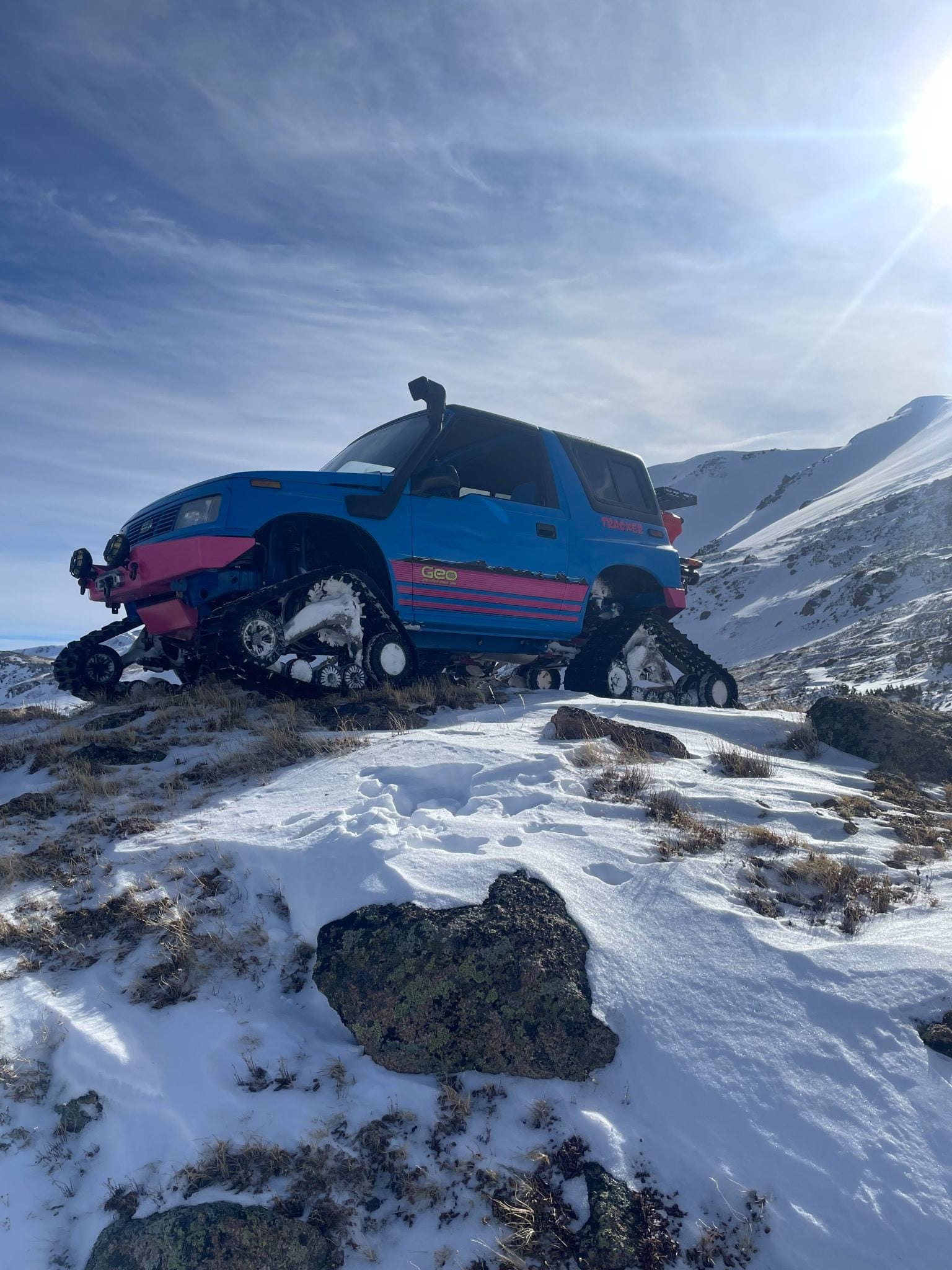
This 1993 Geo Tracker LSi is a modified version of the two-door 4×4 variant that has been transformed into a purpose-built adventure rig, albeit in slightly smaller scale than usual. It now rides on a Camso track system which is secured with lug nuts to the original hubs, keeping the stock front disc, rear drum brake set up.
Inside, the front bucket seats and rear bench are trimmed in gray and blue cloth and the cabin was refreshed in 2024 with sound-deadening insulation and replacement carpets. It also has a Pioneer touchscreen head unit, a rearview camera, aftermarket speakers, and aftermarket pedals and floor mats. There is a winch switch mounted to the left of the steering wheel for when you get yourself stuck.
This unusual Tracker is now being offered for sale on Bring a Trailer out of Denver, Colorado with a Carfax report, and a clean Colorado title in the owner’s name. If you’d like to read more about the vehicle and its history, you can visit the listing here.
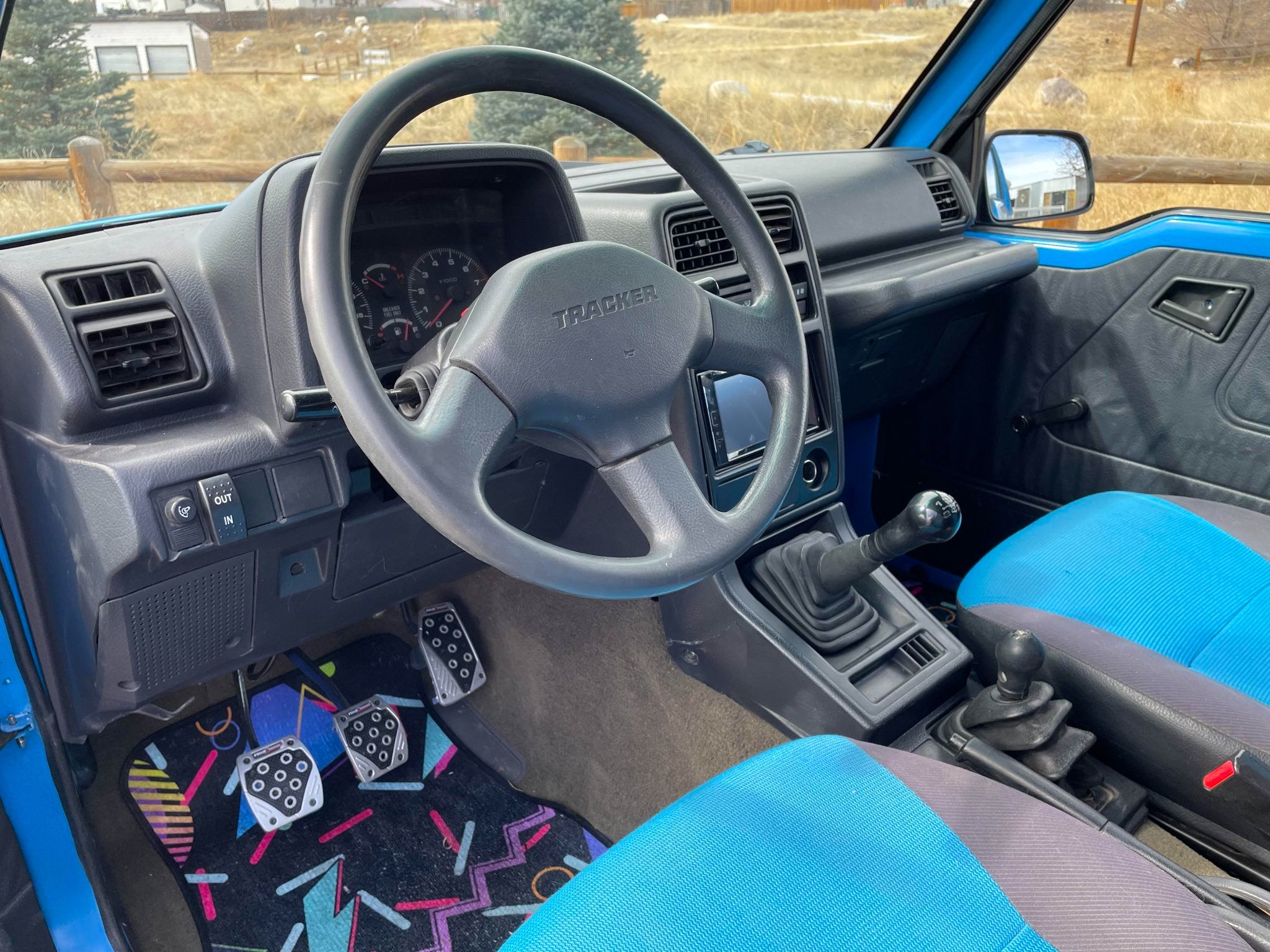
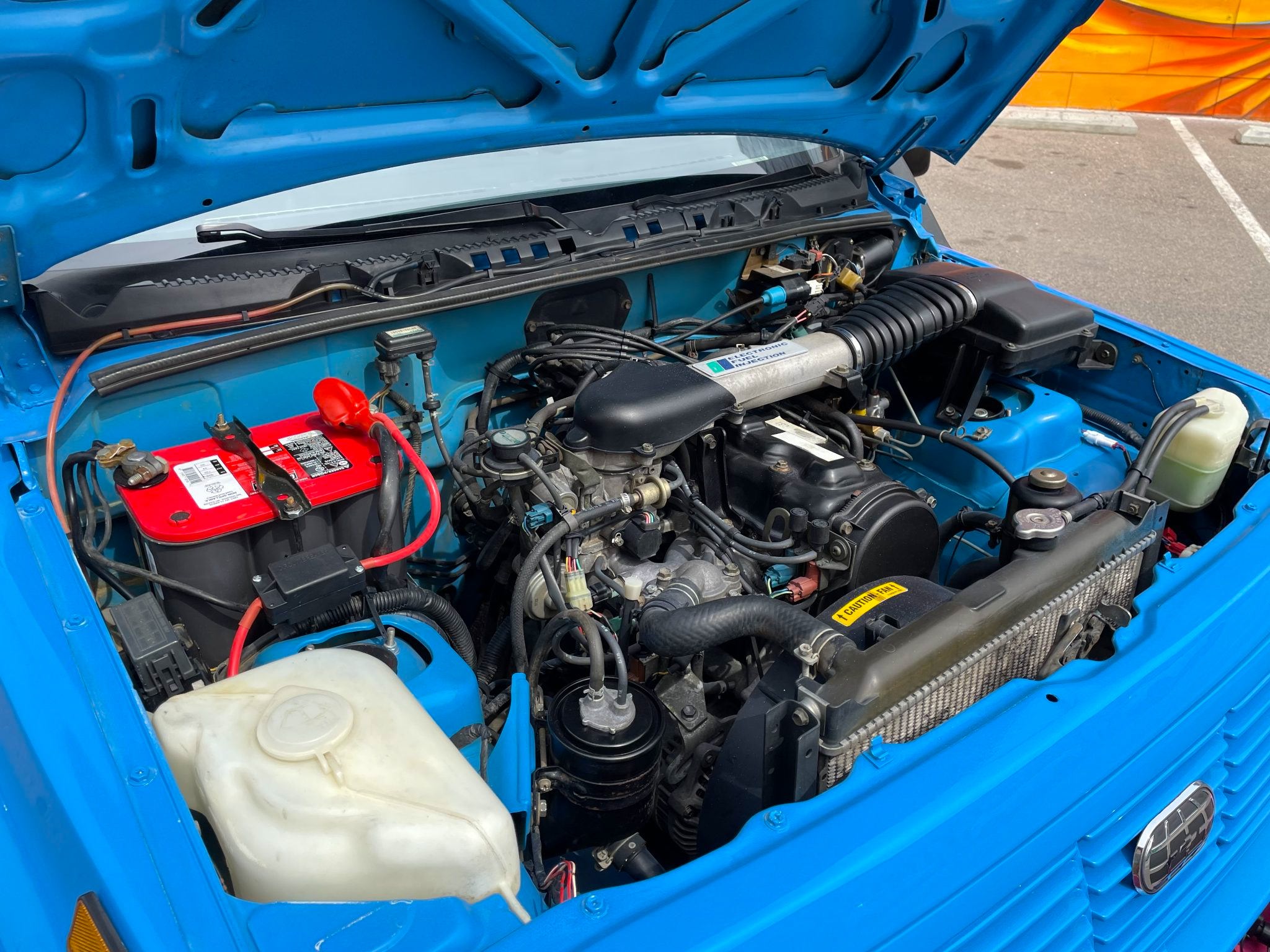
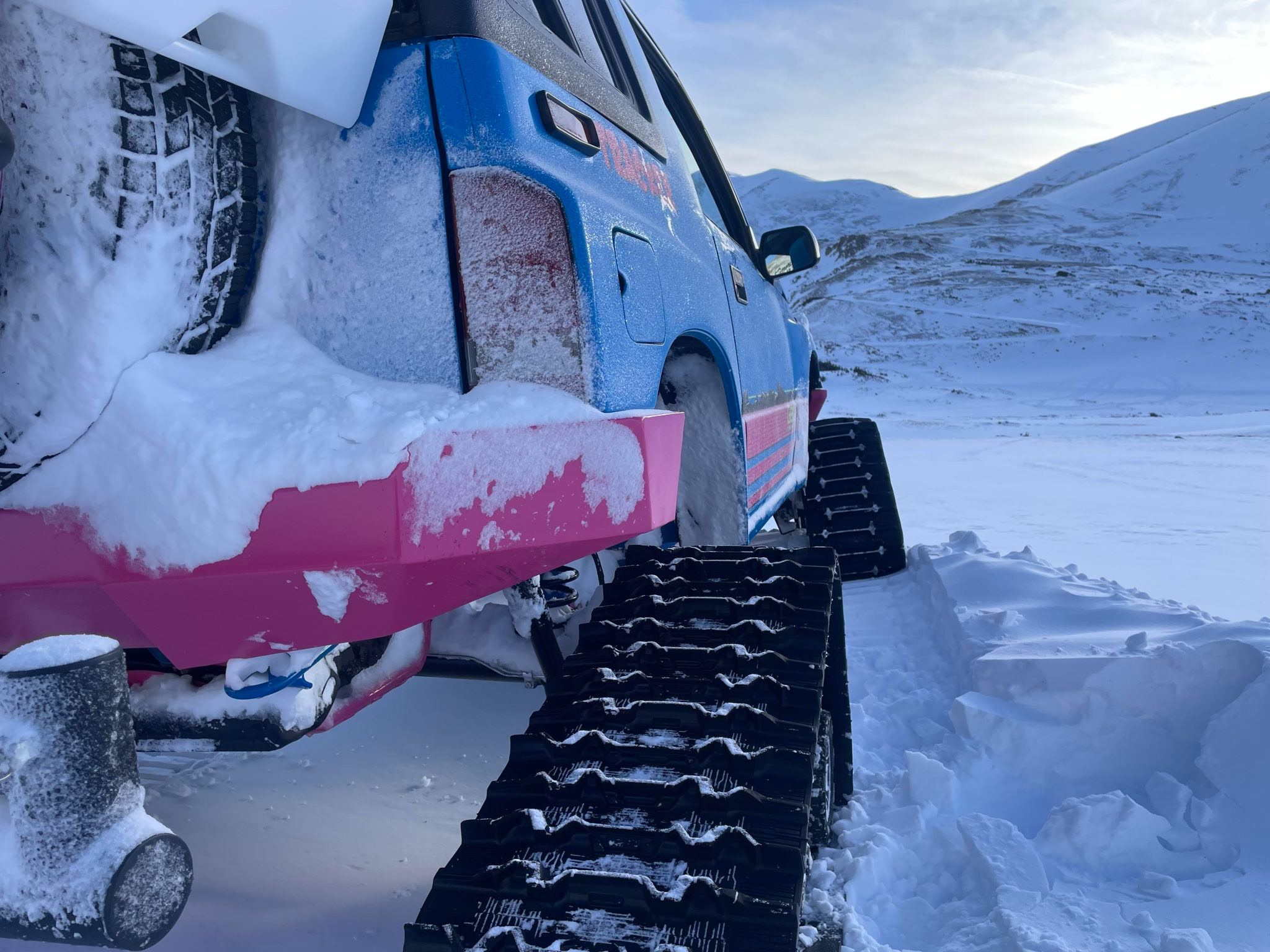
Images courtesy of Bring a Trailer

Articles that Ben Branch has written have been covered on CNN, Popular Mechanics, Smithsonian Magazine, Road & Track Magazine, the official Pinterest blog, the official eBay Motors blog, BuzzFeed, Autoweek Magazine, Wired Magazine, Autoblog, Gear Patrol, Jalopnik, The Verge, and many more.
Silodrome was founded by Ben back in 2010, in the years since the site has grown to become a world leader in the alternative and vintage motoring sector, with well over a million monthly readers from around the world and many hundreds of thousands of followers on social media.